U.S. Pat. No. 10,783,057
TESTING AS A SERVICE FOR CLOUD GAMING
AssigneeSony Interactive Entertainment LLC
Issue DateNovember 21, 2018
Illustrative Figure
Abstract
Technology is described for Testing as a Service (TaaS) for a video game. In one embodiment, a method includes an operation for receiving a game application for testing for one or more bugs. The method further provides for executing, by an automated game testing module, a plurality of automated sessions of the game session while implementing testing inputs for the plurality of automated sessions, the testing inputs include control inputs, game states, system parameters and network parameters. The method further includes operations for detecting an occurrence of a bug during the said executing the plurality of sessions for generating a snapshot file including a portion of the control inputs, the game state data, and a video component associated with the occurrence of the bug.
Description
DETAILED DESCRIPTION Embodiments of the present disclosure relate to methods and systems for enabling game developers to reproduce bugs identified by game testers. Embodiments of the present disclosure also relate to methods using machine learning algorithms to provide additional machine-learned control inputs that are causative of a previously identified bug or an unidentified bug. Moreover, embodiments of the present disclosure relate to method and systems for automating portions of the testing process to test the game under varying system-related conditions. Further, embodiments of the present disclosure relate to allowing aspects of game testing to be performed as a service. It will be obvious, however, to one skilled in the art, that the present disclosure may be practiced without some or all of these specific details. In other instances, well known process operations have not been described in detail in order to not unnecessarily obscure the present disclosure. Game testing is an expensive and time-consuming process. Virtually all game titles that make it to a commercial stage will have gone through many rounds of testing to ensure a level of functional and artistic quality. There are a variety of roles that testing plays in the development of a video game application for release. Some of these include functionality testing, compliance testing, compatibility testing, load testing, beta testing, multiplayer testing and the like. Overall, the goal of game testing is to ensure the video game runs smoothly, e.g., in an expected manner, across various hardware platforms. Thus, one of the goals of game testing is to identify bugs in the video game that prevent the game from running smoothly. Bugs can be manifested in a number of ways. Generally, a bug refers to a portion of the game and its associated code where an unanticipated result occurs, whether the unanticipated result is ...
DETAILED DESCRIPTION
Embodiments of the present disclosure relate to methods and systems for enabling game developers to reproduce bugs identified by game testers. Embodiments of the present disclosure also relate to methods using machine learning algorithms to provide additional machine-learned control inputs that are causative of a previously identified bug or an unidentified bug. Moreover, embodiments of the present disclosure relate to method and systems for automating portions of the testing process to test the game under varying system-related conditions. Further, embodiments of the present disclosure relate to allowing aspects of game testing to be performed as a service. It will be obvious, however, to one skilled in the art, that the present disclosure may be practiced without some or all of these specific details. In other instances, well known process operations have not been described in detail in order to not unnecessarily obscure the present disclosure.
Game testing is an expensive and time-consuming process. Virtually all game titles that make it to a commercial stage will have gone through many rounds of testing to ensure a level of functional and artistic quality. There are a variety of roles that testing plays in the development of a video game application for release. Some of these include functionality testing, compliance testing, compatibility testing, load testing, beta testing, multiplayer testing and the like. Overall, the goal of game testing is to ensure the video game runs smoothly, e.g., in an expected manner, across various hardware platforms. Thus, one of the goals of game testing is to identify bugs in the video game that prevent the game from running smoothly. Bugs can be manifested in a number of ways. Generally, a bug refers to a portion of the game and its associated code where an unanticipated result occurs, whether the unanticipated result is related to game logic, game mechanics, a glitch, artwork, a system malfunction, or other game or system response that is other than which is desired, anticipated, or expected.
FIG. 1shows a conceptual diagram of bug reporting and reproduction, according to one embodiment. A game tester101is shown to play through a segment112of a video game using a testing device100such as a development kit. The game tester101uncovers three bugs106,108, and110through playing the segment112of the video game. The game tester101is then shown to furnish a bug report102that is delivered to the developer104. The bug report102may be provided through a defect tracking system and may specify the circumstances (e.g., a level or map coordinate) under which the bug was produced and certain steps for reproducing the bug (e.g., a set of control inputs). The developer104uses the bug report102to reproduce the bugs106,108, and110before attempting to fix them.
The developer104, who may be an artist, a programmer, or a game designer, etc., successfully reproduces bug106′ on each of three attempts and bug108′ on the second of the three attempts. The developer104is unable to reproduce bug110. The inability to reproduce certain bugs such as bug110and the ability to reproduce bugs intermittently such as bug108may result from a number of factors associated with the game play of the game tester101. For example, the game tester101and the developer104may have differing seed data or other game state data or may have inputted the sequence of control inputs in a very temporally unidentical ways. Additionally, there may be system variances (e.g., latency, jitter, CPU clock, GPU clock, memory usage, etc.) associated with the testing device100of game tester101that factored into the production of bugs108and110. These system variances would be difficult for the developer104to track and to mimic for the reproduction of bugs108and110using current methodology. Moreover, it may be the case that some game testers report bug110while others do not, resulting in an epistemological conflict of whether bug110exists and whether it should be dealt with. An improved methodology and system are contemplated for providing faithful reproduction of bugs.
FIG. 2shows a conceptual illustration of an improved method and system for faithfully reproducing bugs uncovered by a game tester101, according to one embodiment. Similar toFIG. 1, game tester101ofFIG. 2is shown to have produced bugs106,108,110during interaction with segment112of a video game. The segment112may be a part of a video game session201that is executed on a server system200. That is, for example, the video game session201may be hosted by a system204having test hardware206of the server system200. The test hardware206may be proprietary in some embodiments.
The system204is shown to run an operating system208on which the video game application210for testing is being executed. The game tester101interacts with the video game session201via network202. For example, video game application210is contemplated to generate audio and video components at the server system200for delivery and presentation to the game tester101. The server system200then receives control inputs from the game tester101via network202for the game tester101to interact with the video game session201. In other embodiments, the video game session201may be executed on the testing device100that is local to the game tester101. In any case, however, a set of raw test data212is produced as a result of the game tester101interacting with the video game application210during the video game session201.
The raw test data212is shown to include the sequence of control inputs214, which may be any suitable data structure that has control inputs as data elements as a function of time. For example, the sequence of control inputs214is contemplated to record each of the various control inputs as inputted on some input device of the game tester101, including button pushes, keystrokes, mouse clicks, cursor movements, controller movements, joystick movements, voice commands, movement of the body and other inputs made by the game tester101. Each of the data elements of the sequence of control inputs214may be timestamped according to the moment the control input is registered by video game application201as well as the moment in which they are inputted at the controller in the real world. The raw test data212is also shown to include game state data216, which may be of any suitable data structure for capturing the game environment, including saved data, game values, map data, asset data, and others. The game state data216is also contemplated to be timestamped so that bugs may be time-referenced to game state data216.
As the game tester101interacts with the video game application201for uncovering bugs106,108, and110, a video component218is generated by the system204as instructed by the video game application210. The video component218may include both an audio component and a video component in the form of a sequence of video frames. Additionally, as the game tester101interacts with the video game application210various network and system properties associated with the video game session201are captured in real time or near real time in network data220and system data222, respectively, as a part of the raw test data212. It is contemplated that network data220may include various parameters associated with the communications link between the server system200and the game tester101, including, for example, latency, jitter, data rate capacity, packet loss, quality of service (QoS), throughput, and other network properties. It is completed that system data222may include various parameters associated with the system204or testing device100that executes the video game application210, including a CPU clock, GPU clock, memory usage, frame rate, resolution, and other system properties. Both of the network data220and system data222are contemplated to be time-stamped so that bugs may be time-referenced to a particular time within network data220and/or system data222.
Also shown to be included in raw test data212are seed data224and a bug log226. Seed data224refers to an initial set of data that the video game application210uses to introduce some variation or randomness into the video game. Seed data224may make use of random number generators in some embodiments. Additionally, the bug log226records markers or flags the game tester101inputs for indicating the existence of a bug. For example, when the game tester101encounters each of bugs106,108, and110, they may indicate so much in the bug log226. The bug log226is also contemplated to be timestamped such that the time in which each of bugs106,108, and110occur may be referenced to a particular window in each of the sequence of control inputs214, the game state data216, the video component218, network data220, and system data222.
The snapshot generator228is configured to generate snapshot files232that are stored in a snapshot log230. Each snapshot file232is contemplated to be associated with a particular bug and include a portion of the sequence of control inputs214, the game state data216, the video component218, the network data220, the system data222, the seed data224and the portion of the bug log226associated with the bug. For example, each of bugs106,108, and110is contemplated to be included within a snapshot file232that the snapshot generator228generates. For example, when the game tester101indicates the existence of bug106, the snapshot generator228is contemplated to access a window corresponding to the timestamp of the bug106in the bug log226for each of the sequence of control inputs214, the game state data216, the video component218, the network data220, the system data222and the seed data224to generate a snapshot file232for bug106. The window may be between about 1 minute to 10 minutes prior to and subsequent to the occurrence of bug106. The snapshot generator228is contemplated to also generated snapshot files232for bugs108and110to be stored in the snapshot log230. In addition to snapshot files232for bugs106,108, and110as uncovered or produced by game tester101, the snapshot log230may be a database for snapshot files232associated with various additional bugs as uncovered or produced by other game testers or by automated game testing agents.
The server system200is also contemplated to host a bug reproduction module234that interfaces with a device of a developer104over network202to reproduce the bugs106′,108′, and110′. There a number of ways in which the bug reproduction module234is contemplated to allow the developer104to reproduce the bug. Three non-limiting embodiments include a replay mode, an automated reproduction mode, and a manual reproduction mode. In the replay mode, the snapshot file232is replayed to the developer104such that the bugs106′,108′, and110′ are played back to the developer104as they appeared to the game tester101. As a result, bugs106,108, and110are represented identically to the way in which they were manifest to the game tester101.
In the automated reproduction mode, the bug reproduction module234is contemplated to load the game state data216associated with a snapshot file232for execution of the video game application210. The bug reproduction module234may access system204, test hardware206, operating system208, and the video game application210for execution of the snapshot file232in the automated reproduction mode. For example, the system204may load the game state data216to spin-up the video game session201between about 5 seconds to about 10 minutes, or between about 10 seconds and 5 minutes, or between about 15 seconds and about 60 seconds prior to the occurrence of each of bugs106,108,110. Once the video game session201is spun-up, the sequence of control inputs214is automatically inputted to the video game application210based on the timestamp of each of the control inputs of the sequence of control inputs214. As a result, the sequence of control inputs214is synchronized with the game state data216such that the video game session201is recreated for the developer104in real time. In other embodiments, the bug reproduction module234may be provisioned with dedicated replay system hardware, operating systems, and a development version of the video game application. In addition to replicating the sequence of control inputs214during execution of the video game application210, the network data220, system data222, and the seed data224may also be replicated, mirrored, or simulated to recreate the operating conditions during the windows in which bugs106,108, and110occurred. In this manner, the bugs106′,108′, and110′ are generated anew for the developer but can be theoretically identical to bugs106,108, and110as observed by the game tester101.
In the manual reproduction mode, the game state data216of a snapshot file232is loaded by the bug reproduction module234for execution of the video game application210at a state within the video game session201that is between about 5 seconds to about 10 minutes, or between about 10 seconds and 5 minutes, or between about 15 seconds and about 60 seconds prior to the occurrence of each of bugs106,108,110. However, instead of automatically inputting the sequence of control inputs214, the developer104is provided with a textual or visual representation of the sequence of control inputs214so that they can manually recreate bugs106′,108′, and110′. In this manner, the developer104causes or triggers the manifestation of the bugs106′,108′,110′ and can experiment with other configurations of control inputs that may or may not trigger the same bug. As a result, the developer104may better understand the parameters causing the bug. In any case, the bug reproduction module enables the developer104to reproduce bugs106′,108′, and110′ as identified by the game tester101so that the developer104may fix them.
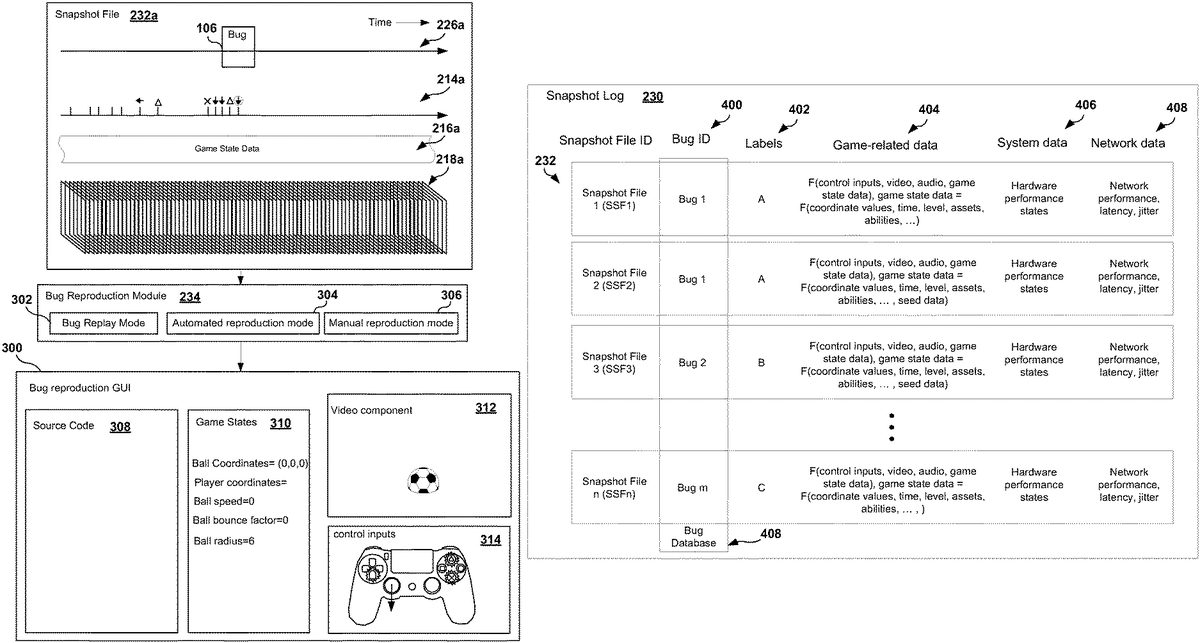
FIG. 3shows a conceptual illustration of a bug reproduction module234that is used to reproduce a bug106identified by a game tester by processing a snapshot file232that captures the bug106, according to one embodiment. The snapshot file232a“captures” bug106by containing a portion of the bug log226a, a portion of the sequence of control inputs214a, a portion of game state data216a, and a portion of the video component218athat is time-associated with the occurrence of the bug106′. Although not shown, system data, network data, and seed data are also contemplated to be included within a snapshot file232aassociated with bug106′. In certain embodiments, each snapshot file232aassociated with one instance of a bug. For example, if bug106is captured by snapshot file232a, bugs108and110may be captured by respective snapshot files. However, when bugs are closely associated to one another such as when a first bug causes a second bug or when the first and second bugs occur very close in time to one another, both the first and second bugs may be captured by one snapshot file.
In the embodiment shown, the bug reproduction module234is contemplated to execute a bug replay mode302to simply replay the bug, an automated reproduction mode304for automatically reproducing an identical instance of the bug, or a manual reproduction mode306for instructing the developer to manually reproduce the bug. In any of the aforementioned modes, the bug reproduction module234generates a bug reproduction GUI300for the developer to interact with. The bug reproduction GUI300is shown to include multiple panels for display, including a source code308panel, a game states310panel, a video component312panel, and a control inputs314panel. The video component312shows that bug108involves a soccer ball that falls through the field. If the bug reproduction module234is in bug replay mode302, the video frames shown in video component312are taken directly from video component218aas was displayed for the game tester. If instead the automated reproduction mode304or the manual reproduction mode306are employed, the video component312may include newly generated video frames as a result of executing the game application while inputting the sequence of control inputs214a. However, even in automated reproduction mode304or in manual reproduction mode306, the bug reproduction GUI300may also display video frames generated for display to the game tester (e.g., original frames) such that developer can view the original frames and the newly-generated frames side-by-side.
The source code308may include the video game programming code containing instructions for operation of the video game, including code for game mechanics, game logic, asset management, game physics, multiplayer mechanics, and metadata management. The source code308panel is envisioned to display the code being executed during the occurrence of bug108. For example, the source code308may include instructions to the game engine to drop the soccer ball from a height of 5 units. The source code308panel is contemplated to scroll to the relevant portions of the game code as the bug is being reproduced.
The game states310is shown to include various game state values associated with the soccer ball. Here, the game state310shows that the “ball bounce factor” is set to “0,” while the “ball radius” is set to “6.” The game states310panel enables the developer to view various game state values and game engine parameters as they change during reproduction of the bug.
Additionally, the control inputs314panel enables the developer to view the sequence of control inputs214athat may have caused the bug. Here, a virtual representation of the controller the game tester used is provided to present the sequence of control inputs214aas they were inputted by the game tester. For example, the sequence of control inputs214ashow that the game tester inputted the following sequence: “X-down-down-triangle-left_joystick_down.” The same sequence may be represented virtually on the virtual controller with the same sequence and timing as that of the sequence of control inputs214a. For example, the virtual controller may have “X” button depressed, the down button depressed twice, the triangle button depressed, and the left joystick angled down in sequence.
FIG. 4shows a conceptual diagram of a snapshot log230including a plurality of snapshot files232, according to one embodiment. The snapshot log230may include snapshot files232generated by one game tester or a number of game testers. Each snapshot file232in the snapshot log230includes a snapshot file identifier401, a bug identifier400, a label402, game-related data404, system data406, and network data408. The bug identifier400may be synchronized with a defect tracking system such that bugs of the same token are provided with the same bug identifier400. The labels402may be annotated by the game tester or the developer and may include a description of the type of bug, the severity of the bug, and descriptors useful for classifying bugs across the snapshot log230. Game-related data404may be represented in multi-dimensional space as a function of control inputs, video output, audio output, and game state data. The game state data itself may be represented in multi-dimensional space as a function of various game state values, coordinate values of objects, time coordinates, level, assets, abilities, seed data, and so on.
Further, system data406includes time-dependent state data of the system executing the game application in which the associated bug was identified. System data may include system performance data such as CPU clock and usage, GPU clock and usage, memory speed and usage, frame rate, resolution, video compression codec and ratio, temperature indicators, and other indicators of system performance. Network data408is contemplated to include time-dependent indicators of communication channel between a game tester and a server system hosting the video game application. These indicators may specify latency, data rate capacity, jitter, and other communications properties.
FIG. 5illustrates how a cloud-based testing server system500implements machine learning to generate new control inputs that are statistically relevant to causing a previously identified bug or a newly identified bug, according to one embodiment. The server system500includes a snapshot database502, an automated game testing module504, a machine learning module506, and a bug implementation module508. A plurality of game testers501are shown to interact with a video game for identifying bugs. When bugs are identified, player-generated snapshot files514pertaining to those player-generated bugs are recorded in the snapshot database502. The player-generated snapshot files514, including the control inputs516are inputted into the machine learning module506via an application interface522. In some embodiments, the player-generated snapshot files514may be used as a training data set528or ground truth. The feature extractor524analyzes the player-generated snapshot files514determines values in feature space related to the generation of the particular bug. The feature extractor524may be defined to analyze features associated with the sequence of control inputs, timing of control inputs, prior history of control inputs, etc. Additionally, the feature extractor524may analyze features associated with game state values, seed values, system parameters and network parameters.
The machine learning module506uses the machine learning algorithm526, the training data set528, the player-generated snapshot files514to generate a bug classification model532. The bug classification model532is usable to identify machine-learned control inputs530that are in addition to the player-generated control inputs516. The machine-learned control inputs530are statistically predictive of causing the bug. Any suitable machine learning algorithm526may be implemented for generating the bug classification model532, including, but not limited to a Bayesian network, linear regression, decision trees, neural networks, k-means clustering, and the like. The bug classification model532provides statistically relevant combinations, permutations, and time-dependent sequences of control inputs that are predictive of causing the player-generated bug or a newly identified bug. The training data set528and the player-generate snapshot files514are usable to assign labels to each set of incoming control inputs516. The labels may include “bug,” or “not a bug.”
In various embodiments, each set of the machine-learned control inputs530are implemented by the automated game testing module504. The automated game testing module504is configured to spin up a plurality of game sessions to test the sets of machine-learned control inputs514for the occurrence of a bug or not. The automated game testing module504includes a GUI module534, a variance implementation module536, the video game application538, the game engine540, the operating system542, a game engine distribution module544, and a bug reporter546. The GUI module534enables a developer to interface with the automated game testing module504and to specify conditions under which the automated game session is to be run. For example, the developer may decide to introduce variances in system or network parameters (hereafter, “variances”) via the variance implementation module536while running the automated game sessions. In some embodiments, the machine learning module506may also provide a set of machine-learned variances that instruct the variance implementation module536on how to introduce variance during the automated gaming sessions. In other embodiments, the developer may choose to load-test the video game application by introducing variances via the variance implementation module. For example, the developer is envisioned to be enabled to specify a frame rate, resolution, CPU clock and usage, GPU clock and usage, and memory usage parameters to be simulated during execution of the automated video game sessions. Additionally, the developer may specify network variances such as latency, jitter, data rate capacity, and other network properties to be simulated during the automated video game sessions.
Any suitable number of video game sessions may be spun up in parallel depending upon the number of machine-learned control inputs530to be implemented, the variances sought to be introduced, and the granularity of the changes or differences in parameters between runs. In any case, when an automated game session is run by the automated game testing module504, video game application538may be loaded with a particular game state that is immediately prior to the expected occurrence of the bug, for example, by about 5 seconds to about 10 minutes, or about 10 seconds to about 5 minutes, or about 30 seconds to about 1 minute prior. As the video game application538is executed, the machine-learned control inputs530are inputted in a time-dependent manner. Additionally, the automated game session may be executed while simultaneously implementing variances via the variance implementation module536. In this manner, a plurality of automated game sessions may be implemented using one set of machine-learned control inputs514where each session tests for different variances. For example, a first automated game session may implement a low level of jitter while a second automated game session may implement a higher level of jitter. A third automated game session may overclock a GPU while a fourth automated game session may underclock a similar GPU, and so on.
Further, as the automated game session are executed, a bug reporter546may be layered on top of each game session for detecting the occurrence of the bug. The bug reporter546may be pre-defined to automatically detect the bug by game states produced by the automated game session that are indicative of the bug. Additionally, the bug reporter546detect bugs associated with game mechanisms or rendering by using image analysis to identify images or portions of images indicative of the bug.
The results of the automated sessions, whether reproducing the bug or not, are recorded as machine-generated snapshot files530. The machine-generated snapshot files518are labeled as “bug” or “not a bug” based on the results of the bug reporter546. However, a developer may also annotate or change the label if the bug reporter546results are inconclusive or incomplete, or if the developer disagrees with the label. The machine-generated snapshot files518having been labeled are then feed into the machine-learning module506for training or updating the bug classification model532.
When the bug classification model532is updated, a new set of machine-learned control inputs530may be generated and tested using the automated game testing module504. The process of learning via the machine learning module504, validation via the automated game testing module504(e.g., supervision), and refining the bug classification model532may be repeated until there is some acceptable level of confidence that the bug classification model532classifies control inputs are predictively causative of a bug or not. That is, for example, the process of learning, validation, and model refinement may be repeated until the bug classification model532is able to classify new control inputs to be either causative of a bug or not causative of a bug with, say, a 99% confidence interval. Additionally, with each iteration of learning, validation, and refinement, it is envisioned that the machine learning module506may generate sets of machine-learned control inputs530that more statistically predictive of causing the bug. Conversely, the machine learning module506also improves at identify those sets of control inputs that are not predictively causative of the bug.
While the machine learning module506has been described thus far as learning in terms of control inputs, such as those from the player-generated snapshot files514, the machine learning module506is also envisioned to learn based upon system and network variances. For example, similar to generating machine-learned control inputs530based upon the bug classification model532, the machine learning module506may also generate machine-learned variances503that are predictively causative of the bug. Thus, the machine learning module506may detect patterns of system and network parameters that are attendant to the occurrence of the bug and may generated machine-learned variances503to system and network parameters for testing via the automated game testing module504. The automated game testing module504may be implemented via the variance implementation module536such that system and network conditions specified by the machine-learned variances503are simulated, mimicked, or reproduced during execution of the automated game sessions. The results of the bug reporter of the occurrence of a bug or not may be recorded in the machine-generated snapshot files518along with the machine-learned control inputs530. For example, the bug reporter546may serve to label each run with a label of “bug,” or “not a bug,” or “inconclusive.” A human labeler may later resolve the automated game sessions labeled “inconclusive” as “bug” or “not a bug.”
As with the machine-learned control inputs530, the results from the machine-learned variances503may then be fed back into the machine-learning module506, which functions to update the bug classification model532. The cycle of learning, testing, and updating the bug classification model532serves, in one capacity, to determine the set of system and network parameters that cause or proximately cause a particular bug or that are in common in causing or proximately causing a set of bugs.
In various embodiments, the machine learning module506serves, in one capacity, to learn generalities of the types of control inputs, system parameters, and network parameters that cause a particular bug or a set of bugs through experience. The generalities are represented in the bug classification model532and are contemplated to be extrapolated by a bug implementation module508. The bug implementation module508serves to formalize or represent the generalities within the bug classification model532into bug implementation conditions510, which include rules548, categories550, game scenarios552, and system scenarios554. The bug implementation module508is also shown to include a bug implementation library512having bug-implementation control inputs556and bug-implementation system parameters520. The bug implementation module508is, in a sense, a platform that serves to trigger or implement a given bug.
Similar to the bug reproduction module234ofFIG. 2, the bug implementation module508can replay or reproduce a given bug for a developer to view. In addition, however, because the bug implementation module508accesses the machine learning module506, the snapshot database502, bug implementation conditions510, and a bug implementation library512, the bug implementation module508can also show a developer a plurality of other ways to cause the same bug and certain constraints or boundaries on those conditions that do cause the bug. The bug implementation module508is further contemplated to be able to identify and present newly discovered bugs to the user. For example, when the machine learning module506generates machine-learned control inputs530and machine-learned variances503, they may uncover previously unidentified bugs when they are implemented by the automated game testing module504.
The bug classification model532represents generalities associated with the occurrence of bugs in various ways, depending upon the model or the machine learning algorithm526. For example, generalities may be represented by way of weights, graph connectivity, clustering, distributions, probabilities, and other relationships. From these, rules548, categories550, game scenarios552, and system scenarios554may be constructed. Rules548define sets of conditions that are to cause a particular bug. For example, a rule such as “if X-down-down-triangle is inputted while character A is at (x, y, z) on the map, then the bug will occur” may be included within rules548. Categories550define a category of conditions that cause a particular bug. For example, a category may circumscribe a universe of control inputs that are found to cause the bug.
Game scenarios552and system scenarios554further specify rules or categories related to scenarios in either the video game or the system or network that are causative of the bug. For example, there may be a game scenario552in which an AI character falls through the world when the character attempts to jump. The game scenario552may help identify bugs that are not necessarily produced by input by a player. Additionally, system scenarios554describe states of system and network parameters that are causative of some bug. For example, a system scenario554may specify that a game session with a latency of over 70 milliseconds, an overclocked CPU, and with a rendering of 60 FPS will cause the player to fall through the virtual world. Of course, there may be slippage between each of rules548, categories550, game scenarios552, system scenarios554such that one with relate or depend upon another.
It is also contemplated that the bug implementation module508includes a bug implementation library512, including bug-implementation control inputs556and bug-implementation system parameters520that, when executed, will reproduce various bugs. When a new build for the video game application538is being tested, the bug implementation module508may be used to test the new build for the presence of those previously tester- or machine-identified bugs. In this manner, the developer in enabled to test previously identified bugs automatically without the game testers501having to attempt to recreate the bugs from the prior build.
FIG. 6shows a conceptual diagram of how the variance implementation module536creates variance packages606that are executed alongside an automated game session at the automated game testing module504. Input variances600include variances in the sequence and timing of control inputs that are sent to and executed by the automated game testing module504for the automated game sessions. For example, sequence600amay be identical to a player-generated sequence of control inputs that was identified by a game tester. Sequence600amay thus serve as a control that is expected to cause the bug. Sequence600bis varied from sequence600ain that the triangle input is temporally shifted to some time sooner. Input variances600may assist in establishing the bug implementation conditions510. For example, if sequence600breturns the same bug as sequence600a, then timing difference between sequence600aand sequence600bmay be ruled as non-determinative of causing the bug. On the other hand, if sequence600bdoes not return a bug as sequence600a, then the timing of inputting the triangle may be determinative of causing the bug, if all else is held equal between sequences600aand600b.
Additionally, seed data variances602are shown to vary seeding data for initializing the automated game sessions. Seed data602aand seed data602b, for example, differ in their first and second seeds. Introducing variances in seed data may assist the bug implementation module508in determining whether and how seed data affect causation of the bug. For example, if seed data602aand seed data602breturn differing bug results, it may be surmised that the first or second seed, or both, are causally related to causation of the bug. In a second iteration of variance implementation module536, seed data variations may be introduced to isolate the seed that is causally linked to the bug.
Further, the variance implementation module536is configured to introduce variances to system and network parameters in system variances604to be simulated during the automated testing sessions. In system variances604, the first column may represent latency, the second jitter, the third CPU clock, and the fourth GPU clock. System variances604may be used to mimic various real-world gaming conditions where players play video games with varying latency properties, jitter properties, CPU and GPU configurations, and other hardware and network variations. System variances604assist in not only emulating real-world gaming conditions, but also pinpointing whether such conditions are causally related to the occurrence of the bug. The variance implementation module536combines input variances600, seed data variances602, and system variances604to generate a plurality of variance packages. When the automated game sessions are spun up by the automated game testing module504, the operating system542may implement the set of conditions specified by the variances packages606during execution of the automated game sessions.
FIG. 7shows a conceptual illustration of the automated game testing module504that is executing a plurality of automated game sessions700, according to one embodiment. Each of the automated game sessions700is executed on a system708communicating with an operating system542, which operates a game engine440. The game engine540in turn executes the video game application538for the video game sessions700. While the video game sessions700are being run, control inputs702, game states704, and system parameters706are implemented in synchrony with the video game application538. For example, the control inputs702may be implemented during execution of the video game application538via an input socket of the game engine540. The control inputs702may be the machine-learned control inputs530or the player-generated control inputs516as modified by the variance implementation module536. Additionally, control inputs702may include control inputs from more than one virtual player for a multiplayer game. For example, the player generated snapshot files514may include a sequence of control inputs516for each player during testing. The machine-learning module506is operable to generate machine-learned control inputs530that vary the control inputs for just one player or more than one player. As a result, the automated game testing module504is contemplated to test for bugs that are associated with multiplayer games and scenarios in which player interaction of some sort causes the bug.
Game states704such as seed data may also be implemented via the game engine such that the video game application is initialized with the pre-defined seed data. System parameters706such as machine-learned variances503as modified by the variance implementation module536may be implemented at the operating system542level or the system708level.
During each run of the automated game sessions700, a bug reporter546is executed at the operating system542level or the game engine540level. The bug reporter546is configured to automatically monitor and detect the occurrence of a pre-defined bug or a previously un-identified bug. Each run of the automated game sessions700produces a corresponding automated game session report710, which includes the machine-generated snapshot file associated with the occurrence of a bug or not. In this manner, any number of automated game sessions700may be spun up to better understand the conditions and the boundaries of what causes the bug. Understanding the conditions and their boundaries enables the developer to address the bug in a more efficient manner.
A game application such as video game application538will generally demand a game engine serving a plurality of diverse functions. A typical game engine has many subcomponents for handling various aspects or features of the game environment and defining how it should behave, for example, in response to player input. Some of these subcomponents, or what will be referred to as “game engine nodes,” include a timing node, a physics node, an artificial intelligence (AI) node, a game logic node, game mechanic node, a rendering rode (which may itself be subdivided into a number of nodes), a map node, an animation node, an asset management node, a network node, an communications node, an control inputs node, a chat node, and others. The rendering node may refer to various rendering functions (e.g., such as those typical of graphics APIs like DirectX® or OpenGL®), including camera transformations, projections, clipping, lighting, shading, smoothening, etc. Additionally, game engines may offer additional services that benefits the gameplay, such as a social network interactivity node, a game-help node, an in-game resource surfacing node, a gameplay sharing or broadcast node, etc.
In some game engine embodiments, the game engine may be served by a single compute node, such as a computer, a server, a console, or other device. In other embodiments, the compute node may be a virtual machine that is deployed by a server for the game engine along with others deployed to serve other game engines and game application there run. As a result, each of the game engine subcomponents are executed by one compute node, e.g., one server, virtual machine, desktop computer, or console. This one-to-one or many-to-one architecture of game engines to compute nodes may not offer the performance desired of the game engine nor the efficiency desired of usage of the compute node because game engines may be elastic in their computational demands as opposed to fixed. That is, the game engine, at any given time, may have differing processing, graphics, memory, and network demands from that of any other given time within the same game.
For example, in massively multiplayer online role-playing game (MMORPG), the computing needs of the associated game engine may depend upon the type of action occurring in the game (e.g., whether players are engaging one another), the number of players (e.g., whether there are 10 players currently but will be 100 players in the near future), among other factors. When a game engine is resourced with one computing node, e.g., within a server, the associated hardware is likely to have a narrow window in which it performs as efficiently as desired while having the performance desired. For example, when the players are few and non-interacting in the MMORPG, the associated compute node may be underutilized, whereas when the players are many and mutually engaging, the associated compute node may underperform, causing a lower quality of service, lag, rendering quality issues, glitches.
These considerations are no less pertinent to the context of automated game testing where hundreds or thousands or more game sessions and associated game engines may be instantiated at a time. For example, the computational demands of the game engines instantiating the plurality of automated game sessions will vary in a time dependent way depending upon the behavior of the game environment and objects there within, e.g., farming resources at one time and battling an AI character at another. demands. Moreover, the type of computing demands may vary as a function of time or game state. For example, the processing, graphics, memory, and network demands of the game engine may vary between on scene in which a player is shooting a free-throw and when, after missing the free throw, the opposing team rebounds the ball and moves the ball up court. Further, in the automated game sessions may be used to automate multiplayer game play by implementing control inputs for multiple players simultaneously during the runs. The presence of multiplayer inputs further causes further elasticity in the computing demands of the corresponding game engine, for example, depending upon the number of players and their level of interaction. An improved game engine architecture is therefore contemplated to execute the automated game sessions for the automated game testing module504.
FIG. 8illustrates a diagram of the architecture of an automated game testing module504utilizing a distributed game engine800for executing a plurality of automated game sessions700, according to one embodiment. The video game application538is executed on a distributed game engine800having a plurality game engine nodes800aand a game engine manager800b. Each of the game engine nodes800ais contemplated to serve subcomponent or part of a subcomponent of the distributed game engine800as a whole. In some embodiments, the game engine nodes800amay be predefined based on the functionality it provides for the distributed game engine800. For example, there may be game engine node800athat is defined or dedicated to carry out the functions related to each of game logic, game mechanisms, game timing, AI, physics, input mapping, scripting, network, audio, graphics, animation, asset management, as well as in-game services. For example, for automated game session700agame engine node1(GEN1) may be dedicated to handling the game logic subcomponent/function, for example, and not any function related to graphics, or asset management. Meanwhile, game engine node2(GEN2) may be defined to handle AI exclusively, with GEN3defined for physics, GEN4for scripting, GEN5for graphics, GEN6for scripting, and GEN n for a service such as real time game broadcasting.
Each of the game engine nodes800ais matched by the game engine manager800awith a compute node within the servers802of racks804depending upon the computational demands of each game engine node800a. The game engine nodes800amay communicate with the compute nodes via UDP or TCP or some other protocol. The servers802and racks804may be localized at data center or the like. The game engine manager800bserves as a bus between a game engine node800aand an assigned compute node. The game engine manager800bperforms various tasks related to sending and receiving data, buffering, routing, threading, queuing, relaying, stitching, etc. In this manner, game engine manager800bensures that operations of each of the game engine nodes800ais performed by a desired compute node and the resulting return values or other result is delivered back to the proper game engine node800afor implementation into the video game application538. Moreover, the game engine manager800amanages communication between game engine nodes800ato ensure proper functioning of the video game application as a whole.
As shown inFIG. 8game engine node1GEN1is assigned to a compute node806, which is associated with a hardware CPU located on server1of rack1. The game engine manager may have sourced compute node806for its suitability in handling the computational needs of game logic, for example.
Meanwhile automated game session700bis likewise being executed on a distributed game engine800having a plurality of game engine nodes GEN1-n, each of which are assigned to handle a particular function or subcomponent of the distributed game engine800. The same is true of game session700n. For example, the operations of GEN1of automated game session700band GEN1of automated game session700nare both assigned to compute node806of server1of rack1, similar to GEN1of automated game session700a. Thus, compute node806executes the processes requested of it by each of GEN1, GEN2, and GEN3. GEN2for each of automated game sessions700a,700b, and700nare assigned to compute node808, which is a virtual machine VM1provisioned with CPU2, GPU1, and 16 gigabytes of RAM. The game engine managers800bmay have identified VM1based on the expected needs of GEN2, which, for example, serves to execute AI. In some embodiments, the game engine manager800bmay have itself requested deployment of VM1, or the automated game testing module504may have made the request. In some embodiments, if the operations requested to be performed by the compute node are substantially similar for each of the game engine nodes assigned to it, the compute node could potentially perform the requested operations once and return the result to each of the game engine nodes as opposed to performing the requested operations one time for each of the game engine nodes.
GEN3of each of the automated game sessions700are shown to be associated with a compute node812associated with a GPU1, whereas GEN4is associated with compute814associated with GPU2. GPU1and GPU2may be of different configurations. For example, GPU1may have more cores, a higher clock, more memory, or a higher memory bandwidth than GPU2. In this case, operations for GEN3may have been assigned to GPU1if GEN3demands a greater number of calculations or more complex calculations. Operations for GEN4may have been assigned to GPU2because GEN4may demand fewer calculations or less complex ones.
GEN5is shown to be assigned to compute node810, which is a virtual machine VM2provisioned with a CPU3, a GPU2, and 8 gigabytes of RAM. GEN5may have been assigned by the game engine manager800bto compute node810to match the computing needs of GEN5. GEN6of the automated game sessions700is shown to be assigned to a containerized compute node816that includes containers1-N that interface with a host operating system on server3of rack3. In particular, GEN6of automated game session700ais assigned to container1, that of automated game session700bto container2, and that of automated game session700nto container N. Each of containers1-N is a contained unit of software and dependencies that, for example, includes the software for processing operations of the associated game engine nodes. Each container runs on container runtime, which interfaces with the operating system of the server. In this sense, the operating system is virtualized for each of the containers, whereas it is the hardware that is virtualized for a virtual machine.
FIGS. 9A and 9Bshow conceptually how the machine learning module506, the automated game testing module504and the bug implementation module508work together to identify the set of conditions in which a previously or newly identified bug may be implemented, according to various embodiments. Bug implementation conditions refer to the scope or universe of conditions that are causally related to the occurrence of a given bug. Conditions refer to control inputs, system parameters, network parameters, and game states that, when caused to exist or coexist during the execution of the game application, are individually or collectively causative of the given bug. Thus, bug implementation conditions may be conceptualized in multi-dimensional space as the set of all combinations of conditions that cause or are likely to cause the bug. Here, bug1implementation conditions900will refer to the set of combinations of control inputs when executed under particular system and network parameters and at certain game states, cause or are likely to cause bug1. The machine learning module506, the automated game testing module504, and the bug implementation508, are contemplated to work in conjunction to identify, circumscribe, or approximate bug1implementation conditions to assist the developer in understanding root causes of the bug for higher quality and more effective fixes. The bug1implementation conditions900may be formalized in terms of rules, categories, and scenarios in the bug implementation module508for communication to the developer. The following will be described with respect to machine-learned control inputs for filling in the bug1implementation conditions900for the sake of clarity. However, the principles apply with similar force to using machine-learned system and network parameters and game state data for corralling the rest of bug1implementation conditions.
When one or more game testers identify a bug, the player-generated control inputs902are recorded in snapshot files and processed by the machine learning module506. The machine learning module506uses a bug classification model to generate machine-learned control inputs904, which are then implemented by automated game testing module504for detection of bug1or not. Here, a portion the machine-learned control inputs904cause bug1. The results are fed back into the machine learning module504to update the bug classification model and to generate a new set of machine-learned control inputs906. Here, a larger portion of the second set of machine-learned generated control inputs906cause bug1than the first set of machine-learned control inputs904, as may be expected. The process of learning and testing is repeated for machine-learned control inputs908, and so on until, for example, no new sets of control inputs are found to cause the bug. The bug1implementation conditions900is then processed by the bug implementation module508for extracting any rules, categories, or scenarios that may be ascribed to the bug1implementation conditions900.
InFIG. 9B, the learning and testing process discovers new bug2during analysis of the bug1implementation conditions900. For example, machine-learned control inputs904are tested by automated game testing module504and found to trigger both bug1and bug2. In this instance, the machine-learning module506, the automated game testing module504and the bug implementation module508, may, in addition to or in parallel with corralling bug1implementation conditions900, do the same for bug2implementation conditions901. Machine-learned control inputs906-914are generated by the machine learning module506and are tested by automated game testing module904. The resulting scope of bug2implementation conditions901are then formalized into rules, categories, and scenarios by bug implementation module508, which will have those rules, categories, and scenarios for both bug1and bug2.
FIG. 10shows a method of discovering new bugs via a chaos or shotgun testing, according to one embodiment. In addition to defining the bug implementation conditions for known bugs or player-identified bugs, the systems and methods presented here are contemplated to detect unidentified bugs in an automated manner. In some embodiments, chaos testing or shotgun testing is provided to uncover undiscovered bugs. Here, a chaos testing module1001generates sets of chaos inputs1002a-g. Each of chaos inputs1002a-gmay include a set of randomly, stochastically, or chaotically defined inputs. In other embodiments, the chaos inputs1002a-gmay be of known or knowable sequences of inputs that are designed to stress the game application. In any case, out of the chaos inputs1002a-g, chaos input1002cis shown to cause bug3as detected by the automated game testing module504. The automated game testing module504relays the results to the machine learning module506, which generated more targeted machine-learned inputs1004aand1004b. The learning and testing process continues until the scope of bug3implementation conditions1000may be defined. In some embodiments, the chaos testing module1001may continue to generate chaos inputs to find other ways of inducing bug3or other bugs. As a result, the methods of system presented here are further enabled to automatically identify previously unknown bugs. The process of identifying previously unknown bugs using the chaos testing module1001, the machine learning module506, the automated game testing module504, and the bug implementation module508may be offered to developers as a service (e.g., testing as a service, TaaS), as discussed in greater detail below.
FIG. 11shows a conceptual diagram of automated testing for a previously identified bug in a new build or version of a game. Assume that the circle of the bug implementation conditions1100represents the bug implementation conditions1100in control input, game state, system and data parameter space for a first build. Further assume that the bug implementation module has defined four categories of control inputs1101a-dthat effectively overlap with much of the bug implementation conditions1100and that trigger the bug for the first build. If each of the control inputs1001a-dagain cause the bug for a second build, it may be the case that the bug was not fixed. If instead only a portion of the control inputs1101a-dcause the bug, it may be the case that the bug was partially fixed. Otherwise, if none of the control inputs1101a-dcause the bug when they are implemented in the second build, it may be the case that the bug was fixed. Thus, when a second build is constructed, a previous bug from a prior may be automatically tested in a quick and efficient manner.
FIG. 12shows how bug implementation conditions known for a first game may be applied to a second game as part of testing as a service (TaaS), according to one embodiment. InFIG. 12bug implementation conditions1100for a first game are known and are reproducible using control inputs1101a-d. As part of the testing as a service process, the control inputs1101a-dmay be applied to a second game title that may be created by a different developer than the first game title. InFIG. 12, control inputs1101a-care shown to cause a bug in part or in whole, whereas control input1101dis shown to be outside of the bug implementation conditions for game title2and therefore not causative of the bug.
FIG. 13is a conceptual illustration of a platform usable for testing as a service (TaaS), according to one embodiment. TaaS is contemplated to enable game developers to test video games for bug and validating bug fixes without needing a team of human game testers. Here, a developer1300simply drops a game into a TaaS server1303, which includes a game title1302of a first build. The game title1302is executed as video game application538that run on an appropriate game engine540. The game engine540may be a distributed game engine implemented in a manner shown inFIG. 8. An appropriate operating system540is sourced for the game engine540. If the game title1302is intended to be executed on differing game engines, differing operating system, or versions thereof, the automated game testing module504may correspondingly spin up automated video game sessions of the video game application538for each type of game engine540and operating system542and combinations desired thereof. The automated game sessions may be run in parallel or otherwise.
The game title1302may be tested by the automated game testing module504in many ways. For example, the TaaS may supply chaos testing of the video game application538via chaos testing module1001. Any bugs that are identified via chaos testing will be recorded to the snapshot database502. Further, if the developer1300has previously identified a bug and wishes to understand the circumstances causing the bug, they may interact with the video game application538while executed on the TaaS to manually cause the bug. A snapshot file is will be generated as a result of such interaction and the control inputs causing the bug will be recorded to snapshot database502. The machine learning module506may then generate new machine-learned control inputs530and machine-learned variances503that are also causative of the bug.
Moreover, the video game application may be tested against bug implementation conditions510and bug implementation control inputs556and bug-implementation system parameters520of the bug implementation module508. The bug-implementation module508may provide various control inputs and system and network parameters that have been known to cause bugs for prior builds of this video game, for differing video games with similar features to game title1302, or for differing games having a game engine in common. Further still, the TaaS Server1303may communicate with one or more human game testers for discovery of bugs the raw test data of which is generated into snapshot files at snapshot database502.
Any bugs that are identified in the abovementioned ways are recorded in the snapshot database along with the control inputs1302(as well as system and network parameters) that caused the bug. These will be shared with developer1300. Moreover, these bugs may be reproduced for the developer1300via the bug reproduction module234, in any of the replay mode302, automated reproduction mode304, or the manual reproduction mode306. In this fashion, the developer may view in a GUI such as the bug reproduction GUI300any discovered bugs and the source code, game states, control inputs, and video components associated with the bug.
The snapshot database502is accessed by the machine learning module506for generating machine-learned control inputs530and machine-learned variances503that are predictively causative of the previously identified bug or a new bug. These machine-learned control inputs530and machine-learned variances503are then tested at the automated game testing module504for the bug reporter546to detect whether previously identified bug or a previously unidentified bug has occurred. The results of the automated game testing module504are again recorded in the snapshot database502. Here, again, the machine-learned control inputs530and the machine-learned variances503may be provided to the developer1300so that the developer can be apprised of additional control inputs and system and network parameters that are causative of the bug. Moreover, the developer may be apprised of new bugs and the control inputs and system and network parameters that caused them.
The process of learning and testing may be repeated to refine the bug classification model532such that generalities associated with causation of the bug may be extracted by the bug implementation module508via rules548, categories550, game scenarios552and system scenarios554. The bug implementation conditions510may then be provided to the developer1300, which helps to identify the conditions causing the bug. This enables the developer1300to better understand the underlying cause of the bug to such that higher quality fixes may be applied. After the developer1300attempts to fix the bug for a second build of the game title1304, the game title1304may again be dropped into the TaaS server1303for validation and testing. To see if the bug has been fixed, certain control inputs1302known to have caused the bug in the prior build, the first build, may be tested at the automated game testing module504. Additional control inputs and system parameters may be generated from the bug implementation module508that, while not necessarily tested as causing the bug for the prior build, are expected to have using rules548, categories550, game scenarios552, and system scenarios554. In this manner, the developer1300is enabled to quickly test the operation of a new build with a bug fix.
FIG. 14illustrates components of an example device1400that can be used to perform aspects of the various embodiments of the present disclosure, such as server system200, server system500, one of servers802, or the TaaS server1300. This block diagram illustrates a device1400that can incorporate or can be a personal computer, video game console, personal digital assistant, a server or other digital device, suitable for practicing an embodiment of the disclosure. Device1400includes a central processing unit (CPU)1402for running software applications and optionally an operating system. CPU1402may be comprised of one or more homogeneous or heterogeneous processing cores. For example, CPU1402is one or more general-purpose microprocessors having one or more processing cores. Further embodiments can be implemented using one or more CPUs with microprocessor architectures specifically adapted for highly parallel and computationally intensive applications, such as automated game testing, machine-learning operations, and bug reproduction processes. Device1400may be a localized to a player playing a game segment (e.g., game console), or remote from the player (e.g., back-end server processor).
Memory1404stores applications and data for use by the CPU1402. Storage1406provides non-volatile storage and other computer readable media for applications and data and may include fixed disk drives, removable disk drives, flash memory devices, and CD-ROM, DVD-ROM, Blu-ray, HD-DVD, or other optical storage devices, as well as signal transmission and storage media. User input devices1408communicate user inputs from one or more users to device1400, examples of which may include keyboards, mice, joysticks, touch pads, touch screens, still or video recorders/cameras, tracking devices for recognizing gestures, and/or microphones. Network interface1410allows device1400to communicate with other computer systems via an electronic communications network and may include wired or wireless communication over local area networks and wide area networks such as the internet. An audio processor1412is adapted to generate analog or digital audio output from instructions and/or data provided by the CPU1402, memory1404, and/or storage1406. The components of device1400, including CPU1402, memory1404, data storage1406, user input devices1408, network interface1410, and audio processor1412are connected via one or more data buses1422.
A graphics subsystem1420is further connected with data bus1422and the components of the device1400. The graphics subsystem1420includes a graphics processing unit (GPU)1416and graphics memory1418. Graphics memory1418includes a display memory (e.g., a frame buffer) used for storing pixel data for each pixel of an output image. Graphics memory1418can be integrated in the same device as GPU1416, connected as a separate device with GPU1416, and/or implemented within memory1404. Pixel data can be provided to graphics memory1418directly from the CPU1402. Alternatively, CPU1402provides the GPU1416with data and/or instructions defining the desired output images, from which the GPU1416generates the pixel data of one or more output images. The data and/or instructions defining the desired output images can be stored in memory1404and/or graphics memory1418. In an embodiment, the GPU1416includes 3D rendering capabilities for generating pixel data for output images from instructions and data defining the geometry, lighting, shading, texturing, motion, and/or camera parameters for a scene. The GPU1416can further include one or more programmable execution units capable of executing shader programs.
The graphics subsystem1420periodically outputs pixel data for an image from graphics memory1418to be displayed on display device1414. Display device1414can be any device capable of displaying visual information in response to a signal from the device1400, including CRT, LCD, plasma, and OLED displays. Device1400can provide the display device1414with an analog or digital signal, for example.
It should be noted, that access services, such as providing access to games of the current embodiments, delivered over a wide geographical area often use cloud computing. Cloud computing is a style of computing in which dynamically scalable and often virtualized resources are provided as a service over the Internet. Users do not need to be an expert in the technology infrastructure in the “cloud” that supports them. Cloud computing can be divided into different services, such as Infrastructure as a Service (IaaS), Platform as a Service (PaaS), and Software as a Service (SaaS). Cloud computing services often provide common applications, such as video games, online that are accessed from a web browser, while the software and data are stored on the servers in the cloud. The term cloud is used as a metaphor for the Internet, based on how the Internet is depicted in computer network diagrams and is an abstraction for the complex infrastructure it conceals.
Most video games played over the Internet operate via a connection to the game server. Typically, games use a dedicated server application that collects data from players and distributes it to other players. Users access the remote services with client devices, which include at least a CPU, a display and I/O. The client device can be a PC, a mobile phone, a netbook, a PDA, etc. In one embodiment, the network executing on the game server recognizes the type of device used by the client and adjusts the communication method employed. In other cases, client devices use a standard communications method, such as html, to access the application on the game server over the internet.
Embodiments of the present disclosure may be practiced with various computer system configurations including hand-held devices, microprocessor systems, microprocessor-based or programmable consumer electronics, minicomputers, mainframe computers and the like. The disclosure can also be practiced in distributed computing environments where tasks are performed by remote processing devices that are linked through a wire-based or wireless network.
It should be appreciated that a given video game or gaming application may be developed for a specific platform and a specific associated controller device. However, when such a game is made available via a game cloud system as presented herein, the user may be accessing the video game with a different controller device. For example, a game might have been developed for a game console and its associated controller, whereas the user might be accessing a cloud-based version of the game from a personal computer utilizing a keyboard and mouse. In such a scenario, the input parameter configuration can define a mapping from inputs which can be generated by the user's available controller device (in this case, a keyboard and mouse) to inputs which are acceptable for the execution of the video game.
In another example, a user may access the cloud gaming system via a tablet computing device, a touchscreen smartphone, or other touchscreen driven device. In this case, the client device and the controller device are integrated together in the same device, with inputs being provided by way of detected touchscreen inputs/gestures. For such a device, the input parameter configuration may define particular touchscreen inputs corresponding to game inputs for the video game. For example, buttons, a directional pad, or other types of input elements might be displayed or overlaid during running of the video game to indicate locations on the touchscreen that the user can touch to generate a game input. Gestures such as swipes in particular directions or specific touch motions may also be detected as game inputs. In one embodiment, a tutorial can be provided to the user indicating how to provide input via the touchscreen for gameplay, e.g. prior to beginning gameplay of the video game, so as to acclimate the user to the operation of the controls on the touchscreen.
In some embodiments, the client device serves as the connection point for a controller device. That is, the controller device communicates via a wireless or wired connection with the client device to transmit inputs from the controller device to the client device. The client device may in turn process these inputs and then transmit input data to the cloud game server via a network (e.g. accessed via a local networking device such as a router). However, in other embodiments, the controller can itself be a networked device, with the ability to communicate inputs directly via the network to the cloud game server, without being required to communicate such inputs through the client device first. For example, the controller might connect to a local networking device (such as the aforementioned router) to send to and receive data from the cloud game server. Thus, while the client device may still be required to receive video output from the cloud-based video game and render it on a local display, input latency can be reduced by allowing the controller to send inputs directly over the network to the cloud game server, bypassing the client device.
In one embodiment, a networked controller and client device can be configured to send certain types of inputs directly from the controller to the cloud game server, and other types of inputs via the client device. For example, inputs whose detection does not depend on any additional hardware or processing apart from the controller itself can be sent directly from the controller to the cloud game server via the network, bypassing the client device. Such inputs may include button inputs, joystick inputs, embedded motion detection inputs (e.g. accelerometer, magnetometer, gyroscope), etc. However, inputs that utilize additional hardware or require processing by the client device can be sent by the client device to the cloud game server. These might include captured video or audio from the game environment that may be processed by the client device before sending to the cloud game server. Additionally, inputs from motion detection hardware of the controller might be processed by the client device in conjunction with captured video to detect the position and motion of the controller, which would subsequently be communicated by the client device to the cloud game server. It should be appreciated that the controller device in accordance with various embodiments may also receive data (e.g. feedback data) from the client device or directly from the cloud gaming server.
It should be understood that the various embodiments defined herein may be combined or assembled into specific implementations using the various features disclosed herein. Thus, the examples provided are just some possible examples, without limitation to the various implementations that are possible by combining the various elements to define many more implementations. In some examples, some implementations may include fewer elements, without departing from the spirit of the disclosed or equivalent implementations.
Embodiments of the present disclosure may be practiced with various computer system configurations including hand-held devices, microprocessor systems, microprocessor-based or programmable consumer electronics, minicomputers, mainframe computers and the like. Embodiments of the present disclosure can also be practiced in distributed computing environments where tasks are performed by remote processing devices that are linked through a wire-based or wireless network.
Although the method operations were described in a specific order, it should be understood that other housekeeping operations may be performed in between operations, or operations may be adjusted so that they occur at slightly different times or may be distributed in a system which allows the occurrence of the processing operations at various intervals associated with the processing, as long as the processing of the telemetry and game state data for generating modified game states and are performed in the desired way.
One or more embodiments can also be fabricated as computer readable code on a computer readable medium. The computer readable medium is any data storage device that can store data, which can be thereafter be read by a computer system. Examples of the computer readable medium include hard drives, network attached storage (NAS), read-only memory, random-access memory, CD-ROMs, CD-Rs, CD-RWs, magnetic tapes and other optical and non-optical data storage devices. The computer readable medium can include computer readable tangible medium distributed over a network-coupled computer system so that the computer readable code is stored and executed in a distributed fashion.
Although the foregoing embodiments have been described in some detail for purposes of clarity of understanding, it will be apparent that certain changes and modifications can be practiced within the scope of the appended claims. Accordingly, the present embodiments are to be considered as illustrative and not restrictive, and the embodiments are not to be limited to the details given herein, but may be modified within the scope and equivalents of the appended claims.
Claims
- A method, comprising: executing, on a server of a cloud testing system, a video game for play by a player, said executing the video game producing a video output;receiving, from a client device of the player, a sequence of control inputs for interacting with the video game, a portion of the sequence of control inputs causes a bug to appear during said interacting with the video game;recording the portion of sequence of control inputs that caused the bug along with the video output and game state data produced by the video game in a player-generated snapshot file;processing the player-generated snapshot file using a machine learning module, the machine learning module extracts features from the sequence of control inputs, the video output, and the game state for classification into a bug detection model;identifying, using the bug detection model, a set of test control inputs that are likely to reproduce the bug by the video game.
- The method of claim 1 , further comprising: executing a plurality of automated video game sessions while respectively inputting the set of test control inputs for reproducing the bug, said executing the plurality of automated video game sessions each producing respective game state data and respective video components, wherein the respective test control inputs, game state data, and video components are recorded in respective machine-generated snapshot files in a snapshot database of the cloud testing system.
- The method of claim 2 , further comprising: performing, using the machine learning module, classification of the respective snapshot files based on whether the bug was reproduced or not and updating the bug detection model based on the classification;extracting bug-implementation conditions from the bug detection model, the bug-implementation conditions are usable to identify additional control inputs causative of the bug.
- The method of claim 3 , wherein the bug-implementation conditions include one or more rules associated with the bug, the one or more rules are usable to identify a category of sequences of control inputs that are causative of the bug, the category of sequences of control inputs includes the sequence of control inputs and additional sequences of control inputs.
- The method of claim 3 , wherein the bug-implementation conditions include game scenarios associated with the bug, the game scenarios are usable to identify one or more categories of game states that are commonly shared by the player-generated snapshot files and the machine-generated snap shot files associated with an occurrence of the bug.
- The method of claim 5 , wherein the one or more categories of game states specify one or more of a level, a stage, a task, a mission, an in-game action, a map region, a character, an item, an ability, an in-game object, an interaction between in-game objects, an artificial intelligence (AI) character, a player-controlled character, or a structure.
- The method of claim 3 , wherein the bug-implementation conditions include system scenarios associated with the bug, the system scenarios are usable to identify one or more categories of system parameters that are commonly shared by the player-generated snapshot files and the machine-generated snapshot files associated with an occurrence of the bug.
- The method of claim of claim 7 , wherein the categories of system parameters specify one or more of a clock rate of a central processing unit (CPU), a clock rate of a graphics processing unit (CPU), a data rate capacity of a communications link, a latency of the communications link, a jitter associated with the communications link, or a compression rate.
- The method of claim 1 , wherein each of the plurality of automated video game sessions is executed on a distributed game engine, the distributed game engine includes a plurality of functional units having operations performed by a respective plurality of compute nodes, wherein the operation performed by the respective plurality of compute nodes for the distributed game engine is managed by a distributed game engine manager.
- The method of claim 2 , wherein the automated video game sessions are executed on respective distributed game engines, each distributed game engine includes a plurality of game engine nodes for performing respective functions, each of the game nodes communicate with respective compute nodes for processing operations for said performing the respective functions.
- A computer-implemented method, comprising: generating player-generated snapshot files from game play of one or more players of a video game, each of the player-generated snapshot files includes a sequence of control inputs, game state data, and a video component that are associated with a portion of the game play of the video game in which a bug occurred;processing the player-generated snapshot files using a machine learning module to generate a plurality of machined-learned control inputs that are in addition to the sequence of control inputs from the player-generated snapshot files for reproducing the bug;executing a plurality of automated video game sessions while inputting respective machine-learned control inputs, said executing the plurality of automated video game sessions each producing respective game state data, and respective video components, wherein the respective machine-learned control inputs, the respective game state data, and the respective video components are recorded in respective machine-generated snapshot files;and processing, using the machine learning module, the machine-generated snapshot files to identify bug-implementation conditions, the bug-implementation conditions are usable to identify categories of sequences of control inputs causative of the bug that are in addition to the sequence of control inputs of the player-generated snapshot files.
- The computer-implemented method of claim 11 , wherein said executing the plurality of automated video game sessions further includes: introducing variances in parameters associated with execution of the automated video game sessions or the inputting the machine-learned control inputs, the variances in parameters are also recorded in the machine-generated snapshot files for processing by the machine learning module, wherein the bug-implementation conditions are further usable to identify specific variances in parameters that are causative of the bug.
- The computer-implemented method of claim 11 , wherein said processing the player-generated snapshot files using the machine learning module further includes: extracting features from the player-generated snapshot files based on respective sequences of control inputs, respective game state data, and respective video components;classifying, using a bug detection model, the player-generated snapshot files based on the features for generating correlations between characteristics of the respective sequences of control inputs and occurrences of the bug;and constructing the machine-learned control inputs based on bug detection model.
- The computer-implemented method of claim 12 , wherein said introducing variances in parameters associated with execution of the automated video game sessions includes one or more of overclocking or underclocking the central processing unit (CPU), overclocking or underclocking the graphics processing unit (GPU), varying a size or speed of system memory, varying size or speed of graphics memory, varying a size or speed of system storage, varying a size or speed of framebuffer, and varying a resolution or framerate of the respective video components.
- The computer-implemented method of claim 11 , wherein the plurality of automated video game sessions is executed on respective distributed game engines, each distributed game engine includes a plurality of game engine nodes for performing respective functions, each of the game nodes communicate with respective compute nodes for processing operations for said performing the respective functions.
Disclaimer: Data collected from the USPTO and may be malformed, incomplete, and/or otherwise inaccurate.