U.S. Pat. No. 10,740,777
EXTRINSIC INCENTIVIZED SCAFFOLDING IN COMPUTER GAMES VIA ADVERTISING RESPONSIVE TO INTRINSIC GAME EVENTS
AssigneeTAPJOY, INC.
Issue DateMarch 13, 2013
Illustrative Figure
Abstract
In an embodiment, a data processing method comprises receiving, by a mobile app, incentive data comprising one or more app event types, wherein each app event type is associated with an incentive frequency value and a reward type; detecting an occurrence of an app event of the mobile app, wherein the app event is associated with a particular app event type of the one or more app event types; determining, based on the incentive frequency value for the particular app event type, whether to generate a scaffolding event comprising displaying an advertisement and providing a reward of the reward type associated with the particular app event type; displaying the advertisement and providing the reward; wherein the method is performed by one or more computing devices.
Description
DETAILED DESCRIPTION In the following description, for the purposes of explanation, numerous specific details are set forth in order to provide a thorough understanding of the present invention. It will be apparent, however, that the present invention may be practiced without these specific details. In other instances, well-known structures and devices are shown in block diagram form in order to avoid unnecessarily obscuring the present invention. 1.0 General Overview In an embodiment, a data processing method comprises receiving, by a mobile app, incentive data comprising one or more app event types, wherein each app event type is associated with an incentive frequency value and a reward type; detecting an occurrence of an app event of the mobile app, wherein the app event is associated with a particular app event type of the one or more app event types; determining, based on the incentive frequency value for the particular app event type, whether to generate a scaffolding event comprising displaying an advertisement and providing a reward of the reward type associated with the particular app event type; displaying the advertisement and providing the reward; wherein the method is performed by one or more computing devices. In an embodiment, a data processing method comprises receiving, by a game app, incentive data comprising one or more adverse gameplay event types, wherein each adverse gameplay event type is associated with an incentive frequency value and a game reward type; detecting an occurrence of a gameplay event of the game app, wherein the gameplay event is associated with a particular adverse gameplay event type of the one or more adverse gameplay event types; determining, based on the incentive frequency value associated with the adverse gameplay event type, whether to generate a scaffolding event including displaying an advertisement and providing a game reward of the game ...
DETAILED DESCRIPTION
In the following description, for the purposes of explanation, numerous specific details are set forth in order to provide a thorough understanding of the present invention. It will be apparent, however, that the present invention may be practiced without these specific details. In other instances, well-known structures and devices are shown in block diagram form in order to avoid unnecessarily obscuring the present invention.
1.0 General Overview
In an embodiment, a data processing method comprises receiving, by a mobile app, incentive data comprising one or more app event types, wherein each app event type is associated with an incentive frequency value and a reward type; detecting an occurrence of an app event of the mobile app, wherein the app event is associated with a particular app event type of the one or more app event types; determining, based on the incentive frequency value for the particular app event type, whether to generate a scaffolding event comprising displaying an advertisement and providing a reward of the reward type associated with the particular app event type; displaying the advertisement and providing the reward; wherein the method is performed by one or more computing devices.
In an embodiment, a data processing method comprises receiving, by a game app, incentive data comprising one or more adverse gameplay event types, wherein each adverse gameplay event type is associated with an incentive frequency value and a game reward type; detecting an occurrence of a gameplay event of the game app, wherein the gameplay event is associated with a particular adverse gameplay event type of the one or more adverse gameplay event types; determining, based on the incentive frequency value associated with the adverse gameplay event type, whether to generate a scaffolding event including displaying an advertisement and providing a game reward of the game reward type associated with the particular adverse gameplay event type; displaying the advertisement and providing the game reward; wherein the method is performed by one or more computing devices.
2.0 Structural & Functional Overview
2.1 System Overview
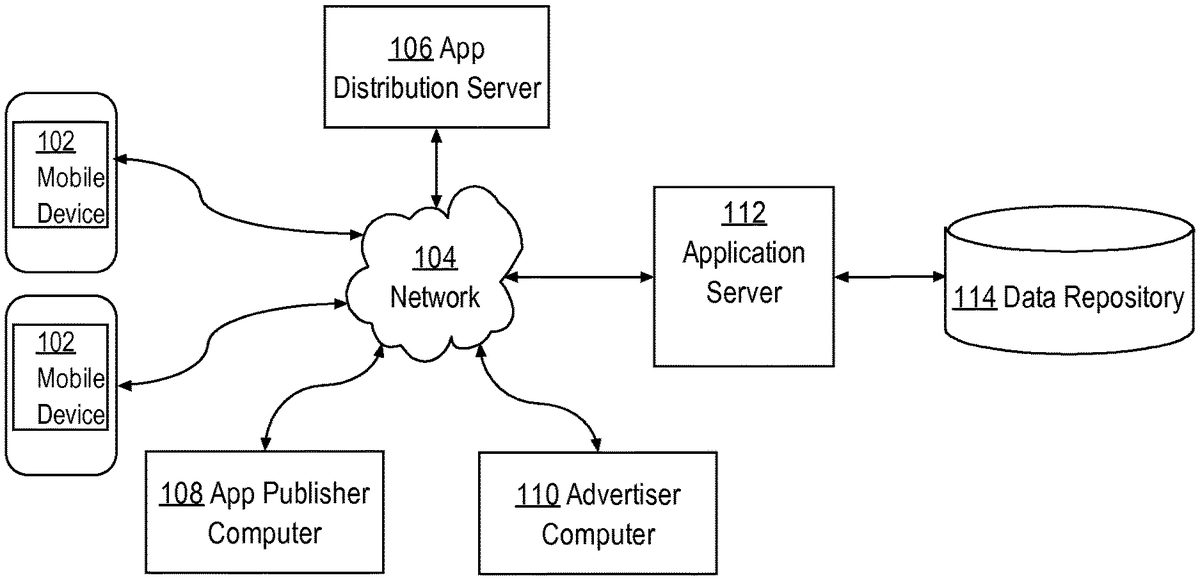
FIG. 1illustrates a networked computer system arrangement that may be used to implement an embodiment. In an embodiment, the computer system generally comprises one or more mobile computing devices102, a network104, at least one application server112coupled to a data repository114, one or more app distribution servers106, one or more app publisher computers108, and one or more advertiser computers110.
Each of the mobile computing devices102comprises a smartphone, tablet computer, netbook computer, laptop computer, or other movable computer. Examples include APPLE IPHONE and IPAD devices, ANDROID devices, etc. Typically wireless links couple the mobile devices102to network104, which broadly represents one or more local area networks, wide area networks, internetworks, global interconnected internetworks such as the public internet, or a combination thereof. For purposes of illustrating a clear example, two (2) mobile devices102are shown inFIG. 1and one cloud symbol representing network104is shown, but practical implementations may use thousands or millions of mobile devices and any number of interconnected networks.
App distribution server106is associated with a developer, author, or publisher of a mobile device application computer program or app, or a distribution channel such as a centralized app downloading service; examples include the APPLE APP STORE and GOOGLE PLAY service. The app may be a game app, utility app, product-related app, or other app. Typically the app developer, author, or publisher desires to provide advertising within the graphical user interface displays of the app. The application server112may serve ads to apps installed on mobile devices102directly or another ad inventory server (not shown) may serve the ads.
In one particular embodiment, application server112is associated with an advertising network service that directs advertisements to apps that comply with an application programming interface (API) or software development kit (SDK) defined by the advertising network service operator. In a commercial embodiment, the advertising network service is operated by Tapjoy, Inc., San Francisco, Calif. Advertisers associated with a computer such as advertiser computer110may place advertisements with the advertising network service. Publishers, such as software developers, game developers, or vendors of products or services, cause authoring and publication of apps that may provide non-advertising functions, such as games. The apps implement the API or SDK defined by the advertising network service operator. The service provider routes advertisements from advertiser computer110, from a data repository114, or from other sources, to the apps via the API or SDK. The service provider has contractual relationships with the advertisers and the publishers according to known advertising network models. Users of mobile devices102benefit from use of the apps and exposure to products or services that may interest them.
In one embodiment, application server112may host a web-based console or other interface that enables app publishers and advertisers to configure various aspects of the advertising network service. App publishers may use the web-based console, for example, to register developed apps with application server112and to configure settings related to the display of ads in registered apps. Advertisers may use the web-based console to provide ads for use in the advertising network service and to configure various aspects of the advertising network service with respect to how the advertiser's ads are used in one or more apps. Further details regarding configuration of the advertising network service by publishers and advertisers are provided in separate sections herein.
Application server112may be coupled to a data repository118that is configured to store data obtained from the mobile devices102, from an app publisher computer108, from an advertiser computer110, and other data generated by application server112.
2.2 SDK Integration
FIG. 2illustrates further details of an embodiment of the system ofFIG. 1. In an embodiment, one of the mobile devices102hosts, executes or otherwise comprises an app202. The app202also comprises SDK code204and app event logic206, each of which is configured to perform special processing, further described herein, in response to detecting the occurrence of particular app events during execution of app202. In one embodiment, app202may be an app configured to enable a user of a mobile device102to play a game, such as an action or arcade type game; however, the features described herein are not limited to game-related apps and may be applied to other types of app. For purposes of illustrating a clear example,FIG. 2shows one app202, but other embodiments may include any number of apps based upon the amount of memory or other storage that is available in a mobile device102.
SDK code204typically is statically linked or dynamically linked to the rest of the code of app202at the time that a developer prepares production versions of an executable of the app202. Consequently, at runtime, SDK code204runs as native code in a mobile device102. However, the source code for SDK code204typically is defined by the owner or operator of the application server112and is not always known to the app developer, author or publisher, except possibly with respect to public interfaces or APIs that the owner or operator of the application server elects to publish or disclose.
In one embodiment, SDK code204comprises one or more public interfaces or APIs configured to enable a developer of app202to map one or more app events of app202to logic included in SDK code204. In this context, an app event may include any processing event, step, or programmatic action that may occur during execution of app202. For example, if app202is a game app, an app event may represent a processing event that occurs during execution of app202such as a user opening an in-game menu, the user beginning a particular level of the game, or the user ending a current game session. In an embodiment, a developer of app202may identify in app event logic206one or more particular app events of app202and cause app event logic206to interact with logic of SDK code204in response to an occurrence of the particular app events. For example, a developer may include a code segment or other logic in association with each of the particular app events that causes app202to trigger logic of SDK code204when a particular app event occurs during execution of app202.
In one particular embodiment, app events identified by a developer in app event logic206and mapped to logic of SDK code204may generally comprise “adverse” app events. An adverse app event, in this context, may generally refer to an event that represents an obstacle or setback with respect to a user's interaction with app202. Referring again to a game app example, adverse app events may comprise app events such as a user's in-game character losing energy or currency (e.g., as a result of the user committing a misstep in the game), the user failing to complete a level or stage in a threshold time period, or the user's current game attempt terminating as a result of the user's in-game character losing all available energy or currency.
In one embodiment, in response to notification of an occurrence of an app event by app event logic206, logic of SDK code204may cause an occurrence of an event referred to herein as a scaffolding event. In this context, a scaffolding event refers to a programmatic event during execution of an app202wherein a user of app202may be provided with a reward in exchange for viewing a displayed ad or interacting with a displayed ad in a specified manner. In an embodiment, SDK code204may provide a reward by modifying some aspect of a user's interaction with app202. For example, if app202is a game app, providing a reward to a user of app202may comprise increasing the user's number of available in-game lives, enabling the user to bypass a particular in-game stage, or adding to the user's amount of available in-game currency.
In this sense, the event may be referred to as a “scaffolding” event because it may serve to assist or enhance the user's interaction with app202by conceptually moving the user to a higher position, level or status within the game. By providing scaffolding events at various points during a user's interaction with an app, an app developer or publisher may increase a user's engagement and enjoyment of the game by assisting the user to advance in the app, while also providing value to the game publisher and advertisers through the display of ads. For example, scaffolding events may be used particularly in response to adverse app events, as described above, as a way to motivate the user to continue the user's interaction with the app. In an embodiment, an advertising network service enables app developers and publishers to further customize the generation of scaffolding events in response to app events, as further described herein.
In one embodiment, SDK code204may define one or more taxonomies of app event types to which an app developer may map particular app events of app202. An app event taxonomy generally may provide a high-level classification of app event types for a particular type of app. For example, a game publisher may desire to identify and associate scaffolding events with adverse game events and accordingly, in one particular embodiment, a taxonomy of app event types may relate primarily to types of adverse gameplay events that may occur in the context of a game app. The following list provides an example taxonomy of app event types that may be defined by SDK code204for a game app:Energy/currency punishment event—relating to an app event that causes the loss of in-game energy or currency.Life punishment event—relating to an app event that causes the loss of an in-game life.Game termination punishment event—relating to an app event that causes a game to terminate (e.g., because the user ran out of energy, currency, or time).Setback punishment event—relating to an app event that causes the user to replay a level or stage of a game, or that causes the user to fail to advance from a particular level or stage, or that causes the user to lose certain abilities or other game advancing items.Voluntary punishment event—relating to an app event causing the game to terminate in response to the user voluntary quitting the game.
The app event type taxonomy described above is provided only as an example; other taxonomies may include any number and types of gaming-related app events. Further, app event taxonomies may be defined for other types of apps and include app event types wholly unrelated to gameplay.
In one embodiment, SDK code204may further include logic enabling a developer of an app202to specify any number of custom app event types. For example, an app developer may identify one or more app events of app202that the developer may desire to associate with scaffolding events, but that are not a good fit for a pre-defined taxonomy of SDK code204. In an embodiment, a developer of app202may define a custom app event type using app event logic206by providing a label for the custom app event type and mapping one or more app events to the custom app event type. The label provided for the custom app event type may be used for display and configuration of the custom app event types with the advertising network service, as further described herein with reference toFIG. 3.
In an embodiment, SDK code204may be further comprise logic configured to enable a developer of app202to map one or more app events of app202to particular reward types. A reward type may represent a type of a reward that may be presented to a user of app202and that may be associated with a scaffolding event generated by SDK code204. For example, if app202is a game app that involves the use of in-game currency, one relevant reward type for the app may relate to increasing a user's amount of available in-game currency. In the example, a developer of app202may map an app event that causes a user's available in-game currency to increase to a reward type related to increasing in-game currency. In an embodiment, SDK code204may define one or more taxonomies of reward types to which an app developer may map particular app events of an app202. The following list provides an example of one particular reward type taxonomy of game rewards that may be defined by SDK code204for a game app:Currency or energy reward—relating to an app event causing an increase in the amount or value of a user's in-game currency or energy.Life reward—relating to an app event causing an increase to a user's number of available in-game lives.Game reward—relating to an app event causing an increase to a user's number of available game attempts.Level forward reward—relating to an app event causing the user to advance one or more particular levels or stages of a game.Item granting reward—relating to an app event causing the user to have access to one or more previously unavailable in-game items.
In an embodiment, similar to the description app event type taxonomies, SDK code204may further include logic enabling a developer of an app202to specify any number of custom reward types. For example, in the context of app202, particular rewards desired by a developer (e.g., causing a user to have access to in-game items or abilities that are specific to app202) may not be a good fit for a reward type taxonomy defined by SDK code204. In an embodiment, a developer of app202may define a custom reward type using app event logic206by providing a label for the custom reward type and mapping one or more app events representing the custom rewards to the defined custom reward type.
2.2 App Registration
In the embodiment ofFIG. 2, application server112comprises app registration unit210that enables an app developer, publisher, or other user to register an app that has integrated an instance of SDK code204with the advertising network service hosted by application server112. In general, by registering an app with the advertising network service, an app publisher enables the registered app to receive ads from the advertising network service in connection with scaffolding events generated during a user's use of the app. App publishers may further configure various aspects of the advertising network service with respect to a registered app, as described below.
In an embodiment, users may interact with app registration unit210and other components of application server112including advertisement registration unit212and app analytics unit214, via a web-based console provided by web server208. The web-based console may comprise one or more graphical dashboards and other graphical user interface displays that facilitate app publishers and advertisers configuration of the advertising network service. App publisher computer108and advertiser computer110may, for example, comprise browsers that enable app publishers and advertisers to access and interact with HTML documents generated by web server208to enable remote configuration.
FIG. 3illustrates a process for registering an app and configuring a registered app with the advertising network service. In an embodiment, one or more of the steps described below may be omitted, repeated, or performed in a different order. The specific arrangement shown inFIG. 3is not required.
In Step302, an app publisher or other user sends app data to an application server hosting the advertising network service. The app data may represent an app that the app publisher desires to register with the service. In an embodiment, an app publisher may cause source code of an app, an app binary, or other information associated with an app to be uploaded to an application server such as application server112. For example, an app publisher may cause the app data to be sent to application server112by uploading the app data using a web-based console or other interface provided by web server208.
In Step304, the application server determines for the app one or more configured app event types and reward types. In an embodiment, the application server may determine the configured app event types and reward types for the app by inspecting the provided app data. For example, in reference to the example app event type taxonomy described herein in Section 2.1, the application server may determine that an app has mapped app events to a “Life punishment” app event type, a “Game termination punishment” app event type, and one or more custom app event types. The application server may further determine that the app has mapped one or more app events to one or more reward types. The mapped reward types similarly may include reward types defined by an available reward type taxonomy and/or custom reward types. In an embodiment, data associated with the app, including the identified app event types and reward types, may be stored in a data repository such as data repository114for subsequent access and configuration.
In Step306, a user selects one or more of the identified app event types to incentivize. In an embodiment, by selecting an identified app event type to incentivize, the user indicates a desire for installations of the app202on mobile devices102, when executed, to generate scaffolding events in response to app202detecting occurrences of app events of the identified app event type. Conversely, by not selecting or unselecting one or more of the identified app event types, the user indicates a desire that scaffolding events not be generated in response to installations of app202detecting the one or more unselected app event types. In an embodiment, a user may select one or more app event types to incentivize from a list generated and displayed on the web-based console or other interface of application server112. The list may be generated, for example, based on the identified app event types determined for the app in Step302. Referring again to the example in Step302, the user may be presented with a list that includes the “Life punishment” and “Game termination punishment” app event types, in addition to any custom event types identified by app202. A user's selection of app event types to incentivize for a particular app may be stored by application server112in association with the registered app data stored in Step302.
In an embodiment, a user may modify the selection of incentivized app event types for a particular app at any time after the app data is provided to application server112. By enabling a user to select and modify incentivized app event types for a particular app using application server112, the occurrence of scaffolding events in an app may be modified without the user modifying or redeploying the app to user devices.
In Step308, a user specifies, for each incentivized app event type, an incentive frequency value. In an embodiment, an incentive frequency value specified for a particular app event type represents a frequency with which the user desires that a scaffolding event occur relative to the number of detected occurrences of an app event of the particular app event type. For example, a developer of an app may map one or more app events to a “Life punishment” app event type. The developer or other user associated with the app may further desire that a scaffolding event occur in the app in response to 10% of occurrences of an app event mapped to the “Life punishment” app event type. Accordingly, the developer may specify the desired incentive frequency value in association with the “Life punishment” app event type. In an embodiment, an incentive frequency value for a particular app event type may be specified as a percentage value or any other value indicating a desired ratio of scaffolding events per occurrences of an app event of the particular app event type.
In general, an incentive frequency value for a particular app event type may represent a desired frequency of scaffolding events per occurrences of the particular app event type for a particular app user. In an embodiment, the developer may further specify whether the incentive frequency value is configured for each separate user app session or maintained across a plurality of user app sessions.
In Step310, a user selects a reward type for each incentivized app event type. The reward types available for selection for a particular app may, for example, be based on the reward types identified in Step302. For example, if an app event type selected for incentivizing represents app events causing a decrease in an app user's available in-app currency, the app developer or publisher may select a reward type representing an app event causing an increase in the amount of in-game currency available to the app user. In this manner, the app developer or publisher may provide contextual rewards to an app user in response to the occurrence of particular app event types, and may modify the mapping between app event types and reward types over time.
2.3 Advertiser Registration
In an embodiment, application server112comprises advertisement registration unit212configured to enable advertisers to register ads with the advertising network service hosted by application server112. In an embodiment, advertisers may use the web-based console provided by web server208or another interface to interact with advertisement registration unit212.
In an embodiment, an advertiser may specify particular app event types that the advertiser desires to target with ads provided by the advertiser. For example, an advertiser desiring to place ads in a game app may indicate that ads associated with advertiser may be displayed in response to events representing currency punishment events, but not other events. By allowing an advertiser to select particular app event types, an advertiser may select app event types that may be most relevant to the ads provided by the advertiser. In an embodiment, advertisers may provide additional information in association with ads provided by the advertisers such as, for example, a message to display to the user when the ad is displayed.
In an embodiment, an advertiser may specify for each selected app event type whether rewards associated with scaffolding events generated for the app event type are associated with one or more specified actions. If a user indicates that a particular reward is associated with one or more specified actions, the reward may be provided to an app user in response to the app user completing the one or more specified actions either by engaging with the associated ad in some specified manner and/or taking specified actions external to the ad. If a scaffolding event is generated based on an app event type that is associated with one or more specified actions, an app user may be presented with the option to perform the actions and receive an associated reward, or to decline performing the actions and proceed in the app without receiving the reward. Examples of user actions that may be specified include instructing a user to watch an advertiser video, fill out an online survey, post a message to a social networking site, register a provided offer, subscribe to a commercial service, or view product information. In one embodiment, actions associated with a reward may involve user engagement or completing an action within ad itself, for example, by requesting that the user play a mini-game that runs within the ad. In other embodiments, actions associated with a reward may direct a user to download other apps and/or to engage with the downloaded apps in a particular fashion (e.g., reach a particular level in a downloaded game app).
In another embodiment, one or more app event types may not be associated with a specified action. If a scaffolding event is generated based on an app event type that is not associated with any specified actions, an associated reward may be provided to a user without any express action from the user. For example, if an advertiser does not specify an action in association with a particular app event type that a game publisher has associated with a reward type representing the addition of in-game currency, an app user may be provided an in-game currency reward in response to triggering an associated scaffolding event and without the user taking any express action with respect to an ad displayed in conjunction with the scaffolding event. An app user's interaction with rewards and specified actions associated with rewards is described in further detail with respect toFIG. 5herein.
2.4 App Analytics
In an embodiment, application server112comprises app analytics unit214. App analytics unit214may comprise logic configured to receive information related to the occurrence of app events within apps registered with application server112. For example, SDK code204of an app202may be configured to report to app analytics unit214each time SDK code204is made aware of an occurrence of an app event and/or generates a scaffolding event.
In an embodiment, app analytics unit214may be configured to generate one or more analytic displays related to the occurrence of app events and other app related information. For example, app analytics unit214may generate one or more analytics displays for each registered app related to the number of occurrences of each identified app event type and reward type, including averages of the occurrence of particular app event types and reward types per user and per user session. Examples of other analytic displays for a particular app may relate to the total time users spend interacting with the app, the frequency with which users accept or decline rewards, and reward types most frequently accepted by users. In an embodiment, analytic displays generated by app analytics unit214may be access by game publishers and advertisers via a web-based console of web server208.
In an embodiment, analytic displays generated by app analytics unit214may be referenced to inform decisions about incentivizing and placing ads with particular app event types registered in the service. For example, a game publisher may notice from app analytics unit214that a particular app event type representing a user failing a level is occurring frequently in an app registered by the game publisher. In response, the game publisher may decide to incentivize the particular app event type or to adjust the incentive frequency of the incentivized app event type using the web-based console of application server112.
2.5 Example App Operation
As described above, an app202may be made available to users of mobile devices102via an app distribution server106. Users of mobile devices102may install one or more of the available apps on their devices and may periodically execute and interact with installed apps. In one embodiment, the installed apps may be configured to detect the occurrence of app events and to generate scaffolding events according to settings configured by the app developer or publisher, as described above.FIG. 4Aillustrates a computer-implemented process for detecting incentivized app events and generating scaffolding events according to an embodiment.
Referring toFIG. 4A, at Step402A, a mobile device sends a request to an application server, the request comprising one or more data values identifying an app executing on the mobile device. The request may be generated, for example, in response to a user of the mobile device initiating execution of a particular app on a mobile device. For example, the user may select an icon or provide other input to the mobile device causing execution of the app. In an embodiment, the app may be configured to generate the request to the application server as part of initial execution steps of the app.
The request sent to the application server may comprise a unique app identifier or other information indicating that the app has initiated execution on the mobile device. The application server may use the app identifier to retrieve incentive data configured by a developer or publisher of the app, as described above in reference toFIG. 3. For example, the application server may retrieve incentive data for a particular app from a data repository such as data repository114.
At Step404A, the mobile device receives incentive data comprising one or more app event types, wherein each app event type is associated with an incentive frequency value and a reward type. In an embodiment, the incentive data comprises data identifying one or more app event types that a developer or publisher of the app has identified as incentivized app event types with the advertising network service. Similarly, the associated incentive frequency values and reward types may represent the values configured by the developer or publisher for each of the app event types. The mobile device may store the received incentive data for subsequent access during execution of the app.
At Step406A, the app detects an occurrence of an incentivized app event type. In an embodiment, the app may detect occurrences of any app event mapped to an app event type by the developer of the app. For example, logic of SDK code204may be triggered by app event logic206each time one of the app events mapped by the developer of app202occurs during execution of app202. The logic of SDK code204or other logic of app202may then determine whether the app event type associated with the detected app event is one of the app event types identified in the received incentive data. If the app event type is one of those identified in the received incentive data, the app may determine that the app event type represents an incentivized app event type.
In an embodiment, in response to the app detecting an occurrence of an app event, the app may send to application server112data comprising identifiers of the mobile app, a user of the mobile app, and the app event type associated with the app event. The app may send the data in response to detecting both incentivized and non-incentivized app events. For example, the logic of SDK code204may generate and send the message in response to being notified of the occurrence of an app event by app event logic206. Application server112may collect the data sent from the app, and from other apps and other devices, in order to generate one or more statistical displays, as described above in Section 2.4.
At Step408A, a determination is made, based on the incentive frequency value associated with the incentivized app event type, whether to generate a scaffolding event. In one embodiment, the app may determine whether to generate a scaffolding event by comparing the incentive frequency value, representing a desired frequency of occurrences, to an actual historical frequency of occurrences of scaffolding events. For example, the app may track, for each app event type, a total number of past occurrences of app events of the app event type. The app may also track the number of past occurrences of a scaffolding event for each app event type. The app may compute a historical scaffolding event frequency value for a particular app event type based on a ratio of the total number of past occurrences of an app event of the particular app event type and the total number of past occurrences of a scaffolding event for the app event type. In an embodiment, the app may determine whether to generate a scaffolding event by determining whether the incentive frequency value exceeds the historical scaffolding event value. For example, if a developer or publisher has specified an incentive frequency of 10%, and the app computes a historical scaffolding event frequency value of 9%, the app may determine that a scaffolding event is to be displayed. In an embodiment, an exception may be made if no previous scaffolding events have been generated for a particular app event type. In the event of there being no historical scaffolding event frequency information, the occurrence of a scaffolding event may, for example, be based on a randomized chance equal to the incentive frequency value.
In one embodiment, the determination of whether to generate a scaffolding event may comprise determining whether generation of a scaffolding event would occur within a specified time period of the most recent scaffolding event. If the most recent scaffolding event occurred within the specified time period, a new scaffolding event may not be triggered, even if the occurrence of the scaffolding event would not cause the scaffolding event frequency exceed the specified incentive frequency. By specifying a minimum time period between the generation of scaffolding events, app users may be prevented from causing a large number of app events to occur in a short period of time in order to generate more scaffolding events, thereby effectively “gaming” the system. In an embodiment, the minimum time period may be specified by an app developer as part of app event logic206, or specified by a publisher using the web-console of application server112.
If in Step408A it is determined that generating a scaffolding event would cause the occurrence of scaffolding events to exceed the specified incentive frequency, the process returns to Step406A and awaits the occurrence of subsequent incentivized app events.
If in Step408A it is determined that generating a scaffolding event would not exceed the incentive frequency, a scaffolding event is generated in Step410A. In general, generating a scaffolding event comprises displaying an advertisement and determining whether to provide a reward, as further described below in reference toFIG. 5.
In the example process illustrated above and inFIG. 4A, an app installed on a mobile device may be configured to detect the occurrence of app events and to determine, by the mobile device, whether to generate a scaffolding event.FIG. 4Billustrates a computer-implemented process for determining whether to generate a scaffolding event, according to another embodiment. In general,FIG. 4Billustrates an example process for determining, by a centralized application server such as an application server112, whether to generate a scaffolding event for a particular instance of an app running on a mobile device. The process for determining whether to generate scaffolding events for a particular app may be processed by a centralized application server rather than by the app, for example, in order to reduce the processing demands of a mobile device executing the app.
In Step402B, an application server receives a message from a mobile device indicating an occurrence of an app event. As described above in reference toFIG. 4A, apps may be configured to send data comprising various identifying information in response to detecting an occurrence of an app event. For example, a particular app detecting an occurrence of an app event may send a message to the application server that includes identifiers of the particular mobile app generating the message, a user of the mobile app, and an app event type associated with the app event. In an embodiment, the application server may store the received data included in an app event message for generating various analytics and configuration displays.
In Step404B, the application server retrieves incentive data comprising incentivized app event types and associated incentive frequency values and reward types. The application server may retrieve the incentive data for a particular app, for example, from a data repository based on one or more of the identifiers included in the app event message. The incentive data may comprise information indicating whether one or more app event types associates with the app generating the message are incentivized app event types and, for each incentivized app type, an associated incentive frequency value and a reward type.
In Step406B, the application server determines, based on the incentive data, whether to generate a scaffolding event. In one embodiment, the determination comprises determining whether incentive data identifies the app event type associated with the app event generating the message as an incentivized app event type. If the app event type is not identified as an incentivized app event type, the application server may take no further action and return to Step402B to await receipt of additional messages. If the app event type is identified in the incentive data as an incentivized app event type, then determining whether to generate a scaffolding event may further comprise determining whether to generate a scaffolding event based on an associated incentive frequency value of the retrieved incentive data. In an embodiment, the incentive frequency value for the app event type may be compared to an actual historical frequency of occurrences of scaffolding events for the app event type, which may be tracked by the application server or included in the message from the mobile device reporting the occurrence of the app event.
In Step408B, in response to determining to generate a scaffolding event, the application server sends a message to the mobile device causing the mobile device to generate a scaffolding event. In an embodiment, the message sent to a mobile device causing the mobile device to generate a scaffolding event may include an advertising unit and reward type information, as described below.
FIG. 5illustrates a computer-implemented process for generating a scaffolding event by a mobile device. In general, a mobile device may generate a scaffolding event either in response the mobile device determining to generate the scaffolding event, or in response to an application server causing the mobile device to generate the scaffolding event, as described above in reference toFIGS. 4A, 4B. In an embodiment, one or more of the steps described below may be omitted, repeated, or performed in a different order. The specific arrangement shown inFIG. 5is not required.
At Step502, an advertisement unit is retrieved from an advertisement server. In general, an advertisement server stores an inventory of ads that are available for use in the advertising network service. For example, the inventory of ads may comprise ads provided by advertisers using advertisement registration unit212. In one embodiment, a request to the advertisement server may comprise information identifying the particular app, the app event type generating the request, and other information including user and mobile device identification information. The request may be generated by either a mobile device or an application server, depending on which device made the determination to generate a scaffolding event for the app. If the request is generated by an application server, the generated advertising unit may be sent to the associated mobile device directly, or to the application server for delivery to the mobile device. In an embodiment, an application server112may comprise the advertisement server or the advertisement server may be a separate server.
In response to receiving the request, an advertisement server may select an appropriate advertising unit based on one or more settings configured by advertisers, as described in Section 2.3. For example, the advertisement server may retrieve an advertising unit that is associated with the particular app event type and that currently is associated with the highest advertiser bid value for the particular app event type.
At Step504, the retrieved ad unit is displayed. In an embodiment, displaying an ad unit may comprise displaying a message to the user indicating that the advertiser associated with the ad unit is offering a particular reward to the user. For example, the app may display a default message, or may display a custom advertiser message included in the ad unit.
In an embodiment, the process ofFIG. 5proceeds to either Step506or Step508depending on whether the reward is associated with any specified actions. The ad unit may comprise a value or other data indicating whether or not the reward is associated with a specified action. If the app determines that the award is not associated with an action, in Step506, the app determines whether the user accepts the award.
In Step510, if the user accepts the reward, the reward is provided to the user. The user may accept the reward, for example, by clicking on a graphical button or providing other input indicating that the user desires to accept the reward. In an embodiment, the app may provide the reward by determining an app event of the reward type associated with the app event type generating the scaffolding event. As described above, the mapping between app event types and reward types may be specified in the incentive data received by the app from an application server. The app event corresponding to the reward type generally may provide the user with an in-game benefit such as increasing the user's available amount of in-game currency, providing the user with in-game items or content, updating gameplay data to indicate successful completion of a particular game level or otherwise changing the game level of the user, or any other action programmed by the developer of the app.
In response to the award being provided, the app may continue execution in Step512. In an embodiment, if the user provides input indicating that the user is choosing not to accept the reward in Step506, the app may continue execution in Step512without providing the reward to the user.
If the reward is associated with one or more specified actions, in Step508, the app determines whether the user completes the one or more actions. In an embodiment, an advertising unit associated with reward may include instructions related to the one or more specified actions and the user may receive the reward in response to the user completing the specified actions. As described above, the actions may include watching an advertiser video, filling out an online survey, posting a message to a social networking site, and other actions that may related directly to the ad or to content external to the ad. If the app determines that the user completes the specified actions in Step508, the user may be provided with the reward in Step510. If the user does complete the specified actions, for example, by exiting the ad display without engaging with the ad or providing other input indicating that the user does not desire to accept the reward, the app may continue execution in Step512without providing the reward to the user.
3.0 Implementation Example—Hardware Overview
According to one embodiment, the techniques described herein are implemented by one or more special-purpose computing devices. The special-purpose computing devices may be hard-wired to perform the techniques, or may include digital electronic devices such as one or more application-specific integrated circuits (ASICs) or field programmable gate arrays (FPGAs) that are persistently programmed to perform the techniques, or may include one or more general purpose hardware processors programmed to perform the techniques pursuant to program instructions in firmware, memory, other storage, or a combination. Such special-purpose computing devices may also combine custom hard-wired logic, ASICs, or FPGAs with custom programming to accomplish the techniques. The special-purpose computing devices may be desktop computer systems, portable computer systems, handheld devices, networking devices or any other device that incorporates hard-wired and/or program logic to implement the techniques.
For example,FIG. 6is a block diagram that illustrates a computer system600upon which an embodiment of the invention may be implemented. Computer system600includes a bus602or other communication mechanism for communicating information, and a hardware processor604coupled with bus602for processing information. Hardware processor604may be, for example, a general purpose microprocessor.
Computer system600also includes a main memory606, such as a random access memory (RAM) or other dynamic storage device, coupled to bus602for storing information and instructions to be executed by processor604. Main memory606also may be used for storing temporary variables or other intermediate information during execution of instructions to be executed by processor604. Such instructions, when stored in non-transitory storage media accessible to processor604, render computer system600into a special-purpose machine that is customized to perform the operations specified in the instructions.
Computer system600further includes a read only memory (ROM)608or other static storage device coupled to bus602for storing static information and instructions for processor604. A storage device610, such as a magnetic disk or optical disk, is provided and coupled to bus602for storing information and instructions.
Computer system600may be coupled via bus602to a display612, such as a cathode ray tube (CRT), for displaying information to a computer user. An input device614, including alphanumeric and other keys, is coupled to bus602for communicating information and command selections to processor604. Another type of user input device is cursor control616, such as a mouse, a trackball, or cursor direction keys for communicating direction information and command selections to processor604and for controlling cursor movement on display612. This input device typically has two degrees of freedom in two axes, a first axis (e.g., x) and a second axis (e.g., y), that allows the device to specify positions in a plane.
Computer system600may implement the techniques described herein using customized hard-wired logic, one or more ASICs or FPGAs, firmware and/or program logic which in combination with the computer system causes or programs computer system600to be a special-purpose machine. According to one embodiment, the techniques herein are performed by computer system600in response to processor604executing one or more sequences of one or more instructions contained in main memory606. Such instructions may be read into main memory606from another storage medium, such as storage device610. Execution of the sequences of instructions contained in main memory606causes processor604to perform the process steps described herein. In alternative embodiments, hard-wired circuitry may be used in place of or in combination with software instructions.
The term “storage media” as used herein refers to any non-transitory media that store data and/or instructions that cause a machine to operation in a specific fashion. Such storage media may comprise non-volatile media and/or volatile media. Non-volatile media includes, for example, optical or magnetic disks, such as storage device610. Volatile media includes dynamic memory, such as main memory606. Common forms of storage media include, for example, a floppy disk, a flexible disk, hard disk, solid state drive, magnetic tape, or any other magnetic data storage medium, a CD-ROM, any other optical data storage medium, any physical medium with patterns of holes, a RAM, a PROM, and EPROM, a FLASH-EPROM, NVRAM, any other memory chip or cartridge.
Storage media is distinct from but may be used in conjunction with transmission media. Transmission media participates in transferring information between storage media. For example, transmission media includes coaxial cables, copper wire and fiber optics, including the wires that comprise bus602. Transmission media can also take the form of acoustic or light waves, such as those generated during radio-wave and infra-red data communications.
Various forms of media may be involved in carrying one or more sequences of one or more instructions to processor604for execution. For example, the instructions may initially be carried on a magnetic disk or solid state drive of a remote computer. The remote computer can load the instructions into its dynamic memory and send the instructions over a telephone line using a modem. A modem local to computer system600can receive the data on the telephone line and use an infra-red transmitter to convert the data to an infra-red signal. An infra-red detector can receive the data carried in the infra-red signal and appropriate circuitry can place the data on bus602. Bus602carries the data to main memory606, from which processor604retrieves and executes the instructions. The instructions received by main memory606may optionally be stored on storage device610either before or after execution by processor604.
Computer system600also includes a communication interface618coupled to bus602. Communication interface618provides a two-way data communication coupling to a network link620that is connected to a local network622. For example, communication interface618may be an integrated services digital network (ISDN) card, cable modem, satellite modem, or a modem to provide a data communication connection to a corresponding type of telephone line. As another example, communication interface618may be a local area network (LAN) card to provide a data communication connection to a compatible LAN. Wireless links may also be implemented. In any such implementation, communication interface618sends and receives electrical, electromagnetic or optical signals that carry digital data streams representing various types of information.
Network link620typically provides data communication through one or more networks to other data devices. For example, network link620may provide a connection through local network622to a host computer624or to data equipment operated by an Internet Service Provider (ISP)626. ISP626in turn provides data communication services through the world wide packet data communication network now commonly referred to as the “Internet”628. Local network622and Internet628both use electrical, electromagnetic or optical signals that carry digital data streams. The signals through the various networks and the signals on network link620and through communication interface618, which carry the digital data to and from computer system600, are example forms of transmission media.
Computer system600can send messages and receive data, including program code, through the network(s), network link620and communication interface618. In the Internet example, a server630might transmit a requested code for an application program through Internet628, ISP626, local network622and communication interface618.
The received code may be executed by processor604as it is received, and/or stored in storage device610, or other non-volatile storage for later execution.
4.0 Extensions & Alternatives
In the foregoing specification, embodiments of the invention have been described with reference to numerous specific details that may vary from implementation to implementation. The specification and drawings are, accordingly, to be regarded in an illustrative rather than a restrictive sense. The sole and exclusive indicator of the scope of the invention, and what is intended by the applicants to be the scope of the invention, is the literal and equivalent scope of the set of claims that issue from this application, in the specific form in which such claims issue, including any subsequent correction.
Claims
- A data processing method comprising: using a programmed digital electronic mobile computing device requesting, by a mobile app executing on the mobile device, incentive data from an app server and receiving the incentive data;wherein the incentive data comprises first incentive data associating a first app event type with a first incentive frequency value and a first reward type and second incentive data associating a second app event type with a second incentive frequency value and a second reward type, wherein the first app event type is different from the second app event type, and wherein the first reward type is different from the second reward type;wherein the first incentive frequency value and the second incentive frequency value each indicates a ratio of scaffolding events to a number of occurrences of app events of the associated app event type;wherein rewards of the first reward type and rewards of the second reward type are related to app events of the associated app event type;detecting, by an app event logic of the mobile device, an occurrence of a particular app event of the mobile app, wherein the particular app event is associated with the first event type;determining, by the mobile device based on the incentive data, that the particular app event is an incentivized app event;determining, by the mobile device based on the first incentive frequency value, whether to generate a scaffolding event, wherein the scaffolding event comprises displaying an advertisement using a display of the mobile device and providing a reward of the first reward type, and wherein the scaffolding event is an event that occurs within the mobile app during execution using the mobile device;in response to determining that the scaffolding event should be generated, using the mobile device displaying, on the mobile device, the advertisement and providing the reward.
- The method of claim 1 , wherein determining whether to generate the scaffolding event further comprises determining (a) a number of occurrences of app events of the particular app event type, and (b) a number of scaffolding events generated in response to an occurrence of an app event of the particular app event type.
- The method of claim 2 , further comprising: determining a historical scaffolding event frequency value based on a ratio of (a) the number of occurrences of app events of the particular app event type and (b) the number of scaffolding events generated in response to an occurrence of an app event of the particular app event type;wherein determining whether to generate a scaffolding event further comprises determining that the incentive frequency value exceeds the historical scaffolding event frequency value.
- The method of claim 2 , wherein the number of occurrences of app events of the particular app event type is based on one of: a current session of the mobile app, a plurality of sessions of the mobile app.
- The method of claim 1 , wherein the mobile app is a game app, and wherein each of the plurality of app event types represents a gameplay related event.
- The method of claim 5 , wherein one or more of the one or more app event types comprises one of a game currency punishment event, a game life punishment event, a game termination event, a game level setback event, a custom game event.
- The method of claim 5 , wherein the reward is associated with the game app and comprises one or more of: an increase of in-game currency or in-game energy, an increase of available in-game lives, advancing a user of the mobile app to a particular in-game level, granting the user an in-game item, or a custom reward.
- The method of claim 1 , further comprising: in response to determining to generate a scaffolding event, sending a request to an advertisement server for an advertising unit comprising a particular ad;determining whether a user of the mobile app interacts with the particular ad;in response to determining that the user interacts with the particular ad, providing the reward.
- The method of claim 1 , further comprising sending, to a server, a message comprising identifiers of one or more of the mobile app, a user of the mobile app, or the particular app event type.
- A data processing method comprising: using a programmed digital electronic mobile computing device requesting, by a game app executing on the mobile device, incentive data from an app server and receiving the incentive data;wherein the incentive data comprises first incentive data associating a first adverse gameplay event type with a first incentive frequency value and a first game reward type and second incentive data associating a second adverse gameplay event type with a second incentive frequency value and a second game reward type, wherein the first adverse gameplay event type is different from the second adverse gameplay event type, and wherein the first game reward type is different from the second game reward type;wherein the first incentive frequency value and the second incentive frequency value each indicates a ratio of scaffolding events to a number of occurrences of adverse gameplay events of the associated adverse gameplay event type;wherein rewards of the first game reward type and rewards of the second reward type are related to adverse gameplay events of the associated gameplay event type;using app event logic of the mobile device, detecting an occurrence of a particular gameplay event of the game app, wherein the particular gameplay event is associated with the first adverse gameplay event type;determining, by the mobile device based on the incentive data, that the particular adverse gameplay event is an incentivized adverse gameplay event;determining, by the mobile device based on the first incentive frequency value, whether to generate a scaffolding event, wherein the scaffolding event comprises displaying an advertisement using a display of the mobile device and providing a game reward of the first game reward type, and wherein the scaffolding event is an event that occurs within the game app during execution using the mobile device;in response to determining that the scaffolding event should be generated, using the mobile device displaying, on the mobile device, the advertisement and providing the game reward.
- The method of claim 10 , wherein one or more of the one or more adverse gameplay event types comprises one of a game currency punishment event, a game life punishment event, a game termination event, a game level setback event, a custom game event.
- The method of claim 10 , wherein the game reward comprises one or more of: an increase of in-game currency or in-game energy, an increase of available in-game lives, advancing a user of the game app to a particular in-game level, granting the user an in-game item, or a custom game reward.
- The method of claim 10 , further comprising: in response to determining to generate a scaffolding event, sending a request to an advertisement server for an advertising unit comprising a particular ad;determining whether a user of the mobile app interacts with the particular ad;in response to determining that the user interacts with the particular ad, providing the game reward.
- A data processing method comprising: using an app server receiving, from the mobile device, a message indicating an occurrence of a gameplay event of a game app executing on the mobile device, wherein the gameplay event is associated with a particular adverse gameplay event type of one or more adverse gameplay event types;retrieving, by an app event logic of the app server, incentive data associated with the one or more adverse gameplay event types, wherein the incentive data indicates, for each of the one or more adverse gameplay event types, an incentive frequency value and a game reward type, wherein game rewards of the game reward type are related to adverse gameplay events of the adverse gameplay event type, wherein the incentive frequency value indicates a ratio of scaffolding events to a number of occurrences of adverse gameplay events of the associated adverse gameplay event type;determining, by the app server based on the incentive data, that the particular adverse gameplay event is an incentivized adverse gameplay event;determining, by the app server, based on the incentive frequency value associated with the particular adverse gameplay event type, whether to cause the mobile device to generate a scaffolding event, wherein the scaffolding event comprises displaying an advertisement and providing a game reward of the game reward type associated with the particular adverse gameplay event and wherein the scaffolding event is an event that occurs within the game app during execution using the mobile device;in response to determining that the scaffolding event should be generated, using the app server, causing the mobile device to display the advertisement and to provide the game reward.
- A non-transitory computer-readable medium storing one or more sequences of instructions, which when executed by one or more processors, cause the one or more processors to carry out the steps of: using a programmed digital electronic mobile computing device requesting, by a mobile app executing on the mobile device, incentive data from an app server and receiving the incentive data;wherein the incentive data comprises first incentive data associating a first app event type with a first incentive frequency value and a first reward type and second incentive data associating a second app event type with a second incentive frequency value and a second reward type, wherein the first app event type is different from the second app event type, and wherein the first reward type is different from the second reward type;wherein the first incentive frequency value and the second incentive frequency value each indicates a ratio of scaffolding events to a number of occurrences of app events of the associated app event type;wherein rewards of the first reward type and rewards of the second reward type are related to app events of the associated app event type;detecting, by an app event logic of the mobile device, an occurrence of a particular app event of the mobile app, wherein the particular app event is associated with the first event type;determining, by the mobile device based on the incentive data, that the particular app event is an incentivized app event;determining, by the mobile device based on the first incentive frequency value, whether to generate a scaffolding event, wherein the scaffolding event comprises displaying an advertisement using a display of the mobile device and providing a reward of the first reward type, and wherein the scaffolding event is an event that occurs within the mobile app during execution using the mobile device;in response to determining that the scaffolding event should be generated, using the mobile device displaying, on the mobile device, the advertisement and providing the reward.
- The non-transitory computer-readable medium of claim 15 , wherein determining whether to generate the scaffolding event further comprises determining (a) a number of occurrences of app events of the particular app event type, and (b) a number of scaffolding events generated in response to an occurrence of an app event of the particular app event type.
- The non-transitory computer-readable medium of claim 16 , wherein the one or more instructions further comprise instructions which, when executed by one or more processors, cause the one or more processors to perform: determining a historical scaffolding event frequency value based on a ratio of (a) the number of occurrences of app events of the particular app event type and (b) the number of scaffolding events generated in response to an occurrence of an app event of the particular app event type;wherein determining whether to generate a scaffolding event further comprises determining that the incentive frequency value exceeds the historical scaffolding event frequency value.
- The non-transitory computer-readable medium of claim 16 , wherein the number of occurrences of app events of the particular app event type is based on one of: a current session of the mobile app, a plurality of sessions of the mobile app.
- The non-transitory computer-readable medium of claim 15 , wherein the mobile app is a game app, and wherein each of the plurality of app event types represents a gameplay related event.
- The non-transitory computer-readable medium of claim 19 , wherein one or more of the one or more app event types comprises one of a game currency punishment event, a game life punishment event, a game termination event, a game level setback event, a custom game event.
- The non-transitory computer-readable medium of claim 19 , wherein the reward is associated with the game app and comprises one or more of: an increase of in-game currency or in-game energy, an increase of available in-game lives, advancing a user of the mobile app to a particular in-game level, granting the user an in-game item, or a custom reward.
- The non-transitory computer-readable medium of claim 15 , wherein the one or more instructions further comprise instructions which, when executed by one or more processors, cause the one or more processors to perform: in response to determining to generate a scaffolding event, sending a request to an advertisement server for an advertising unit comprising a particular ad;determining whether a user of the mobile app interacts with the particular ad;in response to determining that the user interacts with the particular ad, providing the reward.
- The non-transitory computer-readable medium of claim 15 , wherein the one or more instructions further comprise instructions which, when executed by one or more processors, cause the one or more processors to perform sending, to a server, a message comprising identifiers of one or more of the mobile app, a user of the mobile app, or the particular app event type.
- A non-transitory computer-readable medium storing one or more sequences of instructions, which when executed by one or more processors, cause the one or more processors to carry out the steps of: using a programmed digital electronic mobile computing device requesting, by a game app executing on the mobile device, incentive data from an app server and receiving the incentive data;wherein the incentive data comprises first incentive data associating a first adverse gameplay event type with a first incentive frequency value and a first game reward type and second incentive data associating a second adverse gameplay event type with a second incentive frequency value and a second game reward type, wherein the first adverse gameplay event type is different from the second adverse gameplay event type, and wherein the first game reward type is different from the second game reward type;wherein the first incentive frequency value and the second incentive frequency value each indicates a ratio of scaffolding events to a number of occurrences of adverse gameplay events of the associated adverse gameplay event type;wherein rewards of the first game reward type and rewards of the second reward type are related to adverse gameplay events of the associated gameplay event type;detecting, by an app event logic of the mobile device, an occurrence of a particular gameplay event of the game app, wherein the particular gameplay event is associated with the first adverse gameplay event type;determining, by the mobile device based on the incentive data, that the particular adverse gameplay event is an incentivized adverse gameplay event;determining, by the mobile device based on the first incentive frequency value value, whether to generate a scaffolding event, wherein the scaffolding event comprises displaying an advertisement using a display of the mobile device and providing a game reward of the first game reward type, and wherein the scaffolding event is an event that occurs within the game app during execution using the mobile device;in response to determining that the scaffolding event should be generated, using the mobile device displaying, on the mobile device, the advertisement and providing the game reward.
- The non-transitory computer-readable medium of claim 24 , wherein one or more of the one or more adverse gameplay event types comprises one of a game currency punishment event, a game life punishment event, a game termination event, a game level setback event, a custom game event.
- The non-transitory computer-readable medium of claim 24 , wherein the game reward comprises one or more of: an increase of in-game currency or in-game energy, an increase of available in-game lives, advancing a user of the game app to a particular in-game level, granting the user an in-game item, or a custom game reward.
- The non-transitory computer-readable medium of claim 24 , wherein the one or more instructions further comprise instructions which, when executed by one or more processors, cause the one or more processors to perform: in response to determining to generate a scaffolding event, sending a request to an advertisement server for an advertising unit comprising a particular ad;determining whether a user of the mobile app interacts with the particular ad;in response to determining that the user interacts with the particular ad, providing the game reward.
- A non-transitory computer-readable medium storing one or more sequences of instructions, which when executed by one or more processors, cause the one or more processors to carry out the steps of: using an app server receiving, from the mobile device, a message indicating an occurrence of a gameplay event of a game app executing on the mobile device, wherein the gameplay event is associated with a particular adverse gameplay event type of one or more adverse gameplay event types;retrieving, by an app event logic of the app server, incentive data associated with the one or more adverse gameplay event types, wherein the incentive data indicates, for each of the one or more adverse gameplay event types, an incentive frequency value and a game reward type, wherein game rewards of the game reward type are related to adverse gameplay events of the adverse gameplay event type, wherein the incentive frequency value indicates a ratio of scaffolding events to a number of occurrences of adverse gameplay events of the associated adverse gameplay event type;determining, by the app server based on the incentive data, that the particular adverse gameplay event is an incentivized adverse gameplay event;determining, by the app server, based on the incentive frequency value associated with the particular adverse gameplay event type, whether to cause the mobile device to generate a scaffolding event, wherein the scaffolding event comprises displaying an advertisement and providing a game reward of the game reward type associated with the particular adverse gameplay event and wherein the scaffolding event is an event that occurs within the game app during execution using the mobile device;in response to determining that the scaffolding event should be generated, using the app server, causing the mobile device to display the advertisement and to provide the game reward.
Disclaimer: Data collected from the USPTO and may be malformed, incomplete, and/or otherwise inaccurate.