U.S. Pat. No. 10,709,969
GAME SYSTEM WITH GAME MACHINE EXECUTING A GAME PROGRAM THAT RECEIVES INPUTS AND OUTPUTS CONTROL SIGNALS TO A GAME CONTROLLER
AssigneeDiversified Healthcare Development, LLC
Issue DateDecember 17, 2018
Illustrative Figure
Abstract
A game system including a game controller and game machine that executes a game program. The game controller including a balance platform supported at its center and under its periphery by an inflatable bladder, an air pressure source, a dual-axis accelerometer measuring tilt of the balance platform, a control valve, and an air pressure sensor measuring air pressure of the inflatable bladder. The game machine receives real time measures of the air pressure of the inflatable bladder and the tilt of the balance platform, displays on a screen a game player's location in a game space generated by the game program, based on the measures of the tilt, and changes the air pressure of the inflatable bladder during game play in response to the game program generating an interaction between the game player's location and a location of an interactive graphic image created by the game program.
Description
DETAILED DESCRIPTION The various embodiments of the invention and their various features and details are explained more fully with reference to the non-limiting examples that are illustrated in the accompanying drawings and detailed in the following description. It should be noted that the features and details illustrated in the drawings are not necessarily drawn to scale. Descriptions of well-known materials, components, and processing techniques are omitted so as to not unnecessarily obscure the exemplary systems and methods of the embodiments of the invention. The examples described, below, are intended to facilitate an understanding of ways in which the exemplary systems and methods of the embodiments of the invention may be practiced and to further enable those of skill in the art to practice these exemplary systems and methods. Accordingly, the examples should not be construed as limiting the scope of the exemplary systems and methods of the embodiments of the invention. FIG. 1is a schematic diagram illustrating a game system100including a game machine200and a game controller400in an embodiment of the invention. During game play, a game player160balances on a rigid balance platform410of the game controller400. Postural sway by the game player160causes the location of the center of pressure (CoP) on the balance platform410to change, and thus, tilt the balance platform410about its center point in any direction of the horizontal plane. Tilt is measured by rotation about the transverse x-axis412of the balance platform410, i.e., pitch, and/or about the longitudinal y-axis414of the balance platform410, i.e., roll. A real time dual-axis accelerometer measures the tilt of the balance platform410and the real time tilt data are transmitted from the game controller400to the game machine200in response to requests from a subroutine of a game program executed by the game machine200. Another subroutine of the game program may calculate the direction and resulting location of the ...
DETAILED DESCRIPTION
The various embodiments of the invention and their various features and details are explained more fully with reference to the non-limiting examples that are illustrated in the accompanying drawings and detailed in the following description. It should be noted that the features and details illustrated in the drawings are not necessarily drawn to scale. Descriptions of well-known materials, components, and processing techniques are omitted so as to not unnecessarily obscure the exemplary systems and methods of the embodiments of the invention. The examples described, below, are intended to facilitate an understanding of ways in which the exemplary systems and methods of the embodiments of the invention may be practiced and to further enable those of skill in the art to practice these exemplary systems and methods. Accordingly, the examples should not be construed as limiting the scope of the exemplary systems and methods of the embodiments of the invention.
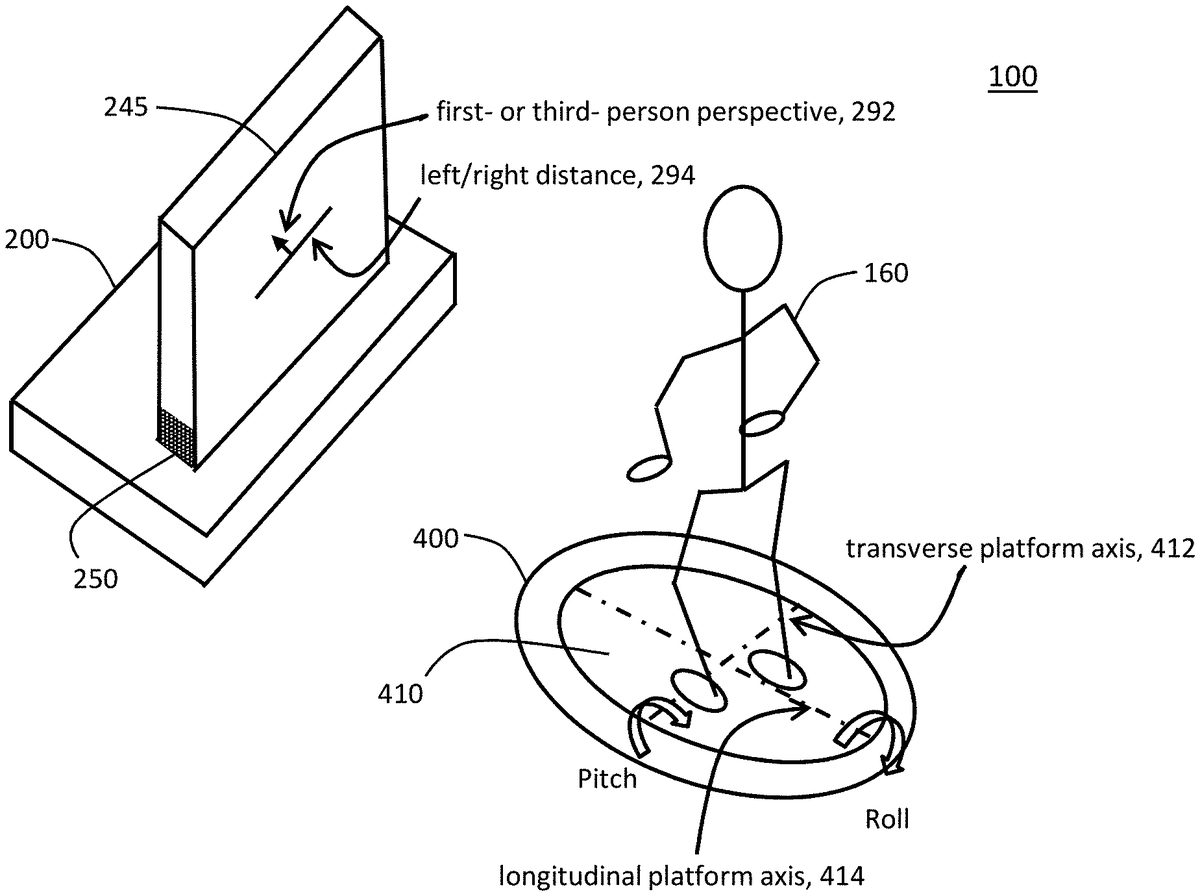
FIG. 1is a schematic diagram illustrating a game system100including a game machine200and a game controller400in an embodiment of the invention. During game play, a game player160balances on a rigid balance platform410of the game controller400. Postural sway by the game player160causes the location of the center of pressure (CoP) on the balance platform410to change, and thus, tilt the balance platform410about its center point in any direction of the horizontal plane. Tilt is measured by rotation about the transverse x-axis412of the balance platform410, i.e., pitch, and/or about the longitudinal y-axis414of the balance platform410, i.e., roll. A real time dual-axis accelerometer measures the tilt of the balance platform410and the real time tilt data are transmitted from the game controller400to the game machine200in response to requests from a subroutine of a game program executed by the game machine200. Another subroutine of the game program may calculate the direction and resulting location of the game player's movements in a game space or topology, generated by the game program, based on the real time tilt measures of the balance platform410. The game program may display the real time changes to a game player's location in the game space on a screen245of the game machine200using either a forward-facing first- or a third-person perspective292, where the third-person perspective has a viewpoint removed at a distance from a graphic image of the game player's avatar. The game machine200also receives real time sensor data from the game controller400relating to the stability of the balance platform410, i.e., the relative ease with which a game player may tilt the balance platform410. The game machine200outputs control signals governing the stability of the balance platform410to the game controller400, in response to the game program identifying an interaction between the game player, who is located within the game space and an interactive graphic image generated by the game program within the same game space. The game machine200also outputs audio data to speakers250of the game machine200. Typically, the game machine200and the game controller400are powered by mains electricity.
Wireless transfer of data between the game machine200and the game controller400may utilize transceivers operating under a Bluetooth standard, a wireless LAN protocol, or an infrared communication standard. Alternatively, the game machine200and the game controller400may communicate via wires. Although not shown, the game machine200may also receive direction and location data relating to the movements of other game players from a plurality of other game systems.
FIG. 2is a block diagram illustrating hardware components of the game machine200of the game system100in an embodiment of the invention. A central processor210executes a game program and subroutines of the game program that are stored in main memory230. A game processing subroutine issues graphics generation commands to a graphics processor215, which creates and displays on the screen245of the game machine200, the game space or topology through which the game player moves in real time may be rendered in a first- or third person perspective. The game space also contains stationary and/or moving interactive graphic images generated by the game program and the graphics processor215. The interactive graphic images may include any of: geographic features, environmental elements, artifacts, inhabitants, and other game players. A game processing subroutine also issues audio signal generation commands to a digital signals processor220to create audio data for output to speakers250of the game machine200.
During game play, the real time location of the game player moves in a sequence of consecutive moves based on the real time measures of the tilt data. An input tilt data subroutine of the game program, executed by the game machine200, may request tilt data from the game controller400at a frequency of 10-100 Hz, and preferably at a frequency of 50 Hz. The tilt data is then stored in the buffer memory235. Using the real time tilt data, a game player's direction and location subroutine may calculate the direction of each consecutive move to its resulting location. The calculated direction and the resulting location of each game player's move are then stored as game player's direction and location data in the buffer memory235. A moving interactive graphic image, however, travels through the displayed game space by a sequence of consecutive moves provided by a game processing subroutine of the game program executed by the game machine200. The direction and the next location of each moving interactive graphic image's move are then stored as interaction's direction and location data in the buffer memory235. Similarly, each of the stationary interactive graphic images is provided with direction data and location data by the game processing subroutine of the game program, where the direction data provides a direction in which the stationary interactive image faces, for example, a steep cliff of a mountain that faces north, while a gradual incline to the summit of the mountain faces south, and where the location data image maps the extent of the stationary interactive graphic image to the game space. The direction and location data for each of the stationary interactive graphic images is stored in the buffer memory235.
Real time consecutive air pressure measures, relating to the stability of the balance platform, are transmitted from the game controller400to the game machine200according to an input air pressure data subroutine of the game program. The input air pressure data subroutine may request air pressure data from the game controller400at a frequency of 3-30 Hz, and preferably at a frequency of 20 Hz. Each consecutive real time air pressure measure is stored as air pressure data in the buffer memory235of the game machine200.
An interaction between the game player and an interactive graphic image is generated by the game program of the game machine200, when the game player moves to a location in proximity to the location of the interactive graphic image in the displayed game space. When the interaction is generated, an interaction's change air pressure subroutine, particular to the interactive graphic image, calculates either a positive or negative change to be made to the air pressure that inflates an inflatable bladder which provides stability to the balance platform410of the game controller400. The calculated change to the air pressure is compared to subsequent real time air pressure measures by a compare air pressure to changed air pressure subroutine of the game program, which then transmits control signals the game controller400so as to effect the calculated change to the air pressure. The game program subroutines of the game machine200receive real time tilt data and air pressure data from the game controller400and transmit control signals from the game machine200to the game controller400via an input/output processor225and a transceiver280.
The game machine200may import a game program via the Internet or may read the game program contained on a compact disk. The game machine200stores the game program in the main memory230. Typically, the game machine200is powered by mains electricity.
FIG. 3provides an exemplary illustration of a third-person perspective292of the game player's avatar, i.e., a car, in a game space displayed on the screen245of the game machine200of game system100. The screen245also displays a stationary interactive graphic image370of an artifact, i.e., a paved road to the game player's right, and a moving interactive graphic image375of an environmental element, i.e., a giant boulder rolling downhill, to the game player's left. Moving to the right, so as to drive on the paved road, may cause the stability of the balance platform410to increase. Being hit by the boulder, however, may cause inter alia the stability of the balance platform410to decrease, reflecting damage to the game player's car.
FIG. 4AandFIG. 4Bschematically illustrate the hardware components of the game controller400of the game system100in an embodiment of the invention.FIG. 4Aillustrates a cross section of the game controller400through the X-X′ axis, shown inFIG. 4B, whileFIG. 4Billustrates a top view of the game controller400, where the balance platform410has been removed so as to not obscure the underlying components.
InFIG. 4A, the game controller400includes a balance platform410that responds to the postural sway of a game player standing on the balance platform410by tilting about the balance platform's center in any direction of the horizontal plane. The balance platform410is supported by a ball joint413disposed on a vertical support415under the center of the balance platform410. The vertical support415and an inflatable bladder420are disposed on a base416. The inflatable bladder420encircles the vertical support415and supports the periphery of the balance platform410.
A dual-axis accelerometer450, disposed on the underside of the balance platform410, detects the degrees of tilt about the balance platform's transverse x-axis412, i.e., pitch, and the balance platform's longitudinal y-axis414, i.e., roll, relative to the center of the balance platform410. A maximal degree of tilt about the balance platform's x-axis and/or y-axis may be +/−15° to +/−30°, and preferably +/−20°. An analog-to-digital converter470converts, in real time, the degree of tilt about the balance platform's transverse x-axis and the degree of tilt about the balance platform's longitudinal y-axis into digital signals for transmission to the game machine200via transceiver480. Transmission of the tilt data may be conducted according to a Bluetooth standard, a wireless LAN protocol, or an infrared communication standard used by the game machine200of game system100. Alternatively, transmission of the tilt data from the dual-axis accelerometer450to the game machine200of game system100may be over wires.
Referring toFIG. 4B, an air pressure sensor430measures, in real time, the air pressure of the inflatable bladder420, which may be toroidal in shape. The air pressure measures of the inflatable bladder420are transmitted to the game machine200by transceiver480of the game controller400, according to an input air pressure data subroutine of the game machine200of the game system100. During game play, increasing or decreasing the air pressure of the inflatable bladder420causes, respectively, an increased or decreased stability of the balance platform410. To change the air pressure of the inflatable bladder420, the game program transmits control signals to the control valve435in the game controller400. The control valve435controllably connects an air pressure source including one of: a high-pressure reservoir440and an air compressor (not shown) and the inflatable bladder420, and the inflatable bladder420and the atmosphere. When the game program of the game system100transmits a positive change to the air pressure of the inflatable bladder420, a set of control signals opens the control valve435between the air pressure source and the inflatable bladder420, inflating the inflatable bladder420and increasing stability of the balance platform410, and closes the control valve435between the air pressure source and the inflatable bladder420when the positive change to the air pressure is effected, as measured by the air pressure sensor430. Alternatively, another set of control signals opens the control valve435between the inflatable bladder420and the atmosphere, deflating the inflatable bladder420and decreasing stability of the balance platform410, when the game program of the game system100transmits a negative change to the air pressure of the inflatable bladder420, and closes the control valve435between the inflatable bladder420and the atmosphere when the negative change to the air pressure of the inflatable bladder420is effected, as measured by the air pressure sensor430.
As illustrated inFIG. 4B, the air pressure source may include a high-pressure reservoir440to quickly inflate the inflatable bladder420, so as to quickly increase the stability of the balance platform410during game play. The high-pressure reservoir440maintains a range of high air pressures that exceed the maximum inflationary air pressure of the inflatable bladder420. For example, when the maximum inflationary air pressure of the inflatable bladder420is 15 psi, the high-pressure reservoir may maintain a range of high air pressures between a lower value of 30 psi and a higher value of 50 psi, so as to quickly inflate the inflatable bladder420to a value of 15 psi, when instructed by the game program of the game machine200in the game system100.
A high-pressure sensor442, connected to the high-pressure reservoir440, transmits an air pressure value of the high-pressure reservoir440to a local processor444of the game controller400of game system100. The local processor444may request inputs from the high pressure-sensor442at a frequency of from 3-30 Hz, and preferably at 20 Hz. The local processor444automatically transmits a control signal to activate an air pump448and to open an input valve446, which is connected between the air pump448and the high-pressure reservoir440, when the measured pressure of the high-pressure reservoir440is less than the lower value of the range of high air pressures maintained by the high-pressure reservoir440, e.g., 30 psi, allowing air to be pumped into the high-pressure reservoir440. The air pump448continues to pump air into the high-pressure reservoir440until the higher value of the range of high air pressures maintained by the high-pressure reservoir440, e.g., 50 psi, is reached, at which point, the local processor444transmits another control signal to shut off the air pump448and to close the input valve446.
As illustrated in the top view ofFIG. 4C, the inflatable bladder may include at least three connected bladders490to which the control valve435and the air pressure sensor430are connected in the game controller400of game system100. The reduced volume of the three connected bladders490, when compared to that of the toroidally-shaped inflatable bladder420ofFIG. 4B, may allow even more rapid inflation, and thus, even more rapid increases to the stability of the balance platform410.
Alternatively, the air pressure source of the game controller400of the game system100may consist of an air compressor (not shown) that is activated by the game program when a positive change to the air pressure of the inflatable bladder420is required.
Many video games render a 3-dimensional (3D) graphical perspective of a game space or background from either a first-person perspective or a third-person perspective that displays the game player's avatar. Although the video game may render a 3D perspective, the game controller400of the game system100inputs but two variables resulting from the game player's postural sway, i.e., the degree of rotation about the balance platform's transverse x-axis412, i.e., pitch, and the degree of rotation about the balance platform's longitudinal y-axis414, i.e., roll. The degree of rotation about the balance platform's x-axis caused by the game player's forward and back movements corresponds to a speed of the game player in a forward-facing direction through the 3D graphical perspective of the game space, while the degree of rotation about the balance platform's y-axis caused by the game player's left and right movements corresponds to a lateral distance to be moved by the game player away from the forward-facing direction in the 3D graphical perspective of the game space.
During game play, an input tilt data subroutine of the game program may request consecutive inputs of tilt data from the game controller400of the game system100at a fixed timing frequency. When the game controller400receives a request for tilt data from the game machine200, the measures of the balance platform's tilt are transmitted from the dual-axis accelerometer450to the transceiver480of the game controller400for transmission to the game machine200. Alternatively, the tilt data may be sent to the game machine200of game system100over wires. Upon receipt of the tilt data, the game machine200may store the tilt data in the buffer memory235.
At the start of the game program, the game player stands on the balance platform410facing the screen245of the game machine200of the game system100. The initial forward-facing direction of the game player, as displayed on the screen245, further extends a line of sight between the game player standing on his or her balance platform410and the screen245. The game program may assign the forward-facing direction to the initial direction of the game player's movement, and coordinates (x0, y0) to the initial location of the game player. An input tilt data subroutine of the game machine200may then request an input of tilt data from the game controller400according to the fixed timing frequency of the subroutine. The degree of tilt about the transverse x-axis of the balance platform410corresponds to a speed of the game player in the forward-facing direction of the game space. Using the fixed time interval of the fixed timing frequency, a game player's direction and location subroutine rapidly calculates from the speed, a distance to be moved in the forward-facing direction by the game player. The degree of tilt about the longitudinal y-axis of the balance platform410provides a distance to be moved laterally by the game player, either leftward or rightward, from the forward-facing direction in the fixed timing interval. The distance in the forward-facing direction to be moved and the lateral distance to be moved from the initial coordinates provide new coordinates, (x1, y1), in the game space, to which the game player moves in the fixed time interval. The new coordinates, (x1, y1), may be stored as game player's direction and location data in the buffer memory235. With each consecutive movement, in real time, further coordinates, and thus, locations are calculated and stored in the buffer memory235.
The direction of movement of the game player corresponds to a vector from the initial coordinates, (x0, y0), to the new coordinates, (x1, y1) of the game space, which may also be calculated by the game player's direction and location subroutine. The direction of movement may be used to turn the game player after each consecutive movement, so that the forward-facing direction of the game player is that of the most recently calculated direction of movement through the game space. For example, a series of consecutive movements by the game player in a leftward direction may result in the game player turning completely about, so as to reverse his or her forward-facing direction to that of a rightward movement.
The locations of stationary interactive graphic images, e.g., the geographic feature of a river-containing canyon in an adventure game, or the artifact of a well-paved road in a racing simulation game, are provided by the game program and are stored in the interaction's direction and location data of the buffer memory235. The real time locations of moving interactive graphic images, e.g., a wooly mammoth inhabitant of the adventure game, or the environmental element of a moving thunderstorm in the racing simulation, are also stored in real time as interaction's direction and location data in the buffer memory235.
During game play with the game system100, a game processing subroutine may compare, in real time, the most recent location of the game player, which is stored as game player's direction and location data in the buffer memory235, to the locations of stationary interactive graphic images, which are stored as interaction's direction and locations data in the buffer memory235, and to the most recent locations of moving interactive graphic images, which are also stored as interaction's direction and location data in the buffer memory235. When the central processor210determines the most recent location of the game player matches, or is proximate to, the location of a stationary interactive graphic image or to the most recent calculated location of a moving interactive graphic image, an interaction's change pressure subroutine, particular to the stationary or moving interactive graphic image, is accessed to calculate a change to the air pressure of the inflatable bladder420, and thus, to effect a change to the stability of the balance platform410on which the game player stands.
The calculated change to the air pressure is compared to the subsequent real time air pressure measures by a compare air pressure to changed air pressure subroutine of the game program, which transmits control signals to the control valve435of the game controller400of the game system100, so as to change the stability of the balance platform410. For example, if the most recent location of the game player were to share its location with the stationary location of an interactive graphic image of a smoothly paved road, i.e., an artifact, in a racing simulation game, the interaction's change pressure subroutine may cause the air pressure of the inflatable bladder420to change positively, e.g., by +3 psi, and thus, increase the stability of the balance platform410. On the other hand, if the most recent location of the game player were to share its location with the most recent location of the moving interactive graphic image of a moving thunderstorm, i.e., an environmental element, in the racing simulation game, the interaction's change pressure subroutine may cause the air pressure of the inflatable bladder420to change negatively, e.g., by −3 psi, and thus, decrease the stability of the balance platform410.
FIG. 5AandFIG. 5Bare schematic diagrams of an upper surface and a side view, respectively, of a remote game controller500, which may be a device for the game system100. A plastic housing510of the remote game controller500may form a parallelepiped that is easily held in hand of the game player.
An on-off switch520, e.g., a push button, on the upper surface of the plastic housing510may provide battery power to transmit the game player's inputs from the remote game controller500to the game machine200of the game system100. Prior to game play, a game selection subroutine stored in the main memory230may display a list of game programs on the screen245of the game machine200. The game player may select a particular game from the list of games by using a multi-position switch530, e.g., numeric thumbwheel switch, on the upper surface of the plastic housing510of the remote game controller500to select a game, while activating switch532, e.g., a push button, may cause the identity of the selected game to be transmitted from the remote game controller500to the game machine200of the game system100. Also prior to game play, the game player may select an initial stability level for the balance platform410of the game controller400of the game system100by selecting a stability level associated with a position on a multi-position switch540, e.g., a three-position rotary switch, on the upper surface of the plastic housing510. The selected stability level of the game system100corresponds to a higher, normal or lesser inflationary air pressure value for the balance platform410. The selected stability value may be transmitted from the remote game controller500to the game machine200of the game system100, when switch542, e.g., a push button, is activated, to effect selection of the initial stability of the balance platform410.
Activation of a momentary two-position switch550, e.g., a momentary two-position rocker-switch, on the upper surface of the plastic housing510by the game player may provide either an increased or decreased transient speed change to the game machine200of the game system100. The change of speed by the remote game controller500may be transmitted to a game processing subroutine of the game program of the game machine200, which proportionately changes the degree of tilt used by the game player's direction and location subroutine of the game program to yield a proportionately changed speed in the forward-facing direction of the game player. For example, the remote game controller's transient increase in speed may provide a “turbo boost” to a race car in a racing simulation game, while the remote game controller's transient decrease in speed may provide emergency braking to a runaway train in an adventure game.
Similarly, activation of momentary two-position switch560, e.g., another two-position rocker-switch, on the upper surface of the plastic housing510by the game player may transmit either an increased or decreased transient change of air pressure to the game machine200of the game system100. The change of air pressure by the remote game controller500may be transmitted to a game processing subroutine of the game program, which then proportionately changes the value of the air pressure data, which is then compared to the subsequent real time air pressure measures by a compare air pressure to changed air pressure subroutine of the game program. The game machine200would then transmits control signals to the control valve435of the game controller400of the game system100, so as to transiently change the air pressure of the inflatable bladder420. The control valve435may then open between the air pressure source and the inflatable bladder420for a period of time, inflating the inflatable bladder420and increasing stability of the balance platform410, or open between the inflatable bladder420and the atmosphere for a period of time, deflating the inflatable bladder420and decreasing stability of the balance platform410. For example, activation of momentary two-position switch560of the remote game controller500of the game system100to transiently increase the balance platform's stability may reflect deployment of an inertial damper during a bouncy ride of a racing simulation, while activation of momentary two-position switch560to transiently decrease the balance platform's stability may allow quick, sharp turns for a series of switchbacks in the racing simulation.
A trigger580may be disposed on a lower surface of the plastic housing510of the remote game controller500of the game system100. Activation of the trigger580may invoke a subroutine of the game processing program that allows the game player to initiate “shooting” along the forward-facing direction of movement by the game player. In this case, the subroutine may also access an interactive graphic image's location data of any of stationary artifacts, moving inhabitants, or other moving game players stored in the buffer memory260of the game machine200of the game system100.
A transceiver590may be disposed within the housing510of the remote game controller500of the game system100. The transceiver590may transmit information from any of: on/off switch520, multi-position switch530, switch532, multi-position switch540, switch542, momentary two-position switch550, momentary two-position switch560, and trigger580to the game machine200of the game system100.
FIG. 6is a block diagram of a memory map600of the game machine200of the game system100in an embodiment of the invention. The memory map600includes a subroutine memory area603-621located in the main memory230of the game machine200and a data memory area653-665located in the buffer memory235of the game machine200of the game system100. The game machine200may load the game program including subroutines603-621from the Internet or a compact disk into main memory230. Additional subroutines, e.g., sound processing subroutines, that are related to the game program, but are not described in this disclosure, are also loaded into the main memory230.
As described above, the game player may select a game for play using the remote game controller500of the game system100. The game selection subroutine603, stored in main memory230of the game machine200of the game system100, may display a list of the games available to the game player on the screen245of the game machine200. The game player may select a particular game to play, using the remote game controller500, and the information identifying the selected game is transmitted from the remote game controller500to the game machine200, where the selected game information653is stored in buffer memory235.
An input tilt subroutine606, stored in main memory230of the game machine200of the game system100, may request inputs of real time tilt measures from the game controller400at a frequency of 10-100 Hz, and preferably at a frequency of 50 Hz, which is then stored as tilt data656in the buffer memory235of the game machine200. The degree of tilt about the transverse x-axis of the balance platform410provides a speed of the game player in the forward-facing direction of the game space. Using the fixed time interval of the fixed timing frequency, a game player's direction and location subroutine609, stored in the main memory230, calculates from the speed, which is a component of the tilt data656, a distance to be moved in the forward-facing direction by the game player from his or her current location in the game space. Similarly, the degree of tilt about the longitudinal y-axis of the balance platform410, which is another component of the tilt data656, provides to the game player's direction and location subroutine609, a distance to be moved laterally by the game player, either leftward or rightward, from the current location. The distance to be moved in the forward-facing direction and the distance to be moved laterally provide new coordinates of a new location of the game player at the end of the time interval. The new location and the new forward-facing direction of the game player are stored as player's direction and location data659in buffer memory235of the game machine200of the game system100.
In the case of a moving interactive graphic image, a game processing subroutine621, stored in main memory230of the game machine200of the game system100, provides real time direction and location data for storage as interaction's direction and location data662at the fixed timing frequency. Similarly, in the case of a stationary interactive graphic image, the game processing subroutine621provides a direction in which the stationary graphic image faces and its location in the game space, which are also stored as interaction's direction and location data662in the buffer memory235of the game machine200of the game system100.
An input pressure subroutine612, stored in the main memory230of the game machine200of the game system100, may request real time air pressure measures from the air pressure sensor430connected to the inflatable bladder420of the game controller400at a frequency of 3-30 Hz, and preferably at a frequency of 20 Hz. The real time air pressure measures are stored as pressure data665in the buffer memory235of the game machine200of the game system100.
During game play, a game processing subroutine621may compare, in real time, the most recent location of the game player, which is stored as game player's direction and location data659in the buffer memory235of the game machine200of the game system100, to the locations of stationary interactive graphic images, which are stored as interaction's direction and locations data662in the buffer memory235, and to the most recent locations of moving interactive graphic images, which are also stored as interaction's direction and location data662in the buffer memory235. When a subroutine of the game program determines the most recent location of the game player matches, or is proximate to, the location of a stationary interactive graphic image or to the most recent calculated location of a moving interactive graphic image, an interaction's change pressure subroutine615, particular to the stationary or moving interactive graphic image, is accessed to calculate a change to the air pressure of the inflatable bladder420, and thus, to effect a real time change to the stability of the balance platform410on which the game player stands.
The calculated change to the air pressure is compared to the subsequent real time air pressure measures by a compare air pressure to changed air pressure subroutine618of the game program of the game machine200of the game system100, which transmits control signals to the control valve435of the game controller400, so as to change the stability of the balance platform410.
FIG. 7is a schematic diagram illustrating a game system700including a game machine200, a game controller400, and a remote game controller with speed control900in another embodiment of the invention. The hardware components of the game machine200of game system100, illustrated inFIG. 2, and the hardware components of the game controller400of the game system100, illustrated inFIGS. 4A-C, are identical to the hardware components of the game machine200and the game controller400of the game system700illustrated inFIG. 7.
In contrast to the game system100, however, the software programs and subroutines executed by the game machine200of the game system700convert the game player's real time tilting about the balance platform's transverse x-axis412, i.e., pitch, and the balance platform's longitudinal y-axis414, i.e., roll, into two axial variables, an up/down component796and a left/right component794, respectively, that when summed yield a forward-facing direction (not magnitude) of movement for a first- or third-person perspective792of the game player to his or her next location in a sequence of consecutive moves. For example, the game player may cause the balance platform410to pitch downward about the x-axis by 15°, while simultaneously rolling about the y-axis to the right by 45° to perform a dive to the right. In addition, the game player160provides via his or her remote game controller with speed control900of the game system700, a real time third axial variable, i.e., a magnitude of speed along the calculated forward-facing direction from a current location to a next location. The speed of the first- or third-person perspective792of the game player along the calculated forward-facing direction moves the game player a distance away from the plane of his or her current location to the next location along a third axis, i.e., a depth “into” the screen245for the first- or third-person perspective792of the game player. Thus, the 3 input variables input by the game player160allow controlled movement through a volume of a 3-dimensional (3D) game space in the game system700.
Referring toFIG. 7, the game player's tilting about the transverse x-axis412and the longitudinal y-axis414of the balance platform410may be likened to a joystick control of a flight simulation game, which allows the game player to bank (tilt sideways), climb and dive, while the game player's input via the remote game controller with speed control900may be likened to a separate throttle control, i.e., speed control, of the flight simulation game.
Unlike the flight simulation game using a joystick control, the physical movements of the game player160on the balance platform410of game system700mirror the movements of the first- or third-person perspective792of the game player through the volume of the 3D game space. For example, as the game player160leans forward and to the right, the balance platform410tilts down and to the right and the first- or third-person perspective792of the game player on the screen245of game system700banks to the right and dives, and as the game player160leans back, the balance platform410tilts up, and the first- or third-person perspective792of the game player climbs into the sky. Thus, the balance platform410of the game controller400of the game system700calls to mind, the Goblin Glider flown by the Green Goblin® or the surfboard flown by the Silver Surfer® of Marvel Comics.
Also, unlike the flight simulation game using a joystick control, movements of the balance platform410about the transverse x-axis412and the longitudinal y-axis414are subject to changes in the stability of the balance platform410, i.e., the relative ease with which a game player may tilt the balance platform410, when an interaction between the locations of a game player and an interactive graphic image is generated by the game program.
Referring toFIG. 2andFIG. 7, the hardware components of the game machine200of the game system100, illustrated inFIG. 2, are identical to those of the game machine200of the game system700illustrated byFIG. 7. In the game system700, the game machine200includes a central processor210that executes a game program and subroutines, which are stored in main memory230. A game processing subroutine issues graphics generation commands to a graphics processor215, which creates and displays on the screen245of the game machine200of the game system700, the 3D game space through which the first- or third-person perspective792of the game player moves in real time. The 3D game space also contains stationary and/or moving interactive graphic images generated by the game program and the graphics processor215. The interactive graphic images may include any of: geographic features, environmental elements, artifacts, inhabitants, and other game players. A game processing subroutine also issues audio signal generation commands to a digital signals processor220to create audio data for output to speakers250of the game machine200.
During game play with the game system700, the first- or third-person perspective792of the game player moves in a sequence of consecutive moves based on real time measures of the input tilt data from the game controller400and the input speed data from the remote game controller with speed control900of the game system700. An input tilt data subroutine and an input speed data subroutine of the game program of the game system700may request tilt data from the game controller400and speed data from the remote game controller with speed control900at a frequency of 10-100 Hz, and preferably at a frequency of 50 Hz. The tilt data and the speed data are then stored in the buffer memory235of the game machine200of the game system700. Using the real time tilt data and speed data, a game player's direction and location subroutine, executed by the game machine200of the game system700, may calculate the direction of each consecutive move to its resulting location in the next fixed timing interval. The calculated direction and the resulting location of each game player's move are then stored as game player's direction and location data in the buffer memory235of the game machine200of the game system700.
A moving interactive graphic image travels through the 3D game space by a sequence of consecutive moves that are displayed on the screen245of the game machine200of the game system700, based on direction and location data provided by a game processing subroutine of the game program. The direction and location data for each moving interactive graphic image's move are stored in real time as interaction's direction and location data in the buffer memory235of the game machine200of the game system700. Similarly, direction and location data for each stationary interactive graphic image is provided by the game processing subroutine, where the direction information of the stationary interactive graphic image provides a direction in which the stationary interactive image faces and where the location data of the stationary interactive graphic image maps the extent of the stationary interactive graphic image to the 3D game space. The direction and location data for each of the stationary interactive graphic images is also stored in the buffer memory235of the game machine200of the game system700.
Referring toFIG. 7, an interaction between the locations of the game player and an interactive graphic image in the game space is generated by the game program of the game machine200of the game system700, when the game player moves to a location proximate to the location of the interactive graphic image775in the 3D game space. When the interaction, which is particular to the interactive graphic image, is generated, an interaction's change air pressure subroutine, executed by the game machine200of the game system700, calculates either a positive or negative change to be made to the air pressure that inflates an inflatable bladder, which provides stability to the balance platform410of the game controller400of the game system700. The calculated change to the air pressure is compared to subsequent real time air pressure measures by a compare air pressure to changed air pressure subroutine of the game program executed by the game machine200of the game system700. The game machine200of the game system700then transmits control signals to the game controller400of the game system700, so as to effect the calculated change to the air pressure. The game machine200of the game system700receives real time tilt data and air pressure data from the game controller400and real time speed data from the remote game controller with speed control900, and transmits control signals from the game machine200to the game controller400of the game system700via an input/output processor225and a transceiver280of the game machine200of the game system700.
The game machine200of the game system700may import a game program via the Internet or may read the game program contained on a compact disk. The game machine200of the game system700stores the game program in its main memory230. Typically, the game machine200of the game system700is powered by mains electricity.
Referring toFIGS. 4A-4CandFIG. 7, the hardware components of the game controller400of the game system700are illustrated inFIGS. 4A-4C. In the game system700, the game controller400includes a balance platform410that responds to postural sway of a game player standing on the balance platform410by tilting about the balance platform's center in any direction of the horizontal plane. The balance platform410is supported by a ball joint413disposed on a vertical support415under the center of the balance platform410. In the game system700, the game controller400further includes an inflatable bladder420that is disposed on a base416and encircles the vertical support415, while supporting the periphery of the balance platform410.
In the game system700, the game controller400yet further includes a dual-axis accelerometer450, disposed on the underside of the balance platform410, that detects the degrees of tilt about the balance platform's transverse x-axis, i.e., pitch, and the balance platform's orthogonal longitudinal y-axis, i.e., roll. A maximal degree of tilt about the balance platform's x-axis and/or y-axis may be +/−15° to +/−30°, and preferably +/−20°. In the game system700, the game controller400yet further includes an analog-to-digital converter470that converts, in real time, the degree of tilt about the balance platform's transverse x-axis and the degree of tilt about the balance platform's longitudinal y-axis into digital signals for transmission to the game machine200of the game system700via transceiver480. Transmission of the tilt data may be conducted according to a Bluetooth standard, a wireless LAN protocol, or an infrared communication standard used by the game machine200of the game system700. Alternatively, transmission of the tilt data from the dual-axis accelerometer450of the game controller400of the game system700to the game machine200of the game system700may be over wires.
In the game system700, the game controller400yet further includes an air pressure sensor430that measures, in real time, the air pressure of the inflatable bladder420, which may be toroidal in shape. The air pressure measures of the inflatable bladder420are transmitted to the game machine200of the game system700by transceiver480of the game controller400, according to an input air pressure data subroutine of the game machine200. An input air pressure data subroutine may request air pressure data from the game controller400of the game system700at a frequency of 3-30 Hz, and preferably at a frequency of 20 Hz. Each consecutive real time air pressure measure is stored as air pressure data in the buffer memory235of the game machine200of the game system700.
To change the air pressure of the inflatable bladder420, the game program executed by the game system700transmits control signals to the control valve435in the game controller400of the game system700. The control valve435of the game system700controllably connects an air pressure source of the game system700including one of: a high-pressure reservoir440of the game system700and an air compressor (not shown) and the inflatable bladder420, and the inflatable bladder420and the atmosphere. When the game program of the game system700transmits a positive change to the air pressure of the inflatable bladder420, a set of control signals opens the control valve435between the air pressure source and the inflatable bladder420, inflating the inflatable bladder420and increasing stability of the balance platform410, and closes the control valve435between the air pressure source and the inflatable bladder420when the positive change to the air pressure is effected, as measured by the air pressure sensor430. Alternatively, another set of control signals opens the control valve435between the inflatable bladder420and the atmosphere, deflating the inflatable bladder420and decreasing stability of the balance platform410, when the game program of the game system700transmits a negative change to the air pressure of the inflatable bladder420, and closes the control valve435between the inflatable bladder420and the atmosphere when the negative change to the air pressure of the inflatable bladder420is effected, as measured by the air pressure sensor430.
In the game controller400of the game system700, a high-pressure sensor442is connected to the high-pressure reservoir440and transmits an air pressure value of the high-pressure reservoir440to a local processor444. In the game system700, the local processor444of the game controller400may request inputs from the high pressure-sensor442at a frequency of from 3-30 Hz, and preferably at a frequency of 20 Hz. The local processor444of the game system700automatically transmits a control signal to activate an air pump448and to open an input valve446, which is connected between the air pump448and the high-pressure reservoir440, when the measured pressure of the high-pressure reservoir440is less than the lower value of the range of high air pressures maintained by the high-pressure reservoir440, allowing air to be pumped into the high-pressure reservoir440. The air pump448of the game system700continues to pump air into the high-pressure reservoir440until the higher value of the range of high air pressures maintained by the high-pressure reservoir440is reached, at which point, the local processor444transmits another control signal to shut off the air pump448and to close the input valve446.
In the game controller400of the game system700, the inflatable bladder may include at least three connected bladders490to which the control valve435and the air pressure sensor430are connected.
Alternatively, the air pressure source of the game controller400of the game system700may consist of an air compressor (not shown) that is activated by the game program of the game system700when a positive change to the air pressure of the inflatable bladder420is required.
During game play with the game system700, input tilt data and input speed data subroutines of the game program may request consecutive inputs of tilt data from the game controller400and speed data from the remote game controller with speed control900at a fixed timing frequency. Alternatively, the tilt data and speed data may be sent to the game machine200of the game system700over wires. Upon receipt of the tilt data and the speed data, the game machine200of game system700may store the tilt data and speed data in the buffer memory235.
At the start of the game program in game system700, the game player stands on the balance platform410facing the screen245of the game machine200. The initial forward-facing direction of the first- or third perspective702of the game player is perpendicular to the plane of the left/right component794and the up/down component796. The game program of the game system700may assign the forward-facing direction to the initial direction of the game player's movement and coordinates (x0, y0, z0) to the initial location of the game player. In the game system700, the input tilt data and input speed data subroutines of the game machine200may then request tilt data from the game controller400and speed data from the remote game controller with speed control900according to the fixed timing frequency of the subroutine. The tilt about the transverse x-axis of the balance platform410and the tilt about the longitudinal y-axis of the balance platform410correspond to an up/down component796and a left/right component794, respectively, of a forward-facing direction for the game player moving through a game space of the game program in game system700. When summed, the up/down and left/right components796,794provide a forward-facing direction (not magnitude) for the game player's movement from his or her current location to a next location in the next timing interval, while the magnitude of the speed control from the remote game controller with speed control900provides a speed of movement for the game player along the calculated forward-facing direction. Using the fixed time interval of the fixed timing frequency, the game player's direction and location subroutine of the game system700rapidly calculates from the speed, a distance to be moved in the forward-facing direction by the game player; thus, moving the game player through the volume of the 3D game space. The calculation of the forward-facing direction in which the game player is to be moved and the distance along the forward-facing direction by which the game player is moved provides new coordinates (x1, y1, z1) in the 3D game space, to which the game player moves in the fixed timing interval. The new coordinates (x1, y1, z1) may be stored as game player's direction and location data in the buffer memory235of the game system700. With each consecutive movement, in real time, further coordinates, and thus, locations are calculated and stored in the buffer memory235of the game system700.
In the game system700, the directions and locations of stationary interactive graphic images, e.g., the geographic feature of mountain in an adventure game, or the artifact of an air race pylon in a racing simulation game, are provided by a game processing subroutine and are stored in the interaction's direction and location data of the buffer memory235of the game machine200. Similarly, the real time locations of moving interactive graphic images, e.g., a flying pterosaur of the adventure game, or the environmental element of a moving thunderstorm in the racing simulation, are stored as interaction's direction and location data in the buffer memory235of the game machine200of the game system700.
During game play with the game system700, a game processing subroutine may compare, in real time, the most recent location of the game player, which is stored as game player's direction and location data in the buffer memory235, to the locations of stationary interactive graphic images, which are stored as interaction's direction and locations data in the buffer memory235, and to the real time locations of moving interactive graphic images, which are also stored as interaction's direction and location data in the buffer memory235. When the central processor210of the game machine200of the game system700determines the location of the game player matches, or is proximate to, the location of a stationary interactive graphic image or to the real time location of a moving interactive graphic image, an interaction's change pressure subroutine, particular to the stationary or moving interactive graphic image, is accessed to calculate a change to the air pressure of the inflatable bladder420, and thus, to effect a change to the stability of the balance platform410on which the game player stands.
The calculated change to the air pressure is compared to the subsequent real time air pressure measures by a compare air pressure to changed air pressure subroutine of the game program of the game machine200of game system700, which transmits control signals to the control valve435of the game controller400, so as to change the stability of the balance platform410. For example, if the real time location of the game player playing the game system700were to share its location with the stationary location of an interactive graphic image of a gently rising thermal column of air, i.e., an environmental element in a flight simulation game, the interaction's change pressure subroutine may cause the air pressure of the inflatable bladder420to change positively, e.g., by +3 psi, and thus, increase the stability of the balance platform410. On the other hand, if the real time location of the game player playing the game system700were to share its location with the real time location of the moving interactive graphic image of a turbulent thunderstorm, i.e., an environmental element in the flight simulation game, the interaction's change pressure subroutine may cause the air pressure of the inflatable bladder420to change negatively, e.g., by −3 psi, and thus, decrease the stability of the balance platform410.
FIG. 8provides an exemplary illustration of a third-person perspective792of the game player's avatar, i.e., a fighter jet, in a 3D game space displayed on the screen245of the game machine200of the game system700. The screen245also displays a stationary interactive graphic image870of a geographic feature, i.e., a low-lying mountain range, to the game payer's right, and a moving interactive graphic image875of an environmental element, i.e., a moving thunderstorm, to the game player's left. During game play, flying over the low-lying mountain range into an enclosed valley with calmer air may cause the stability of the balance platform410to increase, while flying into the turbulent winds of the moving thunderstorm may cause the stability of the balance platform410to decrease.
FIG. 9AandFIG. 9Bare schematic diagrams of an upper surface and a side view, respectively, of a remote game controller with speed control900, which is a device of the game system700. A plastic housing910of the remote game controller with speed control900may form a parallelepiped that is easily held in hand of the game player.
An on-off switch, e.g., a button,920on the upper surface of the plastic housing910may provide battery power to transmit the game player's inputs from the remote game controller with speed control900to the game machine200of the game system700. Prior to game play, a game selection subroutine stored in the main memory230may display a list of game programs on the screen245of the game machine200of the game system700. The game player may select a particular game from the list of games by using a multi-position switch930, e.g., a numeric thumbwheel switch, on the upper surface of the plastic housing910of the remote game controller with speed control900to select a game, while activating switch932, e.g., a button, may cause the identity of the selected game to be transmitted from the remote game controller with speed control900to the game machine200of the game system700. Also prior to game play, the game player may select an initial stability for the balance platform410of the game controller400of the game system700by selecting a stability level associated with a position on a multi-position switch940, e.g., a three-position rotary switch, on the upper surface of the plastic housing910. The selected stability level of the game system700corresponds to a higher, normal or lesser inflationary air pressure value for the balance platform410. The selected stability value may be transmitted from the remote game controller500to the game machine200of the game system700, when selected stability switch942is activated, to effect selection of the initial stability of the balance platform410.
Activation of switch950, e.g., a momentary two-position rocker-switch, on the upper surface of the plastic housing910by the game player may provide either an increased or decreased transient speed change to the game machine200of the game system700. The change of speed by the remote game controller with speed control900may be transmitted to a game processing subroutine of the game program, which proportionately changes the speed data to yield a distance to be moved in the forward-facing direction of the game player in the game system700. For example, activation of switch950to transiently increase speed may provide afterburners for a jet at take-off in a flight simulation game, while activation of switch950to transiently decrease speed may provide a drogue parachute to slow a jet at landing in the flight simulation game.
Similarly, activation of switch960, e.g., another two-position rocker-switch, on the upper surface of the plastic housing910by the game player may provide either an increased or decreased transient change of air pressure to the game machine200of game system700. The change of air pressure by the remote game controller with speed control900may be transmitted to a game processing subroutine of the game program, which proportionately changes the measure of the air pressure, which is then compared to the subsequent real time air pressure measures by a compare air pressure to changed air pressure subroutine of the game program of game system700. The game program of the game system700then transmits control signals to the control valve435of the game controller400, so as to transiently change the air pressure of the inflatable bladder. In the game system700, the control valve435may then open between the air pressure source and the inflatable bladder420for a period of time, inflating the inflatable bladder420and increasing stability of the balance platform410, or open between the inflatable bladder420and the atmosphere for a period of time, deflating the inflatable bladder420and decreasing stability of the balance platform410. For example, activation of switch960to transiently increase the balance platform's stability may reflect increased power to the flight controls in a flight simulation game, while activation of switch960to transiently decrease the balance platform's stability may reflect a loss of power to the flight controls in the flight simulation game.
A game player-controlled variable speed control970, e.g., a single-turn potentiometer, on the upper surface of the plastic housing910of the remote game controller with speed control900may provide a variable speed in the forward-facing direction of the game player that is input to the game machine200of the game system700in real time. Using the fixed time interval of the fixed timing frequency, the game player's direction and location subroutine of the game system700rapidly calculates from the input speed, a distance to be moved in the forward-facing direction by the game player; thus, controllably moving the game player through the volume of the 3D game space. Alternatively, the game player may wear a headset that transmits voice commands related to speed changes to the game machine200of the game system700.
A trigger980may be disposed on a lower surface of the plastic housing910. Activation of the trigger980may invoke a subroutine of the game processing program of the game system700that allows the game player to initiate “shooting” along the direction of movement by the game player. In this case, the subroutine may also access an interactive graphic image's location data of any of stationary artifacts, moving inhabitants, or other moving game players stored in the buffer memory260of the game machine200of the game system700.
A transceiver990may be disposed within the plastic housing910of the remote game controller with speed control900. The transceiver990may transmit information from any of: on/off switch920, multi-position switch930, switch932, multi-position switch940, switch942, momentary two-position switch950, momentary two-position switch960, and trigger980to the game machine200of the game system700.
FIG. 10is a block diagram of a memory map1000of the game machine200of the game system700. The memory map1000includes a subroutine memory area1003-1021located in the main memory230of the game machine200of the game system700and a data memory area1053-1065located in the buffer memory235of the game machine200of the game system700. The game machine200of the game system700may load the game program including subroutines1003-1021from the Internet or a compact disk into the main memory230. Additional subroutines, e.g., sound processing subroutines, that are related to the game program of the game system700, but are not described in this disclosure, are also loaded into the main memory230.
As described above, the game player may select a game for play using the remote game controller with speed control900. The game selection subroutine1003, stored in main memory230, may display a list of the games available to the game player on the screen245of the game machine200of the game system700. The game player may select a particular game to play, using the remote game controller with speed control900, and the information identifying the selected game is transmitted from the remote game controller with speed control900to the game machine200of the game system700, where the selected game information1053is stored in buffer memory235.
An input tilt data subroutine1006and an input speed data subroutine1007of the game program of the game system700request tilt data from the game controller400and speed data from the remote game controller with speed control900at a frequency of 10-100 Hz, and preferably at a frequency of 50 Hz. The tilt data1056and the speed data1057are then stored in the buffer memory235of the game machine200of the game system700. Using the real time tilt data1056and speed data1057, a game player's direction and location subroutine1009, executed by the game machine200of the game system700, may calculate the direction of each consecutive move to its resulting location for the next fixed timing interval. The calculated direction and the resulting location of each game player's move are then stored as game player's direction and location data1059in the buffer memory235of the game machine200of the game system700.
A moving interactive graphic image moves through the 3D game space by a sequence of consecutive moves at the fixed frequency that are displayed on the screen245of the game machine200of the game system700, based on direction and location data provided by a game processing subroutine1021, which are then stored in interaction's direction and location data1062of the buffer memory235. Similarly, direction and location data for each stationary interactive graphic image is stored as interaction's direction and location data1062in the buffer memory235of the game machine200of the game system700, where the direction information of the stationary interactive graphic image provides a direction in which the stationary interactive image faces and where the location data of the stationary interactive graphic image maps the extent of the stationary interactive graphic image to the 3D game space.
An interaction between the game player and an interactive graphic image, particular to the interactive graphic image, is generated by a game processing subroutine1021of the game program of the game machine200of the game system700, when the game player moves to a location in proximity to the location of the interactive graphic image in the 3D game space. When the interaction is generated, an interaction's change air pressure subroutine1015, executed by the game machine200of the game system700, calculates either a positive or negative change to be made to the air pressure inflating the inflatable bladder, which provides stability to the balance platform410of the game controller400of the game system700. The calculated change to the air pressure is compared to subsequent real time air pressure measures by a compare air pressure to changed air pressure subroutine1018of the game program executed by the game machine200of the game system700. The game machine200of the game system700then transmits control signals to the game controller400of the game system700, so as to effect the calculated change to the air pressure. The game machine200of the game system700receives real time tilt data1056and air pressure data1065from the game controller400and real time speed data1057from the remote game controller with speed control900, and transmits control signals from the game machine200to the game controller400of the game system700via an input/output processor225and a transceiver280of the game machine200of the game system700.
FIG. 11is a schematic diagram illustrating a game system1100including a game machine1200and a game controller1400in yet another embodiment of the invention. The hardware components of the game machine1200of game system1100, illustrated inFIG. 12, are similar to the hardware components of the game machine200of the game system100illustrated inFIG. 2, differing only in the central processor of the game machine1200of the game system1100receiving information from the digital signal processor related to changes in a load upon the balance platform. Most of the hardware components of the game controller1400of game system1100, illustrated inFIGS. 14A and 14B, are similar to the hardware components of the game controller400of the game system100, illustrated inFIGS. 4A and 4B. However, the game controller1400of the game system1100is distinguished from that of the game controller400of the game system100by a balance platform1410including a load cell1408sandwiched between an upper layer1405and lower layer1402of the balance platform1410, so as to measure a weight of the game player prior to game play and to measure changes to the load upon the upper layer1405of the balance platform1410caused by rapid up and down movements of the game player during game play.
Referring toFIG. 11, a game player1160may balance on the balance platform1410of the game controller1400of game system1100. Movements by the game player1160tilt the balance platform1410, about its center point, in any direction of the horizontal plane. Similar to the game system100illustrated inFIG. 1, tilt is measured by rotation about the transverse x-axis1412of the balance platform1410, i.e., pitch, which provides a speed in the forward-facing direction of the game player's perspective1292for display on the screen1245, and about the longitudinal y-axis1414of the balance platform1410, i.e., roll, which provides a distance to the left or right1294away from the forward-facing direction of the game player's perspective1292. A real time dual-axis accelerometer measures the tilt of the balance platform1410and the real time tilt data are transmitted from the game controller1400to the game machine1200. A subroutine may calculate the direction and resulting location of the game player's movements in a game space, generated by the game program, based only on the real time tilt measures of the balance platform1410. Prior to game play, the game machine1200of the game system1100receives a measure of the game player's weight from the game controller1400, so as to provide a comparable degree of stability of the balance platform for game players of different weights during subsequent game play. During game play, the game machine1200receives real time sensor data from the game controller1400of the game system1100relating to the stability of the balance platform1410and to real time changes to a sensed load on the balance platform1410. The game machine1200of the game system1100outputs control signals governing the stability of the balance platform1410to the game controller1400, in response to the game program identifying an interaction between the game player, who is located within the game space and an interactive graphic image generated by the game program within the same game space. The game machine1200of the game system1100also outputs audio data to speakers1250of the game machine1200. Typically, the game machine1200and the game controller1400of the game system1100are powered by mains electricity.
Wireless transfer of data between the game machine1200and the game controller1400of the game system1100may utilize transceivers operating under a Bluetooth standard, a wireless LAN protocol, or an infrared communication standard. Alternatively, the game machine1200and the game controller1400of the game system1100may communicate via wires. Although not shown, the game machine1200of the game system1100may also receive direction and location data relating to the movements of other game players from a plurality of other game systems.
FIG. 12is a block diagram illustrating hardware components of the game machine1200of the game system1100. A central processor1210executes a game program and subroutines of the game program that are stored in main memory1230. An input tilt data subroutine of the game program, executed by the game machine1200, may request tilt data from the game controller400at a frequency of 10-100 Hz, and preferably at a frequency of 50 Hz. The central processor1210also receives processed information from the digital signal processor1220related to game player's weight prior to game play and to real time changes in a sensed load upon the balance platform from the load sensor1408. A game processing subroutine issues graphics generation commands to a graphics processor1215, which creates and displays on the screen1245of the game machine1200, the game space through which a first- or third-person perspective1292of the game player moves in real time. The game space also contains stationary and/or moving interactive graphic images generated by the game program and the graphics processor1215. The interactive graphic images may include any of: geographic features, environmental elements, artifacts, inhabitants, and other game players. A game processing subroutine also issues audio signal generation commands to a digital signals processor1220to create audio data for output to speakers1250. The game program subroutines of the game machine1200receive real time tilt data, air pressure data, and load data from the game controller1400of the game system1100and transmit control signals from the game machine1200to the game controller1400via an input/output processor1225and a transceiver1280.
During game play with the game system1100, the game player's perspective moves in a sequence of consecutive moves based on the real time measures of the tilt data. An input tilt data subroutine, executed by the game machine1200of the game system1100, may request tilt data from the game controller1400of the game system1100at a frequency of 10-100 Hz, and preferably at a frequency of 50 Hz. The tilt data may be stored in the buffer memory1235of the game machine1200. A game player's direction and location may be calculated for each consecutive move by the game machine1200of the game system1100based on the input tilt data, as described above in game system100. The direction and location of each moving interactive graphic image's may be calculated for each consecutive move by the game machine1200of the game system1100based on a game processing subroutine. Similarly, each of the stationary interactive graphic images is provided with direction data and location data by the game processing subroutine of the game system1100.
Real time consecutive air pressure measures, relating to the stability of the balance platform1410, are transmitted from the game controller1400to the game machine1200of the game system1100. The input air pressure data subroutine may request air pressure data from the game controller1400of the game system1100at a frequency of 3-30 Hz, and preferably at a frequency of 20 Hz.
Real time load measures from the load sensor1408of the balance platform1410may measure the weight of a game player prior to game play, to provide a proportional factor by which changes to the stability of the balance platform caused by an interaction between the game player and an interactive graphic image are multiplied. The load sensor1408may also provide measures of a changing load on the balance platform1410caused by rapid up and down movement of the game player on the balance platform1410that may be used as timing signals during game play. An input load data subroutine may request load data from the game controller1400of the game system1100at a frequency of 3-30 Hz, and preferably at a frequency of 20 Hz.
After turning on the game machine1200and the game controller1400of the game system1100and prior to game play, the inflatable bladder of the game controller1400may be inflated to its maximum inflationary pressure, so as to maximally stabilize the balance platform1410. The load cell1408sandwiched between an upper layer1405and a lower layer1402of the balance platform1410may be activated to then measure the load, i.e., the weight, of the game player standing at the center of the balance platform1410. The weight of the game player is then stored in the buffer memory1235of the game machine1200. The weight of the game player affects the ease with which the game player may tilt the balance platform1410at a particular inflationary pressure for the inflatable bladder. For example, the balance platform1410, when supported by an inflatable bladder inflated to 12 psi, may be more easily tilted 10° by a game player weighing 180 lbs. versus a game player weighing but 100 lbs. This is because changes to the center of pressure on the balance platform1410, caused by the game player's movements, are in part proportional to the game player's weight. The measured load or weight of the game player provides a proportional load factor by which an air pressure value and changes to an air pressure value of the inflatable bladder may be multiplied during game play, so as to more evenly match the efforts of game players of different weights in the tilting the balance platform1410while playing a game.
An interaction between the game player and an interactive graphic image is generated by the game program, when the game player moves to a location in proximity to the location of the interactive graphic image in the displayed game space on the screen1245of the game machine1200of the game system1100. When the interaction is generated, an interaction's change air pressure subroutine calculates either a positive or negative change to be made to the air pressure that inflates an inflatable bladder1420which provides stability to the balance platform1410of the game controller1400of the game system1100. The calculated change to the air pressure is compared to subsequent real time air pressure measures by a compare air pressure to changed air pressure subroutine of the game program of the game machine1200of the game system1100, which then transmits control signals the game controller1400so as to effect the calculated change to the air pressure. The game program subroutines of the game machine1200of the game system1100receive real time tilt data and air pressure data from the game controller1400of the game system1100and transmit control signals from the game machine1200to the game controller1400via an input/output processor1225and a transceiver1280.
The game machine1200of the game system1100may import a game program via the Internet or may read the game program contained on a compact disk. The game machine1200of the game system1100stores the game program in the main memory1230. Typically, the game machine1200of the game system1100is powered by mains electricity.
FIG. 13provides an exemplary illustration of a first-person perspective1292of a ski jumper at the top of a ski jump, which is displayed on the screen1245of the game machine1200of the game system1100. The screen1245also displays stationary interactive graphic images1370of artifacts, i.e., the edges of the ski jump. According to the physics of the ski jump game, when the game player quickly assumes a tucked position, to decrease wind resistance and increase speed on the downhill run to the jump, a real time load sensor sandwiched between upper and lower layers of the balance platform1410may signal the start of the game player's downhill run to the game machine1200of the game system1100. Near the end of the jump, the game player may quickly stand from the tucked position to signal his or her “jumping” and the assumption of an air-foil like attitude to extend the length of his or her jump. Thus, rapid changes to the load upon the balance platform1410, caused by large up and down movements of the game player1160, may signal the timing of events used by the physics of the game executed by the game system1100. If the game player were to go over either of the two side edges of the ski jump, i.e., to interact with either of stationary interactive graphic images1370, an interaction's change air pressure subroutine of the game machine1200may cause a rapid and total loss of stability of the balance platform1410, reflecting the game player's wild tumbling through the air.
FIG. 14AandFIG. 14Bschematically illustrate the hardware components of the game controller1400of the game system1100in yet another embodiment of the invention.FIG. 14Aillustrates a cross section of the game controller1400through the X-X′ axis, shown inFIG. 14B, whileFIG. 14Billustrates a top view of the game controller1400, where the balance platform1410has been removed, so as to not obscure the underlying components.
InFIG. 14A, the game controller1400of game system1100includes a balance platform1410that responds to moves of a game player standing on the balance platform1410by tilting about the balance platform's center in any direction of the horizontal plane. The balance platform1410further includes an upper layer1405upon which the game player stands, a load cell1408that measures the game player's weight prior to game play and large up and down movements by the game player during game play, and a lower layer1402that supports the load cell1408. The load cell1408may be sandwiched between and disposed near the centers of the upper layer1405and the lower layer1402of the balance platform1410. In game system1100, the lower layer1402may be supported by a ball joint1413that is disposed on a vertical support1415underneath the center of the lower layer1402of the balance platform1410. The vertical support1415and an inflatable bladder1420, which may be toroidal in shape, may be disposed on a base1416of game system1100. The inflatable bladder1420may encircle the vertical support1415and support the lower layer1402of the balance platform1410under its periphery.
In game system1100, a dual-axis accelerometer1450, disposed on the underside of the balance platform1410, detects the degrees of tilt about the balance platform's transverse x-axis, i.e., pitch, and the balance platform's orthogonal longitudinal y-axis, i.e., roll, relative to the center of the balance platform1410. A maximal degree of tilt about the balance platform's x-axis and/or y-axis may be +/−15° to +/−30°, and preferably +/−20°. An analog-to-digital converter1470converts, in real time, both the degree of tilt about the balance platform's transverse x-axis and the degree of tilt about the balance platform's longitudinal y-axis into digital signals for transmission to the game machine1200of game system1100via transceiver1480of the game controller1400. Transmission of the tilt data may be conducted according to a Bluetooth standard, a wireless LAN protocol, or an infrared communication standard used by the game machine1200of game system1100. Alternatively, transmission of the tilt data from the dual-axis accelerometer1450to the game machine1200of game system1100may be over wires.
Referring toFIG. 14B, an air pressure sensor1430of the game system1100measures, in real time, the air pressure of the inflatable bladder1420. The air pressure measures of the inflatable bladder1420are transmitted to the game machine1200by transceiver1480of the game controller1400, according to an input air pressure data subroutine of the game machine1200of the game system1100. To change the air pressure of the inflatable bladder1420, the game program transmits control signals to the control valve1435in the game controller1400. The control valve1435controllably connects an air pressure source including one of: a high-pressure reservoir1440and an air compressor (not shown) and the inflatable bladder1420, and the inflatable bladder1420and the atmosphere. When the game program of the game system1100transmits a positive change to the air pressure of the inflatable bladder1420, a set of control signals opens the control valve1435between the air pressure source and the inflatable bladder1420, inflating the inflatable bladder1420and increasing stability of the balance platform1410, and closes the control valve1435between the air pressure source and the inflatable bladder1420when the positive change to the air pressure is effected, as measured by the air pressure sensor1430. Alternatively, another set of control signals opens the control valve1435between the inflatable bladder1420and the atmosphere, deflating the inflatable bladder1420and decreasing stability of the balance platform1410, when the game program of the game system1100transmits a negative change to the air pressure of the inflatable bladder1420, and closes the control valve1435between the inflatable bladder1420and the atmosphere when the negative change to the air pressure of the inflatable bladder1420is effected, as measured by the air pressure sensor1430.
As illustrated inFIG. 14B, the air pressure source of game system1100may include a high-pressure reservoir1440to quickly inflate the inflatable bladder1420, so as to quickly increase the stability of the balance platform1410during game play. The high-pressure reservoir1440maintains a range of high air pressures that exceed the maximum inflationary air pressure of the inflatable bladder1420. A high-pressure sensor1442, connected to the high-pres sure reservoir1440, transmits an air pressure value of the high-pressure reservoir1440to a local processor1444of the game controller1400of game system1100. The local processor1444may request inputs from the high pressure-sensor1442at a frequency of from 3-30 Hz, and preferably at 20 Hz. The local processor1444automatically transmits a control signal to activate an air pump1448and to open an input valve1446, which is connected between the air pump1448and the high-pressure reservoir1440, when the measured pressure of the high-pressure reservoir1440is less than the lower value of the range of high air pressures maintained by the high-pressure reservoir1440. The air pump1448continues to pump air into the high-pressure reservoir1440until the higher value of the range of high air pressures maintained by the high-pressure reservoir1440is reached, at which point, the local processor1444transmits another control signal to shut off the air pump1448and to close the input valve1446.
As illustrated in the top view ofFIG. 14Cof the game controller1400of the game system1100, the inflatable bladder may include at least three connected bladders1490to which the control valve1435and the air pressure sensor1430are connected. The reduced volume of the three connected bladders1490, when compared to that of the toroidally-shaped inflatable bladder1420ofFIG. 14B, may allow even more rapid inflation, and thus, even more rapid increases to the stability of the balance platform1410during game play with the game system1100.
Alternatively, the air pressure source of the game controller1400of the game system1100may consist of an air compressor (not shown) that is activated by the game program when a positive change to the air pressure of the inflatable bladder1420is required.
Although a video game played on the game system1100may render a three-dimensional (3D) perspective, the game controller1400inputs but two variables resulting from the game player's movements, i.e., the degree of rotation about the balance platform's transverse x-axis1412, i.e., pitch, and the degree of rotation about the balance platform's longitudinal y-axis1414, i.e., roll. The degree of rotation about the balance platform's x-axis caused by the game player's forward and back movements corresponds to a speed of the game player in a forward-facing direction, while the degree of rotation about the balance platform's y-axis caused by the game player's left and right movements corresponds to a lateral distance to be moved by the game player away from the forward-facing direction in the 3D graphical perspective of the game space.
During game play, an input tilt data subroutine of the game program may request consecutive inputs of tilt data from the game controller1400of the game system1100at a fixed timing frequency. When the game controller1400receives a request for tilt data from the game machine1200of the game system1100, the measures of the balance platform's tilt are transmitted from the dual-axis accelerometer1450to the transceiver1480of the game controller1400for transmission to the game machine1200. Alternatively, the tilt data may be sent to the game machine1200of game system1100over wires.
The initial forward-facing direction of the game player, as displayed on the screen1245of the game machine1200of the game system1100, further extends a line of sight between the game player and the screen1245. The game program may assign a forward-facing direction to the initial direction of the game player's movement and coordinates (x0, y0) to the initial location of the game player. An input tilt data subroutine of the game machine1200may request an input of tilt data from the game controller1400according to the fixed timing frequency of the subroutine. The degree of tilt about the transverse x-axis of the balance platform1410of the game system1100corresponds to a speed of the game player in the forward-facing direction of the game space. Using the fixed time interval of the fixed timing frequency, a game player's direction and location subroutine calculates from the speed, a distance to be moved in the forward-facing direction by the game player in the fixed timing interval. The degree of tilt about the longitudinal y-axis of the balance platform1410of the game system1100provides a distance to be moved laterally by the game player from the forward-facing direction in the fixed timing interval. The distance in the forward-facing direction to be moved and the lateral distance to be moved from the initial coordinates provide new coordinates, (x1, y1), in the game space, to which the game player moves in the fixed time interval.
The direction of movement of the game player corresponds to a vector from the initial coordinates, (x0, y0), to the new coordinates, (x1, y1) of the game space generated by the game program executed by the game machine1200, which may also be calculated by the game player's direction and location subroutine.
The locations of stationary interactive graphic images and the most recent locations of moving interactive graphic images are provided by a game processing program and are stored in an interaction's direction and location data of the buffer memory1235of the game system1100. During game play with the game system1100, a game processing subroutine may compare, in real time, the most recent location of the game player to the locations of stationary interactive graphic images, and to the most recent locations of moving interactive graphic images. When the central processor1210of the game system1100determines the most recent location of the game player matches, or is proximate to, the location of a stationary interactive graphic image or to the most recent calculated location of a moving interactive graphic image, an interaction's change pressure subroutine, particular to the stationary or moving interactive graphic image, is accessed to calculate a change to the air pressure of the inflatable bladder1420, and thus, to effect a change to the stability of the balance platform1410on which the game player stands. The calculated change to the air pressure of the inflatable bladder1420is compared to the subsequent real time air pressure measures by a compare air pressure to changed air pressure subroutine of the game program, which transmits control signals to the control valve1435of the game controller1400of the game system1100, so as to change the stability of the balance platform1410.
The game system1100, illustrated inFIG. 11, may also include the remote game controller500, illustrated inFIGS. 5A and 5B, as a device for use with the game system1100.
Referring toFIGS. 5A and 5B, as described above, the plastic housing510of the remote game controller500may form a parallelepiped that is easily held in hand of the game player in game system1100. An on-off button520may provide battery power to transmit the game player's inputs from the remote game controller500to the game machine1200of the game system1100. Prior to game play, the game player may select a particular game from a list of games displayed on the screen1245of game machine1200by using a multi-position switch530, e.g., numeric thumbwheel switch, to select a game, while activating switch532may cause the identity of the selected game to be transmitted from the remote game controller500to the game machine1200of the game system1100. Also prior to game play, the game player may select an initial stability level for the balance platform1410of the game controller1400of the game system1100by using a multi-position switch540, e.g., a three-position rotary switch, to start game play with the game system1100with any of a higher, normal or lesser stability for the balance platform1410. The selected stability value may be transmitted from the remote game controller500to the game machine1200of the game system1100, when switch542is activated, to effect selection of the initial stability.
Activation of a momentary two-position switch550by the game player may provide either an increased or decreased transient speed change to the game machine1200of the game system1100. The change of speed by the remote game controller500may be transmitted to a game processing subroutine of the game program of the game machine1200, which proportionately changes the degree of tilt used by the game player's direction and location subroutine of the game program to yield a proportionately changed speed in the forward-facing direction of the game player.
Similarly, activation of momentary two-position switch560by the game player may provide either an increased or decreased transient change of air pressure to the game machine1200of the game system1100. The change of air pressure by the remote game controller500may be transmitted to a game processing subroutine of the game program of the game system1100, which proportionately changes the value of the air pressure, which is then compared to the subsequent real time air pressure measures by a compare air pressure to changed air pressure subroutine of the game program. The game machine1200then transmits control signals to the control valve1435of the game controller1400of the game system1100, so as to transiently change the air pressure of the inflatable bladder1420. The control valve435may then open between the air pressure source and the inflatable bladder1420for a period of time, inflating the inflatable bladder1420and increasing stability of the balance platform1410, or open between the inflatable bladder1420and the atmosphere for a period of time, deflating the inflatable bladder1420and decreasing stability of the balance platform1410.
Referring toFIG. 5B, a trigger580may be disposed on a lower surface of the remote game controller500of the game system1100. Activation of the trigger580may invoke a subroutine of the game processing program of the game system1100that allows the game player to initiate “shooting” along the direction of movement by the game player. In this case, the subroutine of the game system1100may also access an interactive graphic image's location data of any of stationary artifacts, moving inhabitants, or other moving game players stored in the buffer memory1260of the game machine1200of the game system1100.
InFIG. 5B, a transceiver590may be disposed within the housing510of the remote game controller500of the game system1100. The transceiver590may transmit information from any of: on/off button520, multi-position switch530, switch532, multi-position switch540, switch542, momentary two-position switch550, momentary two-position switch560, and trigger580to the game machine1200of the game system1100.
FIG. 15is a block diagram of a memory map1500of the game machine1200of the game system1100in an embodiment of the invention. The memory map1500includes a subroutine memory area1503-1521located in the main memory1230of the game machine1200and a data memory area1553-1565located in the buffer memory1235of the game machine1200of the game system1100. The game machine1200may load the game program including subroutines1503-1521from the Internet or a compact disk into main memory1230. Additional subroutines, e.g., sound processing subroutines, that are related to the game program, but are not described in this disclosure, are also loaded into the main memory1230.
As described above, the game player may select a game for play using the remote game controller500of the game system1100. The game selection subroutine1503, stored in main memory1230of the game machine1200of the game system1100, may display a list of the games available to the game player on the screen1245of the game machine1200. The game player may select a particular game to play, using the remote game controller500, and the information identifying the selected game is transmitted from the remote game controller500to the game machine1200, where the selected game information1553is stored in buffer memory1235.
An input tilt subroutine1506, stored in main memory1230of the game machine1200of the game system1100, may request inputs of real time tilt measures from the game controller1400at a frequency of 10-100 Hz, and preferably at a frequency of 50 Hz, which is then stored as tilt data1556in the buffer memory1235of the game machine1200. The degree of tilt about the transverse x-axis of the balance platform1410provides a speed of the game player in the forward-facing direction of the game space. Using the fixed time interval of the fixed timing frequency, a game player's direction and location subroutine1509, stored in the main memory1230, calculates from the speed, a distance to be moved in the forward-facing direction by the game player from his or her current location in the game space. Similarly, the degree of tilt about the longitudinal y-axis of the balance platform1410provides to the game player's direction and location subroutine1509, a distance to be moved orthogonally by the game player, either leftward or rightward, from the current location. The distance to be moved in the forward-facing direction and the distance to be moved orthogonally provide new coordinates of a new location of the game player at the end of the time interval. The new location and the new forward-facing direction of the game player are stored as player's direction and location data1559in buffer memory1235of the game machine1200of the game system1100.
An input load subroutine1510, stored in main memory1230of the game machine1200of the game system1100, may request inputs of the load of the game player balanced on the balance platform1410from the game controller1400at a frequency of 3-30 Hz, and preferably at a frequency of 20 Hz. Prior to game play, the input load data may be used to determine the game player's weight1564, which is stored in the buffer memory1235of the game machine1200. The player's weight data1564may correspond to a proportional factor subsequently used by the interaction's change pressure subroutine1515of the main memory1230to provide a comparable change to the degree of stability, i.e., a change to the inflationary air pressure of the inflatable bladder1420, between game players of different weights with an interactive graphic image during subsequent play of the game. During game play, a game player's changed load subroutine1511may evaluate rapid changes to the load upon the balance platform1410, caused by rapid up and down movements of the game player balanced on the balance platform1410, to provide timing signals to a game processing subroutine1521of the game machine1200of the game system1100.
Referring toFIG. 15, a game processing subroutine152121, stored in main memory1230of the game machine1200of the game system1100, may also provide real time direction and location data1562at the fixed timing frequency for both stationary and moving interactive graphic images.
An input pressure subroutine1512, stored in the main memory1230of the game machine1200of the game system1100, may request real time air pressure measures from the air pressure sensor1430connected to the inflatable bladder1420of the game controller1400at a fixed frequency. The real time air pressure measures are then stored as pressure data1565in the buffer memory1235of the game machine1200of the game system1100.
An interaction between the game player and an interactive graphic image is generated by a game processing subroutine1521of the game program of the game machine1200of the game system1100, when the game player moves to a location in proximity to the location of the interactive graphic image in the game space. When the interaction is generated, an interaction's change pressure subroutine1515, executed by the game machine1200of the game system1100, calculates either a positive or negative change to be made to the air pressure inflating the inflatable bladder1420, using the proportional factor determined from the player's weight1564prior to game play. The calculated change to the air pressure is compared to subsequent real time air pressure measures by a compare air pressure to changed air pressure subroutine1518of the game program executed by the game machine1200. The game machine1400of the game system1100then transmits control signals to the game controller1400of the game system1100, so as to effect the calculated change to the air pressure.
FIG. 16illustrates exemplary changes to a real time load on the balance platform1410caused by rapid up and down movements of the game player in the game system1100. The real time waveform1680, provided by the load sensor1408to the digital signal processor1220of the game machine1200may be associated with a game player assuming a tucked position on the balance platform1410, while waveform1685may be associated with a game player standing from the tucked position to an upright position on the balance platform1410. The digital signal processor1220of the game machine1200may use any of frequency filtering, deviations from the baseline, crossings of the baseline, inflection points, maxima and minima to process real time waveforms from the load sensor1408to provide timing signals associated with the game player's movement to the game program being executed by game system1100.
FIG. 17is a schematic diagram illustrating a game system1700including the game machine1200, the game controller1400, and the remote game controller with speed control900in yet another embodiment of the invention. The hardware components of the game machine1200of the game system1700are identical to the hardware components of the game machine1200of game system1100illustrated inFIG. 11, while the hardware components of the game controller1400are identical to the hardware components of the game controller1400of game system1100illustrated inFIG. 11. The hardware components of the remote game controller with speed control900of the game system1700are identical to the hardware components of remote game controller with speed control900of the game system700illustrated inFIGS. 9A and 9B.
In contrast to the game machine1200of the game system1100, however, the software game program and subroutines executed by the game machine1200of the game system1700convert the game player's real time tilting about the balance platform's transverse x-axis1412, i.e., pitch, and the balance platform's longitudinal y-axis1414, i.e., roll, into two axial variables, an up/down component1796and a left/right component1794, respectively, that when summed yield a forward-facing direction (not magnitude) of movement for a first- or third-person perspective1792of the game player to his or her next location in a sequence of consecutive moves. The game player provides via his or her remote game controller with speed control900in the game system1700, a real time third axial variable, i.e., a magnitude of speed along the calculated forward-facing direction from a current location to a next location. Referring toFIG. 17, the speed of the first- or third-person perspective1792along the calculated forward-facing direction moves the game player a distance away from the plane of his or her current location to the next location along a third axis, i.e., a depth “into” the screen1245that corresponds to the third axial variable for the first- or third-person perspective1792. Thus, the 3 input variables input by the game player allow controlled movement through a volume of a 3D game space in the game system1700.
Referring toFIG. 17, the game player's tilting about the transverse x-axis1412and the longitudinal y-axis1414of the balance platform1410may be likened to a joystick control of a flight simulation game, which allows the game player to bank (tilt sideways), climb and dive, while the game player's input via the remote game controller with speed control900may be likened to a separate throttle control, i.e., speed control, of the flight simulation game. As described above in regard to game system700, the physical movements of the game player on the balance platform1410of game system1700mirror the movements of the first- or third-person perspective1792of the game player through the volume of the 3D game space.
Unlike the flight simulation game using a joystick control, however, movements of the balance platform1410about the transverse x-axis1412and the longitudinal y-axis1414are subject to change in the stability of the balance platform1410, i.e., the relative ease with which a game player may tilt the balance platform1410, when an interaction between the game player and an interactive graphic image is generated by the game program executed by the game machine1200of the game system1700.
Referring toFIG. 12andFIG. 17, the hardware components of the game machine1200of the game system1100, illustrated inFIG. 12, are identical to those of the game machine1200of the game system1700illustrated inFIG. 17. A central processor1210executes a game program and subroutines of the game program that are stored in main memory1230of the game machine1200of the game system1700. To calculate movements of the game player through the 3D game space, the central processor1210receives tilt data from the game controller1400, and speed data from the remote game controller with speed control900at the same frequency as that of the received tilt data in the game system1700. The central processor1210of the game system1700also receives processed information from the digital signal processor1220related to a game player's weight prior to game play and to real time changes in a sensed load upon the balance platform1410during game play. A game processing subroutine issues graphics generation commands to a graphics processor1215, which creates and displays on the screen1245of the game machine1200of the game system1700, the 3D game space through which a first- or third-person perspective1292of the game player moves in real time. The 3D game space also contains stationary and/or moving interactive graphic images generated by the game program and the graphics processor1215of the game system1700. The interactive graphic images may include any of: geographic features, environmental elements, artifacts, inhabitants, and other game players. A game processing subroutine also issues audio signal generation commands to a digital signals processor1220to create audio data for output to speakers1250of the game system1700. The game program subroutines of the game machine1200of the game system1700receive real time tilt data, air pressure data, and load data from the game controller1400and real time speed data from the remote game controller with speed control900. Control signals are transmitted from the game machine1200to the game controller1400of the game system1700to control stability of the balance platform1410via an input/output processor1225and a transceiver1280.
During game play, the game player's perspective1792moves in a sequence of consecutive moves through the 3D game space based on the real time measures of the tilt data and the speed data in the game system1700. A game player's direction and location in the 3D game space may be calculated for each consecutive move by the game machine1200of the game system1700based on the input tilt data and speed data. Similarly, the direction and location of each moving interactive graphic image in the 3D game space may be calculated for each consecutive move by the game machine1200of the game system1700based on a game processing subroutine. Direction data and location data for each of the stationary interactive graphic images may also be provided by a game processing subroutine of the game system1700.
In the game system1700, real time consecutive air pressure measures, relating to the stability of the balance platform1410, are transmitted from the game controller1400to the game machine1200. An input air pressure data subroutine may request air pressure data from the game controller1400of the game system1700at a frequency of 3-30 Hz, and preferably at a frequency of 20 Hz. An input load data subroutine may request load data from the game controller1400of the game system1700at a frequency of 3-30 Hz, and preferably at a frequency of 20 Hz. Real time load measures from the load sensor1408of the balance platform1410of game system1700may measure the weight of a game player prior to game play and may provide a proportional load factor, based on the game player's weight, by which an air pressure value and changes to an air pressure value of the inflatable bladder may be multiplied during game play, so as to more evenly match the efforts of game players of different weights in the tilting the balance platform1410. The proportional factor may be used by an interaction's change pressure subroutine of the main memory of the game system1700to provide a comparable change to the degree of stability of the balance platform1410between game players of different weights with an interactive graphic image during subsequent game play. During game play, a game player's changed load subroutine may evaluate rapid changes to the load upon the balance platform1410, caused by rapid up and down movements of the game player, to provide timing signals to a game processing subroutine of the game machine1200of the game system1700.
The game machine1200of the game system1700may import a game program via the Internet or may read the game program contained on a compact disk. The game machine1200of the game system1700stores the game program in its main memory1230. Typically, the game machine1200of the game system1700is powered by mains electricity.
The hardware components of the game controller1400of the game system1100, illustrated inFIGS. 14A-14C, are identical to those of the game controller1400of the game system1700illustrated inFIG. 17.
Referring toFIG. 14AandFIG. 17, the game controller1400of game system1700includes a balance platform1410that responds to moves of a game player standing on the balance platform1410by tilting about the balance platform's center in any direction of the horizontal plane. The balance platform1410of the game system1700further includes an upper layer1405upon which the game player stands, a load cell1408that measures the game player's weight prior to game play and large up and down movements by the game player during game play, and a lower layer1402that supports the load cell1408. The load cell1408may be sandwiched between and disposed near the centers of the upper layer1405and the lower layer1402of the balance platform1410of the game controller1400of the game system1700. In game system1700, the lower layer1402may be supported by a ball joint1413that is disposed on a vertical support1415underneath the center of the lower layer1402of the balance platform1410. The vertical support1415and an inflatable bladder1420, which may be toroidal in shape, may be disposed on a base1416of game system1700. The inflatable bladder1420of game system1700may encircle the vertical support1415and support the lower layer1402of the balance platform1410under its periphery.
Referring toFIG. 14BandFIG. 17for the game system1700, a dual-axis accelerometer1450, disposed on the underside of the balance platform1410, detects the degrees of tilt about the balance platform's transverse x-axis, i.e., pitch, and the balance platform's orthogonal longitudinal y-axis, i.e., roll, relative to the center of the balance platform1410. A maximal degree of tilt about the balance platform's x-axis and/or y-axis may be +/−15° to +/−30°, and preferably +/−20°. An analog-to-digital converter1470converts, in real time, both the degree of tilt about the balance platform's transverse x-axis and the degree of tilt about the balance platform's longitudinal y-axis into digital signals for transmission to the game machine1200of game system1700via transceiver1480of the game controller1400. Transmission of the tilt data may be conducted according to a Bluetooth standard, a wireless LAN protocol, or an infrared communication standard used by the game machine1200of game system1700. Alternatively, transmission of the tilt data from the dual-axis accelerometer1450to the game machine1200of game system1700may be over wires.
Referring toFIG. 14BandFIG. 17, an air pressure sensor1430of the game system1700measures, in real time, the air pressure of the inflatable bladder1420. The air pressure measures of the inflatable bladder1420are transmitted to the game machine1200by transceiver1480of the game controller1400, according to an input air pressure data subroutine of the game machine1200of the game system1700. To change the air pressure of the inflatable bladder1420, the game program transmits control signals to the control valve1435in the game controller1400of the game system1700. The control valve1435of the game system1700controllably connects an air pressure source including one of: a high-pressure reservoir1440and an air compressor (not shown) and the inflatable bladder1420, and the inflatable bladder1420and the atmosphere. When the game program of the game system1700transmits a positive change to the air pressure of the inflatable bladder1420, a set of control signals opens the control valve1435between the air pressure source and the inflatable bladder1420, inflating the inflatable bladder1420and increasing stability of the balance platform1410, and closes the control valve1435between the air pressure source and the inflatable bladder1420when the positive change to the air pressure is effected, as measured by the air pressure sensor1430. Alternatively, another set of control signals opens the control valve1435between the inflatable bladder1420and the atmosphere, deflating the inflatable bladder1420and decreasing stability of the balance platform1410, when the game program of the game system1700transmits a negative change to the air pressure of the inflatable bladder1420, and closes the control valve1435between the inflatable bladder1420and the atmosphere when the negative change to the air pressure of the inflatable bladder1420is effected, as measured by the air pressure sensor1430.
As illustrated inFIG. 14BandFIG. 17, the air pressure source of game system1700may include a high-pressure reservoir1440to quickly inflate the inflatable bladder1420, so as to quickly increase the stability of the balance platform1410during game play. The high-pres sure reservoir1440of the game system1700maintains a range of high air pressures that exceed the maximum inflationary air pressure of the inflatable bladder1420. A high-pressure sensor1442, connected to the high-pressure reservoir1440, transmits an air pressure value of the high-pressure reservoir1440to a local processor1444of the game controller1400of game system1700. The local processor1444may request inputs from the high pressure-sensor1442at a frequency of from 3-30 Hz, and preferably at 20 Hz in the game system1700. The local processor1444automatically transmits a control signal to activate an air pump1448and to open an input valve1446, which is connected between the air pump1448and the high-pressure reservoir1440, when the measured pressure of the high-pressure reservoir1440is less than the lower value of the range of high air pressures maintained by the high-pressure reservoir1440in the game system1700. The air pump1448continues to pump air into the high-pressure reservoir1440until the higher value of the range of high air pressures maintained by the high-pressure reservoir1440is reached, at which point, the local processor1444transmits another control signal to shut off the air pump1448and to close the input valve1446of game system1700.
As illustrated in the top view ofFIG. 14Cof the game controller1400of the game system1700illustrated inFIG. 17, the inflatable bladder may include at least three connected bladders1490to which the control valve1435and the air pressure sensor1430are connected. The reduced volume of the three connected bladders1490, when compared to that of the toroidally-shaped inflatable bladder1420ofFIG. 14B, may allow even more rapid inflation, and thus, even more rapid increases to the stability of the balance platform1410during game play with the game system1700.
Alternatively, the air pressure source of the game controller1400of the game system1700may consist of an air compressor (not shown) that is activated by the game program when a positive change to the air pressure of the inflatable bladder1420is required.
After turning on the game machine1200and the game controller1400of the game system1700and prior to game play, the inflatable bladder1420of the game controller1400may be inflated to its maximum inflationary pressure, so as to maximally stabilize the balance platform1410. The load cell1408sandwiched between an upper layer1405and a lower layer1402of the balance platform1410may be activated to then measure the load, i.e., the weight, of the game player standing at the center of the balance platform1410of the game system1700. The weight of the game player is then stored in the buffer memory1235of the game machine1200of the game system1700. The measured load or weight of the game player provides a proportional load factor by which an air pressure value and changes to an air pressure value of the inflatable bladder1420may be multiplied during game play, so as to more evenly match the efforts of game players of different weights in the tilting of the balance platform1410while playing a game with the game system1700. During game play, a game player's changed load subroutine may evaluate rapid changes to the load upon the balance platform1410, caused by rapid up and down movements of the game player balanced on the balance platform1410, to provide timing signals to a game processing subroutine of the game machine1200of the game system1700.
Referring toFIGS. 9A-9BandFIG. 17, the hardware components of the remote game controller with speed control900of the game system1100, illustrated inFIGS. 9A-9B, are identical to those of the remote game controller with speed control900of the game system1700illustrated inFIG. 17. A plastic housing910of the remote game controller with speed control900of game system1700may form a parallelepiped that is easily held in hand of the game player.
An on-off button920on the upper surface of the plastic housing910may provide battery power to transmit the game player's inputs from the remote game controller with speed control900to the game machine1200of the game system1700. Prior to game play, the game player may select a particular game from the list of games displayed on the screen1245of the game machine1200of the game system1700by using a multi-position switch930, e.g., a numeric thumbwheel switch, on the upper surface of the plastic housing910of the remote game controller with speed control900to select a game, while depressing button932may cause the identity of the selected game to be transmitted from the remote game controller with speed control900to the game machine1200of the game system1700. Also prior to game play, the game player may select an initial stability for the balance platform1410of the game controller1400of the game system1700by selecting a stability level associated with a position on a multi-position switch940, e.g., a three-position rotary switch, on the upper surface of the plastic housing910. The selected stability level of the game system1700corresponds to a higher, normal or lesser inflationary air pressure value for the balance platform1410. The selected stability value may be transmitted from the remote game controller with speed control900to the game machine1200of the game system1700, when switch942is activated, to effect selection of the initial stability of the balance platform1410.
Activation of switch950, e.g., a momentary two-position rocker-switch, on the upper surface of the plastic housing910by the game player may provide either an increased or decreased transient speed change to the game machine1200of the game system1700. The change of speed by the remote game controller with speed control900may be transmitted to a game processing subroutine of the game program, which proportionately changes the speed data to yield a distance to be moved in the forward-facing direction of the game player in the game system1700.
Similarly, activation of switch960, e.g., another two-position rocker-switch, on the upper surface of the plastic housing910by the game player may provide either an increased or decreased transient change of air pressure to the game machine1200of game system1700. The change of air pressure by the remote game controller with speed control900may be transmitted to a game processing subroutine of the game program, which proportionately changes the measure of the air pressure, which is then compared to the subsequent real time air pressure measures by a compare air pressure to changed air pressure subroutine of the game program of game system1700. The game program of the game system1700then transmits control signals to the control valve1435of the game controller1400, so as to transiently change the air pressure of the inflatable bladder. In the game system1700, the control valve1435may then open between the air pressure source and the inflatable bladder1420for a period of time, inflating the inflatable bladder1420and increasing stability of the balance platform1410, or open between the inflatable bladder1420and the atmosphere for a period of time, deflating the inflatable bladder1420and decreasing stability of the balance platform1410.
A game player-controlled variable speed control970, e.g., a single-turn potentiometer, on the upper surface of the plastic housing910of the remote game controller with speed control900may provide a variable speed in the forward-facing direction of the game player that is input to the game machine1200of the game system1700in real time. Using the fixed time interval of the fixed timing frequency, the game player's direction and location subroutine of the game system1700rapidly calculates from the input speed, a distance to be moved in the forward-facing direction by the game player. Thus, controllably moving the game player through the volume of the 3D game space of the game system1700. Alternatively, the game player may wear a headset that transmits voice commands related to speed changes to the game machine1200of the game system1700.
A trigger980may be disposed on a lower surface of the plastic housing910of the remote game controller with speed control900in the game system1700. Activation of the trigger980may invoke a subroutine of the game processing program of the game system1700that allows the game player to initiate “shooting” along the direction of movement by the game player. In this case, the subroutine may also access an interactive graphic image's location data of any of stationary artifacts, moving inhabitants, or other moving game players stored in the buffer memory1260of the game machine1200of the game system1700.
A transceiver990may be disposed within the housing910of the remote game controller with speed control900of the game system1700. The transceiver990may transmit information from any of: on/off switch920, multi-position switch930, button932, multi-position switch940, button942, momentary two-position switch950, momentary two-position switch960, and trigger980to the game machine1200of the game system1700.
FIG. 18provides an exemplary illustration of a third-person perspective1792of a skateboarder1860displayed on the screen1245of the game machine1200of the game system1700. As displayed on the screen1245of the game machine1200, the skateboarder1860is about to perform an ollie, i.e., popping into the air on the skateboard, to avoid the stationary interactive graphic image1870of a patch of grass, which would slow the skateboarder's speed. A rapid downward thrust of the gameplayer's back leg to the balance platform1410may provide a change to the gameplayer's load, i.e., a timing signal, on the balance platform1410that is detected by the load sensor1408of the game controller1400of the game system1700, which would then—according to the physics of the skateboarding game—initiate a pre-programmed display of a successful ollie by the displayed skateboarder. The digital signal processor1220of the game machine1200of the game system1700may use any of frequency filtering, deviations from the baseline, crossings of the baseline, inflection points, maxima and minima to process real time waveforms from the load sensor1408of the game controller1400of the game system1700to provide timing signals associated with the game player's movement to the game program being executed by game system1700.
FIG. 19is a block diagram of a memory map1900of the game machine1200of the game system1700in an embodiment of the invention. The memory map1900includes a subroutine memory area1903-1921located in the main memory1230of the game machine1200and a data memory area1953-1965located in the buffer memory1235of the game machine1200of the game system1700. The game machine1200may load the game program including subroutines1903-1921from the Internet or a compact disk into main memory1230of the game system1700. Additional subroutines, e.g., sound processing subroutines, that are related to the game program, but are not described in this disclosure, are also loaded into the main memory1230of the game system1700.
As described above, the game player may select a game for play using the remote game controller with speed control900of the game system1700. The game selection subroutine1903, stored in main memory1230of the game machine1200of the game system1700, may display a list of the games available to the game player on the screen1245of the game machine1200. The game player may select a particular game to play, using the remote game controller with speed control900, and the information identifying the selected game is transmitted from the remote game controller900to the game machine1200of the game system1700, where the selected game information1953is stored in buffer memory1235.
An input tilt data subroutine1906and an input speed data subroutine1907of the game program of the game system1700request tilt data from the game controller1400and speed data from the remote game controller with speed control900at a frequency of 10-100 Hz, and preferably at a frequency of 50 Hz. The tilt data1956and the speed data1957are then stored in the buffer memory1235of the game machine1200of the game system1700. Using the real time tilt data1956and speed data1957, a game player's direction and location subroutine1909, executed by the game machine1200of the game system1700, may calculate the direction of each consecutive move to its resulting location for the next fixed timing interval. The calculated direction and the resulting location of each game player's move are then stored as game player's direction and location data1959in the buffer memory1235of the game machine1200of the game system1700.
An input load subroutine1910, stored in main memory1230of the game machine1200of the game system1700, may request inputs of the load of the game player balanced on the balance platform1410from the game controller1400at a frequency of 3-30 Hz, and preferably at a frequency of 20 Hz. Prior to game play, the input load data may be used to determine the game player's weight1964, which is stored in the buffer memory1235of the game machine1200. The game player's weight data1964may correspond to a proportional factor subsequently used by the interaction's change pressure subroutine1915of the main memory1230to provide a comparable change to the degree of stability, i.e., a change to the inflationary air pressure of the inflatable bladder1420, between game players of different weights with an interactive graphic image during subsequent play of the game. During game play, a game player's changed load subroutine1911may evaluate rapid changes to the load upon the balance platform1410, caused by rapid up and down movements of the game player balanced on the balance platform1410, to provide timing signals to a game processing subroutine1921of the game machine1200of the game system1700.
Referring toFIG. 19, a game processing subroutine192121, stored in main memory1230of the game machine1200of the game system1700, may also provide real time direction and location data1962at the fixed timing frequency for both stationary and moving interactive graphic images.
An input pressure subroutine1912, stored in the main memory1230of the game machine1200of the game system1700, may request real time air pressure measures from the air pressure sensor1430connected to the inflatable bladder1420of the game controller1400at a fixed frequency. The real time air pressure measures are then stored as pressure data1965in the buffer memory1235of the game machine1200of the game system1700.
An interaction between the game player and an interactive graphic image is generated by a game processing subroutine1921of the game program of the game machine1200of the game system1700, when the game player moves to a location in proximity to the location of the interactive graphic image in the game space. When the interaction is generated, an interaction's change air pressure subroutine1915, executed by the game machine1200of the game system1700, calculates either a positive or negative change to be made to the air pressure inflating the inflatable bladder1420, using the proportional factor determined from the player's weight1964prior to game play. The calculated change to the air pressure is compared to subsequent real time air pressure measures by a compare air pressure to changed air pressure subroutine1918of the game program executed by the game machine1200of the game system1700. The game machine1400of the game system1700then transmits control signals to the game controller1400of the game system1700, so as to effect the calculated change to the air pressure.
The terminology used herein is for the purpose of describing particular embodiments only and is not intended to be limiting of this disclosure. As used herein, the singular forms “a”, “an” and “the” are intended to include the plural forms as well, unless the context clearly indicates otherwise. It will be further understood that the terms “includes” and/or “including,” when used in this specification, specify the presence of stated features, integers, steps, operations, elements, and/or components, but do not preclude the presence or addition of one or more other features, integers, steps, operations, elements, components, and/or groups thereof.
The descriptions of the various embodiments of the present invention have been presented for purposes of illustration but are not intended to be exhaustive or limited to the embodiments disclosed. Many modifications and variations will be apparent to those of ordinary skill in the art without departing from the scope and spirit of the described embodiments. The terminology used herein was chosen to best explain the principles of the embodiments, the practical application or technical improvement over technologies found in the marketplace, or to enable others of ordinary skill in the art to understand the embodiments disclosed herein.
Claims
- A game system, comprising: a game controller, including: a balance platform supported under its center, the balance platform tilting in all directions of the horizontal plane in response to changes to a center of pressure caused by a game player balancing on the balance platform;an inflatable bladder supporting the balance platform under its periphery;an air pressure source controllably inflating the inflatable bladder;a dual-axis accelerometer measuring tilt of the balance platform in real time;a control valve controllably connecting one of: an air pressure source and the inflatable bladder, and the inflatable bladder and the atmosphere;and an air pressure sensor measuring air pressure of the inflatable bladder in real time;and a game machine, including: a screen;and a central processor executing a game program that receives measures of the air pressure of the inflatable bladder from the air pressure sensor and the tilt of the balance platform from the dual-axis accelerometer, displays on the screen a game player's location in a game space based on measures of the tilt, and controllably changes the air pressure of the inflatable bladder by the control valve during game play in response to the game program generating an interaction between the game player's location and a location of an interactive graphic image created by the game program, the game program transmitting to the game controller one of: first control signals for a first interaction that generate a positive change to the air pressure by opening the control valve between the air pressure source and the inflatable bladder, inflating the inflatable bladder and increasing stability of the balance platform, and closing the control valve between the air pressure source and the inflatable bladder when the positive change to the air pressure is effected, as measured by the air pressure sensor;and second control signals for a second interaction that generate a negative change to the air pressure by opening the control valve between the inflatable bladder and the atmosphere, deflating the inflatable bladder and decreasing the stability of the balance platform, and closing the control valve between the inflatable bladder and the atmosphere when the negative change to the air pressure is effected, as measured by the air pressure sensor.
- The game controller of the game system of claim 1 , real time measures of the tilt of the balance platform including: a first degree of rotation about the balance platform's transverse x-axis that corresponds to a speed of the game player's location in a forward-facing direction of movement through the game space generated by the game program, and a second degree of rotation about the balance platform's longitudinal y-axis that corresponds to a distance to be moved laterally to the right or to the left from the forward-facing direction of the game player's location through the game space.
- The game controller of the game system of claim 1 , the air pressure source including: a high-pressure reservoir: a high-pressure sensor connected to the high-pressure reservoir;an air pump;a controllable input valve connected between the air pump and the high-pressure reservoir;and a local processor receiving high air pressure measures from the high-pressure sensor in real time, the local processor automatically activating the air pump and opening the input valve to pump air into the high-pressure reservoir, when the high-pressure sensor measures a first high air pressure less than a lowest value of a range of high air pressures maintained by the high-pressure reservoir, and automatically de-activating the air pump and closing the input valve, when the high-pressure sensor measures a second high air pressure equal to a highest value of the range of high air pressures maintained by the high-pressure reservoir.
- The game controller of the game system of claim 1 , a maximal degree of tilt measured by the dual-axis accelerometer in any direction of the horizontal plane being +/−15° to +/−30°, and preferably +/−20°.
- The game system of claim 1 , further comprising a remote game controller, including: a housing forming a parallelepiped that is held in hand by the game player;an on/off switch that powers the remote game controller;a multi-position game selection switch;a multi-position initial stability level switch;a trigger that allows the game player to shoot along a forward-facing direction of the game player in the game space;and a transceiver that transmits information from any of the on/off switch, the multi-position game selection switch, the multi-position initial stability level switch, and the trigger to the game machine.
- A game system, comprising: a game controller, including: a balance platform supported under its center, the balance platform tilting in all directions of the horizontal plane in response to changes to a center of pressure caused by a game player balancing on the balance platform;an inflatable bladder supporting the balance platform under its periphery;an air pressure source controllably inflating the inflatable bladder;a dual-axis accelerometer measuring tilt about the balance platform in real time;a control valve controllably connecting one of: an air pressure source and the inflatable bladder, and the inflatable bladder and the atmosphere;and an air pressure sensor measuring air pressure of the inflatable bladder in real time;a remote game controller with speed control that is held in hand by the game player, the remote game controller with speed control including a game player-controlled variable speed control that operates in real time;and a game machine, including: a screen;and a central processor executing a game program that receives real time measures of the air pressure of the inflatable bladder from the air pressure sensor, the tilt of the balance platform from the dual-axis accelerometer, and a game player-controlled variable speed from the game player-controlled variable speed control, the game program displaying on the screen a game player's location in a 3-dimensional (3D) game space based on measures of the tilt and of the game player-controlled variable speed, and controllably changing the air pressure of the inflatable bladder by the control valve during game play in response to the game program generating an interaction between the game player's location and a location of an interactive graphic image created by the game program, the game program transmitting to the game controller one of: first control signals for a first interaction that generate a positive change to the air pressure by opening the control valve between the air pressure source and the inflatable bladder, inflating the inflatable bladder and increasing stability of the balance platform, and closing the control valve between the air pressure source and the inflatable bladder when the positive change to the air pressure is effected, as measured by the air pressure sensor;and second control signals for a second interaction that generate a negative change to the air pressure by opening the control valve between the inflatable bladder and the atmosphere, deflating the inflatable bladder and decreasing the stability of the balance platform, and closing the control valve between the inflatable bladder and the atmosphere when the negative change to the air pressure is effected, as measured by the air pressure sensor.
- The game system of claim 6 , the dual-axis accelerometer of the game controller providing real time measures of the tilt of the balance platform including: a first degree of rotation about the balance platform's transverse x-axis that corresponds to an up/down component of the game player's forward-facing direction of movement through the 3D game space and a second degree of rotation about the balance platform's longitudinal y-axis that corresponds to a left/right component of the game player's forward-facing direction of movement through the 3D game space, a sum of the up/down and left/right components providing the forward-facing direction (not magnitude) of a game player's movement through the 3D game space, and the remote game controller with speed control providing a game player-controlled variable speed for the game player along the forward-facing direction of the game player's movement through the 3D game space.
- The game controller of the game system of claim 6 , the air pressure source including: a high-pressure reservoir: a high-pressure sensor connected to the high-pressure reservoir;an air pump;a controllable input valve connected between the air pump and the high-pressure reservoir;and a local processor receiving high air pressure measures from the high-pressure sensor in real time, the local processor automatically activating the air pump and opening the input valve to pump air into the high-pressure reservoir, when the high-pressure sensor measures a first high air pressure less than a lowest value of a range of high air pressures maintained by the high-pressure reservoir, and automatically de-activating the air pump and closing the input valve, when the high-pressure sensor measures a second high air pressure equal to a highest value of the range of high air pressures maintained by the high-pressure reservoir.
- The game controller of the game system of claim 6 , a maximal degree of tilt measured by the dual-axis accelerometer in any direction of the horizontal plane being +/−15° to +/−30°, and preferably +/−20°.
- The remote game controller with speed control of the game system of claim 6 , further including: a housing forming a parallelepiped;an on/off switch that powers the remote game controller with speed control;a multi-position game selection switch;a multi-position initial stability level switch;a trigger that allows the game player to shoot along a forward-facing direction of the game player in the game space;and a transceiver that transmits information from any of the on/off switch, the multi-position game selection switch, the multi-position initial stability level switch, the trigger, and the game player-controlled variable speed control to the game machine.
- A game system, comprising: a game controller, including: a balance platform supported under its center, the balance platform tilting in all directions of the horizontal plane in response to changes to a center of pressure caused by a game player balancing on the balance platform, the balance platform including an upper layer, a lower layer, and a load cell sandwiched between the upper layer and the lower layer;an inflatable bladder supporting the balance platform under its periphery;an air pressure source controllably inflating the inflatable bladder;a dual-axis accelerometer measuring tilt of the balance platform in real time;a control valve controllably connecting one of: an air pressure source and the inflatable bladder, and the inflatable bladder and the atmosphere;an air pressure sensor measuring air pressure of the inflatable bladder in real time;and the load cell measuring a load on the balance platform resulting from the game player balancing on the balance platform in real time;and a game machine, including: a screen;and a central processor executing a game program that receives real time measures of the air pressure of the inflatable bladder from the air pressure sensor, the tilt of the balance platform from the dual-axis accelerometer, and the load on the balance platform from the load cell, the game program displaying on the screen a game player's location in a game space based on measures of the tilt, and controllably changing the air pressure of the inflatable bladder by a proportional load factor, based on the load of the game player prior to game play, via the control valve during game play in response to the game program generating an interaction between the game player's location and a location of an interactive graphic image created by the game program, the game program transmitting to the game controller one of: first control signals for a first interaction that generate a positive change to the air pressure, based on the proportional load factor, by opening the control valve between the air pressure source and the inflatable bladder, inflating the inflatable bladder and increasing stability of the balance platform, and closing the control valve between the air pressure source and the inflatable bladder when the positive change to the air pressure, based on the proportional load factor, is effected, as measured by the air pressure sensor;and second control signals for a second interaction that generate a negative change to the air pressure, based on the proportional load factor, by opening the control valve between the inflatable bladder and the atmosphere, deflating the inflatable bladder and decreasing the stability of the balance platform, and closing the control valve between the inflatable bladder and the atmosphere when the negative change to the air pressure, based on the proportional load factor, is effected, as measured by the air pressure sensor.
- The game controller of the game system of claim 11 , real time measures of the tilt of the balance platform including: a first degree of rotation about the balance platform's transverse x-axis that corresponds to a speed of the game player's location in a forward-facing direction of movement through the game space generated by the game program, and a second degree of rotation about the balance platform's longitudinal y-axis that corresponds to a distance to be moved laterally to the right or to the left from the forward-facing direction of the game player's location through the game space.
- The game controller of the game system of claim 11 , the air pressure source including: a high-pressure reservoir: a high-pressure sensor connected to the high-pressure reservoir;an air pump;a controllable input valve connected between the air pump and the high-pressure reservoir;and a local processor receiving high air pressure measures from the high-pressure sensor in real time, the local processor automatically activating the air pump and opening the input valve to pump air into the high-pressure reservoir, when the high-pressure sensor measures a first high air pressure less than a lowest value of a range of high air pressures maintained by the high-pressure reservoir, and automatically de-activating the air pump and closing the input valve, when the high-pressure sensor measures a second high air pressure equal to a highest value of the range of high air pressures maintained by the high-pressure reservoir.
- The game controller of the game system of claim 11 , a real time load sensor of the balance platform detecting rapid up and down changes to the load of the game player upon the balance platform during game play, the rapid up and down changes to the load being transmitted to the game machine for processing, the processing identifying the rapid up and down changes to the load as timing signals used during game play.
- The game system of claim 11 , further comprising a remote game controller, including: a housing forming a parallelepiped that is held in hand by the game player;an on/off switch that powers the remote game controller;a multi-position game selection switch;a multi-position initial stability level switch;a trigger that allows the game player to shoot along the forward-facing direction of the game player in the game space;and a transceiver that transmits information from any of the on/off switch, the multi-position game selection switch, the multi-position initial stability level switch, and the trigger to the game machine.
- A game system, comprising: a game controller, including: a balance platform supported under its center, the balance platform tilting in all directions of the horizontal plane in response to changes to a center of pressure caused by a game player balancing on the balance platform, the balance platform including an upper layer, a lower layer, and a load cell sandwiched between the upper layer and the lower layer;an inflatable bladder supporting the balance platform under its periphery;an air pressure source controllably inflating the inflatable bladder;a dual-axis accelerometer measuring tilt of the balance platform in real time;a control valve controllably connecting one of: an air pressure source and the inflatable bladder, and the inflatable bladder and the atmosphere;an air pressure sensor measuring air pressure of the inflatable bladder in real time;and the load cell measuring a load on the balance platform resulting from the game player balancing on the balance platform in real time;a remote game controller with speed control that is held in hand by the game player, the remote game controller with speed control including a game player-controlled variable speed control that operates in real time;and a game machine, including: a screen;and a central processor executing a game program that receives real time measures of the air pressure of the inflatable bladder from the air pressure sensor, the tilt of the balance platform from the dual-axis accelerometer, the load on the balance platform from the load cell, and a game player-controlled variable speed from the game player-controlled variable speed control, the game program displaying on the screen a game player's location in a 3-dimensional (3D) game space based on measures of the tilt and of the game player-controlled variable speed, and controllably changing the air pressure of the inflatable bladder by a proportional load factor, based on the load of the game player prior to game play, via the control valve during game play in response to the game program generating an interaction between the game player's location and a location of an interactive graphic image created by the game program, the game program transmitting to the game controller one of: first control signals for a first interaction that generate a positive change to the air pressure, based on the proportional load factor, by opening the control valve between the air pressure source and the inflatable bladder, inflating the inflatable bladder and increasing stability of the balance platform, and closing the control valve between the air pressure source and the inflatable bladder when the positive change to the air pressure, based on the proportional load factor, is effected, as measured by the air pressure sensor;and second control signals for a second interaction that generate a negative change to the air pressure, based on the proportional load factor, by opening the control valve between the inflatable bladder and the atmosphere, deflating the inflatable bladder and decreasing the stability of the balance platform, and closing the control valve between the inflatable bladder and the atmosphere when the negative change to the air pressure, based on the proportional load factor, is effected, as measured by the air pressure sensor.
- The game system of claim 16 , the dual-axis accelerometer of the game controller providing real time measures of the tilt of the balance platform including: a first degree of rotation about the balance platform's transverse x-axis that corresponds to an up/down component of the game player's forward-facing direction of movement through the 3D game space and a second degree of rotation about the balance platform's longitudinal y-axis that corresponds to a left/right component of the game player's forward-facing direction of movement through the 3D game space, a sum of the up/down and left/right components providing the forward-facing direction (not magnitude) of a game player's movement through the 3D game space, and the remote game controller with speed control providing a game player-controlled variable speed for the game player along the forward-facing direction of the game player's movement through the 3D game space.
- The game controller of the game system of claim 16 , a real time load sensor of the balance platform detecting rapid up and down changes to the load of the game player upon the balance platform during game play, the rapid up and down changes to the load being transmitted to the game machine for processing, the processing identifying the rapid up and down changes to the load as timing signals used during game play.
- The game controller of the game system of claim 16 , the air pressure source including: a high-pressure reservoir: a high-pressure sensor connected to the high-pressure reservoir;an air pump;a controllable input valve connected between the air pump and the high-pressure reservoir;and a local processor receiving high air pressure measures from the high-pressure sensor in real time, the local processor automatically activating the air pump and opening the input valve to pump air into the high-pressure reservoir, when the high-pressure sensor measures a first high air pressure less than a lowest value of a range of high air pressures maintained by the high-pressure reservoir, and automatically de-activating the air pump and closing the input valve, when the high-pressure sensor measures a second high air pressure equal to a highest value of the range of high air pressures maintained by the high-pressure reservoir.
- The remote game controller with speed control of the game system of claim 16 , further including: a housing forming a parallelepiped;an on/off switch that powers the remote game controller with speed control;a multi-position game selection switch;a multi-position initial stability level switch;a trigger that allows the game player to shoot along the forward-facing direction of the game player in the game space;and a transceiver that transmits information from any of the on/off switch, the multi-position game selection switch, the multi-position initial stability level switch, the trigger, and the game player-controlled variable speed control to the game machine.
Disclaimer: Data collected from the USPTO and may be malformed, incomplete, and/or otherwise inaccurate.