U.S. Pat. No. 10,695,671
ESTABLISHING AND MANAGING MULTIPLAYER SESSIONS
AssigneeSony Interactive Entertainment Inc; Sony Interactive Entertainment LLC
Issue DateSeptember 28, 2018
Illustrative Figure
Abstract
A system and method for establishing and managing multiuser sessions is provided. A plurality of interactive content titles and at least one activity template associated with each of the interactive content titles are stored in memory. A processor executes instructions stored in memory, wherein execution of the instructions by the processor receives input regarding a selected activity associated with one of the interactive content titles stored in memory, retrieves an activity template associated with the selected activity from memory, establishes a session based at least on the activity properties, assigns a user as a leader of the established session, adds each of a plurality of peers to an available participant slot in accordance with leader input, and automatically initiates the selected activity within the established session.
Description
DETAILED DESCRIPTION The detailed description set forth below is intended as a description of various configurations of the subject technology and is not intended to represent the only configurations in which the technology can be practiced. The appended drawings are incorporated herein and constitute a part of the detailed description. The detailed description includes specific details for the purpose of providing a more thorough understanding of the technology. However, it will be clear and apparent that the technology is not limited to the specific details set forth herein and may be practiced without these details. In some instances, structures and components are shown in block diagram form in order to avoid obscuring the concepts of the subject technology. Embodiments of the present invention include systems and methods for establishing and managing multiuser sessions. A user may select an activity within an interactive content title that requires multiple users to participate in the activity. As such, the user may create a lead session to invite peers and/or interact with such peers before, during, or after participating in the selected activity. Such selected activity may be associated with an interactive content title. An activity template associated with the selected activity may be retrieved and include data regarding activity properties of the selected activity. A lead session may be established with lead session properties based on at least the activity properties. Such lead session may also include a plurality of participant slots, wherein each slot is occupied by a participating user or peer. A user may be assigned as a leader of the lead session. Such leader may have leadership responsibilities including at least adding or removing peers from the lead session. FIG. 1illustrates an exemplary network environment100in which a system for establishing and managing multiuser lead sessions can occur. The network environment100may ...
DETAILED DESCRIPTION
The detailed description set forth below is intended as a description of various configurations of the subject technology and is not intended to represent the only configurations in which the technology can be practiced. The appended drawings are incorporated herein and constitute a part of the detailed description. The detailed description includes specific details for the purpose of providing a more thorough understanding of the technology. However, it will be clear and apparent that the technology is not limited to the specific details set forth herein and may be practiced without these details. In some instances, structures and components are shown in block diagram form in order to avoid obscuring the concepts of the subject technology.
Embodiments of the present invention include systems and methods for establishing and managing multiuser sessions. A user may select an activity within an interactive content title that requires multiple users to participate in the activity. As such, the user may create a lead session to invite peers and/or interact with such peers before, during, or after participating in the selected activity. Such selected activity may be associated with an interactive content title. An activity template associated with the selected activity may be retrieved and include data regarding activity properties of the selected activity. A lead session may be established with lead session properties based on at least the activity properties. Such lead session may also include a plurality of participant slots, wherein each slot is occupied by a participating user or peer. A user may be assigned as a leader of the lead session. Such leader may have leadership responsibilities including at least adding or removing peers from the lead session.
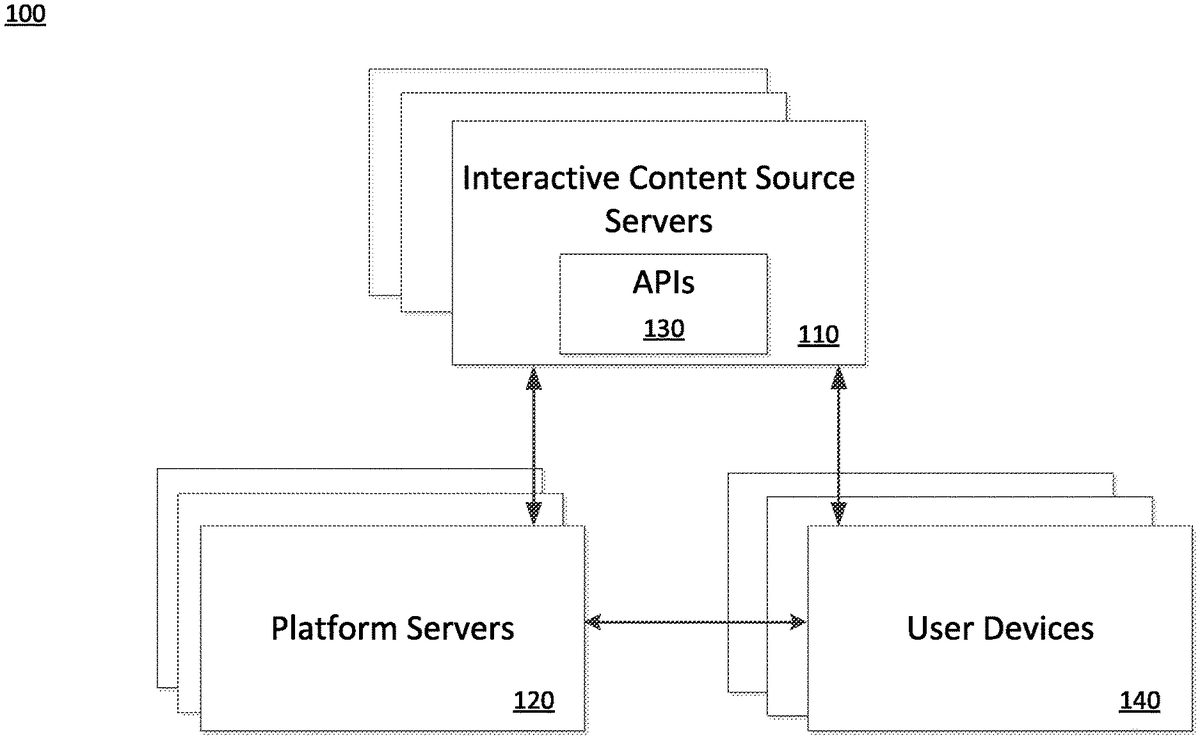
FIG. 1illustrates an exemplary network environment100in which a system for establishing and managing multiuser lead sessions can occur. The network environment100may include one or more interactive content source servers110that provide interactive content (e.g., video games, interactive video, etc.), platform servers120, and one or more user devices140.
Interactive content source servers110may maintain and host interactive content titles available for play to a user device140over a communication network. Such interactive content servers110may be implemented in the cloud (e.g., one or more cloud servers). Each interactive content title may include one or more activities available within the content title. The one or more activities may be playable by a single user or by multiple users. Each interactive content title may include one or more templates corresponding to one or more activities available within the content title. Each template may provide a structured data set regarding the corresponding activities and that may be used as the basis for tracking and displaying information regarding the corresponding activities in real-time. Each template may also provide data regarding establishing a lead session for multiuser interactions and for participation in multiple interactive contents as a single lead session. Such lead session may be implemented at the interactive content source servers110and/or the platform servers120.
In one example, the interactive content title is a video game title, and the one or more templates may correspond to different modes of competitive gameplay available within that game title. In another example, the one or more templates may correspond to different chapters of an interactive storyline. Each template may be associated with a portion of the interactive content title where the corresponding activity starts within the interactive content title. For example, the template may include a waypoint within a portion of a game (e.g., at a specific game environment location at a specific point in time in the game storyline) where an activity starts. In another example, the template may virtually teleport a character of the user to the location within the game environment that is closest to the start of the associated activity. The template may also be associated with establishing a lead session to group users for participation in the associated activity and to provide group management. Such template associated with the lead session may further provide activity requirements (e.g., number of players maximum and/or minimum, skill level and/or rank, character level and/or rank, user device requirements, etc.) required to launch the selected activity (e.g., competitive match). Each template may be updated, edited, or removed, or new templates may be created. The one or more templates may be stored at the interactive content source servers110or at platform server120and retrieved therefrom.
The platform servers120may be responsible for communicating with the different interactive content source servers110in order to establish and manage a lead session or a social session. Such platform servers120may be implemented on one or more cloud servers. The interactive content source servers110may communicate with multiple platform servers120. The platform servers120may also carry out instructions, for example, for establishing a lead session having lead session properties and a plurality of participant slots. Such lead session properties may be based off of the activity requirements (e.g., number of players maximum and/or minimum, type of skill, skill level and/or rank, type of character/role, character level and/or rank, user device requirements, etc.) of the template associated with the selected activity and/or user preference (e.g., limiting lead session to certain peers setting the lead session to private and/or by invite only, requiring a skill level to join, etc.). The lead session may be established by a platform server120associated with a user or a platform server120associated with a peer. Such lead session can include two or more users and can provide communication between the users (e.g., voice chat, direct messaging, text chat, screen sharing, video chat, etc.) within the lead session. The platform servers120may further carry out instructions, for example, to start or launch the selected activity and enter the lead session into the launched activity.
The interactive content titles and their corresponding activities may be provided through an application programming interface (API)130, which allows various types of interactive content source servers110to communicate with different platform servers120and different user devices140. API130may be specific to the particular computer programming language, operating system, protocols, etc., of the interactive content source servers110providing the interactive content titles, the platform servers120providing the associated templates, and user devices140receiving the same. In a network environment100that includes multiple different types of interactive content source servers110(or platform servers120or user devices140), there may likewise be a corresponding number of APIs130.
The user device140may include a plurality of different types of computing devices. For example, the user device140may include any number of different gaming consoles, mobile devices, laptops, and desktops. Such user devices140may also be configured to access data from other storage media, such as, but not limited to memory cards or disk drives as may be appropriate in the case of downloaded services. Such devices140may include standard hardware computing components such as, but not limited to network and media interfaces, non-transitory computer-readable storage (memory), and processors for executing instructions that may be stored in memory. These user devices140may also run using a variety of different operating systems (e.g., iOS, Android), applications or computing languages (e.g., C++, JavaScript). An exemplary user device140is described in detail herein with respect toFIG. 4.
In the exemplary network environment200ofFIG. 2, an exemplary social session202, an exemplary lead session204, an exemplary activity session206, and an exemplary interactive interface208are illustrated. A social session202may be established without an activity selection or without an activity template. Such social session202may be created at the platform server120by a user to group the user and peers (e.g., friends) together prior to an activity selection and to provide communication (e.g., voice chat, video chat, text chat, screen sharing, etc.) to the social session. A user of the social session202may receive an invitation to join a peer in an established lead session204to participate in an activity selected by the peer. A user of the social session202may also create a lead session204and invite peers to join such lead session204. Activities that the social session202may qualify for may be displayed on the interactive interface208to each of the user and the peers of the social session202for selection.
An exemplary lead session204may be established on the interactive content source servers110when a user selects an activity to participate in. Such lead session204may include lead session properties. The lead session properties may be based on at least the activity properties and/or user preferences (e.g., limiting lead session to certain peers setting the lead session to private and/or by invite only, requiring a skill level to join, etc.). The lead session204may further include a plurality of participant slots. Such participant slots may be based on the minimum and/or maximum number of players that can participate in the selected activity. Each participant slot may be occupied by a participant (e.g., a user or peer). Such participant may be required to satisfy the lead session properties to occupy a slot. For example, the lead session property may require a certain skill level to join, and the participant may possess such skill level, thereby allowing the participant to join the lead session and occupy a participant slot.
The lead session204may further include one or more spectator slots. Such spectator slots correspond to slots for viewing the activity during the lead session204interaction with the activity on spectator devices. The spectator slots may be restriction by some or all of the lead session properties (e.g., hardware and/or software requirements) or the spectator slots may not be restricted. Such spectator slots may not be added or generated until the selected activity has begun.
The lead session204can further include lead session history. Such lead session history may be based on past activities completed by the lead session and may include lead session data corresponding to each past activity (e.g., achievements and/or trophies earned by the lead session, activity run time, statistics related to the performance of the lead session in the activity, activity results, past leaders, past peers, etc.). Such lead session history may be displayed on an interactive interface of the user device140as part of a user profile or part of a session profile. Such lead session history can allow a former leader or peer to re-establish the session based on the lead session history. Such re-established lead session can include the same lead session properties previously established for the past lead session.
An exemplary activity session206may be established on the interactive content source servers110for the duration of a selected activity if a lead session204is lacking the required number of participants for the selected activity. Such activity session206may join the leader and peers of the lead session204to the activity session206and also join another lead session204or individual peers (e.g., peers not part of a lead session) to the activity session206until the activity requirements for the selected activity are fulfilled. For example, an activity may require twelve participants and a first lead session and a second lead session having six participants may be joined in an activity session.206After the selected activity is completed, the activity session206ends.
The leader and peers may remain in the lead session204, while participating in the activity session206. In other words, the lead session204remains intact during participation by the leader and the peers in the selected activity and the leader and the peers are simultaneous members of the lead session204and the activity session206. As such, the lead session204persists during and after the selected activity ends. Further, if the lead session204has open participant slots or open spectator slots, other peers may join the lead session204during an active activity. For example, while the leader and the current peers are participating in an activity, another peer can join the lead session204and can spectate or wait until the leader and the current peers complete the activity. In the same example, the other peer can join the activity if one of the leader or the current peers leaves the activity. Alternatively, the leader and the current peers may be added to the activity session206, and a placeholder may be established in the lead session204for each leader and peer until the activity is completed.
From either an established lead session204and/or an activity session, a user can join an established social session202or create a social session202. Further, session data related to activity session may be stored at the platform servers120and/or displayed at a social session202and/or on an interactive interface208.
An interactive interface208can be established by the platform servers120and can be displayed on the user devices140. Such interactive interface208may display available activities, user and/or peer data (e.g., current status, past history, etc.), or available lead sessions204to join. Such interactive interface208may also allow a user to create a social session202, join an established social session202, create a lead session204and invite peers, or join an existing lead session204.
FIG. 3is a flowchart illustrating an exemplary method300for establishing and managing multiuser lead sessions. The method300ofFIG. 3may be embodied as executable instructions in a non-transitory computer readable storage medium including but not limited to a CD, DVD, or non-volatile memory such as a hard drive. The instructions of the storage medium may be executed by a processor (or processors) to cause various hardware components of a computing device hosting or otherwise accessing the storage medium to effectuate the method. The execution of the instructions may be implemented on the cloud servers (e.g., the steps identified inFIG. 3are performed in the cloud). The steps identified inFIG. 3(and the order thereof) are exemplary and may include various alternatives, equivalents, or derivations thereof including but not limited to the order of execution of the same.
In step310, input regarding a selected activity associated with an interactive content title is received by the platform server120. Such activity may be an activity requiring multiple user participation (e.g., a dungeon, multi-user quest, competitive match, etc.). Such selection may occur while a user is participating in a different activity of the same or different interactive content title. Further, such selection may occur when the user is not participating in an activity.
In step320, an activity template may be retrieved by the platform server120or the interactive content servers110. Such activity template may be associated with the selected activity. Such activity template may also include data regarding activity properties (e.g., minimum number of participants, maximum number of participants, hardware and/or software required, user level requirements, etc.) of the selected activity required to start the activity.
In step330, a lead session204may be established by the platform servers120or the interactive content servers110. Such lead session204may include a plurality of participation slots corresponding to a maximum number of participants established by the activity template.
In step340, a user may be assigned as a leader of the lead session204by the platform servers120or the interactive content servers110. In one example, the first user to enter a lead session204is assigned leader of such lead session204. Such leader may have leadership responsibilities (e.g., adding or removing peers from the lead session, changing the privacy level of the lead session204(e.g., allowing peers to enter the lead session without an invite, requiring an invite to join the lead session, etc.), inviting peers to join the lead session, selecting another activity for the lead session to interact with, etc.). If the leader exits or drops out of the lead session204, one of a plurality of peers in the lead session204may be assigned as the leader. Such assignment may be based on the order of each peer joining the lead session204. For example, a peer that joined the lead session204first may be selected as the leader and the peer that joined the lead session204second may be next in line to be assigned the leader. Such assignment may be based on a leadership requirement (e.g., hardware and/or software requirements, peer experience, highest amount of playtime, achievements earned, etc.). For example, the leader may be required to have certain hardware to host an activity.
In step350, each of a plurality of peers may be added to each empty participant slot in accordance with leader input (e.g., express selections, preferences, profile information) as implemented by the platform servers120or the interactive content source servers110. The plurality of peers may be equal to the number of empty participant slots. Such plurality of peers may be added to the empty participant slots by the leader. The plurality of peers may alternatively be invited to join the lead session204and peers who accept the invitation may be added to the empty participant slots. Further, a peer may join a lead session204that is not restricted to invite-only. Such lead session204may include other restrictions that the peer has satisfied (e.g., the peer must be a “friend” of the leader). The plurality of peers may also be added by matchmaking. Such matchmaking may include matching at least one peer to the lead session204based on peer data (e.g., peer experience, peer skill, peer hardware and/or software, etc.) of each peer corresponding to one or more properties of the lead session204. Such matched peers may automatically added to the lead session204.
The plurality of peers may be part of social session202outside of an interactive content title (e.g., game), as described above. The social session202may receive an invitation to join a lead session204that is currently participating in an activity or will participate in the activity in the future by a leader or a peer of the lead session204. Such social session invitation may send an invitation to each peer in the social session202to join the lead session, wherein each peer may individually accept the invitation to join the lead session204. Once a user or a peer is added to a lead session204, the peer cannot be added to another lead session204without leaving the first lead session204. In other words, a user or a peer can only participate or spectate in one lead session204at a time.
In step360, the selected activity automatically initiated by the interactive content source servers110within the established lead session204by the platform servers120or the interactive content source servers110The lead session204can provide further communication between the users (e.g., voice chat, direct messaging, text chat, screen sharing, video chat, etc.) during interaction with the activity. After the interaction with the activity has ended or been completed, the existing lead session204can persist after leaving the activity. In other words, the participants of the lead session204remain together even after the activity has ended.
After the selected activity ends, the leader of the lead session204may then select another activity in the same interactive content title to participate in. Such selection of a new activity can modify the existing lead session204to satisfy the activity requirements of the new activity. For example, the new activity may require twelve participants while the former activity required six participants. In the same example, the lead session204may be modified to add six participant slots to the existing six participant slots, thus opening the lead session204to new peers. On the other hand, selection of a new activity may restrict the leader or one of the peers of the lead session204from participating in the new activity. For example, if the new activity allows five users, but the lead session204currently has six participants, then one of the participants will not participate in the activity. As such, the established lead session204can be maintained throughout multiple activities without establishing a new lead session204for each activity.
Moreover, if the leader selects an activity in a different interactive content title, the leader may first establish a new social session202and add each peer from the existing lead session204to the new social session202. The leader can then select an activity in a different interactive content title, thereby establishing a new lead session204within the new interactive content title and can add or invite the social session202to the lead session204, which adds or invites each peer within the new social session202to the new user session204. Such process allows the leader and peer to transition between interactive content titles or between an interactive content title and a platform while reducing risk of failed addition or invites of peers to lead sessions204.
Multiuser lead sessions as provided and described allow a group of user and peers to interact with multiple activities and/or titles without having to recreate the group of users in each different activity and/or interactive content title, thereby allowing the group of user and peers to maintain interaction with each other through multiple activities and periods between activities.
FIG. 4is an exemplary user electronic entertainment system that may be used in launching interactive content and providing dynamic interfaces. The entertainment system400ofFIG. 4includes a main memory405, a central processing unit (CPU)410, vector unit415, a graphics processing unit420, an input/output (I/O) processor425, an I/O processor memory430, a peripheral interface435, a memory card440, a Universal Serial Bus (USB) interface445, and a communication network interface450. The entertainment system400further includes an operating system read-only memory (OS ROM)455, a sound processing unit460, an optical disc control unit470, and a hard disc drive465, which are connected via a bus475to the I/O processor425.
Entertainment system400may be an electronic game console. Alternatively, the entertainment system400may be implemented as a general-purpose computer, a set-top box, a hand-held game device, a tablet computing device, a virtual reality device, an augmented reality device, or a mobile computing device or phone. Entertainment systems may contain more or less operating components depending on a particular form factor, purpose, or design.
The CPU410, the vector unit415, the graphics processing unit420, and the I/O processor425ofFIG. 4communicate via a system bus485. Further, the CPU410ofFIG. 4communicates with the main memory405via a dedicated bus480, while the vector unit415and the graphics processing unit420may communicate through a dedicated bus490. The CPU410ofFIG. 4executes programs stored in the OS ROM455and the main memory405. The main memory405ofFIG. 4may contain pre-stored programs and programs transferred through the I/O Processor425from a CD-ROM, DVD-ROM, or other optical disc (not shown) using the optical disc control unit470. I/O Processor425ofFIG. 4may also allow for the introduction of content transferred over a wireless or other communications network (e.g., 4G, LTE, 1G, and so forth). The I/O processor425ofFIG. 4primarily controls data exchanges between the various devices of the entertainment system400including the CPU410, the vector unit415, the graphics processing unit420, and the peripheral interface435.
The graphics processing unit420ofFIG. 4executes graphics instructions received from the CPU410and the vector unit415to produce images for display on a display device (not shown). For example, the vector unit415ofFIG. 4may transform objects from three-dimensional coordinates to two-dimensional coordinates, and send the two-dimensional coordinates to the graphics processing unit420. Furthermore, the sound processing unit460executes instructions to produce sound signals that are outputted to an audio device such as speakers (not shown). Other devices may be connected to the entertainment system400via the USB interface445, and the communication network interface450such as wireless transceivers, which may also be embedded in the system400or as a part of some other component such as a processor.
A user of the entertainment system400ofFIG. 4provides instructions via the peripheral interface435to the CPU410, which allows for use of a variety of different available peripheral devices (e.g., controllers) known in the art. For example, the user may instruct the CPU410to store certain game information on the memory card440or other non-transitory computer-readable storage media or instruct a character in a game to perform some specified action.
The present invention may be implemented in an application that may be operable by a variety of end user devices. For example, an end user device may be a personal computer, a home entertainment system (e.g., Sony PlayStation2® or Sony PlayStation3® or Sony PlayStation4®), a portable gaming device (e.g., Sony PSP® or Sony Vita®), or a home entertainment system of a different albeit inferior manufacturer. The present methodologies described herein are fully intended to be operable on a variety of devices. The present invention may also be implemented with cross-title neutrality wherein an embodiment of the present system may be utilized across a variety of titles from various publishers.
The present invention may be implemented in an application that may be operable using a variety of devices. Non-transitory computer-readable storage media refer to any medium or media that participate in providing instructions to a central processing unit (CPU) for execution. Such media can take many forms, including, but not limited to, non-volatile and volatile media such as optical or magnetic disks and dynamic memory, respectively. Common forms of non-transitory computer-readable media include, for example, a floppy disk, a flexible disk, a hard disk, magnetic tape, any other magnetic medium, a CD-ROM disk, digital video disk (DVD), any other optical medium, RAM, PROM, EPROM, a FLASHEPROM, and any other memory chip or cartridge.
Various forms of transmission media may be involved in carrying one or more sequences of one or more instructions to a CPU for execution. A bus carries the data to system RAM, from which a CPU retrieves and executes the instructions. The instructions received by system RAM can optionally be stored on a fixed disk either before or after execution by a CPU. Various forms of storage may likewise be implemented as well as the necessary network interfaces and network topologies to implement the same.
The foregoing detailed description of the technology has been presented for purposes of illustration and description. It is not intended to be exhaustive or to limit the technology to the precise form disclosed. Many modifications and variations are possible in light of the above teaching. The described embodiments were chosen in order to best explain the principles of the technology, its practical application, and to enable others skilled in the art to utilize the technology in various embodiments and with various modifications as are suited to the particular use contemplated. It is intended that the scope of the technology be defined by the claim.
Claims
- A method for establishing sessions, the method comprising: receiving input regarding a selected activity associated with an interactive content title;retrieving an activity template associated with the selected activity, the activity template including activity properties specifying at least a minimum number of participants to start the selected activity;establishing a session based at least on the activity properties, wherein the session has a plurality of participant slots based on the minimum number of participants specified by the retrieved activity template;assigning a user as a leader of the established session, the leader having leadership responsibilities including at least adding peers as participants in the session;adding each of a plurality of peers to each available participant slot in accordance with leader input;and initiating the selected activity within the established session;and maintaining the established session when a different activity is selected, the different activity associated with a different activity template specifying different session properties.
- The method of claim 1 , wherein adding each of the plurality of peers further includes: sending an invitation to each of the plurality of peers to join the session;and receiving an acceptance from at least one peer, wherein the at least one peer is added to one of the available participant slots based on the acceptance.
- The method of claim 2 , wherein adding each of the plurality of peers further includes automatically matching the plurality of invited peers to the established session based on peer data of each of the plurality of peers corresponding to one or more properties of the established session, the properties specified by the activity template.
- The method of claim 1 , wherein the plurality of participant slots associated with the established session is modified based on a different minimum number of participants specified by the different activity template.
- The method of claim 1 , further comprising storing session history in session memory, wherein the stored session history includes information regarding one or more past activities in the established session.
- The method of claim 5 , wherein the stored session history further includes leader data regarding participation by the leader in each past activity and peer data for each peer in each respective past activity.
- The method of claim 1 , wherein the established session further specifies a number of available spectator slots for spectator devices allowed to view the selected activity during the established session.
- The method of claim 1 , wherein establishing the session further includes providing voice chat among the leader and the added peers.
- The method of claim 1 , wherein the established session includes session properties that are based on leader preference.
- The method of claim 1 , further comprising assigning one of the added peers to be a next leader when a device of the leader drops out of the established session.
- The method of claim 10 , wherein assigning the next leader is based on an order in which each of the added peer was added to the established session.
- A system for establishing sessions, the system comprising: memory that stores a plurality of interactive content titles and at least one activity template associated with each of the interactive content titles;and a processor that executes instructions stored in memory, wherein execution of the instructions by the processor: receives input regarding a selected activity associated with one of the interactive content titles stored in memory;retrieves an activity template associated with the selected activity from the at least one activity template, the activity template including activity properties specifying at least a minimum number of participants to start the selected activity;establishes a session based at least on the activity properties, wherein the session has a plurality of participant slots based on the minimum number of participants specified by the retrieved activity template;assigns a user as a leader of the established session, the leader having leadership responsibilities including at least adding peers as participants in the session;adds each of a plurality of peers to each available participant slot in accordance with leader input;initiates the selected activity within the established session and maintains the established session when a different activity is selected, the different activity associated with a different activity template specifying different session properties.
- The system of claim 12 , wherein the processor executes instructions to add each of the plurality of peers by: sending an invitation to each of the plurality of peers to join the session;and receiving an acceptance from at least one peer, wherein the at least one peer is added to one of the available participant slots based on the acceptance.
- The system of claim 13 , wherein the processor executes instructions to add each of the plurality of peers by automatically matching the plurality of invited peers to the established session based on peer data of each of the plurality of peers corresponding to one or more properties of the established session, the properties specified by the activity template.
- The system of claim 12 , wherein the plurality of participant slots associated with the established session is modified based on a different minimum number of participants specified by the different activity template.
- The system of claim 12 , the processor executes further instructions to store session history in session memory, wherein the stored session history includes information regarding one or more past activities in the established session.
- The system of claim 16 , wherein the session history further includes leader data regarding participation by the leader in each past activity and peer data for each peer in each respective past activity.
- A non-transitory computer-readable medium having embodied thereon a program executable by a processor to perform a method for establishing sessions, the method comprising: receiving input regarding a selected activity associated with an interactive content title;retrieving an activity template associated with the selected activity, the activity template including activity properties specifying at least a minimum number of participants to start the selected activity;establishing a session based at least on the activity properties, wherein the session has a plurality of participant slots based on the minimum number of participants specified by the retrieved activity template;assigning a user as a leader of the established session, the leader having leadership responsibilities including at least adding peers as participants in the session;adding each of a plurality of peers to each available participant slot in accordance with leader input;initiating the selected activity within the established session;and maintaining the established session when a different activity is selected, the different activity associated with a different activity template specifying different session properties.
- The method of claim 18 , wherein adding each of the plurality of peers further includes: sending an invitation to each of the plurality of peers to join the session;and receiving an acceptance from at least one peer, wherein the at least one peer is added to one of the available participant slots based on the acceptance, wherein adding each of the plurality of peers further includes automatically matching the plurality of invited peers to the established session based on peer data of each of the plurality of peers corresponding to one or more properties of the established session, the properties specified by the activity template.
- The method of claim 18 , wherein the plurality of participant slots associated with the established session is modified based on a different minimum number of participants specified by the different activity template.
- The method of claim 18 , wherein the plurality of participant slots associated with the established session is modified based on a different minimum number of participants specified by the different activity template.
Disclaimer: Data collected from the USPTO and may be malformed, incomplete, and/or otherwise inaccurate.