U.S. Pat. No. 10,664,990
Modular Virtual Reality Tracking System for a Game Console Play Area
AssigneeSONY INTERACTIVE ENTERTAINMENT LLC
Issue DateSeptember 25, 2017
Illustrative Figure
Abstract
The disclosure provides methods and systems for modular virtual reality tracking of an object in a play area. An example system includes a first tracking module located at a first place and configured to capture a first image of a play area and obtain first coordinates of the object relative to the first place. The system may include at least one second tracking module located at a second place different from the first place and configured to capture a second image of the play area and obtain second coordinates of the object relative to the second place. The system may include a processing unit configured to receive the first coordinates from the first tracking unit and the second coordinates from the second tracking unit and continuously track the object while the object is within the boundaries of at least one of the first image and the second image.
Description
DETAILED DESCRIPTION The following detailed description includes references to the accompanying drawings, which form a part of the detailed description. The drawings show illustrations in accordance with example embodiments. These example embodiments, which are also referred to herein as “examples,” are described in enough detail to enable those skilled in the art to practice the present subject matter. The embodiments can be combined, other embodiments can be utilized, or structural, logical, and electrical changes can be made without departing from the scope of what is claimed. The following detailed description is therefore not to be taken in a limiting sense, and the scope is defined by the appended claims and their equivalents. In this document, the terms “a” and “an” are used, as is common in patent documents, to include one or more than one. In this document, the term “or” is used to refer to a nonexclusive “or,” such that “A or B” includes “A but not B,” “B but not A,” and “A and B,” unless otherwise indicated. The techniques of the embodiments disclosed herein can be implemented using a variety of technologies. For example, the methods described herein are implemented in software executing on a computer system or in hardware utilizing either a combination of microprocessors or other specially designed application-specific integrated circuits (ASICs), programmable logic devices, or various combinations thereof. In particular, the methods described herein are implemented by a series of computer-executable instructions residing on a storage medium such as a disk drive, or computer-readable medium. It should be noted that methods disclosed herein can be implemented by a cellular phone, smart phone, computer (e.g., a desktop computer, tablet computer, laptop computer), game console, handheld gaming device, and so forth. In general, various embodiments of the present disclosure are directed to methods and systems for ...
DETAILED DESCRIPTION
The following detailed description includes references to the accompanying drawings, which form a part of the detailed description. The drawings show illustrations in accordance with example embodiments. These example embodiments, which are also referred to herein as “examples,” are described in enough detail to enable those skilled in the art to practice the present subject matter. The embodiments can be combined, other embodiments can be utilized, or structural, logical, and electrical changes can be made without departing from the scope of what is claimed. The following detailed description is therefore not to be taken in a limiting sense, and the scope is defined by the appended claims and their equivalents. In this document, the terms “a” and “an” are used, as is common in patent documents, to include one or more than one. In this document, the term “or” is used to refer to a nonexclusive “or,” such that “A or B” includes “A but not B,” “B but not A,” and “A and B,” unless otherwise indicated.
The techniques of the embodiments disclosed herein can be implemented using a variety of technologies. For example, the methods described herein are implemented in software executing on a computer system or in hardware utilizing either a combination of microprocessors or other specially designed application-specific integrated circuits (ASICs), programmable logic devices, or various combinations thereof. In particular, the methods described herein are implemented by a series of computer-executable instructions residing on a storage medium such as a disk drive, or computer-readable medium. It should be noted that methods disclosed herein can be implemented by a cellular phone, smart phone, computer (e.g., a desktop computer, tablet computer, laptop computer), game console, handheld gaming device, and so forth.
In general, various embodiments of the present disclosure are directed to methods and systems for modular virtual reality tracking. The tracking can be made based on an analysis of images and/or depth data of a play area. The images and/or depth data can be obtained from image sensor(s) of at least two tracking modules. Various embodiments of the present disclosure may allow identification of an object in a play area. Various embodiments may further allow tracking the object in the play area in situations when the object leaves boundaries of an image captured by one of the tracking modules while being within boundaries of at least one more tracking module.
Further tracking modules can be added to either increase the play area by spreading the tracking modules out or to increase tracking quality by overlapping the same play area from multiple locations and angles.
According to an example embodiment, a method for modular virtual reality tracking may include capturing, by a first tracking module located at a first place, a first image of the play area. The method may further include analyzing, by the first tracking module, the first image to obtain first coordinates of the object in play area. The first coordinates can be associated with the first place. The method may further include capturing, by at least one second tracking module located at second place different from the first place, a second image of the play area. The method may further include analyzing, the second image to obtained second coordinates of the object. The second coordinates can be associated with the second place. The method may further include receiving, by a processing unit communicatively coupled to the first tracking module and the at least one second tracking module, at least the first coordinates and the second coordinates of the object. The method may include continuously tracking, by the processing unit and based at least one of the first coordinates and the second coordinates, the object in the play area while the object is within boundaries of at least one of the first image or the second image.
With reference now to the drawings,FIG. 1is an example system100suitable for implementation of various aspects of the present technology, in accordance with an embodiment of the disclosure. The system100may include a first tracking module110, at least one second tracking module120, and a processing unit130.
According to embodiments of the present disclosure, the first and second tracking modules110and120can be placed at different locations and directions relative to a play area. The first tracking module110can be configured to capture a first image of a play area. The second tracking module120can be configured to capture a second image of the same play area. The first image and the second image may represent, correspondently, a first part and a second part of the play area. In some embodiments, the first part may include an overlapping area with the second part. In some embodiments, the first tracking module110may be configured to analyze the first image in order to obtain first coordinates of an object in the play area. The second tracking module can be configured to analyze the second image to obtain second coordinates of the same object. The first coordinates of the object can be relative to a location and a direction of the first tracking module110. The second coordinates of the object can be relative to the location and the direction of the second tracking module120.
In various embodiments, the first tracking module110and the second tracking module120can be communicatively coupled with the processing unit130. The processing unit130may be configured to acquire, simultaneously in real time, the first coordinates of the object obtained by the first tracking module110and the second coordinates of the object obtained by the second tracking module120. In certain embodiments, the processing unit130may also be configured to receive color data of the object and metadata of the object from both the first tracking module110and the second tracking module120.
In some embodiments, the object may include a static object or a moving object present in the play area. In the example ofFIG. 1, the object may include a user140or a controller150. The object may include points of a skeleton of the user140.
When the object can move within the play area, it may be out of view of either the first tracking module110or the second tracking module120. In some embodiments, the processing unit130can be configured to determine a location of the object relative to the first tracking module110in a situation when the object leaves the boundaries of the first image of the play area captured by the first tracking module110. This determination can be carried out when the following conditions are met: 1) the object is still within boundaries of the second image of the play area captured by the second tracking module120, so that the second coordinates of the object can be determined by the second tracking module; and 2) the location of the second tracking module120relative to the first tracking module110is known or previously determined.
In various embodiments of the present disclosure, the first tracking module110and/or the second tracking module120may include a PlayStation, a game console, a smart phone, a tablet computer, a desktop or a laptop computer equipped with a web camera, and the like.
In various embodiments, the processing unit130may include hardware (e.g., dedicated logic, programmable logic, and microcode), software (such as software run on a general-purpose computer system or a dedicated machine), or a combination of both. In some example embodiments, the processing unit130may reside at the play area. In another example embodiment, the processing unit130may reside at a remote place.
FIG. 2is a block diagram showing components of an example first tracking module110(or at least one second tracking module120) suitable for employing methods for modular virtual reality tracking, according to some embodiments of the disclosure.
The first tracking module110may include a communication module210, a computing unit220, and an image sensor230. In some embodiments, the first tracking module110may also include a depth sensor240.
In certain embodiments, the image sensor230is a device that converts an optical image into an electronic signal. The image sensor230may include, for instance, one or more video cameras that are sensitive to the visual range, infrared (1R) cameras sensitive in one of the IR bands, (ultraviolet) UV cameras or other direct or indirect image-generating sensor systems (for example, radar or laser radar (lidar)).
In certain embodiments, the depth sensor240may be configured to capture video data in3D under any ambient light conditions. The sensing range of the depth sensor240can be adjustable and automatically calibrated based on a physical environment and accommodating for the presence of furniture or other obstacles. Images from the depth sensor240and the image sensor230can be combined by data fusion.
In certain embodiments, the computing unit220is configured to process images of the play area received from the image sensor230and/or the depth sensor240to obtain data according to a pre-determined format. The data may include coordinates of points in the images of the play area and, optionally, color of points in the images of the play area
The communication module210may be configured to operatively communicate with the processing unit130shown inFIG. 1. In certain embodiments, the communication module210is configured to transmit data related to the images of a play area captured by the image sensor230and/or the depth sensor240to the processing unit130. The data may include the coordinates and/or of points in the images.
FIG. 3is a schematic showing a mechanism for calibrating of tracking modules300, according to some example embodiments. In some embodiments, upon receiving the data related to the first image of the play area from the first module110and data related to the at least one second image of the play area from at least one second module120, the processing unit130may be configured to couple the first tracking module110and at least the second tracking module120. The processing unit130may be configured to assign the first tracking module110as a master module and the second tracking module as an assisting module. In some embodiments, the processing unit130is configured to determine location and orientation of the second tracking module120relative to location of the first tracking module110. For example, the processing unit130may be configured to determine a transformation matrix for translating coordinates of a point relative to the second tracking module to coordinates relative to the first tracking module.
In various embodiments, the processing unit130may be configured to analyze the data related to the first image captured by the first tracking module110and the data related to the at least one second image captured by at least one second tracking module120to identify at least three common points310,320, and330. In some embodiments, the common points310,320, and330may belong to the same object in the play area. In certain embodiments, the identification may be based on a color of the points. For example, when tracking movement of a controller with a light ball, the first and second tracking modules110and120can be configured to report the color of the light ball to the processing unit130. This may provide processing unit130enough information to determine if the first and second tracking modules110and120are reporting the same object.
In some embodiments, if color based identification is not available, the identification of common points can be based on comparison of movement of the points over time in the images reported by the first tracking module110and at least one second tracking module120.
If a skeletal tracking is being performed, the identification of common points may be based on locations and orientations of the skeletal joints in the data of images reported by the first tracking module110and at least one second tracking module120. The locations and orientations of the skeletal joints should be unique enough to differentiate between two skeletons.
After identifying at least three common points310,320, and330, the processing unit130can be further configured to determine location and orientation of the first and second tracking modules110and120relative to each other.
In some embodiments, the processing unit130may be configured to assign a first matrix360(also referred to as first identity matrix360) to the first tracking module110and a second matrix370(also referred to as second identity matrix370) to the at least one second tracking module120. The first matrix360and the second matrix370can be initially assigned the same values.
The second matrix370can be further transformed so that the coordinates of first common point310reported by the second tracking module120are aligned to the coordinates of the first common point310as reported by the first tracking module110when the second matrix370is applied to the coordinates of the points relative to the second tracking module120.
The second matrix370can be further rotated around the first common point310so that the coordinates of the second common point320as reported by the second tracking module120are aligned to the coordinates of the second common point320as reported by the first tracking module110when the second matrix370is applied to the coordinates of the points relative to the second tracking module120.
The second matrix370can be further rotated around an axis350drawn from the first common point310and the second common point320so the coordinates of the third common point330as reported by the second tracking module120are aligned to the coordinates of the third common point330when the second matrix370is applied to the coordinates of the points relative to the second tracking module120.
In some embodiments, additional common points can be used to increase the robustness of the calibration of the tracking modules.
Once the first tracking module110and the at least one second tracking module120are calibrated, the processing unit can be configured to translate coordinates of points of a tracked object as reported by at least one second module120to coordinates associated with the first tracking module110. In this way, the location of the tracked object in the play area can be determined relative to the first tracking module110(the main tracking module) when the tracked object leaves the view of the first racking module110but is still in view of at least one of the second tracking module120(the assisting tracking module).
In some embodiments, the selection of the main tracking module can be based on a time of arrival of images from the tracking modules to the processing unit130(that is, which of the tracking modules registers first). In some further embodiments, when registering, the tracking modules can be configured to send the boundaries of tracking areas to the processing unit130. The processing unit130can be configured to, for example, select the main tracking module based on boundaries of the tracking area of the tracking modules.
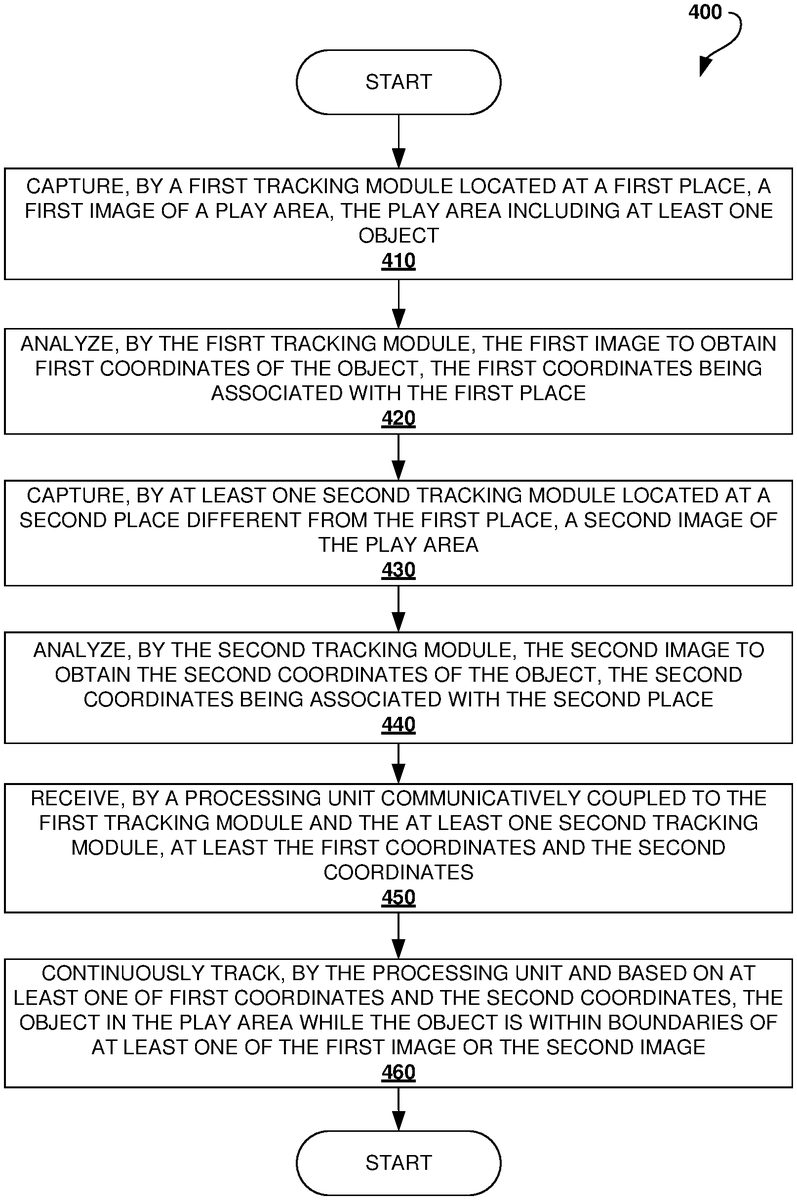
FIG. 4is a flow chart showing a method400for modular virtual reality tracking, according to an example embodiment. The method400can be implemented by elements of system100shown inFIG. 1.
The method400may commence in block410, with capturing, by the first tracking module110, a first image of a play area. The play area may include at least one object. The first tracking module110can be located at a first place.
In block420, the method400may proceed with analyzing, by the first tracking module110, the first image to obtain first coordinates of the at least one object in the play area. The first coordinates can be associated with the first place.
In block430, the method400may include capturing, by at least one second tracking module120, a second image of the play area. The second tracking module can be located at a second place. The location of the second tracking module120may be different from the location of the first tracking module110.
In block440, the method400may proceed with analyzing, by the at least one second tracking module120, the second image to obtain second coordinates of the at least one object in the play area. The second coordinates can be associated with the second place, therefore, the first tracking module110and the second tracking module120may provide coordinates of the at least one object in the play area from different locations and directions.
In block450, the method400may include receiving, by the processing unit130communicatively coupled to the first tracking module110and the second tracking module120, at least the first coordinates and the second coordinates of the at least one object in the play area.
In some embodiments, the method400may include (not shown inFIG. 4) also receiving, by the processing unit, color data of the object and metadata of the object from both the first tracking module110and the second tracking module120.
In block460, the method400may include continuously tracking, by the processing unit130and based at least on one of the first coordinates and the second coordinates, the at least one object in the play area while the at least one object is within the boundaries of either the first image or the second image.
FIG. 5is a flow chart showing a method500for modular virtual reality tracking, in accordance with some embodiments of the disclosure. The method500can be implemented by elements of system100shown inFIG. 1. The method500may be used to couple the first tracking module110and the second tracking module120the first time the modules communicate to the processing unit130.
As shown inFIG. 5, the method500may commence in block510, with determining, by the processing unit130, that at least three first points in the first image and at least three second points in the second image represent the same three points of an object in the play area. The determination of common points in the first image and the second image can be based on a color of the points, comparison of movement of the points, and location of the points relative to each other.
In block520, the method500may include determining, by the processing unit130, based on the at least three points in the first image and the three second points in the second image, a transformation matrix for translating coordinates associated with the second tracking module120to coordinates associated with the first tracking module110.
In block530, the method500may include transforming, by the processing unit130and using a transformation matrix, at least one point of the second image into a further point of the first image. The coordinates of the point relative to the second tracking module120can be translated to coordinates of the point relative to the first tracking module110in situations when the first tracking module110does not capture the point, but the point is captured by the second tracking module120.
FIG. 6shows a diagrammatic representation of a computing device for a machine in the example electronic form of a computer system600, within which a set of instructions for causing the machine to perform any one or more of the methodologies discussed herein can be executed. In example embodiments, the machine operates as a standalone device, or can be connected (e.g., networked) to other machines. In a networked deployment, the machine can operate in the capacity of a server, a client machine in a server-client network environment, or as a peer machine in a peer-to-peer (or distributed) network environment. The machine can be a personal computer (PC), tablet PC, set-top box (STB), PDA, cellular telephone, portable music player (e.g., a portable hard drive audio device, such as a Moving Picture Experts Group Audio Layer 3 (MP3) player), web appliance, network router, switch, bridge, or any machine capable of executing a set of instructions (sequential or otherwise) that specify actions to be taken by that machine. Further, while only a single machine is illustrated, the term “machine” shall also be taken to include any collection of machines that separately or jointly execute a set (or multiple sets) of instructions to perform any one or more of the methodologies discussed herein.
The example computer system600includes a processor or multiple processors605(e.g., a central processing unit (CPU), a graphics processing unit (GPU), or both), and a main memory610and a static memory615, which communicate with each other via a bus620. The computer system600can further include a video display unit625(e.g., a LCD or a cathode ray tube (CRT)). The computer system600also includes at least one input device630, such as an alphanumeric input device (e.g., an keyboard), a cursor control device (e.g., a mouse), a microphone, a digital camera, a video camera, and so forth. The computer system600also includes a disk drive unit635, a signal generation device640(e.g., a speaker), and a network interface device645.
The drive unit635(also referred to as the disk drive unit635) includes a machine-readable medium650(also referred to as a computer-readable medium650), which stores one or more sets of instructions and data structures (e.g., instructions655) embodying or utilized by any one or more of the methodologies or functions described herein. The instructions655can also reside, completely or at least partially, within the main memory610and/or within the processors605during execution thereof by the computer system600. The main memory610and the processor(s)605also constitute machine-readable media.
The instructions655can further be transmitted or received over a communications network660via the network interface device645utilizing any one of a number of well-known transfer protocols (e.g., Hyper Text Transfer Protocol (HTTP), CAN, Serial, and Modbus). The communications network660includes the Internet, local intranet, Personal Area Network (PAN), Local Area Network (LAN), Wide Area Network (WAN), Metropolitan Area Network (MAN), virtual private network (VPN), storage area network (SAN), frame relay connection, Advanced Intelligent Network (AlN) connection, synchronous optical network (SONET) connection, digital T1, T3, E1 or E3 line, Digital Data Service (DDS) connection, Digital Subscriber Line (DSL) connection, Ethernet connection, Integrated Services Digital Network (ISDN) line, cable modem, Asynchronous Transfer Mode (ATM) connection, or an Fiber Distributed Data Interface (FDDI) or Copper Distributed Data Interface (CDDI) connection. Furthermore, communications also includes links to any of a variety of wireless networks including Wireless Application Protocol (WAP), General Packet Radio Service (GPRS), Global System for Mobile Communication (GSM), Code Division Multiple Access (CDMA) or Time Division Multiple Access (TDMA), cellular phone networks, Global Positioning System (GPS), cellular digital packet data (CDPD), Research in Motion, Limited (RIM) duplex paging network, Bluetooth radio, or an IEEE 802.11-based radio frequency network.
While the machine-readable medium650is shown in an example embodiment to be a single medium, the term “computer-readable medium” should be taken to include a single medium or multiple media (e.g., a centralized or distributed database, and/or associated caches and servers) that store the one or more sets of instructions. The term “computer-readable medium” shall also be taken to include any medium that is capable of storing, encoding, or carrying a set of instructions for execution by the machine and that causes the machine to perform any one or more of the methodologies of the present application, or that is capable of storing, encoding, or carrying data structures utilized by or associated with such a set of instructions. The term “computer-readable medium” shall accordingly be taken to include, but not be limited to, solid-state memories, optical and magnetic media. Such media can also include, without limitation, hard disks, floppy disks, flash memory cards, digital video disks, random access memory (RAM), read only memory (ROM), and the like.
The example embodiments described herein can be implemented in an operating environment comprising computer-executable instructions (e.g., software) installed on a computer, in hardware, or in a combination of software and hardware. The computer-executable instructions can be written in a computer programming language or can be embodied in firmware logic. If written in a programming language conforming to a recognized standard, such instructions can be executed on a variety of hardware platforms and for interfaces to a variety of operating systems. Although not limited thereto, computer software programs for implementing the present method can be written in any number of suitable programming languages such as, for example, Hypertext Markup Language (HTML), Dynamic HTML, XML, Extensible Stylesheet Language (XSL), Document Style Semantics and Specification Language (DSSSL), Cascading Style Sheets (CSS), Synchronized Multimedia Integration Language (SMIL), Wireless Markup Language (WML), Java™, Jini™, C, C++, C#, .NET, Adobe Flash, Perl, UNIX Shell, Visual Basic or Visual Basic Script, Virtual Reality Markup Language (VRML), ColdFusion™ or other compilers, assemblers, interpreters, or other computer languages or platforms.
Thus, the technology for modular virtual reality tracking is disclosed. Although embodiments have been described with reference to specific example embodiments, it will be evident that various modifications and changes can be made to these example embodiments without departing from the broader spirit and scope of the present application. Accordingly, the specification and drawings are to be regarded in an illustrative rather than a restrictive sense.
Claims
- A system comprising: a first tracking module having an image sensor, the first tracking module being configured to: capture, using the image sensor located at a first place, a first image of a play area, the play area including at least one object;and analyze the first image to obtain first coordinates of the at least one object, wherein the first coordinates are associated with the first place;at least one second tracking module having at least one other image sensor, the at least one second tracking module being configured to: capture, using the at least one other image sensor located at a second place, a second image of the play area, wherein the second place differs from the first place;and analyze the second image to obtain second coordinates of the at least one object, wherein the second coordinates are associated with the second place;and a processing unit communicatively coupled to at least part of the first tracking module and at least part of the at least one second tracking module, the processing unit being configured to: receive, simultaneously in real time from the first tracking module and the second tracking module respectively, at least the first coordinates and the second coordinates;and continuously track, based at least on one of the first and the second coordinates, the at least one object in the play area while the at least one object is within boundaries of at least one of the first image or the second image.
- The system of claim 1 , wherein the processing unit is further configured to determine, based on at least on the first coordinates and the second coordinates, a location and an orientation of the at least one second tracking module relative to the first tracking module.
- The system of claim 1 , wherein the processing unit is further configured to determine, based at least on the first coordinates and the second coordinates, a transformation matrix for translating the second coordinates into the first coordinates.
- The system of claim 3 , wherein the processing unit is further configured to transform at least one point of the second image into at least one point of the first image using the transformation matrix.
- The system of claim 3 , wherein the processing unit is further configured to: determine that at least three first points (A1, A2, A3) in the first image and at least three second points (B1, B2, B3) in the second image represent the same three points of the at least one object in the play area;associate an identity matrix with the at least one second tracking module;and apply at least one operation to the identity matrix, thereby obtaining the transformation matrix, wherein (B1, B2, B3) are translated to (A1, A2, A3) using the transformation matrix.
- The system of claim 5 , wherein the at least one operation includes: a translation to align B1 to A1;a first rotation around B1 to align B2 to A2;and a second rotation around an axis between B1 and B2 to align B3 to A
- The system of claim 5 , wherein the determination that (A1, A2, A3) and (B1, B2, B3) represent the same three points of the at least one object is based on matching colors of the at least three first points and the at least three second points.
- The system of claim 5 , wherein the determination that (A1, A2, A3) and (B1, B2, B3) represent the same three points of the at least one object is based on matching movements of the at least three first points and the at least three second points.
- The system of claim 5 , wherein the determination that (A1, A2, A3) and (B1, B2, B3) represent the same three points of the at least one object is based on matching relative positions of the at least three first points and the at least three second points.
- The system of claim 1 , wherein one of the first tracking module and the at least one second tracking module includes a game console, a smart phone, a tablet computer, a desktop computer, a laptop computer, or a handheld gaming device.
- A method for tracking an object in a play area, the method comprising: capturing, by a first tracking module having an image sensor, a first image of the play area, wherein the image sensor is located at a first place;analyzing, by the first tracking module, the first image to obtain first coordinates of the object, wherein the first coordinates are associated with the first place;capturing, by at least one second tracking module having at least one other image sensor, a second image of the play area, wherein the at least one other image sensor is located at a second place, the second place being different from the first place;analyzing, by the at least one second tracking module, the second image to obtain second coordinates of the object, wherein the second coordinates are associated with the second place;receiving simultaneously in real time from the first tracking module and the second tracking module respectively, by a processing unit communicatively coupled to at least part of the first tracking module and at least part of the at least one second tracking module, at least the first coordinates and the second coordinates;and continuously tracking, by the processing unit and based at least on one of the first coordinates and the second coordinates, the object in the play area while the object is within boundaries of at least one of the first image or the second image.
- The method of claim 11 , further comprising determining, by the processing unit and based at least on the first coordinates and the second coordinates, a position and an orientation of the at least one second tracking module relative to the first tracking module.
- The method of claim 11 , further comprising determining, by the processing unit and based at least on the first coordinates and the second coordinates, a transformation matrix for translating the second coordinates to the first coordinates.
- The method of claim 13 , further comprising transforming, by the processing unit and using the transformation matrix, at least one point of the second image into at least one point of the first image.
- The method of claim 13 , wherein the determining the transformation matrix includes: determining, by the processing unit, that at least three first points (A1, A2, A3) in the first image and at least three second points (B1, B2, B3) in the second image represent the same three points of the object in the play area;associating, by the processing unit, an identity matrix with the at least one second tracking module;and applying at least one operation to the identity matrix, thereby obtaining the transformation matrix, wherein (B1, B2, B3) are translated to (A1, A2, A3) using the transformation matrix.
- The method of claim 15 , wherein the at least one operation includes: a translation to align B1 to A1;a first rotation around B1 to align B2 to A2;and a second rotation around an axis between B1 and B2 to align B3 to A
- The method of claim 15 , wherein the determination that (A1, A2, A3) and (B1, B2, B3) represent the same three points of the object is based on matching a color of the at least three first points and the at least three second points.
- The method of claim 15 , wherein the determination that (A1, A2, A3) and (B1, B2, B3) represent the same three points of the object is based on matching movement of the at least three first points and the at least three second points.
- The method of claim 15 , wherein the determination that (A1, A2, A3) and (B1, B2, B3) represent the same three points of the object is based on matching relative positions of the at least three first points and the at least three second points.
- A system for tracking an object in a play area, the system comprising: a first tracking module having an image sensor, the first tracking module being configured to: capture, using the image sensor located at a first place, a first image of the play area;and analyze the first image to obtain first coordinates of the object, wherein the first coordinates are associated with the first place;at least one second tracking module having at least one other image sensor, the at least one second tracking module being configured to: capture, using the at least one other image sensor located at a second place, a second image of the play area, wherein the second place differs from the first place;and analyze the second image to obtain second coordinates of the object, wherein the second coordinates are associated with the second place;and a processing unit communicatively coupled to at least part of the first tracking module and at least part of the at least one second tracking module, the processing unit being configured to: receive, simultaneously in real time, at least the first and the second coordinates;determine, based at least on the received first coordinates, and the second coordinates, that at least three first points in the first image and at least three second points in the second image represent the same at least three points of the object;determine, based on the at least three first points and the at least three second points, a transformation matrix for translating the second coordinates to the first coordinates;and continuously track, based at least on one of the first coordinates and the second coordinates, the object in the play area, and while tracking the object: determining that the object leaves boundaries of the first image and the object is within the at least one second image;and if the object leaves boundaries of the first image, determining object coordinates of the object relative to the at least one second tracking module and translating, using the transformation matrix, the object coordinates to further object coordinates relative to the first tracking module.
- A system for tracking an object in a play area, the system comprising: a first tracking module having an image sensor, the first tracking module being configured to: capture, using the image sensor located at a first place, a first image of the play area;and analyze the first image to obtain first coordinates of the object, wherein the first coordinates are associated with the first place;at least one second tracking module having at least one other image sensor, the at least one second tracking module being configured to: capture, using the at least one other image sensor located at a second place, a second image of the play area, wherein the second place differs from the first place;and analyze the second image to obtain second coordinates of the object, wherein the second coordinates are associated with the second place;and a processing unit communicatively coupled to at least part of the first tracking module and at least part of the at least one second tracking module, the processing unit being configured to: receive, simultaneously in real time, at least the first and the second coordinates;determine, based at least on the received first coordinates, and the second coordinates, that at least three first points in the first image and at least three second points in the second image represent the same at least three points of the object;determine, based on the at least three first points and the at least three second points, a transformation matrix for translating the second coordinates to the first coordinates;and continuously track, based at least on one of the first coordinates and the second coordinates, the object in the play area, and while tracking the object: determining that the object leaves boundaries of the first image and the object is within the at least one second image;and if the object leaves boundaries of the first image, determining object coordinates of the object relative to the at least one second tracking module and translating, using the transformation matrix, the object coordinates to further object coordinates relative to the first tracking module.
Disclaimer: Data collected from the USPTO and may be malformed, incomplete, and/or otherwise inaccurate.