U.S. Pat. No. 10,661,178
NON-TRANSITORY STORAGE MEDIUM HAVING STORED THEREIN INFORMATION PROCESSING PROGRAM, INFORMATION PROCESSING DEVICE, INFORMATION PROCESSING METHOD, AND INFORMATION PROCESSING SYSTEM FOR POSSESSING A VIRTUAL CHARACTER IN A VIRTUAL SPACE
AssigneeNintendo Co., Ltd.
Issue DateMarch 29, 2018
Illustrative Figure
Abstract
A game system includes an input receiving unit (71) that receives input by a player, an operated character changing unit (722) that changes an object to be assigned as an operated object that is operated in response to the input received with the input receiving unit (71) among objects in a virtual space between a PC and an NPC, and an NPC control unit (723) that controls the NPC using a first control method while the NPC is not assigned as the operated object. During a period until a predetermined condition is satisfied after an object to serve as the operated object is changed from the NPC to the PC by the operated character changing unit (722), the NPC control unit (723) controls the NPC using a second control method different from the first control method.
Description
DETAILED DESCRIPTION OF NON-LIMITING EXAMPLE EMBODIMENTS Hereinafter, an embodiment of the present disclosure will be described with reference to the drawings. The embodiment described below is an example when the present disclosure is carried out and the present disclosure is not limited to a specific configuration described below. When the present disclosure is carried out, a specific configuration according to the embodiment may be appropriately adopted. Hereinafter, a game system according to an example of the present embodiment will be described. An example of a game system1in the present embodiment includes a main body apparatus (information processing apparatus, functioning as a game apparatus main body in the present embodiment)2, a left controller3, and a right controller4. The left controller3and the right controller4are individually detachable from the main body apparatus2. Specifically, the game system1may be used as an integrated apparatus by attaching each of the left controller3and the right controller4to the main body apparatus2. Moreover, in the game system1, the main body apparatus2and the left controller3and the right controller4can be used separately (refer toFIG. 2). In the following, a hardware configuration of the game system1according to the present embodiment will be described, and the control of the game system1of the present embodiment will then be described. FIG. 1is a diagram illustrating an example of a state in which the left controller3and the right controller4are attached to the main body apparatus2. As illustrated inFIG. 1, the left controller3and the right controller4are attached to and integrated with the main body apparatus2. The main body apparatus2is an apparatus configured to execute various types of processing (for example, game processing) in the game system1. The main body apparatus2includes a display12. Each of the left controller3and the right controller4is an apparatus including an operation unit used by a user to perform input. FIG. 2is a diagram ...
DETAILED DESCRIPTION OF NON-LIMITING EXAMPLE EMBODIMENTS
Hereinafter, an embodiment of the present disclosure will be described with reference to the drawings. The embodiment described below is an example when the present disclosure is carried out and the present disclosure is not limited to a specific configuration described below. When the present disclosure is carried out, a specific configuration according to the embodiment may be appropriately adopted.
Hereinafter, a game system according to an example of the present embodiment will be described. An example of a game system1in the present embodiment includes a main body apparatus (information processing apparatus, functioning as a game apparatus main body in the present embodiment)2, a left controller3, and a right controller4. The left controller3and the right controller4are individually detachable from the main body apparatus2. Specifically, the game system1may be used as an integrated apparatus by attaching each of the left controller3and the right controller4to the main body apparatus2. Moreover, in the game system1, the main body apparatus2and the left controller3and the right controller4can be used separately (refer toFIG. 2). In the following, a hardware configuration of the game system1according to the present embodiment will be described, and the control of the game system1of the present embodiment will then be described.
FIG. 1is a diagram illustrating an example of a state in which the left controller3and the right controller4are attached to the main body apparatus2. As illustrated inFIG. 1, the left controller3and the right controller4are attached to and integrated with the main body apparatus2. The main body apparatus2is an apparatus configured to execute various types of processing (for example, game processing) in the game system1. The main body apparatus2includes a display12. Each of the left controller3and the right controller4is an apparatus including an operation unit used by a user to perform input.
FIG. 2is a diagram illustrating an exemplary state in which the left controller3and the right controller4are removed from the main body apparatus2. As illustrated inFIGS. 1 and 2, the left controller3and the right controller4are detachable from the main body apparatus2. In the following description, the left controller3and the right controller4will be collectively referred to as the “controller” in some cases.
FIG. 3is a six-sided view illustrating an example of the main body apparatus2. As illustrated inFIG. 3, the main body apparatus2includes a substantially plate-like housing11. In the present embodiment, a main surface of the housing11(in other words, a front-side surface, that is, the surface on which the display12is provided) is substantially rectangular in shape.
The shape and size of the housing11are arbitrary. For example, the housing11may be formed in a mobile size. Moreover, the main body apparatus2alone and the integrated apparatus in which the left controller3and the right controller4are attached to the main body apparatus2may be a mobile apparatus. The main body apparatus2or the integrated apparatus may be a handheld apparatus. Alternatively, the main body apparatus2or the integrated apparatus may be a portable apparatus.
As illustrated inFIG. 3, the main body apparatus2includes a display12provided on the main surface of the housing11. The display12displays an image generated by the main body apparatus2. In the present embodiment, the display12is a liquid crystal display (LCD). Note that the display12may be any type of display apparatus.
The main body apparatus2includes a touch panel13on a screen of the display12. In the present embodiment, the touch panel13uses a system capable of multi-touch input (for example, capacitance system). Note that the touch panel13may use any system, for example, a system capable of single touch input (for example, resistive film system).
The main body apparatus2includes a speaker (that is, a speaker88illustrated inFIG. 6) inside the housing11. As illustrated inFIG. 3, speaker holes11aand11bare formed on the main surface of the housing11. The output sound of the speaker88is output from each of the speaker holes11aand11b.
Moreover, the main body apparatus2includes a left side terminal17as a terminal used by the main body apparatus2to perform wired communication with the left controller3, and a right side terminal21used by the main body apparatus2to perform wired communication with the right controller4.
As illustrated inFIG. 3, the main body apparatus2includes a slot23. The slot23is provided on the upper side surface of the housing11. The slot23has a shape that enables a predetermined type of storage medium to be attached. The storage medium is, for example, a storage medium (for example, a dedicated memory card) dedicated to the game system1and the information processing apparatus of the same type as the game system1. The predetermined type of storage medium is used for storing, for example, one or both of the data (for example, saved data of an application) used in the main body apparatus2and a program (for example, an application program) executed in the main body apparatus2. Moreover, the main body apparatus2includes a power button28.
The main body apparatus2includes a lower terminal27. The lower terminal27is a terminal used by the main body apparatus2to communicate with a cradle. In the present embodiment, the lower terminal27is a USB connector (more specifically, a female connector). When the integrated apparatus or the main body apparatus2alone is mounted on the cradle, the game system1can display an image generated and output by the main body apparatus2, on the stationary monitor. Moreover, in the present embodiment, the cradle has a function of charging the above-described integrated apparatus or the main body apparatus2alone mounted on the cradle. The cradle also has a function of a hub apparatus (specifically, a USB hub).
FIG. 4is a six-sided view illustrating an example of the left controller3. As illustrated inFIG. 4, the left controller3includes a housing31. In the present embodiment, the housing31has a vertically long shape, that is, a long shape in the vertical direction (that is, in the y-axis direction illustrated inFIGS. 1 and 4). The left controller3can also be held in a vertically long orientation in a state detached from the main body apparatus2. The housing31has a shape and size that can be held with one hand, in particular with the left hand, in a case of being held in a vertically long orientation. Moreover, the left controller3can also be held in a landscape orientation. In the case where the left controller3is held in a landscape orientation, it may be held with both hands.
The left controller3includes an analog stick32. As illustrated inFIG. 4, the analog stick32is provided on the main surface of the housing31. The analog stick32can be used as a direction input unit capable of inputting a direction. By inclining the analog stick32, the user can input a direction corresponding to the inclination direction (and input with a size corresponding to the inclined angle). Instead of the analog stick, the left controller3may include a cross key or a slide stick capable of slide input may be provided as the direction input unit. Moreover, an input by pressing the analog stick32is possible in the present embodiment.
The left controller3includes various operation buttons. The left controller3includes four operation buttons33to36(specifically, a right direction button33, a down direction button34, an up direction button35, and a left direction button36) on the main surface of the housing31. Furthermore, the left controller3includes a recording button37and a − (minus sign) button47. The left controller3includes a first L button38and a ZL button39on the upper left of the side surface of the housing31. The left controller3also includes a second L button43and a second R button44on the side surface of the housing31, the side to be attached when it is attached to the main body apparatus2. These operation buttons are used to give instructions according to various programs (for example, OS program and application program) executed by the main body apparatus2.
Moreover, the left controller3includes a terminal42used by the left controller3to perform wired communication with the main body apparatus2.
FIG. 5is a six-sided view illustrating an example of the right controller4. As illustrated inFIG. 5, the right controller4includes a housing51. In the present embodiment, the housing51has a vertically long shape, that is, a long shape in the vertical direction. The right controller4can also be held in a vertically long orientation in a state detached from the main body apparatus2. The housing51has a shape and size that can be held with one hand, in particular with the right hand, in a case of being held in a vertically long orientation. Moreover, the right controller4can also be held in a landscape orientation. In the case where the right controller4is held in a landscape orientation, it may be held with both hands.
Similarly to the left controller3, the right controller4includes an analog stick52as a direction input unit. In the present embodiment, the analog stick52has the same configuration as the analog stick32of the left controller3. Instead of the analog stick, the right controller4includes a cross key or a slide stick capable of inputting a slide or the like may be provided. Similarly to the left controller3, the right controller4includes four operation buttons53to56(specifically, A button53, B button54, X button55, and Y button56) on the main surface of the housing51. Furthermore, the right controller4includes a + (plus sign) button57and a home button58. The right controller4also includes a first R button60and a ZR button61on the upper right of the side surface of the housing51. Similarly to the left controller3, the right controller4includes a second L button65and a second R button66.
Moreover, the right controller4includes a terminal64used by the right controller4to perform wired communication with the main body apparatus2.
FIG. 6is a block diagram illustrating an example of the internal configuration of the main body apparatus2. In addition to the configuration illustrated inFIG. 3, the main body apparatus2includes individual components81to91,97and98illustrated inFIG. 6. Some of these components81to91,97and98may be mounted on an electronic circuit board as electronic components and stored in the housing11.
The main body apparatus2includes a processor81. The processor81is an information processing unit that executes various types of information processing to be executed in the main body apparatus2, and may be constituted only by a CPU (Central Processing Unit), for example, or it may be constituted by a system-on-a-chip (SoC) including a plurality of functions such as a CPU function and a GPU (Graphics Processing Unit) function. The processor81executes various types of information processing by executing an information processing program (for example, a game program) stored in a storage unit (specifically, an internal storage medium such as a flash memory84or an external storage medium attached to the slot23, or the like).
The main body apparatus2includes the flash memory84and a dynamic random access memory (DRAM)85as an exemplary internal storage medium incorporated in oneself. The flash memory84and the DRAM85are connected to the processor81. The flash memory84is mainly used for storing various data (or may be programs) stored in the main body apparatus2. The DRAM85is a memory used for temporarily storing various data used in information processing.
The main body apparatus2includes a slot interface (hereinafter abbreviated as “I/F”)91. The slot I/F91is connected to the processor81. The slot I/F91is connected to the slot23, and performs reading and writing of data from/into a predetermined type of storage medium (for example, a dedicated memory card) attached to the slot23in accordance with an instruction of the processor81.
The processor81appropriately reads or writes data to and from the flash memory84and the DRAM85and the individual storage media, thereby executing the above-described information processing.
The main body apparatus2includes a network communication unit82. The network communication unit82is connected to the processor81. The network communication unit82performs communication (specifically, wireless communication) with an external apparatus via a network. In the present embodiment, the network communication unit82communicates with an external apparatus using a wireless LAN connection with a method conforming to the Wi-Fi standard as a first communication mode. Moreover, the network communication unit82performs wireless communication with another main body apparatus2of the same type by a predetermined communication method (for example, communication based on a proprietary protocol or infrared communication) as a second communication mode. Note that the wireless communication according to the second communication mode is capable of performing wireless communication with another main body apparatus2arranged in a closed local network area and achieves a function enabling “local communication” of transferring data by directly communicating among a plurality of main body apparatuses2.
The main body apparatus2includes a controller communication unit83. The controller communication unit83is connected to the processor81. The controller communication unit83performs wireless communication with one or both of the left controller3and the right controller4. While it is allowable to use any communication system between the main body apparatus2and the left controller3and between the main body apparatus2and the right controller4, the present embodiment uses communication conforming to Bluetooth (registered trademark) standard to be used for communication by the controller communication unit83with the left controller3and with the right controller4.
The processor81is connected to the left side terminal17, the right side terminal21, and the lower terminal27described above. In a case of performing wired communication with the left controller3, the processor81transmits data to the left controller3via the left side terminal17and receives operation data from the left controller3via the left side terminal17. Moreover, in a case of performing wired communication with the right controller4, the processor81transmits data to the right controller4via the right side terminal21and receives operation data from the right controller4via the right side terminal21. Moreover, in a case of communicating with the cradle, the processor81transmits data to the cradle via the lower terminal27. In this manner, in the present embodiment, the main body apparatus2can perform both wired communication and wireless communication with the left controller3and the right controller4. Moreover, in a case where the integrated apparatus including the left controller3and the right controller4attached to the main body apparatus2is attached to the cradle or where the main body apparatus2alone is attached to the cradle, the main body apparatus2can output data (for example, image data and sound data) to the stationary monitor, or the like, via the cradle.
Note that the main body apparatus2can communicate simultaneously (in other words, in parallel) with a plurality of left controllers3. Moreover, the main body apparatus2can communicate simultaneously (in other words, in parallel) with a plurality of right controllers4. This makes it possible to perform inputs by the user into the main body apparatus2using the plurality of left controllers3and the plurality of right controllers4.
The main body apparatus2includes a touch panel controller86as a circuit for controlling the touch panel13. The touch panel controller86is connected between the touch panel13and the processor81. The touch panel controller86generates, for example, data indicating a position of input of a touch input on the basis of a signal from the touch panel13and outputs the generated data to the processor81.
Moreover, the display12is connected to the processor81. The processor81displays on the display12one or both of the generated image (for example, by executing the above information processing) and the image obtained from the outside.
The main body apparatus2includes a coder/decoder (codec) circuit87and speakers (specifically, a left speaker and a right speaker)88. The codec circuit87is connected to the speaker88and a sound input/output terminal25, and is also connected to the processor81. The codec circuit87is a circuit for controlling input and output of sound data to and from the speaker88and the sound input/output terminal25.
The main body apparatus2includes a power control unit97and a battery98. The power control unit97is connected to the battery98and the processor81. Although not illustrated, the power control unit97is connected to each of portions of the main body apparatus2(specifically, each of portions receiving the power supply of the battery98, the left side terminal17, and the right side terminal21). The power control unit97controls power supply from the battery98to each of the above-described portions on the basis of a command from the processor81.
Moreover, the battery98is connected to the lower terminal27. In a case where an external charging apparatus (for example, a cradle) is connected to the lower terminal27and the power is supplied to the main body apparatus2via the lower terminal27, the supplied power is charged in the battery98.
FIG. 7is a block diagram illustrating an exemplary internal configuration of the main body apparatus2, the left controller3, and the right controller4. Note that details of the internal configuration related to the main body apparatus2are omitted inFIG. 7because they are illustrated inFIG. 6.
The left controller3includes a communication control unit101that communicates with the main body apparatus2. As illustrated inFIG. 7, the communication control unit101is connected to each of components including the terminal42. In the present embodiment, the communication control unit101can communicate with the main body apparatus2by both wired communication via the terminal42and wireless communication not via the terminal42. The communication control unit101controls a communication method performed by the left controller3on the main body apparatus2. That is, in a case where the left controller3is attached to the main body apparatus2, the communication control unit101communicates with the main body apparatus2via the terminal42. In contrast, in a case where the left controller3is detached from the main body apparatus2, the communication control unit101performs wireless communication with the main body apparatus2(specifically, the controller communication unit83). Wireless communication between the controller communication unit83and the communication control unit101is performed in accordance with the Bluetooth (registered trademark) standard, for example.
Moreover, the left controller3includes a memory102such as a flash memory. The communication control unit101is formed with, for example, a microcomputer (also referred to as a microprocessor) and executes various types of processing by executing firmware stored in the memory102.
The left controller3includes individual buttons103(specifically, buttons33to39,43,44,46, and47). The left controller3also includes the analog stick32(described as “stick” inFIG. 7). Individual buttons103and the analog stick32repeatedly output information related to the operation performed on oneself to the communication control unit101at an appropriate timing.
The communication control unit101obtains information related to the input (specifically, information related to the operation or a detection result by the sensor) from each of input units (specifically, the individual buttons103, the analog stick32, the sensors104and105). The communication control unit101transmits the operation data including the obtained information (or the information obtained by performing predetermined processing on the obtained information) to the main body apparatus2. The operation data is repeatedly transmitted at a rate of once every predetermined time. The interval at which the information related to the input is transmitted to the main body apparatus2may either be the same or not the same for individual input units.
With transmission of the above-described operation data to the main body apparatus2, the main body apparatus2can obtain the input performed onto the left controller3. That is, the main body apparatus2can distinguish the operation onto the individual buttons103and the analog stick32on the basis of the operation data.
The left controller3includes a power supply unit108. In the present embodiment, the power supply unit108includes a battery and a power control circuit. Although not illustrated, the power control circuit is connected to the battery and is also connected to each of portions of the left controller3(specifically, each of portions receiving power supply of the battery).
As illustrated inFIG. 7, the right controller4includes a communication control unit111that communicates with the main body apparatus2. The right controller4also includes a memory112connected to the communication control unit111. The communication control unit111is connected to each of the components including the terminal64. The communication control unit111and the memory112have the functions similar to the functions of the communication control unit101and the memory102of the left controller3. Accordingly, the communication control unit111can communicate with the main body apparatus2in both wired communication via the terminal64and wireless communication not via the terminal64(specifically, communication conforming to the Bluetooth (registered trademark) standard) and controls the communication method performed by the right controller4onto the main body apparatus2.
The right controller4includes individual input units similar to the individual input units of the left controller3. Specifically, the right controller4includes the individual buttons113and the analog stick52. Each of these input units has functions similar to individual input units of the left controller3and operates in the similar manner.
The right controller4includes a power supply unit118. The power supply unit118has functions similar to the functions of the power supply unit108of the left controller3and operates in the similar manner.
Next, the control of the game system1of the present embodiment will be described.FIGS. 8 to 11are diagrams illustrating examples of game screens. An outline of a game executed in the game system1will be described with reference toFIGS. 8 to 11. As illustrated inFIG. 8, in this game, a PC10and an NPC20are set in a virtual space. Note that, although the examples inFIGS. 8 to 11simply illustrate one NPC20, a plurality of NPCs20may be set in the virtual space. The PC10wears a hat object30.
By operating the controller, a player can move the PC10in the virtual space and cause the PC10to execute various actions. One of actions executable by the PC10is a motion of throwing the hat object30(hat throwing motion). In the hat throwing motion, the hat object30attached to the head of the PC10is discharged from the PC10to proceed by a predetermined distance and then returns to the PC10to be attached again to the head of the PC10.
The NPC20moves in accordance with a game program and, when an action execution condition is satisfied, executes a corresponding action. Actions executed by the NPC20include a motion of moving so as to approach the PC10, a motion of moving so as to go away from the PC10, a motion of attacking the PC10, and a motion of doing damage to the PC10that has made contact therewith. Attacks include a direct attack against the PC10and an attack that throws a flying tool like a hammer to the PC10.
When the hat object30discharged from the PC10hits the NPC20as illustrated inFIG. 9, the PC10possesses the NPC20as illustrated inFIG. 10. The PC10disappears from the game screen because of this possession and the NPC20is displayed as an NPC20′ incorporating some elements of the PC10such that it can be seen that the PC10has possessed the NPC20. While the PC10possesses the NPC20, the player can operate the NPC20′ possessed by the PC10instead of the PC10. In addition, it is possible to release the possession by the PC10such that the PC10leaves the NPC20′.
FIG. 11illustrates a state in which the PC10has left the NPC20′ possessed by the PC10. The PC10enters the game screen because of this leaving and the NPC20′ returns to the original NPC20. At this time, the PC10appears in the vicinity of the NPC20. Alternatively, the PC10may appear in the vicinity of the NPC20by animation such as that the PC10jumps out from the NPC20′ possessed by the PC10.
As for the NPC20, during a predetermined time period after this leaving, NPC20is placed in a stunned state so as to stop at the current place without moving and also stop an attack to the PC10and not to do damage to the PC10even if the PC10makes contact therewith. As a result, the PC10that appeared in the vicinity of the NPC20is not immediately attacked by the NPC20and receives no damage even if the PC10makes contact therewith. Additionally, since the NPC20is stopped without moving, it is also easy for the PC10to possess the NPC20again. When the predetermined time period elapses, the NPC20moves as originally and restarts an attack to the PC10, for example.
Next, the configuration of the game system1for performing the game control as described above will be described.FIG. 12is a block diagram illustrating a functional configuration of the game system1. The game system1includes an input receiving unit71, a game control unit72, and a screen generation unit73. The left terminal17, the right terminal21, and the touch panel controller86of the main body device2illustrated in FIG.6correspond to the input receiving unit71. The game control unit72and the screen generation unit73are implemented by the processor81of the main body device2illustrated inFIG. 6executing the game program stored in a storage medium mounted in the slot23or the flash memory84.
The input receiving unit71receives an input made by the player operating the left controller3, the right controller4, and the touch panel13. The game control unit72controls the game according to input received by the input receiving unit71in accordance with the game program. The game control unit72includes a PC control unit721, an operated character changing unit722, and an NPC control unit723. The screen generation unit73generates a game screen reflecting the results of the game processing of the game control unit72, including PC control processing in the PC control unit721, operated character changing processing in the operated character changing unit722, and NPC control processing in the NPC control unit723and outputs the generated game screen to the display.
The operated character changing unit722changes an object assigned as an operated object to be operated in response to input received by the input receiving unit71among objects in the virtual space, between the PC10and the NPC20. The operated character changing unit722assigns the PC10as the operated object at the start of the game.
Once the operated character changing unit722sets the PC10as the operated object, the PC control unit721controls the behavior of the PC10in the virtual space in accordance with input received by the input receiving unit71. Specifically, when the input receiving unit71receives the input of a movement direction, the PC control unit721moves the PC10in accordance with this movement direction in the virtual space and, when the input receiving unit71receives the input of the hat throwing motion, the PC control unit721causes the PC10to execute the hat throwing motion. In this manner, the PC10is operated in response to input received by the input receiving unit71so as to move and execute various actions in the virtual space.
While the PC10is assigned as the operated object, the NPC control unit723controls the NPC20in accordance with the game program. A control method for the NPC20by the NPC control unit723in this case is hereinafter referred to as a “first control method”. The first control method is a control method for a normal state while the NPC20is not assigned as the operated object. For example, the NPC control unit723moves the NPC20toward the PC10and controls the NPC20such that the NPC20attacks the PC10when a predetermined action condition is satisfied (for example, when a distance between the NPC20and the PC10becomes smaller than a predetermined value).
When the hat throwing motion illustrated inFIG. 9is performed in a case where the PC10is assigned as the operated object, the operated character changing unit722judges whether the thrown hat object30has hit the NPC20. When it is judged that the hat object30discharged from the PC10has hit the NPC20, the operated character changing unit722changes an object to serve as the operated object from the PC10to the NPC20.
Once the NPC20is assigned as the operated object, the operated character changing unit722first erases the display of the PC10and changes the picture of the NPC20to a picture incorporating elements of the PC10such that the fact that the NPC20is serving as the operated object is visually distinguishable. The NPC20whose picture has been changed because of the possession in this manner is denoted as “NPC20′” (refer toFIG. 10). In the example inFIG. 10, the mustache that the PC10had is incorporated into the NPC20′, elements of the PC10are also incorporated into the arms of the NPC20′, and the shape of the head of the NPC20′ has a shape such as when the PC10and the NPC20are combined. By this change in character, the player can recognize, during the game, that the NPC20is possessed by the PC10(the PC10has possessed the NPC20) and accordingly the NPC20is assigned as the operated object.
Once the operated character changing unit722sets the NPC20as the operated object, the NPC control unit723controls the behavior of the NPC20′ in the virtual space in accordance with input received by the input receiving unit71. As a result, the NPC20′ is operated in response to input received by the input receiving unit71so as to move and execute various actions in the virtual space.
Note that, although the display of the PC10is erased when the NPC20is assigned as the operated object, in the game processing, the game control unit72performs processing such that the PC10moves to accompany the NPC20′. Thus, for example, in a case where the NPC20′ falls to a falling death judgment area in the virtual space, also the PC10falls with the NPC20′ and the game control unit72performs game processing that the PC10fell and died.
The player can release the possession of the NPC20. In the present embodiment, the player can release the possession by pressing the B button54of the right controller4. When the input receiving unit71receives input of pressing of the B button54while the NPC20is in a possessed state, the operated character changing unit722changes a character to serve as the operated object from the NPC20to the PC10.
Once the PC10is assigned as the operated object, the operated character changing unit722causes the PC10to appear in the vicinity of the NPC20′. Since the NPC20′ is no longer the operated object, the NPC control unit723returns the picture of the NPC20′ to the original picture and assigns the NPC20′ as the NPC20(refer toFIG. 11).
Once the operated character changing unit722changes a character to serve as the operated object from the NPC20to the PC10, the PC control unit721controls the behavior of the PC10in the virtual space in accordance with input received by the input receiving unit71.
During a period until a predetermined condition is satisfied after an object to serve as the operated object is changed from the NPC20to the PC10by the operated character changing unit722, the NPC control unit723controls the NPC using a control method different from the first control method. A control method for the NPC20by the NPC control unit723in this case is hereinafter referred to as a “second control method”. For example, the NPC control unit723uses the second control method to stop the NPC20at the current place and to control the NPC20such that the NPC20also stops an attack against the PC10and does not do damage to the PC10even if the PC10makes contact therewith.
When the predetermined condition is satisfied, the NPC control unit723switches from the second control method (for example, stop at the current place, no attack, doing no damage) to the first control method (for example, moving to follow the PC10, attacking the PC10, and doing damage to the PC10that has made contact therewith) to control the NPC20. In the present embodiment, the predetermined condition for switching from the second control method to the first control method is that a predetermined time period (for example, three seconds) has elapsed since the PC10leaves the NPC20. That is, the NPC control unit723stops the NPC20at the current place for the predetermined time period after the possession of the NPC20by the PC10is released and the PC10appears near the NPC20.
In a case where the NPC20is controlled by the second control method, when it is judged that the PC10has performed the hat throwing motion and the hat object30has hit the NPC20, the operated character changing unit722again changes an object to serve as the operated object from the PC10to the NPC20. That is, the change of the operated object is permitted irrespective of whether the NPC20is controlled using the first control method or the second control method and the operated character changing unit722changes an object to serve as the operated object from the PC10to the NPC20when judging that the hat object30has hit the NPC20.
The NPC control unit723controls the NPC20by the second control method different from the first control method after the possession is released such that the PC10is not immediately attacked by the NPC20located near the PC10after the possession is released and additionally, since the NPC20is stopped without moving under the second control method, it is easy to possess the NPC20again. Incidentally, as this control of the NPC20after the release of the possession (leaving), the second control method may shift to the first control method gradually in such a manner that, for example, the attack is stopped for three seconds and the movement is stopped for five seconds.
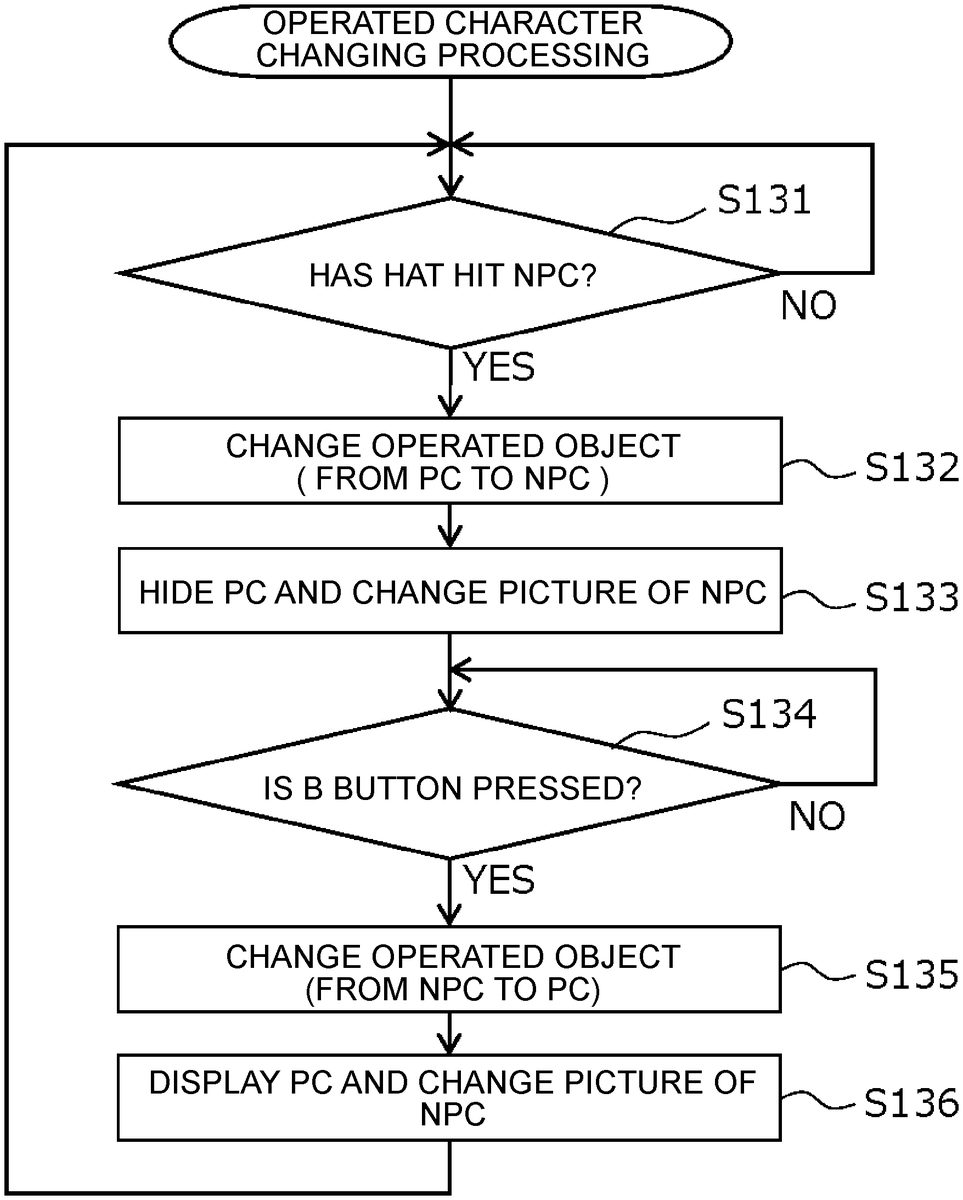
FIG. 13is a flowchart of the operated character changing processing performed by the operated character changing unit722. As described earlier, the PC10is initially assigned as the operated object at the start of the game. The operated character changing unit722judges whether the hat object30has hit the NPC20(step S131). When the hat object30has not hit the NPC20(NO in step S131), this judgment is repeated.
When it is judged that the hat object30has hit the NPC20(YES in step S131), the operated character changing unit722changes a character to serve as the operated object from the PC10to the NPC20(step S132). Then, the operated character changing unit722hides the PC10and changes the picture of the NPC20to assign the NPC20as the NPC20′ (step S133).
Next, the operated character changing unit722judges whether the B button54for releasing the possession is pressed (step S134). When the B button54has not been pressed (NO in step S134), this judgment is repeated. When the B button54is pressed (YES in step S134), the operated character changing unit722changes a character to serve as the operated object from the NPC20to the PC10(step S135). Then, the operated character changing unit722displays the PC10that has been hidden and changes the NPC20′ to return to the original picture (step S136). Thereafter, the processing returns to step S131.
FIG. 14is a flowchart of the PC control processing performed by the PC control unit721. The PC control unit721judges whether the PC10is assigned as the operated object (step S141). When the PC10is assigned as the operated object (YES in step S141), the PC control unit721controls the behavior of the PC10in accordance with input received by the input receiving unit71(step S142). When the PC10is not assigned as the operated object (NO in step S141), the PC control unit721controls such that the hidden PC10moves to accompany the NPC20(step S143).
FIG. 15is a flowchart of the NPC control processing performed by the NPC control unit723. The NPC control unit723judges whether the NPC20is assigned as the operated object (step S151). When the NPC20is not assigned as the operated object (NO in step S151), the NPC control unit723controls the behavior of the NPC20using the first control method (step S152). When the NPC20is assigned as the operated object (YES in step S151), the NPC control unit723controls the behavior of the NPC20in accordance with input received by the input receiving unit71(step S153).
Then, the NPC control unit723judges whether the NPC20has been assigned as the operated object (step S154). When the NPC20is assigned as the operated object (YES in step S154), the NPC control unit723continues the control (step S153) of the NPC20in accordance with input received by the input receiving unit71.
When the assignment of the NPC20as the operated object is canceled by the operated character changing unit722(NO in step S154) while the NPC20is controlled in accordance with input received by the input receiving unit71(step S153), a timer is started (step S155) and the behavior of the NPC20is controlled using the second control method (step S156). Then, the NPC control unit723judges whether the elapsed time of the timer has reached the predetermined time period (step S157). When the predetermined time period has not elapsed (NO in step S157), the control of the NPC20by the second control method is continued. When the predetermined time period has elapsed (YES in step S157), the timer is reset (step S158) and the processing returns to step S151.
As described above, according to the game system1of the present embodiment, when the possession is released (leaving) (NO in step S154) after the PC10possesses the NPC20and the PC10is hidden, although the PC10appears in the vicinity of the NPC20, the NPC20is caused to stop until the predetermined time period elapses so as not to attack the PC10and not to do damage to the PC10even if the PC10makes contact therewith. Therefore, the PC10that has appeared because of the release of the possession is not immediately attacked by the NPC20located in the vicinity or receives no damage therefrom and additionally, since the NPC20is stopped, the possession again becomes easy.
In the above embodiment, under the control for the normal state by the first control method, the NPC20is caused, in accordance with the game program, to follow the PC10, move so as to go away from the PC10, attack the PC10under a predetermined condition, or do damage to the PC10when the PC10makes contact therewith. Meanwhile, under the control immediately after leaving by the second control method, moving, attacking, and doing damage by the NPC20is stopped. That is, in the second control method, the NPC20is controlled so as to be advantageous to the player (the PC10). The control of the NPC20advantageous to the player in this manner is not limited to the above example. Hereinafter, a modification of the second control method for the NPC20will be described.
FIGS. 16 to 19are diagrams illustrating examples of the game screens for explaining the modification of the second control method for the NPC20. As illustrated inFIG. 16, in the virtual space, a shore object B1on the near side and a shore object B2on the far side are set with a river therebetween and the PC10is located on the shore object B1on the near side. The NPC20in the form of a cloud is floating on the river and the NPC20is positioned beside the shore object B1. That is, the NPC20is floating on the river with the position illustrated inFIG. 16as a fixed position.
The PC10cannot proceed through the river or on the river. The PC10can possess the NPC20by making contact with the NPC20. When the PC10possesses the NPC20, as in the above embodiment, the picture of the NPC20is changed to a picture incorporating elements of the PC10in part and the NPC20becomes the NPC20′. In this state, the player can cross the river by operating the NPC20′.
In addition, the player can release the possession by pressing the B button54. When the possession is released at a time point at which the NPC20′ proceeds across the river and arrives at the shore object B2, as illustrated inFIG. 18, the picture of the NPC20′ returns to that of the NPC20and the PC10appears in the vicinity of the NPC20on the shore object B2. Since the NPC20′ has returned to the NPC20, the NPC20′ is supposed to return to a position20aas the fixed position when the original control is resumed. However, until the predetermined condition is satisfied, the NPC20left by the PC10stays at the position at that time or in the vicinity thereof and, when the predetermined condition is satisfied, returns to the fixed position20a.
Here, in the present modification, the control in which the NPC20stays at the position at the time of leaving by the PC10is the second control method and the control in which the NPC20stays at the fixed position20ais the first control method. In this example, the predetermined condition for the NPC20, for which the possession is released, to return to the fixed position20ais that the PC10that has appeared because of leaving is separated from the NPC20by a predetermined distance or more. In the example inFIG. 19, since the PC10is separated from the NPC20that has been left by the PC10by a predetermined distance or more, the NPC20has returned to the fixed position20a.
The PC10can possess the NPC20again by making contact with the NPC20positioned beside the shore object B2. After the NPC20is possessed, the NPC20is transformed into the NPC20′ to be assigned as the operated object. When the player operates the NPC20′ to cause the NPC20′ to arrive at the shore object B1and releases the possession at this time point, the NPC20′ is transformed into the NPC20and at the same time the PC10appears in the vicinity of the NPC20on the shore object B1.
As described above, in the present modification, the PC10can possess the NPC20and cross the river to land on the shore object B2on the far side, while also being able to possess the NPC20to return to the shore object B1from the shore object B2. At this time, when the PC10leaves the NPC20′ on the shore object B2on the far side, if the normal control is immediately resumed such that the NPC20moves to the fixed position20a, the PC10who has landed on the shore object B2can no longer come back to the shore object B1. Therefore, the NPC20is designed to stop at the leaving position or the vicinity thereof after the PC10leaves the NPC20until the PC10is separated from the NPC20to an adequate extent.
This modification also can be implemented by the configuration of the game system1illustrated inFIG. 12. In addition, the flows of the processing by the operated character changing unit722and the PC control unit721are the same as the flows inFIG. 13andFIG. 14, respectively. However, in the present modification, it is judged in step S131whether the PC10has made contact with the NPC20.
FIG. 20is a flowchart of the NPC control processing performed by the NPC control unit723of the present modification. The NPC control unit723judges whether the NPC20is assigned as the operated object (step S201). When the NPC20is not assigned as the operated object (NO in step S201), the NPC control unit723controls the behavior of the NPC20using the first control method (step S202). That is, the NPC control unit723causes the NPC20to stay at the fixed position20a. When the NPC20is assigned as the operated object (YES in step S201), the NPC control unit723controls the behavior of the NPC20in accordance with input received by the input receiving unit71(step S203).
Then, the NPC control unit723judges whether the NPC20has been assigned as the operated object (step S204). When the NPC20is assigned as the operated object (YES in step S204), the NPC control unit723continues the control (step S203) of the NPC20in accordance with input received by the input receiving unit71.
When the assignment of the NPC20as the operated object is canceled by the operated character changing unit722(NO in step S204) while the NPC20is controlled in accordance with input received by the input receiving unit71(step S203), the NPC control unit723controls the behavior of the NPC20using the second control method (step S205). Then, the NPC control unit723judges whether the PC10has been separated from the NPC20by the predetermined distance or more (step S206). When the PC10is located within the predetermined distance from the NPC20(NO in step S206), the control of the NPC20by the second control method is continued and, when the PC10is separated from the NPC20by the predetermined distance or more (YES in step S206), the processing returns to step S201.
As described above, in the present modification, the NPC20does not return to the fixed position immediately after the PC10leaves the NPC20(NO in step S204). Therefore, if the PC10is desired to return to the shore object B1again after getting down on the shore object B2, the PC10can possess the NPC20staying beside the shore object B2.
As described thus far, in the above embodiments and the modifications thereof, the NPC20immediately after the PC10leaves the NPC20is controlled by the second control method different from the first control method for the normal state. This second control method is in any case a control method advantageous to the player (PC10) in developing of the game.
Note that, although the above embodiment simply indicates one NPC20, a plurality of NPCs may exist in the virtual space and the above-described possession may be selectively enabled for a specific type of NPC among the plurality of NPCs.
In addition, in the above embodiments, the NPC control unit723uses a control method for the NPC20in the normal state when the PC10does not possess the NPC20as the first control method and uses a control method for a state immediately after the possession is released, which is different from the control method for the normal state, as the second control method, so as to return the second control method to the first control method after a predetermined condition is satisfied. However, after the second control method, the NPC20may be controlled by a third control method different from the first control method and the second control method. Furthermore, the NPC control unit723may control the NPC20so as to return this second control method to the first control method by way of the third control method. For example, in a case where the first control method is control to move the NPC20such that the NPC20approaches the PC10, the second control method may be assigned as control to stop the NPC20at the current place and the third control method may be assigned as control to move the NPC20such that the NPC20goes away from the PC10.
Additionally, in the above embodiments, the NPC control unit723controls the NPC20after the possession is released as the second control method such that the NPC20stops at the current place without moving, stops an attack to the PC10, and does not do damage to the PC10even if the PC10makes contact therewith. However, the second control method may perform a part of these types of control selectively. For example, the second control method may control so as to do damage to the PC10when contact is made by the PC10but not to attack or move to the PC10.
Meanwhile, in the above embodiments, when the PC10possesses the NPC20, the character thereof is changed to be assigned as the NPC20′ such that the NPC20can be visually distinguished as being possessed by the PC10. However, it is not always necessary to change the appearance of the possessed NPC20.
Claims
- A non-transitory storage medium having stored therein an information processing program that when executed by at least one processor, causes the at least one processor to provide execution comprising: receive input by a player;change an object to serve as an operated object between a first object and a second object among objects in a virtual space, the operated object being operated in response to the input;control the second object using a first control method while the second object does not serve as the operated object, the first control method includes control to arrange the second object at a predetermined position in the virtual space;control the second object using a second control method, that includes arranging the second object at a position of the second object or in a vicinity of the position where an object to serve as the operated object is changed from the second object to the first object, until a predetermined condition associated with, at least, a distance between the first object and the second object is satisfied after an object to serve as the operated object is changed from the second object to the first object;and control the second object using the first control method, that includes arranging the second object at the predetermined position in the virtual space, after the predetermined condition is satisfied.
- The non-transitory storage medium according to claim 1 , the information processing program further causing the at least one processor to provide execution comprising display the first object while the first object serves as the operated object and hide the first object while the second object serves as the operated object.
- The non-transitory storage medium according to claim 1 , the information processing program further causing the at least one processor to provide execution comprising arrange the first object in a vicinity of the second object when an object to serve as the operated object is changed from the second object to the first object.
- The non-transitory storage medium according to claim 1 , wherein the first control method includes control to move the second object such that the second object approaches the first object.
- The non-transitory storage medium according to claim 1 , wherein the first control method includes control to move the second object such that the second object goes away from the first object.
- The non-transitory storage medium according to claim 1 , wherein the first control method includes control to cause the second object to attack the first object and the second control method includes control to stop an attack to the first object by the second object.
- The non-transitory storage medium according to claim 1 , wherein the first control method includes control to do damage to the first object in a case where the first object makes contact with the second object and the second control method includes control to prevent damage to the first object in a case where the first object makes contact with the second object.
- The non-transitory storage medium according to claim 1 , wherein the information processing program further causes the at least one processor to provide execution comprising change an object to serve as the operated object from the first object to the second object when a third object discharged from the first object serving as the operated object hits the second object.
- The non-transitory storage medium according to claim 1 , wherein the information processing program further causes the at least one processor to provide execution comprising allow to change an object to serve as the operated object from the first object to the second object during a period until a predetermined condition is satisfied after an object to serve as the operated object is changed from the second object to the first object.
- The non-transitory storage medium according to claim 1 , wherein the information processing program further causes the at least one processor to provide execution comprising, while the second object serves as the operated object, place the second object into a state visually distinguishable from while not serving as the operated object.
- The non-transitory storage medium according to claim 1 , wherein the second control method includes disabling movement of the second object for a period of time and then switching the second object to the first control method after the period of time elapses.
- The non-transitory storage medium according to claim 1 , wherein the operated object is operated based on input received by the player.
- The non-transitory storage medium according to claim 1 , wherein the second control method further includes preventing the second object from moving position until a predetermined condition associated with a period of time is satisfied.
- The non-transitory storage medium according to claim 1 , wherein the second object is prevented from damaging the first object when the first object makes contact with the second object while the second object is controlled using the second control method.
- The non-transitory storage medium according to claim 1 , wherein the second object moves from the position of the second object, or in the vicinity of the position where the object to serve as the operated object is changed from the second object to the first object, back to the predetermined position in the virtual space after the predetermined condition is satisfied.
- The non-transitory storage medium according to claim 15 , wherein the second object moves back to the predetermined position after the first object is at a position where the distance between the first object and the second object is equal to or exceeding a predetermined value.
- An information processing device comprising at least one processor, the at least one processor configured to: receive input by a player;change an object to serve as an operated object between a first object and a second object among objects in a virtual space, the operated object being operated in response to the input;control the second object using a first control method while the second object does not serve as the operated object, the first control method includes control to arrange the second object at a predetermined position in the virtual space;control the second object using a second control method, that includes arranging the second object at a position of the second object or in a vicinity of the position where an object to serve as the operated object is changed from the second object to the first object, until a predetermined condition associated with, at least, a distance between the first object and the second object is satisfied after an object to serve as the operated object is changed from the second object to the first object;and control the second object using the first control method, that includes arranging the second object at the predetermined position in the virtual space, after the predetermined condition is satisfied.
- An information processing system, comprising: a processor;and a memory configured to store computer readable instructions that, when executed by the processor, causes the information processing system to: receive input by a player;change an object to serve as an operated object between a first object and a second object among objects in a virtual space being operated in response to the input;control the second object using a first control method while the second object does not serve as the operated object, the first control method includes control to arrange the second object at a predetermined position in the virtual space;control the second object using a second control method, that includes arranging the second object at a position of the second object or in a vicinity of the position where an object to serve as the operated object is changed from the second object to the first object, until a predetermined condition associated with, at least, a distance between the first object and the second object is satisfied after an object to serve as the operated object is changed from the second object to the first object;and control the second object using the first control method, that includes arranging the second object at the predetermined position in the virtual space, after the predetermined condition is satisfied.
- An information processing method, comprising: controlling a first object in accordance with input received from a player with the first object among objects in a virtual space as an operated object and controlling a second object among the objects in the virtual space using a first control method, the first control method includes control to arrange the second object at a predetermined position in the virtual space;changing an object to serve as the operated object from the first object to the second object;changing the object to be assigned as the operated object from the second object to the first object after the changing of the object to serve as the operated object;controlling the first object in accordance with input received from a player with the first object as the operated object during a period until a predetermined condition associated with, at least, a distance between the first object and the second object is satisfied after the changing of the object to be assigned as the operated object and controlling the second object using a second control method that includes arranging the second object at a position of the second object or in a vicinity of the position where an object to serve as the operated object is changed from the second object to the first object;and controlling the second object using the first control method, that includes arranging the second object at the predetermined position in the virtual space, after the predetermined condition is satisfied.
- An information processing method, comprising: controlling a first object in accordance with input received from a player with the first object among objects in a virtual space as an operated object and controlling a second object among the objects in the virtual space using a first control method, the first control method includes control to arrange the second object at a predetermined position in the virtual space;changing an object to serve as the operated object from the first object to the second object;changing the object to be assigned as the operated object from the second object to the first object after the changing of the object to serve as the operated object;controlling the first object in accordance with input received from a player with the first object as the operated object during a period until a predetermined condition associated with, at least, a distance between the first object and the second object is satisfied after the changing of the object to be assigned as the operated object and controlling the second object using a second control method that includes arranging the second object at a position of the second object or in a vicinity of the position where an object to serve as the operated object is changed from the second object to the first object;and controlling the second object using the first control method, that includes arranging the second object at the predetermined position in the virtual space, after the predetermined condition is satisfied.
Disclaimer: Data collected from the USPTO and may be malformed, incomplete, and/or otherwise inaccurate.