U.S. Pat. No. 10,653,947
NON-TRANSITORY STORAGE MEDIUM HAVING GAME PROGRAM STORED THEREIN, INFORMATION PROCESSING APPARATUS, INFORMATION PROCESSING SYSTEM, GAME PROCESSING METHOD
AssigneeNintendo Co., Ltd.
Issue DateFebruary 7, 2017
Illustrative Figure
Abstract
A technique for allowing a user to easily understand an operation method of an input apparatus is disclosed. An example of non-transitory storage medium having a game program stored therein is performed by a computer of an information processing apparatus, and the information processing apparatus is connected to a display apparatus and an input apparatus and performs game processing on the basis of an operation performed by a user. When the game processing is in a predetermined situation, the game program causes the computer of the information processing apparatus to perform outputting an operation model video showing a model of an operation of the input apparatus together with a video related to a content of the game to the display apparatus. In the outputting, an animation video, which indicates an animation occurring in the game when an operation indicated by the operation model video is performed, and the operation model video are displayed side by side.
Description
DETAILED DESCRIPTION OF NON-LIMITING EXAMPLE EMBODIMENTS Hereinafter, a game system and a game program according to the embodiment of the present technique will be described with reference to the drawings. [Configuration of Game System] FIG. 1is an external view illustrating a game system according to an embodiment of the present technique. The game system1includes a game apparatus100and a monitor200. The game apparatus100includes a game apparatus main body110and a controller120. The game apparatus main body110is connected to the monitor200. The controller120is configured by connecting a first controller121and a second controller122to each other. In the game apparatus main body110, a disk slot111into which an optical disk D is inserted is formed. The monitor200has a screen201and a speaker202. The controller120transmits a controller signal to the game apparatus main body110by radio. The game apparatus main body110reads and executes the game program from the optical disk D and performs game processing according to the controller signal received by radio from the controller120. The monitor200outputs video with the screen201and outputs sound from the speaker202according to the game processing executed by the game apparatus main body110. FIG. 2is a block diagram illustrating the game apparatus main body110. The game apparatus main body110includes a system Large Scale Integration (LSI)11, a Central Processing Unit (CPU)12, a main memory13, a Read Only Memory/Real Time Clock (ROM/RTC)14, a radio module15, a disk drive16, and a monitor interface (I/F)17. The CPU12, the main memory13, the ROM/RTC14, the radio module15, the disk drive16, and the monitor I/F17are connected to the system LSI11, respectively. The system LSI11performs processing such as control of data transmission between each constituent element connected thereto, generation of an image to be displayed, acquisition of data from an external apparatus, and the like. The CPU12executes the game processing by executing the game program stored in the optical disk D, and ...
DETAILED DESCRIPTION OF NON-LIMITING EXAMPLE EMBODIMENTS
Hereinafter, a game system and a game program according to the embodiment of the present technique will be described with reference to the drawings.
[Configuration of Game System]
FIG. 1is an external view illustrating a game system according to an embodiment of the present technique. The game system1includes a game apparatus100and a monitor200. The game apparatus100includes a game apparatus main body110and a controller120. The game apparatus main body110is connected to the monitor200.
The controller120is configured by connecting a first controller121and a second controller122to each other. In the game apparatus main body110, a disk slot111into which an optical disk D is inserted is formed. The monitor200has a screen201and a speaker202.
The controller120transmits a controller signal to the game apparatus main body110by radio. The game apparatus main body110reads and executes the game program from the optical disk D and performs game processing according to the controller signal received by radio from the controller120. The monitor200outputs video with the screen201and outputs sound from the speaker202according to the game processing executed by the game apparatus main body110.
FIG. 2is a block diagram illustrating the game apparatus main body110. The game apparatus main body110includes a system Large Scale Integration (LSI)11, a Central Processing Unit (CPU)12, a main memory13, a Read Only Memory/Real Time Clock (ROM/RTC)14, a radio module15, a disk drive16, and a monitor interface (I/F)17. The CPU12, the main memory13, the ROM/RTC14, the radio module15, the disk drive16, and the monitor I/F17are connected to the system LSI11, respectively.
The system LSI11performs processing such as control of data transmission between each constituent element connected thereto, generation of an image to be displayed, acquisition of data from an external apparatus, and the like. The CPU12executes the game processing by executing the game program stored in the optical disk D, and functions as a game processor. The game program stored in the optical disk D corresponds to the “game program” of the present technique. It is to be noted that the game program is not limited to being stored in the optical disk D, but may be stored in a cartridge containing a nonvolatile memory or a NAND flash memory (not shown) in the game apparatus main body110, readout therefrom, and executed. Alternatively, the game program may be downloaded to the storage apparatus (NAND flash memory or the like) in the game apparatus main body110via the network. The main memory13stores the game program read out from the optical disk D and is used as a work area or a buffer area of the CPU12. The ROM/RTC14has a ROM (boot ROM) in which a program for starting the game apparatus main body110is incorporated, and a clock circuit RTC for counting time.
The radio module15receives the controller signal transmitted via radio from the controller120and transmits the control signal from the game apparatus main body110to the controller120by radio. The radio module15modulates the carrier wave of a predetermined frequency with the control signal using a short range radio communication technique such as Bluetooth (registered trademark), and radiates the weak radio wave signal. The disk drive16reads program data, texture data, and the like from the optical disk D and writes the read data to the memory in the system LSI11and the main memory13. The monitor I/F17outputs the video and audio signals generated by the system LSI11to the monitor200.
Back toFIG. 1, the first controller121has a substantially rectangular parallelepiped housing, and the housing is provided with a plurality of operation members. In the side view, the second controller122has a housing that is curved so as to descend from the horizontal portion of the tip side toward the rear end side, and an analog joystick is provided on the housing.
FIG. 3is a block diagram showing the configuration of the controller120. As described above, the controller120is composed of the first controller121and the second controller122, and is connected with a connection line. The first controller121is a main controller and includes an operation unit21, an acceleration sensor22, a microcomputer23, a radio module24, and a memory25. The first controller121may include a gyro sensor. The second controller122is a sub controller, and is provided with an operation unit26and an acceleration sensor27.
The acceleration sensor22of the first controller121and the acceleration sensor27of the second controller122are capacitance type acceleration sensors. The acceleration sensors22and27detect acceleration and gravitational acceleration of linear components for each of three sensing axes in the vertical direction, the lateral direction, and the longitudinal direction, and generate an acceleration signal. With this configuration, the user can perform operation by swinging the first controller121and the second controller122.
[Operation Guide of Game]
Subsequently, a configuration in which the game system1of the present embodiment teaches an operation method will be explained. When game processing reaches a predetermined state, the game system1displays a video relating to a content of a game on the screen201, and displays an operation model video in the lower right area of screen201.
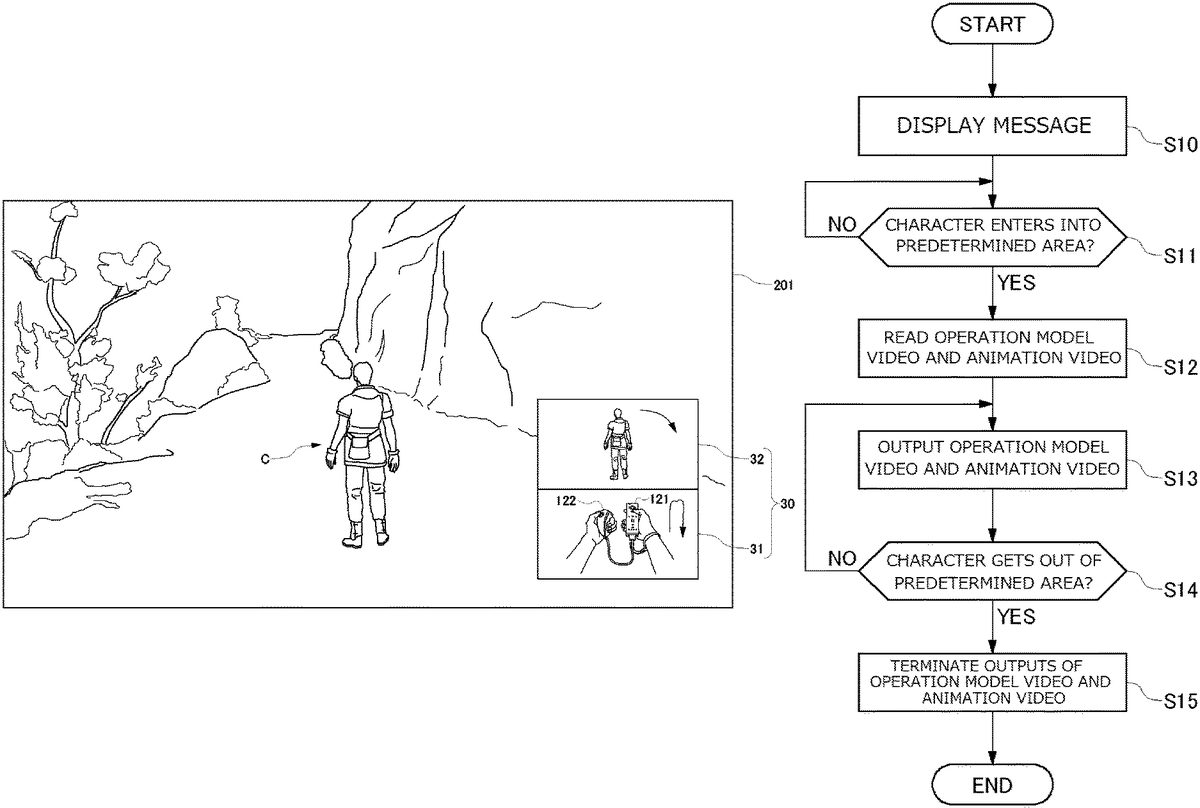
FIG. 4is a diagram showing a screen example displaying an operation model video31on the screen201of the game system1of the present embodiment. The operation model video31is a live-action video showing a model of operation of the first controller121and the second controller122. The game system1displays, on the operation model video31, the animation video32showing the animation of characters occurring within the game due to an operation shown in the operation model video31. More specifically, the animation video32shows what kind of action the character in the game performs when the player actually performs the operation guided by the operation model video31. Hereinafter, the operation model video31and the animation video32will be collectively referred to as “operation guide30”. InFIG. 4, arrows are shown in the operation model video31and the animation video32, but the arrows show motion of the moving picture merely for the sake of convenience of explanation, and the arrows are not actually displayed.
Both the data of the operation model video31and the data of the animation video32are stored in the optical disk D, and when a predetermined situation occurs, the game system1once reads the data from the optical disk D to the main memory13, and displays its contents. Alternatively, the content of the data read in the main memory13is displayed in advance. The present embodiment describes an example in which the data of the operation model video31and the data of the animation video32are separately held, but one video in which the operation model video31and the animation video32are arranged one above the other may be generated as data of the operation guide30and stored in the optical disk D. In the present embodiment, the data of the operation guide30is stored in the optical disk D, but like the game program, it may be stored in a cartridge type memory or a NAND flash memory, not shown, in the game apparatus main body110, and may also be downloaded to game apparatus main body110via a network.
In the example shown inFIG. 4, the operation model video31shows a motion picture in which a user swings up and then swings down the first controller121held in the right hand in the vertical direction. In the present embodiment, the operation model video31shows parts of the operator's hands and arms. As described above, since the operation model video31includes parts of the body of the operator, it is easy to understand how to grab and move the first controller121.
The animation video32shows the video in which the character in the game makes a cartwheel to the right. The movement of the right hand in the operation model video31and the action of the cartwheel of the character are in synchronization. The game system1repeatedly displays this movement until a predetermined end condition is satisfied. With this operation guide30, the user can easily understand that the user can vertically swing the first controller121held in the right hand in order to cause the character to make a cartwheel to the right side. In this example, the operation of the first controller121is associated with the animation of character, but the operation target may not necessarily be a character but may be any object in the game.
As shown inFIG. 4, the operation guide30is displayed superimposed on the game image, and the game image is also displayed on the screen201while the operation guide30is being displayed. The operation guide30is independent of the progress of the game, and the game system1advances the game independently from the display of the operation guide30. When the user shakes the first controller121up and down to imitate the operation shown in operation model video31, the character C of the player makes a cartwheel in the game image. In this way, while viewing the operation guide30, the user can actually try operation.
[Predetermined Situation for Displaying Operation Guide]
The operation guide30is basically displayed when a new operation becomes possible with the progress of the game. For example, the operation guide30is displayed when (i) the character of the player enters into a predetermined area after talking with a non-player character, (ii) the character of the player enters into a predetermined area, and (iii) the character of the player transforms or makes a power up. In addition, (iv) operation guide30may be displayed again when the operation guide30is displayed and the operation has not been performed for a predetermined period of time since the display of the operation guide30is ended. This is because, when an operation shown in the operation guide30is not performed even though the operation guide30is displayed, it may be possible that the user does not understand the operation.
Examples of conditions for terminating the display of the operation guide30include (i) a condition that the character of the player gets out of a predetermined area, (ii) a condition that a predetermined period of time elapses since the output of the operation guide30is started, and (iii) a condition that the character of the player has finished a transformation state or a power-up state and returns back to the normal state. For example, (iv) when the operation indicated in the operation guide30is successfully performed one or more times, it may be determined that the player is accustomed to the operation and accordingly, the display of the operation guide30may be ended.
It should be noted that the above-mentioned predetermined situation for displaying the operation guide30is merely an example, and the operation guide30may be displayed even in a situation other than the above-mentioned situations, or the display of the operation guide30may be ended in a situation other than the above-mentioned situations.
[Operation of Game System]
FIG. 5is a diagram showing an example of an operation in which the game system1of the present embodiment displays an operation model video. In the example shown inFIG. 5, the operation model video is displayed on condition that the character of the player enters into a predetermined area after the character of the player has a conversation with a non-player character.
The game system1displays a message of a non-player character (S10), and thereafter, the game system1determines whether or not the character of the player has entered into the predetermined area (S11). In a case where the character of the player has not entered into the predetermined area (NO in S11), the determination as to the entry into the predetermined area is repeated (S11) until the character of the player enters into the predetermined area.
When the character enters into the predetermined area (YES in S11), the operation model video corresponding to that area and the animation video of the character are read from the optical disk D (S12). Subsequently, the game system1outputs the operation model video31and animation video32(operation guide30), which have been read, to the lower right area of the screen201(S13).
Even when the operation guide30is displayed on the screen201in this way, the game system1advances the game independently from the operation guide30. In other words, the player can move the character of the player and cause the character of the player to perform other actions by operating the operation units of first controller121and the second controller122, and moving those controllers and changing the sensor value of acceleration sensor. The game system1determines whether or not the character of the player has gotten out of the predetermined area (S14). In a case where the character is determined not to have gotten out of the predetermined area (NO in S14), the operation model video31and animation video32are continuously output (S13). When the playback of the operation model video31or the animation video32have been finished, the operation model video31or the animation video32are continued to be repeatedly played from the beginning. When the character is determined to have gotten out of the predetermined area (YES in S14), the output of the operation model video31and the animation video32are terminated, and the operation model video31and the animation video32disappear from screen201(S15).
FIG. 6is a diagram showing another example of an operation in which the game system1of the present embodiment displays the operation model video. In the example shown inFIG. 6, an operation model video is displayed on the condition that the form of the character of the player has changed.
The game system1determines whether the form of the character of the player has changed (S20). The “change in the form” is, for example, a case in which some item is acquired and a character acquires a new attribute, or a case where a new weapon and the like is acquired to achieve a power up. In a case where the form of the character of the player has not changed (NO in S20), a determination is made as to whether the form of character has changed (S20) until the form of the character of the player changes.
When the form of character has changed (YES in S20), a determination is made as to whether or not the operation model video31of the operation which can be performed in the changed form has been output (S21). In a case where the operation model video31or the animation video32have been output in the past (YES in S21), processing is terminated without outputting the same operation model video31and the same animation video32. As a result, it is possible to avoid a trouble in which the operation model video31and the animation video32are displayed with regard to the already learned operation.
In a case where any operation model video31or any animation video32has not yet been output in the past, the operation model video31and the animation video32are read from the optical disk D to the main memory13(S22). Subsequently, the game system1outputs the operation model video31and the animation video32(the operation guide30), which are read to the main memory13, to the area at the lower right of the screen201(S23).
As described above, even when the operation guide30is displayed on the screen201, the game system1advances the game independently from the operation guide30. The game system1determines whether or not a predetermined period of time has elapsed since the display of the operation guide30has been started (S24). In a case where the predetermined period of time is determined not to have elapsed (NO in S24), the operation guide30is continuously output (S23). In a case where the predetermined period of time is determined to have elapsed (YES in S24), the outputs of the operation model video31and the animation video32are terminated, and the operation model video31and the animation video32disappear from the screen201(S25).
Subsequently, the game system1determines whether or not the operation taught in the operation model video31is not performed for a predetermined period of time (S26). In a case where the non-operation state is determined to have continued for the predetermined period of time (YES in S26), the operation model video31and the animation video32are read again (S22), and the operation model video31and the animation video32are output to the screen201(S23). In a case where the non-operation state is determined not to have continued for the predetermined period of time (NO in S26), the game system1terminates the processing.
The game system1of the present embodiment displays the operation model video showing the model of the operation of the first controller121and the second controller122on the screen201when a new operation can be performed with a progress in the game, and therefore, the user can concretely understand how to operate the first controller121and the second controller122. It is particularly effective in the case where the input apparatus has the motion sensor just like the one in the present embodiment. Further, the first controller121and the second controller122may perform different operations in some cases. For example, this includes a case where the user moves the first controller121downward and moves the second controller122upwards, and a case where the user moves the first controller121held with the right hand and the second controller122held with the left hand in the opposite directions like the user runs. Models of such continuous and complicated operation can be displayed over time, so that the operator can easily understand. Furthermore, in a case where the number of controllers further increases, the operation tends to be complicated, so that applying the present technique makes it easier for the operator to understand.
The game system1of the present embodiment displays the animation video32together with the operation model video31, so that, before the user performs the operation actually displayed with the operation model video31, the user can find what kind of actions occur when the user performs the operation. Furthermore, when the user compares the animation video32and an actual game image obtained when the user performs the operation shown in the operation model video31, the user can confirm whether or not the operation corresponding to the animation video32is occurring in the game image. This allows the user to check whether the operation performed by the user is correct or not. The arrangement of the operation guide30in which the animation video32is arranged in the upper row and the operation model video31is arranged in the lower row is in a manner close to a positional relationship when the user operates the controller120while watching the screen201, and therefore, it is easy for the user to intuitively understand the contents of the operation guide30.
In the game system1of the present embodiment, the live-action video obtained by shooting the scene when the user actually performs the operation is used as the operation model video31, and therefore, it is easy to distinguish the operation model video31from the game image, the user can readily notice that the guidance for the operation is displayed.
[Modification]
Although the game system1of the present embodiment and the game program for realizing the game system1have been described above, the game system and the game program of the present technique are not limited to the above-mentioned embodiments.
In the above embodiment, the operation model video31and the animation video32are read from the optical disk D and displayed on the screen201, but the animation video32may be rendered in real time. Alternatively, a single motion picture file obtained by combining the operation model video31and the animation video32in a vertical direction may be stored in the optical disk D. When the operation model video31and the animation video32have large sizes, the operation guide30may be read in advance a predetermined period of time before the operation guide30is displayed, e.g., at the time of the start of the game or the start of a stage, rather than reading the operation guide30immediately before the operation guide30is displayed, so that a time lag of reading and the like can be prevented. Further, although the operation model video31and the animation video32are once read out to the main memory13and displayed, the data read from the optical disk D may be displayed without going through the main memory13.
In the above embodiment, live-action video showing the model of the operation is used as the operation model video, but the operation model video may not necessarily be a live-action picture and may be animation or CG. In this case, the video is required to be sufficiently smooth so that the state of operation can be clearly seen, and the sample rate of motion picture is preferably 20 frames/second or more, and more preferably, the sample rate of motion picture is 30 frames/second or 60 frames/second. When a live-action video is used, it can be easily distinguished from the video related to the contents of the game, and the user can easily recognize that it is a video for the guide of operation method. Compared to animation, CG, and the like, the live-action video requires less steps to prepare.
In the above-described embodiment, an example for displaying the operation model video31and the animation video32arranged side by side has been explained, but the animation video32is not necessary, and only the operation model video31may be displayed.
In the above-described embodiment, an example of displaying the operation guide30at the lower right of the monitor200has been explained, but the position at which the operation guide30is displayed is not limited to the lower right. For example, it is also possible to, on every occasion, determine where is a position at which there is no important object depending on the progress of the game, and display the operation guide30at a position where there is no important object. The size of the operation guide30may be changed in relation to other objects in the virtual space. Further, the operation guide30may not overlap the game image, and the area displaying the game image and the area displaying the operation guide30may be clearly separated.
In the embodiment described above, for example, the controller120having the motion sensor has been explained as the input apparatus, but the present technique is also effective in an input apparatus having a touch panel and a game system using an input apparatus and the like for detecting the posture of the user by a depth sensor.
In the above-described embodiment, the stationary game machine has been described as an example, but the present technique can also be applied to any information processing apparatus such as a portable game machine, a PC, and the like.
Claims
- A non-transitory storage medium having a game program stored therein, the program, when executed, being configured to cause a computer of an information processing apparatus that is connected to a display apparatus and an input apparatus and that performs game processing based on an operation performed by a user, to at least: output to the display apparatus, when the game processing is in a predetermined situation, an operation model video providing a model of how to operate the input apparatus, together with a video related to content of a game achievable via operation of the input apparatus in accordance with the model, the operation model video being provided in a first display area of a game screen displayable via the display apparatus, the video related to content of the game being provided in a second display area of the game screen, the first and second display areas being different from one another and being displayable together with a main game screen that advances with play of the game, wherein an animation video indicating an animation occurring in the game when the operation indicated by the operation model video is performed is output together with the operation model video.
- The non-transitory storage medium according to claim 1 , wherein the operation model video is a video obtained by shooting an actual operation performed with the input apparatus.
- The non-transitory storage medium according to claim 1 , wherein the operation model video has a frame rate that is high enough to be played smoothly.
- The non-transitory storage medium according to claim 1 , wherein the operation model video contains at least a part of a body of an operator of the input apparatus.
- The non-transitory storage medium according to claim 1 , wherein the operation model video and the animation video are output side by side.
- The non-transitory storage medium according to claim 1 , wherein the input apparatus has a motion sensor and/or a touch panel.
- The non-transitory storage medium according to claim 1 , wherein the input apparatus has two controllers.
- The non-transitory storage medium according to claim 1 , wherein the output of the operation model video begins when a new operation is ready to be performed in accordance with progress of the game.
- A non-transitory storage medium having a game program stored therein, the program, when executed, being configured to cause a computer of an information processing apparatus that is connected to a display apparatus and an input apparatus and that performs game processing based on an operation performed by a user, to at least: output to the display apparatus, when the game processing is in a predetermined situation, an operation model video providing a model of how to operate the input apparatus, together with a video related to content of a game achievable via operation of the input apparatus in accordance with the model, the operation model video being provided in a first display area of a game screen displayable via the display apparatus, the video related to content of the game being provided in a second display area of the game screen, the first and second display areas being different from one another and being displayable together with a main game screen that advances with play of the game;and control an object in the game according to an operation performed by user with the input apparatus and output a result thereof to the display apparatus, wherein the output of the operation model video is started when the object enters into a predetermined range in a virtual space.
- The non-transitory storage medium according to claim 1 , wherein the program, when executed, is further configured to cause the computer of the information processing apparatus to at least count a time from when the operation model video begins being output, wherein the output of the operation model video is terminated when a time counting result reaches a predetermined time.
- An information processing apparatus connected to a display apparatus and an input apparatus and being configured to perform game processing based on an operation performed by a user, the information processing apparatus comprising: at least one processor and a memory coupled thereto, the at least one processor being configured to output, to the display apparatus, when the game processing is in a predetermined situation, an operation model video providing a model of how to operate the input apparatus, together with a video related to content of the game achievable via operation of the input apparatus in accordance with the model, the operation model video being provided in a first display area of a game screen displayable via the display apparatus, the video related to content of the game being provided in a second display area of the game screen, the first and second display areas being different from one another and being displayable together with a main game screen that advances with play of the game, wherein an animation video indicating an animation occurring in the game when the operation indicated by the operation model video is performed is output together with the operation model video.
- An information processing system comprising: a display apparatus;an input apparatus;and an information processing apparatus configured to perform game processing based on an operation performed by a user, wherein: the information processing apparatus is configured to output, to the display apparatus, when the game processing is in a predetermined situation, an operation model video providing a model of how to operate the input apparatus, together with a video related to content of the game achievable via operation of the input apparatus in accordance with the model, the operation model video being provided in a first display area of a game screen displayable via the display apparatus, the video related to content of the game being provided in a second display area of the game screen, the first and second display areas being different from one another and being displayable together with a main game screen that advances with play of the game;and an animation video indicating an animation occurring in the game when the operation indicated by the operation model video is performed is output together with the operation model video.
- A game processing method for performing game processing based on an operation performed by a user with an information processing apparatus that is connected to a display apparatus and an input apparatus, the game processing method comprising: outputting to the display apparatus, when the game processing is in a predetermined situation, an operation model video providing a model of how to operate the input apparatus together, with a video related to content of the game achievable via operation of the input apparatus in accordance with the model, the operation model video being provided in a first display area of a game screen displayable via the display apparatus, the video related to content of the game being provided in a second display area of the game screen, the first and second display areas being different from one another and being displayable together with a main game screen that advances with play of the game;and outputting an animation video indicating an animation occurring in the game when the operation indicated by the operation model video is performed is together with the operation model video.
- An information processing apparatus connected to a display apparatus and an input apparatus and being configured to perform game processing based on an operation performed by a user, the information processing apparatus comprising: at least one processor and a memory coupled thereto, the at least one processor being configured to output, to the display apparatus, when the game processing is in a predetermined situation, an operation model video providing a model of how to operate the input apparatus, together with a video related to content of the game achievable via operation of the input apparatus in accordance with the model, the operation model video being provided in a first display area of a game screen displayable via the display apparatus, the video related to content of the game being provided in a second display area of the game screen, the first and second display areas being different from one another and being displayable together with a main game screen that advances with play of the game, wherein the output of the operation model video begins when a new operation is ready to be performed in accordance with progress of the game and the output of the operation model video continues for a predetermined amount of time.
- An information processing apparatus connected to a display apparatus and an input apparatus and being configured to perform game processing based on an operation performed by a user, the information processing apparatus comprising: at least one processor and a memory coupled thereto, the at least one processor being configured to: output, to the display apparatus, when the game processing is in a predetermined situation, an operation model video providing a model of how to operate the input apparatus, together with a video related to content of the game achievable via operation of the input apparatus in accordance with the model, the operation model video being provided in a first display area of a game screen displayable via the display apparatus, the video related to content of the game being provided in a second display area of the game screen, the first and second display areas being different from one another and being displayable together with a main game screen that advances with play of the game;and control an object in the game according to an operation performed by user with the input apparatus and output a result thereof to the display apparatus, wherein the output of the operation model video is started when the object enters into a predetermined range in a virtual space.
- A game processing method for performing game processing based on an operation performed by a user with an information processing apparatus that is connected to a display apparatus and an input apparatus, the game processing method comprising: outputting to the display apparatus, when the game processing is in a predetermined situation, an operation model video providing a model of how to operate the input apparatus together, with a video related to content of the game achievable via operation of the input apparatus in accordance with the model, the operation model video being provided in a first display area of a game screen displayable via the display apparatus, the video related to content of the game being provided in a second display area of the game screen, the first and second display areas being different from one another and being displayable together with a main game screen that advances with play of the game, wherein the output of the operation model video begins when a new operation is ready to be performed in accordance with progress of the game and the output of the operation model video continues for a predetermined amount of time.
- A game processing method for performing game processing based on an operation performed by a user with an information processing apparatus that is connected to a display apparatus and an input apparatus, the game processing method comprising: outputting to the display apparatus, when the game processing is in a predetermined situation, an operation model video providing a model of how to operate the input apparatus together, with a video related to content of the game achievable via operation of the input apparatus in accordance with the model, the operation model video being provided in a first display area of a game screen displayable via the display apparatus, the video related to content of the game being provided in a second display area of the game screen, the first and second display areas being different from one another and being displayable together with a main game screen that advances with play of the game;and controlling an object in the game according to an operation performed by user with the input apparatus and output a result thereof to the display apparatus, wherein the output of the operation model video is started when the object enters into a predetermined range in a virtual space.
- A game processing method for performing game processing based on an operation performed by a user with an information processing apparatus that is connected to a display apparatus and an input apparatus, the game processing method comprising: outputting to the display apparatus, when the game processing is in a predetermined situation, an operation model video providing a model of how to operate the input apparatus together, with a video related to content of the game achievable via operation of the input apparatus in accordance with the model, the operation model video being provided in a first display area of a game screen displayable via the display apparatus, the video related to content of the game being provided in a second display area of the game screen, the first and second display areas being different from one another and being displayable together with a main game screen that advances with play of the game;and controlling an object in the game according to an operation performed by user with the input apparatus and output a result thereof to the display apparatus, wherein the output of the operation model video is started when the object enters into a predetermined range in a virtual space.
Disclaimer: Data collected from the USPTO and may be malformed, incomplete, and/or otherwise inaccurate.