U.S. Pat. No. 10,650,563
Tongue Position Tracking for Facial Animation
AssigneeBinaryVR, Inc.
Issue DateJuly 26, 2018
U.S. Patent No. 10,650,563: Tongue position tracking for facial animation
U.S. Patent No. 10,650,563: Tongue position tracking for facial animation
Issued May 12, 2020, to Binary VR, Inc. (assigned to Epic Games, Inc.)
Filed/Priority to July 26, 2018
So many jokes…. so little time. Say ahhhh…….
Overview:
U.S. Patent No. 10,650,563 (the ‘563 patent) relates to adjustment of a 3D representation of a face based on images of a face, determining the length of a tongue. The ‘563 patent details receiving several images of a face containing a mouth, at least one of which shows the tongue extended out of the mouth and, from that, creating a digital representation where the tongue is a part of the face of the representation. Values and length are assigned to the tongue based on the amount of time the tongue sticks out of the mouth, the minimum being fully inside the mouth and the maximum being fully extended out of the mouth. The ‘563 patent could allow players in VR environments to have advanced facial representations, allowing them to even stick out their tongue in VR, potentially even directionally.
Abstract:
A method is provided that includes receiving, from a camera, a plurality of images representing a portion of a face containing a mouth. One or more images of the plurality of images depict a tongue extended out of the mouth. The method also includes determining, based on the plurality of images, an amount of time for which the tongue has been extended out of the mouth. The method additionally includes determining, based on the amount of time, a tongue length for a digital representation of the tongue. The digital representation of the tongue forms part of a digital representation of the face. The method further includes adjusting the digital representation of the face to have the digital representation of the tongue extend out of the mouth with the determined tongue length. The method yet further includes providing instructions to display the adjusted digital representation of the face.
Illustrative Claim:
- A method comprising: receiving, by a processor and from a camera, a plurality of images representing a portion of a face containing a mouth, wherein one or more images of the plurality of images depict a tongue extended out of the mouth; determining, by the processor, based on the plurality of images, an amount of time for which the tongue has been extended out of the mouth; determining, by the processor based on the amount of time for which the tongue has been extended out of the mouth, a tongue length for a digital representation of the tongue, wherein the digital representation of the tongue forms part of a digital representation of the face, and wherein the tongue length is proportional to the amount of time; adjusting, by the processor, the digital representation of the face to have the digital representation of the tongue extend out of the mouth with the determined tongue length; and providing, by the processor, instructions to display the digital representation of the face adjusted to have the digital representation of the tongue extend out of the mouth with the determined tongue length.
Illustrative Figure
Abstract
A method is provided that includes receiving, from a camera, a plurality of images representing a portion of a face containing a mouth. One or more images of the plurality of images depict a tongue extended out of the mouth. The method also includes determining, based on the plurality of images, an amount of time for which the tongue has been extended out of the mouth. The method additionally includes determining, based on the amount of time, a tongue length for a digital representation of the tongue. The digital representation of the tongue forms part of a digital representation of the face. The method further includes adjusting the digital representation of the face to have the digital representation of the tongue extend out of the mouth with the determined tongue length. The method yet further includes providing instructions to display the adjusted digital representation of the face.
Description
DETAILED DESCRIPTION Example methods, devices, and systems are described herein. It should be understood that the words “example” and “exemplary” are used herein to mean “serving as an example, instance, or illustration.” Any embodiment or feature described herein as being an “example” or “exemplary” is not necessarily to be construed as preferred or advantageous over other embodiments or features unless indicated as such. Other embodiments can be utilized, and other changes can be made, without departing from the scope of the subject matter presented herein. Thus, the example embodiments described herein are not meant to be limiting. It will be readily understood that the aspects of the present disclosure, as generally described herein, and illustrated in the figures, can be arranged, substituted, combined, separated, and designed in a wide variety of different configurations. Throughout this description, the articles “a” or “an” are used to introduce elements of the example embodiments. Any reference to “a” or “an” refers to “at least one,” and any reference to “the” refers to “the at least one,” unless otherwise specified, or unless the context clearly dictates otherwise. The intent of using the conjunction “or” within a described list of at least two terms is to indicate any of the listed terms or any combination of the listed terms. The use of ordinal numbers such as “first,” “second,” “third” and so on is to distinguish respective elements rather than to denote a particular order of those elements. For purpose of this description, the terms “multiple” and “a plurality of” refer to “two or more” or “more than one.” Further, unless context suggests otherwise, the features illustrated in each of the figures may be used in combination with one another. Thus, the figures should be generally viewed as component aspects of one or more overall embodiments, with ...
DETAILED DESCRIPTION
Example methods, devices, and systems are described herein. It should be understood that the words “example” and “exemplary” are used herein to mean “serving as an example, instance, or illustration.” Any embodiment or feature described herein as being an “example” or “exemplary” is not necessarily to be construed as preferred or advantageous over other embodiments or features unless indicated as such. Other embodiments can be utilized, and other changes can be made, without departing from the scope of the subject matter presented herein.
Thus, the example embodiments described herein are not meant to be limiting. It will be readily understood that the aspects of the present disclosure, as generally described herein, and illustrated in the figures, can be arranged, substituted, combined, separated, and designed in a wide variety of different configurations.
Throughout this description, the articles “a” or “an” are used to introduce elements of the example embodiments. Any reference to “a” or “an” refers to “at least one,” and any reference to “the” refers to “the at least one,” unless otherwise specified, or unless the context clearly dictates otherwise. The intent of using the conjunction “or” within a described list of at least two terms is to indicate any of the listed terms or any combination of the listed terms.
The use of ordinal numbers such as “first,” “second,” “third” and so on is to distinguish respective elements rather than to denote a particular order of those elements. For purpose of this description, the terms “multiple” and “a plurality of” refer to “two or more” or “more than one.”
Further, unless context suggests otherwise, the features illustrated in each of the figures may be used in combination with one another. Thus, the figures should be generally viewed as component aspects of one or more overall embodiments, with the understanding that not all illustrated features are necessary for each embodiment. In the figures, similar symbols typically identify similar components, unless context dictates otherwise. Further, unless otherwise noted, figures are not drawn to scale and are used for illustrative purposes only. Moreover, the figures are representational only and not all components are shown. For example, additional structural or restraining components might not be shown.
Additionally, any enumeration of elements, blocks, or steps in this specification or the claims is for purposes of clarity. Thus, such enumeration should not be interpreted to require or imply that these elements, blocks, or steps adhere to a particular arrangement or are carried out in a particular order.
I. Overview
Computing devices such as smartphones and head-mounted displays (HMDs) may allow for real-time detection of a user's facial expressions and physical tongue movements. Such computing devices may be equipped with vision sensors (e.g., cameras, depth sensors, etc.) that allow data (e.g., color images, depth maps) representing the facial expressions and physical tongue movements to be captured. Once captured, the data may be processed to extract therefrom information allowing a digital representation of the user's face and a digital representation of the user's tongue to be adjusted or transformed to match the user's actual, real-world facial expressions and physical tongue movements. The digital representation may be animated in real-time based on a stream of data from the vision sensors to mimic the user's actual facial expressions and physical tongue movements. The digital representation may be used in combination with various VR and AR technologies to enhance users' VR or AR experiences.
Animating a digital representation of the tongue (i.e., a digital tongue) may involve controlling a length of the digital tongue and/or a direction in which the digital tongue is pointed. In some cases, animating the digital tongue may further include controlling a width and a conformation of the digital tongue (e.g., flat tongue, rolled tongue, etc.). These parameters of the tongue may be controlled based on image data and/or depth data representing a portion of a face that includes the lips and mouth.
The length of the digital tongue may be controlled based on an amount of time for which the physical tongue has been exposed outside the mouth. While the physical tongue remains exposed, the digital tongue may lengthen up to a maximum length. While the physical tongue is hidden, the digital tongue may shorten to a minimum length (e.g., tongue hidden). Image and depth data may be periodically evaluated to determine whether the physical tongue is exposed or hidden. When the physical tongue is exposed, a physical tongue cumulative exposure time counter may be increased by a predetermined amount. On the other hand, when the physical tongue is hidden, the cumulative exposure time counter may be decreased by the predetermined amount. The length of the digital tongue may be adjustable to a plurality of different lengths based on the value of the cumulative exposure time counter. The cumulative exposure time counter may range from a minimum to a maximum value, with the minimum value corresponding to a hidden digital tongue and the maximum value corresponding to a fully exposed digital tongue.
The length of the digital tongue may also be adjusted based on an actual length of the physical tongue as determined based on the image and depth data. However, because the actual length of the physical tongue depends on analysis of images which may vary in quality using image processing algorithms which might sometimes be inaccurate, the determined actual length might include high-frequency variations. Such high-frequency variations may result in a digital tongue animation that is not smooth (e.g., that jitters or fluctuates quickly) and therefore produces a poor user experience. On the other hand, the binary determination of whether the physical tongue is exposed, combined with an integration of this information by the cumulative exposure time counter, is much more stable, thus allowing for a smooth animation of changes in the digital tongue length. Additionally, the binary determination of whether the physical tongue is exposed or not is less computationally intensive than the analysis of images to determine the actual length of the physical tongue. Accordingly, using the cumulative exposure time to control the length of the digital tongue requires fewer computational resources and/or less computation time, thus allowing for processing of more image and/or depth data to provide a smoother animation to the digital tongue.
Accordingly, the length of the digital tongue may be adjusted, at least in part, based on the cumulative amount of time for which the physical tongue has been exposed. In some implementations, a portion of the total length of the digital tongue (e.g., 25%) may be based on the actual length of the physical tongue, while another portion (e.g., 75%) may be based on the cumulative exposure time. Similarly, in another example, the actual length may be used to determine the appearance of the maximum length of the digital tongue, while the cumulative exposure time may be used to adjust the percentage of this maximum length to which the digital tongue is adjusted. The digital tongue length may thus nevertheless depend on the actual length of the physical tongue, resulting in the digital tongue appearing longer for users with long tongues than for users with short tongues.
In addition or alternative to controlling the length of the digital tongue, the direction in which the digital tongue is extended out of the digital representation of the mouth may be adjusted based on the direction in which the physical tongue is extended out of the user's mouth. In one example, a plurality of landmark locations or features may be identified on and around the lips based on image data representing the user's face. The landmark locations may be used to determine a center of the mouth, about which a coordinate system may be defined.
Additionally, the image and/or depth data may be used to identify a tip of the physical tongue. A vector between the center of the mouth and the tip of the physical tongue may be used to define a direction of the tongue in two dimensions or three dimensions. The digital representation of the face may include a corresponding coordinate system defined about a center of the mouth thereof, thus allowing the direction of the physical tongue to be mimicked by the digital representation by animating the digital tongue to stick out according to the determined vector. Relying on the center of the mouth and the tip of the tongue to determine the direction of the physical tongue may be faster and less computationally-intensive than detecting multiple landmark locations on the physical tongue and adjusting corresponding vertices of the digital tongue to match therewith, while still providing an accurate representation of the direction of the physical tongue. Notably, a length of the vector may also indicate an actual length of the physical tongue.
The direction in which the physical tongue is extended may also be verified or independently determined based on one or more landmark locations that have been occluded by the physical tongue. While the physical tongue is hidden, all landmark locations of the lips might be detectable. However, as the physical tongue is extended, some landmark locations in the direction of the physical tongue's extension may become occluded as the physical tongue comes between the image sensor and the lips and thus makes these occluded landmark locations undetectable. Based on the positions of the remaining unoccluded landmark locations, the expected positions of the occluded landmark locations may nevertheless be determined. These expected positions of the occluded landmarks may be used to determine the direction in which the tongue is extended.
For example, a line or vector of best fit for the occluded landmark locations may be determined that also originates from the center of the mouth. This line or vector of best fit may represent the direction of the tongue, and may approximately match the vector determined by connecting the center of the mouth to the detected tip of the physical tongue. In another example, lines or vectors may be drawn from the center of the mouth through each of the occluded landmark locations to an end of the tongue. The angles at which these lines or vectors are directed may then be averaged or otherwise weighted to identify one overall line or vector that approximates the direction of the physical tongue. The relative positions of the center of the mouth, the occluded landmark locations, and the tip of the physical tongue may be used in other ways and combinations to determine a direction in which the physical tongue is extended out of the user's mouth.
Notably, by using the occluded landmark locations to determine the direction of the tongue, image and/or depth data might not need to be analyzed to identify a tip of the physical tongue. Since the landmark locations of the lips are determined in order to animate the lips of digital representation 400, additional image analysis (aside from detecting whether the physical tongue is exposed or not) might not be needed to determine the direction of the extended physical tongue. Accordingly, using occluded landmark locations to determine the direction of the tongue may be more computationally efficient than other approaches that require additional analysis of images of the extended physical tongue.
The occluded landmark locations may also be used to determine whether the physical tongue is extended (e.g., when one or more landmark locations are occluded) or hidden (e.g., when all landmark locations are detectable or unoccluded). Further, a number or pattern of occluded landmark locations may be used to determine a width of the physical tongue or a conformation of the physical tongue (e.g., rolled tongue). The digital tongue may be adjusted to mimic the physical width and the conformation.
Adjusting the digital tongue to match the direction of the physical tongue may involve determining a combination of tongue expression parameters, each corresponding to a different tongue expression (e.g., direction of extension), that indicate how to blend together the different tongue expressions to generate the desired digital tongue animation that mimics the physical tongue. In one example, the digital tongue may be morphable or adjustable based on five different fundamental tongue expressions, including (i) tongue extending left, (ii) tongue extending right, (iii) tongue extending up, (iv) tongue extending down, and (v) tongue extending directly out. Notably, the image data may be used to determine the horizontal and vertical components of the direction of the physical tongue while the depth data may be used to determine a depth component of the direction in which the physical tongue is pointed. Accordingly, image data may be used to dictate expressions parameter values corresponding to expressions (i), (ii), (iii), and (iv), while depth data may be used to dictate an expression parameter value correspond to expression (v).
II. Example Computing Device
Referring now to the Figures,FIG. 1illustrates a simplified block diagram showing some of the components of an example computing device100. By way of example and without limitation, computing device100may be a cellular mobile telephone (e.g., a smartphone), a computer (such as a desktop, notebook, tablet, handheld computer, server computer, or a specialized, purpose-built computer), a personal digital assistant (PDA), a home or business automation component, a digital television, a smartwatch, or some other type of device capable of operating in accordance with the example embodiments described herein. It should be understood that computing device100may represent combinations of hardware and software that are configured to carry out the disclosed operations. Computing device100may represent the HMD units described herein. In some cases, computing device100may be referred to as a computing system.
As shown inFIG. 1, computing device100may include communication interface102, user interface104, processor(s)106, data storage108, camera(s)124, and depth sensor(s)126, all of which may be communicatively linked together by a system bus, network, or other connection mechanism110.
Communication interface102may allow computing device100to communicate, using analog or digital modulation, with other devices, access networks, and/or transport networks. Thus, communication interface102may facilitate circuit-switched and/or packet-switched communication, such as plain old telephone service (POTS) communication and/or Internet protocol (IP) or other packetized communication. For instance, communication interface102may include a chipset and antenna arranged for wireless communication with a radio access network or an access point.
Communication interface102may take the form of or include a wireline interface, such as an Ethernet, Universal Serial Bus (USB), or High-Definition Multimedia Interface (HDMI) port. Communication interface102may also take the form of or include a wireless interface, such as a Wi-Fi, BLUETOOTH®, global positioning system (GPS), or wide-area wireless interface (e.g., WiMAX or 3GPP Long-Term Evolution (LTE)). However, other forms of physical layer interfaces and other types of standard or proprietary communication protocols may be used over communication interface102. Furthermore, communication interface102may comprise multiple physical communication interfaces (e.g., a Wi-Fi interface, a BLUETOOTH® interface, and a wide-area wireless interface).
User interface104may operate to allow computing device100to interact with a user, such as to receive input from the user and to provide output to the user. Thus, user interface104may include input components such as a keypad, keyboard, touch-sensitive panel, computer mouse, trackball, joystick, microphone, and so on. User interface104may also include one or more output components such as a display screen that, for example, may be combined with a touch-sensitive panel. The display screen may be based on cathode ray tube (CRT), liquid-crystal display (LCD), light-emitting diode (LED) technologies, organic light emitting diode (OLED) technologies, or other technologies now known or later developed. User interface104may also be configured to generate audible output(s), via a speaker, speaker jack, audio output port, audio output device, earphones, and/or other similar devices.
In some embodiments, user interface104may include one or more buttons, switches, knobs, and/or dials that facilitate interaction with computing device100. It may be possible that some or all of these buttons, switches, knobs, and/or dials are implemented by way of graphics on a touch-sensitive panel.
Processor(s)106may comprise one or more general purpose processors (e.g., microprocessors) or one or more special purpose processors (e.g., digital signal processors (DSPs), graphics processing units (GPUs), floating point units (FPUs), network processors, or application-specific integrated circuits (ASICs)).
Data storage108may include one or more volatile and/or non-volatile storage components, such as magnetic, optical, flash, or organic storage, and may be integrated in whole or in part with processor(s)106. Data storage108may include removable and/or non-removable components.
Processor(s)106may be capable of executing program instructions118(e.g., compiled or non-compiled program logic and/or machine code) stored in data storage108to carry out the various operations described herein. Therefore, data storage108may include a non-transitory computer-readable medium, having stored thereon program instructions that, upon execution by computing device100, cause the computing device100to carry out any of the methods, processes, or operations disclosed in this specification and/or the accompanying drawings. The execution of program instructions118by processor(s)106may result in processor(s)106using data112.
By way of example, program instructions118may include an operating system122(e.g., an operating system kernel, device driver(s), and/or other modules) and one or more application programs120(e.g., camera functions, image processing functions, address book, email, web browsing, social networking, and/or gaming applications) installed on computing device100. Similarly, data112may include operating system data116and application data114. Operating system data116may be accessible primarily to operating system122, and application data114may be accessible primarily to one or more of application programs120. Application data114may be arranged in a file system that is visible to or hidden from a user of computing device100.
Application programs120may communicate with operating system122through one or more application programming interfaces (APIs). These APIs may facilitate, for instance, application programs120reading and/or writing application data114, transmitting or receiving information via communication interface102, receiving and/or displaying information on user interface104, and so on.
In some examples, application programs120may be referred to as “apps” for short. Additionally, application programs120may be downloadable to computing device100through one or more online application stores or application markets. However, application programs can also be installed on computing device100in other ways, such as via a web browser or through a physical interface (e.g., a USB port) on computing device100.
Camera(s)124may be configured to capture image data (i.e., photo or video) of an environment or scene. The image data may provide a two-dimensional (2D) representation of the environment. The image data may represent the environment or scene in black-and-white, using grayscale pixel values, or in color, using combinations of red, green, and blue pixel color components. To that end, camera(s)124may include one or more lenses, one or more image sensors, and one or more color filters. The image sensors may include, for example, charge coupled device (CCD) sensors or complementary metal-oxide-semiconductor (CMOS) sensors. The color filters may include, for example, a Bayer filter. In some cases, a color filter may be omitted entirely, or an image sensor relying on differences in penetration by light of different wavelengths of the material making up the image sensor may be used to detect light of different colors (e.g., FOVEON X3 image sensor).
Depth sensor(s)126may be configured to capture depth data of an environment or scene. The depth data may be represented as a 2D image, with an intensity of each pixel representing a distance between the sensor and a corresponding point or feature within the environment. Depth sensor(s)126can operate according to a number of different techniques, including stereo triangulation, sheet of light triangulation, structured light, time-of-flight, interferometry, or coded aperture, among other possibilities. Thus, in some implementations, depth sensor(s)126may include one or more cameras and one or more light sources, among other components.
It should be understood that the components of the computing device may be distributed, logically or physically, over multiple devices of the same or of a different type. Additionally, multiple computing devices may work in combination to perform the operations described herein.
III. Example HMD Device
FIG. 2illustrates an example HMD200configured to be worn on a head of a user. HMD200represents an example form factor of computing device100shown inFIG. 1. HMD200includes a body202and a vertical extension member208extending downwards from body202. Body202includes vision sensors204A and204B, displays206A and206B, and other sensors (e.g., inertial measurement units (IMUs)). Vertical extension member208includes thereon vision sensors210. HMD200may also include straps214which allow HMD200to be secured to the user's head.
Vertical extension member208may be coupled to HMD200via a mechanism that allows for adjustment of the vertical position of vision sensor210relative to body202, thereby enabling adjustment of the region of the user's face captured by vision sensor210. Vision sensor210may, for example, be positioned by way of vertical extension member208to capture data representing a region around a user's lips and mouth so that a tongue extending out therefrom can be detected and monitored. In some implementations, a member extending horizontally or in a slanted orientation may be used instead of vertical extension member208to mount vision sensor210to body202.
Vision sensors204A,204B, and210may each include a camera (e.g., red-green-blue or infrared) and/or a depth sensor, and may therefore be configured to provide a 3D depth map and/or 2D images (e.g., color or infrared) of the respective regions of the face captured thereby. For example, the depth sensor included in vision sensor210may be used to obtain 3D geometry information about lower facial features of the user's face (e.g., mouth, lips, and chin). Alternatively or additionally, a 2D color camera included in vision sensor210may be used to capture images of the user's lower facial features. Color images captured by the 2D color camera may be processed by computing device100to generate 3D geometry information about lower facial features.
Vision sensors204A and204B are included in the upper corners of body202to capture respective regions (i.e., left and right eye regions) of a user's face. When HMD200is worn on the head of the user, vision sensors204A and204B are directed at the user's face. In alternative embodiments, vision sensors204A and204B may be placed at side walls212of HMD200. Vision sensors204A and204B can also be placed immediately next to displays206A and206B.
Displays206A and206B may include two distinct display modules: one for displaying left side images to the user's left eye and another for display right side images to the user's right eye. Displays206A and206B may be physically separated to match the separation between the user's left and right eyes. Alternatively, in some implementations, a single display module may be divided into two distinct display regions for separately displaying left and right side images.
IV. Example Facial Landmark Detection
FIG. 3illustrates example facial landmarks of face300. Facial landmarks may be used to match a facial expression of a digital representation of a user's face to the user's actual facial expression, as represented by face300. Face300may be represented in image312. Image312may be processed by a computing device to identify therein eyebrow landmarks302, eye landmarks304, nose landmarks306, lip landmarks308, chin landmarks310, and a tip of a tongue (not shown) when the tongue is extended out from the lips, among other landmarks. Processing of image312to detect the facial landmarks may involve one or more machine learning, computer vision, or image processing algorithms.
FIG. 4illustrates a digital representation400of face300. Digital representation400may be a 3D mesh made up of vertices, edges, and faces. Digital representation400may be a volumetric mesh or a polygon mesh, for example. However, digital representation400could also be another type of computer graphics model. Digital representation400may include facial landmarks corresponding to the facial landmarks identified in image312. That is, digital representation400may include eyebrow landmarks402, eye landmark404, nose landmarks406, lip landmarks408, and chin landmarks410. Digital representation400may also include a digital representation of a tongue (not shown), which may include landmarks such as a tongue tip, and which may be adjusted or animated in accordance with detected movements of a physical tongue associated with face300when the physical tongue is exposed outside a mouth of the face.
In addition to being represented by image data312, face300may also be represented by simultaneously-captured depth data414. Image data312and depth data414may be spatially aligned, as indicated by arrow416, thereby representing face300in three dimensions. Image data312and depth data414may be spatially aligned due to having been captured from the same perspective or view point or, alternatively, one of image data312or depth data414may be transformed or adjusted to spatially match the other. Accordingly, image data312and depth data414may be used to adjust 3D digital representation400to match a user's facial expressions.
Digital representation400of the user's head may be represented mathematically by equation (1). In equation (1), R represents a rotation matrix that accounts for the orientation of a user's head, and t represents a translation matrix that accounts for translational movements of the user's head. The values of matrices t and R may be determined based on image data312, depth data414, as well as data from other sensors associated with the computing device used to capture the image and depth data (e.g., IMUs). F(ei) represents an expression of the user's face, which may be determined according to equation (2).
W(ei)=RF(ei)+t(1)F(ei)=b0+∑in(bi-b0)ei(2)B={b0,b1,b2,…,bn}(3)
In equation (3), B represents a personalized face model which is made up of the user's neutral face expression mesh b0and a plurality of (non-neutral) face expression meshes b1, b2, . . . , bnrepresenting different facial expressions such as a smile, a frown, one eye closed, etc. The personalized face model may be determined for each user by way of a calibration procedure described in U.S. Patent Application Publication Number 2017/0091535 which is herein incorporated by reference in its entirety.
The facial expression F(ei) of digital representation400thus represents a superposition of the user's neutral face with a weighted plurality of non-neutral facial expression. Weights eidetermine the overall facial expression of the digital representation by indicating the amount or extent of each of the different facial expressions that is to be included in the overall facial expression F(ei) of digital representation400. Weights eimay therefore be referred to as facial expression parameters. Weights eican be determined by reducing or minimizing the energy term represented by equation (4). EOVERALLmay be referred to as a cost function, and may be determined iteratively for different candidate weights ei. The candidate weights eimay be determined using, for example, gradient descent or other optimization algorithms.
EOVERALL=ELANDMARK+EDEPTH+EREGULARIZATION(4)
In equation (4), the summand ELANDMARKrepresents the difference between positions of landmark features302,304,306,308, and310in image data312and corresponding landmark features402,404,406,408, and410in digital representation400. That is, since image data312represents a user's current facial expression, ELANDMARKrepresents the difference between positions of landmark features of the user's current facial expression and digital representation400. ELANDMARKis minimized or reduced below a threshold when positions of landmark features in image data312match or approximate positions of landmark features in digital representation400.
ELANDMARKmay be mathematically represented by equation (5). In equation (5), uirepresents the position of a tracked landmark feature in the image data (i.e., the coordinates of landmarks302,304,306,308, and310), virepresents a vertex of the digital representation corresponding to the tracked landmark feature, π(vi) represents a projection of the vertex vifrom the 3D mesh onto the 2D image data, and m is equal to the total number of tracked landmark features. ELANDMARKmay be referred to as the landmark energy and the value to which equation (5) evaluates may be referred to as the landmark energy value.
For example, m=21 might represent the topmost landmark of nose landmarks306/406. Accordingly, u21represents the coordinates within image312of the topmost nose landmark and π(v21) represents the coordinates within image312of the topmost nose landmark projected from digital representation400onto image312. When u21and π(v21) are equal, the position of the topmost nose landmark in image312is the same as the 2D position of the topmost nose landmark in digital representation400.
ELANDMARK=∑imπ(vi)-ui22(5)
The summand EDEPTHin equation (4) represents the difference between depths of points along a user's face represented in depth data414and in digital representation400. That is, whereas ELANDMARKallows digital representation400to match a user's facial expression along the vertical and horizontal axis, EDEPTHallows representation400to match the user's facial expression along the depth axis. EDEPTHis minimized or reduced below a threshold when depths of points along face300represented in image data414match depths of corresponding vertices in digital representation400.
EDEPTHmay be mathematically represented by equation (6). In equation (6), virepresents the ith vertex of the digital representation mesh, zirepresents a pixel within the depth data corresponding to vi, nirepresents a surface normal at vi, and k is equal to the total number of pixels along the face represented in the depth data. The correspondence between pixels of depth data414and vertices of digital representation400is known since depth data414is spatially aligned with image312, as indicated by arrow416, and image312is spatially linked to digital representation400by way of the facial landmarks, as indicated by arrow418. EDEPTHmay be referred to as the depth energy and the value to which equation (6) evaluates may be referred to as the depth energy value.
EDEPTH=∑ik[ni·(vi-zi)]2(6)
The summand EREGULARIZATIONin equation (4) represents a sum of weights ei. Each of weights eimay range from a value of 0 to a value of 1, for example. Minimizing or reducing under a threshold the EREGULARIZATIONterm allows for suppression of noise in weights ei. For example, when some of weights eiare very small (e.g., less than 0.01), such weights may be suppressed to 0 without significantly affecting the output facial expression of the digital representation. When such small weights are suppressed to 0, the output facial expression of the digital representation mesh may be rendered without having to include the non-contributing facial expressions in the rendering process, thereby reducing the computational complexity of the rendering process. EREGULARIZATION, represented by equation (7), may be referred to as the regularization energy and the value to which equation (7) evaluates may be referred to as the regularization energy value.
EREGULARIZATION=∑inei2(7)
Calculating weights eito minimize equation (4), or reduce its value under a threshold, based on a single pair of image data312and depth data414allows for digital representation400to be adjusted to match a user's facial expression at one point in time. However, the process of calculating weights eimay be performed repeatedly over time as additional image data and depth data are generated. Digital representation400may thus be adjusted based on a time-varying stream of weights eidetermined based on the additional image and depth data to thereby generate an animated digital representation of the user's face.
V. Example Tongue Length Tracking and Control
In addition to adjusting digital representation400to match or mimic the facial expression of face300, digital representation400may additionally be adjusted or animated to match or mimic movements of a tongue of face300. Digital representation400may include a digital representation of a tongue, which may be referred to herein as a digital tongue. The user's actual tongue may be referred to herein as a physical tongue and may be represented by image data and depth data when exposed outside the mouth of face300. A length of the digital tongue may be adjusted based on an amount of time for which the user's tongue has been exposed outside the user's mouth.
FIG. 5Aillustrates an example relationship between an amount of time for which the user's physical tongue has been exposed and a length to which the digital tongue is adjusted. The amount of time for which the physical tongue has been exposed may be a cumulative length of time represented by, for example, an integral over time of whether the physical tongue is exposed or not at predetermined time points. That is, whenever the physical tongue is exposed, as determined based on the image or depth data, a counter may be incremented by a predetermined value. On the other hand, whenever the physical tongue is not exposed, the counter may be decreased by the predetermined value. The counter may take on values ranging from a minimum value corresponding to a fully hidden digital tongue up to a maximum value corresponding to a fully extended digital tongue, with values in therebetween corresponding to varying degrees of exposure of the digital tongue. The counter value may thus indicate (e.g., be proportional to) the cumulative exposure time of the physical tongue.
When the physical tongue has been exposed for zero seconds, the digital tongue might not be extended at all (i.e., 0% digital tongue extension), as illustrated by image500which depicts the visual appearance of the digital tongue at 0% extension (i.e., digital tongue not shown). The mouth of digital representation400may be shown open, as in image500, or closed (not shown), depending on whether the mouth of face300is open or closed, respectively. When the physical tongue has been exposed for a cumulative 1 second, the digital tongue may be extended one-third of the way from the mouth, as illustrated by image502which depicts the visual appearance of the digital tongue (indicated with a cross-hatched pattern) at 33.3% extension. Similarly, when the physical tongue has been exposed for a cumulative 2 seconds, the digital tongue may be extended two-thirds of the way from the mouth, as illustrated by image504which depicts the visual appearance of the digital tongue at 66.6% extension. Finally, when the physical tongue has been exposed for a cumulative 3 seconds, the digital tongue may be fully extended from the mouth, as illustrated by image506which depicts the visual appearance of the digital tongue at 100% extension.
WhileFIG. 5Ashows 0%, 33.3%. 66.6%, and 100% extension of the digital tongue, the digital tongue may also be adjusted to exhibit various other tongue extension states (i.e., extension percentages) between 0% and 100%, as indicated by the ellipses. For example, digital model may be adjustable to 10, 100, or 1000 different tongue extension states. When more digital tongue extension states are available, animations of changing the length of the tongue may appear smoother due to the difference between adjacent tongue extension states appearing smaller. Notably, exposing the physical tongue for more than a cumulative 3 seconds might not further increase the length of the digital tongue. However, in some embodiments, maximum extension of the digital tongue may correspond to a maximum cumulative time period of exposure of the physical tongue different than 3 seconds. For example, a maximum cumulative time period of 2 seconds might make the digital tongue appear more responsive to exposure of the physical tongue, while a maximum cumulative time period of 5 seconds might make the digital tongue appear less responsive to exposure of the physical tongue. When the maximum cumulative time period is modified, the mapping between physical tongue cumulative exposure time and digital tongue extension percentage may be modified as well to maintain a smooth (e.g., linear) animation of the digital tongue.
FIG. 5Billustrates an example sequence of samples for controlling a length of the digital tongue. In particular, column1(i.e., the leftmost column) ofFIG. 5Billustrates a sample number and a corresponding time at which the sample is captured. The sample may correspond to image data and/or depth data captured at the corresponding time. The image data and/or depth data may be analyzed by way of one or more computer vision, machine learning, or other algorithms to detect therein an exposed tongue. Column2shows the result of such analysis, indicating whether a physical tongue is or is not exposed in corresponding image and/or depth data. Column3tracks a cumulative exposure time of the physical tongue. Column4(i.e., the rightmost column) indicates an extent to which the digital tongue is extended based on the cumulative extension time of the physical tongue indicated in column3.
In sample0, corresponding to 0 seconds, the physical tongue is not detected. Thus, the physical cumulative exposure time, which started at 0, remains unchanged. Similarly, the digital tongue extension remains at 0%. In sample1, corresponding to 0.5 seconds, the physical tongue is detected. Thus, the physical cumulative exposure time is incremented from 0 seconds by 0.5 seconds to 0.5 seconds. Accordingly, the digital tongue extension increases to 16.6%. The physical tongue continues to be detected in samples2-5, resulting in the digital tongue growing progressively longer.
Namely, in sample2, corresponding to 1.0 seconds, the physical tongue is detected. Thus, the physical cumulative exposure time is incremented from 0.5 seconds by 0.5 seconds to 1.0 seconds. Accordingly, the digital tongue extension increases to 33.3%. In sample3, corresponding to 1.5 seconds, the physical tongue is detected. Thus, the physical cumulative exposure time is incremented from 1.0 seconds by 0.5 seconds to 1.5 seconds. Accordingly, the digital tongue extension increases to 50.0%. In sample4, corresponding to 2.0 seconds, the physical tongue is detected. Thus, the physical cumulative exposure time is incremented from 1.5 seconds by 0.5 seconds to 2.0 seconds. Accordingly, the digital tongue extension increases to 66.6%. In sample5, corresponding to 2.5 seconds, the physical tongue is detected. Thus, the physical cumulative exposure time is incremented from 2.0 seconds by 0.5 seconds to 2.5 seconds. Accordingly, the digital tongue extension increases to 83.3%.
However, in sample6, corresponding to 3.0 seconds, the physical tongue is not detected. Thus, the physical cumulative exposure time is decreased from 2.5 seconds by 0.5 seconds to 2.0 seconds. Accordingly, the digital tongue extension decreases to 66.6%. Similarly, in sample7, corresponding to 3.5 seconds, the physical tongue is not detected. Thus, the physical cumulative exposure time is decreased from 2.0 seconds by 0.5 seconds to 1.5 seconds. Accordingly, the digital tongue extension decreases to 50.0%. When the physical tongue is again exposed and detected in samples8-11, the digital tongue again grows progressively longer up to the maximum length.
Namely, in sample8, corresponding to 4.0 seconds, the physical tongue is detected. Thus, the physical cumulative exposure time is incremented from 1.5 seconds by 0.5 seconds to 2.0 seconds. Accordingly, the digital tongue extension increases to 66.6%. In sample9, corresponding to 4.5 seconds, the physical tongue is detected. Thus, the physical cumulative exposure time is incremented from 2.0 seconds by 0.5 seconds to 2.5 seconds. Accordingly, the digital tongue extension increases to 83.3%. In sample10, corresponding to 5.0 seconds, the physical tongue is detected. Thus, the physical cumulative exposure time is incremented from 2.5 seconds by 0.5 seconds to 3.0 seconds. Accordingly, the digital tongue extension increases to 100.0%. In sample11, corresponding to 5.5 seconds, the physical tongue is detected. However, since the physical cumulative exposure time is already at its maximum value of 3.0 seconds, it remains unchanged. Accordingly, the digital tongue extension remains at 100.0%.
In sample12, corresponding to 6.0 seconds, the physical tongue is again not detected. Thus, the physical cumulative exposure time is decreased from 3.0 seconds by 0.5 seconds to 2.5 seconds. Accordingly, the digital tongue extension decreases to 83.3%. In sample13, corresponding to 6.5 seconds, the physical tongue is not detected. Thus, the physical cumulative exposure time is decreased from 2.5 seconds by 0.5 seconds to 2.0 seconds. Accordingly, the digital tongue extension decreases to 66.6%. In sample14, corresponding to 7.0 seconds, the physical tongue is not detected. Thus, the physical cumulative exposure time is decreased from 2.0 seconds by 0.5 seconds to 1.5 seconds. Accordingly, the digital tongue extension decreases to 50.0%. In sample15, corresponding to 7.5 seconds, the physical tongue is not detected. Thus, the physical cumulative exposure time is decreased from 1.5 seconds by 0.5 seconds to 1.0 seconds. Accordingly, the digital tongue extension decreases to 33.3%. In sample16, corresponding to 8.0 seconds, the physical tongue is not detected. Thus, the physical cumulative exposure time is decreased from 1.0 seconds by 0.5 seconds to 0.5 seconds. Accordingly, the digital tongue extension decreases to 16.6%. In sample17, corresponding to 8.5 seconds, the physical tongue is not detected. Thus, the physical cumulative exposure time is decreased from 0.5 seconds by 0.5 seconds to 0 seconds. Accordingly, the digital tongue extension decreases to 0%.
In sample18, corresponding to 9.0 seconds, the physical tongue is not detected. However, since the physical cumulative exposure time is already at its minimum value of 0 seconds, it remains unchanged. Accordingly, the digital tongue extension remains at 0%.
As illustrated byFIG. 5B, whether the physical tongue is exposed or hidden may be evaluated periodically. For example, an image frame or a depth frame may be selected and evaluated at predetermined time points, which may be separated by a uniform or non-uniform time interval. In some implementations, each available image frame and/or depth frame may be analyzed to determine whether the physical tongue is exposed. Alternatively, every N image frames (e.g., N=1, 2, 3, . . . ) or M depth frames (e.g., M=1, 2, 3, . . . ) may be analyzed to determine whether the physical tongue is exposed. Since image and depth frames may be generated at predetermined rates, the predetermined time points at which tongue exposure is detected may be based on the respective frame rates of the sensors. The amount of time added to the physical tongue cumulative exposure counter may depend on the frequency with which the image sensor and/or the depth sensor generate data. For example, the amount by which the physical tongue cumulative exposure counter is increased or decreased may be inversely proportional to the frame rates of the sensors (e.g., where each image or depth frame is analyzed for tongue exposure).
VI. Example Tongue Direction Tracking and Control
The digital tongue of digital representation400may be adjusted or animated to mimic the direction in which the physical tongue (e.g., the tip thereof) is extended out of the mouth. The direction in which the digital tongue is extended may be adjusted in combination with controlling the length of the digital tongue. That is, cumulative exposure time may control a length of the tongue while the tongue extends in a direction dictated by the physical tongue. Alternatively, tongue direction may be controlled independently of controlling a length of the tongue. For example, a digital tongue of a fixed length may be extended in a direction dictated by the physical tongue every time the physical tongue is detected to be extended.
FIGS. 6A, 6B, 6C, and 6Dillustrate example operations for determining a direction in which a physical tongue is extended.FIG. 6Aillustrates a plurality of landmark locations or features detected on lips600of face300. Lips600may include thereon landmark locations610,611,612,613,614,615,616,617,618,619,620,621,622, and623(i.e., landmark locations610-623) delineating the outside contour of lips600. When lips600are open, lips600may additionally include thereon landmark location601,602,603,604,605,606,607,608, and609(i.e., landmark locations601-609) delineating the inside contour of lips600. When lips600are closed, landmark locations601-609may be repositioned accordingly or consolidated into a smaller number of landmark locations. Landmark locations601-609and610-623may be detected within image data representing lips600using one or more computer vision, machine learning, artificial intelligence, or other image processing algorithms. In some implementations, each of landmark locations601-609and610-623may also be associated with a corresponding depth value determined based on data from the depth sensor.
When the physical tongue does not extend out of lips600, landmark locations601-609and610-623may be used to identify a center630of lips600or the mouth associated therewith, as illustrated byFIG. 6B. Center630may be determined, for example, by determining an average of the coordinates of each of landmark locations601-609and610-623, or by projecting lines through different combinations of landmark locations601-609and610-623, among other possibilities. A coordinate system (e.g., a Cartesian xy-coordinate system, a Cartesian xyz-coordinate system, two-dimensional polar coordinate system, three-dimensional polar coordinate system, etc.) may be centered about center630to be used for locating a tip of the tongue relative to the mouth. A y-axis (i.e., a vertical axis) of the coordinate system may be aligned with or near landmark locations614,603,607, and621using, for example, a least squares regression. Similarly, an x-axis (i.e., a horizontal axis) of the coordinate system may be aligned with or near landmark locations610,601,605, and618. In some implementations, the coordinate system may additionally include a z-axis (i.e., a depth axis extending out of and into the page) orthogonal to the x-axis and the y-axis.
When physical tongue628is detected extending outside of the mouth, as illustrated inFIG. 6C, tip624of physical tongue628may be detected based on image and/or depth data. For example, the depth data may be used to identify tip624as the point farthest away from the face along the z-axis. Tip624of physical tongue628may be localized relative to the coordinate system. For example, exact coordinates of tip624in the coordinate system and/or a quadrant of the coordinate system (e.g., lower left quadrant, as shown) in which tip624is located may be determined. Additionally, an angle between tip624and the x-axis, the y-axis, and/or the z-axis may be determined. For example, as shown, tip624is positioned left of the y-axis at an angle θ below the negative (left-pointing) x-axis. Angle θ may alternatively be measured relative to the y-axis or relative to the positive (right-pointing) x-axis, among other possibilities.
Digital representation400may include a corresponding coordinate system originating or positioned at a center of a mouth of digital representation400. Accordingly, determining a position of tip624of physical tongue628allows the digital tongue to be modulated to point the tip thereof in the same or similar direction or position the tip thereof at the same or similar coordinates as physical tongue628. Monitoring physical tongue628and tip624thereof over time allows the digital tongue to be animated to mimic any changes in the position or direction of tip624of physical tongue628.
FIG. 6Dillustrates another approach that may be used additionally or alternatively to determine the direction in which physical tongue628is pointed. When physical tongue628is extended out of the mouth, some of landmark locations601-609and610-623may become occluded by physical tongue628. The position of these occluded landmark locations may be used to determine the direction of physical tongue628. For example, as shown inFIG. 6D, when physical tongue628is extended out in the same manner as inFIG. 6C, landmark locations623,622,608,607, and606are occluded. Notably, occluded landmark locations623,622,608,607, and606are shown bolded, while the remaining landmark features are shown with a lighter line weight.
Occluded landmark locations623,622,608,607, and606, although they might not be detectable due to occlusion by physical tongue628, may each be associated with an expected or predicted position along lips600. The expected position of each of occluded landmark location623,622,608,607, and606may be determined based on the positions of the remaining unoccluded landmark locations. These expected positions may be used to determine the direction in which physical tongue628is pointed. For example, a line may be drawn from center630, through the expected position of each occluded landmark location, to an end of physical tongue628, as shown inFIG. 6D. The angles at which each of the lines is drawn may be averaged to determine line626as a line that bisects or runs along the middle of physical tongue628, and thus represents the direction in which physical tongue628is pointed. In some cases, the length of each line may be used to weigh how much each line's angle contributes to the overall angle of line626, with longer lines contributing more than shorter lines. In yet other cases, line626may be determined using a least squares regression with the constraint that the line starts at center630. Other approaches and variations for determining line626are possible.
Occluded landmark locations623,622,608,607, and606may be used to determine the direction of physical tongue628in combination with the tongue tip detection approach discussed with respect toFIG. 6C. For example, occluded landmark locations623,622,608,607, and606may be used to verify that tip624has been detected within the same quadrant as line626or that angle θ matches (e.g., is within a threshold number of degrees relative to) a corresponding angle of line626, among other possibilities. Using occluded landmarks in this way may allow for any erratic or high-frequency variations in the detected position of tip624to be suppressed (e.g. an erroneously-determined position of tip624may be ignored when it does not fall within a threshold distance of the tip of line626), thus making the animation of the digital tongue appear smoother. However, occluded landmark locations623,622,608,607, and606may also be used to determine the direction of physical tongue628independently of the approach discussed with respect toFIG. 6C. In general however, the direction of physical tongue628may be determined based on any combination of relative positions and orientations of center630, tip624, landmark locations623,622,608,607, and606(or any other occluded landmark locations), and line626.
Occlusion of one or more landmark locations may additionally be used to determine whether physical tongue628is exposed or hidden inside the mouth. For example, when one or more landmark locations become occluded, physical tongue628may be determined to be exposed. Detection of occluded landmarks may thus also be used to indirectly control the length of the digital tongue by dictating whether to increase or decrease the cumulative exposure time counter of physical tongue628.
The positions of any occluded landmarks may also be used in some implementations to control a width of the digital tongue. A narrow physical tongue, for example, might cover fewer landmark locations than a wide physical tongue when both tongues are extended outside the mouth by a same length. Thus, a width of the digital tongue may be proportional to a number of landmark locations601-609and/or landmark location610-623that are occluded. Further, in some implementations, a conformation of the digital tongue (i.e., a shape into which a tongue is arranged from its neutral or flat position) may be controlled based on the pattern of occluded landmark locations. A rolled tongue, for example, might result in landmark locations602,604,613, and615being occluded, but all the remaining landmark locations, including landmark locations614, and603, remaining unoccluded. Other tongue conformations may be associated with other corresponding occlusion patterns.
In some implementations, in addition to controlling the length of the digital tongue based on a cumulative exposure time of physical tongue628, the length of the digital tongue may also be based on an actual length of physical tongue628. Thus, a digital expression of a user with a long physical tongue may have a longer digital tongue than a digital expression of a user with a short physical tongue. The actual length of physical tongue628may be based on a distance L between center630and tongue tip624within corresponding image and depth data. Distance L may represent the length of a two-dimensional or three-dimensional vector extending from center630to tip624. Alternatively or additionally, the actual length of physical tongue628may be based on a length of line626.
In one example, a first portion of the total length (e.g., 40%) of the digital tongue may be determine by the actual length of physical tongue628, while a second portion of the total length (e.g., 60%) of the digital tongue may be determined by the cumulative exposure time of physical tongue628. In another example, the actual length of physical tongue628(e.g., a maximum detected length thereof) may be used to determine how long the digital tongue appears at maximum extension, while the cumulative exposure time of physical tongue628may determine the fraction of the maximum extension that the digital tongue is adjusted to. Notably, the cumulative exposure time, which depends on a binary analysis of tongue presence (e.g., tongue exposed vs tongue hidden), may exhibit fewer high frequency changes than the determined actual length of physical tongue628, which depends on a more analog analysis of tongue positioning (e.g., image analysis to determine a length). Accordingly, using the cumulative exposure time to control, at least in part, the length of the digital tongue may result in a smoother animation of the digital tongue than using the actual physical tongue length alone.
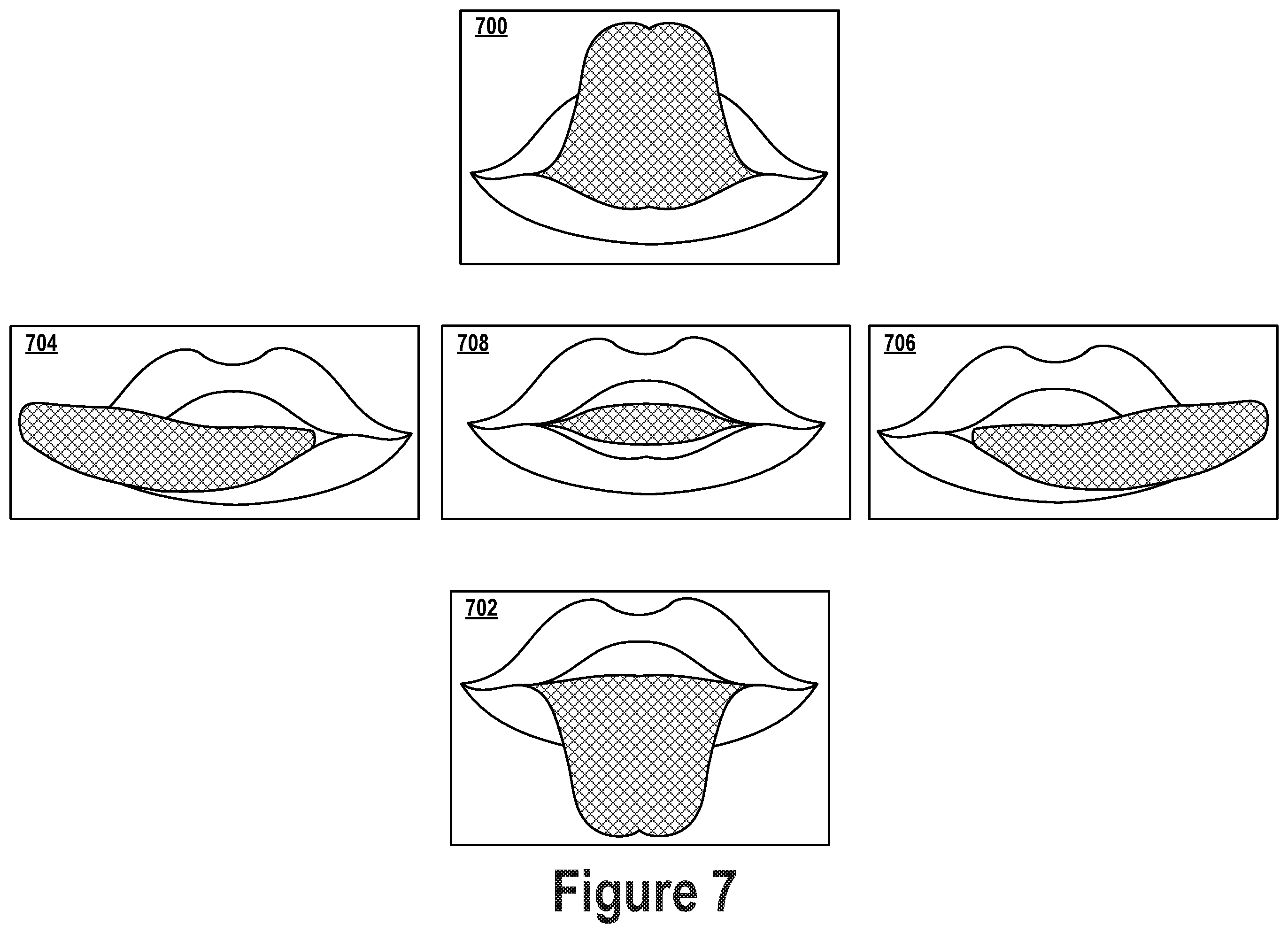
The direction of the digital tongue may be controlled to mimic movements of physical tongue628with varying degrees of granularity. That is, the digital tongue may be positioned along a varying number of discrete positions or directions. For example, as illustrated inFIG. 7, the digital tongue may be pointed up along the positive y-axis, as indicated by digital tongue expression700, down along the negative y-axis, as indicated by digital tongue expression702, right along the positive x-axis, as indicated by digital tongue expression706, left along the negative x-axis, as indicated by digital tongue expression704, or out of the page along the positive z-axis, as indicated by digital tongue expression708, depending on the direction of tip624of physical tongue628and/or line626therealong. A closest one of these expressions may be selected based on the direction of tip624or line626.
In other embodiments, the digital tongue may also be pointed in various additional directions between those shown in expressions700-708. For example, additional expressions may be provided that point the digital tongue along these various additional directions, with the closest one of these various additional directions being selected based on the determined direction of the physical tongue. Alternatively, expressions700-708may be blended, morphed, or otherwise combined together in different amounts into an overall digital tongue expression or shape to mimic or approximate the determined direction of the physical tongue. To that end, each of expressions700-708may be associated with an expression parameter ranging in value between a corresponding minimum and maximum value. A minimum value of the expression parameter may indicate that the corresponding expression is not present in the overall digital tongue expression, while a maximum value may indicate that the corresponding expression is fully present in the overall digital tongue expression.
Different combinations of expression parameters may thus animate the digital tongue to be pointed in a wide range of different directions in two-dimensions or three-dimensions. The expression parameters of expressions700and702may control a vertical component of a position of the digital tongue and the tip thereof, the expression parameters of expressions704and706may control a horizontal position of the digital tongue and the tip thereof, and the expression parameter of expression708may control a depth of the digital tongue and the tip thereof. Notably, as described above, a length of the overall digital tongue expressions may be adjusted based on the cumulative length of time for which the physical tongue has been exposed regardless of the direction in which the overall digital tongue expression is extended or pointed.
VII. Additional Example Operations
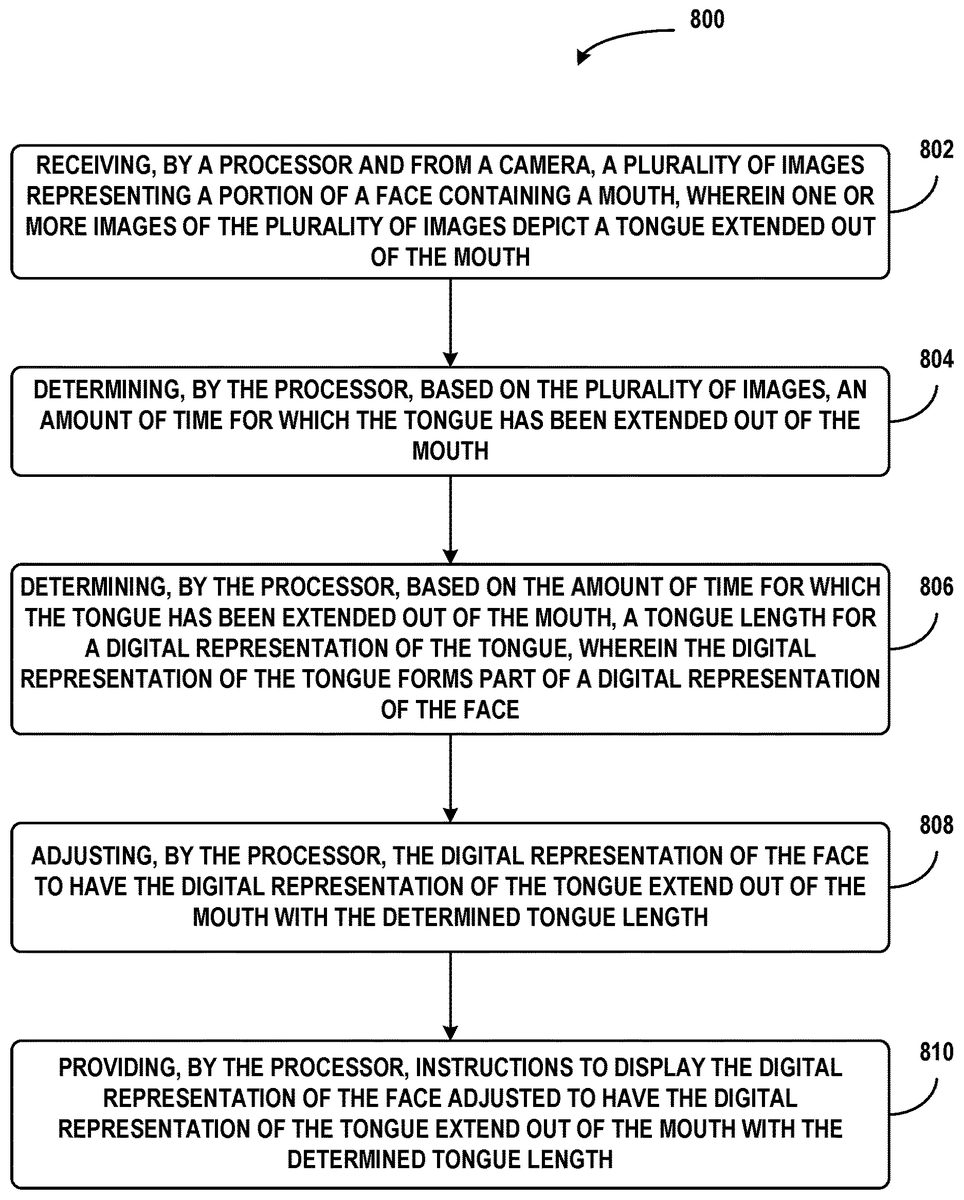
FIG. 8illustrates flow chart800of example operations related to tongue tracking. These operations may be executed by, for example, computing device100. In general, the operations of flow chart800, as well as any other operations herein described, may be performed by any computing device connected to or equipped with a camera (e.g., a red-green-blue camera) and/or a depth sensor. The computing device executing these operations may be implemented in a plurality of form factors such as, for example, a phone, a tablet, an HMD, a laptop, a television, or a watch, among other possibilities.
Block802involves, receiving, by a processor and from a camera, a plurality of images representing a portion of a face containing a mouth. One or more images of the plurality of images depict a tongue extended out of the mouth.
Block804involves determining, by the processor, based on the plurality of images, an amount of time for which the tongue has been extended out of the mouth.
Block806involves determining, by the processor, based on the amount of time for which the tongue has been extended out of the mouth, a tongue length for a digital representation of the tongue. The digital representation of the tongue forms part of a digital representation of the face.
Block808involves adjusting, by the processor, the digital representation of the face to have the digital representation of the tongue extend out of the mouth with the determined tongue length.
Block810involves providing, by the processor, instructions to display the digital representation of the face adjusted to have the digital representation of the tongue extend out of the mouth with the determined tongue length.
In some embodiments, determining the amount of time for which the tongue has been extended out of the mouth may include, for each image of the one or more images that depict the tongue extended out of the mouth, increasing a counter value by a predetermined amount. The counter value may be increasable up to a maximum value. Determining the amount of time for which the tongue has been extended out of the mouth may also include, for each image of the plurality of images that do not depict the tongue extended out of the mouth, decreasing the counter value by the predetermined amount. The counter value may be decreasable down to a minimum value.
In some embodiments, determining the tongue length for a digital representation of the tongue may include determining the tongue length based on the counter value. The tongue length may be proportional to the counter value. The maximum value may correspond to the tongue fully extended out of the mouth. The minimum value may correspond to the tongue fully hidden inside the mouth.
In some embodiments, the plurality of images may be captured by a camera having a first frame rate. The predetermined amount may be inversely proportional to the first frame rate.
In some embodiments, a direction in which the tongue is extended out of the mouth within the one or more images may be determined by the processor. The digital representation of the face may be adjusted by the processor to have the digital representation of the tongue extend out of the mouth in the determined direction. Instructions to display the digital representation of the face adjusted to have the digital representation of the tongue extend out of the mouth in the determined direction may be provided by the processor.
In some embodiments, determining the direction in which the tongue is extended out of the mouth may include detecting, within the plurality of images, a plurality of landmark locations corresponding to lips of the face. Based on the plurality of landmark locations corresponding to the lips, a center of the mouth may be determined. Based on the one or more images that depict the tongue extended out of the mouth, a tip of the tongue may be identified. The direction in which the tongue is extended out of the mouth may be determined based on a position of the tip of the tongue relative to the center of the mouth.
In some embodiments, determining the direction in which the tongue is extended out of the mouth may involve detecting, within an image of the plurality of images that does not depict the tongue extended out of the mouth, a plurality of landmark locations corresponding to lips of the face. Based the one or more images that depict the tongue extended out of the mouth, one or more occluded landmark locations of the plurality of landmark locations may be identified. The occluded landmark locations may be occluded by the tongue. The direction in which the tongue is extended out of the mouth may be determined based on a position of the one or more occluded landmark locations.
In some embodiments, determining the direction in which the tongue is extended out of the mouth based on a position of the one or more occluded landmark locations may include, based on the plurality of landmark locations corresponding to the lips, determining a center of the mouth. The direction in which the tongue is extended out of the mouth may be determined based on a position of the one or more occluded landmark locations relative to the center of the mouth.
In some embodiments, determining the direction in which the tongue is extended out of the mouth based on a position of the one or more occluded landmark locations may include, based on the one or more images depicting the tongue extended out of the mouth, identifying a tip of the tongue. The direction in which the tongue is extended out of the mouth may be determined based on a position of the tip of the tongue relative to a position of the one or more occluded landmark locations.
In some embodiments, adjusting the digital representation of the face to have the digital representation of the tongue extend out of the mouth in the determined direction may include, based on the direction in which the tongue is extended out of the mouth, determining (i) a first value of a first expression parameter corresponding to a first expression with a tongue sticking out in a left direction, (ii) a second value of a second expression parameter corresponding to a second expression with a tongue sticking out in a right direction, (iii) a third value of a third expression parameter corresponding to a third expression with a tongue sticking out in an upward direction, and (iv) a fourth value of a fourth expression parameter corresponding to a fourth expression with a tongue sticking out in a downward direction. Based on the first value, the second value, the third value, and the fourth value, a combination of the first expression, the second expression, the third expression, and the fourth expression may be determined according to which to adjust the digital representation of the tongue
In some embodiments, depth data representing the portion of the face containing the mouth may be received from a depth sensor. The depth data may represent the tongue extended out of the mouth. Based on the one or more images, (i) a horizontal component of the direction in which the tongue is extended out of the mouth and (ii) a vertical component of the direction in which the tongue is extended out of the mouth may be determined. Based on the depth data, a depth component of the direction in which the tongue is extended out of the mouth may be determined.
In some embodiments, depth data representing the portion of a face containing the mouth may be received from a depth sensor. The depth data may represent the tongue extended out of the mouth. The tongue length for the digital representation of the tongue may be determined further based on the depth data.
In some embodiments, a plurality of landmark locations corresponding to lips of the face may be detected within an image of the plurality of images that does not depict the tongue extended out of the mouth. One or more landmark locations of the plurality of landmark locations that are occluded by the tongue may be identified based the one or more images that depict the tongue extended out of the mouth. Based on the one or more landmark locations being occluded by the tongue, it may be determined that the tongue is extended out of the mouth.
In some embodiments, a plurality of landmark locations corresponding to lips of the face may be detected within the plurality of images. Based on the plurality of landmark locations corresponding to the lips, a center of the mouth may be determined. Based on the one or more images that depict the tongue extended out of the mouth, a tip of the tongue may be identified. The tongue length for the digital representation of the tongue may be determined further based on a distance between the tip of the tongue and the center of the mouth.
VIII. Conclusion
The present disclosure is not to be limited in terms of the particular embodiments described in this application, which are intended as illustrations of various aspects. Many modifications and variations can be made without departing from its scope, as will be apparent to those skilled in the art. Functionally equivalent methods and apparatuses within the scope of the disclosure, in addition to those enumerated herein, will be apparent to those skilled in the art from the foregoing descriptions. Such modifications and variations are intended to fall within the scope of the appended claims.
The above detailed description describes various features and functions of the disclosed systems, devices, and methods with reference to the accompanying figures. The example embodiments described herein and in the figures are not meant to be limiting. Other embodiments can be utilized, and other changes can be made, without departing from the spirit or scope of the subject matter presented herein. It will be readily understood that the aspects of the present disclosure, as generally described herein, and illustrated in the figures, can be arranged, substituted, combined, separated, and designed in a wide variety of different configurations, all of which are explicitly contemplated herein.
A block that represents a processing of information may correspond to circuitry that can be configured to perform the specific logical functions of a herein-described method or technique. Alternatively or additionally, a block that represents a processing of information may correspond to a module, a segment, or a portion of program code (including related data). The program code may include one or more instructions executable by a processor for implementing specific logical functions or actions in the method or technique. The program code and/or related data may be stored on any type of computer readable medium such as a storage device including a disk or hard drive or other storage medium.
The computer readable medium may also include non-transitory computer readable media such as computer-readable media that stores data for short periods of time like register memory, processor cache, and random access memory (RAM). The computer readable media may also include non-transitory computer readable media that stores program code and/or data for longer periods of time, such as secondary or persistent long term storage, like read only memory (ROM), optical or magnetic disks, compact-disc read only memory (CD-ROM), for example. The computer readable media may also be any other volatile or non-volatile storage systems. A computer readable medium may be considered a computer readable storage medium, for example, or a tangible storage device.
Moreover, a block that represents one or more information transmissions may correspond to information transmissions between software and/or hardware modules in the same physical device. However, other information transmissions may be between software modules and/or hardware modules in different physical devices.
The particular arrangements shown in the figures should not be viewed as limiting. It should be understood that other embodiments can include more or less of each element shown in a given figure. Further, some of the illustrated elements can be combined or omitted. Yet further, an example embodiment can include elements that are not illustrated in the figures.
Additionally, any enumeration of elements, blocks, or steps in this specification or the claims is for purposes of clarity. Thus, such enumeration should not be interpreted to require or imply that these elements, blocks, or steps adhere to a particular arrangement or are carried out in a particular order.
While various aspects and embodiments have been disclosed herein, other aspects and embodiments will be apparent to those skilled in the art. The various aspects and embodiments disclosed herein are for purposes of illustration and are not intended to be limiting, with the true scope being indicated by the following claims.
Claims
- A method comprising: receiving, by a processor and from a camera, a plurality of images representing a portion of a face containing a mouth, wherein one or more images of the plurality of images depict a tongue extended out of the mouth;determining, by the processor, based on the plurality of images, an amount of time for which the tongue has been extended out of the mouth;determining, by the processor based on the amount of time for which the tongue has been extended out of the mouth, a tongue length for a digital representation of the tongue, wherein the digital representation of the tongue forms part of a digital representation of the face, and wherein the tongue length is proportional to the amount of time;adjusting, by the processor, the digital representation of the face to have the digital representation of the tongue extend out of the mouth with the determined tongue length;and providing, by the processor, instructions to display the digital representation of the face adjusted to have the digital representation of the tongue extend out of the mouth with the determined tongue length.
- The method of claim 1 , wherein determining the amount of time for which the tongue has been extended out of the mouth comprises: for each image of the one or more images that depict the tongue extended out of the mouth, increasing a counter value by a predetermined amount, wherein the counter value is increasable up to a maximum value;and for each image of the plurality of images that do not depict the tongue extended out of the mouth, decreasing the counter value by the predetermined amount, wherein the counter value is decreasable down to a minimum value.
- The method of claim 2 , wherein determining the tongue length for a digital representation of the tongue comprises: determining the tongue length based on the counter value, wherein the tongue length is proportional to the counter value, wherein the maximum value corresponds to the tongue fully extended out of the mouth, and wherein the minimum value corresponds to the tongue fully hidden inside the mouth.
- The method of claim 2 , wherein the plurality of images is captured by a camera having a first frame rate, and wherein the predetermined amount is inversely proportional to the first frame rate.
- The method of claim 1 , further comprising: determining, by the processor, a direction in which the tongue is extended out of the mouth within the one or more images;adjusting, by the processor, the digital representation of the face to have the digital representation of the tongue extend out of the mouth in the determined direction;and providing, by the processor, instructions to display the digital representation of the face adjusted to have the digital representation of the tongue extend out of the mouth in the determined direction.
- The method of claim 5 , wherein determining the direction in which the tongue is extended out of the mouth comprises: detecting, within the plurality of images, a plurality of landmark locations corresponding to lips of the face;based on the plurality of landmark locations corresponding to the lips, determining a center of the mouth;based on the one or more images that depict the tongue extended out of the mouth, identifying a tip of the tongue;and determining the direction in which the tongue is extended out of the mouth based on a position of the tip of the tongue relative to the center of the mouth.
- The method of claim 5 , wherein determining the direction in which the tongue is extended out of the mouth comprises: detecting, within an image of the plurality of images that does not depict the tongue extended out of the mouth, a plurality of landmark locations corresponding to lips of the face;identifying, based the one or more images that depict the tongue extended out of the mouth, one or more occluded landmark locations of the plurality of landmark locations, wherein the occluded landmark locations are occluded by the tongue;and determining the direction in which the tongue is extended out of the mouth based on a position of the one or more occluded landmark locations.
- The method of claim 7 , wherein determining the direction in which the tongue is extended out of the mouth based on a position of the one or more occluded landmark locations further comprises: based on the plurality of landmark locations corresponding to the lips, determining a center of the mouth;and determining the direction in which the tongue is extended out of the mouth based on a position of the one or more occluded landmark locations relative to the center of the mouth.
- The method of claim 7 , wherein determining the direction in which the tongue is extended out of the mouth based on a position of the one or more occluded landmark locations further comprises: based on the one or more images depicting the tongue extended out of the mouth, identifying a tip of the tongue;and determining the direction in which the tongue is extended out of the mouth based on a position of the tip of the tongue relative to a position of the one or more occluded landmark locations.
- The method of claim 5 , wherein adjusting the digital representation of the face to have the digital representation of the tongue extend out of the mouth in the determined direction comprises: based on the direction in which the tongue is extended out of the mouth, determining (i) a first value of a first expression parameter corresponding to a first expression with a tongue sticking out in a left direction, (ii) a second value of a second expression parameter corresponding to a second expression with a tongue sticking out in a right direction, (iii) a third value of a third expression parameter corresponding to a third expression with a tongue sticking out in an upward direction, and (iv) a fourth value of a fourth expression parameter corresponding to a fourth expression with a tongue sticking out in a downward direction;and based on the first value, the second value, the third value, and the fourth value, determining a combination of the first expression, the second expression, the third expression, and the fourth expression according to which to adjust the digital representation of the tongue.
- The method of claim 5 , further comprising: receiving, from a depth sensor, depth data representing the portion of the face containing the mouth, wherein the depth data represents the tongue extended out of the mouth;and determining, based on the one or more images, (i) a horizontal component of the direction in which the tongue is extended out of the mouth and (ii) a vertical component of the direction in which the tongue is extended out of the mouth;and determining, based on the depth data, a depth component of the direction in which the tongue is extended out of the mouth.
- The method of claim 1 , further comprising: receiving, from a depth sensor, depth data representing the portion of a face containing the mouth, wherein the depth data represents the tongue extended out of the mouth;and determining the tongue length for the digital representation of the tongue further based on the depth data.
- The method of claim 1 , further comprising: detecting, within an image of the plurality of images that does not depict the tongue extended out of the mouth, a plurality of landmark locations corresponding to lips of the face;identifying, based the one or more images that depict the tongue extended out of the mouth, one or more landmark locations of the plurality of landmark locations that are occluded by the tongue;and based on the one or more landmark locations being occluded by the tongue, determining that the tongue is extended out of the mouth.
- The method of claim 1 , further comprising: detecting, within the plurality of images, a plurality of landmark locations corresponding to lips of the face;based on the plurality of landmark locations corresponding to the lips, determining a center of the mouth;based on the one or more images that depict the tongue extended out of the mouth, identifying a tip of the tongue;and determining the tongue length for the digital representation of the tongue further based on a distance between the tip of the tongue and the center of the mouth.
- A system comprising: a camera;a display;and computing hardware configured to: receive, from the camera, a plurality of images representing a portion of a face containing a mouth, wherein one or more images of the plurality of images depict a tongue extended out of the mouth;determine, based on the plurality of images, an amount of time for which the tongue has been extended out of the mouth;determine, based on the amount of time for which the tongue has been extended out of the mouth, a tongue length for a digital representation of the tongue, wherein the digital representation of the tongue forms part of a digital representation of the face, and wherein the tongue length is proportional to the amount of time;adjust the digital representation of the face to have the digital representation of the tongue extend out of the mouth with the determined tongue length;and provide instructions to display, on the display, the digital representation of the face adjusted to have the digital representation of the tongue extend out of the mouth with the determined tongue length.
- The system of claim 15 , wherein the computing hardware is configured to determine the amount of time for which the tongue has been extended out of the mouth by: for each image of the one or more images that depict the tongue extended out of the mouth, increasing a counter value by a predetermined amount, wherein the counter value is increasable up to a maximum value;and for each image of the plurality of images that do not depict the tongue extended out of the mouth, decreasing the counter value by the predetermined amount, wherein the counter value is decreasable down to a minimum value.
- The system of claim 16 , wherein the computing hardware is configured to determine the tongue length for a digital representation of the tongue by: determining the tongue length based on the counter value, wherein the tongue length is proportional to the counter value, wherein the maximum value corresponds to the tongue fully extended out of the mouth, and wherein the minimum value corresponds to the tongue fully hidden inside the mouth.
- The system of claim 15 , wherein the computing hardware is further configured to: determine a direction in which the tongue is extended out of the mouth within the one or more images;adjust the digital representation of the face to have the digital representation of the tongue extend out of the mouth in the determined direction;and provide instructions to display, on the display, the digital representation of the face adjusted to have the digital representation of the tongue extend out of the mouth in the determined direction.
- The system of claim 18 , wherein the computing hardware is configured to determine the direction in which the tongue is extended out of the mouth by: detecting, within an image of the plurality of images that does not depict the tongue extended out of the mouth, a plurality of landmark locations corresponding to lips of the face;identifying, based the one or more images that depict the tongue extended out of the mouth, one or more occluded landmark locations of the plurality of landmark locations, wherein the occluded landmark locations are occluded by the tongue;and determining the direction in which the tongue is extended out of the mouth based on a position of the one or more occluded landmark locations.
- A non-transitory computer-readable storage medium having stored thereon instructions that, when executed by a computing device, cause the computing device to perform operations comprising: receiving, from a camera, a plurality of images representing a portion of a face containing a mouth, wherein one or more images of the plurality of images depict a tongue extended out of the mouth;determining, based on the plurality of images, an amount of time for which the tongue has been extended out of the mouth;determining, based on the amount of time for which the tongue has been extended out of the mouth, a tongue length for a digital representation of the tongue, wherein the digital representation of the tongue forms part of a digital representation of the face, and wherein the tongue length is proportional to the amount of time;adjusting the digital representation of the face to have the digital representation of the tongue extend out of the mouth with the determined tongue length;and providing instructions to display the digital representation of the face adjusted to have the digital representation of the tongue extend out of the mouth with the determined tongue length.
- A non-transitory computer-readable storage medium having stored thereon instructions that, when executed by a computing device, cause the computing device to perform operations comprising: receiving, from a camera, a plurality of images representing a portion of a face containing a mouth, wherein one or more images of the plurality of images depict a tongue extended out of the mouth;determining, based on the plurality of images, an amount of time for which the tongue has been extended out of the mouth;determining, based on the amount of time for which the tongue has been extended out of the mouth, a tongue length for a digital representation of the tongue, wherein the digital representation of the tongue forms part of a digital representation of the face, and wherein the tongue length is proportional to the amount of time;adjusting the digital representation of the face to have the digital representation of the tongue extend out of the mouth with the determined tongue length;and providing instructions to display the digital representation of the face adjusted to have the digital representation of the tongue extend out of the mouth with the determined tongue length.
Disclaimer: Data collected from the USPTO and may be malformed, incomplete, and/or otherwise inaccurate.