Illustrative Figure
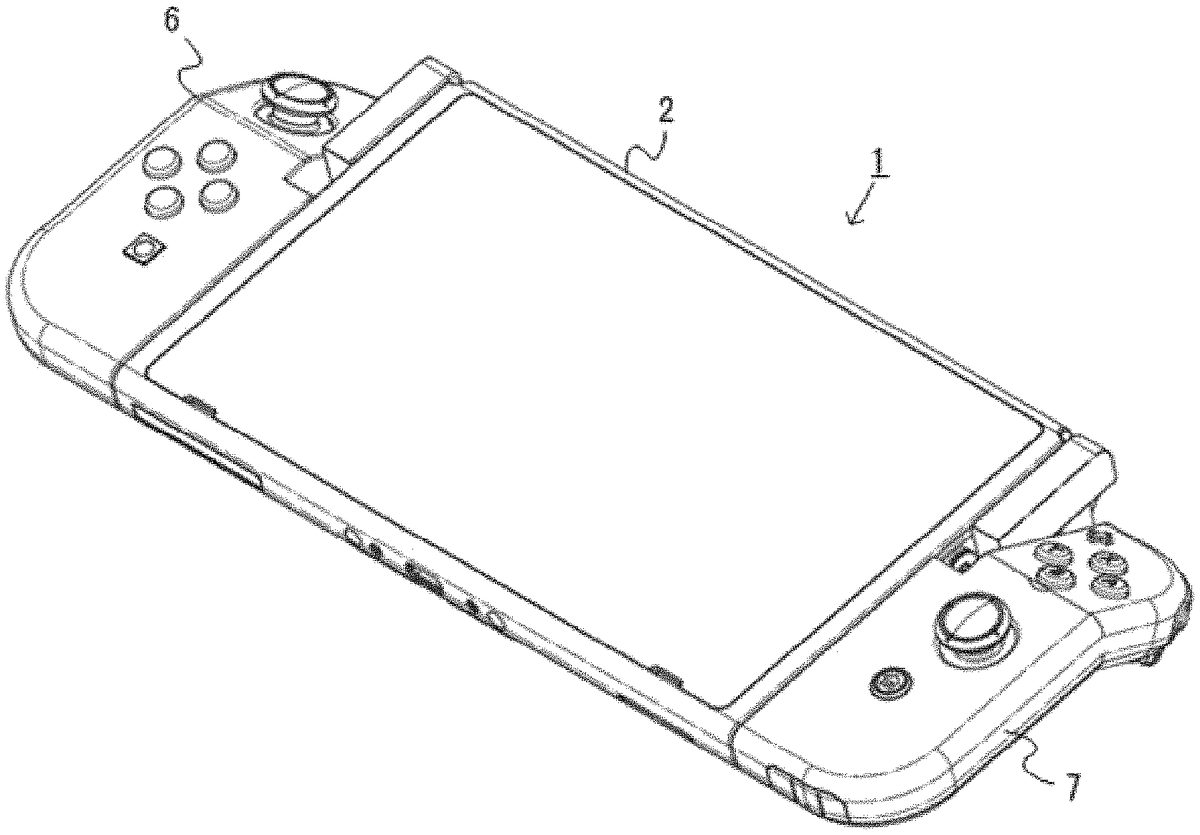
Abstract
An example of a game controller is removably attachable to a main unit having a main unit-side slide member and configured to execute game processes. The game controller includes: an operation section; and a controller-side slide member configured to slidably engage with the main unit-side slide member in a slide direction. The controller-side slide member has a first end and a second end in the slide direction, and the game controller is configured to be attached to the main unit by inserting the controller-side slide member into the main unit-side slide member from the first end. The controller-side slide member includes: a fixed portion that protrudes from a surface of the game controller and is fixed to the surface; and a pivoting portion that is connected to the fixed portion and is configured to pivot relative to the fixed portion.
Description
DETAILED DESCRIPTION OF NON-LIMITING EXAMPLE EMBODIMENTS A game system according to an example of an exemplary embodiment is described below. An example of a game system1according to the exemplary embodiment includes a main body apparatus (an information processing apparatus; which functions as a game apparatus main body in the exemplary embodiment)2, a first left controller3, and a first right controller4. Each of a first left controller3and a first right controller4is attachable to and detachable from the main body apparatus2. That is, the game system1can be used as a unified apparatus obtained by attaching each of the first left controller3and the first right controller4to the main body apparatus2. Further, in the game system1, the main body apparatus2, the first left controller3, and the first right controller4can also be used as separate bodies (seeFIG. 2). Moreover, according to the present embodiment, the game system includes a second left controller6and a second right controller7to be described later (FIG. 11andFIG. 12). In the present embodiment, the second left controller6, instead of the first left controller3, can be attached to the main body apparatus2, and the second right controller7, instead of the first right controller4, can be attached to the main body apparatus2. The second left controller6and the second right controller7will be described later. Note that in the present specification, the first left controller3, the first right controller4, the second left controller6and the second right controller7may be referred to collectively as the “controller”. The first left controller3and the first right controller4may be referred to collectively as the “first controller”, and the second left controller6and the second right controller7may be referred to collectively as the “second controller”. [1. Configuration of Main Body Apparatus and Each of the First Controller] FIG. 1is a diagram showing an example of the state where the first left controller3and the first ...
DETAILED DESCRIPTION OF NON-LIMITING EXAMPLE EMBODIMENTS
A game system according to an example of an exemplary embodiment is described below. An example of a game system1according to the exemplary embodiment includes a main body apparatus (an information processing apparatus; which functions as a game apparatus main body in the exemplary embodiment)2, a first left controller3, and a first right controller4. Each of a first left controller3and a first right controller4is attachable to and detachable from the main body apparatus2. That is, the game system1can be used as a unified apparatus obtained by attaching each of the first left controller3and the first right controller4to the main body apparatus2. Further, in the game system1, the main body apparatus2, the first left controller3, and the first right controller4can also be used as separate bodies (seeFIG. 2).
Moreover, according to the present embodiment, the game system includes a second left controller6and a second right controller7to be described later (FIG. 11andFIG. 12). In the present embodiment, the second left controller6, instead of the first left controller3, can be attached to the main body apparatus2, and the second right controller7, instead of the first right controller4, can be attached to the main body apparatus2. The second left controller6and the second right controller7will be described later.
Note that in the present specification, the first left controller3, the first right controller4, the second left controller6and the second right controller7may be referred to collectively as the “controller”. The first left controller3and the first right controller4may be referred to collectively as the “first controller”, and the second left controller6and the second right controller7may be referred to collectively as the “second controller”.
[1. Configuration of Main Body Apparatus and Each of the First Controller]
FIG. 1is a diagram showing an example of the state where the first left controller3and the first right controller4are attached to the main body apparatus2. As shown inFIG. 1, each of the first left controller3and the first right controller4is attached to and unified with the main body apparatus2. The main body apparatus2is an apparatus for performing various processes (e.g., game processing) in the game system1. The main body apparatus2includes a display12. Each of the first left controller3and the first right controller4is an apparatus including operation sections with which a user provides inputs.
FIG. 2is a diagram showing an example of the state where each of the first left controller3and the first right controller4is detached from the main body apparatus2. As shown inFIGS. 1 and 2, the first left controller3and the first right controller4are attachable to and detachable from the main body apparatus2.
FIG. 3is six orthogonal views showing an example of the main body apparatus2. As shown inFIG. 3, the main body apparatus2includes an approximately plate-shaped housing11. In the exemplary embodiment, a main surface (in other words, a surface on a front side, i.e., a surface on which the display12is provided) of a housing11has a generally rectangular shape.
It should be noted that the shape and the size of the housing11are optional. As an example, the housing11may be of a portable size. Further, the main body apparatus2alone or the unified apparatus obtained by attaching the first left controller3and the first right controller4to the main body apparatus2may function as a mobile apparatus. The main body apparatus2or the unified apparatus may function as a handheld apparatus or a portable apparatus.
As shown inFIG. 3, the main body apparatus2includes the display12, which is provided on the main surface of the housing11. The display12displays an image generated by the main body apparatus2. In the exemplary embodiment, the display12is a liquid crystal display device (LCD). The display12, however, may be a display device of any type.
Further, the main body apparatus2includes a touch panel13on a screen of the display12. In the exemplary embodiment, the touch panel13is of a type that allows a multi-touch input (e.g., a capacitive type). The touch panel13, however, may be of any type. For example, the touch panel13may be of a type that allows a single-touch input (e.g., a resistive type).
The main body apparatus2includes speakers (i.e., speakers88shown inFIG. 6) within the housing11. As shown inFIG. 3, speaker holes11aand11bare formed on the main surface of the housing11. Then, sounds output from the speakers88are output through the speaker holes11aand11b.
Further, the main body apparatus2includes a left terminal17, which is a terminal for the main body apparatus2to perform wired communication with the first left controller3, and a right terminal21, which is a terminal for the main body apparatus2to perform wired communication with the first right controller4.
As shown inFIG. 3, the main body apparatus2includes a slot23. The slot23is provided on an upper side surface of the housing11. The slot23is so shaped as to allow a predetermined type of storage medium to be attached to the slot23. The predetermined type of storage medium is, for example, a dedicated storage medium (e.g., a dedicated memory card) for the game system1and an information processing apparatus of the same type as the game system1. The predetermined type of storage medium is used to store, for example, data (e.g., saved data of an application or the like) used by the main body apparatus2and/or a program (e.g., a program for an application or the like) executed by the main body apparatus2. Further, the main body apparatus2includes a power button28.
The main body apparatus2includes a lower terminal27. The lower terminal27is a terminal for the main body apparatus2to communicate with a cradle. In the exemplary embodiment, the lower terminal27is a USB connector (more specifically, a female connector). Further, when the unified apparatus or the main body apparatus2alone is mounted on the cradle, the game system1can display on a stationary monitor an image generated by and output from the main body apparatus2. Further, in the exemplary embodiment, the cradle has the function of charging the unified apparatus or the main body apparatus2alone mounted on the cradle. Further, the cradle has the function of a hub device (specifically, a USB hub).
FIG. 4is six orthogonal views showing an example of the first left controller3. As shown inFIG. 4, the first left controller3includes a housing31. In the exemplary embodiment, the housing31has a vertically long shape, i.e., is shaped to be long in an up-down direction (i.e., a y-axis direction shown inFIGS. 1 and 4). In the state where the first left controller3is detached from the main body apparatus2, the first left controller3can also be held in the orientation in which the first left controller3is vertically long. The housing31has such a shape and a size that when held in the orientation in which the housing31is vertically long, the housing31can be held with one hand, particularly the left hand. Further, the first left controller3can also be held in the orientation in which the first left controller3is horizontally long. When held in the orientation in which the first left controller3is horizontally long, the first left controller3may be held with both hands.
The first left controller3includes an analog stick32. As shown inFIG. 4, an analog stick32is provided on a main surface of the housing31. The analog stick32can be used as a direction input section with which a direction can be input. The user tilts the analog stick32and thereby can input a direction corresponding to the direction of the tilt (and input a magnitude corresponding to the angle of the tilt). It should be noted that the first left controller3may include a directional pad, a slide stick that allows a slide input, or the like as the direction input section, instead of the analog stick. Further, in the exemplary embodiment, it is possible to provide an input by pressing the analog stick32.
The first left controller3includes various operation buttons. The first left controller3includes four operation buttons33to36(specifically, a right direction button33, a down direction button34, an up direction button35, and a left direction button36) on the main surface of the housing31. Further, the first left controller3includes a record button37and a “−” (minus) button47. The first left controller3includes a first L-button38and a ZL-button39in an upper left portion of a side surface of the housing31. Further, the first left controller3includes a second L-button43and a second R-button44, on the side surface of the housing31on which the first left controller3is attached to the main body apparatus2. These operation buttons are used to give instructions depending on various programs (e.g., an OS program and an application program) executed by the main body apparatus2.
Further, the first left controller3includes a terminal42for the first left controller3to perform wired communication with the main body apparatus2.
FIG. 5is six orthogonal views showing an example of the first right controller4. As shown inFIG. 5, the first right controller4includes a housing51. In the exemplary embodiment, the housing51has a vertically long shape, i.e., is shaped to be long in the up-down direction. In the state where the first right controller4is detached from the main body apparatus2, the first right controller4can also be held in the orientation in which the first right controller4is vertically long. The housing51has such a shape and a size that when held in the orientation in which the housing51is vertically long, the housing51can be held with one hand, particularly the right hand. Further, the first right controller4can also be held in the orientation in which the first right controller4is horizontally long. When held in the orientation in which the first right controller4is horizontally long, the first right controller4may be held with both hands.
Similarly to the first left controller3, the first right controller4includes an analog stick52as a direction input section. In the exemplary embodiment, an analog stick52has the same configuration as that of the analog stick32of the first left controller3. Further, the first right controller4may include a directional pad, a slide stick that allows a slide input, or the like, instead of the analog stick. Further, similarly to the first left controller3, the first right controller4includes four operation buttons53to56(specifically, an A-button53, a B-button54, an X-button55, and a Y-button56) on a main surface of the housing51. Further, the first right controller4includes a “+” (plus) button57and a home button58. Further, the first right controller4includes a first R-button60and a ZR-button61in an upper right portion of a side surface of the housing51. Further, similarly to the first left controller3, the first right controller4includes a second L-button65and a second R-button66.
Further, a window portion68is provided on a lower side surface of the housing51. Although the details will be described later, the first right controller4includes an infrared image capturing section123and an infrared light-emitting section124, which are placed within the housing51. The infrared image capturing section123captures a portion around the first right controller4through a window portion68such that a down direction of the first right controller4(a negative y-axis direction shown inFIG. 5) is the image capturing direction. The infrared light-emitting section124emits infrared light through the window portion68to an image capturing target to be captured by the infrared image capturing section123such that a predetermined range about the down direction of the first right controller4(the negative y-axis direction shown inFIG. 5) is the emission range. The window portion68is used to protect a lens of a camera of the infrared image capturing section123, a light emitter of the infrared light-emitting section124, and the like and composed of a material (e.g., a transparent material) that transmits light of a wavelength sensed by the camera and light emitted from the light emitter. It should be noted that the window portion68may be a hole formed in the housing51. It should be noted that in the exemplary embodiment, the infrared image capturing section123itself includes a filter member for inhibiting the transmission of light of a wavelength other than light sensed by the camera (infrared light in the exemplary embodiment). In another exemplary embodiment, the window portion68may have the function of a filter.
Further, although the details will be described later, the first right controller4includes an NFC communication section122. The NFC communication section122performs short-range wireless communication based on the NFC (Near Field Communication) standard. The NFC communication section122includes an antenna122a,which is used for short-range wireless communication, and a circuit (e.g., an NFC chip) for generating a signal (a radio wave) to be sent from the antenna122a.It should be noted that the NFC communication section122may perform short-range wireless communication through any proximity communication (or contactless communication), instead of performing short-range wireless communication based on the NFC standard. Here, the NFC standard can be used for proximity communication (contactless communication), and “may perform short-range wireless communication through any proximity communication (or contactless communication)” is intended to mean that short-range wireless communication may be performed through other proximity communication except for proximity communication based on the NFC standard.
Further, the first right controller4includes a terminal64for the first right controller4to perform wired communication with the main body apparatus2.
FIG. 6is a block diagram showing an example of the internal configuration of the main body apparatus2. The main body apparatus2includes components81to91,97, and98shown inFIG. 6in addition to the components shown inFIG. 3. Some of the components81to91,97, and98may be mounted as electronic components on an electronic circuit board and accommodated in the housing11.
The main body apparatus2includes a processor81. The processor81is an information processing section for executing various types of information processing to be executed by the main body apparatus2. For example, the processor81may be composed only of a CPU (Central Processing Unit), or may be composed of a SoC (System-on-a-chip) having a plurality of functions such as a CPU function and a GPU (Graphics Processing Unit) function. The processor81executes an information processing program (e.g., a game program) stored in a storage section (specifically, an internal storage medium such as a flash memory84, an external storage medium attached to the slot23, or the like), thereby performing the various types of information processing.
The main body apparatus2includes a flash memory84and a DRAM (Dynamic Random Access Memory)85as examples of internal storage media built into the main body apparatus2. The flash memory84and the DRAM85are connected to the processor81. The flash memory84is a memory mainly used to store various data (or programs) to be saved in the main body apparatus2. The DRAM85is a memory used to temporarily store various data used for information processing.
The main body apparatus2includes a slot interface (hereinafter abbreviated as “I/F”)91. The slot I/F91is connected to the processor81. The slot I/F91is connected to the slot23, and in accordance with an instruction from the processor81, reads and writes data from and to the predetermined type of storage medium (e.g., a dedicated memory card) attached to the slot23.
The processor81appropriately reads and writes data from and to the flash memory84, the DRAM85, and each of the above storage media, thereby performing the above information processing.
The main body apparatus2includes a network communication section82. The network communication section82is connected to the processor81. The network communication section82communicates (specifically, through wireless communication) with an external apparatus via a network. In the exemplary embodiment, as a first communication form, the network communication section82connects to a wireless LAN and communicates with an external apparatus, using a method compliant with the Wi-Fi standard. Further, as a second communication form, the network communication section82wirelessly communicates with another main body apparatus2of the same type, using a predetermined communication method (e.g., communication based on a unique protocol or infrared light communication). It should be noted that the wireless communication in the above second communication form achieves the function of enabling so-called “local communication” in which the main body apparatus2can wirelessly communicate with another main body apparatus2placed in a closed local network area, and the plurality of main body apparatuses2directly communicate with each other to transmit and receive data.
The main body apparatus2includes a controller communication section83. The controller communication section83is connected to the processor81. The controller communication section83wirelessly communicates with the first left controller3and/or the first right controller4. The communication method between the main body apparatus2and the first left controller3and the first right controller4is optional. In the exemplary embodiment, the controller communication section83performs communication compliant with the Bluetooth (registered trademark) standard with the first left controller3and with the first right controller4.
The processor81is connected to the left terminal17, the right terminal21, and the lower terminal27. When performing wired communication with the first left controller3, the processor81transmits data to the first left controller3via the left terminal17and also receives operation data from the first left controller3via the left terminal17. Further, when performing wired communication with the first right controller4, the processor81transmits data to the first right controller4via the right terminal21and also receives operation data from the first right controller4via the right terminal21. Further, when communicating with the cradle, the processor81transmits data to the cradle via the lower terminal27. As described above, in the exemplary embodiment, the main body apparatus2can perform both wired communication and wireless communication with each of the first left controller3and the first right controller4. Further, when the unified apparatus obtained by attaching the first left controller3and the first right controller4to the main body apparatus2or the main body apparatus2alone is attached to the cradle, the main body apparatus2can output data (e.g., image data or sound data) to the stationary monitor or the like via the cradle.
Here, the main body apparatus2can communicate with a plurality of first left controllers3simultaneously (in other words, in parallel). Further, the main body apparatus2can communicate with a plurality of first right controllers4simultaneously (in other words, in parallel). Thus, a plurality of users can simultaneously provide inputs to the main body apparatus2, each using a set of the first left controller3and the first right controller4. As an example, a first user can provide an input to the main body apparatus2using a first set of the first left controller3and the first right controller4, and simultaneously, a second user can provide an input to the main body apparatus2using a second set of the first left controller3and the first right controller4.
The main body apparatus2includes a touch panel controller86, which is a circuit for controlling the touch panel13. The touch panel controller86is connected between the touch panel13and the processor81. Based on a signal from the touch panel13, the touch panel controller86generates, for example, data indicating the position where a touch input is provided. Then, the touch panel controller86outputs the data to the processor81.
Further, the display12is connected to the processor81. The processor81displays a generated image (e.g., an image generated by executing the above information processing) and/or an externally acquired image on the display12.
The main body apparatus2includes a codec circuit87and speakers (specifically, a left speaker and a right speaker)88. The codec circuit87is connected to the speakers88and a sound input/output terminal25and also connected to the processor81. The codec circuit87is a circuit for controlling the input and output of sound data to and from the speakers88and the sound input/output terminal25.
Further, the main body apparatus2includes an acceleration sensor89. In the exemplary embodiment, the acceleration sensor89detects the magnitudes of accelerations along predetermined three axial (e.g., xyz axes shown inFIG. 1) directions. It should be noted that the acceleration sensor89may detect an acceleration along one axial direction or accelerations along two axial directions.
Further, the main body apparatus2includes an angular velocity sensor90. In the exemplary embodiment, the angular velocity sensor90detects angular velocities about predetermined three axes (e.g., the xyz axes shown inFIG. 1). It should be noted that the angular velocity sensor90may detect an angular velocity about one axis or angular velocities about two axes.
The acceleration sensor89and the angular velocity sensor90are connected to the processor81, and the detection results of the acceleration sensor89and the angular velocity sensor90are output to the processor81. Based on the detection results of the acceleration sensor89and the angular velocity sensor90, the processor81can calculate information regarding the motion and/or the orientation of the main body apparatus2.
The main body apparatus2includes a power control section97and a battery98. The power control section97is connected to the battery98and the processor81. Further, although not shown inFIG. 6, the power control section97is connected to components of the main body apparatus2(specifically, components that receive power supplied from the battery98, the left terminal17, and the right terminal21). Based on a command from the processor81, the power control section97controls the supply of power from the battery98to the above components.
Further, the battery98is connected to the lower terminal27. When an external charging device (e.g., the cradle) is connected to the lower terminal27, and power is supplied to the main body apparatus2via the lower terminal27, the battery98is charged with the supplied power.
FIG. 7is a block diagram showing examples of the internal configurations of the main body apparatus2, the first left controller3, and the first right controller4. It should be noted that the details of the internal configuration of the main body apparatus2are shown inFIG. 6and therefore are omitted inFIG. 7.
The first left controller3includes a communication control section101, which communicates with the main body apparatus2. As shown inFIG. 7, the communication control section101is connected to components including the terminal42. In the exemplary embodiment, the communication control section101can communicate with the main body apparatus2through both wired communication via the terminal42and wireless communication not via the terminal42. The communication control section101controls the method for communication performed by the first left controller3with the main body apparatus2. That is, when the first left controller3is attached to the main body apparatus2, the communication control section101communicates with the main body apparatus2via the terminal42. Further, when the first left controller3is detached from the main body apparatus2, the communication control section101wirelessly communicates with the main body apparatus2(specifically, the controller communication section83). The wireless communication between the communication control section101and the controller communication section83is performed in accordance with the Bluetooth (registered trademark) standard, for example.
Further, the first left controller3includes a memory102such as a flash memory. The communication control section101includes, for example, a microcomputer (or a microprocessor) and executes firmware stored in the memory102, thereby performing various processes.
The first left controller3includes buttons103(specifically, the buttons33to39,43,44, and47). Further, the first left controller3includes the analog stick (“stick” inFIG. 7)32. Each of the buttons103and the analog stick32outputs information regarding an operation performed on itself to the communication control section101repeatedly at appropriate timing.
The first left controller3includes inertial sensors. Specifically, the first left controller3includes an acceleration sensor104. Further, the first left controller3includes an angular velocity sensor105. In the exemplary embodiment, the acceleration sensor104detects the magnitudes of accelerations along predetermined three axial (e.g., xyz axes shown inFIG. 4) directions. It should be noted that the acceleration sensor104may detect an acceleration along one axial direction or accelerations along two axial directions. In the exemplary embodiment, the angular velocity sensor105detects angular velocities about predetermined three axes (e.g., the xyz axes shown inFIG. 4). It should be noted that the angular velocity sensor105may detect an angular velocity about one axis or angular velocities about two axes. Each of the acceleration sensor104and the angular velocity sensor105is connected to the communication control section101. Then, the detection results of the acceleration sensor104and the angular velocity sensor105are output to the communication control section101repeatedly at appropriate timing.
The communication control section101acquires information regarding an input (specifically, information regarding an operation or the detection result of the sensor) from each of input sections (specifically, the buttons103, the analog stick32, and the sensors104and105). The communication control section101transmits operation data including the acquired information (or information obtained by performing predetermined processing on the acquired information) to the main body apparatus2. It should be noted that the operation data is transmitted repeatedly, once every predetermined time. It should be noted that the interval at which the information regarding an input is transmitted from each of the input sections to the main body apparatus2may or may not be the same.
The above operation data is transmitted to the main body apparatus2, whereby the main body apparatus2can obtain inputs provided to the first left controller3. That is, the main body apparatus2can determine operations on the buttons103and the analog stick32based on the operation data. Further, the main body apparatus2can calculate information regarding the motion and/or the orientation of the first left controller3based on the operation data (specifically, the detection results of the acceleration sensor104and the angular velocity sensor105).
The first left controller3includes a vibrator107for giving notification to the user by a vibration. In the exemplary embodiment, the vibrator107is controlled by a command from the main body apparatus2. That is, if receiving the above command from the main body apparatus2, the communication control section101drives the vibrator107in accordance with the received command. Here, the first left controller3includes a codec section106. If receiving the above command, the communication control section101outputs a control signal corresponding to the command to the codec section106. The codec section106generates a driving signal for driving the vibrator107from the control signal from the communication control section101and outputs the driving signal to the vibrator107. Consequently, the vibrator107operates.
More specifically, the vibrator107is a linear vibration motor. Unlike a regular motor that rotationally moves, the linear vibration motor is driven in a predetermined direction in accordance with an input voltage and therefore can be vibrated at an amplitude and a frequency corresponding to the waveform of the input voltage. In the exemplary embodiment, a vibration control signal transmitted from the main body apparatus2to the first left controller3may be a digital signal representing the frequency and the amplitude every unit of time. In another exemplary embodiment, the main body apparatus2may transmit information indicating the waveform itself. The transmission of only the amplitude and the frequency, however, enables a reduction in the amount of communication data. Additionally, to further reduce the amount of data, only the differences between the numerical values of the amplitude and the frequency at that time and the previous values may be transmitted, instead of the numerical values. In this case, the codec section106converts a digital signal indicating the values of the amplitude and the frequency acquired from the communication control section101into the waveform of an analog voltage and inputs a voltage in accordance with the resulting waveform, thereby driving the vibrator107. Thus, the main body apparatus2changes the amplitude and the frequency to be transmitted every unit of time and thereby can control the amplitude and the frequency at which the vibrator107is to be vibrated at that time. It should be noted that not only a single amplitude and a single frequency, but also two or more amplitudes and two or more frequencies may be transmitted from the main body apparatus2to the first left controller3. In this case, the codec section106combines waveforms indicated by the plurality of received amplitudes and frequencies and thereby can generate the waveform of a voltage for controlling the vibrator107.
The first left controller3includes a power supply section108. In the exemplary embodiment, the power supply section108includes a battery and a power control circuit. Although not shown inFIG. 7, the power control circuit is connected to the battery and also connected to components of the first left controller3(specifically, components that receive power supplied from the battery).
As shown inFIG. 7, the first right controller4includes a communication control section111, which communicates with the main body apparatus2. Further, the first right controller4includes a memory112, which is connected to the communication control section111. The communication control section111is connected to components including the terminal64. The communication control section111and the memory112have functions similar to those of the communication control section101and the memory102, respectively, of the first left controller3. Thus, the communication control section111can communicate with the main body apparatus2through both wired communication via the terminal64and wireless communication not via the terminal64(specifically, communication compliant with the Bluetooth (registered trademark) standard). The communication control section111controls the method for communication performed by the first right controller4with the main body apparatus2.
The first right controller4includes input sections similar to the input sections of the first left controller3. Specifically, the first right controller4includes buttons113, the analog stick52, and inertial sensors (an acceleration sensor114and an angular velocity sensor115). These input sections have functions similar to those of the input sections of the first left controller3and operate similarly to the input sections of the first left controller3.
Further, the first right controller4includes a vibrator117and a codec section116. The vibrator117and the codec section116operate similarly to the vibrator107and the codec section106, respectively, of the first left controller3. That is, in accordance with a command from the main body apparatus2, the communication control section111causes the vibrator117to operate, using the codec section116.
The first right controller4includes the NFC communication section122, which performs short-range wireless communication based on the NFC standard. The NFC communication section122has the function of a so-called NFC reader/writer. Here, the term “short-range wireless communication” as used herein includes a communication method where a radio wave from an apparatus (here, the first right controller4) develops an electromotive force (e.g., by electromagnetic induction) in another device (here, a device near the antenna122a). The other device can operate by the developed electromotive force, and may or may not have a power supply. When the first right controller4(the antenna122a) and a communication target come close to each other (typically, the distance between the first right controller4and the communication target becomes dozen centimeters or less), the NFC communication section122becomes able to communicate with the communication target. The communication target is any apparatus capable of performing short-range wireless communication with the NFC communication section122and is, for example, an NFC tag or a storage medium having the function of an NFC tag. Alternatively, the communication target may be another apparatus having an NFC card emulation function.
Further, the first right controller4includes the infrared image capturing section123. The infrared image capturing section123includes an infrared camera for capturing a portion around the first right controller4. As an example, the main body apparatus2and/or the first right controller4calculate information of a captured image (e.g., information related to the luminance of a plurality of blocks into which at least the entirety of a partial area of a captured image is divided or the like), and based on the calculated information, determine a change in the portion around the first right controller4. Further, the infrared image capturing section123may capture an image using ambient light, but in the exemplary embodiment, includes the infrared light-emitting section124, which emits infrared light. The infrared light-emitting section124emits infrared light, for example, in synchronization with the timing when the infrared camera captures an image. Then, the infrared light emitted from the infrared light-emitting section124is reflected by an image capturing target, and the infrared camera receives the reflected infrared light, thereby acquiring an image of the infrared light. This enables the infrared image capturing section123to obtain a clearer infrared light image. It should be noted that the infrared image capturing section123and the infrared light-emitting section124may be provided as different devices in the first right controller4, or may be provided as a single device in the same package in the first right controller4. Further, in the exemplary embodiment, the infrared image capturing section123including an infrared camera is used. In another exemplary embodiment, a visible light camera (a camera using a visible light image sensor) may be used as image capturing means, instead of the infrared camera.
The first right controller4includes a processing section121. The processing section121is connected to the communication control section111. Further, the processing section121is connected to the NFC communication section122, the infrared image capturing section123, and the infrared light-emitting section124. In accordance with a command from the main body apparatus2, the processing section121performs the process of managing the NFC communication section122. For example, in accordance with a command from the main body apparatus2, the processing section121controls the operation of the NFC communication section122. Further, the processing section121controls the start of the NFC communication section122or controls the operations (specifically, reading, writing, and the like) of the NFC communication section122performed on a communication target (e.g., an NFC tag). Further, the processing section121receives, from the main body apparatus2, information to be transmitted to the communication target via the communication control section111and passes the information to the NFC communication section122. Further, the processing section121acquires, from the NFC communication section122, information received from the communication target and transmits the information to the main body apparatus2via the communication control section111.
Further, the processing section121includes a CPU, a memory, and the like. Based on a predetermined program (e.g., an application program for performing image processing and various calculations) stored in a storage device (e.g., a non-volatile memory or the like) (not shown) included in the first right controller4, and in accordance with a command from the main body apparatus2, the processing section121performs the process of managing the infrared image capturing section123. For example, the processing section121causes the infrared image capturing section123to perform an image capturing operation. Further, the processing section121acquires and/or calculates information based on an image capturing result (information of a captured image, information calculated from this information, or the like) and transmits the information to the main body apparatus2via the communication control section111. Further, in accordance with a command from the main body apparatus2, the processing section121performs the process of managing the infrared light-emitting section124. For example, in accordance with a command from the main body apparatus2, the processing section121controls the light emission of the infrared light-emitting section124. It should be noted that a memory used by the processing section121to perform processing may be provided in the processing section121or may be the memory112.
The first right controller4includes a power supply section118. The power supply section118has a function similar to that of the power supply section108of the first left controller3and operates similarly to the power supply section108.
(Slide Member of Main Body Apparatus)
The configuration that enables a controller to be attached to and detached from the main body apparatus2will now be described. In the present embodiment, a slide mechanism allows the controller to be detachably attached to the main body apparatus2. The main body apparatus2and the controller each include a slide member that forms a slide mechanism. The slide member of the main body apparatus2and the slide member of the controller can be slidably attached to each other. The slide member of the main body apparatus2will now be described.
As shown inFIG. 3, the main body apparatus2includes a main body rail member29as an example of the slide member. The main body rail member29is provided on the left side surface of the main body apparatus2. The main body rail member29is a slide member that allows the first left controller3(or the second left controller6to be described later) to be detachably attached to the main body apparatus2. Note that in other embodiments, the main body rail member29may be formed as an integral unit with the housing11of the main body apparatus2. That is, a part of the housing11may function as the main body rail member.
FIG. 8is an enlarged view of the main body rail member29shown inFIG. 3.FIG. 9is a diagram schematically showing an example of a cross section of the main body rail member29taken along A-A′ shown inFIG. 8. Note that “to schematically show” as used herein means to show an element of interest (e.g., the main body rail member29inFIG. 9) in such a manner that its size, shape and/or positional relationship with other elements may be different from other figures so that the element of interest is more conspicuous.
As shown inFIG. 8andFIG. 9, the main body rail member29includes a bottom surface portion201, side surface portions202aand202b,and top surface portions203aand203b.Note that the side surface portions202aand202bmay be hereinafter referred to collectively as “a side surface portion202”. Also, the top surface portions203aand203bmay be referred to collectively as “a top surface portion203”. In the present embodiment, these portions201to203are generally plate-shaped members.
The bottom surface portion201is placed on the engaging surface (i.e., the left side surface) of the housing11so as to be substantially parallel to the engaging surface. Note that “substantially (in a certain state)” as used herein means to include cases in which that state is achieved in a strict sense and also cases in which that state is generally achieved. For example, “substantially parallel” means that they may be parallel to each other in a strict sense, and they may not be parallel to each other in a strict sense but may be generally parallel to each other.
The bottom surface portion201includes a bottom surface2011of the main body rail member29. As shown inFIG. 9, the side surface portion202includes side surfaces2021(specifically, side surfaces2021aand2021b) substantially perpendicular to the bottom surface. The side surface portions202extend substantially perpendicular to the bottom surface portion201from the opposite ends of the bottom surface portion201in the width direction (i.e., the z-axis direction shown inFIG. 8). Specifically, the side surface portion202aextends from one end (i.e., the z-axis negative direction side) of the bottom surface portion201, and the side surface portion202bextends from the other end (i.e., the z-axis positive direction side) of the bottom surface portion201. As shown inFIG. 9, the bottom surface portion201and the side surface portion202together form a groove portion. Note that the upper end (i.e., the end on the y-axis positive direction side) of the groove portion has an opening so that the slide member of the controller can be inserted through the upper end.
As shown inFIG. 9, the top surface portion203includes a top surface2031(specifically, top surfaces2031aand2031b) substantially parallel to the bottom surface2011. The top surface portion203extends in a direction substantially parallel to the bottom surface2011from an end of the side surface portion202that is opposite to the end at which the bottom surface portion201is connected to the side surface portion202(i.e., the x-axis negative direction side). Specifically, the top surface portion203aextends from an end portion of the side surface portion202aon the x-axis negative direction side, and the top surface portion203bextends from an end portion of the side surface portion202bon the x-axis negative direction side. The top surface portions203aand203bare provided so as to protrude from the side surface portion202toward the inside of the main body rail member29(in other words, so as to protrude toward each other). The top surface portion203aand the top surface portion203bare spaced apart from each other so that the slide member of the controller can be inserted into the groove portion formed by the bottom surface portion201and the side surface portion202(FIG. 9).
A part of the upper end portion (i.e., the end portion on the y-axis positive direction side) of the top surface portion203includes a cut-out portion C1, as shown inFIG. 8. Although the details will be described later, the cut-out portion C1is provided so that a stop member of the controller engages with the cut-out portion C1(strictly speaking, the top surface portion203around the cut-out portion C1) in a state in which the controller is attached to the main body apparatus2. That is, a portion of the top surface portion203where the cut-out portion C1is formed serves as a stop-receiving portion that receives the stop member of the controller.
FIG. 10is a diagram schematically showing an example of a cross section in the vicinity of the lower end of the rail member shown inFIG. 8.FIG. 10is a diagram schematically showing an example of a partial cross section of the main body rail member29taken along B-B′ shown inFIG. 8.
As shown inFIG. 8andFIG. 10, the main body rail member29includes an opposing portion204. In the present embodiment, the opposing portion204stops the slide movement of the slide member by being in contact with the slide member of the controller, which is inserted into the main body rail member29from the upper side in the slide direction. Note that in other embodiments, the slide movement of the slide member may be stopped by the distal end of the slide member being in contact with a wall surface provided on the far end (i.e., the y-axis negative direction side shown inFIG. 10) of the opposing portion204instead of (or in addition to) the opposing portion204being in contact with the slide member of the controller.
As shown inFIG. 10, the opposing portion204is provided, spaced apart from the bottom surface portion201, so as to be located to oppose a portion of the bottom surface portion201(specifically, a portion near the lower end of the bottom surface portion201). The opposing portion204includes an opposing surface204afacing toward the bottom surface portion201. The opposing surface204ais a surface that is facing toward the housing11of the main body apparatus2(in other words, the engaging surface). In the present embodiment, when the controller is attached to the main body apparatus2, the slide member of the controller (more specifically, a protruding portion308to be described later) is inserted into the space between the bottom surface portion201and the opposing portion204.
In the present embodiment, the top surface portion203and the opposing portion204are formed as an integral unit. In other words, the upper surface of the opposing portion204(i.e., the surface facing toward the x-axis negative direction side) is continuous with the upper surface of the top surface portion203(i.e., the surface facing toward the x-axis negative direction side). This makes it possible to simplify the shape of the main body rail member29, and to facilitate the production of the rail member.
Note that in the present embodiment, the main body rail member29including the portions201to204is a metal. This makes it possible to improve the mechanical strength of the rail member. Moreover, by improving the mechanical strength of the rail member, it is also possible to contribute to improving the mechanical strength of the main body apparatus2to which the rail member is attached.
As shown inFIG. 8, the main body rail member29includes a leaf spring205. The leaf spring205is provided on the bottom surface portion201of the main body rail member29. The leaf spring205is an example of an elastic member for applying a force in a direction away from the main body apparatus2(i.e., the x-axis negative direction shown inFIG. 9) onto the controller in a state in which the controller is attached to the main body apparatus2. In other embodiments, an elastic member of a rubber, or the like, may be used instead of the leaf spring. In other embodiments, the main body rail member29does not need to include the leaf spring205.
As shown inFIG. 10, left-side terminals17of the main body apparatus2are provided on the opposing surface204aof the opposing portion204. As shown inFIG. 10, the left-side terminals17are arranged so that one side thereof facing the bottom surface portion201is exposed. Thus, in the present embodiment, the left-side terminals17are arranged on the reverse side (i.e., the side opposing the bottom surface portion201) of the member (i.e., the opposing portion204) arranged spaced apart from the engaging surface of the main body apparatus2(i.e., the bottom surface portion201). Then, it is possible to reduce the possibility that the left-side terminals17come into contact with a hand of the user or other objects, thereby protecting the left-side terminals17.
The main body apparatus2includes a rail member similar to the main body rail member29on the right side surface of the main body apparatus2(FIG. 3). The rail member provided on the right side surface is an example of a slide member that allows the first right controller4(or the second right controller7to be described later) to be detachably attached to the main body apparatus2. The configuration of the rail member provided on the right side surface is similar to the configuration of the main body rail member29, and will not be described below in detail. Similar to the left-side terminals17, right-side terminals21are provided on the opposing surface of the opposing portion of the rail member.
[2. Configuration of Second Controller]
Next, an example of a configuration of the second controller included in the game system will be described.FIG. 11is a diagram showing an example of the second left controller.FIG. 12is a diagram showing an example of the second right controller. The second left controller6shown inFIG. 11can be attached to the left side surface of the main body apparatus2, as can the first left controller3. The second right controller7shown inFIG. 12can be attached to the right side surface of the main body apparatus2, as can the first right controller4. As shown inFIG. 11andFIG. 12, the second controller is different from the first controller in that a portion thereof has a bent shape. The configuration of the second controller will now be described using the second left controller6as an example. Note that the internal configuration of the second controller is similar to the internal configuration of the first controller (FIG. 7) and will not be described below in detail.
[2-1. Second Left Controller]
[2-1-1. Body Section]
FIG. 13is six orthogonal views showing an example of the second left controller6shown inFIG. 11. As shown inFIG. 11andFIG. 13, the second left controller6includes a body section301. The body section301is a portion that is primarily held by the user when the user uses the second left controller6. The body section301is provided with operation sections (e.g., the analog stick32, etc.). Herein, with the body section301of the second left controller6, as opposed to the first left controller3, an upper portion (i.e., the y-axis positive direction side shown inFIG. 11) of the plate-shaped body (in other words, a rectangular parallelepiped) is bent rearward (i.e., the z-axis positive direction shown inFIG. 11). Although the details will be described later, as the body section301is bent, the second left controller6has such a shape that the second left controller6can be easily held and operated by the user.
As shown inFIG. 11andFIG. 13, the front surface of the body section301is bent in an upwardly-protruding shape. Specifically, the front surface of the body section301includes a non-inclined surface301aand an inclined surface301b.In the present embodiment, the non-inclined surface301aand the inclined surface301bare each a plane (specifically, a plane such that a straight line between any two points on the plane is always included in the plane). Note however that in other embodiments, the non-inclined surface301aand/or the inclined surface301bmay be a curved surface (e.g., an upwardly-protruding curved surface). In other embodiments, the connecting portion between the non-inclined surface301aand the inclined surface301b(in other words, the boundary between the non-inclined surface301aand the inclined surface301b) may be chamfered.
The non-inclined surface301ais a surface that is substantially perpendicular to the front surface direction of the second left controller6(referred to also as the front-rear direction, that is, the z-axis direction shown inFIG. 11). In the present embodiment, the non-inclined surface301ais a lower portion (i.e., the y-axis negative direction side shown inFIG. 11) of the front surface of the body section301.
The inclined surface301bis provided on the upper side of the non-inclined surface301a.The inclined surface301bis a surface that is continuous with the non-inclined surface301a,and is provided inclined with respect to the non-inclined surface301a.The inclined surface301bis inclined in a direction such that an upper portion of the inclined surface301bis located rearward (i.e., the z-axis positive direction side) of a lower portion of the inclined surface301b.It can be said that the inclined surface301bis inclined in substantially the same direction as the pivoting direction of a pivoting portion304to be described later (i.e., the direction in which the pivoting portion304pivots about the x axis). The inclined surface301bis provided inclined by a predetermined angle (e.g.,) 30° with respect to the non-inclined surface301a.Note that the direction in which the inclined surface301bis inclined with respect to the non-inclined surface301ais substantially the same direction as the direction in which the pivoting portion304to be described later pivots. In other embodiments, there is no limitation on the magnitude of the inclination angle of the inclined surface301b.
As shown inFIG. 13, the body section301has a plate shape. The reverse surface of the body section301is provided generally parallel to the front surface of the body section301. Specifically, the reverse surface of the body section301includes a first reverse surface301cthat is substantially parallel to the non-inclined surface301a,and a second reverse surface301dthat is substantially parallel to the inclined surface301b.
The body section301has a side surface that is in contact with the front surface and the reverse surface. In the present embodiment, a slide member302is provided on the right side surface, of the side surfaces, of the body section301. Note that as shown inFIG. 11, the right side surface of the body section301includes a first right side surface301eand a second right side surface301f.The first right side surface301eis a side surface provided on a portion of the right side surface of the body section301that is on the side (specifically, the left-right direction, i.e., the x-axis direction shown inFIG. 11) of the non-inclined surface301a.The second right side surface301fis a side surface provided on a portion of the right side surface of the body section301that is on the side of the inclined surface301b.
As shown inFIG. 11andFIG. 13, in the present embodiment, the operation buttons33to36and the record button37are provided on the non-inclined surface301a. The analog stick32and the “−” (minus) button47are provided on the inclined surface301b.Note that in the present specification, components of the second left controller6that are also included in the first left controller3described above are denoted by the same reference signs as those of the first left controller3.
As shown in the front view ofFIG. 13, the upper left portion of the body section301(strictly speaking, the upper left portion as the body section301is seen from the front side) is chamfered in a rounded shape. The first L button38and the ZL button39are provided on the corner portion. The first L button38is provided on the upper left portion of the side surface of the body section301. The ZL button39is provided on the upper left portion so as to extend from the side surface of the body section301to the reverse surface (more specifically, the second reverse surface301d). That is, the ZL button39is provided on the rear side (the z-axis positive direction side shown inFIG. 13) of the first L button38. In the present embodiment, since the upper left portion of the body section301has a rounded shape, the first L button38and the ZL button39have a rounded shape in accordance with the roundedness of the upper left portion of the body section301.
[2-1-2. Slide Member]
As shown inFIG. 11andFIG. 13, the second left controller6includes the slide member302. In the present embodiment, the slide member302includes a fixed portion303and the pivoting portion304. The fixed portion303is fixed to the body section301. The pivoting portion304can pivot relative to the fixed portion303. That is, a portion (i.e., the pivoting portion304) of the slide member302of the second left controller6is movable relative to the body section301. The slide member302can change its shape by pivoting the pivoting portion304.
As shown inFIG. 11, the fixed portion303is provided on the first right side surface301e.That is, the fixed portion303is provided on the side of the non-inclined surface301a.The fixed portion303is provided protruding from the first right side surface301e.The fixed portion303is a bar-shaped member and is provided along the up-down direction (i.e., the y-axis direction shown inFIG. 13) of the second left controller6. Note that the fixed portion303is provided on the side of the body section301so as not to protrude from the front surface of the body section301as seen from the direction perpendicular to the side surface of the body section301(seeFIG. 14to be described below). That is, the fixed portion303is provided on the back surface side relative to the front surface of the body section301. For example, the fixed portion303is provided so as to be within the extent of the first right side surface301eas seen from the direction perpendicular to the side surface of the body section301.
The fixed portion303has such a shape that it can slidably engage with the main body rail member29. Note that the direction (the y-axis direction shown inFIG. 11in the present embodiment) in which the fixed portion303can slide in a state where the fixed portion303engages with the main body rail member29of the main body apparatus2will hereinafter be referred to as the “slide direction (of the fixed portion303)”. The axis that passes through the fixed portion303(more specifically, the center of the fixed portion303) and that is parallel to the slide direction of the fixed portion303is referred to as the “slide axis (of the fixed portion303)”. Therefore, the fixed portion303can slidably engage with the main body rail member29in the direction along the slide axis of the fixed portion303. An example of a specific configuration of the fixed portion303will now be described.
FIG. 14is an enlarged view showing an example of the fixed portion303and the pivoting portion304of the second left controller6. Enlarged view A shown inFIG. 14is an enlarged view as the fixed portion303is seen from the lower side (i.e., the y-axis negative direction side shown inFIG. 14).
As shown in Enlarged view A, the fixed portion303is shaped so that a cross section thereof taken perpendicular to the slide direction is generally T-shaped. Specifically, the fixed portion303includes a shaft306and a top surface portion307. As shown in Enlarged view A, the shaft306is provided so as to protrude from the first right side surface301eof the body section301. The top surface portion307is provided on one side of the shaft306that is away from the body section301(i.e., the x-axis negative direction side). The width of the top surface portion307(i.e., the length in the z-axis direction) is greater than the width of the shaft306. The end of the top surface portion307in the z-axis direction is located so as to protrude past (in other words, located on the outer side of) the end of the shaft306in the z-axis direction.
Thus, the fixed portion303has a cross-sectional shape along a cross section perpendicular to the slide direction such that the width of a first portion (i.e., the shaft306) that protrudes from the side surface (in other words, that is adjacent to the side surface) of the body section301is shorter than the width of a second portion (i.e., the top surface portion307) that is located farther away from the side surface than the first portion. Although the details will be described later, with the shape described above, the fixed portion303in engagement with the main body rail member29of the main body apparatus2is locked on the main body rail member29so as not to come off in the direction perpendicular to the slide direction (seeFIG. 21).
As shown inFIG. 14, the fixed portion303is a bar-shaped member extending along the slide axis. The shaft306and the top surface portion307are provided so as to extend along the slide axis of the fixed portion303. In the present embodiment, the slide axis of the fixed portion303is provided to be substantially parallel to the non-inclined surface301a.The slide axis of the fixed portion303is provided to be substantially parallel to the first right side surface301eof the body section301.
As shown inFIG. 11andFIG. 14, the shaft306is provided and the top surface portion307is absent on an upper portion (i.e., a portion on the y-axis positive direction side) of the fixed portion303. Thus, the top surface portion307does not need to be provided over the entirety in the slide direction of the fixed portion303. In other embodiments, as with the top surface portion307, the shaft306also does not need to be provided over the entirety in the slide direction of the fixed portion303.
FIG. 15is a diagram schematically showing an example of a cross section in the vicinity of the lower end of the fixed portion.FIG. 15is a diagram schematically showing an example of a partial cross section of the fixed portion303taken along C-C′ shown inFIG. 14. As shown inFIG. 15, in the present embodiment, the second left controller6includes terminals42provided on the fixed portion303. Specifically, as shown inFIG. 15, the fixed portion303includes the protruding portion308at the lower end portion of the fixed portion303. The protruding portion308is provided so as to protrude in the slide direction (more specifically, in the lower direction, i.e., the y-axis negative direction) from the top surface portion307. The protruding portion308is provided on one side of the fixed portion303farther away from the body section301(i.e., the x-axis positive direction side). That is, the protruding portion308is provided spaced apart from the body section301. As shown inFIG. 15, the protruding portion308includes an opposing surface308afacing toward the body section301. The opposing surface308aopposes a predetermined surface of the second left controller6(specifically, the first right side surface301e).
As shown inFIG. 15, the terminals42are provided between the opposing surface308aand the predetermined surface. More specifically, in the present embodiment, the terminals42are provided on the opposing surface308a.The terminals42are arranged so that one side thereof facing the body section301is exposed. The terminals42are arranged on the reverse side of the fixed portion303(specifically, the protruding portion308). With the terminals42arranged so that one side thereof facing the body section301is exposed, as described above, it is possible to reduce the possibility that the terminals42come into contact with a hand of the user or other objects, thereby protecting the terminals42. Note that as shown inFIG. 15, the distal end of the terminals42is located on the inner side relative to the distal end of the protruding portion308(specifically, the top on the y-axis negative direction side) in the slide direction. This also makes it possible to protect the terminals42.
FIG. 16is a perspective view showing an example of the terminals provided on the protruding portion.FIG. 16shows the protruding portion308as seen from the reverse side (i.e., the side of the opposing surface308a). As shown inFIG. 15andFIG. 16, the protruding portion308includes wall portions309. The wall portions309are provided on the opposing surface308aon both sides with respect to the direction that is parallel to the opposing surface308aand substantially perpendicular to the slide direction (i.e., the z-axis direction). With the wall portion309, it is possible to further reduce the possibility that the terminals42come into contact with a hand of the user or other objects, thereby more reliably protecting the terminals42.
As shown in the enlarged view ofFIG. 16, holes306aare provided on the surface of the shaft306of the fixed portion303on which the protruding portion308is provided (i.e., the end surface on y-axis negative direction side). The terminals42are provided so as to protrude from the inside of the fixed portion303via the holes306a. The same number of slits308bas the number (herein, ten) of the terminals42are formed on the opposing surface308aof the protruding portion308. The slits308bare connected to the holes306a.The slits308bare formed so as to extend in the slide direction (i.e., the y-axis direction). As shown inFIG. 16, the slits308bare arranged next to each other in a direction that is parallel to the opposing surface308aand perpendicular to the slide direction (i.e., the z-axis direction).
As shown inFIG. 16, the terminals42are provided on the opposing surface308aalong the slits308b.The terminals42are arranged next to each other in a direction perpendicular to the slide direction (i.e., the z-axis direction), as are the slits308b.In the present embodiment, the terminals42are provided so that a portion thereof (e.g., a distal end portion) is in the slits308bwhile the other portion is outside the slits308b(FIG. 15andFIG. 16). Herein, when the terminals42of the second left controller6are connected to the left-side terminals17of the main body apparatus2in the state where the second left controller6is attached to the main body apparatus2(referred to as the “attached state”), the terminals42are pressed and deformed by the left-side terminals17to move in the direction toward the slits308b(i.e., the x-axis negative direction). That is, each terminal42is bent so that at least a part of the terminal42lies in a slit308bprovided on the opposing surface308a.It can be said that the slits308bare provided so that the terminals42being deformed can be retracted so that the terminals42will not be in contact with the opposing surface308a.Thus, although the terminals42are not in contact with the opposing surface308ain the present embodiment, they are provided at positions corresponding to the slits308bprovided on the opposing surface308a,and are provided at such positions that they would be in contact with the opposing surface308awithout the slits308b.In this sense, in the present embodiment, it can be said that the terminals42are provided on the opposing surface308a.Note that in other embodiments, the slits308bmay be absent on the opposing surface308a,and the terminals42may be provided so as to be in contact with the opposing surface308a.As shown inFIG. 16, the terminals42extend along the opposing surface308a.
As shown inFIG. 14, the pivoting portion304is connected to the fixed portion303. In the present embodiment, the pivoting portion304is connected to the upper end portion of the fixed portion303(in other words, the upper end portion of the shaft306). As does the fixed portion303, the pivoting portion304also has a shape such that it can slidably engage with the main body rail member29. Note that the direction in which the pivoting portion304, in engagement with the main body rail member29of the main body apparatus2, can slide will be hereinafter referred to as the “slide direction (of the pivoting portion304)”. The axis that passes through the pivoting portion304(more specifically, the center of the pivoting portion304) and that is parallel to the slide direction of the pivoting portion304is referred to as the “slide axis (of the pivoting portion304)”. Therefore, the pivoting portion304can slidably engage with the main body rail member29in the direction along the slide axis of the pivoting portion304. An example of a specific configuration of the pivoting portion304will now be described.
Enlarged view B shown inFIG. 14is an enlarged view of the pivoting portion304as seen from the distal end side (specifically, an end portion that is opposite to the end portion that is connected to the fixed portion303) of the pivoting portion304. As shown in Enlarged view B, as is the fixed portion303, the pivoting portion304is shaped so that a cross section thereof taken perpendicular to the slide direction is generally T-shaped. Specifically, the pivoting portion304includes a shaft316and a top surface portion317. As shown in Enlarged view B, the shaft316is provided to protrude from a movable casing319to be described later. The top surface portion317is provided on one side of the shaft316that is away from the body section301(i.e., the x-axis negative direction side). The length of the top surface portion317in the width direction (specifically, the direction that is perpendicular to the slide direction of the pivoting portion304and perpendicular to the z-axis direction) is greater than the width of the shaft316. The end portion of the top surface portion317in the width direction is located so as to protrude past (in other words, located on the outer side of) the end of the shaft316in the z-axis direction. With the shape described above, as is the fixed portion303, the pivoting portion304in engagement with the main body rail member29of the main body apparatus2is locked on the main body rail member29so as not to come off in the direction perpendicular to the slide direction.
As shown inFIG. 11, the shaft316of the pivoting portion304is provided at substantially the same position as the shaft306of the fixed portion303with respect to the x-axis direction (in other words, the direction perpendicular to the first right side surface301e), and the top surface portion317of the pivoting portion304is provided at substantially the same position as the top surface portion307of the fixed portion303with respect to the x-axis direction. Therefore, when the slide axis of the fixed portion303and the slide axis of the pivoting portion304are aligned on the same straight line, the fixed portion303and the pivoting portion304can be both engaged with the main body rail member29.
As shown inFIG. 14, the pivoting portion304is a bar-shaped member extending along the slide axis. The shaft316and the top surface portion317are provided so as to extend along the slide axis of the pivoting portion304. In the present embodiment, as with the fixed portion303, the slide axis of the pivoting portion304is provided substantially parallel to the first right side surface301eof the body section301.
As shown inFIG. 11andFIG. 14, on one end portion of the pivoting portion304that is connected to the fixed portion303, the shaft316is provided and the top surface portion317is absent. Thus, the top surface portion317does not need to be provided over the entirety in the slide direction of the pivoting portion304. In other embodiments, as with the top surface portion317, the shaft316also does not need to be provided over the entirety in the slide direction of the pivoting portion304. Note that one end portion of the pivoting portion304that is connected to the fixed portion303is not connected to the movable casing319.
In the present embodiment, the pivoting portion304is pivotally connected to the fixed portion303. Referring toFIG. 17, an example of a configuration with which the fixed portion303and the pivoting portion304are pivotally connected together will now be described.
FIG. 17is a diagram schematically showing an example of a connecting portion between the fixed portion and the pivoting portion. As shown inFIG. 17, a substantially circular hole306ais formed in the vicinity of the upper end portion of the fixed portion303(specifically, the shaft306). The pivoting portion304(specifically, the shaft316) includes a shaft304athat can be inserted into the hole306aof the fixed portion303, at one end portion of the pivoting portion304that is connected to the fixed portion303. The shaft304ais provided to extend in a direction (i.e., the x-axis direction) that is substantially perpendicular to the first right side surface301eon which the fixed portion303is provided. The diameter of the shaft304ais set to be substantially equal to the diameter of the hole306aof the fixed portion303(or slightly smaller than the diameter of the hole). The slide member302includes a fastening disc313and a fastening screw314. The fastening disc313has a circular shape that is larger than the hole306aof the fixed portion303.
As shown inFIG. 17, the pivoting portion304is connected to the fastening disc313by the fastening screw314, with the shaft304ainserted in the hole306aof the fixed portion303. That is, the shaft304ais provided at the upper end portion of the fixed portion303. Then, an upper end portion of the fixed portion303(in other words, a portion around the hole306a) is sandwiched between the pivoting portion304and the fastening disc313. With such a configuration, the pivoting portion304can pivot about the shaft304a.Specifically, since the shaft304ato be the pivoting axis is oriented in a direction that is substantially perpendicular to the first right side surface301e(i.e., the x-axis direction), the pivoting portion304pivots about the x axis relative to the fixed portion303.
Note that there is no limitation on the pivoting mechanism used for pivotally connecting together the fixed portion303and the pivoting portion304. For example, in other embodiments, a hole may be provided in one end portion of the pivoting portion304, and a shaft that can be inserted in the hole may be provided on an upper end portion of the fixed portion303.
While the slide member302of the second left controller6has one axis of rotation in the present embodiment, the slide member302may have two or more axes of rotation in other embodiments. For example, in other embodiments, the slide member includes a fixed portion, a first pivoting portion and a second pivoting portion. Then, as in the present embodiment, the fixed portion is fixed to the body section301. The first pivoting portion is pivotally connected to the fixed portion. Note that one end of the first pivoting portion is connected to the upper end of the fixed portion, and the other end of the first pivoting portion is connected to one end of the second pivoting portion. The second pivoting portion is pivotally connected to the first pivoting portion. Note that the fixed portion and at least one of the first pivoting portion and the second pivoting portion may be shaped so that they can slidably engage with the main body rail member29of the main body apparatus2.
Note that as shown in Enlarged view ofFIG. 14, the second left controller6includes a stop member318. In the present embodiment, the stop member318is provided on the pivoting portion304. The stop member318is provided to stop the slide movement of the second left controller6against the main body apparatus2while the second left controller6is attached to the main body apparatus2. The details of the stop member318will be described later.
As shown inFIG. 11,FIG. 13andFIG. 14, the pivoting portion304includes the movable casing319. The movable casing319is fixed to the shaft316of the pivoting portion304. Herein, as shown inFIG. 13, the inclined surface301bof the body section301is provided so that the right side of the inclined surface301bis located on the left side relative to the right side of the non-inclined surface301aof the body section301. That is, the second right side surface301f,which is in contact with the inclined surface301b,of the right side surface of the body section301, is provided so as to have a step relative to the first right side surface301e,which is in contact with the non-inclined surface301a. Specifically, as the right side surface of the body section301is seen from the right side (i.e., the x-axis negative direction side), the second right side surface301fis provided on the far side relative to the first right side surface301e.Therefore, the second right side surface301fand the shaft316are spaced apart from each other. The movable casing319is provided between the second right side surface301fand the shaft316. Note that in the present embodiment, the movable casing319is provided so that there is substantially no gap between the movable casing319and the body section301(FIG. 13).
(Configuration for Restricting Pivot of Pivoting Portion304)
As shown inFIG. 13, the second left controller6includes a projecting portion321. The projecting portion321is provided on the body section301so as to project from the second right side surface301fSpecifically, the amount (in other words, length) by which the projecting portion321projects from the second right side surface301fis set to be greater than the gap in the x-axis direction between the movable casing319and the body section301(there is substantially no gap in the present embodiment as described above). In the present embodiment, the projecting portion321is provided on the rear side of the second right side surface301f(in other words, the side of the reverse surface of the body section301). The projecting portion321is provided so as to restrict the pivot of the pivoting portion304.
FIG. 18is a diagram showing an example of how the pivoting portion pivots. Note that the pivoting portion304is hatched inFIG. 18so that the pivoting portion304is more conspicuous. In the present embodiment, the pivoting portion304can pivot in a predetermined pivoting direction (i.e., a pivoting direction about the x axis), and can assume a straight position and an inclined position as shown inFIG. 18. The straight position is a position in which the slide axis of the fixed portion303(one-dot-chain line A shown inFIG. 18) and the slide axis of the pivoting portion304(one-dot-chain line B shown inFIG. 18) are aligned on the same straight line ((a) shown inFIG. 18). That is, when the pivoting portion304is in the straight position, the slide direction of the fixed portion303and the slide direction of the pivoting portion304coincide with each other. In other words, the straight position is a position in which the fixed portion303and the pivoting portion304can at the same time engage with the main body rail member29.
On the other hand, the inclined position is a position in which the slide axis of the pivoting portion304is inclined with respect to the slide axis of the fixed portion303((b) shown inFIG. 18). When the pivoting portion304is in the inclined position, the slide axis of the pivoting portion304forms a predetermined angle (e.g., 30°) other than the straight angle relative to the slide axis of the fixed portion303. More specifically, in the present embodiment, the inclined position is a position in which the slide axis of the pivoting portion304(in other words, the slide direction of the pivoting portion304) is substantially parallel to the inclined surface301bof the body section301((b) shown inFIG. 18). In other words, the inclined position can be said to be a position in which the pivoting portion304does not protrude relative to the front surface of the body section301, and a position in which the pivoting portion304is farther back (in other words, on the back surface side) relative to the front surface of the body section301(more specifically, the inclined surface301b). In the present embodiment, the pivoting portion304can pivot at least over a range from the straight position to the inclined position. In other words, the slide member302can change its shape between a straight-line shape and a shape in which a portion thereof (i.e., the pivoting portion304) is inclined.
As shown inFIG. 14andFIG. 18, the connecting portion between the fixed portion303and the pivoting portion304is provided at a position corresponding to the boundary portion between the inclined surface301band the non-inclined surface301awith respect to the slide direction of the slide member302(i.e., the y-axis direction). In other words, the position of the connecting portion between the fixed portion303and the pivoting portion304and the position of the boundary portion between the inclined surface301band the non-inclined surface301asubstantially coincide with each other for the longitudinal direction (i.e., the slide direction) of the body section301. Note that the boundary portion can be said to be the position of bending of the body section301that has a bent shape. As described above, since the pivoting portion304pivots about the boundary portion as the axis of pivot, the pivoting portion304can be placed along the inclined surface301b.Therefore, when the pivoting portion304is in the inclined position, the pivoting portion304does not protrude from the inclined surface301b.
Note that the fixed portion303is fixed to the body section301and the slide direction of the fixed portion303does not change (i.e., always oriented in the y-axis direction), whereas the pivoting portion304can pivot and the slide direction of the pivoting portion304changes as the pivoting portion304pivots. Although the details will be described later, when the second left controller6is attached to the main body apparatus2, the slide axis of the fixed portion303and the slide axis of the pivoting portion304are substantially parallel to each other. That is, the slide direction of the fixed portion303and the slide direction of the pivoting portion304substantially coincide with each other. Therefore, the “slide direction” as in “the slide member302slidably engages with the main body rail member29in a predetermined slide direction” refers to the slide direction of the fixed portion303, in other words, the slide direction of the pivoting portion304when it substantially coincides with the slide direction of the fixed portion303.
The projecting portion321is provided at such a position that the projecting portion321is in contact with the movable casing319when the pivoting portion304is in the inclined position. Specifically, a portion of the back surface side of the movable casing319is cut out in substantially the same shape as the shape of the projecting portion321, and when the pivoting portion304is in the inclined position, the projecting portion321is in contact with the movable casing319while being inserted into the cut-out portion of the movable casing319. Thus, when the pivoting portion304reaches the inclined position by pivoting from the straight position to the inclined position, the projecting portion321comes into contact with the movable casing319of the pivoting portion304. With the projecting portion321in contact with the movable casing319, the pivot of the pivoting portion304is stopped at the inclined position ((b) shown inFIG. 18). Thus, in the present embodiment, the projecting portion321restricts the pivoting portion304, which pivots in the direction from the straight position to the inclined position (see the arrow shown inFIG. 18) from pivoting past the inclined position.
As described above, in the present embodiment, the second left controller6includes a first restricting portion (specifically, the projecting portion321) that restricts the pivot of the pivoting portion304at a predetermined position (specifically, the inclined position) in which the slide axis of the pivoting portion304is inclined relative to the slide axis of the fixed portion303as compared with the straight position. More specifically, the first restricting portion restricts the pivot of the pivoting portion304, which has pivoted from the straight position to the predetermined position, at the predetermined position. Then, it is possible to reduce the possibility that the pivoting portion304may pivot to a position past the predetermined position (in other words, past the range from the straight position to the predetermined position), and the pivoting portion304is unlikely to hinder the user. For example, it is possible to reduce the possibility that the pivoting portion304at a position past the predetermined position may get damaged by hitting something or getting caught on something.
Note that in other embodiments, the predetermined position at which the first restricting portion restricts the pivot of the pivoting portion304may be a position different from the inclined position. For example, the first restricting portion may stop the pivot of the pivoting portion304at a position between the straight position and the inclined position, or may stop the pivot of the pivoting portion304at a position near the inclined position (strictly speaking, it may be a position past the inclined position). Also in this case, as in the present embodiment, the pivoting portion304is unlikely to hinder the user.
In other embodiments, the second left controller6may include a second restricting portion that restricts the pivot of the pivoting portion304at the straight position. More specifically, the second restricting portion restricts the pivot of the pivoting portion304, which has pivoted from the predetermined position to the straight position, at the straight position. Then, it is possible to reduce the possibility that the pivoting portion304may pivot to a position past the straight position (in other words, past the range from the straight position to the predetermined position). Therefore, it is easier for the user to place the pivoting portion304in the straight position, and to move the slide member302into a shape such that the pivoting portion304can be attached to the main body apparatus2. Thus, it is easier for the user to perform the operation of attaching the second left controller6to the main body apparatus2. Since the pivoting portion304is unlikely to pivot to a position past the straight position, the pivoting portion304is unlikely to hinder the user.
Note that there is no limitation on the specific configuration of the second restricting portion. For example, the second left controller6may include a projection as the second restricting portion. The projection may be provided on the upper end portion of the fixed portion303, for example, and may be provided so that the projection is in contact with the movable casing319when the pivoting portion304is in the straight position.
(Configuration for Holding Position of Pivoting Portion)
As shown in the front view ofFIG. 13, the body section301is provided with a first magnet322, and the movable casing319is provided with a second magnet323. The first magnet322is provided, inside the casing of the body section301, in the vicinity of a surface (i.e., the second right side surface3010that opposes the movable casing319of the pivoting portion304in the inclined position. The second magnet323is provided, inside the movable casing319, in the vicinity of a surface (referred to as the “pivoting-side opposing surface”) that opposes the body section301when the pivoting portion304is in the inclined position. In the present embodiment, the first magnet322and the second magnet323are arranged inside the casing so that they are not visible from outside the second left controller6. Note however that in other embodiments, the magnets322and323may be provided exposed on the outside of the second left controller6. For example, the first magnet322may be provided on the second right side surface301f,and the second magnet323may be provided on the pivoting-side opposing surface.
The first magnet322and the second magnet323are oriented so that their polarities are opposite to each other (in other words, so that there is magnetic attraction between the two magnets). For example, where the first magnet322is provided so that the N pole thereof is facing the second magnet323when the pivoting portion304is in the inclined position, the second magnet323is provided so that the S pole thereof is facing the first magnet322. Then, there is magnetic attraction between the second right side surface301fof the body section301and the pivoting-side opposing surface of the movable casing319. Therefore, with no force acting upon the pivoting portion304, the pivoting portion304is held (in other words, maintained) in the inclined position by the magnetic attraction between the magnets322and323. In other words, the pivoting portion304is urged toward the inclined position by the magnetic attraction between the magnets322and323. Note that the magnets322and323do not need to hold (in other words, move) the pivoting portion304in the inclined position in a strict sense, but may only hold the pivoting portion304around the inclined position.
As described above, in the present embodiment, the second left controller6includes a holding portion (specifically, the first magnet322and the second magnet323) for holding the pivoting portion in a hold position (specifically, the inclined position). Note that the holding portion can be said to give the pivoting portion304a holding force for holding the pivoting portion304in a hold position. According to the present embodiment, with no force, other than the gravity, acting upon the pivoting portion304, the pivoting portion304is held in the inclined position, and it is therefore possible to reduce the possibility that the pivoting portion304may flap around and hinder the user. Note that the holding portion releases the hold of the pivoting portion304in the inclined position upon receiving a force of a certain magnitude or more acting upon the pivoting portion304. That is, the pivoting portion304can pivot even when the second left controller6includes the holding portion.
Note that in other embodiments, the holding portion may be any component other than magnets. For example, when an engagement hole is provided on one of the second right side surface301fand the pivoting-side opposing surface, a projection that can engaged with the engagement hole may be provided on the other surface as the holding portion. The projection is provided at a position such that the projection is inserted in and engaged with the engagement hole when the pivoting portion304is in the inclined position. Therefore, as the projection engages with the engagement hole, the pivoting portion304is held in the inclined position. Note that the projection may be biased so as to protrude from the surface on which the projection is provided, and may be able to move in the retracting direction upon receiving a force in the opposite direction. As described above, the holding portion may be a projection as described above, and it is possible, also in such a case, to hold the pivoting portion304in the inclined position.
In other embodiments, the holding portion may be an elastic member (e.g., a rubber) provided on at least one of the second right side surface301fand the pivoting-side opposing surface. When the pivoting portion304is in the inclined position, the elastic member presses a surface that opposes the surface on which the elastic member is provided (i.e., the second right side surface301for the pivoting-side opposing surface). The pivoting portion304is held in the inclined position by the frictional force between the elastic member and the surface pressed by the elastic member.
Note that the holding portion may hold the pivoting portion304in a position that is different from the inclined position and the straight position. Irrespective of the position at which the pivoting portion304is held by the holding portion, it is possible to reduce the possibility that the pivoting portion304may flap around and hinder the user.
The components functioning as the holding portion (i.e., the magnet, the projection and the elastic member) have the function of stopping the pivot of the pivoting portion304in the inclined position. That is, these components can each be said to be the first restricting portion described above. Note that the projecting portion321in the present embodiment prohibits the pivot of the pivoting portion304past the inclined position unless the projecting portion321is broken, or the like. In contrast, the components described above do not prohibit the pivot of the pivoting portion304past the inclined position, but apply a certain force so that the pivoting portion304stays in the inclined position. That is, the first restricting portion may prohibit the pivot of the pivoting portion304past the inclined position or not prohibit the pivot past the inclined position.
The first magnet322and the second magnet323have the function of biasing the pivoting portion304toward the inclined position (from the current position of the pivoting portion304). That is, the first magnet322and the second magnet323can be said to be a biasing portion for biasing the pivoting portion304in the direction from the straight position toward the inclined position. With the biasing portion, the pivoting portion304can be moved to the inclined position, without the user moving the pivoting portion304, it is possible to save the trouble of the user who wishes to move the pivoting portion304to the inclined position.
Note that in other embodiments, the biasing portion may be a component other than a magnet, e.g., an elastic member such as a spring. Specifically, the biasing portion may be a twisted coil spring provided at the axis of rotation of the pivoting portion304(i.e., the shaft304a). The second left controller6may include an elastic member for biasing the pivoting portion304, instead of (or together with) the first magnet322and the second magnet323.
When the second left controller6includes the first restricting portion (i.e., the projecting portion321) and an elastic member that functions as the biasing portion, the pivoting portion304that is biased by the elastic member in the direction from the straight position toward the inclined position is stopped in the inclined position by the projecting portion321. As a result, the pivoting portion304is held in the inclined position. Thus, the first restricting portion and the elastic member may function as the holding portion. That is, the holding portion may be composed of the first restricting portion and the elastic member.
In other embodiments, the projecting portion321may include a hook that can be engaged with the pivoting portion304. Specifically, when the pivoting portion304is in the inclined position, the hook is engaged with the movable casing319of the pivoting portion304to prevent the pivoting portion304from pivoting in the direction from the inclined position to the straight position. Therefore, in such a case, the pivoting portion304is restricted by the projecting portion321from pivoting past the inclined position (more specifically, past the range from the straight position to the inclined position), and is restricted by the hook of the projecting portion321from pivoting in the direction from the inclined position to the straight position. Note that the user can pivot the pivoting portion304in the direction from the inclined position to the straight position by applying a force of a magnitude such that the hook is disengaged. As described above, the projecting portion321may have both the function as the first restricting portion and the function as the holding portion.
In other embodiments, the biasing portion may bias the pivoting portion304in the direction from the inclined position to the straight position. For example, the first magnet322and the second magnet323may be arranged so as to hold the pivoting portion304in the straight position. The twisted coil spring may be provided so as to bias the pivoting portion304in the direction from the inclined position toward the straight position. Note that when the second left controller6includes the second restricting portion and a twisted coil spring that biases the pivoting portion304in the direction from the inclined position toward the straight position, the pivoting portion304is held in the straight position when there is no force acting upon the pivoting portion304.
(Operation Sections Provided on Slide Member302)
As shown inFIG. 11andFIG. 13, as does the first left controller3, the second left controller6includes operation sections on the slide member302. The operation sections are provided on the engaging surface of the slide member302(i.e., the surface that opposes the main body apparatus2when the slide member302is attached to the main body apparatus2; specifically, the surface that faces the x-axis negative direction side). Specifically, the second left controller6includes the second R-button44and a pairing button325on the fixed portion303(more specifically, the top surface portion307). In the present embodiment, the pairing button325is used to instruct a setting process (referred to also as a pairing process) for the wireless communication between the second left controller6and the main body apparatus2.
Note that in the present embodiment, the engaging surface of the slide member302includes an upper-tier surface and a lower-tier surface. The upper-tier surface is a surface that is located farther away from the body section301(i.e., as compared with the lower-tier surface), and the lower-tier surface is a surface that is located closer to the body section301(i.e., as compared with the upper-tier surface). The engaging surface of the slide member302includes an inclined surface that connects together the upper-tier surface and the lower-tier surface. The buttons44and325provided on the engaging surface of the slide member302are provided so as not to protrude relative to the upper-tier surface. That is, the buttons are provided on the lower-tier surface or the inclined surface, and the upper surface of each button (i.e., the surface on the x-axis negative direction side; in other words, the surface to be pressed) is arranged flush with the upper-tier surface or arranged at a position sunken from the upper-tier surface. This allows the slide member302to slide smoothly against the main body rail member29when the slide member302is inserted in the main body rail member29of the main body apparatus2.
As shown inFIG. 13, the second left controller6includes an indicator LED326on the fixed portion303(four indicator LEDs in the present embodiment). The indicator LED326is an indicator section for indicating predetermined information to the user. There is no limitation on the information to be indicated by the indicator LED326. For example, in the present embodiment, the indicator LED326shows the user identification information of the controller (e.g., the number assigned to the controller) when the main body apparatus2communicates with a plurality of controllers. Note that in the present embodiment, two of the four indicator LEDs are provided on the top surface portion307, and the remaining two indicator LEDs are provided on the shaft306. Note however that there is no limitation on the arrangement of the indicator LEDs326.
As shown inFIG. 11andFIG. 13, the second L-button43is provided on the pivoting portion304. In the present embodiment, the second L-button is provided on the shaft316and is provided so as not to protrude past the top surface portion317. That is, the upper surface of the second L-button (i.e., the surface on the x-axis negative direction side; in other words, the surface to be pressed) is arranged flush with the upper surface of the top surface portion317(i.e., the surface on the x-axis negative direction side) or arranged at a position sunken from the surface.
As described above, in the present embodiment, operation sections are provided on the pivoting portion304. Therefore, the second left controller6includes a transmission section for detecting an operation performed using the second L-button43to transmit a signal representing the operation from the pivoting portion304to the body section301. Specifically, in the present embodiment, the transmission section is a flexible printed circuit board327, which is a film-shaped substrate.
FIG. 19is a diagram showing an example of the internal configuration of the slide member (the fixed portion and the pivoting portion). As shown inFIG. 19, the flexible printed circuit board327is provided so as to extend between the movable casing319and the fixed portion303. That is, a portion of the flexible printed circuit board327(i.e., the first portion) is provided inside the movable casing319, and another portion of the flexible printed circuit board327(i.e., the second portion) extends out of the movable casing319, with still another portion of the flexible printed circuit board327(i.e., the third portion) provided inside the fixed portion303. Thus, in the present embodiment, since the pivoting portion304pivots relative to the fixed portion303, the fixed portion303and the pivoting portion304are electrically connected to each other by the flexible printed circuit board327that can be bent.
Note that in the present embodiment, the second portion of the flexible printed circuit board327, which is between the first portion inside the movable casing319and the third portion inside the fixed portion303, is exposed on the outside of the second left controller6. Note however that in other embodiments, the flexible printed circuit board327may be provided so as not to be exposed on the outside of the second left controller6. For example, the flexible printed circuit board327may be provided so as to extend from the inside of the shaft316of the pivoting portion304, through the inside of the pivoting mechanism, and into the inside of the shaft306of the fixed portion303.
The flexible printed circuit board327detects an operation performed using the second L-button43in the first portion provided inside the movable casing319. The flexible printed circuit board327detects an operation performed using the second R-button44and an operation performed using the pairing button325in the third portion provided inside the fixed portion303. Although not shown in the figures, the flexible printed circuit board327is electrically connected to a communication controller101provided inside the body section301. The flexible printed circuit board327outputs, to the communication controller101, signals representing operations performed using the second L-button43, the second R-button44and the pairing button325. The flexible printed circuit board327is electrically connected to the indicator LED326, and turns ON/OFF the indicator LED326based on control instructions from the communication controller101.
[2-1-3. Stop Member]
As shown in Enlarged view B ofFIG. 14, the second left controller6includes the stop member318. The stop member318is a member that stops the slide movement of the slide member302of the second left controller6against the main body apparatus2in the attached state.
The stop member318is provided on the upper portion (in other words, the pivoting portion304) the slide member302(Enlarged view B ofFIG. 14). Note that the position of the stop member318is determined based on the position of the stop-receiving portion (i.e., the cut-out portion C1shown inFIG. 9) of the main body rail member29of the main body apparatus2. That is, the position of the stop member318is determined so that the stop member318is located at the cut-out portion C1of the main body rail member29in the attached state. If the stop member318is provided in an upper portion of the slide member302as in the present embodiment, it is possible to shorten the period of time over which the stop member318is in contact with the main body rail member29when the slide member302is inserted into the main body rail member29. Thus, the user can smoothly slide the slide member302. Note that there is no limitation on the position of the stop member318, and the stop member318may be provided in a lower portion of the slide member302(e.g., the fixed portion303) in other embodiments.
As shown in Enlarged view B ofFIG. 14, the stop member318is provided so as to protrude from the side surface of the shaft316(i.e., the surface perpendicular to the width direction of the shaft316) of the slide member302. The stop member318is provided so as to protrude from the right side surface of the movable casing319. Thus, the stop member318is provided so as to protrude from the side surface of the slide member302and the right side surface of the movable casing319. Specifically, a hole is provided so as to extend over the side surface of the shaft316and the right side surface of the movable casing319, and at least a portion of the stop member318is provided so as to protrude from the hole (Enlarged view B ofFIG. 14). Note that the stop member318may be provided so as to protrude from only one of the side surface of the slide member302and the right side surface of the movable casing319.
In the present embodiment, the stop member318is movable (Enlarged view B ofFIG. 14). Specifically, the stop member318is movable between the protruding state in which the stop member318protrudes from the side surface of the shaft316, and the retracted state in which the stop member318has moved toward the inside of the side surface from the position in the protruding state. Note that the retracted state may be a state where the stop member318is somewhat retracted inside the shaft316or may be a state where the stop member318is completely retracted. Therefore, the protruding state can be said to be a state in which the stop member318is more protruding than in the retracted state. Note that in other embodiments, the stop member318may be movable in the direction perpendicular to the right side surface of the movable casing319. Then, the stop member318is brought into the retracted state by moving toward the inside of the movable casing319.
In the present embodiment, the stop member318is biased by an elastic member (e.g., a spring) toward the protruding state. For example, the stop member318can be biased toward the protruding state by providing a spring, inside the pivoting portion304, so as to be on the inner side relative to the stop member318and in contact with the stop member318. In other embodiments, the stop member318may be a member that is provided to protrude from the side surface of the slide member302and/or the right side surface of the movable casing319and that itself deforms upon receiving an external force.
As shown inFIG. 13, the second left controller6includes a release button328. The release button328is an example of a movable member that can be moved by an operation by the user. The release button328is provided on the movable casing319. Although not shown in the figures, the release button328is configured so that it can be moved in conjunction with the stop member318. Note that the stop member318and the release button328may be formed as an integral unit. For example, a groove along which the stop member318and the release button328can move is provided in the pivoting portion304. The stop member318and the release button328are provided so as to be movable in a predetermined direction (i.e., the direction of movement shown inFIG. 14) along the groove. Therefore, the release button328is pressed, the stop member318also moves, together with the release button328.
Thus, in the present embodiment, in a state where the release button328is not pressed, the stop member318is in the protruding state, and the stop member318is brought into the retracted state in response to the release button328being pressed.
Where the second left controller6is attached to the main body apparatus2, when the stop member318is in the retracted state, the stop member318is not engaged (or not substantially engaged) with the cut-out portion C1of the main body rail member29. Therefore, in the retracted state, the engagement (in other words, the lock) by the stop member318is released. Thus, the user can release the lock by the stop member318by pressing the release button328to bring the stop member318into the retracted state.
[2-2. Second Right Controller]
As shown inFIG. 12, the second right controller7has a similar configuration to the second left controller6except for the arrangement of the operation sections, etc. Specifically, the second right controller7includes a body section401and a slide member402.
In the present embodiment, the shape of the body section401of the second right controller7is in left-right symmetry with the body section301of the second left controller6. Note however that the body section401does not need to be in left-right symmetry in a strict sense with the body section301. As does the front surface of the body section301the front surface of the body section401includes a non-inclined surface401aand an inclined surface401b.As does the first right controller4, the second right controller7includes the window portion68on the lower surface of the body section401.
The slide member402is detachably attachable to a rail portion provided on the right side surface of the main body apparatus2. As shown inFIG. 12, the slide member402includes a fixed portion403and a pivoting portion404. The configuration of the slide member402of the second right controller7is similar to that of the slide member302of the second left controller6except that they are opposite to each other in the front-rear direction (i.e., the z-axis direction shown inFIG. 12).
As shown inFIG. 12, the second right controller7includes the analog stick52and the home button58provided on the non-inclined surface401a,and the operation buttons53to55and the “+” (plus) button57provided on the inclined surface401b.The first R-button60is provided on the upper right portion of the body section401, and the ZR button (not shown) is provided on the rear side of the first R-button60(i.e., the z-axis positive direction side shown inFIG. 12). Although not shown in the figures, the second L-button and the pairing button are provided on the fixed portion403. The second R-button is provided on the pivoting portion404.
As described above, as does the second left controller6, the second right controller7also has a shape such that the body section401can be held easily. While in the non-attached state, the pivoting portion404is in the inclined position, and the pivoting portion404is therefore unlikely to hinder the user and is easily held by the user. Since the pivoting portion404can assume the straight position, the slide member402can be inserted into the rail portion of the main body apparatus2, allowing the second right controller7to be attached to the main body apparatus2.
[3. Use of Second Controller]
Operations to be performed when the second controller is used will now be described. As with the first controller, the second controller can be used while detached from the main body apparatus2(referred to as the “non-attached state”) and can be used while attached to the main body apparatus2(i.e., the attached state“).
[3-1. Use in Non-Attached State]
FIG. 20is a diagram showing an example of how the user holds the second left controller6in the non-attached state. Note thatFIG. 20shows how the user holds the second left controller6with one hand. InFIG. 20, it can be said that the user is holding the second left controller6in the vertical position (i.e., the longitudinal direction of the controller is generally the vertical direction).
InFIG. 20, the user holds the body section301in the palm. That is, the body section301can be said to be the hold portion to be held by the user. InFIG. 20, the user can use the second left controller6while holding the body section301, with the thumb placed so that the analog stick32can be operated with the thumb, and with the index finger placed so that the first L button38or the ZL button39can be operated with the index finger. Note that when the second left controller6is held in the vertical position, the user can operate the operation buttons33to36with the thumb, and can operate the second L-button43and the second R-button44with any finger other than the thumb.
With the second left controller6, since the upper portion of the body section301is bent toward the far side (i.e., the z-axis positive direction side shown inFIG. 20), it is easier for the user to hold the second left controller6. With the second left controller6, the analog stick32is provided on the inclined surface301b.In the present embodiment, the length over which the analog stick32protrudes from the body section301is greater than the length over which the operation buttons33to36protrudes from the body section301. Thus, with the second left controller6, the analog stick32, which has a large amount of protrusion, is provided on the inclined surface301b,and it is therefore easy for the user to operate the analog stick32.
Note that although not shown in the figures, also when the user holds the second left controller6with both hands in the horizontal position (i.e., the longitudinal direction of the controller is generally the horizontal direction), it is easier to hold the second left controller6, as in the vertical position. That is, the user can use the second left controller6while holding the inclined surface301bportion of the body section301with the left hand and the non-inclined surface301aportion with the right hand, with the thumb of the left hand placed so that the analog stick32can be operated with the thumb, and with the thumb of the right hand placed so that the operation buttons33to36can be operated with the thumb. Thus, when the second left controller6is held in the horizontal position, the body section301of the left controller6can be held easily because there is an angle formed between the inclined surface301bheld by the left hand and the non-inclined surface301aheld by the right hand.
Note that in the non-attached state, when the pivoting portion304is in a position other than the inclined position, the pivoting portion304pivots to the inclined position by the magnets322and323, which function as the biasing portion. When the pivoting portion304is in the inclined position while in the non-attached state, the pivoting portion304is held in the inclined position by the magnets322and323, which function as the holding portion. Thus, in the non-attached state, the pivoting portion304is placed in the inclined position. Therefore, in the non-attached state, since the pivoting portion304is placed to extend along the shape of the body section301, the pivoting portion304is unlikely to hinder the user when holding the second left controller6, and the user can easily hold the second left controller6.
[3-2. Use in Attached State]
Next, a case where the second controller is used while attached to the main body apparatus2will be described. When the second left controller6is attached to the main body apparatus2, the user first inserts the lower end of the slide member302of the second left controller6(specifically, the lower end of the fixed portion303) into the insertion hole at the upper end of the main body rail member29of the main body apparatus2. After the fixed portion303of the second left controller6is inserted in the main body rail member29, the user moves the fixed portion303toward the far end (the y-axis negative direction side inFIG. 8) of the main body rail member29.
FIG. 21is a diagram schematically showing an example of the state where the slide member of the controller is in engagement with the slide member of the main body apparatus2. Note thatFIG. 21shows a cross section of the fixed portion303of the second left controller6and the main body rail member29of the main body apparatus2. When the slide member302(the fixed portion303in the example shown inFIG. 21) of the second left controller6is inserted in the main body rail member29, the main body rail member29and the fixed portion303are in engagement with each other as shown inFIG. 21. In this state, the fixed portion303in engagement with the main body rail member29is slidable in the slide direction (i.e., the y-axis direction) and is locked by the top surface portion203of the main body rail member29so as not to come off in the direction perpendicular to the slide direction (i.e., the x-axis direction).
As the fixed portion303inserted in the main body rail member29is moved toward the far end of the main body rail member29, the pivoting portion304starts to be inserted in the main body rail member29. Then, the pivoting portion304hits the main body rail member29, and the pivoting portion304pivots in the direction from the inclined position to the straight position. Then, when the fixed portion303is inserted somewhat toward the far end into the main body rail member29, the pivoting portion304gradually assumes the straight position as it is inserted into the main body rail member29. Then, when the distal end of the fixed portion303reaches the far end of the main body rail member29, the attached state is achieved where the second left controller6is attached to the main body apparatus2.
FIG. 22is a diagram showing an example of the second left controller6in the attached state.FIG. 23is a diagram showing an example of a game system where the second controllers are attached to the main body apparatus2. Note thatFIG. 22only shows the second left controller6, and does not show the main body apparatus2, so that the second left controller6is more conspicuous. As shown inFIG. 22, when the second left controller6is attached to the main body apparatus2, the pivoting portion304is in the straight position, and the fixed portion303and the pivoting portion304, which are slide members of the second left controller6, are co-linear with each other (i.e., the slide axis of the fixed portion303and the slide axis of the pivoting portion304are aligned on the same straight line).
In the attached state, the stop member318is located so as to correspond to the cut-out portion C1formed in the main body rail member29. Therefore, in the attached state, the stop member318is in the protruding state and is engaged with the cut-out portion C1of the main body rail member29. Thus, the stop member318stops the slide movement of the slide member302of the second left controller6in the removal direction (i.e., the direction in which the slide member302is removed from the main body rail member29, in other words, the direction opposite to the direction in which the slide member302is inserted into the main body rail member29). Thus, the stop member318can engage (in other words, lock) the second left controller6on the main body apparatus2.
Note that the stop member318can assume the retracted state, and the stop member318is held in the retracted state by contacting the top surface portion203of the main body rail member29while the slide member302of the second left controller6is being inserted into or being removed from the main body rail member29. Therefore, in such a state, the second left controller6can be smoothly slid against the main body apparatus2.
In the attached state, the leaf spring205provided on the main body rail member29is in contact with the slide member of the second left controller6, pushing the second left controller6in a direction away from the main body apparatus2. Thus, it is possible to reduce the looseness between the main body apparatus2and the second left controller6, and it is possible to firmly connect the main body apparatus2and the second left controller6to each other.
Note that while the description above is directed to an example where the second left controller6is attached to the main body apparatus2, the second right controller7can also be attached to the main body apparatus2in a similar manner to that with the second left controller6.
FIG. 24is a diagram showing an example of how the user holds the game system in which the second controllers are attached to the main body apparatus2. InFIG. 24, the user holds the second left controller6attached to the main body apparatus2in the left hand, and holds the second right controller7attached to the main body apparatus2in the right hand. As shown inFIG. 24, the user can hold the second controllers also in the attached state in a similar manner to that in the non-attached state (FIG. 20). Herein, since the upper portions of the body sections of the second controllers are bent toward the far side, it is easier for the user to hold the second controllers. Moreover, it is easier to operate the operation sections (the analog stick32or the operation buttons53to56, etc.) provided on the inclined surfaces of the second controllers.
Note that although two, left and right, second controllers are attached to the main body apparatus2inFIG. 24, one first controller and one second controller may be attached to the main body apparatus2.
When removing the second left controller6from the main body apparatus2, the user presses the release button328described above. The release button328, in response to being operated by the user, moves the stop member318from the position of the protruding state to the position of the retracted state. In response to the release button328being pressed, the stop member318is brought into the retracted state, thereby releasing the state in which the stop member318stops the slide movement of the slide member in the removal direction, as described above. Then, the user can more easily (than when the stop member318stops the slide movement) slide the second left controller6in the removal direction. Therefore, by sliding the second left controller6in a state where the release button328has been pressed to release the stop, the user can easily remove the second left controller6from the main body apparatus2. Note that the second right controller7can also be removed from the main body apparatus2in a similar manner to that with the second left controller6.
Note that when the second left controller6is removed from the main body apparatus2, the pivoting portion304is configured to pivot. Since the main body apparatus2includes the first magnet322and the second magnet323in the present embodiment, the pivoting portion304pivots to the inclined position and the inclined position is maintained (unless a force is applied thereto) by the magnetic attraction between the magnets322and323. Thus, in the present embodiment, when the second left controller6is removed from the main body apparatus2, the pivoting portion304moves to the inclined position, in which the pivoting portion304is unlikely to hinder the user, without being moved by the user. According to the present embodiment, the user conveniently does not need to move the pivoting portion304to the inclined position.
[4. Functions/Effects and Variations of Present Embodiment]
According to the embodiment described above, the game controller (i.e., the second controller) is removably attachable to the main unit2having the main unit-side slide member (e.g., the main body rail member29) and configured to execute game processes. The game controller includes the operation sections (e.g., the analog stick32) and the controller-side slide member (e.g., the slide member302). The controller-side slide member is configured to slidably engage with the main unit-side slide member in a slide direction. The controller-side slide member has a first end and a second end in the slide direction, and the game controller is configured to be attached to the main unit by inserting the controller-side slide member into the main unit-side slide member from the first end (e.g., the end on the y-axis negative direction side shown inFIG. 11). The controller-side slide member includes the fixed portion303that protrudes from a surface of the game controller and is fixed to the surface, and the pivoting portion304that is connected to the fixed portion303and is configured to pivot relative to the fixed portion303.
According to the embodiment described above, the pivoting portion304, which is a part of the slide member302, can pivot, and therefore the shape of the slide member302(in other words, the orientation of the pivoting portion304relative to the fixed portion303) can be changed. Herein, the design of the shape of the controller is limited by the shape of the slide member302. For this, according to the embodiment described above, the degree of freedom in the shape of the slide member302is increased, and it is possible to improve the degree of freedom in the shape of the controller.
(Variation Regarding Shape of Body Section)
In the embodiment described above, the front surface of the body section301of the second left controller6is bent in an upwardly-protruding shape. Specifically, the front surface of the body section301includes two planes, i.e., the inclined surface301b, on which operation sections (i.e., the analog stick32) are provided, and the non-inclined surface301a,which is not parallel to the inclined surface (in other words, inclined by a predetermined angle relative to the inclined surface301bas seen from a direction perpendicular to the side surface). Note that the bent portion of the front surface of the body section301(i.e., the boundary portion between the non-inclined surface301aand the inclined surface301b) may be chamfered. That is, the boundary portion may be a curved surface. Then, the boundary portion can be said to be a curved portion. In other embodiments, the front surface of the body section301may include no flat surface, as will be illustrated below.
FIG. 25is a diagram showing an example of a third left controller according to a first variation of the embodiment described above. As shown inFIG. 25, a third left controller8of the first variation includes a body section501and a movable casing502. Note that the third left controller8is similar to the second left controller6of the embodiment described above except for the shapes of the body section501and the movable casing502.
As shown inFIG. 25, the front surface of the body section501is curved in an upwardly-protruding shape. In other words, the front surface of the body section501includes an upwardly-protruding curved surface. Operation sections (the analog stick32, etc.) are provided on this curved surface. The front surface of the body section501is a curved surface that is protruding toward the front side (i.e., the z-axis negative direction side shown inFIG. 25). In other words, the front surface of the body section501has its opposite ends in the up-down direction (i.e., the y-axis direction shown inFIG. 25) retracted rearward, with the portion between the opposite ends protruding.
Note that in the present embodiment, “a surface bent (or curved) in an upwardly-protruding shape” refers to a surface having an apex at a certain point thereon, wherein away from the apex toward opposite ends in a certain direction, the surface is located gradually toward the far side (which can be said to be the back surface side assuming that this surface is the front surface). Note however that portions of the surface do not need to be located more toward the far side relative to the apex in all directions (i.e., across360degrees). For example, in the embodiment described above, the front surface of the body section301has an apex at a point on the boundary between the non-inclined surface301aand the inclined surface301b,wherein the surface is located more toward the far side further away from the apex toward opposite ends in the up-down direction (i.e., the y-axis direction) of the body section301, and the front surface can therefore be said to be a “surface bent in an upwardly-protruding shape”.
Note that in the first variation, the entire front surface of the body section501is an upwardly-protruding curved surface. Herein, in other embodiments, a portion of the front surface of the body section501may be an upwardly-protruding curved surface. For example, a portion of the front surface of the body section501over a range in the up-down direction where the slide member is provided may be an upwardly-protruding curved surface. Alternatively, a portion of the front surface of the body section501over a range in the up-down direction where predetermined operation sections (e.g., the analog stick32and the operation buttons33to36) are provided may be an upwardly-protruding curved surface.
As described above, the body section of the left controller may be bent to protrude forward (e.g., the embodiment described above) or may be curved to protrude forward (e.g., the first variation). Thus, it is easier for the user to hold the body section.
In the first variation, the movable casing502is configured to have a curved surface in accordance with the shape of the body section501. That is, as shown inFIG. 25, the movable casing502is provided so that the front surface of the body section501and the front surface of the movable casing502substantially coincide with each other as seen from the horizontal direction (i.e., the x-axis direction shown inFIG. 25), when the pivoting portion304is in the inclined position. Thus, when the pivoting portion304is in the inclined position, the movable casing502is unlikely to hinder the user. Note that in other embodiments, the movable casing502may be provided so as not to protrude past the body section501as seen from the horizontal direction when the pivoting portion304is in the inclined position.
(Variation Regarding Range of Pivot of Pivoting Portion)
Note that in the embodiment described above and in the first variation, the pivoting portion304can pivot between the straight position and the inclined position. Therefore, according to the embodiment described above and the first variation, the pivoting portion304can pivot to a position (i.e., the straight position) in which the left controller can be attached to the main body apparatus2, and the pivoting portion304can also pivot to the predetermined position in which the pivoting portion304is unlikely to hinder the user.
Note that in other embodiments, the pivoting portion304does not need to be configured to pivot between the straight position and the inclined position, but may be configured to pivot between the straight position and a predetermined position. The predetermined position is a position between the straight position and the inclined position (this position is different from the straight position and the inclined position). The predetermined position is a position that is reached when the pivoting portion304pivots in such a direction (i.e., the direction from the straight position to the inclined position, in other words, the direction in which the pivoting portion304moves from the front surface side to the back surface side) that the amount by which the pivoting portion304protrudes from the front surface of the body section301(more specifically, the inclined surface301b) decreases from the amount of protrusion (in other words, the length of protrusion) of the pivoting portion304in the straight position. In other words, as the pivoting portion304moves from the straight position to the predetermined position, the length by which the pivoting portion304protrudes from the front surface of the body section301becomes shorter, and the portion of the pivoting portion304that protrudes from the front surface becomes smaller. Therefore, as the pivoting portion304is in the predetermined position, the pivoting portion304is unlikely to hinder the user (as compared with a state in which the pivoting portion304is in the straight position). Thus, also when the pivoting portion304is configured to pivot between the straight position and the predetermined position, it is possible to realize an advantageous effect that the pivoting portion304is unlikely to hinder the user, as in the embodiment described above.
(Variation Regarding Grip Portion)
FIG. 26is a diagram showing an example of the left controller according to a second variation of the embodiment described above. Note thatFIG. 26includes a diagram of the left controller of the second variation as seen from the right side, and a diagram thereof as seen from the lower side. As shown inFIG. 26, a left controller9according to the second variation includes a grip portion505on the reverse surface301cof the body section301. As shown inFIG. 26, the grip portion505has a protruding surface that protrudes past the reverse surface301c.The protruding surface can be held by a hand of the user (i.e., it protrudes to such an extent that it can be held by a hand of the user). According to the second variation, it is easier for the user to hold the body section301by placing a hand on the grip portion505(in other words, place the hand on the surface of the grip portion505).
Note that in the second variation, the grip portion505is provided at least on the lower side portion of the reverse surface of the body section301. Then, the user can hold the controller by placing the middle finger, the ring finger and/or the little finger, for example, on the grip portion505, making it easier to hold the body section301. Note that in other embodiments, there is no limitation on the position where the grip portion505is provided, and the grip portion505may be provided so as to extend over the reverse surface301cand the reverse surface301d,for example. The grip portion505may be of any protruding shape.
InFIG. 26, the body section301includes the reverse surface301c,which is a flat surface. Note however that in other embodiments, the reverse surface of the body section301may entirely be a protruding surface without including a flat surface.
InFIG. 26, the grip portion505is formed as an integral unit with the casing of the body section301. Note however that in other embodiments, the grip portion505may be an accessory that can be attached to and detached from the body section301. In such a case, for example, the grip portion505may be configured so that it can be attached to and detached from the controller by means of a slide member (e.g., a slide member similar to the main body rail member29) that can be attached to and detached from the slide member of the controller.
(Variation Regarding Arrangement of Fixed Portion and Pivoting Portion)
In the embodiment described above, the fixed portion303is provided on the lower end side (i.e., the y-axis negative direction side shown inFIG. 13) of the slide member of the second left controller6, and the pivoting portion304is provided on the upper end side. The terminals42are provided on the protruding portion308, which is provided at the lower end of the fixed portion303. Herein, in other embodiments, the arrangement of the fixed portion and the pivoting portion may be reversed (i.e., the fixed portion is provided on the upper end side of the slide member of the controller and the pivoting portion is provided on the lower end side) as will be described below.
In the variation where the arrangement of the fixed portion and the pivoting portion is reversed, of the right side surface of the body section of the second left controller6, the first right side surface on the side of the non-inclined surface is at a position sunken from the second right side surface on the side of the inclined surface. The fixed portion is provided fixed to the second right side surface. The pivoting portion is connected to the lower end of the fixed portion, and is pivotally connected to the fixed portion. The movable casing is fixed to the shaft of the pivoting portion. Note that the movable casing is provided between the first right side surface and the shaft of the pivoting portion. The protruding portion is provided on the lower end side of the pivoting portion, and the terminals are provided on the protruding portion. Note that also in this variation, as in the embodiment described above, the terminals are provided on the opposing surface of the protruding portion (i.e., the surface that opposes the body section).
Note that in the variation described above, when the second left controller6is attached to the main body apparatus2, the lower end of the pivoting portion is inserted into the insertion hole at the upper end of the main body rail member29of the main body apparatus2. Also in the variation described above, as in the embodiment described above, by aligning the slide axis of the pivoting portion and the slide axis of the fixed portion on the same straight line, the slide member of the second left controller6can be inserted into the main body rail member29, and the second left controller6can be attached to the main body apparatus2.
(Variation Regarding Configuration of Slide Member)
In other embodiments, the slide member of the second controller may be configured without the pivoting portion so that the shape thereof cannot be changed. Then, as in the embodiment described above, the front surface of the body section of the second controller may include the non-inclined surface301aand the inclined surface301b, or may include an upwardly-protruding curved surface as in the first variation described above. The slide member is provided so that a portion thereof protrudes past the front surface of the body section as seen from the direction perpendicular to the side surface of the body section. Note that the body section does not need to include the grip portion on the reverse surface thereof. With the configuration described above, as in the embodiment described above, it is possible to make it easy to hold the body section, and it is possible to provide a controller that is easy to hold.
The embodiment described above is applicable to a game controller, for example, with the aim of, for example, improving the degree of freedom in designing the shape of the controller.
While certain example systems, methods, devices and apparatuses have been described herein, it is to be understood that the appended claims are not to be limited to the systems, methods, devices and apparatuses disclosed, but on the contrary, are intended to cover various modifications and equivalent arrangements included within the spirit and scope of the appended claims.
Claims
- A game controller which is removably attachable to a main unit having a main unit-side slide member and configured to execute game processes, the game controller comprising: an operation section;and a controller-side slide member configured to slidably engage with the main unit-side slide member in a slide direction, wherein: the controller-side slide member has a first end and a second end in the slide direction;the game controller is configured to be attached to the main unit by inserting the controller-side slide member into the main unit-side slide member from the first end;and the controller-side slide member includes: a fixed portion that protrudes from a surface of the game controller and is fixed to the surface;and a pivoting portion that is connected to the fixed portion and is configured to pivot relative to the fixed portion.
- The game controller according to claim 1 , wherein the pivoting portion is configured to pivot to a first position in which a slide axis of the pivoting portion is substantially on the same straight line with a slide axis of the fixed portion.
- The game controller according to claim 1 , wherein the pivoting portion is configured to pivot to a first position in which the fixed portion and the pivoting portion are configured to engage at the same time with the main unit-side slide member.
- The game controller according to claim 2 , wherein: the pivoting portion is configured to pivot over a range including an extent from the first position to a second position in which the slide axis of the pivoting portion is inclined relative to the slide axis of the fixed portion;and the game controller further comprises a biasing portion that biases the pivoting portion in one of a pivoting direction from the first position toward the second position and a pivoting direction from the second position toward the first position.
- The game controller according to claim 2 , wherein: the pivoting portion is configured to pivot over a range including an extent from the first position to a second position in which the slide axis of the pivoting portion forms an angle other than a straight angle relative to the slide axis of the fixed portion;and the game controller further comprises a biasing portion that biases the pivoting portion in a pivoting direction from the first position toward the second position or in a pivoting direction from the second position toward the first position.
- The game controller according to claim 1 , further comprising a holding portion that holds the pivoting portion in a hold position.
- The game controller according to claim 1 , further comprising a holding portion that holds the pivoting portion in a second position in which a slide axis of the pivoting portion is inclined relative to a slide axis of the fixed portion.
- The game controller according to claim 1 , further comprising a holding portion that holds the pivoting portion in a second position in which a slide axis of the pivoting portion forms an angle other than a straight angle relative to a slide axis of the fixed portion.
- The game controller according to claim 1 , further comprising a first restricting portion that restricts the pivot of the pivoting portion at a second position in which a slide axis of the pivoting portion is inclined relative to a slide axis of the fixed portion.
- The game controller according to claim 1 , further comprising a second restricting portion that restricts the pivot of the pivoting portion at a first position in which a slide axis of the pivoting portion is substantially on the same straight line with a slide axis of the fixed portion.
- The game controller according to claim 1 , wherein: the surface from which the fixed portion protrudes is a side surface of a body section of the game controller;and a front surface of the body section includes: a first plane on which the operation section is provided;and a second plane that is not parallel to the first plane.
- The game controller according to claim 11 , wherein a connecting portion between the fixed portion and the pivoting portion is at a position corresponding to a boundary portion between the first plane and the second plane in the slide direction.
- The game controller according to claim 11 , wherein: the fixed portion is on a side surface, of the side surface of the body section, that is located on a side of the second plane, wherein a slide axis of the fixed portion and the second plane are substantially parallel to each other;and the pivoting portion is: along a side of the first plane;and configured to pivot between a first position in which a slide axis of the pivoting portion is substantially on the same straight line with a slide axis of the fixed portion and a third position that is reached when the pivoting portion pivots in such a direction that an amount by which the pivoting portion protrudes from the first plane of the body section decreases from an amount of protrusion of the pivoting portion in the first position.
- The game controller according to claim 13 , wherein the third position is a position in which the pivoting portion is on a back surface side relative to the first plane of the body section.
- The game controller according to claim 1 , wherein: the surface from which the fixed portion protrudes is a side surface of a body section of the game controller;a front surface of the body section is bent or curved;and the operation section is on the front surface of the body section.
- The game controller according to claim 15 , wherein a connecting portion between the fixed portion and the pivoting portion is at a position corresponding to a portion in the slide direction at which the body section is bent or curved.
- The game controller according to claim 11 , wherein the fixed portion is on a side surface, of the side surface of the body section, that is located on a side of the second plane, wherein a slide axis of the fixed portion and the second plane are substantially parallel to each other.
- The game controller according to claim 11 , wherein the fixed portion is on a back surface side relative to the front surface of the body section.
- The game controller according to claim 15 , wherein the pivoting portion is configured to pivot between a first position in which a slide axis of the pivoting portion is substantially on the same straight line with a slide axis of the fixed portion and a fourth position that is reached when the pivoting portion pivots in such a direction that an amount by which the pivoting portion protrudes from the front surface of the body section decreases from an amount of protrusion of the pivoting portion in the first position.
- The game controller according to claim 19 , wherein the fourth position is a position in which the pivoting portion is on a back surface side relative to the front surface of the body section.
- The game controller according to claim 1 , wherein the pivoting portion is configured to pivot about an axis that is substantially perpendicular to the surface from which the fixed portion protrudes.
- The game controller according to claim 1 , wherein: the controller-side slide member further includes a shaft on an end portion of the fixed portion in the slide direction;and the pivoting portion is configured to pivot about the shaft.
- The game controller according to claim 1 , further comprising a stop member on the pivoting portion that resists a slide movement of the controller-side slide member against the main unit-side slide member in a direction opposite to a direction in which the controller-side slide member is inserted into the main unit-side slide member when the controller-side slide member has been inserted up to a predetermined position into the main unit-side slide member.
- The game controller according to claim 23 , further comprising a movable member on the pivoting portion that is configured to be moved by an operation by a user, wherein the stop member is moved from a fourth position to a fifth position in response to the movable member being operated by the user, wherein: the stop member in the fourth position is more protruding from at least one of the surface, from which the fixed portion protrudes, of the game controller and a side surface of the controller-side slide member as compared with the stop member in the fifth position;and the stop member is biased toward a protruding state in the fourth position.
- The game controller according to claim 1 , further comprising an operation section provided on the pivoting portion.
- The game controller according to claim 1 , wherein: the fixed portion is on a side of the first end of the controller-side slide member, and the pivoting portion is on a side of the second end of the controller-side slide member;and the fixed portion includes: a protruding portion protruding in the slide direction from the side of the first end of the fixed portion and having a facing surface that faces the surface, from which the fixed portion protrudes, of the game controller;and at least one terminal between the facing surface and the surface from which the fixed portion protrudes, wherein the terminal is configured to be electrically connected to the main unit.
- The game controller according to claim 1 , wherein: the fixed portion is on a side of the second end of the controller-side slide member, and the pivoting portion is on a side of the first end of the controller-side slide member;the pivoting portion includes: a protruding portion protruding in the slide direction from the side of the second end of the pivoting portion and having a facing surface that faces the surface, from which the fixed portion protrudes, of the game controller;and at least one terminal between the opposing surface and the surface from which the fixed portion protrudes, wherein the terminal is configured to be electrically connected to the main unit.
- A game controller which is removably attachable to a main unit having a main unit-side slide member and configured to execute game processes, the game controller comprising: an operation section;and a controller-side slide member protruding from a surface of the game controller and configured to slidably engage with the main unit-side slide member in a slide direction, wherein: the controller-side slide member has a first end and a second end in the slide direction;the game controller is configured to be attached to the main unit by inserting the controller-side slide member into the main unit-side slide member from the first end;the surface is a side surface of a body section of the game controller;and the front surface of the body section includes: a first surface on which the operation section is provided;and a second surface that is not parallel to the first surface;and a portion of the controller-side slide member protrudes past the front surface of the body section as seen from a direction perpendicular to the side surface.
- A game controller which is removably attachable to a main unit having a main unit-side slide member and configured to execute game processes, the game controller comprising: an operation section;and a controller-side slide member protruding from a surface of the game controller and configured to slidably engage with the main unit-side slide member in a slide direction, wherein: the controller-side slide member has a first end and a second end in the slide direction;the game controller is configured to be attached to the main unit by inserting the controller-side slide member into the main unit-side slide member from the first end;the surface is a side surface of a body section of the game controller;a front surface of the body section includes an upwardly-protruding curved surface on which the operation section is provided;and a portion of the controller-side slide member protrudes past the front surface of the body section as seen from a direction perpendicular to the side surface.
- A game controller which is removably attachable to a main unit having a main unit-side slide member and configured to execute game processes, the game controller comprising: an operation section;and a controller-side slide member protruding from a surface of the game controller and configured to slidably engage with the main unit-side slide member in a slide direction, wherein: the controller-side slide member has a first end and a second end in the slide direction;the game controller is configured to be attached to the main unit by inserting the controller-side slide member into the main unit-side slide member from the first end;the surface is a side surface of a body section of the game controller;the front surface of the body section includes: a first surface on which the operation section is provided;and a second surface that is not parallel to the first surface;and a reverse surface of the body section includes: a third surface;and an upwardly-protruding fourth surface that protrudes from the third surface and is configured to be held by a hand of a user.
- A game controller which is removably attachable to a main unit having a main unit-side slide member and configured to execute game processes, the game controller comprising: an operation section;and a controller-side slide member protruding from a surface of the game controller and configured to slidably engage with the main unit-side slide member in a slide direction, wherein: the controller-side slide member has a first end and a second end in the slide direction;the game controller is configured to be attached to the main unit by inserting the controller-side slide member into the main unit-side slide member from the first end;the surface is a side surface of a body section of the game controller;the front surface of the body section includes: a first surface on which the operation section is provided;and a second surface that is not parallel to the first surface;and a reverse surface of the body section includes: a third surface;and an upwardly-protruding fourth surface that protrudes from the third surface and is configured to be held by a hand of a user.
Disclaimer: Data collected from the USPTO and may be malformed, incomplete, and/or otherwise inaccurate.