U.S. Pat. No. 10,625,151
METHOD FOR CONTROLLING GAME CHARACTER AND METHOD FOR CONTROLLING VIRTUAL CONTROL COMPONENT
AssigneeNETEASE (HANGZHOU) NETWORK CO., LTD.
Issue DateMarch 2, 2018
Illustrative Figure
Abstract
The method for controlling a game character includes: obtaining a user initial indication position p1 in response to a screen-sliding operation of a user; monitoring a screen-sliding operation track of the user, and obtaining a user current indication position p2; calculating a moving distance between the user current indication position p2 and the user initial indication position p1 as |u|=|p2−p1|; comparing the moving distance |u| with a first preset threshold S1; and generating, according to the vector u=p2−p1, an operating instruction for controlling the game character. By means of the control method, a user may control a game character without being restricted, and may perform more flexible and fluent operations, thereby greatly improving the user experience of a game.
Description
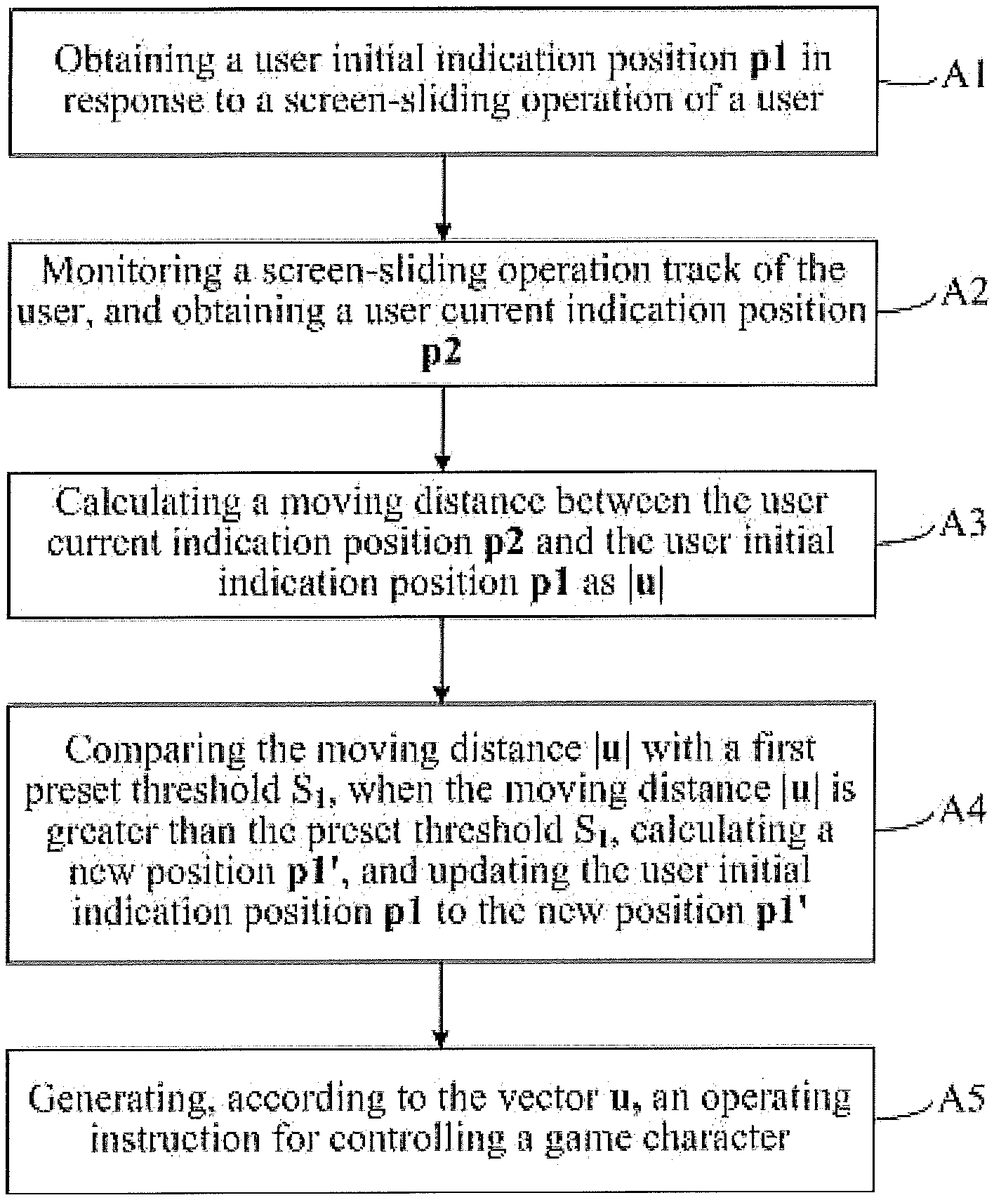
DETAILED DESCRIPTION The present application is described in further detail below with reference to the accompanying drawings and preferred embodiments. A screen-sliding operation in the present application is a continuous control action on an electronic apparatus, which comprises, but is not limited to, an action of touching and continuous sliding on a touchscreen, an action of clicking and dragging of a mouse, continuous sensing and sliding of a sensing operation, and the like. An indication position comprises, but is not limited to, a touch position, a mouse click position, a sensing operation position, and the like. As shown inFIG. 1, the present application discloses a method for controlling a game character, comprising the following steps: A1. an initial-coordinate obtaining step: Obtaining a user initial indication position p1in response to a screen-sliding operation of a user. A2. a screen-sliding track monitoring step: Monitoring a screen-sliding operation track of the user, and obtaining a user current indication position p2. A3. a calculation step: Calculating a moving distance between the user current indication position p2and the user initial indication position p1as |u|=|p2−p|. A4. an updating step: Comparing the moving distance |u| with a first preset threshold S1, when the moving distance |u| is greater than the preset threshold S1, calculating a new position via p1′=p2−(p2−p1)/|u|*S1*k, where k is a preset constant and k>0, and updating the user initial indication position p1to the new position p1′. A5. a control-instruction generation step: Generating, according to the vector u=p2−p1, an operating instruction for controlling the game character. In some preferred embodiments, the generating, according to the vector u, an operating instruction for controlling the game character in step A5 comprises the following steps: comparing the moving distance |u| with a preset threshold S2; and if |u||v1|. In some preferred embodiments, the generating, according to the vector ...
DETAILED DESCRIPTION
The present application is described in further detail below with reference to the accompanying drawings and preferred embodiments.
A screen-sliding operation in the present application is a continuous control action on an electronic apparatus, which comprises, but is not limited to, an action of touching and continuous sliding on a touchscreen, an action of clicking and dragging of a mouse, continuous sensing and sliding of a sensing operation, and the like. An indication position comprises, but is not limited to, a touch position, a mouse click position, a sensing operation position, and the like.
As shown inFIG. 1, the present application discloses a method for controlling a game character, comprising the following steps:
A1. an initial-coordinate obtaining step: Obtaining a user initial indication position p1in response to a screen-sliding operation of a user.
A2. a screen-sliding track monitoring step: Monitoring a screen-sliding operation track of the user, and obtaining a user current indication position p2.
A3. a calculation step: Calculating a moving distance between the user current indication position p2and the user initial indication position p1as |u|=|p2−p|.
A4. an updating step: Comparing the moving distance |u| with a first preset threshold S1, when the moving distance |u| is greater than the preset threshold S1, calculating a new position via p1′=p2−(p2−p1)/|u|*S1*k, where k is a preset constant and k>0, and updating the user initial indication position p1to the new position p1′.
A5. a control-instruction generation step: Generating, according to the vector u=p2−p1, an operating instruction for controlling the game character.
In some preferred embodiments, the generating, according to the vector u, an operating instruction for controlling the game character in step A5 comprises the following steps:
comparing the moving distance |u| with a preset threshold S2; and
if |u||v1|.
In some preferred embodiments, the generating, according to the vector u, an operating instruction for controlling the game character in step A5 comprises the following steps:
comparing the moving distance |u| with N preset thresholds Q1, Q2, Q3, . . . , QN−1, and QN, where N≥3; and
if |u|<Q1, generating a first operating instruction for controlling the game character: the controlled game character moves at a first velocity v1, where the velocity v1is codirectional with the vector u; or
if Q1≤|u|<Q2, generating a second operating instruction for controlling the game character: the controlled game character moves at a second velocity v2, where the velocity v2is codirectional with the vector u; or
if Q2≤|u|<Q3, generating a third operating instruction for controlling the game character: the controlled game character moves at a third velocity v3, where the velocity v3is codirectional with the vector u; or
. . .
if QN−1≤|u| . . . >|v3|>|v2|>|v1|.
Further, |v1|=0. When the moving distance |u| is less than the preset threshold Q1, the velocity of the controlled game character is set to 0, so as to avoid a misoperation of the user. The preset threshold Q1is set to a distance range of a misoperation of the user, so that a screen-sliding operation behavior of the user is more accurately recorded, thereby reducing the misoperation rate of the user, and improving the user experience.
In some preferred embodiments, the operating instruction in step A5 comprises: the controlled game character moves at a velocity v=w*|u|, where w is a preset correlation coefficient, and the velocity v is codirectional with the vector u.
In some preferred embodiments, the operating instruction in step A5 comprises: the controlled game character moves at a preset velocity, and the value of at least one attribute parameter of the controlled game character has a positive correlation with |u|. Attribute parameters of the controlled game character comprise: vitality, an attack power, a defensive power, and sensitivity.
In a preferred embodiment, step A1 further comprises: providing a first visual reference identifier used by the user for observing coordinates of the user initial indication position p1. Further, step A2 further comprises: providing a second visual reference identifier used by the user for observing coordinates of the user current indication position p2.
As shown inFIG. 2, the present application further discloses a method for controlling a virtual control component, the virtual control component being used for controlling a game character, where the virtual control component comprises a base and an operation portion, and the control method comprises the following steps:
B1. a virtual-control-component creating step: Creating the virtual control component, and presetting positions of the base and the operation portion as an initial position.
B2. an initial-coordinate obtaining step: Obtaining a user initial indication position p1in response to a screen-sliding operation of a user, and moving the positions of the base and the operation portion to the user initial indication position p1.
B3. a screen-sliding track monitoring step: Monitoring a screen-sliding operation track of the user, and obtaining a user current indication position p2, and moving the operation portion with the screen-sliding operation track.
B4. a calculation step: Calculating a moving distance between the user current indication position p2and the user initial indication position p1as |u|=|p2−p1|.
B5. an updating step: Comparing the moving distance |u| with a preset threshold S1, when the moving distance |u| is greater than the preset threshold S1, calculating a new position via p1′=p2−(p2−p1)/|u|*S1*k, where k is a preset constant and k>0, updating the user initial indication position p1to the new position p1′, and moving the position of the base to the new position p1′.
B6. a control-instruction generation step: Generating, according to the vector u=p2−p1, an operating instruction for controlling the game character.
The positions of the base and the operation portion are respectively coordinates of logical centers of the base and the operation portion.
In a preferred embodiment, the control step further comprises: B7. ending the control: setting a velocity of the controlled game character to 0 in response to ending of the screen-sliding operation, and moving the positions of the base and the operation portion to the initial position.
In some preferred embodiments, the generating, according to the vector u, an operating instruction for controlling the game character in step B6 comprises the following steps:
comparing the moving distance |u| with a second preset threshold S2; and
if |u||v1|.
In some preferred embodiments, the generating, according to the vector u, an operating instruction for controlling the game character in step B6 comprises the following steps:
comparing the moving distance |u| with N preset thresholds Q1, Q2, Q3, . . . , QN−1, and QN, where N≥3; and
if |u|<Q1, generating a first operating instruction for controlling the game character: the controlled game character moves at a first velocity v1, where the velocity v1is codirectional with the vector u; or
if Q1≤|u|<Q2, generating a second operating instruction for controlling the game character: the controlled game character moves at a second velocity v2, where the velocity v2is codirectional with the vector u; or
if Q2≤|u|<Q3, generating a third operating instruction for controlling the game character: the controlled game character moves at a third velocity v3, where the velocity v3is codirectional with the vector u; or
. . .
if QN−1≤|u| . . . >|v3|>|v2|>|v1|.
Further, |v1|=0
In some preferred embodiments, the operating instruction in step B6 comprises: the controlled game character moves at a velocity v=w*|u|, where w is a preset correlation coefficient, and the velocity v is codirectional with the vector u.
In some preferred embodiments, the operating instruction in step B6 comprises: the controlled game character moves at a preset velocity, and the value of at least one attribute parameter of the controlled game character has a positive correlation with |u|. Further, attribute parameters of the controlled game character comprise: vitality, an attack power, a defensive power, and sensitivity.
As shown inFIG. 3,FIG. 3is a flowchart of a method for controlling a game character according to Embodiment 1 of the present application. In this embodiment, a user controls a character T in a game on a computer. The control method comprises the following steps:
A1. The computer receives a screen-sliding operation of the user, and obtains an initial indication position p1of the user in response to the screen-sliding operation of the user, where a first visual reference identifier is set on the computer and used by the user for observing coordinates of the initial indication position p1.
A2. Background of the computer monitors a screen-sliding operation track of the user, obtains a current indication position p2of the user, where a second visual reference identifier is set on the computer and used by the user for observing coordinates of the current indication position p2.
A3. Calculating a moving distance between the current indication position p2of the user and the initial indication position p1of the user as |u|=|p2−p|.
A4. Comparing the moving distance |u| with a first preset threshold S1, when the moving distance |u| is greater than the first preset threshold S1, calculating a new position via p1′=p2−(p2−p1)/|u|*S1*k, where k is a preset constant and k>0, and updating the user initial indication position p1to the new position p1′.
A50. Comparing the moving distance |u| with a second preset threshold S2, and if u||v1|.
When step A51 or step A52 is performed, the value of at least one attribute parameter of the character T has a positive correlation with the moving distance |u|, and attribute parameters of the character T comprise, but is not limited to, vitality, an attack power, a defensive power, and sensitivity.
In this embodiment, the screen-sliding operation is actions of clicking and dragging of a mouse, and the indication position is a mouse click position.
During practical application, v1, v2, and k may be set according to a requirement and may be dynamically changed, to meet a flexible control requirement. In this embodiment, controlling of the game character is set to two segmentations. When the moving distance |u| is less than the second preset threshold S2, the character T moves at a relatively small velocity. When the moving distance |u| is greater than the second preset threshold S2, the character T moves at a relatively large velocity. The movement of character T corresponds to different feedbacks in cases of different moving distances, so that the character T is more flexibly controlled, thereby improving the sense of reality of motion of the character T.
As shown inFIG. 4,FIG. 4is a flowchart of a method for controlling a game character according to Embodiment 2 of the present application. In this embodiment, a user controls a character R in a game on a touchscreen of mobile phone. The control method comprises the following steps:
A1. The touchscreen of mobile phone receives a screen-sliding operation of the user, and obtains an initial indication position p1of the user in response to the screen-sliding operation of the user.
A2. Background of the touchscreen of mobile phone monitors a screen-sliding operation track of the user, and obtains a current indication position p2of the user.
A3. Calculating a moving distance between the current indication position p2of the user and the initial indication position p1of the user as |u|=|p2−p1|.
A4. Comparing the moving distance |u| with a first preset threshold S1, when the moving distance |u| is greater than the first preset threshold S1, calculating a new position via p1′=p2−(p2−p1)/|u|*S1*k, where k is a preset constant and k>0, and updating the user initial indication position p1to the new position p1′.
A5. The character R moves at a velocity v=w*|u|, where w is a preset correlation coefficient, and the velocity v is codirectional with the vector u.
When step A5 is performed, the value of at least one attribute parameter of the character R has a positive correlation with the moving distance |u|, and the attribute parameters of the character R comprise, but is not limited to, vitality, an attack power, a defensive power, and sensitivity.
In this embodiment, the screen-sliding operation is an action of touching and continuous sliding, and the indication position is a touch position of a user.
During practical application, k and w may be set according to a requirement and may be dynamically changed, to meet a flexible control requirement. In this embodiment, control of the game character is set to be continuously changed, so that the moving velocity v of the character R is directly proportional to the moving distance |u|. A larger moving distance |u| indicates a larger moving velocity v of the character R. Therefore, the movement of character R corresponds to different feedbacks in cases of different moving distances, so that the character R is more flexibly controlled, thereby improving the sense of reality of motion of the character R.
As shown inFIG. 5,FIG. 5is a flowchart of a method for controlling a virtual control component according to Embodiment 3 of the present application. In this embodiment, the virtual control component is used by a user for controlling a character X in a game on a touchscreen of mobile phone. The virtual control component comprises a base and an operation portion, and the control method comprises the following steps:
B1, and the initial position p0is at a position of the character X or a certain position which is around the character X.
B2. The background of the mobile phone monitors a touch event, and when the user performs a touch-and-press operation in an initial indication position p1within a range of a mobile phone screen, moves the positions of the base and the operation portion to the initial indication position p1.
B30: During a period of continuously touching the mobile phone screen by the user, the background of the mobile phone regularly detects a current indication position p2of the user, presets the position of the operation portion to the current indication position p2, records a moving vector u from the current indication position p2to the initial indication position p1and a moving distance |u|, where u=p2−p1, and |u|=|p2−p1|, and
compares the absolute value |u| of the moving distance with preset thresholds Q1, Q2, and Q3, which further comprising:
B31. When |u|<Q1, setting a velocity of the character X to v1, keeping the position of the base at the initial indication position p1, where v1=0.
B32. When Q1≤|u|<Q2, setting a velocity of the character X to v2, and setting a velocity direction of the character X to u, keeping the position of the base at the initial indication position p1.
B33. When Q2≤|u|<Q3, setting a velocity of the character X to v3, and setting a velocity direction of the character X to u, keeping the position of the base at the initial indication position p1.
B34. When |u|≥Q3, setting a velocity of the character X to v4, and setting a velocity direction of the character X to u, moving the position of the base to a new position p1′, where p1′=p2−u/|u|*Q3, and updating the initial indication position p1to the new position p1′.
B4. The background of the mobile phone detects that the user stops touching the screen, sets the velocity of the character X to 0, and moves the positions of the base and the operation portion back to the initial position p0.
In this embodiment, the indication position is a touch position of a user, the positions of the operation portion of the virtual control component are respectively a first visual reference identifier and a second visual reference identifier that are used by the user for observing coordinates of the user initial indication position p1and the user current indication position p2.
In this embodiment, setting v1to 0 is aiming to avoid a misoperation of the user, and a preset value S1is set to a distance range of a misoperation of the user, so that a touch behavior of the user is more accurately recorded, the misoperation rate of the user will be reduced, and accordingly the user experience will be improved.
In this embodiment, the first preset threshold S1is equal to the preset threshold Q3.
During practical application, Q1, Q2, Q3, v2, v3, and v4may be set according to a requirement and may be dynamically changed, to meet a flexible control requirement. In some embodiments, v2<v3=v4. In this embodiment, controlling of the virtual control component is set to three segmentations, which discretely controlling in different statuses. Such as: when a moving distance of the user is in the range of 0 through Q1, the base or the character X does not move in this condition; when the moving distance is in the range of Q1through Q2, the base does not move and the character X moves at the velocity v2; when the distance is in the range of Q2through Q3, the base does not move and the character X moves at the velocity v3; when the distance is greater than or equal to Q3, the character X moves at the velocity v4and the base moves with the operation portion. The movement of character X corresponds to different feedbacks in cases of different moving distances. A larger moving distance may indicate a larger velocity of the character X, so that a control status of a real joystick is more accurately simulated, thereby improving the sense of reality of the virtual control component, and increasing the flexibility of the virtual control component.
The preset values Q1, Q2, and Q3are determined according to an operation habit and a comfort level of the user, and may be customized based on different individuals. For example, Q1=36 pixels, Q2=90 pixels, and Q3=100 pixels.
As shown inFIG. 6,FIG. 6is a flowchart of a method for controlling a virtual control component according to Embodiment 4 of the present application. In this embodiment, the virtual control component is used by a user for controlling an animal Y in a game on a computer by means of clicking and moving of a mouse. The virtual control component comprises a base and an operation portion, and the control method comprises the following steps:
B1, and the initial position p0is at a position of the animal Y or a certain position which is around the animal Y.
B2. The background of the computer monitors a mouse click event, and when the user performs clicking in an initial indication position p1within a game response area of the computer, moves the positions of the base and the operation portion to the initial indication position p1.
B30. During a period of clicking a computer screen by the user by using a mouse, the background of the computer regularly detects a current indication position p2of the user, presets the position of the operation portion to the current indication position p2, records a moving vector u from the current indication position p2to the initial indication position p1and a moving distance |u|, where u=p2−p1, and |u|=|p2−p1|, and
compares the moving distance |u| with preset thresholds Q1, Q2, Q3, and Q4, which further comprising:
B31. When |u|<Q1, setting a velocity of the animal Y to v1, and setting a velocity direction of the animal Y to u, keeping the position of the base at the initial indication position p1.
B32. When Q1≤|u|<Q2, setting a velocity of the animal Y to v2, and setting a velocity direction of the animal Y to u, keeping the position of the base at the initial indication position p1.
B33. When Q2≤|u|<Q3, setting a velocity of the animal Y to v3, and setting a velocity direction of the animal Y to u, keeping the position of the base at the initial indication position p1.
B34. When Q3≤|u|0, and updating the initial indication position p1to the new position p1′.
B4. The background of the computer detects that the user stops clicking the mouse, sets the velocity of the animal Y to 0, and moves the positions of the base and the operation portion back to the initial position p0.
In this embodiment, the indication position is a position clicked by the user by using the mouse, the positions of the operation portion of the virtual control component are respectively a first visual reference identifier and a second visual reference identifier that are used by the user for observing coordinates of the user initial indication position p1and the user current indication position p2.
In this embodiment, a first preset threshold S1is equal to the preset threshold Q4.
During practical application, Q1, Q2, Q3, Q4, v1, v2, v3, v4, v5, and k may be set according to a requirement and may be dynamically changed, to meet a flexible control requirement. In some embodiments, v1<v2<v3<v4≤v5. In this embodiment, controlling of the virtual control component is set to four segmentations, which discretely controlling in different statuses. Such as: when a moving distance of the user is in range of 0 through Q1, the base does not move and the animal Y moves at the velocity v1; when the distance is in range of Q1through Q2, the base does not move and the animal Y moves at the velocity v2; when the distance is in range of Q2through Q3, the base does not move and the animal Y moves at the velocity v3; when the distance is in range of Q3through Q4, the base does not move and the animal Y moves at the velocity v4; when the distance is greater than or equal to Q4, the animal Y moves at the velocity v5and the base moves with the operation portion. The movement of animal Y corresponds to different feedbacks in cases of different moving distances. A larger moving distance may indicate a large velocity of the animal Y, so that a control status of a real joystick is more accurately simulated, thereby improving the sense of reality of the virtual control component, and increasing the flexibility of the virtual control component.
As shown inFIG. 7,FIG. 7is a flowchart of a method for controlling a virtual control component according to Embodiment 5 of the present application. In this embodiment, the virtual control component is used by a user for controlling a cartoon character Z in an online game on a touchscreen of mobile phone. The virtual control component comprises a base and an operation portion, and the control method comprises the following steps:
B1. A network server side creates the virtual control component, where positions of the base and the operation portion are preset to an initial position p0, and the initial position p0 is at a position of the cartoon character Z or a certain position which is around the cartoon character Z.
B2. The network server side monitors a touch event, and when the user performs a touch-and-press operation in an initial indication position p1within a range of a mobile phone screen, moves the positions of the base and the operation portion to the initial indication position p1.
B30. During a period of touching the mobile phone screen by the user, the network server side regularly detects a current indication position p2of the user, presets the position of the operation portion to the current indication position p2, records a moving vector u from the current indication position p2to the initial indication position p1and a moving distance |u|, where u=p2−p1, and |u|=|p2−p1|, and
compares the moving distance |u| with preset thresholds Q1, Q2, Q3, Q4, and Q5, which further comprising:
B31. When |u|<Q1, setting a velocity of the cartoon character Z to v1, and setting a velocity direction of the cartoon character Z to u, keeping the position of the base at the initial indication position p1.
B32. When Q1≤|u|<Q2, setting a velocity of the cartoon character Z to v2, and setting a velocity direction of the cartoon character Z to u, keeping the position of the base at the initial indication position p1.
B33. When Q2≤|u|<Q3, setting a velocity of the cartoon character Z to v3, and setting a velocity direction of the cartoon character Z to u, keeping the position of the base at the initial indication position p1.
B34. When Q3≤|u|<Q4, setting a velocity of the cartoon character Z to v4, and setting a velocity direction of the cartoon character Z to u, keeping the position of the base at the initial indication position p1.
B35. When Q4≤|u|0, and updating the initial indication position p1to the new position p1′.
B4. The network server side detects that the user stops touching the screen, sets the velocity of the cartoon character Z to 0, and moves the positions of the base and the operation portion back to the initial position p0.
In this embodiment, the indication position is a touch position of a user, the positions of the operation portion of the virtual control component are respectively a first visual reference identifier and a second visual reference identifier that are used by the user for observing coordinates of the user initial indication position p1and the user current indication position p2.
In this embodiment, a first preset threshold S1is equal to the preset threshold Q5.
During practical application, Q1, Q2, Q3, Q4, Q5, v1, v2, v3, v4, v5, and v6may be set according to a requirement and may be dynamically changed, to meet a flexible control requirement. In some embodiments, v1<v2<v3<v4<v5≤v6. In this embodiment, controlling of the virtual control component is set to five segmentations, which discretely controlling in different statuses. Such as: when a touch moving distance of the user is in range of 0 through Q1, the base does not move and the cartoon character Z moves at the velocity v1; when the distance is in range of Q1through Q2, the base does not move and the cartoon character Z moves at the velocity v2; when the distance is in range of Q2through Q3, the base does not move and the cartoon character Z moves at the velocity v3; when the distance is in range of Q3through Q4, the base does not move and the cartoon character Z moves at the velocity v4; when the distance is in range of Q4through Q5, the base does not move and the cartoon character Z moves at the velocity v5; when the distance is greater than or equal to Q5, the cartoon character Z moves at the velocity v6and the base moves with the operation portion. The movement of cartoon character Z corresponds to different feedbacks in cases of different moving distances. A larger moving distance may indicate a larger velocity of the cartoon character Z, so that a control status of a real joystick is more accurately simulated, thereby improving the sense of reality of the virtual control component, and increasing the flexibility of the virtual control component.
In the present application, when the moving distance of the current indication position of the user relative to the initial indication position is greater than a value, not only the position of the base of the virtual control component moves with the operation portion, but also the initial indication position moves with the operation portion. After the initial indication position is updated, the moving distance also needs to be re-calculated, so that the user controls the game character without being restricted and performs operations more fluently. In addition, compared with the prior art, in which the sliding operation of a user has to be performed around a user initial indication position when the user wants to change a direction of a game character. However, in the present invention, sliding operation only needs to be performed around an updated user initial indication position, so that a distance by which sliding needs to be performed when the game character changes the direction is greatly shortened, and the user performs more convenient and flexible operations in a control process, thereby greatly improving the user experience.
The method for controlling a virtual control component in the present application may alternatively be set to six or more segmentations according to requirements of different users, so as to satisfy various requirements of various users, thereby improving the user experience of the users.
In some other embodiments, N may be set to an infinite integer, and v1<v2< . . . <vN≤vN+1, so that the controlling of a controlled object corresponding to a touch behavior will be present to a progressive effect, and therefore, controlling of the virtual control component is more realistic.
Although the present application is described above in further detail through specific preferred embodiments, the present application is not limited to the specific embodiments. It should be understood by persons skilled in the art that any equivalent replacement or obvious variations made without departing from the spirit of the present application and having same performance or applications shall fall within the protection scope of the present application.
Claims
- A method for controlling a game character, comprising: obtaining a user initial indication position p 1 in response to a screen-sliding operation of a user;monitoring a screen-sliding operation track of the user, and obtaining a user current indication position p 2;calculating a moving distance between the user current indication position p 2 and the user initial indication position p 1 as |u|=|p 2 −p 1 |;comparing the moving distance |u|with a first preset threshold S 1 , when the moving distance |u|is greater than the first preset threshold S 1 , calculating a new position via p 1 ′=p 2 −(p 2 −p 1 )/|u|*S 1 *k, wherein k is a preset constant and k>0, and updating the user initial indication position p 1 _to the new position p 1 ′;and generating, according to the vector u=p 2 −p 1 , an operating instruction for controlling the game character, wherein the operating instruction comprises the controlled game character moving at a preset velocity and a value of at least one attribute of the controlled game character has a positive correlation with |u|.
- The method for controlling a game character according to claim 1 , wherein the generating, according to the vector u, the operating instruction for controlling the game character comprises: comparing the moving distance |u|with a second preset threshold S 2;and if |u|<S 2 , generating a first operating instruction for controlling the game character: the controlled game character moves at a first velocity v 1 , wherein the velocity v 1 is codirectional with the vector u;or if |u|≥S 2 , generating a second operating instruction for controlling the game character: the controlled game character moves at a second velocity v 2 , wherein the velocity v 2 is codirectional with the vector u, wherein |v 2 |>|v 1 |.
- The method for controlling a game character according to claim 1 , wherein the generating, according to the vector u=p 2 −p 1 , the operating instruction for controlling the game character comprises: comparing the moving distance |u|with N preset thresholds Q 1 , Q 2 , and Q 3;and if |u|<Q 1 , generating a first operating instruction for controlling the game character: the controlled game character moves at a first velocity v 1 , wherein the velocity v 1 is codirectional with the vector u;or if Q 1 ≤|u|<Q 2 , generating a second operating instruction for controlling the game character: the controlled game character moves at a second velocity v 2 , wherein the velocity v 2 is codirectional with the vector u;or if Q 2 ≤|u|<Q 3 , generating a third operating instruction for controlling the game character: the controlled game character moves at a third velocity v 3 , wherein the velocity v 3 is codirectional with the vector u;wherein v 3 |>|v 2 |>|v 1 |.
- The method for controlling a game character according to claim 3 , wherein |v 1 |=
- The method for controlling a game character according to claim 1 , wherein the operating instruction comprises: the controlled game character moves at a velocity v=w*|u|, wherein w is a preset correlation coefficient, and the velocity v is codirectional with the vector u.
- The method for controlling a game character according to claim 1 , wherein attribute parameters of the controlled game character comprise: vitality, an attack power, a defensive power, and sensitivity.
- The method for controlling a game character according to claim 1 , wherein the screen-sliding operation is a continuous control action on an electronic apparatus, which comprises: one or more of action of touching and continuous sliding on a touchscreen, action of clicking and dragging of a mouse, and continuous sensing and sliding of a sensing operation.
- The method for controlling a game character according to claim 1 , wherein the obtaining the user initial indication position p 1 further comprises: providing a first visual reference identifier used by the user for observing coordinates of the user initial indication position p 1 .
- The method for controlling a game character according to claim 8 , wherein the monitoring the screen-sliding operation track of the user, and obtaining the user current indication position p 2 further comprises: providing a second visual reference identifier used by the user for observing coordinates of the user current indication position p 2 .
- A method for controlling a virtual control component, the virtual control component being used for controlling a game character, wherein the virtual control component comprises a base and an operation portion, and the control method comprises: creating the virtual control component, and presetting positions of the base and the operation portion as an initial position;obtaining a user initial indication position p 1 in response to a screen-sliding operation of a user, and moving the positions of the base and the operation portion to the user initial indication position p 1;monitoring a screen-sliding operation track of the user, and obtaining a user current indication position p 2 , and moving the operation portion with the screen-sliding operation track;calculating a moving distance between the user current indication position p 2 and the user initial indication position p 1 as |u|=|p 2 −p 1 |;comparing the moving distance |u|with a preset threshold S 1 , when the moving distance |u|is greater than the preset threshold S 1 , calculating a new position via p 1 ′=p 2 −(p 2 −p 1 )/|u|*S 1 *k, wherein k is a preset constant and k>0, updating the user initial indication position p 1 to the new position p 1 ′, and moving the position of the base to the new position p 1 ′;and generating, according to the vector u=p 2 −p 1 , an operating instruction for controlling the game character, wherein the operating instruction comprises the controlled game character moving at a preset velocity, and a value of at least one attribute parameter of the controlled game character has a positive correlation with |u|.
- The method for controlling a virtual control component according to claim 10 , further comprising: setting a velocity of the controlled game character to 0 in response to ending of the screen-sliding operation, and moving the positions of the base and the operation portion to the initial position.
- The method for controlling a virtual control component according to claim 10 , further comprising: setting a velocity of the controlled game character to 0 in response to ending of the screen-sliding operation, and moving the positions of the base and the operation portion to the initial position.
Disclaimer: Data collected from the USPTO and may be malformed, incomplete, and/or otherwise inaccurate.