U.S. Pat. No. 10,625,150
GAME SYSTEM, GAME APPARATUS, STORAGE MEDIUM HAVING STORED THEREIN GAME PROGRAM, AND GAME PROCESSING METHOD
AssigneeNINTENDO CO., LTD.
Issue DateSeptember 6, 2017
Illustrative Figure
Abstract
Based on first data corresponding to at least one of a motion and an orientation of a first game controller and second data corresponding to at least one of a motion and an orientation of a second game controller, it is determined whether or not the first game controller and the second game controller are attached to an attachment, and based on the result of the determination, game processing is performed.
Description
DETAILED DESCRIPTION OF NON-LIMITING EXAMPLE EMBODIMENTS A game system according to an example of an exemplary embodiment is described below. An example of a game system1according to the exemplary embodiment includes a main body apparatus (an information processing apparatus; which functions as a game apparatus main body in the exemplary embodiment)2, a left controller3, and a right controller4. Each of the left controller3and the right controller4is attachable to and detachable from the main body apparatus2. That is, the game system1can be used as a unified apparatus obtained by attaching each of the left controller3and the right controller4to the main body apparatus2. Further, in the game system1, the main body apparatus2, the left controller3, and the right controller4can also be used as separate bodies (seeFIG. 2). Hereinafter, first, the hardware configuration of the game system1according to the exemplary embodiment is described, and then, the control of the game system1according to the exemplary embodiment is described. FIG. 1is a diagram showing an example of the state where the left controller3and the right controller4are attached to the main body apparatus2. As shown inFIG. 1, each of the left controller3and the right controller4is attached to and unified with the main body apparatus2. The main body apparatus2is an apparatus for performing various processes (e.g., game processing) in the game system1. The main body apparatus2includes a display12. Each of the left controller3and the right controller4is an apparatus including operation sections with which a user provides inputs. FIG. 2is a diagram showing an example of the state where each of the left controller3and the right controller4is detached from the main body apparatus2. As shown inFIGS. 1 and 2, the left controller3and the right controller4are attachable to and detachable from the main body apparatus2. It should be noted that hereinafter, the left controller3and the right controller4will occasionally be ...
DETAILED DESCRIPTION OF NON-LIMITING EXAMPLE EMBODIMENTS
A game system according to an example of an exemplary embodiment is described below. An example of a game system1according to the exemplary embodiment includes a main body apparatus (an information processing apparatus; which functions as a game apparatus main body in the exemplary embodiment)2, a left controller3, and a right controller4. Each of the left controller3and the right controller4is attachable to and detachable from the main body apparatus2. That is, the game system1can be used as a unified apparatus obtained by attaching each of the left controller3and the right controller4to the main body apparatus2. Further, in the game system1, the main body apparatus2, the left controller3, and the right controller4can also be used as separate bodies (seeFIG. 2). Hereinafter, first, the hardware configuration of the game system1according to the exemplary embodiment is described, and then, the control of the game system1according to the exemplary embodiment is described.
FIG. 1is a diagram showing an example of the state where the left controller3and the right controller4are attached to the main body apparatus2. As shown inFIG. 1, each of the left controller3and the right controller4is attached to and unified with the main body apparatus2. The main body apparatus2is an apparatus for performing various processes (e.g., game processing) in the game system1. The main body apparatus2includes a display12. Each of the left controller3and the right controller4is an apparatus including operation sections with which a user provides inputs.
FIG. 2is a diagram showing an example of the state where each of the left controller3and the right controller4is detached from the main body apparatus2. As shown inFIGS. 1 and 2, the left controller3and the right controller4are attachable to and detachable from the main body apparatus2. It should be noted that hereinafter, the left controller3and the right controller4will occasionally be referred to collectively as a “controller”.
FIG. 3is six orthogonal views showing an example of the main body apparatus2. As shown inFIG. 3, the main body apparatus2includes an approximately plate-shaped housing11. In the exemplary embodiment, a main surface (in other words, a surface on a front side, i.e., a surface on which the display12is provided) of the housing11has a generally rectangular shape.
It should be noted that the shape and the size of the housing11are optional. As an example, the housing11may be of a portable size. Further, the main body apparatus2alone or the unified apparatus obtained by attaching the left controller3and the right controller4to the main body apparatus2may function as a mobile apparatus. The main body apparatus2or the unified apparatus may function as a handheld apparatus or a portable apparatus.
As shown inFIG. 3, the main body apparatus2includes the display12, which is provided on the main surface of the housing11. The display12displays an image generated by the main body apparatus2. In the exemplary embodiment, the display12is a liquid crystal display device (LCD). The display12, however, may be a display device of any type.
Further, the main body apparatus2includes a touch panel13on a screen of the display12. In the exemplary embodiment, the touch panel13is of a type that allows a multi-touch input (e.g., a capacitive type). The touch panel13, however, may be of any type. For example, the touch panel13may be of a type that allows a single-touch input (e.g., a resistive type).
The main body apparatus2includes speakers (i.e., speakers88shown inFIG. 6) within the housing11. As shown inFIG. 3, speaker holes11aand11bare formed on the main surface of the housing11. Then, sounds output from the speakers88are output through the speaker holes11aand11b.
Further, the main body apparatus2includes a left terminal17, which is a terminal for the main body apparatus2to perform wired communication with the left controller3, and a right terminal21, which is a terminal for the main body apparatus2to perform wired communication with the right controller4.
As shown inFIG. 3, the main body apparatus2includes a slot23. The slot23is provided on an upper side surface of the housing11. The slot23is so shaped as to allow a predetermined type of storage medium to be attached to the slot23. The predetermined type of storage medium is, for example, a dedicated storage medium (e.g., a dedicated memory card) for the game system1and an information processing apparatus of the same type as the game system1. The predetermined type of storage medium is used to store, for example, data (e.g., saved data of an application or the like) used by the main body apparatus2and/or a program (e.g., a program for an application or the like) executed by the main body apparatus2. Further, the main body apparatus2includes a power button28.
The main body apparatus2includes a lower terminal27. The lower terminal27is a terminal for the main body apparatus2to communicate with a cradle. In the exemplary embodiment, the lower terminal27is a USB connector (more specifically, a female connector). Further, when the unified apparatus or the main body apparatus2alone is mounted on the cradle, the game system1can display on a stationary monitor an image generated by and output from the main body apparatus2. Further, in the exemplary embodiment, the cradle has the function of charging the unified apparatus or the main body apparatus2alone mounted on the cradle. Further, the cradle has the function of a hub device (specifically, a USB hub).
FIG. 4is six orthogonal views showing an example of the left controller3. As shown inFIG. 4, the left controller3includes a housing31. In the exemplary embodiment, the housing31has a vertically long shape, i.e., is shaped to be long in an up-down direction (i.e., a y-axis direction shown inFIGS. 1 and 4). In the state where the left controller3is detached from the main body apparatus2, the left controller3can also be held in the orientation in which the left controller3is vertically long. The housing31has such a shape and a size that when held in the orientation in which the housing31is vertically long, the housing31can be held with one hand, particularly the left hand. Further, the left controller3can also be held in the orientation in which the left controller3is horizontally long. When held in the orientation in which the left controller3is horizontally long, the left controller3may be held with both hands.
The left controller3includes an analog stick32. As shown inFIG. 4, the analog stick32is provided on a main surface of the housing31. The analog stick32can be used as a direction input section with which a direction can be input. The user tilts the analog stick32and thereby can input a direction corresponding to the direction of the tilt (and input a magnitude corresponding to the angle of the tilt). It should be noted that the left controller3may include a directional pad, a slide stick that allows a slide input, or the like as the direction input section, instead of the analog stick. Further, in the exemplary embodiment, it is possible to provide an input by pressing the analog stick32.
The left controller3includes various operation buttons. The left controller3includes four operation buttons33to36(specifically, a right direction button33, a down direction button34, an up direction button35, and a left direction button36) on the main surface of the housing31. Further, the left controller3includes a record button37and a “−” (minus) button47. The left controller3includes a first L-button38and a ZL-button39in an upper left portion of a side surface of the housing31. Further, the left controller3includes a second L-button43and a second R-button44, on the side surface of the housing31on which the left controller3is attached to the main body apparatus2. These operation buttons are used to give instructions depending on various programs (e.g., an OS program and an application program) executed by the main body apparatus2.
Further, the left controller3includes a terminal42for the left controller3to perform wired communication with the main body apparatus2.
FIG. 5is six orthogonal views showing an example of the right controller4. As shown inFIG. 5, the right controller4includes a housing51. In the exemplary embodiment, the housing51has a vertically long shape, i.e., is shaped to be long in the up-down direction. In the state where the right controller4is detached from the main body apparatus2, the right controller4can also be held in the orientation in which the right controller4is vertically long. The housing51has such a shape and a size that when held in the orientation in which the housing51is vertically long, the housing51can be held with one hand, particularly the right hand. Further, the right controller4can also be held in the orientation in which the right controller4is horizontally long. When held in the orientation in which the right controller4is horizontally long, the right controller4may be held with both hands.
Similarly to the left controller3, the right controller4includes an analog stick52as a direction input section. In the exemplary embodiment, the analog stick52has the same configuration as that of the analog stick32of the left controller3. Further, the right controller4may include a directional pad, a slide stick that allows a slide input, or the like, instead of the analog stick. Further, similarly to the left controller3, the right controller4includes four operation buttons53to56(specifically, an A-button53, a B-button54, an X-button55, and a Y-button56) on a main surface of the housing51. Further, the right controller4includes a “+” (plus) button57and a home button58. Further, the right controller4includes a first R-button60and a ZR-button61in an upper right portion of a side surface of the housing51. Further, similarly to the left controller3, the right controller4includes a second L-button65and a second R-button66.
Further, the right controller4includes a terminal64for the right controller4to perform wired communication with the main body apparatus2.
FIG. 6is a block diagram showing an example of the internal configuration of the main body apparatus2. The main body apparatus2includes components81to91,97, and98shown inFIG. 6in addition to the components shown inFIG. 3. Some of the components81to91,97, and98may be mounted as electronic components on an electronic circuit board and accommodated in the housing11.
The main body apparatus2includes a CPU (Central Processing Unit)81. The CPU81is an information processing section for executing various types of information processing to be executed by the main body apparatus2. To be exact, the CPU81is a SoC (System-on-a-chip) having a plurality of functions such as a CPU function and a GPU function. The CPU81executes an information processing program (e.g., a game program) stored in a storage section (specifically, an internal storage medium such as a flash memory84, an external storage medium attached to the slot23, or the like), thereby performing the various types of information processing.
The main body apparatus2includes a flash memory84and a DRAM (Dynamic Random Access Memory)85as examples of internal storage media built into the main body apparatus2. The flash memory84and the DRAM85are connected to the CPU81. The flash memory84is a memory mainly used to store various data (or programs) to be saved in the main body apparatus2. The DRAM85is a memory used to temporarily store various data used for information processing.
The main body apparatus2includes a slot interface (hereinafter abbreviated as “I/F”)91. The slot I/F91is connected to the CPU81. The slot I/F91is connected to the slot23, and in accordance with an instruction from the CPU81, reads and writes data from and to the predetermined type of storage medium (e.g., a dedicated memory card) attached to the slot23.
The CPU81appropriately reads and writes data from and to the flash memory84, the DRAM85, and each of the above storage media, thereby performing the above information processing.
The main body apparatus2includes a network communication section82. The network communication section82is connected to the CPU81. The network communication section82communicates (specifically, through wireless communication) with an external apparatus via a network. In the exemplary embodiment, as a first communication form, the network communication section82connects to a wireless LAN and communicates with an external apparatus, using a method compliant with the Wi-Fi standard. Further, as a second communication form, the network communication section82wirelessly communicates with another main body apparatus2of the same type, using a predetermined communication method (e.g., communication based on a unique protocol or infrared light communication). It should be noted that the wireless communication in the above second communication form achieves the function of enabling so-called “local communication” in which the main body apparatus2can wirelessly communicate with another main body apparatus2placed in a closed local network area, and the plurality of main body apparatuses2directly communicate with each other to transmit and receive data.
The main body apparatus2includes a controller communication section83. The controller communication section83is connected to the CPU81. The controller communication section83wirelessly communicates with the left controller3and/or the right controller4. The communication method between the main body apparatus2and the left controller3and the right controller4is optional. In the exemplary embodiment, the controller communication section83performs communication compliant with the Bluetooth (registered trademark) standard with the left controller3and with the right controller4.
The CPU81is connected to the left terminal17, the right terminal21, and the lower terminal27. When performing wired communication with the left controller3, the CPU81transmits data to the left controller3via the left terminal17and also receives operation data from the left controller3via the left terminal17. Further, when performing wired communication with the right controller4, the CPU81transmits data to the right controller4via the right terminal21and also receives operation data from the right controller4via the right terminal21. Further, when communicating with the cradle, the CPU81transmits data to the cradle via the lower terminal27. As described above, in the exemplary embodiment, the main body apparatus2can perform both wired communication and wireless communication with each of the left controller3and the right controller4. Further, when the unified apparatus obtained by attaching the left controller3and the right controller4to the main body apparatus2or the main body apparatus2alone is attached to the cradle, the main body apparatus2can output data (e.g., image data or sound data) to the stationary monitor or the like via the cradle.
Here, the main body apparatus2can communicate with a plurality of left controllers3simultaneously (in other words, in parallel). Further, the main body apparatus2can communicate with a plurality of right controllers4simultaneously (in other words, in parallel). Thus, the user can provide inputs to the main body apparatus2using a plurality of left controllers3and a plurality of right controllers4.
The main body apparatus2includes a touch panel controller86, which is a circuit for controlling the touch panel13. The touch panel controller86is connected between the touch panel13and the CPU81. Based on a signal from the touch panel13, the touch panel controller86generates, for example, data indicating the position where a touch input is provided. Then, the touch panel controller86outputs the data to the CPU81.
Further, the display12is connected to the CPU81. The CPU81displays a generated image (e.g., an image generated by executing the above information processing) and/or an externally acquired image on the display12.
The main body apparatus2includes a codec circuit87and speakers (specifically, a left speaker and a right speaker)88. The codec circuit87is connected to the speakers88and a sound input/output terminal25and also connected to the CPU81. The codec circuit87is a circuit for controlling the input and output of sound data to and from the speakers88and the sound input/output terminal25.
Further, the main body apparatus2includes an acceleration sensor89. In the exemplary embodiment, the acceleration sensor89detects the magnitudes of accelerations along predetermined three axial (e.g., xyz axes shown inFIG. 1) directions. It should be noted that the acceleration sensor89may detect an acceleration along one axial direction or accelerations along two axial directions.
Further, the main body apparatus2includes an angular velocity sensor90. In the exemplary embodiment, the angular velocity sensor90detects angular velocities about predetermined three axes (e.g., the xyz axes shown inFIG. 1). It should be noted that the angular velocity sensor90may detect an angular velocity about one axis or angular velocities about two axes.
The acceleration sensor89and the angular velocity sensor90are connected to the CPU81, and the detection results of the acceleration sensor89and the angular velocity sensor90are output to the CPU81. Based on the detection results of the acceleration sensor89and the angular velocity sensor90, the CPU81can calculate information regarding the motion and/or the orientation of the main body apparatus2.
The main body apparatus2includes a power control section97and a battery98. The power control section97is connected to the battery98and the CPU81. Further, although not shown inFIG. 6, the power control section97is connected to components of the main body apparatus2(specifically, components that receive power supplied from the battery98, the left terminal17, and the right terminal21). Based on a command from the CPU81, the power control section97controls the supply of power from the battery98to the above components.
Further, the battery98is connected to the lower terminal27. When an external charging device (e.g., the cradle) is connected to the lower terminal27, and power is supplied to the main body apparatus2via the lower terminal27, the battery98is charged with the supplied power.
FIG. 7is a block diagram showing examples of the internal configurations of the main body apparatus2, the left controller3, and the right controller4. It should be noted that the details of the internal configuration of the main body apparatus2are shown inFIG. 6and therefore are omitted inFIG. 7.
The left controller3includes a communication control section101, which communicates with the main body apparatus2. As shown inFIG. 7, the communication control section101is connected to components including the terminal42. In the exemplary embodiment, the communication control section101can communicate with the main body apparatus2through both wired communication via the terminal42and wireless communication not via the terminal42. The communication control section101controls the method for communication performed by the left controller3with the main body apparatus2. That is, when the left controller3is attached to the main body apparatus2, the communication control section101communicates with the main body apparatus2via the terminal42. Further, when the left controller3is detached from the main body apparatus2, the communication control section101wirelessly communicates with the main body apparatus2(specifically, the controller communication section83). The wireless communication between the communication control section101and the controller communication section83is performed in accordance with the Bluetooth (registered trademark) standard, for example.
Further, the left controller3includes a memory102such as a flash memory. The communication control section101includes, for example, a microcomputer (or a microprocessor) and executes firmware stored in the memory102, thereby performing various processes.
The left controller3includes buttons103(specifically, the buttons33to39,43,44, and47). Further, the left controller3includes the analog stick (“stick” inFIG. 7)32. Each of the buttons103and the analog stick32outputs information regarding an operation performed on itself to the communication control section101repeatedly at appropriate timing.
The left controller3includes inertial sensors. Specifically, the left controller3includes an acceleration sensor104. Further, the left controller3includes an angular velocity sensor105. In the exemplary embodiment, the acceleration sensor104detects the magnitudes of accelerations along predetermined three axial (e.g., xyz axes shown inFIG. 4) directions. It should be noted that the acceleration sensor104may detect an acceleration along one axial direction or accelerations along two axial directions. In the exemplary embodiment, the angular velocity sensor105detects angular velocities about predetermined three axes (e.g., the xyz axes shown inFIG. 4). It should be noted that the angular velocity sensor105may detect an angular velocity about one axis or angular velocities about two axes. Each of the acceleration sensor104and the angular velocity sensor105is connected to the communication control section101. Then, the detection results of the acceleration sensor104and the angular velocity sensor105are output to the communication control section101repeatedly at appropriate timing.
The communication control section101acquires information regarding an input (specifically, information regarding an operation or the detection result of the sensor) from each of input sections (specifically, the buttons103, the analog stick32, and the sensors104and105). The communication control section101transmits operation data including the acquired information (or information obtained by performing predetermined processing on the acquired information) to the main body apparatus2. It should be noted that the operation data is transmitted repeatedly, once every predetermined time. It should be noted that the interval at which the information regarding an input is transmitted from each of the input sections to the main body apparatus2may or may not be the same.
The above operation data is transmitted to the main body apparatus2, whereby the main body apparatus2can obtain inputs provided to the left controller3. That is, the main body apparatus2can determine operations on the buttons103and the analog stick32based on the operation data. Further, the main body apparatus2can calculate information regarding the motion and/or the orientation of the left controller3based on the operation data (specifically, the detection results of the acceleration sensor104and the angular velocity sensor105).
The left controller3includes a power supply section108. In the exemplary embodiment, the power supply section108includes a battery and a power control circuit. Although not shown inFIG. 7, the power control circuit is connected to the battery and also connected to components of the left controller3(specifically, components that receive power supplied from the battery).
As shown inFIG. 7, the right controller4includes a communication control section111, which communicates with the main body apparatus2. Further, the right controller4includes a memory112, which is connected to the communication control section111. The communication control section111is connected to components including the terminal64. The communication control section111and the memory112have functions similar to those of the communication control section101and the memory102, respectively, of the left controller3. Thus, the communication control section111can communicate with the main body apparatus2through both wired communication via the terminal64and wireless communication not via the terminal64(specifically, communication compliant with the Bluetooth (registered trademark) standard). The communication control section111controls the method for communication performed by the right controller4with the main body apparatus2.
The right controller4includes input sections similar to the input sections of the left controller3. Specifically, the right controller4includes buttons113, the analog stick52, and inertial sensors (an acceleration sensor114and an angular velocity sensor115). These input sections have functions similar to those of the input sections of the left controller3and operate similarly to the input sections of the left controller3.
The right controller4includes a power supply section118. The power supply section118has a function similar to that of the power supply section108of the left controller3and operates similarly to the power supply section108.
As describe above, in the game system1according to the exemplary embodiment, the left controller3and the right controller4are attachable to and detachable from the main body apparatus2. Further, the unified apparatus obtained by attaching the left controller3and the right controller4to the main body apparatus2or the main body apparatus2alone is attached to the cradle and thereby can output an image (and a sound) to the stationary monitor6. A description is given below using the game system in use forms in which an image (and a sound) is output to the stationary monitor6by attaching the main body apparatus2alone to the cradle in the state where the left controller3and the right controller4are detached from the main body apparatus2.
As described above, in the exemplary embodiment, the game system1can also be used in the state where the left controller3and the right controller4are detached from the main body apparatus2(referred to as a “separate state”). As a form in a case where an operation is performed on an application (e.g., a game application) using the game system1in the separate state, a form in which a single user uses both the left controller3and the right controller4is possible. It should be noted that when a single user uses both the left controller3and the right controller4, the user can also use an accessory device (e.g., an extension grip350described later) for joining the left controller3and the right controller4to cause the left controller3and the right controller4to function as a single operation device. It should be noted that when a plurality of users perform operations using the same application, a form is possible in which a plurality of sets of the left controller3and the right controller4are prepared, and each user uses one of the plurality of sets.
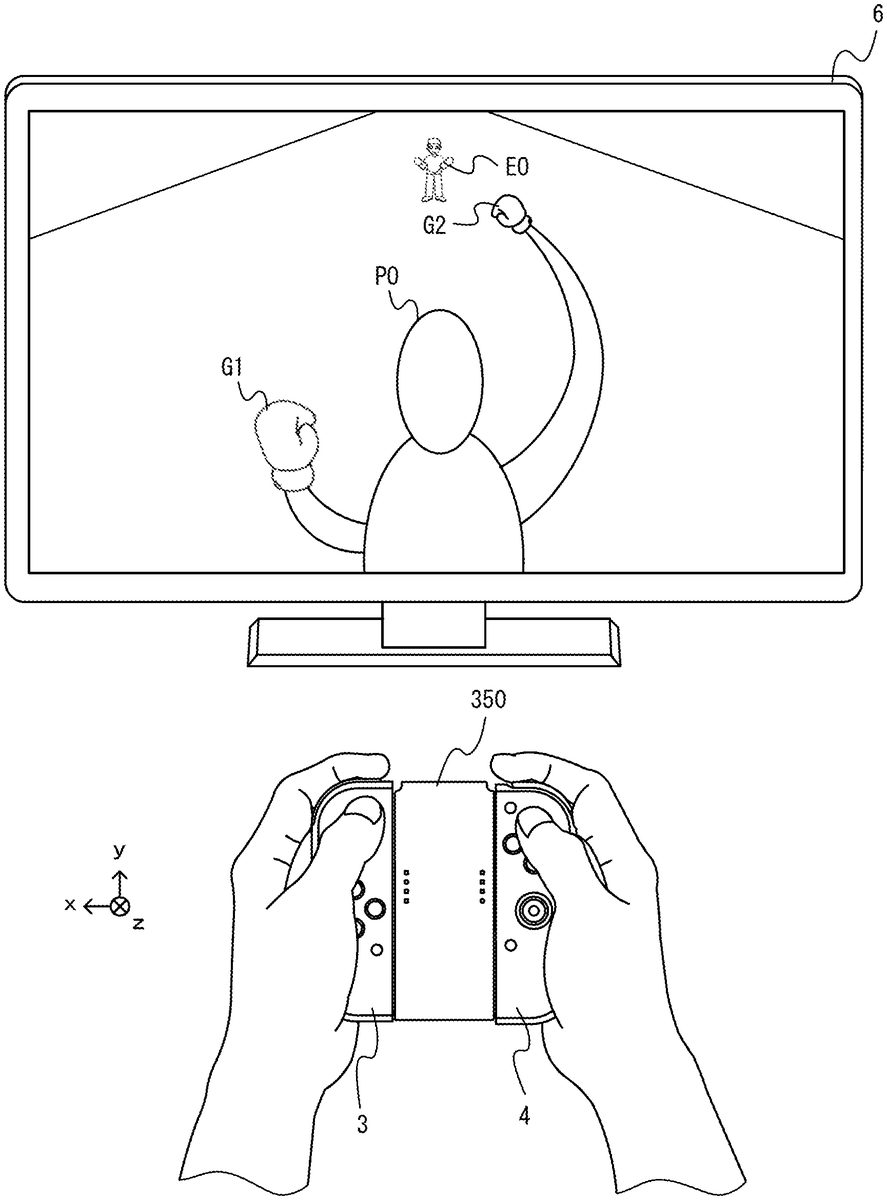
FIGS. 8 to 10are diagrams showing an example of the state where a single user uses the game system1by holding a set of the left controller3and the right controller4in the separate state. As shown inFIGS. 11 to 13, in the separate state, the user can view an image displayed on the stationary monitor6while operating the left controller3and the right controller4by holding the left controller3with their left hand and the right controller4with their right hand.
For example, in the exemplary embodiment, the user holds the left controller3with their left hand such that the down direction of the longitudinal direction of the left controller3(the down direction (the negative y-axis direction) shown inFIG. 1), which is vertically long and approximately plate-shaped, is the vertical direction, also the side surface that is in contact with the main body apparatus2when the left controller3is attached to the main body apparatus2is directed forward, and also the main surface of the left controller3(the surface on which the analog stick32is provided) is directed to the right. That is, the left controller3held with the left hand of the user is in the state where the negative x-axis direction is directed in the forward direction of the user, and the positive z-axis direction is directed to the left. Further, the user holds the right controller4with their right hand such that the down direction of the longitudinal direction of the right controller4(the down direction (the negative y-axis direction) shown inFIG. 1), which is vertically long and approximately plate-shaped, is the vertical direction, also the side surface that is in contact with the main body apparatus2when the right controller4is attached to the main body apparatus2is directed forward, and also the main surface of the right controller4(the surface on which the analog stick52is provided) is directed to the left. That is, the right controller4held with the right hand of the user is in the state where the positive x-axis direction is directed in the forward direction of the user, and the positive z-axis direction is directed to the right.
In the state where the left controller3is held with the left hand, and the right controller4is held with the right hand (hereinafter, such an operation method will occasionally be referred to as a “two-hand-held operation method”, and the orientations of the left controller3and the right controller4held in these directions will occasionally be referred to as “basic orientations”), each controller is moved in up, down, left, right, front, and back directions, rotated, or swung, whereby game play is performed in accordance with the motion or the orientation of the controller. Then, in the above game play, the acceleration sensor104of the left controller3can detect accelerations in the xyz-axis directions as operation inputs, and the angular velocity sensor105can detect angular velocities about the xyz-axis directions as operation inputs. Further, the acceleration sensor114of the right controller4can detect accelerations in the xyz-axis directions as operation inputs, and the angular velocity sensor115can detect angular velocities about the xyz-axis directions as operation inputs. Further, in the two-hand-held operation, it is possible to perform the operation of pressing the first L-button38with the thumb of the left hand of the user and perform the operation of pressing the first R-button60with the thumb of the right hand of the user, and game play is also performed by these button operations (seeFIG. 9).
Further, when the user performs game play by holding the left controller3and the right controller4, vibrations are imparted to the left controller3and/or the right controller4in accordance with the situation of this game. As described above, the left controller3includes the vibrator107, and the right controller4includes the vibrator117. The CPU81of the main body apparatus2transmits vibration data to the left controller3and/or the right controller4in accordance with the situation of an executed game and thereby can vibrate the vibrator107and/or the vibrator117at an amplitude and a frequency corresponding to the vibration data.
Next,FIGS. 11 to 13are diagrams showing examples of a game image displayed in a game played by moving the left controller3and the right controller4. As shown inFIG. 11, in this exemplary game, an image of a game (e.g., a boxing game) in which a player object PO and an enemy object EO compete against each other is displayed on the stationary monitor6. Then, the user operating the left controller3and the right controller4can operate the player object PO by swinging the main body of the left controller3and/or the main body of the right controller4, changing the orientations of the main body of the left controller3and/or the main body of the right controller4, or pressing an operation button (e.g., the first L-button38or the first R-button60).
For example, the user swings the left controller3and thereby can control the action of a first object G1, which represents a left glove (a left fist) of the player object PO. The user swings the right controller4and thereby can control the action of a second object G2, which represents a right glove (a right fist) of the player object PO. Specifically, when the user performs the operation of swinging so as to throw a left punch using the left hand holding the left controller3, the first object G1, which represents the left glove of the player object PO, moves toward the place where the enemy object EO is placed. Further, when the user performs the operation of swinging so as to throw a right punch using the right hand holding the right controller4, the second object G2, which represents the right glove of the player object PO, moves toward the place where the enemy object EO is placed.
Specifically, when the right controller4is swung so as to be pushed forward (in the positive x-axis direction of the right controller4) in the state where neither of the left controller3and the right controller4moves (the state shown inFIG. 11), then as shown inFIG. 12, the second object G2of the player object PO moves toward the enemy object EO in accordance with the motion of the right controller4. Consequently, a game image is displayed such that the player object PO throws a right punch at the enemy object EO. Further, when the left controller3is swung so as to be pushed forward (in the negative x-axis direction of the left controller3) in the state where neither of the left controller3and the right controller4moves, the first object G1of the player object PO moves toward the enemy object EO in accordance with the motion of the left controller3. Consequently, a game image is displayed such that the player object PO throws a left punch at the enemy object EO.
Here, the moving direction of the first object G1starting moving is set by the orientation of the left controller3when the left controller3is swung so as to be pushed forward. Further, the moving direction of the second object G2starting moving is set by the orientation of the right controller4when the right controller4is moved so as to be pushed forward. For example, when the right controller4moves in the positive x-axis direction as shown inFIG. 12, the moving direction of the second object G2is set in accordance with the orientation in a roll direction of the right controller4in this movement. As an example, in the exemplary embodiment, in the period in which the right controller4moves, the tilt in the y-axis direction of the right controller4with respect to the direction in which a gravitational acceleration acts in real space is calculated, and the moving direction of the second object G2is calculated based on the tilt in the y-axis direction. Specifically, when the tilt in the y-axis direction indicates that the right controller4is in the orientation in which the right controller4roll-rotates in the right direction with respect to the above reference orientation, the second object G2moves in the right direction in a virtual space. Further, when the tilt in the y-axis direction indicates that the right controller4is in the orientation in which the right controller4roll-rotates in the left direction with respect to the reference orientation, the second object G2moves in the left direction in the virtual space. Then, the angle at which the moving direction shifts in the right direction or the left direction is calculated in accordance with the tilt angle in the y-axis direction.
Further, in this exemplary game, even when the distance between the player object PO and the enemy object EO is relatively long in the virtual space, it is possible to throw a punch. The arms of the player object PO extend, whereby the first object G1and the second object G2can move by a relatively long distance. Then, the first object G1or the second object G2collides with another object (e.g., the enemy object EO) or moves by a predetermined distance, then finishes the movement, and returns to a movement start position where the first object G1or the second object G2starts moving (e.g., a hand portion of the player object PO shown inFIG. 11). The first object G1and the second object G2return to the movement start positions and thereby can make a next movement toward the enemy object EO. In other words, it is possible to throw a next punch. Thus, the time from when the first object G1or the second object G2starts moving from the movement start position to when the first object G1or the second object G2returns to the movement start position again is longer than in a general boxing game.
Further, in this exemplary game, even while the first object G1or the second object G2is moving using such a movement time (typically, the period in which the first object G1or the second object G2is moving in the direction of the enemy object EO), it is possible to change a trajectory moving in accordance with the orientation or the motion of the left controller3or the right controller4. For example, when the left controller3or the right controller4rotates in the roll direction or rotates in a yaw direction from the orientation of the left controller3or the right controller4when the first object G1or the second object G2starts moving, the trajectory of the first object G1or the second object G2is changed in accordance with the rotation.
As an example, in the exemplary embodiment, in the state where the rotational velocity (the angular velocity) about the x-axis of the left controller3or the right controller4after the first object G1or the second object G2starts moving is the rotation in the roll direction, the trajectory of the first object G1or the second object G2moving based on this rotational velocity about the x-axis is changed. Specifically, when the rotational velocity of the left controller3roll-rotating in the right direction about the x-axis while the first object G1is moving is obtained, the trajectory of the first object G1is changed in the right direction in the virtual space. When the rotational velocity of the left controller3roll-rotating in the left direction about the x-axis is obtained, the trajectory of the first object G1is changed in the left direction in the virtual space. Further, when the rotational velocity of the right controller4roll-rotating in the right direction about the x-axis while the second object G2is moving is obtained, the trajectory of the second object G2is changed in the right direction in the virtual space. When the rotational velocity of the right controller4roll-rotating in the left direction about the x-axis is obtained, the trajectory of the second object G2is changed in the left direction in the virtual space.
As another example, in the exemplary embodiment, in the state where the rotational velocity (the angular velocity) of the left controller3or the right controller4about the direction of gravity in real space after the first object G1or the second object G2starts moving is the rotation in the yaw direction, the trajectory of the first object G1or the second object G2moving based on this rotational velocity is changed. Specifically, when the rotational velocity of the left controller3yaw-rotating in the right direction about the direction of gravity while the first object G1is moving is obtained, the trajectory of the first object G1is changed in the right direction in the virtual space. When the rotational velocity of the left controller3yaw-rotating in the left direction about the direction of gravity is obtained, the trajectory of the first object G1is changed in the left direction in the virtual space. Further, when the rotational velocity of the right controller4yaw-rotating in the right direction about the direction of gravity while the second object G2is moving is obtained, the trajectory of the second object G2is changed in the right direction in the virtual space. When the rotational velocity of the right controller4yaw-rotating in the left direction about the direction of gravity is obtained, the trajectory of the second object G2is changed in the left direction in the virtual space.
Further, in this exemplary game, using the magnitude of an acceleration generated in the left controller3or the right controller4, it is determined whether or not the left controller3or the right controller4is swung. Then, when it is determined that the left controller3is swung in the negative x-axis direction in the state where the first object G1is placed at the movement start position, the first object G1starts moving from the movement start position toward the enemy object EO. Further, when it is determined that the right controller4is swung in the positive x-axis direction in the state where the second object G2is placed at the movement start position, the second object G2starts moving from the movement start position toward the enemy object EO.
Further, in this exemplary game, even when one of the first object G1and the second object G2starts moving from the movement start position and is moving, it is possible to cause also the other of the first object G1and the second object G2to start moving from the movement start position. For example, as shown inFIG. 16, the user swings the right controller4so as to push the right controller4forward (in the positive x-axis direction of the right controller4), whereby the second object G2starts moving toward the enemy object EO. Then, the user swings the left controller3so as to push the left controller3forward (in the negative x-axis direction of the left controller3) during the movement of the second object G2, whereby the first object G1also starts moving toward the enemy object EO. Thus, on the stationary monitor6shown inFIG. 16, a game image is displayed in which both the first object G1and the second object G2move toward the enemy object EO. Further,FIG. 16shows an example of a game image in which the second object G2having started moving first collides with (hits) the enemy object EO.
Here, in this exemplary game, vibrations are imparted to the left controller3and/or the right controller4in accordance with the states of the first object G1and/or the second object G2in a virtual game world. As an example, in this exemplary game, when the first object G1moves in the virtual game world, a vibration corresponding to the type, the moving velocity, the moving direction, the collision state, and the like of the first object G1is imparted to the left controller3. Further, when the second object G2moves in the virtual game world, a vibration corresponding to the type, the moving velocity, the moving direction, the collision state, and the like of the second object G2is imparted to the right controller4.
Further, in this exemplary game, it is possible to move the player object PO or cause the player object PO to perform an action in the virtual game world in accordance with the motions or the orientations of both the left controller3and the right controller4. For example, when both the left controller3and the right controller4rotate in a pitch direction or rotate in the roll direction in real space, the player object PO is caused to move in accordance with the tilts of the rotations. Specifically, the tilts in the x-axis direction and the y-axis direction of the left controller3and the tilts in the x-axis direction and the y-axis direction of the right controller4with respect to the direction of gravity in real space are calculated. Then, based on these tilts, when it is determined that both the left controller3and the right controller4are in the orientations in which the left controller3and the right controller4are tilted forward, the player object PO is caused to move forward in the virtual game world by the amount of movement corresponding to the angles at which both the left controller3and the right controller4are tilted forward (e.g., the average value of these angles). Further, based on these tilts, when it is determined that both the left controller3and the right controller4are in the orientations in which the left controller3and the right controller4are tilted backward, the player object PO is caused to move backward in the virtual game world by the amount of movement corresponding to the angles at which both the left controller3and the right controller4are tilted backward (e.g., the average value of these angles). Further, based on these tilts, when it is determined that both the left controller3and the right controller4are in the orientations in which the left controller3and the right controller4are tilted to the left, the player object PO is caused to move to the left in the virtual game world by the amount of movement corresponding to the angles at which both the left controller3and the right controller4are tilted to the left (e.g., the average value of these angles). Further, based on these tilts, when it is determined that both the left controller3and the right controller4are in the orientations in which the left controller3and the right controller4are tilted to the right, the player object PO is caused to move to the right in the virtual game world by the amount of movement corresponding to the angles at which both the left controller3and the right controller4are tilted to the right (e.g., the average value of these angles). Further, based on these tilts, when it is determined that both the left controller3and the right controller4are in the orientations in which the left controller3and the right controller4are tilted inward, the player object PO performs the action of defending against an attack from the enemy object EO in the virtual game world.
Further, in this exemplary game, in accordance with operations on the operation buttons of the left controller3and the right controller4, it is possible to cause the player object PO to move or perform an action in the virtual space. For example, when the first L-button38of the left controller3is subjected to a pressing operation, the player object PO moves dashing (moves rapidly) in the virtual game world. Further, when the first R-button60of the right controller4is subjected to a pressing operation, the player object PO jumps in the virtual game world.
Further, in the exemplary embodiment, it is also possible to play the above game using an attachment (an accessory device) for attaching the left controller3and the right controller4to cause the left controller3and the right controller4to function as a single operation device.
FIGS. 14 and 15are diagrams showing an example of an accessory device to which the left controller3and the right controller4are attachable. As shown inFIGS. 14 and 15, an extension grip350, which is an example of the accessory device, is an accessory device used by the user to perform an operation. The left controller3is attachable to the extension grip350, and the right controller4is also attachable to the extension grip350. Thus, with the extension grip350, the user can perform an operation (hereinafter, such an operation method will occasionally be referred to as an “extension grip operation method”) by holding, in a unified manner, the two controllers3and4detached from the main body apparatus2.
The extension grip350includes a main body portion351and a supporting portion352. The main body portion351includes a left grip portion353, which is held by the user with their left hand, and a right grip portion354, which is held by the user with their right hand. Thus, the main body portion351can also be said to be a holding portion. Further, the main body portion351includes a connection portion355.
The connection portion355connects the left grip portion353and the right grip portion354. The connection portion355is, for example, a member extending in the horizontal direction (i.e., an x-axis direction shown inFIGS. 14 and 15). The left grip portion353is provided in a left end portion of the connection portion355, and the right grip portion354is provided in a right end portion of the connection portion355. The left grip portion353is shaped to extend in the up-down direction (i.e., a y-axis direction shown inFIGS. 14 and 15). Similarly to the left grip portion353, the right grip portion354is also shaped to extend in the up-down direction. It should be noted that to be exact, the left grip portion353and the right grip portion354are shaped to extend in directions slightly obliquely inclined with respect to the up-down direction. Specifically, the left grip portion353and the right grip portion354are inclined in such directions that the further downward from portions in which the left grip portion353and the right grip portion354are connected the connection portion355, the further away the left grip portion353and the right grip portion354are from each other. The grip portions353and354have such shapes, whereby the user can comfortably hold the grip portions353and354and comfortably operate the controllers3and4attached to the extension grip350.
In the exemplary embodiment, the main body portion351is formed of a single housing (in other words, a housing formed in a unified manner). In the exemplary embodiment, the housing of the main body portion351is composed of a resin. It should be noted that in another exemplary embodiment, the main body portion351may have a configuration in which a plurality of housings (e.g., housings for the respective components353to355) are connected together.
The supporting portion352is a member for supporting the controllers3and4. As shown inFIGS. 14 and 15, the supporting portion352is joined to the main body portion351(specifically, the connection portion355of the main body portion351). The supporting portion352(in other words, a housing of the supporting portion352) has an approximately cuboid outer shape, and a back surface (i.e., a surface further in the positive z-axis direction) of the supporting portion352is joined to a front surface (i.e., the surface further in the negative z-axis direction) of the connection portion355. It should be noted that in the exemplary embodiment, the housing of the supporting portion352is composed of a resin. Further, the main body portion351and the supporting portion352may be formed in a unified manner, and the main body portion351and the supporting portion352may be formed of a single housing.
To the extension grip350, the left controller3and the right controller4can be simultaneously attached. Specifically, on a left side surface (i.e., a surface further in the positive x-axis direction) of the supporting portion352, the extension grip350includes a mechanism similar to the mechanism of the main body apparatus2for attaching the left controller3to its left side surface. Further, on a right side surface (i.e., a surface further in the negative x-axis direction) of the supporting portion352, the extension grip350includes a mechanism similar to the mechanism of the main body apparatus2for attaching the right controller4to its right side surface. Then, as shown inFIG. 15, when the left controller3and the right controller4are attached to the extension grip350, the left controller3is on the left side of the right controller4, and the left controller3and the right controller4are supported by the extension grip350such that the left controller3and the right controller4are in the same direction (i.e., the positive y-axis directions of the left controller3and the right controller4are substantially parallel and are the same direction). Further, the left grip portion353is placed on the left side of the left controller3attached to the extension grip350, and the right grip portion354is placed on the right side of the right controller4attached to the extension grip350. This enables the user to hold the extension grip350and the left controller3and the right controller4attached to the extension grip350as if a single controller. Further, the user can hold the left controller3and the right controller4with the feeling that the user holds the left grip portion353and the right grip portion354directly connected to the outside of the left controller3and the right controller4.
It should be noted that to the extension grip350according to the exemplary embodiment, the left controller3and the right controller4can be attached in the state where the extension grip350is not electrically connected to the left controller3and the right controller4. Here, user notification LEDs may be provided on an attachment surface (a right side surface further in the negative x-axis direction) of the left controller3or an attachment surface (a left side surface further in the positive x-axis direction) of the right controller4. Even in such a case, the extension grip350has a configuration for enabling the user to view light from the notification LEDs in the state where the extension grip350is not electrically connected to the left controller3and the right controller4.
For example, as shown inFIG. 14, on the left side surface (i.e., the surface further in the positive x-axis direction) and the right side surface (i.e., the surface further in the negative x-axis direction) of the supporting portion352, incident surfaces of light guide paths358for guiding light from notification LEDs are provided corresponding to the placement positions of the notification LEDs. Then, exit surfaces of the light guide paths358are provided on an outer surface of the supporting portion352(e.g., a front surface of the supporting portion352(i.e., a surface further in the negative z-axis direction). This enables the user to view light from the notification LEDs of the left controller3and the right controller4in the state where the left controller3and the right controller4are attached to the extension grip350. Even in the state where the extension grip350is not electrically connected to the left controller3and the right controller4, it is possible to notify the user of information notified by the notification LEDs.
As shown inFIG. 16, when the above game is played using the left controller3and the right controller4unified by such an extension grip350, an operation is performed using the operation buttons and the sticks provided in the left controller3and the right controller4. For example, when the B-button54of the right controller4is subjected to a pressing operation, the player object PO throws a left punch, and the first object G1starts moving. When the A-button53of the right controller4is subjected to a pressing operation, the player object PO throws a right punch, and the second object G2starts moving. When the analog stick32of the left controller3is subjected to a tilt operation while the first object G1and/or the second object G2are moving in a virtual game world, the moving directions of the first object G1and/or the second object G2that are moving change in accordance with the direction of the tilt operation and the tilt angle. When the analog stick32of the left controller3is subjected to a tilt operation in a case where both the first object G1and the second object G2are placed at the movement start positions, the player object PO moves in the virtual game world in accordance with the direction of the tilt operation and the tilt angle. Further, when the operation of pushing in the analog stick32of the left controller3is performed in a case where both the first object G1and the second object G2are placed at the movement start positions, the player object PO defends against an attack from the enemy object EO in the virtual game world. When the X-button55of the right controller4is subjected to a pressing operation, the player object PO performs the action of jumping in the virtual game world. Then, when the Y-button56of the right controller4is subjected to a pressing operation, the player object PO dashes (moves rapidly) in the virtual game world. Further, also when game play is performed using the extension grip350, vibrations are imparted to the left controller3and/or the right controller4attached to the extension grip350in accordance with the states of the first object G1and/or the second object G2in the virtual game world.
FIG. 17is an example of an operation correspondence table indicating the actions of the player object PO for operation contents in each of the above operation methods (the two-hand-held operation method and the extension grip operation method).
As is clear fromFIG. 17, even when the user wishes to cause the player object PO to perform the same action, it may be necessary to perform a different operation due to the fact that the operation method is different. For example, when the user wishes to cause the player object PO to move in the front, back, left, and right directions, then in the two-hand-held operation method, it is necessary to perform the operation of tilting the left controller3and the right controller4in the direction in which the user wishes to cause the player object PO to move. In the extension grip operation method, however, it is necessary to perform an tilt operation on a stick. Further, these operation contents have similar differences also in a case where the moving directions of the first object G1and/or the second object G2are changed, or the player object PO is caused to perform a defense action.
Further, when the user causes the player object PO to perform the action of throwing a left punch or a right punch, then in the two-hand-held operation method, it is necessary to perform the operation of swinging the left controller3or the right controller4. In the extension grip operation method, however, it is necessary to perform the operation of pressing operation buttons assigned as described above. Further, when the user causes the player object PO to perform the action of jumping or dashing, an operation button assigned to each operation method is different.
It should be noted that a setting may be made so that even when the same operation is performed using the left controller3and/or the right controller4, the corresponding game processing may be different due to the fact that the operation method is different. As an example, it is possible to make a setting so that a process corresponding to a pointing operation is different depending on the left controller3and/or the right controller4.
For example, in the two-hand-held operation method, in accordance with a position indicated by the left controller3or the right controller4, a predetermined object image (e.g., a cursor image) is displayed on the stationary monitor6. Specifically, in accordance with angular velocities generated in the left controller3, a direction indicated by the longitudinal direction (the positive y-axis direction) of the left controller3is calculated, and an object image is displayed such that a position on a display screen corresponding to the calculated direction is a pointing position. Then, when the direction of the longitudinal direction of the left controller3changes, the pointing position is moved in accordance with angular velocities generated by this change.
On the other hand, in the extension grip operation method, when an indicating operation is performed using the left controller3and the right controller4attached to the extension grip350, then similarly, in accordance with an indicated position, a predetermined object image (e.g., a cursor image) is displayed on the stationary monitor6. However, the amount of movement of the pointing position in accordance with a change in an indicated direction is relatively large. Specifically, in the extension grip operation method, when the direction of the longitudinal direction of the left controller3(or the right controller4) changes, the amount of movement of the pointing position in accordance with angular velocities generated by this change is a magnitude obtained by multiplying the amount of movement in the two-hand-held operation method by a coefficient equal to or greater than 1. Thus, in the extension grip operation method, even when the same operation for changing an indicated direction is performed at the same angular velocities as those in the two-hand-held operation method, a correction process for making the distance at which the pointing position moves relatively great is performed. Generally, it is more difficult to perform the operation of changing the direction of a single operation device by holding the operation device with both hands than the operation of changing the direction of a single operation device by holding the operation device with one hand. However, the correction process can perform an appropriate process corresponding to the level of difficulty of the operation.
Here, in the exemplary embodiment, the extension grip350is not electrically connected to the left controller3and the right controller4. Thus, an operation method (e.g., the two-hand-held operation method or the extension grip operation method) used by the user is determined based on the motions and/or the orientations of the left controller3and the right controller4. For example, the operation method is determined by the main body apparatus2, using data based on the motion and/or the orientation of the left controller3detected by a motion/orientation sensor included in the left controller3(e.g., the acceleration sensor104or the angular velocity sensor105), and data based on the motion and/or the orientation of the right controller4detected by a motion/orientation sensor included in the right controller4(e.g., the acceleration sensor114or the angular velocity sensor115). It should be noted that the determination of the operation method is made not only before the game is started, but also while the game is played. Thus, even when the user changes the operation method during the game, this change is detected, and game processing corresponding to the operation method is performed.
As a first example of the determination of the operation method used by the user, the main body apparatus2makes the determination based on whether or not a first condition that the difference between the orientations of the left controller3and the right controller4is within a predetermined range and a second condition that the difference between the amounts of change in the orientations of the left controller3and the right controller4is within a predetermined range are satisfied. Then, when the determinations are affirmative in both the first condition and the second condition, it is determined that the user is performing an operation using the extension grip operation method. When the determination is negative in at least one of the first condition and the second condition, it is determined that the user is performing an operation using the two-hand-held operation method.
For example, the determination based on the first condition is made as follows. When orientations with respect to the directions of the gravitational accelerations acting on the left controller3and the right controller4are calculated, and the difference between the orientations is within the predetermined range, the determination is affirmative. Here, orientations in the left-right directions in real space, which are directions about the directions of the gravitational accelerations, may be corrected so that to the orientation of one of the controllers, the orientation of the other controller is always adjusted. In the exemplary embodiment, in the state where the orientations of the left controller3and the right controller4are corrected so that the left directions (the positive x-axis directions) of the left controller3and the right controller4always coincide with the left-right directions about the directions of the gravitational accelerations, the degree of coincidence between the orientations is determined. Then, when the state where the difference between the orientations of the left controller3and the right controller4is within the predetermined range continues for a predetermined time, the determination based on the first condition is affirmative. When the difference between the orientations of the left controller3and the right controller4goes outside the predetermined range, the determination based on the first condition is immediately negative.
Further, the determination based on the second condition is made as follows. Angular velocities about axes (e.g., the xyz axes) acting on the left controller3and the right controller4are accumulated to calculate the directions of the respective axes. When the difference between the amounts of change in the axial directions is within a predetermined range, the determination is affirmative. Here, the amounts of change in the axial directions conceptually represent the angular velocities about the axes. Thus, the determination based on the second condition can also be considered as a determination in which, when the difference between the angular velocities is within a predetermined range, the determination is affirmative. It should be noted that in the exemplary embodiment, the second condition is determined using the difference between the amounts of change in the longitudinal directions (the y-axis directions) and the difference between the amounts of change in the left-right directions (the x-axis directions) in the xyz axes defined in the left controller3and the right controller4. Then, when the state where the difference between the amounts of change in the axial directions of the left controller3and the right controller4is within the predetermined range continues for a predetermined time, the determination based on the second condition is affirmative. When the state where the difference between the amounts of change in the axial directions of the left controller3and the right controller4is outside the predetermined range continues for a predetermined time, the determination based on the second condition is negative.
It should be noted that in the first example where the operation method used by the user is determined, an operation using the two-hand-held operation method or the extension grip operation method is determined depending on a case where both the first condition and the second condition are satisfied, and a case where at least one of the first condition and the second condition is satisfied. The operation method is determined thus using two conditions, whereby it is possible to accurately determine various operations. For example, when one of the controllers is moved to rotate about the gravitational acceleration, both controllers may enter the state where the orientations of the controllers coincide with each other, and the determination based on the first condition may be affirmative. However, the determination based on the second condition is always negative. That is, in the determination using only the first condition, it may be erroneously determined that the operation method is an operation using the extension grip operation method. However, the determination based on the second condition is also made, whereby it is possible to accurately determine that the operation method is the two-hand-held operation method even in the above state. Further, even when an operation is performed using the two-hand-held operation method, and in the state where both controllers make the same motion, the determination based on the second condition may be affirmative. However, if the orientations of the controllers do not coincide with each other, the determination based on the first condition is always negative. That is, in the determination using only the second condition, it may be erroneously determined that the operation method is an operation using the extension grip operation method. However, the determination based on the first condition is also made, whereby it is possible to accurately determine that the operation method is the two-hand-held operation method even in the above state. If such effects are not desired, the operation method used by the user may be determined using one of the first condition and the second condition. Further, the operation method used by the user may be determined by adding another condition described later to the first condition and the second condition.
As a second example of the determination of the operation method used by the user, the main body apparatus2makes the determination based on whether or not a third condition that the difference between the value of data based on the detection result of the motion/orientation sensor included in the left controller3(e.g., the value of angular velocity data detected by the angular velocity sensor105) and the value of data based on the detection result of the motion/orientation sensor included in the right controller4(e.g., the value of angular velocity data detected by the angular velocity sensor115) is within a predetermined range is satisfied. Then, when the determination using the third condition is affirmative, it is determined that the user is performing an operation using the extension grip operation method. When the determination using the third condition is negative, it is determined that the user is performing an operation using the two-hand-held operation method. Then, when the state where the difference between the values of the above data output from the left controller3and the right controller4is within the predetermined range continues for a predetermined time, the determination based on the third condition is affirmative. When the state where the difference between the values of the above data output from the left controller3and the right controller4is outside the predetermined range continues for a predetermined time, the determination based on the third condition is negative.
It should be noted that the first example and the second example of the determination of the operation method are mere examples of the determination of the operation method based on the motions and/or the orientations of the left controller3and the right controller4. Alternatively, the operation method may be determined using another parameter. As a third example, the process of determining the operation method may be performed only in a case where the left controller3and the right controller4are moving (i.e., by eliminating a case where the left controller3and the right controller4remain still). In this case, in the state where the left controller3and the right controller4are moving, and when the difference between the values of angular velocities generated in the controllers is within a predetermined range, it is possible to determine that the user is performing an operation using the extension grip operation method. In the state where the left controller3and the right controller4are moving, and when the difference between the values of angular velocities generated in the controllers is outside the predetermined range, it is possible to determine that the user is performing an operation using the two-hand-held operation method.
As a fourth example, the process of determining the operation method may be performed using the values of accelerations generated in the left controller3and the right controller4. In this case, in accordance with the directions of the gravitational accelerations generated in the left controller3and the right controller4, or the directions of accelerations generated in accordance with the motions of the left controller3and/or the right controller4, when the left controller3and the right controller4are in the same orientation and/or are making the same motion, it is possible to determine that the user is performing an operation using the extension grip operation method. When the left controller3and the right controller4are in different orientations and/or are making different motions, it is possible to determine that the user is performing an operation using the two-hand-held operation method.
As a fifth example, the process of determining the operation method may be performed based on data based on the motion and/or the orientation of the left controller3detected by another motion/orientation sensor for detecting at least one of the motion and the orientation of the left controller3, and data based on the motion and/or the orientation of the right controller4detected by another motion/orientation sensor for detecting at least one of the motion and the orientation of the right controller4. As another motion/orientation sensor, it is possible to use a magnetic sensor for detecting the direction of magnetism generated in the controller, an image capturing apparatus for capturing a predetermined direction from the controller, or the like. In this case, in accordance with the directions of magnetism generated in the left controller3and the right controller4, or the image capturing directions of the left controller3and/or the right controller4, when the left controller3and the right controller4are in the same orientation and/or are making the same motion, it is possible to determine that the user is performing an operation using the extension grip operation method. When the left controller3and the right controller4are in different orientations and/or are making different motions, it is possible to determine that the user is performing an operation using the two-hand-held operation method.
Further, in the process of determining the operation method, when the left controller3and/or the right controller4are making predetermined motions or are in predetermined orientations, the determination may not be made, and the result of the determination of the operation method in the past set at this time may be maintained. For example, when an operation is performed in the above game, and when it is estimated that the motions or the orientations are the motions or the orientations of the controllers frequently used in an operation using the two-hand-held operation method, the process of changing the operation method from the two-hand-held operation method to the extension grip operation method (e.g., the process of determining the operation method) may not be performed. Further, when an operation is performed in the above game, and when it is estimated that the motions or the orientations are the motions or the orientations of the controllers frequently used in an operation using the extension grip operation method, the process of changing the operation method from the extension grip operation method to the two-hand-held operation method (e.g., the process of determining the operation method) may not be performed. As an example, in the above exemplary game, the operation of swinging and moving the left controller3and/or the right controller4is frequently used in an operation using the two-hand-held operation method. Thus, when accelerations exceeding a threshold are generated in the left controller3and/or the right controller4, the process of determining the operation method may not be performed. Further, in the above exemplary game, the operation of setting the longitudinal directions of the left controller3and/or the right controller4to the vertical direction (i.e., the operation in which the negative y-axis directions are directed in the vertical direction) is frequently used in an operation using the two-hand-held operation method. Thus, when the negative y-axis directions of the left controller3and/or the right controller4are directed near the vertical direction, the process of determining the operation method may not be performed.
Next, with reference toFIGS. 18 to 23, a description is given of an example of specific processing executed by the game system1according to the exemplary embodiment.FIG. 18is a diagram showing an example of a data area set in the DRAM85of the main body apparatus2according to the exemplary embodiment. It should be noted that in the DRAM85, in addition to data shown inFIG. 18, data used for other processes is also stored, but is not described in detail here.
In a program storage area of the DRAM85, various programs Pa, which are executed by the game system1, are stored. In the exemplary embodiment, as the various programs Pa, a communication program for wirelessly communicating with the left controller3and the right controller4, an application program for performing information processing (e.g., game processing) based on data acquired from the left controller3and/or the right controller4, a determination program for determining an operation method using the left controller3and/or the right controller4, and the like are stored. It should be noted that the various programs Pa may be stored in advance in the flash memory84, or may be acquired from a storage medium attachable to and detachable from the game system1(e.g., the predetermined type of storage medium attached to the slot23) and stored in the DRAM85, or may be acquired from another apparatus via a network such as the Internet and stored in the DRAM85. The CPU81executes the various programs Pa stored in the DRAM85.
In a data storage area of the DRAM85, various data used for processes such as a communication process, information processing, and the like executed by the game system1is stored. In the exemplary embodiment, in the DRAM85, operation data Da, angular velocity data Db, acceleration data Dc, axial direction data Dd, orientation data De, operation method flag data Df, determination-allowed flag data Dg, operation correspondence table data Dh, player object position data Di, enemy object position data Dj, image data Dk, and the like are stored.
The operation data Da is operation data appropriately acquired from each of the left controller3and/or the right controller4. As described above, operation data transmitted from each of the left controller3and/or the right controller4includes information regarding an input (specifically, information regarding an operation or the detection result of each sensor) from each input section (specifically, each button, an analog stick, and each sensor). In the exemplary embodiment, operation data is transmitted from each of the left controller3and/or the right controller4in a predetermined cycle through wireless communication, and the operation data Da is appropriately updated using the received operation data. It should be noted that the update cycle of the operation data Dc may be such that the operation data Da is updated every frame, which is the cycle of the processing described later performed by the game system1, or is updated every cycle in which operation data is transmitted through the above wireless communication.
The angular velocity data Db is data indicating angular velocities generated in each of the left controller3and the right controller4. For example, the angular velocity data Db includes data indicating angular velocities about the xyz axes generated in each of the left controller3and the right controller4and the like.
The acceleration data Dc is data indicating accelerations generated in each of the left controller3and the right controller4. For example, the acceleration data Dc includes data indicating accelerations generated in the xyz-axis directions except for the gravitational acceleration generated in each of the left controller3and the right controller4and the like.
The axial direction data Dd is data indicating the axial directions of each of the left controller3and the right controller4. For example, the axial direction data Dd includes data indicating the xyz-axis directions obtained by accumulating angular velocities about the xyz axes of each of the left controller3and the right controller4and the like.
The orientation data De is data indicating each of the orientations of the left controller3and the right controller4with respect to the direction of a gravitational acceleration in real space. For example, the orientation data De includes data indicating the direction of a gravitational acceleration acting on each of the left controller3and the right controller4, data indicating xyz-axis directions relative to the direction of the gravitational acceleration, and the like.
The operation method flag data Df is data indicating an operation method flag indicating an operation method (e.g., the two-hand-held operation method or the extension grip operation method) determined and set, and is set to on when the extension grip operation method is set.
The determination-allowed flag data Dg is data indicating a determination-allowed flag, which is set to on when the process of determining the operation method can be performed.
The operation correspondence table data Dh is data indicating the operation correspondence table (seeFIG. 17) in which the contents of instructions to be given corresponding to operations are described with respect to each operation method.
The player object position data Di is data indicating each of the positions and the directions (the moving directions) in the virtual space of the first object G1, the second object G2, and the player object PO. The enemy object position data Dj is data indicating the position and the direction in the virtual space of the enemy object EO and data indicating the positions and the directions in the virtual space of objects shot from the enemy object EO (e.g., objects representing the left glove (the left fist) and the right glove (the right fist)).
The image data Dk is data for displaying an image (e.g., an image of a virtual object, a field image, or a background image) on the display12of the main body apparatus2or the display screen of the stationary monitor6when a game is performed.
Next, with reference toFIGS. 19 to 23, a detailed example of information processing (game processing) according to the exemplary embodiment is described.FIG. 19is a flow chart showing an example of game processing executed by the game system1.FIG. 20is a subroutine showing an example of the details of an operation method determination process performed in step S143inFIG. 19.FIG. 21is a subroutine showing an example of the details of a capability determination process performed in step S162inFIG. 20.FIG. 22is a subroutine showing an example of the details of a two-hand-held game process performed in step S146inFIG. 19.FIG. 23is a subroutine showing an example of the details of an extension grip game process performed in step S147inFIG. 19. In the exemplary embodiment, a series of processes shown inFIGS. 19 to 23is performed by the CPU81executing the communication program and a predetermined application program (a game program) included in the various programs Pa. Further, the game processing shown inFIGS. 19 to 23is started at any timing.
It should be noted that the processes of all of the steps in the flow charts shown inFIGS. 19 to 23are merely illustrative. Thus, the processing order of the steps may be changed, or another process may be performed in addition to (or instead of) the processes of all of the steps, so long as similar results are obtained. Further, in the exemplary embodiment, descriptions are given on the assumption that the CPU81performs the processes of all of the steps in the flow charts. Alternatively, a processor or a dedicated circuit other than the CPU81may perform the processes of some of the steps in the flow charts. Yet alternatively, part of the processing performed by the main body apparatus2may be executed by another information processing apparatus capable of communicating with the main body apparatus2(e.g., a server capable of communicating with the main body apparatus2via a network). That is, all the processes shown inFIGS. 19 to 23may be executed by the cooperation of a plurality of information processing apparatuses including the main body apparatus2.
InFIG. 19, the CPU81performs initialization in the game processing (step S141), and the processing proceeds to the next step. For example, in the initialization, the CPU81initializes parameters for performing the processing described below. Further, in the initialization, the CPU81sets a game field for performing game play and sets the initial positions of the player object PO and the enemy object EO on the game field, thereby updating the player object position data Di and the enemy object position data Dj. Further, the CPU81initializes the moving directions of the first object G1and the second object G2to default values (e.g., front directions), thereby updating the player object position data Di.
Next, the CPU81acquires operation data from the left controller3and/or the right controller4and updates the operation data Da (step S142), and the processing proceeds to the next step.
Next, the CPU81performs an operation method determination process (step S143), and the processing proceeds to the next step. With reference toFIG. 20, the operation method determination process is described below.
Next, the CPU81calculates the accelerations, the angular velocities, and the orientation of each of the left controller3and the right controller4(step S161), and the processing proceeds to the next step.
For example, in the above step S161, the CPU81acquires data indicating accelerations generated in each of the left controller3and the right controller4from the operation data Da, removes a gravitational acceleration component from accelerations about the xyz-axis directions generated in each of the left controller3and the right controller4, and updates the acceleration data Dc using data indicating the accelerations after the removal. As a method for extracting a gravitational acceleration, any method may be used. For example, an acceleration component generated on average in each of the left controller3and the right controller4may be calculated and extracted as a gravitational acceleration.
Further, in the above step S161, the CPU81accumulates angular velocities generated in each of the left controller3and the right controller4, thereby calculating the axial directions of each of the left controller3and the right controller4. Then, the CPU81updates the axial direction data Dd using data indicating the axial directions. The CPU81acquires, from the operation data Da, data indicating angular velocities generated in each of the left controller3and the right controller4, calculates angular velocities about the xyz axes of each of the left controller3and the right controller4, and accumulates the angular velocities, thereby calculating the xyz-axis directions of each of the left controller3and the right controller4. It should be noted that as will be apparent later, the CPU81also maintains axial direction data calculated in the previous process to calculate the amounts of change in the xyz-axis directions.
Further, in the above step S161, the CPU81calculates, as the orientation of the left controller3, the xyz-axis directions of the left controller3with respect to the direction of the gravitational acceleration calculated for the left controller3and updates the orientation data De using data indicating the orientation. Further, the CPU81calculates, as the orientation of the right controller4, the xyz-axis directions of the right controller4with respect to the direction of the gravitational acceleration calculated for the right controller4and updates the orientation data De using data indicating the orientation. Here, the CPU81corrects the above orientation so that predetermined axial directions (e.g., the positive x-axis directions) of the left controller3and the right controller4about the direction of the gravitational acceleration coincide with each other, thereby updating the orientation data De. Specifically, the CPU81calculates horizontal direction components of the positive x-axis directions of the left controller3and the right controller4and corrects one of the orientations of the left controller3and the right controller4by rotating the orientation about the direction of the gravitational acceleration so that the directions of the horizontal direction components coincide with each other.
It should be noted that after the xyz-axis directions with respect to the gravitational acceleration are calculated, the orientation of the left controller3or the right controller4may be updated in accordance with only the angular velocities about the xyz axes. However, to prevent the relationship between the orientation of the left controller3or the right controller4and the direction of the gravitational acceleration from shifting due to erroneous accumulation, the xyz-axis directions relative to the direction of the gravitational acceleration may be calculated and the above correction is made every predetermined cycle, and the orientation of the left controller3or the right controller4may be corrected.
Next, the CPU81performs a capability determination process (step S162), and the processing proceeds to the next step. With reference toFIG. 21, the capability determination process is described below.
InFIG. 21, the CPU81determines whether or not the orientations are an elimination orientation for eliminating the performance of the operation method determination process (step S181). For example, with reference to the orientation data De, the CPU81acquires the orientations of the left controller3and the right controller4and determines whether or not the orientations are included in the elimination orientation. Specifically, when the orientations in which the longitudinal directions of the left controller3and/or the right controller4are the vertical direction (i.e., the orientation in which the negative y-axis directions are directed in the vertical direction) are set to the elimination orientation, the CPU81performs the determination process in the above step S181based on whether or not the negative y-axis directions indicated by the orientation data De are included in a range recognized as the elimination orientation. Then, when the orientations are not the elimination orientation, the processing proceeds to step S182. On the other hand, when the orientations are the elimination orientation, the processing proceeds to step S187.
In step S182, the CPU81determines whether or not an acceleration generated in the left controller3or the right controller4is equal to or greater than a predetermined value. For example, with reference to the acceleration data Dc, the CPU81acquires the magnitudes of accelerations generated in the left controller3and the right controller4. When at least one of the magnitudes of the accelerations is greater than the predetermined value, the determination is affirmative in the above step S182. Here, for example, the predetermined value is set to a threshold that, when the user moves the left controller3and/or the right controller4, allows the determination of the accelerations generated in the left controller3and/or the right controller4. Then, when both the accelerations generated in the left controller3and the right controller4are less than the predetermined value, the processing proceeds to step S183. On the other hand, when at least one of the accelerations generated in the left controller3and the right controller4is equal to or greater than the predetermined value, the processing proceeds to step S187.
In step S183, the CPU81determines whether or not the determination-allowed flag is set to off. For example, with reference to the determination-allowed flag data Dg, the CPU81determines whether or not the determination-allowed flag is set to off. Then, when the determination-allowed flag is set to off, the processing proceeds to step S184. On the other hand, when the determination-allowed flag is set to on, the processing of this subroutine ends.
In step S184, the CPU81adds 1 to a temporary variable T3, and the processing proceeds to the next step. Here, the temporary variable T3is a parameter indicating a stability time of the left controller3and the right controller4for performing the operation method determination process. Every time the above step S184is executed, 1 is added to the temporary variable T3, thereby measuring the stability time.
Next, the CPU81determines whether or not the temporary variable T3reaches a threshold A3(step S185). Here, the threshold A3is a value indicating a time (e.g., 20 frames) for determining that the left controller3and the right controller4are both in stable states, and is set to A3=20, for example. Then, when the temporary variable T3reaches the threshold A3, the processing proceeds to step S186. On the other hand, when the temporary variable T3does not reach the threshold A3, the processing of this subroutine ends.
In step S186, the CPU81sets the determination-allowed flag to on, and the processing of this subroutine ends. For example, the CPU81sets the determination-allowed flag to on, thereby updating the determination-allowed flag data Dg. As described above, when the state where the orientations are not the elimination orientation (the determination is negative in step S181), and the left controller3and the right controller4are stable (the determination is negative in step S182) continues for a predetermined time (the determination is affirmative in step S185), the CPU81sets the determination-allowed flag to on so that the operation method determination process can be executed.
On the other hand, when the left controller3or the right controller4is in the elimination orientation (the determination is affirmative in step S181), or when at least one of the accelerations generated in the left controller3and the right controller4is equal to or greater than the predetermined value (the determination is affirmative in step S182), the CPU81initializes all temporary variables T1, T2, and T3to 0 (step S187), and the processing proceeds to the next step. Here, as will be apparent later, the temporary variable T1is a parameter indicating the time in which the difference between the amounts of change in the axial directions is within a predetermined range. The temporary variable T2is a parameter indicating the time in which the difference between the amounts of change is outside the predetermined range.
Next, the CPU81sets the determination-allowed flag to off, and the processing of this subroutine ends. For example, the CPU81sets the determination-allowed flag to off, thereby updating the determination-allowed flag data Dg. As described above, when the orientations are the elimination orientation (the determination is affirmative in step S181), or when the left controller3and the right controller4are not stable (the determination is affirmative in step S182), the CPU81sets the determination-allowed flag to off so that the operation method determination process cannot be executed.
Referring back toFIG. 20, after the capability determination process in the above step S162, the CPU81determines whether or not the determination-allowed flag is set to on (step S163). Then, when the determination-allowed flag is set to on, the processing proceeds to step S164. On the other hand, when the determination-allowed flag is set to off, the processing of this subroutine ends without the CPU81performing an operation method determination process described later.
In step S164, the CPU81determines whether or not the orientation of the left controller3and the orientation of the right controller4coincide with each other. Then, when the orientation of the left controller3and the orientation of the right controller4coincide with each other, the processing proceeds to step S165. On the other hand, when the orientation of the left controller3and the orientation of the right controller4do not coincide with each other, the processing proceeds to step S172. For example, with reference to the orientation data De, the CPU81acquires the orientations of the left controller3and the right controller4. When the difference between the orientations is within a predetermined range, the determination is affirmative in the above step S164. Here, the predetermined range is an allowable amount of shift of each axial direction based on which it is determined that the orientation of the left controller3and the orientation of the right controller4coincide with each other in real space. In the exemplary embodiment, the degree of coincidence between two axes (e.g., the x-axis and the y-axis) in the xyz axes is determined. Thus, when both shifts in the x-axis directions of the controllers and shifts in the y-axis directions of the controllers in real space are within the predetermined range, the determination is affirmative in the above step S164.
In step S165, the CPU81determines whether or not the amounts of change in the axial directions coincide with each other. Then, when the amounts of change in the axial directions coincide with each other, the processing proceeds to step S166. On the other hand, when the amounts of change in the axial directions do not coincide with each other, the processing proceeds to step S173. For example, with reference to the axial direction data Dd, when the difference between the amount of change in the axial direction of the left controller3and the amount of change in the axial direction of the right controller4is within a predetermined range, the determination is affirmative in the above step S165. Specifically, CPU81compares the angular difference (the amount of change) between the positive x-axis direction of the left controller3set in the previous process and the positive x-axis direction of the left controller3set in the current process, with the angular difference (the amount of change) between the positive x-axis direction of the right controller4set in the previous process and the positive x-axis direction of the right controller4set in the current process. When the difference between the angular differences is within a predetermined range, it is determined that the amounts of change in the x-axis directions coincide with each other. Further, the CPU81compares the angular difference (the amount of change) between the positive y-axis direction of the left controller3set in the previous process and the positive y-axis direction of the left controller3set in the current process, with the angular difference (the amount of change) between the positive y-axis direction of the right controller4set in the previous process and the positive y-axis direction of the right controller4set in the current process. When the difference between the angular differences is within a predetermined range, it is determined that the amounts of change in the y-axis directions coincide with each other. Then, when it is determined that the amounts of change in the x-axis directions coincide with each other, and also the amounts of change in the y-axis directions coincide with each other, the determination is affirmative in the above step S165.
In step S166, the CPU81initializes the temporary variable T2to 0, and the processing proceeds to the next step.
Next, the CPU81determines whether or not the operation method flag is set to off (step S167). For example, with reference to the operation method flag data Df, the CPU81determines whether or not the operation method flag is set to off. Then, when the operation method flag is set to off, the processing proceeds to step S168. On the other hand, when the operation method flag is set to on, the processing of this subroutine ends.
In step S168, the CPU81adds 1 to the temporary variable T1, and the processing proceeds to the next step. Here, the temporary variable T1is a parameter indicating the time in which the difference between the amounts of change in the axial directions is maintained within the predetermined range. Every time the above step S168is executed, 1 is added to the temporary variable T1, thereby measuring the time.
Next, the CPU81determines whether or not the temporary variable T1reaches the threshold A1(step S169). Here, the threshold A1is a value indicating a time for determining that the state where the difference between the amounts of change in the axial directions is within the predetermined range is continuously maintained for a predetermined time (e.g., 30 frames), and is set to A1=30, for example. Then, when the temporary variable T1is equal to or greater than the threshold A, the processing proceeds to step S170. On the other hand, when the temporary variable T1does not reach the threshold A1, the processing of this subroutine ends.
In step S170, the CPU81determines whether or not a predetermined input is provided. Then, when the predetermined input is provided, the processing proceeds to step S171. On the other hand, when the predetermined input is not provided, the processing of this subroutine ends. For example, with reference to the operation data Da, when the user performs any of operation inputs used in an operation method set when the operation method flag is set to on, i.e., in the extension grip operation method, the CPU81determines that the predetermined input is provided. As an example, in the case of the above exemplary game, when an operation input for tilting or pushing in the stick32or an operation input for pressing the A-button53, the B-button54, the X-button55, or the Y-button56is provided, the CPU81determines that the predetermined input is provided.
In step S171, the CPU81sets the operation method flag to on, and the processing of this subroutine ends. For example, the CPU81sets the operation method flag to on, thereby updating the operation method flag data Df. As described above, the time (the temporary variable T1) in which the orientations of the left controller3and the right controller4coincide with each other (the determination is affirmative in step S164), and the amounts of change in the axial directions coincide with each other (the determination is affirmative in step S165) continues for the predetermined time (the threshold A1) (the determination is affirmative in step S169), the CPU81switches the operation method to the extension grip operation method using the provision of the predetermined input as a trigger (sets the operation method flag to on in step S171).
On the other hand, when it is determined in the above step S164that the orientations of the left controller3and the orientation of the right controller4do not coincide with each other, the CPU81initializes the temporary variables T1and T2to 0 (step S172), and the processing proceeds to step S177.
Further, when it is determined in the above step S165that the amounts of change in the axial directions do not coincide with each other, the CPU81initializes the temporary variable T1to 0 (step S173), and the processing proceeds to the next step.
Next, the CPU81determines whether or not the operation method flag is set to on (step S174). For example, with reference to the operation method flag data Df, the CPU81determines whether or not the operation method flag is set to on. Then, when the operation method flag is set to on, the processing proceeds to step S175. On the other hand, when the operation method flag is set to off, the processing of this subroutine ends.
In step S175, the CPU81adds 1 to the temporary variable T2, and the processing proceeds to the next step. Here, the temporary variable T2is a parameter indicating the time in which the state where the difference between the amounts of change in the axial directions exceeds the predetermined range continues. Every time the above step S174is executed, 1 is added to the temporary variable T2, thereby measuring the time.
Next, the CPU81determines whether or not the temporary variable T2reaches the threshold A2(step S176). Here, the threshold A2is a value indicating a time for determining that the state where the difference between the amounts of change in the axial directions exceeds the predetermined range continues for a predetermined time (e.g., 5 frames), and is set to A2=5, for example. Then, when the temporary variable T2reaches the threshold A2, the processing proceeds to step S177. On the other hand, when the temporary variable T2does not reach the threshold A2, the processing of this subroutine ends.
In step S177, the CPU81sets the operation method flag to off, and the processing of this subroutine ends. For example, the CPU81sets the operation method flag to off, thereby updating the operation method flag data Df. As described above, when the orientations of the left controller3and the right controller4do not coincide with each other (the determination is negative in step S164), the CPU81immediately switches the operation method to the two-hand-held operation method (sets the operation method flag to off in step S177). Further, when the time (the temporary variable T2) in which the amounts of change in the axial directions do not coincide with each other (the determination is negative in step S165) continues for the predetermined time (the threshold A2) (the determination is affirmative in step S176), the CPU81switches the operation method to the two-hand-held operation method (sets the operation method flag to off in step S177).
Referring back toFIG. 19, after the operation method determination process in the above step S143, the CPU81sets the operation method (step S144), and the processing proceeds to the next step. For example, in accordance with the operation method flag indicated by the operation method flag data Df, the CPU81sets an operation mode for use in the game processing. For example, the operation mode for use in the game processing is set, whereby the CPU81makes a setting so that an operation method corresponding to the operation mode is selected and used based on the description content of the operation correspondence table data Dh in the subsequent game processing.
Next, the CPU81determines whether or not the two-hand-held operation method is selected (step S145). Then, when the two-hand-held operation method is selected, the processing proceeds to step S146. On the other hand, when the extension grip operation method is selected, the processing proceeds to step S147.
In step S146, the CPU81performs the game processing in a two-hand-held operation mode, and the processing proceeds to step S148. With reference toFIG. 22, a description is given below of the game processing in the two-hand-held operation mode.
InFIG. 22, the CPU81performs a left controller swing recognition process (step S193), and the processing proceeds to the next step. For example, with reference to the acceleration data Dc, when the magnitudes of xy accelerations generated in the left controller3at the current moment are greater than a threshold for a swing determination regarding the left controller3, the CPU81determines that the left controller3is swung. Here, the xy accelerations are accelerations obtained by removing a z-axis direction component (i.e., a horizontal direction component of the left controller3in an operation by the two-hand-held operation method described with reference toFIGS. 8 to 13) from accelerations generated in the left controller3.
Next, the CPU81performs a right controller swing recognition process (step S194), and the processing proceeds to the next step. For example, with reference to the acceleration data Dc, when the magnitudes of xy accelerations generated in the right controller4at the current moment are greater than a threshold for a swing determination regarding the right controller4, the CPU81determines that the right controller4is swung. Here, the xy accelerations are accelerations obtained by removing a z-axis direction component (i.e., a horizontal direction component of the right controller4in an operation by the two-hand-held operation method described with reference toFIGS. 8 to 13) from accelerations generated in the right controller4.
Next, the CPU81performs a first object action process (step S195), and the processing proceeds to the next step. For example, in accordance with the determination in the above step S163that the left controller3is swung, the CPU81starts the movement of the first object G1from the movement start position. Then, in accordance with the tilt in the z-axis direction of the left controller3relative to the direction of the gravitational acceleration, the CPU81changes the moving direction of the first object G1. Specifically, the CPU81acquires the orientation of the left controller3with reference to the orientation data De and calculates the tilt in the z-axis direction of the left controller3relative to the direction of the gravitational acceleration. Further, in accordance with the angular velocity of the left controller3about the direction of the gravitational acceleration, the CPU81changes the moving direction of the first object G1. Specifically, with reference to the angular velocity data Db, the CPU81acquires angular velocities about the xyz axes generated in the left controller3, and based on the acquired angular velocities, the CPU81calculates the angular velocity of the left controller3about the direction of the gravitational acceleration. Then, based on the moving direction and the movement algorithm of the first object G1, the CPU81continues the movement of the first object G1until the first object G1returns to the movement start position. For example, with reference to the player object position data Di, the CPU81acquires the position and the moving direction of the first object G1, and based on the moving direction and the movement algorithm, the CPU81causes the first object G1to move from the acquired position of the first object G1. Then, the CPU81updates the player object position data Di using the position of the first object G1after the movement. It should be noted that when the first object G1is moving on a homeward path in the virtual space for returning to the movement start position, the CPU81may fixedly set the moving direction to the direction in which the first object G1returns from the current position of the first object G1to the movement start position. Further, when the first object G1collides with another object, the position of the first object G1is set to a position corresponding to this collision state. Further, when the player object PO does not perform the action of throwing a left punch, the position of the first object G1is set to a movement start position based on the position of the player object PO.
Next, the CPU81performs a second object action process (step S196), and the processing proceeds to the next step. For example, in accordance with the determination in the above step S194that the right controller4is swung, the CPU81starts the movement of the second object G2from the movement start position. Then, in accordance with the tilt in the z-axis direction of the right controller4relative to the direction of the gravitational acceleration, the CPU81changes the moving direction of the second object G2. Specifically, the CPU81acquires the orientation of the right controller4with reference to the orientation data De and calculates the tilt in the z-axis direction of the right controller4relative to the direction of the gravitational acceleration. Further, in accordance with the angular velocity of the right controller4about the direction of the gravitational acceleration, the CPU81changes the moving direction of the second object G2. Specifically, with reference to the angular velocity data Db, the CPU81acquires angular velocities about the xyz axes generated in the right controller4, and based on the angular velocities, the CPU81calculates the angular velocity of the right controller4about the direction of the gravitational acceleration. Then, based on the moving direction and the movement algorithm of the second object G2, the CPU81continues the movement of the second object G2until the second object G2returns to the movement start position. For example, with reference to the player object position data Di, the CPU81acquires the position and the moving direction of the second object G2, and based on the moving direction and the movement algorithm, the CPU81causes the second object G2to move from the acquired position of the second object G2. Then, the CPU81updates the player object position data Di using the position of the second object G2after the movement. It should be noted that when the second object G2is moving on a homeward path in the virtual space for returning to the movement start position, the CPU81may fixedly set the moving direction to the direction in which the second object G2returns from the current position of the second object G2to the movement start position. Further, when the second object G2collides with another object, the position of the second object G2is set to a position corresponding to this collision state. Further, when the player object PO does not perform the action of throwing a right punch, the position of the second object G2is set to a movement start position based on the position of the player object PO.
Next, the CPU81performs a player object action process (step S197), and the processing of this subroutine ends. For example, based on a description content corresponding to the two-hand-held operation mode in the operation correspondence table indicated by the operation correspondence table data Dh, the CPU81sets the content of an instruction indicated by the operation data acquired in the above step S142, and in accordance with the set content of the instruction, the CPU81causes the player object PO to perform an action, thereby updating the player object position data Di. That is, with reference to the orientation data De, when both the left controller3and the right controller4are tilted to the left, the CPU81causes the player object PO to move to the left at a moving velocity corresponding to the tilt angle, thereby updating the player object position data Di. With reference to the orientation data De, when both the left controller3and the right controller4are tilted to the right, the CPU81causes the player object PO to move to the right at a moving velocity corresponding to the tilt angle, thereby updating the player object position data Di. With reference to the orientation data De, when both the left controller3and the right controller4are tilted forward, the CPU81causes the player object PO to move forward at a moving velocity corresponding to the tilt angle, thereby updating the player object position data Di. With reference to the orientation data De, when both the left controller3and the right controller4are tilted backward, the CPU81causes the player object PO to move backward at a moving velocity corresponding to the tilt angle, thereby updating the player object position data Di. Then, with reference to the orientation data De, when both the left controller3and the right controller4are tilted inward, and if the first object G1and the second object G2are placed at the movement start positions, the CPU81causes the player object PO to perform a defense action. Further, with reference to the operation data Da, when the first L-button38is pressed, the CPU81causes the player object PO to move dashing, thereby updating the player object position data Di. Further, with reference to the operation data Da, when the first R-button60is pressed, the CPU81causes the player object PO to jump, thereby updating the player object position data Di.
Referring back toFIG. 19, when it is determined in the above step S145that the two-hand-held operation method is not selected, the CPU81performs the game processing in an extension grip operation mode (step S147), and the processing proceeds to step S148. With reference toFIG. 23, the game processing in the extension grip operation mode is described below.
InFIG. 23, the CPU81performs a first object action process (step S202), and the processing proceeds to the next step. For example, based on a description content corresponding to the extension grip operation mode in the operation correspondence table indicated by the operation correspondence table data Dh, the CPU81sets the content of an instruction indicated by the operation data acquired in the above step S142, and in accordance with the set content of the instruction, the CPU81causes the first object G1to perform an action, thereby updating the player object position data Di.
For example, when the operation data acquired in the above step S142indicates a pressing operation on the B-button54, the CPU81starts the movement of the first object G1from the movement start position in a predetermined direction, thereby updating the player object position data Di. Further, when the operation data acquired in the above step S142indicates a tilt operation on the analog stick32, and if the first object G1is moving away from the movement start position in the virtual game world, then in accordance with the direction in which the analog stick32is subjected to the tilt operation and the tilt angle, the CPU81changes the moving direction or the moving velocity of the first object G1, thereby updating the player object position data Di. Then, based on the moving direction and the movement algorithm of the first object G1, the CPU81continues the movement of the first object G1until the first object G1returns to the movement start position. For example, with reference to the player object position data Di, the CPU81acquires the position and the moving direction of the first object G1, and based on the moving direction and the movement algorithm, the CPU81causes the first object G1to move from the acquired position of the first object G1. Then, the CPU81updates the player object position data Di using the position of the first object G1after the movement. It should be noted that when the first object G1is moving on the homeward path in the virtual space for returning to the movement start position, the CPU81may fixedly set the moving direction to the direction in which the first object G1returns from the current position of the first object G1to the movement start position. Further, when the first object G1collides with another object, the position of the first object G1is set to a position corresponding to this collision state. Further, when the player object PO does not perform the action of throwing a left punch, the position of the first object G1is set to a movement start position based on the position of the player object PO.
Next, the CPU81performs a second object action process (step S203), and the processing proceeds to the next step. For example, based on the description content corresponding to the extension grip operation mode in the operation correspondence table indicated by the operation correspondence table data Dh, the CPU81sets the content of an instruction indicated by the operation data acquired in the above step S142, and in accordance with the set content of the instruction, the CPU81causes the second object G2to perform an action, thereby updating the player object position data Di.
For example, when the operation data acquired in the above step S142indicates a pressing operation on the A-button53, the CPU81starts the movement of the second object G2from the movement start position in a predetermined direction, thereby updating the player object position data Di. Further, when the operation data acquired in the above step S142indicates a tilt operation on the analog stick32, and if the second object G2is moving away from the movement start position in the virtual game world, then in accordance with the direction in which the analog stick32is subjected to the tilt operation and the tilt angle, the CPU81changes the moving direction or the moving velocity of the second object G2, thereby updating the player object position data Di. Then, based on the moving direction and the movement algorithm of the second object G2, the CPU81continues the movement of the second object G2until the second object G2returns to the movement start position. For example, with reference to the player object position data Di, the CPU81acquires the position and the moving direction of the second object G2, and based on the moving direction and the movement algorithm, the CPU81causes the second object G2to move from the acquired position of the second object G2. Then, the CPU81updates the player object position data Di using the position of the second object G2after the movement. It should be noted that when the second object G2is moving on the homeward path in the virtual space for returning to the movement start position, the CPU81may fixedly set the moving direction to the direction in which the second object G2returns from the current position of the second object G2to the movement start position. Further, when the second object G2collides with another object, the position of the second object G2is set to a position corresponding to this collision state. Further, when the player object PO does not perform the action of throwing a right punch, the position of the second object G2is set to a movement start position based on the position of the player object PO.
Next, the CPU81performs a player object action process (step S204), and the processing of this subroutine ends. For example, based on the description content corresponding to the extension grip operation mode in the operation correspondence table indicated by the operation correspondence table data Dh, the CPU81sets the content of an instruction indicated by the operation data acquired in the above step S142, and in accordance with the set content of the instruction, the CPU81causes the player object PO to perform an action, thereby updating the player object position data Di. That is, with reference to the operation data Da, when the analog stick32is subjected to a tilt operation in the positive x-axis direction, the CPU81causes the player object PO to move to the left at a moving velocity corresponding to the tilt angle, thereby updating the player object position data Di. With reference to the operation data Da, when the analog stick32is subjected to a tilt operation in the negative x-axis direction, the CPU81causes the player object PO to move to the right at a moving velocity corresponding to the tilt angle, thereby updating the player object position data Di. With reference to the operation data Da, when the analog stick32is subjected to a tilt operation in the positive y-axis direction, the CPU81causes the player object PO to move forward at a moving velocity corresponding to the tilt angle, thereby updating the player object position data Di. With reference to the operation data Da, when the analog stick32is subjected to a tilt operation in the negative y-axis direction, the CPU81causes the player object PO to move backward at a moving velocity corresponding to the tilt angle, thereby updating the player object position data Di. Then, with reference to the operation data Da, when the operation of pushing in the analog stick32is performed, and if the first object G1and the second object G2are placed at the movement start positions, the CPU81causes the player object PO to perform a defense action. Further, with reference to the operation data Da, when the Y-button56is pressed, the CPU81causes the player object PO to move dashing, thereby updating the player object position data Di. Further, with reference to the operation data Da, when the X-button55is pressed, the CPU81causes the player object PO to jump, thereby updating the player object position data Di.
Referring back toFIG. 19, in step S148, the CPU81performs a display control process, and the processing proceeds to the next step. For example, the CPU81places the player object PO, the first object G1, the second object G2, and the enemy object EO on the game field using the player object position data Di and the enemy object position data Dj. Then, the CPU81performs the process of generating a virtual space image in which the game field is viewed from a virtual camera placed at a predetermined position (e.g., behind the player object PO), and displaying the virtual space image on a display screen of a display device (e.g., the stationary monitor6).
Next, the CPU81determines whether or not the game is to be ended (step S149). In the above step S149, examples of a condition for ending the game include: the fact that the result of the above game is settled; and the fact that the user performs the operation of ending the game. When the game is not to be ended, the processing returns to the above step S142, and the process of step S145is repeated. When the game is to be ended, the processing of the flow chart ends. Hereinafter, the series of processes of steps S142to S149are repeatedly executed until it is determined in step S149that the game is to be ended. It should be noted that as is clear from the series of processes of steps S142to S149, which are repeatedly executed, the operation method determination process in the above step S143is repeatedly executed even after the game is started. That is, in the exemplary embodiment, when the user changes the operation method during the game, it is possible to continue the game in a game mode based on the operation method after this change.
As described above, in the exemplary embodiment, when an operation is performed using both the left controller3and the right controller4, it is possible to determine, based on the motion or the orientation of each controller, by what operation method (the two-hand-held operation method or the extension grip operation method) the operation is performed. Further, it is possible to determine the operation method based on the motions or the orientations of the left controller3and the right controller4. Thus, even when the extension grip350is not electrically connected to the left controller3and the right controller4, it is possible to determine whether or not the left controller3and the right controller4are attached to the extension grip350.
It should be noted that in the above exemplary embodiment, the two-hand-held operation method switches to the extension grip operation method using a predetermined operation input as a trigger. When the extension grip operation method switches to the two-hand-held operation method, an operation input is not required. This may be appropriately set in accordance with an operation input used in each operation mode in accordance with the game content. Even when an operation input is not provided, the two-hand-held operation method may switch to the extension grip operation method. Alternatively, the extension grip operation method may switch to the two-hand-held operation method using a predetermined operation input as a trigger.
Further, in the above exemplary embodiment, using the difference between the amounts of change in the longitudinal directions (the y-axis directions) and the difference between the amounts of change in the left-right directions (the x-axis directions) in the xyz axes defined in the left controller3and the right controller4, the difference between the amounts of change in the axial directions is determined. Alternatively, the amounts of change in other two axes may be used. Yet alternatively, when high determination accuracy is not required, then using only single axes in the xyz-axis directions defined in the left controller3and the right controller4, the amount of change in the axial direction may be determined. In this case, the single axes used for the determination in the xyz axes may be selected based on the orientations or the motions of the left controller3and the right controller4frequently used in accordance with the game content.
Further, in the above exemplary embodiment, when the orientations of the left controller3and the right controller4are calculated, correction is always made by rotating one of the orientations of the left controller3and the right controller4about the direction of the gravitational acceleration so that the directions of horizontal direction components in the positive x-axis directions coincide with each other. This correction process, however, may not be performed. For example, when a predetermined condition is satisfied (e.g., when the left controller3and the right controller4are attached to the extension grip350), the axial directions of the left controller3and the right controller4are caused to coincide with each other, and thereafter, the axial directions are changed in accordance with detected velocities. As described above, in the state where the relationships between the axial directions are fixed, the positional relationships between the axial directions are set, whereby not only is it possible to make a similar determination without performing the process of always making correction as described above, but it is also possible to make a determination taking into account the directions of the left controller3and the right controller4in the left-right directions.
Further, in the above exemplary embodiment, as an example of the attachment to which the left controller3and the right controller4are attachable, the extension grip350is used, to which the left controller3and the right controller4are attached in the same direction. Alternatively, the attachment of the left controller3and the right controller to an attachment to which the left controller3and the right controller4are attached in different directions may be determined. As an example, a gun-shaped attachment having a barrel portion to which one of the left controller3and the right controller4is attached, and a handle portion to which the other of the left controller3and the right controller4is attached may be used. In this case, one of the controllers is attached to the barrel portion so that the longitudinal direction of the controller is the bullet firing direction of the barrel portion, and the other controller is attached to the handle portion such that the left-right direction of the controller is held, whereby the left controller3and the right controller4are attached to the gun-shaped attachment in different directions. Even in such a gun-shaped attachment, the orientations of the left controller3and the right controller4when attached to the gun-shaped attachment are set in advance, and the above determination of the coincidence between the orientations is replaced with the determination of whether or not the left controller3and the right controller4are in the set orientations, whereby it is possible to determine, based on the motions or the orientations of the left controller3and the right controller4, whether or not an operation is performed in the state where the left controller3and the right controller4are attached to the gun-shaped attachment.
Further, in the above description, an example has been used where the main body apparatus2performs the operation method determination process. Alternatively, the left controller3and/or the right controller4may perform at least part of the operation method determination process. For example, the process of calculating the orientation of the left controller3, the process of calculating the axial directions or the amounts of change in the axial directions of the left controller3, the process of calculating an acceleration (a gravitational acceleration) generated in the left controller3, and the like may be performed in the left controller3. Alternatively, the process of calculating the orientation of the right controller4, the process of calculating the axial directions or the amounts of change in the axial directions of the right controller4, the process of calculating an acceleration (a gravitational acceleration) generated in the right controller4, and the like may be performed in the right controller4. As an example, when, in each of the left controller3and the right controller4, the process of calculating the orientation of the controller is performed, the process is performed in a processing section provided in the controller. Based on acceleration data detected by the acceleration sensor provided in the controller, the processing section calculates the direction of the gravitational acceleration generated in the controller and calculates the directions of the xyz axes of the controller with respect to the direction of the gravitational acceleration. Then, the processing section changes the xyz-axis directions with respect to the direction of the gravitational acceleration using angular velocities about the axes detected by the angular velocity sensor provided in the controller, thereby sequentially calculating the orientation of the controller. Then, the processing section transmits data indicating the orientation to the main body apparatus2. Consequently, the main body apparatus2acquires the orientations of the left controller3and the right controller4and performs the processing after the orientation calculation, and thereby can perform the above operation method determination process.
Further, in the above exemplary embodiment, examples have been used where a single user performs game play using the left controller3and the right controller4by the two-hand-held operation method or the extension grip operation method. Alternatively, it is also possible that a plurality of users perform game play. In this case, regarding a set of the left controller3and the right controller4used by each of the users, an operation method may be determined, and game processing corresponding to the operation method may be performed.
Further, in the above exemplary embodiment, an example has been used where it is determined whether an operation is performed in the state where the left controller3and the right controller4are attached to the extension grip350, which is an example of the attachment (in the extension grip operation method), or an operation is performed in the state where the left controller3and the right controller4are detached from the main body apparatus2and the extension grip350(in the two-hand-held operation method). Alternatively, the presence or absence of attachment to an apparatus different from the attachment may be determined. For example, based on the motions or the orientations of the left controller3and the right controller4, it may be determined whether an operation is performed in the state where the left controller3and the right controller4are attached to an information processing apparatus (the main body apparatus2in the exemplary embodiment) for performing the above game processing or making the above determination of the operation method, or an operation is performed in the state where the left controller3and the right controller4are detached from the information processing apparatus. In the above exemplary embodiment, when the left controller3and the right controller4are attached to the main body apparatus2, the left controller3and the right controller4are electrically connected to the main body apparatus2and become able to perform wired communication with each other. Based on whether or not the wired communication can be performed, the presence or absence of attachment to the main body apparatus2can be determined. However, the following cases are possible. That is, even when the left controller3and the right controller4are attached to the information processing apparatus, but when the left controller3and the right controller4are not electrically connected to the information processing apparatus, and these apparatuses do not have the functions of performing wired communication with each other. Further, the left controller3and the right controller4always perform wireless communication with the information processing apparatus, regardless of whether or not the left controller3and the right controller4are attached to the information processing apparatus. Even in such forms, based on the motions or the orientations of the left controller3and the right controller4, and using the operation method determination process, the information processing apparatus can determine whether an operation is performed in the state where the left controller3and the right controller4are attached to the information processing apparatus, or an operation is performed in the state where the left controller3and the right controller4are detached from the information processing apparatus. Thus, it is possible to similarly determine the operation method.
Further, in the above exemplary embodiment, an example has been used where it is determined whether or not a plurality of controllers (the left controller3and the right controller4) are attached to the attachment (the extension grip350). Alternatively, it may be determined whether or not one of the controllers is attached to the attachment. As an example, even when it is determined whether or not the left controller3is attached to the extension grip350to which the right controller4is already attached or fixed, the main body apparatus2receives the detection results (e.g., acceleration data and/or angular velocity data) of the motion/orientation sensors transmitted from the left controller3and the right controller4, whereby the main body apparatus2can determine whether or not the left controller3is attached to the extension grip350. In this case, after the determination of attachment of the left controller3is made, operation data transmitted from the right controller3may not be used. As another example, a case is possible where it is determined whether or not the left controller3is attached to the extension grip350in which a sensor similar to the motion/orientation sensor included in the right controller4(e.g., the acceleration sensor114and/or the angular velocity sensor115) is provided. In this case, the left controller3and the extension grip350transmit the detection results of the motion/orientation sensors (e.g., acceleration data and/or angular velocity data) to the main body apparatus2, whereby the main body apparatus2receiving the detection results can determine whether or not the left controller3is attached to the extension grip350.
Further, in the above exemplary embodiment, the method for detecting the motions and the orientations of the left controller3and the right controller4is merely illustrative, and the motions and the orientations of the left controller3and the right controller4may be detected using another method or other data. Further, in the above exemplary embodiment, a game image corresponding to an operation using the left controller3or the right controller4is displayed on the stationary monitor6. Alternatively, the game image may be displayed on the display12of the main body apparatus2. Further, a controller for controlling the actions of the first object G1and/or the second object G2may not only be a set of the left controller3and the right controller4, but also be obtained by combining another controller with the left controller3or the right controller4, or combining other controllers together.
Further, in another exemplary embodiment, the main body apparatus2may be able to directly communicate with the stationary monitor6. For example, the main body apparatus2and the stationary monitor6may be able to directly perform wired communication with each other, or directly perform wireless communication with each other. In this case, based on whether or not the main body apparatus2and the stationary monitor6can directly communicate with each other, the main body apparatus2may determine the display destination of an image.
Further, an additional apparatus (e.g., a cradle) may be any additional apparatus attachable to and detachable from the main body apparatus2. The additional apparatus may or may not have the function of charging the main body apparatus2as in the exemplary embodiment.
Further, the game system1may be any apparatus, and may be a mobile game apparatus, any mobile electronic device (a PDA (Personal Digital Assistant), a mobile phone, a personal computer, a camera, a tablet, or the like) or the like.
Further, the above descriptions have been given using an example where the game system1performs information processing (game processing) and a communication process. Alternatively, another apparatus may perform at least some of the processing steps. For example, if the game system1is further configured to communicate with another apparatus (e.g., another server, another image display device, another game apparatus, or another mobile terminal), the other apparatus may cooperate to perform the processing steps. Another apparatus may thus perform at least some of the processing steps, thereby enabling processing similar to that described above. Further, the above information processing (game processing) can be performed by a processor or the cooperation of a plurality of processors, the processor or the plurality of processors included in an information processing system including at least one information processing apparatus. Further, in the above exemplary embodiment, information processing can be performed by the CPU81of the game system1executing a predetermined program. Alternatively, part or all of the processing of the flow charts may be performed by a dedicated circuit included in the game system1.
Here, according to the above variations, it is possible to achieve the exemplary embodiment also by a system form such as cloud computing, or a system form such as a distributed wide area network or a local area network. For example, in a system form such as a distributed local area network, it is possible to execute the processing between a stationary information processing apparatus (a stationary game apparatus) and a mobile information processing apparatus (a mobile game apparatus) by the cooperation of the apparatuses. It should be noted that, in these system forms, there is no particular limitation on which apparatus performs the above processing. Thus, it goes without saying that it is possible to achieve the exemplary embodiment by sharing the processing in any manner.
Further, the processing orders, the setting values, the conditions used in the determinations, and the like that are used in the information processing described above are merely illustrative. Thus, it goes without saying that the exemplary embodiment can be achieved also with other orders, other values, and other conditions.
Further, the above program may be supplied to the game system1not only through an external storage medium such as an external memory, but also through a wired or wireless communication link. Further, the program may be stored in advance in a non-volatile storage device included in the apparatus. It should be noted that examples of an information storage medium having stored therein the program may include CD-ROMs, DVDs, optical disk storage media similar to these, flexible disks, hard disks, magneto-optical disks, and magnetic tapes, as well as non-volatile memories. Alternatively, an information storage medium having stored therein the program may be a volatile memory for storing the program. It can be said that such a storage medium is a storage medium readable by a computer or the like. For example, it is possible to provide the various functions described above by causing a computer or the like to load a program from the storage medium and execute it.
While some exemplary systems, exemplary methods, exemplary devices, and exemplary apparatuses have been described in detail above, the above descriptions are merely illustrative in all respects, and do not limit the scope of the systems, the methods, the devices, and the apparatuses. It goes without saying that the systems, the methods, the devices, and the apparatuses can be improved and modified in various manners without departing the spirit and scope of the appended claims. It is understood that the scope of the systems, the methods, the devices, and the apparatuses should be interpreted only by the scope of the appended claims. Further, it is understood that the specific descriptions of the exemplary embodiment enable a person skilled in the art to carry out an equivalent scope on the basis of the descriptions of the exemplary embodiment and general technical knowledge. When used in the specification, the components and the like described in the singular with the word “a” or “an” preceding them do not exclude the plurals of the components. Furthermore, it should be understood that, unless otherwise stated, the terms used in the specification are used in their common meanings in the field. Thus, unless otherwise defined, all the jargons and the technical terms used in the specification have the same meanings as those generally understood by a person skilled in the art in the field of the exemplary embodiment. If there is a conflict, the specification (including definitions) takes precedence.
As described above, the exemplary embodiment can be used as a game system, a game apparatus, a game program, a game processing method, and the like that are capable of, based on at least one of the motion and the orientation of a game controller, determining, for example, whether the game controller is operated in the state where the game controller is attached to an attachment, or the game controller is operated in the state where the game controller is not attached to the attachment.
Claims
- A game system including a first game controller, a second game controller, an attachment to which the first game controller and the second game controller are physically couplable, and a game apparatus configured to communicate with the first game controller and the second game controller, the game apparatus and the attachment being separate and remote from, and unconnected to, one another, the first game controller comprising: a first motion/orientation sensor configured to output first data corresponding to at least one of a motion and an orientation of the first game controller;and a first transceiver configured to transmit, to the game apparatus, the first data output from the first motion/orientation sensor, the second game controller comprising: a second motion/orientation sensor configured to output second data corresponding to at least one of a motion and an orientation of the second game controller;and a second transceiver configured to transmit, to the game apparatus, the second data output from the second motion/orientation sensor, the game apparatus comprising a computer configured to: receive the first data and the second data;based on the first data and the second data, determine which one of plural modes the first and second game controllers are being used in, a first mode corresponding to the first and second game controllers being physically coupled to the attachment and being structured to operate as a single unitary game controller made integrally, and a second mode corresponding to the first and second game controllers being physically decoupled from the attachment and the game apparatus as well as each other and being structured to operate as a single game controller divided into first and second unconnected parts corresponding to the first and second game controllers;and perform game processing using inputs from the first and second game controllers according to the mode that the first and second game controllers are determined to be used in.
- The game system according to claim 1 , wherein: the first motion/orientation sensor is an angular velocity sensor configured to detect an angular velocity generated in the first game controller, and the second motion/orientation sensor is an angular velocity sensor configured to detect an angular velocity generated in the second game controller.
- The game system according to claim 2 , wherein: in the determination, the computer is further configured to: based on an angular velocity corresponding to the first data, calculate a first orientation of the first game controller;and based on an angular velocity corresponding to the second data, calculate a second orientation of the second game controller, and the determination of the mode that the first and second game controllers are being used in is based on the first orientation and the second orientation.
- The game system according to claim 3 , wherein when a difference between the first orientation and the second orientation is within a predetermined range, the first and second game controllers are determined to be operating in the first mode.
- The game system according to claim 4 , when a difference between the first orientation and the second orientation is within the predetermined range for a predetermined time, the first and second game controllers are determined to be operating in the first mode.
- The game system according to claim 3 , wherein: in the determination, the computer is further configured to: in accordance with an angular velocity based on the first data, calculate a first parameter indicating at least one of the motion and the orientation of the first game controller that is different from the first orientation;and in accordance with an angular velocity based on the second data, calculate a second parameter indicating at least one of the motion and the orientation of the second game controller that is different from the second orientation, and the determination of the mode that the first and second game controllers are being used in is based on the first orientation, the second orientation, the first parameter, and the second parameter.
- The game system according to claim 1 , wherein: the first game controller further comprises a third motion/orientation sensor configured to output third data corresponding to at least one of the motion and the orientation of the first game controller, the third motion/orientation sensor being different from the first motion/orientation sensor, the first transceiver is further configured to transmit, to the game apparatus, the third data output from the third motion/orientation sensor, the second game controller further comprises a fourth motion/orientation sensor configured to output fourth data corresponding to at least one of the motion and the orientation of the second game controller, the fourth motion/orientation sensor being different from the second motion/orientation sensor, the second transceiver is further configured to transmit, to the game apparatus, the fourth data output from the fourth motion/orientation sensor, the third data and the fourth data are further received by the computer of the game apparatus, and the determination of the mode that the first and second game controllers are being used in is based on the first, second, third, and fourth data.
- The game system according to claim 7 , wherein: the first motion/orientation sensor is an angular velocity sensor configured to detect an angular velocity generated in the first game controller, the second motion/orientation sensor is an angular velocity sensor configured to detect an angular velocity generated in the second game controller, the third motion/orientation sensor is an acceleration sensor configured to detect an acceleration generated in the first game controller, and the fourth motion/orientation sensor is an acceleration sensor configured to detect an acceleration generated in the second game controller.
- The game system according to claim 7 , wherein when at least either of the at least one of the motion and the orientation of the first game controller indicated by the third data and the at least one of the motion and the orientation of the second game controller indicated by the fourth data satisfies a predetermined condition, a result of a determination as to the mode that the first and second game controllers are being used in before the condition is satisfied is maintained.
- The game system according to claim 1 , wherein when a difference between a value of the first data and a value of the second data is within a predetermined range, the first and second game controllers are determined to be operating in the first mode.
- The game system according to claim 10 , wherein when the difference between the value of the first data and the value of the second data is within the predetermined range for a predetermined time, the first and second game controllers are determined to be operating in the first mode.
- The game system according to claim 1 , wherein, at least during the performance of the game processing, a determination process for determining which mode the first and second game controllers are being used in is repeatedly performed.
- The game system according to claim 12 , wherein when a condition for determining that the motion or the orientation of at least one of the first game controller and the second game controller is the motion or the orientation of the controller(s) used in the second mode is satisfied in a state where the game processing is performed in the second mode, the result of the determination that the first game controller and the second game controller are being used in the second mode is maintained.
- The game system according to claim 1 , wherein the determination as to which mode the first and second game controllers are being used in is performed during the game processing.
- The game system according to claim 14 , wherein: when the determination is made that the first and second game controllers are being used in the second mode, the game processing is performed in accordance with a first operation performed on the first game controller and/or the second game controller, and when the determination is made that the first and second game controllers are being used in the first mode, the game processing is performed in accordance with a second operation different from the first operation performed on the first game controller and/or the second game controller.
- The game system according to claim 14 , wherein: when the determination is made that the first and second game controllers are being used in the second mode, the game processing is performed in accordance with a third operation performed on the first game controller and/or the second game controller, and when the determination is made that the first and second game controllers are being used in the first mode, the game processing is performed differently from the game processing that is performed in accordance with the third operation performed on the first game controller and/or the second game controller.
- The game system according to claim 1 , wherein the first transceiver is configured to transmit first operation data corresponding to an operation performed on the first game controller, together with the first data to the game apparatus, the second transceiver is configured to transmit second operation data corresponding to an operation performed on the second game controller, together with the second data to the game apparatus, the first data, the second data, the first operation data, and the second operation data are received by the computer of the game apparatus, and the game processing is performed based on the result of the determination and the first operation data and the second operation data.
- The game system according to claim 1 , wherein in the determination, the computer is further configured to: based on the first data, calculate the motion of the first game controller;and based on the second data, calculate the motion of the second game controller, and a determination that the first and second game controllers are being used in the first mode when the motion of the first game controller and the motion of the second game controller are the same as each other.
- The game system according to claim 18 , wherein: the first motion/orientation sensor is an angular velocity sensor configured to detect an angular velocity generated in the first game controller, the second motion/orientation sensor is an angular velocity sensor configured to detect an angular velocity generated in the second game controller, in the calculation of the motion of the first game controller, the angular velocity generated in the first game controller is calculated as the motion of the first game controller, and in the calculation of the motion of the second game controller, the angular velocity generated in the second game controller is calculated as the motion of the second game controller.
- A game apparatus configured to communicate with a first game controller and a second game controller that are physically couplable to an attachment, the game apparatus and the attachment being separate and remote from, and unconnected to, one another, the game apparatus comprising a computer configured to at least: receive from a first motion/orientation sensor of the first game controller via a first transceiver of the first game controller first data based on at least one of a motion and an orientation of the first game controller, and receive from a second motion/orientation sensor of the second game controller via a second transceiver of the second game controller second data based on at least one of a motion and an orientation of the second game controller;based on the first data and the second data, determine which one of plural modes the first and second game controllers are being used in, a first mode corresponding to the first and second game controllers being physically coupled to the attachment and being structured to operate as a single unitary game controller made integrally, and a second mode corresponding to the first and second game controllers being physically decoupled from the attachment and the game apparatus as well as each other and being structured to operate as a single game controller divided into first and second unconnected parts corresponding to the first and second game controllers;and perform game processing using inputs from the first and second game controllers according to the mode that the first and second game controllers are determined to be used in.
- A non-transitory computer-readable storage medium having stored therein a game program executed by a computer included in a game apparatus configured to communicate with a first game controller and a second game controller that are physically couplable to an attachment, the game apparatus and the attachment being separate and remote from, and unconnected to, one another, the game program, when executed, causing the computer to at least: receive from a first motion/orientation sensor of the first game controller via a first transceiver of the first game controller first data based on at least one of a motion and an orientation of the first game controller, and receive from a second motion/orientation sensor of the second game controller via a second transceiver of the second game controller second data based on at least one of a motion and an orientation of the second game controller;based on the first data and the second data, determine which one of plural modes the first and second game controllers are being used in, a first mode corresponding to the first and second game controllers being physically coupled to the attachment and being structured to operate as a single unitary game controller made integrally, and a second mode corresponding to the first and second game controllers being physically decoupled from the attachment and the game apparatus as well as each other and being structured to operate as a single game controller divided into first and second unconnected parts corresponding to the first and second game controllers;and perform game processing using inputs from the first and second game controllers according to the mode that the first and second game controllers are determined to be used in.
- A game processing method for use with a game apparatus, a first game controller, a second game controller, and an attachment to which the first game controller and the second game controller are physically couplable, the game apparatus and the attachment being separate and remote from, and unconnected to, one another, the method comprising: receiving from a first motion/orientation sensor of the first game controller via a first transceiver of the first game controller first data based on at least one of a motion and an orientation of the first game controller, and receiving from a second motion/orientation sensor of the second game controller via a second transceiver of the second game controller second data based on at least one of a motion and an orientation of the second game controller;based on the first data and the second data, determining which one of plural modes the first and second game controllers are being used in, a first mode corresponding to the first and second game controllers being physically coupled to the attachment and being structured to operate as a single unitary game controller made integrally, and a second mode corresponding to the first and second game controllers being physically decoupled from the attachment and the game apparatus as well as each other and being structured to operate as a single game controller divided into first and second unconnected parts corresponding to the first and second game controllers;and controlling the game processing based on inputs from the first and second game controllers according to the mode that the first and second game controllers are determined to be used in.
- A game processing method for use with a game apparatus, a first game controller, a second game controller, and an attachment to which the first game controller and the second game controller are physically couplable, the game apparatus and the attachment being separate and remote from, and unconnected to, one another, the method comprising: receiving from a first motion/orientation sensor of the first game controller via a first transceiver of the first game controller first data based on at least one of a motion and an orientation of the first game controller, and receiving from a second motion/orientation sensor of the second game controller via a second transceiver of the second game controller second data based on at least one of a motion and an orientation of the second game controller;based on the first data and the second data, determining which one of plural modes the first and second game controllers are being used in, a first mode corresponding to the first and second game controllers being physically coupled to the attachment and being structured to operate as a single unitary game controller made integrally, and a second mode corresponding to the first and second game controllers being physically decoupled from the attachment and the game apparatus as well as each other and being structured to operate as a single game controller divided into first and second unconnected parts corresponding to the first and second game controllers;and controlling the game processing based on inputs from the first and second game controllers according to the mode that the first and second game controllers are determined to be used in.
Disclaimer: Data collected from the USPTO and may be malformed, incomplete, and/or otherwise inaccurate.