U.S. Pat. No. 10,576,379
SYSTEMS AND METHODS FOR ADJUSTING ONLINE GAME CONTENT AND ACCESS FOR MULTIPLE PLATFORMS
AssigneeElectronic Arts Inc.
Issue DateJuly 26, 2018
Illustrative Figure
Abstract
Embodiments of systems and methods for enabling access to an online game, modifying user progress within the online game, monitoring user interactions with the online game, or adjusting user gameplay with the online game, via multiple platforms. The multiple platforms may include virtual reality platforms and non-virtual reality platforms.
Description
DETAILED DESCRIPTION OF EMBODIMENTS The following describes multiple embodiments based on virtual reality and non-virtual reality platforms, including systems and methods for changing access to one or more platforms, game content, or gameplay, for example. Providing Virtual Reality Content in an Online Game FIGS. 1A-1Cillustrates systems10A-10C configured to provide virtual reality content in an online game. Providing one or more of the online games may include hosting the online games over a network. In some implementations, as shown in these examples, systems10A-10C may include one or more servers12configured for hosting online games. Users may access systems10A-10C, the online game, and/or a game instance of the online game via client computing platforms14, such as client computing platforms14A-E as shown inFIG. 3. Systems10A-10C may include one or more of server(s)12, client computing platforms14, external resource(s)16, processor20, electronic storage30, network40, and/or other components. Server(s)12, client computing platforms14, external resource(s)16, and/or other components may be connected via network40. Client computing platforms14may include virtual reality platforms and/or non-virtual reality platforms. Virtual reality platforms may refer to platforms that allow users of a game to interact with a virtual space as the users would interact with the real world. The virtual reality platforms may provide one or more sensory experience that simulates the users' presence in the virtual space. Sensory experience provided by virtual reality platforms may include one or more of experience based on sight, touch, hearing, smell and/or other sensory experience. As non-limiting examples, the virtual reality platforms may include one or more of a virtual reality headset display, a motion controller, a haptic generator, and/or other virtual reality platforms. In some implementations, the virtual reality platforms may include one or more of non-virtual reality platforms. For example, a virtual reality platform may include a virtual reality headset display and a laptop device. As ...
DETAILED DESCRIPTION OF EMBODIMENTS
The following describes multiple embodiments based on virtual reality and non-virtual reality platforms, including systems and methods for changing access to one or more platforms, game content, or gameplay, for example.
Providing Virtual Reality Content in an Online Game
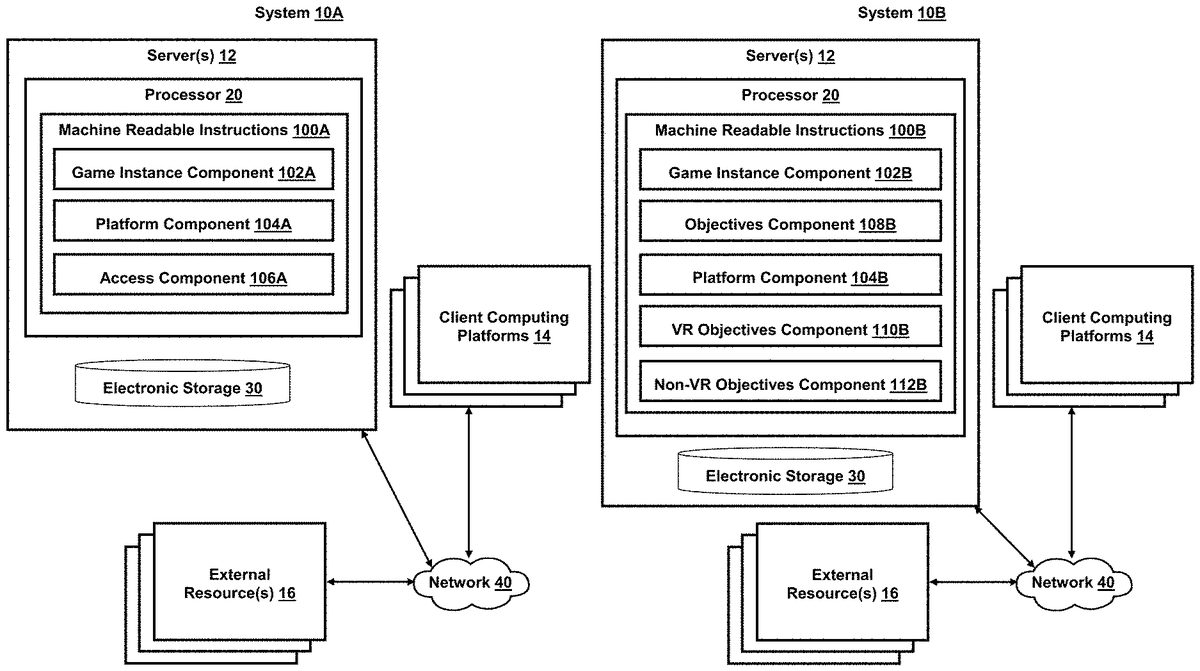
FIGS. 1A-1Cillustrates systems10A-10C configured to provide virtual reality content in an online game. Providing one or more of the online games may include hosting the online games over a network. In some implementations, as shown in these examples, systems10A-10C may include one or more servers12configured for hosting online games. Users may access systems10A-10C, the online game, and/or a game instance of the online game via client computing platforms14, such as client computing platforms14A-E as shown inFIG. 3. Systems10A-10C may include one or more of server(s)12, client computing platforms14, external resource(s)16, processor20, electronic storage30, network40, and/or other components. Server(s)12, client computing platforms14, external resource(s)16, and/or other components may be connected via network40.
Client computing platforms14may include virtual reality platforms and/or non-virtual reality platforms. Virtual reality platforms may refer to platforms that allow users of a game to interact with a virtual space as the users would interact with the real world. The virtual reality platforms may provide one or more sensory experience that simulates the users' presence in the virtual space. Sensory experience provided by virtual reality platforms may include one or more of experience based on sight, touch, hearing, smell and/or other sensory experience. As non-limiting examples, the virtual reality platforms may include one or more of a virtual reality headset display, a motion controller, a haptic generator, and/or other virtual reality platforms.
In some implementations, the virtual reality platforms may include one or more of non-virtual reality platforms. For example, a virtual reality platform may include a virtual reality headset display and a laptop device. As another example, a virtual reality platform may include a mobile device configured to act as a head-mounted display device. Other combinations and configurations of non-virtual reality platforms to function as virtual reality platforms are contemplated.
Virtual reality platforms may present views of the online game in a manner that simulates the users' immersion within the online game. The online game may have a higher interactive potential when played via the virtual reality platforms than when played via the non-virtual reality platforms. For example, the virtual reality platforms may be able to support additional and/or increased motion inputs, views, visibility, feedback and/or other interactions a user may have with the online game.
External resources16may include sources of information, hosts and/or providers of virtual environments outside of systems10A-10C, external entities participating with systems10A-10C, and/or other resources.
Server(s)12may include electronic storage30. Electronic storage30may include electronic storage media that electronically stores information. Electronic storage30may store software algorithms, information determined by processor20, information received remotely, information received from server(s)12, information received from client computing platforms14, and/or other information that enables systems10A-10C and/or server(s)12to function properly. For example, electronic storage30may store information relating to an online game, information relating to a game instance of an online game, information relating to virtual reality platforms and non-virtual reality platforms, information relating to objectives, information relating to rewards, information relating to one or more computer components, and/or other information.
Server(s)12may be configured to communicate with one or more client computing platforms14according to a client/server architecture, and with each other. Server(s)12may include processor20configured to execute one or more machine readable instructions100. In some implementations, client computing platforms14may include one or more computer program components that are the same as or similar to the computer program components of physical processor20to facilitate in game actions.
Game instance components102A-C of systems10A-C may execute a game instance of the online game. The game instance may include the virtual reality content. Virtual reality content may refer to content in the online game that requires interaction via virtual reality platforms. Virtual reality content may require input from virtual reality platforms and/or output to virtual reality platforms. For example, virtual reality content may require one or more movements and/or gestures of a user (e.g., hand motion, head motion, body motion, etc.) registered by the virtual reality platforms to interact with the virtual reality content. As another example, virtual reality content may provide output from the online game via the virtual reality platforms (e.g., displaying views of the game instance, generating vibrations, etc.).
The game instance of the online game may comprise a simulated virtual space, e.g., a virtual space that is accessible by users via clients (e.g., client computing platforms14) that present the views of the virtual space to a user. The virtual space may have a topography, express ongoing real-time interaction by one or more users and/or include one or more objects positioned within the topography that are capable of locomotion within the topography. In some instances, the topography may include a two-dimensional topography. In other instances, the topography may include a three-dimensional topography. The topography may include dimensions of the space and/or surface features of a surface or objects that are “native” to the space. In some instances, the topography may describe a surface (e.g., a ground surface) that runs through at least a substantial portion of the space. In some instances, the topography may describe a volume with one or more bodies positioned therein (e.g., a simulation of gravity-deprived space with one or more celestial bodies positioned therein). The instance executed by the computer components may be synchronous, asynchronous, and/or semi-synchronous.
It should be understood the above description of the manner in which state of the virtual space associated with the online game as determined by game instance component102A-C is not intended to be limiting. Game instance component102A-C may be configured to express the virtual space in a more limited, or richer, manner. For example, views determined for the online game representing the game state of the instance of the online game may be selected from a limited set of graphics depicting an occurrence in a given place within the online game. The views may include additional content (e.g., text, audio, pre-stored video content, and/or other content) that describes particulars of the current state of the place, beyond the relatively generic graphics. For example, a view may include a generic battle graphic with a textual description of the opponents to be confronted. Other expressions of individual places within the online game are contemplated.
Game instance component102A-C may be configured to use the game instance to generate game state information that is transmitted to client computing platforms14over network40. The execution of the instance of the online game by game instance component102A-C may include determining a game state associated with the online game. The game state information may facilitate presentation of views of the online game to the users via client computing platforms14. The game state information may include information defining the virtual space in which the online game is played.
Game instance component102A-C may be configured to transmit the game state information over network40to the client computing platforms14, causing client computing platforms14to present views of the online game. The game state information may be communicated (e.g., via streaming visual data, via object/position data, and/or other state information) from server(s)12to client computing platforms14for presentation to users.
The game state information determined and transmitted to a given client computing platform14may correspond to a view for a user character being controlled by a user via the given client computing platform104. The state determined and transmitted to a given client computing platform104may correspond to a location in a virtual space associated with the online game. The view described by the game state information for the given client computing platform may correspond, for example, to the location from which the view is taken, the location the view depicts, and/or other locations, a zoom ratio, a dimensionality of objects, a point-of-view, and/or view parameters of the view. One or more of the view parameters may be selectable by the user.
Views of the online game presented via a virtual reality platform may include views presented on a virtual reality headset display (e.g., a head-mounted display device, etc.). The views may be presented stereoscopically—one for each eye—via the virtual reality headset display and the user's brain may combine them to create a three-dimensional experience. The virtual reality headset display may include a head tracking system that tracks movement (e.g., position, orientation, change in position, change in orientation, etc.) of the users as they move their heads and/or move around the environment. The virtual reality headset display may include a sensor system (e.g., image sensor system, distance sensor system, etc.) that track movement of the users' body parts (e.g., user's hands, arms, feet, legs, etc.) and/or objects (e.g., glove, wand, controller, markers, etc.). Views of the online game presented via a non-virtual reality platform may include views presented on a display for one or more of a mobile device (e.g., a smart phone, tablet, laptop, etc.), desktop computer, gaming console, televisions, and/or other non-virtual reality platforms.
The execution of the game instance may enable interaction by the users with the online game and/or each other. Game instance component102A-C may be configured to perform operations in the game instance in response to commands received over network40from client computing platforms14. Within the instance of the online game, users may interact with elements in the online game and/or with each other through gameplays provided by the online game.
Users may participate in the online game through client game applications implemented on client computing platforms14associated with the users. Within the game instance of the online game executed by game instance component102A-C, the users may participate by controlling one or more of an element in the virtual space associated with the online game. The user-controlled elements may include avatars, user characters, virtual space units (e.g., troops), objects (e.g., weapons, horses, vehicle and so on), simulated physical phenomena (e.g., wind, rain, earthquakes, and/or other phenomena), and/or other user-controlled elements.
The user-controlled avatars may represent the users in the virtual space. The user characters may include heroes, knights, commanders, leaders, generals and/or any other virtual space entities that may possess strength, skills, abilities, magic powers, knowledge, and/or any other individualized attributes. The virtual space units controlled by the user may include troops and/or any other game entities that may be trained, recruited, captured, and/or otherwise acquired by the users in groups or en-mass. The objects controlled by the users may include weapons, vehicles, projectiles, magic items, wardrobes, boots, armor, knapsacks, medicine, healing potion, and/or any other virtual items that may be employed by the users for interaction within the online game.
The user controlled element(s) may move through and interact with the virtual space (e.g., user-virtual space units in the virtual space, non-user characters in the virtual space, other objects in the virtual space). The user controlled elements controlled by and/or associated with a given user may be created and/or customized by the given user. The user may have an “inventory” of virtual goods and/or currency that the user can use (e.g., by manipulation of a user character or other user controlled element, and/or other items) within the virtual space.
Controls of virtual elements in the online game may be exercised through commands input by a given user through client computing platforms14. The given user may interact with other users through communications exchanged within the virtual space. Such communications may include one or more of textual chat, instant messages, private messages, voice communications, and/or other communications. Communications may be received and entered by the users via their respective client computing platforms14. Communications may be routed to and from the appropriate users through server(s)12(e.g., through game instance component102A-C).
Execution and/or performance of the user action by game instance component102A-C may produce changes to the game state, which may reflect progresses and/or results of the user actions. In some examples, state changes caused by the execution of the user actions may be recorded in the electronic storage30to facilitate persistency throughout the instance of the online game. In some examples, execution of the user actions may not produce persistent changes to the game state (e.g., a user character jumping forward and backward successively may not produce any perceivable game state changes to other users).
A given user may input commands with specific parameters to undertake specific deeds, actions, functions, spheres of actions and/or any other types of interactions within the virtual space. For example, the given user may input commands to construct, upgrade and/or demolish virtual buildings; harvest and/or gather virtual resources; heal virtual user-controlled elements, non-player entities and/or elements controlled by other users; train, march, transport, reinforce, reassign, recruit, and/or arrange troops; attack, manage, create, demolish and/or defend cities, realms, kingdoms, and/or any other virtual space locations controlled by or associated with the users; craft or transport virtual items; interact with, compete against or along with non-player entities and/or virtual space elements controlled by other users in combats; research technologies and/or skills; mine and/or prospect for virtual resources; complete missions, quests, and/or campaigns; exercise magic power and/or cast spells; and/or perform any other specific deeds, actions, functions, or sphere of actions within the virtual space. In some examples, the given user may input commands to compete against elements in an environment within the virtual space—i.e., Player vs. Environment (PvE) activities. In some examples, the given user may input commands to compete against each other within the virtual space—i.e., Player vs. Player (PvP) activities.
In some implementations, when the online game is played via a virtual reality platform, a given user may input a broad range of commands. The input commands via virtual reality platform may include the user performing the action as an input command. Based on the user's actions in the real world, the user may be able to look around, move about, and/or otherwise act within the virtual space in which the online game is played.
The instance of the online game may comprise virtual entities automatically controlled in the instance of the online game. Such virtual entities may or may not be associated with any user. As such, the automatically controlled virtual entities may be generated and/or developed by artificial intelligence configured with server(s)12by a provider, administrator, moderator, and/or any other entities related to the online game. These automatically controlled entities may evolve within the online game free from user controls and may interact with the entities controlled by or associated with the users, other automatically controlled virtual space entities, as well as the topography of the virtual space. Certain manifested traits may be associated with the automatically controlled entities in accordance with the artificial intelligence configured with server(s)12. As used herein, such automatically controlled virtual space entities in the instance of the online game are referred to as “non-player entities.”
The instance of the online game may be persistent. That is, the online game may continue on whether or not individual users are currently logged in and/or participating in the online game. A user that logs out of the online game and then logs back in some time later may find the virtual space and/or the online game has been changed through the interactions of other users with the online game during the time the user was logged out. These changes may include changes to the simulated physical space, changes in the user's inventory, changes in other users' inventories, changes experienced by non-user characters, and/or other changes.
In one aspect of the disclosure, virtual reality content in an online game may be provided by determining whether the users of the online game are attempting to join the game instance via the virtual reality platforms or the non-virtual reality platforms. Access to the game instance may be provided to users attempting to join the game instance via one or more of the virtual reality platforms. Access to the game instance may be denied to users attempting to join the game instance via one or more of the non-virtual reality platforms.
Referring toFIG. 1A, machine readable instructions100A may include one or more computer program components. The computer program components may include one or more of game instance component102A, platform component104A, access component106A, and/or other components.
Game instance component102A may be configured to execute a game instance of the online game. The game instance may include virtual reality content, as described above. In some implementations, the game instance of the online game may be executed during a time period. A time period may refer to one or more durations of time in which the game instance is executed and is available for play by the users.
In some implementations, the time period may include a duration within 5 PM to 11 PM for a time zone in which the most number of users are located. For example, a time period may include a duration from 6 PM to 9 PM. As another example, a time period may include durations from 5 PM to 8 PM and from 9:30 PM to 10:30 PM. Durations of time may change between day(s), week(s), month(s), year(s), and/or other times. For example, a time period may include a duration from 7:30 PM to 9:30 PM on weekdays and durations from 9 AM to 11 AM and 4:30 PM to 11:30 PM on weekends. Others durations of time are contemplated.
The time zone for the time period may be selected based on the numbers of users. For example, a time zone may be selected based on the time zone having more number of users registered to play the online game than other time zones. The users may be registered to play the online game via virtual reality platforms and/or non-virtual reality platforms. As another example, a time zone may be selected based on historical information regarding users playing the online game via virtual reality platforms and/or non-virtual reality platforms. A time zone historically having the most number of playing users may be selected for the time period. The historical information regarding users playing the online game may be gathered for different time periods, such as for a part of a day/week/month, a full day/week/month, multiple days/week/month, etc. Other implementations of selecting the time zone are contemplated.
In some implementations, the game instance of the online game may include a set of rewards for users interacting with the online game via the one or more of the virtual reality platforms. A reward may refer to one or more changes in the online game for the users. A reward may change the interactions of the user with the online game at a time, over a period of time, at a location, or over a range of locations. For example, a reward may include one or more of changes in awards received by the users during the online game, changes in attributes of user characters, changes in virtual space units, changes in objects, and/or other changes in the online game.
Awards received by the users during the online game may be changed by increasing the award (e.g., receiving twice as many awards, etc.), changing the type of award (e.g., receiving an object instead of virtual currency, etc.), changing the requirements for receiving the award (e.g., making it easier for the user to receive the award, etc.), and/or making other changes. Attributes of user characters may be changed by increasing one or more attributes (e.g., increasing strength of user characters, etc.), deceasing one or more attributes (e.g., decreasing wait times to perform actions, etc.), adding attributes (e.g., giving abilities not previously available, etc.), and/or making other changes. Objects may be changed by increasing one or more properties of objects (e.g., increase the strength of a sword, etc.), decreasing one or more properties of objects (e.g., decreasing adverse effects of using objects, etc.), changing properties of objects (e.g., changing an object into another object, etc.), and/or making other changes.
In some implementations, game instance component102A may execute another instance of the online game. The other game instance may not include the virtual reality content. In some implementations, the other game instance may include a substitute non-virtual reality content for the virtual reality content (e.g., in the place of interacting with virtual reality content, the users may interact with substitute non-virtual reality content, etc.). In some implementations, the other game instance may not include a substitute non-virtual reality content for the virtual reality content (e.g., the users may miss out on virtual reality content without a chance to play substitute non-virtual reality content, etc.).
Platform component104A may be configured determine whether the users of the online game are attempting to join the game instance via the virtual reality platforms or the non-virtual reality platforms. Platform component104A may obtain client computing platform information and identify client computing platforms14used to interact with the virtual space based on the client computing platform information. The client computing platform information may include information that identifies virtual reality capability of client computing platform14(e.g., virtual reality vs. non-virtual reality, etc.), a class of client computing platform14, a particular type of client computing platform14, and/or other information identifying the client computing platform14.
Platform component104A may include or retrieve information (for example, a database, etc.) that matches the client computing platform information to one or more virtual reality platforms or one or more non-virtual reality platforms. For example, a class of client computing platform may include general descriptions of client computing platforms such as information indicating that a client computing platform includes a virtual reality headset display, a motion controller, a game controller, a haptic generator, a speaker, a head-mounted display device, a desktop computing device, a laptop computing device, a tablet device, a mobile device (e.g., smart phone), and/or other general description regarding the client computing platforms used to interact with the virtual space. Platform component104A may include or retrieve information that matches one or more information regarding the class of client computing platform to one or more virtual reality platforms or one or more non-virtual reality platforms.
As another example, a type of client computing platform may include specific descriptions of client computing platforms such as a particular brand, model, operating system, and/or other description that more specifically identifies the client computing platform14used to interact with the virtual space. Platform component104A may include or retrieve information that matches one or more information regarding the type of client computing platform to one or more virtual reality platforms or one or more non-virtual reality platforms.
For example,FIG. 3illustrates exemplary connections between server(s)12and client computing platforms14. Server(s)12may execute a game instance of an online game and users may be attempting to join the game instance via computing platforms14. Computing platforms14may include first client computing platform14A (e.g., a virtual reality headset display, etc.), second client computing platform14B (e.g., a head-mounted display and a game controller, etc.), third client computing platform14C (e.g., a tablet device, etc.), fourth client computing platform14D (e.g., a laptop computing device, etc.), fifth client computing platform14E (e.g., other client computing platform(s)), and/or other client computing platforms.
Based on the client computing platform information, platform component104A may determine that users of first client computing platform14A and second client computing platform14B are attempting to join the game instance via virtual reality platforms. Based on the client computing platform information, platform component104A may determine that users of third client computing platform14C and fourth client computing platform14D are attempting to join the game instance via non-virtual reality platforms. Based on the client computing platform information, platform component104A may determine whether the user of fifth client computing platform14E is attempting to join the game instance via virtual reality platform or non-virtual reality platform.
Platform component104A may obtain the client computing platform information passively or actively. Platform component104A may passively obtain the client computing platform information based on communications with client computing platforms14such as by reading headers and/or other portions of communications from client computing platforms14to identify the client computing platforms being used to interact with the virtual space. For example, platform component104A may read Hypertext Transfer Protocol (“HTTP”) headers to determine a browser used to interact with the virtual space and accordingly identify the client computing platform that operates the browser. Agents used to interact with the virtual space other than a browser may be operating on client computing platform14. Such agents may encode the client computing platform information and provide to server(s)12the client computing platform information.
Platform component104A may actively obtain the client computing platform information such as by querying and/or otherwise causing client computing platforms14to provide the client computing platform information. For example, platform component104A and/or an agent operating on client computing platforms14may cause a prompt for users to input the client computing platform information.
Access component106A may be configured to, responsive to determination that an individual user is attempting to join the game instance via one or more of the virtual reality platforms, provide access to the game instance to such individual user. Access to the game instance may be provided by allowing the users to join the game instance and begin playing the online game.
Access component106A may be configured to, responsive to determination that an individual user is attempting to join the game instance via one or more of the non-virtual reality platforms, deny access to the game instance to such individual user. Access to the game instance may be denied by preventing the users from joining the game. In some implementations, denying access to the game instance may include providing information about one or more of the virtual reality platforms required to join the game instance.
In some implementations, access component106A may be configured to, responsive to the determination that the individual user is attempting to join the game instance via the one or more of the non-virtual reality platforms, provide access to the other game instance to such individual user. The other game instance may not include the virtual reality content. In some implementation, providing access to the other game instance may include providing information about the other game instance. In some implementation, providing access to the other game instance may include providing information about one or more of the virtual reality platforms required to join the game instance.
In some implementations, access component106A may be configured to provide one or more rewards from a set of rewards to the users interacting with the online game via the one or more of the virtual reality platforms. A reward may change the interaction of the users with the online game. For example, a reward may include one or more of changes in awards received by the users during the online game, changes in attributes of user characters, changes in virtual space units, changes in objects, and/or other changes in the online game, as described above.
In some implementations, access component106A may provide the one or more rewards to the users interacting with the online game via the one or more of the virtual reality platforms in response to the users joining the game instance via the one or more of the virtual reality platforms during a time period. For example, a time period may include a duration from 9 PM to 11 PM in a certain time zone and access component106may provide one or more rewards to users that join the online game at any time between 9 PM and 11 PM via one or more of the virtual reality platforms. Information regarding one or more rewards provided to users may be stored so that a user joining the online game multiples times during the time period do not receive multiple rewards.
In some implementations, access component106A may provide one or more rewards to the users interacting with the online game via the one or more of the virtual reality platforms in response to the users interacting with the game instance via the one or more of the virtual reality platforms for a certain duration within a time period. For example, a time period may include a duration from 9 AM and 11 AM and a certain duration may include thirty minutes. Access component106A may provide one or more rewards to users That join the online game between 9 AM and 11 AM and interact with the game for thirty minutes. In some implementations, users may be required to interact with the online game for the certain duration consecutively (e.g., a user that joins the online game at 9 AM and LOAM and interacts with the game for 15 minutes each time may not receive a reward, etc.). In some implementations, users may be required to interact with the online game for the certain duration within the time period (e.g., a user that joins the online game at 10:50 AM and interacts with the game until 11:20 AM may not receive a reward, etc.). Information regarding one or more rewards provided to users may be stored so that a user joining the online game multiples times during the time period and interacting with the online game for the certain duration do not receive multiple rewards.
In one aspect of the disclosure, virtual reality content in an online game may be provided by determining a set of objectives to be achieved by the users. The set of objectives may include a first objective requiring one or more interactions of the users with the virtual reality content, a second objective not requiring the one or more interactions of the users with the virtual reality content, and/or other objectives. Users playing the online game via one or more of the virtual reality platforms during a time period may be required to achieve the first objective. Users playing the online game via one or more of the non-virtual reality platforms during the time period may be required to achieve the second objective.
Referring toFIG. 1B, machine readable instructions100B may include one or more computer program components. The computer program components may include one or more of game instance component102B, objectives component108B, platform component104B, VR objectives component110B, non-VR objectives component112B, and/or other components.
Game instance component102B may be configured to execute a game instance of the online game. The game instance may include virtual reality content, as described above.
Objectives component108B may be configured to determine a set of objectives to be achieved by the users. An objective may refer to a set of interactions required between the online game and the users. The interactions between the online game and the users may require interactions of the users with one or more elements in the online game and/or with each other through gameplays provided by the online game. As non-limiting examples, an objective may include requiring users' interactions with the online game to reach a certain point in the online game, obtain a certain level for the user character, obtain a certain object, interact with a certain user, win a battle against a certain user or an enemy, and/or other interactions with the online game.
A set of objectives may include a first objective, a second objective, and/or other objectives. The first objective may require one or more interactions of the users with the virtual reality content. For example, the first objective may require the users to manipulate a virtual puzzle by hand via one or more virtual reality platforms. The second objective may not require the one or more interactions of the users with the virtual reality content. For example, the second object may require the users to manipulate a virtual puzzle by clicking on the surface of a tablet device. Other types of objectives are contemplated.
In some implementations, the objectives may be characterized by different game difficulties. Game difficulty may refer to one or more parameters of the online game that determines interaction results of the users with one or more elements in the online game and/or with each other. Game difficulty may be static or dynamic. Game difficulty for an online game/game instance may remain the same throughout a play of the online game or change during the play of the online game. In some implementations, the first objective may be characterized by a first game difficulty and the second objective may be characterized by a second game difficulty. The first game difficulty may be lower than the second game difficulty.
For example, a low difficulty may include changes in the online game that make it easier for the users to achieve an objective. For example, a low difficulty may include changes in attributes of user characters (e.g., increasing strength of user characters, etc.), changes in virtual space units (e.g., changing the abilities of virtual space units, etc.), changes in objects (e.g., increasing durability of weapons, etc.), changes in non-player entities (e.g., decreasing health of non-player entities, etc.) and/or other changes in the online game that make it easier for the users to achieve the objective.
As another example, a high difficulty may include changes in the online game that make it harder for the users to achieve an objective. For example, a high difficulty may include changes in attributes of user characters (e.g., decreasing health of user characters, etc.), changes in virtual space units (e.g., changing the skills of virtual space units, etc.), changes in objects (e.g., decreasing object effects, etc.), changes in non-player entities (e.g., increasing magic power of non-player entities, etc.) and/or other changes in the online game that make it harder for the users to achieve the objective.
In some implementations, the objectives may be characterized by different types of gameplay. For example, the first objective may be characterized by a first type of gameplay and the second objective may be characterized by a second type of gameplay. A gameplay may refer to a manner in which users interact with the online game. A gameplay may define one or more of views of the online game, options available to users to interact with the online game and/or each other, inputs into the online game available to users, outputs out of the online game available to users, and/or other manner in which users may interact with the online game. For example, types of gameplays may include role-playing, first-person shooter, real-time strategy, turn-based strategy, simulation, music or rhythm playing, social interaction, twitching and/or any other gameplays.
The first type of gameplay may differ from the second type of gameplay. For example, the first objective may be characterize by a first-person battle type of gameplay and the second objective may be characterized by a resource gathering type of gameplay. A battle type of gameplay may include users using virtual reality platforms to fight against enemies from a first-person view (e.g., view of the game instance may be generated from the position of the user's avatars, and the users may use physical motions to change the direction of view, to duck, to jump, to strike, to defend, etc. within the online game) A resource gathering type of gameplay may include users using non-virtual reality platforms to gather resources (e.g., view of the game instance may be generated above the position of the user's avatars (e.g., top-down view, etc.), and the users may use controllers (e.g., game controller, keyboard, mouse, touch screen, etc.) to command gathering of resources, etc.). Other types of gameplays are contemplated.
In some implementations, the types of gameplay for the objectives may be determined based on historical information regarding users' prior plays of the online game and/or other games. Historical information regarding the users' prior plays may characterize the type of gameplays preferred by the users. For example, historical information regarding the users' prior plays may track users' decisions to play certain types of gameplays over other types of gameplays (e.g., a user provided with an option of playing a battle type of gameplay or a resource gathering type of gameplay may choose the battle type of gameplay more often than the resource gathering type of gameplay, etc.). The first type of gameplay of the first objective may include one or more types of gameplay more preferred by the users. The second type of gameplay of the second objective may include one or more types of gameplay less preferred by the users.
In some implementations, the objectives may be characterized by different rewards. For example, the first objective may be associated with a first reward and the second objective may be associated with a second reward. Rewards may be provided to the users upon the users achieving the associated objectives. A reward may change the interaction of the users with the online game. For example, a reward may include one or more of changes in awards received by the users during the online game, changes in attributes of user characters, changes in virtual space units, changes in objects, and/or other changes in the online game, as described above.
The first reward may differ from the second reward. For example, the first reward may include one or more of changes in awards received by the users during the online game, changes in attributes of user characters, changes in virtual space units, changes in objects, and/or other changes in the online game that provide more benefit(s) to the users than the benefit(s) provided by the second reward. For example, the first reward may be twice as large as the second reward.
In some implementations, the rewards associated with the objectives may be determined based on historical information regarding users' prior plays of the online game and/or other games. Historical information regarding the users' prior plays may characterize the type of rewards preferred by the users. For example, historical information regarding the users' prior plays may track users' decisions to seek after certain types of rewards over other types of rewards (e.g., a user provided with an option of playing to receive a user character attributes reward or an object reward may choose the object reward more often than the user character attributes reward, etc.). The first reward associated with the first objective may include one or more types of rewards more preferred by the users. The second reward associated with the second objective may include one or more types of rewards less preferred by the users.
Platform component104B may be configured to determine whether the users of the online game are playing the online game via the virtual reality platforms or the non-virtual reality platforms during a time period. Platform component104B may obtain client computing platform information and identify client computing platforms14used to interact with the virtual space based on the client computing platform information as described above.
In some implementations, platform component104B may be configured to determine changes in client computing platforms14used by the users to interact with the online game. Platform component104B may determine when a given user changes the client computing platform14used to interact with the virtual space. For example, a user may change from using a laptop device to using a virtual reality headset display to interact with the virtual space. Platform component104B may detect the change and accordingly associate the new client computing information with the user.
VR objectives component110B may be configured to, responsive to determination that an individual user is playing the online game via one or more of the virtual reality platforms during the time period, require such individual user to achieve the first objective in the online game via the one or more of the virtual reality platforms. VR objectives component110B may provide information about the first objective to the users via visual and/or audio information relating to the first objective. Visual information may refer to one or more information that may be observed visually. Visual information may be static or dynamic. For example, visual information relating to the first objective may include one or more of an image (e.g., an image showing the first objective, etc.), a text (e.g., a text describing the first objective, etc.), a video (e.g., a video showing the first objective, etc.) and/or other visual information conveying information regarding the first objective.
Audio information may refer to one or more information that may be observed audibly. Audio information may be static or dynamic. For example, audio information relating the first objective may include one or more of a sound (e.g., a sound clip associated with the first objective, etc.), a music (e.g., a song associated with the first objective, etc.), a word (e.g., a word associated with the first objective, etc.), a sentence (e.g., a sentence describing the first objective), and/or other audio information conveying information regarding the first objective.
In some implementations, VR objectives component110B may be configured to, responsive to determination that an individual user changed from playing the online game via the one or more of the non-virtual reality platforms to the one or more of the virtual reality platforms during the time period, cancel the second objective for such individual user and require such individual user to achieve the first objective in the online game via the one or more of the virtual reality platforms. Cancelling the second objective may prevent the users from achieving the second objective. In some implementations, VR objective component110B may store information relating to the users' progress in achieving the second objective. If the users are later presented with the second objective, the users may continue the progress they had achieved prior to the second objective being cancelled.
In some implementations, VR objectives component110B may be configured to, responsive to determination that an individual user achieved the first objective, provide the first reward to such individual user. VR objectives component110B may provide the first reward to the users upon the users achieving of the first objective, upon completion of the game instance in which the user achieved the first objective, at other times during the game instance in which the user achieved the first objective, or during another game instance.
Non-VR objectives component112B may be configured to, responsive to determination that an individual user is playing the online game via one or more of the non-virtual reality platforms during the time period, require such individual user to achieve the second objective in the online game via the one or more of the non-virtual reality platforms. Non-VR objectives component112B may provide information about the second objective to the users via visual and/or audio information relating to the second objective.
In some implementations, non-VR objectives component112B may be configured to, responsive to determination that an individual user changed from playing the online game via the one or more of the virtual reality platforms to the one or more of the non-virtual reality platforms during the time period, cancel the first objective for such individual user and require such individual user to achieve the second objective in the online game via the one or more of the non-virtual reality platforms. Cancelling the first objective may prevent the users from achieving the first objective. In some implementations, non-VR objective component112B may store information relating to the users' progress in achieving the first objective. If the users are later presented with the first objective, the users may continue the progress they had achieved prior to the first objective being cancelled.
In some implementations, non-VR objectives component112B may be configured to, responsive to determination that an individual user achieved the second objective, provide the second reward to such individual user. Non-VR objectives component112B may provide the second reward to the users upon the users achieving of the second objective, upon completion of the game instance in which the user achieved the second objective, at other times during the game instance in which the user achieved the second objective, or during another game instance.
In one aspect of the disclosure, virtual reality content in an online game may be provided by determining, for users interacting with the online game during a time period, one or more objectives to be achieved by the users to advance in the online game. The one or more objectives may require one or more interactions of the users with the virtual reality content. The users may be required to achieve the one or more objectives in the online game via operation of the virtual reality platforms.
Referring toFIG. 1C, machine readable instructions100C may include one or more computer program components. The computer program components may include one or more of game instance component102C, objectives component108C, progress component114C, and/or other components.
Game instance component102C may be configured to execute a game instance of the online game during a time period. The game instance may include virtual reality content, as described above.
In some implementations, game instance component102C may be configured to execute another instance of the online game. The other game instance may not include the virtual reality content. In some implementations, the other game instance may include a substitute non-virtual reality content for the virtual reality content (e.g., in the place of interacting with virtual reality content, the users may interact with substitute non-virtual reality content, etc.). In some implementations, the other game instance may not include a substitute non-virtual reality content for the virtual reality content (e.g., the users may miss out on virtual reality content without a chance to play substitute non-virtual reality content).
Objectives component108C may be configured to, for users interacting with the online game during the time period, determine one or more objectives to be achieved by the users to advance in the online game. The one or more objectives may require one or more interactions of the users with the virtual reality content. Users playing the online game during the period may be required to achieve the one or more objectives to advance in the online game. For example, an objective may require the users to manipulate a virtual puzzle by hand via one or more virtual reality platforms to advance in the online game. As another example, an objective may require the users to perform certain movements registerable by the virtual reality platforms to advance in the online game. Other objectives requiring interactions with the virtual reality content are contemplated.
Progress component114C may be configured to require the users to achieve the one or more objectives in the online game via operation of the virtual reality platforms. Progress component114C may detect interactions of the users with the online game via operation of the virtual reality platforms and determine whether the users have achieved the one or more objectives. For users that have achieved the one or more objectives, progress component114C may allow the users to advance in the online game. For users that have not achieved the one or more objectives, progress component114C may not allow the users to advance in the online game.
Advancing in the online game may refer to changes in the online game, such as changes in attributes of user characters (e.g., changes in character level and/or other attributes, etc.), changes in virtual space units (e.g., change in the number, types, or other characteristics of virtual space units, etc.), changes in objects (e.g., changes in the number, types, or other characteristics of objects, etc.), changes in areas within the online game available to the users (e.g., changes in elements in areas or changes in areas are available to the users, etc.), and/or other changes in the online game.
In some implementations, progress component114C may be configured to determine whether the users of the online game are playing the online game via the virtual reality platforms or the non-virtual reality platforms during the time period. Progress component114C may obtain client computing platform information and identify client computing platforms14used to interact with the virtual space based on the client computing platform information as described above with respect to platform components104A-B.
In some implementations, progress component114C may be configured to, responsive to determination that an individual user is playing the online game via one or more of the non-virtual reality platforms during the time period, effectuate presentation of an invitation to such user to change to one or more of the virtual reality platforms. Presentation of an invitation may be effectuated through provision of visual and/or audio information relating to the invitation.
Visual information may refer to one or more information that may be observed visually. Visual information may be static or dynamic. For example, visual information relating to the invitation may include one or more of an image (e.g., an image showing the invitation, etc.), a text (e.g., a text of the invitation, etc.), a video (e.g., a video showing the invitation, etc.) and/or other visual information conveying information regarding the invitation.
Audio information may refer to one or more information that may be observed audibly. Audio information may be static or dynamic. For example, audio information relating the invitation may include one or more of a sound (e.g., a sound clip associated with the invitation, etc.), a music (e.g., a song associated with the invitation, etc.), a word (e.g., a word associated with the invitation, etc.), a sentence (e.g., a sentence describing the invitation), and/or other audio information conveying information regarding the invitation.
In some implementations, progress component114C may be configured to, responsive to determination that an individual user is playing the online game via one or more of the non-virtual reality platforms during the time period, provide access to the other game instance to such individual user. The other game instance may not include the virtual reality content. In some implementation, providing access to the other game instance may include providing information about the other game instance. In some implementation, providing access to the other game instance may include providing information about one or more of the virtual reality platforms required to join the game instance.
In some implementations, server(s)12, client computing platforms14, and/or external resources16may be operatively linked via one or more electronic communication links. For example, such electronic communication links may be established, at least in part, via a network such as the Internet and/or other networks. It will be appreciated that this is not intended to be limiting, and that the scope of this disclosure includes implementations in which server(s)12, client computing platforms14, and/or external resources16may be operatively linked via some other communication media.
A given client computing platform14may include one or more processors configured to execute computer program components. The computer program components may be configured to enable a user associated with the given client computing platform14to interface with systems10A-10C and/or external resources16, and/or provide other functionality attributed herein to client computing platforms14.
Server(s)12may include electronic storage30, one or more processors20, and/or other components. Server(s)12may include communication lines, or ports to enable the exchange of information with a network and/or other computing platforms. Illustration of server(s)12inFIGS. 1A-1Care not intended to be limiting. Server(s)12may include a plurality of hardware, software, and/or firmware components operating together to provide the functionality attributed herein to server(s)12. For example, server(s)12may be implemented by a cloud of computing platforms operating together as server(s)12.
Processor20may be configured to provide information processing capabilities in server(s)12. As such, processor20may include one or more of a digital processor, a central processing unit, a graphics processing unit, a microcontroller, an analog processor, a digital circuit designed to process information, an analog circuit designed to process information, a state machine, and/or other mechanisms for electronically processing information.
Although processor20is shown inFIGS. 1A-1Cas a single entity, this is for illustrative purposes only. In some implementations, processor20may include a plurality of processing units. These processing units may be physically located within the same device, or processor20may represent processing functionality of a plurality of devices operating in coordination. Processor20may be configured to execute computer components. Processor20may be configured to execute computer components by software; hardware; firmware; some combination of software, hardware, and/or firmware; and/or other mechanisms for configuring processing capabilities on processor20.
It should be appreciated that although computer components are illustrated inFIGS. 1A-1Cas being co-located within a single processing unit, in implementations in which processor20includes multiple processing units, one or more of computer components may be located remotely from the other components.
The description of the functionality provided by the different computer components described herein is for illustrative purposes, and is not intended to be limiting, as any of computer components may provide more or less functionality than is described. For example, one or more of computer components may be eliminated, and some or all of its functionality may be provided by other computer components. As another example, processor20may be configured to execute one or more additional computer components that may perform some or all of the functionality attributed to one or more of computer components.
Electronic storage30may comprise electronic storage media that electronically stores information. The electronic storage media of electronic storage30may include one or both of system storage that is provided integrally (i.e., substantially non-removable) with server(s)12and/or removable storage that is removably connectable to server(s)12via, for example, a port (e.g., a USB port, a firewire port, etc.) or a drive (e.g., a disk drive, etc.). Electronic storage30may include one or more of optically readable storage media (e.g., optical disks, etc.), magnetically readable storage media (e.g., magnetic tape, magnetic hard drive, floppy drive, etc.), electrical charge-based storage media (e.g., EEPROM, RAM, etc.), solid-state storage media (e.g., flash drive, etc.), and/or other electronically readable storage media. Electronic storage30may include one or more virtual storage resources (e.g., cloud storage, a virtual private network, and/or other virtual storage resources). Although electronic storage30is shown inFIGS. 1A-1Cas a single entity, this is for illustrative purposes only. In some implementations, electronic storage30may comprise a plurality of storage units. These storage units may be physically located within the same device, or electronic storage30may represent storage functionality of a plurality of devices operating in coordination.
FIGS. 2A-2Cillustrate methods200A-C for providing virtual reality content in an online game. The operations of methods200A-C presented below are intended to be illustrative. In some implementations, methods200A-C may be accomplished with one or more additional operations not described, and/or without one or more of the operations discussed. In some implementations, two or more of the operations may occur substantially simultaneously.
In some implementations, methods200A-C may be implemented in one or more processing devices (e.g., a digital processor, an analog processor, a digital circuit designed to process information, a central processing unit, a graphics processing unit, a microcontroller, an analog circuit designed to process information, a state machine, and/or other mechanisms for electronically processing information). The one or more processing devices may include one or more devices executing some or all of the operations of methods200A-C in response to instructions stored electronically on one or more electronic storage mediums. The one or more processing devices may include one or more devices configured through hardware, firmware, and/or software to be specifically designed for execution of one or more of the operations of methods200A-C.
Referring toFIG. 2Aand method200A, at operation201A, a game instance of an online game may be executed. The game instance may include virtual reality content. In some implementations, operation201A may be performed by a processor component the same as or similar to game instance component102A (shown inFIG. 1Aand described herein).
At operation202A, whether users of the online game are attempting to join the game instance via virtual reality platforms or non-virtual reality platforms may be determined. In some implementations, operation202A may be performed by a processor component the same as or similar to platform component104A (shown inFIG. 1Aand described herein).
At operation203A, responsive to determination that an individual user is attempting to join the game instance via one or more of the virtual reality platforms, access to the game instance may be provided to such individual user. In some implementations, operation203A may be performed by a processor component the same as or similar to access component106A (shown inFIG. 1and described herein).
At operation204A, responsive to determination that an individual user is attempting to join the game instance via one or more of the non-virtual reality platforms, access to the game instance may be denied to such individual user. In some implementations, operation204A may be performed by a processor component the same as or similar to access component106A (shown inFIG. 1Aand described herein).
Referring toFIG. 2Band method200B, at operation201B, a game instance of an online game may be executed. The game instance may include virtual reality content. In some implementations, operation201B may be performed by a processor component the same as or similar to game instance component102B (shown inFIG. 1Band described herein).
At operation202B, a set of objectives to be achieved by the users may be determined. The set of objectives may include a first objective, a second objective, and/or other objectives. The first objective may require one or more interactions of the users with the virtual reality content and the second objective may not require one or more interactions of the users with the virtual reality content. In some implementations, operation202B may be performed by a processor component the same as or similar to objectives component108B (shown inFIG. 1Band described herein).
At operation203B, whether users of the online game are playing the online game via virtual reality platforms or non-virtual reality platforms during a time period may be determined. In some implementations, operation203B may be performed by a processor component the same as or similar to platform component104B (shown inFIG. 1Band described herein).
At operation204B, responsive to determination that an individual user is playing the online game via one or more of the virtual reality platforms during the time period, such individual user may be required to achieve the first objective. In some implementations, operation204B may be performed by a processor component the same as or similar to VR objectives component110B (shown inFIG. 1Band described herein).
At operation205B, responsive to determination that an individual user is playing the online game via one or more of the non-virtual reality platforms during the time period, such individual user may be required to achieve the second objective. In some implementations, operation205B may be performed by a processor component the same as or similar to non-VR objectives component112B (shown inFIG. 1Band described herein).
Referring toFIG. 2Cand method200C, at operation201C, a game instance of an online game may be executed during a time period. The game instance may include virtual reality content. In some implementations, operation201C may be performed by a processor component the same as or similar to game instance component102C (shown inFIG. 1Cand described herein).
At operation202C, for users interacting with the online game during the time period, an objective to be achieved by the users to advance in the online game may be determined. The objective may require one or more interactions of the users with the virtual reality content. In some implementations, operation202C may be performed by a processor component the same as or similar to objectives component108C (shown inFIG. 1Cand described herein).
At operation203C, the users may be required to achieve the objective in the online game via operation of the virtual reality platforms. In some implementations, operation203C may be performed by a processor component the same as or similar to progress component114C (shown inFIG. 1Cand described herein).
Virtual reality content in an online game may be provided by providing access to users attempting to join a game instance via virtual reality platforms and denying access to users attempting to join the game instance via non-virtual reality platforms. Virtual reality content in an online game may be provided by requiring users playing the online game via virtual reality platforms during a time period to achieve a first objective, and requiring users playing the online game via non-reality platforms during the time period to achieve a second objective. The first objective may require interaction with the virtual reality content and the second object may not require interaction with the virtual reality content. Virtual reality content in an online game may be provided by requiring all users to achieve an objective during a time period. The objective may require interaction with the virtual reality content.
In some embodiments, a system for providing virtual reality content in an online game, the system comprising: one or more physical processors configured by machine readable instructions to: execute a game instance of the online game, the game instance including the virtual reality content, and use the game instance to generate game state information that is transmitted to client computing platforms over a network, the game state information facilitating presentation of views of the online game to users via the client computing platforms, wherein execution of the game instance further enables interaction by the users with the online game and/or each other by performing operations in the game instance in response to commands received over the network from the client computing platforms, wherein the client computing platforms include virtual reality platforms and non-virtual reality platforms; determine whether the users of the online game are attempting to join the game instance via the virtual reality platforms or the non-virtual reality platforms; responsive to determination that an individual user is attempting to join the game instance via one or more of the virtual reality platforms, provide access to the game instance to such individual user; and responsive to determination that an individual user is attempting to join the game instance via one or more of the non-virtual reality platforms, deny access to the game instance to such individual user. In some embodiments, the system as described above, wherein the one or more physical processors are further configured by machine readable instruction to: execute another game instance of the online game, the other game instance not including the virtual reality content; and responsive to the determination that the individual user is attempting to join the game instance via the one or more of the non-virtual reality platforms, provide access to the other game instance to such individual user. In some embodiments, the system as described above, wherein the game instance of the online game is executed during a time period. In some embodiments, the system as described above, wherein the time period includes a duration within 5 PM to 11 PM for a time zone in which the most number of users are located. In some embodiments, the system as described above, wherein the game instance of the online game includes a set of rewards for users interacting with the online game via the one or more of the virtual reality platforms, and the one or more physical processors are further configured by machine readable instruction to provide one or more rewards from the set of rewards to the users interacting with the online game via the one or more of the virtual reality platforms. In some embodiments, the system as described above, wherein the one or more rewards are provided to the users interacting with the online game via the one or more of the virtual reality platforms in response to the users joining the game instance via the one or more of the virtual reality platforms during a time period. In some embodiments, the system as described above, wherein the one or more rewards are provided to the users interacting with the online game via the one or more of the virtual reality platforms in response to the users interacting with the game instance via the one or more of the virtual reality platforms for a certain duration within a time period. In some embodiments, the system as described above, wherein the virtual reality platforms include a virtual reality headset display. In some embodiments, the system as described above, wherein the virtual reality platforms include a motion controller. In some embodiments, the virtual reality platforms include a haptic generator.
In some embodiments, a system for providing virtual reality content in an online game, the system comprising: one or more physical processors configured by machine readable instructions to: execute a game instance of the online game, the game instance including the virtual reality content, and use the game instance to generate game state information that is transmitted to client computing platforms over a network, the game state information facilitating presentation of views of the online game to users via the client computing platforms, wherein execution of the game instance further enables interaction by the users with the online game and/or each other by performing operations in the game instance in response to commands received over the network from the client computing platforms, wherein the client computing platforms include virtual reality platforms and non-virtual reality platforms; determine a set of objectives to be achieved by the users, the set of objectives including a first objective and a second objective, the first objective requiring one or more interactions of the users with the virtual reality content and the second objective not requiring the one or more interactions of the users with the virtual reality content; determine whether the users of the online game are playing the online game via the virtual reality platforms or the non-virtual reality platforms during a time period; responsive to determination that an individual user is playing the online game via one or more of the virtual reality platforms during the time period, require such individual user to achieve the first objective in the online game via the one or more of the virtual reality platforms; and responsive to determination that an individual user is playing the online game via one or more of the non-virtual reality platforms during the time period, require such individual user to achieve the second objective in the online game via the one or more of the non-virtual reality platforms. In some embodiments, the system as described above, wherein the one or more physical processors are further configured by machine readable instruction to: determine changes in the client computing platforms used by the users to interact with the online game during the time period; responsive to determination that an individual user changed from playing the online game via the one or more of the virtual reality platforms to the one or more of the non-virtual reality platforms during the time period, cancel the first objective for such individual user and require such individual user to achieve the second objective in the online game via the one or more of the non-virtual reality platforms; and responsive to determination that an individual user changed from playing the online game via the one or more of the non-virtual reality platforms to the one or more of the virtual reality platforms during the time period, cancel the second objective for such individual user and require such individual user to achieve the first objective in the online game via the one or more of the virtual reality platforms. In some embodiments, the system as described above, wherein the first objective is characterized by a first game difficulty and the second objective is characterized by a second game difficulty, the first game difficulty being lower than the second game difficulty. In some embodiments, the system as described above, wherein the first objective is characterized by a first type of gameplay and the second objective is characterized by a second type of gameplay, the first type of gameplay differing from the second type of gameplay. In some embodiments, the system as described above, wherein the first objective is associated with a first reward and the second objective is associated with a second reward, and the one or more physical professors are further configured to: responsive to determination that an individual user achieved the first objective, provide the first reward to such individual user; and responsive to determination that an individual user achieved the second objective, provide the second reward to such individual user.
In some embodiments, a system for providing virtual reality content in an online game, the system comprising: one or more physical processors configured by machine readable instructions to: execute a game instance of the online game, the game instance including the virtual reality content, and use the game instance to generate game state information that is transmitted to client computing platforms over a network, the game state information facilitating presentation of views of the online game to users via the client computing platforms, wherein execution of the game instance further enables interaction by the users with the online game and/or each other by performing operations in the game instance in response to commands received over the network from the client computing platforms, wherein the client computing platforms include virtual reality platforms and non-virtual reality platforms; for users interacting with the online game during a time period, determine an objective to be achieved by the users to advance in the online game, the objective requiring one or more interactions of the users with the virtual reality content; and require the users to achieve the objective in the online game via operation of the virtual reality platforms. In some embodiments, the system as described above, wherein the one or more physical processors are further configured to: determine whether the users of the online game are playing the online game via the virtual reality platforms or the non-virtual reality platforms during the time period; and responsive to determination that an individual user is playing the online game via one or more of the non-virtual reality platforms during the time period, effectuate presentation of an invitation to such user to change to one or more of the virtual reality platforms. In some embodiments, the system as described above, wherein the one or more physical processors are further configured to: execute another game instance of the online game, the other game instance not including the virtual reality content; determine whether the users of the online game are playing the online game via the virtual reality platforms or the non-virtual reality platforms during the time period; and responsive to determination that an individual user is playing the online game via one or more of the non-virtual reality platforms during the time period, provide access to the other game instance to such individual user.
Regulating Access to Game Content of an Online Game
FIG. 4illustrates system210configured to regulate access to game content of an online game. The online game may be provided and/or executed by system210. An online game may include game content that may be played cooperatively by groups of users. The game content may include a group roles set for the users in individual groups. The group roles set may include a first set of group roles, a second set of group roles, and/or other set(s) of group roles. Users of the online game may interact with the online game and/or each other via the users' client computing platforms. Client computing platforms214may include virtual reality platforms and/or non-virtual reality platforms. Access to the game content of the online game may be regulated by executing a game instance of the online game and determining whether the users are attempting to play the game instance via the virtual reality platforms or the non-virtual reality platforms. The first set of group roles may be presented to users attempting to play the game instance via the virtual reality platforms. The second set of group roles may be presented to users attempting to play the game instance via the non-virtual reality platforms.
Providing one or more of the online games may include hosting the online games over a network. In some implementations, as shown in this example, system210may include one or more servers212configured for hosting online games. Users may access system210, the online game, and/or a game instance of the online game via client computing platforms214, such as client computing platforms214A-E as shown inFIG. 6.
Referring toFIG. 4, system210may include one or more of server(s)12, client computing platforms214, external resource(s)216, processor220, electronic storage230, network240, and/or other components. Server(s)212, client computing platforms214, external resource(s)216, and/or other components may be connected via network240.
Client computing platforms214may include virtual reality platforms and/or non-virtual reality platforms. Virtual reality platforms may refer to platforms that allow users of a game to interact with a virtual space as the users would interact with the real world. The virtual reality platforms may provide one or more sensory experience that simulates the users' presence in the virtual space. Sensory experience provided by virtual reality platforms may include one or more of experience based on sight, touch, hearing, smell and/or other sensory experience. As non-limiting examples, the virtual reality platforms may include one or more of a virtual reality headset display, a motion controller, a haptic generator, and/or other virtual reality platforms.
In some implementations, the virtual reality platforms may include one or more of non-virtual reality platforms. For example, a virtual reality platform may include a virtual reality headset display and a laptop device. As another example, a virtual reality platform may include a mobile device configured to act as a head-mounted display device. Other combinations and configurations of non-virtual reality platforms to function as virtual reality platforms are contemplated.
Virtual reality platforms may present views of the online game in a manner that simulates the users' immersion within the online game. The online game may have a higher interactive potential when played via the virtual reality platforms than when played via the non-virtual reality platforms. For example, the virtual reality platforms may be able to support additional and/or increased motion inputs, views, visibility, feedback and/or other interactions a user may have with the online game.
External resource(s)216may include sources of information, hosts and/or providers of virtual environments outside of system210, external entities participating with system210, and/or other resources.
Server(s)212may include electronic storage230. Electronic storage230may include electronic storage media that electronically stores information. Electronic storage230may store software algorithms, information determined by processor220, information received remotely, information received from server(s)212, information received from client computing platforms214, and/or other information that enables system210and/or server(s)212to function properly. For example, electronic storage230may store information relating to an online game, information relating to a game instance of an online game, information relating to virtual reality platforms and non-virtual reality platforms, information relating to group roles, information relating to one or more computer components, and/or other information.
Server(s)212may be configured to communicate with one or more client computing platforms214according to a client/server architecture, and with each other. Server(s)212may include processor220configured to execute one or more machine readable instructions2100. Machine readable instructions2100may include one or more computer program components. The computer program components may include one or more of game instance component2102, platform component2104, VR roles component2106, non-VR roles component,2108, and/or other components. In some implementations, client computing platforms214may include one or more computer program components that are the same as or similar to the computer program components of physical processor220to facilitate in game actions.
Game instance component2102may be configured to execute a game instance of the online game. The online game may include the game content that is played cooperatively by groups of users. For example, a game content may be played cooperatively by one or more groups of users against entities controlled by game instance component2102(Player vs. Environment content). As another example, a game content may be played cooperatively between group(s) of users against other group(s) of users (Player vs. Player content). As another example, a game content may be played cooperatively between group(s) of users against other group(s) of users and against entities controlled by game instance component2102(Hybrid content).
A group of users may refer to one or more users associated together in an online game. A group of users may associate together as a loose collection of users that work together to progress through a game session. A game session may include a beginning, a middle, an end, and/or other portions. A game instance may include one or more game sessions. One or more users of a group may be associated together based on one or more common objectives in the online game/game session. For example, a group of users may include an affiliation (e.g., alliance, guild, team, party, etc.) in an online game and a common objective in the online game may include defeating enemies of the affiliation (e.g., non-player entities or enemies controlled by users not in the alliance/guild/team/party, etc.), reaching a certain point in the online game, and/or other common objectives.
A group of users may be inclusive or exclusive of other groups. For example, users belonging in one group may be prohibited from joining another group (e.g., in an online battle game between groups A and B, users in group A may be prohibited from joining group B and vice versa, etc.). As another example, users belonging in one group may be allowed to join another group (e.g., in an online racing game between factions C and D, faction C may include multiple groups and users in one group of faction C may join another group of faction C, etc.).
A group of users may be temporary or persistent. A temporary group may refer to an affiliation of users that may exist for a single game session or a single game instance (which may include one or more game sessions). For example, users in a game session may be randomly assigned to different teams. When the game session is over, the users' assignments to the teams may be cleared and the users may again be randomly assigned to different teams. As another example, users in a game instance may join different teams. The team assignment for a user may be maintained (unless changed by the user) across multiple game sessions of the game instance. The team assignment for the user may be cleared when the user leaves the game instance.
A persistent group may refer to an affiliation of users that crosses over multiple game instances. For example, a user may be assigned to a team while playing in a cooperative gameplay. After the cooperative gameplay, the user may switch to an individual gameplay. When the user returns to the cooperative gameplay, the user's assignment to the team may be maintained and the user may cooperatively play the online game with the same team. As another example, a user may join a team during a game instance and leave the game instance. When the user joins another game instance, the user's team assignment may be maintained.
Users in a group may play the online game by taking on one or more group roles. A group role may refer to one or more parts and/or functions in the online game that assist other part(s) and/or function(s) in the same group. A group role may be static or dynamic. For example, a group role may include the same part(s) and/or function(s) in the online game regardless of the time(s) of play and/or the state(s) of the online game. As another example, a group role may include different part(s) and/or function(s) in the online game based on the time(s) of play and/or the state(s) of the online game. A group role may allow a user to take one or more actions in the online game to progress in the game and/or cooperate with other users in the group. Of possible actions that may be available in the online game, different sets of options may be made available to different group roles.
For example, an online game may include a group role of a group member, a group role of a group leader, and/or other group roles. A user playing the role of a group leader may be provided with additional options in the online game not available to a user playing the role of a group member. Additional options available to a group leader may be made available during a play portion of the online game (e.g., racing portion of a racing game, etc.) and/or during a non-play portion of the online game (e.g., one or more portions of a racing game used to determine racing tracks, weather conditions, cars available, assignment of specific cars to specific group member, inviting and/or accepting users to a group, etc.). For example, during a play portion of the online game, a group leader may be provided with additional options of assigning task(s) to group members, and/or other options. As another example, during a non-play portion of the online game, a group leader may be provided with additional options of adding/removing users from the group, and/or other options. As another example, a group leader may be provided with additional and/or different interfaces within the online game than a group member. Additional and/or different interfaces may allow a group leader to perform one or more additional options.
A group roles set may refer to one or more group roles available for an individual group. A group roles set for one group may include the same or different group roles as a group roles set for another group. For example, in an online space fighter game between group A and group B, a group roles set for group A and group B may both include a group role of a pilot and a group role of a navigator. As another example, in an online fantasy game between group C and group D, group C may include group role of a knight and a group role of a priest, and group D may include group role of a troll and a group role of a dragon. Other types of group roles are contemplated.
A game content may include one or more group roles set for the users in individual groups. Group roles in individual group roles sets may be played cooperatively with each other and/or may complement each other. Interaction with the game instance by one group role in a group roles set may assist another group role in the group roles set. For example, for an individual group, one group role in a group role set may include a group role of a fighter and another group role in the group role set may include a group role of a healer. A fighter may assist a healer by providing combat support in fight against enemies. A healer may assist a fighter by providing healing support. Other types of cooperation between group roles are contemplated.
A group roles set may include different sets of group roles. For example, a group roles set may include a first set of group roles, a second set of group roles, and/or other set(s) of group roles. The first set of group roles may differ from the second set of group roles. The first set of group roles and the second set of group roles may include different capabilities of interacting with the online game. For example, the first set of group roles may include higher capabilities of interacting with the online game than the second set of group roles.
Higher capabilities of interacting with the online game may provide greater potential for game experience based on one or more of sight, touch, hearing, smell, and/or other sensory experience. Higher capabilities of interacting with the online game may include additional and/or increased motion inputs, views, visibility, feedback and/or other interactions a user may have with the online game. For example, the first set of group roles may include additional and/or increased motion inputs that allow the users to provide input through one or more motions and/or gestures (e.g., waving a hand/motion controller in a particular manner to provide input associated with a combat movement, moving a head to change the direction of view, etc.). As another example, the first set of group roles may include additional and/or increased feedback (e.g., a hit is registered with one or more vibrations and/or temperature, etc.). Other types of interactive capabilities are contemplated.
In some implementations, the first set of group roles may be characterized by a first type of gameplay and the second set of group roles may be characterized by a second type of gameplay. A gameplay may refer to a manner in which users interact with the online game. A gameplay may define one or more of views of the online game, options available to users to interact with the online game and/or each other, inputs into the online game available to users, outputs out of the online game available to users, and/or other manner in which users may interact with the online game. For example, types of gameplays may include role-playing, first-person shooter, third-person action, real-time strategy, turn-based strategy, simulation, music or rhythm playing, social interaction, twitching and/or any other gameplays.
The first type of gameplay may differ from the second type of gameplay. For example, the first set of group roles may be characterize by a first-person battle type of gameplay and the second set of group roles may be characterized by a resource gathering type of gameplay. A battle type of gameplay may include users using virtual reality platforms to fight against enemies from a first-person view (e.g., view of the game instance may be generated from the position of the users' avatars, and the users may use physical motions to change the direction of view, to duck, to jump, to strike, to defend, etc. within the online game) A resource gathering type of gameplay may include users using non-virtual reality platforms to gather resources (e.g., view of the game instance may be generated above the position of the user's avatars (e.g., top-down view, etc.), and the users may use controllers (e.g., game controller, keyboard, mouse, touch screen, etc.) to command gathering of resources, etc.). Other types of gameplays are contemplated.
The game instance of the online game may comprise a simulated virtual space, e.g., a virtual space that is accessible by users via clients (e.g., client computing platforms214) that present the views of the virtual space to a user. The virtual space may have a topography, express ongoing real-time interaction by one or more users and/or include one or more objects positioned within the topography that are capable of locomotion within the topography. In some instances, the topography may include a two-dimensional topography. In other instances, the topography may include a three-dimensional topography. The topography may include dimensions of the space and/or surface features of a surface or objects that are “native” to the space. In some instances, the topography may describe a surface (e.g., a ground surface) that runs through at least a substantial portion of the space. In some instances, the topography may describe a volume with one or more bodies positioned therein (e.g., a simulation of gravity-deprived space with one or more celestial bodies positioned therein). The instance executed by the computer components may be synchronous, asynchronous, and/or semi-synchronous.
It should be understood the above description of the manner in which state of the virtual space associated with the online game as determined by game instance component2102is not intended to be limiting. Game instance component2102may be configured to express the virtual space in a more limited, or richer, manner. For example, views determined for the online game representing the game state of the instance of the online game may be selected from a limited set of graphics depicting an occurrence in a given place within the online game. The views may include additional content (e.g., text, audio, pre-stored video content, and/or other content) that describes particulars of the current state of the place, beyond the relatively generic graphics. For example, a view may include a generic battle graphic with a textual description of the opponents to be confronted. Other expressions of individual places within the online game are contemplated.
Game instance component2102may be configured to use the game instance to generate game state information that is transmitted to client computing platforms214over network240. The execution of the instance of the online game by game instance component2102may include determining a game state associated with the online game. The game state information may facilitate presentation of views of the online game to the users via client computing platforms214. The game state information may include information defining the virtual space in which the online game is played.
Game instance component2102may be configured to transmit the game state information over network240to the client computing platforms214, causing client computing platforms214to present views of the online game. The game state information may be communicated (e.g., via streaming visual data, via object/position data, and/or other state information) from server(s)212to client computing platforms214for presentation to users.
The game state information determined and transmitted to a given client computing platform214may correspond to a view for a user character being controlled by a user via the given client computing platform2104. The state determined and transmitted to a given client computing platform2104may correspond to a location in a virtual space associated with the online game. The view described by the game state information for the given client computing platform may correspond, for example, to the location from which the view is taken, the location the view depicts, and/or other locations, a zoom ratio, a dimensionality of objects, a point-of-view, and/or view parameters of the view. One or more of the view parameters may be selectable by the user.
Views of the online game presented via a virtual reality platform may include views presented on a virtual reality headset display (e.g., a head-mounted display device, etc.). The views may be presented stereoscopically—one for each eye—via the virtual reality headset display and the user's brain may combine them to create a three-dimensional experience. The virtual reality headset display may include a head tracking system that tracks movement (e.g., position, orientation, change in position, change in orientation, etc.) of the users as they move their heads and/or move around the environment. The virtual reality headset display may include a sensor system (e.g., image sensor system, distance sensor system, etc.) that track movement of the users' body parts (e.g., user's hands, arms, feet, legs, etc.) and/or objects (e.g., glove, wand, controller, markers, etc.). Views of the online game presented via a non-virtual reality platform may include views presented on a display for one or more of a mobile device (e.g., a smart phone, tablet, laptop, etc.), desktop computer, gaming console, televisions, and/or other non-virtual reality platforms.
The execution of the game instance may enable interaction by the users with the online game and/or each other. Game instance component2102may be configured to perform operations in the game instance in response to commands received over network240from client computing platforms214. Within the instance of the online game, users may interact with elements in the online game and/or with each other through gameplays provided by the online game.
Users may participate in the online game through client game applications implemented on client computing platforms214associated with the users. Within the game instance of the online game executed by game instance component2102, the users may participate by controlling one or more of an element in the virtual space associated with the online game. The user-controlled elements may include avatars, user characters, virtual space units (e.g., troops), objects (e.g., weapons, horses, vehicle and so on), simulated physical phenomena (e.g., wind, rain, earthquakes, and/or other phenomena), and/or other user-controlled elements.
The user-controlled avatars may represent the users in the virtual space. The user characters may include heroes, knights, commanders, leaders, generals and/or any other virtual space entities that may possess strength, skills, abilities, magic powers, knowledge, and/or any other individualized attributes. The virtual space units controlled by the user may include troops and/or any other game entities that may be trained, recruited, captured, and/or otherwise acquired by the users in groups or en-mass. The objects controlled by the users may include weapons, vehicles, projectiles, magic items, wardrobes, boots, armor, knapsacks, medicine, healing potion, and/or any other virtual items that may be employed by the users for interaction within the online game.
The user controlled element(s) may move through and interact with the virtual space (e.g., user-virtual space units in the virtual space, non-user characters in the virtual space, other objects in the virtual space). The user controlled elements controlled by and/or associated with a given user may be created and/or customized by the given user. The user may have an “inventory” of virtual goods and/or currency that the user can use (e.g., by manipulation of a user character or other user controlled element, and/or other items) within the virtual space.
Controls of virtual elements in the online game may be exercised through commands input by a given user through client computing platforms214. The given user may interact with other users through communications exchanged within the virtual space. Such communications may include one or more of textual chat, instant messages, private messages, voice communications, and/or other communications. Communications may be received and entered by the users via their respective client computing platforms214. Communications may be routed to and from the appropriate users through server(s)212(e.g., through game instance component2102).
Execution and/or performance of the user action by game instance component2102may produce changes to the game state, which may reflect progresses and/or results of the user actions. In some examples, state changes caused by the execution of the user actions may be recorded in the electronic storage230to facilitate persistency throughout the instance of the online game. In some examples, execution of the user actions may not produce persistent changes to the game state (e.g., a user character jumping forward and backward successively may not produce any perceivable game state changes to other users).
A given user may input commands with specific parameters to undertake specific deeds, actions, functions, spheres of actions and/or any other types of interactions within the virtual space. For example, the given user may input commands to construct, upgrade and/or demolish virtual buildings; harvest and/or gather virtual resources; heal virtual user-controlled elements, non-player entities and/or elements controlled by other users; train, march, transport, reinforce, reassign, recruit, and/or arrange troops; attack, manage, create, demolish and/or defend cities, realms, kingdoms, and/or any other virtual space locations controlled by or associated with the users; craft or transport virtual items; interact with, compete against or along with non-player entities and/or virtual space elements controlled by other users in combats; research technologies and/or skills; mine and/or prospect for virtual resources; complete missions, quests, and/or campaigns; exercise magic power and/or cast spells; and/or perform any other specific deeds, actions, functions, or sphere of actions within the virtual space. In some examples, the given user may input commands to compete against elements in an environment within the virtual space—i.e., Player vs. Environment (PvE) activities. In some examples, the given user may input commands to compete against each other within the virtual space—i.e., Player vs. Player (PvP) activities.
In some implementations, when the online game is played via a virtual reality platform, a given user may input a broad range of commands. The input commands via virtual reality platform may include the user performing the action as an input command. Based on the user's actions in the real world, the user may be able to look around, move about, and or otherwise act within the virtual space in which the online game is played.
The instance of the online game may comprise virtual entities automatically controlled in the instance of the online game. Such virtual entities may or may not be associated with any user. As such, the automatically controlled virtual entities may be generated and/or developed by artificial intelligence configured with server(s)212by a provider, administrator, moderator, and/or any other entities related to the online game. These automatically controlled entities may evolve within the online game free from user controls and may interact with the entities controlled by or associated with the users, other automatically controlled virtual space entities, as well as the topography of the virtual space. Certain manifested traits may be associated with the automatically controlled entities in accordance with the artificial intelligence configured with server(s)212. As used herein, such automatically controlled virtual space entities in the instance of the online game are referred to as “non-player entities.”
The instance of the online game may be persistent. That is, the online game may continue on whether or not individual users are currently logged in and/or participating in the online game. A user that logs out of the online game and then logs back in some time later may find the virtual space and/or the online game has been changed through the interactions of other users with the online game during the time the user was logged out. These changes may include changes to the simulated physical space, changes in the user's inventory, changes in other users' inventories, changes experienced by non-user characters, and/or other changes.
Platform component2104may be configured to determine whether the users of the online game are attempting to play the game instance via the virtual reality platforms or the non-virtual reality platforms. Platform component2104may obtain client computing platform information and identify client computing platforms214used to interact with the virtual space based on the client computing platform information. The client computing platform information may include information that identifies virtual reality capability of client computing platforms214(e.g., virtual reality vs. non-virtual reality, etc.), a class of client computing platforms214, a particular type of client computing platform214, and/or other information identifying client computing platforms214.
Platform component2104may include or retrieve information (for example, a database, etc.) that matches the client computing platform information to one or more virtual reality platforms or one or more non-virtual reality platforms. For example, a class of client computing platform may include general descriptions of client computing platforms such as information indicating that a client computing platform includes a virtual reality headset display, a motion controller, a game controller, a haptic generator, a speaker, a head-mounted display device, a desktop computing device, a laptop computing device, a tablet device, a mobile device (e.g., smart phone), and/or other general description regarding the client computing platforms used to interact with the virtual space. Platform component2104may include or retrieve information that matches one or more information regarding the class of client computing platform to one or more virtual reality platforms or one or more non-virtual reality platforms.
As another example, a type of client computing platform may include specific descriptions of client computing platforms such as a particular brand, model, operating system, and/or other description that more specifically identifies the client computing platform14used to interact with the virtual space. Platform component2104may include or retrieve information that matches one or more information regarding the type of client computing platform to one or more virtual reality platforms or one or more non-virtual reality platforms.
For example,FIG. 6illustrates exemplary connections between server(s)212and client computing platforms214. Server(s)212may execute a game instance of an online game and users may be attempting to play the game instance via computing platforms214. Computing platforms214may include first client computing platform214A (e.g., a virtual reality headset display, etc.), second client computing platform214B (e.g., a head-mounted display and a game controller, etc.), third client computing platform214C (e.g., a tablet device, etc.), fourth client computing platform214D (e.g., a laptop computing device, etc.), fifth client computing platform214E (e.g., other client computing platform(s)), and/or other client computing platforms.
Based on the client computing platform information, platform component2104may determine that users of first client computing platform214A and second client computing platform214B are attempting to play the game instance via virtual reality platforms. Based on the client computing platform information, platform component2104may determine that users of third client computing platform214C and fourth client computing platform214D are attempting to play the game instance via non-virtual reality platforms. Based on the client computing platform information, platform component2104may determine whether the user of fifth client computing platform214E is attempting to play the game instance via virtual reality platform or non-virtual reality platform.
Platform component2104may obtain the client computing platform information passively or actively. Platform component2104may passively obtain the client computing platform information based on communications with client computing platforms214such as by reading headers and/or other portions of communications from client computing platforms214to identify the client computing platforms being used to interact with the virtual space. For example, platform component2104may read Hypertext Transfer Protocol (“HTTP”) headers to determine a browser used to interact with the virtual space and accordingly identify the client computing platform that operates the browser. Agents used to interact with the virtual space other than a browser may be operating on client computing platform214. Such agents may encode the client computing platform information and provide to server(s)212the client computing platform information.
Platform component2104may actively obtain the client computing platform information such as by querying and/or otherwise causing client computing platforms214to provide the client computing platform information. For example, platform component2104and/or an agent operating on client computing platforms214may cause a prompt for users to input the client computing platform information.
In some implementations, platform component2104may be configured to determine changes in client computing platforms214used by the users to interact with the online game. Platform component2104may determine when a given user changes the client computing platform214used to interact with the virtual space. For example, a user may change from using a laptop device to using a virtual reality headset display to interact with the virtual space. Platform component2104may detect the change and accordingly associate the new client computing information with the user.
VR roles component2106may, responsive to determination that an individual user is attempting to play the game instance via one or more of the virtual reality platforms, effectuate presentation of the first set of group roles to such individual user. Presentation of the first group of roles may be effectuated through provision of visual and/or audio information relating to the first set of group roles via the users' client computing platforms214.
Visual information may refer to one or more information that may be observed visually. Visual information may be static or dynamic. For example, visual information relating to a set of group roles may include one or more of an image (e.g., an image showing the set of group roles, etc.), a text (e.g., a text listing the set of group roles, etc.), a video (e.g., a video showing the set of group roles, etc.) and/or other visual information conveying information regarding the set of group roles.
Audio information may refer to one or more information that may be observed audibly. Audio information may be static or dynamic. For example, audio information relating to a set of group roles may include one or more of a sound (e.g., a sound clip associated with the set of group roles, etc.), a music (e.g., a song associated with the first set of group roles, etc.), a word (e.g., a word associated with the set of group roles, etc.), a sentence (e.g., a sentence describing the set of group roles), and/or other audio information conveying information regarding the set of group roles.
In some implementations, VR roles component2106may, responsive to determination that an individual user changed from playing the online game via the one or more of the non-virtual reality platforms to the one or more of the virtual reality platforms, effectuate presentation of the first set of group roles to such individual user.
In some implementations, effectuating presentation of the first set of group of roles may include receiving selection of a group role from the first set of group roles by the users attempting to play the game instance via one or more of the virtual reality platforms. The selected group roles may be implemented for the users attempting to play the game instance via one or more of the virtual reality platforms.
Users may select a group role from the first set of group roles via client computing platforms214. For example, a user of first client computing platform214A may select a group role by making a gesture or other movements observed by the virtual reality headset display. As another example, a user of second computing platform214B may select a group role shown in the head-mounted display via operation of the game controller or by speaking a word/command associated with the group role. Other implementations of selecting the group role are contemplated.
In some implementations, effectuating presentation of the first set of group of roles may include selecting a group role from the first set of group roles for the users attempting to play the game instance via one or more of the virtual reality platforms. The selected group roles may be implemented for the users attempting to play the game instance via one or more of the virtual reality platforms.
VR roles component2106may select a group role from the first set of group roles for a user. The selection may be based on input received from the user (e.g., input indicating the user's preference for play, etc.), information about the user (e.g., the user's amount of experience, level, currency, prior role(s), etc.), input received from another user (e.g., input from a team leader indicating the user's role, etc.) and/or other information relating to selection of the group role.
In some implementations, VR roles component2106may exclude from the first set of group roles fulfilled by other users in the group. For example, the first set of group roles may include two roles for fighters and other roles. Before a user joins the online game, two other users in the same group may have already selected the two roles for fighters. The user may be presented with the first set of group roles excluding the two roles for fighters.
Non-VR roles component2108may, responsive to determination that an individual user is attempting to play the game instance via one or more of the non-virtual reality platforms, effectuate presentation of the second set of group roles to such individual user. Presentation of the second group of roles may be effectuated through provision of visual and/or audio information relating to the second set of group roles via the users' client computing platforms214.
In some implementations, non-VR roles component2108may, responsive to determination that an individual user changed from playing the online game via the one or more of the virtual reality platforms to the one or more of the non-virtual reality platforms, effectuate presentation of the second set of group roles to such individual user.
In some implementations, effectuating presentation of the second set of group of roles may include receiving selection of a group role from the second set of group roles by the users attempting to play the game instance via one or more of the non-virtual reality platforms.
Users may select a group role from the second set of group roles via client computing platforms214. For example, a user of third client computing platform214C may select a group role by touching different portions of the tablet device. As another example, a user of fourth computing platform214D may select a group role shown in a laptop computing device via operation of the laptop computing device (e.g., operation of a keyboard and/or mouse, etc.) to input associated with the group role. Other implementations of selecting the group role are contemplated.
In some implementations, effectuating presentation of the second set of group of roles may include selecting a group role from the second set of group roles for the users attempting to play the game instance via one or more of the non-virtual reality platforms. The selected group roles may be implemented for the users attempting to play the game instance via one or more of the non-virtual reality platforms.
In some implementations, the first set of group roles may be based on the users attempting to the play the game instance via one or more of the virtual reality platforms and other client computing platform information (e.g., class, type, etc.) for the client computing platforms214. For example, the first set of group roles may be adjusted based on the class and/or type of the virtual reality platform. In some implementations, the second set of group roles may be based on the users attempting to the play the game instance via one or more of the non-virtual reality platforms and other client computing platform information (e.g., class, type, etc.) for the client computing platforms214. For example, the second set of group roles may be adjusted based on the class and/or type of the non-virtual reality platform.
For example,FIGS. 7-8illustrates exemplary data structures2400,2500storing platform information for client computing platforms and group role information. The data representation of data structures2400,2500illustrated herein are for illustrative purposes only. The data structures may take different forms and may store some or all of the illustrated data values (as well as others not illustrated). Data structures2400,2500may be stored in electronic storage (e.g., electronic storage230illustrated inFIG. 4). Data structures2400,2500and/or other data structures may be programmed into platform component2104, updated by platform component2104, obtained by platform component2104from electronic storage230, obtained by platform component2104from remote location (e.g., a server, a network, etc.), and/or obtained by platform component2104in other ways.
As illustrated, data structure2400may store client computing platform information for various client computing platforms that may be used to interact with the online game. For example, data structure2400may store various client computing platforms and their corresponding characteristics, which may indicate capabilities of the client computing platforms. For example, data structure2400may store an identifier (which may be auto-incremented, not an actual identifier such as a MAC address), client computing platform information, and/or other information. Data structure2400may match a certain identifier with certain client computing platform information.
For example, a virtual reality platform identified as “VR A” may correspond to client computing platform information for first client computing platform214A (e.g., a virtual reality headset display, etc.). A virtual reality platform identified as “VR B” may correspond to second client computing platform214B (e.g., a head-mounted display and a game controller, etc.). A non-virtual reality platform identified as “Non-VR A” may correspond to third client computing platform214C (e.g., a tablet device, etc.). And a non-virtual reality platform identified as “Non-VR B” may correspond to fourth client computing platform214D (e.g., a laptop computing device, etc.).
The virtual reality platform “VR A” may correspond to identifier1. The virtual reality platform “VR B” may correspond to identifier2. The non-virtual reality platform “Non-VR A” may correspond to identifier3. And the non-virtual reality platform “Non-VR B” may correspond to identifier4. In some implementations, one or more platforms may correspond to multiple identifiers. In some implementations, one or more identifiers may correspond to multiple platforms.
As illustrated, data structure2500may store group role information for various client computing platforms that may be used to interact with the online game. Data structure2500may include identifiers that correspond to one or more sets of group roles. For example, data structure2500may include identifiers that correspond to one or more group roles for the first set of group roles and/or second set of group roles. “Group Role A” may correspond to identifiers1and2. “Group Role B” may correspond to identifier1. “Group Role C” may correspond to identifier3. “Group Role D” may correspond to identifier4.
Based on data structures2400and2500, VR roles component2106may effectuate presentation of the first set of group roles to users playing the online game via one or more of the virtual reality platforms. For example, VR roles component2106may effectuate presentation of “Group Role A” to users of first client computing platform214A and second client computing platform214B. VR roles component2106may also effectuate presentation of “Group Role B” to the user of first client computing platform214A. Other uses of data structures to effectuate presentation of the first set of group roles to users playing the online game via one or more of the virtual reality platforms are contemplated.
Based on data structures2400and2500, non-VR roles component2108may effectuate presentation of the second set of group roles to users playing the online game via one or more of the non-virtual reality platforms. Non-VR roles component2108may effectuate presentation of “Group Role C” to users of third client computing platform214C and fourth client computing platform214D. Non-VR roles component2108may also effectuate presentation of “Group Role D” to the user of fourth client computing platform214D. Other uses of data structures to effectuate presentation of the second set of group roles to users playing the online game via one or more of the non-virtual reality platforms are contemplated.
In some implementations, server(s)212, client computing platforms214, and/or external resource(s)16may be operatively linked via one or more electronic communication links. For example, such electronic communication links may be established, at least in part, via a network such as the Internet and/or other networks. It will be appreciated that this is not intended to be limiting, and that the scope of this disclosure includes implementations in which server(s)212, client computing platforms214, and/or external resource(s)216may be operatively linked via some other communication media.
A given client computing platform214may include one or more processors configured to execute computer program components. The computer program components may be configured to enable a user associated with the given client computing platform214to interface with system210and/or external resource(s)216, and/or provide other functionality attributed herein to client computing platforms214.
Server(s)212may include electronic storage230, one or more processors220, and/or other components. Server(s)212may include communication lines, or ports to enable the exchange of information with a network and/or other computing platforms. Illustration of server(s)212inFIG. 4is not intended to be limiting. Server(s)212may include a plurality of hardware, software, and/or firmware components operating together to provide the functionality attributed herein to server(s)212. For example, server(s)212may be implemented by a cloud of computing platforms operating together as server(s)212.
Processor220may be configured to provide information processing capabilities in server(s)212. As such, processor220may include one or more of a digital processor, a central processing unit, a graphics processing unit, a microcontroller, an analog processor, a digital circuit designed to process information, an analog circuit designed to process information, a state machine, and/or other mechanisms for electronically processing information.
Although processor220is shown inFIG. 4as a single entity, this is for illustrative purposes only. In some implementations, processor220may include a plurality of processing units. These processing units may be physically located within the same device, or processor220may represent processing functionality of a plurality of devices operating in coordination. Processor220may be configured to execute computer components2102,2104,2106, and/or2108. Processor220may be configured to execute computer components2102,2104,2106, and/or2108by software; hardware; firmware; some combination of software, hardware, and/or firmware; and/or other mechanisms for configuring processing capabilities on processor220.
It should be appreciated that although computer components2102,2104,2106, and2108are illustrated inFIG. 4as being co-located within a single processing unit, in implementations in which processor220includes multiple processing units, one or more of computer components2102,2104,2106, and/or2108may be located remotely from the other components.
The description of the functionality provided by the different computer components2102,2104,2106, and2108described herein is for illustrative purposes, and is not intended to be limiting, as any of computer components2102,2104,2106, and2108may provide more or less functionality than is described. For example, one or more of computer components2102,2104,2106, and/or2108may be eliminated, and some or all of its functionality may be provided by other computer components2102,2104,2106, and/or2108. As another example, processor220may be configured to execute one or more additional computer components that may perform some or all of the functionality attributed to one or more of computer components2102,2104,2106, and/or2108.
Electronic storage230may comprise electronic storage media that electronically stores information. The electronic storage media of electronic storage230may include one or both of system storage that is provided integrally (i.e., substantially non-removable) with server(s)212and/or removable storage that is removably connectable to server(s)212via, for example, a port (e.g., a USB port, a firewire port, etc.) or a drive (e.g., a disk drive, etc.). Electronic storage230may include one or more of optically readable storage media (e.g., optical disks, etc.), magnetically readable storage media (e.g., magnetic tape, magnetic hard drive, floppy drive, etc.), electrical charge-based storage media (e.g., EEPROM, RAM, etc.), solid-state storage media (e.g., flash drive, etc.), and/or other electronically readable storage media. Electronic storage230may include one or more virtual storage resources (e.g., cloud storage, a virtual private network, and/or other virtual storage resources). Although electronic storage230is shown inFIG. 4as a single entity, this is for illustrative purposes only. In some implementations, electronic storage230may comprise a plurality of storage units. These storage units may be physically located within the same device, or electronic storage230may represent storage functionality of a plurality of devices operating in coordination.
FIG. 5illustrates method2200for regulating access to game content of an online game. The operations of method2200presented below are intended to be illustrative. In some implementations, method2200may be accomplished with one or more additional operations not described, and/or without one or more of the operations discussed. In some implementations, two or more of the operations may occur substantially simultaneously.
In some implementations, method2200may be implemented in one or more processing devices (e.g., a digital processor, an analog processor, a digital circuit designed to process information, a central processing unit, a graphics processing unit, a microcontroller, an analog circuit designed to process information, a state machine, and/or other mechanisms for electronically processing information). The one or more processing devices may include one or more devices executing some or all of the operations of method2200in response to instructions stored electronically on one or more electronic storage mediums. The one or more processing devices may include one or more devices configured through hardware, firmware, and/or software to be specifically designed for execution of one or more of the operations of method2200.
Referring toFIG. 5and method2200, at operation2201, a game instance of an online game may be executed. The online game may include game content that is played cooperatively by groups of users. The game content may include a set of group roles for the users in individual groups, wherein the set of group roles include a first set of group roles and a second set of group roles. The first set of group roles may differ from the second set of group roles. In some implementations, operation2201may be performed by a processor component the same as or similar to game instance component2102(shown inFIG. 4and described herein).
At operation2202, whether users of the online game are attempting to play the game instance via virtual reality platforms or non-virtual reality platforms may be determined. In some implementations, operation2202may be performed by a processor component the same as or similar to platform component2104(shown inFIG. 4and described herein).
At operation2203, responsive to determination that an individual user is attempting to play the game instance via one or more of the virtual reality platforms, presentation of the first set of group roles may be effectuated to such individual user. In some implementations, operation2203may be performed by a processor component the same as or similar to VR roles component2106(shown inFIG. 4and described herein).
At operation2204, responsive to determination that an individual user is attempting to play the game instance via one or more of the non-virtual reality platforms, presentation of the second set of group roles may be effectuated to such individual user. In some implementations, operation2204may be performed by a processor component the same as or similar to non-VR roles component2108(shown inFIG. 4and described herein).
Online games may include game content that may be played cooperatively by groups of users. The game content may include a group roles set for the users in individual groups. Users of an online game may interact with the online game via client computing platforms. The client computing platforms may include virtual reality platforms and non-virtual reality platforms. Access to the game content of the online game may be regulated by determining whether the users are attempting to play a game instance of the online game via the virtual reality platforms or the non-virtual reality platforms. A first set of group roles may be presented to users attempting to play the game instance via the virtual reality platforms. A second set of group roles may be presented to users attempting to play the game instance via the non-virtual reality platforms.
In some embodiments, a system that regulates access to game content of an online game, the system comprising: one or more physical processors configured by machine readable instructions to: execute a game instance of the online game and use the game instance to generate game state information that is transmitted to client computing platforms over a network, the game state information facilitating presentation of views of the online game to users via the client computing platforms, wherein execution of the game instance further enables interaction by the users with the online game and/or each other by performing operations in the game instance in response to commands received over the network from the client computing platforms, wherein the client computing platforms include virtual reality platforms and non-virtual reality platforms, the online game including the game content that is played cooperatively by groups of users and includes a group roles set for the users in individual groups, wherein the group roles set include a first set of group roles and a second set of group roles, the first set of group roles differing from the second set of group roles; determine whether the users of the online game are attempting to play the game instance via the virtual reality platforms or the non-virtual reality platforms; responsive to determination that an individual user is attempting to play the game instance via one or more of the virtual reality platforms, effectuate presentation of the first set of group roles to such individual user; and responsive to determination that an individual user is attempting to play the game instance via one or more of the non-virtual reality platforms, effectuate presentation of the second set of group roles to such individual user. In some embodiments, the system as described above, wherein the one or more physical computer processors configured by machine readable instructions to: determine changes in the client computing platforms used by the users to interact with the online game; responsive to determination that an individual user changed from playing the online game via the one or more of the virtual reality platforms to the one or more of the non-virtual reality platforms, effectuate presentation of the second set of group roles to such individual user; and responsive to determination that an individual user changed from playing the online game via the one or more of the non-virtual reality platforms to the one or more of the virtual reality platforms, effectuate presentation of the first set of group roles to such individual user. In some embodiments, the system as described above, wherein the first set of group roles is characterized by a first type of gameplay and the second set of group roles is characterized by a second type of gameplay, the first type of gameplay differing from the second type of gameplay. In some embodiments, the system as described above, wherein effectuating presentation of the first set of group roles includes: receiving selection of a group role from the first set of group roles by the users attempting to play the game instance via one or more of the virtual reality platforms; and implementing the selected group roles for the users attempting to play the game instance via one or more of the virtual reality platforms. In some embodiments, the system as described above, wherein effectuating presentation of the first set of group roles includes: selecting a group role from the first set of group roles for the users attempting to play the game instance via one or more of the virtual reality platforms; and implementing the selected group roles for the users attempting to play the game instance via one or more of the virtual reality platforms. In some embodiments, the system as described above, wherein effectuating presentation of the second set of group roles includes: receiving selection of a group role from the second set of group roles by the users attempting to play the game instance via one or more of the non-virtual reality platforms; and implementing the selected group roles for the users attempting to play the game instance via one or more of the non-virtual reality platforms. In some embodiments, the system as described above, wherein effectuating presentation of the second set of group roles includes: selecting a group role from the second set of group roles for the users attempting to play the game instance via one or more of the non-virtual reality platforms; and implementing the selected group roles for the users attempting to play the game instance via one or more of the non-virtual reality platforms. In some embodiments, the system as described above, wherein the virtual reality platforms include a virtual reality headset display. In some embodiments, the system as described above, wherein virtual reality platforms include a motion controller. In some embodiments, the system as described above, wherein the virtual reality platforms include a haptic generator.
In some embodiments, a method that regulates access to game content of an online game, the method comprising: executing a game instance of the online game and using the game instance to generate game state information that is transmitted to client computing platforms over a network, the game state information facilitating presentation of views of the online game to users via the client computing platforms, wherein execution of the game instance further enables interaction by the users with the online game and/or each other by performing operations in the game instance in response to commands received over the network from the client computing platforms, wherein the client computing platforms include virtual reality platforms and non-virtual reality platforms, the online game including the game content that is played cooperatively by groups of users and includes a group roles set for the users in individual groups, wherein the group roles set include a first set of group roles and a second set of group roles, the first set of group roles differing from the second set of group roles; determining whether the users of the online game are attempting to play the game instance via the virtual reality platforms or the non-virtual reality platforms; responsive to determination that an individual user is attempting to play the game instance via one or more of the virtual reality platforms, effectuating presentation of the first set of group roles to such individual user; and responsive to determination that an individual user is attempting to play the game instance via one or more of the non-virtual reality platforms, effectuating presentation of the second set of group roles to such individual user. In some embodiments, the method as described above, wherein the one or more physical processors are further configured by machine readable instruction to: determining changes in the client computing platforms used by the users to interact with the online game; responsive to determination that an individual user changed from playing the online game via the one or more of the virtual reality platforms to the one or more of the non-virtual reality platforms, effectuating presentation of the second set of group roles to such individual user; and responsive to determination that an individual user changed from playing the online game via the one or more of the non-virtual reality platforms to the one or more of the virtual reality platforms, effectuating presentation of the first set of group roles to such individual user. In some embodiments, the method as described above, wherein the first set of group roles is characterized by a first type of gameplay and the second set of group roles is characterized by a second type of gameplay, the first type of gameplay differing from the second type of gameplay. In some embodiments, the method as described above, wherein effectuating presentation of the first set of group roles includes: receiving selection of a group role from the first set of group roles by the users attempting to play the game instance via one or more of the virtual reality platforms; and implementing the selected group roles for the users attempting to play the game instance via one or more of the virtual reality platforms. In some embodiments, the method as described above, wherein effectuating presentation of the first set of group roles includes: selecting a group role from the first set of group roles for the users attempting to play the game instance via one or more of the virtual reality platforms; and implementing the selected group roles for the users attempting to play the game instance via one or more of the virtual reality platforms. In some embodiments, the method as described above, wherein effectuating presentation of the second set of group roles includes: receiving selection of a group role from the second set of group roles by the users attempting to play the game instance via one or more of the non-virtual reality platforms; and implementing the selected group roles for the users attempting to play the game instance via one or more of the non-virtual reality platforms. In some embodiments, the method as described above, wherein effectuating presentation of the second set of group roles includes: selecting a group role from the second set of group roles for the users attempting to play the game instance via one or more of the non-virtual reality platforms; and implementing the selected group roles for the users attempting to play the game instance via one or more of the non-virtual reality platforms. In some embodiments, the method as described above, wherein the virtual reality platforms include a virtual reality headset display. In some embodiments, the method as described above, wherein the virtual reality platforms include a motion controller. In some embodiments, the method as described above, wherein the virtual reality platforms include a haptic generator.
Determining and Implementing Platform Specific Online Game Customizations:
FIG. 9illustrates a system3100that determines and implements platform specific online game customizations. The online game may be played via multiple client computing platforms. The client computing platforms may include virtual reality platforms and non-virtual reality platforms. The virtual reality platforms may present views of the online game in a manner that simulates immersion (e.g., the user's perception of being physically present within a non-physical world) within the online game. The online game may have a higher interactive potential when played via the virtual reality platforms than when played via the non-virtual reality platforms. For example, the virtual reality platforms may be able to support additional and/or increased motion inputs, views, visibility, and/or other interactions a user may have with the online game. As such, users may be more invested in the online game and willing to spend money in the online game when played via virtual reality platforms. However, the virtual reality platforms may also be more restrictive because a user may not always have access to a virtual reality platform or may be too distracted when playing the game via virtual reality to make purchases.
The online game may be provided and/or executed by system3100. Providing the online game may include hosting the online game over a network3150. In some implementations, system3100may include one or more servers3102configured for hosting online games. Server3102may be configured to communicate with one or more client computing platforms3104according to a client/server architecture, and with each other. The users may access system3100, the online game, and/or the game space associated with the online game via client computing platforms3104, such as client computing platforms3104a-bas shown. Client computing platforms3104may include virtual reality platform(s)3104aand non-virtual reality platform(s)3104b. Server3102may comprise a processor3108configured to execute machine readable instructions to implement system components. The computer program components may include one or more of a game component3112, an interaction component3114, a user component3116, a valuation component3118, a customization component3120, and/or other components.
The game component3112may be configured to execute a game instance of an online game played via multiple platforms. The online game may be played by users via virtual reality platforms and non-virtual reality platforms. The virtual reality platforms may include a first platform associated with a first user. The non-virtual reality platforms may include a second platform associated with the first user. The virtual reality platforms may provide an immersive gaming experience by simulating the user's presence within the online game (e.g., within a virtual space in which the online game is played). The game component3112may be configured to use the game instance to generate game state information that is transmitted to client computing platforms3104over a network3150. The game state information may facilitate presentation of views of the online game to the users via the client computing platforms.
Game component3112may transmit the game state information over network3150to the client computing platforms3104, causing client computing platforms3104to present views of the online game. Views of the online game presented via virtual reality platform3104amay include views presented via a head-mounted display device. The views may be presented stereoscopically—one for each eye—via the head mounted display device and the user's brain combines them creating a three-dimensional experience. The head mounted display device may include a head and/or eye tracking system that tracks movement of the user as they move their head, eyes, and/or themselves around in physical space to select views and/or move about the online game (e.g., the virtual space in which the online game is played). Views of the online game presented via a non-virtual reality platform may include views presented on a display for one or more of a mobile device (e.g., a smart phone, tablet, laptop), desktop computer, gaming console, televisions, and/or other non-virtual reality platforms.
In some implementations, the game content for the online game provided to the users via the virtual reality platforms may be different than the game content provided to the users via the non-virtual reality platforms. For example, different, but related game content, may be provided to the users via the non-virtual reality platforms compared to the virtual reality platforms.
Execution of the game instance may enable interaction by the users with the online game and/or each other. Game component3112may be configured to perform operations in the game instance in response to commands received over network3150from client computing platforms3104. Users may participate in the online game through client game applications implemented on the client computing platforms3104associated with the users.
Within the instance of the online game, users may interact with elements in the online game and/or with each other through gameplays provided by the online game. The gameplays may include role-playing, first-person shooter, real-time strategy, turn-based strategy, simulation, music or rhythm playing, social interaction, twitching and/or any other gameplays. The execution of the instance of the online game by game component3112may include determining a game state associated with the online game. The game state information may include information defining a virtual space in which the online game is played. The state may be communicated (e.g., via streaming visual data, via object/position data, and/or other state information) from server(s)3102to client computing platforms3104for presentation to users. The state determined and transmitted to a given client computing platform3104may correspond to a view for a user character being controlled by a user via the given client computing platform3104. The state determined and transmitted to a given client computing platform3104may correspond to a location in a virtual space associated with the online game. The view described by the state for the given client computing platform may correspond, for example, to the location from which the view is taken, the location the view depicts, and/or other locations, a zoom ratio, a dimensionality of objects, a point-of-view, and/or view parameters of the view. One or more of the view parameters may be selectable by the user. In some implementations, when the user is playing the online game via the virtual reality platforms, the view may be selected by the user based on their head and/or eye movement.
The instance of the online game may be persistent. That is, the online game may continue on whether or not individual users are currently logged in and/or participating in the online game. A user that logs out of the online game and then logs back in some time later may find the virtual space and/or the online game has been changed through the interactions of other users with the online game during the time the user was logged out. These changes may include changes to the simulated physical space, changes in the user's inventory, changes in other users' inventories, changes experienced by non-user characters, and/or other changes.
The online game may be played within a simulated virtual space, e.g., a virtual space that is accessible by users via clients (e.g., client computing platforms3104) that present the views of the virtual space to a user. The virtual space may have a topography, express ongoing real-time interaction by one or more users and/or include one or more objects positioned within the topography that are capable of locomotion within the topography. In some instances, the topography may be a two-dimensional topography. In other instances, the topography may be a three-dimensional topography. The topography may include dimensions of the space and/or surface features of a surface or objects that are “native” to the space. In some instances, the topography may describe a surface (e.g., a ground surface) that runs through at least a substantial portion of the space. In some instances, the topography may describe a volume with one or more bodies positioned therein (e.g., a simulation of gravity-deprived space with one or more celestial bodies positioned therein). The instance executed by the computer components may be synchronous, asynchronous, and/or semi-synchronous.
The instance of the online game may comprise virtual entities automatically controlled in the online game. Such virtual entities may not be associated with any user. As such, the automatically controlled virtual entities may be generated and/or developed by artificial intelligence configured with the server(s)3102by a provider, administrator, moderator, and/or any other entities related to the online game. These automatically controlled entities may evolve within the online game free from user controls and may interact with the entities controlled by or associated with the users, other automatically controlled virtual space entities, as well as the topography of the virtual space. Certain manifested traits may be associated with the automatically controlled entities in accordance with the artificial intelligence configured with the server3102. As used herein, such automatically controlled virtual space entities in the instance of the online game are referred to as “non-player entities”.
It should be understood the above description of the manner in which state of the virtual space associated with the online game as determined by game component3112is not intended to be limiting. The game component3112may be configured to express the virtual space in a more limited, or richer, manner. For example, views determined for the online game representing the game state of the instance of the online game may be selected from a limited set of graphics depicting an occurrence in a given place within the online game. The views may include additional content (e.g., text, audio, pre-stored video content, and/or other content) that describes particulars of the current state of the place, beyond the relatively generic graphics. For example, a view may include a generic battle graphic with a textual description of the opponents to be confronted. Other expressions of individual places within the online game are contemplated.
Within the instance of the online game executed by game component3112, the users may participate by controlling one or more of an element in the virtual space associated with the online game. The user-controlled elements may include avatars, user characters, virtual space units (e.g., troops), objects (e.g., weapons, horses, vehicle and so on), simulated physical phenomena (e.g., wind, rain, earthquakes, and/or other phenomena), and/or other user-controlled elements. The user-controlled avatars may represent the users in the virtual space. The user characters may include heroes, knights, commanders, leaders, generals and/or any other virtual space entities that may possess strength, skills, abilities, magic powers, knowledge, and/or any other individualized attributes. The virtual space units controlled by the user may include troops and/or any other game entities that may be trained, recruited, captured, and/or otherwise acquired by the users in groups or en-mass. The objects controlled by the users may include weapons, vehicles, projectiles, magic items, wardrobes, boots, armor, knapsacks, medicine, healing potion, and/or any other virtual items that may be employed by the users for interaction within the online game.
In any case, the user-controlled elements may move through and interact with the virtual space (e.g., non-player entities, elements controlled by other users and/or topography in the virtual space) associated with the online game. The elements controlled by a given user may be created and/or customized by the given user. The given user may have an “inventory” of virtual goods and/or currency usable within the virtual space.
Controls of virtual elements in the online game may be exercised through commands input by a given user through and/or by client computing platforms3104. The given user may interact with other users through communications exchanged within the virtual space. Such communications may include one or more of textual chat, instant messages, private messages, voice communications, and/or other communications. Communications may be received and entered by the users via their respective client computing platforms3104. Communications may be routed to and from the appropriate users through server(s)3102(e.g., through the game component3112).
A given user may input commands with specific parameters to undertake specific deeds, actions, functions, spheres of actions and/or any other types of interactions within the virtual space. For example, the given user may input commands to construct, upgrade and/or demolish virtual buildings; harvest and/or gather virtual resources; heal virtual user-controlled elements, non-player entities and/or elements controlled by other users; train, march, transport, reinforce, reassign, recruit, and/or arrange troops; attack, manage, create, demolish and/or defend cities, realms, kingdoms, and/or any other virtual space locations controlled by or associated with the users; craft or transport virtual items; interact with, compete against or along with non-player entities and/or virtual space elements controlled by other users in combats; research technologies and/or skills; mine and/or prospect for virtual resources; complete missions, quests, and/or campaigns; exercise magic power and/or cast spells; and/or perform any other specific deeds, actions, functions, or sphere of actions within the virtual space. In some examples, the given user may input commands to compete against elements in an environment within the virtual space—i.e., Player vs. Environment (PvE) activities. In some examples, the given user may input commands to compete against each other within the virtual space—i.e., Player vs. Player (PvP) activities.
In some implementations, when the online game is played via virtual reality3104aplatform, a given user may input a broader range of commands compared to those available on non-virtual reality platform3104b. The input commands via the virtual reality platform3104amay include the user performing the action as an input command. The user may also be able to look around and/or move about the virtual space in which the online game is played.
The game component3112may be configured to execute and/or perform user actions to facilitate participation of the users in the online game and/or with each other in response to receiving game commands input by the users. Execution and/or performance of the user action by the game component3112may produce changes to the game state, which may reflect progresses and/or results of the user actions. In some examples, state changes caused by the execution of the user actions may be recorded in the electronic storage3110to facilitate persistency throughout the instance of the online game. In some examples, execution of the user actions may not produce persistent changes to the game state (e.g., a user character jumping forward and backward successively may not produce any perceivable game state changes to other users).
Interaction component3114may be configured to monitor interactions of the users with the online game. Interaction component3114may monitor interactions of the users through the virtual reality platforms and/or the non-virtual reality platforms. For example, interaction of the first user with the online game through the first platform, the second platform, and/or any other platform may be monitored. Monitoring the interactions of the users may include monitoring, for a given user, one or more of: times at which the given user is logged in to the online game via a given platform; areas of the online game the given user views or interacts with or in via a given platform; other users the given user interacts with via a given platform; the nature and/or content of interactions of the given user with other users via a given platform; activities participated in within the online game when played via a given platform; level, powers, or skill attained in the online game; inventory items obtained in the online game via a given platform; settings associated with a given platform; spending of the users in the online game when playing via a given platform; and/or other interactions of the given user with the online game, a given platform (e.g., individual ones of the virtual reality platforms and/or the non-virtual reality platforms) and/or other users. Monitoring the interactions may include tracking and/or obtaining interaction information for storage in one or more user profiles associated with the users.
User component3116may be configured to manage user profiles. The user profiles may include user information related to participating in the online game through the virtual reality platforms and/or the non-virtual reality platforms. The user information may be based on the interactions monitored by interaction component3114. The user profiles may include a first user profile that includes user information for the first user. The user information for the first user may describe interactions of the first user with the online game through the first platform, the second platform, and/or any other platform. User information may be stored in user accounts and/or profiles. User accounts may be an account on a game central server, linked to one or more of the virtual reality platforms and/or the non-virtual reality platforms, or within a peer-to-peer network that contains a user profile.
The user profiles may include, for example, personal information identifying users (e.g., a username or handle, a number, an identifier, and/or other identifying information) within the online game, payment information (e.g., information associated with a method of payment and/or an account, and/or whether a payment method has been established for a given platform), security login information (e.g., a login code or password), online game account information, subscription information, character account information (e.g., user characters associated with the user, a status and/or characteristics of the user characters, a level of the user characters, etc.), platform information (e.g., virtual reality platform(s) and/or non-virtual reality platforms associated with a user), virtual currency account information (e.g., related to currency held in credit for a user), relationship information (e.g., information related to relationships between users in the online game), inventory information, online game usage information, demographic information associated with users, interaction history among users in the online game, information stated by users, purchase information of users, browsing history of users, a virtual reality client computing platform identification associated with a user, a non-virtual reality client computing platform identification associated with a user, and/or other information related to users.
The user component3118may be configured to store inventories of virtual items including resources that are available to users in the online game. Various matters may be collected in an inventory. These matters may include, but are not limited to, virtual items, virtual resources, character attributes, character skills, and/or virtual currency. A virtual item may be an item that can be used in a virtual world to assist a player's character. Examples of virtual items include, but are not limited to, valuables (money, valuable metals or gems, etc.), weapons, spell components, defense components, and/or armor. A virtual resource may be a resource that can be used in the virtual world to create game attributes. Examples of virtual resources include wood, stone, herbs, water, ores, animals, monsters, bosses, non-player characters (NPCs), building materials, potions, etc. A character attribute may be any quality, trait, feature and/or characteristic a particular character can have. Character attributes may include, but are not be limited to: a character score, a virtual object, the physical appearance of a character, an emblem or mark, a synthetic voice, virtual currency, virtual help points or credits, the ability to join groups of other players at a later time, a score for subsequent matching of later game parameters, a relationship with another character, a genetic profile or makeup, a skill or skill level, and/or a ranking. Character skills may be game attributes inherent in or acquired by a player character during game play such as, but not limited to: the ability to cast (certain) spells, foretell the future, read minds, use (certain) weapons, cook, hunt, find herbs, assemble herbs into potions, mine, assemble objects into other objects, fly, and/or enchant other player characters.
User component3118may maintain an inventory for the user's character in which virtual awards may be collected. Players may collect, trade, buy, fight over items, and/or perform other actions to add to their inventory. Users in the online game may acquire virtual currency. In such games, the virtual currency might be represented by virtual coins, virtual cash, or by a number or value stored by the server for that user's benefit. Such virtual currency represents units of value for use in the online game system. Virtual currency may be purchased in one or more actual cash or credit transactions by a user, where the real world currency is transferred using a credit/debit/charge card transaction conveyed over a financial network. A user may earn virtual currency by taking action in the game. For example, a user may be rewarded with one or more units of virtual currency after completing a task, quest, challenge, or mission within the game.
Virtual currency may be used to purchase one or more in-game assets or other benefits. For example, a player may be able to exchange virtual currency and/or real-currency for a desired level, access, right, or item in an online game. Multiple types of virtual currency may be available for purchase from the game system operator. For example, an online game may have virtual gold coins and virtual cash. The different types of virtual currency may have different exchange rates with respect to real-world currency and each other. In some embodiments, certain types of virtual currency can be acquired by engaging in various in-game actions while other types of virtual currency can only be acquired by exchanging real-world currency.
The user information may include payment information for individual ones of the users and/or the platforms. The payment information for a given user may indicate whether the user has established a payment method for individual ones of the virtual reality platforms and/or the non-virtual reality platforms. The payment information may include account information for facilitating payments in the online game via individual ones of the virtual reality platforms and/or the non-virtual reality platforms. For example, the payment information for the first user may indicate whether the first user has established a method of payment (e.g., an account enabling a user to make purchases) in the first platform and/or the second platform.
The user information in the user account associated with the given user for the online game may include historic transaction information indicating previous spending by the user in the online game via a given platform. In some exemplary implementations, such historic transaction information may reflect various statistics and details about the individual spending by the user via individual ones of the virtual reality platform(s) and/or the non-virtual reality platform(s). Examples of such statistics may include purchases made within the online game when played via a given platform, when purchases were made in the online game when played via a given platform, an amount of virtual and/or real currency spent, a number of times a user spends virtual and/or real currency in exchange for virtual items (e.g., a number of transactions), a frequency of such spending by the user with in a time period of interest (e.g., past 24 hours, past week, past month, etc.), a spend velocity (e.g., rate of spending), and/or any other statistics. For example, historic transaction information for the first user may include that the first user spent a first amount of virtual currency in the online game via a first platform (e.g., the virtual reality platform) and a second amount of virtual currency in the online game via the second platform (e.g., non-virtual reality platform).
The valuation component3118may be configured to determine user value metrics for the users on the virtual reality platforms and/or the non-virtual reality platforms. The user value metrics may indicate an economic value associated with a given user. The user value metrics may be associated with individual platforms such that a user value metric for a user for a given platform indicates the value associated with that user when playing the online game via the given platform. The economic value may include a valuation, potential economic value, and/or prediction of a value a given user may represent to a game provider. The value metrics may include a first user value metric, second user value metric, and/or any other value metrics. Valuation component3118may determine the user value metrics based on the user information stored in the user profiles. Valuation component3118may be configured to determine one or more of a first user value metric for the first user on the first platform (e.g., the virtual reality platform), a second user value metric for the first user on the second platform (e.g., the non-virtual reality platform), and/or other value metrics for the first user on other platforms. The first user value metric and the second user value metric, for the first user, may be determined based on the user information stored in the first user profile.
In some implementations, the user value metrics may include spend parameters. The spend parameters may indicate spending in the online game by individual ones of the users on the virtual reality platforms and/or the non-virtual reality platforms. For example, a first spend parameter indicating spending in the online game by the first user on the first platform (e.g., the virtual reality platform), may be determined. A second spend parameter indicating spending in the online game by the first user on the second platform (e.g., the non-virtual reality platform) may be determined. In some implementations, the spend parameters for a given user may be determined based on the payment information and/or the historic transaction information stored and/or included in the user profile for the given user. The spending by a given user on a given platform may indicate past user spending and/or any other type of spending by the given users on the platforms. The past user spending may comprise one or more of: virtual currency and real world currency and/or any other type of currency. Valuation component3118may be configured such that the spend parameters determined include one or more of: an amount of currency spent during a period of time, a total amount of currency spent, a spend velocity, an average amount of currency spent, a spend frequency, monetization through ads via the different platforms, and/or other spend parameters that impact value to the game provider.
In some implementations, the user value metric may quantify one or more of a progress within the online game via a given platform, a power level within the online game via a given platform, a skill level within the online game via a given platform, a level of virtual technology advancement within the online game via a given platform, success within the online game via a given platform as a whole or within certain types of gameplay (e.g., player-versus-player gameplay, player-versus-environment gameplay, harvesting gameplay, and/or other gameplay types), and/or other aspects. A user value metric can be classified as a status metric or a predictive metric. A status metric characterizes behavioral information of a set of on-line entities where the behavioral information is related to at least one activity of the on-line entities within the online game. Example status metrics include, without limitation, a prominence metric, a centrality degree metric, a cohesive subgroup metric, a group level equivalence metric, a leadership metric, a strength of ties metric, an interactivity metric, a topic of interaction metric, a role metric, a social accounting metric, a game-play metric, a modeling metric, and an interaction topic metric as well as other metrics. These metrics are subsequently briefly described.
A predictive metric can, for example, evaluate the change in a status metric over time. Example predictive metrics include, without limitation: a churn metric, compatibility metric, a scheduling metric, a content consumption metric, an environmental balance metric, a survival metric, and an economic metric. Churn metrics predict the probability of a user leaving the online game, based on the user's past interaction patterns. Compatibility metrics indicate whether or not a user's play style will match a proposed player association or whether the user's play style matches that of the user association to which he/she is a member. Scheduling metrics predict the probability of a player being available for a future joint activity, so that such activities can be planned in advance. Content consumption metrics predict when users will have exhausted the online game virtual environment's resources, in order to plan timely expansions to the online game. Environmental balance metrics predict the effects of a design change on the online game, such as removing a given “profession” or certain items from the online game. Economic metrics predict inflation, trade volume, and other variables in order to maintain the balance of trade in the online game. The survival metric indicates the health of a user association.
The predictive metrics can include those that develop a time-series of single or combinations of status metrics (weighted or un-weighted) that represent trends; metrics that represent heuristically determined conditions relevant to the predicted health of the online game; metrics based on a vector of attributes representing characteristics of the on-line entity such that the vectors can be used to classify on-line entities and to determine the characteristics of successful on-line entities; and to determine whether on-line entities have characteristics that are progressing toward or away from the characteristics of successful online entities.
The predictive metrics can timely measure the social aspects of user interactions in the online game, and measure and/or monitor the health of the online user community in the online game. By using the predictive metrics, the MMOG provider can alter the online game when played via a given platform to encourage desired social interactions and to discourage less desired social interactions.
Customization component3120may be configured to determine one or more platform specific game customizations for the online game. The platform specific customizations may be determined for the online game when played via the virtual reality platforms and/or the non-virtual reality platforms. Platform specific customizations may include customizations and/or differences in the online game when the game is played via a given platform associated with a user compared to when the game is played via another platform associated with the user. For example, the platform specific customizations may include a customization for the online game when played via the virtual reality platform, but not when played via the non-virtual reality platform; or, when played via the non-virtual reality platform, but not when played via the virtual reality platform. In some implementations, the online game may be customized when played via both the virtual reality platform and the non-virtual reality platform, wherein the customizations may be different. The platform specific customizations may be based on the user value metrics determined for the users. Customization component3120and/or valuation component3118may be configured to compare a first user value metric for an individual user when playing the game via a virtual reality platform and a second user value metric for the individual user when playing the game via a non-virtual reality platform. The comparison may be used to determine one or more platform specific customizations for the individual user via one or both of the platforms. For example, a first game customization may be determined for the first platform and/or the second platform based on a comparison of the first user value metric and the second user value metric.
The platform specific customizations may include an alteration and/or customization of one or more aspects of the online game related to: the virtual space in which the online game is played, the user-controlled entities within the online game, the non-user controlled entities within the online game, the virtual items and/or resources in the online game, the actions available to the user, and other areas of the online game. For example, the one or more aspects of the online game that may be customized may include one or more of: a reward, a strength and/or power of one or more user characters, a spawn rate or recovery rate of one or more user characters, a power of attacks, a resistance to attacks, speed or responsiveness of controlled units, a quality or effectiveness of virtual items, a quantity of available virtual items, availability of user actions, wait periods associated with one or more actions, and/or other customizations.
The platform specific online game customizations may increase and/or decrease the difficulty of the online game when played via a given platform. For example, the first game customization may increase and/or decrease the difficulty of the online game when played by the first user via the first platform or the second platform, in comparison to when the online game is played by the first user via the non-customized platform (e.g., either the first platform or the second platform, whichever is not customized). Increasing and/or decreasing difficulty of the online game when played via a given platform may be relative to when the online game is played via another platform. Adjusting the difficulty may include adjusting the convenience, play speed, effort and/or stamina required, likelihood of obtaining a desired outcome, and/or other ways the difficulty of the online game may be adjusted.
By way of non-limiting example, responsive to a user spending a larger amount of currency in the online game via the non-virtual reality platform than via the virtual reality platform, a game customization may include increasing the wait times associated with one or more actions in the online game when played via the virtual reality platform but not adjusting the wait times in the non-virtual reality platform. As such, based on the user value metric (e.g., a spend parameter) the platform specific online game customization may make playing the online game via the virtual reality platform more difficult.
By way of another non-limiting example, responsive to the user information for a given user indicating the given user has established a payment method in the virtual reality platform but not has not established a payment method in the non-virtual reality platform, a platform specific online game customization determined may include decreasing the resistance to attacks in the online game when played when played via the virtual reality platform. As such, based on the user value metric (e.g., payment information) the platform specific online game customization may make playing the online game via the virtual reality platform more difficult such that a user may be more likely to pay to increase their resistance to attacks.
Customization component3120may be configured to implement one or more platform specific online game customizations determined. For example, customization component3120may implement the first game customization that customizes one or more aspects of the online game for the first user when played via the first platform (e.g., the virtual reality platform) and/or the second platform (e.g., the non-virtual reality platform). Customization component3120may be configured to communicate with game component3112in order to execute the instance of the game including the game customizations determined.
In some implementations, a user may and/or may not be made aware of the platform specific customizations. Customization component3120may be configured to effectuate presentation of a customization notification. The customization notification may include information indicating one or more of the customizations determined. Information indicating the first game customization may be presented via the first platform such that the first user is made aware that the first game customization impacts gameplay of the online game when played via the first platform or the second platform, but not when played via the non-customized platform. In some implementations, the user may not be made aware of one or more of the platform specific online game customizations. For example, the first user may not be made aware of the first game customization and/or that the first game customization impacts gameplay of the online game when played via the first platform or the second platform, but not when played via a non-customized platform.
FIG. 10adepicts a customization notification3200aincluding information indicating a platform specific customization in the online game when played via a virtual reality platform3104a, in accordance with some implementations. Customization notification3200amay be presented within views3202aof the online game presented to user3201via virtual reality platform3104a. Presentation of customization notification3200amay cause user3202ato be made aware of the platform specific customization. Customization notification3200amay indicate that the platform specific customization impacts gameplay of the online game when played via virtual reality platform3104a, but not when played via a non-virtual reality platform (e.g., the same as or similar to non-virtual reality platform3104b).
FIG. 10bdepicts a customization notification3200bincluding information indicating a platform specific customization in the online game when played via non-virtual reality platform3104b, in accordance with some implementations. Customization notification3200bmay be presented within views3202bof the online game presented to the user (e.g., the same as or similar to user3201) via non-virtual reality platform3104b. Presentation of customization notification3200bmay cause user3202bto be made aware of the platform specific customization. Customization notification3200bmay indicate that the platform specific customization impacts gameplay of the online game when played via non-virtual reality platform3104b, but not when played via a virtual reality platform (e.g., the same as or similar to virtual reality platform3104a).
Returning toFIG. 9, the client computing platform(s)3104may include one or more processors, memory, display devices, head-mounted display devices, sensors, and/or any other components. The processor(s) may be configured to execute machine-readable instructions to launch and/or implement one or more client game applications associated with the online games. In some implementations, the machine-readable instructions may cause the processors of one of more client computing platforms to perform functionality the same as or similar to the functionality performed by one or more components of system3100.
The client computing platform(s)3104may be configured to: present a graphical representation of the virtual space (e.g., a virtual reality representation and/or a non-virtual reality representation) corresponding to a given online game; provide controls and/or sense input commands enabling the given user to maneuver virtual items, initiate actions, and/or purchase virtual item(s) usable in the online game(s) within the virtual space associated with the online game; determine information for implementing game interfaces for the online game(s) hosted by system3100; obtain state information regarding a given online game hosted by the system3100; determine view information (e.g., a view point, field of view, eye/head movement, and/or location) of the user at a given time; determine a level of rendering of a scene in the online game based on the state information and view information; determining one or more action menus for presentation to the user in the game interface; facilitate interaction by the given user in the online game(s) and/or interaction with other users; communicate with sever(s)3102(e.g., receive and/or transmitting information to/from servers3102); and/or provide any other functionality. In some implementations, client computing platform3104may be a virtual reality platform and/or a non-virtual reality platform. Client computing platform3104may be configured to communicate with, transmit information to, and/or receive information from one or more of servers3102, and/or other components of system3100.
The server(s)3102, client computing platform(s)3104, and/or external resources3106may be operatively linked via one or more electronic communication links. For example, such electronic communication links may be established, at least in part, via a network such as the Internet and/or other networks. It will be appreciated that this is not intended to be limiting, and that the scope of this disclosure includes implementations in which servers3102, client computing platforms3104, and/or external resources3106may be operatively linked via some other communication media.
A given client computing platform3104may include one or more processors configured to execute computer program components. The computer program components may be configured to enable an expert or user associated with the given client computing platform3104to interface with system3100and/or external resources3106, and/or provide other functionality attributed herein to client computing platforms3104. By way of non-limiting example, the given client computing platform3104may include one or more of a virtual reality system, a head-mounted virtual reality display, desktop computer, a laptop computer, a handheld computer, a tablet computing platform, a NetBook, a Smartphone, a gaming console, and/or other computing platforms.
The external resources3106may include sources of information, hosts and/or providers of virtual environments outside of system3100, external entities participating with system3100, and/or other resources. In some implementations, some or all of the functionality attributed herein to external resources3106may be provided by resources included in system3100.
The server(s)3102may include electronic storage3110, one or more processors3108, and/or other components. The server(s)3102may include communication lines, or ports to enable the exchange of information with a network and/or other computing platforms. Illustration of server(s)3102inFIG. 9is not intended to be limiting. The server(s)3102may include a plurality of hardware, software, and/or firmware components operating together to provide the functionality attributed herein to server(s)3102. For example, server(s)3102may be implemented by a cloud of computing platforms operating together as server(s)3102.
Electronic storage3110may comprise electronic storage media that electronically stores information. The electronic storage media of electronic storage3110may include one or both of system storage that is provided integrally (i.e., substantially non-removable) with server(s)3102and/or removable storage that is removably connectable to server(s)3102via, for example, a port (e.g., a USB port, a FireWire port, etc.) or a drive (e.g., a disk drive, etc.). Electronic storage3110may include one or more of optically readable storage media (e.g., optical disks, etc.), magnetically readable storage media (e.g., magnetic tape, magnetic hard drive, floppy drive, etc.), electrical charge-based storage media (e.g., EEPROM, RAM, etc.), solid-state storage media (e.g., flash drive, etc.), and/or other electronically readable storage media. The Electronic storage3110may include one or more virtual storage resources (e.g., cloud storage, a virtual private network, and/or other virtual storage resources). Electronic storage3110may store software algorithms, information determined by processor108, information received from server(s)3102, information received from client computing platforms3104, and/or other information that enables server(s)3102to function as described herein.
Processor(s)3108is configured to provide information processing capabilities in server(s)3102. As such, processor3108may include one or more of a digital processor, an analog processor, a digital circuit designed to process information, an analog circuit designed to process information, a state machine, and/or other mechanisms for electronically processing information. Although processor3108is shown inFIG. 9as a single entity, this is for illustrative purposes only. In some implementations, processor3108may include a plurality of processing units. These processing units may be physically located within the same device, or processor3108may represent processing functionality of a plurality of devices operating in coordination. The processor3108may be configured to execute components3112,3114,3116,3118,3120. Processor3108may be configured to execute components3112,3114,3116,3118,3120by software; hardware; firmware; some combination of software, hardware, and/or firmware; and/or other mechanisms for configuring processing capabilities on processor3108.
It should be appreciated that although components3112,3114,3116,3118,3120are illustrated herein as being co-located within a single processing unit, in some other implementations, one or more of components3112,3114,3116,3118,3120may be located remotely from the other components. The description of the functionality provided by the different components3112,3114,3116,3118,3120described below is for illustrative purposes, and is not intended to be limiting, as any of components3112,3114,3116,3118,3120may provide more or less functionality than is described. For example, one or more of components3112,3114,3116,3118,3120may be eliminated, and some or all of its functionality may be provided by other ones of components3112,3114,3116,3118,3120. As another example, processor3108may be configured to execute one or more additional components that may perform some or all of the functionality attributed below to one of components3112,3114,3116,3118,3120.
FIG. 11illustrates a method for determining and implementing platform specific online game customizations, in accordance with one or more implementations. The operations of method3300presented below are intended to be illustrative. In some embodiments, method3300may be accomplished with one or more additional operations not described, and/or without one or more of the operations discussed. Additionally, the order in which the operations of method3300illustrated inFIG. 11and described below is not intended to be limiting.
In some embodiments, method3300may be implemented in one or more processing devices (e.g., a digital processor, an analog processor, a digital circuit designed to process information, an analog circuit designed to process information, a state machine, and/or other mechanisms for electronically processing information). The one or more processing devices may include one or more devices executing some or all of the operations of method3300in response to instructions stored electronically on an electronic storage medium. The one or more processing devices may include one or more devices configured through hardware, firmware, and/or software to be specifically designed for execution of one or more of the operations of method3300.
At an operation3302, a game instance of the online game played via multiple platforms may be executed. The game instance may be used to generate game state information that is transmitted to client computing platforms over a network. The game state information may facilitate presentation of views of the online game to the users via the client computing platforms. Execution of the game instance further enables interaction by the users with the online game and/or each other by performing operations in the game instance in response to commands received over the network from the client computing platforms. The client computing platforms may include virtual reality platforms and non-virtual reality platforms. The virtual reality platforms may include a first platform associated with a first user. The non-virtual reality platforms may include a second platform associated with the first user. In some implementations, operation3302may be performed by a game component the same as or similar to game component3112(shown inFIG. 9and described herein).
At an operation3304, interactions of the users with the online game through the virtual reality platforms and/or the non-virtual reality platforms may be monitored. As such, interaction of the first user with the online game through the first platform and/or the second platform may be monitored. In some implementations, operation3304may be performed by an interaction component the same as or similar to interaction component3114(shown inFIG. 9and described herein).
At operation3306, user profiles including user information may be managed. The user information may relate to participating in the online game through the virtual reality platforms and/or the non-virtual reality platforms. The user information may be based on the monitored interactions. The user profiles may include a first user profile that includes user information for the first user. The user information for the first user may describe interaction of the first user with the online game through the first platform and/or the second platform. In some implementations, operation3306may be performed by a user component the same as or similar to user component3116(shown inFIG. 9and described herein).
At operation3308, user value metrics for the users may be determined. User value metrics for the users on the virtual reality platforms and/or the non-virtual reality platforms may be determined. A first user value metric for the first user on the first platform, and/or a second user value metric for the first user on the second platform may be determined. The first user value metric and/or the second user value metric may be determined based on the user information stored in the first user profile. In some implementations, operation3308may be performed by a valuation component the same as or similar to valuation component3118(shown inFIG. 9and described herein).
At operation3310, one or more platform specific online game customizations for the online game when played via the virtual reality platforms and/or the non-virtual reality platforms may be determined. The platform specific customizations may be determined based on the user value metrics determined for the users. A first game customization may be determined for the first platform and/or the second platform. The first game customization may be determined based on a comparison of the first user value metric and the second user value metric. In some implementations, operation3310may be performed by a customization component the same as or similar to customization component3120(shown inFIG. 9and described herein).
At operation3312, the first game customization may be implemented. The first game customization may customize one or more aspects of the online game for the first user when played via the first platform and/or the second platform. In some implementations, operation3312may be performed by a customization component the same as or similar to customization component3120(shown inFIG. 9and described herein).
A system and method for determining and implementing platform specific online game customizations. The multiple platforms may include virtual reality platforms and non-virtual reality platforms. The system may monitor interactions of the users with the online game through the multiple platforms. User profiles including user information related to participating in the online game through the virtual reality platforms and the non-virtual reality platforms may be managed by the system. The system may determine user value metrics for a given user on a virtual reality platform and a non-virtual reality platform. A platform specific online game customization for the online game when played via a virtual reality platform and/or a non-virtual reality platform may be determined based on the user value metrics. The game customization that customizes one or more aspects of the online game for the given user when played via a given platform may be implemented.
In some embodiments, a system that determines and implements platform specific online game customizations, the system comprising: one or more physical computer processors configured by machine readable instructions to: execute a game instance of the online game played via multiple platforms, and use the game instance to generate game state information that is transmitted to client computing platforms over a network, the game state information facilitating presentation of views of the online game to the users via the client computing platforms, wherein execution of the game instance further enables interaction by the users with the online game and/or each other by performing operations in the game instance in response to commands received over the network from the client computing platforms, wherein the client computing platforms include virtual reality platforms and non-virtual reality platforms, the virtual reality platforms including a first platform associated with a first user and the non-virtual reality platforms including a second platform associated with the first user; monitor interactions of the users with the online game through the virtual reality platforms and the non-virtual reality platforms such that interaction of the first user with the online game through the first platform and the second platform is monitored; manage user profiles including user information related to participating in the online game through the virtual reality platforms and the non-virtual reality platforms such that the user information is based on the monitored interactions, the user profiles including a first user profile that includes user information for the first user that describes interaction of the first user with the online game through the first platform and the second platform; determine user value metrics for the users on the virtual reality platforms and the non-virtual reality platforms, wherein a first user value metric for the first user on the first platform and a second user value metric for the first user on the second platform are determined based on the user information stored in the first user profile; determine one or more platform specific online game customizations for the online game when played via the virtual reality platforms and/or the non-virtual reality platforms based on the user value metrics determined for the users, wherein a first game customization is determined for the first platform or the second platform based on a comparison of the first user value metric and the second user value metric; and implement the first game customization that customizes one or more aspects of the online game for the first user when played via the first platform or the second platform. In some embodiments, the system as described above, wherein the one or more physical computer processors configured by machine readable instructions to: transmit the game state information over the network causing the first platform to present the views of the online game to the first user via a headset display device associated with the first platform. In some embodiments, the system as described above, wherein the user value metrics include spend parameters that indicate spending in the online game by individual ones of the users on the virtual reality platforms and the non-virtual reality platforms, such that a first spend parameter indicating spending in the online game by the first user on the first platform and a second spend parameter indicating spending in the online game by the first user on the second platform, are determined. In some embodiments, the system as described above, wherein spend parameters obtained include one or more of an amount of currency spent during a period of time, a total amount of currency spent, a spend velocity, an average amount of currency spent, and/or a spend frequency. In some embodiments, the system as described above, wherein the user information includes payment information such that the user value metrics indicate whether the users have established a method of payment in one or more of the virtual reality platforms and/or the non-virtual reality platforms. In some embodiments, the system as described above, wherein the first game customization increases or decreases the difficulty of the online game when played by the first user via the first platform or the second platform in comparison to when the online game is played by the first user via a non-customized platform. In some embodiments, the system as described above, wherein the one or more processors are further configured by machine-readable instructions to: effectuate presentation of a customization notification, the customization notification including information indicating the first game customization via the first platform such that the first user is made aware that the first game customization impacts gameplay of the online game when played via the first platform or the second platform, but not when played via a non-customized platform. In some embodiments, the system as described above, wherein the first user is not made aware of the first game customization and/or that the first game customization impacts gameplay of the online game when played via the first platform or the second platform, but not when played via a non-customized platform. In some embodiments, the system as described above, wherein the one or more aspects of the online game that are customized include one or more of a reward, a strength and/or power of one or more user characters, a spawn rate or recovery rate of one or more user characters, power of attacks, resistance to attacks, speed or responsiveness of controlled units, a quality or effectiveness of virtual items, a quantity of available virtual items, wait periods associated with one or more actions, and/or availability of user actions.
In some embodiments, a computer-implemented method that determines and implements platform specific online game customizations, the method being implemented by a computer system including one or more physical processors configured by machine-readable instructions, the method comprising: executing a game instance of the online game played via multiple platforms, and use the game instance to generate game state information that is transmitted to client computing platforms over a network, the game state information facilitating presentation of views of the online game to the users via the client computing platforms, wherein execution of the game instance further enables interaction by the users with the online game and/or each other by performing operations in the game instance in response to commands received over the network from the client computing platforms, wherein the client computing platforms include virtual reality platforms and non-virtual reality platforms, the virtual reality platforms including a first platform associated with a first user and the non-virtual reality platforms including a second platform associated with the first user; monitoring interactions of the users with the online game through the virtual reality platforms and the non-virtual reality platforms such that interaction of the first user with the online game through the first platform and the second platform is monitored; managing user profiles including user information related to participating in the online game through the virtual reality platforms and the non-virtual reality platforms such that the user information is based on the monitored interactions, the user profiles including a first user profile that includes user information for the first user that describes interaction of the first user with the online game through the first platform and the second platform; determining user value metrics for the users on the virtual reality platforms and the non-virtual reality platforms, wherein a first user value metric for the first user on the first platform and a second user value metric for the first user on the second platform are determined based on the user information stored in the first user profile; determining one or more platform specific online game customizations for the online game when played via the virtual reality platforms and/or the nonvirtual reality platforms based on the user value metrics determined for the users, wherein a first game customization is determined for the first platform or the second platform based on a comparison of the first user value metric and the second user value metric; and implementing the first game customization that customizes one or more aspects of the online game for the first user when played via the first platform or the second platform. In some embodiments, the method as described above, further comprising: transmitting the game state information over the network causing the first platform to present the views of the online game to the first user via a headset display device associated with the first platform. In some embodiments, the method as described above, wherein the user value metrics include spend parameters that indicate spending in the online game by individual ones of the users on the virtual reality platforms and the non-virtual reality platforms, such that a first spend parameter indicating spending in the online game by the first user on the first platform and a second spend parameter indicating spending in the online game by the first user on the second platform, are determined. In some embodiments, the method as described above, wherein the spend parameters obtained include one or more of an amount of currency spent during a period of time, a total amount of currency spent, a spend velocity, an average amount of currency spent, and/or a spend frequency. In some embodiments, the method as described above, wherein the user information includes payment information such that the user value metrics indicate whether the users have established a method of payment in one or more of the virtual reality platforms and/or the non-virtual reality platforms. In some embodiments, the method as described above, wherein the first game customization increases or decreases the difficulty of the online game when played by the first user via the first platform or the second platform in comparison to when the online game is played by the first user via a non-customized platform. In some embodiments, the method as described above, further comprising: effectuating presentation of a customization notification, the customization notification including information indicating the first game customization via the first platform such that the first user is made aware that the first game customization impacts gameplay of the online game when played via the first platform or the second platform, but not when played via a non-customized platform. In some embodiments, the method as described above, wherein the first user is not made aware of the first game customization and/or that the first game customization impacts gameplay of the online game when played via the first platform or the second platform, but not when played via a non-customized platform. In some embodiments, the method as described above, wherein the one or more aspects of the online game that are customized include one or more of a reward, a strength and/or power of one or more user characters, a spawn rate or recovery rate of one or more user characters, power of attacks, resistance to attacks, speed or responsiveness of controlled units, a quality or effectiveness of virtual items, a quantity of available virtual items, wait periods associated with one or more actions, and/or availability of user actions.
Making Progress of a User Character Obtained in an Online Game Via a Non-Virtual Reality Interface Available in a Virtual Reality Interface:
FIG. 12illustrates a system4100that makes progress of a user character obtained in an online game via a non-virtual reality interface available in a virtual reality interface. The online game may be played via multiple client computing platforms. The client computing platforms may include virtual reality platforms and non-virtual reality platforms. The virtual reality platforms may provide a virtual reality interface to the users. The non-virtual reality platforms may provide a non-virtual reality interface to the users. The virtual reality platforms may present views of the online game in a manner that simulates immersion (e.g., the user's perception of being physically present within a non-physical world) within the online game. The online game may have a higher interactive potential when played via the virtual reality platforms than when played via the non-virtual reality platforms. For example, the virtual reality platforms may be able to support additional and/or increased motion inputs, views, visibility, and/or other interactions a user may have with the online game. However, the virtual reality platforms may also be restrictive because a user may not always have access to a virtual reality platform or may not be able to immerse themselves in the online game as required by virtual reality. Thus, a balance between playing the online game via the virtual reality platforms and the non-virtual reality platforms may enable game providers to introduce new interface experiences to the user without decreasing monetization opportunities and/or losing the flexible and constant access to the online game provided by non-virtual reality.
The online game may be provided and/or executed by system4100. Providing the online game may include hosting the online game over a network4150. In some implementations, system4100may include one or more servers4102configured for hosting online games. Server4102may be configured to communicate with one or more client computing platforms4104according to a client/server architecture, and with each other. The users may access system4100, the online game, and/or the game space associated with the online game via client computing platforms4104, such as client computing platforms4104a-bas shown. Client computing platforms4104may include virtual reality platform(s)104aand non-virtual reality platform(s)4104b. Server4102may comprise a processor4108configured to execute machine readable instructions to implement system components. The computer program components may include one or more of a game component4112, a gameplay component4114, a user component4116, an award component4118, an ability component4120, and/or other components.
Game component4112may be configured to execute a game instance of an online game played via multiple platforms. The multiple platforms may include virtual reality platforms and non-virtual reality platforms. For example, the virtual reality platforms may include a first platform associated with a first user. The non-virtual reality platforms may include a second platform associated with the first user. Game component4112may be configured to use the game instance to generate game state information that is transmitted to client computing platforms over a network. The game state information may facilitate presentation of views of the online game to the users via the client computing platforms.
Game component4112may transmit the game state information over the network to the client computing platforms. Transmitting the game state information may cause the client computing platforms to present views of the online game. Views of the online game presented via a virtual reality platform may include views presented on a head-mounted display device and/or other immersive views (e.g., causing the user to have the perception of being physically present in a virtual world). Views of the online game presented via a non-virtual reality platform may include views presented on a touch screen, television, computer monitor, and/or other non-immersive views (e.g., not fully immersive such that the user does not have the perception of being physically present in a virtual world). The virtual reality platforms, including the first platform, may provide a virtual reality interface to the first user. The non-virtual reality platforms, including the second platform, may provide a non-virtual reality interface to the first user.
The non-virtual reality platforms may have limited functionality compared to the virtual reality platforms. For example, the second platform may have limited functionality compared to the first platform. Limited functionality may relate to the actions available to be performed by one or more users via the platform and/or the way actions are performed by the users via the platform. In some implementations, the device(s) providing the non-virtual reality platform may be less capable then the device(s) providing the virtual reality platform. By way of non-limiting example, an attack action via a non-virtual reality platform may be limited to a general, straight on attack actions having a twitch type of gameplay. An attack action via a virtual reality platform may be more controllable by the user such that form of the input (e.g., via the user performing the action), location of the strike, depth and/or positioning of the attack, and/or other input parameters may be available due to the immersive capabilities of the virtual reality platform. In some implementations, limited functionality may be limited available actions. To illustrate, actions available to be performed by the first user in the online game via the second platform may be limited compared to the actions available to be performed via the first platform.
Game component4112may transmit the game state information over network4150to the client computing platforms4104, causing client computing platforms4104to present views of the online game. Views of the online game presented via virtual reality platform4104amay include views presented via a head-mounted display device. The views may be presented stereoscopically—one for each eye—via the head mounted display device. The user's brain may combine the views creating a three-dimensional experience. The head mounted display device may include a head and/or eye tracking system that tracks movement of the user as they move their head, eyes, and/or themselves around in physical space to select views and/or move about the online game (e.g., the virtual space in which the online game is played). Views of the online game presented via a non-virtual reality platform may include views presented on a display for one or more of a mobile device (e.g., a smart phone, tablet, laptop), desktop computer, gaming console, televisions, and/or other non-virtual reality platforms.
In some implementations, the game content for the online game provided to the users via the virtual reality platforms may be different than the game content provided to the users via the non-virtual reality platforms. For example, different, but related game content, may be provided to the users via the non-virtual reality platforms compared to the virtual reality platforms.
Execution of the game instance may enable interaction by the users with the online game and/or each other. Game component4112may be configured to perform operations in the game instance in response to commands received over network4150from client computing platforms4104. Users may participate in the online game through client game applications implemented on the client computing platforms4104associated with the users.
Within the instance of the online game, users may interact with elements in the online game and/or with each other through gameplays provided by the online game. The gameplays may include role-playing, first-person shooter, real-time strategy, turn-based strategy, simulation, music or rhythm playing, social interaction, twitching and/or any other gameplays. The execution of the instance of the online game by game component4112may include determining a game state associated with the online game. The game state information may include information defining a virtual space in which the online game is played. The state may be communicated (e.g., via streaming visual data, via object/position data, and/or other state information) from server(s)4102to client computing platforms4104for presentation to users. The state determined and transmitted to a given client computing platform4104may correspond to a view for a user character being controlled by a user via the given client computing platform4104. The state determined and transmitted to a given client computing platform4104may correspond to a location in a virtual space associated with the online game. The view described by the state for the given client computing platform may correspond, for example, to the location from which the view is taken, the location the view depicts, and/or other locations, a zoom ratio, a dimensionality of objects, a point-of-view, and/or view parameters of the view. One or more of the view parameters may be selectable by the user. In some implementations, when the user is playing the online game via the virtual reality platforms, the view may be selected by the user based on their head and/or eye movement.
The instance of the online game may be persistent. That is, the online game may continue on whether or not individual users are currently logged in and/or participating in the online game. A user that logs out of the online game and then logs back in some time later may find the virtual space and/or the online game has been changed through the interactions of other users with the online game during the time the user was logged out. These changes may include changes to the simulated physical space, changes in the user's inventory, changes in other users' inventories, changes experienced by non-user characters, and/or other changes.
The online game may be played within a simulated virtual space, e.g., a virtual space that is accessible by users via clients (e.g., client computing platforms4104) that present the views of the virtual space to a user. The virtual space may have a topography, express ongoing real-time interaction by one or more users and/or include one or more objects positioned within the topography that are capable of locomotion within the topography. In some instances, the topography may be a two-dimensional topography. In other instances, the topography may be a three-dimensional topography. The topography may include dimensions of the space and/or surface features of a surface or objects that are “native” to the space. In some instances, the topography may describe a surface (e.g., a ground surface) that runs through at least a substantial portion of the space. In some instances, the topography may describe a volume with one or more bodies positioned therein (e.g., a simulation of gravity-deprived space with one or more celestial bodies positioned therein). The instance executed by the computer components may be synchronous, asynchronous, and/or semi-synchronous.
The instance of the online game may comprise virtual entities automatically controlled in the online game. Such virtual entities may not be associated with any user. As such, the automatically controlled virtual entities may be generated and/or developed by artificial intelligence configured with the server(s)4102by a provider, administrator, moderator, and/or any other entities related to the online game. These automatically controlled entities may evolve within the online game free from user controls and may interact with the entities controlled by or associated with the users, other automatically controlled virtual space entities, as well as the topography of the virtual space. Certain manifested traits may be associated with the automatically controlled entities in accordance with the artificial intelligence configured with the server4102. As used herein, such automatically controlled virtual space entities in the instance of the online game are referred to as “non-player entities”.
It should be understood the above description of the manner in which state of the virtual space associated with the online game as determined by game component4112is not intended to be limiting. The game component4112may be configured to express the virtual space in a more limited, or richer, manner. For example, views determined for the online game representing the game state of the instance of the online game may be selected from a limited set of graphics depicting an occurrence in a given place within the online game. The views may include additional content (e.g., text, audio, pre-stored video content, and/or other content) that describes particulars of the current state of the place, beyond the relatively generic graphics. For example, a view may include a generic battle graphic with a textual description of the opponents to be confronted. Other expressions of individual places within the online game are contemplated.
Within the instance of the online game executed by game component4112, the users may participate by controlling one or more of an element in the virtual space associated with the online game. The user-controlled elements may include avatars, user characters, virtual space units (e.g., troops), objects (e.g., weapons, horses, vehicle and so on), simulated physical phenomena (e.g., wind, rain, earthquakes, and/or other phenomena), and/or other user-controlled elements. The user-controlled avatars may represent the users in the virtual space. The user characters may include heroes, knights, commanders, leaders, generals and/or any other virtual space entities that may possess strength, skills, abilities, magic powers, knowledge, and/or any other individualized attributes. The virtual space units controlled by the user may include troops and/or any other game entities that may be trained, recruited, captured, and/or otherwise acquired by the users in groups or en-mass. The objects controlled by the users may include weapons, vehicles, projectiles, magic items, wardrobes, boots, armor, knapsacks, medicine, healing potion, and/or any other virtual items that may be employed by the users for interaction within the online game.
In any case, the user-controlled elements may move through and interact with the virtual space (e.g., non-player entities, elements controlled by other users and/or topography in the virtual space) associated with the online game. The elements controlled by a given user may be created and/or customized by the given user. The given user may have an “inventory” of virtual goods and/or currency usable within the virtual space.
Controls of virtual elements in the online game may be exercised through commands input by a given user through and/or by client computing platforms4104. The given user may interact with other users through communications exchanged within the virtual space. Such communications may include one or more of textual chat, instant messages, private messages, voice communications, and/or other communications. Communications may be received and entered by the users via their respective client computing platforms4104. Communications may be routed to and from the appropriate users through server(s)4102(e.g., through the game component4112).
A given user may input commands with specific parameters to undertake specific deeds, actions, functions, spheres of actions and/or any other types of interactions within the virtual space. For example, the given user may input commands to construct, upgrade and/or demolish virtual buildings; harvest and/or gather virtual resources; heal virtual user-controlled elements, non-player entities and/or elements controlled by other users; train, march, transport, reinforce, reassign, recruit, and/or arrange troops; attack, manage, create, demolish and/or defend cities, realms, kingdoms, and/or any other virtual space locations controlled by or associated with the users; craft or transport virtual items; interact with, compete against or along with non-player entities and/or virtual space elements controlled by other users in combats; research technologies and/or skills; mine and/or prospect for virtual resources; complete missions, quests, and/or campaigns; exercise magic power and/or cast spells; and/or perform any other specific deeds, actions, functions, or sphere of actions within the virtual space. In some examples, the given user may input commands to compete against elements in an environment within the virtual space—i.e., Player vs. Environment (PvE) activities. In some examples, the given user may input commands to compete against each other within the virtual space—i.e., Player vs. Player (PvP) activities.
In some implementations, when the online game is played via virtual reality4104aplatform, a given user may input a broader range of commands compared to those available on non-virtual reality platform4104b. The input commands via the virtual reality platform4104amay include the user performing the action as an input command. The user may also be able to look around and/or move about the virtual space in which the online game is played via the virtual reality platform.
The game component4112may be configured to execute and/or perform user actions to facilitate participation of the users in the online game and/or with each other in response to receiving game commands input by the users. Execution and/or performance of the user action by the game component4112may produce changes to the game state, which may reflect progresses and/or results of the user actions. In some examples, state changes caused by the execution of the user actions may be recorded in the electronic storage4110to facilitate persistency throughout the instance of the online game. In some examples, execution of the user actions may not produce persistent changes to the game state (e.g., a user character jumping forward and backward successively may not produce any perceivable game state changes to other users).
Gameplay component4114may be configured to monitor gameplay progress made by the users via the non-virtual reality platforms. For example, gameplay progress made by the first user through actions requested via the second platform (e.g., the non-virtual reality platform) may be monitored by gameplay component4114. Gameplay progress made by the users via the non-virtual reality platforms may include one or more actions that progress and/or cause progression of a user along a skill tree of the online game. For example, the gameplay progress may include one or more of defeating a boss, winning a battle, resisting an attack, building and/or rebuilding a virtual entity, healing a virtual character and/or a non-user character, unlocking game content, developing a skill, leveling-up, completing one or more experience segments of the online game, and/or other progress within the online game. The virtual entities built and/or rebuilt via user actions requested via the non-virtual reality platforms may include non-user characters (e.g., virtual armies, etc.), virtual structures, and/or other virtual entities that may be built, depleted, and/or damaged within the online game. Virtual characters may sustain injury and/or damage within the online game wherein the actions requested via the non-virtual reality platform may heal and/or repair one or more of the virtual characters.
The users actions requested via the non-virtual reality platform may progress the user towards unlocking game content (e.g., a level, world, virtual item, virtual entity, etc.) within the online game. In some implementations, the user may develop one or more skills of the virtual character via actions requested through the non-virtual reality platform. In some implementations, the gameplay progress made through actions requested via the non-virtual reality platforms may include completion of one or more experience segments. The experience segments may include portions of the online game that may be completed and/or played by the users. For example, experience segments may include one or more of a game tile, game level, event, challenge, quest, nodes, mini-game, and/or other experience segment within the online game.
In some implementations, one or more of the actions requested via the non-virtual reality platform may not be able to be requested by a user via the virtual reality platform. For example, one or more of the actions requested via the second platform may not be able to be requested by the first user via the first platform. In some implementations, wherein users may perform one or more actions via the virtual reality platform and the non-virtual reality platform, performing actions via the non-virtual reality platform may be more advantageous to the user. For example, performing the actions available to be performed by the first user via the second platform may provide more gameplay progress and/or similar gameplay progress but faster than performing the same or similar actions via the first platform.
In some implementations, system4100may include user component4116. User component4116may be configured to manage one or more user accounts associated with individual users of the online game. User component4116may be configured to store gameplay progress made by the users user through actions requested via the non-virtual reality platforms.
The user accounts managed by user component4116may include user information regarding the individual users of the online game. The user information may be stored in a network storage location such as the electronic storage4110, and/or any other storage locations. User component4116may be configured to manage user accounts comprising user information regarding the users. The user information managed by user component4116and/or included in the user accounts may include gameplay information indicating gameplay progress made by the users via the non-virtual reality platforms. The gameplay information may be determined by gameplay component4114by monitoring gameplay progress by the users via the non-virtual reality platforms. The user profiles may include a first user profile for the first user.
The user profiles may include, for example, personal information identifying users (e.g., a username or handle, a number, an identifier, and/or other identifying information) within the online game, payment information (e.g., information associated with a method of payment and/or an account, and/or whether a payment method has been established for a given platform), security login information (e.g., a login code or password), online game account information, subscription information, character account information (e.g., gameplay progress information, virtual characters associated with the user, a status and/or characteristics of the virtual characters, a level of the virtual characters, etc.), platform information (e.g., virtual reality platform(s) and/or non-virtual reality platforms associated with a user), virtual resources and/or currency account information (e.g., related to virtual resources and/or virtual currency obtained and/or held in credit for a user), relationship information (e.g., information related to relationships between users in the online game), inventory information, online game usage information, demographic information associated with users, and/or other information related to users.
The user component4116may be configured to store inventories of virtual items including virtual resources that are available to users in the online game. Various matters may be collected in an inventory. These matters may include, but are not limited to, virtual items, virtual resources, character attributes, character skills, and/or other virtual matters. The virtual resources may be earned by the users for the gameplay progress made through actions requested via the non-virtual reality platforms. A virtual resource may be a resource that can be exchanged to enhance one or more abilities for a virtual character. The virtual resources may include one or more of virtual currency, virtual items, energy, non-player characters, building materials, natural virtual resources, and/or other virtual resources. Virtual currency may be consideration for use within the online game. Virtual currency may be represented by virtual coins, virtual gems, virtual crystals, virtual cash, or by a number or value stored by the server for that user's benefit. Such virtual currency represents units of value for use in the online game system. Virtual currency may be purchased in one or more actual cash or credit transactions by a user, where the real world currency is transferred using a credit/debit/charge card transaction conveyed over a financial network. A user may earn virtual currency for gameplay progress. For example, a user may be rewarded with one or more units of virtual currency after making progress via actions requested via the non-virtual reality platform, completing a task, quest, challenge, and/or mission within the game.
Virtual currency may be used to purchase one or more in-game assets or other benefits. For example, a player may be able to exchange virtual currency for an enhancement of an ability for a virtual character, a desired level, access, right, or item in an online game. Multiple types of virtual currency may be available for purchase from the game system operator. In some embodiments, certain types of virtual currency can be acquired by engaging in various in-game actions while other types of virtual currency can only be acquired by exchanging real-world currency. A virtual item may be an item associated with a given ability and/or an item that can be used in a virtual world to assist a player's character. Examples of virtual items include, but are not limited to, weapons, spell components, defense components, armor, and/or other virtual items. Players may collect, trade, buy, fight over items, and/or perform other actions to add to their inventory. Energy may include stamina and/or energy of a virtual character within the online game. Non-player characters may include, by way of non-limiting example, one or more of armies/soldiers, wizards, monsters, bosses, and/or other non-player characters (NPCs). Building materials may include one or more virtual items for building, upgrading and/or enhancing one or more virtual entities and/or structures. Examples of natural virtual resources include wood, stone, herbs, water, ores, animals, and/or other natural resources and/or materials.
The user information in the user account associated with the given user for the online game may include historic transaction information indicating previous spending by the user in the online game via a given platform. In some exemplary implementations, such historic transaction information may reflect various statistics and details about the individual spending by the user via individual ones of the virtual reality platform(s) and/or the non-virtual reality platform(s). Examples of such statistics may include purchases made within the online game when played via a given platform, when purchases were made in the online game when played via a given platform, an amount of virtual and/or real currency spent, a number of times a user spends virtual and/or real currency in exchange for virtual items (e.g., a number of transactions), a frequency of such spending by the user with in a time period of interest (e.g., past 24 hours, past week, past month, etc.), a spend velocity (e.g., rate of spending), and/or any other statistics.
Award component4118may be configured to award an amount of a virtual resource to users for gameplay progress made by actions requested through non-virtual reality platforms. For example, award component4118may be configured to award an amount of virtual resources to the first user for the gameplay progress made by the first user through actions requested via the second platform. The virtual resource may be redeemable for enhanced abilities for one or more virtual characters controlled by the user in the online game. The abilities for a virtual character associated with the user may include an ability to access a game level, an ability to access game content, an ability to access and/or use virtual items, a stamina associated with the virtual character, an identity of the virtual character associated with one or more skills, a healing rate associated with the virtual character, a respawn rate for the virtual character, a skill of the virtual character, a power of the virtual character, an ability to perform one or more actions, a resistance of the virtual character, and/or other abilities.
By way of non-limiting example, award component4118may be configured to award a crystal to a user for completing one or more game tiles within the online game via the non-virtual reality platform. The crystal may be redeemable for a new identity for the virtual character, wherein the new identity is associated with one or more skills. By way of another non-limiting example, award component4118may be configured to award a sword to user for building an army base within the online game via the non-virtual reality platform. The sword may be redeemable for the ability of the virtual character to use the sword (e.g., increasing an effectiveness of an attack by the virtual character) within the online game.
By way of another non-limiting example, award component4118may be configured to award an amount of gems to a user for resisting an attack by actions requested via the non-virtual reality platform. At least a portion of the amount of gems awarded may be redeemable for increasing the stamina and/or resistance for the virtual character.
A power of the virtual character may relate to the effectiveness and/or power associated with one or more actions performed by the virtual character within the online game. Virtual character skills may be game attributes inherent in or acquired by a virtual character during game play such as, but not limited to: the ability to cast (certain) spells, foretell the future, read minds, use (certain) weapons, cook, hunt, find herbs, assemble herbs into potions, mine, assemble objects into other objects, fly, enchant other player characters, and/or other character skills. A resistance of the virtual character may include the virtual character's resistance to an attack.
Ability component4120may be configured to receive requests from the non-virtual reality platforms associated with the users to exchange a portion of the virtual resource for an enhancement of an ability for a virtual character. The requests may be received by ability component4120, over network4150. For example, a request from the second platform to exchange at least a portion of the amount of the virtual resource for an enhancement of a first ability for a first virtual character controlled by the first user in the online game may be received.
Ability component4120may be configured to enhance the first ability for the first virtual character in response to receipt of the request. Enhancing an ability may include improving the ability, adjusting the ability, increasing the ability, enabling the ability, and/or otherwise enhancing the ability. In some implementations, enhancement of the first ability for the first virtual character is reflected in the online game via the first platform. The enhancement of the first ability may be in response to receipt of the request from the second platform. As such, for example, the first user may be able to perform actions within the virtual reality interface in accordance with the enhancement.
By way of non-limiting example, a first user may perform attack actions within the online game via the non-virtual reality platform such that the user's performance of attack options defeats a boss associated with a given level in the online game. Continuing the example, the user may be awarded a medal for defeating the boss wherein the medal may be exchanged for a virtual character's ability to access a new level such that when playing the online game via the virtual reality platform, the virtual character is able to access the new level.
FIG. 13depicts a virtual reality interface4202provided by virtual reality platform4104a. The views of the online game provided via virtual reality interface4202may include immersive views that cause user4201to have the perception of being physically present in a virtual world in which the online game is played. Enhancement of an ability for a virtual character, earned via gameplay progress made in a non-virtual reality interface, may be reflected in virtual reality interface4202. User4201may be able to perform actions within virtual reality interface4202in accordance with the enhancement.
Returning toFIG. 12, the client computing platform(s)4104may include one or more processors, memory, display devices, head-mounted display devices, sensors, and/or any other components. The processor(s) may be configured to execute machine-readable instructions to launch and/or implement one or more client game applications associated with the online games. In some implementations, the machine-readable instructions may cause the processors of one of more client computing platforms to perform functionality the same as or similar to the functionality performed by one or more components of system4100.
The client computing platform(s)4104may be configured to: present a graphical representation of the virtual space (e.g., a virtual reality representation and/or a non-virtual reality representation) corresponding to a given online game; provide controls and/or sense input commands enabling the given user to maneuver virtual items, initiate actions, and/or purchase virtual item(s) usable in the online game(s) within the virtual space associated with the online game; determine information for implementing game interfaces for the online game(s) hosted by system4100; obtain state information regarding a given online game hosted by the system4100; determine view information (e.g., a view point, field of view, eye/head movement, and/or location) of the user at a given time; determine a level of rendering of a scene in the online game based on the state information and view information; determining one or more action menus for presentation to the user in the game interface; facilitate interaction by the given user in the online game(s) and/or interaction with other users; communicate with sever(s)4102(e.g., receive and/or transmitting information to/from servers4102); and/or provide any other functionality. In some implementations, client computing platform4104may be a virtual reality platform and/or a non-virtual reality platform. Client computing platform4104may be configured to communicate with, transmit information to, and/or receive information from one or more of servers4102, and/or other components of system4100.
The server(s)4102, client computing platform(s)4104, and/or external resources4106may be operatively linked via one or more electronic communication links. For example, such electronic communication links may be established, at least in part, via a network such as the Internet and/or other networks. It will be appreciated that this is not intended to be limiting, and that the scope of this disclosure includes implementations in which servers4102, client computing platforms4104, and/or external resources4106may be operatively linked via some other communication media.
A given client computing platform4104may include one or more processors configured to execute computer program components. The computer program components may be configured to enable an expert or user associated with the given client computing platform4104to interface with system4100and/or external resources4106, and/or provide other functionality attributed herein to client computing platforms4104. By way of non-limiting example, the given client computing platform4104may include one or more of a virtual reality system, a head-mounted virtual reality display, desktop computer, a laptop computer, a handheld computer, a tablet computing platform, a NetBook, a Smartphone, a gaming console, and/or other computing platforms.
The external resources4106may include sources of information, hosts and/or providers of virtual environments outside of system4100, external entities participating with system4100, and/or other resources. In some implementations, some or all of the functionality attributed herein to external resources4106may be provided by resources included in system4100.
The server(s)4102may include electronic storage4110, one or more processors108, and/or other components. The server(s)4102may include communication lines, or ports to enable the exchange of information with a network and/or other computing platforms. Illustration of server(s)4102inFIG. 12is not intended to be limiting. The server(s)4102may include a plurality of hardware, software, and/or firmware components operating together to provide the functionality attributed herein to server(s)4102. For example, server(s)4102may be implemented by a cloud of computing platforms operating together as server(s)4102.
Electronic storage4110may comprise electronic storage media that electronically stores information. The electronic storage media of electronic storage4110may include one or both of system storage that is provided integrally (i.e., substantially non-removable) with server(s)4102and/or removable storage that is removably connectable to server(s)4102via, for example, a port (e.g., a USB port, a FireWire port, etc.) or a drive (e.g., a disk drive, etc.). Electronic storage4110may include one or more of optically readable storage media (e.g., optical disks, etc.), magnetically readable storage media (e.g., magnetic tape, magnetic hard drive, floppy drive, etc.), electrical charge-based storage media (e.g., EEPROM, RAM, etc.), solid-state storage media (e.g., flash drive, etc.), and/or other electronically readable storage media. The Electronic storage4110may include one or more virtual storage resources (e.g., cloud storage, a virtual private network, and/or other virtual storage resources). Electronic storage4110may store software algorithms, information determined by processor108, information received from server(s)4102, information received from client computing platforms4104, and/or other information that enables server(s)4102to function as described herein.
Processor(s)4108is configured to provide information processing capabilities in server(s)4102. As such, processor4108may include one or more of a digital processor, an analog processor, a digital circuit designed to process information, an analog circuit designed to process information, a state machine, and/or other mechanisms for electronically processing information. Although processor4108is shown inFIG. 12as a single entity, this is for illustrative purposes only. In some implementations, processor4108may include a plurality of processing units. These processing units may be physically located within the same device, or processor108may represent processing functionality of a plurality of devices operating in coordination. The processor4108may be configured to execute components4112,4114,4116,4118,4120. Processor4108may be configured to execute components4112,4114,4116,4118,4120by software; hardware; firmware; some combination of software, hardware, and/or firmware; and/or other mechanisms for configuring processing capabilities on processor4108.
It should be appreciated that although components4112,4114,4116,4118,4120are illustrated herein as being co-located within a single processing unit, in some other implementations, one or more of components4112,4114,4116,4118,4120may be located remotely from the other components. The description of the functionality provided by the different components4112,4114,4116,4118,4120described below is for illustrative purposes, and is not intended to be limiting, as any of components4112,4114,4116,4118,4120may provide more or less functionality than is described. For example, one or more of components4112,4114,4116,4118,4120may be eliminated, and some or all of its functionality may be provided by other ones of components4112,4114,4116,4118,4120. As another example, processor4108may be configured to execute one or more additional components that may perform some or all of the functionality attributed below to one of components4112,4114,4116,4118,4120.
FIG. 14illustrates a method that makes progress of a user character obtained in an online game via a non-virtual reality interface available in a virtual reality interface, in accordance with one or more implementations. The operations of method4300presented below are intended to be illustrative. In some embodiments, method4300may be accomplished with one or more additional operations not described, and/or without one or more of the operations discussed. Additionally, the order in which the operations of method4300illustrated inFIG. 14and described below is not intended to be limiting.
In some embodiments, method4300may be implemented in one or more processing devices (e.g., a digital processor, an analog processor, a digital circuit designed to process information, an analog circuit designed to process information, a state machine, and/or other mechanisms for electronically processing information). The one or more processing devices may include one or more devices executing some or all of the operations of method4300in response to instructions stored electronically on an electronic storage medium. The one or more processing devices may include one or more devices configured through hardware, firmware, and/or software to be specifically designed for execution of one or more of the operations of method4300.
At an operation4302, a game instance of the online game played via multiple platforms may be executed. The game instance may be used to generate game state information that is transmitted to client computing platforms over a network. The game state information may facilitate presentation of views of the online game to the users via the client computing platforms. Execution of the game instance further enables interaction by the users with the online game and/or each other by performing operations in the game instance in response to commands received over the network from the client computing platforms. The client computing platforms may include virtual reality platforms and non-virtual reality platforms. The virtual reality platforms may include a first platform that provides a virtual reality interface to a first user. The non-virtual reality platforms may include a second platform that provides a non-virtual reality interface to the user. The second platform may have a limited functionality compared to the first platform. Actions available to be performed by the first user in the online game via the second platform may be limited compared to the actions available to be performed via the first platform. In some implementations, operation4302may be performed by a game component the same as or similar to game component4112(shown inFIG. 12and described herein).
At an operation4304, gameplay progress may be monitored. Gameplay progress made by the first user through actions requested via the second platform may be monitored. In some implementations, operation4304may be performed by a gameplay component the same as or similar to gameplay component4114(shown inFIG. 12and described herein).
At operation4306, an amount of a virtual resource may be awarded to the first user. The amount of virtual resource may be awarded to the first user for the gameplay progress made by the first user through actions requested via the second platform. The virtual resource may be redeemable for enhanced abilities for one or more virtual characters controlled by the first user in the online game. In some implementations, operation4306may be performed by a reward component the same as or similar to award component4118(shown inFIG. 12and described herein).
At operation4308, a request may be received from the second platform to exchange at least a portion of the amount of the virtual resource for an enhancement of a first ability. The enhancement of the first ability may be for a first virtual character controlled by the first user in the online game. In some implementations, operation4308may be performed by an ability component the same as or similar to ability component4120(shown inFIG. 12and described herein).
At operation4310, the first ability for the first virtual character may be enhanced. The first ability for the first virtual character may be enhanced in response to receipt of the request. Enhancement of the first ability for the first virtual character in response to receipt of the request may be reflected in the online game via the first platform. As such, the first user may be able to perform actions within the virtual reality interface in accordance with the enhancement. In some implementations, operation4310may be performed by an ability component the same as or similar to ability component4120(shown inFIG. 12and described herein).
A system and method for making progress of a user character obtained in an online game via a non-virtual reality interface available in a virtual reality interface. The online game may be played via multiple platforms including virtual reality platforms and non-virtual reality platforms. The actions available to be performed by users via the non-virtual reality platforms may be limited compared to the actions available to be performed via the virtual reality platforms. Gameplay progress made by a user through actions requested via a non-virtual reality platform may be monitored. An amount of a virtual resource may be awarded based on the progress, and/or exchanged for an enhancement of an ability for a virtual character controlled by the user in the online game. The ability may be enhanced such that the enhancement is reflected in the online game via the virtual reality platform.
In some embodiments, a system that makes progress of a user character obtained in an online game via a non-virtual reality interface available in a virtual reality interface, the system comprising: one or more physical computer processors configured by machine readable instructions to: execute a game instance of the online game played via multiple platforms, and use the game instance to generate game state information that is transmitted to client computing platforms over a network, the game state information facilitating presentation of views of the online game to users via the client computing platforms, wherein execution of the game instance further enables interaction by the users with the online game and/or each other by performing operations in the game instance in response to commands received over the network from the client computing platforms, wherein the client computing platforms include virtual reality platforms and non-virtual reality platforms, the virtual reality platforms including a first platform that provides a virtual reality interface to a first user, and the non-virtual reality platforms including a second platform that provides a non-virtual reality interface to the user, wherein the second platform has limited functionality compared to the first platform; wherein actions available to be performed by the first user in the online game via the second platform are limited compared to the actions available to be performed via the first platform; monitor gameplay progress made by the first user through actions requested via the second platform; award an amount of a virtual resource to the first user for the gameplay progress made by the first user through actions requested via the second platform, the virtual resource being redeemable for enhanced abilities for one or more virtual characters controlled by the first user in the online game; receive a request from the second platform to exchange at least a portion of the amount of the virtual resource for an enhancement of a first ability for a first virtual character controlled by the first user in the online game; enhance the first ability for the first virtual character in response to receipt of the request; and wherein enhancement of the first ability for the first virtual character in response to receipt of the request is reflected in the online game via the first platform, such that the first user is able to perform actions within the virtual reality interface in accordance with the enhancement. In some embodiments, the system as described above, wherein the first ability includes one or more of an ability to access a game level, an ability to access game content, an ability to access and/or use virtual items, stamina, healing rate, respawn rate, skill, power, an ability to perform one or more actions, and/or resistance of or for the first virtual character. In some embodiments, the system as described above, wherein the virtual resource includes one or more of virtual currency, virtual items, points, energy, non-player characters, building materials, and/or natural virtual resources. In some embodiments, the system as described above, wherein the gameplay progress made by the user through actions requested via the second platform includes one or more of defeating a boss, achieving a level, winning a battle, resisting an attack, building and/or rebuilding a virtual entity, healing a user character and/or a non-user character, unlocking game content, developing a skill, and/or completing one or more experience segments of the online game. In some embodiments, the system as described above, wherein the second platform includes a mobile device including one or more of a smart phone, tablet, and/or laptop computer. In some embodiments, the system as described above, wherein the first platform includes a virtual reality head mounted display device. In some embodiments, the system as described above, the one or more physical computer processors configured by machine readable instructions to: transmit the game state information over the network causing the first platform to present the views of the online game to the first user via a head mounted display device associated with the first platform. In some embodiments, the system as described above, wherein the virtual reality interface has a higher interactive potential than the non-virtual reality interface, the interactive potential indicating a level of interactions, inputs, and/or views available to the users in the virtual reality interface provided via the first platform and the non-virtual reality interface provided via the second platform. In some embodiments, the system as described above, wherein one or more of the actions requested via the second platform cannot be requested by the first user via the first platform. In some embodiments, the system as described above, wherein performing the actions available to be performed by the first user via the second platform provides more gameplay progress and/or similar gameplay progress faster to the first user than performing same or similar actions via the first platform.
In some embodiments, a game server implemented method that makes progress of a user character obtained in an online game via a non-virtual reality interface available in a virtual reality interface, the method being implemented by a computer system including one or more physical processors configured by machine-readable instructions, the method comprising: executing a game instance of the online game played via multiple platforms, and use the game instance to generate game state information that is transmitted to client computing platforms over a network, the game state information facilitating presentation of views of the online game to users via the client computing platforms, wherein execution of the game instance further enables interaction by the users with the online game and/or each other by performing operations in the game instance in response to commands received over the network from the client computing platforms, wherein the client computing platforms include virtual reality platforms and non-virtual reality platforms, the virtual reality platforms including a first platform that provides a virtual reality interface to a first user, and the non-virtual reality platforms including a second platform that provides a non-virtual reality interface to the user, wherein the second platform has limited functionality compared to the first platform; wherein actions available to be performed by the first user in the online game via the second platform are limited compared to the actions available to be performed via the first platform; monitoring gameplay progress made by the first user through actions requested via the second platform; awarding an amount of a virtual resource to the first user for the gameplay progress made by the first user through actions requested via the second platform, the virtual resource being redeemable for enhanced abilities for one or more virtual characters controlled by the first user in the online game; receiving a request from the second platform to exchange at least a portion of the amount of the virtual resource for an enhancement of a first ability for a first virtual character controlled by the first user in the online game; enhancing the first ability for the first virtual character in response to receipt of the request; and wherein enhancement of the first ability for the first virtual character in response to receipt of the request is reflected in the online game via the first platform, such that the first user is able to perform actions within the virtual reality interface in accordance with the enhancement. In some embodiments, the method as described above, wherein the first ability includes one or more of an ability to access a game level, an ability to access game content, an ability to access and/or use virtual items, stamina, healing rate, respawn rate, skill, power, an ability to perform one or more actions, and/or resistance of or for the first virtual character. In some embodiments, the method as described above, wherein the virtual resource includes one or more of virtual currency, virtual items, points, energy, non-player characters, building materials, and/or natural virtual resources. In some embodiments, the method as described above, wherein the gameplay progress made by the user through actions requested via the second platform includes one or more of defeating a boss, achieving a level, winning a battle, resisting an attack, building and/or rebuilding a virtual entity, healing a user character and/or a non-user character, unlocking game content, developing a skill, and/or completing one or more experience segments of the online game. In some embodiments, the method as described above, wherein the second platform includes a mobile device including one or more of a smart phone, tablet, and/or laptop computer. In some embodiments, the method as described above, wherein the first platform includes a virtual reality head mounted display device. In some embodiments, the method as described above, further comprising: transmitting the game state information over the network causing the first platform to present the views of the online game to the first user via a head mounted display device associated with the first platform. In some embodiments, the method as described above, wherein the virtual reality interface has a higher interactive potential than the non-virtual reality interface, the interactive potential indicating a level of interactions, inputs, and/or views available to the users in the virtual reality interface provided via the first platform and the non-virtual reality interface provided via the second platform. In some embodiments, the method as described above, wherein one or more of the actions requested via the second platform cannot be requested by the first user via the first platform. In some embodiments, the method as described above, wherein performing the actions available to be performed by the first user via the second platform provides more gameplay progress and/or similar gameplay progress faster to the first user than performing same or similar actions via the first platform.
Making Game Content from a Single Online Game Accessible to Users Via Multiple Platforms:
FIG. 15illustrates a system5100that makes game content from a single online game accessible to users via multiple platforms. The multiple platforms may include client computing platforms via which users play the online game. The client computing platforms may include virtual reality platforms and non-virtual reality platforms. The virtual reality platforms may present views of the online game in a manner that simulates immersion (e.g., the user's perception of being physically present within a non-physical world) within the online game. The online game may have a higher interactive potential when played via the virtual reality platforms than when played via the non-virtual reality platforms. For example, the virtual reality platforms may be able to support additional and/or increased motion inputs, views, visibility, and/or other interactions a user may have with the online game. However, the virtual reality platforms may also be more restrictive because a user may not always have access to a virtual reality platform or may not be able to immerse themselves in the online game as required by virtual reality. Thus, a balance between playing the online game via the virtual reality platforms and the non-virtual reality platforms may improve the users' experience with the game and introduce new monetization opportunities, without losing the flexible and constant access to the online game provided by non-virtual reality platforms.
The online game may be provided and/or executed by system5100. Providing the online game may include hosting the online game over a network. In some implementations, system5100may include one or more servers5102configured for hosting online games. Server5102may be configured to communicate with one or more client computing platforms5104according to a client/server architecture, and with each other. The users may access system5100, the online game, and/or the game space associated with the online game via client computing platforms5104, such as client computing platforms5104a-bas shown. Client computing platforms5104may include virtual reality platform(s)5104aand non-virtual reality platform(s)5104b. Server5102may comprise a processor5108configured to execute machine readable instructions to implement system components. The computer program components may include one or more of a game component5112, a gameplay component5114, a user component5116, a platform component5118, a requirement component5120, a notification component5122, and/or other components.
The game component5112may be configured to execute a game instance of an online game played via multiple platforms. The online game may be played by users via virtual reality platforms and non-virtual reality platforms. The virtual reality platforms may provide an immersive gaming experience by simulating the user's presence within the virtual space in which the online game is played. The game component5112may be configured to use the game instance to generate game state information that is transmitted to client computing platforms5104over a network5150. The game state information may facilitate presentation of views of the online game to the users via the client computing platforms. The game component5112may transmit the game state information over network5150to the client computing platforms5104, causing client computing platforms5104to present views of the online game. Views of the online game presented via virtual reality platform5104amay include views presented on a head-mounted display device. The views may be presented stereoscopically—one for each eye—via the head mounted display device and the user's brain combines them creating a three-dimensional experience. The head mounted display device may include a head and/or eye tracking system that tracks movement of the user as they move their head, eyes, and/or themselves around the virtual space in which the online game is played. Views of the online game presented via a non-virtual reality platform may include views presented on a display for one or more of a mobile device (e.g., a smart phone, tablet, laptop), desktop computer, gaming console, televisions, and/or other non-virtual reality platforms.
In some implementations, the game content for the online game provided to the users via the virtual reality platforms may be different than the game content provided to the users via the non-virtual reality platforms. For example, different, but related game content, may be provided to the users via the non-virtual reality platforms compared to the virtual reality platforms. To illustrate, where first game content is provided to the first user via the first platform (e.g., a virtual reality platform) and second game content is provided to the first user via the second platform (e.g., a non-virtual reality platform), the second game content may be different than the first game content. The second game content may be related to the first game content. Differences in the game content provided via a given platform may include one or more of: dimension differences (e.g., three-dimensional vs two-dimensional), location differences within the virtual space, character differences, and/or other differences. Relatedness of the game content may indicate that one or more of the subject matter, characters, virtual environment, in the online game via played via a virtual reality platform and played via the non-virtual reality platform are related. By way of non-limiting example, in the online game played via the virtual reality platform, the user may be an astronaut in space and/or on a planet. In the online game played via the non-virtual reality platform, the user may be an astronaut that has returned to the space station or base.
Execution of the game instance may enable interaction by the users with the online game and/or each other. Game component5112may be configured to perform operations in the game instance in response to commands received over network5150from client computing platforms5104. Users may participate in the online game through client game applications implemented on the client computing platforms5104associated with the users.
Within the instance of the online game, users may interact with elements in the online game and/or with each other through gameplays provided by the online game. The gameplays may include role-playing, first-person shooter, real-time strategy, turn-based strategy, simulation, music or rhythm playing, social interaction, twitching and/or any other gameplays. The execution of the instance of the online game by game component5112may include determining a game state associated with the online game. The game state information may include information defining a virtual space in which the online game is played. The state may be communicated (e.g., via streaming visual data, via object/position data, and/or other state information) from server(s)5102to client computing platforms5104for presentation to users. The state determined and transmitted to a given client computing platform5104may correspond to a view for a user character being controlled by a user via the given client computing platform5104. The state determined and transmitted to a given client computing platform5104may correspond to a location in a virtual space associated with the online game. The view described by the state for the given client computing platform may correspond, for example, to the location from which the view is taken, the location the view depicts, and/or other locations, a zoom ratio, a dimensionality of objects, a point-of-view, and/or view parameters of the view. One or more of the view parameters may be selectable by the user.
The instance of the online game may be persistent. That is, the online game may continue on whether or not individual users are currently logged in and/or participating in the online game. A user that logs out of the online game and then logs back in some time later may find the virtual space and/or the online game has been changed through the interactions of other users with the online game during the time the user was logged out. These changes may include changes to the simulated physical space, changes in the user's inventory, changes in other users' inventories, changes experienced by non-user characters, and/or other changes.
The instance of the online game may comprise a simulated virtual space, e.g., a virtual space that is accessible by users via clients (e.g., client computing platforms5104) that present the views of the virtual space to a user. The virtual space may have a topography, express ongoing real-time interaction by one or more users and/or include one or more objects positioned within the topography that are capable of locomotion within the topography. In some instances, the topography may be a two-dimensional topography. In other instances, the topography may be a three-dimensional topography. The topography may include dimensions of the space and/or surface features of a surface or objects that are “native” to the space. In some instances, the topography may describe a surface (e.g., a ground surface) that runs through at least a substantial portion of the space. In some instances, the topography may describe a volume with one or more bodies positioned therein (e.g., a simulation of gravity-deprived space with one or more celestial bodies positioned therein). The instance executed by the computer components may be synchronous, asynchronous, and/or semi-synchronous.
The instance of the online game may comprise virtual entities automatically controlled in the instance of the online game. Such virtual entities may not be associated with any user. As such, the automatically controlled virtual entities may be generated and/or developed by artificial intelligence configured with the server(s)5102by a provider, administrator, moderator, and/or any other entities related to the online game. These automatically controlled entities may evolve within the online game free from user controls and may interact with the entities controlled by or associated with the users, other automatically controlled virtual space entities, as well as the topography of the virtual space. Certain manifested traits may be associated with the automatically controlled entities in accordance with the artificial intelligence configured with the server5102. As used herein, such automatically controlled virtual space entities in the instance of the online game are referred to as “non-player entities”.
It should be understood the above description of the manner in which state of the virtual space associated with the online game as determined by game component5112is not intended to be limiting. The game component5112may be configured to express the virtual space in a more limited, or richer, manner. For example, views determined for the online game representing the game state of the instance of the online game may be selected from a limited set of graphics depicting an occurrence in a given place within the online game. The views may include additional content (e.g., text, audio, pre-stored video content, and/or other content) that describes particulars of the current state of the place, beyond the relatively generic graphics. For example, a view may include a generic battle graphic with a textual description of the opponents to be confronted. Other expressions of individual places within the online game are contemplated.
Within the instance of the online game executed by game component5112, the users may participate by controlling one or more of an element in the virtual space associated with the online game. The user-controlled elements may include avatars, user characters, virtual space units (e.g., troops), objects (e.g., weapons, horses, vehicle and so on), simulated physical phenomena (e.g., wind, rain, earthquakes, and/or other phenomena), and/or other user-controlled elements. The user-controlled avatars may represent the users in the virtual space. The user characters may include heroes, knights, commanders, leaders, generals and/or any other virtual space entities that may possess strength, skills, abilities, magic powers, knowledge, and/or any other individualized attributes. The virtual space units controlled by the user may include troops and/or any other game entities that may be trained, recruited, captured, and/or otherwise acquired by the users in groups or en-mass. The objects controlled by the users may include weapons, vehicles, projectiles, magic items, wardrobes, boots, armor, knapsacks, medicine, healing potion, and/or any other virtual items that may be employed by the users for interaction within the online game.
In any case, the user-controlled elements may move through and interact with the virtual space (e.g., non-player entities, elements controlled by other users and/or topography in the virtual space) associated with the online game. The elements controlled by a given user may be created and/or customized by the given user. The given user may have an “inventory” of virtual goods and/or currency usable within the virtual space.
Controls of virtual elements in the online game may be exercised through commands input by a given user through client computing platforms5104. The given user may interact with other users through communications exchanged within the virtual space. Such communications may include one or more of textual chat, instant messages, private messages, voice communications, and/or other communications. Communications may be received and entered by the users via their respective client computing platforms5104. Communications may be routed to and from the appropriate users through server(s)5102(e.g., through the game component5112).
A given user may input commands with specific parameters to undertake specific deeds, actions, functions, spheres of actions and/or any other types of interactions within the virtual space. For example, the given user may input commands to construct, upgrade and/or demolish virtual buildings; harvest and/or gather virtual resources; heal virtual user-controlled elements, non-player entities and/or elements controlled by other users; train, march, transport, reinforce, reassign, recruit, and/or arrange troops; attack, manage, create, demolish and/or defend cities, realms, kingdoms, and/or any other virtual space locations controlled by or associated with the users; craft or transport virtual items; interact with, compete against or along with non-player entities and/or virtual space elements controlled by other users in combats; research technologies and/or skills; mine and/or prospect for virtual resources; complete missions, quests, and/or campaigns; exercise magic power and/or cast spells; and/or perform any other specific deeds, actions, functions, or sphere of actions within the virtual space. In some examples, the given user may input commands to compete against elements in an environment within the virtual space—i.e., Player vs. Environment (PvE) activities. In some examples, the given user may input commands to compete against each other within the virtual space—i.e., Player vs. Player (PvP) activities.
In some implementations, when the online game is played via virtual reality5104aplatform, a given user may input a broader range of commands compared to those available on non-virtual reality platform5104b. The input commands via the virtual reality platform5104amay include the user performing the action as an input command. The user may also be able to look around and/or move about the virtual space in which the online game is played.
The game component5112may be configured to execute and/or perform user actions to facilitate participation of the users in the online game and/or with each other in response to receiving game commands input by the users. Execution and/or performance of the user action by the game component5112may produce changes to the game state, which may reflect progresses and/or results of the user actions. In some examples, state changes caused by the execution of the user actions may be recorded in the electronic storage5110to facilitate persistency throughout the instance of the online game. In some examples, execution of the user actions may not produce persistent changes to the game state (e.g., a user character jumping forward and backward successively may not produce any perceivable game state changes to other users).
Gameplay component5114may be configured to monitor gameplay by the users via the virtual reality platforms5104a. Monitoring the gameplay of users may include tracking and/or storing game commands and/or information related to the game commands received from virtual reality platforms associated with the users. In some implementations, monitoring the gameplay may include monitoring an amount of gameplay via the virtual reality platform and/or the non-virtual reality platform associated with the user. For example, monitoring the gameplay by the first user may include monitoring an amount of gameplay by the first user via the first platform (e.g., a virtual reality platform).
The amount of gameplay may indicate an amount of time playing the game via a given platform. For example, the amount of gameplay may indicate an amount of time the first user has played the online game via the first platform. The amount of time may include a total amount of time or an amount of time per some defined segment of time or actions. For example, the amount of time may include one or more of a cumulative amount of time, an amount of time for a given period of time (e.g., hour(s), day(s), week(s), month(s), etc.), an amount of time per play session, an amount of time per level within the online game, an average amount of time, a frequency, and/or any other amount of time. By way of non-limiting example, an amount of gameplay may indicate that the user has played the online game via the virtual reality platform for 15 minutes on a given day. By way of another non-limiting example, an amount of gameplay may indicate that the user has played the online game via the virtual reality platform twice a day on average over the past month (e.g., frequency).
In some implementations, the amount of gameplay may relate to a user's activity within the online game. For example, the amount of gameplay may describe an accomplishment or action within the online game that the user has performed and/or completed. The amount of gameplay may include one or more of a quantity of experience segments completed, a level achieved, a boss defeated, an amount of virtual items and/or resources used and/or obtained, an amount of stamina depleted and/or obtained, one or more actions performed, and/or other amounts of gameplay. Some online games may be segmented into experience segments. Experience segments may describe portions of the online game that may be completed and/or played by the users. Experience segments may, for example, include one or more of a game tile, game level, event, challenge, quest, nodes, mini-game, and/or other experience segment within the online game. By way of non-limiting example, the amount of gameplay may indicate that the user has completed one game tile via the virtual reality platform during their current game session. By way of another non-limiting example, the amount of gameplay may indicate that the user has participated in two mini-games via the virtual reality platform.
Gameplay component5114may be configured to monitor the amount of gameplay by a given user via a given platform continuously and/or in a re-occurring manner. In some implementations, gameplay component5114may be configured to monitory gameplay of the online game by the users via the non-virtual reality platforms. Gameplay via the non-virtual reality platforms may be monitored instead of or in addition to monitoring gameplay via the virtual reality platforms.
In some implementations, system5100may include user component5116. User component5116may be configured to manage one or more user accounts associated with individual users of the online game. The user accounts managed by user component5116may include user information regarding the individual users of the online game. The user information may be stored in a network storage location such as the electronic storage5110, and/or any other storage locations. User component5116may be configured to manage user accounts comprising user information regarding the users. The user information managed by user component5116and/or included in the user accounts may include gameplay information for the users. The gameplay information may be determined by gameplay component5114by monitoring gameplay by the users via the virtual reality platforms and/or the non-virtual reality platforms. The user information may include information reflecting a balance of stored consideration associated with the individual user usable in the given online game. The stored consideration may include, for example virtual currencies, real-world money, virtual objects, virtual resources, real-world objects (e.g., coupons) and/or any other stored consideration usable in the online game. Balances of such stored consideration may be maintained, modified, account, retrieved, tracked, and/or otherwise managed by the user component5116. By way of non-limiting example, the user information in the user account associated with the user for the online game may reflect that the user has 50 gems (e.g., a virtual currency) in the online game; and/or the user information in the user account associated with the user for the online game may reflect that the user has earned 30 ores (e.g., a virtual currency) in online game via a virtual reality platform or a non-virtual reality platform.
The user information in the user account associated with the given user for the online game may include historic transaction information indicating previous spending by the user in the online game via a given platform. In some exemplary implementations, such historic transaction information may reflect various statistics and details about the individual spending by the user via individual ones of the virtual reality platform(s) and/or the non-virtual reality platform(s). Examples of such statistics may include a number of times a user spends virtual currency in exchange for virtual items (e.g., a number of transactions), a frequency of such spending by the user with in a time period of interest (e.g., past 24 hours, past week, past month, etc.), a spend velocity (e.g., rate of spending), and/or any other statistics.
Platform component5118may be configured to limit gameplay of the online via the virtual reality platforms. Gameplay via the virtual reality platforms may be limited responsive to the amount of gameplay determined by gameplay component5114, reaching a gameplay threshold. Limiting gameplay via the virtual reality platform may include restricting access to the online game via the virtual reality platform. Access to the online game through the virtual reality platform may be restricted for a given user based on the given user reaching a gameplay threshold. The access via the virtual reality platform associated with the user may be restricted until a requirement is satisfied. As such, for example, responsive to the amount of gameplay by the first user via the first platform (e.g., the virtual reality platform) reaching a gameplay threshold, access to the online game through the first platform may be restricted for the first user.
The gameplay threshold may be a limit on the amount of gameplay a user may participate in via a given platform (e.g., the virtual reality platform or the non-virtual reality platform) for a given period of time and/or segment of the online game. The gameplay threshold may indicate an amount of time playing the game via the given platform that a given user may play for a given period of time and/or segment of the online game prior to the virtual reality platform being restricted. In some implementations, the gameplay threshold may indicate an amount of activity a user may have within the online game via the given platform before the virtual reality platform is restricted. The gameplay threshold may be a value, outcome, achievement, action, quantity, and/or other threshold. The gameplay threshold may be reached responsive to the amount of gameplay reaching and/or breaching the threshold value, outcome, achievement, action, and/or quantity.
By way of non-limiting example, the gameplay threshold may indicate that a user is able to play up to 3 game tiles and/or quests per gaming session via the virtual reality platform. Once the user initiates gameplay on their third gameplay tile via the virtual reality platform, the gameplay threshold may be reached. By way of another non-limiting example, that gameplay threshold may indicate that a user is able to play the online game via the virtual reality platform for an hour a day. Once the user has played the online game for 60 minutes in any given day via the virtual reality platform, the gameplay threshold may be reached. The gameplay threshold may limit the virtual reality experiences of a user such that the user may be enticed to play the online game via other platforms.
In some implementations, platform component5118may be configured to determine the gameplay threshold. The gameplay threshold may be determined based on one or more of input and/or selection by the online game provider; the gameplay of the online game via the virtual reality platform and/or the non-virtual reality platform monitored by gameplay component5114, an economic valuation determined for a given user, spending of a given user in the online game, and/or other information.
Platform component5118may be configured to limit access to the online game through one or more of the virtual reality platforms and/or the non-virtual reality platforms. Limiting access to the online game via a given platform may include ceasing to provide the online game and/or present views of the online game to the user via the given platform, not performing operations in the game instance in response to commands received from the given platform, providing a notification of a requirement that must be satisfied to further access the game via the given platform, and/or otherwise limiting access to the online game via the given platform once the gameplay threshold has been reached and/or breached. In some implementations, access via a given platform may be limited in a manner such that the user can still interact with the online game and/or virtual space but their interactions will not be reflected in the instance of the online game and/or will not progress the user along any skill tree associated with the online game. Access to the online game via a given platform may or may not be limited immediately responsive to the gameplay threshold being reached. For example, access to the online game via the given platform may be limited after the user completes their present segment of the online game and/or reaches a breaking point.
Platform component5118may limit gameplay of the online game via the virtual reality platform(s). Access to the online game through the virtual reality platform(s) and/or another platform may be restricted for one of more users until a requirement is satisfied. For example, access to the online game through the first platform may be restricted for the first user until a first requirement is satisfied. Platform component may communicate with requirement component5120in order to determine whether the requirement has been satisfied. Responsive to a determination that the requirement has been satisfied by the user, access to the online game through the first platform may be enabled (e.g., re-enabled) for the first user.
Platform component5118may enable the user to play the online game via another platform when access to the online game via a given platform is limited and/or while the requirement is unsatisfied. For example, the users may be able to play the online game via the non-virtual reality platforms while the gameplay of the online game via the virtual reality platforms is restricted. As such, the first user may be able to play the online game via the second platform while the first requirement is unsatisfied. Limiting gameplay of the online game via the virtual reality platforms until a requirement is satisfied, but still allowing/enabling gameplay of the online game via the non-virtual reality platforms while the requirement is unsatisfied may encourage users to participate in the online game via the non-virtual reality platforms. As such, system5100may encourage a balance between virtual reality gameplay and non-virtual reality gameplay by the users.
In some implementations, the first requirement may be a requirement that must be satisfied by the user via the non-virtual reality platform. For example, the first user may have to play the online game and/or perform one or more actions within the online game via the second platform (e.g., the non-virtual reality platform) in order to regain access to the online game via the first platform (e.g., the virtual reality platform).
By way of non-limiting example, the requirement may be to either wait for 30 minutes or pay 30 gems, wherein performance of either would satisfy the requirement. By way of another non-limiting example, the requirement may include a wait period of one hour wherein the user has an option to reduce the requirement to a wait period of 10 minutes by paying 20 gems. By way of another non-limiting example, the requirement may be to play a game time (e.g., an experience segment) of the online game via the non-virtual reality platform.
Responsive to the first user satisfying the first requirement, access to the online game through the first platform (e.g., virtual reality platform) may be enabled for the first user. As such, the first user may play the online game via the first platform until a given amount of gameplay reaches a given gameplay threshold. Responsive to the given amount of gameplay reaching the given threshold, access to the online game through the first platform may be restricted until the given requirement is satisfied. Enabling and restricting access to the online game via the virtual reality platform may be performed in a continuous and/or ongoing manner as set forth herein.
In some implementations, requirement component5120may be configured to determine the requirement based on the amount of gameplay by the user via the virtual reality platform and/or the non-virtual reality platform. As such, requirement component120may be configured to determine the first requirement based on one or both of the amount of gameplay by the first user via the first platform, and the second amount of gameplay by the first user via the second platform. By way of non-limiting example, if the amount of gameplay via the virtual reality platform and the second amount of gameplay via the non-virtual reality platform indicates the user plays the online game for an hour a week, the requirement determined may be a 5 minute waiting period. In comparison, if the amount of gameplay via the virtual reality platform and the second amount of gameplay via the non-virtual reality platform indicates the user plays the online game for 6 hours a week, the requirement determined may be a 20 minute waiting period.
Requirement component5120may be configured to determine whether the requirement (e.g., the first requirement) has been satisfied by the user (e.g., the first user). Requirement component5120may determine whether the requirement has been satisfied by the user based on the user's gameplay monitored by gameplay component5114.
Notification component5122may be configured to effectuate presentation of a notification to a user via a given platform. The notification presented may indicate that the gameplay threshold has been reached. In some implementations, the notification may indicate a requirement that must be satisfied in order to regain access to the online game via the virtual reality platform. For example, the notification may indicate the first requirement to the first user via the first platform (e.g., virtual reality platform). In some implementations, notification component5122may be configured to determine and/or present one or more offers and/or options for satisfying a given requirement (e.g., such that a user may be able to re-access the game via the virtual reality platform). The notification may include the one or more offers and/or options for satisfying the given requirement. The offers may include user selection options to satisfy the given requirement. For example, if the requirement is to pay 100 gems, the offer may include a button enabling the user to select and pay 100 gems to satisfy the requirement. The options may include one or more requirements from which the user may choose in order to satisfy the requirement. By way of non-limiting example, the requirement may include a wait period of 30 minutes required before a user can access the online game via the virtual reality platform, or a payment of 50 gems. The notification may indicate the wait period of 30 minutes and/or the option and/or offer to pay 50 gems. The notification may be presented to the user via the virtual reality platform and/or the non-virtual reality platform.
FIG. 16depicts a user5201playing the online game via a virtual reality platform5104a. Views5202of the online game may be presented such that user5201is immersed within the virtual space in which the online game is played. Responsive to user5201reaching a given amount of gameplay via the virtual reality platform5200, access to the online game via virtual reality platform5104amay be restricted for user5201until a requirement is satisfied. Notification5204may indicate the requirement that user5201must perform in order to regain access to the online game via the virtual reality platform5200. Notification5204may be presented to user5201via virtual reality platform5200. In some implementations, notification5204may include one or more options and/or offers for satisfying the requirement.
FIG. 17depicts an exemplary notification5300that includes an indication5302of the requirement that must be performed in order for the user to return to the virtual reality platform. Notification5300may include options5304. The user may perform either one of options5304to satisfy the requirement. Option5304amay include an offer to “Pay 50 Gems.” Responsive to the user selecting option5304a,50 gems may be deducted from an inventory of virtual items (e.g., including virtual currency) associated with the user. Selecting option5304aand paying 50 gems may immediately satisfy the requirement such that access to the online game via the virtual reality platform may no longer be restricted. Selecting option5304bmay return the user to the online game played via the non-virtual reality platform5104. Selecting option5304b, waiting for three hours, and/or playing the online game via the non-virtual reality platform until 3 hours has passed, may satisfy the requirement.
Returning toFIG. 15, the client computing platform(s)5104may include one or more processors, memory, display devices, head-mounted display devices, sensors, and/or any other components. The processor(s) may be configured to execute machine-readable instructions to launch and/or implement one or more client game applications associated with the online games. In some implementations, the machine-readable instructions may cause the processors of one of more client computing platforms to perform functionality the same as or similar to the functionality performed by one or more components of system5100.
The client computing platform(s)5104may be configured to: present a graphical representation of the virtual space (e.g., a virtual reality representation and/or a non-virtual reality representation) corresponding to a given online game; provide controls and/or sense input commands enabling the given user to maneuver virtual items, initiate actions, and/or purchase virtual item(s) usable in the online game(s) within the virtual space associated with the online game; determine information for implementing game interfaces for the online game(s) hosted by system5100; obtain state information regarding a given online game hosted by the system5100; determine view information (e.g., a view point, field of view, eye/head movement, and/or location) of the user at a given time; determine a level of rendering of a scene in the online game based on the state information and view information; determining one or more action menus for presentation to the user in the game interface; facilitate interaction by the given user in the online game(s) and/or interaction with other users; communicate with sever(s)5102(e.g., receive and/or transmitting information to/from servers5102); and/or provide any other functionality. In some implementations, client computing platform5104may be a virtual reality platform and/or a non-virtual reality platform. Client computing platform5104may be configured to communicate with, transmit information to, and/or receive information from one or more of servers5102, and/or other components of system5100.
The server(s)5102, client computing platform(s)5104, and/or external resources5106may be operatively linked via one or more electronic communication links. For example, such electronic communication links may be established, at least in part, via a network such as the Internet and/or other networks. It will be appreciated that this is not intended to be limiting, and that the scope of this disclosure includes implementations in which servers5102, client computing platforms5104, and/or external resources5106may be operatively linked via some other communication media.
A given client computing platform5104may include one or more processors configured to execute computer program components. The computer program components may be configured to enable an expert or user associated with the given client computing platform5104to interface with system5100and/or external resources5106, and/or provide other functionality attributed herein to client computing platforms5104. By way of non-limiting example, the given client computing platform5104may include one or more of a virtual reality system, a head-mounted virtual reality display, desktop computer, a laptop computer, a handheld computer, a tablet computing platform, a NetBook, a Smartphone, a gaming console, and/or other computing platforms.
The external resources5106may include sources of information, hosts and/or providers of virtual environments outside of system5100, external entities participating with system5100, and/or other resources. In some implementations, some or all of the functionality attributed herein to external resources5106may be provided by resources included in system5100.
The server(s)5102may include electronic storage5110, one or more processors108, and/or other components. The server(s)5102may include communication lines, or ports to enable the exchange of information with a network and/or other computing platforms. Illustration of server(s)5102inFIG. 15is not intended to be limiting. The server(s)5102may include a plurality of hardware, software, and/or firmware components operating together to provide the functionality attributed herein to server(s)5102. For example, server(s)5102may be implemented by a cloud of computing platforms operating together as server(s)5102.
Electronic storage5110may comprise electronic storage media that electronically stores information. The electronic storage media of electronic storage5110may include one or both of system storage that is provided integrally (i.e., substantially non-removable) with server(s)5102and/or removable storage that is removably connectable to server(s)5102via, for example, a port (e.g., a USB port, a FireWire port, etc.) or a drive (e.g., a disk drive, etc.). Electronic storage5110may include one or more of optically readable storage media (e.g., optical disks, etc.), magnetically readable storage media (e.g., magnetic tape, magnetic hard drive, floppy drive, etc.), electrical charge-based storage media (e.g., EEPROM, RAM, etc.), solid-state storage media (e.g., flash drive, etc.), and/or other electronically readable storage media. The Electronic storage5110may include one or more virtual storage resources (e.g., cloud storage, a virtual private network, and/or other virtual storage resources). Electronic storage5110may store software algorithms, information determined by processor108, information received from server(s)5102, information received from client computing platforms5104, and/or other information that enables server(s)5102to function as described herein.
Processor(s)5108is configured to provide information processing capabilities in server(s)5102. As such, processor5108may include one or more of a digital processor, an analog processor, a digital circuit designed to process information, an analog circuit designed to process information, a state machine, and/or other mechanisms for electronically processing information. Although processor5108is shown inFIG. 15as a single entity, this is for illustrative purposes only. In some implementations, processor5108may include a plurality of processing units. These processing units may be physically located within the same device, or processor5108may represent processing functionality of a plurality of devices operating in coordination. The processor108may be configured to execute components5112,5114,5116,5118,5120,5122. Processor5108may be configured to execute components5112,5114,5116,5118,5120,5122by software; hardware; firmware; some combination of software, hardware, and/or firmware; and/or other mechanisms for configuring processing capabilities on processor5108.
It should be appreciated that although components5112,5114,5116,5118,5120,5122are illustrated herein as being co-located within a single processing unit, in some other implementations, one or more of components5112,5114,5116,5118,5120,5122may be located remotely from the other components. The description of the functionality provided by the different components5112,5114,5116,5118,5120,5122described below is for illustrative purposes, and is not intended to be limiting, as any of components5112,5114,5116,5118,5120,5122may provide more or less functionality than is described. For example, one or more of components5112,5114,5116,5118,5120,5122may be eliminated, and some or all of its functionality may be provided by other ones of components5112,5114,5116,5118,5120,5122. As another example, processor5108may be configured to execute one or more additional components that may perform some or all of the functionality attributed below to one of components5112,5114,5116,5118,5120,5122.
FIG. 18illustrates a method for making game content from a single online game accessible to users via multiple platforms, in accordance with one or more implementations. The operations of method5400presented below are intended to be illustrative. In some embodiments, method5400may be accomplished with one or more additional operations not described, and/or without one or more of the operations discussed. Additionally, the order in which the operations of method5400illustrated inFIG. 18and described below is not intended to be limiting.
In some embodiments, method5400may be implemented in one or more processing devices (e.g., a digital processor, an analog processor, a digital circuit designed to process information, an analog circuit designed to process information, a state machine, and/or other mechanisms for electronically processing information). The one or more processing devices may include one or more devices executing some or all of the operations of method5400in response to instructions stored electronically on an electronic storage medium. The one or more processing devices may include one or more devices configured through hardware, firmware, and/or software to be specifically designed for execution of one or more of the operations of method5400.
At an operation5402, a game instance of the online game played via multiple platforms may be executed. The game instance may be used to generate game state information that is transmitted to client computing platforms over a network. The game state information may facilitate presentation of views of the online game to the users via the client computing platforms. Execution of the game instance further enables interaction by the users with the online game and/or each other by performing operations in the game instance in response to commands received over the network from the client computing platforms. The client computing platforms may include virtual reality platforms and non-virtual reality platforms. The virtual reality platforms may include a first platform associated with a first user. The non-virtual reality platforms may include a second platform associated with the first user. In some implementations, operation5402may be performed by a game component the same as or similar to game component5112(shown inFIG. 15and described herein).
At an operation5404, gameplay of the online game by the users via the virtual reality platforms may be monitored. Monitoring the gameplay by the first user may include monitoring an amount of gameplay by the first user via the first platform. In some implementations, operation5404may be performed by a gameplay component the same as or similar to gameplay component5114(shown inFIG. 15and described herein).
At operation5406, gameplay of the online game via the virtual reality platforms may be limited. Responsive to the amount of gameplay by the first user reaching a gameplay threshold, access to the online game through the first platform may be restricted for the first user. Access may be restricted for the first user until a first requirement is satisfied. The users may be able to play the online game via the non-virtual reality platforms while the gameplay of the online game via the virtual reality platforms is restricted. As such, the first user may be able to play the online game via the second platform while the first requirement is unsatisfied. In some implementations, operation5406may be performed by a platform component and/or a requirement component the same as or similar to platform component116and/or requirement component5118(shown inFIG. 15and described herein).
A system and method that makes game content from a single online game accessible to users via multiple platforms. The multiple platforms may include virtual reality platforms and non-virtual reality platforms. Amounts of gameplay of the online game by the users via the virtual reality platforms may be monitored. The gameplay of the online game via the virtual reality platforms may be limited. As such, responsive to the amounts of gameplay by the users reaching gameplay thresholds, access to the online game through the first platform is restricted for the users until corresponding requirements are satisfied. The users may be able to play the online game via the non-virtual reality platforms while the gameplay of the online game via the virtual reality platforms is restricted.
In some embodiments, a system that makes game content from a single online game accessible to users via multiple platforms, the system comprising: one or more physical computer processors configured by machine readable instructions to: execute a game instance of the online game played via multiple platforms, and use the game instance to generate game state information that is transmitted to client computing platforms over a network, the game state information facilitating presentation of views of the online game to the users via the client computing platforms, wherein execution of the game instance further enables interaction by the users with the online game and/or each other by performing operations in the game instance in response to commands received over the network from the client computing platforms, wherein the client computing platforms include virtual reality platforms and non-virtual reality platforms, the virtual reality platforms including a first platform associated with a first user and the non-virtual reality platforms including a second platform associated with the first user; monitor gameplay of the online game by the users via the virtual reality platforms, wherein monitoring the gameplay by the first user includes monitoring an amount of gameplay by the first user via the first platform; limit gameplay of the online game via the virtual reality platforms such that, responsive to the amount of gameplay by the first user reaching a gameplay threshold, access to the online game through the first platform is restricted for the first user until a first requirement is satisfied; wherein, the users are able to play the online game via the non-virtual reality platforms while the gameplay of the online game via the virtual reality platforms is restricted such that the first user is able to play the online game via the second platform while the first requirement is unsatisfied. In some embodiments, the system as described above, wherein the first requirement includes one or more of waiting a period of time, paying an amount of virtual currency, paying an amount of real currency, achieving a given level within the online game, obtaining one or more virtual items and/or resources within the online game, rebuilding or reviving one or more virtual items and/or resources within the online game, rebuilding stamina, and/or performing one or more given actions within the online game via the second platform. In some embodiments, the system as described above, wherein the one or more physical computer processors configured by machine readable instructions may also be configured to: monitor gameplay of the online game by the users via the non-virtual reality platforms, wherein monitoring the gameplay by the first user includes monitoring a second amount of gameplay by the first user via the second platform; determine the first requirement based on one or both of the amount of gameplay by the first user via the first platform and the second amount of gameplay by the first user via the second platform. In some embodiments, the system as described above, wherein the amount of gameplay indicates an amount of time playing the game via the first platform, the amount of time including one or more of a cumulative amount of time, an amount of time for a given period of time, an amount of time per play session, an amount of time per level within the online game, an average amount of time, and/or a frequency. In some embodiments, the system as described above, wherein the amount of gameplay relates to the first user's activity within the online game such that the amount of gameplay includes one or more of a quantity of experience segments completed, a level achieved, a boss defeated, an amount of virtual items and/or resources used and/or obtained, an amount of stamina depleted and/or obtained, and/or one or more actions performed. In some embodiments, the system as described above, wherein the one or more physical computer processors are further configured by machine-readable instructions to: transmit the game state information over the network causing the first platform to present the views of the online game to the first user via a headset display device associated with the first platform that causes simulated immersion of the first user in the views of online game. In some embodiments, the system as described above, wherein different but related game content is provided to the users via the non-virtual reality platforms compared to the virtual reality platforms, such that first game content is provided to the first user via the first platform and second game content is provided to the first user via the second platform, wherein the second game content is different than the first game content but related to the first game content. In some embodiments, the system as described above, wherein the one or more processors are further configured by machine-readable instructions to: monitor gameplay of the online game by the users via the non-virtual reality platforms, including monitoring the gameplay by the first user via the second platform; determine whether the first requirement has been satisfied by the first user; and enable, responsive to a determination that the first requirement has been satisfied by the first user, access to the online game through the first platform for the first user. In some embodiments, the system as described above, wherein the one or more processors are further configured by machine-readable instructions to: limit gameplay of the online game by the first user via the first platform such that, responsive to a second amount of gameplay by the first user reaching a second gameplay threshold, access to the online game through the first platform is restricted for the first user until a second requirement is satisfied. In some embodiments, the system as described above, wherein the one or more processors are further configured by machine-readable instructions to: effectuate presentation of a notification indicating the first requirement to the first user via the first platform.
In some embodiments, a method that makes game content from a single online game accessible to users via multiple platforms, the method being implemented by a computer system including one or more physical processors configured by machine readable instructions, the method comprising: executing a game instance of the online game played via multiple platforms, and use the game instance to generate game state information that is transmitted to client computing platforms over a network, the game state information facilitating presentation of views of the online game to the users via the client computing platforms, wherein execution of the game instance further enables interaction by the users with the online game and/or each other by performing operations in the game instance in response to commands received over the network from the client computing platforms, wherein the client computing platforms include virtual reality platforms and non-virtual reality platforms, the virtual reality platforms including a first platform associated with a first user and the non-virtual reality platforms including a second platform associated with the first user; monitoring gameplay of the online game by the users via the virtual reality platforms, wherein monitoring the gameplay by the first user includes monitoring an amount of gameplay by the first user via the first platform; limiting gameplay of the online game via the virtual reality platforms such that, responsive to the amount of gameplay by the first user reaching a gameplay threshold, access to the online game through the first platform is restricted for the first user until a first requirement is satisfied; wherein, the users are able to play the online game via the non-virtual reality platforms while the gameplay of the online game via the virtual reality platforms is restricted such that the first user is able to play the online game via the second platform while the first requirement is unsatisfied. In some embodiments, the method as described above, wherein the first requirement includes one or more of waiting a period of time, paying an amount of virtual currency, paying an amount of real currency, achieving a given level within the online game, obtaining one or more virtual items and/or resources within the online game, rebuilding or reviving one or more virtual items and/or resources within the online game, rebuilding stamina, and/or performing one or more actions within the online game via the second platform. In some embodiments, the method as described above, further comprising: monitoring gameplay of the online game by the users via the non-virtual reality platforms, wherein monitoring the gameplay by the first user includes monitoring a second amount of gameplay by the first user via the second platform; determining the first requirement based on one or both of the amount of gameplay by the first user via the first platform and the second amount of gameplay by the first user via the second platform. In some embodiments, the method as described above, wherein the amount of gameplay indicates an amount of time playing the game via the first platform, the amount of time including one or more of a cumulative amount of time, an amount of time for a given period of time, an amount of time per play session, an amount of time per level within the online game, an average amount of time, and/or a frequency. In some embodiments, the method as described above, wherein the amount of gameplay relates to the first user's activity within the online game such that the amount of gameplay includes one or more of a quantity of experience segments completed, a level achieved, a boss defeated, an amount of virtual items and/or resources used and/or obtained, an amount of stamina depleted and/or obtained, and/or one or more actions performed. In some embodiments, the method as described above, further comprising: transmitting the game state information over the network causing the first platform to present the views of the online game to the first user via a headset display device associated with the first platform that causes simulated immersion of the first user in the views of online game. In some embodiments, the method as described above, wherein different but related game content is provided to the users via the non-virtual reality platforms compared to the virtual reality platforms, such that first game content is provided to the first user via the first platform and second game content is provided to the first user via the second platform, wherein the second game content is different than the first game content but related to the first game content. In some embodiments, the method as described above, further comprising: monitoring gameplay of the online game by the users via the non-virtual reality platforms, including monitoring the gameplay by the first user via the second platform; determining whether the first requirement has been satisfied by the first user; and enabling, responsive to a determination that the first requirement has been satisfied by the first user, access to the online game through the first platform for the first user. In some embodiments, the method as described above, further comprising: limiting gameplay of the online game by the first user via the first platform such that, responsive to a second amount of gameplay by the first user reaching a second gameplay threshold, access to the online game through the first platform is restricted for the first user until a second requirement is satisfied. In some embodiments, the method as described above, further comprising: effectuating presentation of a notification indicating the first requirement to the first user via the first platform.
Although the present technology has been described in detail for the purpose of illustration based on what is currently considered to be the most practical and preferred implementations, it is to be understood that such detail is solely for that purpose and that the technology is not limited to the disclosed implementations, but, on the contrary, is intended to cover modifications and equivalent arrangements that are within the spirit and scope of the appended claims. For example, it is to be understood that the present technology contemplates that, to the extent possible, one or more features of any implementation can be combined with one or more features of any other implementation.
Claims
- A multi-platform gaming system comprising: one or more data stores configured to store: computer-executable instructions;user account information including user preferences and game state information associated with one or more user accounts;and content rendering instructions for rendering content for an online game on a plurality of platforms, which include a first platform and a second platform, wherein the first platform is configured to simulate immersion within online games and is different from the second platform;a network interface configured to communicate with a plurality of network service devices;and one or more physical computer processors in communication with the one or more data stores, wherein the computer-executable instructions, when executed, configure the one or more physical computer processors to: receive, via the network interface, an electronic request associated with a first client computing device to access and play an online game through a first game session, the electronic request comprising: an electronic indication of a user account associated with a first user;and platform identifying information;obtain, via the one or more data stores, based on the electronic request, first user account information associated with the first user including first game state information associated with the online game;determine whether the electronic request is associated with the first platform or the second platform based at least in part on the platform identifying information;in response to determining that the electronic request is from the first platform: obtain content rendering instructions pertaining to the first platform from the one or more data stores;transmit content rendering instructions pertaining to the first platform to the first platform based at least in part on the obtained first game state information, wherein the content rendering instructions pertaining to the first platform is configured to instruct a first platform to render content to be displayed stereoscopically;transmit the first platform content to the first client computing device for display and interaction;in response to determining that the electronic request is from the second platform: obtain content rendering instructions pertaining to the second platform from the one or more data stores, wherein the content rendering instructions pertaining to the second platform are different than the content rendering instructions pertaining to the first platform;transmit content rendering instructions based at least in part on the obtained first game state information to the first client computing device.
- The system of claim 1 , wherein the content rendering instructions pertaining to the second platform are configured to instruct a second platform to render less content than the content rendering instructions pertaining to the first platform.
- The system of claim 1 , wherein the first platform and second platform are the same device operated in two different game modes.
- The system of claim 1 , wherein the first platform supports additional or an increased set of motion inputs, views, and visibility than the second platform.
- The system of claim 1 , wherein the first platform content and second platform content are different based on one or more of: dimension differences, location differences within the virtual space, or character differences.
- The system of claim 1 , wherein the one or more data stores further comprises game session information that is configured to be used to generate additional game session information.
- The system of claim 6 , wherein game session information is persistent and can continue on whether or not individual users are currently logged in or participating in the online games.
- The system of claim 1 , wherein the virtual space comprises topography information.
- The system of claim 1 , wherein the one or more physical processors are further configured by machine readable instructions to: if the first platform content is being transmitted to the first client computing device for display and interaction, restrict access to the first platform content by other client computing devices;if the second platform content is being transmitted to the second client computing device for display and interaction, restrict access to the second platform content by other client computing devices.
- The system of claim 1 , wherein the one or more physical processors are further configured by machine readable instruction to: effectuate presentation of a notification to the first user via the first client computing device.
- A computer-implemented method comprising: receive, via a network interface, an electronic request associated with a first client computing device to access and play an online game through a first game session, the electronic request comprising: an electronic indication of a user account associated with a first user;and platform identifying information;obtain, via one or more data stores, based on the electronic request, first user account information associated with the first user including first game state information associated with the online game, wherein the user account information included user preferences and game state information associated with one or more user accounts;determine whether the electronic request is associated with a first platform or a second platform based at least in part on the platform identifying information, wherein the first platform is configured to simulate immersion within online games and is different from the second platform;in response to determining that the electronic request is from the first platform: obtain content rendering instructions for rendering content for an online game on a plurality of platforms pertaining to the first platform from the one or more data stores;transmit content rendering instructions pertaining to the first platform to the first platform based at least in part on the obtained first game state information, wherein the content rendering instructions pertaining to the first platform is configured to instruct a first platform to render content to be displayed stereoscopically;transmit the first platform content to the first client computing device for display and interaction;in response to determining that the electronic request is from the second platform: obtain content rendering instructions for rendering content for an online game on a plurality of platforms pertaining to the second platform from the one or more data stores, wherein the content rendering instructions pertaining to the second platform are different than the content rendering instructions pertaining to the first platform;transmit content rendering instructions based at least in part on the obtained first game state information to the first client computing device.
- The computer-implemented method of claim 11 , wherein the content rendering instructions pertaining to the second platform are configured to instruct a second platform to render less content than the content rendering instructions pertaining to the first platform.
- The computer-implemented method of claim 11 , wherein the first platform and second platform are the same device operated in two different game modes.
- The computer-implemented method of claim 11 , wherein the first platform supports additional or an increased set of motion inputs, views, and visibility than the second platform.
- The computer-implemented method of claim 11 , wherein the first platform content and second platform content are different based on one or more of: dimension differences, location differences within the virtual space, or character differences.
- The computer-implemented method of claim 11 , wherein the one or more data stores further comprises game session information that is configured to be used to generate additional game session information.
- The computer-implemented method of claim 11 , wherein the virtual space comprises topography information.
- The computer-implemented method of claim 11 , further comprising: if the first platform content is being transmitted to the first client computing device for display and interaction, restrict access to the first platform content by other client computing devices;if the second platform content is being transmitted to the second client computing device for display and interaction, restrict access to the second platform content by other client computing devices.
- The computer-implemented method of claim 11 , wherein the one or more physical processors are further configured by machine readable instruction to: effectuate presentation of a notification to the first user via the first client computing device.
- A gaming system comprising: one or more data stores configured to store computer-executable instructions;a back-end server;a screen;a network interface configured to communicate with a plurality of network service devices;and one or more physical computer processors in communication with the one or more data stores, wherein the computer-executable instructions, when executed, configure the one or more physical computer processors to: transmit, via the network interface to a back-end server, an electronic request associated with a first game mode to access and play an online game through a first game session, the electronic request comprising: an electronic indication of a user account associated with a first user;and game mode identifying information;based on transmitting the request associated with the first game mode, receive, from the back-end server, first content rendering instructions for rendering content for an online game pertaining to the first game mode, wherein the first content rendering instructions is configured to instruct the gaming system to render content to be displayed stereoscopically;render first content based on the first rendering instructions;display rendered first content on a screen;transmit, via the network interface to a back-end server, an electronic request associated with a second game mode to access and play an online game through a second game session, the electronic request comprising: an electronic indication of a user account associated with a first user;and game mode identifying information;based on transmitting the request associated with the second game mode, receive, from the back-end server, second content rendering instructions for rendering content for an online game pertaining to the second game mode, wherein the second content rendering instructions is configured to instruct the gaming system to render content to be displayed differently than the first content rendering instructions;render second content based on the second rendering instructions;and display rendered second content on the screen.
Disclaimer: Data collected from the USPTO and may be malformed, incomplete, and/or otherwise inaccurate.