U.S. Pat. No. 10,569,178
AUTOMATIC MOVEMENT OF PLAYER CHARACTER IN NETWORK GAME
AssigneeKABUSHIKI KAISHA SQUARE ENIX
Issue DateApril 17, 2018
U.S. Patent No. 10,569,178: Automatic movement of player character in network game
U.S. Patent No. 10,569,178: Automatic movement of player character in network game
Issued February 25, 2020 to Square Enix Co Ltd
Priority Date: January 12, 2011
Summary:
U.S. Patent No. 10,569,178 (the ’178 Patent) relates to automatically moving a player’s character in an online game when the player is not currently playing. The ’178 Patent details a method of moving a player’s in-game character when the player himself/herself is not playing, such as in situations where a player temporarily steps away from their device, or logs off. A copy non-player character (“NPC”) may be created based on the “away” player’s character. In one embodiment, this is used when the breakaway player is in a cooperative game with other players to allow the other players to still progress in the game while the breakaway player is gone. Automatic movement instructions allow other players to continue progressing without having to wait for the breakaway player. The copy NPC may be given movement instructions by other players.
Abstract:
A game includes player characters in a virtual space. The game is progressed in accordance with game progress information, which is useable for generating a game screen. The game screen is configured to be displayed on a display device. An instruction for registering a player character, which is manipulated in the game by a first player, is received, and the player character of the first player is registered as a copy non-player character. The copy non-player character is configured to be manipulated in the game by a second player. The game progress information is updated, and data of the player character of the first player is updated in accordance with a manipulation of the copy non-player character by the second player during a period in which the first player is in an off-line state.
Illustrative Claim:
1. A non-transitory computer-readable medium including a program for progressing a game, the game including player characters in a virtual space, the program being executable by a processor and causing the processor to execute operations comprising: progressing the game in accordance with game progress information, the game progress information being useable for generating a game screen, the game screen configured to be displayed on a display device; receiving an instruction for registering a player character of a first player, the player character being manipulated in the game by the first player; registering the player character of the first player as a copy non-player character, the copy non-player character configured to be manipulated in the game by a second player during a period in which the first player is in an off-line state by the second player performing an operation during a period from when the first player becomes the off-line state to when the first player starts a log-in process; receiving, at a time of a log-in process of the first player, a selection of one of a plurality of copy non-player characters from the first player, each of the plurality of copy non-player characters being present at a position on a field of the game and having not been deleted at a time of a log-in process of the first player; and resuming the game from the position at which a selected copy non-player character is present when the first player switches from the off-line state to an on-line state to resume the game, wherein the virtual space includes a plurality of predetermined registration locations from which the instruction for registering the player character of the first player is configured to be received.
Illustrative Figure
Abstract
A game includes player characters in a virtual space. The game is progressed in accordance with game progress information, which is useable for generating a game screen. The game screen is configured to be displayed on a display device. An instruction for registering a player character, which is manipulated in the game by a first player, is received, and the player character of the first player is registered as a copy non-player character. The copy non-player character is configured to be manipulated in the game by a second player. The game progress information is updated, and data of the player character of the first player is updated in accordance with a manipulation of the copy non-player character by the second player during a period in which the first player is in an off-line state.
Description
BEST MODE FOR CARRYING OUT THE INVENTION An embodiment of the invention will now be described with reference to the accompanying drawings. FIG. 1is a block diagram showing the general configuration of a network system where a network game according to this embodiment is played. As illustrated, the network system includes a plurality of video game apparatuses100connected to a server apparatus200over a network151like the Internet. In a game which is applied to this network game system, each player who uses the video game apparatus100moves his/her own player character (hereinafter referred to as “player's own player character”) on a field formed in virtual space (game space) common to all the players. Each player forms a party composed of the player's own player character, player characters which are moved by other players (hereinafter referred to as “other player characters”), and an NPC (Non-Player Character) other than an opponent character. The game progresses party by party. When the party moves on a field and reaches a predetermined point in the progress of the game, the party battles with an opponent character encountered there. The individual player characters belonging to the party can get an experience value by defeating the opponent character in the battle. The acquisition of the experience value can allow each player to power up the player's own player character, so that the player can defeat a stronger opponent character. As apparent from the above, when the video game apparatus100of the player is on-line, the player can move the player's own player character to progress the game. Even in the period where the video game apparatus100of the player is off-line, the player can move a copy of the player's own player character generated based on information on the player's own player character immediately before the off-line as an NPC (hereinafter, referred ...
BEST MODE FOR CARRYING OUT THE INVENTION
An embodiment of the invention will now be described with reference to the accompanying drawings.
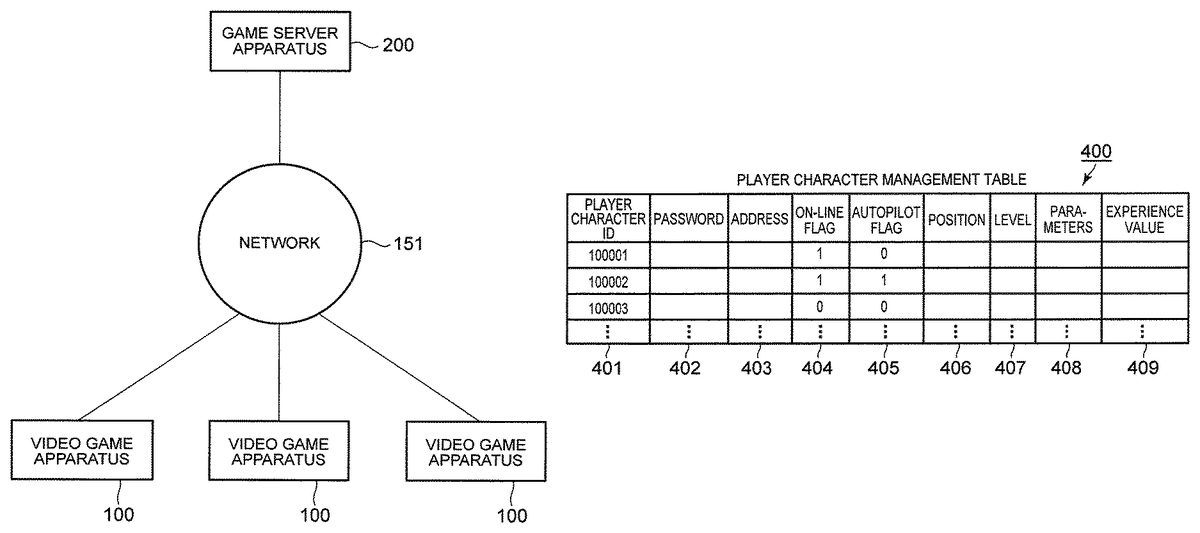
FIG. 1is a block diagram showing the general configuration of a network system where a network game according to this embodiment is played. As illustrated, the network system includes a plurality of video game apparatuses100connected to a server apparatus200over a network151like the Internet.
In a game which is applied to this network game system, each player who uses the video game apparatus100moves his/her own player character (hereinafter referred to as “player's own player character”) on a field formed in virtual space (game space) common to all the players. Each player forms a party composed of the player's own player character, player characters which are moved by other players (hereinafter referred to as “other player characters”), and an NPC (Non-Player Character) other than an opponent character. The game progresses party by party.
When the party moves on a field and reaches a predetermined point in the progress of the game, the party battles with an opponent character encountered there. The individual player characters belonging to the party can get an experience value by defeating the opponent character in the battle. The acquisition of the experience value can allow each player to power up the player's own player character, so that the player can defeat a stronger opponent character.
As apparent from the above, when the video game apparatus100of the player is on-line, the player can move the player's own player character to progress the game. Even in the period where the video game apparatus100of the player is off-line, the player can move a copy of the player's own player character generated based on information on the player's own player character immediately before the off-line as an NPC (hereinafter, referred to as “copy NPC”). The game may be progressed by a party composing the video game apparatus100of the player, other player characters which are on-line, and the copy NPC. Even if the video game apparatus100of the player is on-line, the player can also progress with the game with a player's own player character which is moved without being manipulated by the player (hereinafter, referred to as “autopilot PC”) for a given period.
According to the embodiment, the term “on-line” or “on-line state” means a state in a period from verification of a player using a video game apparatus100through a log-in process to a point when the player using the video game apparatus100leaves the game through a log-out process. In a period other than this period, even if the video game apparatus100exchanges some kind of information with the server apparatus200, for example, the state is considered “off-line”. For the sake of simplicity of the description of the embodiment, it is premised that communications between the video game apparatus100and the server apparatus200are not disconnected without going through the log-out process.
FIG. 2is a block diagram showing the configuration of the video game apparatus100shown inFIG. 1. As illustrated, the video game apparatus100has a main body101as its main unit. The main body101includes a control unit103, a RAM (Random Access Memory)105, a hard disk drive (HDD)107, a sound processor109, a graphics processor111, a DVD/CD-ROM drive113, a communication interface115, and an interface unit117, all of which are connected to an internal bus119.
The sound processor109of the main body101is connected to a sound output device125or a speaker, and the graphics processor111is connected to a display device121having a display screen122. A recording medium (in this embodiment, DVD-ROM or CD-ROM)131is mountable in the DVD/CD-ROM drive113. The communication interface115is connected to the network151. A light emitting unit160, a reception unit161, and a memory card162are connected to the interface unit117.
The control unit103includes a CPU (Central Processing Unit), and a ROM (Read Only Memory), and executes a program stored in the HDD107or on the recording medium131to control the main body101. The control unit103includes an internal timer. The RAM105is used as a work area for the control unit103, and temporarily stores information on the positions of player characters to be described later, HP (Hit Point which will be described later), etc. The HDD107is a storage area for storing programs and data. When instructed to output sounds by a program which is being executed by the control unit103, the sound processor109interprets the instruction and outputs sound signals to the sound output device125.
The graphics processor111maps image data in a frame memory112(which is shown outside the graphics processor111inFIG. 2but is actually provided in a RAM included in a chip composing the graphics processor111) in accordance with a drawing instruction output from the control unit103, and outputs video signals to display images on the display screen122of the display device121. One frame time of images in the video signals output from the graphics processor111is, for example, 1/30 sec. There are two sets of frame memories112, one for writing and the other for reading, which are switched from one to the other for each frame period.
The DVD/CD-ROM drive113reads out programs and data from the recording medium131. The communication interface115is connected to the network151to communicate with other computers. The light emitting unit160includes a plurality of LEDs having light irradiating directions different from one another, and is located in a position having a predetermined relation with the display device121(above or under the display device121).
The input device163includes a light receiver163a, an acceleration sensor163b, and a transmission unit163c. The light receiver163areceives light emitted from each LED included in the light emitting unit160. The number and positions of LEDs whose lights can be received by the light receiver163avary depending on the direction of the input device163. The acceleration sensor163bincludes a multi-axis acceleration sensor having three or more axes, and detects the inclination and three-dimensional motion of the input device163. The input device163has directional keys and a plurality of operation buttons.
The transmission unit163ctransmits an infrared signal according to the condition of the input device163, more specifically, an infrared signal according to the inclination of the input device163and the direction and speed of the motion of the input device163which are detected by the acceleration sensor163b, and inputs from the directional keys and the operation buttons of the input device163. The infrared signal transmitted from the transmission unit163cis received by the reception unit161as input data from the input device163.
The input device163is used to perform a predetermined process, such as moving a player character (to be described later) by operating the directional keys. The directional keys are also used to move a cursor, and the operation buttons are used input predetermined instructions. The action of a player character (to be described later) is sequentially selected by the player operating the directional keys, and the selection is set by operating a specific operation button.
The interface unit117outputs input data received by the input unit161to the RAM105. The control unit103interprets the input data and performs an arithmetic operation. In response to an instruction from the control unit103, the interface unit117stores data representing the progress state of the game stored in the RAM105in the memory card162, and reads out data on the game stored in the memory card162at the time the game has been suspended, and transfers the data to the RAM105.
The programs and data for playing the game on the video game apparatus100are initially stored in, for example, the recording medium131. The data stored in the recording medium131includes graphic data for creating objects present in the game space (the field formed in the game space, the player's own player character, other player characters, the opponent character). The programs and data which are stored in the recording medium131are read out by the DVD/CD-ROM drive113and are loaded onto the RAM105at the time of execution. The control unit103processes the programs and data loaded onto the RAM105, outputs a drawing instruction to the graphics processor111, and outputs a sound output instruction to the sound processor109. Intermediate data which is produced while the control unit103is performing the processing is stored in the RAM105.
FIG. 3is a block diagram showing the configuration of the server apparatus200shown inFIG. 1. As shown, the server apparatus200has a main body201as its main unit. The main body201includes a control unit203, a RAM205, a hard disk drive (HDD)207, a DVD/CD-ROM drive213, and a communication interface215, all of which are connected to an internal bus219. A recording medium (DVD-ROM or CD-ROM)231is mounted in the DVD/CD-ROM drive213.
The control unit203includes a CPU and a ROM, and executes a program stored in the HDD207or on the recording medium231to control the server apparatus200. The control unit203includes an internal timer that measures a current time. The RAM205is used as a work area for the control unit203. The HDD207is a storage area for storing programs or data. The communication interface215is connected to the network151to communicate with each video game apparatus100.
The programs and data for playing a network game on the server apparatus200are initially stored in, for example, the recording medium231, and are installed in the HDD207therefrom. The programs and data are read out from the HDD207and are loaded onto the RAM205at the time of execution. The control unit203processes the programs and data loaded onto the RAM205, and progresses with the network game based on data transmitted from each video game apparatus100. Intermediate data which is produced while the control unit203is performing the processing is stored in the RAM205.
The following describes how the network game according to the embodiment progresses. There are a plurality of player characters which belong to a plurality of parties, a plurality of opponent characters and NPCs other than the opponent characters on a field in the network game. The term “NPC” when simply used herein is intended to include a copy NPC, and an NPC different from a copy NPC (hereinafter, referred to as “normal NPC”). Strictly speaking, an opponent character is a non-player character, but is not intended to belong to “NPCs”. A party of player characters battles with an opponent character encountered on a field. When the party wins the battle and defeats the opponent character, characters belonging to the party (hereinafter, referred to as “party characters” including player characters and NPC) can get an experience value.
The experience value obtained through a battle is uniformly distributed to the individual player characters. Every time a player character obtains an experience value, the value is added to the previous experience value of the player character. When the accumulated experience value of the player character reaches a predetermined value, the level of the player character is incremented by “1”. When the level is incremented, various parameters the player character has are increased (enhanced). When any one of the parameters has a larger value than the value of the parameter of an opponent character, the player character is advantageous over the opponent character in a battle therewith.
The predetermined value for the experience value to move up the level is set crescently. The parameter of an opponent character which provides a greater experience value when defeated is set larger than the parameter of an opponent character which provides a smaller experience value when defeated. That is, the former opponent character is stronger than the latter one. A player can power up the player's own player character by increasing the experience value of the player's own player character through repetitive battles, and progresses with the game to defeat stronger opponent characters.
The level of an autopilot PC, like that of a normal player character, also increases when the experience value of the autopilot PC becomes the predetermined value. However, the level of a copy NPC is not increased even when the experience value obtained through a battle becomes the predetermined value to move up the level. While the experience values of each player character, an autopilot PC and a copy NPC increase by an amount which is uniformly distributed to the party characters depending on the experience value obtained through a battle, the experience value of a normal NPC does not increase.
A description will now be given of how to generate a copy NPC, how to shift a player character to an autopilot PC, and how to register a player character in the network game according to the embodiment. The movement of a copy NPC is determined by the server apparatus200, and the movement of a autopilot PC is determined by a video game apparatus100(those movements will be described in detail later). The following procedures are needed to move a copy NPC or an autopilot PC relating to the player's own player character in a party composing the player's own player character and other player characters without the player's being directly involved in the movement.
The procedures of generating a copy NPC is described below. The player in an on-line state moves the player's own player character to one of a plurality of predetermined locations of registration existing on a field. At such a location of registration, the player performs a player character registering operation for registering the player's own player character using the input device163, so that the player's own player character is registered (hereinafter, referred to as “normal registration”) after which the video game apparatus100manipulated by the player becomes on-line. At the time of the normal registration, the player sets whether the player character registered (hereinafter referred to as “registered player character”) is to be copied or not.
Provided that the normal registration of the player character is done and the player has set the registered player character copyable, another on-line player can make the copy NPC belong to the player's own party by moving the player character registered in such a way to a location of registration, and performing a player character copying operation using the input device163during a period from the point when the player becomes off-line to the point when the player starts a log-in process (hereinafter referred to as “copy acceptance period”). The number of copy NPCs which can be generated by the player character copying operation is one per registered player character for one party, and is set not to exceed fifty.
The procedures of shifting a player character to an autopilot PC is described below. The player in an on-line state can make the player's own player character move as an autopilot PC merely by performing a predetermined operation to autopilot the player's own player character (hereinafter referred to as “autopilot operation”) using the input device163. Note however that even when the player's own player character composes a party with other player characters, all the player characters excluding the player's own player character are not NPCs or autopilot PCs. With a player character moving as an autopilot PC, the player can make the autopilot PC move as a player character again by performing an operation to depress a predetermined button on the input device163to cancel the movement (hereinafter referred to as “autopilot cancel operation”).
When the state of an autopilot PC continues for a predetermined period (e.g., 60 minutes) without any input made by the autopilot cancel operation by the player, the video game apparatus100that moves the autopilot PC becomes off-line since the point when the predetermined period (hereinafter referred to as “time-out period”) expires, and, after a log-out process, the player character will be registered (hereinafter referred to as “time-out registration”) at the location where the normal registration has been made previously (registration accepted location where the immediately previous registration has been made). At this time, the player character which has been an autopilot PC composing the party as a member is deleted, and a copy NPC associated with the player character is generated in place of the player character after the time-out, and is moved as a member of the party to which the player character has belonged.
When the time-out registration is made, however, there is set a period during which a player character copying operation on the registered player character by another player character for a given period (e.g., 2 hours) is not accepted (hereinafter referred to as “acceptance disable period”). The player's resuming the game in the given period will be described later. When a player who moves the sole one player character composing the party is logged out within the given period, however, the log-out allows a time-out registered player character to be subject to a player character copying operation.
With regard to NPCs, when all the player characters belonging to the party become off-line, the party itself disappears, and a copy NPC and a normal NPC are deleted while an autopilot PC is registered at a location where the sole player character belonging to the party has become off-line. In this case, the sole player character belonging to the party is normally registered at the time of performing a log-out process, so that an autopilot PC is likewise registered in a way similar to the normal registration (hereinafter referred to as “pseudo normal registration”). To simplify the description of the embodiment, it is assumed that when log-out is done with a player character, communication between the video game apparatus100and the server apparatus200will not be disconnected without a log-out process being carried out through the normal registration of the player character which is made by the player character registration operation performed by the player.
The following describes a resume position of a player character in resuming the game, and a process of adding up the experience value of a copy NPC. When a player character is registered in the above-described manner, and the off-line video game apparatus100becomes on-line again to resume the game, the player can resume the game from the location where the player character has been present at the time of registration (the registration accepted location in case of normal registration, or the registration accepted location where the immediately previous registration has been made in case of time-out registration). In this case, if there is a copy NPC associated with the registered player character in the log-out process, every such copy NPC becomes a normal NPC and belongs to the party after the process associated with the log-in is terminated.
At the time of the log-in process, the player can select one of such copy NPCs, and become a member of the party in place of the selected copy NPC to resume the game from the position on a field where the copy NPC is present (hereinafter referred to as “game resuming position selecting process”). In this case, a copy NPC which takes place of a player character is deleted from the field, and every copy NPC other than the former copy NPC is moved as a normal NPC.
If at least one copy NPC of a player character is generated in an off-line state before the log-in process, the total of the experience values obtained by all the copy NPCs in the period of the off-line state (hereinafter referred to as “total experience value”) is added to the experience value of the player character at the time of registration (hereinafter referred to as “experience value adding process”). Specifically, for a copy NPC present on a field at the time of the log-in process, all the experience values which have been obtained until the log-in process are added up and are then added to the experience value at the time of registration, whereas for a copy NPC which has been deleted as a result of disappearance of the party to which the copy NPC belongs, all the experience values from the point of generation of the copy NPC to the point of deletion thereof are added up and are then added to the experience value at the time of registration.
When the total experience value resulting from the addition exceeds a predetermined value at which the level of the player character moves up, the level of the player character is moved up when the log-in process is performed. In this manner, the player can resume the game with the player character with whose level has been moved up as a result of the addition of the experience value. After the experience value adding process in the log-in process, the experience value obtained in an off-line state by the original player character of every copy NPC is reset after the copy NPC becomes a normal NPC, and is not increased even if an experience value in a battle is distributed.
When the player of a player character whose copy by another player is disabled logs in again to be on-line and resumes the game within a given period from the point of the time-out registration during which a player character copying operation by another player is disabled, the player can resume the game soon in the party in which a copy NPC associated with this player character is present, without going through the game resuming position selecting process. At this time, the copy NPC is deleted from the field, and the player character belongs to the party instead. The experience value obtained by the copy NPC within the given period is added to the experience value of the player character at the time of time-out registration when the game is resumed.
Regarding a copy NPC which has become a normal NPC this way, the player character of the original copy NPC becomes off-line again, the normal NPC does not have any relation with the player character even if the normal NPC has the same level, parameter, so forth as the player character. When the log-out process is performed again and the registration is updated, therefore, the experience value of every copy NPC which is added in the later log-in process is directed to the experience value of a new copy NPC generated based on the newly updated registration.
The following describes the movement of a copy NPC which is decided by the server apparatus200and the movement of an autopilot PC which is decided by the video game apparatus100. The movements which are decided by the server apparatus200and the video game apparatus100differ in the subject to be moved, but do not differ in procedures of deciding the movements. The movements include a movement associated with traveling and a movement associated with a battle. The movement associated with traveling is basically decided so as to follow up another player character in the party to which a copy NPC and an autopilot PC belong, and may be decided based on the information on the progress of the game received from the server apparatus200.
The movement associated with a battle is decided from movements of the player character which have been selected so far by the player according to the information on the progress of the game received from the server apparatus200in an on-line state, based on the latest 100 movements. There are plural types of movements of the player character which are selected by the player in a battle, and those movements are stored in each of the server apparatus200and the video game apparatus100. The movements of a copy NPC and an autopilot PC are analyzed and decided based on the selection of the stored movements.
Such a movement is decided from an action log of a player character until the time of registration (the time of registration normal registration) for a copy NPC, and is decided from an action log of the player's own player until the execution of the autopilot operation by the player. In case of the time-out registration and the pseudo normal registration, a player character moves as an autopilot PC immediately before the player character is registered, so that the movement of the player character, like that of the immediately previous autopilot PC, is decided from the action log of the player's own player character until the execution of the autopilot operation.
The following describes data which is managed by the server apparatus200and data stored in the video game apparatus100in order to progress with the network game according to the embodiment.
FIG. 4Ashows a player character management table400for managing data on players and the player's own player character who participate in the network game according to the embodiment.FIG. 4Bshows a registered-character management table410for managing data on registration of player characters.FIG. 4Cshows an NPC management table420for managing data on NPCs present on a field.FIG. 4Dshows a parity management table430managing data on party-forming player characters for each party.
The player character management table400shown inFIG. 4Amanages player character IDs401, password information402, addresses403, an on-line flag404, an autopilot flag405, position information406, level information407, various parameters information408, and experience value information409. The player character ID401is identification information for identifying the position of each character present on a field.
The password information402is used to verify a player who moves a player character. The server apparatus200verifies if the combination of a player character ID401and password information402which are transmitted from the video game apparatus100by the player is correct to thereby verify if the player is the proper player to move the player character corresponding to the player character ID401.
The address403is an IP address assigned to specify a video game apparatus100which manipulates an individual player. The on-line flag404indicates whether the video game apparatus100associated with the player character is connected on-line. When the video game apparatus100is on-line, the on-line flag404is ON (1), and when the video game apparatus100is off-line, the on-line flag404is OFF (0). The on-line flag404is updated by a log-in process or log-out process.
The autopilot flag405indicates whether the player character is an autopilot PC. When the player character is an autopilot PC, the autopilot flag405is ON (1), and when the player character is not an autopilot PC, the autopilot flag405is OFF (0). The position information406indicates the position of a character on a field. With regard to a player character, the position information406is updated according to a traveling operation performed by the player. When the player character is an autopilot PC, the position information406is updated according to a movement which is decided by the server apparatus200(traveling movement following up a player character belonging to the party).
The level information407indicates the level of the player character, and is updated when the experience value becomes a predetermined value. The various parameters information408stores various parameters of the player character, and is updated according to the progress of a battle or the like, or according to an increase in level. The experience value information409indicates the value of the experience value which a character has obtained so far, and is updated every time an experience value is obtained through a battle, or when there is an experience value added at the time of a log-in process. Though not shown inFIG. 4A, the player character management table400manages an action log for every player character to be managed.
The registered-character management table410shown inFIG. 4Bstores player character IDs411, an on-line flag412, an acceptance disable flag413, location-of-registration information414, number-of-copies information415, and accumulated experience value information416. The player character ID411is identification information which can uniquely specify a player character. The player character ID411is the same information as the player character ID401stored in the player character management table400shown inFIG. 4A, and corresponds one to one to the player character management table400.
The on-line flag412is the same information as the on-line flag404stored in the player character management table400, and indicates whether the player character is on-line (flag ON (1)), or off-line (flag OFF (0)). The acceptance disable flag413is information indicating whether a copy NPC can be generated from the registered player character (flag ON (1)), or cannot be generated therefrom (flag OFF (0)). Normally, the acceptance disable flag413is updated to “1” when the player character registration operation becomes on-line, and is updated to “0” when the player character registration operation becomes off-line. When the player character registration operation becomes off-line after a time-out period elapses, however, the acceptance disable flag413is not updated to “0” unless an acceptance disable period elapses thereafter.
The location-of-registration information414indicates the position of the location of acceptance of registration on a field where the player character has been registered. The location-of-registration information414is updated with positional information on the location of acceptance of registration where a normal registration by the player has been done, or a pseudo normal registration originating from a normal registration by a player belonging to the same party has been done in case that the player character is an autopilot PC.
The number-of-copies information415indicates the number of copy NPCs generated. The number-of-copies information415is incremented every time a copy NPC is generated by execution of the player character copying operation with the registered player character being off-line, and is decremented by disappearance of the party to which the copy NPCs belong. In the log-in process of a player character associated with a copy NPC, the copy NPC is replaced with a normal NPC or a player character, the number-of-copies information415is updated (reset) to “0”.
The accumulated experience value information416stores an experience value obtained by a copy NPC when the registered player character is off-line. The accumulated experience value information416is added and updated with an experience value obtained by the copy NPC upon deletion of the copy NPC resulting from disappearance of the party, and is updated (reset) to “0” in a log-in process associated with the registered player character.
The NPC management table420shown inFIG. 4Cstores NPC IDs421, player character IDs422, a copy NPC flag423, position information424, various parameters information425, and experience value information426. In the NPC management table420, generation of a copy NPC adds a record, and deletion of a copy NPC or a normal NPC causes a record associated with that NPC to be deleted.
The NPC ID421is identification information which uniquely specifies an NPC, and information which does not match with the player character IDs401,411associated with the player characters shown inFIGS. 4A and 4Bis set to the NPC ID421. When an NPC is a copy NPC, the player character ID422stores the player character ID411of the registered player character which is the base of the copy NPC. When the copy NPC becomes a normal NPC at the time of the log-in process, the player character ID411is deleted, whereas when the NPC keeps being a normal NPC, the information of the player character ID422becomes invalid (NULL).
The copy NPC flag423indicates whether an NPC is a copy NPC or a normal NPC. When an NPC is a copy NPC, the copy NPC flag423is ON (1), and when an NPC is a normal NPC, the copy NPC flag423is OFF (0). The position information424indicates the position of an NPC on a field, and is updated according to the movement which is decided by the server apparatus200(traveling movement following up a player character belonging to the party).
The various parameters information425stores various parameters of an NPC, including what is updated according to the progress of a battle or the like. Because the level of an NPC does not increase, the parameters are not updated by an increase in level. The experience value information426is information indicating the value of the experience value which has been obtained through battles so far. Regarding a copy NPC, the experience value information426is updated with a value added with the experience value which is distributed for each battle until the copy NPC is deleted or until the time of performing a log-in process associated with the registered player character which is the base of the copy NPC. Regarding a normal NPC, the experience value information426is not updated even when the experience value is distributed for each battle, and becomes invalid (NULL). Though not shown inFIG. 4C, the NPC management table420manages an action log for every NPC to be managed. When an NPC is a copy NPC, or when a copy NPC becomes a normal NPC, the action log of the player character which is the base of that NPC is copied directly.
The parity management table430shown inFIG. 4Dstores party IDs431, party-forming player character information432and party-forming NPC information433. The party ID431is identification information which uniquely identifies a party present on a field. The party-forming player character information432stores at least one player character ID of a player character among characters forming a party. While the party-forming NPC information433can store a plurality of NPC IDs of NPCs among characters forming a party, the information becomes invalid (NULL) when there is no NPC in the party.
FIG. 5is a diagram showing the structure of data to be stored in the video game apparatus100. Stored in the RAM105or the HDD107of the video game apparatus100are character IDs501, a party ID502, an on-line flag503, an autopilot flag504, position information505, level information506, various parameters information507, experience value information508, action log information509, and other-player-character information510.
The character ID501is unique to a player character which is moved by the player on the video game apparatus100where the character ID501is stored, and corresponds to the player character ID401in the player character management table400shown inFIG. 4Aand the player character ID411in the registered-character management table410shown inFIG. 4B. The character ID501and the player character ID401uniquely specify a field, a player character on a battle field, and the video game apparatus100which moves the player character, and the character ID501and the player character ID411uniquely specify information on a registered player character and the video game apparatus100which is manipulated by a player who has performed a player character registration operation.
The party ID502is identification information for a party which is composed of the player character which is moved by this video game apparatus100as a member, and corresponds to the party ID431stored in the parity management table430shown inFIG. 4D. This correlation can uniquely specify to which party the player character to be moved by the video game apparatus100belongs. The on-line flag503indicates whether the video game apparatus100is connected on-line to the server apparatus200. When the video game apparatus100is on-line, the on-line flag503is ON (1), and when the video game apparatus100is off-line, the on-line flag503is OFF (0).
The autopilot flag504indicates whether the player character to be moved by the video game apparatus100is an autopilot PC. When the player character is an autopilot PC, the autopilot flag504is ON (1), and when the player character is not an autopilot PC, the autopilot flag504is OFF (0). The position information505, the level information506, the various parameters information507and the experience value information508(hereinafter referred to as “game information”) are information having the same contents as game information including the position information406, the level information407, the various parameters information408and the experience value information409which are stored in the player character management table400shown inFIG. 4A. With the video game apparatus100being on-line, exchange of those pieces of information between the video game apparatus100and the server apparatus200keeps those pieces of information in a non-contradictory state in the progress of the game.
The action log information509stores the action log of the player character which is moved on the video game apparatus100. The other-player-character information510stores information, such as various parameters information and information on action modes or the like of other player characters in the party to which the player's own player character belongs, and includes data needed to display other characters (player characters, NPCs, and an opponent character) on the display screen122by each video game apparatus100.
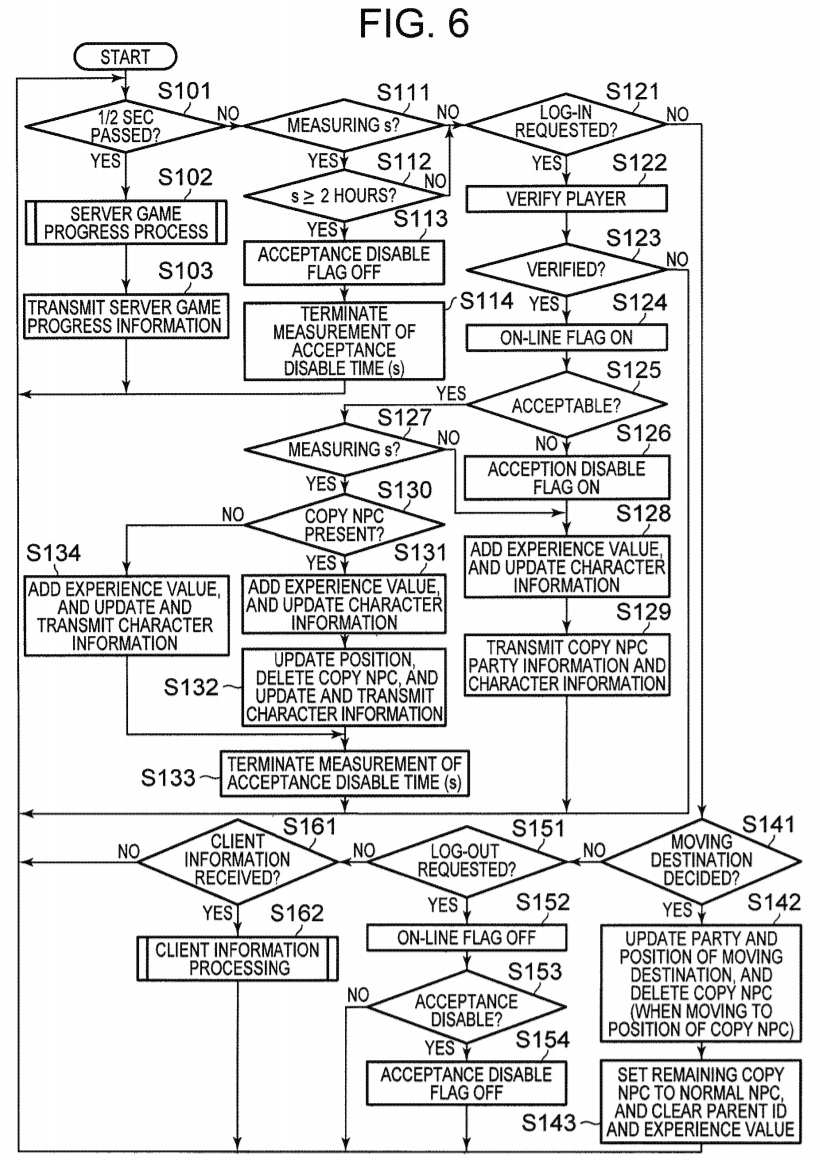
The following describes a routine which is executed by the network game system according to the embodiment.FIGS. 6 and 7present flowcharts illustrating routines which are executed by the server apparatus200according to the embodiment. The routines which are executed by the server apparatus200include processes other than the steps illustrated in the flowcharts inFIGS. 6 and 7, which particularly illustrate the steps which are executed in connection to the invention.
As shown inFIG. 6, the control unit203of the server apparatus200determines whether ½ second has passed since the initiation of the game or since the previous elapsing of ½ second (step S101). When having determined that ½ second has passed, the control unit203executes a server game progress process (step S102). The server game progress process is a process to progress with the game which is executed by the server apparatus200. For example, this process determines and executes movements of an NPC, an opponent character, etc., and updates information which is changed according to the result.
The control unit203transmits information updated based on information input by the player of a video game apparatus100in an on-line state, together with the information update in the server game progress process, as server game progress information to all the on-line video game apparatuses100(step S103). Then, the control unit203returns to the process of step S101.
When having determined in step S101that ½ second has not passed, the control unit203determines whether there is at least one registered player character whose acceptance disable period (s) is measured by an internal timer (hereinafter referred to as “temporarily acceptance disabled character”) (step S111). When having determined that there is at least one temporarily acceptance disabled character, the control unit203determines whether the temporarily acceptance disabled characters include a temporarily acceptance disabled character whose acceptance disable period measured is equal to or greater than 2 hours (step S112).
When having determined that there is a temporarily acceptance disabled character whose acceptance disable period measured is equal to or greater than 2 hours, the control unit203sets the acceptance disable flag OFF (step S113). The control unit203terminates measurement of the acceptance disable period for the temporarily acceptance disabled character (step S114), and returns to the process of step S101.
When having determined in step S111that there is no temporarily acceptance disabled character, or when having determined in step S112that there is not any temporarily acceptance disabled character whose acceptance disable period measured is equal to or greater than 2 hours, the control unit203determines whether the information on making a request for a log-in process (hereinafter referred to as “log-in request information”) transmitted from the video game apparatus100is received (step S121). When having determined that the log-in request information is received, the control unit203compares the player character ID and password included in the log-in request information with the player character ID401and the password information402associated with this player character, stored in the player character management table400, to verify the player who manipulates the video game apparatus100(step S122).
The control unit203determines whether the player has been verified as a proper player qualified to participate in the game as a result of the decision in step S122(step S123). When having determined that the player has been verified, the control unit203sets the on-line flag stored in the player character management table400ON for the player character which is moved by the player (step S124). When having determined that the player has not been verified, the control unit203returns to the process of step S101.
After setting the on-line flag ON, the control unit203determines the acceptance disable flag413stored in the registered-character management table410and indicating whether the player character is not acceptable (step S125). When having determined that the acceptance disable flag413is OFF, the control unit203sets the acceptance disable flag413ON (step S126) and proceeds to step S128. When having determined in step S125that the acceptance disable flag413is ON, the control unit203determines whether the player character associated with the verification is a temporarily acceptance disabled character by means of the internal timer (step S127). When having determined that the player character is not a temporarily acceptance disabled character, the control unit203proceeds to step S128.
In step S128, when there is a copy NPC which is copied based on the registered player character of the verified player at the time the verification has been performed, the control unit203adds up the experience value obtained by the copy NPC which is stored in the NPC management table420and the accumulated experience value information416stored in the registered-character management table410, and adds the total experience value to the experience value information409of the verified player character which is stored in the player character management table400(step S128). When the experience value information409becomes a predetermined value at which the level of the player character moves up at this time, the control unit203updates the level information407to be stored in the player character management table400, and updates the various parameters information408if the increase in level increases a parameter.
When there is a copy NPC, the control unit203extracts information on a party to which the copy NPC belongs (hereinafter referred to as “copy NPC party information”) from the parity management table430, and transmits the extracted information, together with the updated level information on the player character, various parameters information, etc. (hereinafter referred to as “character information in log-in mode”), to the video game apparatus100which is manipulated by the verified player (step S129). Then, the control unit203returns to the process of step S101.
When having determined in step S127that the player character associated with verification is a temporarily acceptance disabled character, the control unit203determines whether there is a copy NPC (step S130). When having determined that there is a copy NPC, the control unit203adds the experience value obtained by the copy NPC in the acceptance disable period to the experience value information409of the player character at the time of time-out registration to be stored in the player character management table400, updates the level information407to be stored in the player character management table400when the experience value information409of the player character becomes a predetermined value at which the level of the player character moves up, and updates the various parameters information408if the increase in level increases a parameter (step S131).
Because it is the acceptance disable period when the log-in process is carried out, the number of copy NPCs is only one. After step S131, therefore, the control unit203adds the character ID associated with the copy NPC to the party-forming player character information432in the parity management table430for the party to which the copy NPC belongs, and deletes the copy NPC from the party-forming NPC information433(step S132). The control unit203updates the position information406to be stored in the player character management table400and associated with the verification to information on the position in which the copy NPC has been present, and transmits the updated information together with the character information in log-in mode to the video game apparatus100associated with the verification. The control unit203terminates measurement of the acceptance disable period for the player character (step S133), and returns to the process of step S101.
When having determined in step S130that there is no copy NPC, the is updated adds the accumulated experience value information416obtained by the copy NPC which has been deleted before the verification and stored in the registered-character management table410to the experience value information409of the player character at the time of time-out registration to be stored in the player character management table400, updates the level information407to be stored in the player character management table400when the experience value information409becomes a predetermined value at which the level of the player character moves up, and updates the various parameters information408and transmits the updated information together with the character information in log-in mode if the increase in level increases a parameter (step S134). Then, the control unit203executes the process of step S133, and returns to the process of step S101.
When having determined in step S121that the log-in request information is not received, the control unit203determines whether information associated with selection of a party or a position at the time of resuming the game (hereinafter referred to as “moving destination determining information”) is received from the video game apparatus100(step S141). When having determined that the moving destination determining information is received, the control unit203updates the position information406included in the moving destination determining information and to be stored in the player character management table400for the player character of the player who is attempting to resume the game (step S142).
When a party is selected as a location of resuming the game, the control unit203adds the character ID of the player character to the party-forming player character information432to be stored in the parity management table430for this party, and deletes the copy NPC which is generated from the player character (copy NPC for which the player character ID of the player character is the same as the player character ID422in the NPC management table420) from the party-forming NPC information433.
When there is a remaining copy NPC generated from the player character, the control unit203sets the copy NPC flag423in the NPC management table420OFF, ad clears the player character ID422and the experience value information426(step S143). Then, the control unit203returns to the process of step S101.
When having determined in step S141that the moving destination determining information is not received, the control unit203determines whether information on a request for the log-out process for the player character transmitted from the video game apparatus100, and information on setting of whether the player permits copying of the registered player character (hereinafter referred to as “log-out request information”) (step S151). When having determined that the log-out request information is received, the control unit203sets OFF both the on-line flag404and the on-line flag412to be respectively stored in the player character management table400and the registered-character management table410for the player character of the player (step S152).
The control unit203determines whether the information associated with permission of copying the registered player character included in the log-out request information will permit copying or not (step S153). When having determined that the information indicates permission of copying, the control unit203sets OFF the acceptance disable flag413to be stored in the registered-character management table410for the player character (step S154). When having determined in step S153that the information does not indicate permission of copying, or after step S153, the control unit203returns to the process of step S101.
When having determined in step S151that the log-out request information is not received, the control unit203determines whether information on an input relating to a battle, a request for generation of a copy NPC, or the like transmitted from the video game apparatus100(hereinafter referred to as “client information”) is received (step S161). When having determined that the client information is received, the control unit203executes a battle relating process based on the input relating to a battle, or a client information process for performing a process of generating a copy NPC based on the manipulation of the player character (step S162). The client information process will be described in detail later. Then, the control unit203returns to the process of step S101.
In the server game progress process as shown inFIG. 7A, the control unit203determines whether there is any copy NPC which has not undergone a determination as to whether or not to move the copy NPC, and as to what movement the copy NPC should take if the copy NPC is to be moved (hereinafter referred to as “unprocessed copy NPC”) (step S201). When having determined that there is an unprocessed copy NPC, the control unit203decides the movement of the copy NPC according to information on the progress of the game based on the action log of the player character relating to one copy NPC among such unprocessed copy NPCs, and updates information on various parameters or the like of each character which vary according to the movement (step S202).
The control unit203determines whether the result of the movement of the copy NPC will result in winning of the battle (step S203). When having determined that the battle is won, the control unit203equally divides the experience value obtained through the winning of the battle by the number of party characters to which the copy NPC belongs, and adds the divided experience value to the experience value of a character other than a normal NPC for update (step S204). Specifically, the experience value equally divided by the number of party characters is added to the experience value information409to be stored in the player character management table400for an autopilot PC, or the experience value information409to be stored in the NPC management table420for a copy NPC. Then, the control unit203returns to the process of step S201. When having determined in step S203that the battle is not wont, the control unit203also returns to the process of step S201.
When having determined in step S201that an unprocessed copy NPC is not present, the control unit203executes a process or the like relating to a determination on the movement of a normal NPC, an opponent character or the like as another game progress process (step S205). Since this process is not related to the invention, its description is omitted.
In the client information process of the server apparatus200, as shown inFIG. 7B, the control unit203determines whether the received client information is information associated with an input related to a battle (hereinafter referred to as “battle relating process”) (step S301). When the battle relating information is received, the control unit203executes a battle relating process such as update of various parameters information of the player character, based on the input information (step S302). Since the battle relating process is not related to the invention, its description is omitted.
The control unit203determines whether the result of the battle relating process will result in winning of the battle (step S303). When having determined that the battle is won, the control unit203equally divides the experience value obtained through the winning of the battle by the number of characters forming the party to which the copy NPC belongs, and adds the divided experience value to the experience value of a character other than a normal NPC for update (step S304). The details of the process are the same as those of the process of step S204in the server game progress process. Then, the control unit203terminates the client information process. When having determined in step S303that the battle is not wont, the control unit203also terminates the client information process.
When having determined in step S301that the client information is not battle relating information, the control unit203determines whether the received client information is information relating to a request for generation of a copy NPC (hereinafter referred to as “copy request information”) (step S311). When having determined that the client information is copy request information, the control unit203determines whether the copy request information relates to a request for generation of a copy NPC at the time of time-out registration (hereinafter referred to as “time-out copy request information”) (step S312). When having determined that the copy request information is not time-out copy request information, the control unit203decides that the time-out copy request information relates to a player character copying operation, and determines whether a copy NPC can be generated for the registered player character which is the target for the generation of the copy NPC based on the acceptance disable flag413to be stored in the registered-character management table410(step S313).
When having determined that a copy NPC can be generated, the control unit203determines whether the upper limit of the number of copy NPCs which can be generated for the target registered player character based on the number-of-copies information415to be stored in the registered-character management table410(step S314). When having determined that the number-of-copies information415is not the upper limit, the control unit203generates a copy NPC according to the copy request information (step S315). The control unit203increments the number-of-copies information415to be stored in the registered-character management table410by “1” for the registered player character whose copy NPC has been generated (step S316). Then, the control unit203terminates the client information process. When having determined in step S313that a copy NPC cannot be generated, or when having determined in step S314that the number-of-copies information415is the upper limit, the control unit203also terminates the client information process.
When having determined in step S312that the copy request information is time-out copy request information, the control unit203sets OFF the on-line flag404to be stored in the player character management table400and the on-line flag412to be stored in the registered-character management table410for the player character which is moved by the video game apparatus100to which the time-out copy request information has been transmitted (step S317). The control unit203resets the acceptance disable period s for the registered player character (step S318), then starts measuring the acceptance disable period s (step S319), and executes the processes of steps S315and S316. Then, the control unit203terminates the client information process.
When having determined in step S311that the client information is not copy request information, the control unit203executes another game process based on information which is not battle relating information or copy request information (step S321). Then, the control unit203terminates the client information process.
FIGS. 8 and 9present flowcharts illustrating routines which are executed by the video game apparatus100according to the embodiment. The routines which are executed by the video game apparatus100include processes other than the steps illustrated in the flowcharts inFIGS. 8 and 9, which particularly illustrate the steps which are executed in connection to the invention.
As shown inFIG. 8, the control unit103of the video game apparatus100determines whether 1/30 second has passed since the initiation of the game or since the previous elapsing of 1/30 second (step S401). When having determined that 1/30 second has passed, the control unit103generates an image to be displayed on the display screen122based on a position associated with the player character which is moved by the video game apparatus100, the other-player-character information510to be stored in the video game apparatus100and the like (step S402). Since the process relating to generation of an image is not related to the invention, its description is omitted. Then, the control unit103returns to the process of step S401.
When having determined in step S401that 1/30 second has not passed, the control unit103determines whether the video game apparatus100is on-line (step S411). When having determined that the video game apparatus100is on-line, the control unit103determines whether input information relating to an operation for the player to perform a log-in process is detected (step S412). When having determined that the input information is detected, the control unit103transmits log-in request information to the server apparatus200(step S413). Then, the control unit103returns to the process of step S401.
When having determined in step S412that input information relating to the operation for the log-in process is not detected, the control unit103determines whether the character information in log-in mode transmitted from the server apparatus200is received (step S414). When having determined that the character information in log-in mode is not received, the control unit103updates the level information506, the various parameters information507, etc. to be stored in the video game apparatus100, based on the character information in log-in mode (step S415). Then, the control unit103returns to the process of step S401.
When having determined in step S414that the character information in log-in mode is not received, the control unit103determines whether input information relating to an operation representing that the player has decided from which one of a party to which a copy NPC belongs, or a position in which the player's own player character has been registered, each received together with the character information in log-in mode and included in the copy NPC party information, the game will be resumed (the operation being hereinafter referred to as “moving destination determining operation”) is detected (step S416). When having determined that the input information is detected, the control unit103updates the position information505to be stored in the video game apparatus100with the information on the decided position, and transmits the updated information to the server apparatus200as moving destination determining information (step S417). The control unit103sets the on-line flag503ON (step S418), and returns to the process of step S401. When having determined in step S416that input information relating to the moving destination determining operation is not detected, the control unit103returns to the process of step S401.
When having determined in step S411that the video game apparatus100is on-line, the control unit103determines whether the server game progress information is received from the server apparatus200(step S421). When having determined that server game progress information is received, the control unit103updates the various parameters information507, the other-player-character information510, etc. to be stored in the video game apparatus100with the information updated in the server game progress process included in the server game progress information (step S422), and returns to the process of step S401.
When having determined in step S421that the server game progress information is not received, the control unit103determines whether the player character is an autopilot PC based on the autopilot flag504(step S431). When having determined that the player character is an autopilot PC, the control unit103determines whether ½ second has passed since the initiation of the game or since the previous elapsing of ½ second (step S432). When having determined that ½ second has passed, the control unit103determines the movement of the autopilot PC according to information on the progress of the game based on the action log information509of the player character, transmits the information on the movement to the server apparatus200, and updates the various parameters information507or the like which is changed by the movement (step S433). Then, the control unit103returns to the process of step S401.
When having determined in step S432that ½ second has not passed, the control unit103determines whether the time-out period has been measured for 60 minutes or longer (step S441). When having determined that the time-out period has been measured for 60 minutes or longer, the control unit103transmits time-out copy request information (step S442). The control unit103sets the autopilot flag504to be stored in the video game apparatus100OFF (step S443), and terminates measurement of the time-out period (step S444). The control unit103sets the on-line flag503to be stored in the video game apparatus100OFF (step S445), and returns to the process of step S401.
When having determined in step S441that the time-out period has not been measured for 60 minutes or longer, the control unit103determines whether input information relating to an autopilot cancel operation by the player is detected (step S451). When having determined that the input information is detected, the control unit103sets the autopilot flag504to be stored in the video game apparatus100OFF (step S452). Then, the control unit103returns to the process of step S401. When having determined in step S451that input information relating to the autopilot cancel operation is not detected, the control unit103returns to the process of step S401.
When having determined in step S431that the player character is not an autopilot PC, the control unit103determines whether input information, such as an operation relating to the progress of the game, an autopilot operation, or a player character copying operation, by the player (hereinafter referred to as “game progress input information”) is detected (step S461). When having determined that there is game progress input information, the control unit103performs a game progress input process (step S462). The details of the game progress input process will be given later. When the game progress input process is terminated, the control unit103returns to the process of step S101.
When having determined in step S461that game progress input information is not detected, the control unit103determines whether input information relating to the player character registration operation by the player is detected (step S471). When having determined that input information relating to the player character registration operation is detected, the control unit103transmits log-out request information to the server apparatus200(step S472), and sets the on-line flag503OFF (step S473). Then, the control unit103terminates the process on the video game apparatus100. When having determined in step S471that input information relating to the player character registration operation is not detected, the control unit103returns to the process of step S401.
In the game progress process of the video game apparatus100, as shown inFIG. 9, the control unit103determines whether an input relating to an autopilot operation by the player is detected (step S501). When having determined that the input is detected, the control unit103sets the autopilot flag504to be stored in the video game apparatus100ON (step S502). The control unit103resets a time-out period (t) which is measured by the internal timer, and starts measuring the time-out period (t) (step S503). Then, the control unit103terminates the game progress process.
When having determined in step S501that an input relating to the autopilot operation is not detected, the control unit103determines whether the an input relating to the player character copying operation by the player is detected (step S511). When having determined that the input is detected, the control unit103transmits copy request information to the server apparatus200(step S512). Then, the control unit103terminates the game progress process.
When having determined in step S511that the input relating to the player character copying operation is not detected, the control unit103determines whether input information on the movement of the player's own player character relating to a battle is detected (step S521). When having determined that the input information is detected, the control unit103transmits the information on the movement of the player's own player character to the server apparatus200, and updates the various parameters information507or the like which is changed by the movement (step S522).
The information on the movement of the player's own player character relating to a battle which is transmitted to the server apparatus200in step S522, and the information on the movement of an autopilot PC in step S433differ from each other in that the player himself/herself moves the player's own player character while the control unit103moves the player's own player character, but should not be distinguished from each other as movement-relating information received by the server apparatus200.
When having determined in step S521that the input information on the player's own player character relating to a battle is not detected, the control unit103determines whether another input information generated by the player operating the input device163is detected (step S531). When having determined that the input information is detected, the control unit103updates the various parameters information507or the like to be stored in the video game apparatus100, and transmits the information on the input operation to the server apparatus200(step S532). Then, the control unit103terminates the game progress process.
When having determined in step S531that the input operation is not detected, the control unit103executes a game progressing process other than the foregoing processes on the video game apparatus100(step S541). Then, the control unit103terminates the game progress process.
The interaction on the process of an autopilot PC between individual objects is described in detail on the time-sequential basis.FIG. 10is a sequence chart illustrating the interaction on an autopilot PC between individual objects.
The description is given, by way of example, of processes for the autopilot operation by the player, execution of the movement of an autopilot PC by the video game apparatus100until the autopilot cancel operation, and termination of the movement of the autopilot PC by the video game apparatus100as a result of elapsing of a predetermined period (60 minutes) after the initiation of the movement of the autopilot PC through the autopilot operation by the player, and execution of the movement of a copy NPC by the server apparatus200thereafter.
Although the process relating to an autopilot PC is the process to be executed when the player character forms a party with the player characters of other players, the video game apparatus100which moves other player characters is not particularly elaborated.
When the player performs an autopilot operation using the input device163of the on-line video game apparatus100, the control unit103of the video game apparatus100moves the player character as an autopilot PC in response to the operation (sequence SQ1). Then, when the player performs an autopilot cancel operation thereafter using the input device163, the control unit103cancels the movement of the player character as an autopilot PC in response to the autopilot cancel operation, and moves the player character according to the manipulation on the input device163performed by the player. Even when an operation other than the autopilot cancel operation is performed during this period, the control unit103keeps moving the player character as an autopilot PC.
In response to the autopilot operation by the player again, the control unit103moves the player character as an autopilot PC (sequence SQ2). When 60 minutes (time-out period) passes thereafter without any autopilot cancel operation performed by the player, the control unit103executes a log-out process to set the video game apparatus100off-line (sequence SQ3). At this time, the control unit103transmits time-out copy request information to the server apparatus200(sequence SQ4).
When the server apparatus200receives the time-out copy request information, the control unit203of the server apparatus200generates a copy NPC which is moved by the server apparatus200(sequence SQ5). Since the video game apparatus100becomes off-line at this time, the player character which has been moved by the video game apparatus100is deleted, and the copy NPC belongs to the party to which the player character has belonged instead. Thereafter, the control unit203of the server apparatus200performs the movement of the copy NPC until the party to which the copy NPC belongs disappears (sequence SQ6).
In the network game system according to the embodiment, as described above, at the time of performing a log-out process in the game, the player registers the player's own player character by performing a player character registration operation. When the player character is registered, and the video game apparatus100which is manipulated by the player becomes off-line, another player who manipulates an on-line video game apparatus100can generate a copy NPC of the player character by performing a player character copying operation.
At this time, the movement of the copy NPC or movements including a movement in a battle are determined by the server apparatus200. Accordingly, even when the video game apparatus100is off-line, and the player who manipulates this video game apparatus100cannot move the player's own player character in the game which is managed by the server apparatus200, a copy NPC based on the player character can be moved according to the progress of the game. This allows a player manipulating an on-line video game apparatus100to feel as if the player is playing the game with the registered player character in the progress of the game. Therefore, the player can play the game in his/her own pace of life with other players without being forced to match each play timing of the game in real time.
In performing the player character registration operation, the player can set whether or not to permit other players to generate a copy NPC based on the player's own player character in a period in which the video game apparatus which is manipulated by the player is off-line, thus preventing the game to progress through the movement of the copy NPC based on the player's own player character of which the player cannot be aware.
When the video game apparatus100which the player manipulates is on-line to play the game, the player can move the player's own player character as an autopilot PC without depending on the player's manipulation on the input device163. At this time, the movement of the copy NPC or movements including a movement in a battle are determined by the video game apparatus100which is manipulated by the player of the player character. Accordingly, the player's own player character can be moved according to the progress of the game without involving the player's own manipulation, so that other players will not feel uncomfortable.
Because a player who moves the player's own player character as an autopilot PC can move the player's own player character according to the progress of the game without involving the player's own manipulation, the player can temporarily break away from playing the game at a desired timing in a middle of the progress of the game. Because the player's own player character is moved according to the progress of the game this way, the player's own player character is kept moving by the video game apparatus100even if the player temporarily breaks away from the game. This can permit the game to keep progressing in cooperation with other players forming the same party without causing the other players to wait for the breakaway player. It is possible to suppress the occurrence of troubles on the other players, thus suppressing ruining the relationship of trust with the other players.
When the player's own player character is moved as an autopilot PC, the player's own player character can be moved again based on the player's own manipulation by performing the autopilot cancel operation to depress a predetermined button on the input device163to cancel the autopilot operation. Because the movement information of the player's own player character as an autopilot PC is canceled by a predetermined cancel operation by the player, it is possible prevent the movement of the player character from being canceled unexpectedly to inhibit the player character from moving when the player does not temporarily manipulate the player's own player character himself/herself.
Battles-relating movements of the player's own player character which have been decided and selected by the player in the game are stored as the action log information509in the video game apparatus100which is manipulated by the player himself/herself. The action log information of the individual player characters is likewise stored in the player character management table400in the server apparatus200for each player character, and the action log information of a player character on which the former action log information is based is stored, as it is, in the NPC management table420together with various parameters information or the like.
Based on the action log information stored in this manner, the movements of a copy NPC and an autopilot PC in a battle are decided. Accordingly, the movement of the player character which is selected by the player is reflected on the movements of the copy NPC and the autopilot PC. Even a movement which is not directly based on the player's manipulation can reduce uncomfortable feeling of other players on the movements of the copy NPC and the autopilot PC.
When an opponent character can be defeated as a consequence of the movements of a copy NPC and an autopilot PC which are not directly based on the player's manipulation, the experience value obtained through a battle is equally divided by the number of members forming a party and the resultant value is added to the experience value of each of the copy NPC and the autopilot PC. Apparently, the experience value obtained as a consequence of a battle is obtained for an autopilot PC in a way similar to the normal way the player obtains it by manipulating the player character.
In case of a copy NPC, the experience value obtained by the copy NPC which is based on the player character that has been moved on the video game apparatus100while the video game apparatus100has been off-line is added to the experience value of the player character when the video game apparatus100becomes on-line. Even when the video game apparatus100on which the player character is moved is off-line, the feeling that the player character has been moved is obtained. A player who has fewer time to play the game can obtain an experience value, which makes the player's own player character stronger, while the player is not playing, so that the difference between the performances of player characters which is originated from the difference in play time can be reduced. This can suppress declining of the motivation for playing the game.
When one or more copy NPCs actually generated are present and have not been deleted at the time of performing a log-in process on the video game apparatus100, executing the game resuming position selecting process makes it possible to resume the game from the position on a field where a single copy NPC selected by the player is present. Accordingly, even when the video game apparatus100the player manipulates is off-line, disabling the corresponding player character to move, the player character can be made to smoothly adapt itself to the progress of the game which has been made with the copy NPC, thereby reducing uncomfortable feeling of other players on the movement of the player character.
Even if the player attempts to forcibly move the player's own player character as an autopilot PC through the autopilot operation, when the time-out period of 60 minutes passes, the video game apparatus100which moves the player's own player character is forcibly set off-line. In general, when a player is not playing a network game on a corresponding video game apparatus100(is not making any input through the input device), there is not information to be transmitted to the server apparatus200from the video game apparatus100, so that the server apparatus200determines that the game is not played on a video game apparatus100which has not transmitted information in a certain long duration, and causes the player of this video game apparatus100to break away from the game.
In the network game system according to the embodiment, an autopilot operation is performed, so that the video game apparatus100whose autopilot has not been canceled transmits information on the movement of the player character to the server apparatus200even when the player does not perform an input operation using the input device163. This may prevent the player of the video game apparatus100from semipermanently leaving the game unless no measure thereagainst is taken. Of course, when the state of no input being made to the video game apparatus100continues for 60 minutes or longer, a request for time-out registration may be transmitted to make the player of the video game apparatus100leave the game as in the case where the player performs the player character registration operation to set the player's own video game apparatus100off-line.
When a log-out process is forcibly carried out when the time-out period passes, however, the player character which has been the autopilot PC is deleted, and a copy NPC generated based on this player character is caused to belong to the party to which the player character has belonged. Accordingly, even when the time-out period elapses with the player keeping the player's own player character moving as an autopilot PC, the character will not be deleted right away, but a copy NPC generated based on the player's own player character is moved, thus making it possible to prevent other players from feeling unnatural about the progress of the game. Because the player character does not become off-line and disappear from the party immediately, and a copy NPC to be generated is generated based on this player character, it is possible to avoid causing an inconvenience or a trouble on other players forming the party.
The invention is not limited to the foregoing embodiment, and is modifiable and applicable in various forms. Some modifications of the embodiment which are applicable to the invention will be described below.
According to the embodiment, each character obtains an experience value as a result of defeating an opponent character in a battle. The embodiment of the invention is not however limited to this particular case, but money may be obtained as a result of defeating an opponent character instead in addition to or in place of the experience value. In this case, the player can purchase equipment or an item to increase various parameters of the player character with money, and an item which increases a parameter more needs greater money.
To obtain a lot of money by defeating a stronger opponent character, the player can repeat battles to increase the money of the player's own player character to obtain a stronger item, thereby making the player's own player character stronger so that the player progresses with the game in order to defeat a stronger opponent character. In this manner, money can motivate the player in a way similar to what is motivated by the experience value.
According to the embodiment, when a player character is moving as an autopilot PC, the player cancels the movement of the autopilot PC by performing the autopilot cancel operation of depressing a predetermined button on the input device163. The embodiment of the invention is not limited to this mode, and operating any button or any direction key provided on the input device163, the player may be able to move the autopilot PC as a player character again. This scheme make is unnecessary for a player to think what kind of manipulation should be taken to cancel the movement of the player character as an autopilot PC, so that the player can quickly release the player's own player character from moving as an autopilot PC, so that the player's own player character can be moved by the player.
Although the player makes setting as to whether a registered player character is allowed to be copyable or not at the time of normal registration, a registered player character may be set to be copyable as the initial setting and copying thereof may be prohibited beforehand by selection made by the player.
According to the embodiment, the information on the movement of the player's own player character relating to a battle which is transmitted to the server apparatus200in step S522, and the information on the movement of an autopilot PC in step S433should not be distinguished from each other as movement-relating information received by the server apparatus200. However, the server apparatus200may discriminate that subject matters with their movements decided differ from each other.
According to the embodiment, the upper limit of the number of copy NPCs which can be generated for a single registered player character (hereinafter referred to as “number of generatable copy NPCs”) is “50”. However, the maximum number of generatable copy NPCs may not be set, or may be set a smaller number, such as “5” or “1”.
According to the embodiment, all the experience values obtained by a generated copy NPC are added up and the total experience value is added to the experience value of the player character which is the base of the copy NPC when the video game apparatus100which moves the base player character of the copy NPC becomes on-line to resume the game. When the maximum number of generatable copy NPCs is not set, however, the upper limit of the total experience value may be set, so that an excess portion of the experience value may not be added to the experience value of the player character at the time of resuming the game.
When the maximum number of generatable copy NPCs is not set, the upper limit of only the number of copy NPCs whose experience values obtained are added up may be set. For example, in off-line mode, the total of the experience values of the first ten copy NPCs which have been generated in the off-line mode may be added to the experience value of the player character when the off-line mode ends and the game is resumed.
Further, a given proportion of the total of the experience values of the copy NPC in the off-line mode may be added to the experience value of the player character when the off-line mode ends to resume the game. The proportion of the total experience value which is to be added to the experience value of the player character may be progressively reduced as the total experience value increases.
The experience values obtained by a plurality of copy NPCs generated in on-line mode may not be added up, but only the experience values of the copy NPC which has obtained the experience values most among the copy NPCs may be added to the experience value of the player character when the on-line mode ends to resume the game.
When only the experience value of a single copy NPC is reflected to the experience value of the player character when the game is resumed this way, various parameters of this copy NPC at the time of the log-in process may be reflected on the various parameters of the player character when the game is resumed, together with the experience value or in place thereof. Only a specific parameter among various parameters may be selectively reflected.
According to the embodiment, an off-line registered player character has its copy NPC generated by the player character copying operation or the like by another player, and the copy NPC moves while the registered player character is off-line. However, the network game system according to the invention is not limited to this particular case, and the player character itself may be moved when the video game apparatus100manipulated by the player is off-line.
According to the embodiment, when the video game apparatus100is off-line, a copy NPC gets an experience value in a battle, and its level does not move up even when the experience value becomes a predetermined experience value at which the level moves up. However, the level of a copy NPC may be set to move up when the experience value thereof becomes a predetermined experience value at which the level moves up as done when the video game apparatus100is on-line.
According to the embodiment, battle-relating movements of a copy NPC and an autopilot PC are analyzed and decided based on the latest 100 movements of the player character which have been selected by the player. The procedures for the analysis and decision may be set as follows.
The movements of plural types of battles are classified into individual types of features of the movements, such as attacks on opponents, attaching spells to opponents, and recovering spells to friends. The ratios of the movement features are acquired by counting the movements in each of the types of movements (hereinafter referred to as “movement feature types”) in the latest 100 movements selected by the player, and the movements of a copy NPC and an autopilot PC may be decided based on the ratios.
The latest 100 movements may be stored only in the video game apparatus100as an action log, only counted data on the movement feature types which are acquired through the procedure at the time of registering the copy NPC may be handed into the server apparatus200, and the movement of the copy NPC may be decided by the server apparatus200based on the data.
At the time of counting the latest 100 movements, the movements may be weighted based on the timings at which the movements are selected (whether a movement is new or old in the action log), and the movement feature types may be evaluated based on the weights.
The weighting may be set by, for example, “10” for the latest ten movements, “9” for the next ten movements, “8” for the next ten movements, and so forth, and the weight values may be added up for each movement feature type. Then, the movements of a copy NPC and an autopilot PC may be decided based on the ratios of the weight values in each movement feature type to the total weight of the entire movement feature types. This approach can allow the movements of a copy NPC and an autopilot PC to reflect newer tendencies of movements as the movements selected by the player, so that the movements of the copy NPC and the autopilot PC character can be set closer to the movements selected by the player.
With regard to the latest 100 movements to be stored in the action log, modes of the tendencies of movements preset in the game may be assigned to the individual player characters based on the ratios acquired in the above manner according to the movement feature types, and the evaluation thereof. This can reduce the amount of information to be stored in the server apparatus200.
Although a method of clearly expressing, to other players, whether a player character which is movable as an autopilot PC is an autopilot PC or not, and whether a copy NPC is a copy NPC or not according to the embodiment, the method may be clarified. As one way clarifying the method, when a player character is moving as an autopilot PC, for example, a message “moving as an autopilot PC” may be displayed above the player character, or moving as an autopilot PC and canceling of the autopilot movement may be declared using a chat capability.
At this time, the control unit203of the server apparatus200may refer to the autopilot flag405stored in the player character management table400, the player character may be displayed on the display device121when the player character is an autopilot PC (ON (1)), and information indicating that the player character is moving as an autopilot PC may be included in the server game progress information which is transmitted to a video game apparatus100which is manipulated by another player. The control unit103of the video game apparatus100which has received this server game progress information may display information clarifying that the player character is moving as an autopilot PC on the display device121.
This approach can make it difficult for other players to misunderstand that the player is moving the player's own player character while the player character is caused to be moving as an autopilot PC so that, for example, the player may leave the game. Even when players chat each other in the network game according to the embodiment, chat-based statements to a player character whose player is not attending can be reduced.
In case of a copy NPC, to give such a clear expression to other players, indication such as “copy NPC” may be shown above the copy NPC displayed on the display device121. At this time, the control unit203of the server apparatus200likewise includes information indicating that the player character is moving as a copy NPC in the server game progress information, so that the control unit103of the video game apparatus100which has received the information displays the information clarifying the movement of the copy NPC on the display device121. The player character and copy NPC may be provided with distinguishable display effects, such as enhanced contours of the characters, which are different from the display effect of a player character which is moved by a player.
According to the embodiment, the video game apparatus100or a dedicated game apparatus is used as a device which becomes the platform to play a video game. According to the invention, however, a general-purpose personal computer or the like which includes components similar to those of the video game apparatus100and has a network connecting capability may be constructed a platform. A portable game apparatus (including a cellular phone having a capability of running applications) which is configured to have the display device121and the sound output device125accommodated in the same casing as the casing of the main body101.
A semiconductor memory card may be adopted as the recording medium131in place of a DVD-ROM or CD-ROM. A card slot where the memory card is inserted may be provided in placed of the DVD/CD-ROM drive113. In case of a general-purpose personal computer, the program and data according to the invention may be provided in the form of being prestored on the HDD107, not stored in the recording medium131. Any recording medium may be optionally used to store and provide the program and data according to the invention according to the physical form of the hardware and the distribution form.
According to the embodiment, the program and data for the video game apparatus100are stored in the recording medium131for distribution. Instead, the program and data may be stored on a fixed disk apparatus included in the server apparatus located on a network, and distributed to the main body101via the network151. The video game apparatus100can save the program and data, received at the communication interface115from the server apparatus200, in the HDD107, and load them into the RAM105at the time the program is run. The program and data which are used in the server apparatus200may be stored on a fixed disk apparatus included in another server apparatus located on a network, and distributed to the main body201via the network151.
Claims
- A non-transitory computer-readable medium including a program for progressing a game, the game including player characters in a virtual space, the program being executable by a processor and causing the processor to execute operations comprising: progressing the game in accordance with game progress information, the game progress information being useable for generating a game screen, the game screen configured to be displayed on a display device;receiving an instruction for registering a player character of a first player, the player character being manipulated in the game by the first player;registering the player character of the first player as a copy non-player character, the copy non-player character configured to be manipulated in the game by a second player during a period in which the first player is in an off-line state by the second player performing an operation during a period from when the first player becomes the off-line state to when the first player starts a log-in process;receiving, at a time of a log-in process of the first player, a selection of one of a plurality of copy non-player characters from the first player, each of the plurality of copy non-player characters being present at a position on a field of the game and having not been deleted at a time of a log-in process of the first player;and resuming the game from the position at which a selected copy non-player character is present when the first player switches from the off-line state to an on-line state to resume the game, wherein the virtual space includes a plurality of predetermined registration locations from which the instruction for registering the player character of the first player is configured to be received.
- The non-transitory computer-readable medium according to claim 1 , the operations further comprising: updating the game progress information;updating data of each of the plurality of copy non-player characters during a period in which the first player is in the off-line state;and updating data of the player character of the first player in accordance with data of the selected copy non-player character.
- The non-transitory computer-readable medium according to claim 2 , the operations further comprising: updating an experience value of the player character of the first player in accordance with an experience value which the selected copy non-player character obtained in a period in which the first player is in the off-line state.
- The non-transitory computer-readable medium according to claim 3 , the operations further comprising: updating the selected copy non-player character to a normal non-player character when the first player switches from the off-line state to the on-line state, wherein the normal non-player character does not obtain the experience value which the selected copy non-player character obtained in the period in which the player is in the off-line state.
- The non-transitory computer-readable medium according to claim 3 , wherein the plurality of copy non-player characters is configured to be manipulated in the game by a plurality of second players.
- The non-transitory computer-readable medium according to claim 5 , wherein the data of the player character of the first player is updated in accordance with manipulations of the plurality of copy non-player characters by the plurality of second players during the period in which the first player is in the off-line state.
- The non-transitory computer-readable medium according to claim 6 , the operations further comprising: updating the experience value of the player character of the first player by adding experience values, obtained in the period in which the first player is in the off-line state, of each of the plurality of copy non-player characters to the experience value of the player character of the first player.
- The non-transitory computer-readable medium according to claim 5 , wherein when the first player switches from the off-line state to the on-line state, the selected copy non-player character becomes a normal non-player character belonging to a corresponding one of the plurality of second players.
- The non-transitory computer-readable medium according to claim 2 , wherein the data of the player character of the first player is updated, in accordance with the data of the selected copy non-player character during the period in which the first player is in the off-line state, when the first player switches from the off-line state to the on-line state.
- The non-transitory computer-readable medium according to claim 1 , the operations further comprising: deleting the one of the plurality of copy non-player characters from the game.
- The non-transitory computer-readable medium according to claim 1 , wherein a level of each of the plurality of copy non-player characters is not increased even when an experience value of a corresponding copy non-player character becomes a predetermined value necessary to move up from the level.
- A non-transitory computer-readable medium including a program for causing a user terminal to control progress of a game, the game including player characters in a virtual space, the program being executable by a processor and causing the processor to execute operations comprising: progressing the game in accordance with game progress information, the game progress information being useable for generating a game screen, the game screen configured to be displayed on a display device;receiving an instruction for registering a player character of a first player, the player character being manipulated in the game by the first player;registering the player character of the first player as a copy non-player character, the copy non-player character configured to be manipulated in the game by a second player during a period in which the first player is in an off-line state by the second player performing an operation during a period from when the first player becomes the off-line state to when the first player starts a log-in process;receiving, at a time of a log-in process of the first player, a selection of one of a plurality of copy non-player characters from the first player, each of the plurality of copy non-player characters being present at a position on a field of the game and having not been deleted at a time of a log-in process of the first player;and resuming the game from the position at which a selected copy non-player character is present when the first player switches from the off-line state to an on-line state to resume the game, wherein the virtual space includes a plurality of predetermined registration locations from which the instruction for registering the player character of the first player is configured to be received.
- A game system for progressing a game, the game including player characters in a virtual space, the game system comprising: a processor;and a memory including a set of executable instructions that, when executed by the processor, causes the processor to perform operations including: progressing the game in accordance with game progress information, the game progress information being useable for generating a game screen, the game screen configured to be displayed on a display device;receiving an instruction for registering a player character of a first player, the player character being manipulated in the game by the first player;registering the player character of the first player as a copy non-player character, the copy non-player character configured to be manipulated in the game by a second player during a period in which the first player is in an off-line state by the second player performing an operation during a period from when the first player becomes the off-line state to when the first player starts a log-in process;receiving, at a time of a log-in process of the first player, a selection of one of a plurality of copy non-player characters from the first player, each of the plurality of copy non-player characters being present at a position on a field of the game and having not been deleted at a time of a log-in process of the first player;and resuming the game from the position at which a selected copy non-player character is present when the first player switches from the off-line state to an on-line state to resume the game, wherein the virtual space includes a plurality of predetermined registration locations from which the instruction for registering the player character of the first player is configured to be received.
Disclaimer: Data collected from the USPTO and may be malformed, incomplete, and/or otherwise inaccurate.