U.S. Pat. No. 10,537,808
CONTROL OF MOBILE GAME PLAY ON A MOBILE VEHICLE
AssigneeNguyem Gaming LLC
Issue DateFebruary 7, 2017
Illustrative Figure
Abstract
In one embodiment, a system and method for controlling mobile gaming on a vessel may have a plurality of mobile gaming devices, a location server operable to track a device position of each of the plurality of mobile gaming devices and track a vessel position of the vessel, and a mobile gaming management server configured to communicate with the location server and a gaming server, the mobile gaming management server operable to individually control whether each of the plurality of mobile gaming devices is permitted to play a game of chance based on the device position and the vessel position.
Description
DESCRIPTION OF EXAMPLE EMBODIMENTS Embodiments are described herein in the context of control of mobile game play on a mobile vessel. The following detailed description is illustrative only and is not intended to be in any way limiting. Other embodiments will readily suggest themselves to such skilled persons having the benefit of this disclosure. Reference will now be made in detail to implementations as illustrated in the accompanying drawings. The same reference indicators will be used throughout the drawings and the following detailed description to refer to the same or like parts. In the interest of clarity, not all of the routine features of the implementations described herein are shown and described. It will, of course, be appreciated that in the development of any such actual implementation, numerous implementation-specific decisions must be made in order to achieve the developer's specific goals, such as compliance with application- and business-related constraints, and that these specific goals will vary from one implementation to another and from one developer to another. Moreover, it will be appreciated that such a development effort might be complex and time-consuming, but would nevertheless be a routine undertaking of engineering for those of ordinary skill in the art having the benefit of this disclosure. The invention provides for the control of on-board game of chance play on a mobile device while on a vessel. A vessel may be any movable transport device such as an airplane, car, bus, and any vehicle in the water, such as cruiseliners, riverboats, and the like. In one embodiment, a determination of whether to permit or deny play of the on-board game of chance may be based upon at least a global and local device position of the mobile gaming device. In another embodiment, determination of whether to permit or deny play of the ...
DESCRIPTION OF EXAMPLE EMBODIMENTS
Embodiments are described herein in the context of control of mobile game play on a mobile vessel. The following detailed description is illustrative only and is not intended to be in any way limiting. Other embodiments will readily suggest themselves to such skilled persons having the benefit of this disclosure. Reference will now be made in detail to implementations as illustrated in the accompanying drawings. The same reference indicators will be used throughout the drawings and the following detailed description to refer to the same or like parts.
In the interest of clarity, not all of the routine features of the implementations described herein are shown and described. It will, of course, be appreciated that in the development of any such actual implementation, numerous implementation-specific decisions must be made in order to achieve the developer's specific goals, such as compliance with application- and business-related constraints, and that these specific goals will vary from one implementation to another and from one developer to another. Moreover, it will be appreciated that such a development effort might be complex and time-consuming, but would nevertheless be a routine undertaking of engineering for those of ordinary skill in the art having the benefit of this disclosure.
The invention provides for the control of on-board game of chance play on a mobile device while on a vessel. A vessel may be any movable transport device such as an airplane, car, bus, and any vehicle in the water, such as cruiseliners, riverboats, and the like. In one embodiment, a determination of whether to permit or deny play of the on-board game of chance may be based upon at least a global and local device position of the mobile gaming device. In another embodiment, determination of whether to permit or deny play of the on-board game of chance may be based upon other predefined rules such as a time rule, captain's rule (e.g. any user desired defined rules), and other criteria. For example, determination of whether to permit or deny play of the on-board game of chance may be based upon whether the vessel is in international or national waters. In another example, determination of whether to permit or deny play of the on-board game of chance may be based upon the current time.
FIG. 1is an example block diagram of a game control system. The game control system100may have a mobile gaming management server102configured to communicate with a location server104, a gaming server106, and a vessel server108. The mobile gaming management server102may be designed as an intermediary server to store data or information such as mobile gaming device information, gaming rules database, player gaming accounts, and any other desired data or information. The mobile gaming device information may be stored in the mobile gaming device database110and may include information such as the mobile gaming device identification, information of the user using the mobile gaming device116, programs on the mobile gaming device116, and other mobile gaming device data. The mobile gaming device116may be any type of portable mobile gaming device such as a mobile phone, a portable media player, a personal digital assistant, a portable gaming device, or any other similar device.
The user of the mobile gaming device116may also have a player gaming account112. The player gaming account112may store any information such as user contact information, available funds in the player gaming account, and any other player information. In one embodiment, any wins from a game of chance played by the user of the mobile gaming device116may be stored in the player gaming account112.
Gaming rules may be stored in the gaming rules database114. The rules may be any criteria used to determine whether to permit or deny play of the game of chance on the mobile device. For example, the determination of whether to permit or deny play of the game of chance may be based on at least the device position of the mobile gaming device and the location of the vessel. If the device is, for example, located near the childcare center and the vessel is in international waters, play of the game of chance may be denied. However, if the user is sitting at a bar and the vessel is in international waters, play of the game of chance may be granted.
In another example, determination to permit or deny play of the game of chance may also be based upon a time rule that may be predetermined by the vessel. For example, the vessel may set games of chance to be played between 7 a.m. to 2 a.m. Thus, if the request to play a game of chance is made at 3 a.m., play of the game of chance may be denied. If the request to play a game of chance is made at 12 p.m., play of the game of chance may be permitted.
The mobile gaming management server102may be configured to communicate with a gaming server106, which may be configured to communicate with the mobile gaming device116. The mobile gaming device116may transmit a request to the gaming server106to play at least one game of chance on the mobile gaming device. The gaming server106may transmit the request to play the game of chance to the mobile gaming management server102. The mobile gaming management server102may then obtain a device position and a vessel position from the location server104.
The location server104may be configured to determine the location of the mobile gaming device116and the vessel. The location server104may have a global position server118to determine the location of the vessel relative to the globe, earth, or world. Global position server118may use any known position or location method to determine the location of the vessel such as cellular positioning, triangulation, global positioning systems, or any other location or positioning determining method.
The location server104may also have a device position server120designed or configured to determine the location of the mobile gaming device116relative to the vessel. The device position of the mobile gaming device116may be the position of the mobile gaming device116relative to the vessel. The device position server120may use any known position or location method to determine the location of the mobile gaming device116such as cellular positioning, triangulation, global positioning systems, or any other location or positioning determining method.
The location server104may have a location database113to store the global vessel position of the vessel and the device position of the mobile gaming device. The vessel position and device position may be associated with a mobile gaming device.
Mobile gaming management server102may also be configured to communicate with a vessel server108. Vessel server108may be configured to store customer information in the passenger main account database122. The vessel server108may store information such as customer credit card information, address, username and password, date of birth, and any other desired information.
In use, when boarding a vessel, the passenger's information may be stored in the passenger main account122in the vessel server108. The passenger's information may include financial information such as credit card information, address, birth date, family members, room number, room key number, username and password, and any other desired or relevant passenger information.
The passenger may be associated with a mobile gaming device116used to play the game of chance. In one embodiment, the mobile gaming device116may be provided to the passenger. In another embodiment, the passenger may utilize his own mobile gaming device116. The passenger may request to play a game of chance on the mobile gaming device116. The passenger may also be authenticated and/or verified by including the passenger's username and password with the request. However, any other authentication and/or verification method may be used to authenticate and/or verify the user of the mobile gaming device such as biometric verification (i.e. voice recognition, retinal scan, fingerprint verification, and the like).
The request to play a game of chance may be transmitted from the mobile gaming device116to the gaming server106. The gaming server106may transmit the request to the mobile gaming management server102. The mobile gaming management server102may determine whether the passenger has a player gaming account112. If the passenger does not have a player gaming account112, a player gaming account112may be created for the passenger.
The mobile gaming management server102may obtain location information from the location server104. The global position server118may determine a global vessel position of the vessel. Referring toFIG. 2A, an example diagram of a vessel position of a cruise ship, the global position server may use any location or position determination methods to determine the position of the cruise ship202. Although example embodiments illustrate the vessel as a cruise ship, this is not intended to be limiting as any vessel may be used such as a riverboat, and any other movable transport device. The cruise ship202may be positioned or located in international waters206or national waters204. Thus, the vessel position may be a global position relative to the world200. As illustrated, the cruise ship202is located in international waters206.
Referring back toFIG. 1, the device position server120of the location server104may determine a device position of the mobile gaming device116relative to the vessel. Referring toFIG. 2B, an example layout of a cruise ship, the cruise ship210may have a main pool212, pool bar214, children's pool216, restaurant218, night club/bar220, kids club or childcare center222, reception224, and gift store226on its main deck. Although example embodiments illustrate the vessel as a cruise ship, this is not intended to be limiting as the vessel may be a car, bus, airplane, train, riverboat, and any other movable transport device. Specific gaming areas may be predetermined on the cruise ship210. For example, games of chance may be played at the main pool212, pool bar214, and night club/bar220on the main deck. Games of chance may not be permitted to be played at the children's pool216, restaurant218, kids club or childcare center222, reception224, and gift store226. In one example, passenger A228may want to play a game of chance while lounging at the main pool212. The location server may determine that the device position of the mobile gaming device is at or around the main pool area212. In another embodiment, passenger B230may want to play a game of chance while at the kids club or childcare center222. The location server104may determine that the device position of the mobile gaming device is at or around the childcare center222.
Referring back toFIG. 1, once the vessel position and device position are determined, the information may be associated with the mobile gaming device and stored in the location database113. The mobile gaming management server102may request and obtain location information for each mobile gaming device from the location server104.
Once obtained, the mobile gaming management server102may determine whether play of the game of chance is permitted on the mobile gaming device. The determination may be based upon the gaming rules stored in the gaming rules database114. For example, since passenger A is located at the main pool area where playing games of chance are permitted, the mobile gaming management server102may determine that the game of chance may be played on the mobile gaming device116of passenger A.
However, since passenger B is located at the childcare center where playing games of chance are not permitted, the request to play the game of chance will be denied. In this embodiment, a denial message may be transmitted to the mobile gaming device of passenger B. The denial message may also include at least one reason for the denial of the transfer fund request. For example, the denial message may display that games are chance are not permitted to be played in the childcare center.
Since passenger A is permitted to play the game of chance, the mobile gaming management server102the game of chance may be enabled on the mobile gaming device116. The gaming server106may transmit the requested game of chance to the mobile gaming device116.
In another embodiment, the mobile gaming management server102may also user other criteria to determine whether to permit or deny play of a game of chance. For example, one criterion may be a time rule. A time stamp on the request to play the game of chance may be used to determine whether the game of chance may be played on the mobile gaming device. If the time stamp was at 3 a.m., the game of chance may not be permitted to be played. If the time stamp was at 10 a.m., the game of chance may be permitted to be played. The time rule may also be updated based on different time zones.
In another example, one criterion may be the age of the passenger. If the user information obtained from the passenger main account122indicates that the passenger is only 18 years old, based upon certain gaming rules, the game of chance may not be permitted to be played. It will now be appreciated that the mobile gaming management server102may use any other desired criteria to determine whether or not to permit play of the game of chance on the mobile gaming device116.
FIG. 2Cillustrates an example gaming rules table. The gaming rules table may be stored, for example, in the gaming rules database114illustrated inFIG. 1. The gaming rules table240may include criteria used to determine whether to permit play of the game of chance252on the mobile gaming device. Each criterion may be associated with a device242. As illustrated, the criteria may be based on device position244, vessel position246, and time248.
Device1254may be located at the main pool in international waters. A request to play a game of chance may be received at 11 a.m. Based on the device position, vessel position, and time rule, the mobile gaming management server102may determine that the game of chance may be played on the mobile gaming device.
Device2256may be located at the childcare center in international waters. A request to play a game of chance may be received at 3 p.m. Based on the device position, vessel position, and time rule, the mobile gaming management server102may determine that the game of chance may not be played on the mobile gaming device.
Device3258may be located at the night club in international waters. A request to play a game of chance may be received at 11 p.m. Based on the device position, vessel position, and time rule, the mobile gaming management server102may determine that the game of chance may be played on the mobile gaming device.
FIG. 3illustrates an example method for controlling play of a game of a chance on a cruise ship. The method300may begin with receiving a request to play a game of chance from a mobile gaming device at302. The request may be transferred to a gaming server, e.g. such as gaming server106illustrated inFIG. 1. The gaming server may transmit the request to an intermediary server, e.g. such as mobile gaming management server102illustrated inFIG. 1. The intermediary server may determine whether the passenger has a player gaming account at304. If the passenger does not have a player gaming account, a player gaming account may be created for the passenger306.
The intermediary server may obtain a vessel position of the vessel and device position of the mobile gaming device at308. The vessel position and device position may be obtained from, for example, a location server e.g. such as location server104illustrated inFIG. 1. The vessel position of the vessel may be a position relative to the world. The device position of the mobile gaming device may be a position relative to the vessel.
Once obtained, the intermediary server may determine whether to permit or deny play of the game of chance at310. The determination may be based upon the gaming rules stored in a gaming rules database, e.g. such as gaming rules database114illustrated inFIG. 1. In one embodiment, the determination whether to permit or deny play of the game of chance may be based on at least the device position and the vessel position. In another embodiment, the determination whether to transfer permit or deny play of the game of chance may be based on at least time rules, user information, or any other predetermined criteria.
If the intermediary server determines that play of the game of chance is not permitted at310, the method300may end. If the intermediary server determines that play of the game of chance is permitted at310, the game of chance may be enabled on the mobile gaming device at312.
FIG. 4illustrates another example method for controlling play of a game of a chance on a vessel. The method400may begin with the vessel position and device position being periodically updated at402. The vessel position and device position may be periodically updated by a location server, e.g. such as location server104illustrated inFIG. 1. Updating the vessel position and device position ensures that play of the games of chance, are carried out only in allowable areas, environments and times. The intermediary server may determine whether the game of chance may be permitted to be played on the mobile gaming device at404. In one embodiment, the determination of whether the game of chance may be permitted to be played on the mobile gaming device may be based upon the updated vessel position and updated device position. For example, although the original device position may have been in an area where playing games of chance is permitted, the updated device position may now indicate the mobile gaming device is located at a location where playing games of chance is not permitted. In one embodiment, the determination of whether the game of chance may be permitted to be played on the mobile gaming device may also be based upon an updated time as well. For example, although the time may have been a time when playing games of chance is permitted (e.g. 7 am-3 am), the updated time may now indicate the mobile gaming device is being played at a time when playing games of chance is not permitted (e.g. 3 am-7 am).
If it is determined that the game of chance of is permitted to be played at404, the method may continue at402. If it is determined that the game of chance is not permitted to be played at404, a termination notification may be transmitted to the mobile gaming device at406. In one embodiment, the termination notification may include at least one reason for termination of the game of chance. For example, the reason for termination may be based on the vessel position. The vessel may be entering into national waters from international waters. In another example, the reason for termination may be because the mobile gaming device entered an unauthorized location where playing games of chance are not permitted. In still another example, the reason for termination may be because the time restriction to end play of the game of chance is imminent. The game of chance may be terminated on the mobile gaming device within a predetermined time period at408. The predetermined time period may allow the player to complete play of the game of chance, cash out, and perform any other functions prior to ending play of the game of chance.
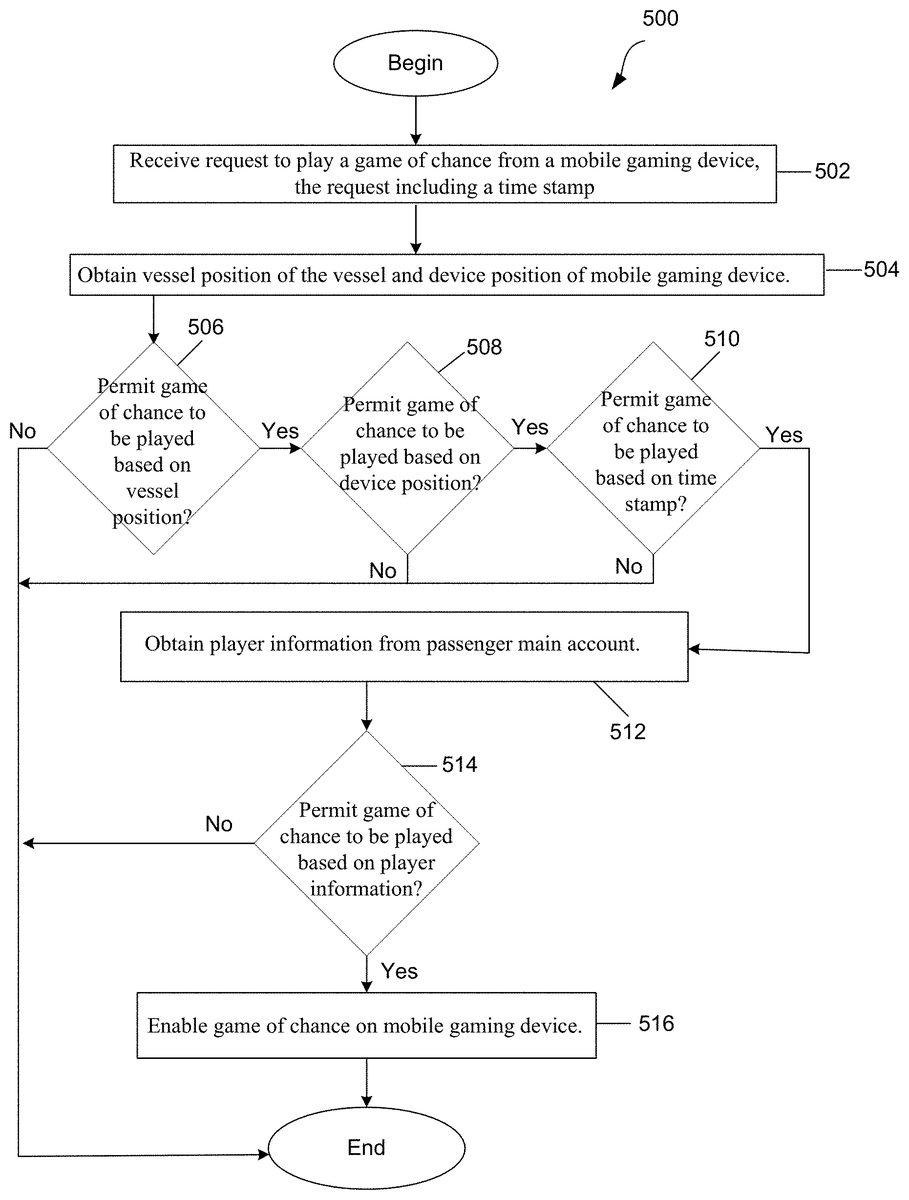
FIG. 5illustrates another example method for controlling play of a game of a chance on a vessel. The method500may begin with receipt of a request to play a game of chance from a mobile gaming device at502. The request may include a time stamp. The request may be transferred to a gaming server, e.g. such as gaming server106illustrated inFIG. 1. The gaming server may transmit the request to an intermediary server, e.g. such as mobile gaming management server102illustrated inFIG. 1.
The intermediary server may obtain a vessel position of the vessel and device position of the mobile gaming device at504. The vessel position and device position may be obtained from a location server, e.g. such as location server104illustrated inFIG. 1. The vessel position of the vessel may be a position relative to the world or earth. The device position of the mobile gaming device may be a position relative to the vessel.
Once obtained, the intermediary server may determine whether the game of chance may be played on the mobile gaming device based upon the vessel position at506. If it is determined that the game of chance may not be played on the mobile gaming device based upon the vessel position at506, the method500may end. If it is determined that the game of chance may be played on the mobile gaming device based upon the vessel position at506, a determination of whether the game of chance may be played on the mobile gaming device based upon the device position at508.
If it is determined that the game of chance may not be played on the mobile gaming device based upon the device position at508, the method500may end. If it is determined that the game of chance may be played on the mobile gaming device based upon the device position at508, a determination of whether the game of chance may be played on the mobile gaming device based upon the time stamp at510. If it is determined that the game of chance may not be played on the mobile gaming device based upon the time stamp at510, the method500may end.
If it is determined that the game of chance may be played on the mobile gaming device based upon the time stamp at510, passenger information (e.g. username and password, date of birth, and any other player information) may be obtained from the passenger main account at512. A determination of whether to permit the game of chance to be played on the mobile gaming device based on player information may be made at514. The determination of whether the game of chance may be played on the mobile gaming device based upon the vessel position, device position, time stamp, or passenger information may be similar to the determination described above with respect toFIGS. 1, 2A, 2B, 3 and 4.
If it is determined that the game of chance may be played on the mobile gaming device based on passenger information at514, the game of chance may be enabled on the mobile gaming device at516.
FIG. 6illustrates an example block diagram of a computing device. The computing device600can represent circuitry of a representative computing device (e.g. mobile gaming device, mobile gaming device management sever, location server, cruise ship server, gaming server) described and illustrated inFIG. 1. The computing device can be designed to primarily stationary or can be portable.
The computing device600includes a processor602that pertains to a microprocessor or controller for controlling the overall operation of the computing device600. The computing device600stores data pertaining to passengers, products and services, location, and the like in a file system604and a cache606. The file system604is, typically, semiconductor memory (e.g., Flash memory) and/or one or more storage disks. The file system604typically provides high capacity storage capability for the computing device600. However, since the access time to the file system604can be relatively slow, the computing device600can also include the cache606. The cache606is, for example, Random-Access Memory (RAM). The relative access time to the cache606is typically shorter than for the file system604. However, the cache606does not have the large storage capacity of the file system604. The computing device600also includes a RAM620and a Read-Only Memory (ROM)622. The ROM622can store programs, utilities or processes to be executed in a non-volatile manner. The RAM620provides volatile data storage, such as for the cache606.
The computing device600may also include a user input device608that allows a user of the computing device600to interact with the computing device600. For example, the user input device608can take a variety of forms, such as a button, keypad, dial, touch-sensitive surface, joystick, and the like. Still further, the computing device600includes a display610(screen display) that can be controlled by the processor602to display information to the user. A data bus611can facilitate data transfer between at least the file system604, the cache606, the processor602, an audio coder/decoder (CODEC)612and/or a video CODEC615.
In one embodiment, for example, if the computing device600(e.g. mobile gaming device116, cruise ship server108, mobile gaming management server102, location server104, gaming server106illustrated inFIG. 1) is a mobile gaming device, the computing device600may store a plurality of games of chance in the file system604. When a user desires to have the computing device play a particular game of chance, a list of available games of chance is displayed on the display610. Then, using the user input device608, a user can select one of the games of chance to play. The processor602, upon receiving a selection of a particular media item, supplies the game of chance data to one or more appropriate output devices. If the particular media item is encrypted, the particular media item is first decrypted as noted above, which could involve one or more layers of encryption. As an example, for audio output, the processor602can supply the media data (e.g., audio file) for the particular media item to the audio CODEC612. The audio CODEC612can then produce analog output signals for a speaker614. The speaker614can be a speaker internal to the computing device600or external to the computing device600. For example, headphones or earphones that connect to the computing device600would be considered an external speaker. As another example, for video output, the processor602can supply the media data (e.g., video file) for the particular media item to the video CODEC615. The video CODEC615can then produce output signals for the display610and/or the speaker614.
The computing device600also includes a network/bus interface616that couples to a data link618. The data link618allows the computing device600to couple to another device (e.g., a host computer, a power source, or an accessory device). The data link618can be provided over a wired connection or a wireless connection. In the case of a wireless connection, the network/bus interface616can include a wireless transceiver.
The various aspects, features, embodiments or implementations of the invention described above can be used alone or in various combinations. Embodiments of the invention can, for example, be implemented by software, hardware, or a combination of hardware and software. Embodiments of the invention can also be embodied as computer readable code on a computer readable medium. The computer readable medium is any data storage device that can store data, which can thereafter be read by a computer system. Examples of the computer readable medium generally include read-only memory and random-access memory. More specific examples of computer readable medium are tangible and include Flash memory, EEPROM memory, memory card, CD-ROM, DVD, hard drive, magnetic tape, and optical data storage device. The computer readable medium can also be distributed over network-coupled computer systems so that the computer readable code is stored and executed in a distributed fashion.
Numerous specific details are set forth in order to provide a thorough understanding of the present invention. However, it will become obvious to those skilled in the art that the invention may be practiced without these specific details. The description and representation herein are the common meanings used by those experienced or skilled in the art to most effectively convey the substance of their work to others skilled in the art. In other instances, well-known methods, procedures, components, and circuitry have not been described in detail to avoid unnecessarily obscuring aspects of the present invention.
In the foregoing description, reference to “one embodiment”, “an embodiment”, “one example” means that a particular feature, structure, or characteristic described in connection with the embodiment can be included in at least one embodiment of the invention. The appearances of the phrase “in one embodiment” in various places in the specification are not necessarily all referring to the same embodiment, nor are separate or alternative embodiments mutually exclusive of other embodiments. Further, the order of blocks in process flowcharts or diagrams representing one or more embodiments of the invention do not inherently indicate any particular order nor imply any limitations in the invention.
Claims
- A system for controlling mobile gaming a plurality of mobile gaming devices while on a vehicle, each of the plurality of mobile gaming devices associated with a player, each of the plurality of mobile gaming devices having a wireless transceiver, the system comprising: at least one server provided on the vehicle and operable to: receive data from one or more of the mobile gaming devices;determine if at least one of the plurality of mobile gaming devices is located on the vehicle based on the received data from the one or more of the mobile gaming devices;receive vehicle position data pertaining to a vehicle position, the vehicle position being a global location relative to earth;and determine if the vehicle position is located in at least one game play geographic region;and permit a game of chance to be played on the at least one of the plurality of mobile gaming devices if (i) the vehicle position is determined to be located in at least one game play geographic region and (ii) the at least one of the plurality of mobile gaming devices is determined to be located on the vehicle.
- A system as recited in claim 1 , wherein the at least one server is operable to: periodically update the vehicle position.
- A system as recited in claim 2 , wherein the at least one server is operable to: determine whether the game of chance is permitted to be played on each of the plurality of mobile gaming devices based on at least the updated vehicle position;and automatically terminate the game of chance currently played on each of the plurality of mobile gaming devices if it is determined that the game of chance is not permitted to be played on each of the plurality of mobile gaming devices based on at least the updated vehicle position.
- A system as recited in claim 1 , wherein the at least one server is operable to: determine whether the game of chance is permitted to be played on the at least one of the plurality of mobile gaming devices based on a predefined time rule;and enable the game of chance on the at least one of the plurality of mobile gaming devices if it is determined that the game of chance is permitted to be played based on the predefined time rule.
- A system as recited in claim 1 , wherein the at least one server is operable to: determine whether the game of chance is permitted to be played on the at least one of the plurality of mobile gaming devices based on player information;and enable the game of chance to be played on the at least one of the plurality of mobile gaming devices if it is determined that the game of chance is permitted to be played based on the player information.
- A system as recited in claim 1 , wherein said computer readable medium comprises: authenticate a player of at least one of the plurality of mobile gaming devices using a biometric verification.
- A system as recited in claim 1 , wherein the game of chance to be played in accordance with gaming rules, and wherein the at least one server is operable to: access a gaming rules database to acquire the gaming rules to be used with the game of chance.
- A system as recited in claim 7 , wherein the gaming rules database includes at least a plurality of predetermined gaming regions and at least one gaming rule that is dependent on the one of the predetermined gaming regions.
- A system as recited in claim 1 , wherein the at least one server is operable to: communicate with a player database configured to store player information about a plurality of players, including the players of the plurality of mobile gaming devices;and individually control whether each of the plurality of mobile gaming devices is permitted to play the game of chance based on the stored player information in the player database.
- A method for controlling mobile gaming on a vehicle, comprising: obtaining a vehicle position of the vehicle;determining if the vehicle position is located in a game play geographic region;obtaining a device position of at least one of a plurality of mobile gaming devices;determining if at least one of the plurality of mobile gaming devices is located on the vehicle based on the device position for the at least one of the plurality of mobile gaming devices corresponding thereto;receiving a request to play a game of chance from at least one of the plurality of mobile gaming devices;and enabling the game of chance to be played on the at least one of the plurality of mobile gaming devices if the determining determines that the vehicle position is located in a game play geographic region, and the determining determines that the at least one of the plurality of mobile gaming devices is located on the vehicle based on the device position.
- A method as recited in claim 10 , wherein the method comprises: authenticating a player of at least one of the plurality of mobile gaming devices using a biometric verification.
- A method as recited in claim 11 , wherein the game of chance to be played in accordance with gaming rules, wherein the method comprises: accessing a gaming rules database to acquire the gaming rules to be used with the game of chance, and wherein the gaming rules database includes at least a plurality of predetermined gaming regions and at least one gaming rule that is dependent on the one of the predetermined gaming regions.
- A method as recited in claim 11 , wherein the method comprises: communicating with a player database configured to store player information about a plurality of players, including the players of the plurality of mobile gaming devices;and individually controlling whether each of the plurality of mobile gaming devices is permitted to play the game of chance based on the stored player information in the player database.
- A computer readable medium executable computer program code stored thereon for controlling mobile gaming on or in a vehicle, said computer readable medium comprising: computer program code for obtaining a vehicle position of the vehicle;computer program code for determining if the vehicle position is located in a game play geographic region;computer program code for obtaining a device position of at least one of a plurality of mobile gaming devices;computer program code for determining if at least one of the plurality of mobile gaming devices is located at or on the vehicle based on the device position for the at least one of the plurality of mobile gaming devices corresponding thereto;computer program code for receiving a request to play a game of chance from at least one of the plurality of mobile gaming devices;and computer program code for enabling the game of chance to be played on the at least one of the plurality of mobile gaming devices if the computer program code for determining determines that the vehicle position is located in a game play geographic region, and the computer program code for determining determines that the at least one of the plurality of mobile gaming devices is located at or on the vehicle based on the device position.
- A computer readable medium as recited in claim 14 , wherein the vehicle is a vessel.
- A computer readable medium as recited in claim 15 , wherein the vessel is a cruise ship.
- A computer readable medium as recited in claim 14 , wherein said computer readable medium comprises: computer program code for periodically updating the vehicle position.
- A computer readable medium as recited in claim 17 , wherein said computer readable medium comprises: computer program code for determining whether the game of chance is permitted to be played on each of the plurality of mobile gaming devices based on at least the updated vehicle position;and computer program code for automatically terminating the game of chance currently played on each of the plurality of mobile gaming devices if the computer program code for determining determines that the game of chance is not permitted to be played on each of the plurality of mobile gaming devices based on at least the updated vehicle position.
- A computer readable medium as recited in claim 14 , wherein said computer readable medium comprises: computer program code for determining whether the game of chance is permitted to be played on the at least one of the plurality of mobile gaming devices based on a predefined time rule;and computer program code for enabling the game of chance on the at least one of the plurality of mobile gaming devices if the computer program code for determining determines that the game of chance is permitted to be played based on the predefined time rule.
- A computer readable medium as recited in claim 14 , wherein said computer readable medium comprises: computer program code for determining whether the game of chance is permitted to be played on the at least one of the plurality of mobile gaming devices based on player information;and computer program code for enabling the game of chance to be played on the at least one of the plurality of mobile gaming devices if the computer program code for determining determines that the game of chance is permitted to be played based on the player information.
- A computer readable medium as recited in claim 14 , wherein said computer readable medium comprises: computer program code for authenticating a player of at least one of the plurality of mobile gaming devices using a biometric verification.
- A computer readable medium as recited in claim 14 , wherein the game of chance to be played in accordance with gaming rules, and wherein said computer readable medium comprises: computer program code for accessing a gaming rules database to acquire the gaming rules to be used with the game of chance.
- A computer readable medium as recited in claim 22 , wherein the gaming rules database includes at least a plurality of predetermined gaming regions and at least one gaming rule that is dependent on the one of the predetermined gaming regions.
- A computer readable medium as recited in claim 14 , wherein said computer readable medium comprises: computer program code for communicating with a player database configured to store player information about a plurality of players, including the players of the plurality of mobile gaming devices.
- A computer readable medium as recited in claim 24 , wherein said computer readable medium comprises: computer program code for individually controlling whether each of the plurality of mobile gaming devices is permitted to play the game of chance based on the stored player information in the player database.
Disclaimer: Data collected from the USPTO and may be malformed, incomplete, and/or otherwise inaccurate.