U.S. Pat. No. 10,537,797
SIMULATED VIDEO GAME CHANNEL
AssigneeDISH Technologies L.L.C.
Issue DateApril 30, 2018
Illustrative Figure
Abstract
Simulated video game channel systems and methods are disclosed that allows users to connect their video game consoles to a device, such as a set-top box, and to then connect over a gaming channel that is identified by an electronic programming guide (EPG). Both audiovisual broadcast content channels and video game channels are displayed on the same integrated EPG. An individual may either watch the video game action or participate in the video game. A video game channel may be either public, viewable by all service provider subscribers, or private, viewable to only a subset of subscribers. The system also analyzes the video gaming habits of the user to determine recommendations for audiovisual broadcast content and video on demand content to present to the user.
Description
DETAILED DESCRIPTION FIG. 1contains diagram500that shows one implementation of a simulated video game channel. A user20is able to communicate with set-top box30using remote control22over remote control communication link32. The user20is also able to communicate with video game console26using video game controller24that is connected to the console. In one example implementation, the video game console26is connected to the set-top box30. The television display28is connected to the set-top box30, and is able to display audiovisual broadcast content information received by the set-top box30from communications network36. Examples of a communications network36includes audiovisual broadcast content that is provided by content distributors such as Dish Network™ and DirecTV™ The communications network36also provides information in the form of an electronic programming guide34that describes the name, in addition to other information, about audiovisual programs that are available on different channels at various time slots. By viewing electronic programming guide34, a user20is able to determine what programs are available for desire viewing. In addition, the electronic programming guide34may also contain information about video game channels that are available for the user20either view or to play. In this way, the user20is able to view the electronic programming guide34and to get information on channels available to the user20either watching audiovisual broadcast content or watching or playing video games. The user20is able to connect video game console26to a set-top box30and to control the video game console26using video game controller24. In different implementations, a single device may be used to control both the video game console26and the set-top box30. In other implementations, these devices may be combined into one unit. In still other implementations, the user20is able to connect laptops, PCs, smart phones, tablets or any other device to the set-top box30in order to simulate a channel, displayable on an electronic program guide34, that shows video game action as a channel. For ...
DETAILED DESCRIPTION
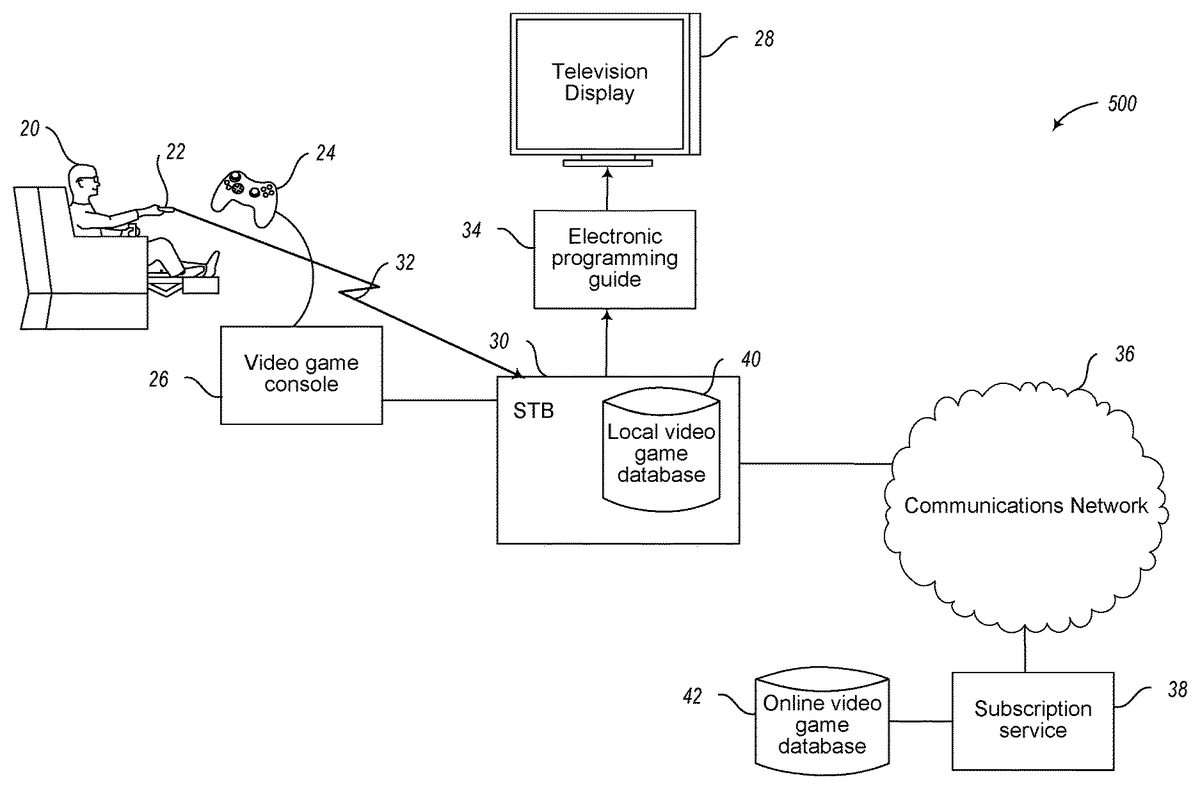
FIG. 1contains diagram500that shows one implementation of a simulated video game channel. A user20is able to communicate with set-top box30using remote control22over remote control communication link32. The user20is also able to communicate with video game console26using video game controller24that is connected to the console. In one example implementation, the video game console26is connected to the set-top box30. The television display28is connected to the set-top box30, and is able to display audiovisual broadcast content information received by the set-top box30from communications network36. Examples of a communications network36includes audiovisual broadcast content that is provided by content distributors such as Dish Network™ and DirecTV™
The communications network36also provides information in the form of an electronic programming guide34that describes the name, in addition to other information, about audiovisual programs that are available on different channels at various time slots. By viewing electronic programming guide34, a user20is able to determine what programs are available for desire viewing.
In addition, the electronic programming guide34may also contain information about video game channels that are available for the user20either view or to play. In this way, the user20is able to view the electronic programming guide34and to get information on channels available to the user20either watching audiovisual broadcast content or watching or playing video games.
The user20is able to connect video game console26to a set-top box30and to control the video game console26using video game controller24. In different implementations, a single device may be used to control both the video game console26and the set-top box30. In other implementations, these devices may be combined into one unit. In still other implementations, the user20is able to connect laptops, PCs, smart phones, tablets or any other device to the set-top box30in order to simulate a channel, displayable on an electronic program guide34, that shows video game action as a channel.
For example, multiplayer games, such as those played using a video game subscription service38, which may or may not be different from the audiovisual broadcast content distribution service, connected to a communications network36, may allow player interaction with other video game subscribers that would like to either play or watch the action of the video games on one or more channels. An example of a video game subscription service38is the Xbox™ live service. By connecting the video game console26to the set-top box30, the set-top box30will manage to connect all the players to the same video game through communications network36, and to display the action to the individual user on television display28. The action as displayed will be associated with the channel that may be accessed through the electronic programming guide34as a regular channel. In one implementation, a video game channel may have one of two types of profiles: public and private. A public profile video game channel can be watched by other subscribers even if they are not connected to play the video game. A private profile channel can be accessed only by a user20that created the channel with the private profile, and by those that have received and have accepted an invitation from the channel creator.
Information about all video game channels, including public and private channels, may be stored in an online video game database42to which all video distribution service subscribers have access.
Additional databases, such as a local database that is internal to set-top box30, or a local video game database40, is included and contains information related to the video game channels and the associated user20. In one or more implementations, the local video gaming database40contains only the public channels and the private channels to which the user20has access. In other implementations, information about the video games associated with each channel are included, including information such as genre, participants, e.g., people playing the game, game type, etc. This information may be presented on the television display28.
Some or all of this information may also be found on the online video gaming database42. The online video gaming database42and local video gaming database40may synchronize periodically in order to add new public channels that exist in the online video gaming database42but not in all of the local video gaming database40databases yet. For example, the local video gaming database40may contain a listing of all of the available public video game channels, the private video game channels created by the user20, and the private channels to which the user20has been invited and has accepted. For example, when user20creates a public profile channel, this information is sent over communications network36to the online video gaming database42. In some implementations, a flag in the online video gaming database42database may indicate that channels need to be updated, for example, that the information about the newly created channel needs to be pushed to each user's20set-top box30so that the information can be included in the local video gaming database40. For example, a database field titled “last update” in the local video gaming database40may indicate the last time the video game channels were updated.
In some implementations, the set-top box30will use information in the local video gaming database40to build the video game channels in the electronic programming guide information34. In order to do this, the set-top box30, may combine event information, for example from Event Information Tables sent with linear programming via communications network36or included as metadata with events, such as with video-on-demand (VOD) movies or other programming. This is described further below.
Both the online video gaming database42and local video gaming database40contain information regarding the genres of different video games. This information may be used by a recommendation engine in order to recommend other video games or audiovisual broadcast programming events from a service provider. Note that audiovisual broadcast events may come from satellite networks, cable networks, internet protocol television networks, terrestrial broadcast television and the like. For example, if user20either joins, plays, or watches a video game such as Jurassic Park™, then the recommendation engine may flag movies or other audiovisual programming events that are tagged with the genres of adventure, sci-fi or action, and recommend them to the user20.
In other implementations, a user20may be offered a special communication channel to enable the user20to communicate with other players playing a video game identified with a channel in electronic programming guide information34. This communication channel may be public, e.g., visible to all players, or private, e.g., only visible to some other participants. The players may be able to talk with each other while the communication channel carries the audio. In other implementations, a player can talk to other players and the audio communication is translated into text messages that would be displayed on the television display28.
FIG. 2contains a diagram550that shows a multiuser environment for playing games using a simulated video channel. Individual users50a-50fare associated with individual set-top boxes52a-52fimplementing at least part of the simulated video channel. Other example implementation hardware is also shown as a tablet52g,personal computer52h,and smart phone52i.Examples of local video gaming databases54a-54eare also shown. As described above, users50a-50f,are able to create new video game channels that are either public or private. Public video game channels are able to be viewed by all set-top boxes52a-52f. Private video game channels are only able to be viewed by the private channel creator, in addition to any other user who has received and accepted an invitation to join the video game channel.
FIG. 2shows example configurations of users involved in one or more private channels. Each of set-top boxes52a-52fbelonging to users50a-50fare connected through a communications network36. In one example, a user50ahas created a video game channel, has invited another user50bto join that channel, and the invitation was accepted. This creates a channel that is a private channel involving only these two users50a,50band is identified in the figure by a dashed circle48a.In this example, other users50c-50fare not able to view the private channel as a part of the electronic programming guide information34or gain access to the contents of the video game channel for either viewing or playing. In some implementations, the private channel indicates who may join the video game on a video game channel, but others outside of the private channel may be able to view the video game play.
Similarly, dashed circle48bshows an analogous example of a private channel between two users50band50c.In this example, one user50bis a member of two different private channels, where each of the other users50aand50care members of only one private channel.
FIG. 3is a diagram600that shows an example of electronic programming guide information34that is received from one or more sources58from an audiovisual distributor, a broadcaster or content provider, for example, Dish Network™ or DirecTV™, via communications network36. In one or more implementations, the sources include event information tables58areceived from linear services, which include programming for each channel that is sent in real time that allows a user20to tune into a specific channel and immediately view the content received on that channel. Another source includes event information tables that are included as metadata for video-on-demand items58b,which includes programming that is not received in a linear way, but instead is specified such as by a selection from a menu for downloading and/or immediate watching. Yet another source includes event information tables58cfrom the local video gaming database40. This source includes event information with respect to video game channels that are available for either viewing or for play for a user20associated with a set-top box30. In other embodiments, event information tables from online video gaming database42may also be included.
In addition, rich media information58dmay also be provided to populate electronic program guide34. This rich media may include logos and event pictures that visually depict an event or identify a channel by, for example, using a trademark logo to identify the event or channel. In addition, various genres may be identified visually by the use of logos or graphics. For example, associated with electronic program guide34, a channel designator60may include a specific channel number, or could be augmented with a logo representing the content provider associated with that channel. For example, a picture of Mickey Mouse™ associated with the Disney Channel.
The main portion of the electronic program guide34includes a list of events that occur in various time slots in a particular channel60. Each event is graphically represented as existing in the timeslot. For example, the audiovisual event on channel102“Comedy1”64will end before the audiovisual event on channel103“Comedy1”66ends. At the lower part of the electronic program guide34there are two video game channels62listed. The first is “video game channel1”68associated with channel1001, and is a public video game channel, meaning that any subscriber to the video distribution service, e.g., DirecTV™ or Dish Network™, may view that video game channel. The second is video game channel270associated with channel1002, which is a private channel, meaning that only the channel creator are those that have accepted an invitation to join the channel by the channel creator are able to view the channel.
FIG. 4shows diagram650of one implementation of the structure and contents of the local video game database40. In one or more implementations, the local video gaming database40resides within set-top box30, which is connected to video game console26. Both are able to communicate via communications network36.
The electronic programming guide channel ID74identifies the numeric channel associated with any particular video game channel. Next, the video game ID76uniquely identifies the video games being played. This may be done through a description of the game name, e.g., “Final Fantasy”, through an abbreviation “FINF” or through a graphical image (not shown). In addition, the video game ID76may also identify the video game console that is used for play, for example, Xbox™ or PlayStation™
The next column represents profile type78, which may be either public or private. A public channel indicates that any member of the video distribution subscription service is able to view the gameplay on the channel. A private channel indicates that the channel creator has invited one or more users to participate in the video game channel and these users have accepted the invitation. Genre80describes the one or more genres describing the video game. For example, the game “Final Fantasy” falls under the genre fantasy, the game “The Sims” falls under the genre economy, “FIFA Football” falls under the genre sports, and “Halo” falls under the genres sci-fi and combat. The next column, actors/participants82, describes a list of those users who are participating in the gaming experience. These participants may be identified by a unique user ID, by email name, by full name, or by one or more names they are known by within one or more video games, e.g., “Scullkiller.” The maximum number of players84indicates the maximum number of active participants in gameplay that are allowed. When this number is exceeded, no additional players are allowed to join. Instead, they may be allowed to view the video game play until a player drops out, at which time another player may join.
The next column, game type86, identifies the type of game that is being played. The examples given here are role-playing, simulation, sports and real-time strategy. The final column, last update88, describes the date at which the information for the corresponding channel ID was last updated.
FIG. 5shows diagram700of one implementation of the structure and contents of the online video game database42. In one or more implementations, the online video gaming database42resides outside of the set-top box30as a cloud-based drive accessible via communications network36.
The electronic programming guide (EPG) channel ID90identifies the numeric channel associated with any particular video game channel. In one or more implementations, a predefined range of numbers may be used to identify public and private video game channels within electronic program guide34. For example, a range of channel IDs2000-2999may be defined for public video game channels while a channel ID range of3000-3399is defined for private video game channels.
Next, the video game ID92uniquely identifies the video games being played. This may be done through a description of the game name, e.g., “Final Fantasy”, through an abbreviation of “FINF,” or through a graphical image (not shown).
In addition, the video game ID92may also identify the video game console that is used for play, for example, Xbox™ or PlayStation™
The next column represents profile type94, which may be either public or private. A public channel indicates that any member of the video distribution subscription service is able to view the gameplay on the channel. A private channel indicates that the channel creator has invited one or more users to participate in the video game channel and these users have accepted the invitation. Genre96describes the one or more genres describing the video game. For example, the game “Final Fantasy” falls under the genre fantasy, the game “The Sims” falls under the genre economy, “FIFA Football” falls under the genre sports, and “Halo” falls under the genres sci-fi and combat. The next column, actors/participants98, describes a list of those users who are participating in the gaming experience. These participants may be identified by a unique user ID, by email name, by full name, or by one or more names they are known by within one or more video games, e.g., “Scullkiller.” The maximum number of players100indicates the maximum number of active participants in gameplay that are allowed. When this number is exceeded, no additional players are allowed to join. Instead, they may be allowed to view the video game play until a player drops out, at which time another player may join.
The next column, game type102, identifies the type of game that is being played. The examples given here are role-playing, simulation, sports, music and real-time strategy. The final column, “needs to be updated”104, indicates whether updates to the information described for each EPG channel ID90need to be pushed to the individual local video gaming databases40located at each set-top box.
FIGS. 6A-6Bshow flow diagrams750and800that describe an implementation of a flow diagram for identifying a video game channel for play, or for creating a public video game channel. Starting withFIG. 6Aand flow diagram750, the method starts at step110.
At step112, the video game console26is connected to the set-top box30. In one or more implementations, this may take the form of either a hardwired connection between the2components, or may take the form of a wireless connection such as a Bluetooth, infrared, or Wi-Fi connection.
At step114, data is extracted about the video game that is running in the video game console26. This data may be extracted by querying the video game software itself, or may be entered manually by the video game user into a user interface display. This data includes one or more data fields such as video game ID, genre, maximum number of players, game type, etc., that appear as fields in either the online video gaming database42or local video gaming database40.
At step116, the method checks if there are invitations to the user20to join any private channels. If there are no invitations, then the method continues to step130ofFIG. 6B. If there are invitations, then at step118the user is prompted to join the private channel. At step120if the user accepts the invitation, then at step124the user joins the private channel, which may include sending an acknowledgement by communication back to the individual who invited the user20to join the channel. At step126, the online video gaming database and local video gaming database are updated to include the new participant. At step127, if the user wishes to join another channel, then the method moves to step122. Otherwise at129the method ends.
If the user does not accept the invitation to join, then at step122the method determines if there are more invitations to join a private channel. If so, the method moves to step118. If not, then the method continues to step130ofFIG. 6B.
FIG. 6Bshows flow diagram800that describes the creation of a public video game channel, creation of a private video game channel and a user joining a public channel. The method starts at128(connector A).
At step130, the method determines if there is a public video game channel in the local video gaming database that the user wishes to either view or play. For example, the user20may connect the video game console26to the set-top box30and request to play “Final Fantasy.” If so, the method proceeds to step132to determine whether the user wants to join the public channel as either a viewer or a game player. For example, to determine if there are public video game channels where people are already playing “Final Fantasy.” If not, the method proceeds to step134. If so, then at step142the method joins the user to the public channel, and at step144updates the online video gaming database and local video gaming database to include the user as a new participant, and the method ends at step154.
At step134, the method determines whether the user wants to create a new public channel, for example, to play the game “Final Fantasy.” In one or more embodiments, any user that subscribes to the video distribution service has a right to create a video game channel. If so, at step136the method creates a new public channel. In the example, the user20will begin to play the game “Final Fantasy.” At step138, the channel is added to the local video gaming database and online video gaming database, and at step140the channel is added to the local electronic programming guide. At this point, all other subscribers of the video distribution service will be able to watch the Final Fantasy game being played by the user20by selecting the channel indicated by the EPG. At step154, the method ends.
At step146, the method determines whether the user wants to create a private channel. If so, at step148the method creates a new private channel. At step150, the method adds the channel to the local video gaming database and online video gaming database, and at step152the method adds the private video game channel to the local electronic programming guide. Similarly to the public channel creation described above, this sequence of method steps would create a private video game channel for the user20, which could only be accessed by other users if user20specifically invited them to view and/or play on the private video game channel. At step153, the user invites other participants to join the channel.
At step154, the method ends.
FIG. 7shows diagram900which is one implementation of a flow diagram for building a local electronic programming guide34. The method starts at step170. At step172, the method starts the television receiver. In one or more implementations, this is the set-top box30that receives audiovisual content from the content distributor that includes the local video gaming database40and access to the online video gaming database42over communications network36.
At step174, the method checks the local video gaming database and online video gaming database video game databases to retrieve available video game channels.
At step176, the method checks if there are filters with preferences of video game channels to be included in the electronic programming guide. In one or more implementations, these filters are settings that may be customized by the user20by manually entering these filters into a user preferences database, or having the method analyze the user's20audiovisual viewing habits and/or video game channel viewing and playing habits.
At step178, the local electronic programming guide is built by combining the electronic programming guide data for audiovisual content channels with the retrieved video game channels.
At step180, the method ends.
FIG. 8Ashows flow diagram950which is one implementation of a flow diagram for the interplay between the online video gaming database and local video gaming database databases when creating a public video game channel. At step200, the method starts.
At step202, the user indicates that a public video game channel is to be created.
At step204, the method includes the newly created public video game channel in the local video game database40.
At step206, information about the newly created video game channel is pushed to the online video gaming database42and the “Needs To Be Updated” data entry in the corresponding database record associated with the newly created video game is set to “Yes.” This signals the method that the information in the online video gaming database42needs to be pushed to all other local video gaming database databases.
At step208, the method pushes the newly updated information in the online video gaming database to all other local video gaming databases that are connected via the communications network36.
At step210, the newly created video game channel information is included in the local video gaming database databases, and the local electronic programming guide information34associated with set-top box30is updated to reflect the new information.
The method ends at step220.
FIG. 8Bshows flow diagram1000which is one implementation of a flow diagram for the interplay between the online video gaming database and local video gaming database databases when creating a private video game channel. At step240, the method starts.
At step242, the user indicates that a private video game channel is to be created.
At step244, the method includes the newly created private video game channel in the local video game database40.
At step246, information about the newly created video game channel is pushed to the online video gaming database42and the “Needs To Be Updated” data entry in the corresponding database record associated with the newly created video game is set to “Yes.” This signals the method that the information in the online video gaming database42needs to be pushed to other local video gaming database databases.
At step248, the method provides for the initiator of the private video game channel to send invitations to join the channel to other users. In one or more implementations, these invitations may take the form of an email with a key that authorizes the invitee to join the private channel, which the invitee uses to accept the invitation.
At step250, if the user accepts the invitation, then the newly created private channel is included in the local video game database40within the set-top box of the user that has accepted the invitation.
At step252, the method ends.
FIG. 9shows a flow diagram1050of one implementation of providing recommendations for audiovisual broadcast content to a user based on the user's video game playing and viewing history. At step260, the method starts.
At step262, the method receives video game playing and viewing history of the user20. In one or more implementations, the video game channel playing and viewing history is tracked by the user's set-top box30. In other implementations, the video game playing and viewing history may be tracked by the video game console26, which may provide history data to the set-top box30.
At step264, the method analyzes the received history of the user's video game playing and viewing habits.
At step266, the method determines, based on the received history, recommended audiovisual content. This may include broadcast content that corresponds to a subscription service from a television content provider. For example, if the user20plays predominantly sci-fi and adventure games such as “Halo”, then the method may recommend sci-fi and adventure TV shows such as Star Trek™ and movies such as Guardians of the Galaxy™ to the user20.
At step268, the method presents to the user indications of the recommended audiovisual content. In one or more embodiments, the user20may be presented with an option to record the recommended content when it becomes available, be presented with an option to begin watching the recommended content immediately, or an option to be reminded when the recommended content is available for viewing at a later date.
The method ends at270.
In one or more alternative implementations, video game channels maybe also recommended based on the viewing habits of broadcast television content or on the viewing or playing habits on other video game channels.
FIG. 10shows diagram1100of one implementation of a computing system for implementing a simulated video game channel system310.FIG. 10includes a computing system300that may be utilized to implement simulated video game channel system310with features and functions as described above. One or more general-purpose or special-purpose computing systems may be used to implement the simulated video game channel system310. More specifically, the computing system300may include one or more distinct computing systems present having distributed locations, such as within a set-top box, or within a personal computing device. In addition, each block shown may represent one or more such blocks as appropriate to a specific embodiment or may be combined with other blocks. Moreover, the various blocks of the simulated video game channel system310may physically reside on one or more machines, which may use standard inter-process communication mechanisms (e.g., TCP/IP) to communicate with each other. Further, the simulated video game channel system310may be implemented in software, hardware, firmware or in some combination to achieve the capabilities described herein.
In the embodiment shown, computing system300includes a computer memory312, a display28, one or more Central Processing Units (“CPUs”)380, input/output devices382(e.g., keyboard, mouse, joystick, track pad, LCD display, smart phone display, tablet and the like), other computer-readable media384and network connections386(e.g., Internet network connections or connections to audiovisual content distributors). In other embodiments, some portion of the contents of some or all of the components of the simulated video game channel system310may be stored on and/or transmitted over other computer-readable media384or over network connections386. The components of the simulated video game channel system310preferably execute on one or more CPUs380to create, manage and update the video game channels that are integrated with electronic programming guide information for audiovisual broadcast content, and to perform user habit analysis to determine recommended audiovisual events based on the users20video game watching or playing activity. Other code or programs388(e.g., a Web server, a database management system, and the like), and potentially one or more other data repositories320, also reside in the computer memory312, and preferably execute on one or more CPUs380. Not all of the components inFIG. 10are required for each implementation. For example, some embodiments embedded in other software do not provide means for user input, for display, for a customer computing system, or other components, such as, for example, a set-top box or other receiving device receiving audiovisual content.
In a typical embodiment, the simulated video game channel system-310includes an EPG Integration Module368, a video game database manager module370and a video game habits module372. Audiovisual broadcast event content, including electronic programming guide (EPG) information is received from an audiovisual content provider340, which may be provided by a network connection386or via satellite downlink338. The video game database manager module370receives information from user20, from the online video game database42and the local video game database40and appropriately synchronizes the databases across systems. The video game habits module372acquires and analyzes user20video game habits in order to determine recommendations for audiovisual content to present the user20at a later time. Other and/or different modules may be implemented. The simulated video game channel system310also, in some embodiments, contains the user preference database360, which includes information to determine relevant filters to apply when creating information to be stored in the local EPG330. In addition, the simulated video game channel system310interacts with communications network36in communicating with the video game subscription service38, and in one or more implementations video game console26, and electronic program guide34.
The EPG integration module368performs at least some of the functions of EPG integration described with reference toFIGS. 1, 6A-6B and 8A-8B. In particular, the EPG integration module368interacts with electronic programming guide information34received from communications network36that reflects electronic programming guide information for audiovisual broadcast events received from the audiovisual content provider340, e.g., DirecTV™ or Dish Network™. It also interacts with the online video gaming database42and local video gaming database40to receive information to populate the local EPG330with video game channels that are available to the user20to either view or to play. This way, the local EPG330has an integrated listing of audiovisual broadcast events, video-on-demand events, and video game channels available to the user.
The video game database manager module370performs at least some of the functions of database management described with reference toFIGS. 1 and 3-8. The module takes video game channel creation information from user20, and uses that information to update the local video gaming database40and the online video gaming database42to ensure consistent and accurate EPG information with respect to video game channels are available throughout the network. Similarly, the video game database manager module370makes sure that changes reflected in the online video gaming database42are propagated to the local video gaming database40.
The video game habits module372performs at least some of the functions of collecting and analyzing video game watching and playing habits of a user20as described with reference toFIGS. 1 and 9. The video game habits module372gathers and analyzes the video game channel viewing and playing habits of the user20. In one or more implementations, this may include video games played on video game console26in direct connection to a video game subscription service38accessed via communications network36and not going through a set-top box30. In other implementations, it includes video games that are watched or played using the simulated video game channel system implemented, for example, on set-top box30. This module uses the gathered information to determine and to recommend to the user20the audiovisual broadcast content events or video-on-demand events that the user might be the most interested in viewing. In one or more implementations, this module presents the recommendation to the user either by immediately playing the recommended content, offering to record recommended content, or offering to remind user20when the content is available at a later date.
The video game habits module372may consider not only the title of the video games that have been played by the user20, but also consider other attributes of the video games for example, by examining one or more genres of the video games to determine the user's20interest in that genre and to use that in the audiovisual recommendation. In addition, the module may also consider how the user20engages in the game, for example, if the user only views certain genres of games but actively participates in other genres. This is meant to be one non-limiting example of video game attributes that may be used by this module.
The various embodiments described above can be combined to provide further embodiments. All of the U.S. patents, U.S. patent application publications, U.S. patent applications, foreign patents, foreign patent applications and non-patent publications referred to in this specification and/or listed in the Application Data Sheet are incorporated herein by reference, in their entirety. Aspects of the embodiments can be modified, if necessary to employ concepts of the various patents, applications and publications to provide yet further embodiments.
These and other changes can be made to the embodiments in light of the above-detailed description. In general, in the following claims, the terms used should not be construed to limit the claims to the specific embodiments disclosed in the specification and the claims, but should be construed to include all possible embodiments along with the full scope of equivalents to which such claims are entitled. Accordingly, the claims are not limited by the disclosure.
Claims
- A system for providing a video game channel, comprising: a set-top box;a processor connected to the set-top box;a display connected to the set-top box;a communications network connected to the processor;and a non-transitory computer-readable memory communicatively coupled to the processor, the memory storing computer-executable instructions that, when executed, cause the processor to: receive an identification of a user;receive, from the communications network, an electronic programming guide, the guide including selections of audiovisual broadcast content channels and video game channels;display the received electronic programming guide to the user;receive, from the user, a request to access a video game channel from the displayed electronic programming guide;determine, based on the received request, access rights of the user to the video game channel;present, based on the determined access rights, the video game channel to the user;and display, to the user, indications of audiovisual content related to the requested video game channel.
- The system of claim 1 , wherein receiving from the user the request to access the video game channel, further includes: determining, based on the received user identification, private video game channels available to the user;and determining, based on the received user identification, public video game channels available to the user.
- The system of claim 2 , wherein presenting the video game channel to the user further incudes: if the received video game channel selection includes a request from the user to play on the video game channel and the determined access rights of the user to the video game channel allow the user to play on the video game channel, then: receiving video gaming inputs from a video gaming device;sending the received video gaming inputs to the communications network;receiving from the communications network audiovisual content of the video game channel;and outputting the audiovisual content of the video game channel.
- The system of claim 1 , wherein receiving from the user the request to access the video game channel further includes: receiving, from the user, a request to create a video game channel, the request including whether the channel is a public or private channel.
- The system of claim 4 , wherein receiving from the user the request to access the video game channel further includes: if the channel is a private channel, receiving, from the user, a list of other users to have access to the created video game channel, the list including access rights of each of the other users to the created video game channel;creating the channel as a private video game channel;updating the access rights of each of the other users to the created private video game channel;and storing the access rights of each of the users.
- The system of claim 5 , wherein updating the access rights of each of the other users further includes for each user: sending an invitation to the user to join the private video game channel;and receiving an acknowledgement from the user.
- The system of claim 4 , wherein receiving from the user the request to access the video game channel further includes: if the channel is a public channel, creating the channel as a public channel.
- A method, comprising: receiving, from a communications network, contents of an electronic programing guide, the programming guide including indications of multiple channels that include audiovisual broadcast channels and a video game channel;sending the contents of the electronic programming guide for display to a viewer;receiving, from the viewer, an indication of the video game channel;receiving, from the communications network, content of the video game channel;sending the content of the video game channel to the viewer.
- The method of claim 8 , further comprising: receiving, from the viewer, an indication of whether the viewer wishes to play a video game associated with the video game channel;and if the viewer wishes to play the video game associated with the video game channel: receiving, from the viewer, an identification of the viewer;sending, by the communications network, the identification of the viewer to a video game provider of the video game;receiving, by the communications network, an indication of whether the viewer is allowed to play the video game;and if the viewer is allowed to play the video game: receiving from the viewer, video game commands, sending, by the communications network, the received video game commands, receiving, by the communications network, audiovisual content in response to the sent video game commands, and sending the received audiovisual content to the viewer.
- The method of claim 8 , further comprising: determining one or more audiovisual broadcast content items that are related to the video game channel;and sending an indication of the one or more audiovisual broadcast content items to the viewer.
- The method of claim 8 , further comprising: receiving, from the viewer, an indication of an audiovisual broadcast channel;determining one or more video game channels that are related to an audiovisual content event of the indicated audiovisual broadcast channel;and sending an indication of the one or more video game channels to the viewer.
Disclaimer: Data collected from the USPTO and may be malformed, incomplete, and/or otherwise inaccurate.