U.S. Pat. No. 10,532,286
REACTIVE EMITTERS OF A VIDEO GAME EFFECT BASED ON INTERSECTION OF COVERAGE AND DETECTION ZONES
AssigneeACTIVISION PUBLISHING, INC.
Issue DateMay 1, 2014
Illustrative Figure
Abstract
A reactive emitter associated with an object in a video game emits an asset in response to a secondary effect of an activity that occurs in the video game within a vicinity of the object.
Description
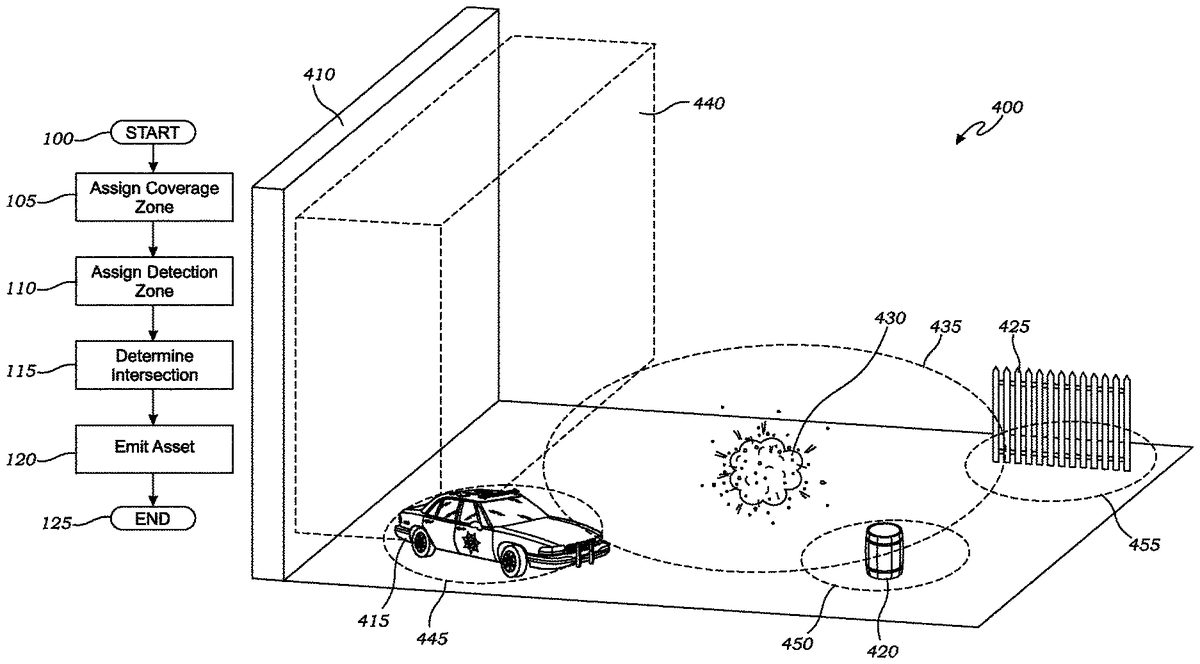
DETAILED DESCRIPTION OF THE EMBODIMENTS Preferred embodiments of the present invention will now be described with reference to the above-described drawings. Beginning withFIG. 4, a partial scene400from within a video game is shown, in which an explosion430is occurring. The scene400includes a building wall410, a car415, a barrel420, and a fence425. Also shown inFIG. 4are dotted lines representing coverage zone435of the explosion430, and detection zones440,445,450, and455, of the wall410, car415, barrel420, and fence425respectively. The dotted lines are for illustration purposes only, and would not be visible during video game play as part of the scene400or otherwise. Coverage zone435is shown as substantially circular, as are detection zones445,450, and455. These zones could be any shape, including three-dimensional shapes such as substantially spherical. Detection zone440of wall410is shown as three-dimensional, specifically in the shape of a rectangular prism corresponding to the shape of the wall. Coverage zone435of explosion430represents the area affected by the shockwave of the explosion. InFIG. 4, coverage zone435extends radially outward from the point of origin of explosion430, and intersects with each of detection zones410,415,420, and425. Thus, in accordance with preferred embodiments of the present invention, the shockwave of explosion430in scene400would cause each of objects410,415,420, and425to emit one or more assets. For example, as further described herein: wall410might shake, creak, and/or wobble etc.; car415might roll, tilt, spin, become airborne, have an airbag go off, have an alarm go off, and/or have the horn honk, etc.; barrel420might crack, split, roll, spin, become airborne, and/or discharge some or all of its contents, etc.; and fence425might rattle, buckle, and/or bend, etc. Various real-life sounds could be associated with the aforementioned. Turning now toFIG. 1, a method to output an asset in a video game in accordance with the present invention is illustrated in a flowchart. The method begins at Step100. At Step105, a coverage zone is ...
DETAILED DESCRIPTION OF THE EMBODIMENTS
Preferred embodiments of the present invention will now be described with reference to the above-described drawings. Beginning withFIG. 4, a partial scene400from within a video game is shown, in which an explosion430is occurring. The scene400includes a building wall410, a car415, a barrel420, and a fence425. Also shown inFIG. 4are dotted lines representing coverage zone435of the explosion430, and detection zones440,445,450, and455, of the wall410, car415, barrel420, and fence425respectively. The dotted lines are for illustration purposes only, and would not be visible during video game play as part of the scene400or otherwise.
Coverage zone435is shown as substantially circular, as are detection zones445,450, and455. These zones could be any shape, including three-dimensional shapes such as substantially spherical. Detection zone440of wall410is shown as three-dimensional, specifically in the shape of a rectangular prism corresponding to the shape of the wall. Coverage zone435of explosion430represents the area affected by the shockwave of the explosion. InFIG. 4, coverage zone435extends radially outward from the point of origin of explosion430, and intersects with each of detection zones410,415,420, and425. Thus, in accordance with preferred embodiments of the present invention, the shockwave of explosion430in scene400would cause each of objects410,415,420, and425to emit one or more assets. For example, as further described herein: wall410might shake, creak, and/or wobble etc.; car415might roll, tilt, spin, become airborne, have an airbag go off, have an alarm go off, and/or have the horn honk, etc.; barrel420might crack, split, roll, spin, become airborne, and/or discharge some or all of its contents, etc.; and fence425might rattle, buckle, and/or bend, etc. Various real-life sounds could be associated with the aforementioned.
Turning now toFIG. 1, a method to output an asset in a video game in accordance with the present invention is illustrated in a flowchart. The method begins at Step100. At Step105, a coverage zone is assigned to a secondary effect of an activity in the video game. The activity may be any activity generating a shockwave, pressure wave, or other secondary force. For example, the activity may be an explosion (as illustrated inFIG. 4) from a bomb, grenade, rocket, missile, or any other type of explosive. The activity may be a weather event or natural phenomenon such as an earthquake, lightning strike, hurricane, tornado, tsunami, volcanic eruption, etc. The activity may be a sonic boom from an aircraft, or a force wave from a supernatural power. The activity may be recoil or reverberation from firing a weapon, or a shockwave from a large building falling or an aircraft crashing.
The coverage zone represents the area affected by the secondary effect of the activity. Typically the coverage zone is substantially spherical, and thus is defined by a coverage radius. When the activity is an explosion, the coverage radius is a blast radius. However, the coverage zone may be any geometric shape or irregular area, and may even be three-dimensional. Various three-dimensional coverage zones are shown, e.g., inFIG. 3. Specifically: a cylindrical zone305is shown for an activity centered at320; a conical zone310is shown for an activity centered at325; and a spherical zone315is shown for an activity centered at330.
The coverage zone is programmed into the video game by associating the zone with the activity. The coverage zone may be constant for the activity, or may vary depending on other parameters. For example, a certain type of explosion may always have a blast radius of 15 feet, or that type of explosion may have a blast radius varying from 5 feet to 25 feet, depending on parameters such as which character triggered the explosion, the weather conditions, whether the weapon causing the explosion has been enhanced, etc. Or the range may be randomly generated. Multiple activities may have corresponding coverage zones assigned to their corresponding secondary effects at Step105. The coverage zones may be assigned as part of the video game development, or dynamically during video game play.
At Step110, a detection zone is assigned to an object in the video game. Objects may be fences, barrels, walls, windows, cars or other vehicles, boxes, poles, trees, bushes, dirt, leaves, rocks, water, structures, or anything else. Multiple objects may be assigned corresponding detection zones at Step110. Assignment of detection zones to objects may occur before, after, or simultaneously with assigning coverage zones to the secondary effects of activities at Step105. The detection zones may be assigned as part of the video game development, or dynamically during video game play. Various detection zones440,445,450, and455are shown inFIG. 4. Typically detection zones are substantially spherical, and thus are defined by a detection radius.
During video game play, when an activity occurs having a coverage zone, if the coverage zone intersects with the detection zone of an object, the object will emit an asset based on the intersection. Determination of the intersection occurs at Step115, and is discussed in more detail herein with reference toFIGS. 2 and 3. The object emits the asset at Step120. The asset may be audio, visual, audio-visual, or even another sensory asset such as a smell, flavor, or tactile output. The asset may have properties associated therewith, and the values of those properties are referred to herein as the asset's payload. For example, a sound asset may have properties of pitch, volume, duration, frequency, etc., each assigned a value. A video asset may have properties of direction, speed, condition, color, axis of rotation, discharge, deformation, etc., each assigned a value.
As an example, if an explosion occurs generating a shockwave with a coverage zone intersecting the detection zone of a barrel, the barrel may shake, roll, break, and discharge its contents, all with accompanying lifelike sounds. Similarly, if the coverage zone intersects the detection zone of a car, the car may spin, become airborne, and have its hood pop off when it lands, all with accompanying lifelike sounds. If the coverage zone intersects the detection zone of a fence, the fence may rattle, buckle, or dislodge, all with accompanying lifelike sounds. If the coverage zone intersects the detection zone of a wall or building, the wall or building may shake, crumble, crack, or have portions dislodged, all with accompanying lifelike sounds.
The scope and extent of the asset or assets emitted may be determined by various factors. For example, an object may have fixed assets associated therewith. In such a case, the object would emit the same asset(s) whenever its detection zone intersected a coverage zone. Or an object may have various fixed assets associated therewith corresponding to various known activities. In such a case, the asset(s) emitted would depend on the activity associated with the coverage zone intersecting the object's detection zone. Various objects may have various assets assigned thereto depending on the type of the object. Objects may be classified into different types such as human, inanimate, extraterrestrial, etc., and may be further classified into sub-types such as by size, stability, foundation, material composition, etc. Such classifications may be determined at the programming level (as may classifications of activities).
Further, the payload of an asset may depend on various factors. For example, the payload may vary as the magnitude of the intersection between the coverage zone and the detection zone varies. In other words, if an object's detection zone barely intersects an activity's coverage zone, the payload may be minimal, whereas if the object's detection zone significantly intersects an activity's coverage zone, the payload may be more significant. The payload may also vary depending on the type of object (as previously described) and/or the type of activity. Activities may be classified into different types such as weather, explosion, structural, supernatural, etc. Or each activity may have its own unique payload associated therewith. An activity with a short duration and high frequency may cause the object to emit a short more “pingy” payload as compared to a longer low-frequency activity.
Turning now toFIG. 2, intersections of various two-dimensional coverage zones (205,210,220, and225) and detection zones (215and230) are shown in a geometric diagram. The coverage zones205,210,220, and225represent areas affected by secondary effects of various activities centered at235,240,250, and255respectively. The zones are all circular, and thus have coverage radii265,270,280, and285respectively. The activities may occur substantially simultaneously or at different times during the video game. The detection zones215and230represent areas in the vicinities of objects centered at245and260respectively, and are also circular and thus have detection radii275and290respectively.
As can be seen, not all of the coverage zones205,210,220, and225intersect both of the detection zones215(for object centered at245) and225(for object centered at260). Starting with coverage zone205of activity centered at235, this zone does not intersect with either of detection zones215or230. Thus, occurrence of this activity would not cause either of those objects to emit an asset. Coverage zones210and220intersect detection zone215, but does not intersect detection zone230. Thus, occurrence of the activities centered at240and250would cause the object centered at245to emit an asset, but would not cause the object centered at260to emit an asset. And coverage zone225intersects detection zone230, but does not intersect detection zone215. Thus, occurrence of the activity centered at255would cause the object centered at260to emit an asset, but would not cause the object centered at245to emit an asset.
As already mentioned, the output asset may vary in intensity based on a determination of the magnitude of intersection of the coverage zone and the detection zone. For example, the asset's payload may increase as the magnitude of the intersection between the coverage zone and the detection zone increases. Determination of the size/intensity of the payload may be based on a percent of intersection of the coverage zone and detection zone, and/or some other linear or exponential function dependent on proximity of the activity to the object, intervening obstacles, etc. InFIG. 2, for example, coverage zones210and220intersect with detection zone215at295and297respectively. Those intersections are small compared to intersection299of coverage zone225and detection zone230. Thus, if a payload is directly proportional to the magnitude of intersection, the payload of the object centered at260based on the activity centered at255would be greater than the payload of the object centered at245based on either of the activities centered at240or250.
As an example of modifying assets based on the magnitude of intersection of the applicable coverage zone and detection zone, a barrel at245might react to activity at240or250by slightly wobbling or tilting over, with a low volume corresponding sound. On the other hand, a barrel at260might react to activity at255by being ejected into the air and breaking apart, with loud thuds as the pieces land. Any or all of audio properties of pitch, volume, duration, and frequency, may be adjusted accordingly based on the magnitude of intersection.
Also as already mentioned, the output asset may vary based on the type of object and/or the type of activity. For example, all metal objects may have specific sounds associated with them, whereas all liquid objects may have other specific sounds associated with them. Objects may be classified as broadly or narrowly as is desired. Likewise, activities may be classified as broadly or narrowly as desired. An object's output asset(s) may depend on the type of activity associated with the coverage zone. Such assets for any object or type/class of objects may be mapped to any activity or class/type of activity as desired.
Additionally, detection areas may vary for an object, depending on the type of activity. For example, a barrel might have one detection zone for weather-related activities, and a different detection zone for explosions. Or the barrel might have one detection zone for earthquakes, and a different detection zone for lightning strikes. Detection zones may also be randomly generated.
Although particular embodiments have been shown and described, the above description is not intended to limit the scope of these embodiments. While embodiments and variations of the many aspects of the invention have been disclosed and described herein, such disclosure is provided for purposes of explanation and illustration only. Thus, various changes and modifications may be made without departing from the scope of the claims. Accordingly, embodiments are intended to exemplify alternatives, modifications, and equivalents that may fall within the scope of the claims. The invention, therefore, should not be limited, except to the following claims, and their equivalents.
Claims
- A method of outputting an asset and exhibiting a simulated physical effect in a video game being played by a user, comprising: assigning a coverage zone to a secondary effect of an activity in the video game, the secondary effect simulating a force caused by the activity;assigning a detection zone to an object in the video game;determining the coverage zone intersects with the detection zone;determining a magnitude of the intersection;assigning a payload to an asset dependent at least partially on the magnitude of the intersection and at least partially on a factor from the group consisting of activity type and object type, the asset corresponding to a simulated physical effect of the simulated force acting on the object;causing the object to emit the asset based on the intersection of the coverage zone and the detection zone, and exhibiting the simulated physical effect perceivable by the user playing the video game.
- The method of claim 1 , wherein the asset is an audio asset.
- The method of claim 2 , wherein the detection zone is substantially spherical and is defined by a detection radius.
- The method of claim 3 , wherein the activity is an explosion.
- The method of claim 1 , wherein assigning the payload to the asset further comprises assigning a value to a property of the asset from the group consisting of pitch, volume, duration, frequency.
- The method of claim 3 , wherein the coverage zone is substantially spherical and is defined by a coverage radius.
- The method of claim 2 , wherein the coverage zone is substantially spherical and is defined by a coverage radius.
- The method of claim 2 , wherein the activity is an explosion.
- The method of claim 1 , wherein the detection zone is substantially spherical and is defined by a detection radius.
- The method of claim 9 , wherein the coverage zone is substantially spherical and is defined by a coverage radius.
- The method of claim 1 , wherein the coverage zone is substantially spherical and is defined by a coverage radius.
- The method of claim 1 , wherein the activity is an explosion.
- A method of outputting an asset and exhibiting a simulated physical effect in a video game being played by a user, comprising: assigning a coverage zone to a secondary effect of an activity in the video game, the secondary effect simulating a force caused by the activity;assigning a detection zone to an object in the video game;determining the coverage zone intersects with the detection zone;determining a magnitude of the intersection;assigning a payload to the asset dependent at least partially on the magnitude of the intersection and at least partially on a factor from the group consisting of activity type and object type, the asset corresponding to a simulated physical effect of the simulated force acting on the object;causing the object to emit the asset based on the intersection of the coverage zone and the detection zone;and exhibiting the simulated physical effect perceivable by the user playing the video game.
- The method of claim 13 , wherein assigning the payload to the asset further comprises assigning a value to a property of the asset from the group consisting of pitch, volume, duration, frequency.
Disclaimer: Data collected from the USPTO and may be malformed, incomplete, and/or otherwise inaccurate.