U.S. Pat. No. 10,532,279
VIDEO GAMEPLAY HAPTICS
AssigneeImmersion Corporation
Issue DateFebruary 7, 2018
Illustrative Figure
Abstract
A video game system records video gameplay by a player interacting with an endpoint, such as a game controller. The recording includes recording a haptic track of haptic effects generated on the endpoint during the gameplay and recording a video track of video generated during the gameplay. The recording further includes encoding the haptic track with the video track.
Description
DETAILED DESCRIPTION One embodiment captures haptic effects that are generated during a video gameplay, and then plays back the haptic effects while the video gameplay is viewed, either “live” during the gameplay via streaming, or at a later time. Further, another embodiment captures gestures and user inputs by a player during video gameplay, and plays back those gestures and user inputs in the form of haptic effects while the video gameplay is viewed live or at a later time. Therefore, a viewer can experience, during playback, the haptic effects felt by the player or “gamer” during gameplay, and/or the viewer can “feel” the input and gestures provided by the gamer during gameplay. The haptic effects can be played back on the same endpoint/peripheral (e.g., a game controller) on which the effects were originally generated, or translated for playback on a different type of endpoint. FIG. 1is a block diagram of a system10that can implement embodiments of the present invention. System10includes a server70coupled to an endpoint80via a communications link that can be wired or wireless. Endpoint80can be a video game controller, as shown inFIG. 1, or any type of device that can generate haptic effects in conjunction with a video game. Server70can be any processing device that implements the functionality disclosed herein. System10includes a bus12or other communication mechanism for communicating information, and a processor/controller22coupled to bus12for processing information. Processor22may be any type of general or specific purpose processor. System10further includes a memory14for storing information and instructions to be executed by processor22. Memory14can be comprised of any combination of random access memory (“RAM”), read only memory (“ROM”), static storage such as a magnetic or optical disk, or any other type of computer-readable medium. A computer-readable medium may be any available medium that can be accessed by processor22and may include both a volatile ...
DETAILED DESCRIPTION
One embodiment captures haptic effects that are generated during a video gameplay, and then plays back the haptic effects while the video gameplay is viewed, either “live” during the gameplay via streaming, or at a later time. Further, another embodiment captures gestures and user inputs by a player during video gameplay, and plays back those gestures and user inputs in the form of haptic effects while the video gameplay is viewed live or at a later time. Therefore, a viewer can experience, during playback, the haptic effects felt by the player or “gamer” during gameplay, and/or the viewer can “feel” the input and gestures provided by the gamer during gameplay. The haptic effects can be played back on the same endpoint/peripheral (e.g., a game controller) on which the effects were originally generated, or translated for playback on a different type of endpoint.
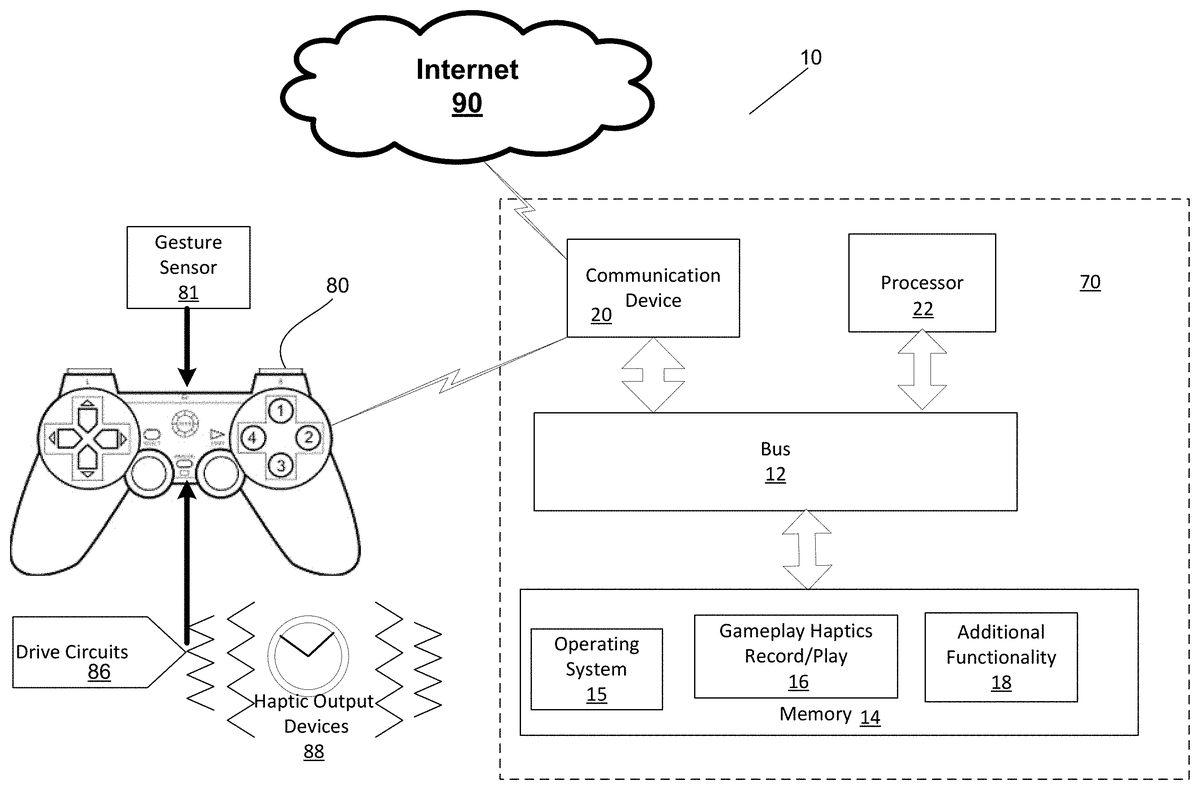
FIG. 1is a block diagram of a system10that can implement embodiments of the present invention. System10includes a server70coupled to an endpoint80via a communications link that can be wired or wireless. Endpoint80can be a video game controller, as shown inFIG. 1, or any type of device that can generate haptic effects in conjunction with a video game. Server70can be any processing device that implements the functionality disclosed herein.
System10includes a bus12or other communication mechanism for communicating information, and a processor/controller22coupled to bus12for processing information. Processor22may be any type of general or specific purpose processor. System10further includes a memory14for storing information and instructions to be executed by processor22. Memory14can be comprised of any combination of random access memory (“RAM”), read only memory (“ROM”), static storage such as a magnetic or optical disk, or any other type of computer-readable medium.
A computer-readable medium may be any available medium that can be accessed by processor22and may include both a volatile and nonvolatile medium, a removable and non-removable medium, a communication medium, and a storage medium. A communication medium may include computer readable instructions, data structures, program modules or other data in a modulated data signal such as a carrier wave or other transport mechanism, and may include any other form of an information delivery medium known in the art. A storage medium may include RAM, flash memory, ROM, erasable programmable read-only memory (“EPROM”), electrically erasable programmable read-only memory (“EEPROM”), registers, hard disk, a removable disk, a compact disk read-only memory (“CD-ROM”), or any other form of a storage medium known in the art.
In one embodiment, memory14stores software modules that provide functionality when executed by processor22. The modules include an operating system15that provides operating system functionality for system10. The modules further include a gameplay haptics record/play module16that records and/or plays haptic effects in conjunction with a video game, as disclosed in more detail below. System10will typically include one or more additional application modules18to provide additional functionality, such as Haptic Studio™ software by Immersion Corporation, or video game related software.
System10, further includes a communication device20, such as a network interface card, to provide mobile wireless network communication, such as infrared, radio, Wi-Fi, or cellular network communication. In other embodiments, communication device20provides a wired network connection, such as an Ethernet connection or a modem. Communication device20enables endpoint80to be communicatively coupled to server70, and communicatively couples server70to external networks such as Internet90.
Endpoint80, in one embodiment is a game controller that includes known user interface devices, such as buttons, bumpers, joysticks, triggers, directional pads, driving wheels, etc. Endpoint80includes one or more haptic output devices88coupled to one or more drive circuits86. Endpoint80further includes a gesture sensor81that senses the gestures when a video game player interacts with endpoint80, such as the pushing of a button, the squeezing of a trigger, etc.
Haptic output device88may be any type of device that generates haptic effects. In one embodiment, haptic output device88is an actuator that generates vibratory type haptic effects. Actuators used for this purpose may include an electromagnetic actuator such as an Eccentric Rotating Mass (“ERM”) in which an eccentric mass is moved by a motor, a Linear Resonant Actuator (“LRA”) in which a mass attached to a spring is driven back and forth, or a “smart material” such as piezoelectric, electroactive polymers or shape memory alloys. Haptic output device88may also be a device such as an electrostatic friction (“ESF”) device or an ultrasonic surface friction (“USF”) device, or a device that induces acoustic radiation pressure with an ultrasonic haptic transducer. Other devices can use a haptic substrate and a flexible or deformable surface, and devices can provide projected haptic output such as a puff of air using an air jet, etc.
Haptic output device88may further be any type of device that causes user interfaces of endpoint80to “move” or otherwise generate haptic effects in order to mimic the physical interactions of a player on an endpoint that is the same or similar as endpoint80. For example, if a player presses a button on a game controller, endpoint80, in the form of the same type or similar game controller, will cause one its buttons to be similarly depressed through the use of a haptic output device88, such as a motor.
Endpoint80may be a game controller, as described above, or any type of peripheral device, handheld device, or mobile device, such a cellular telephone, personal digital assistant (“PDA”), smartphone, computer tablet, gaming console, etc., or may be any other type of device that provides a user interface and includes a haptic effect system that includes one or more haptic output devices. In addition to buttons, joysticks, etc., the user interface may be a touch sensitive surface, or endpoint80may be a flexible/bendable device that generates haptic effects when physically manipulated, in which case the “user interface” is the flexible/bendable portion of the device itself.
Processor22outputs the control signals to drive circuit86, which includes electronic components and circuitry used to supply haptic output device88with the required electrical current and voltage (i.e., “motor signals”) to cause the desired haptic effects to be generated.
Although shown as separate systems inFIG. 1, endpoint80and server70may be combined into a physical single system, or any functionality shown inFIG. 1may be separated from or included within endpoint80.
For video games that generate haptic effects during gameplay, the various haptic effects, such as vibrations, will typically be generated on the game controller. In one embodiment, these haptic effects, that are “felt” by the video game player or “gamer”, are recorded so that they can be played back during a gameplay video. Therefore, a “viewer” of the gameplay video, while holding a similar game controller, can feel the haptic effects that are being felt by the gamer. In another embodiment, during gameplay, the player's inputs (i.e., interactions with the player's game controller, such as pushing of buttons, etc.) are recorded so that they can be played back during a gameplay video.
Further, recorded haptic effects can be played back during a video gameplay. In one embodiment, the playback allows a viewer to feel the same haptic effects felt by the player, while the viewer is holding the same or a different endpoint that was used by the player. Therefore, video games that have implemented haptic effects can mirror/capture those haptic effects to viewers watching while adapting to any applicable peripheral that the viewer has during the viewing session.
In another embodiment, the playback allows the viewer to feel the player's interaction with the endpoint while playing the game, so that the viewer feels what the player does instead of what the player feels. This can be useful for tutorials/learning.
FIG. 2is a flow diagram of the functionality of system10ofFIG. 1when capturing haptic input during the playing of a video game, and playing back the captured haptic input, in accordance with an embodiment. In one embodiment, the functionality of the flow diagram ofFIG. 2(andFIG. 3below) is implemented by software stored in memory or other computer readable or tangible medium, and executed by a processor. In other embodiments, the functionality may be performed by hardware (e.g., through the use of an application specific integrated circuit (“ASIC”), a programmable gate array (“PGA”), a field programmable gate array (“FPGA”), etc.), or any combination of hardware and software. The functionality ofFIGS. 2 and 3can be performed by the same system10ofFIG. 1, or by different systems10ofFIG. 1(e.g., one system10for recording haptic effects, and a different system10for playing back the haptic effects)
At201, gameplay haptic effect capture begins. The initiation of the gameplay haptic effect capture can occur at the same time and coincide with audio/video gameplay capture. The initiation can begin in response to input from the player, can be automatically initiated at all times when gameplay occurs, such as during the entire gameplay or during a rolling window (e.g., the previous five minutes of gameplay will always be recorded and available), or using any known initiation method. In one embodiment, the initiation occurs automatically during significant events in the gameplay, such as when a player is “killed”.
At202, in one embodiment, the haptic effects felt by the player are recorded. For a game controller such as game controller80ofFIG. 1with multiple types of haptic output devices88, in multiple locations, the recorded haptic effects would include the identity/location of each haptic output device, as well as the haptic effect generated by the output device. The recorded haptic effects can be recorded inside the controller based on haptic commands it receives from an external processor or a device such as a gaming console (e.g., gaming console70), or the recorded haptic effects can be recorded inside the console based on haptic commands generated by the content or game.
The haptic effect can be recorded as a haptic effect signal that includes haptic parameters. In general, high level parameters that define a particular haptic effect include magnitude, frequency and duration. Low level parameters such as streaming motor commands could also be used to determine a particular haptic effect. A haptic effect may be considered “dynamic” if it includes some variation of these parameters when the haptic effect is generated or a variation of these parameters based on a user's interaction. Directionality may be another parameter, such as if a trigger were pushing out or pulling in. Other parameters can be related to the envelope of the effect, such as the length/rate of attack and decay.
At203, in another embodiment, or as a separate haptic track from the haptic track of202, the haptic effects that are recorded are based on the input interactions of the player. Gesture sensor81senses the player's interactions with endpoint80, such as the pushing of buttons, the squeezing of triggers, the pressing of gamepads, the motion or orientation of the controller, etc. The sensing can include the force of the interactions, the frequency/timing of interactions, etc. The sensing data is converted to corresponding haptic effects that would simulate the player's interactions on another endpoint80during playback.
After the recording at either202or203(or in other embodiments, both types of recording can be made), at204the recorded haptic effects are encoded/combined in the form of a haptic track per haptic output device and/or a separate track for202and203. In one embodiment, for each haptic output device in the playback endpoint, a separate haptic effect track will be generated. The haptic effect track may vary depending on the type/properties of the intended haptic output device that will be used for playback. In some embodiments, the haptic output device on the playback endpoint will be identical to the corresponding haptic output device on the recording endpoint, such as when identical game controllers are used. In other embodiments, when different endpoints are used, the number/type/location, etc., of the haptic output devices may differ between the two endpoints.
For example, recording a game player pushing a button or pulling a trigger can generate a haptic effect that is generated for the viewer's controller that will pull in and push out the button/trigger, rendering the input as a haptic effect. If the button is pressed with enough force, speed, or at a maximum throw, then the effect might render both a pull and push for the viewer. However, if a trigger/button is lightly pulled or pressed, it might render effects only in one direction to further illustrate to the viewer the force exerted on the button/trigger.
In conjunction with204, at205the gameplay player can modify/remove any captured haptic effects or insert new haptic effects in a “post-production” period prior to finalizing. The effects available for the player to add may be contextually based on the effects captured, the type of game/genre, achievements/awards unlocked, and the recorded actions of the game. For example, there likely would not be an option to add a galloping pony across a war zone, as this would not fit into the context of the game.
At206, the haptic track or tracks are encoded with the audio/video tracks using known encoding methods. As a result, the timing of the haptic tracks will be synchronized with the audio/video tracks.
At207, for playback of the gameplay, which would include the haptic/audio/video tracks, the haptic enabled playback device compatibility with the recorded tracks is determined. If the playback device is the same as the recording device, 100% compatibility is achieved. However, in other situations, the playback device will be different than the recording device. The differences can include the number/type/location/etc. of the haptic output devices. The different types of devices can include whether or not an actuator is capable of multiple directions or multiple frequencies, or where in the device the actuator may be mounted (e.g., relevant to tuning parameters).
At208, in conjunction with207, it is determined if the playback device has fewer or different actuators than are in the recording device, or that are otherwise referenced in the original recorded track.
If yes at208, during playback, a mix-down of the haptic track is decoded, as disclosed in more detail in conjunction withFIG. 3.
If no at210, during playback, the appropriate haptic track is decoded, as disclosed in more detail in conjunction withFIG. 3.
AlthoughFIG. 2describes the “automatic” recording of haptic effects along with the gameplay, in other embodiments the haptic effects can be added manually using haptic authoring tools. A game might have pre-set badges, stickers, emoticons, icons, animations, etc., with associated haptic effects that may be added to captured gameplay. Alternatively, they might be contextualized as disclosed above. Additionally, games may enable players to perform specific game functions in isolated environments to capture audio, visual, or haptic effects to add in a post-production capacity.
FIG. 3is a flow diagram of the functionality of system10ofFIG. 1when decoding a haptic track for playback that was previously encoded in accordance with an embodiment.
At301, the encoded haptic track is received. The haptic track may have been encoded as described in conjunction withFIG. 2.
At302, the actuators, or haptic output devices, that were the source of the haptic track are determined. In an embodiment where the haptic effects are felt by the player, the type/location/etc. of each haptic output device is determined. For the embodiment where the player's input is recorded, the type/location/etc. of the interface that received the player's input would be recorded (e.g., left button, right trigger, etc.).
At303, the types/locations/etc. of the actuators, or haptic output devices, of the playback device are determined.
At304, it is determined if the haptic output devices are the same. In most circumstances, they will be the same at304only when the playback device and recording device are identical types of devices, such as the same type of game controller.
If yes at304, at305the haptic track is decoded and the source haptic track is played, along with the source audio/video track during a gameplay video.
If no at304, at306the capabilities of the playback device, in terms of number/type/location of haptic output devices is determined.
At307, the haptic track is modulated to account for the determined capabilities at306. Modulation of haptic track may be determined in numerous ways. In one embodiment, it can be based on frequency. For example, if a source haptic effect was created on an actuator with a similar operating frequency to the playback actuator, the signal may be modified very little compared to when the playback actuator has a vastly different operating frequency than the source. Further, tracks designed for multi-frequency capable actuators may have effects split and routed to actuators capable of the appropriate frequency in a multi-actuator device (without an identical actuator to the source material).
Effects may also be modulated by actuator response times. For example, a trigger actuator may have a fast response time and may translate well directly to an LRA. However, trigger effect signals would need to be changed from periodic gap-like effects to solid signal effects for certain low ERM actuators, and vice versa.
At308, the source haptic tracks are decoded.
At309, the new track is rendered and played.
In one embodiment, the haptic track includes a timeline, and a “null” signal or a haptic signal at various points on timeline indicating that a haptic effect should not, or should be generated at that time. In another embodiment, the haptic track specifies a particular time to play a particular haptic effect, as identified by an identity of a pre-stored haptic effect signal, or the actual haptic effect signal.
As disclosed, embodiments record a haptic track that is combined with audio/video tracks of a video gameplay. In one embodiment, the user records gameplay video that does not have haptics. The user can then employ a haptic authoring tool to add haptic effects to the video.
In another embodiment, the user records gameplay video, which also records a haptic track based on the haptic effects generated by the game. This haptic track would feel the same (if the viewer were holding the same peripheral), or it may be simplified for other actuators.
In another embodiment, the user records a gameplay video and the haptic track is generated based on the input of the user during gameplay of the player. If the player were to use the same haptically-enabled peripheral, they would feel the buttons that the player pressed while playing the game. Otherwise, the haptic effects can be modified for different actuators.
In another embodiment, the user is playing in a video game tournament that is being broadcast live. The viewers can then enable haptics to feel what the player(s) (depending on who they lock their camera onto) press in real time.
In another embodiment, the user is playing a video game that is being broadcast live. The viewers can feel the same effects as the player when using the same peripheral or a simplified track for alternate actuators.
In another embodiment, a localized streaming of effects (both from the gameplay and the player input) is provided. For example, other game controllers, such as those held by an observer of the game locally, can feel the same haptic effects as the player of the game.
As disclosed, embodiments allow for the recording of haptic effects generated during gameplay, or player inputs applied during gameplay. As a result, during playback of the gameplay, or “live” during the gameplay, the viewer can feel the same haptic effects that are felt by the player, or can feel the inputs applied by the player.
Several embodiments are specifically illustrated and/or described herein. However, it will be appreciated that modifications and variations of the disclosed embodiments are covered by the above teachings and within the purview of the appended claims without departing from the spirit and intended scope of the invention.
Claims
- A method for reproducing haptic interactions, the method comprising: receiving a video track and a haptic track, the video track synchronized with the haptic track, and the haptic track generated according to a first input interaction on a first endpoint;generating a modified haptic track based on the haptic track and at least one of a user input or a second endpoint;and transmitting an output that includes the video track and the modified haptic track, wherein the output is configured to generate a second input interaction on the second endpoint, wherein the second input interaction reproduces the first input interaction.
- The method according to claim 1 , wherein the second endpoint includes one or more haptic output devices to generate the second input interaction.
- The method according to claim 1 , wherein the video track includes a video game and the first input interaction includes an application of force on the first endpoint by a player of the video game.
- The method according to claim 3 , wherein the second input interaction is generated in real-time and is synchronized with a display of a real-time stream of the video track.
- The method according to claim 4 , wherein the real-time stream of the video track is displayed live while the player interacts with the video game using the first endpoint.
- The method according to claim 1 , wherein the first endpoint includes a game controller, and the first input interaction includes a physical interaction with at least one of a button, a trigger, a bumper, a joystick or a directional pad.
- The method according to claim 6 , further comprising: determining if the second endpoint, different from the first endpoint, is a same type as the first endpoint, wherein the output is configured to reproduce the first input interaction to generate the second input interaction on the second endpoint based at least in part on the determining.
- The method according to claim 6 , wherein the output is configured to simplify the first input interaction that are reproduced to generate the second input interaction when the second endpoint has different capabilities than the first endpoint.
- A non-transitory computer readable storage medium storing one or more programs configured to be executed by a processor, the one or more programs comprising processor-executable instructions configured to cause the processor to: receive a video track and a haptic track, the video track synchronized with the haptic track, and the haptic track generated according to a first input interaction on a first endpoint;generate a modified haptic track based on the haptic track and at least one of a user input or a second endpoint;and transmit an output that includes the video track and the modified haptic track, wherein the output is configured to generate a second input interaction on the second endpoint, wherein the second input interaction reproduces the first input interaction.
- The non-transitory computer readable storage medium according to claim 9 , wherein the second endpoint includes one or more haptic output devices to generate the second input interaction.
- The non-transitory computer readable storage medium according to claim 9 , wherein the video track includes a video game and the first input interaction include an application of force on the first endpoint by a player of the video game.
- The non-transitory computer readable storage medium according to claim 11 , wherein the second input interaction is generated in real-time and is synchronized with a display of a real-time stream of the video track.
- The non-transitory computer readable storage medium according to claim 12 , wherein the real-time stream of the video track is displayed live while the player interacts with the video game using the first endpoint.
- The non-transitory computer readable storage medium according to claim 9 , wherein the first endpoint includes a game controller, and the first input interaction include a physical interaction with at least one of a button, a trigger, a bumper, a joystick or a directional pad.
- A device comprising: a processor;and a memory storing processor-executable instructions configured to cause the processor to: receive a video track and a haptic track, the video track synchronized with the haptic track, and the haptic track generated according to a first input interaction on a first endpoint;generate a modified haptic track based on the haptic track and at least one of a user input or a second endpoint;and transmitting an output that includes the video track and the modified haptic track, wherein the output is configured to generate a second input interaction on the second endpoint, wherein the second input interaction reproduces the first input interaction.
- The device according to claim 15 , wherein the second endpoint includes one or more haptic output devices to generate the second input interaction.
- The device according to claim 15 , wherein the video track includes a video game and the first input interaction includes an application of force on the first endpoint by a player of the video game.
- The device according to claim 17 , wherein the second input interaction is generated in real-time and is synchronized with a display of a real-time stream of the video track.
- The device according to claim 18 , wherein the real-time stream of the video track is displayed live while the player interacts with the video game using the first endpoint.
- The device according to claim 15 , wherein the first endpoint includes a game controller, and the first input interaction includes a physical interaction with at least one of a button, a trigger, a bumper, a joystick or a directional pad.
Disclaimer: Data collected from the USPTO and may be malformed, incomplete, and/or otherwise inaccurate.