U.S. Pat. No. 10,525,340
GAME CONSOLE CONTROLLER AND CONTROLLER SYSTEM FOR GAME CONSOLES
AssigneeHORI CO., LTD.
Issue DateJuly 10, 2018
Illustrative Figure
Abstract
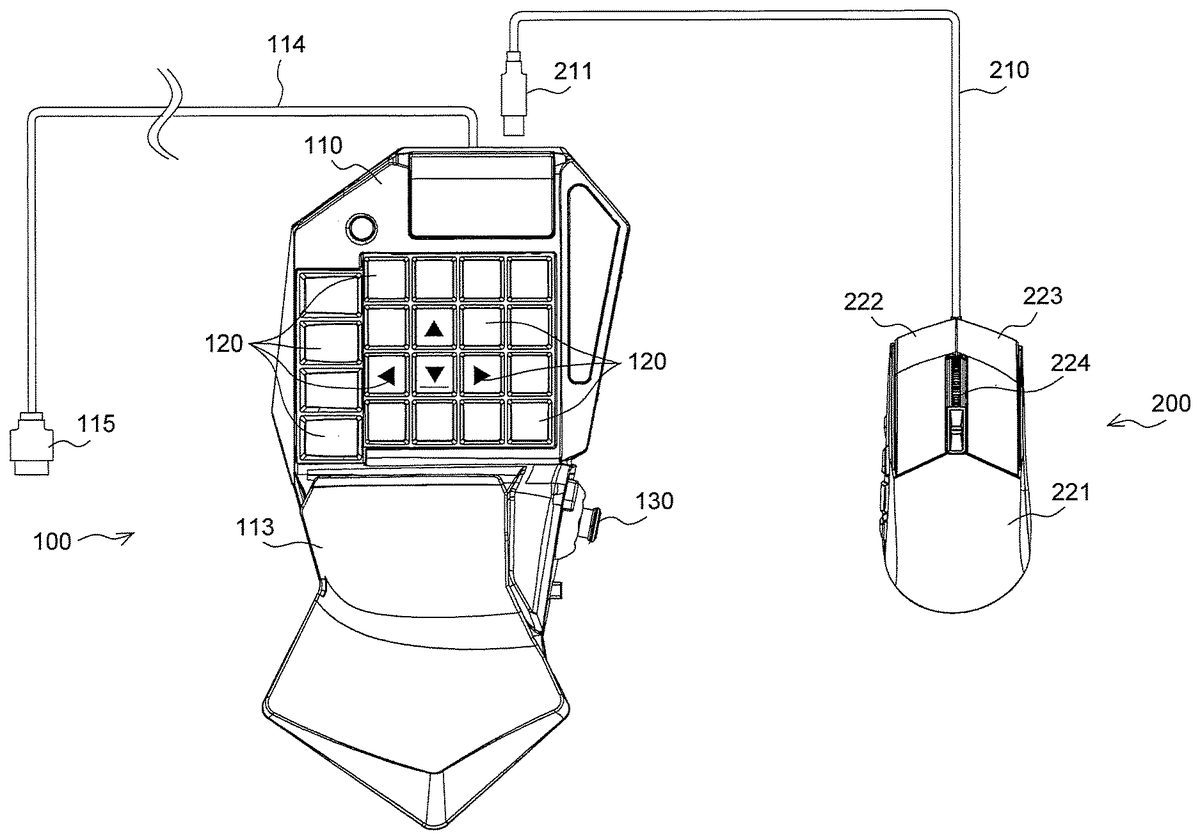
To allow users who usually play games on a personal computer to enter input to game consoles for domestic use without being stressed. A controller system for game consoles is made up of a game console controller 100 and a mouse 200. The mouse 200 is identical to an ordinary mouse. The game console controller 100 has a structure resembling a part of a keyboard that is used for common personal computers and equipped with at least six keys 120 in a 2-by-3 array. The mouse 200 and the game console controller 100 can be attached to and removed from each other via a cable 210 extending from the mouse 200. The connection between them is an USB connection.
Description
DETAILED DESCRIPTION Hereinafter, preferred embodiments of the present invention are described with reference to the drawings. FIG. 1shows a plan view of a controller system for a game console according to the present invention which is constituted by a combination of a controller for the game console and a mouse.FIGS. 2 and 3show a perspective view and six views, respectively, of a controller for a game console.FIGS. 4 and 5show a perspective view and six views, respectively, of a mouse. The controller system for game consoles is used to enter input to game consoles. The game console is a home console for domestic use such as PlayStation 4 (trademark) manufactured and sold by Sony Interactive Entertainment Inc. or Xbox One (trademark) manufactured and sold by Microsoft Japan Co., Ltd. The controller system for game consoles is used in combination with such game consoles, and the controller system in this embodiment is combined with, but not limited to, PlayStation 4. In use, the controller system for game consoles is placed on a mount surface which is a substantially horizontal surface. The mount surface may be any surface as long as it is substantially horizontal but is typically a top surface such as a top plate of a desk or a table. As described above, the controller system for game consoles includes a game console controller100and a mouse200. The mouse200has a cable210. In using the controller system for game consoles, the mouse200is connected to the game console controller100via the cable210as described later. Then, users enter input to the game console controller100in a similar manner that they enter input to an official controller by manipulating the game console controller100with one hand and the mouse200with the other hand. In this embodiment, a user manipulates the game console controller100and the mouse200with, but not necessarily limited ...
DETAILED DESCRIPTION
Hereinafter, preferred embodiments of the present invention are described with reference to the drawings.
FIG. 1shows a plan view of a controller system for a game console according to the present invention which is constituted by a combination of a controller for the game console and a mouse.FIGS. 2 and 3show a perspective view and six views, respectively, of a controller for a game console.FIGS. 4 and 5show a perspective view and six views, respectively, of a mouse.
The controller system for game consoles is used to enter input to game consoles. The game console is a home console for domestic use such as PlayStation 4 (trademark) manufactured and sold by Sony Interactive Entertainment Inc. or Xbox One (trademark) manufactured and sold by Microsoft Japan Co., Ltd. The controller system for game consoles is used in combination with such game consoles, and the controller system in this embodiment is combined with, but not limited to, PlayStation 4.
In use, the controller system for game consoles is placed on a mount surface which is a substantially horizontal surface. The mount surface may be any surface as long as it is substantially horizontal but is typically a top surface such as a top plate of a desk or a table.
As described above, the controller system for game consoles includes a game console controller100and a mouse200. The mouse200has a cable210. In using the controller system for game consoles, the mouse200is connected to the game console controller100via the cable210as described later.
Then, users enter input to the game console controller100in a similar manner that they enter input to an official controller by manipulating the game console controller100with one hand and the mouse200with the other hand. In this embodiment, a user manipulates the game console controller100and the mouse200with, but not necessarily limited to, his or her left and right hands, respectively.
First, the mouse200is described.
The mouse200in this embodiment may be a commercially available ordinary mouse that the user has chosen according to his or her preference. The mouse200may be an accessory of the game console controller100sold alongside the game console controller100.
The only requirements for the mouse200in this embodiment are: it is configured to be capable of generating point data indicating the amount and direction of movement of the mouse200when it is moved on the mount surface; it has the cable210for transmitting the point data generated; and the cable210has, at its one end, a standardized output terminal211to be connected to an input terminal described later on the game console controller100that receives the point data.
A way of generating point data is publicly or widely known, and a publicly- or widely-known appropriate technique can be applied thereto. For example, the mouse200may be an optical mouse or a laser mouse.
Furthermore, the mouse200has the standardized output terminal211as described above. With this, the mouse200can be connected to an input terminal described later which uses the same standard as the output terminal. The standard in this case is, for example, the USB standard. The USB standard includes Type A, Type B, Type C, Mini A, Mini B, Micro A, Micro B, etc. The output terminal211in this embodiment has, but not limited to, a USB standard Type A configuration. In fact, various kinds of such mice are commercially available.
As described above, the mouse200is required to be able to generate point data but can be configured such that users can enter other data as in the case of publicly- or widely-known mice. The mouse200in this embodiment has, but not limited to, a left button222and a right button223for so-called left-click and right-click, respectively, at positions near an end of a mouse housing221attached to a mouse main body220, and a wheel224that allows users to input their responses by rolling it. The mouse200is also equipped with, on its left side, but not limited to, four push buttons225to228at positions where it is easier for users to manipulate the push buttons225to228with their thumb when they use the mouse with their right hand. The left button222, the right button223, the wheel224, and four push buttons225to228may or may not be assigned with appropriate inputs. When the left button222, the right button223, the wheel224, and the four push buttons225to228are assigned with certain inputs, the data generated as a result of their activations can also be outputted from the output terminal211via the cable210.
Next, the game console controller100is described.
The game console controller100includes a base110which corresponds to the main body of the present invention. The base110is configured so as to be stably placed on the mount surface. The base110has a substantially rectangular shape with its longer sides aligned along the front-to-back direction when viewed in plan, and has a substantially plate-like shape when viewed as a whole. The base110has anti-slip pieces111made of a resilient material (e.g., rubber) on the bottom surface thereof. With them, the base110hardly slip on the mount surface when the base110is placed thereon and rest stably on the mount surface.
The controller100has an input terminal112on the front side thereof. The input terminal112can be connected to the output terminal211of the mouse200described above, and is capable of receiving, when connected to the output terminal211, the aforementioned point data from the output terminal211(and, when appropriate, data generated by the left button222, the right button223, the wheel224, and the four push buttons225to228). The input terminal112is a standardized terminal. This increases the chance for the input terminal112to be connected to output terminals211of many kinds of mice200. An example of the standard used for the input terminal112is, but not limited to, the USB standard. The USB standard includes Type A, Type B, Type C, Mini A, Mini B, Micro A, Micro B, etc. The input terminal112in this embodiment has, but not limited to, a USB standard Type A configuration. It should be noted that providing two or more input terminals112for different standards can increase the number of mice200that can be connected to the game console controller100, allowing the users to have a wider choice of the mice200.
In a predetermined area on a front side of the top surface of the base110, twenty keys120are arranged in a 4-by-5 array (with 4 rows and 5 columns). Each of the keys120is for accepting inputs by user's pressing it against the base110. The keys120can be configured in the same manner as the keys of publicly- or widely-known keyboards except for their number and layout and, in this embodiment, are configured so. For example, as a way of entering input through the keys120, any one of publicly- or widely-known approaches can be used such as those used in membrane keyboards, scissor-switch keyboards, and mechanical keyboards.
The keys120are arranged in an area where the user can manipulate the keys with a hand, more specifically, the left finger(s) in this embodiment, without displacing the entire left hand. As long as this requirement is met, the number of the keys120may be larger or smaller. As will be described later, the keys120are often assigned with four inputs corresponding to the up, down, left, and right directions of a four-button directional pad of an official controller of a game console. Accordingly, at least four keys120are required. The keys of the keys120expected to be assigned by most users with the up, down, left, and right inputs are labeled with black arrow heads each having a shape of an equilateral triangle so that users can visually recognize that the keys120are assigned with the inputs of the four directions (up, down, left, and right) (the arrowheads are shown only inFIG. 1). These arrow heads are, for example, embossed in relief or printed on the top of each key120. InFIG. 1, the keys120from the second key from the left to the second key from the right in the third row from the top are labeled with arrowheads pointing the left, down, and right directions. This means that these three keys120are expected to be assigned with the left, down and right inputs. The key120that is located immediately above the key120expected to be assigned with the down input inFIG. 1is labeled with an arrow head pointing up. This means that this key120is expected to be assigned with the up input.
The keys120may be six keys120(arranged in a 2-by-3 array), i.e., the three keys120expected to be assigned with the left, down, and up inputs in the third row inFIG. 1and the three keys120in the second row immediately above.
It is possible that a raised element that marks the home position may be provided on the top surface of any one of the keys120such as the key120assigned with the down input.
The game console controller100has a palm rest113with an upwardly convex contour which locates closer to the user who is using the game console controller100(i.e., the lower side inFIG. 1) than the keys120, which are provided on the base110.
The palm rest113is for allowing users to rest their palm thereon in a stable manner. Users can, with their left palm placed on the palm rest113, manipulate the keys120with their four fingers other than the thumb and manipulate an analog stick described later with their left thumb. In this embodiment, the palm rest113has, but not limited to, the entirely upward convex shape as well as the inner side (right side inFIG. 1) that is higher than the outer side. This makes it easier for users to manipulate the analog stick described later with their left thumb and ensures a space to displace the analog stick.
To the base110, an analog stick130is attached. The analog stick130has, but not limited to, for example, a rod shape, and includes an umbrella-like member at the end thereof for stabilizing the user's manipulation with the thumb. The analog stick130is for entering analog input using the direction and magnitude of the displacement.
The analog stick130is, but not limited to, located inward at a position closer to the user than the keys120in this embodiment. The analog stick130in this embodiment protrudes substantially horizontally from the inside of the aforementioned palm rest113. With the analog stick130disposed at this position, users can manipulate the analog stick130with their left thumb contacted with the tip of the analog stick without putting too great a load on their thumb, while placing their left palm on the palm rest113.
Inside the base110, a built-in circuit board which is not shown is provided. The circuit board is publicly- or widely-known substrates on which publicly- or widely-known electronic components are mounted using a publicly- or widely-known method and forms a functional block as shown inFIG. 6.
The block is made up of an input decision unit151, a key data generation unit152, an output unit153, an input determination unit154, and a recording unit155.
The input decision unit151is for determining, when the key(s)120or the analog stick130is/are activated, whether the input is data representing an input to be transmitted to the game console or data for determining which input is to be assigned to which key120. The input decision unit151is configured to transmit, when the input from the key(s)120or the analog stick130is the data representing an input to be transmitted to the game console, the data to the key data generation unit152, and transmit, when the input is the data for determining which input is to be assigned to which key120, the data to the input determination unit154.
More specifically, for example, in this embodiment, when a user holds the analog stick130at a downwardly displaced position for 5 seconds or more, the game console controller100proceeds to an input setting mode unless the analog stick130is further held at the downwardly displaced position for 5 seconds or more. The input decision unit151is configured to transmit the data entered through the analog stick130or the key(s)120at any time from the beginning to the end of the input setting mode to the input determination unit154as the data for determining which input is to be assigned to which key120. The input decision unit151is also configured to transmit, when the game console controller100is not in the input setting mode, the input from the analog stick130or the key(s)120to the key data generation unit152as the data representing the input to be transmitted to the game console.
Furthermore, the input decision unit151is also connected to the input terminal112and is configured to receive, from the input terminal112, the data that the input terminal112has received from the mouse200. The input decision unit151is configured to transmit the data received from the mouse200to the input determination unit154when the game console controller is in the input setting mode and transmit it to the key data generation unit152when the game console controller is not in the input setting mode.
The input determination unit154is for determining which input is to be assigned to which one of the keys120, the analog stick130, and the mouse200(i.e., which input corresponding to which input that can be entered using an official controller for game consoles is to be assigned to which device or devices). Any method can be used for the determination but, for example, when the game console controller100is in the input setting mode, to the key(s)120with which input is entered after the user manipulates certain key(s)120(e.g., pressing two or more keys120in a certain order) in order to identify a certain input of an official controller for game consoles, the certain input of the official controller specified as a result of the activation of the aforementioned certain key(s)120can be assigned. For example, the official controller for PlayStation 4 is equipped with, on the right side thereof, four push buttons labeled with circle, cross, triangle, and square symbols. Then, for example, it is assumed that the input from the button labeled with the circle symbol is identified by pressing, among many keys120, the left three keys120on the first row one by one from the left. The input determination unit154is configured to determine that, in such cases, when the key120located to the upper left of the key120labeled with an upward arrow is pressed immediately after the input is entered by pressing the aforementioned three keys120one by one to identify the input from the button assigned with the circle symbol, the input from the key120which is made when the game console controller100is not in the input setting mode is considered (dealt with) as the input from the push button labeled with the circle symbol of the official controller for game consoles. The input determination unit154is configured to record, on the recording unit155, the data representing which one of the inputs that can be entered from the official controller is assigned to each key.
The input determination unit154may, if the user desires to do so, assign certain inputs that can be entered from the official controller for game consoles to the left and right buttons222and223, the wheel224, and four push buttons225to228of the mouse200. When the game console controller100is in the input setting mode, certain inputs are assigned to the left and right buttons222and223, the wheel224, and four push buttons225to228of the mouse200according to the data transmitted from the mouse via the input decision unit151from the input terminal112. More specifically, for example, the input determination unit154is configured to, if the push button225of the mouse200is pressed immediately after the input entered by pressing the aforementioned three keys120one by one to identify the input from the push button labeled with the circle symbol of the official controller, consider (deal with) the input from the push button225of the mouse200as the input from the push button labeled with the circle symbol of the official controller for game consoles.
As described above, the data indicating which one of the inputs that can be entered from the official controller is assigned to each key120is recorded on the recording unit155. These data are updated every time when the assignment is changed. Among the data, the latest one is supplied to the key data generation unit152.
The key data generation unit152is configured to receive, when the game console controller100is not in the input setting mode, inputs from the keys120, the analog stick130, or the left button222, the right button223, the wheel224, and the four push buttons225to228of the mouse200.
The key data generation unit152is for identifying, when the key(s)120and others are activated, from which one of the keys120and others each input is made and generating key data which is the data about the output assigned to the key (s)120and others activated, based on the data recorded on the recording unit115and received from the recording unit155. The key data generation unit152may be configured to read the data recorded on the recording unit155from the recording unit155every time when the data on the recording unit155is updated, or may be configured to read the latest data from the recording unit155every time an input is received from one of the key(s)120and others. The same applies to cases where an input is made from an interface other than the keys120. The key data generation unit152is configured to generate key data which is the data about the output assigned to the left button222or others activated, in response to an input from the mouse, i.e., from one of the left button222, the right button223, the wheel224, and the four push buttons225to228.
Furthermore, the key data generation unit152of this embodiment is configured to generate, when the analog stick130is activated, analog data indicating the displacement direction and angle of it. The output unit153has functions to receive the key data and the analog data from the key data generation unit152, receive the point data from the input terminal112, and output the key data, analog data, and point data.
On the front side of the base110, an output cable114is provided. The output unit153is configured to transmit the point data, the key data, and the analog data to the game console via the output cable114. A connection terminal115is provided at an end of the output cable114to allow the output cable114to be connected to the game console via the connection terminal115. The connection terminal115is designed to be connected to a terminal on the game console for the terminal on the game console.
In this embodiment, the output unit153is configured to wire the point data, the analog data, and the key data to the game console via the output cable114but the output unit153may be configured to transmit the point data, the analog data, and the key data to the game console wirelessly by media such as radio waves and light.
Next, how to use the controller system for game consoles described above and operations thereof are described.
In using the controller system for game consoles, the user places the game console controller100and the mouse200on the mount surface (whichever may come first). Then, the user first connects the game console controller100and the mouse200via the cable210and connects the game console controller100and the game console via the output cable114.
The game console controller100and the mouse200are connected to each other by plugging the output terminal211at the end of the cable210of the mouse200into the input terminal112of the game console controller100. The game console controller100and the game console are connected to each other by plugging the connection terminal115at the end of the output cable114into a connection terminal (not shown) of the game console.
Next, the user shifts the game console controller100to the input setting mode in order to determine to which one of the inputs from the official controller for the game console each of the inputs from the keys120of the game console controller100, the input from the analog stick130, and the input about the movement of the mouse200corresponds. As described above, in the input setting mode, an input may be assigned to, if necessary, each of the left button222, the right button223, the wheel224, and the four push buttons225to228of the mouse200. The user can shift the game console controller100to the input setting mode by means of, but not limited to, pressing and holding the analog stick130of the game console controller for 5 seconds or more in this embodiment.
As described above, commercially available game consoles are equipped with a four-button directional pad and an analog stick located on the left half, and four push buttons and an analog stick located on the right half. The user can assign inputs from these devices for entering input to respective inputs from the keys120and others of the game console controller100according to his or her preference.
For example, the user can assign the up, down, left, and right inputs entered through the four-button directional pad of an official controller to the keys120of the game console controller100which are labeled with upward, downward, leftward, and rightward arrow heads, respectively. As a result, when the user presses these keys120labeled with the upward, downward, leftward, and rightward arrow heads with the game console controller100not in the input setting mode, the data that are same to those produced when the four-button directional pad of the official controller is pressed in the upward, downward, leftward, and rightward directions are sent to the game console. The same applies to below.
The user assigns the input entered through the right analog stick of the two analog sticks of the official controller to the movement of the mouse200.
Furthermore, the user assigns the input entered through the left analog stick of the two analog sticks of the official controller to the analog stick130of the game console controller100.
The user also assigns each of the inputs entered through the four push buttons of the official controller to each of the left button222, the right button223, the wheel224, and the four push buttons225to228of the mouse200, or to each of the keys120that have not yet been assigned with anything, other than the four keys120labeled with the arrow heads.
The official controller of the game console has additional six buttons that allow users to enter certain input by pressing them, such as L1, L2, L3, R1, R2, and R3 buttons of a controller for PlayStation 4. The user can assign inputs associated with these buttons to the left button222, the right button223, the wheel224, and the four push buttons225to228of the mouse200or the keys120of the game console controller100which have not yet been assigned with anything. Furthermore, the user can assign an input that occurs when two or more operations of the input device of the official controller are done, to one of the keys120and others which have not yet been assigned with anything. With this, it is possible to allow users to send, merely by operating one of the keys120and others of the game console controller100, to the game console, the data that are identical to simultaneous pressing of, for example, one of the four push buttons and the up input of the four-button directional pad of the official controller used when the user controls the official controller. This makes it possible to achieve, by a simple operation of, for example, pressing one of the keys120of the game console controller, a complicated input that can be achieved only after two or more operations are performed using the official controller of the game console.
It should be noted that, among the assignments described above, assignment of the input associated with the left analog stick of the two analog sticks of the official controller to the analog stick130of the game console controller100is more likely to be accepted by many users. Accordingly, this can be recorded previously, as a default setting, on the recording unit155of the game console controller at the time of shipment.
In any case, the data indicating which input that can be entered from the official controller is assigned to which one of the keys120and others is recorded on the recording unit155by the input determination unit154.
The user again presses and holds the analog stick130at a downwardly displaced position for 5 seconds or more to terminate the input setting mode.
After the user have completed the input setting mode in a manner as described above, he or she can play a game using the controller system for game consoles.
The user manipulates, while resting his or her left palm on the palm rest113of the game console controller100, the key(s)120with the finger(s) other than the thumb and manipulates the analog stick130with the thumb. In addition, the user holds the mouse200with the right hand to move the mouse200and manipulates the left button222, the right button223, and the four push buttons225to228of the mouse200when appropriate. Users who are familiar with gaming on a general-purpose personal computer are not stressed by these manipulations.
When the user manipulates the key(s)120, key data is generated in the key data generation unit152. When the user manipulates the left button222, the right button223, the wheel224, and the four push buttons225to228of the mouse200, data corresponding to the respective devices are generated by the mouse200and sent to the game console controller100via the cable210. These data are sent to the key data generation unit152, and the key data generation unit152generates key data depending on the received data. When the user manipulates the analog stick130, analog data is generated. The key data and the analog data are transmitted from the key data generation unit152to the output unit153.
On the other hand, when the user moves the mouse200, point data is generated by the mouse200and is sent to the game console controller100via the cable210. Although the point data need not to be necessarily sent to the key data generation unit152, the point data in this embodiment is sent to the key data generation unit152and, in turn, to the output unit153without being processed in the key data generation unit152.
The output unit153in the game console controller100transmits the received key data, analog data, and point data to the game console via the output cable114.
In this way, the game is performed.
Once the game is over, the user releases the connection between the game console controller100and the mouse200as well as the connection between the game console controller100and the game console.
It is, of course, possible to change the aforementioned assignments to the key(s)120and others when, for example, the user want to play another game.
The mouse200and the game console controller100in this embodiment are connected to each other using a wired connection via the cable114.
Alternatively, the game console controller100and the mouse200may be connected to each other wirelessly by media such as radio waves and light and the point data generated by the mouse200and the data generated upon activation of the left button222, the right button223, and the four push buttons225to228of the mouse200may be transmitted from the mouse200to the game console controller100wirelessly.
However, even in this case, the communication between the game console controller100and the mouse200should be achieved in a standardized manner as in the case that the aforementioned output terminal211and the input terminal112are both standardized. Examples of the standardized communication include the Bluetooth™ communication technology or the technology for the wireless USB protocol.
Claims
- A game console controller for use with a computer mouse capable of generating point data indicating an amount and direction of movement of the mouse by way of a user and including a mouse output interface configured to transmit the point data to the game console controller, the game console controller comprising: a main body having a top surface and a bottom surface, the bottom surface capable of being stably supported on a substantially flat mount surface, the main body including a control unit having an input communication interface configured to receive data and an output communication interface configured to transmit data to a remote game console;a plurality of keys arranged on the top surface of the main body and configured to be actuable by the user to thereby generate key data when each of the keys are pressed, the keys being arranged in an area of the top surface of the main body where the user can actuate the keys;wherein the input communication interface of the control unit of the main body of the game console controller is configured to receive the generated point data from the mouse output interface;wherein the output communication interface of the control unit of the game console controller is configured to transmit the key data and the point data to the remote game console;and wherein the input communication interface of the control unit of the main body of the game console controller is a standardized input interface whereby the game console controller is capable of communicating with a plurality of different computer mice having a standardized mouse output interface.
- The game console controller of claim 1 , wherein the input communication interface of the control unit supports a wireless standard.
- The game console controller of claim 1 , wherein the input communication interface of the control unit includes an input terminal configured to releasably secure to an output terminal of a cable extending from the computer mouse to receive the generated point data from the mouse.
- The game console controller of claim 3 , wherein the input communication interface of the control unit supports the USB standard.
- The game console controller of claim 1 , wherein the plurality of keys includes three keys that are aligned in a row across a width of the main body of the game console controller and a forth key disposed on one side of the row of three keys.
- The game console controller of claim 5 , wherein the plurality of keys are programmable and each of the four keys are programmed to generate key data representing one of an up, a down, a left, and a right direction.
- The game console controller of claim 1 , further including an analog stick arranged with the main body and configured to be actuable by the user to thereby generate analog data according to a direction in which the analog stick is inclined.
- The game console controller of claim 7 , wherein the analog stick is arranged on a side surface of the main body of the game console controller.
- The game console controller of claim 1 , further including a palm rest arranged with the main body onto which a palm of the user can rest and located in a position such that a plurality of fingers of the user can actuate the plurality of keys to generate the key data.
- The game console controller of claim 9 , wherein the palm rest is configured in an upwardly extending convex shape.
- The game console controller of claim 9 , further including an analog stick arranged with the main body and configured to be actuable by the user to thereby generate analog data according to a direction in which the analog stick is inclined.
- The game console controller of claim 11 , wherein the analog stick is arranged on a side surface of the main body of the game console controller and located in a position such that a thumb of the user can actuate the analog to generate the analog data.
- A game console controller for use with a computer mouse having a standardized mouse output interface configured to transmit point data generated by movement of the mouse by a user, the game console controller comprising: a main body including a control unit having a standardized input communication interface configured to receive the point data from the standardized mouse output interface and an output communication interface configured to transmit data to a remote game console;a plurality of keys arranged on the main body and configured to be actuable by the user to thereby generate key data when each of the keys are pressed;wherein the output communication interface of the control unit of the game console controller is configured to transmit the key data and the point data to the remote game console;and wherein the game console controller is capable of communicating with a plurality of different computer mice having standardized mouse output interfaces by way of the standardized input communication interface of the control unit of the game console controller.
- The game console controller of claim 13 , wherein the standardized input communication interface of the control unit supports a wireless standard.
- The game console controller of claim 13 , wherein the standardized input communication interface of the control unit includes an input terminal configured to releasably secure to an output terminal of a cable extending from the computer mouse to receive the generated point data from the mouse.
- The game console controller of claim 15 , wherein the standardized input communication interface of the control unit supports the USB standard.
- The game console controller of claim 13 , further including an analog stick arranged with the main body and configured to be actuable by the user to thereby generate analog data according to a direction in which the analog stick is inclined.
- The game console controller of claim 17 , wherein the analog stick is arranged on a side surface of the main body of the game console controller.
- The game console controller of claim 13 , further including a palm rest arranged with the main body onto which a palm of the user can rest and located in a position such that a plurality of fingers of the user can actuate the plurality of keys to generate the key data.
- The game console controller of claim 19 , further including an analog stick arranged with the main body and configured to be actuable by the user to thereby generate analog data according to a direction in which the analog stick is inclined.
- A combination of a game console controller and a computer mouse, the combination comprising: a computer mouse capable of generating point data indicating an amount and direction of movement of the mouse by way of a user, the computer mouse including a standardized mouse output interface configured to transmit the point data;a game console controller comprising: a main body including a control unit having a standardized input communication interface configured to receive the point data from the standardized mouse output interface and an output communication interface configured to transmit data to a remote game console;a plurality of keys arranged on the main body and configured to be actuable by the user to thereby generate key data when each of the keys are pressed;wherein the output communication interface of the control unit of the game console controller is configured to transmit the key data and the point data to the remote game console;and wherein the game console controller is capable of communicating with the computer mouse by way of the standardized input communication interface of the control unit of the game console controller.
Disclaimer: Data collected from the USPTO and may be malformed, incomplete, and/or otherwise inaccurate.