U.S. Pat. No. 10,512,842
STORAGE MEDIUM, GAME DEVICE, AND GAME PROCESSING METHOD
AssigneeNintendo Co Ltd
Issue DateAugust 10, 2017
Illustrative Figure
Abstract
A storage medium according to a first aspect of the present invention is a non-transitory storage medium storing therein a game program that is readable by a computer in an information processing device. The game program causes the computer to execute: a game processing step of performing game processing, based on an operation by a player; a first event processing step of reproducing a predetermined event scene every timing at which a predetermined condition is satisfied during progress of a game; a memory monitoring step of monitoring a usage state of a memory during the progress of the game; and a second event processing step of, when an area available in the memory is insufficient, performing processing of reproducing the event scene and allocating an area available in the memory.
Description
DETAILED DESCRIPTION OF THE PREFERRED EMBODIMENTS A storage medium that stores a game program therein, a game device, and a game processing method according to an embodiment of the present invention will be described below with reference to the drawings. In the following, the game device will be schematically described first, and then the game program and the game processing method will be described. 1. Game Device 1-1. Appearance of Game Device With reference toFIG. 1, first, a description will be given of an appearance of the game device.FIG. 1is a perspective view that illustrates the appearance of the game device. As illustrated inFIG. 1, the game device10includes a casing1formed in a rectangular flat shape as seen in plan view. The casing1has a main surface on which a liquid crystal display (LCD)2is almost entirely disposed. The LCD2is formed in a rectangular shape. The LCD2has a surface on which a touch panel3is almost entirely disposed. The touch panel3is almost identical in shape to the LCD2. The touch panel3used herein is not particularly limited, and various types of touch panels may be employed, such as an electrostatic capacity type, a resistive film type, a planar scatter detection type, and an ultrasonic type. In addition, a player may tap his/her finger on the touch panel3or may tap a touch pen on the touch panel3. The touch panel3may also be of a single touch type or a multiple touch type. The casing1has both sides to which controllers6are mounted respectively. Each of the controllers6includes a housing61that can be grasped with one hand and is formed in a rectangular shape as seen in plan view, a plurality of (e.g., four) operation buttons62that are disposed on a main surface of the housing61, the main surface being directed on the same side as the main surface of the ...
DETAILED DESCRIPTION OF THE PREFERRED EMBODIMENTS
A storage medium that stores a game program therein, a game device, and a game processing method according to an embodiment of the present invention will be described below with reference to the drawings. In the following, the game device will be schematically described first, and then the game program and the game processing method will be described.
1. Game Device
1-1. Appearance of Game Device
With reference toFIG. 1, first, a description will be given of an appearance of the game device.FIG. 1is a perspective view that illustrates the appearance of the game device. As illustrated inFIG. 1, the game device10includes a casing1formed in a rectangular flat shape as seen in plan view. The casing1has a main surface on which a liquid crystal display (LCD)2is almost entirely disposed. The LCD2is formed in a rectangular shape. The LCD2has a surface on which a touch panel3is almost entirely disposed. The touch panel3is almost identical in shape to the LCD2. The touch panel3used herein is not particularly limited, and various types of touch panels may be employed, such as an electrostatic capacity type, a resistive film type, a planar scatter detection type, and an ultrasonic type. In addition, a player may tap his/her finger on the touch panel3or may tap a touch pen on the touch panel3. The touch panel3may also be of a single touch type or a multiple touch type.
The casing1has both sides to which controllers6are mounted respectively. Each of the controllers6includes a housing61that can be grasped with one hand and is formed in a rectangular shape as seen in plan view, a plurality of (e.g., four) operation buttons62that are disposed on a main surface of the housing61, the main surface being directed on the same side as the main surface of the casing1, and an analog stick63that is disposed on the main surface of the housing61. The analog stick63is disposed to be tiltable to the main surface of the housing61and is configured to allow a player to input, for example, directions. The analog stick63and the plurality of operation buttons62enable various game operations. In the following description, means for performing the game operations, including the analog stick63and the plurality of operation buttons62, but excluding the touch panel3, will be collectively referred to as an operating means65.
In addition, the casing1has an insertion slot (not illustrated) through which an external storage medium4is inserted, and a connector (not illustrated) that is disposed in the insertion slot and is electrically connected to the external storage medium4in a detachable manner. If necessary, the casing1may also be provided with various devices such as a camera, a speaker, and a microphone. In cases where a player performs game operations by voice, the operating means65may include a microphone.
1-2. Internal Configuration of Game Device
With reference toFIG. 2, next, a description will be given of an internal configuration of the game device10.FIG. 2is a block diagram that illustrates the internal configuration of the game device10. As illustrated inFIG. 2, the game device10includes an information processing part (control part)31in addition to the configuration illustrated inFIG. 1. The information processing part31is connected to, for example, a main memory32, an external storage medium interface (external storage medium I/F)33, a data storing internal storage medium34, a wireless communication module (communication part)35, an inertial sensor36, a power supply circuit37, and a plurality of interface circuits (I/F circuits)38. These electronic components are mounted on an electronic circuit board and are accommodated in the casing1. The information processing part31is also connected to the LCD2.
The information processing part31includes, for example, a central processing unit (CPU)311for executing a predetermined program, a graphics processing unit (GPU)312for performing image processing, and a video random access memory (VRAM)313. In this embodiment, the predetermined program is stored in a memory (e.g., the external storage medium4connected to the external storage medium I/F33, the data storing internal storage medium34) in the game device10. The CPU311of the information processing part31executes the predetermined program, thereby performing game processing (to be described later) and various kinds of processing based on the game processing.
In the information processing part31, the GPU312generates an image in accordance with a command from the CPU311and draws the image on the VRAM313. The GPU312then outputs the image drawn on the VRAM313to the LCD2connected to the information processing part31. The image is thus displayed on the LCD2.
The main memory32is a volatile storage means to be used as a work region and a buffer region for the CPU311. In other words, the main memory32temporarily stores therein various kinds of data for use in the processing described above and temporarily stores therein programs to be acquired from the outside (e.g., the external storage medium4, another equipment).
The external storage medium I/F33is an interface to which the external storage medium4is detachably connected. The external storage medium4is a nonvolatile storage means for storing a program to be executed by the information processing part31. The external storage medium4is constituted of, for example, a read-only semiconductor memory. When the external storage medium4is connected to the external storage medium I/F33, the information processing part31reads a program stored in the external storage medium4. The information processing part31executes the program thus read, thereby performing predetermined processing.
The data storing internal storage medium34is constituted of a readable and writable nonvolatile memory (e.g., a NAND flash memory) and is used for storing predetermined data. For example, the data storing internal storage medium34stores therein data and programs downloaded by wireless communications via the wireless communication module35.
The wireless communication module35is, for example, a Wi-Fi certified communication module. The wireless communication module35has a function of establishing connection with a wireless local area network (LAN) by a method conforming to, for example, IEEE 802.11a/b/g/n/ac. The information processing part31exchanges data with another game device by use of the wireless communication module35or exchanges data with another equipment via the Internet, for example.
The wireless communication module35also has a function of establishing wireless communications among a plurality of game devices in cases where a game is played among the plurality of game devices.
The inertial sensor36is configured to detect angular speeds about three axes (X, Y, and Z axes in this embodiment). The inertial sensor36may be, for example, at least one gyro sensor or acceleration sensor. In cases of employing a gyro sensor, the inertial sensor36detects an angular speed about the X axis extending in a shorter side direction of the casing1illustrated inFIG. 1, an angular speed about the Y axis extending in a longer side direction of the casing1, and an angular speed about the Z axis extending in a thickness direction of the casing1(i.e., a direction perpendicular to the main surface). The information processing part31receives data indicating the angular speeds detected by the inertial sensor36, such as a gyro sensor or an acceleration sensor, to calculate amounts of tilt of the casing1about the X, Y, and Z axes.
The power supply circuit37controls electric power from a power supply (not illustrated) of the game device10and feeds the electric power to the respective components of the game device10.
The game device10includes the plurality of I/F circuits38to which the touch panel3and the operating means65are connected respectively. The I/F circuit38, to which the touch panel3is connected, includes a touch panel control circuit that controls the touch panel3. The touch panel control circuit generates tapped position data in a predetermined format, based on a signal from the touch panel3and outputs the tapped position data to the information processing part31. The tapped position data indicates coordinates (touch information) of an input position on an input face of the touch panel3. The touch panel control circuit reads a signal from the touch panel3and generates tapped position data once a predetermined time. The information processing part31acquires the tapped position data to determine the input position on the touch panel3.
The I/F circuit38, to which the operating means65is connected, includes a control circuit that controls the operating means65. The control circuit generates operation data in a predetermined format, based on a signal from the operating means65and outputs the operation data to the information processing part31.
2. Management of Main Memory in Game Device
Next, a description will be given of management of the main memory32in playing a game using the game device10configured as described above.
2-1. Exemplary Data for Use in Game Processing
First, a description will be given of various kinds of data for use in the game processing to be performed by the game device10.FIG. 3illustrates various kinds of data that are stored in the main memory32and are used for the game processing. As illustrated inFIG. 3, the main memory32of the game device10has a game program area50, an object memory area51, a resource memory area52, and a data save area53. A description will be given of each of the areas.
The game program area50stores therein a game program for progress of a game. The game program is partially or entirely read from the external storage medium4or the data storing internal storage medium34and then is stored in the main memory32at appropriate timing after power-on of the game device10. A part of the game program (e.g., a program for calculating an orientation of the casing1) may be stored in the game device10in advance.
The object memory area51stores therein data on a program required for creating various objects appearing in a game (e.g., characters such as humans, backgrounds such as mountains and rocks). Hereinafter, the data will be referred to as object data items1,2,3, . . . for each object. The object memory area51is allocated in the main memory32by the game program.
The resource memory area52stores therein data on various files for creating objects. Hereinafter, the data will be referred to as file data items1,2,3, . . . for each file. The file data items respectively indicate, for example, a shape of an object and a surface property (texture) of an object. Accordingly, in creating a plurality of objects, one file data item is commonly used for the plurality of object data items in some cases. These data items are read from the external storage medium4via the external storage medium I/F33and then are loaded onto the resource memory area52, for example.
The data save area53stores therein save data indicating progress of a game. For example, if a game is suspended, referring to the save data makes it possible to restart the game by returning the progress of the game to the state before the suspension. The save data is at least partially written to the external storage medium4for data backup as occasion arises.
In addition, the main memory32stores therein data required for a game, such as operation data indicating operations to be performed on the game device10by a player, audio data on audio to be used for the game, and moving image data on moving images.
In this embodiment, the CPU311is configured to execute steps in a flowchart to be described later; however, the present invention is not limited thereto. For example, a processor or a dedicated circuit may execute some of the steps in the flowchart in place of the CPU311.
2-2. Exemplary Use of Main Memory
Next, a description will be given of exemplary use of the main memory32. Exemplary use of the object memory area51will be described first, and then exemplary use of the resource memory area52will be described. The description of the exemplary use of each memory area involves a case where an available area becomes insufficient.
2-2-1. Exemplary Use of Object Memory Area
A description will be given of an example that three different objects, i.e., an object1, an object2, and an object3appear in a virtual space in a game screen to be displayed on the LCD2. In the following description, as illustrated inFIG. 4, object data items corresponding to the respective objects are referred to as an object data item1, an object data item2, and an object data item3. InFIG. 4, widthwise lengths of the respective data items1to3indicate sizes of the respective data items1to3, for convenience of the description. The same thing may hold true for the description of the other memory areas.
It is assumed herein that three objects1and two objects2appear in the virtual space. As illustrated inFIG. 5, for example, three object data items1and two object data items2are stored in the object memory area51. At this time, the object memory area51has a space area. In this state, when the objects2are erased from the virtual space because the objects2died, for example, the two object data items2are deleted from the object memory area51, so that the object memory area51has space areas corresponding to the two object data items2thus deleted. As a result, three space areas exist on the object memory area51as illustrated inFIG. 6. In other words, three data storable areas are fragmented.
In this state, when an object3is planned to appear in the virtual space, the object data item3needs to be loaded onto a space area. If the object data item3has a large size, the object memory area51has no space area onto which the object data item3can be loaded, as illustrated inFIG. 7. Accordingly, an available area becomes insufficient in the object memory area51.
2-2-2. Exemplary Use of Resource Memory Area
A description will be given of an example that four different objects, i.e., an object1, an object2, an object3, and an object4appear in the virtual space in the game screen. As illustrated inFIG. 8, a file data item1and a file data item2are used for the object1. Likewise, the file data item1, a file data item3, and a file data item4are used for the object2. The file data item4and a file data item5are used for the object3. A file data item6is used for the object4. As described above, the respective file data items are used for a plurality of objects in some cases. At this time, the number of objects is stored as a reference counter, in addition to the respective file data items. For example, when the file data item1is used for two objects, the number of objects “2” is stored as a reference counter (see, for example,FIG. 9).
Next, a description will be given of exemplary use of the resource memory area52. As illustrated inFIG. 9, when the object1is created, the file data item1and the file data item2are loaded onto the resource memory area52. In this case, since the number of objects is one, reference counters (each of which is simply referred to as “reference” in the drawings) each indicate “1”. At this time, the resource memory area52has a space area.
As illustrated inFIG. 10, next, when the object2is created, the file data item3and the file data item4are loaded onto the resource memory area52. Since the file data item1to be required for the object2is already stored in the resource memory area52, this file data item1is used for creating the object2. However, the file data item1is also used for creating the object1, the reference counter of the file data item1indicates “2”. Since the file data item3and the file data item4are used for creating only the object2, the reference counters of the file data item3and file data item4each indicate “1”. At this time, the resource memory area52still has a space area.
As illustrated inFIG. 11, next, when the object3is created, the file data item5is loaded onto the resource memory area52. Since the file data item4to be required for creating the object3is already stored in the resource memory area52, this file data item4is used for creating the object3. However, the file data item4is also used for creating the object2, the reference counter of the file data item4indicates “2”. Since the file data item5is used for creating only the object3, the reference counter of the file data item5indicates “1”. At this time, the resource memory area52still has a space area.
In this state, if the object2is erased from the virtual space because the object2died, for example, the reference counters of the file data items1,3, and4used for the object2are subtracted from the resource memory area52as illustrated inFIG. 12. In other words, the reference counters of the file data items1,3, and4are decremented by one to indicate “1”, “0”, and “1”, respectively. At this time, the reference counter of the file data item3indicates “0”, and the data item3is used for none of the objects. However, the file data item3is not deleted from the resource memory area52. The file data item3is left on the resource memory area52in preparation for a case where the file data item3is required for creating the object2later. The file data item3stored as described above performs a cache function to promptly create an object using the file data item3.
In the state illustrated inFIG. 12, next, when the object4is planned to appear in the virtual space, the file data item6needs to be loaded onto the resource memory area52. As illustrated inFIG. 13, however, the resource memory area52has no space area onto which the file data item6can be loaded. In this case, a file data item of which the reference counter indicates “0” is deleted from the resource memory area52. As illustrated inFIG. 14, specifically, the file data item3is deleted from the resource memory area52, so that the resource memory area52has two fragmented space areas. However, although the fragmented space areas are allocated as described above, the resource memory area52still has no space area onto which the file data item6can be loaded. Accordingly, an available area becomes insufficient in the resource memory area52.
2-3. Suspension Event
When an area available in each of the memory areas51and52becomes insufficient (hereinafter, such a state will be simply referred to as an “insufficient state”), it is necessary to release the memory areas. The game device10according to this embodiment carries out an suspension event prior to the release of the memory areas. In progress of a game, this suspension event is regularly carried out in addition to the case where the insufficient state arises. A description will be given of the suspension event.
The suspension event is carried out under two situations. First, the suspension event is carried out under a predetermined condition set in a game. Hereinafter, the suspension event to be carried out such a condition will be referred to as first event processing. With reference to a flowchart ofFIG. 15, a description will be given of the first event processing. For example, the first event processing is performed under a condition that a predetermined in-game time has elapsed. The in-game time is a time that elapses with progress of a game. The in-game time is set for a game. For example, real 24 minutes may be set at 24 hours (one day) in a game. In terms of the in-game time, the first event processing may be performed every predetermined in-game time, e.g., 10 days.
As illustrated inFIG. 15, first, the CPU311performs the first event processing as the suspension event to reproduce a predetermined moving image on the LCD2(step S101). For example, the moving image may have a bearing on progress of a game or may have no bearing on the progress of the game. In course of progress of a game, if a predetermined object is erased because of its death, the CPU311may reproduce a moving image of a ceremony to revive dead objects. In any case, the suspension event preferably makes a player understand that the suspension event is repeatedly carried out under the predetermined condition described above. A method of reproducing a moving image may be processing of reproducing a moving image file recorded in advance or may be processing of moving an object in a three-dimensional space as is set in advance.
After the reproduction of the moving image has been completed, the CPU311performs processing concerning the progress of the game. For example, the CPU311subjects predetermined processing to an object (step S102). The object may be subjected to various kinds of processing. In this embodiment, for example, the CPU311may perform processing of reviving a dead object. Specifically, the CPU311resets a predetermined object from a death status to a revivable status in the save data. The object thus becomes appearable in the virtual space.
2-4. Memory Area Release Processing
Next, a description will be given of memory area release processing. A description will also be given of the other situation in which the suspension event is carried out. As described above, each of the memory areas51and52may be brought into the insufficient state. In this embodiment, the CPU311performs second event processing when the memory areas are in the insufficient state. With reference to a flowchart ofFIG. 16, a description will be given of the second event processing.
For example, the following cases may be considered as the state in which an available area in each memory area becomes insufficient.
(1) The case where the capacity of the object memory area51exceeds a predetermined value (e.g., 95% or more).
(2) The case where data cannot be loaded on the object memory area51.
(3) The case where the capacity of the resource memory area52exceeds a predetermined value (e.g., 95% or more).
(4) The case where data cannot be loaded on the resource memory area52.
The conditions described above are referred to as memory insufficient conditions. However, these conditions are merely examples, and various settings may be made as the memory insufficient conditions.
As illustrated inFIG. 16, in the second event processing, the CPU311performs the first event processing including the suspension event (step S201), and then performs the memory area release processing (hereinafter, referred to as “object reset”) (step S202).
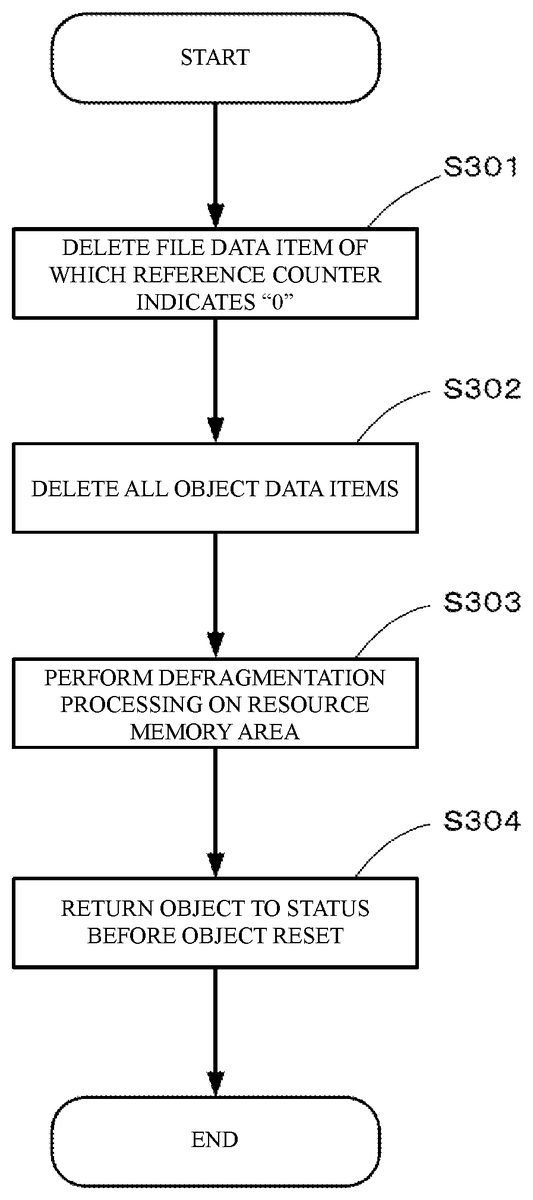
With reference toFIGS. 17 to 22, a description will be given of the object reset.FIG. 17is a flowchart that illustrates the object reset.FIGS. 18 to 22each illustrate release processing for the resource memory area52.
During the object reset, a suspension screen is displayed on the LCD2. For example, a predetermined moving image, a static image, or an image of an object subjected to animation processing is displayed as the suspension screen. The object reset is performed concurrently with the display of the suspension screen.FIG. 18schematically illustrates a state of the resource memory area52immediately before the second event processing. In this state, for example, the resource memory area52stores therein five file data items1to5of which the reference counters indicate “2”, “0”, “1”, “0”, and “3”, respectively. As illustrated inFIG. 17, in the object reset, the CPU311deletes a file data item of which the reference counter indicates “0”, from the resource memory area52(step S301). The file data items2and4are thus deleted from the resource memory area52as illustrated inFIG. 19, so that the resource memory area52has two new space areas. Next, the CPU311deletes all the object data items from the object memory area51to release the entire object memory area51(step S302). In the resource memory area52, the reference counters of all the file data items thus indicate “0” along with the deletion of the object data items as illustrated inFIG. 20.
Next, the CPU311performs defragmentation processing on the resource memory area52(step S303). As illustrated inFIG. 21, specifically, the CPU311moves the file data items such that the resource memory area52has one space area. Next, the CPU311revives the objects, which have been displayed immediately before the second event processing, at their initial positions (step S304). Specifically, the CPU311refers to the save data to load onto the object memory area51the object data items corresponding to the objects to be revived. Moreover, the CPU311changes the reference counters of the file data items left on the resource memory area52, in correspondence with the object data items. In other words, as illustrated inFIG. 22, the reference counters of the file data items left on the resource memory area52are set to be identical to the reference counters immediately before the second event processing illustrated inFIG. 18. The objects thus return to their initial statuses before the second event processing.
The object reset is performed when each of the memory areas51and52is brought into the insufficient state. In this embodiment, the object reset may be performed in the following cases. For example, the object reset may be performed when an object which is a main character gets in or out of a dungeon, when an object which is a main character moves (e.g., teleports) to another place, when a game is over, or when saved data is to be loaded. The object reset is performed concurrently with the display of the suspension screen as described above. Therefore, the player does not feel strange even when the object reset is performed upon change of the screen because of, for example, teleportation. In addition to the memory insufficient state, the condition under which the object reset is performed is referred to as a reset condition.
3. Game Processing
With reference toFIG. 23, next, a description will be given of the game processing.FIG. 23is a flowchart that illustrates progress of a game.
In the game processing according to this embodiment, as illustrated inFIG. 23, the CPU311executes a game program to start a main loop (step S401). In other words, the CPU311normally starts progress of a game. When a predetermined in-game time has elapsed (YES in step S402), the CPU311performs the first event processing (step S403). When the predetermined in-game time has not elapsed yet (NO in step S402) and when a memory insufficient condition is satisfied (YES in step S404), the CPU311performs the second event processing (step S405). Next, when a reset condition is satisfied (YES in step S406), the CPU311performs the object reset (step S407). Next, when a predetermined game termination condition is satisfied (YES in step S408), the CPU311terminates the game. When no game termination condition is satisfied (NO in step S408), the CPU311continues the progress of the game in the main loop (step S401).
4. Features
According to this embodiment, as described above, the first event processing including the suspension event to reproduce a moving image is performed every predetermined in-game time in course of progress of a game. The suspension event is repeatedly carried out every predetermined in-game time. Therefore, the suspension event makes a player understand that the suspension event is carried out concomitantly with the progress of the game.
If an area available in each of the memory areas51and52becomes insufficient, it is necessary to release the memory areas. However, it is necessary to suspend the game in order to release the memory areas. In view of this circumstance, according to this embodiment, if each of the memory areas51and52is brought into the insufficient state, the first event processing including the suspension event is performed, and then the object reset is performed to release the memory areas. In other words, the object data is loaded again onto the object memory area51with the object memory area51released entirely, and the defragmentation processing is performed on the resource memory area52. Even when the suspension event is carried out owing to the insufficient memory irrespective of the progress of the game, this configuration makes a player understand that this suspension event is carried out as a normal suspension event in the first event processing. Accordingly, the insufficient state of each of the memory areas51and52is resolved without making a player feel strange because of sudden suspension of a game.
In addition to the case where the available area becomes insufficient, the object reset is also performed when a reset condition is satisfied, for example, when an object which is a main character gets in or out of a dungeon. In other words, the object reset is also performed when data is to be loaded. Accordingly, the object reset which is performed although each of the memory areas51and52is not brought into the insufficient state prevents the memory areas51and52from being brought into the insufficient state.
5. Modifications
The above description is about an embodiment of the present invention. However, the present invention is not limited to the foregoing embodiment. It is to be understood by a person skilled in the art that various modifications and variations may be made without departing from the scope and spirit of the present invention. For example, the following modifications may be made. The following modifications may also be made in combination as appropriate.
5-1
In the foregoing embodiment, a moving image is reproduced in the suspension event of the first event processing; however, the present invention is not limited thereto. In addition to reproduction of a moving image by execution of a predetermined moving image file, for example, animation processing may be performed to impart predetermined motion to a predetermined model. Alternatively, at least one or more static images of a predetermined event scene may be displayed.
5-2
In the foregoing embodiment, the first event processing involves processing for an object, such as processing of reviving an object, in addition to the processing of reproducing a moving image; however, the present invention is not limited thereto. For example, any kind of processing may be performed in addition to the processing of reproducing a moving image. Alternatively, the first event processing may involve only the reproduction of the moving image.
5-3
In the foregoing embodiment, the second event processing involves performing the first event processing and then performing the object reset; however, the present invention is not limited thereto. As described above, various kinds of processing are considered as the first event processing to be performed in the second event processing. Therefore, the first event processing has only to involve at least reproducing, for example, a moving image.
5-4
In the foregoing embodiment, the object reset is performed when a memory insufficient condition is satisfied, and is also performed when a reset condition is satisfied; however, the present invention is not limited thereto. For example, the object reset may be performed only when a memory insufficient condition is satisfied.
5-5
The object reset is not limited to the defragmentation processing or the processing of releasing all the memory areas, but may involve various kinds of processing. In other words, the object reset is not particularly limited as long as it involves processing of freeing an area available in a memory area.
5-6
In the foregoing embodiment, a game device is exemplified; however, the present invention is not limited thereto. In other words, the present invention is not limited to a game device as long as the game program described above can be executed. The present invention is applicable to various information processing devices. Examples of such an information processing device may include: a special-purpose portable game terminal that is provided with an LCD; a mobile terminal that is provided with an LCD, such as a smartphone; a special-purpose stationary game device that is not provided with an LCD and is connectable to an external display device; and a personal computer.
Claims
- A non-transitory storage medium storing therein a game program that is readable by a computer in an information processing device with at least one memory, the game program causing the computer to execute: a game processing step of performing game processing, based on an operation by a player;a first event processing step of reproducing a predetermined event scene every timing at which a predetermined condition associated with progress of a game based on the game processing is satisfied;a memory monitoring step of monitoring a usage state of the memory during the progress of the game;and a second event processing step of, when an area available in the memory is insufficient, performing processing of reproducing the event scene and allocating an area available in the memory, wherein the second event processing step includes defragmentation processing for the memory, in order to allocate the area available in the memory.
- The storage medium according to claim 1 , wherein the game processing involves processing of changing a status of a predetermined object in a virtual space and updating data that concerns the object and is stored in an area of the memory, based on an operation by the player, and the second event processing step includes memory initialization processing of initializing the data stored in the area of the memory, in order to allocate the area available in the memory.
- The storage medium according to claim 2 , wherein the game processing involves processing of erasing at least some of objects in the virtual space, based on an operation by the player, and the first event processing step and the second event processing step are set to further reproduce the event scene and to cause at least some of the erased objects to appear again in the virtual space.
- A non-transitory storage medium storing therein a game program that is readable by a computer in an information processing device with at least one memory, the game program causing the computer to execute: a game processing step of performing game processing, based on an operation by a player;a first event processing step of reproducing a predetermined event scene every timing at which a predetermined condition associated with progress of a game based on the game processing is satisfied;a memory monitoring step of monitoring a usage state of the memory during the progress of the game;and a second event processing step of, when an area available in the memory is insufficient, performing processing of reproducing the event scene and allocating an area available in the memory, wherein in the first event processing step, the event scene is reproduced every lapse of a predetermined time in terms of an in-game time.
- The storage medium according to claim 1 , wherein in the second event processing step, the area available in the memory is allocated in reproducing at least a part of the event scene.
- The storage medium according to claim 1 , wherein the area available in the memory is allocated every timing at which predetermined game suspension processing is performed.
- A game device comprising: at least one processor;at least one memory;and a non-transitory storage medium that stores therein at least one game program, wherein the game program causes the at least one processor to execute: a game processing step of performing game processing, based on an operation by a player;a first event processing step of reproducing a predetermined event scene every timing at which a predetermined condition associated with progress of a game based on the game processing is satisfied;a memory monitoring step of monitoring a usage state of the memory during the progress of the game;and a second event processing step of, when an area available in the memory is insufficient, performing processing of reproducing the event scene and allocating an area available in the memory, wherein the second event processing step includes defragmentation processing for the memory, in order to allocate the area available in the memory.
- The game device according to claim 7 , wherein the game processing involves processing of changing a status of a predetermined object in a virtual space and updating data that concerns the object and is stored in an area of the memory, based on an operation by the player, and the second event processing step includes memory initialization processing of initializing the data stored in the area of the memory, in order to allocate the area available in the memory.
- The game device according to claim 8 , wherein the game processing involves processing of erasing at least some of objects in the virtual space, based on an operation by the player, and the first event processing step and the second event processing step are set to further reproduce the event scene and to cause at least some of the erased objects to appear again in the virtual space.
- A game device comprising: at least one processor;at least one memory;and a non-transitory storage medium that stores therein at least one game program, wherein the game program causes the at least one processor to execute: a game processing step of performing game processing, based on an operation by a player;a first event processing step of reproducing a predetermined event scene every timing at which a predetermined condition associated with progress of a game based on the game processing is satisfied;a memory monitoring step of monitoring a usage state of the memory during the progress of the game;and a second event processing step of, when an area available in the memory is insufficient, performing processing of reproducing the event scene and allocating an area available in the memory, wherein in the first event processing step, the event scene is reproduced every lapse of a predetermined time in terms of an in-game time.
- The game device according to claim 7 , wherein in the second event processing step, the area available in the memory is allocated in reproducing at least a part of the event scene.
- The game device according to claim 7 , wherein the area available in the memory is allocated every timing at which predetermined game suspension processing is performed.
- A game processing method to be carried out in an information processing device with at least one memory, the game processing method comprising: a game processing step of performing game processing, based on an operation by a player;a first event processing step of reproducing a predetermined event scene every timing at which a predetermined condition associated with progress of a game based on the game processing is satisfied;a memory monitoring step of monitoring a usage state of the memory during the progress of the game;and a second event processing step of, when an area available in the memory is insufficient, performing processing of reproducing the event scene and allocating an area available in the memory, wherein the second event processing step includes defragmentation processing for the memory, in order to allocate the area available in the memory.
- The game processing method according to claim 13 , wherein the game processing involves processing of changing a status of a predetermined object in a virtual space and updating data that concerns the object and is stored in an area of the memory, based on an operation by the player, and the second event processing step includes memory initialization processing of initializing the data stored in the area of the memory, in order to allocate the area available in the memory.
- The game processing method according to claim 14 , wherein the game processing involves processing of erasing at least some of objects in the virtual space, based on an operation by the player, and the first event processing step and the second event processing step are set to further reproduce the event scene and to cause at least some of the erased objects to appear again in the virtual space.
- A game processing method to be carried out in an information processing device with at least one memory, the game processing method comprising: a game processing step of performing game processing, based on an operation by a player;a first event processing step of reproducing a predetermined event scene every timing at which a predetermined condition associated with progress of a game based on the game processing is satisfied;a memory monitoring step of monitoring a usage state of the memory during the progress of the game;and a second event processing step of, when an area available in the memory is insufficient, performing processing of reproducing the event scene and allocating an area available in the memory, wherein in the first event processing step, the event scene is reproduced every lapse of a predetermined time in terms of an in-game time.
- The game processing method according to claim 13 , wherein in the second event processing step, the area available in the memory is allocated in reproducing at least a part of the event scene.
- The game processing method according to claim 13 , wherein the area available in the memory is allocated every timing at which predetermined game suspension processing is performed.
- A game device comprising: memory;and processing system, including at least one processor, coupled to the memory, the processing system configured to: perform game processing based on operations received from an input device, the game processing comprises controlling a plurality of objects in a virtual space;update, based on the game processing, object related data stored in a portion of the memory;upon satisfying a predetermined condition during the game processing, suspend the game processing and display an event scene related to the performed game processing;upon determining that the portion of the memory does not have enough space to store object related data for a new object, (1) suspend the game processing, (2) display the event scene, and (3) delete one or more object related data stored in the portion of the memory;and after deleting the one or more object related data stored in the portion of the memory, store the object related data for the new object and resume performing the game processing comprising controlling the new object in the virtual space.
- A game processing method to be carried out in an information processing device with at least one memory, the game processing method comprising: performing game processing based on operations received from an input device, the game processing comprises controlling a plurality of objects in a virtual space;updating, based on the game processing, object related data stored in a portion of the memory;upon satisfying a predetermined condition during the game processing, suspending the game processing and display an event scene related to the performed game processing;upon determining that the portion of the memory does not have enough space to store object related data for a new object, (1) suspending the game processing, (2) displaying the event scene, and (3) deleting one or more object related data stored in the portion of the memory;and after deleting the one or more object related data stored in the portion of the memory, storing the object related data for the new object and resuming performance of the game processing comprising controlling the new object in the virtual space.
- A non-transitory storage medium storing therein a game program that is readable by a computer in an information processing device with at least one memory, the game program, when executed, causing the computer at least to: perform game processing based on operations received from an input device, the game processing comprises controlling a plurality of objects in a virtual space;update, based on the game processing, object related data stored in a portion of the memory;upon satisfying a predetermined condition during the game processing, suspend the game processing and display an event scene related to the performed game processing;upon determining that the portion of the memory does not have enough space to store object related data for a new object, (1) suspend the game processing, (2) display the event scene, and (3) delete one or more object related data stored in the portion of the memory;and after deleting the one or more object related data stored in the portion of the memory, store the object related data for the new object and resume performing the game processing comprising controlling the new object in the virtual space.
Disclaimer: Data collected from the USPTO and may be malformed, incomplete, and/or otherwise inaccurate.