U.S. Pat. No. 10,512,841
Game State Save, Transfer and Resume for Cloud Gaming
AssigneeSony Interactive Entertainment America LLC
Issue DateOctober 24, 2017
Illustrative Figure
Abstract
A system and method of pausing a game in a cloud gaming system including playing a game on a first game computer included in the cloud gaming system, pausing the game at a selected point in the game and capturing game state data for the paused game. The paused game can be resumed by retrieving the game state data and applying the game state data to a selected game computer and resuming the game at the selected point in the game on the selected game computer.
Description
DETAILED DESCRIPTION Several exemplary embodiments for systems and methods for saving a state of an on-going game, at any point in the game, and resuming the game at the same point of the game at some time in the future will now be described. It will be apparent to those skilled in the art that the present invention may be practiced without some or all of the specific details set forth herein. Cloud gaming is becoming very popular gaming environment. Cloud gaming allows single player and multi-player game play and also allows a user to play complex, content-rich games such as games with rich interactive content as well as immersive three-dimensional (3D) graphics. Such content rich games require complex and powerful, often very specialized computers having specialized processors, co-processors and graphics processors. Cloud gaming also requires well engineered server processes to reduce latency and monitor latency to avoid performance drops. As an added benefit, cloud gaming allows a user to play content rich games on a much simpler, client computer. As an example, a user can play games on a cloud gaming system using a tablet, a smartphone or other handheld computing device capable of communicating with the cloud gaming system via a local network and/or the Internet. In a cloud gaming environment, just maintaining a game session open for the user to return to at some undefined moment in the future is not a viable option. Indefinitely maintaining a game session open for the user is costly for a cloud gaming provider. These costs include power usage by the cloud game computer and preventing another user from using that same game computer. In one embodiment, a cloud gaming system may assign a user a dedicated game computer (i.e., managed by a cloud gaming server), per game session. Thus, a ...
DETAILED DESCRIPTION
Several exemplary embodiments for systems and methods for saving a state of an on-going game, at any point in the game, and resuming the game at the same point of the game at some time in the future will now be described. It will be apparent to those skilled in the art that the present invention may be practiced without some or all of the specific details set forth herein.
Cloud gaming is becoming very popular gaming environment. Cloud gaming allows single player and multi-player game play and also allows a user to play complex, content-rich games such as games with rich interactive content as well as immersive three-dimensional (3D) graphics. Such content rich games require complex and powerful, often very specialized computers having specialized processors, co-processors and graphics processors. Cloud gaming also requires well engineered server processes to reduce latency and monitor latency to avoid performance drops. As an added benefit, cloud gaming allows a user to play content rich games on a much simpler, client computer. As an example, a user can play games on a cloud gaming system using a tablet, a smartphone or other handheld computing device capable of communicating with the cloud gaming system via a local network and/or the Internet.
In a cloud gaming environment, just maintaining a game session open for the user to return to at some undefined moment in the future is not a viable option. Indefinitely maintaining a game session open for the user is costly for a cloud gaming provider. These costs include power usage by the cloud game computer and preventing another user from using that same game computer. In one embodiment, a cloud gaming system may assign a user a dedicated game computer (i.e., managed by a cloud gaming server), per game session. Thus, a same game computer can also be assigned to a second user when the earlier user is no longer assigned to the game computer for use. Over time, multiple users share a game computer, but they are not using the same game computer at the same point in time.
The disclosed cloud gaming state save, resume and transfer technology allows a user to pause his game play session anytime during the game play that the user chooses. Behind the scenes, the user's game state is stored and then the user's cloud game computer is freed up for another user. The cloud gaming state save, resume and transfer technology saves energy as the gaming server can transfer use of the user's assigned game computer to another user.
When the user is ready to resume his game, the user's saved game state is retrieved and loaded into the same or a different cloud game computer. The user can then resume his game play at the same point he paused it. The user can resume his game state using the same or a different client device. The user can resume his game state using the same or a different cloud gaming data center. The user can resume his game state from a geographically different part of the world.
The disclosed cloud gaming state save, resume and transfer technology has other uses as well. For example the user's gaming session could be shared among other users to allow other users to experience the same gaming session or possibly to help the other user (who may be at another remote location, but connected the cloud gaming service). As an example, a first user pauses game play, passes (e.g., shares) game state data to a second user, the second user completes a difficult fight for the first user and then pauses the game once again and passes the new game state data back to the first user. In one implementation, the user can select a share button or option on a controller or other user interface to share the saved game state. The disclosed cloud gaming state save, resume and transfer technology has many other uses as well. When the user shares the game state, the user that received the share may be assigned to another game computer by the cloud gaming system (i.e., different from the game computer of the sharing user). Before each share, the state is saved, and when the state is resumed, it may be resumed on the same game computer or another, depending on which game computer the user is assigned from time to time.
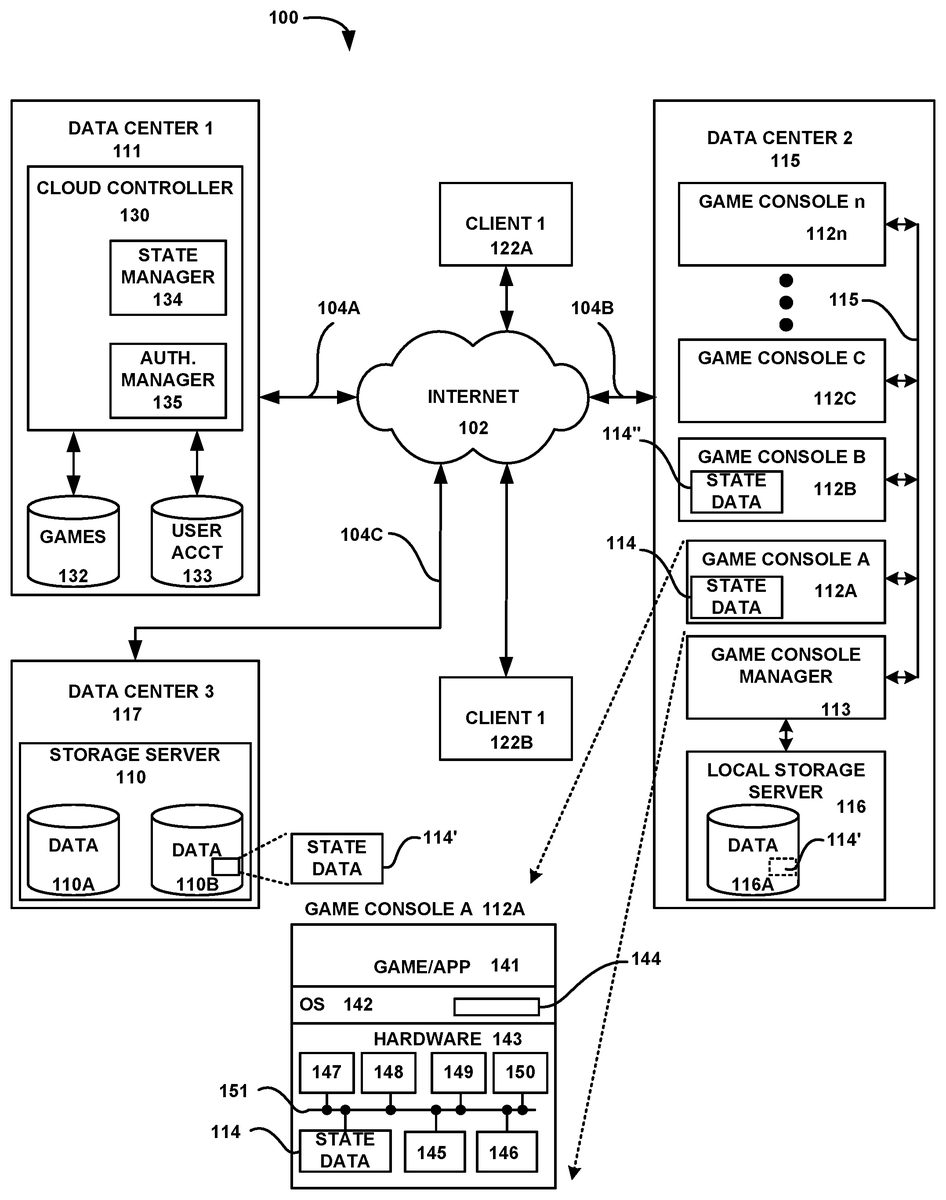
FIG. 1is a simplified cloud gaming system100, for implementing embodiments of the present disclosure. The cloud gaming system100includes a controller130, multiple game consoles112A-n (e.g., computers), one or more game console managers113and a storage server110. The cloud controller130(e.g., controller), the multiple game consoles112A-n, the one or more game console managers113and the storage server110can be located in one or more data centers111,115,117. The cloud controller130, the multiple game consoles112A-n and the storage server110are coupled together by local area networks104A,104B,104C and/or the Internet102. The multiple game consoles112A-n and the game console manager113can be co-located in a single data center115or distributed among more than one data centers.
One or more game console managers113can be included in each rack of game consoles112A-n. The game console managers113manage one or more game consoles112A-n depending on one or more hardware and/or software architectures. The game console managers113are physically connected to the game consoles112A-n using a network connection115and/or an optional general purpose input/output, a universal serial bus or an equivalent control connection for activating power to a game console. The game console manager113can optionally include additional roles such as setting up and managing a streaming session between the assigned game console and the user's client device.
A local storage server116could optionally be co-located in the same data center115with one or more of the multiple game consoles112A-n. The local storage server116can store data116A to be used by or received from the multiple game consoles112A-n and/or the cloud controller130. The data centers111,115,117can be separated geographically. By way of example, the first data center111and the third data center117can be located in Los Angeles, Calif. and the second data center115can be located in Stockholm, Sweden.
The cloud controller130and/or the game console manager113includes a games database132for storing multiple games and other applications that may be downloaded to one of more of the multiple game consoles112A-n. The cloud controller130also includes an authorization manager135. The authorization manager135determines if a first user has a valid account and the authorized access to the cloud gaming system100. The first user's account information is included in a user account database133. In one or more implementations, the cloud controller130can also include a state manager134. The state manager134can also work with a state manager client144included in each of the game consoles112A-n to capture the game state data for the respective game console, when initiated.
The storage server110provides storage facilities for the cloud gaming system100. The storage server110includes one or more storage devices110A,110B for storing data such as a user's state data114′, as may be required by the cloud gaming system100. The one or more storage devices110A,110B can be any suitable storage media, e.g., hard disk drive, solid state drive, or optical drive, etc.
Each of the game consoles112A-n includes a hardware layer143and an operating system layer142overlying the hardware layer. An application layer141overlays the operating system layer142. The application layer141includes games and other application that are run on the game console112A. The hardware layer includes a main processor145, a co-processor146, a graphics processor (GPU)147, a memory system148, an input output system149, a network interface card150and many other physical peripherals and virtual peripherals that may be required for the operations of the game console112A. The main processor145, the co-processor146, the graphics processor147, the memory system148, the input output system149, the network interface card150and other peripherals are coupled together by one or more data buses151.
In at least one implementation, the operations system layer142includes a state manager client144. In other implementations the state manager client144could be included in one or more applications in the application layer141. The state manager client144could also be implemented having portions residing in both the operations system layer142and the application layer141. The state manager client144can capture game state data114of the game console112A, when initiated. The captured game state data114can be stored as game state data114′ in a local storage server116and/or in the storage server110. The storage location of the stored game state data114′ is provided to the cloud controller to add to the first user's account information in the user account database133.
The client devices122A,122B provide access to the cloud gaming system100via the Internet102or a local network104A-C. The client devices122A,122B can be any suitable platform capable of accessing the Internet102and/or a local network104A-C. By way of example, the client devices122A,122B can be a personal computer, laptop computer, a notebook computer, a handheld gaming device, a handheld computing device such as a tablet computer or a smart telephone or any other suitable computing platform. The first client computing device122A and the second client computing device122B can be used in multiple different, geographically disparate locations. By way of example, the first client computing device122A can be a tablet computer used to access the Internet102and the cloud gaming system100by the first user at his home, in his office and while he is travelling. Similarly, the second client computing device122B can be a notebook computer capable of accessing the Internet102and the cloud gaming system100in a home, in an office or other locations having Internet access.
In one implementation, a first user can use the first client computing device122A to access the cloud controller130via the Internet102. The authentication manager135authenticates the first user and determines the access level allowed for the first user. The cloud controller130and/or the game console manager113assigns the first user to the game console A112A for the present cloud gaming session and provides the authorized level of access including the authorized applications and games from the games and application database132. The cloud controller130and/or the game console manager113may also transfer the authorized games and other applications to the assigned game console A112A from the games and applications database132. In one implementation, the assigned game console A112A can access the games and applications database132to transfer the authorized games and other applications to the assigned game console A.
The disclosed cloud gaming state save, resume and transfer technology is especially useful for cloud gaming purposes because there is a large amount of data involved in pausing and restoring the game state. Cloud gaming systems100are well suited to the disclosed cloud gaming state save, resume and transfer technology, because cloud gaming systems include thousands of cloud gaming consoles112A-n connected all around the world using high-speed networks104A-C.
Multiple implementations of the cloud gaming state save, resume and transfer technology and methods are disclosed herein. One approach is transferring at least one of a full hardware state data or a full application state data, between game consoles. The following is a description of how the cloud gaming state save, resume and transfer mechanism can work. A detailed description of how to make a copy of the hardware state data and application state data is also provided.
Cloud gaming state save, resume and transfer mechanism allows the transfer of game state data from one game console to another game console.FIG. 2Ais a flowchart diagram that illustrates a simplified overview of the method operations200performed in the cloud gaming state save, resume and transfer mechanism, for implementing embodiments of the present disclosure. In an operation205, a first user is playing a game on a game console112A in a cloud gaming system100. In an operation210, the first user opts to pause the game at a selected pause point in the game. The selected pause point can be any point in the game other than a predefined game pause point. The cloud gaming system100may also automatically pause the user's game for one or more cloud gaming system management reasons. By way of example, if the cloud controller130detects no activity from the first user for a period of time longer than a predetermined inactivity time limit or if the cloud controller detects a network disconnect from the first user's client device112A.
In one embodiment, the cloud controller has knowledge of available games and available game servers but due to capacity reasons, typically relies on the streaming software in the assigned game console and or the game console manager to handle continuous interaction with the client devices112A-B. The game console manager, the assigned game console or the client device can determine inactivity. Inactivity by the user can be determined by the client device such as no button presses for a predefined time duration. The game console manager and/or the assigned game console can similarly identify inactivity by the user. By way of example, when the client device detects inactivity by the user for the predefined time duration, the client device sends a disconnect message to the assigned game console and/or the game console manager. The disconnect message may also include a reason for the disconnect message e.g., no user activity. When the assigned game console and/or the game console manager receives the disconnect message, processes to shutdown the remainder of the streaming session, such as stop the game, store user data, capture game state data, etc. are initiated. In one implementation, the disconnect message is received by the streaming software in the assigned game console and/or in the game console manager and the streaming software issues a shutdown message to the game console manager and the game console manager handles the shutdown process.
The user disconnect ultimately may also be communicated to the cloud controller depending on the architecture. In one embodiment, the cloud controller can monitor or track whether a user is currently streaming or not (e.g. for billing purposes) or to prevent the user from streaming multiple times which could cause data corruption if the user access his saved data from two or more locations.
The first user's game state data is captured and stored in an operation215. The game console112A can be freed up for a second user's use after the first user's game state data is captured and stored. The game state data includes hardware state data and/or application state data. The game state data may also include historical dependency data and process data that may be necessary to reconstruct the game at the selected pause point of the game. The historical dependency data and process data can be in the form of a data structure including temporal metadata and user interactive historical metadata required to form an executable gaming application capable of resuming at the selected pause point. Examples of temporal metadata and user interactive historical metadata include graphics data such as color data, texture data, vertex data, fragmentation data, art assets, drawing data, shading data, lighting data and more. The temporal metadata and user interactive historical metadata can also include contents and states of various buffers and caches and the status of various counters and timers necessary to coordinate the operation of the game. Capturing the game state data can also include capturing a current image of the scene in the game at the first user's selected pause point.
At some later time, in an operation220, the first user opts to resume the paused game and the stored first user's game state data is retrieved and loaded on an assigned game console and the game is resumed at the paused point in the game in an operation225. The user can resume the game on the same game console112A as originally the user originally used with the game. Alternatively, the first user can resume the game on another game console112B. The first user can also authorize the second user to access the first user's game state data to allow the second user to resume the first user's paused game. Resuming the game includes applying the game state data on the selected game console. The game state data can include a data structure including temporal metadata and user interactive historical metadata required to form an executable gaming application capable of resuming at the selected pause point.
FIG. 2Bis a simplified graphical user interface of a user's cloud gaming system dashboard250, for implementing embodiments of the present disclosure. The cloud gaming system dashboard250includes options to select a new game252, research the user's current standing in a gaming tournament254, review user's gaming history256, update user's friends258, other options260and update user account262. Each of the options moves the user to a corresponding screen for performing the selected option.
The cloud gaming system dashboard250can also include a paused game menu270. The paused game menu270includes a list of paused games and options to resume or delete the paused games. It should be noted that the user can have more than one paused games and can pause a game at any time and for any reason he chooses. A pointer280for selecting the displayed menu options is also shown in the cloud gaming system dashboard250screen.
Cloud gaming state save, resume and transfer provides the capture and allows transfer of a user's game state from one game console to another game console. The user's game state can include one or both of the hardware state data and/or the application state data of the user's gaming console at the time the user pauses the game.
FIG. 2Cillustrates an example where the user is provided the functionality to share290a saved state of game A. The system may also save data that the user saved the game state with Bob292, and is then provided with the ability to resume292from some saved pause point or state made by Bob. It is also possible for Bob to complete a level and save or indicate back to the user that the level is complete, which would enable re-starting of a next level. Further shown inFIG. 2Cis the option to save historical information294of paused points in game B. If the user pauses several times, it is possible for the user to resume at these earlier pause points, instead of only the last saved pause point. In some embodiments, a certain number of pause points are saved for historical purposes to save on storage space or the user may be provided with the ability to download saved pause points. Further, a user may be able to share a pause point with more than one user. For example, a user may share a paused point in game A with multiple users (e.g., friends) to see who scores the best in a level, achieves the best trophies, etc. Then, the user can select which friends pause point he or she wishes to take over from or resume from.
FIG. 3is a flowchart diagram that illustrates the method operations300performed in the cloud gaming state save, resume and transfer, for implementing embodiments of the present disclosure. In an operation305, a first user accesses a cloud gaming system cloud controller130. The authorization manager135confirms the user has a valid account and the first user's authorized access by querying the user account database133and comparing the first user's login access information to the first user's account information in the user account data base133. The first user can access the cloud controller via a client device122A.
The cloud controller130assigns the first user to a game console112A, in an operation310. In one implementation, assigning the first user to a game console112A can include automatically loading any of the first user's previously paused games on the assigned game console112A. Assigning the game console112A to the first user can also include displaying the first user's cloud gaming system dashboard250screen. In one implementation the game console manager can assign the first user to a game console112A. The cloud controller performs the authorization and the game console manager activates the game console (e.g., apply power), transfers any needed data such as game data, user data, game state data, etc., and trigger a login sequence to the assigned game console. Alternatively, the assigned game console can retrieve any needed data such as game data, user data, game state data, etc. from the corresponding storage locations as indicated by the user data and/or the game console manager and/or the cloud controller130.
In an operation315, the first user selects and executes a game or an application on the assigned game console112A. The assigned game console112A can be one of many game consoles in one or more cloud gaming servers. In one implementation, the first user's assigned game console112A can be limited to a timeshare of a game console, where the first user is allocated only a portion of the operating time of the assigned game console112A. The game console112A can provide one or more timeshares, each of the timeshares can be assigned to respective user, thus allowing multiple users to use a single game console at the same time.
In an operation320, a pause is initiated in the game at a point other than a predefined pause point in the application. For example, the first user could initiate the pause request to pause his streaming game session. Alternatively, the cloud controller130can initiate the pause due to inactivity by the first user that exceeds a preselected inactivity time limit. For cost reasons, the cloud controller130can automatically pause the first user's game console112A so that the first user's game console can be freed up and made available to a second user. The first user can initiate the pause by communicating the pause request to one or both of the cloud controller130and the first user's assigned game console112A. As noted above, the pause operations may be distributed among the assigned game console, the game console manager, the cloud controller130and the streaming software.
In an operation325, the first user's current game state data114of the assigned game console112A is captured. The captured first user's game state data114can be hardware state data or application state data or both hardware state data and application state data. The hardware state data and application state data and methods and systems for capturing the hardware state data and application state data are described in more detail below.
In an operation330, the captured first user's game state data114is stored for later retrieval. As described above, the captured first user's game state data114can be stored as stored game state data114′ in the local storage server116and/or in the storage server110. The storage server110and the local storage server116can efficiently store game state data for multiple game consoles and/or multiple users. In an operation335, the location of the first user's stored game state data114′ is associated with the first user's account data in the user account data base133. This allows the first user's account information to include the storage location of the first user's paused game state data.
At some later time, and in an operation340, a request to resume the first user's paused game at the point it was paused in operation320above, is initiated. The resume request can originate from the first user or an authorized second user. The first user or an authorized second user can issue the resume request through an assigned game console such as game console112B.
If the first user had logged off his initial gaming session or his initial gaming session was otherwise interrupted such as the cloud controller terminating the initial gaming session or the first user experiencing an interruption in the network connection to the cloud gaming server130or to the game console manager113or to the assigned game console, then the first user may be required to re-access the cloud gaming service and be assigned a game console, as described in operation305above. When the first user is assigned a game console112B, one or more of the first user's paused games may be automatically loaded on the assigned game console. When the first user is assigned a game console112B and one of the first user's paused games is loaded on the assigned game console, the assigned game console may provide an indication to the first user that the paused game is ready to resume and provide access for the first user to resume the paused game, at the point the game was paused in operation320above.
The first user can also share, or send the stored game state data114′ or otherwise authorize access to the stored state game data114′ to the second user as described above. The request to resume the game is received in the cloud controller130from an assigned game console, e.g., game console112B.
Upon receiving the resume request, the cloud controller130queries the first user's account information in the user account database133to determine the storage location of the stored first user's game state data114′ for the user's paused game, in an operation345. The cloud controller130and/or the game console manager113can retrieve the stored first user's game state data114′ and send the stored first user's game state data114′ to the requesting game console112B, in an operation250. In an operation355, the requesting game console112B receives the stored first user's game state data114′.
In an operation360, the requesting game console112B applies the stored first user's game state data114′ to produce resumed game state data114″ to reconstruct the game at the paused point. Reconstructing the game at the paused point configures the requesting game console112B to the equivalent configuration as the game console112A and the game to when the game was paused in operation320above.
Reconstructing the game at the paused point can include populating multiple respective aspects and locations within the requesting game console112B with the respective portions of the resumed game state data. By way of example, reconstructing the game at the paused point can include populating all historical dependency data and process data that may be necessary to reconstruct the game at the point the game was paused. Examples of dependency data and process data necessary to reconstruct the game include graphics data such as color data, texture data, vertex data, fragmentation data, art assets, drawing data, shading data, lighting data and more. The dependency data and process data can also include contents and states of various buffers and caches and the status of various counters and timers necessary to coordinate the operation of the game. Reconstructing the game at the point the game was paused can also include displaying a captured image of the scene in the game at the first user's selected pause point.
In an operation370, the first user's game is resumed in game console112B, at the same point in the game as was paused, in operation320above, and the method operations can end.
Game state data can be expressed in the form of an application state data and/or a hardware state data. Each of the application state data and hardware state data capture and resume has its own challenges for the cloud gaming state save, resume and transfer technology, as discussed below.
Application State Data
A computer is a piece of hardware composed of one or more processors, memory and input output peripherals like a graphics processor unit (GPU), a sound card, a keyboard and other peripherals. The tasks the computer runs are computer programs or applications. The computer processors execute these applications' code and make decisions based on the I/O, e.g. a keyboard button press can result in an output of the video frame on a display.
The application state data can be attributed to the hardware state data. The memory buffers the application uses are ultimately areas of a RAM chip or in a swap file, e.g. a hard disk drive or a solid state drive. The processor stores the instructions for the application in instruction caches and retrieves/stores data in processor registers, data caches or RAM. During execution, each computer application has a corresponding application state data. The application state data is in the form of:
Open file handles
Network connections in the form of open sockets
Pipes
State of memory buffers used by the application
Instruction counters
Timers
As an example, the application state data can include signals, threads, file descriptors, virtual memory mappings, thread local storage, threads, process IDs, user IDs, group IDs, pipes, sockets and more. The application state data can also include operating system level concepts such as GPU resources occupied by the game. The game is aware of resources such as textures, geometry buffers, shader instructions for the GPU to execute, and others. Textures are stored in GPU memory, shader instructions are loaded into GPU memory and in an instruction cache during execution and there is ultimately a matching instruction pointer.
Referring again toFIG. 3above, the game or application is suspended when the pause is initiated in operation320ofFIG. 3above. In operation325, the game state data is captured by capturing the application state data. The application state data includes virtual memory mappings, retrieve file descriptors, etc. In one implementation, a debugger-like functionality from within the application can be used to capture the virtual memory mappings, retrieve file descriptors etc.
A portion of the application state data can also be obtained from the outside on a Linux operating system e.g. from /proc/application. An example of application state data could be an open file, for which the application has a file descriptor, which is numerical value. The numerical value file descriptor is used in file read/write calls as an identifier for the file. In order to restore this state, the application needs to be provided with the correct numerical value file descriptor. By way of example, in a Linux operating system the numerical value file descriptor can be captured by pseudo code such as:
original_file_descriptor=42
file_descriptor=open(“/path/to/file”, . . . )
dup2(file_descriptor, original_file_descriptor)
Also on a Linux operating system other types of application state data such as process IDs (PIDs), user id, group ids, network layout and others can be virtualized using name spaces. The virtualized process IDs (PIDs), user ID, group IDs, network layout, etc., allow creation of sandbox/container environments, in which portions of the system can be hidden and in which PIDs, user IDs and other operating system level resources can be recreated.
The captured application state data can then be used to re-create an identical application state data on the same or a different computer system, e.g., game console112B, in operation360ofFIG. 3. The various application state data can be placed in the respective locations in the game console112B being used to resume the application or game. Content of the network buffers can be recreated in the operating system. Alternatively, the network buffers can be drained to a safe recovery point, similar to the hardware interrupts described below. In this manner the user would be able to resume the application at the point the application or game was paused in operation320above.
Hardware State Data
Hardware state data includes the operational conditions of a computer that us paused during execution of an application, such as when the user chooses to pause the application. The current operational conditions of the computer are frozen in time so that the computer's hardware, e.g., processors, RAM, all the peripherals, GPU, sound card, network card . . . etc. Capturing this hardware state data and then applying the captured hardware state data to another computer can allow the user to resume the application where the user had paused the application in the first computer.
An emulator is an application that mimics a computer's hardware completely in software. Emulators are often used to run legacy applications from a very old computer or game console, such as an obsolete computer or game console, on a more recently produced computer system. The more recently produced computer system is incompatible with the legacy applications due to hardware incompatibilities and without the emulator application, the more recently produced computer system is unable to run the legacy applications.
In order to save hardware state data at any selected point in the operation, the emulator can save the emulated hardware state data for the emulated computer e.g. to a file. The emulated hardware state data includes capturing all the memory for the emulated devices, state of peripherals, storing the address of the currently executed instruction in others for the emulated computer. The emulated computer is realized completely in the emulator application, thus capturing the application state data of the emulator application, as described above.
A virtual machine state is similar to an emulated hardware state data. In the context of cloud gaming, a hardware state data capture, transfer and resume, one challenge for emulators is sharing the emulated hardware state data between multiple, virtual game machines.
Typically, server applications, e.g. a web server, a database server, an email server, etc., are run on a physical server hardware, e.g., a server machine. The server machine includes a powerful central processing unit (CPU) and a large amount of memory, which allows running multiple server applications in parallel. Computer hardware such as processors, memory, data buses, etc., have become more powerful and server uptime and security has become even more critical and important.
Server applications typically run on a virtualized server hardware. In such an instance, there is a powerful server processor, which runs a virtualization application. The virtualization application allows for the creation of multiple virtual machines. Each virtual machine is a separately operating, emulated computer hardware. Each virtual machine includes its own set of virtual or physical peripherals, e.g., network cards, storage devices, etc. Each virtual machine can run its own operating system. The operating system on each of the virtual machines can be different the other virtual machines and different from the operating system of the physical machine e.g. a Linux physical machine running multiple virtual machines, each of the virtual machines running different versions of Windows or other suitable computer operating systems.
Each server application, e.g. web server, database server, email server, etc. is typically assigned to its own virtual machine for security isolation reasons. In general, virtual machines, like emulators, are software concepts, and can be paused in a way similar to emulators and the virtual machine state can be captured as application state data of the virtualization application.
The virtual machine state can then be transferred to a second virtual machine. The second virtual machine can be running on a different physical server potentially using different physical components but the physical components will not matter due to the virtual peripheral devices and the virtual machine's virtual processor.
The virtual machine state can be considered a type of application state data. Transferring the virtual machine state between computer systems is called migration of virtual machines and is a common feature in the server world.
A recent extension to migration of virtual machines is referred to as live migration and improves server reliability. For example, a virtual database server may detect that the physical hardware is failing, e.g., memory errors, hard disk read errors, etc., and trigger a migration of the virtual database server to another, identical virtual database server hosted on a different server hardware. The live migration can occur with only a few milliseconds or less of downtime and without disconnecting any clients.
Unfortunately, all peripherals of the virtual machine must be virtual peripherals for migration of the virtual machine to function correctly. Migration of the virtual machine does not support migration of physical peripherals. Migrating the hardware state data of a first game console to a second game console requires migrating physical hardware and thus the virtual machine migration is unsuitable for this purpose.
The game consoles cannot easily or efficiently be emulated or virtualized due to the complexity required of the game console hardware to produce the content rich, interactive gaming environment. The user is assigned to a specific game console and the user's selected game is being executed by the hardware of the assigned game console. Thus the emulation and virtualization will not provide the needed functionality for capturing hardware state data as a type of application state data.
As described above, hardware migration requires capturing the relevant hardware state data of the computer and the peripherals for that computer. The device drivers for the respective peripherals can be queried to capture the relevant hardware state data for the peripherals and storing such state in system memory when the system is going into hibernation. When the system is powered on again all memory state is restored from disk and peripheral device drivers would also be instructed to restore any hardware state data e.g. buffers containing 3D textures for the GPU.
In one implementation, the game console112A includes a main processor145and a coprocessor146, as shown inFIG. 1above. When the user opts to pause the game console112A, in operation320above, the main processor145can freeze one or more of the current operation(s). In the operation325, the coprocessor146can query the main processor145, buffers, the graphics processor147, the memory system148, the input output system149, the network interface card150and other peripherals to determine the respective present states to capture the hardware state data. Alternatively, an application working with or as part of the operating system can pause and query the buffers, graphics processor147, the memory system148, the input output system149, the network interface card150and other peripherals.
To support game console hardware state data migration from a first game console112A to a second game console112B requires extra measures, even if the second game console112B includes the same components and peripherals as the first game console112A. For example, peripherals in each of the game consoles112A,112B will have different internal serial numbers, which may require some reconfiguration. Another example would be the MAC address of a network device which would require additional reconfiguration.
Further, the second game console112B can be in a different network environment than the first game console112A. The different network environment is likely using different network settings and thus the game console hardware state data migration would also require network out reconfiguration. Game console hardware state data migration may also be required to be reconfigured for geographic differences between the first game console112A and the second game console112B. As an example, transfer to the second game console112B in a different geographic region than the first game console112A may require time zone changes, language changes and possibly even changes to the language used in a running game.
The second game console112B may also be have a different hardware revision than the first game console112A, which may require different re-initialization. For example the second game console112B may be a newer hardware revision, e.g. at a smaller semiconductor process, may be more power efficient and would need different power and cooling settings than the first game console112A.
Live migration of single applications is a fairly new area. One approach allows pausing an application, followed by capturing the application state data such as file handles, sockets, memory state, and other types of application state data, such as described above. During resume, the identical file descriptors are restored to the same condition as when the application was paused. The network connections, timers, mutual exclusions and other types of states are also restored. A 3D game application relies on hardware state data in the form of buffers residing on a GPU. The previous approach does not capture the respective hardware state data and would be required for application state data transfer of 3D games. In this context hardware state data refers to any data or state stored in hardware on behalf of the application. For example, buffers in GPU memory containing geometry or texture data, memory buffers containing game data files on a hard disk. The application typically accesses such hardware state data through software abstraction layers provided by an operating system kernel or device drivers. Examples of such abstractions can be file descriptors to a file on a disk is ultimately a layer on top of the storage device, file descriptors representing GPU side buffers and graphics contexts. Sometimes, for performance reasons, the application may directly access hardware buffers. Directly accessing hardware buffers may be guided by a device driver.
One approach to capturing hardware state data includes pausing the application to and the software abstractions linked to the paused hardware state data would be captured. If the software abstraction mechanism is a file descriptor, the file descriptor can be used to look up corresponding hardware state data. Since the file descriptors are often a device driver/OS kernel concept, the corresponding device driver needs to expose a method for retrieving its associated hardware state data. The process of identifying all hardware state data behind the back of the application can be quite difficult
Examples of hardware state data includes content of various registers, fifo buffers, instruction caches (in both CPU and GPU), data caches (CPU/GPU), RAM, program counter(s)/instruction pointer(s) on CPU and GPU. The GPU instructions would be for shader applications.
The hardware state data also includes transitional state related information. For example hardware may issue an interrupt signal. The interrupt signal can be regenerated or the buffer can drain the current content of the buffer and then reload the buffer in a known safe recover state. In one implementation the hardware can be allowed to finish any queued or scheduled operations. Interrupts can then be used to trigger new operations or to notify completion or an operation. If the hardware is busy with operations, such interrupt signals can be re-generated else the hardware may not complete an operation on resume in case the hardware was waiting for an interrupt signal for some pending operation. Some operations may have fewer transitional states to capture. In one implementation, the game operations can be continued until the pending transitional states are minimized or below a selected threshold then less transitional hardware state data such as interrupts and instruction counters may be needed for the reconstruction during resuming the game.
Another approach is to get assistance from the application. Instead of pausing the application, the application could be sent a suspend signal, which makes the application store all its internal state to disk and which allows it to recover any needed hardware state data. Upon resuming the application, it is the application's job to do the recovery. The advantage is that the application knows what hardware state data it really needs to capture. A significant portion of the hardware state data can likely recover by reloading data from its game files. The game may also handle recovery e.g. drop network connection to online cloud controller.
Independent of the recovery via transfer of application state data or hardware state data, there are additional resume aspects including an online game disconnect, adjusting for time zone of the user and the game console, selecting an appropriate language for the user and resuming the game timer. Games often use high precision always increasing timers, for internal game timing. After resume, these timers need to be restarted at exactly the same time as they were at before suspend else the game may make wrong decisions, e.g. a game character could be stuck in a wall or die. Depending on the operating system which may or may not handle this yet, software changes are needed. As described above, in operation350et seq., the correct application or game and all the supporting data files are needed for a successful resume
FIG. 4is a block diagram of a Game System400, according to various embodiments of the invention. Game System400is configured to provide a video stream to one or more Clients410via a Network415. Game System400typically includes a Video Server System420and an optional game server425. Video Server System420is configured to provide the video stream to the one or more Clients410with a minimal quality of service. For example, Video Server System420may receive a game command that changes the state of or a point of view within a video game, and provide Clients410with an updated video stream reflecting this change in state with minimal lag time. The Video Server System420may be configured to provide the video stream in a wide variety of alternative video formats, including formats yet to be defined. Further, the video stream may include video frames configured for presentation to a user at a wide variety of frame rates. Typical frame rates are 30 frames per second, 60 frames per second, and 420 frames per second. Although higher or lower frame rates are included in alternative embodiments of the invention.
Clients410, referred to herein individually as410A.,410B., etc., may include head mounted displays, terminals, personal computers, game consoles, tablet computers, telephones, set top boxes, kiosks, wireless devices, digital pads, stand-alone devices, handheld game playing devices, and/or the like. Typically, Clients410are configured to receive encoded video streams, decode the video streams, and present the resulting video to a user, e.g., a player of a game. The processes of receiving encoded video streams and/or decoding the video streams typically includes storing individual video frames in a receive buffer of the client. The video streams may be presented to the user on a display integral to Client410or on a separate device such as a monitor or television. Clients410are optionally configured to support more than one game player. For example, a game console may be configured to support two, three, four or more simultaneous players. Each of these players may receive a separate video stream, or a single video stream may include regions of a frame generated specifically for each player, e.g., generated based on each player's point of view. Clients410are optionally geographically dispersed. The number of clients included in Game System400may vary widely from one or two to thousands, tens of thousands, or more. As used herein, the term “game player” is used to refer to a person that plays a game and the term “game playing device” is used to refer to a device used to play a game. In some embodiments, the game playing device may refer to a plurality of computing devices that cooperate to deliver a game experience to the user. For example, a game console and an HMD may cooperate with the video server system420to deliver a game viewed through the HMD. In one embodiment, the game console receives the video stream from the video server system420, and the game console forwards the video stream, or updates to the video stream, to the HMD for rendering.
Clients410are configured to receive video streams via Network415. Network415may be any type of communication network including, a telephone network, the Internet, wireless networks, powerline networks, local area networks, wide area networks, private networks, and/or the like. In typical embodiments, the video streams are communicated via standard protocols, such as TCP/IP or UDP/IP. Alternatively, the video streams are communicated via proprietary standards.
A typical example of Clients410is a personal computer comprising a processor, non-volatile memory, a display, decoding logic, network communication capabilities, and input devices. The decoding logic may include hardware, firmware, and/or software stored on a computer readable medium. Systems for decoding (and encoding) video streams are well known in the art and vary depending on the particular encoding scheme used.
Clients410may, but are not required to, further include systems configured for modifying received video. For example, a client may be configured to perform further rendering, to overlay one video image on another video image, to crop a video image, and/or the like. For example, Clients410may be configured to receive various types of video frames, such as I-frames, P-frames and B-frames, and to process these frames into images for display to a user. In some embodiments, a member of Clients410is configured to perform further rendering, shading, conversion to 3-D, or like operations on the video stream. A member of Clients410is optionally configured to receive more than one audio or video stream. Input devices of Clients410may include, for example, a one-hand game controller, a two-hand game controller, a gesture recognition system, a gaze recognition system, a voice recognition system, a keyboard, a joystick, a pointing device, a force feedback device, a motion and/or location sensing device, a mouse, a touch screen, a neural interface, a camera, input devices yet to be developed, and/or the like.
The video stream (and optionally audio stream) received by Clients410is generated and provided by Video Server System420. As is described further elsewhere herein, this video stream includes video frames (and the audio stream includes audio frames). The video frames are configured (e.g., they include pixel information in an appropriate data structure) to contribute meaningfully to the images displayed to the user. As used herein, the term “video frames” is used to refer to frames including predominantly information that is configured to contribute to, e.g. to effect, the images shown to the user. Most of the teachings herein with regard to “video frames” can also be applied to “audio frames.”
Clients410are typically configured to receive inputs from a user. These inputs may include game commands configured to change the state of the video game or otherwise affect game play. The game commands can be received using input devices and/or may be automatically generated by computing instructions executing on Clients410. The received game commands are communicated from Clients410via Network415to Video Server System420and/or Game Server425. For example, in some embodiments, the game commands are communicated to Game Server425via Video Server System420. In some embodiments, separate copies of the game commands are communicated from Clients410to Game Server425and Video Server System420. The communication of game commands is optionally dependent on the identity of the command Game commands are optionally communicated from Client410A through a different route or communication channel that that used to provide audio or video streams to Client410A. It should be understood that the game server425can include portions of the cloud controller130and/or the game manager113as described above.
Game Server425is optionally operated by a different entity than Video Server System420. For example, Game Server425may be operated by the publisher of a multiplayer game. In this example, Video Server System420is optionally viewed as a client by Game Server425and optionally configured to appear from the point of view of Game Server425to be a prior art client executing a prior art game engine. Communication between Video Server System420and Game Server425optionally occurs via Network415. As such, Game Server425can be a prior art multiplayer game server that sends game state information to multiple clients, one of which is game server system420. Video Server System420may be configured to communicate with multiple instances of Game Server425at the same time. For example, Video Server System420can be configured to provide a plurality of different video games to different users. Each of these different video games may be supported by a different Game Server425and/or published by different entities. In some embodiments, several geographically distributed instances of Video Server System420are configured to provide game video to a plurality of different users. Each of these instances of Video Server System420may be in communication with the same instance of Game Server425. Communication between Video Server System420and one or more Game Server425optionally occurs via a dedicated communication channel. For example, Video Server System420may be connected to Game Server425via a high bandwidth channel that is dedicated to communication between these two systems.
Video Server System420comprises at least a Video Source430, an I/O Device445, a Processor450, and non-transitory Storage455. Video Server System420may include one computing device or be distributed among a plurality of computing devices. These computing devices are optionally connected via a communications system such as a local area network.
Video Source430is configured to provide a video stream, e.g., streaming video or a series of video frames that form a moving picture. In some embodiments, Video Source430includes a video game engine and rendering logic. The video game engine is configured to receive game commands from a player and to maintain a copy of the state of the video game based on the received commands. This game state includes the position of objects in a game environment, as well as typically a point of view. The game state may also include properties, images, colors and/or textures of objects. The game state is typically maintained based on game rules, as well as game commands such as move, turn, attack, set focus to, interact, use, and/or the like. Part of the game engine is optionally disposed within Game Server425. Game Server425may maintain a copy of the state of the game based on game commands received from multiple players using geographically disperse clients. In these cases, the game state is provided by Game Server425to Video Source430, wherein a copy of the game state is stored and rendering is performed. Game Server425may receive game commands directly from Clients410via Network415, and/or may receive game commands via Video Server System420.
Video Source430typically includes rendering logic, e.g., hardware, firmware, and/or software stored on a computer readable medium such as Storage455. This rendering logic is configured to create video frames of the video stream based on the game state. All or part of the rendering logic is optionally disposed within a graphics processing unit (GPU). Rendering logic typically includes processing stages configured for determining the three-dimensional spatial relationships between objects and/or for applying appropriate textures, etc., based on the game state and viewpoint. The rendering logic produces raw video that is then usually encoded prior to communication to Clients410. For example, the raw video may be encoded according to an Adobe Flash® standard, .wav, H.264, H.263, On2, VP6, VC-1, WMA, Huffyuv, Lagarith, MPG-x. Xvid. FFmpeg, x264, VP6-8, realvideo, mp3, or the like. The encoding process produces a video stream that is optionally packaged for delivery to a decoder on a remote device. The video stream is characterized by a frame size and a frame rate. Typical frame sizes include 800×600, 1280×720 (e.g., 720p), 1024×768, although any other frame sizes may be used. The frame rate is the number of video frames per second. A video stream may include different types of video frames. For example, the H.264 standard includes a “P” frame and a “I” frame. I-frames include information to refresh all macro blocks/pixels on a display device, while P-frames include information to refresh a subset thereof. P-frames are typically smaller in data size than are I-frames. As used herein the term “frame size” is meant to refer to a number of pixels within a frame. The term “frame data size” is used to refer to a number of bytes required to store the frame.
In alternative embodiments Video Source430includes a video recording device such as a camera. This camera may be used to generate delayed or live video that can be included in the video stream of a computer game. The resulting video stream, optionally includes both rendered images and images recorded using a still or video camera. Video Source430may also include storage devices configured to store previously recorded video to be included in a video stream. Video Source430may also include motion or positioning sensing devices configured to detect motion or position of an object, e.g., person, and logic configured to determine a game state or produce video-based on the detected motion and/or position.
Video Source430is optionally configured to provide overlays configured to be placed on other video. For example, these overlays may include a command interface, log in instructions, messages to a game player, images of other game players, video feeds of other game players (e.g., webcam video). In embodiments of Client410A including a touch screen interface or a gaze detection interface, the overlay may include a virtual keyboard, joystick, touch pad, and/or the like. In one example of an overlay a player's voice is overlaid on an audio stream. Video Source430optionally further includes one or more audio sources.
In embodiments wherein Video Server System420is configured to maintain the game state based on input from more than one player, each player may have a different point of view comprising a position and direction of view. Video Source430is optionally configured to provide a separate video stream for each player based on their point of view. Further, Video Source430may be configured to provide a different frame size, frame data size, and/or encoding to each of Client410. Video Source430is optionally configured to provide 3-D video.
I/O Device445is configured for Video Server System420to send and/or receive information such as video, commands, requests for information, a game state, gaze information, device motion, device location, user motion, client identities, player identities, game commands, security information, audio, and/or the like. I/O Device445typically includes communication hardware such as a network card or modem. I/O Device445is configured to communicate with Game Server425, Network415, and/or Clients410.
Processor450is configured to execute logic, e.g. software, included within the various components of Video Server System420discussed herein. For example, Processor450may be programmed with software instructions in order to perform the functions of Video Source430, Game Server425, and/or a Client Qualifier460. Video Server System420optionally includes more than one instance of Processor450. Processor450may also be programmed with software instructions in order to execute commands received by Video Server System420, or to coordinate the operation of the various elements of Game System400discussed herein. Processor450may include one or more hardware device. Processor450is an electronic processor.
Storage455includes non-transitory analog and/or digital storage devices. For example, Storage455may include an analog storage device configured to store video frames. Storage455may include a computer readable digital storage, e.g. a hard drive, an optical drive, or solid state storage. Storage415is configured (e.g. by way of an appropriate data structure or file system) to store video frames, artificial frames, a video stream including both video frames and artificial frames, audio frame, an audio stream, and/or the like. Storage455is optionally distributed among a plurality of devices. In some embodiments, Storage455is configured to store the software components of Video Source430discussed elsewhere herein. These components may be stored in a format ready to be provisioned when needed.
Video Server System420optionally further comprises Client Qualifier460. Client Qualifier460is configured for remotely determining the capabilities of a client, such as Clients410A or410B. These capabilities can include both the capabilities of Client410A itself as well as the capabilities of one or more communication channels between Client410A and Video Server System420. For example, Client Qualifier460may be configured to test a communication channel through Network415.
Client Qualifier460can determine (e.g., discover) the capabilities of Client410A manually or automatically. Manual determination includes communicating with a user of Client410A and asking the user to provide capabilities. For example, in some embodiments, Client Qualifier460is configured to display images, text, and/or the like within a browser of Client410A. In one embodiment, Client410A is an HMD that includes a browser. In another embodiment, client410A is a game console having a browser, which may be displayed on the HMD. The displayed objects request that the user enter information such as operating system, processor, video decoder type, type of network connection, display resolution, etc. of Client410A. The information entered by the user is communicated back to Client Qualifier460.
Automatic determination may occur, for example, by execution of an agent on Client410A and/or by sending test video to Client410A. The agent may comprise computing instructions, such as java script, embedded in a web page or installed as an add-on. The agent is optionally provided by Client Qualifier460. In various embodiments, the agent can find out processing power of Client410A, decoding and display capabilities of Client410A, lag time reliability and bandwidth of communication channels between Client410A and Video Server System420, a display type of Client410A, firewalls present on Client410A, hardware of Client410A, software executing on Client410A, registry entries within Client410A, and/or the like.
Client Qualifier460includes hardware, firmware, and/or software stored on a computer readable medium. Client Qualifier460is optionally disposed on a computing device separate from one or more other elements of Video Server System420. For example, in some embodiments, Client Qualifier460is configured to determine the characteristics of communication channels between Clients410and more than one instance of Video Server System420. In these embodiments the information discovered by Client Qualifier can be used to determine which instance of Video Server System420is best suited for delivery of streaming video to one of Clients410.
Embodiments of the present invention may be practiced with various computer system configurations including hand-held devices, microprocessor systems, microprocessor-based or programmable consumer electronics, minicomputers, mainframe computers and the like. The invention can also be practiced in distributed computing environments where tasks are performed by remote processing devices that are linked through a wire-based or wireless network.
With the above embodiments in mind, it should be understood that the invention can employ various computer-implemented operations involving data stored in computer systems. These operations are those requiring physical manipulation of physical quantities. Any of the operations described herein that form part of the invention are useful machine operations. The invention also relates to a device or an apparatus for performing these operations. The apparatus can be specially constructed for the required purpose, or the apparatus can be a general-purpose computer selectively activated or configured by a computer program stored in the computer. In particular, various general-purpose machines can be used with computer programs written in accordance with the teachings herein, or it may be more convenient to construct a more specialized apparatus to perform the required operations.
The invention can also be embodied as computer readable code on a computer readable medium. The computer readable medium is any data storage device that can store data, which can be thereafter be read by a computer system. Examples of the computer readable medium include hard drives, network attached storage (NAS), read-only memory, random-access memory, CD-ROMs, CD-Rs, CD-RWs, magnetic tapes and other optical and non-optical data storage devices. The computer readable medium can include computer readable tangible medium distributed over a network-coupled computer system so that the computer readable code is stored and executed in a distributed fashion.
Although the method operations were described in a specific order, it should be understood that other housekeeping operations may be performed in between operations, or operations may be adjusted so that they occur at slightly different times, or may be distributed in a system which allows the occurrence of the processing operations at various intervals associated with the processing, as long as the processing of the overlay operations are performed in the desired way.
Although the foregoing invention has been described in some detail for purposes of clarity of understanding, it will be apparent that certain changes and modifications can be practiced within the scope of the appended claims. Accordingly, the present embodiments are to be considered as illustrative and not restrictive, and the invention is not to be limited to the details given herein, but may be modified within the scope and equivalents of the described embodiments.
Claims
- A cloud gaming system comprising: a controller;a storage device coupled to the controller;a plurality of game computers coupled to the controller by a network, each one of the plurality of game computers including: a hardware layer;an operating system layer configured for interacting with the hardware layer, the operating system layer including a state manager client;an application layer configured for interacting with at least a portion of the operating system layer and a portion of the hardware layer, the application layer including a gaming application, the state manager client configured to capture game state data of the game computer and storing the captured game state data when the gaming application is paused at a selected pause point, wherein the selected paused point is not a predefined stopping point, wherein the game state data is used to recreate an executable state for the game capable of resuming at the selected pause point.
- The cloud gaming system of claim 1 , wherein the state manager client is further configured to apply the stored, captured game state data to the game computer to resume the gaming application at the point the gaming application was paused, wherein resuming the game includes applying game state data to the game computer to produce an executable gaming application.
- The cloud gaming system of claim 1 , wherein the game state data includes a data structure including temporal metadata and user interactive historical metadata to recreate the executable state for the game.
- The cloud gaming system of claim 3 , further comprising account data having a listing of a paused gaming application for a selected user of a plurality of users and a storage location of the game data for the paused gaming application.
- The cloud gaming system of claim 4 , wherein the controller includes an authentication manager configured to determine an authorized access for the selected user.
- The cloud gaming system of claim 1 , wherein the hardware layer of each one of the plurality of game computers includes: a processor;and a graphics processor coupled to the processor by a data bus.
- The cloud gaming system of claim 6 , wherein the hardware layer of each one of the plurality of game computers further includes a co-processor coupled to the data bus and wherein the co-processor of each one of the plurality of game computers is configured to capture game state data.
- The cloud gaming system of claim 1 , wherein the controller and a first portion of the plurality of game computers are disposed in a first data center.
- The cloud gaming system of claim 8 , wherein the storage device coupled to the controller is included in a storage server and wherein the controller is disposed in the first data center and the storage server is disposed in a third data center.
- The cloud gaming system of claim 1 , wherein the game state data includes at least one of a hardware state data or an application state data.
- A method for pausing a game in a cloud gaming system comprising: receiving a gaming request from a first client device, the gaming request being received by a controller in a cloud gaming system;assigning the first client device to a first game computer in the cloud gaming system;receiving an game execution request from the first client device;executing the game on the first game computer;receiving a request to pause the game at a selected pause point, the request to pause being received from the first client device, the selected pause point is not a predefined stop point;pausing the game on the first game computer at the selected pause point in the game;and capturing a game state data for the paused game on the first game computer, wherein the game state data is used to recreate an executable state for the game capable of resuming at the selected pause point.
- The method of claim 11 , wherein the first game computer captures the game state data to enable the first game computer to terminate execution of the game so that the first game computer is available to be assigned to another user.
- The method of claim 11 , wherein the game state data includes a data structure including temporal metadata and user interactive historical metadata.
- The method of claim 11 , wherein resuming the resuming the game at the selected pause point capable of occurring at any one of the first game computer or another game computer.
- The method of claim 11 , further comprising: retrieving the game state data and applying the game state data to a selected game computer, the selected game computer included in the cloud gaming system;and resuming the game at the selected point in the game.
- The method of claim 15 , wherein applying the game state data to the selected game computer includes populating respective locations in the selected game computer with respective portions of the game state data, and wherein the selected game computer is a second game computer.
- The method of claim 11 , wherein capturing the game state data includes capturing at least one of an application state data or a hardware state data.
- The method of claim 11 , wherein capturing the game state data includes storing the game state data and updating a corresponding user account information with a storage location of the stored game state data.
- The method of claim 11 , further comprising: receiving an authentication request from a first user, the authentication request being received in the controller;determining an authorized access for the first user;and wherein assigning the first client device to the first game computer includes assigning the first user to the first game computer, loading a paused game state data in the first game computer when the first user's user account data includes the paused game and a location of the game state data.
- The method of claim 11 , further comprising: receiving an authentication request from a first user, the authentication request being received in the controller;determining an authorized access for the first user, wherein assigning the first client device to the first game computer includes assigning the first user to the first game computer;and retrieving game state data when the first user's user account data includes the paused game and the location of the game state data;receiving a game state share request in the controller, wherein the game state share request is received from the first user and wherein the game state share request is a request to share the first user's game state data with a second user;sharing the game state data with a second game computer assigned to the second user.
Disclaimer: Data collected from the USPTO and may be malformed, incomplete, and/or otherwise inaccurate.