U.S. Pat. No. 10,500,492
SYSTEMS AND METHODS OF CONTROLLING A CHARACTER IN A VIRTUAL SPACE BASED ON COLOR
AssigneeNINTENDO CO., LTD.
Issue DateMarch 5, 2018
Illustrative Figure
Abstract
An information processing system includes a controller which receives an operation input of a user and an information processing unit which performs an information process based on the operation input received by the controller. The information processing unit includes a game progress unit which controls an own character in the virtual space based on the operation input of the user to draw the virtual space with the corresponding color of the own character and a battle determination unit which performs a battle determination based on a drawing state of a corresponding color of an enemy character, which is different from the corresponding color of the own character, to a virtual space and a drawing state of the corresponding color of the own character to the virtual space.
Description
DETAILED DESCRIPTION OF NON-LIMITING EXEMPLARY EMBODIMENTS Hereinafter, an information processing system according to an embodiment of the technology will be described with reference to the drawing. Further, the embodiment to be described below shows an example in a case where the technology is implemented, and the technology is not limited to the specific configuration to be described below. A specific configuration according to the embodiment may be appropriately employed to the implementation of the technology. FIG. 1shows a diagram of an example non-limiting configuration of an information processing system. An information processing system100of the embodiment provides a game in which the virtual space is drawn with a corresponding color of the own character by controlling the own character in a virtual space, and a battle determination is performed based on the drawing state thereof and a drawing state of a corresponding color of an enemy character. The information processing system100includes a controller11serving as an operation input receiver, an information processing unit12serving as an information processor, a transmitting/receiving unit13serving as a communication module, and a display unit14as an output device which displays a video. The output device may further include a speaker which outputs a voice and a vibrator which vibrates and outputs a dynamic force. Further,FIG. 1illustrates an example of the information processing system100which includes the controller11, the information processing unit12, the transmitting/receiving unit13, and the display unit14and is provided as an integrated apparatus, but these components may be distributed into a plurality of devices and transmit/receive information therebetween in a wired or wireless manner as needed. For example, the information processing system100may be a portable game apparatus which includes the controller11, the information processing unit12, the transmitting/receiving unit13, and the display unit14, or may be configured to include a game apparatus body which integrally includes the information processing unit12and ...
DETAILED DESCRIPTION OF NON-LIMITING EXEMPLARY EMBODIMENTS
Hereinafter, an information processing system according to an embodiment of the technology will be described with reference to the drawing. Further, the embodiment to be described below shows an example in a case where the technology is implemented, and the technology is not limited to the specific configuration to be described below. A specific configuration according to the embodiment may be appropriately employed to the implementation of the technology.
FIG. 1shows a diagram of an example non-limiting configuration of an information processing system. An information processing system100of the embodiment provides a game in which the virtual space is drawn with a corresponding color of the own character by controlling the own character in a virtual space, and a battle determination is performed based on the drawing state thereof and a drawing state of a corresponding color of an enemy character. The information processing system100includes a controller11serving as an operation input receiver, an information processing unit12serving as an information processor, a transmitting/receiving unit13serving as a communication module, and a display unit14as an output device which displays a video. The output device may further include a speaker which outputs a voice and a vibrator which vibrates and outputs a dynamic force.
Further,FIG. 1illustrates an example of the information processing system100which includes the controller11, the information processing unit12, the transmitting/receiving unit13, and the display unit14and is provided as an integrated apparatus, but these components may be distributed into a plurality of devices and transmit/receive information therebetween in a wired or wireless manner as needed. For example, the information processing system100may be a portable game apparatus which includes the controller11, the information processing unit12, the transmitting/receiving unit13, and the display unit14, or may be configured to include a game apparatus body which integrally includes the information processing unit12and the transmitting/receiving unit13, the controller11which communicates with the game apparatus body by a near field communication, and the display unit14which receives display data from the game apparatus body through a cable and outputs the data. Further, the information processing unit12may be present on a communication network.
The information processing unit12includes a game progress unit121which progresses the game based on an operation input into the controller11and data on an opponent user or a fellow user received by the transmitting/receiving unit13from the information processing system100, a battle determination unit122which performs the battle determination based on a game result of the game progress unit121, a stencil buffer123, and a depth buffer124.
The game progress unit121and the battle determination unit122of the information processing unit12is realized such that a general purpose processor such as a central processing unit (CPU) and a graphics processing unit (GPU) performs a game program as an information processing program of the embodiment of the technology. The game program is provided using a non-transitory computer-readable storage medium, and the game progress unit121and the battle determination unit122are realized such that the information processing unit12reads the game program out of the storage medium. Further, the game progress unit121and the battle determination unit122may be realized such that the game program is received through the transmitting/receiving unit13, and is installed and executed by the information processing unit12.
The transmitting/receiving unit13transmits various types of data to another information processing system100through a communication network such as the Internet, and receives data transmitted from another information processing system100through the communication network. In the embodiment, particularly, drawing event data to be described below is transmitted and received by the transmitting/receiving unit13through the communication network. The transmitting/receiving unit13may include an interface for wire communication, or may include a communication module for wireless communication. The display unit14outputs graphic data generated by the GPU of the information processing unit12.
The game progressed by the game progress unit121and the battle determination performed by the battle determination unit122will be described. In the game of the embodiment, the own character and the enemy character are provided in association with colors different from each other. A color associated to each character will be referred to as a corresponding color. In the game, the own character is operated in a 3D virtual space to paint the ground with the corresponding color of the own character, and similarly the enemy character paints the ground with the corresponding color of the enemy character.
The own character may have one or plural fellow characters which are operated by another user (a fellow user). In this case, the own character and the fellow character form an own team, and the own character and the fellow character have the same corresponding color. Therefore, the cooperative play can be performed by a plurality of users. Further, the enemy character may have the fellow characters. In this case, these characters form an enemy team, and the characters belonging to the enemy team have the same corresponding color.
Further, the characters may be divided into three or more teams. In this case, the corresponding color is set to be different for each team, the characters belonging to the same team with the own character become the fellow characters, the other teams become the enemy teams, and the characters belonging to the enemy teams become the enemy characters. In the embodiment, a battle between the own team including the own character and the plurality of fellow characters and the enemy team including the plurality of enemy characters will be described as an example. In the following, the corresponding color of the own team is referred to as an “own color”, and the corresponding color of the enemy team will be referred to as an “enemy color”.
Further, the enemy character may be operated by the game progress unit121according to the game program based on the operations of the own character and the fellow character and the game program, or may be operated according to an operation input of another user. In a case where the enemy character is operated based on the operation input of another user, the battle play with another user is realized. In the embodiment, an example in which another user operates the enemy character will be described.
Further, the fellow character may be operated by the game progress unit121according to the game program based on the operations of the own character and the enemy character and the game program, or may be operated according to an operation input of another user. In a case where the fellow character is operated based on the operation input of another user, the cooperative play with another user is realized.
The respective characters including the own character, the fellow character, and the enemy character can move in a common 3D virtual space. Further, the respective characters can also change their directions in the virtual space. Furthermore, the respective characters have their own color ink, and can paint the ground around their positions in the virtual space with their own color ink. Further, in the embodiment, the coloring of the ground of the virtual space with the corresponding color of each character during the game will be expressed as “the ground is painted with the corresponding color (of the ink)” when it is focused on a game progressed in the 3D virtual space, and will be expressed as “the ground is drawn with the corresponding color” when it is focused on an information process in the information processing unit12.
The user issues a drawing event by operating the own character, and can paint the ground of the virtual space. Specifically, an area is painted with the corresponding color according to a position and a direction of the own character in the virtual space, and a type of the drawing event. As the type of the drawing event, “Shooting of the ink gun”, “Painting with a roller”, and “Attack on the enemy character” are included. The type of the drawing event corresponds to the shape of the area to be drawn.
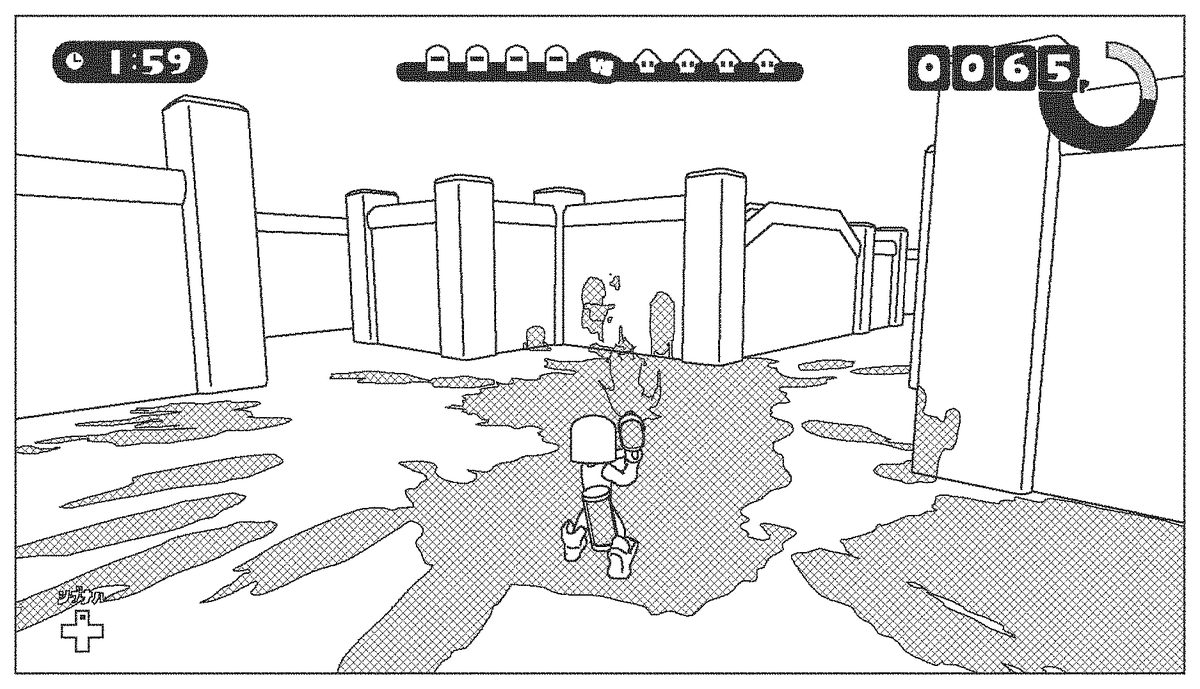
In the drawing event “Shooting of the ink gun”, the ink is painted in a landing area when the ink is shot from the position (the start point) of the own character toward a direction the own character faces. The shooting of the ink gun may be performed in a plurality of shooting methods, a shooting direction may be adjusted in a vertical direction besides a horizontal direction, and a shooting strength may be adjusted.FIG. 2shows an example non-limiting screen of a scene in which the own character shoots the ink gun to paint the ground. In the drawing event “Painting by a roller”, when the own character moves in the virtual space, the ground is painted with the ink by the width of the roller in the moving direction. Herein, a plurality of different roller widths may be provided.
The drawing event “Attack on the enemy character” refers to shooting the ink gun toward the enemy character, and when the shot ink hits the enemy character, the attack becomes successful. When the attack is successful, the attacked enemy character scatters the ink of the corresponding color of the attacking character to the surroundings. Therefore, the ground around the attacked enemy character is painted with the corresponding color of the attacking character. In this way, a drawing range of the own color can also be increased through the attack on the enemy character.
FIGS. 3A and 3Bshow examples non-limiting screens in which the own character succeeds in attacking on the enemy character to paint the surroundings of the enemy character with the own color. Specifically,FIG. 3Ashows an example non-limiting screen of a scene in which the enemy character is attacked, andFIG. 3Bshows an example non-limiting screen of a scene in which the attack on the enemy character is successful and surroundings of the enemy character is painted with a color corresponding to the own character.
The drawing event “Shooting of the ink gun” is defined by a type of the drawing event (Shooting of the ink), a position of the character, a shooting direction (horizontally, or horizontally and vertically), a type of the ink gun (in a case where a plurality of guns are present), strength (in a case where the shooting is adjustable), and a color of the ink (the corresponding color of the character). Further, the drawing event “Painting by the roller” is defined by a type of the drawing event (Painting by the roller), a position of the character, a moving direction, a width of the roller (in a case where a plurality of rollers are present), and a color of the ink (the corresponding color of the character). Further, the drawing event “Attack on the enemy character” is defined by a type of the drawing event (Attack on the enemy character), a position of the enemy character, and a color of the ink (the corresponding color of the attacking character).
When moving in the virtual space, each character is assimilated into the ink according to the operation of the user in an area painted with the ink of the corresponding color of the own team, so that the character can disappear. In a state where the character is assimilated into the ink and disappears, the character can move in the virtual space at a high speed. Since the own character disappears, the own character is not displayed in the screen of the user who operates the enemy character.FIGS. 4A and 4Bshow examples non-limiting screens of scenes in which the character is assimilated into the ink painted on the ground. Specifically,FIG. 4Ashows an example non-limiting screen of a scene before the character is assimilated, andFIG. 4Bshows an example non-limiting screen of a scene after the character is assimilated. Further, the moving speed of the own character is slowed down in an area painted with the corresponding color of the enemy team. In this way, the game progress unit121performs movement control of the character with respect to the input operation from the controller11according to the drawing state at the position of the own character. In other words, the game progress unit121causes the character to move at a speed corresponding to the drawing state at the position of the own character.
Further, when a predetermined operation is performed by the user during the game, the game progress unit121displays the drawing states of the corresponding colors of the respective teams in the entire virtual space at that time. Specifically, the game progress unit121displays the corresponding colors of the respective teams in an elevated screen of the virtual space.FIG. 5shows an example non-limiting elevated screen. Along with the elevated screen, sizes of the drawn areas of the respective teams may be displayed by a graph or numerical values.
In the virtual space, the ground once painted with the corresponding color of a certain team can be repainted by painting the ground thereon again with the corresponding color of another team. In other words, the ground of the virtual space is drawn with the lastly painted color. Even though the ground is an area painted with the enemy color, the area is painted with the own color by painting the area with the own color thereon, and vice versa.
In the game progress unit121, the drawing (coloring) of the virtual space with the corresponding color is performed based on drawing data indicating which portion (pixel) of the virtual space is drawn with the corresponding color of which team. The game progress unit121fills a texture of a size covering the entire virtual space with the color of the ink according to the drawing data, projects the texture to the virtual space, and thus draws the virtual space. Specifically, when the color of the ink fills the texture, the game progress unit121writes a symbol indicating a team as the drawing data in the stencil buffer123. In a case where a drawing operation is performed with the corresponding color of a certain team, only when information matched with the symbol indicating the team is written in the stencil buffer123, a command of drawing the corresponding color of the team is executed through the GPU.FIG. 6shows an example non-limiting virtual space of which the ground is drawn. The state of the drawing is displayed by a texture of 3200×3200 pixels.
In a case where a battle game or a cooperation game is performed by communicating with other users who operate the enemy characters or the fellow characters, when the drawing data is frequently transmitted and received, an appropriate sharing of the drawing state with the other users is disadvantageous in a method of regularly transmitting and receiving all the data since the magnitude of the drawing data is relatively large.
Therefore, in order to share the drawing state in a case where a plurality of users play the game through communication, each information processing system100generates and transmits a relatively small size of drawing event data instead of a relatively large size of drawing data from the transmitting/receiving unit13to the information processing system100of another user according to an issued drawing event during the game, and also receives the drawing event data instead of the drawing data from the information processing system100of another user. The drawing event data is data indicating the content of the drawing event in order to generate the drawing data, and the game progress unit121generates the drawing data based on the drawing event data. In this way, since a communication battle game is performed by transmitting and receiving the drawing event data instead of the drawing data, a communication load is not increased and the plurality of users can share the drawing state at all time.
The game progress unit121generates own character drawing event data based on the operation input received by the controller11. The own character drawing event data indicates the content of the drawing event for drawing the corresponding color of the own character in the virtual space. The transmitting/receiving unit13transmits the own character drawing event data generated by the game progress unit121to the information processing system100of another user, and receives the drawing event data of the enemy character or the fellow character operated by another user from the information processing system100of another user.
FIG. 7shows an example non-limiting drawing operation which is performed based on drawing event data. In this example, the drawing event is defined by a center position, a radius, and a color, and the drawing operation is performed by a circular painting. In the example ofFIG. 7, Area A71is painted with orange according to the drawing event data such as “Position: (3, 4), Radius: 5 m, Color: Orange”, Area A72is painted with blue according to the drawing event data such as “Position: (6, 5), Radius: 4 m, Color: Blue”, Area A73is painted with blue according to the drawing event such as “Position: (6, 3), Radius: 2 m, Color: Blue”, Area A74is painted with orange according to the drawing event data such as “Position: (4, 7), Radius: 3 m, Color: Orange”, and Area A75is painted with blue according to the drawing event data such as “Position: (7, 7), Radius: 1 m, Color: Blue”.
In the communication battle game or cooperation game, when a plurality of characters color (draw) an overlapping area at almost the same time, the drawing states may be inconsistent between the plurality of users due to a transmission delay in a communication network in some cases.FIGS. 8 and 9show examples non-limiting drawing states which are inconsistent. As illustrated inFIG. 8, in a case where the drawing event that the enemy character paints Area A82partially overlapping with Area A81with the corresponding color of the enemy character occurs immediately after the drawing event that the own character paints Area A81with the own color occurs, the game progress unit121of the user of the own character paints Area A81with the own color according to the drawing event by the own character. Then, when the drawing event data of the enemy character is received, the game progress unit121repaints the overlapping portion of Area A81painted with the own color with the enemy color, so that Area A82is painted with the enemy color.
On the other hand, similarly, even in a case where the drawing event that the enemy character paints Area A82partially overlapping with Area A81with the corresponding color of the enemy character occurs immediately after the drawing event that the own character paints Area A81with the own color occurs, Area A82is painted with the corresponding color of the enemy character according to the drawing event that the area is painted with the corresponding color of the enemy character on the user side of the enemy character as illustrated inFIG. 9. Then, in a case where the drawing event data of the own character is received, Area A81comes to be painted with the corresponding color of the own character so that a portion of Area A82is repainted with the own color. Therefore, the area on the user side of the own character (FIG. 8) and the area on the user side of the enemy character (FIG. 9) are different from each other in the drawing state (that is, a color painted thereon) of the overlapping area. Actually, since the drawing event that the enemy character paints Area A82with the corresponding color of the enemy character occurs immediately after the drawing event that the own character paints Area A81with the own color occurs, the drawing state ofFIG. 8should be shown to all the users originally.
In order to avoid such inconsistency in the drawing state, the drawing event data includes information of an occurrence time of the drawing event in addition to the information indicating the content of the drawing event. The information indicating the content of the drawing event, for example, may be the information for defining the drawing event described above. The game progress unit121paints the area of the virtual space according to the drawing event data generated by itself and the drawing event data of the enemy character obtained from the outside. At this time, the information of the occurrence time of the drawing event is recorded in the 3200×3200 depth buffer124corresponding to a texture of the virtual space, and the information generated later is left. Therefore, even when an order of the occurrence of the drawing events and an order of drawing processes in the virtual space according to the drawing events by the game progress units121are mixed with each other due to the delay caused by the communication, the final drawing state is not different for the information processing system100of any user.
FIGS. 10A and 10Bshow examples non-limiting virtual space which is drawn with a corresponding color using time information.FIGS. 10A and 10Bshow cases where the drawing event that Area A101is painted with orange occurs before the drawing event that Area A102partially overlapping with Area A101is painted with blue. InFIGS. 10A and 10B, the virtual space to be drawn is illustrated on the left, and a depth value to be stored in the depth buffer124is illustrated on the right. In this example, as illustrated inFIG. 10A, the game progress unit121first processes the drawing event that Area A101is painted with orange, and then as illustrated inFIG. 10Bprocesses the drawing event that Area A102is painted with blue. Herein, the drawing event data of the drawing event painting Area A101is “Position: (2, 5), Radius: 5 m, Color: Orange, Time: 90”, and the drawing event data of the drawing event painting Area A102is “Position: (8, 5), Radius: 5 m, Color: Blue, Time: 100”.
As illustrated inFIG. 10A, the game progress unit121draws Area A101with orange, and a depth value of 90 corresponding to Time90at a position corresponding to Area A101is stored in the depth buffer124. Next, as illustrated inFIG. 10B, the game progress unit121draws Area A102with blue, and a depth value of 100 corresponding to Time100at a position corresponding to Area A102is stored in the depth buffer124. At this time, an overlapping area between Area A101and Area A102is drawn with blue such that the blue area having a depth value of 100 is put on the orange area having a depth value of 90, that is, one having a large depth value (later occurrence time of the drawing event) becomes the finally drawn area.
FIGS. 11A and 11Bshow examples other non-limiting virtual spaces which are drawn with the corresponding color using the time information. Similarly to the examples ofFIGS. 10A and 10B,FIGS. 11A and 11Balso illustrate a case where the drawing event painting Area A101with orange occurs earlier than the drawing event painting Area A102partially overlapping with Area A101with blue. However, as illustrated inFIG. 11A, in these examples, the game progress unit121first processes the drawing event painting Area A102with blue, and then as illustrated inFIG. 11Bprocesses the drawing event painting Area A101with orange. The contents of the respective pieces of drawing event data are the same as those of the examples ofFIGS. 10A and 10B.
As illustrated inFIG. 11A, the game progress unit121draws Area A102with blue, and a depth value of 90 corresponding to Time90at a position corresponding to Area A102is stored in the depth buffer124. Next, the game progress unit121draws Area A101with orange, and a depth value of 100 corresponding to Time100at a position corresponding to Area A101is stored in the depth buffer124. At this time, in a case where time is not taken into consideration, since the painting is performed in the drawing order, the overlapping area between Area A101and Area A102is drawn with orange which is made in a later drawing process. However, the game progress unit121of the embodiment draws the overlapping area between Area A101and Area A102with blue such that the blue area having a depth value of 100 is put on the orange area having a depth value of 90, that is, one having a large depth value (later occurrence time of the drawing event) becomes the finally drawn area.
Further, in an actual game, a numerical value obtained by adding an offset value which is differently set for each character generated by the drawing event to an occurrence time value is used as the depth value. For example, in a case where the depth value is given in units of integers based on time, the respective characters are assigned with the offset values such as 0.1, 0.2, 0.3 and so on which are smaller than a minimum unit of the depth value based on time and are differently set for the respect characters. In other words, in a case where the drawing evens of a plurality of characters occur at the same time, the order of the drawing events of the characters are determined in advance. Therefore, even in a case where the plurality of drawing event data partially overlapping with at least the drawing area are generated at the same time, the depth values do not become equal, so that it is guaranteed that the final result is uniquely determined.
The battle determination unit122performs the battle determination by comparing the drawing state of the own color and the drawing state of the enemy color at the time of the game over. Specifically, the battle determination unit122compares a range of the ground painted with the own color and a range of the ground painted with the enemy color. As a comparison result, in a case where the range of the ground painted with the own color is wide, it is determined that the own team wins, and in a case where the range of the ground painted with the enemy color is wide, it is determined that the enemy team wins. In other words, the battle determination unit122determines victory or defeat based on wideness of the painted color range. In a case where a plurality of teams participate, a team which paints a widest range with the corresponding color is determined as a winner. Further, the game will be over at the time when a predetermined time elapses from the beginning.
Specifically, as described above, since the drawing operation by the game progress unit121is performed according to a symbol representing a team which is stored for every pixel in the stencil buffer123as the drawing data, the battle determination unit122acquires areas of the corresponding colors of the respective teams by counting the number of pixels at the time of the game over and compares these areas.
As described above, according to the information processing system of the embodiment, there is provided a new game in which the virtual space is drawn with the corresponding color of the own character by controlling the own character in the virtual space, and the battle determination is performed based on the drawing state and the drawing state of the corresponding color of the enemy character.
Further, in the above-mentioned embodiment, the face to be painted with the ink by the character is described only as the “ground” of the virtual space, but embodiments of the technology are not limited thereto. The face to be painted with the ink by the character may be walls, ceilings, and the like on the path where the character moves in the virtual space, or may be surfaces of arbitrary objects.
Further, in the above-mentioned embodiments, in order to share the drawing states in a case where the plurality of users play the game through communication, a relatively small size of drawing event data is transmitted and received instead of a relatively large size of drawing data. Further, in order not to generate inconsistency in the drawing state among the plurality of users, information of the occurrence time of the drawing event is included in the drawing event data, but instead of the drawing event data, the drawing data may be transmitted and received together with the information of the occurrence time of the drawing event. Even in this case, the size of data to be transmitted and received becomes large, but it is possible to avoid the above-mentioned inconsistency in the drawing state among the plurality of users.
Claims
- A non-transitory storing medium having stored therein an information processing program, the information processing program when executed by a processor of an information processing system comprising an operation input receiver configured to receive an operation input of a user, the information processing program comprising instructions that are configured to cause the processor to: perform, for an own character in a virtual space, a painting action in the virtual space based on the operation input received by the operation input receiver, the painting action to paint a painting area in the virtual space in a corresponding color of the own character, perform display control and/or first moving control of the own character based on the own character being in an area of the virtual space that is painted in the corresponding color of the own character, wherein the display control and/or first moving control is performed differently based on the own character being in an area of the virtual space that is not painted in the corresponding color of the own character.
- The non-transitory storing medium according to claim 1 , wherein the information processing program comprises further instructions that causes the processor to perform, for an enemy character, a painting action to paint a painting area in the virtual space in a corresponding color of the enemy character that is different from the corresponding color of the own character.
- The non-transitory storing medium according to claim 1 , wherein the display control includes changing an appearance of the own character to an appearance corresponding to the corresponding color of the own character.
- The non-transitory storing medium according to claim 3 , wherein the display control includes changing an appearance of the own character to an appearance assimilated to the corresponding color of the own character.
- The non-transitory storing medium according to claim 1 , wherein the first moving control includes moving the own character in a speed faster than a speed when the own character is in the area not painted in the corresponding color of the own character.
- The non-transitory storing medium according to claim 2 , wherein the information processing program comprises further instructions that causes the processor to perform a second moving control of the own character when the own character is in an area painted in the corresponding color of the enemy character, the second moving control being different from the first moving control.
- The non-transitory storing medium according to claim 6 , wherein the second moving control includes moving the own character in a speed slower than a speed when the own character is in the area painted in the corresponding color of the own character.
- The non-transitory storing medium according to claim 2 , wherein the information processing program comprises further instructions that causes the processor to perform a third moving control of the own character when the own character is in an area that is not painted in the corresponding color of the own character and is not painted in the corresponding color of the enemy character.
- The non-transitory storing medium according to claim 1 , wherein the information processing program comprises further instructions that causes the processor to cause the own character in the virtual space to perform the painting action based on the operation input to paint the painting area in the virtual space according to the painting action in the corresponding color of the own character.
- The non-transitory storing medium according to claim 1 , wherein the information processing program comprises further instructions that causes the processor to cause the own character to move in the virtual space based on the operation input and paint a painting area corresponding to a position of the own character in the virtual space in the corresponding color of the own character.
- The non-transitory storing medium according to claim 1 , wherein the painting area painted in the corresponding color of the own character in the virtual space is painted based on an operation input of one or more fellow users.
- The non-transitory storing medium according to claim 2 , wherein the painting area in the virtual space painted in the corresponding color of the enemy character is painted based on an operation input of one or more opponent users.
- The non-transitory storing medium according to claim 2 , wherein the information processing program comprises further instructions that causes the processor to perform a battle determination based on a painting state of the corresponding color of the own character and a painting state of the corresponding color of the enemy character.
- The non-transitory storing medium according to claim 13 , wherein the battle determination includes comparing a painted area painted in the corresponding color of the own character and a painted area painted in the corresponding color of the enemy character.
- The non-transitory storing medium according to claim 1 , wherein the information processing system further comprises a transceiver, the information processing program comprises further instructions that causes the processor to: generate own character painting event data which indicates a painting event to paint the painting area in the virtual space in the corresponding color of the own character based on the operation input received by the operation input receiver, cause the transceiver to transmit the own character painting event data to another information processing system of an opponent user;accept, via the transceiver, enemy character painting event data which is generated based on an operation input of the opponent user and indicates a painting event to paint the painting area in the virtual space in a corresponding color of the enemy character, and wherein the painting area in the virtual space is painted in the corresponding color of the own character and the corresponding color of the enemy character, which are respectively based on the own character painting event data and the enemy character painting event data.
- The non-transitory storing medium according to claim 15 , wherein the own character painting event data and the enemy character painting event data include information related to a position and a color of the painting area in the virtual space in which the corresponding color is painted.
- The non-transitory storing medium according to claim 15 , wherein the own character painting event data and the enemy character painting event data include time information indicating a time of an event, and wherein the painting in the virtual space is performed based on the time information when the corresponding color of the own character and the corresponding color of the enemy character are painted in an overlapping manner.
- The non-transitory storing medium according to claim 15 , wherein the transceiver is configured to communicate via the Internet.
- The non-transitory storing medium according to claim 1 , wherein the information processing program comprises further instructions that causes the processor to cause the own character in the virtual space to perform attack action on an enemy character based on the operation input.
- The non-transitory storing medium according to claim 19 , wherein the information processing program comprises further instructions that causes the processor to cause the own character to perform attack action on the enemy character by causing the own character to perform the painting action.
- The non-transitory storing medium according to claim 19 , wherein the painting area in the virtual space is painted in the corresponding color of the own character when the attack action on the enemy character by the own character is successful.
- The non-transitory storing medium according to claim 21 , wherein a peripheral area of the enemy character in the virtual space is painted in the corresponding color of the own character when the attack action on the enemy character by the own character is successful.
- The non-transitory storing medium according to claim 1 , wherein the information processing program comprises further instructions that causes the processor to generate an overhead view that shows how the virtual space has been painted by at least the corresponding color of the own character and a corresponding color of an enemy character.
- The non-transitory storing medium according to claim 23 , wherein the information processing program comprises further instructions that causes the processor to output the generated overhead view for display based on the operation input received by the operation input receiver during a match.
- The non-transitory storing medium according to claim 1 , wherein the virtual space is a three-dimensional space.
- The non-transitory storing medium according to claim 25 , wherein the corresponding color is painted on a ground in the three-dimensional space.
- The non-transitory storing medium according to claim 1 , wherein one of a plurality of types of painting events occurs based the operation input, and the types of the painting events correspond to shapes of the painting area.
- An information processing system comprising: a user input device configured to receive an operation input provided by a user;and at least one hardware processor that is configured to: cause an own character in a virtual space to perform painting action in the virtual space based on the operation input received by the operation input receiver, wherein the performed painting action includes painting a painting area in the virtual space in a corresponding color of the own character, and perform display control and/or first moving control of the own character as a result of determining that the own character is in an area painted in the corresponding color of the own character, wherein the performed display control and/or performed first moving control is different from when the own character is in an area not painted in the corresponding color of the own character.
- An information processing apparatus comprising: an operation input receiver configured to receive an operation input of a user;and at least one game progress processor that is configured to: cause an own character in a virtual space to perform painting action in the virtual space based on the operation input received by the operation input receiver to paint a painting area in the virtual space in a corresponding color of the own character, and when the own character is in an area painted in the corresponding color of the own character, perform a display control and/or a first moving control of the own character that is different from when the own character is in an area not painted in the corresponding color of the own character.
- An information processing method that is performed on a computer system, the information processing comprising: receiving, via an input device, an operation input of a user;causing an own character in a virtual space to perform a painting action in the virtual space based on the operation input received by the operation input receiver, the painting action including painting a painting area in the virtual space in a corresponding color of the own character;and when the own character is in an area painted in the corresponding color of the own character, performing display control and/or first moving control of the own character different from when the own character is in an area not painted in the corresponding color of the own character.
Disclaimer: Data collected from the USPTO and may be malformed, incomplete, and/or otherwise inaccurate.