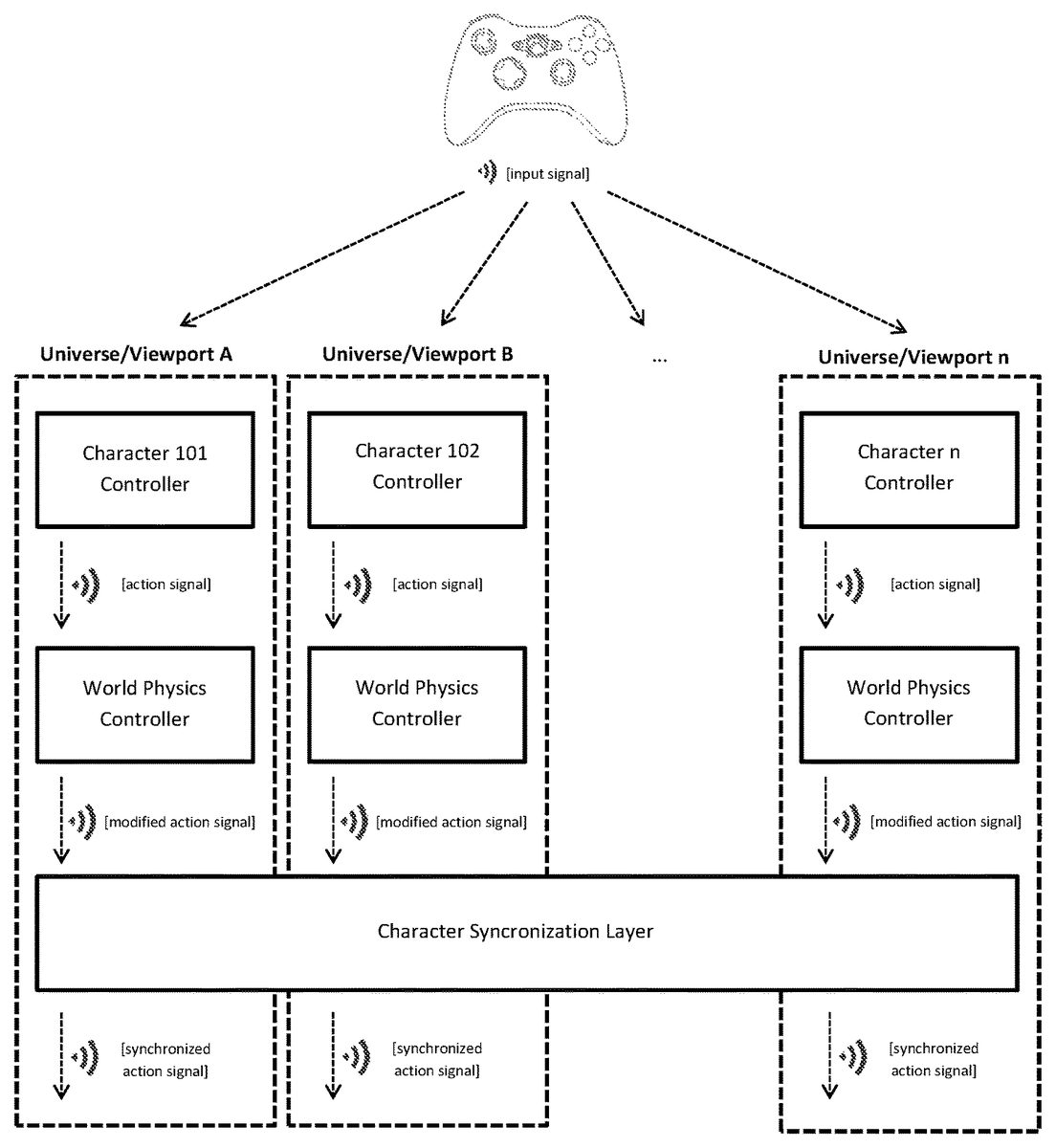
EMBODIMENTS The method of simultaneous playing of a game by a single player on two or more screens with the use of a software synchronization layer has been presented in several exemplary situations that may occur as a result of controlling the movement of the character to the right. In the first embodiment presented onFIG. 3one screen displays two worlds rendered in two horizontally separated frames that constitute viewports A and B, in which the character controlled by the player has its separate representation, respectively as avatars1and2. Both avatars react to a signal sent from the player's controller and go to the right. The avatar from world A finds obstacle3on its way and stops. The synchronization layer causes that the avatar in world B cannot go further either. Due to the missing obstacle in its world B, animation controlled by the synchronization layer presents avatar2standing in place, although there is no obstacle, while in the case of avatar1, it is an animation of the reaction to an obstacle. In the second embodiment presented onFIG. 4one screen displays two worlds rendered in two horizontally separated frames, being viewports A and B, in which the character controlled by the player has its separate representation, respectively as avatars1and2. The avatar2from world B finds an obstacle3in the form of a deep hole that the player decides to jump over. The synchronization layer causes that avatar1in world A marches through the distance covered by avatar2with a jump. Due to the missing obstacle in universe A, avatar1moves with the walking animation. In the third embodiment presented onFIG. 5one screen displays two worlds rendered in two horizontally separated frames, being viewports A and B, in which the character controlled by the player has its separate representation, respectively as avatars1and2. Avatar2from world B meets an opponent4, which the ...
EMBODIMENTS
The method of simultaneous playing of a game by a single player on two or more screens with the use of a software synchronization layer has been presented in several exemplary situations that may occur as a result of controlling the movement of the character to the right.
In the first embodiment presented onFIG. 3one screen displays two worlds rendered in two horizontally separated frames that constitute viewports A and B, in which the character controlled by the player has its separate representation, respectively as avatars1and2. Both avatars react to a signal sent from the player's controller and go to the right. The avatar from world A finds obstacle3on its way and stops. The synchronization layer causes that the avatar in world B cannot go further either. Due to the missing obstacle in its world B, animation controlled by the synchronization layer presents avatar2standing in place, although there is no obstacle, while in the case of avatar1, it is an animation of the reaction to an obstacle.
In the second embodiment presented onFIG. 4one screen displays two worlds rendered in two horizontally separated frames, being viewports A and B, in which the character controlled by the player has its separate representation, respectively as avatars1and2. The avatar2from world B finds an obstacle3in the form of a deep hole that the player decides to jump over. The synchronization layer causes that avatar1in world A marches through the distance covered by avatar2with a jump. Due to the missing obstacle in universe A, avatar1moves with the walking animation.
In the third embodiment presented onFIG. 5one screen displays two worlds rendered in two horizontally separated frames, being viewports A and B, in which the character controlled by the player has its separate representation, respectively as avatars1and2. Avatar2from world B meets an opponent4, which the player decides to attack with a bolt of energy5. This skill is available only for avatar2in world B, this way the synchronization layer causes that avatar1in world A reacts only with idle animation.
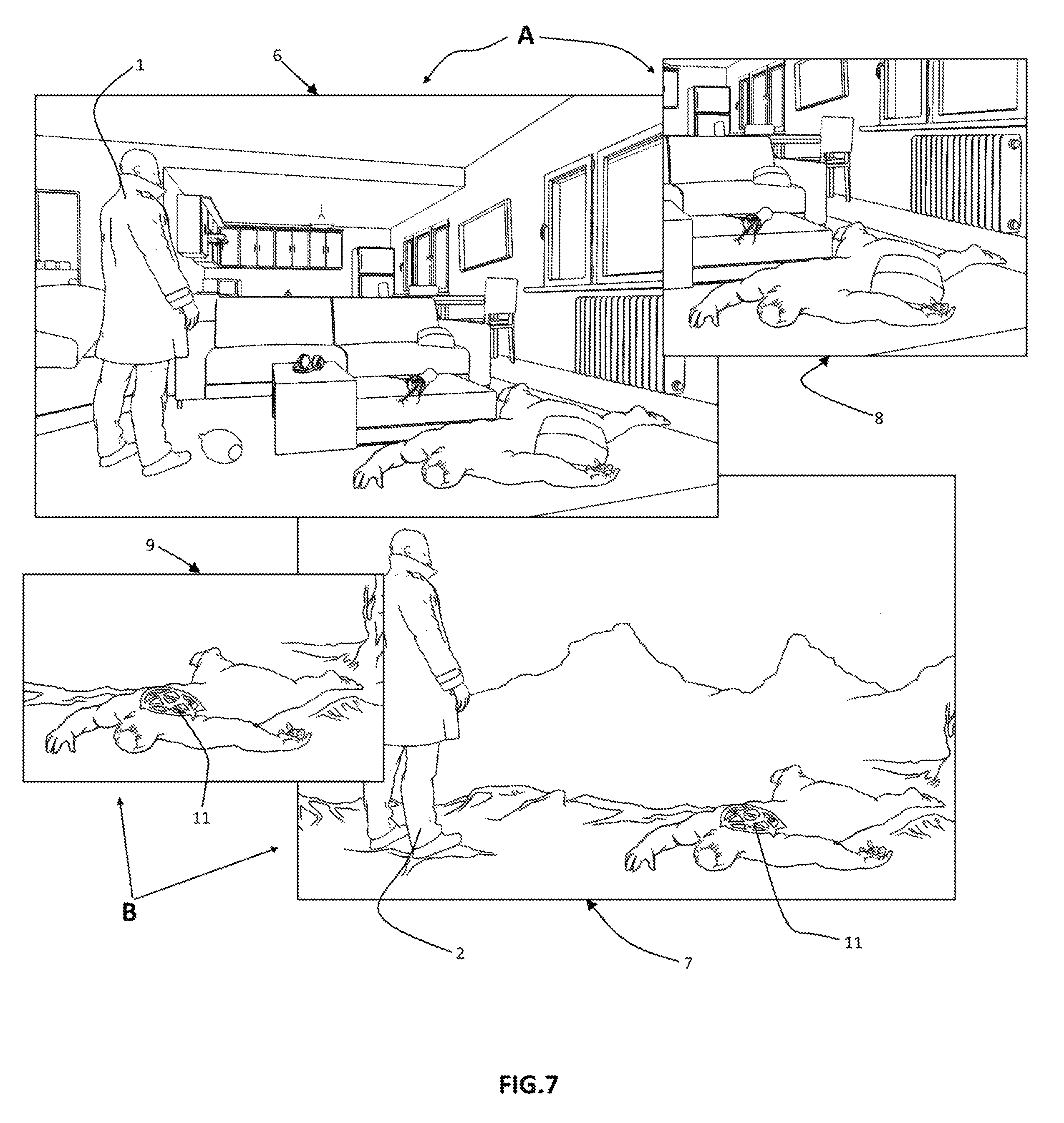
The fourth embodiment presents exemplary scenes from a 3D game that implements this invention. In the fourth embodiment of the implemented invention presented onFIG. 6andFIG. 7, the game takes place in two alternative realities A, B represented by two worlds distinguished with different graphic styles and often different physical structure. The main character represented by two avatars1,2is present in both worlds A, B simultaneously through most of the play and visible on one physical screen at least in two viewports6,7, one per world. The comic style applied for the method of presentation of viewports (virtual screens) often allows using additional viewports8,9presenting the same scene from different perspectives or with the use of different framing or zooming.
The game takes place simultaneously in the real world and phantasmagorical world. An ambitious and hypnotizing story will allow the player to fully engage in the game, causing doubled emotions resulting from several viewports related to parallel virtual worlds A, B where the story takes place. The player controls the character represented by two avatars1,2having paranormal skills and being a medium. While the paranormal skills can be only used in the phantasmagorical world B.
In the scene presented onFIG. 7, the character controlled by the player enters an apartment. There is a scene with marks of fighting. After a few steps, the character finds a dead body10on the floor, which is covered with symbols11that emit light in the phantasmagorical world B and are not visible in the reality world A. The scene is prepared so that after the development of the scene in three dimensions based on sketches and conceptual graphics, scene directing and implementation is started. The scene is prepared twice—for the reality world A and for the spiritual universe B. Both worlds are built one on another in separate layers in order to keep the coherence easily. Avatars1and2personalizing the character controlled by the player are shown in separate viewports, presentation of which can be arranged in any way required for the predefined story points. Additionally, organization of the presented viewports in individual storyline points can change.
From a technical point of view, the activators of framing changes or displaying additional viewports or changing their arrangement are virtual locations (points), distributed in the game scene and invisible to the player, which, unlike the statistical items visible for the player, let the character go with a simultaneous reaction on the contact with the programmed effect. In response to such events, specific predefined actions are activated—including scene view change, zooming in to a specific detail or starting a specific sound or interaction of the character with the environment.
In the fifth embodiment of the invention presented onFIG. 8A,FIG. 8B,FIG. 8C, in world A, avatar1is represented as in earlier embodiments—as a man operating in the world that is a reflection of the real world. The character can use dialogs and interact with other characters from the world of the game. While in world B that constitutes and illustration of the phantasmagorical world, only a mixture of colors and shapes can be seen. Avatar2controlled by the player is only a spot, which moves among other spots. While in world A there is a conversation or other type of interaction with an independent character12controlled by the game, shapes13in world B, in a position corresponding to the position of the independent character12in world A, change depending on the selection of dialogue options in the world A, this way giving the player a hint related to the mode and correctness of interaction control. The player can establish a dialogue or participate in other interaction as avatar1in world A, while observing the impact of the actions or selected dialogue options on the other character in world B. Therefore, the player receives guide hints and tips from world B as related to the correct choice of actions in world A.
Advantages
The solution according to the invention allows advanced and ambitious gaming, as it requires more concentration from the player. The increased level of player's concentration has been confirmed in observations and research of player's behavior. Managing the active character in a few viewports at the same time is challenging and requires more concentration and engagement from the player.
While the story can relate to many situations that occur in the life or any person, but can be observed from a different perspective. While the parallel worlds, in which the character controlled by the player and synchronized way of playing the game in several virtual worlds are to help the player understand subjectivity of each observation. At the same time, it is worth to note that this type of an interactive scenario would not have a chance to be realized without the functional and technological solution involving simultaneous game playing in several viewports. Doubling the emphasis on player's engagement in the story and plot about the character results from the fact that the two screens present different realities, however, related to the same game.
The storyline and narrative carried out parallel in several universes of the same game allows full player's engagement in the game, causing more experiencing as a consequence of placing the game story in several worlds shown in several viewports. Games implementing the method according to the invention may refer to the ideas of perception of different choices in life and the applied aesthetics supplements and co-creates the game scenario planned by the designers.
Games with the implemented method of game playing of a single player in two or more viewports according to the invention show significantly higher gameplay capabilities than traditional games. Splitting the story into several worlds with a feedback between them requires more concentration and intellectual effort, which influences enhancing of experiences related to the game. Increased intensity and amount of information sent to the player by the game and multi-layered story allows creating logical and practical riddles based on elements contained in individual worlds of the story. It is also possible to use multiple relationships between the parallel story elements. For example, tips required to solve a specific riddle can be placed in a different world than the universe where the riddle is present. Multiple avatars of the character controlled by the player allow multi-dimensional perception of the reality presented in the game, which, in turn, allows different interpretations of the realities. Information that the player receives in the form of a kaleidoscope of viewports allows looking on the problem from various perspectives and requires combining all collected information into a whole.