U.S. Pat. No. 10,486,067
SYSTEMS AND METHODS FOR FITNESS AND VIDEO GAMES
Issue DateFebruary 27, 2018
Illustrative Figure
Abstract
In some aspects, a system is provided that includes (1) a plurality of mobile devices; and (2) an application on each mobile device, the application adapted to (a) allow exercisers to form an exercise group; (b) track position or change in position of each exerciser in the exerciser group; and (c) display an avatar having a position that is controlled by a position or change in position of one or more member of the exercise group. Numerous other aspects are provided.
Description
DETAILED DESCRIPTION Embodiments of the present invention provide systems and methods that motivate an exerciser to continue exercising, exercise harder and have fun during exercise. For example, in some embodiments, systems and methods are provided that allow an exerciser to employ a mobile phone, tablet or other similar portable computing device to join a group of exercisers in an exercising program. FIG. 1illustrates a system100for employing a mobile device102ato motivate an exerciser104ato exercise via communication with one or more other exercisers104b-nthrough one or more other mobile devices102b-nover a communication network106. The exercisers104a-nmay form an exercise group108. Mobile devices102a-nmay include mobile (e.g., cellular) phones, other personal digital assistants (PDAs), tablet computers or the like which run an application110provided in accordance with the present invention and described further below. Exercisers104a-nmay be runners, cyclers, walkers or any other suitable exercisers. Communication network106may be the internet, one or more mobile telephone networks such as a 3G or 4G network, an intranet, a WiFi network or the like. In one or more embodiments of the invention, each mobile device102a-nmay execute an application110that may:(1) Employ GPS features of the mobile device to track position or change in position of the exerciser using the mobile device;(2) Determine change in position information of the exerciser;(3) Prompt the exerciser when and/or for how long the exerciser should change position;(4) Determine speed information of the exerciser;(5) Display a representation of the position, change in position, and/or speed of one or more exercisers on one or more of the mobile devices102a-n;(6) Communicate messages to one or more exercisers from one or more other exercisers;(7) Monitor and/or communicate other biometric information of an exerciser such as heart rate, step rate, pulse, distance travelled, speed, etc.;(8) Communicate position, change in position, heart rate, step rate, pulse, distance travelled, and/or other biometric information to ...
DETAILED DESCRIPTION
Embodiments of the present invention provide systems and methods that motivate an exerciser to continue exercising, exercise harder and have fun during exercise. For example, in some embodiments, systems and methods are provided that allow an exerciser to employ a mobile phone, tablet or other similar portable computing device to join a group of exercisers in an exercising program.
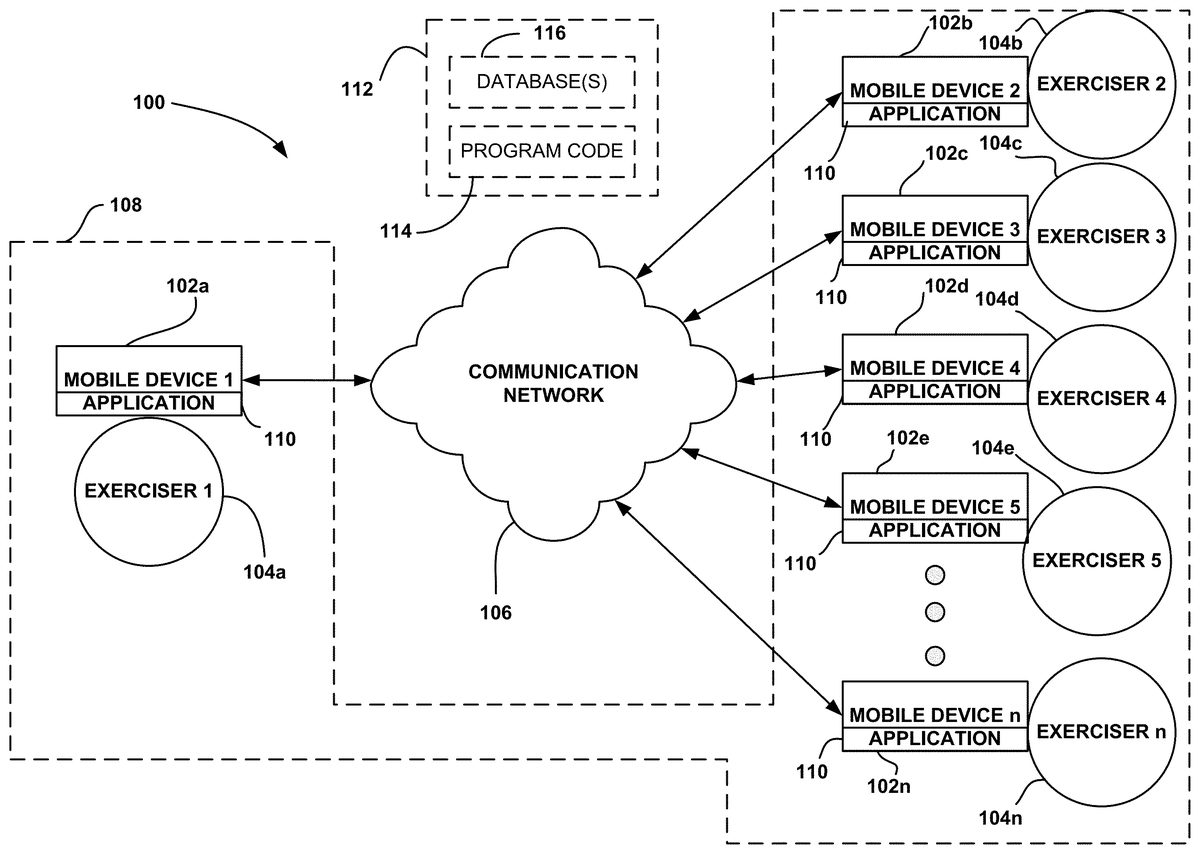
FIG. 1illustrates a system100for employing a mobile device102ato motivate an exerciser104ato exercise via communication with one or more other exercisers104b-nthrough one or more other mobile devices102b-nover a communication network106. The exercisers104a-nmay form an exercise group108. Mobile devices102a-nmay include mobile (e.g., cellular) phones, other personal digital assistants (PDAs), tablet computers or the like which run an application110provided in accordance with the present invention and described further below. Exercisers104a-nmay be runners, cyclers, walkers or any other suitable exercisers. Communication network106may be the internet, one or more mobile telephone networks such as a 3G or 4G network, an intranet, a WiFi network or the like.
In one or more embodiments of the invention, each mobile device102a-nmay execute an application110that may:(1) Employ GPS features of the mobile device to track position or change in position of the exerciser using the mobile device;(2) Determine change in position information of the exerciser;(3) Prompt the exerciser when and/or for how long the exerciser should change position;(4) Determine speed information of the exerciser;(5) Display a representation of the position, change in position, and/or speed of one or more exercisers on one or more of the mobile devices102a-n;(6) Communicate messages to one or more exercisers from one or more other exercisers;(7) Monitor and/or communicate other biometric information of an exerciser such as heart rate, step rate, pulse, distance travelled, speed, etc.;(8) Communicate position, change in position, heart rate, step rate, pulse, distance travelled, and/or other biometric information to one or more other exercisers, a third party such as family, friends, a doctor, an insurance company, a social network, etc.;(9) Allow each exerciser to select an exercise group in which to participate; and/or(10) Display information about the success of one or more exercisers and/or of the group at achieving a goal (e.g., time exercised, distance travelled, speed achieved, heart rate achieved, etc.).
In one particular embodiment, the application110may display information about and/or facilitate execution of a race in which each of the exercisers104a-nmay participate. For example, the race may be a relay race, a race between two destinations such as between two cities, across the island of Manhattan, across a state or the like, a race around the world, etc. Exerciser104a(Exerciser1) may be directed by mobile device102a, such as by a visual and/or audio prompt, to exercise by walking, running, cycling or otherwise changing position for a predetermined time period and/or predetermined distance. In some embodiments, the application110may track the position of the exerciser104a(exerciser1) using a GPS feature of the mobile device102aand communicate the position information to the exerciser104a(exerciser1) and/or to one or more of the mobile devices102b-nof the exercisers104b-n(and/or another third party if desired such as a family member, friends, retailers and/or restaurants near the exerciser, a social network site such as Facebook, Google+ or Twitter, etc. Each mobile device102a-nmay display a representation of the exerciser104a's position (and/or change in position) as the exerciser104achanges position. Other biometric information may be monitored, communicated and/or displayed such as heart rate, step rate, pulse rate, distance travelled, speed, etc.
Once the exerciser104a(exerciser1) completes his/her exercise such as by walking, running, cycling or otherwise changing position for the predetermined time period and/or predetermined distance, the second exerciser104b(exerciser2) may be begin exercising by walking, running, cycling or otherwise changing position for a predetermined time period and/or predetermined distance. In some embodiments, the application110may track the position of the exerciser104b(exerciser2) using a GPS feature of the mobile device102band communicate the position information to the exerciser104b(exerciser2) and/or to one or more of the mobile devices102a,102c-nof the exercisers104a,104c-n(exercisers1, and3-n). Each mobile device102a-nmay display a representation of the exerciser104b's position (and/or change in position) as the exerciser104bchanges position. Other biometric information also may be monitored, communicated and/or displayed such as heart rate, step rate, pulse rate, etc. (In some embodiments, the periods in which exercisers exercise may overlap.)
The above process may repeat until each exerciser104a-nhas completed an exercise routine. For instance, each exerciser104a-nmay walk, run, cycle or otherwise change position one, two, three, etc., times during the race. Each exerciser104a-nmay exercise the same number or a different number of times during the race. While the above has been described with regard to exercisers changing position, it will be understood that other forms of exercise may be employed in which the exerciser does not change position significantly. For example, an exerciser may run or march in place, perform jumping jacks, etc., all of which may be detected by changes in acceleration measured by accelerometers within a mobile device such as a mobile phone, tablet computer, etc. Alternatively or additionally, heart rate, pulse or other biometric monitors may monitor and/or provide biometric information to a mobile device and track exercise.
FIG. 2is a schematic diagram of an exemplary race200in which the group108may participate and which may be displayed on each mobile device102a-nusing application110. With reference toFIG. 2, the race200includes four destinations including a desert202, a castle204, a city206and paradise208that are connected by paths210a-c, respectively. An avatar212is shown traversing path210bbetween castle204and city206. Fewer, more and/or different destinations may be employed.
In operation, race200may be displayed on each mobile device102a-nvia application110running on each mobile device102a-n. In general, each mobile device102a-nneed not be running application110simultaneously and exercisers104a-nmay launch application110at any time on a respective mobile device102a-n(or any other suitable device) to check the status of avatar212within the race200. In some embodiments, the program code for managing and/or administering race200(or any video game as described below) may reside on a Web server or other server112(FIG. 1) in communication with the mobile devices102a-nand/or may be managed and/or administered by a social networking site such as Facebook or Twitter. For example, web server112may include program code114and/or one or more databases116for managing and/or administering the race200, storing information regarding exercisers104a-nand/or their exercise activities, allowing new members to join the group108, filtering potential new group members, etc. Likewise, race statistics may be displayed and/or viewed on such social networking sites.
With reference toFIGS. 1 and 2, the position of avatar212is controlled by the exercise (e.g., such as change in position, heart rate, steps taken, other biometric parameters, etc.) of exercisers104a-n. For example, exerciser104a(exerciser1) may be directed by mobile device102a, such as by a visual and/or audio prompt, to exercise by walking, running, cycling or otherwise changing position for a predetermined time period and/or predetermined distance. In some embodiments, the application110may track the position of the exerciser104a(exerciser1) using a GPS feature of the mobile device102aand display a change in position of the avatar212in response to a change in position of exerciser104a. In this manner the avatar212may travel along paths210a-210cbetween the various destinations202-208. Each mobile device102a-nmay display the avatar212changing position as the exerciser104achanges position. Each exerciser104a-nmay be assigned a portion or “leg” of the race200to complete by moving a predetermined distance or for a predetermined time period. In some embodiments, the exercisers104a-nmay assist one another by offering encouragement, taking over the leg of the race200from another exerciser or the like. The avatar212may likewise change position based on biometric data measured for an exerciser such as heart rate, steps taken, pulse, etc.
FIG. 3is a schematic diagram of a race300in which multiple exercise groups108may compete with one another within the race300. The race300is similar to the race200, but includes a separate avatar312a-nfor each exercise group108. In such embodiments, the mobile device of each exerciser in each group may be employed to display the race300and (multiple) avatar positions as the exercisers compete. Any number of exerciser groups may compete. In some embodiments, “handoffs” between exercisers within a group may be displayed as shown by avatar312nwhich indicates that the current exerciser of an exercise group is ending his/her leg of the race and another member of the exercise group is beginning his/her leg of the race.
Exercisers within a group may not wish to share actual GPS coordinates with other members of their exercise group. Accordingly, in some embodiments, the application110may only communicate information representative of position or change in position of an exerciser to other mobile devices. For instance, when exerciser104abegins his/her leg of a race, the application110on the mobile device102amay treat the exerciser104aas being at position x=0. Subsequent positions of the exerciser104amay be adjusted accordingly so as to mask actual GPS coordinates of exerciser104a. As mentioned, other biometric data such as heart rate, pulse rate, step rate, other parameters mentioned in Table 1 below, or the like may be monitored and employed to affect position, speed or the like of avatars212and/or312a-n.
As stated, in some embodiments, the program code for managing and/or administering a race (or any video game as described below) may reside on a Web server or other server112in communication with the mobile devices102a-nand/or may be managed and/or administered by a social networking site such as Facebook or Twitter. In addition to races, other competitive sports activities may include a “virtual” baseball or kickball game in which accelerometers within a mobile device are used to detect a kick, jump, swing of a baseball bat (or arm/hand that mimics a swing of a baseball bat), swing of a tennis racquet, or the like. For example, with reference toFIG. 4, an exercise group108may participate in a virtual baseball game400in which each exerciser104a-nin the group108is assigned a position with an avatar412a-nthat is displayed in that position on a virtual baseball field414displayed on each mobile device102a-n. In some embodiments, a remote web server, such as web server112inFIG. 1, may be programmed to communicate with the mobile device of each exerciser104a-n, host the virtual game, issue avatar position updates to each mobile device used by an exerciser104a-n(e.g., based on biometric or other information received from each mobile device as described below).
During a game, the position and/or behavior of each avatar412a-don a baseball field414may be controlled by the GPS location and/or other data measured by each mobile device102a-n(and/or by biometric data collected by the mobile device102a-nsuch as heart rate, speed, cadence, pulse, etc.). For example, exerciser1(represented by avatar412a) may pitch a ball to exerciser2(represented by avatar412b) by pretending to pitch a ball with his/her mobile device. For instance, exerciser1(represented by avatar412a) may hold his/her mobile device in his/her pitching arm, and carry out a pitching motion while holding the mobile device. Accelerometers within the mobile device may measure forces generated during the pitch, for example, by measuring x, y and/or z axis acceleration. Each mobile device102a-nmay display an avatar representative of exerciser1pitching a ball and/or ball speed in the “virtual” game may be based on the real world pitch of exerciser1(e.g., as measured by accelerometers in the mobile device of exerciser1, one or more external accelerometers in communication with the mobile device of exerciser1such as an accelerometer mounted in a write band, or the like). Exerciser2(represented by avatar412b) may hit the ball pitched by exerciser1(represented by avatar412a) by swinging his/her mobile device at the appropriate time based on the pitch of exerciser1(represented by avatar412a) or by performing some predetermined exercise requirement (e.g., running for a predetermined time, distance and/or speed, maintaining a predetermined heart rate range for a predetermined time, or the like). Assuming exerciser2(represented by avatar412b) actually hits the virtual ball (e.g., swings his/her mobile device at the correct time or performs a predetermined exercise requirement), each mobile device102a-nmay display a ball being hit by the avatar412bof exerciser2. Exerciser3(represented by avatar412c), who may be playing infield or outfield, may catch the ball hit by exerciser2by running or performing some other predetermined exercise so as to cause his/her avatar412cto run toward the virtual ball hit by the avatar412bof exerciser2. Exerciser3may “catch” the ball hit by exerciser2using his/her mobile device, for example. In general, all types of ball play may be similarly conducted using the accelerometers and/or GPS features of mobile devices102a-n(or external biometric measurement devices that provide biometric information to the mobile devices). Other virtual games may be similarly played such as tennis football, basketball, hockey, volleyball, or the like. While only four avatars are shown inFIG. 4representing four exercisers, it will be understood that fewer or more exercisers and/or avatars may be employed.
Note that virtual game play may or may not be performed in real time. In some embodiments, the position or other characteristics of an avatar may be changed during or after exercise is performed.
In one or more embodiments, an exercise group, such as a group of friends, a group with members that share certain characteristics such as similar age, interests, historical exercise performance, education, or the like (which in some embodiments may be identified via a social networking site), may agree to play a virtual game while each group member works out. For instance, one group member may wish to work out at a local gym, while another may wish to work out in his/her home, etc. As described above, each gaming device such as a cellular telephone, tablet computer, etc., may include an application which displays a video game in which each group member may control one or more aspects of the video game. For instance, each group member's exercise may control the position, speed, movement or the like of a video game character. In this manner a group of friends may be motivated to work out together. Similarly, an exerciser may enter a “pick up” game with previously unknown exercisers. In a further example, such games may be used in a match-making embodiment (e.g., to introduce people with similar interests and/or geographic location that meet predetermined criteria such as age, education, marital status, or the like). For example, a first exerciser may be at a local health club and wish to meet another exerciser within the health club. He/she may send out a request for someone within the health club to participate and/or compete in a video game or virtual competition. In some embodiments, an application on a mobile device may be used to access a social networking cite to identify exercise partners. For instance, the health club may maintain a Facebook or similar page that may be used to identify exercisers currently at the health club that may wish to interact, such as train or compete, with other exercisers at the health club. The request may include filters such as required characteristics of the invited exerciser (e.g., female, single, age, employment status, etc.). Accordingly, an application with such functionality may be provided to execute on a mobile device or other gaming device of the exercisers. Any suitable biometric information may be monitored during exercise such as position, speed, heart rate, cadence, etc.
FIG. 5is a schematic diagram of an exemplary video game500for use by mobile devices102a-nvia a Web server or other server112in communication with the mobile devices102a-nand/or may be managed and/or administered by a social networking site such as Facebook, Google+ or Twitter. In the embodiment ofFIG. 5, a virtual farm502is provided that includes crops504, a tractor506, a barn508, a silo510, chickens512, cows514and/or any other typical farm items (not shown). In some embodiments, the goal of such a video game500may be to grow more crops, buy more land, obtain more eggs, chickens, cows or milk, plow fields, harvest crops, or the like. In accordance with embodiments of the present invention, performance of such activities may be enhanced by exercise of one or more exercisers104a-n. For instance, if exerciser104ais playing the video game500, exerciser104amay be assigned (or establish) an exercise goal such as a number of miles to walk or run, a number of minutes to walk or run on a treadmill, a length of time to perform an aerobics routine, a number of jumping jacks to perform, etc. Completion of such goals may be monitored by a mobile device102a-nas previously described (e.g., through use of accelerometers of the mobile device or external accelerometers, GPS-features, use of heart rate monitors, verification by a third party such as a friend or health club staff, etc.). In exchange for completion (or partial completion) of the exercise goal, an exerciser may be rewarded with more land, more or heartier crops, more cows or more milk production from cows, new farm animals or equipment, gas or diesel fuel for farm equipment, more grain in the silo510, more tokens or virtual money for farm item purchases, or the like.
In some embodiments, an exercise group108may be assigned to a farm (e.g., a community farm). Exercisers104a-nwithin the exercise group108may be assigned farm tasks that are enhance by exercise as described above. Being a part of such a group may be provide additional motivation for each exerciser104a-nto complete regular exercise (e.g., due to peer pressure).
Other Embodiments
The exercisers104a-nmay wish to have a more interactive experience. Accordingly, in some embodiments, the race200and/or300may be part of a video game in which the avatar212and/or avatars312a-nencounter monsters, snipers, assassins, wild animals, obstacles or other typical video game scenarios that the avatar(s) must navigate through and/or survive. In this regard, if exerciser104ais currently exercising, his/her exercise level may directly affect video game play of either the exerciser104aor of the other exercisers104b-n. For instance, exercise of exerciser104amay be employed to affect the speed, striking force, game level, etc., of the avatar212. Exemplary video game character performance levels that may be affected by a measured exercise parameter are shown below in Table 1. Such parameters may be measured using suitable sensors such heart rate monitor chest straps, pedometers, accelerometers, or the like.
TABLE 1MONITORED EXERCISERVIDEO GAME CHARACTERPERFORMANCE LEVELPERFORMANCE LEVEL CONTROLLEDpedaling ratespeed, striking forcestepping ratespeed, striking forcerowing ratespeed, striking forcerunning ratespeed, striking forcepulse ratespeed, energy level, accuracystriking forcestriking forceswing velocityswing velocitydistance traveledgame leveltime exercisedgame level
In one example, exercise of exerciser104amay be used to control speed, striking force or game level of a video game in which avatar212is a character. One or more of the other exercisers104b-nin group108may control other parameters of the avatar212such as movement to the right, left, up, down, other movements such as jumping, kicking, firing a weapon, steering a car, etc. For instance, while exercising, the exerciser104amay not be free to use his/her hands to manipulate the mobile device102ain a manner that would cause the avatar212to turn right or left, kick, jump, fire a weapon, etc. Nonetheless, the exercise of the exerciser104amay be used to affect the speed, striking force, game level, etc., of the avatar212. One or more of the other exercisers104b-nin group108who is/are not exercising may use his/her respective mobile device102b-nto cause movement of the avatar212to the right or left, to kick, etc., or otherwise proceed through the video game (e.g., using accelerometers within the mobile device, tapping the screen of the mobile device, etc.) while the exerciser104ais exercising.
In some embodiments, primary control of the avatar212may pass back and forth between two or more members of an exercise group over and over during a work out routine (e.g., as the person exercising changes). For example,FIG. 6is a schematic diagram of a video game600executing on mobile devices102aand102bof exercisers104aand104b, respectively. Other numbers of mobile devices and/or exercisers may be used.
Mobile devices102a-binclude an application for the video game600. In the example shown, a race car602is shown. Any other video game type, character, setting or the like may be used (as described above, for example). Mobile devices102a-bmay communicate with each other directly, such as via WIFI, a cellular network, some other protocol, etc., or may communicate indirectly through a web server112or similar system. In the embodiment shown, control of the steering and/or braking of car602is controlled by the exerciser102aor102bwho is not exercising, while control the speed of the car602is controlled by the exerciser102aor102bwho is exercising. Who exercises when and/or for how long may be determined by the exercisers102a,102b, a third party such as other members of an exercise group, a trainer, a retailer that may offer rewards for completing an exercise program, or the like. For instance, in some embodiments, web server112may host a web interface in which the race600, or information or statistics about the race600, may be observed. Through such a web interface, an exerciser or other party may enter a desired exercise duration for the game600, when and/or for how long each exerciser will exercise, etc. Such information may be communicated to the mobile devices102a-nbefore and/or during game play, for example.
In other embodiments, the exerciser104amay control such movements of an avatar as well. In one particular embodiment, an application110may be adapted to process voice commands of the exerciser104ato control movement or other behaviors of an avatar. Exemplary voice commands are shown in Table 2 below.
TABLE 2VOICE COMMANDVIDEO GAME CHARACTEROF EXERCISERCHARACTERISTIC CONTROLLED“L” or “Left”turn left“R” or “Right”turn right“J” or “Jump”jump“D” or “Duck”duck or drop to the ground“B” or “Back”move back“K” or “Kick”kick“F” or “Fly”fly
In other embodiments, another sound of exerciser104amay be used to control the avatar, such as a “clacking” sound. For instance, the exerciser104amay clack his/her tongue once to turn right, twice to turn left, thrice to jump, etc., similar to Morse code. In some embodiments, the exerciser104amay select/record sounds that are to be interpreted by the application110to correspond to turning left or right, jumping, ducking, kicking with a left or right leg, flying, etc.
Additional Embodiments
In some embodiments, a gaming device such as a mobile telephone, tablet computer, or the like, may include a video game with characteristics that change based on the number of other gaming devices near the gaming device. For example, an application may be provided for execution on mobile devices. The application may monitor whether mobile devices are within a predetermined geographic area of one another, such as by using GPS location information from each mobile device. Characteristics of a video game running on one or more of the mobile devices may depend on or otherwise be affected by the number or proximity of other mobile devices (e.g., video game characteristics such as the number or position of video game characters within the video game, the landscape or background characteristics of the video game, etc.). In some embodiments, biometric information collected by each mobile device such as heart rate, speed, etc., similarly may be used to affect the video game by affecting the speed, strength, position, etc., of characters within the video game). Further, in some embodiments, certain game levels, movements, etc., may only be possible within the video game if a large enough (or small enough) number of mobile devices are present within a predetermined location.
In some embodiments, the video game may communicate with a social networking site such as Facebook, Google+ or Twitter, and such social networking sites may identify or notify friends or affiliated groups of the presence of friends or members within a particular geographic area (e.g., using GPS features of mobile devices). Such friends or affiliated groups may be prompted to participate in video games or to otherwise interact.
In one or more embodiments, video game characteristics of a video game may be affected by location information of the mobile device executing the video game. For instance, a user may only enter a certain game level if he/she is physically located at a particular location such as a restaurant, a mall, a computer store, a city, a monument, or the like. The user's position may be determined, for example, using GPS features of the mobile device.
In yet other embodiments, location information from mobile devices may be collected and/or aggregated to track position, travel habits, etc., of a group of people such as lawyers, doctors, gamers, etc., that are members of a social network. In fact, a virtual world or map may be generated by tracking the position of one or mobile devices during any given time period. In some embodiments, such information may be used to affect video game characteristics such as game environment, number of video game characters, or the like.
The foregoing description discloses only exemplary embodiments of the invention; modifications of the above disclosed apparatus and method which fall within the scope of the invention will be readily apparent to those of ordinary skill in the art. For instance, any number of performance levels of an exerciser may be monitored and used to control any number of performance levels of a video game character. Further, old video games may be modified for use with the present invention, or new video games may be developed.
In some embodiments, exercisers may join exercise groups via a social networking site such as Facebook, Google+ or Twitter. Such social networking sites may collect information on the exercisers and make recommendations for exercise groups based on age, weight, type of exercise, geographic location or the like.
In some embodiments, exercisers training for a marathon or other exercise goal may be identified by a social networking site (e.g., based on hobbies, interests, or other identifying data posted by the exerciser on the social networking site). One or more exercisers, or the social networking site itself, may invite like exercisers to join a training group. In some embodiments, retail businesses such as clothing stores, restaurants, cellular telephone providers, or the like, may offer members of the group discounts such as reduced rate clothing, discounted meals, reduced cell phone rates or free minutes (e.g., for calls between group members) or the like.
In some aspects, a method for exercising using a mobile device is provided that includes providing an application on a first mobile device. The application adapted to (1) display an avatar on the first mobile device; (2) monitor exercise performed by a user of the first mobile device to obtain monitored exercise information; (3) communicate monitored exercise information from the first mobile device to one or more other mobile devices employed by one or more other users; (4) receive monitored exercise information from one or more other mobile devices employed by one or more other users; (5) display an avatar on the first mobile device; and (6) adjust a position of the avatar on the first mobile device based on monitored exercise information of the first user and monitored exercise information from one or more other mobile devices. The monitored exercise information may exchanged between mobile devices via a remote web server, such via a social network web site running on the remote web server.
In some aspects, an application for a mobile device is provided that includes program code adapted to allow the mobile device to (1) display a video game have one or more avatars controllable by location information of a user of the mobile device and location information of at least one user of another mobile device; (2) share location information for the mobile device with at least one other mobile device; and (3) obtain location information of at least one other mobile device. In some embodiments, the program code may be adapted to allow a user of the mobile device to join an exercise group; and communicate location information for the mobile device with mobile devices of other members of the exercise group. In some embodiments, the program code may be adapted to communicate with mobile devices of other members of the exercise group through a social network web site. In additional embodiments, the program code may be adapted to switch control of motion of the avatar on the mobile device between the user of the mobile device and a user of another mobile device.
Accordingly, while the present invention has been disclosed in connection with exemplary embodiments thereof, it should be understood that other embodiments may fall within the spirit and scope of the invention, as defined by the following claims.
Claims
- A system for cooperative control of a video game avatar, the system comprising: a plurality of mobile devices, each mobile device being with a different one of a plurality of users;and computer program code stored in each of the plurality of mobile devices;wherein the computer program code stored in a first mobile device of the plurality of mobile devices, when executed by the first mobile device, causes the first mobile device to: direct a user of the first mobile device to perform an exercise movement;measure, by sensors communicatively coupled to the first mobile device, exercise parameters of the user of the first mobile device;transmit, by communications facilities of the first mobile device, the measured exercise parameters of the user to a server, and receive measured exercise parameters of other users;execute a video game on the first mobile device, the video game operable to employ the measured exercise parameters of the users to cooperatively control movement of an avatar within the video game;transmit location information of the user to the server and to receive location information of other users, wherein the video game has one or more avatars controllable based on location information of the user of the first mobile device and location information of other users, wherein a first movement parameter of the avatar is controlled based upon a first exercise parameter of a first user and a second movement parameter of the avatar is controlled based upon a second exercise parameter of a second user, and wherein movement capabilities of the video game avatar for playing the video game are set based upon an exercise performance level of the users.
- The system of claim 1 , wherein the computer program code stored in the first mobile device, when executed by the first mobile device, causes the first mobile device to output images to a display of the first mobile device depicting a movement of the avatar, which is representative of the exercise movement of the user of the first mobile device.
- The system of claim 1 , wherein the computer program code stored in the first mobile device, when executed by the first mobile device, further causes the first mobile device to direct the first user to perform a first exercise for a first period of time and then direct the first user to perform a second exercise for a second period of time.
- The system of claim 1 , wherein the communications facilities of the first mobile device to allow the user to join an exercise group of other users.
- The system of claim 4 , wherein the computer program code, when executed by the first mobile device, causes the first mobile device to: communicate location information for the user to other users within the exercise group.
- The system of claim 4 , wherein the computer program code stored in the first mobile device, when executed by the first mobile device, causes the first mobile device to display information associated with achievement of a goal of the exercise group.
- The system of claim 4 , wherein competitiveness in the video game is based upon the exercise group achieving a goal of the exercise group.
- The system of claim 4 , wherein the computer program code, when executed by the first mobile device, causes the first mobile device to communicate with other users within the exercise group through a social network web site.
- The system of claim 1 , wherein the computer program code stored in the first mobile device, when executed by the first mobile device, causes the first mobile device to prompt other users to exercise for a predefined amount of time.
- The system of claim 1 , wherein the computer program code stored in the first mobile device, when executed by the first mobile device, causes the first mobile device to prompt the user when to perform exercise.
- The system of claim 1 , wherein the computer program code stored in the first mobile device, when executed by the first mobile device, causes the first mobile device to communicate messages to the other users.
- A system for cooperative control of a video game avatar, the system comprising: a plurality of mobile devices, each mobile device being with a different one of a plurality of users;and computer program code stored in each of the plurality of mobile devices;wherein the computer program code stored in a first mobile device of the plurality of mobile devices, when executed by the first mobile device, causes the first mobile device to: direct a user of the first mobile device to perform an exercise movement;measure, by sensors coupled to the first mobile device, exercise parameters of the user of the first mobile device;transmit, by communications facilities of the first mobile device, the measured exercise parameters of the user to a server, and receive measured exercise parameters of other users;execute a video game on the first mobile device, the video game operable to employ the measured exercise parameters of the users to cooperatively control movement of an avatar within the video game, wherein a first movement parameter of the avatar is controlled based upon a first exercise parameter of a first user and a second movement parameter of the avatar is controlled based upon a second exercise parameter of a second user, and wherein movement capabilities of the video game avatar for playing the video game are set based upon an exercise performance level of the users;wherein the video game is further operable to switch which movement parameter of the avatar is controlled based upon the exercise parameters of the users such that the first movement parameter of the avatar is controlled based upon the second exercise parameter of the second user and the second movement parameter of the avatar is controlled based upon the first exercise parameter of the first user.
- A system for cooperative control of a video game avatar, the system comprising: a plurality of mobile devices, each mobile device being with a different one of a plurality of users;and computer program code stored in each of the plurality of mobile devices;wherein the computer program code stored in a first mobile device of the plurality of mobile devices, when executed by the first mobile device, causes the first mobile device to: direct a user of the first mobile device to perform an exercise movement;measure, by sensors communicatively coupled to the first mobile device, exercise parameters of the user of the first mobile device;transmit, by communications facilities of the first mobile device, the measured exercise parameters of the user to a server, and receive measured exercise parameters of other users;and execute a video game on the first mobile device, the video game operable to employ the measured exercise parameters of the users to cooperatively control movement of an avatar within the video game, wherein a first movement parameter of the avatar is controlled based upon a first exercise parameter of a first user and a second movement parameter of the avatar is controlled based upon a second exercise parameter of a second user, and wherein movement capabilities of the video game avatar for playing the video game are set based upon an exercise performance level of the users, wherein the computer program code stored in the first mobile device, when executed by the first mobile device, causes the first mobile device to communicate measured biometric information of the user to a third party.
- A method for cooperative control of a video game avatar, the method comprising: providing a plurality of mobile devices, each mobile device of the plurality of mobile devices being with a different user;and providing computer program code stored in each of the plurality of mobile devices, wherein execution of the computer program code stored in a first mobile device of the plurality of mobile devices by the first mobile device, causes the first mobile device to: direct a user of the first mobile device to perform an exercise movement;measure, by sensors communicatively coupled to the first mobile device, exercise parameters of the user of the first mobile device;transmit the measured exercise parameters of the user to a server, and receive measured exercise parameters of other users;and execute a video game on the first mobile device, the video game operable to employ the measured exercise parameters of the users to cooperatively control movement of an avatar within the video game;transmit location information of the user to the server and receive location information of other users, wherein the video game has one or more avatars controllable based on location information of the user of the first mobile device and location information of other users, wherein a first movement parameter of the avatar is controlled based upon a first exercise parameter of a first user and a second movement parameter of the avatar is controlled based upon a second exercise parameter of a second user, and wherein movement capabilities of the video game avatar for playing the video game are set based upon an exercise performance level of the users.
- The method of claim 14 , further comprising transmitting location information of a user to the server and receiving location information of other users.
- The method of claim 14 , further comprising controlling one or more avatars of the video game based, at least in part, on location information of a user and location information of other users.
- The method of claim 14 , wherein the computer program code stored in the first mobile device, when executed by the first mobile device, further causes the first mobile device to allow a user to join an exercise group of other users.
- The method of claim 17 , further comprising communicating location information for the user to other users within the exercise group.
Disclaimer: Data collected from the USPTO and may be malformed, incomplete, and/or otherwise inaccurate.