U.S. Pat. No. 10,449,457
SYSTEM AND METHOD FOR DYNAMIC MATCHMAKING POPULATION HERDING
AssigneeDisney Enterprises Inc
Issue DateApril 20, 2011
Illustrative Figure
Abstract
Techniques are disclosed for dynamically herding a matchmaking population for a multi-player game. A new player requesting to play a multi-player game is presented with a gameplay selection mode interface based on metrics gathered by monitoring the matchmaking population for the different gameplay modes of the multi-player game. The metrics are evaluated by a metric evaluation engine to determine a configuration of the gameplay mode selection interface that is designed to herd the matchmaking population to evenly balance the players across the different gameplay modes of the multi-player game. A herding incentive may be determined based on the evaluation of the metrics and included in the gameplay mode selection interface.
Description
DETAILED DESCRIPTION OF EXEMPLARY EMBODIMENTS Embodiments of the invention include a system for dynamically herding a matchmaking population for a multi-player game. When a multi-player game has several different gameplay modes, the population of players is spread across those modes and is typically not evenly distributed. As a result, the matchmaking process that identifies a game for a new player to join takes longer for unpopular gameplay modes. Dynamic matchmaking population herding evaluates various metrics such as the population spread and the average matchmaking wait time. These metrics are used to dynamically adjust herding incentives, e.g., rewards, that new players receive for selecting a particular (less popular) gameplay mode. The metrics are also used to configure a gameplay mode selection interface. The herding more evenly distributes the players among the different gameplay modes, and reduces the worst-case matchmaking wait time. One embodiment of the invention provides a computer-implemented method for dynamically herding a matchmaking population for a multi-player game. The method may generally include evaluating metrics of the matchmaking population to produce metric evaluation results and receiving a request from a new player to join a multi-player game having multiple gameplay modes. Based on the metric evaluation results, a gameplay mode selection interface is determined for display to the new player. In the following, reference is made to embodiments of the invention. However, it should be understood that the invention is not limited to specific described embodiments. Instead, any combination of the following features and elements, whether related to different embodiments or not, is contemplated to implement and practice the invention. Furthermore, although embodiments of the invention may achieve advantages over other possible solutions and/or over the prior art, whether or not a particular advantage is achieved by a given embodiment is not limiting of the invention. Thus, the following ...
DETAILED DESCRIPTION OF EXEMPLARY EMBODIMENTS
Embodiments of the invention include a system for dynamically herding a matchmaking population for a multi-player game. When a multi-player game has several different gameplay modes, the population of players is spread across those modes and is typically not evenly distributed. As a result, the matchmaking process that identifies a game for a new player to join takes longer for unpopular gameplay modes. Dynamic matchmaking population herding evaluates various metrics such as the population spread and the average matchmaking wait time. These metrics are used to dynamically adjust herding incentives, e.g., rewards, that new players receive for selecting a particular (less popular) gameplay mode. The metrics are also used to configure a gameplay mode selection interface. The herding more evenly distributes the players among the different gameplay modes, and reduces the worst-case matchmaking wait time.
One embodiment of the invention provides a computer-implemented method for dynamically herding a matchmaking population for a multi-player game. The method may generally include evaluating metrics of the matchmaking population to produce metric evaluation results and receiving a request from a new player to join a multi-player game having multiple gameplay modes. Based on the metric evaluation results, a gameplay mode selection interface is determined for display to the new player.
In the following, reference is made to embodiments of the invention. However, it should be understood that the invention is not limited to specific described embodiments. Instead, any combination of the following features and elements, whether related to different embodiments or not, is contemplated to implement and practice the invention. Furthermore, although embodiments of the invention may achieve advantages over other possible solutions and/or over the prior art, whether or not a particular advantage is achieved by a given embodiment is not limiting of the invention. Thus, the following aspects, features, embodiments and advantages are merely illustrative and are not considered elements or limitations of the appended claims except where explicitly recited in a claim(s). Likewise, reference to “the invention” shall not be construed as a generalization of any inventive subject matter disclosed herein and shall not be considered to be an element or limitation of the appended claims except where explicitly recited in a claim(s).
As one skilled in the art will appreciate, aspects of the present invention may be embodied as a system, method or computer program product. Accordingly, aspects of the present invention may take the form of an entirely hardware embodiment, an entirely software embodiment (including firmware, resident software, micro-code, etc.) or an embodiment combining software and hardware aspects that may all generally be referred to herein as a “circuit,” “module” or “system.” Furthermore, aspects of the present invention may take the form of a computer program product embodied in one or more computer readable medium(s) having computer readable program code embodied thereon.
Any combination of one or more computer readable medium(s) may be used. The computer readable medium may be a computer readable signal medium or a computer readable storage medium. A computer readable storage medium may be, for example, but not limited to, an electronic, magnetic, optical, electromagnetic, infrared, or semiconductor system, apparatus, or device, or any suitable combination of the foregoing. More specific examples (a non-exhaustive list) of the computer readable storage medium would include the following: an electrical connection having one or more wires, a portable computer diskette, a hard disk, a random access memory (RAM), a read-only memory (ROM), an erasable programmable read-only memory (EPROM or Flash memory), an optical fiber, a portable compact disc read-only memory (CD-ROM), an optical storage device, a magnetic storage device, or any suitable combination of the foregoing. In the context of this document, a computer readable storage medium may be any tangible medium that can contain, or store a program for use by or in connection with an instruction execution system, apparatus or device.
A computer readable signal medium may include a propagated data signal with computer readable program code embodied therein, for example, in baseband or as part of a carrier wave. Such a propagated signal may take any of a variety of forms, including, but not limited to, electro-magnetic, optical, or any suitable combination thereof. A computer readable signal medium may be any computer readable medium that is not a computer readable storage medium and that can communicate, propagate, or transport a program for use by or in connection with an instruction execution system, apparatus, or device.
Program code embodied on a computer readable medium may be transmitted using any appropriate medium, including but not limited to wireless, wireline, optical fiber cable, radio frequency, etc., or any suitable combination of the foregoing.
Computer program code for carrying out operations for aspects of the present invention may be written in any combination of one or more programming languages, including an object oriented programming language such as Java, Smalltalk, C++ or the like and conventional procedural programming languages, such as the “C” programming language or similar programming languages. The program code may execute entirely on the user's computer, partly on the user's computer, as a stand-alone software package, partly on the user's computer and partly on a remote computer or entirely on the remote computer or server. In the latter scenario, the remote computer may be connected to the user's computer through any type of network, including a local area network (LAN) or a wide area network (WAN), or the connection may be made to an external computer (for example, through the Internet using an Internet Service Provider).
Aspects of the present invention are described below with reference to flowchart illustrations and/or block diagrams of methods, apparatus (systems) and computer program products according to embodiments of the invention. It will be understood that each block of the flowchart illustrations and/or block diagrams, and combinations of blocks in the flowchart illustrations and/or block diagrams, can be implemented by computer program instructions. These computer program instructions may be provided to a processor of a general purpose computer, special purpose computer, or other programmable data processing apparatus to produce a machine, such that the instructions, which execute via the processor of the computer or other programmable data processing apparatus, create means for implementing the functions/acts specified in the flowchart and/or block diagram block or blocks.
These computer program instructions may also be stored in a computer readable medium that can direct a computer, other programmable data processing apparatus, or other devices to function in a particular manner, such that the instructions stored in the computer readable medium produce an article of manufacture including instructions which implement the function/act specified in the flowchart and/or block diagram block or blocks. The computer program instructions may also be loaded onto a computer, other programmable data processing apparatus, or other devices to cause a series of operational steps to be performed on the computer, other programmable apparatus or other devices to produce a computer implemented process such that the instructions which execute on the computer or other programmable apparatus provide processes for implementing the functions/acts specified in the flowchart and/or block diagram block or blocks.
FIG. 1Ashows a high-level block diagram of a server system100and player systems170-0,170-1, and170-2in the context of network environment160, according to one embodiment of the invention. As illustrated inFIG. 1A, users may connect to the server system100through a player system170, i.e., client. In a typical embodiment, the player system170-0, the player system170-1, and the player system170-2may be connected through respective network connections106,107, and108to a network165. The network165may allow the player systems170to share resources or information. The network165may further allow the player systems170to communicate with other computers, and access computer systems and applications stored on a server, for example, system server100.
In one embodiment, the player system170-0, player system170-1, player system170-2and server system100may reside on separate computers. Each separate computer may include, for example, computer hardware including a processor, memory, address and data buses, and input and output modules. Each separate computer may also include an operating system, system software, application software, and networking capabilities. Each player system170is configured to execute a multi-player game application program where a user controls the actions of an actor in the multi-player game.
The multi-player game application may be a game engine that provides graphics and animations associated with a scene or moment in the game. Using the I/O devices, a player system170may display a virtual world as instructed by the multi-player game application. The multi-player game application renders a virtual world having virtual locations and virtual actors, including the actor controlled by the user. The multi-player game application may display a three-dimensional map, representing the virtual world and numerous actors through the map, representing both actors controlled by other users in the online environment and non-player, computer-controlled actors.
When a user inputs a command using an input device, the multi-player game application evaluates the command and determines the effect of the command on the execution of the game. Similarly, when an interaction occurs between computer-controlled actors, user controlled actors, and/or objects, the multi-player game application evaluates the interaction and determines the effect of the interaction on the execution of the game. These effects may be reflected in the graphics and animations displayed to the user.
In one embodiment, the server system100and player systems170may include existing computer systems, e.g., desktop computers, server computers, laptop computers, tablet computers and the like. For example, the server system100and/or player systems170may comprise a console designed for execution of games, such as an arcade machine, a SONY PLAYSTATION 3, or a MICROSOFT XBOX 360. The server system100and/or player systems170may also comprise a general computing device configured for execution of games, such as a laptop, desktop, or personal computer.
Graphics and animations for display by the player systems170can be created using any number of methods and devices. Modeling software, such as MAYA, sold by AUTODESK, is often used, especially when generating graphics and animations representing a three dimensional environment. Using such software, an animator can create objects and motions for the objects that can be used by the multi-player game application to provide data for display on a display device. Multi-player games typically are configured to operate in a variety of different gameplay modes. Different gameplay modes may be different virtual environments such as a desert, forest, beach, swamp, mountain, mines, and the like. Within each different virtual environment, there may be a variety of different gameplay levels of difficulty or expertise. In some embodiments, each player is associated with an expertise level based on past gameplay and a player may only join a game at a gameplay level that matches the player's expertise level.
FIG. 1Billustrates a server system100configured according to one embodiment of the invention. The server system100illustrated inFIG. 1B, however, is merely an example of one computing environment. Embodiments of the present invention may be implemented differently, regardless of whether the computer systems are complex multi-user computing systems, such as a cluster of individual computers connected by a high-speed network, single-user workstations or network appliances lacking non-volatile storage.
In one embodiment, server system100includes a multi-player game component135that communicates over the communications network to interact with a multi-player game applications running on the player systems170. The player systems170may be configured to create a connection with the server system100and to render a virtual online environment for one or more gameplay modes of the multi-player game. For example, the multi-player game application running on a player system170receives commands representing the actions of a player's actor and displays the status and movement of each actor within the multi-player game. The multi-player game component135tracks the status and movement of each actor within the multi-player game.
The multi-player game component135includes metrics140, incentive data150, and player data155. The metrics140comprises data that is monitored by the multi-player game component135as multi-player games are played. In particular, metrics140stores data indicating the distribution of the matchmaking population across the different gameplay modes, the average, minimum, and maximum matchmaking wait time for each gameplay mode, and the number of new players who stopped attempting to join a game during the matchmaking process for each gameplay mode. The matchmaking wait time is the length of time a player waits while attempting to join a game. The incentive data150indicates specific rewards or incentives that may be offered to new players to herd the new players to select a particular gameplay mode that is less popular than other gameplay modes.
The herding incentives are typically specified by the game developer and may be unique to each gameplay mode. Example herding incentives include tools, weapons, increase point earning capability, opportunity to be named “player of the week,” increased likelihood of a rare event occurring, presence of extra content, and the like. A point in the context of point earning may include various types of points relating to a score, experience, PvP (Player vs. Player) honor, in-game currency, redeemable tokens, achievement, and the like. For a multi-player battlefield game having five different gameplay modes represented by different maps, a particular vehicle, such as a tank, may only be available in the least popular map as a herding incentive. The player data155stores information that is unique to each player, including the player's expertise level and any herding incentives that the player has received for selecting to play in a particular gameplay mode.
The population herding module150comprises a metric evaluation engine145that receives the metrics140from the multi-player game component135and evaluates the metrics140to generate metric evaluation results. The population herding module150determines a gameplay mode selection interface for presentation to a new player based on evaluation of the metrics140. The population herding module150may determine that a herding incentive should be offered for one or more of the gameplay modes in which case the herding incentive will be encoded in the gameplay mode selection interface.
The population herding module150is configured to function with a variety of different multi-player game applications by receiving game specific data, such as the incentive data150and player data155from the multi-player game component135. In one embodiment, the population herding module150may monitor and store the metrics140for each different multi-player game. The population herding module150may also store the data for each player related to herding incentives associated with the particular player.
The multi-player game component135and/or population herding module150provided by the server system100receives data from multi-player game applications executed by the player systems170and sends updates to the multi-player game applications over the communications network. In particular, the population herding module150provides the gameplay mode selection interface to a multi-player game application when a new player requests to join a multi-player game.
As shown, the client system100includes, without limitation, a central processing unit (CPU)105, a network interface115, an interconnect120, a memory125, and storage130. The client computing system130may also include an I/O devices interface110connecting I/O devices112(e.g., keyboard, display and mouse devices). The CPU105retrieves and executes programming instructions stored in the memory125, e.g., the multi-player game component135and population herding module150. The interconnect120is used to transmit programming instructions and application data between the CPU105, I/O devices interface110, storage130, network interface115, and memory125. CPU105is included to be representative of a single CPU, multiple CPUs, a single CPU having multiple processing cores, and the like. And the memory125is generally included to be representative of a random access memory. Storage130, such as a hard disk drive or flash memory storage drive (e.g., a solid state device (SSD)), may store non-volatile data.
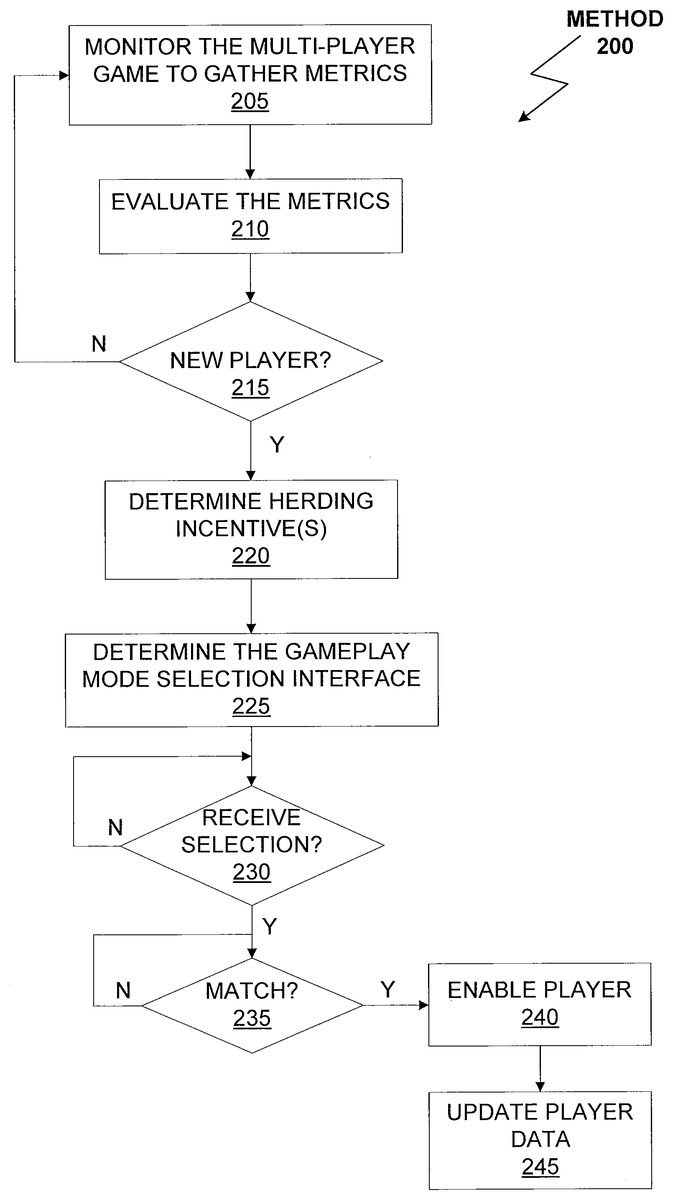
FIG. 2Ais a flowchart of method steps describing dynamic herding of a matchmaking population for multi-player gameplay, according to one embodiment of the invention. Persons skilled in the art would understand that, even though the method200is described in conjunction with the systems ofFIGS. 1A and 1B, any system configured to perform the method steps, in any order, is within the scope of embodiments of the invention. In one embodiment, the multi-player game application may perform the method200. In other embodiments, the multi-player game component135or the population herding module150may perform the method200. As shown, the method200begins at step205, where the multi-player game is monitored to gather the metrics140. In particular, metrics related to the matchmaking population for each gameplay mode of the multi-player game are monitored. At step210the matchmaking population metrics are evaluated by the metrics evaluation engine145to generate evaluation results. At step215, if a new player does not request to join a multi-player game, then the population herding module150and/or the multi-player game component135returns to step205. Otherwise, at step220the population herding module150may determine one or more herding incentives based on the metric evaluation result. In some cases, no herding incentive will be determined. For example, when the players are balanced across the different gameplay modes there is no need to provide an incentive to herd the players to an unpopular gameplay mode.
The frequency at which herding incentives are changed may vary so that the dynamic nature of the matchmaking population evolves at different rates. For example, in one embodiment the herding incentives may be determined once per day. In other embodiments the herding incentives may be determined each time a new player requests to join a multi-player game. Still other embodiments may determine the herding incentives once a week, month, or at some other time interval. Similarly, the metrics140may be gathered for a time period, e.g., day, week, month, hours, minutes, and the like, and then evaluated at a less frequent rate to generate the metric evaluation results.
At step225the population herding module150determines the gameplay mode selection interface based on the metric evaluation results. Examples of various gameplay mode selection interfaces are described in conjunction withFIGS. 2B, 2C, 3A, and 3B. In some of the gameplay mode selection interfaces, the herding incentive information may be directly visible to the new player. In other gameplay mode selection interfaces, herding incentives are not used and the new player is herded using techniques that do not rely on herding incentives. Once the gameplay mode selection interface is determined, it is displayed to the new player at the associated player system170.
At step230the population herding module150determines if a gameplay mode selection is received from the new player, and if not, then the population herding module150remains in step230. Otherwise, at step235the multi-player game component135determines if an in-progress multi-player game is available that matches the gameplay mode selected by the new player. If a matching in-progress multi-player game is not available, then the multi-player game component135remains in step235. When a matching in-progress multi-player game becomes available (or a new multi-player game in the selected gameplay mode starts), at step240the multi-player game component135enables the new player and the population herding module150at step245the multi-player game component135updates the player data155if the player received any herding incentives as a result of his/her gameplay mode selection.
If a new player stops attempting to join a game in step235, the multi-player game component135returns to step205and updates the metrics140. In one embodiment, the population herding module150records herding data that is used to determine the effectiveness of the herding technique for use in modifying the configuration of the gameplay mode selection interface and herding incentives. Herding data may include changes made to the herding incentives, desired effects of the changes, and actual effects resulting from the changes. The herding data may be used by developers of the multi-player games to choose different herding incentives, identify additional metrics to be monitored, and to design different gameplay mode selection interfaces.
FIG. 2Bis a gameplay mode selection interface260, according to one embodiment of the invention. The population herding module150presents the different gameplay modes to the new player in the order of increasing popularity. For example, the swamp gameplay mode is the least popular and the forest gameplay mode is the most popular. Since many new players tend to select the first gameplay mode in a list, the population herding technique of listing the least popular gameplay mode first may successfully evenly distribute the matchmaking population among the different gameplay modes. The gameplay mode selection interface260does not rely on herding incentives to herd the new player.
FIG. 2Cis another gameplay mode selection interface265, according to one embodiment of the invention. The population herding module150presents a “quickstart” button and a pulldown menu266to the new player. The new player may use to the pulldown menu266to select a specific gameplay mode instead of simply selecting the unidentified gameplay mode that is associated with the quickstart button. In another embodiment, the pulldown menu266is omitted and one or more other buttons are included to provide the new player with an alternative to selecting the “quickstart” button.
The population herding module150associates the least popular gameplay mode (hidden from the new player) with the quickstart button. Selection of the quickstart button by a new player automatically selects the gameplay mode which provides the greatest reward. The quickstart button operates as a shortcut button that allows the new player to assume no responsibility in choosing the gameplay mode, thereby minimizing time spent deciding between different gameplay modes. Since many new players may select the quickstart button, this population herding technique may successfully evenly distribute the matchmaking population among the different gameplay modes. Like gameplay mode selection interface260, gameplay mode selection interface265also does not rely on herding incentives to herd the new player. When many new players do use the quickstart button to select their gameplay mode, the availability of servers, rooms, and sessions for the new player to join improves, resulting in a quick entry into a game. Thus, selection of the quickstart button may also allow the new player to start more quickly than if he were to select a particular gameplay mode.
FIG. 3Ais a gameplay mode selection interface300including a herding incentive, according to one embodiment of the invention. The gameplay mode selection interface300does rely on herding incentives to herd the new player and the herding incentives are directly presented to the new player. A point earning rate310herding incentive is used by the population herding module150to herd the new players to the least popular gameplay mode or to a less popular gameplay mode. In particular, the swamp gameplay mode is the least popular, and therefore the population herding module150applies a herding incentive to the swamp gameplay mode, setting the point earning rate of the swamp gameplay mode at the highest point earning rate potential, shown as “very high.”
The beach and mines gameplay modes are more popular than the swamp gameplay mode, but less popular than the other gameplay modes. Therefore, the population herding module150applies a herding incentive to the beach and mines gameplay modes, setting the point earning rate of the beach and mines gameplay modes at the high point earning rate potential, shown as “high.” The forest gameplay mode is the most popular, and therefore the population herding module150does not apply a herding incentive to the forest gameplay mode, setting the point earning rate of the swamp gameplay mode at the low point earning rate potential, shown as “low.” Finally, the mountain and desert gameplay modes are more popular than the swamp, beach, and mines gameplay modes, but less popular than the forest gameplay mode. Therefore, the population herding module150does not apply a herding incentive to the mountain and desert gameplay modes, setting the point earning rate of the mountain and desert gameplay modes at the normal point earning rate potential, shown as “normal.” When the new player selects one of the gameplay modes any herding incentive associated with the gameplay mode is stored with the player data155and is applied or available to the player for the duration of the multi-player game.
FIG. 3Bis another gameplay mode selection interface including a herding incentive, according to one embodiment of the invention. The gameplay mode selection interface320does rely on herding incentives to herd the new player and the herding incentives are directly presented to the new player. A bonus tools330herding incentive is used by the population herding module150to herd the new players to the least popular gameplay mode or to a less popular gameplay mode. In particular, the swamp gameplay mode is the least popular, and therefore the population herding module150applies a herding incentive to the swamp gameplay mode, giving the new player a paddle or other reward to use in the swamp gameplay mode.
The beach and mines gameplay modes are more popular than the swamp gameplay mode, but less popular than the other gameplay modes. Therefore, the population herding module150applies a herding incentive to the beach and mines gameplay modes, giving the new player a shovel and a pick, respectively. The forest gameplay mode is the most popular, and therefore the population herding module150does not apply a herding incentive to the forest gameplay mode. Finally, the mountain and desert gameplay modes are more popular than the swamp, beach, and mines gameplay modes, but less popular than the forest gameplay mode. Therefore, the population herding module150does not apply a herding incentive to the mountain and desert gameplay modes. When the new player selects one of the gameplay modes any herding incentive associated with the gameplay mode is stored with the player data155and is applied or available to the player for the duration of the multi-player game.
Advantageously, embodiments of the invention described above may be used to herd the matchmaking population to evenly balance the players across the different gameplay modes of the multi-player game. Additionally, the metrics may be monitored and used to dynamically determine the configuration of the gameplay mode selection interface and herding incentives. Herding data may be recorded that is used to determine the effectiveness of the herding technique for use in modifying the configuration of the gameplay mode selection interface and herding incentives. The herding data may be used by developers of the multi-player games to choose different herding incentives, identify additional metrics to be monitored, and to design different gameplay mode selection interfaces.
Those skilled in the art will recognize that described systems, devices, components, methods, or algorithms may be implemented using a variety of configurations or steps. No single example described above constitutes a limiting configuration or number of steps. For example, configurations of the system100exist in which the described examples of components therein may be implemented as electronic hardware, computer software, or a combination of both. Illustrative examples have been described above in general terms of functionality. More or less components or steps may be implemented without deviating from the scope of this disclosure. Those skilled in the art will realize varying ways for implementing the described functionality, but such implementation should not be interpreted as a departure from the scope of this disclosure.
The invention has been described above with reference to specific embodiments and numerous specific details are set forth to provide a more thorough understanding of the invention. Persons skilled in the art, however, will understand that various modifications and changes may be made thereto without departing from the broader spirit and scope of the invention. The foregoing description and drawings are, accordingly, to be regarded in an illustrative rather than a restrictive sense.
Claims
- A computer-implemented method for dynamically herding a matchmaking population for a multi-player electronic video game, the method comprising: collecting data, at a gaming server, for the multi-play electronic video game;evaluating the data collected by the gaming server for the multi-player electronic video game and specifying one or more metrics of the matchmaking population, to produce metric evaluation results;receiving, at the gaming server, over a data communications network, an electronic request from a new player to join an instance of the multi-player electronic video game having multiple gameplay modes;determining, dynamically by the gaming server, at least one herding incentive for a first one of the multiple gameplay modes, based on the metric evaluation results indicating that the first gameplay mode is a less popular gameplay mode, wherein the metric evaluation results include data indicating the number of new players that have stopped attempting to join a game after selecting one of the multiple gameplay modes, relative to at least a second one of the multiple gameplay modes, wherein the at least one herding incentive is adapted to encourage more players to play the first gameplay mode;causing a gaming client corresponding to the new player to dynamically generate and output for display a gameplay mode selection interface that includes a quickstart button, wherein the gameplay mode selection interface hides an association between the quickstart button and the first gameplay mode from the new player, and wherein the gaming client, when the quickstart button is selected, automatically transmits a selection of the first gameplay mode to the gaming server;upon receiving, at the gaming server, from the gaming client, a selection of the first gameplay mode, determining that an in-progress multi-player game session is available that matches the first gameplay mode;enabling the new player to join the in-progress multi-player game session;updating player data maintained for the new player by the gaming server, to grant the herding incentive to the new player for a duration of the in-progress multi-player game session, as a result of the selection of the first gameplay mode;and modifying game play for the new player for the duration of the in-progress multi-player game session based on the herding incentive.
- The method of claim 1 , wherein determining that the first gameplay mode is the less popular gameplay mode, is based on a number of players currently playing the first gameplay mode.
- The method of claim 1 , wherein the herding incentive comprises a weapon or tool that the new player can use in the first gameplay mode and wherein modifying game play for the new player for the duration of the in-progress multi-player game session based on the herding incentive includes modifying game play to allow use of the weapon or tool by the new player for the duration of the in-progress multi-player game session.
- The method of claim 1 , further comprising associating the herding incentive with the new player when the new player selects the first gameplay mode.
- The method of claim 1 , wherein the gameplay mode selection interface comprises a list of the multiple gameplay modes for the multi-player game that indicates the herding incentive is associated with the first gameplay mode.
- The method of claim 1 , wherein modifying game play for the new player for the duration of the in-progress multi-player game session based on the herding incentive includes at least one of: increasing a point earning rate for the new player for the duration of the in-progress multi-player game session, increasing a likelihood of a rare event occurring for the duration of the in-progress multi-player game session, and presenting extra content during the in-progress multi-player game session.
- The method of claim 1 , further comprising recording herding data that is used to determine effectiveness of the gameplay mode selection interface and the herding incentive.
- The method of claim 1 , further comprising monitoring the multi-player game to gather the one or more metrics.
- The method of claim 1 , wherein the gameplay mode selection interface includes a list of the multiple gameplay modes for the multi-player game that orders the multiple gameplay modes in increasing popularity.
- The method of claim 1 , wherein the one or more metrics comprise data indicating the distribution of players among the multiple gameplay modes.
- The method of claim 1 , wherein the one or more metrics comprise data indicating how long new players have waited while attempting to join a game in each of the multiple gameplay modes after selecting one of the multiple gameplay modes.
- The method of claim 1 , wherein the multiple gameplay modes are different maps for the multi-player game.
- A system comprising: a processor;a memory, wherein the memory includes a population herding module configured to dynamically herd a matchmaking population for a multi-player electronic video game by performing an operation, the operation comprising: collecting data, at a gaming server, for the multi-play electronic video game;evaluating the data collected by the gaming server for the multi-player electronic video game and specifying one or more metrics of the matchmaking population, to produce metric evaluation results;receiving, at the gaming server, over a data communications network, an electronic request from a new player to join an instance of the multi-player electronic video game having multiple gameplay modes;determining, dynamically by the gaming server, at least one herding incentive for a first one of the multiple gameplay modes, based on the metric evaluation results indicating that the first gameplay mode is a less popular gameplay mode, wherein the metric evaluation results include data indicating the number of new players that have stopped attempting to join a game after selecting one of the multiple gameplay modes, relative to at least a second one of the multiple gameplay modes, wherein the at least one herding incentive is adapted to encourage more players to play the first gameplay mode;causing a gaming client corresponding to the new player to dynamically generate and output for display a gameplay mode selection interface that includes a quickstart button, wherein the gameplay mode selection interface hides an association between the quickstart button and the first gameplay mode from the new player, and wherein the gaming client, when the quickstart button is selected, automatically transmits a selection of the first gameplay mode to the gaming server;upon receiving, at the gaming server, from the gaming client, a selection of the first gameplay mode, determining that an in-progress multi-player game session is available that matches the first gameplay mode;enabling the new player to join the in-progress multi-player game session;updating player data maintained for the new player by the gaming server, to grant the herding incentive to the new player for a duration of the in-progress multi-player game session, as a result of the selection of the first gameplay mode;and modifying game play for the new player for the duration of the in-progress multi-player game session based on the herding incentive.
- The system of claim 13 , wherein modifying game play for the new player for the duration of the in-progress multi-player game session based on the herding incentive includes at least one of: increasing a point earning rate for the new player for the duration of the in-progress multi-player game session, increasing a likelihood of a rare event occurring for the duration of the in-progress multi-player game session, presenting extra content during the in-progress multi-player game session, and modifying game play to allow use of an additional weapon or tool by the new player for the duration of the in-progress multi-player game session.
- A non-transitory computer-readable storage medium storing instructions that, when executed by a processor, cause a computer system to dynamically herd a matchmaking population for a multi-player electronic video game, by performing an operation comprising: collecting data, at a gaming server, for the multi-play electronic video game;evaluating the data collected by the gaming server for the multi-player electronic video game and specifying one or more metrics of the matchmaking population, to produce metric evaluation results;receiving, at the gaming server, over a data communications network, an electronic request from a new player to join an instance of the multi-player electronic video game having multiple gameplay modes;determining, dynamically by the gaming server, at least one herding incentive for a first one of the multiple gameplay modes, based on the metric evaluation results indicating that the first gameplay mode is a less popular gameplay mode, wherein the metric evaluation results include data indicating the number of new players that have stopped attempting to join a game after selecting one of the multiple gameplay modes, relative to at least a second one of the multiple gameplay modes, wherein the at least one herding incentive is adapted to encourage more players to play the first gameplay mode;causing a gaming client corresponding to the new player to dynamically generate and output for display a gameplay mode selection interface that includes a quickstart button, wherein the gameplay mode selection interface hides an association between the quickstart button and the first gameplay mode from the new player, and wherein the gaming client, when the quickstart button is selected, automatically transmits a selection of the first gameplay mode to the gaming server;upon receiving, at the gaming server, from the gaming client, a selection of the first gameplay mode, determining that an in-progress multi-player game session is available that matches the first gameplay mode;enabling the new player to join the in-progress multi-player game session;updating player data maintained for the new player by the gaming server, to grant the herding incentive to the new player for a duration of the in-progress multi-player game session, as a result of the selection of the first gameplay mode;and modifying game play for the new player for the duration of the in-progress multi-player game session based on the herding incentive.
- The non-transitory computer-readable storage medium of claim 15 , further comprising recording herding data that is used to determine effectiveness of the gameplay mode selection interface and the herding incentive.
- The non-transitory computer-readable storage medium of claim 15 , wherein modifying game play for the new player for the duration of the in-progress multi-player game session based on the herding incentive includes at least one of: increasing a point earning rate for the new player for the duration of the in-progress multi-player game session, increasing a likelihood of a rare event occurring for the duration of the in-progress multi-player game session, presenting extra content during the in-progress multi-player game session, and modifying game play to allow use of an additional weapon or tool by the new player for the duration of the in-progress multi-player game session.
Disclaimer: Data collected from the USPTO and may be malformed, incomplete, and/or otherwise inaccurate.