U.S. Pat. No. 10,434,404
COMPUTER-READABLE NON-TRANSITORY STORAGE MEDIUM HAVING STORED THEREIN GAME PROGRAM, GAME PROCESSING METHOD, GAME SYSTEM, AND INFORMATION PROCESSING APPARATUS
AssigneeNINTENDO CO., LTD.
Issue DateJune 6, 2017
Illustrative Figure
Abstract
Current position information of an information processing apparatus is acquired by using a positional information acquiring section, and a distance, in a real space, between a current position and a target position that is a position corresponding to a predetermined position in the real space is calculated. Then, a predetermined process based on the calculated distance is executed when a parameter value indicating a virtual movement range of a player satisfies a first condition according to the calculated distance.
Description
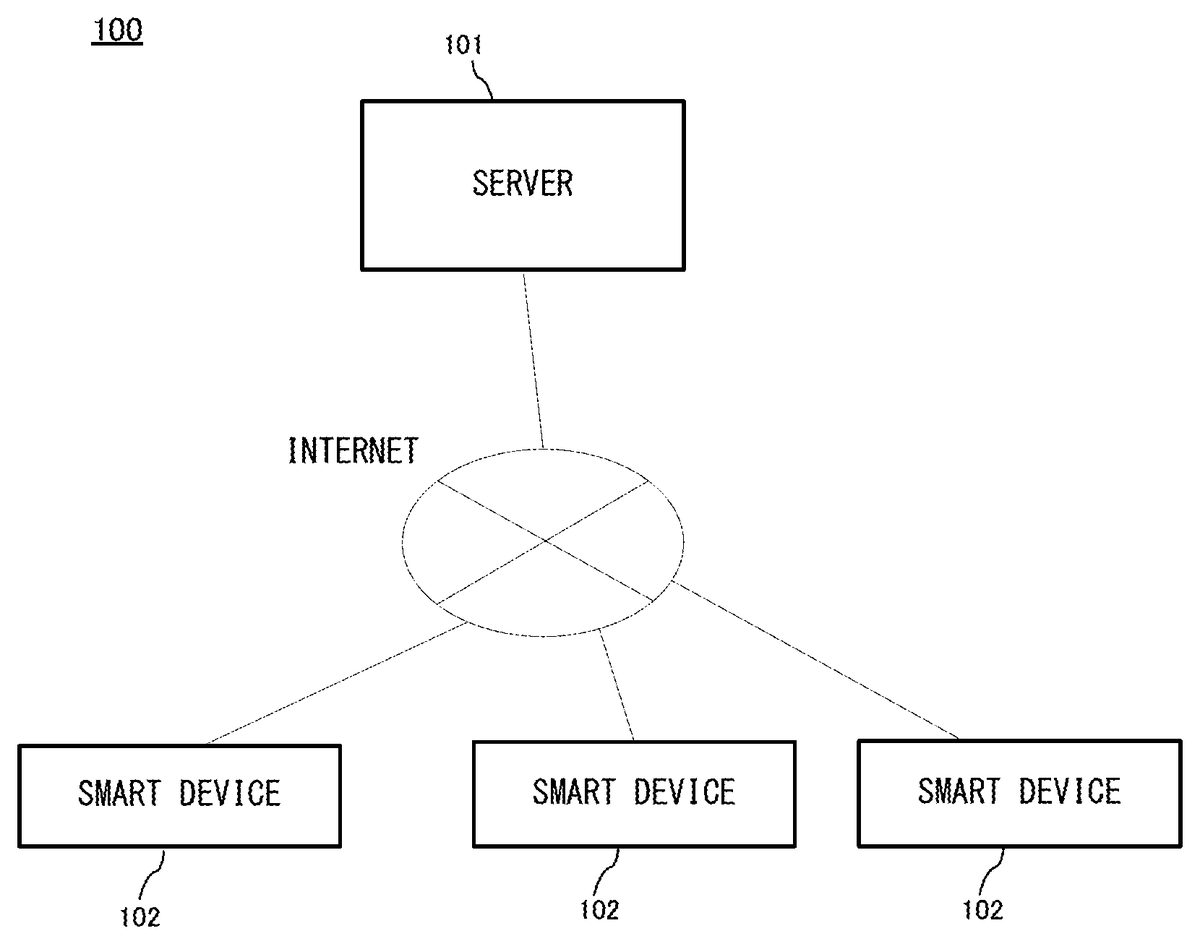
DETAILED DESCRIPTION OF NON-LIMITING EXAMPLE EMBODIMENTS Hereinafter, an exemplary embodiment will be described. FIG. 1is a schematic diagram showing the whole image of a game system according to an embodiment. The game system100according to the embodiment includes a server101, and a plurality of hand-held smart devices102(hereinafter simply referred to as “smart devices”) which are a non-limiting example of information processing apparatus. Each smart device102is, for example, a smartphone, a tablet, or the like. The server101and the smart devices102are configured to be communicable with each other via the Internet. In this embodiment, it is assumed that a communication service among the smart devices is provided in the above configuration. An application for implementing the communication service is installed in each smart device102. Each smart device102transmits/receives predetermined data to/from another smart device via the server101, thereby providing the communication service to the user of the smart device102. Next, the hardware configuration in the above-described system will be described.FIG. 2is a functional block diagram of the smart device102. InFIG. 2, the smart device102includes a processor section111, an internal storage device112, a main memory113, a communication section114, an operation section115, a display section116, and a positional information acquiring section117. The processor section111executes later-described information processing, and executes a system program (not shown) for controlling the overall operation of the smart device102, thereby controlling the operation of the smart device102. The processor section111may be equipped with a single processor or a plurality of processors. The internal storage device112stores therein various programs to be executed by the processor section111, and various kinds of data to be used in the programs. The internal storage device112is, for example, a flash EEPROM or a hard disk device. The main memory113temporarily stores therein computer programs and information. The communication section114is connected to an network by wired or wireless communication, and ...
DETAILED DESCRIPTION OF NON-LIMITING EXAMPLE EMBODIMENTS
Hereinafter, an exemplary embodiment will be described.
FIG. 1is a schematic diagram showing the whole image of a game system according to an embodiment. The game system100according to the embodiment includes a server101, and a plurality of hand-held smart devices102(hereinafter simply referred to as “smart devices”) which are a non-limiting example of information processing apparatus. Each smart device102is, for example, a smartphone, a tablet, or the like. The server101and the smart devices102are configured to be communicable with each other via the Internet. In this embodiment, it is assumed that a communication service among the smart devices is provided in the above configuration. An application for implementing the communication service is installed in each smart device102. Each smart device102transmits/receives predetermined data to/from another smart device via the server101, thereby providing the communication service to the user of the smart device102.
Next, the hardware configuration in the above-described system will be described.FIG. 2is a functional block diagram of the smart device102. InFIG. 2, the smart device102includes a processor section111, an internal storage device112, a main memory113, a communication section114, an operation section115, a display section116, and a positional information acquiring section117. The processor section111executes later-described information processing, and executes a system program (not shown) for controlling the overall operation of the smart device102, thereby controlling the operation of the smart device102. The processor section111may be equipped with a single processor or a plurality of processors. The internal storage device112stores therein various programs to be executed by the processor section111, and various kinds of data to be used in the programs. The internal storage device112is, for example, a flash EEPROM or a hard disk device. The main memory113temporarily stores therein computer programs and information. The communication section114is connected to an network by wired or wireless communication, and transmits/receives predetermined data to/from the server101. The operation section115is, for example, an input device for receiving an operation performed by a user. The display section116is typically a liquid crystal display unit. In processing according to the present embodiment, a touch panel integrated with a liquid crystal screen is assumed as the operation section115and the display section116. In another embodiment, a predetermined pointing device other than a touch panel may be used as the operation section115. The positional information acquiring section117is, for example, a GPS receiver, and is able to acquire information (e.g., latitude and longitude) indicating the current position thereof.
Next, the structure of the server101will be described.FIG. 3is a functional block diagram of the server101. The server101includes at least a processor section121, an internal storage device122, a main memory123, and a communication section124. The processor section121executes various programs for controlling the server101. The internal storage device122stores therein various programs to be executed by the processor section121, and various kinds of data to be used in the programs. The main memory123temporarily stores therein computer programs and information. The communication section124is connected to the network by wired or wireless communication, and transmits/receives predetermined data to/from the smart devices102and other servers (not shown).
Next, the outline of operation of information processing according to the present embodiment will be described. First, the outline of operation of a game assumed in the present embodiment will be described. In the present embodiment, a game utilizing positional information is assumed. The current position of a smart device is reflected in the position of a player object in a virtual game world. A predetermined position in the real world is set as a “target position”, and the target position is reflected in the virtual game world (this target position is managed by the server101, and is appropriately set by the server101). When the player moves the player object to the target position in the virtual game world, the player can get a predetermined item, for example. Thus, the game assumed in the present embodiment is a game in which the player moves the player object to various target positions to collect items.
The outline of the game assumed in the present embodiment will be described more specifically by using examples of screens. In this game, animal objects exist in addition to the player object, and the position of each animal object corresponds to the target position. The player makes the player object go to see these animal objects and get items from the animal objects. The distance between the current position of the smart device in the real world and the position, in the real world, corresponding to the target position is reflected in the distance between the player object and the animal object in the virtual game world. Therefore, for example, when the player who carries the smart device approaches the target position in the real world, the distance between the player object and the animal object can be shortened in the virtual game world. In the following description, a “current position” and a “target position” each mean a position in the real world, and a “position of an animal object” means a position in the virtual game world (position corresponding to a target position).
FIG. 4shows an example of a screen of this game, which is so-called “home screen”. Basically, after the game is started up, such a home screen is displayed first.FIG. 4shows a scene in which a player object201is present in his/her room. In this game, the player makes the player object201“go out” of his/her room to see the animal objects described above. In a lower portion of the screen, a footer region202including a plurality of button images203A to203D is displayed. In an upper portion of the screen, a header region204is displayed. The header region204will be described later.
When the player taps, for example, the button image203B on the home screen, the screen is switched to a screen as shown inFIG. 5(hereinafter referred to as “map screen”). This map screen is a screen for performing an instruction to make the player object go to see an animal object. InFIG. 5, a header region204and a footer region202similar to those described above are displayed in the upper portion and the lower portion of the screen, respectively. A field object simulating the Japanese islands is displayed in a region, between the header and footer regions204and202, which occupies a major part of the screen. On the field object, a player symbol211(corresponding to the player object201) and a plurality of animal symbols212A and212B (respectively corresponding to the animal objects) are displayed (hereinafter, the animal symbols212A and212B may be collectively referred to as “animal symbol212”). This map screen can be enlarged/reduced by, for example, pinch-out/pinch-in operation, or operation of an enlargement/reduction button displayed in an upper right portion of the screen. The map screen can also be enlarged by double-tapping an arbitrary point on the map. Further, slide operation enables scroll of the screen (movement of a virtual camera that is capturing the field object and the like).
The position of the player symbol211immediately after switching to the map screen corresponds to the current position of the player (smart device102) in the real world. Likewise, the position of the animal symbol corresponds to a predetermined position in the real world, that is, the target position described above. That is, the distance relationship between the current position and the target position in the real world is reflected in the distance relationship between the player symbol211and each animal symbol212. In this game, by selecting any of the animal symbols212, the player can make the player object201go to see the animal object corresponding to the animal symbol212.
In this game, when the player object201goes to see the animal object in the game world, the player object201moves by a virtual “car (object)”. A virtual parameter called “fuel” is set in this “car”. Depending on the value of the fuel (hereinafter referred to as “fuel value”), the distance in which the “car” can move is determined. In other words, the fuel value can be regarded as a parameter value indicating the virtual movement range, movement distance, movement performance, or movement ability of the player object201(more precisely, this parameter can be regarded as a parameter indicating the player's activity, activity range, activity performance, movable range, movable distance, stamina, or the like). Therefore, the player object201cannot go to see the animal symbol212far distant from the position of the player symbol211because of shortage of the fuel value. InFIG. 5, two types of animal symbols, i.e., the animal symbols212A and212B, are shown. That is, the animal objects that the player object201can go to see and the animal objects that the player object201cannot go to see because of shortage of the fuel value, are distinguishingly displayed by making the display modes thereof different from each other. Specifically, each animal symbol212B is obtained by gray-out display of an animal symbol212A, and represents an animal object that the player object201cannot go to see because of shortage of the fuel value. Therefore, on the screen ofFIG. 5, by selecting any of the animal symbols212A, the player can make the player object201go to see the animal object corresponding to the selected animal symbol212A. More specifically, when the player taps any of the animal symbols212A, a message inquiring whether or not to go see the corresponding animal object is displayed (at this time, the required fuel value is also displayed). In response to the inquiry, when the player inputs an instruction to make the player object201go to see the corresponding animal object, a scene in which a car moves toward the selected animal symbol is displayed on the map screen, and thereafter, the screen is switched to a screen as shown inFIG. 6.FIG. 6shows a scene in which the player object201receives an item from an animal object205. Thereafter, returning to the map screen, a scene in which the player object201returns to the current position of the player by the car is displayed. Along with such representation, a fuel value according to the distance between the player symbol211and the animal symbol, that is, the distance between the current position and the target position (movement distance), is subtracted (consumed). In other words, in this game, in order to perform a process (e.g., receiving an item from an animal) based on the distance relationship in the real world, the parameter value called the fuel value needs to satisfy a predetermined condition (having fuel according to the distance between the current position and the target position).
The fuel value will be described in more detail. InFIG. 4toFIG. 6, the header region204is displayed in the upper portion of the screen. In the header region204, a fuel meter207and the number-of-jewels208are displayed. The fuel meter207is a horizontally-long bar-shaped meter for indicating the current fuel value. At the right end of the fuel meter207, the current fuel value is numerically indicated. In the example ofFIG. 6, the current fuel value is75. In this game, the fuel value recovers according to the lapse of time. For example, the fuel value recovers by 1 every three minutes. An upper-limit value is set for the fuel value. For example, assuming that the upper-limit value is 100, the fuel value does not exceed 100 even with the lapse of time. The upper-limit value can be raised when a predetermined condition is satisfied. For example, if a “level” or a “rank” of the player is set, the upper-limit value of the fuel value can be raised by so-called “level up” or “rank up”. The greater the upper-limit value is, the more the movable distance increases.
Further, in this game, the fuel value can be immediately increased (recovered) by using a predetermined item. Specifically, in this game, the player can purchase an item called “jewel” by using currency (real money) in the real world. Hereinafter, an item that the player can purchase by using currency in the real world is called a “charging item”. The number-of-jewels208indicates the number of jewels currently possessed by the player is displayed. By using the jewels, the player can immediately increase the fuel value by a value equivalent to the set upper-limit value. For example, it is assumed that the upper-limit value of the fuel value is 100, and the current fuel value is 30. In this case, the fuel value can be increased to 130 by using the jewels. That is, the fuel value can temporarily exceed the set upper-limit value (at this time, the fuel meter207may display, for example, “100+” indicating that the player has the fuel value exceeding the upper-limit value). Alternatively, for example, increase in the fuel value may be limited to the upper-limit value. In this case, assuming that the upper-limit value of the fuel value is 100 and the current fuel value is 30, the fuel value can be increased by 70 by using the jewels. Further, for example, an upper limit may be set for the fuel value that can be increased by one jewel. For example, the fuel value that can be increased by one jewel may be 50. This upper-limit value may have some latitude, and the fuel value may be increased by a random value within this range. For example, the fuel value that can be increased by one jewel may be a random value within the range of 45 to 55 (i.e., the range of ±5 with respect to 50).
Further, in this game, the position of each animal object is not fixed but variable. That is, each animal object is allowed to move in the field object shown inFIG. 5. Therefore, for example, even when the current position of the player is not changed (the player himself/herself does not move), an animal object that the player object could go to see it an hour ago has moved to some distant place an hour later, so that the player object cannot go to see it (and vice versa). More specifically, the server101performs a process to change the position of each animal object, i.e., the target position, at predetermined time intervals (e.g., at intervals of 30 minutes), thereby to represent a state in which the animal object is moving. In order to represent the state in which each animal object is moving around, it is preferable not to change the target position largely at one time. For example, the range in which the target position is changed at one time may be limited to some extent.
Regarding movement of the animal objects, in another embodiment, the movement may be controlled within a predetermined range of the field object. For example, the animal objects may be moved within the region of each prefecture, or within the region of each country. Alternatively, in the field object, the animal objects may be moved within a region of a “land”. A destination may be set for each animal object and the animal object may be moved to the destination, or no particular destination may be set and the animal object may be moved at random. When performing control to set the destinations of the respective animal objects, the control may be performed so as to prevent the animal objects from being unevenly located. For example, when performing control to move an animal A from a point X to a point Y, another animal B existing outside the point X may be moved to the point X.
Regarding the animal objects, in addition to the movement (positional change) thereof described above, a new animal object may be caused to appear.
In the present embodiment, the positions of the animal objects (on the map screen) are common to users (that is, the positional information of the animal objects is collectively managed by the server101). However, in another embodiment, movement control or the like may be performed so that the positions of the animal objects vary from player to player.
As described above, in the present embodiment, in executing a process based on the distance between two points in the real world, the process is executed when a parameter such as the fuel value described above satisfies a predetermined condition relating to the distance. In other words, in executing a predetermined process (item acquisition process, etc.) according to the target position, when the parameter (fuel value) satisfies a predetermined condition according to the distance from the current position to the target position, the predetermined process is executed. In addition, the process according to the target position is executed even when the player does not actually move to the target position (the player can progress the game more advantageously by actually moving to the target position, whereby amusement of the game can be further enhanced). Thus, it is possible to provide a new game using positional information in the real world, particularly, the distance between two points.
The player can also increase the fuel value immediately by utilizing the charging items such as jewels described above. For example, when the player wants to make the player object go to see an animal object, the player may actually move to make the player object go to see the animal object with less fuel value, but such movement takes time and labor. In this case, by utilizing the charging items such as jewels, actual movement of the player can be dispensed with, whereby convenience of the player can be enhanced.
Regarding the position of each animal object (target position), the position is not fixed but is changed with the lapse of time. Thus, even when the player himself/herself does not actually move (even when the movement range of the player is small), it is possible to increase the opportunities for the player to make the player object go to see various animal objects, whereby amusement of the game can be enhanced.
Next, the operation of the game processing according to the present embodiment will be described in more detail with reference toFIGS. 7 to 17. In the following description, various processes not directly related to the process of making the player object201go to see the animal object205will not be described in detail.
FIG. 7shows non-limiting examples of a program and data stored in the main memory123of the server101. The main memory123stores therein a server-side game program301, a player data base302, animal object data304, etc.
The server-side game program301is a program for causing the server101to operate as a game server in the game processing according to the present embodiment. Specifically, the server-side game program301is a program for executing process steps of flowcharts shown inFIGS. 16 and 17.
The player data base302is a data base that includes information relating to players of this game. In this game, each player performs player registration to the server101before the game is started. After the player registration, when the game processing is started in the smart device102, a log-in process using a player ID and the like described later is performed, thereby enabling the player to play the game as described above.
FIG. 8shows a non-limiting example of the structure of the player data base302. InFIG. 8, the player data base302includes entries such as player ID311, fuel value data312, belonging data313, etc. The player ID311is an ID for uniquely identifying each player. The fuel value data312is data indicating the current value and the upper-limit value of the above-described fuel value (inFIG. 8, the fuel value data312is represented in the form of “current value/upper-limit value”). The belonging data313is data indicating items possessed by the player.
The player data base302also includes, in addition to the entries described above, data of password used by each player for the log-in process, and data indicating a nickname, the current level, the number of possessed jewels, etc. of the player.
Referring back toFIG. 7, the animal object data304is data for managing the animal objects205(including the animal symbols212) as described above.FIG. 9shows the structure of the animal object data304. The animal object data304is table data composed of object ID321, existence position322, possession item323, etc. The object ID321is an ID for uniquely identifying each animal object. The existence position322is data indicating the position corresponding to the animal object (in the real world), and is also data indicating the target position described above. The existence position322is appropriately set by the server101, and the content thereof is appropriately changed according to the lapse of time as described above. The possession item323indicates items possessed by the corresponding animal object, and is data of items to be collected by the player in this game.
Next, a program and data stored in the smart device102will be described.FIG. 10shows non-limiting examples of a program and data stored in the main memory113of the smart device102. The main memory113stores therein a terminal-side game program401, operation data402, current position data403, a capability-to-visit table404, object model data405, etc.
The terminal-side game program401is a program for executing the game processing according to the present embodiment in the smart device102. Specifically, the terminal-side game program401is a program for executing process steps in flowcharts shown inFIGS. 12 to 15.
The operation data402is data indicating the contents of various operations performed to the operation section115. In the present embodiment, the operation data402includes: data indicating whether there is an input to the touch panel as the operation section115; data indicating touch coordinates; data indicating whether the various buttons (not shown) are in pressed states; and the like.
The current position data403is data indicating the current position of the smart device102, which is acquired by the positional information acquiring section117. In the present embodiment, during execution of the game processing, the current position data403is automatically acquired (updated) from the positional information acquiring section117at predetermined time intervals.
The capability-to-visit table404is data indicating whether or not the player object can go to see each of the animal objects described above. In other words, the capability-to-visit table404is data indicating whether or not the distance from the current position to the position of each animal object (target position) is equal to or less than the movable distance based on the current fuel value.FIG. 11shows a non-limiting example of the structure of the capability-to-visit table404. InFIG. 11, the capability-to-visit table404is composed of object ID411, existence position412, and capability-to-visit flag413. The object ID411is an ID for identifying each animal object (basically, the object ID411has the same content as the object ID321in the animal object data described above). The existence position412is positional information indicating the current position of the corresponding animal object (i.e., the target position). The capability-to-visit flag413is a flag indicating whether or not the distance from the current position to the position of the animal object (i.e., the target position) is equal to or less than the movable distance according to the current fuel value. The capability-to-visit flag413being ON indicates that the distance is equal to or less than the movable distance (i.e., the player object can go to see the animal object). The object ID411and the existence position412are updated on the basis of the content of the animal object data that is acquired from the server101at predetermined time intervals. Whether the capability-to-visit flag413is to be ON or OFF is determined on the basis of the updated object ID411and existence position412.
Referring back toFIG. 10, the object model data405is model data of various objects displayed in this game, such as the player object201, the animal object205, and the like.
Next, the flow of the game processing according to the present embodiment will be described with reference to the flowchart ofFIGS. 12 to 17. For convenience in the description, not the case of resuming the game play from interruption thereof but the case of starting the game processing from the beginning will be described.
FIG. 12is a flowchart showing a home screen process executed by the smart device102. In the smart device102, when a command for starting the game of the present embodiment is received, the home screen process is executed after a predetermined log-in process (not shown). InFIG. 12, first, in step S1, the processor section111of the smart device102acquires, from the server101, various data indicating the current state of the player, such as the current fuel value, the current level of the player, etc.
Next, in step S2, the processor section111of the smart device102performs, for example, a process of reflecting the acquired current fuel value in the display of the fuel meter207, thereby generating and displaying the home screen as described above.
Next, in step S3, the processor section111of the smart device102acquires the operation data402. Next, in step S4, the processor section111of the smart device102determines, on the basis of the operation data402, whether or not an operation to instruct display of the map screen has been made. When the result of the determination is that the operation has been made, the processor section111advances to a map screen process in step S5. Otherwise, the processor section111of the smart device102executes, as appropriate, another game processing based on the content of operation in step S6. For example, if the player is executing the process of purchasing a jewel described above, the processor section111executes, in cooperation with the server101, the process relating to purchase of a jewel. When an instruction to immediately increase the fuel value by using a jewel has been made, the processor section111executes, in cooperation with the server101(by exchanging predetermined data), a process of updating the content of the fuel value data312. Thereafter, the processor section111returns to the process in step S1and repeats the above-described process steps.
FIG. 13is a flowchart showing the map screen process in step S5in detail. InFIG. 13, first in step S21, the processor section111of the smart device102acquires the fuel value data312from the player data base302of the server101. In the subsequent step S22, the processor section111acquires the animal object data304from the server101, and updates the content of the capability-to-visit table404on the basis of the animal object data304. That is, the processor section111executes the process of updating the object ID411and the existence position412on the basis of the content of the acquired animal object data304, and determining and setting the content of the capability-to-visit flag413on the basis of the updated contents of the object ID411and the existence position412. Specifically, regarding an animal object that has not yet been registered in the capability-to-visit table404, the process of adding the object ID411and the existence position412thereof to the capability-to-visit table404is performed. Regarding an already registered animal object, the process of updating the existence position412thereof is performed as appropriate. Regarding the content of the animal object data304acquired from the server101, in order to reduce the data communication amount, the animal object data304to be acquired may be limited to the data within a predetermined range of the map described above (e.g., within a range in units of countries or prefectures, or a predetermined range from the position of the player object201). Setting of the capability-to-visit flag413will be described later.
Next, in step S23, the processor section111acquires the current position data223. Next, in step S24, the processor section111executes a distance determination process. The distance determination process is a process of determining, for each animal object, whether or not the player object having the current fuel value can go to see the animal object.
FIG. 14is a flowchart showing the distance determination process in detail. First, in step S31, the processor section111calculates the movable distance from the current position on the basis of the current fuel value acquired from the server101in step S21. Next, in step S32, with reference to the capability-to-visit table404, the processor section111selects one animal object to be subjected to the following process (that is, one animal object that has not yet been subjected to the following process). Hereinafter, this object is referred to as an object to be processed.
Next, in step S33, on the basis of the current position of the smart device102and the existence position412of the object to be processed, the processor section111calculates, as a required distance, the direct distance between them. Next, in step S34, the processor section111determines whether or not the calculated required distance is equal to or less than the above-described movable distance. When the result of the determination is that the required distance is equal to or less than the movable distance (YES in step S34), the processor section111, in step S35, turns on the capability-to-visit flag413relating to the object to be processed. On the other hand, when the required distance is not equal to or less than the movable distance (NO in step S34), the processor section111, in step S36, turns off the capability-to-visit flag413relating to the object to be processed.
Next, in step S37, the processor section111, with reference to the capability-to-visit table404, determines whether or not any animal object that has not yet been subjected to the processes in steps S32to S36still remains. When the result of the determination is that such an animal object still remains (YES in step S37), the processor section111returns to step S32, selects a next object to be processed, and subjects the selected object to the process steps as described above. On the other hand, when such an animal object does not remain (NO in step S37), the distance determination process is ended.
Regarding the processes in steps S31to S34, in another embodiment, the required distance may be converted into the fuel value to calculate a “required fuel value”, and whether or not the current fuel value is more than the “required fuel value” may be determined.
Referring back toFIG. 13, next in step S25, the processor section111generates and displays a map screen in which the results of the processes described above are reflected. Specifically, the processor section111locates the player symbol211at a position corresponding to the current position of the smart device on the field object. In addition, the processor section111, on the basis of the capability-to-visit table404, appropriately locates the animal symbols corresponding to the respective animal objects on the field object. At this time, as for the animal symbols whose capability-to-visit flags413are OFF, these animal symbols are set to be displayed in a gray-out manner. Then, the processor section111generates a map screen based on these contents, and displays the map screen on the screen. As the result, for example, an image as shown inFIG. 5is displayed on the screen.
Next, in step S26, the processor section111acquires the operation data402. Next, in step S27, the processor section111, on the basis of the operation data402, determines whether or not an operation (e.g., tapping operation) to select any one of the animal symbols212on the map screen has been performed. When the result of the determination is that any of the animal symbols212has been selected (YES in step S27), a visit representation process is executed in step S28. On the other hand, when none of the animal symbols212has been selected (NO in step S27), another game processing is executed as appropriate in step S29. For example, when an instruction to return to the home screen has been made, the map screen process is ended to start the home screen process.
FIG. 15is a flowchart showing the visit representation process in detail. First, in step S51, the processor section111determines whether or not the distance from the current position to the position corresponding to the selected animal symbol212(i.e., the target position) is equal to or less than the movable distance. Specifically, the processor section111determines whether or not the capability-to-visit flag413of the animal object corresponding to the selected animal symbol212is ON. When the result of the determination is that the capability-to-visit flag413is OFF (NO in step S51), the processor section111, in step S59, displays a message indicating, for example, that the player object cannot go to see the animal object corresponding to the selected animal symbol212, and the fuel value required if the player object goes to see the animal object, and ends the visit representation process.
On the other hand, when the capability-to-visit flag413is ON (YES in step S51), the processor section111, in step S52, displays a message inquiring whether or not the player object will go to see the animal object corresponding to the selected animal symbol212.
Next, in step S53, the processor section111acquires the operation data402. In the subsequent step S54, the processor section111, on the basis of the operation data402, determines whether or not an instruction indicating that the player object will go to see the animal object has been inputted in response to the above inquiry. When the result of the determination is that such an instruction has been inputted (YES in step S54), the processor section111, in step S55, displays a representation in which a car object is caused to travel toward the selected animal symbol212. Subsequently, in step S56, the processor section111generates and displays a “visiting screen” as shown inFIG. 6, and displays a representation in which the player object201receives an item from the animal object205. Further, in step S57, the processor section111transmits, to the server101, an instruction requesting addition of data of this item to the belonging data313. In response to this request, the server101executes a process of adding the data of the item to the belonging data313. Regarding addition of such item data, for example, the number of times the player object can get items may be limited such that the player object can get an item once a day from one animal object. Regarding an animal symbol from which the player object has already got an item and therefore cannot get an item anymore, the display manner of this animal symbol may be changed when being displayed on the map screen so that the player can recognize the animal symbol.
Next, in step S58, the processor section111displays the map screen again, and displays a representation in which the player object returns to the current position by the car. Then, the processor section111ends the visit representation process.
On the other hand, as the result of the determination in step S54, when an instruction indicating that the player object will not go to see the animal object has been inputted (NO in step S54), the processes in steps S55to S58described above are not performed and the visit representation process is ended.
This is the end of the description of the smart device side game processing.
Next, processes relating to the present embodiment among processes to be performed in the server101will be described. Specifically, in the server101, a process of causing each animal object to move, that is, a process of changing the target position in accordance with the lapse of time, is performed. In addition, a process of increasing (recovering) the fuel value of each player in accordance with the lapse of time or the like is also performed.
FIG. 16is a flowchart showing the process of causing each animal object to move in detail. First, in step S71, the processor section121of the server101determines whether or not a predetermined specific time has elapsed from the last updating of the target position. When the result of the determination is that the predetermined time has not yet elapsed (NO in step S71), this determination is repeated until the predetermined time elapses. On the other hand, if the predetermined time has elapsed (YES in step S71), the processor section121of the server101, in step S72, calculates a new position of each animal object. Any calculation method may be adopted. In the present embodiment, the new position is calculated so as not to be very distant from the current position. For example, assuming that the predetermined time is 30 minutes, the new position is calculated within a radius of 1 km from the current existence position. Regarding the size of this range (radius), different values may be used for different animal objects. For example, an animal object modeled after a fast-moving animal may have the range wider than the ranges of the other animal objects.
In another embodiment, as a process of causing each animal object to move, a process of setting a specific destination and causing the animal object toward the destination may be executed.
Next, in step S73, the processor section121of the server101updates the existence position322of each animal object on the basis of the new position calculated as described above. Then, the processor section121returns to step S71, and repeats the process steps. This is the end of the description of the process for causing each animal object to move.
FIG. 17is a flowchart showing a process of increasing the fuel value of the player. First, in step S81, the processor section121of the server101determines whether or not an instruction to add a fuel value by utilizing the jewel (charging item) described above has been received from the smart device102. When the result of the determination is that such an instruction has been received (YES in step S81), data relating to the player who has transmitted this instruction is selected from the player data base302in step S82. Next, in step S83, the processor section121of the server101adds a predetermined value according to the used item to the current fuel value of the player (this addition may cause the current fuel value to temporarily exceed the upper-limit value). Then, the processing is advanced to the next step S84.
On the other hand, when the result of the determination in step S81is that an instruction to add a fuel value is not received (NO in step S81), the processes in steps S82to S83are skipped.
Next, the processor section121of the server101executes a process relating to recovery of the fuel value with the lapse of time. Specifically, in step S84, the processor section121of the server101executes a process of extracting, from the player data base302, data of players for which a predetermined specific time has elapsed from the last recovery, at present time. Next, in step S85, the processor section121selects one piece of player data to be processed from among the extracted player data. Next, in step S86, the processor section121of the server101determines whether or not the current fuel value of the player to be processed is equal to or more than the upper-limit value. When the result of the determination is that the current fuel value is not equal to or more than the upper-limit value (NO in step S86), the processor section121of the server101, in step S87, adds 1 to the current fuel value. When the current fuel value is equal to or more than the upper-limit value (YES in step S86), the process in step S87is skipped.
Next, in step S88, the processor section121of the server101determines whether or not all the extracted player data have been subjected to the processes in steps S85to S87. If some of the extracted player data remain unprocessed (NO in step S88), the processor section121returns to step S85and repeats the process steps. When all the extracted player data have been processed (YES in step S88), the process of increasing the fuel value is ended.
This is the end of the description of the game processing according to the present embodiment.
As described above, in the game processing according to the present embodiment, when the distance between the current position of the player (smart device102) and the target position is equal to or less than the movable distance calculated from the fuel value, the player can make the player object go to see the animal object (virtually) existing at the target position. In addition, by using the charging item such as a jewel described above, the fuel value, which is basically recovered with lapse of time, can be immediately increased. Therefore, even when the player cannot make the player object go to see the animal object because of shortage of the fuel value, the player can make the player object go to see the animal object by absolving actual movement of the player himself/herself, or by temporarily increasing the fuel value to a value exceeding the upper-limit value, whereby convenience of the player can be enhanced. In addition, the position of each animal object (target position) is changed according to the lapse of time. Thus, it is possible to increase the opportunities for the player to make the player object go to see various animal objects, thereby enhancing amusement of the game.
(Modifications)
Regarding determination as to whether or not the player object can go to see the animal object, this determination may be performed by the following process. In the above example, the determination is performed on the basis of the distance between the two points. However, in the example described below, the determination is performed using a “range”. The determination using a “range” as described below is “lenient”, compared with the determination based on the distance between the two points (between the positional coordinates), whereby the degree of difficulty of the game is adjusted to further enhance amusement of the game (that is, difficulty of the game is adjusted by providing some “latitude” or “allowance” to the positional coordinates indicating a certain point).
FIG. 18shows the principle of another example of the process of determining whether or not the player object can go to see an animal object. In this example, first, a movable range503around a current position501is calculated on the basis of the fuel value at that time. Then, whether or not a target position502exists within the movable range503is determined. As for a target position within the range503, it is determined that the player object “can go to see” an animal object at this target position.
FIG. 19shows another example. In this example, first, a predetermined range504around a current position501is calculated. This predetermined range is a predetermined fixed range. Hereinafter, this range is referred to as a fixed range504. Next, a movable range503based on the fuel value is calculated. Then, whether or not a target position502exists in either of the ranges is determined. In this example, even when the fuel value is small, that is, even when, inFIG. 19, the circle of the movable range503is smaller than the circle of the fixed range504or there is almost no movable range503, a target position existing within the fixed range504is determined so that the player object “can go to see” an animal object at the target position. It is preferable that this fixed range is not very large in terms of allowing the current position to have some “latitude”.
FIG. 20shows still another example. In this example, a movable range503around a current position501is calculated on the basis of the fuel value. In addition, a fixed range504around a target position502is calculated. Then, whether or not there is an overlapped portion between the two ranges is determined. When there is such an overlapped portion, it is determined that the player object “can go to see” the animal object.
FIG. 21shows still another example. In this example, a fixed range504A around a current position501and a fixed range504B around a target position502are calculated. Further, a movable range503around the current position501is calculated on the basis of the fuel value. Then, whether or not the fixed range504B overlaps with any of the fixed range504A and the movable range503is determined.
FIGS. 22 to 25each show still another example. These examples are similar to the examples shown inFIGS. 18 to 21except that the relationship between the current position501and the target position502is inverted. That is, in the example ofFIG. 22, a movable range503is set on the target position502side. Also in the example ofFIG. 23, a fixed range504and a movable range503are set on the target position502side. In any example, whether or not a current position501exists within any of the ranges is determined. In the example ofFIG. 24, a movable range503is set on the target position502side while a fixed range504is set on the current position501side. In the example ofFIG. 25, a fixed range504A and a movable range503are set on the target position502side while a fixed range504B is set on the current position501side. In any example, whether or not there is an overlapped portion between the ranges is determined.
Regarding the distance determination process described above, in the above example, this process is executed mainly on the smart device side. However, the distance determination process may be performed on the server101side, and data indicating the result of the determination may be transmitted to the smart device102. Then, in the smart device102, the map screen may be generated and displayed on the basis of the data indicating the result of the determination. The server101side may be a server system composed of a plurality of information processing apparatuses, and the process to be executed on the server side may be divided and executed by the plurality of information processing apparatuses.
In the embodiment described above, an example of a game in which a player object goes to see an animal object to get an item from the animal object, has been described. However, the game may be configured as follows. For example, a player can get a “material” by progressing a game play other than “going to see an animal”. Then, the player makes a player object go to see an animal object to exchange the “material” for an “item”. This item is preferably an item that can be obtained only by exchanging with the “material”. This configuration further enhances amusement of the game.
In the above embodiment, the information indicating the target position is acquired from the game server101. However, in another embodiment, setting, updating, and the like of the target position may be performed as processes on the smart device102side without using the game server101.
Claims
- A computer-readable non-transitory storage medium having stored therein a game program for a video game, the game program executed by a computer of an information processing apparatus, the game program comprising instructions that cause the computer to: acquire positional information;acquire, by using the acquired positional information, a current position of the information processing apparatus in the real world;calculate a distance between a target position in the real world, and the current position of the information processing apparatus in the real world;determine whether a virtual movement range for a player virtual object satisfies a first condition, wherein the first condition is based on the calculated distance, wherein the virtual movement range is a constraint on how far the player virtual object is allowed to move within a virtual world of the video game;and based on results of the determination, control game processing of the video game by using the calculated distance.
- The computer-readable non-transitory storage medium of claim 1 , the game program comprising instructions that cause the computer to: calculate a second distance according to the virtual movement range of the player virtual object, wherein the first condition is satisfied as a result of the calculated distance being equal to or less than the second distance.
- The computer-readable non-transitory storage medium of claim 1 , the game program comprising instructions that cause the computer to: determine whether the virtual movement range is larger than a value according to the calculated distance, wherein the first condition is satisfied as a result of the virtual movement range being larger than the value according to the calculated distance.
- The computer-readable non-transitory storage medium of claim 1 , the game program comprising instructions that cause the computer to: subtract a value from the virtual movement range of the player virtual object, wherein the value is based on the calculated distance.
- The computer-readable non-transitory storage medium of claim 1 , the game program comprising instructions that cause the computer to: increase the virtual movement range of the player virtual object by satisfying a second condition.
- The computer-readable non-transitory storage medium of claim 1 , wherein an upper-limit value is set for the virtual movement range of the player virtual object.
- The computer-readable non-transitory storage medium of claim 1 , the game program comprising instructions that cause the computer to: display a positional relationship between the current position and the target position on a display screen coupled to the information processing apparatus.
- The computer-readable non-transitory storage medium of claim 7 , the game program comprising instructions that cause the computer to: display a virtual map, wherein a first virtual object is displayed at a location on the virtual map that is based on the current position and a second virtual object is display at a location on the virtual map that is based on the target position.
- The computer-readable non-transitory storage medium of claim 8 , wherein the target position is one among a plurality of target positions and the second virtual object is one among a plurality of second virtual objects, which each one of the plurality of second virtual objects respectively associated with at least one of the plurality of target positions, wherein the game program comprises instructions that cause the computer to: process input specifies any of the plurality of second virtual objects.
- The computer-readable non-transitory storage medium of claim 9 , wherein the game program comprises instructions that cause the computer to: display different ones of the plurality of second virtual objects in different display modes based on whether a corresponding second virtual object satisfies a condition.
- The computer-readable non-transitory storage medium of claim 1 , wherein the target position is changed according to a predetermined condition.
- The computer-readable non-transitory storage medium of claim 11 , wherein the target position is changed according to a lapse of time.
- The computer-readable non-transitory storage medium of claim 11 , wherein the target position is moved according to a lapse of time so that a second virtual object moves on a virtual map according to the lapse of time.
- The computer-readable non-transitory storage medium of claim 1 , wherein the information processing apparatus is a smart device.
- The computer-readable non-transitory storage medium of claim 1 , wherein the positional information is acquired using a GPS receiver.
- A game processing method for controlling an information processing apparatus, the method comprising: executing, on the information processing apparatus, a game program for a video game;acquiring position information;determining, by using the acquired positional information, a current position of the information processing apparatus in the real world;calculating a distance between a target position in the real space, and the current position of the information processing apparatus in the real world;determining whether a virtual movement range for a player virtual object satisfies a first condition, wherein the first condition is based on the calculated distance, wherein the virtual movement range is a constraint on how far the player virtual object is allowed to move within a virtual world of the video game;and based on a result of the determination, controlling game processing of the video game by using the calculated distance.
- A game system comprising: a game server that includes a transceiver configured to transmit target position data of a location in the real world;an information processing apparatus that includes a transceiver for receiving the target position data transmitted from the gam server, the input processing apparatus including a processing system that includes at least one hardware processor, the processing system configured to: determine a current position of the information processing apparatus in the real world;calculate a distance between a target position in the real world, and the current position of the information processing apparatus in the real world;process video game input provided to the computer during execution of the game program;and based on the processed video game input, control a virtual object to move to different locations within the virtual world, wherein the calculated distance is used to control how the virtual object is allowed to be moved to the different locations within the virtual world of the video game.
- The game system according to claim 17 , wherein the information processing apparatus includes a GPS receiver for acquiring positional information that is used to determine the current position of the information processing apparatus.
- An information processing apparatus communicable with a game server and configured at least to acquire positional information, the game server including a transmission interface configured to transmit information indicating a target position that is a position corresponding to a predetermined position in the real world, to the information processing apparatus, according to a request from the information processing apparatus, the information processing apparatus comprising: a processing system that includes one or more hardware processors, the processing system configured to: acquire, by using the acquired positional information, a current position of the information processing apparatus in the real world;calculate a distance between a target position in the real world, and the current position of the information processing apparatus in the real world;determine whether a virtual movement range for the a player virtual object satisfies a first condition, wherein the first condition is based on the calculated distance, wherein the virtual movement range is a constraint on how far the player virtual object is allowed to move within a virtual world of the video game;and based on results of the determination, control game processing of the video game by using the calculated distance.
- The information processing apparatus according to claim 19 , further comprising a GPS receiver for acquiring the positional information.
Disclaimer: Data collected from the USPTO and may be malformed, incomplete, and/or otherwise inaccurate.