U.S. Pat. No. 10,413,828
Incorporating Player-Generated Audio in an Electronic Game
AssigneeSony Interactive Entertainment LLC
Issue DateDecember 26, 2017
Illustrative Figure
Abstract
Incorporating player-generated audio in an electronic game is disclosed. Incorporation may include receiving an audio clip from an electronic game player, applying a modification to the audio clip to generate a chant, associating the chant to the execution of an event in the electronic game, retrieving the chant when the event in the electronic game is executed, and initiating the play of the chant upon execution of the event in the electronic game.
Description
DETAILED DESCRIPTION FIG. 1illustrates a schematic diagram of an exemplary architecture for incorporating player-generated audio into an electronic game. One or more clients102may include one or more electronic games104. Electronic game104may be built-in (e.g., pre-loaded) to the client102or be introduced through an optical disk or other data storage medium. Electronic game104may also be obtained over a network. The client102may be connected to a server108via a communications network106or to one another through an ad hoc network. The client102may include a game console such as a PlayStation® 3, a laptop computing device, a portable game device such as the PlayStation® Portable, a desktop computing device, a cellular telephone, or any other device capable of executing the electronic game104and connecting to the network106or, alternatively, an ad hoc network. The client102may be identified by an identification number such as a client ID or an address mechanism such as an IP address. An electronic game player using client102may ‘sign on’ to a network with a user name and/or password, which may be temporarily or permanently associated with the client102. Server108may include the electronic game104; clients102may access the electronic game104on the server108via the network106. The electronic game104on the server108may be an entire game, a portion of the game, or data related to the game as server108may also be a node allowing for the pass though, observation and/or collection of data related to the game104as the game104is played by users in the game community. The electronic game104may be similarly organized at various clients102(e.g., portions of the game or game data related to the game). Electronic game104may also be provided through, for example, a third-party content library server. The library server may or may not be a participating member of the architecture ofFIG. 1. Reference to a client102and a server108in the context ofFIG. 1and the remainder of the ...
DETAILED DESCRIPTION
FIG. 1illustrates a schematic diagram of an exemplary architecture for incorporating player-generated audio into an electronic game. One or more clients102may include one or more electronic games104. Electronic game104may be built-in (e.g., pre-loaded) to the client102or be introduced through an optical disk or other data storage medium. Electronic game104may also be obtained over a network. The client102may be connected to a server108via a communications network106or to one another through an ad hoc network.
The client102may include a game console such as a PlayStation® 3, a laptop computing device, a portable game device such as the PlayStation® Portable, a desktop computing device, a cellular telephone, or any other device capable of executing the electronic game104and connecting to the network106or, alternatively, an ad hoc network. The client102may be identified by an identification number such as a client ID or an address mechanism such as an IP address. An electronic game player using client102may ‘sign on’ to a network with a user name and/or password, which may be temporarily or permanently associated with the client102.
Server108may include the electronic game104; clients102may access the electronic game104on the server108via the network106. The electronic game104on the server108may be an entire game, a portion of the game, or data related to the game as server108may also be a node allowing for the pass though, observation and/or collection of data related to the game104as the game104is played by users in the game community. The electronic game104may be similarly organized at various clients102(e.g., portions of the game or game data related to the game). Electronic game104may also be provided through, for example, a third-party content library server. The library server may or may not be a participating member of the architecture ofFIG. 1.
Reference to a client102and a server108in the context ofFIG. 1and the remainder of the present disclosure is for the convenience of understanding various embodiments of the present invention. Embodiments of the present invention may be implemented in the context of a peer-to-peer network, a client-server network, or within a peer-group (e.g. a specified group of peers). In some instances, a client may function as a server and vice versa depending on the timing and the nature of a data exchange. For example, various clients in a peer-to-peer network may each include a portion of an electronic game104or data related to that game104and may send and receive the same. As such, any reference to a client or a server is meant to be inclusive of operations performed by one or both computing entities.
The electronic game104may include software that may be processed on or by the client102and/or that allows for or facilitates communication and data exchanges with the other clients102and server108via the network106. The network106may include, for example, the Internet. Other proprietary or closed networks may be used either exclusively or in conjunction with the Internet. Certain security protocols (e.g., SSL or VPN) or encryption methodologies may be used to ensure the security of data exchanges over network106, especially if the network106is a publicly accessible network such as the Internet.
Electronic game players associated with each of the clients102may interact with other electronic game players playing the electronic game104. Accordingly, these electronic game players, or players, at clients102may compete with one another despite not being physically present with one another or sharing a common gaming device or console. Electronic game104may include various events for which an electronic game player may customize audio.
In an electronic baseball game, for example, an event may be a home run or the seventh-inning stretch. The event could also be the appearance of a particular game character in the game such as Ryan Howard of the Philadelphia Phillies stepping up to the plate. An event may constitute a combination of individual events. For example, an event may include the appearance of a game player in conjunction with a particular event such as Ryan Howard hitting a home run.
The execution of a game event in electronic game104may trigger the playback of customized audio provided by the game player. Playback of the customized audio may occur on the client device102of the player that generated the audio. Playback of the customized audio may also be distributed over a network for playback to all other game players taking part in the particular session of game play (e.g., a player controlling the pitcher and a player controlling an outfielder).
Electronic game104may also provide audio processing capabilities. The player may utilize these capabilities to enhance or otherwise manipulate player-generated audio and thereby positively affect the gaming experience. For example, in the aforementioned electronic game, a player may provide a single voice audio input to client102. The user may then apply the processing capabilities provided by execution of the electronic game104at client102to, for example, generate a crowd chant thereby creating the illusion of mass participation.
FIG. 2illustrates a portion of an exemplary computing device250that may be utilized for the introduction of player-generated audio in an electronic game executed in a network gaming environment, namely the processor configuration thereof. The exemplary computing device250ofFIG. 2may be implemented in the context of client102for playing electronic game104. The architecture of computing device250may be based on a Cell processor252. Certain aspects of a computer architecture and high speed processing model utilizing a Cell processor are disclosed in U.S. patent publication number 2002-0138637 for a “Computer Architecture and Software Cells for Broadband Networks,” the disclosure of which is incorporated herein by reference.
Additional information may be found at the Cell Broadband Engine™ Public Information and Download Site (http://cell.scei.co.jp/e download.html), specifically documentation entitled “Cell Broadband Engine™ Architecture” (V 1.01 dated Oct. 3, 2006) and “Synergistic Processor Unit (SPU) Instruction Set Architecture” (V 1.2 dated Jan. 27, 2007). The disclosure of each document is incorporated herein by reference. The Cell processor architecture represents the work of Sony Computer Entertainment Inc., Kabushiki Kaisha Toshiba, and International Business Machines Corporation.
Through the use of the aforementioned Cell processor, data and applications may be processed and packaged into uniquely identified and uniformly formatted software cells. The uniformity of structure and unique identification facilitates the processing of applications and data throughout a network of Cell processor equipped computing devices. For example, one computing device may formulate a software cell but distribute that cell to another device for processing. Thus, the cells may migrate throughout a network for processing on the basis of the availability of processing resources on the network.
The cell processor252, in one exemplary embodiment, includes a main memory254, a single power processor element (PPE)256and eight synergistic processor elements (SPE)258. The cell processor252may be configured, however, with more than one PPE and any number of SPEs258. Each SPE258comprises a synergistic processor unit (SPU) and a local store (LS).
Memory254, PPE256, and SPEs258may communicate with each other and with an I/O device260over, for example, a ring-type-element interconnect bus (EIB)264coupled to a bus interface controller (BIC). The PPE256and SPEs258may access the EIB264through bus interface units (Bill). The PPE256and SPEs258may access the main memory254over the EIB264through memory flow controllers (MFC) and memory interface controller (MIC).
Memory254may include a program262that implements executable instructions. The instructions may be read from a CD/ROM or other optical disc in CD/DVD reader266coupled to the I/O device260, the CD/ROM or other optical disc being loaded into the reader266. The CD/ROM, too, may comprise a program, executable instructions, or other data274. Other information may be introduced to the computing device250through peripheral devices (not shown) such as a wireless or USB microphone headset. This information may include player-generated audio, which may then be processed by the processor252for distribution over a network to other client devices.
PPE256may be a standard processor capable of stand-alone processing of data and applications. In operation, PPE256may schedule and orchestrate the processing of data and applications by SPEs258and the associated SPU. The SPU may be a single instruction, multiple data (SIMD) processor. Under the control of PPE256, the SPUs may process data and application in a parallel and independent manner. MIC may control accesses by PPE256SPUs to data and applications in main memory254.
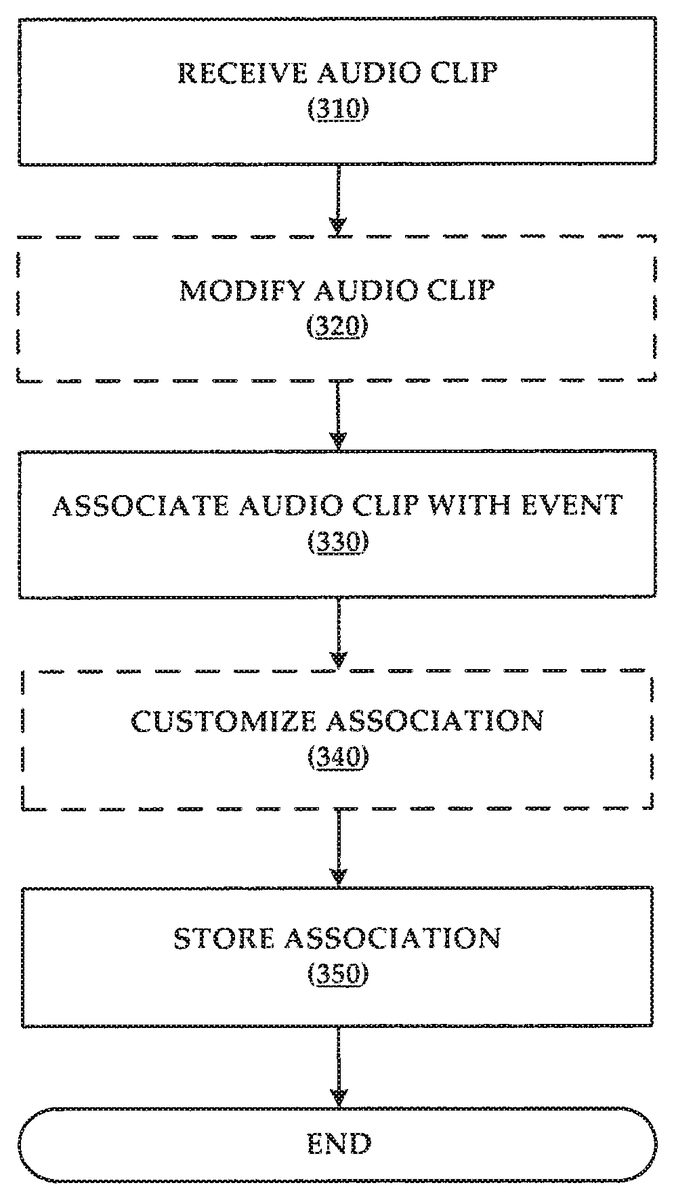
Referring to method300ofFIG. 3, in step310, an audio clip is received at Client102as generated by the player. This audio clip may be input to the client102and an electronic game104through a microphone or some other audio input device coupled to the client104. The audio clip may also be introduced in the form of computer-readable storage media, the media having the clip stored thereon (e.g., a flash card or CD-ROM). The audio clip may be a simple phrase, a series of phrases or expressions, or may be a more complex and involved piece of content such as a song or sound track. In the latter instance, the song may be direct from a music CD that one might purchase in a store or electronic content downloaded from an on-line music provider. Audio clip may be stored directly in memory of the client102as may be the case when the clip is introduced through a microphone. The clip may be accessed as needed from the computer-readable medium. Clips from computer-readable storage media may also be transferred and stored on the client102.
In some embodiments, step310may be conducted in the context of electronic game104or through a menu separate from game play such that the player has suspended game play in order to provide the audio. A recording interface may be made available to the player for recording the audio clip. Such an interface may display audio levels in a recording level meter, allow the player to start or stop the recording of an audio clip, or initiate playback of a captured audio clip such that the player may listen to the audio before accepting a recording.
Upon recording, the player may be prompted by electronic game104via the recording interface to provide further instructions regarding playback of the audio. This may include optional modification or processing in step320or customization of playback in electronic game104as may occur in step340. Event association in step330may also occur via this interface.
In optional step320, one or more modifications may be applied to the received audio clip. These modifications may occur through any number of digital signal processing techniques as are generally known in the art. For example, in step310, a player may introduce a cheer or a chant. That cheer or chant, however, will be largely ineffective and seem out-of-place when uttered by a single user in the context of a stadium or arena environment as may be the case of a sporting game. Through the application of audio modification, however, the chant may be processed to sound as if it comes from dozens, hundreds, or thousands of other persons that might be present in the area or stadium.
Variations in tone and other acoustic properties may be applied such that the audio clip does not merely sound as if it is being uttered by hundreds of people in the exact same tone (e.g., the clip may be modified to sound as if it is being uttered by men, women, and children). These variations may be automated in the context of the game104. For example, a user might input the audio clip and then select in a game menu an option to ‘apply chant processing.’ The game104may then execute the necessary processing to effectuate the aforementioned changes. In some embodiments, however, the game104may offer mixing tools where a user may manually make audio modifications to the file. These modifications may include, for example, the aforementioned addition of number of persons chanting, the environmental acoustics, the tone of the persons chanting, and the gender and age of the persons chanting. Audio clips may also be ‘pre-processed’ by another audio mixing application separate from the game104and then simply introduced to the client102as was the case in step310above.
In step330, the audio clip, which may have been processed in step320, is associated with an event in electronic game104. Game events are inclusive and may encompass any repeatable and/or categorical instance in game104. For example, in the context of a baseball game, a particular player stepping up to bat may constitute an event. In a football game, completion of a pass more than a certain number of yards may constitute an event. In a military role playing game, eliminating a target may constitute an event. In a racing game, beating a particular competitor or competitors may constitute an event. These examples all reflect the breadth and inclusive nature of game events that may be associated with the audio clip.
Audio clip may be a clip having been immediately presented in step310. Audio clip may also be stored on client102or some other storage medium without an immediate association to a game event. A player may then retrieve a previously stored audio clip and associate it with a game event in step330. Certain default setting may also apply in electronic game104concerning a default category or library of clips as they pertain to a similar catalog of game events. These default settings may be applied until a new association is made (or removed) and/or otherwise customized as described in step340below.
Events eligible for association may be categorized by a designer of a game or may be selected by a game player. Selection of events for association and the actual association of events may occur through menu navigation whereby an event or groups of events is identified, selected, and then a particular audio clip is identified and selected and associated with the previously selected event. In some embodiments, certain application programming interfaces (APIs) may be made available whereby a more advanced game player can associate audio clips with particular events not otherwise identified in the likes of a drop down menu. Similarly, a user may be able to use such APIs to expand the events eligible for association with an audio clip.
In optional step340, the audio clip-event association playback may be customized. For example, the game player may not want a particular audio clip to be played each and every time a particular player steps up to the plate. In such an instance, the player may set the frequency to every other time, every third time, a randomized selection, or any other particular frequency as may be applicable to the event in the game. Other aspects of the association may be characterized including duration of playback. By further example, the audio clip-event association playback may only occur if a particular other player or competitor is also present in a networked game play session. Similarly, the audio clip-event association playback may only be presented over the game play network to a particular player or group of players instead of all players involved in the session.
A player may also have associated a number of audio clips with a particular event. Through customization, the player may set a randomizer with respect to which of the audio clips is played in the context of that particular event. Customization may occur through a menu or some other interface or be more complexly coded through the use of APIs as discussed above. Alternatively, a default setting may be used. In step350, the audio clip-event association and any customization information is stored.
The player may provide additional audio clips in which case steps310-350may be repeated. Alternatively, the player may begin game play of electronic game104utilizing the aforementioned audio clips. Upon execution of the event in electronic game104—and subject to any customization or other limitations—the associated audio clip is retrieved from memory and play of the audio clip is initiated in the context of the game event. Playback of that clip, again subject to any customization limitations, may be transmitted over the game play network to other game players involved in a particular gaming session.
The audio clip may be played (locally) via an audio player on client102or on an audio device independent but otherwise coupled to client102. Transmitting the audio clip to another client device in the game network and/or session may occur via network cables, network106, or via an ad hoc network to another client102.
FIG. 4illustrates an exemplary system400that may be used for incorporating player-generated audio in an electronic game executed in a network gaming environment including the exemplary processor configuration ofFIG. 2. System400may constitute a portion of or the entirety of client102. System400may execute all or portions of method300for incorporating player-generated audio into electronic game104.
A player may make use of microphone410in order to record an audio clip. The input to microphone410may be passed to interface420. Interface420is inclusive of a Universal Serial Bus (USB) interface, an IEEE 1394 interface, an wireless interface, which (in some instances) may be network interface490as discussed below. Interface420is likewise inclusive of a memory card interface. Audio input may also be provided through the likes of an optical disc and optical disc control unit/reader (not shown).
Interface420is coupled to input/output processor (IOP)430via one or more system bus, which may or may not be dedicated depending on a particular implementation of system400. IOP430controls data exchanges between interface420, Cell processor252—as was previously described in the context ofFIG. 2—sound processing unit (SPU)480, network interface490, and memory440. IOP430also controls a variety of other system components including graphics processing units (not shown) and controller interfaces (not shown) as well as optical disc control units (not shown) and hard disc drive (not shown). The SPU480executes instructions and processes data to produce sound signals that may be output on an audio device such as speaker. Sound signals may likewise be transmitted over network106via network interface490.Network interface490provides hardware functionality for the system400to connect to a network, which may or may not be wireless. Network adaptor490may also include or access certain software in the system400to allow for identification and connection to a particular Internet Protocol address and/or connect to a particular Internet Service Provider. Software may also provide other functionalities, such as the creation and maintenance of user profiles. Network interface490may allow for communications over a local area network or point-to-point network (e.g., receiving instructions from a wireless control device). Network interface490may concurrently operate to allow for wide area network communications, such as those over the Internet or with a remotely located client device (as shown inFIG. 1).
Cell processor252executes programs stored in, for example, memory440. Cell processor252may likewise access and/or store information in memory440that may be needed and/or generated by one of the aforementioned programs. Memory440may contain pre-stored programs and may also contain programs transferred via the TOP430from a CD-ROM, DVD-ROM, or other optical disc (not shown) using an optical disc control unit (not shown) or from the network106via network interface490as well as interface420.
InFIG. 4, memory440includes a digital signal processing engine450, scrubber application460, and game data470all of which may have been accessed via the likes of an electronic game104. Game data470may include actual game data (e.g., rendering instructions). Game data470may also include data generated for the game, including audio clips and audio-clip/event association data.
Execution of digital signal processing engine450by processor252may allow for manipulation or processing of a pre-recorded audio clip input via interface420. A player may choose to apply various modifications to the audio clip through digital signal processing engine450. Scrubber application460may be executable by processor252to block unwanted audio transmissions sent over network106. An example of such a scrubber application is disclosed in U.S. patent application Ser. No. 11/633,688 filed Dec. 4, 2006 and entitled “Removing Audio Distrubances in a Voice/Chat Network.” Scrubber application460may be a part of electronic game104or a software application installed from another source outside of electronic game104.
e As noted above, game data470may include data for the execution of electronic game104or may concern data about or for electronic game104including audio clip data. Cell processor252may create an association in memory440or some other database between the audio clip and the selected game event in response to a user instruction. Upon occurrence of the related event in the electronic game104and satisfaction of any customized aspect of the same, the audio clip may be retrieved and played back through the SPU480and a related output device (such as a speaker) and/or transmitted over network106.
The methods identified inFIG. 3(and the order thereof) are exemplary and may include various alternatives, equivalents, or derivations thereof including but not limited to the order of execution of the same. The steps of the method ofFIG. 3and its various alternatives may be embodied in hardware or software including a machine-readable storage media (e.g., optical disc and memory card) including programs and/or instructions executable by a machine such as the processor of a computing device. Likewise, the components shown inFIG. 4are meant to be exemplary components in a hardware system configured to execute the methods described inFIG. 3. As such the descriptions and drawings should not be considered in a limiting sense, as it is understood that the disclosure presented is illustrative and not restricted to the embodiments discussed herein.
Claims
- A method for incorporating player-generated audio into an electronic game, the method comprising: receiving one or more audio files recorded by a player using a wireless microphone, the audio files received at an interface of a computing device that executes the electronic game;modifying the one or more received audio files based on player input received via a graphical user interface of the computing device;defining one or more customizations related to playback of the one or more modified audio files during play of the electronic game, the customization definitions stored in memory;detecting one or more triggers for playing the one or more modified audio files, the triggers detected during play of the electronic game;and playing a selected one of the one or more modified audio files during play of the electronic game when the triggers are detected, wherein the selected audio file is selected at random and played in accordance with the defined customizations.
- The method of claim 1 , wherein the wireless microphone is a portable device, and wherein modifying the audio files comprises executing an application separate from the electronic game.
- The method of claim 1 , further comprising distributing the modified audio files for playback to at least one other computing device.
- The method of claim 3 , wherein distributing the modified audio files comprises providing the modified audio files to a server associated with the electronic game.
- The method of claim 3 , wherein one or more other players are participating in the electronic game, and wherein the modified audio files are distributed for playback to a specified subset of the other players.
- The method of claim 1 , wherein playback of the modified audio files is conditioned on presence of a specified other player in the game session.
- The method of claim 1 , wherein modifying the audio files is based on one or more selections indicated by the user input at a graphical interface that is associated with the electronic game.
- The method of claim 1 , further comprising storing the received audio files in a storage device accessible to the computing device.
- The method of claim 1 , further comprising defining the triggers, wherein each trigger is defined in association with a specified event within the electronic game.
- The method of claim 1 , wherein the specified event is selected from a predetermined set of events associated with the electronic game.
- The method of claim 10 , wherein the player expands the predetermined set of events associated with the electronic game via an application programming interface.
- The method of claim 10 , wherein a plurality of modified audio files can be assigned to play when an event occurs within the electronic game, wherein play of the modified audio files is based on a frequency set by the player.
- The method of claim 1 , further comprising selecting the selected audio file at random.
- A non-transitory computer-readable storage medium having embodied thereon a program, the program being executable by a computer to perform a method for incorporating player-generated audio into an electronic game, the method comprising: receiving one or more audio files recorded by a player using a wireless microphone, the audio files received at an interface of a computing device that executes the electronic game;modifying the one or more received audio files based on player input received via a graphical user interface at the computing device;defining one or more customizations related to playback of the one or more modified audio files during play of the electronic game, the customization definitions stored in memory;detecting one or more triggers for playing the one or more modified audio files, the triggers detected during play of the electronic game;and playing a selected one of the one or more modified audio files during play of the electronic game when the triggers are detected, wherein the selected audio file is selected at random and played in accordance with the defined customizations.
- An apparatus for incorporating player-generated audio into an electronic game, the apparatus comprising: an interface that receives one or more audio files recorded by a player using a wireless microphone;memory that stores one or more customization definitions related to playback of the one or more modified audio files during play of the electronic game;and a processor that executes instructions stored in memory, wherein execution of the instructions by the processor: modifies the one or more received audio files based on player input received via a graphical user interface;detects one or more triggers for playing the one or more modified audio files, the triggers detected during play of the electronic game;and plays a selected one of the one or more modified audio files during play of the electronic game when the triggers are detected, wherein the selected audio file is selected at random and played in accordance with the defined customizations.
Disclaimer: Data collected from the USPTO and may be malformed, incomplete, and/or otherwise inaccurate.