U.S. Pat. No. 10,376,793
VIDEOGAME SYSTEM AND METHOD THAT ENABLES CHARACTERS TO EARN VIRTUAL FANS BY COMPLETING SECONDARY OBJECTIVES
AssigneeActivision Publishing, Inc.
Issue DateAugust 22, 2017
U.S. Patent No. 10,376,793: Videogame system and method that enables characters to earn virtual fans by completing secondary objectives
U.S. Patent No. 10,376,793: Videogame system and method that enables characters to earn virtual fans by completing secondary objectives
Issued August 13, 2019, to Activision Publishing Inc.
Filed: August 22, 2017 (claiming priority to February 18, 2010)
Overview:
U.S. Patent No. 10,376,793 (the ‘793 patent) relates to a game where players can earn fans through secondary events. The ‘793 patent details a system providing a video game to one or more users, using a primary event staging module. Staging an event involves rendering views of the character engaging in a game event and determining whether or not to invite the character to participate in the event. There is a fan objective staging module which stages secondary fan objectives performable during the primary event, which a character can complete to earn virtual fans. Staging a fan objective involves inserting an objective icon which provides guidance for performance of the fan objective through a position, shape, symbol, or color. The fans earned from the objective add to a character’s total fanbase.
A fan objective trigger module triggers activation of fan objectives in response to one or more triggers executed by a character during an event. A fan objective evaluation module monitors the performance of one or more active fan objectives, and when an objective is completed the module allocates a number of fans earned by the character based on the performance. The primary event staging module determines whether or not to invite a character to an event based on the number of virtual fans in the character’s fanbase.
The ‘793 patent may be familiar as implemented in the racing game Blur, allowing different cars to be unlocked with more fans and functioning as a ranking system in multiplayer.
Abstract:
A videogame may be provided to one or more users in which characters controlled by users earn fans that impact the videogame similarly to fans in real life. For example, a character may earn virtual currency, be invited to participate in events and/or teams, obtain sponsorships, and/or experience other impacts associated with fanbase size. The videogame may include one or more primary objectives presented to the user. The performance of the primary objectives by the user may impact the progression of a character being controlled by the user through the videogame. The videogame may further include provide one or more fan objectives within the game which can be performed by the character being controlled by the user to earn fans to be included within a fanbase associated with the character in the game
Illustrative Claim:
- A system configured to provide a videogame to one or more users, the system comprising: one or more processors configured to execute computer program modules, the computer program modules comprising: a primary event staging module configured to stage an event in which a character under control of a controller communicatively linked with the one or more processors participates, wherein staging the event comprises rendering views of the character engaging in the event; and determining whether or not to invite the character to participate in the event; and a fan objective staging module configured to stage a plurality of fan objectives, wherein fan objectives are secondary objectives performable during the event by the character to earn virtual fans for a virtual fanbase of the character, wherein staging a fan objective comprises inserting an objective icon into views of the event and associating the fan objective with the objective icon and wherein the objective icon comprises a visual indicator configured to provide guidance for the performance of the fan objective based on at least one of a position, a shape, a symbology, or a color of the objective icon; a fan objective trigger module configured to trigger activation of fan objectives responsive to performance of one or more triggers executed by the character during the event; and a fan objective evaluation module configured to monitor performance of one or more active fan objectives by the character, and upon completion of a fan objective by the character, to allocate a number of fans earned by the character by virtue of the completed fan objective based on the performance of the character in completing the fan objective; and wherein the primary event staging module is further configured to determine whether or not to invite the character to participate in the event based on the number of virtual fans in the fanbase of the character.
Illustrative Figure
Abstract
A videogame may be provided to one or more users in which characters controlled by users earn fans that impact the videogame similarly to fans in real life. For example, a character may earn virtual currency, be invited to participate in events and/or teams, obtain sponsorships, and/or experience other impacts associated with fanbase size. The videogame may include one or more primary objectives presented to the user. The performance of the primary objectives by the user may impact the progression of a character being controlled by the user through the videogame. The videogame may further include provide one or more fan objectives within the game which can be performed by the character being controlled by the user to earn fans to be included within a fanbase associated with the character in the game
Description
DETAILED DESCRIPTION FIG. 1illustrates a system10configured to provide a videogame to one or more users. The videogame may include one or more primary objectives presented to the user. The performance of the primary objectives by the user may impact the progression of a character being controlled by the user through the videogame. The videogame may further include provide one or more fan objectives within the game which can be performed by the character being controlled by the user to earn fans to be included within a fanbase associated with the character in the game. The fans may include virtual fans and/or fans associated with real life people (e.g., other users, people observing the user play the videogame, and/or other people). The number of fans in the fanbase of the character may impact the character within the game in a manner similar to the impact of fanbases in real life. For example, a character may earn virtual currency, be invited to participate in events and/or teams, obtain sponsorships, and/or experience other impacts associated with fanbase size. The system10may include one or more of electronic storage12, an electronic display14, a controller16, one or more processors18, and/or other components. The system10may include a game console, such as Xbox 360® game console, the PlayStation3® game console, the Wii® game console, and/or other game consoles. This is not intended to be limiting. In some implementations, system10may include one or more other consumer computing platforms, such as, a desktop computer, a laptop computer, a handheld computer, a personal gaming device, a NetBook, a SmartPhone, and/or other computing platforms. Electronic storage12may comprise electronic storage media that electronically stores information. The electronic storage media of electronic storage12may include one or both of system storage that is provided integrally (i.e., substantially non-removable) with system10and/or removable storage that is removably ...
DETAILED DESCRIPTION
FIG. 1illustrates a system10configured to provide a videogame to one or more users. The videogame may include one or more primary objectives presented to the user. The performance of the primary objectives by the user may impact the progression of a character being controlled by the user through the videogame. The videogame may further include provide one or more fan objectives within the game which can be performed by the character being controlled by the user to earn fans to be included within a fanbase associated with the character in the game. The fans may include virtual fans and/or fans associated with real life people (e.g., other users, people observing the user play the videogame, and/or other people). The number of fans in the fanbase of the character may impact the character within the game in a manner similar to the impact of fanbases in real life. For example, a character may earn virtual currency, be invited to participate in events and/or teams, obtain sponsorships, and/or experience other impacts associated with fanbase size. The system10may include one or more of electronic storage12, an electronic display14, a controller16, one or more processors18, and/or other components.
The system10may include a game console, such as Xbox 360® game console, the PlayStation3® game console, the Wii® game console, and/or other game consoles. This is not intended to be limiting. In some implementations, system10may include one or more other consumer computing platforms, such as, a desktop computer, a laptop computer, a handheld computer, a personal gaming device, a NetBook, a SmartPhone, and/or other computing platforms.
Electronic storage12may comprise electronic storage media that electronically stores information. The electronic storage media of electronic storage12may include one or both of system storage that is provided integrally (i.e., substantially non-removable) with system10and/or removable storage that is removably connectable to system10via, for example, a port (e.g., a USB port, a firewire port, etc.) or a drive (e.g., a disk drive, etc.). Electronic storage12may include one or more of optically readable storage media (e.g., optical disks, etc.), magnetically readable storage media (e.g., magnetic tape, magnetic hard drive, floppy drive, etc.), electrical charge-based storage media (e.g., EEPROM, RAM, etc.), solid-state storage media (e.g., flash drive, etc.), and/or other electronically readable storage media. Electronic storage12may store software algorithms, information determined by processor18, information received via controller16, and/or other information that enables system10to function properly. Electronic storage12may be a separate component within system10, or electronic storage12may be provided integrally with one or more other components of system10(e.g., processor18).
The electronic display14may be configured to generate a visual display of views rendered by processor18and/or other components of system10. The electronic display14may include one or more of a television, a monitor, a touchscreen, a projection screen and/or projector, and/or other electronic displays. Although electronic display14is illustrated inFIG. 1as a single component, in some implementations electronic display14may include a plurality of separate displays cooperating to generate visual displays rendered by system10to provide the videogame to the user.
In some implementations, electronic display14may be associated with one or more sound production devices (e.g., speakers, amplifiers, and/or other sound production devices). The sound production devices (not shown) may be configured to produce sounds in accordance with the videogame and/or in coordination with the visual displays generated by electronic display14. The one or more sound production devices may be provided integrally with electronic display14and/or separately from electronic display14. The one or more sound production devices may be in operative communication with electronic display14and/or processor18to receive signals dictating the sounds generated by the sound production devices.
The controller16may be configured to enable a user to input control inputs to system10. This may enable the user to control one or more aspects of the videogame being provided to the user by system10, to control operation of one or more of the components of system10(e.g., power, volume, brightness, and/or other aspects of operation), and/or provide other types of interaction between the user and system10. In order to enable the input of control inputs, controller16may include one or more of a switch, a button a knob, a lever, an analog stick, a position, velocity, and/or acceleration detector, a direction pad, a microphone, a keypad, a number pad, and/or other devices enabling the input of control inputs by the user. The controller16may include one or more feedback devices through which information is communicated to the user from system10. By way of non-limiting example, controller16may include a tactile feedback device, a sound generating device, a visual display generating device, and/or other feedback devices. The controller16may be operatively linked for communication with one or more of electronic storage12, electronic display14, processor18, and/or other components of system10.
Processor18is configured to provide information processing capabilities in system10. As such, processor18may include one or more of a digital processor, an analog processor, a digital circuit designed to process information, an analog circuit designed to process information, a state machine, and/or other mechanisms for electronically processing information. Although processor18is shown inFIG. 1as a single entity, this is for illustrative purposes only. In some implementations, processor18may include a plurality of processing units. These processing units may be physically located within the same device, or processor18may represent processing functionality of a plurality of devices operating in coordination.
As is shown inFIG. 1, processor18may be configured to execute one or more computer program modules. The one or more computer program modules may include one or more of a control module20, a character module22, a market module24, a primary objective staging module26, a primary objective evaluation module28, a fan objective staging module30, a fan objective trigger module32, a fan objective evaluation module34, a fanbase module36, a fanbase impact module38, and/or other modules. Processor18may be configured to execute modules20,22,24,26,28,30,32,34,36, and/or38by software; hardware; firmware; some combination of software, hardware, and/or firmware; and/or other mechanisms for configuring processing capabilities on processor18.
It should be appreciated that although modules20,22,24,26,28,30,32,34,36, and38are illustrated inFIG. 1as being co-located within a single processing unit, in implementations in which processor18includes multiple processing units, one or more of modules20,22,24,26,28,30,32,34,36, and/or38may be located remotely from the other modules. The description of the functionality provided by the different modules20,22,24,26,28,30,32,34,36, and/or38described below is for illustrative purposes, and is not intended to be limiting, as any of modules20,22,24,26,28,30,32,34,36, and/or38may provide more or less functionality than is described. For example, one or more of modules20,22,24,26,28,30,32,34,36, and/or38may be eliminated, and some or all of its functionality may be provided by other ones of modules20,22,24,26,28,30,32,34,36, and/or38. As another example, processor18may be configured to execute one or more additional modules that may perform some or all of the functionality attributed below to one of modules20,22,24,26,28,30,32,34,36, and/or38.
The control module20may be configured to enable a user to control one or more objects within views displayed on electronic display14by virtue of control inputs input to system10via controller16. For example, the one or more objects that are controllable by virtue of control module20may include one or more of an avatar associated with a character, a vehicle, vessel, and/or aircraft associated with a character, a weapon being manipulated and/or used by a character, and/or other objects. To accomplish this control, control module20may translate control inputs received via controller16into movements, actions, activities, maneuvers, and/or motions to be performed by the object(s) being controlled.
The character module22may be configured to manage information related to characters within the videogame. The characters for which information is managed by character module22may include characters that are played and/or playable by users. The management of information by character module22may include storing character profiles that correspond to individual characters to electronic storage12. The character profile corresponding to a given character may include character information related to the given character. The character information may include, for example, one or more of user information, character progress information, character inventory information, character skill information, character appearance information, character relationship information, and/or other information.
User information associated with a character may include information identifying a user that has access to the character to play the character in the videogame. The user information may be implemented within system10to provide the user with access to the character (e.g., at initiation of a gaming session).
Character progress information may include information related to the progress of the character through the videogame. This may include information specifying content that has been successfully completed, content that is “unlocked” and/or “unlocked” for the character, objectives previously completed by the character, a current progress with respect to one or more objectives in the videogame, score information, record scores or times for the character, and/or other information related to the progress of the character through the videogame.
Character inventory information may include information related to items currently “possessed” and/or “carried” by the character. Items that are possessed may include any and all items that are at the selective disposal of the character. Items that are carried by the character may include some and/or all of the items that are at the selective disposal of the character at a specific point in time. As such, one or more items “possessed” by the character may not be currently “carried.” Items that may be possessed and/or carried by the character within the videogame may include, for example, clothing and shoes, vehicles, vessels, and/or aircraft, weapons, tokens, potions, food, virtual currency, armor, tools, explosives, fuel, and/or other items.
Character skill information may include information related to the skill level of the character with respect to one or more skills in the videogame. Such skill levels may be earned, bought, traded, received as a given, gained through game progression, and/or otherwise acquired and/or leveled up.
Character appearance information may define one or more aspects of an appearance of the character. Such aspects may be related to clothing, armor, weapons, vehicles, and/or other items currently being used, worn, and/or carried by the character. Such aspects may be related to a physical appearance of the characters body. One or more aspects of the appearance of the character may be customizable by the user playing the videogame as the character.
Character relationship information may be related to relationships between the character and other entities within the videogame. The other entities may include, for example, other characters, a team, a sponsor (e.g., a fictional sponsor within the game), a racing circuit, a club, and/or other entities in the videogame.
The market module24may be configured to support a marketplace within the videogame. The marketplace may enable the character to purchase and/or trade for virtual goods and/or services within the videogame. The virtual goods and/or services may be purchased or traded for with other characters and/or entities controlled by other users, and/or with characters and/or entities that are not controlled by other users. Characters or entities that are not controlled by other users may include characters or entities that are controlled automatically within the videogame (e.g., controlled by artificial intelligence, controlled according to a predetermined algorithm, and/or otherwise automatically controlled), and/or characters or entities that are controlled by the provider of the videogame (e.g., a publisher, a developer, a first-party, and/or videogame providers).
In purchasing and/or trading for virtual goods and/or services within the videogame, the character may use virtual currency, real life currency, and/or items within the inventory corresponding to the character. The marketplace may include one or more virtual locations within the videogame set up to enable the character to make transactions, or the marketplace may enable the character to make some or all transactions throughout the videogame without respect for location within the game.
The primary objective staging module26may be configured to stage an event having a primary objective within the videogame. By way of non-limiting example, an event having a primary objective may include one or more of a race, a puzzle, a fight, a battle, a contest, and/or other events involving primary objectives. In implementations in which the videogame includes a racing game, primary objective staging module26may be configured to stage races in which vehicles are raced through a virtual racecourse. Staging a race may include rendering views of the racecourse that include the vehicles participating in the race. The rendered views may depict the vehicle controlled by a character associated with a user using controller16travelling through the racecourse in accordance with the control inputs input to system10by the user via controller16.
The primary objective evaluation module28may be configured to evaluate the performance of the character in executing the primary objective. In a race staged by primary objective staging module26, the primary objective may include finishing the race, finishing at or above a predetermined place in the race, minimizing the amount of time spent finishing the race, beating one or more predetermined opponents, and/or other objectives. The primary objective evaluation module28may be configured to monitor the character during the race to determine whether the character has completed the primary objective and/or to evaluate the performance of the character during the race. In implementations in which the videogame is not a racing game, and primary objective staging module26stages a primary objective that is not a race, primary objective evaluation module28may monitor the character's performance of other types of primary objectives to evaluate performance.
The fan objective staging module30may be configured to stage a plurality of fan objectives that are selectably performable by the character during a given primary objective (e.g., a race) staged by primary objective staging module26. Fan objectives may be secondary objectives that can be performed during performance of a primary objective. Performance of a fan objective by the character may result in the character earning fans within the videogame to be included in the character's fanbase. The fans may include virtual fans and/or real life fans.
Staging a fan objective may include presenting the fan objective for performance. This may include inserting a fan objective icon into views of a primary objective rendered by primary objective staging module26, and associating a fan objective with the fan objective icon. The fan objective icon may give some indication of what the associated fan objective entails, or the fan objective icon may be generic between fan objectives.
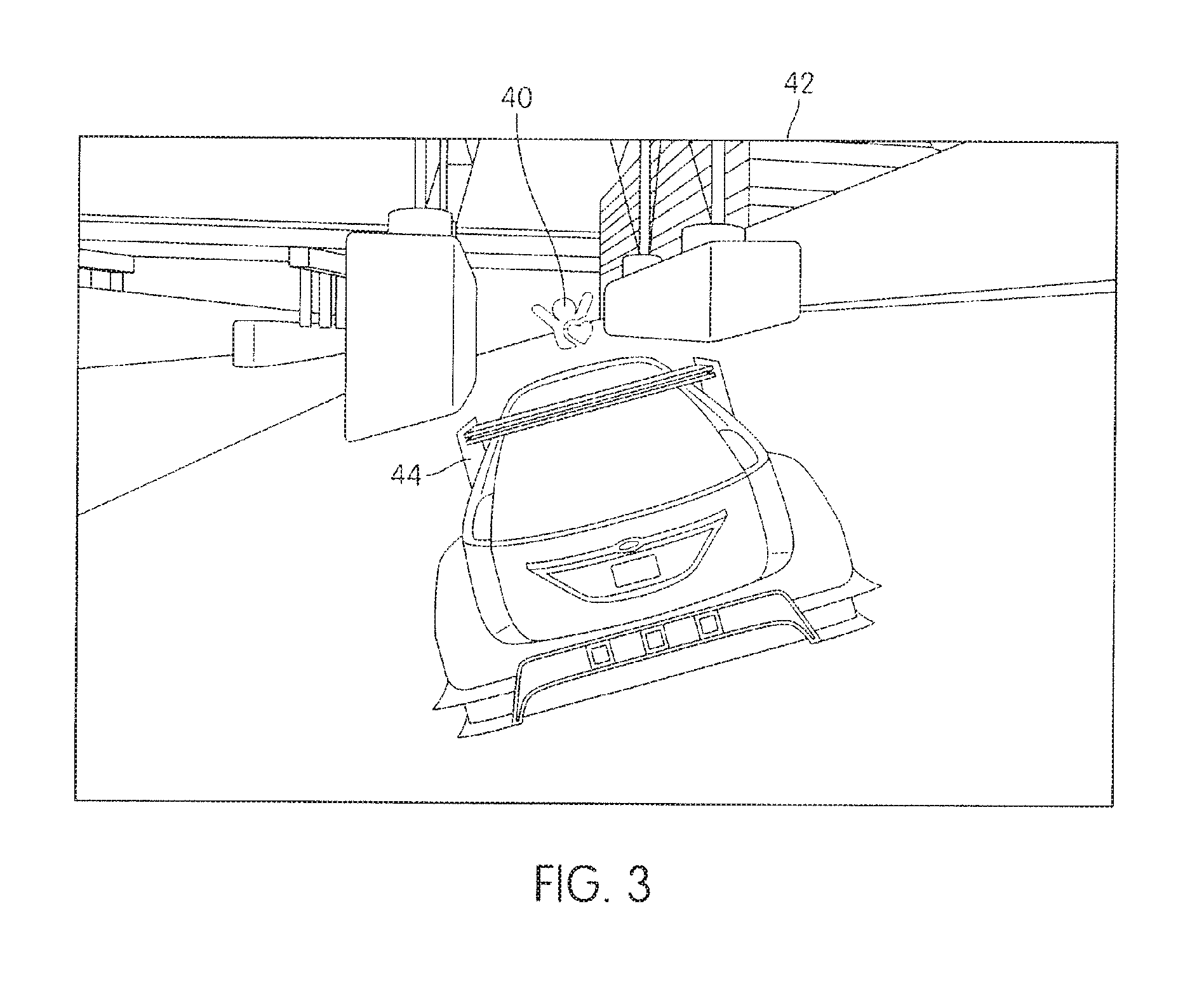
By way of illustration,FIG. 2shows an exemplary fan objective icon40. It will be appreciated that the depiction of fan objective icon40is not intended to be limiting. By way of further illustration,FIG. 3shows fan objective icon40inserted into a view42of a primary objective. In the implementations illustrated inFIG. 3, the primary objective includes a car race through which a vehicle44associated with a character is controlled by a user. In such implementations, the fan objective associated with fan objective icon40may include one or more of a point-to-point objective, a maneuver objective, a pickup objective, a racer interaction objective, a damage objective, and/or other objectives.
A point-to-point objective may involve controlling the vehicle to travel from a beginning location to one or more other designated locations. The beginning location may be the location at which the fan objective icon40is located within the views of the videogame. The other designated locations may include locations that are specially marked, specific locations that are specifically described to the user (e.g., drive under a crane), locations that satisfy some criteria provided to the user (e.g., flat ground, outside of a building, and/or other criteria), and/or other locations. The designated location may be fixed, or may be moving (e.g., drive through a break in a moving set of objects, hit a moving object, and/or other moving locations).
A maneuver objective may involve performing one or more specified maneuver(s) with the vehicle. By way of non-limiting example, the one or more specified maneuvers may include one or more of a jump, a nitro jump, a drifted corner, a powerslide, jumping a designated object or location, jumping to a designated object or location, passing one or more other vehicles, attaining a specified speed, performing a corner or jump with an evaluated level of efficiency and/or effectiveness, and/or other maneuvers.
A pickup objective may involve driving over or near one or more specified “pickups.” The one or more “pickups” may be specified by type, by location and/or both. As used herein, the term “pickup” may refer to a power, resource, or advantage that is obtained by the character when vehicle44drives over or near an icon associated with the power, resource, and/or advantage.
A racer interaction objective may involve effectively interacting with one or more other racers in a predetermined manner. For example, a racer interaction objective may include using a pickup to harm and/or help one or more other racers. As another example, a racer interaction objective may include crashing into one or more other racers, causing one or more other racers to crash, and/or otherwise interacting with other racers during a race.
A damage objective may involve causing predetermined damage. The damage may be to one or more inanimate objects on or near the racecourse, one or more other racers, and/or other objects on or near the racecourse.
It will be appreciated that this is not intended to be an exhaustive list of the types of fan objectives that may be implemented. Other types are contemplated. In some instances, a given fan objective may be a hybrid of two or more types of fan objective. For example, the given fan objective may specify a type of pickup to be made during a specified type of maneuver (e.g., a jump).
Performance or non-performance of fan objectives during performance of a primary objective may not directly impact the performance of the primary objective by the primary character. For example, with respect toFIG. 2, controlling vehicle44to perform a fan objective may not directly impact the relative position or speed of vehicle44in the race. As such, fan objectives may be peripheral, or parallel to the primary objective in which they are staged.
Returning toFIG. 1, the fan objectives staged by fan objective staging module30may be graduated according to difficulty. For example, the fan objectives may include a first set of fan objectives, a second set of fan objectives, and/or a third set of an objectives that are of an increasing difficulty level (e.g., the first set is easiest, the third set is hardest). The fan objective staging module30may be configured such that not every character will be presented with all of the fan objectives during a given primary objective. Some of the fan objectives may be left out of the given primary objective because they are too hard and/or too easy of the character. Determinations of whether to leave fan objectives out of the given primary objective may be made based on, for example, a difficulty setting for the videogame as a whole selected by the user associated with the character.
Staging a fan objective may include presenting to the user one or more indicators that guide the user through performance of the fan objective. The one or more indicators may include visual clues that guide the user via position, shape, symbology, color, and/or other characteristics that convey messages to the user about performance of the fan objective. For example,FIG. 4shows a view43of a racing videogame in which an indicator45is provided that guides the user through performance of a fan objective. In view43, indicator45may indicate a location at which the user will be able to perform the fan objective. For example, if the fan objective includes maneuvering through a specific object (e.g., the highlighted barn doors), indicator45may highlight view43so that the user can more easily spot where to go to perform the fan objective.
The fan objective trigger module32may be configured to trigger activation of fan objectives. Activation of fan objectives may be triggered based on performance of one or more triggering maneuvers by a character. For example, in a racing videogame, a triggering maneuver may include maneuvering a vehicle associated with the character over or through a fan objective icon (e.g., such as fan objective icon40shown inFIG. 2and described above).
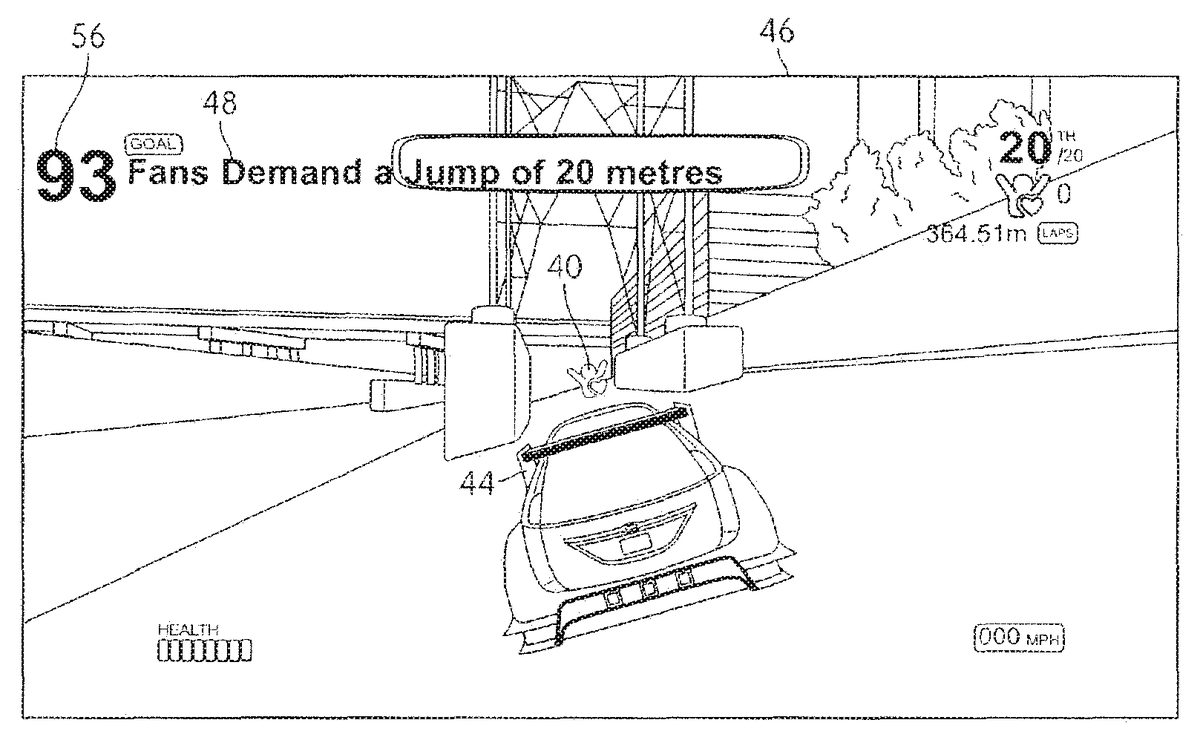
Once a fan objective is activated by fan objective trigger module32, the fan objective may remain active until it is completed, until a time period associated with the fan objective runs out, and/or until some other event. At activation of the fan objective, information about the fan objective may be conveyed to the user corresponding to the character. This may include providing such information to the user via the views of the racecourse by electronic display14. By way of illustration,FIG. 5illustrates a view46of a racing videogame in which a fan objective has been activated. Via view46, a description48of the fan objective is presented to the user.
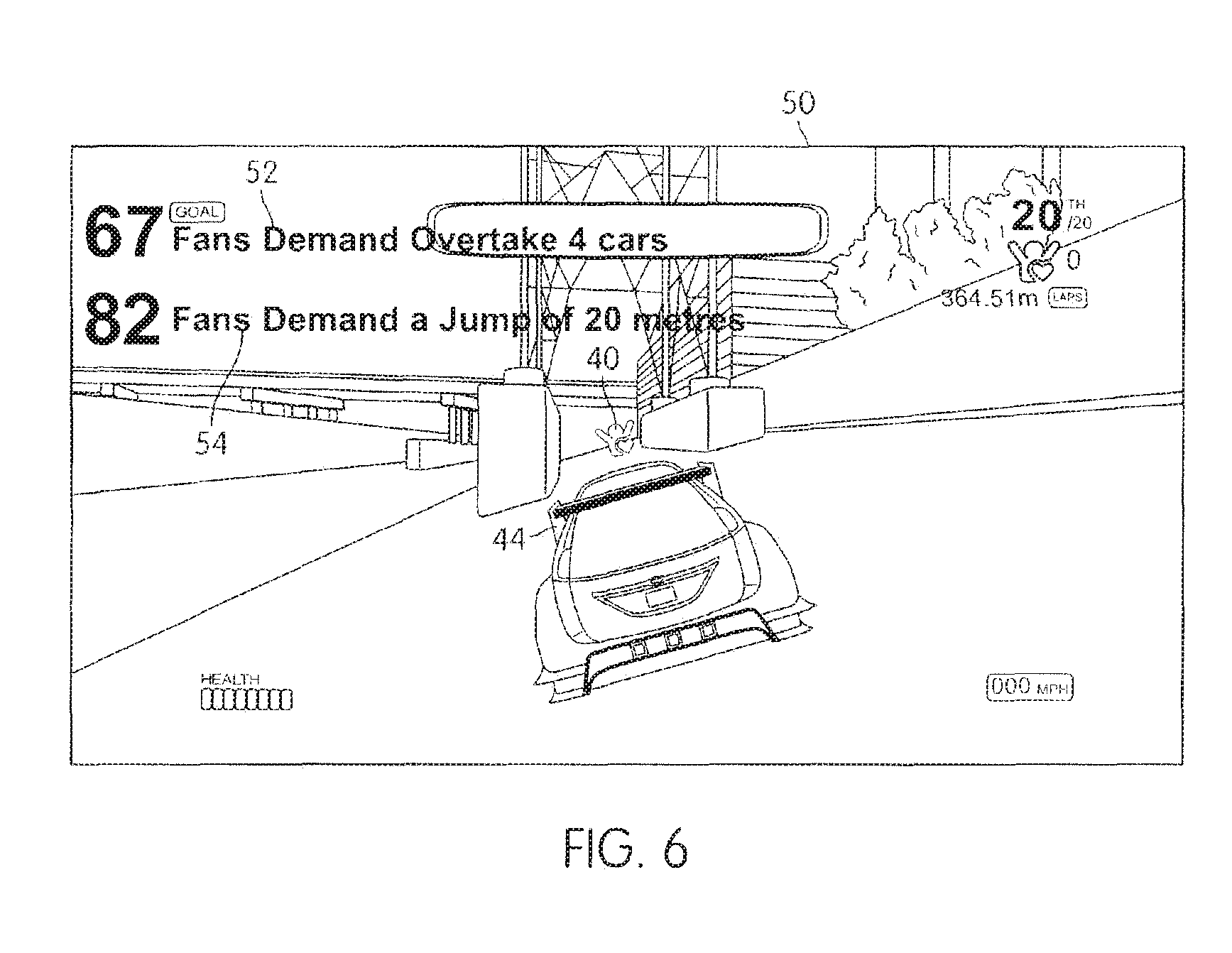
While a first fan objective is active, the character (and/or the vehicle associated with the character) may perform a triggering maneuver associated with a second fan objective. The triggering maneuver associated with the second fan objective may result in the activation of the second fan objective. For example,FIG. 6illustrates a view50of a racing videogame in which triggering of a first and a second fan objective has resulted in a first description52of the first fan objective and a second description54of the second fan objective being displayed in view50.
Returning toFIG. 1, there may be a maximum number of currently activated fan objectives. In such instances, performance of a triggering maneuver when fan objective trigger module32has already triggered activation of the maximum number of currently activated fan objectives may result in the fan objective associated with the triggering maneuver not being triggered. In some instances, performance of a triggering maneuver when fan objective module32has already triggered activation of the maximum number of currently activated fan objectives may result in one of the previously activated fan objectives being expired so that the fan objective associated with the triggering maneuver can be triggered by fan objective trigger module32. In some instances, performance of a triggering maneuver when fan objective trigger module32has already triggered activation of another fan objective may result in the fans associated with performance one of the triggered fan objectives being transferred to the other fan objective.
The manner in which multiple triggered fan objectives are handled may be based in part on the difficulty level of the triggered fan objectives. For example, a newly triggered fan objective having a relatively high difficulty level may result in the expiration of a previously triggered fan objective with a relatively low difficulty level. As another example, a newly triggered fan objective having a relatively low difficulty level may result in the fans associated with performance of the newly triggered fan objective being transferred to a previously triggered fan objective such that performance of the previously triggered fan objective results in the character being awarded with the fans associated with both of the triggered fan objectives.
The fan objective evaluation module34may be configured to evaluate the performance of the fan objectives by the character. This may include monitoring performance of the fan objectives by the character. Upon completion of a fan objective by the character, fan objective evaluation module34may determine a number of fans earned by the character by virtue of the completed fan objective. The number of fans earned by the character may include a number of fans previously assigned to the fan objective, and/or the fans earned by the character may be determined by fan objective evaluation module34based on the performance of the character in completing the fan objective.
In some implementations, fan objective evaluation module34determines the number of fans earned by the character by virtue of a completed fan objective based on an amount of time that the completed fan was active (e.g., between triggering and completion). The number of fans earned by the character may be inversely proportional to the amount of time that the completed fan objective was active.
The fan objective evaluation module34may be configured to provide feedback to the user controlling the character that indicates to the user an amount of fans that could be earned by completing the fan objectives. By way of illustration, turning back toFIG. 5, an indication56may be included in view46that indicates the amount of fans that could be earned by completing the fan objective described in description48. The number of fans indicated in indication56decays as time passes. Thus, the longer it takes for vehicle44to complete the fan objective, the fewer the number of fans that will be earned. The decay of the number of fans indicated in indication56may begin immediately upon triggering of the fan objective, or the decay may be delayed by a delay period. The rate at which the number of fans indicated in indication56decays may be constant with respect to time, or may accelerate or decelerate as time goes on. The delay period and/or the decay rate may be determined based on a level of difficulty of the fan objective.
Returning toFIG. 1, the fan objective evaluation module34may be configured such that after a predetermined period of time from triggering of a fan objective, the fan objective expires. Upon expiration of the fan objective, performance of the fan objective by the character may no longer result in an award of fans to the character. The predetermined period of time may be based on a level of difficulty of the triggered fan objective.
The fan objective evaluation module34may be configured such that once accomplishment of a fan objective can be ruled out (e.g., because performance would be impossible, improbable, and/or counterproductive), the fan objective expires. For instance, in a racing game, if the user maneuvers into an area in which an activity associated with the fan objective becomes impossible, the fan objective expires. By way of illustration, if the fan objective includes jumping over a specific object, and the user drives past the object, the fan objective may expire due to impossibility. In this example, the area past the object may be considered by the fan objective evaluation module to be a “fail zone” associated with the fan objective. If the user maneuvers into a fail zone associated with a fan objective, then the fan objective may expire.
The fanbase module36may be configured to determine the number of fans in the fanbase of a character in the videogame. The fanbase module36may determine the number of fans in the fanbase of the character based on determinations of fan awards by fan objective evaluation module34. For example, fanbase module36may add a new award of fans to the fans previously acquired by the character to determine the number of fans in the fanbase of the character.
In some implementations, fanbase module36may be configured such that fans can be lost by the character. Fans may be lost over time, stolen by other characters, and/or otherwise lost. For example, if the character is not active in participating in primary objectives, attempting to earn new fans through the performance of fan objectives, and/or otherwise inactive and/or unsuccessful within the game, the interest of fans may be lost and the number of fans in the fanbase of the character may begin to decay. This decay may be determined according to a predetermined scheme that rewards a user controlling the character to maintain a certain level of activity and/or success within the videogame.
In some cases, fanbase module36may be configured such that fans may be stolen from the character by other characters (e.g., and vice versa). For example, if the character is outperformed by another one of the characters in a primary objective and/or a fan objective by a predetermined amount, the other character may steal some of the fans of the character. As another example, the videogame may be configured such that one character can challenge another character (or set of characters) to perform a competitive challenge objective. Fans may be exchanged between the characters that participate in the competitive challenge objective based on their relative performances in the competitive challenge objective. The number of fans that are exchanged may be based on a predetermined scheme, based on the difference between the performances of the participating characters (e.g., a close loss would result in fewer fans switching than a contest that was not close), based on an agreement between the participating characters (e.g., a wager of fans), and/or otherwise determined.
Fanbase module36may be configured to track the fanbases of various characters relative to each other. For example, fanbase module36may maintain a leaderboard or ranking of characters associated with different users that is based on the relative number of fans in the fanbases of the different characters. Such leaderboards and/or rankings may further be maintained for amounts of fans earned in specific primary objectives and/or sets of primary objectives.
The fanbase impact module38may be configured to determine the impact of the fanbase of a character on the arch of the character within the videogame. The fanbase impact module38may determine this impact based on the number of fans in the fanbase of the character. The fanbase impact module38may be configured such that the fans in the fanbase of the character may be similar to the impact of fanbases in the real world. For example, opportunities to participate in primary objectives, distribution of virtual currency, relationships with other characters and/or entities within the videogame, sponsorship opportunities, and/or other aspects of the videogame may be impacted by the number of fans in the fan base of the character.
The staging of primary objectives by primary objective staging module26may include determining whether the character should be invited to participate in a given primary objective. In real life, the number of fans in a fanbase of a racer may impact the opportunities to race received by the racer. The more popular the racer is, the more races he may be asked to participate in, and the more prestigious the races may be. In a racing videogame, fanbase impact module38may be configured to mimic this impact of a fanbase such that in staging races, primary objective staging module26may extend, or not extend, invitations to race to the character based on the amount of fans (and/or other characteristics of the fans) in the fanbase of the character.
In real life, the popularity associated with having a relatively large fanbase may enable someone to earn additional money. For example, a popular participant in events may earn appearance fees for participation, may gain entrée to events in which prize money is relatively high, and/or may otherwise leverage their popularity to earn additional money. The fanbase impact module38may be configured to mimic this impact in the videogame. For example, system10may include a virtual currency module (not shown) configured to distribute virtual currency to the character. The fanbase impact module38may be configured to cause the virtual currency module to distribute amounts of virtual currency to the character for participation and/or success in primary objectives based on the amount of fans in the character's fanbase. The fanbase impact module38may be configured to provide the character with other opportunities to earn dispersals of virtual currency to the character that leverage the popularity of the character in a realistic manner.
The fanbase impact module38may be configured such that opportunities for the character to enter and/or enhance relationships within the videogame are impacted by the fanbase of the character. For example, the character may be able to enter and/or enhance relationships with other characters in the game if the fans in the fanbase of the character make the character a more desirable ally or friend. As another example, the character may receive opportunities to join teams and/or formal alliances based, at least in part, on his fanbase.
The fanbase impact module38may be configured such that sponsorship opportunities may be presented to the character based on the fans in the fanbase of the character. The sponsorships may include sponsorships of fictional entities and/or organizations within the videogame. The sponsorships may result in the character receiving virtual currency, equipment or other virtual items, the opportunity to purchase equipment and/or other virtual items, and/or other compensation for the character.
The fans in the fanbase of the character may be virtual fans. These fans may be simply represented by fanbase module36as an amount. In such instance, the impact of the fanbase determined by fanbase impact module38may be based on the amount of fans in the fanbase. However, the virtual fans in the fanbase may be modeled by fanbase module36as individual virtual characters. Such virtual characters may each have individual influences and/or characteristics in the videogame. The fanbase impact module38may be configured to determine the impact of the fanbase based on these specific traits, influences, and/or characteristics of the fans that have been earned by the character. For example, if the fanbase includes fans that have a disproportionate demographic similarity, this demographic similarity may influence the impact of the fanbase determined by fanbase impact module38. As another example, if the fanbase includes virtual fans that are characters within the videogame that have disproportionate influence with respect to other characters, this disproportionate influence may be taken into account by fanbase impact module38in determining the impact of the fanbase.
Although the assignment of fans has been discussed with respect to purely virtual fans, this is not intended to be limiting. The fan objective evaluation module34and/or fanbase module36may be configured to assign characters associated with real life people to be fans of another character based on the other characters performance of one or more fan objectives.
It will be appreciated that the mechanism for earning fans described above (e.g., the performance of fan objectives) is not intended to be limiting. For example, fans may be earned by a character based on performance in primary objectives as well as in the fan objectives staged within the primary objectives.
FIG. 7illustrates a method58of providing a videogame to a user. The operations of method58presented below are intended to be illustrative. In some embodiments, method58may be accomplished with one or more additional operations not described, and/or without one or more of the operations discussed. Additionally, the order in which the operations of method58are illustrated inFIG. 7and described below is not intended to be limiting.
In some embodiments, method58may be implemented in one or more processing devices (e.g., a digital processor, an analog processor, a digital circuit designed to process information, an analog circuit designed to process information, a state machine, and/or other mechanisms for electronically processing information). The one or more processing devices may include one or more devices executing some or all of the operations of method58in response to instructions stored electronically on an electronic storage medium. The one or more processing devices may include one or more devices configured through hardware, firmware, and/or software to be specifically designed for execution of one or more of the operations of method58.
As a part of method58, a primary objective may be staged. The primary objective may include an event in which a primary objective may be attempted by a character being controlled by a user. The staging of the primary objective may include determining whether the character should be invited to participate in the primary objective at an operation60. The determination as to whether the character should be invited may be based on a fanbase associated with the character. The fanbase may include virtual fans previously earned by the character. In some implementations, operation60may be performed by a primary objective staging module that is the same as or similar to primary objective staging module26(shown inFIG. 1and described above).
At an operation62, the staging of the primary objective continues as views of the primary objective are rendered for display to the user. In some implementations, operation62may be performed by a primary objective staging module that is the same as or similar to primary objective staging module26(shown inFIG. 1and described above).
At an operation64, one or more fan objectives may be staged within the primary objective. The fan objectives may be secondary objectives performable during the primary objective by the character to earn fans for the fanbase of the character. Staging the one or more fan objectives may include inserting one or more fan objective icons into the views of the primary objective, and associating individual ones of the fan objective icons with individual ones of the fan objectives. In some implementations, operation64may be performed by a fan objective staging module that is the same as or similar to fan objective staging module30(shown inFIG. 1and described above).
At an operation66, a determination may be determined as to whether or not a fan objective has been triggered. In some implementations, operation66may be performed by a fan objective trigger module that is the same as or similar to fan objective trigger module32(shown inFIG. 1and described above).
If a fan objective has been triggered at operation66, then performance of the triggered fan objective may be monitored and/or evaluated. For example, responsive to a determination at operation66that the fan objective has been triggered, method58may proceed to an operation68. At operation68, a determination may be made as to whether the fan objective has been completed. In some implementations, operation68may be performed by a fan objective evaluation module that is the same as or similar to fan objective evaluation module34(shown inFIG. 1and described above).
If a determination is made at operation68that the fan objective has not been completed, method58may proceed to an operation70. At operation70, a determination may be made as to whether a time period allotted for the fan objective to be performed as expired. In some implementations, operation70may be performed by a fan objective evaluation module34that is the same as or similar to fan objective evaluation module34(shown inFIG. 1and described above).
If a determination is made at operation70that the time period allotted for the fan objective to be performed has expired, method58may return to operation66. If a determination is made at operation70that the time period allotted for the fan objective to be performed has not expired, method58may return to operation68.
Responsive to a determination at operation68that the character has performed the fan objective, method58may proceed to an operation72. At an operation72, an amount of fans earned by the character by virtue of the performance of the fan objective may be determined. In some implementations, operation72may be performed by a fan objective evaluation module that is the same as or similar to fan objective evaluation module34(shown inFIG. 1and described above).
At an operation74, the fans earned by the character at operation72may be added to the fanbase of the character. In some implementations, operation74may be performed by a fanbase module36that is the same as or similar to fanbase module36(shown inFIG. 1and described above).
At an operation76, an impact of the fanbase of the character on the videogame may be determined. In some implementations, operation76may be performed by a fanbase impact module that is the same as or similar to fanbase impact module38(shown inFIG. 1and described above).
Although the invention has been described in detail for the purpose of illustration based on what is currently considered to be the most practical and preferred embodiments, it is to be understood that such detail is solely for that purpose and that the invention is not limited to the disclosed embodiments, but, on the contrary, is intended to cover modifications and equivalent arrangements that are within the spirit and scope of the appended claims. For example, it is to be understood that the present invention contemplates that, to the extent possible, one or more features of any embodiment can be combined with one or more features of any other embodiment.
Claims
- A system configured to provide a videogame to one or more users, the system comprising: one or more processors configured to execute computer program modules, the computer program modules comprising: a primary event staging module configured to stage an event in which a character under control of a controller communicatively linked with the one or more processors participates, wherein staging the event comprises rendering views of the character engaging in the event;and determining whether or not to invite the character to participate in the event;and a fan objective staging module configured to stage a plurality of fan objectives, wherein fan objectives are secondary objectives performable during the event by the character to earn virtual fans for a virtual fanbase of the character, wherein staging a fan objective comprises inserting an objective icon into views of the event and associating the fan objective with the objective icon and wherein the objective icon comprises a visual indicator configured to provide guidance for the performance of the fan objective based on at least one of a position, a shape, a symbology, or a color of the objective icon;a fan objective trigger module configured to trigger activation of fan objectives responsive to performance of one or more triggers executed by the character during the event;and a fan objective evaluation module configured to monitor performance of one or more active fan objectives by the character, and upon completion of a fan objective by the character, to allocate a number of fans earned by the character by virtue of the completed fan objective based on the performance of the character in completing the fan objective;and wherein the primary event staging module is further configured to determine whether or not to invite the character to participate in the event based on the number of virtual fans in the fanbase of the character.
- The system of claim 1 , wherein performance or non-performance of fan objectives during the event do not directly impact a performance or non-performance of a primary objective of the event.
- The system of claim 1 , wherein the fan objective evaluation module is configured to determine the number of fans earned by the character by virtue of the completed fan objective based on an amount of time that the completed fan objective was active.
- The system of claim 3 , wherein the fan objective evaluation module is configured to determine the number of fans earned by the character by virtue of the completed fan objective according to a function that makes the number of fans earned inversely proportional to the amount of time that the completed fan objective was active.
- The system of claim 1 , wherein the computer program modules further comprise a fanbase module configured to determine the number of virtual fans in the fanbase of the character based on the number of fans earned by the character in performing fan objectives during events.
- The system of claim 5 , wherein the fanbase module is further configured such that the number of virtual fans in the fanbase of the character decays over time.
- The system of claim 1 , wherein the computer program modules further comprise a virtual currency module configured to distribute virtual currency to the character, wherein the virtual currency is redeemable in the videogame to acquire equipment and wherein the amount of virtual currency distributed to the character by the virtual currency module is impacted by the number of virtual fans in the fanbase of the character.
- The system of claim 1 , wherein the fan objective staging module is configured such that different characters are presented with different fan objectives during the event.
- The system of claim 1 , wherein the fan objective staging module is configured to present no more than a maximum number of fan objectives.
- The system of claim 9 , wherein the fan objective staging module is configured to cause a previously activated fan objective to expire when the fan objective trigger module has already triggered activation of the maximum number of fan objectives.
- The system of claim 1 , wherein the fan objective evaluation module is configured to provide feedback to the one or more users indicative of the number of fans that could be earned by completing the fan objective.
- A computer-implemented method of providing a videogame to one or more users, wherein the method is implemented in a computer system comprising one or more processors configured to execute one or more computer program modules, the method comprising: executing, on the one or more processors of the computer system, one or more computer program modules configured to: stage, using a primary event staging module, an event in which a character under control of a controller communicatively linked with the one or more processors participates, wherein staging the event further comprises rendering views of the character engaging in the event;and determining whether or not to invite the character to participate in the event;and staging, using a fan objective staging module, a plurality of fan objectives, wherein fan objectives are secondary objectives performable during the event by the character to earn virtual fans for a virtual fanbase of the character, wherein staging a fan objective comprises inserting an objective icon into views of the event and associating the fan objective with the objective icon and wherein the objective icon comprises a visual indicator configured to provide guidance for the performance of the fan objective based on at least one of a position, a shape, a symbology, or a color of the objective icon;triggering, using a fan objective trigger module, activation of fan objectives responsive to performance of one or more triggers executed by the character during the event;monitoring, using a fan objective evaluation module, performance of one or more active fan objectives by the character;allocating, upon completion of a fan objective by the character, a number of fans earned by the character by virtue of the completed fan objective based on the performance of the character in completing the fan objective;and wherein the primary event staging module is further configured to determine whether or not to invite the character to participate in the event based on the number of virtual fans in the fanbase of the character.
- The method of claim 12 , wherein performance or non-performance of fan objectives during the event do not directly impact a performance or non-performance of a primary objective of the event.
- The method of claim 12 , further comprising determining, using the fan objective evaluation module, the number of fans earned by the character by virtue of the completed fan objective based on an amount of time that the completed fan objective was active.
- The method of claim 14 , further comprising determining, using the fan objective evaluation module, the number of fans earned by the character by virtue of the completed fan objective according to a function that makes the number of fans earned inversely proportional to the amount of time that the completed fan objective was active.
- The method of claim 12 , further comprising determining, using a fanbase module, the number of virtual fans in the fanbase of the character based on the number of fans earned by the character in performing fan objectives during events.
- The method of claim 16 , wherein the fanbase module is further configured such that the number of virtual fans in the fanbase of the character decays over time.
- The method of claim 12 , further comprising distributing, using a virtual currency module, virtual currency to the character, wherein the virtual currency is redeemable in the videogame to acquire equipment and wherein the amount of virtual currency distributed to the character by the virtual currency module is impacted by the number of virtual fans in the fanbase of the character.
- The method of claim 12 , further comprising presenting, using the fan objective staging module, different fan objectives to different characters during the event.
- The method of claim 12 , further comprising presenting, using the fan objective staging module, no more than a maximum number of fan objectives.
- The method of claim 20 , further comprising causing, using the fan objective staging module, a previously activated fan objective to expire when the fan objective trigger module has already triggered activation of the maximum number of fan objectives.
- The method of claim 12 , further comprising providing, using the fan objective evaluation module, feedback to the one or more users indicative of an amount of fans that could be earned by completing the fan objective.
Disclaimer: Data collected from the USPTO and may be malformed, incomplete, and/or otherwise inaccurate.