U.S. Pat. No. 10,361,986
GAMEPLAY IN A CHAT THREAD
AssigneeDisney Enterprises Inc
Issue DateSeptember 29, 2014
Illustrative Figure
Abstract
There is provided a system and method for user generated gameplay in chat. The system including a memory storing a text and multimedia messaging software application, and a processor configured to execute the text and multimedia messaging software application to initiate a message exchange session with a remote mobile device, in response to a request received from a user of the mobile device, the message exchange session displaying a user interface for exchanging text and multimedia messages, provide a plurality of games for selection by the user to be played during the message exchange session and within the user interface for exchanging text and multimedia messages, receive a selection of one of the plurality of games by the user after initiating the message exchange session, and initiate the one of the plurality of games for playing within the user interface for exchanging text and multimedia messages.
Description
DETAILED DESCRIPTION The following description contains specific information pertaining to implementations in the present disclosure. The drawings in the present application and their accompanying detailed description are directed to merely exemplary implementations. Unless noted otherwise, like or corresponding elements among the figures may be indicated by like or corresponding reference numerals. Moreover, the drawings and illustrations in the present application are generally not to scale, and are not intended to correspond to actual relative dimensions. FIG. 1presents a system for integrating game mechanics in a chat thread, according to one implementation of the present disclosure. System100ofFIG. 1includes user101in possession of mobile device110, and user102in possession of mobile device150. Mobile device110includes processor111, display112, input interface113, communication interface114, and memory115. Memory115includes messaging software application120and game software application130. Messaging software application120includes message stream121, keyboard126, and game selection127. Message stream121includes chat bubbles122, game launch123, game objects124, and user input125. Game software application130includes games131, objects132, and avatars133. Mobile device150includes processor151, display152, input interface153, communication interface154, and memory155. Memory155includes messaging application160and game software application130. Messaging application160includes message stream121, keyboard166, and game selection127. Message stream121includes chat bubbles122, game launch123, game objects124, and user input165. System100ofFIG. 1further includes game request170, game acceptance171, and game moves172. Mobile device110may comprise a mobile phone, a tablet, a personal computer, or any other device capable of executing a messaging software application to communicate with other mobile devices. As shown inFIG. 1, mobile device110includes display112and input interface113. Input interface113may comprise, for example, a keyboard, a mouse, a game controller, a touch-screen input, a thermal and/or electrical sensor, or any other device capable of accepting user input for use with mobile device110. Display112may comprise a liquid crystal display (LCD) screen built into mobile device110. In alternative implementations of the present disclosure, display112may be another type of display hardware, such as cathode-ray tubes (CRT) monitors. ...
DETAILED DESCRIPTION
The following description contains specific information pertaining to implementations in the present disclosure. The drawings in the present application and their accompanying detailed description are directed to merely exemplary implementations. Unless noted otherwise, like or corresponding elements among the figures may be indicated by like or corresponding reference numerals. Moreover, the drawings and illustrations in the present application are generally not to scale, and are not intended to correspond to actual relative dimensions.
FIG. 1presents a system for integrating game mechanics in a chat thread, according to one implementation of the present disclosure. System100ofFIG. 1includes user101in possession of mobile device110, and user102in possession of mobile device150. Mobile device110includes processor111, display112, input interface113, communication interface114, and memory115. Memory115includes messaging software application120and game software application130. Messaging software application120includes message stream121, keyboard126, and game selection127. Message stream121includes chat bubbles122, game launch123, game objects124, and user input125. Game software application130includes games131, objects132, and avatars133. Mobile device150includes processor151, display152, input interface153, communication interface154, and memory155. Memory155includes messaging application160and game software application130. Messaging application160includes message stream121, keyboard166, and game selection127. Message stream121includes chat bubbles122, game launch123, game objects124, and user input165. System100ofFIG. 1further includes game request170, game acceptance171, and game moves172.
Mobile device110may comprise a mobile phone, a tablet, a personal computer, or any other device capable of executing a messaging software application to communicate with other mobile devices. As shown inFIG. 1, mobile device110includes display112and input interface113. Input interface113may comprise, for example, a keyboard, a mouse, a game controller, a touch-screen input, a thermal and/or electrical sensor, or any other device capable of accepting user input for use with mobile device110. Display112may comprise a liquid crystal display (LCD) screen built into mobile device110. In alternative implementations of the present disclosure, display112may be another type of display hardware, such as cathode-ray tubes (CRT) monitors. In yet other implementations, display112may also be touch sensitive and may serve as input interface113.
Mobile device110further includes processor111and memory115. Processor111may be configured to access memory115to store received input or to execute commands, processes, or programs stored in memory115, such as messaging software application120and game software application130. Processor111may correspond to a processing device, such as a microprocessor or similar hardware processing device, or a plurality of hardware devices. However, in other implementations processor111refers to a general processor capable of performing the functions required of mobile device110. Memory115is a sufficient memory capable of storing commands, processes, and programs for execution by processor111. Memory115may be instituted as ROM, RAM, flash memory, or any sufficient memory capable of storing a set of commands. In other implementations, memory115may correspond to a plurality memory types or modules.
Also illustrated inFIG. 1, mobile device110further includes communication interface114. In the implementation ofFIG. 1, communication interface114includes any device that is capable both transmitting data with a transmitter and receiving data with a receiver. Processor111of mobile device110is thus configured to control communication interface114to communicate with other mobile devices, such as mobile device150.
It should be noted that mobile device150, processor151, display152, input interface153, communication interface154, and memory155may be similar to mobile device110, processor111, display112, input interface113, communication interface114, and memory115, respectively. For example, mobile device150may include a mobile phone, a tablet, a personal computer, or any other device capable of executing a messaging software application to communicate with other mobile devices. Processor151may be configured to access memory155to store received input or to execute commands, processes, or programs stored in memory155, such as messaging application160and game software application130. Furthermore, processor151of mobile device150may be configured to control communication interface154to communicate with other mobile devices using any wired or wireless technology.
Also illustrated inFIG. 1, mobile device110includes game software application130. Mobile device110may utilize game software application130to create and play games with other mobile devices, where the games are created and played within a messaging application, such as messaging software application120. Messaging software application120may include a software application used by mobile device110to communicate with other mobile devices, such as mobile device150. For example, messaging software application120may include a short message service (SMS) used by mobile device110to send and receive text and multimedia messages with other mobile devices. As such, by utilizing game software application130, mobile device110is able to allow user101to directly create and play games within messaging software application120, thus extending the capabilities of messaging software application120.
It should be noted that the implementation ofFIG. 1only illustrates messaging software application120as being separate from game software application130, however, the present disclosure is not limited to the implementation ofFIG. 1. For example, in other implementations, messaging software application120and game software application130may be combined into a single software application.
As illustrated inFIG. 1, game software application130includes games131, objects132, and avatars133. Games131may include a list of games that user101of mobile device110may select from when creating a game within messaging software application120. For example, and as will be illustrated inFIGS. 2, 4A, 4B, 6, 8, and 10, games131may include, but are not limited to, user generated games, shooting games, dice games, avatar games, and trading games. Objects132may include different objects that can be used by user101of mobile device110when creating and playing one or more of games131. For example, objects132may include, but are not limited to, avatars, people, cars, buildings, food, animals, pictures, movie clips, or any other objects that can be utilized to create and play different games131. Finally, avatars133may include all of the different avatars that may be utilized by user101of mobile device110when creating and playing one or more of games131.
Also illustrated inFIG. 1, messaging software application120includes message stream121, keyboard126, and game selection127. Message stream121may include an user interface used by user101of mobile device110to exchange text and multimedia messages with users of other mobile devices, such as user102of mobile device150. For example, message stream121may include a list of each of the messages that have been exchanged between mobile device110and mobile device150. Keyboard126may include the keyboard used by user101of mobile device110to transmit messages within message stream121. For example, keyboard126may include, but is not limited to, a normal keyboard that includes letters for typing words or a special keyboard that can be used to type special figures, such as different emotional faces or objects. Finally, game selection127may include a selection button included within messaging software application120that user101of mobile device110uses to select games to be created and played within message stream121. For example, game selection127may allow user101to select one or more of games131from game software application130.
It should be noted that messaging application160and keyboard166of mobile device150may be similar to messaging software application120and keyboard126of mobile device110. For example, messaging application160may include a software application used by user102of mobile device150to communicate with users of other mobile devices, such as user101of mobile device110. As such, messaging software application120and messaging application160may include the same SMS, or messaging software application120and messaging application160may include different SMSs. Furthermore, keyboard166may be similar to keyboard126except that keyboard166is generated specifically for messaging application160of mobile device150.
Also illustrated inFIG. 1, message stream121includes chat bubbles122, game launch123, game objects124, and user input125. Chat bubbles122may include objects within message stream121that are used to distinguish between each text and multimedia message that exchanged using message stream121. For example, if message stream121includes a chat stream between mobile device110and mobile device150, chat bubbles122would distinguish between each message that is exchanged between mobile device110and mobile device150. In such an example, chat bubbles122are created each time user101of mobile device110transmits a message to user102of mobile device150, and each time user101of mobile device110receives a message from user102of mobile device150.
Game launch123may include a message sent within message stream121that either requests the starting of one of games131, or accepts a request of one of games131if mobile device110has already received the request from another mobile device. For example, and using the example above where message stream121includes an input interface for exchanging messages between mobile device110and mobile device150, game launch123may include a game request transmitted from mobile device110to mobile device150within message stream121requesting the start of one of games131. For another example, and again using the example above where message stream121includes an user interface for exchanging messages between mobile device110and mobile device150, if mobile device110has already received a game request from mobile device150, then game launch123may include an acceptance of the request by user101of mobile device110. In such an example, the request may be displayed within message stream121in one of chat bubbles122.
Game objects124may include each of the objects that have been used to create and play the game within message stream121. For example, game objects124may include one or more of objects132, or game objects124may include one or more of avatars133. Finally, user input125may include each move made by user101of mobile device110during the playing of the game. For example, if user101of mobile device110is playing a game with user102of mobile device150, user input125would include each move made by user101of mobile device110during the playing of the game, and user input165would include each move made by user102of mobile device150during the playing of the game.
In the implementation ofFIG. 1, user101of mobile device110may be using messaging software application120to exchange text and multimedia messages with user102of mobile device150, where the messages are displayed using chat bubbles122within message stream121. During the conversation between user101and user102, user101may decide that he or she wants to play a game with user102. In order to play a game with user102, user101uses game selection127to select one of games131, where game selection127was added to messaging software application120by game software application130. After selecting one of games131using game selection127, mobile device110transmits game request170to mobile device150by posting game request170within message stream121.
User102of mobile device150may receive game request170from user101of mobile device110within message stream121, where game request170is displayed to user102within one of chat bubbles122. User102may then accept game request170received by user101and mobile device150and may transmit game acceptance171to mobile device110in response. By accepting game request170from user101of mobile device110, user101of mobile device110and user102of mobile device150have created a game within message stream121. User101and user102are now able to play each other in a friendly game within message stream121, using various game moves172(corresponding to user input125and user input165). As such, user101is not required to download or launch a new software application to play a game with user102.
It should be noted that in some implementations, and as discussed above, display112may be touch sensitive and serve as input interface113. In such implementations, the game may be displayed on display112of mobile device110and user input125may be made by user101directly touching parts of display112. For example, if the game is a shooting game, user input125may include user101shooting at game objects124within the game by directly touching parts of display112where game objects124are located.
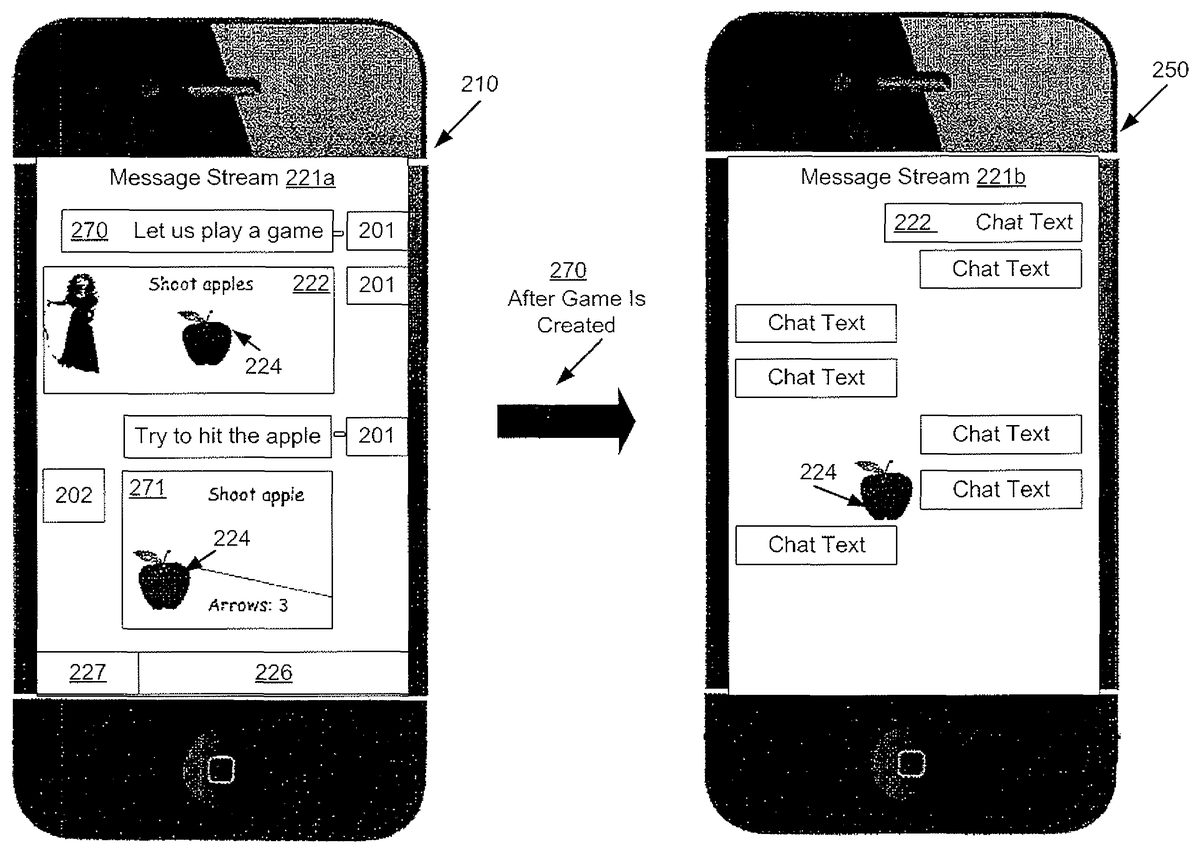
FIG. 2presents an example of user generated gameplay levels in a chat thread, according to one implementation of the present disclosure.FIG. 2includes mobile device210and mobile device250. Mobile device210includes message stream221a, keyboard226, and game selection227. Message stream221aincludes chat bubbles222(corresponding messages exchanged between user201and user202within message stream221a), game object224, game request270, and game acceptance271. Message stream221afurther includes messages from user101and user102. Mobile device250includes message stream221b, which includes chat bubbles222and game object224.
With respect toFIG. 2, it should be noted that user201, user202, mobile device210, each of message stream221aand message stream221b, chat bubbles222, game object224, keyboard226, game selection227, game request270, and game acceptance271correspond respectively to user101, user102, mobile device110, message stream121, chat bubbles122, game objects124, keyboard127, game selection127, game request170, and game acceptance171fromFIG. 1. It should further be noted that only one of chat bubbles222within message stream221aand one of chat bubbles222within message stream221bis labeled for clarity purposes even though each message exchanged between user201and user202is included within one of chat bubbles222.
FIG. 2illustrates an example of a game that can be created and played within a message stream that allows users to generate play levels using the actual chat conversation within the message stream. Users are provided with a game trigger that the users can activate in order to place objects within the chat conversation. The objects are then able to interact with the chat messages (chat bubbles) of the chat conversation between the users during the playing of the game. As such, users are able to design game levels through posting typical chat conversations, which include both the chat messages and the objects. This gives the users the ability to create different game levels each time the users decide to play a game, since the size and types of chat messages and objects will differ within a chat conversation each time a game is played within the message stream.
In the implementation ofFIG. 2, mobile device210includes message stream221a, which may correspond to a chat conversation between user201and user202during the creation of a game. For example, user201may have used game selection227to select a shooting game to play with user202, where the shooting game is created within message stream221ausing chat bubbles222. To begin the game, user201first sends game request270to user202by posting game request270within one of chat bubbles222of message stream221a. In the implementation ofFIG. 2, game request270says “Let us play a game”. Next, user201sends user202the name of the game and the instructions within two more of chat bubbles222, where the instructions tell user202to “Try and hit the apple,” which is illustrated as game object224. After sending game request270to user202, user201then receives game acceptance271within another one of chat bubbles222of message stream221a.
Continuing with the implementation ofFIG. 2, mobile device250includes message stream221b, which may correspond to message stream221aexcept that user202has now started playing the shooting game. As illustrated in message stream221b, user202first has to shoot chat bubbles222which were illustrated in message stream221ain order for game object224to be visible. After shooting each of chat bubbles222, user202then has to shoot game object224within message stream221bto win the game.
FIG. 3shows a flowchart illustrating a method for generating user generated gameplay levels in a chat thread, according to one implementation of the present disclosure. The approach and technique indicated by flowchart300are sufficient to describe at least one implementation of the present disclosure, however, other implementations of the disclosure may utilize approaches and techniques different from those shown in flowchart300. Furthermore, while flowchart300is described with respect toFIGS. 1 and 2, the disclosed inventive concepts are not intended to be limited by specific features shown and described with respect toFIGS. 1 and 2. Furthermore, with respect to the method illustrated inFIG. 3, it is noted that certain details and features have been left out of flowchart300in order not to obscure the discussion of inventive features in the present application.
Referring now to flowchart300ofFIG. 3, flowchart300includes (at310) initiating a message exchange session with a remote mobile device, in response to a request received from a user of the mobile device, the message exchange session displaying a user interface for exchanging text and multimedia messages. For example, processor111of mobile device110/210may execute messaging software application120to open a message exchange session with mobile device150/250, in response to a request received from user101/201of mobile device110/210, the message exchange session displaying message stream121/221a. As discussed above, message stream121/221amay be used to exchange text and multimedia messages with mobile device150/250.
Flowchart300further includes (at320) providing a plurality of games for selection by the user to be played during the message exchange session and within the user interface for exchanging text and multimedia messages. For example, processor111of mobile device110/210may execute messaging software application120to provide games131for selection by user101/201to be played during the message exchange session within message stream121/221a. As discussed above, user101/201may be provided with games131using game selection127/227.
Flowchart300further includes (at330) receiving a selection of one of the plurality of games by the user after initiating the message exchange session. For example, processor111of mobile device110/210may execute messaging software application120to receive a selection of one of games131by user101/201after initiating the messaging exchange session. As discussed above, user101/201may select one of games131using game selection127/227.
Flowchart300further includes (at340) sending a game request to the remote user device using the user interface for exchanging text and multimedia messages. For example, processor111of mobile device110/210may execute messaging software application120to send game request170/270to mobile device150/250using message stream121/221a. As discussed above, game request170/270may be sent to mobile device150/250by posting game request170/270within one of chat bubbles122/222.
Flowchart300further includes (at350) receiving a game acceptance from the remote user device using the user interface for exchanging text and multimedia messages in response to sending the game request. For example, processor111of mobile device110/210may execute messaging software application120to receive game acceptance171/271from mobile device150/250using message stream121/221ain response to sending game request170/270.
Flowchart300also includes (at360) initiating the one of the plurality of games within the user interface for exchanging text and multimedia messages, wherein a game level for the one of the plurality of games is created using chat bubbles within the user interface for exchanging text and multimedia messages. For example, processor111of mobile device110/210may execute messaging software application120to initiate the one of games131within message stream121/221a, wherein a game level for the one of games131is created using chat bubbles122/222within message stream121/221a. As discussed above, the game level for the one of games131may further be created using game objects124/224selected from objects132.
As a preliminary note toFIGS. 4A and 4B,FIGS. 4A and 4Billustrate examples of games that can use the message stream to integrate game mechanics into the chat conversation. The game mechanics work by providing a game selection button within the messaging application. Using the game selection button, a first user is able to select a game to be played. Once a game is selected, a game request is posted within the message stream (in a chat bubble), where the game request includes a game acceptance button. When a second user taps on the game acceptance button within the message stream, the game will trigger a response. These games may include, but are not limited to, dice rolling games, trivia games, rock-paper-scissors games, time based games, and scratchers games. As such, these games may be played between just two users using two different mobile devices, or these games may be played between multiple users on multiple mobile devices.
FIG. 4Apresents a first example of integrating game mechanics in a chat thread, according to one implementation of the present disclosure.FIG. 4Aincludes mobile device410, which includes message stream421a, keyboard426, and game selection427. Message stream421aincludes chat bubbles422(corresponding to messages exchanged between user401and user402within message stream421a), game request470, and game acceptance471.
With respect toFIG. 4A, it should be noted that user401, user402, mobile device410, message stream421a, chat bubbles422, keyboard426, game selection427, game request470, and game acceptance471correspond respectively to user101, user102, mobile device110, message stream121, chat bubbles122, keyboard126, game selection127, game request170, and game acceptance171fromFIG. 1. It should further be noted that only one of chat bubbles422within message stream421ais labeled for clarity purposes even though each message exchanged between user401and user402is included within one of chat bubbles422.
In the implementation ofFIG. 4A, user401may have used game selection427to look through the possible games that are available to be played within message stream421aand clicked on a game icon that corresponds to a dice rolling game. In response to selecting the dice rolling game, game request470has been posted using one of chat bubbles422within message stream421aalong with game acceptance471, which corresponds to a button that can be used by user402to accept game request470. User402may have then seen game request471within message stream421abeing displayed on his or her own mobile device (not shown), and selected game acceptance471. In response to user402selecting game acceptance471, the dice rolling game rolled the dice and selected a winner based on the roll. The dice rolling game further awarded the winner a prize (illustrated as 100 coins). Finally, user401posted another message within message stream421ato play again, which user402can select to play the dice rolling game a second time.
It should be noted that the implementation ofFIG. 4Aillustrates a timer within message stream421a. In such implementations that include a timer, user402may only have a set amount of time to accept game request470before game request470is cancelled and thus no game is created or played. For example, and as illustrated inFIG. 4A, user402had fifty-eight seconds left to accept game request470when user402selected game acceptance471.
FIG. 4Bpresents a second example of integrating game mechanics in a chat thread, according to one implementation of the present disclosure.FIG. 4Bincludes mobile device410, which includes message stream421b, keyboard426, and game selection427. Message stream421bincludes chat bubbles422(corresponding to messages exchanged between user401and user402within message stream421b), game request470, and game acceptance471.
With respect toFIG. 4B, it should be noted that user401, user402, mobile device410, message stream421b, chat bubbles422, keyboard426, game selection427, game request470, and game acceptance471correspond respectively to user101, user102, mobile device110, message stream121, chat bubbles122, keyboard126, game selection127, game request170, and game acceptance171fromFIG. 1. It should further be noted that only one of chat bubbles422within message stream421bis labeled for clarity purposes even though each message exchanged between user401and user402is included within one of chat bubbles422.
In the implementation ofFIG. 4B, user401may now have used game selection427and clicked on a game icon that corresponds to a rock-paper-scissors game. In response to selecting the rock-paper-scissors game, game request470has been posted within message stream421balong with icons for a rock, a paper, and scissors. User401then uses message stream421bbeing displayed on mobile device410, and user402uses message stream421bbeing displayed on his or her own mobile device (not shown), to select either the rock icon, the paper icon, or the scissors icon within game request470. After each of user401and user402make a selection, the rock-paper-scissors game decides who wins and awards the winner with a prize (illustrated as 100 coins).
FIG. 5shows a flowchart illustrating a method for integrating game mechanics in a chat thread, according to one implementation of the present disclosure. The approach and technique indicated by flowchart500are sufficient to describe at least one implementation of the present disclosure, however, other implementations of the disclosure may utilize approaches and techniques different from those shown in flowchart500. Furthermore, while flowchart500is described with respect toFIGS. 1, 4A, and 4B, the disclosed inventive concepts are not intended to be limited by specific features shown and described with respect toFIGS. 1, 4A, and 4B. Furthermore, with respect to the method illustrated inFIG. 5, it is noted that certain details and features have been left out of flowchart500in order not to obscure the discussion of inventive features in the present application.
Referring now to flowchart500ofFIG. 5, flowchart500includes (at510) initiating a message exchange session with a remote mobile device, in response to a request received from a user of the mobile device, the message exchange session displaying a user interface for exchanging text and multimedia messages. For example, processor111of mobile device110/410may execute messaging software application120to open a message exchange session with mobile device150, in response to a request received from user101/401of mobile device110/410, the message exchange session displaying message stream121/421a/421b. As discussed above, message stream121/421a/421bmay be used to exchange text and multimedia messages with mobile device150.
Flowchart500further includes (at520) providing a plurality of games for selection by the user to be played during the message exchange session and within the user interface for exchanging text and multimedia messages. For example, processor111of mobile device110/410may execute messaging software application120to provide games131for selection by user101/401to be played during the message exchange session within message stream121/421a/421b. As discussed above, user101/401may be provided with games131using game selection127/427. Games131may include, but are not limited to, dice rolling games, trivia games, rock-paper-scissors games, time based games, and scratchers games.
Flowchart500further includes (at530) receiving a selection of one of the plurality of games by the user after initiating the message exchange session. For example, processor111of mobile device110/410may execute messaging software application120to receive a selection of one of games131by user101/401after initiating the messaging exchange session. As discussed above, user101/401may select one of games131using game selection127/427.
Flowchart500further includes (at540) sending a game request to the remote user device using the user interface for exchanging text and multimedia messages, the game request including a chat bubble with a game acceptance button. For example, processor111of mobile device110/410may execute messaging software application120to send game request170/470to mobile device150using message stream121/421a/421b, game request170/470including one of chat bubbles122/422with game acceptance171/471button.
Flowchart500further includes (at550) receiving a game acceptance from the remote user device using the user interface for exchanging text and multimedia messages in response to sending the game request. For example, processor111of mobile device110/410may execute messaging software application120to receive game acceptance171/471from mobile device150using message stream121/421a/421bin response to sending game request170/470. As discussed above, mobile device110/410may receive game acceptance171/471when user102/402selects game acceptance171/471button within message stream121/421a/421bon mobile device150.
Flowchart500further includes (at560) playing the one of the plurality of games in response to receiving the game acceptance and (at570) determining a winner of the one of the plurality of games. For example, processor111of mobile device110/410may execute messaging software application120to play the one of games131in response to receiving game acceptance171/471and determine a winner for the one of games131. As discussed above, the one of games131may be played within message stream121/421a/421b.
FIG. 6presents an example of chat message gameplay scripting, according to one implementation of the present disclosure.FIG. 6includes mobile device610, which includes message stream621, keyboard626, and game selection627. Message stream621includes chat bubbles622(corresponding to messages exchanged between user601and user602within message stream621), game object624, and game request670.
With respect toFIG. 6, it should be noted that user601, user602, mobile device610, message stream621, chat bubbles622, game object624, keyboard626, game selection627, and game request670correspond respectively to user101, user102, mobile device110, message stream121, chat bubbles122, one of game objects124, keyboard126, game selection127, and game request170fromFIG. 1. It should further be noted that only one of chat bubbles622within message stream621is labeled for clarity purposes even though each message exchanged between user601and user602is included within one of chat bubbles622.
FIG. 6illustrates an example of a game that can be created within a message stream that includes chat message gameplay scripting. To play the game, users are provided with a game trigger that activates a game object within the message stream. The users are then able to control the game object using chat messages posted within the message stream. The game trigger can either be a game selection button that is provided within the messaging application, or the game trigger can be a certain word or combination of words that is posted within one of the chat messages. After activating the game object within the message stream, the game object may remain in the message stream for a given amount of time or until one of the users ends the game.
In the implementation ofFIG. 6, user602posts game request670within message stream621, which is displayed on mobile device610in possession of user601. Game request670includes the words “Play Request” posted within one of chat bubbles622. In response to user602posting game request670within message stream621, game object624is activated and appears within message stream621. Game object624is illustrated as an avatar in the implementation ofFIG. 6, however, in other implementations, game object624may take the form of other objects, such as one of objects132fromFIG. 1.
Continuing with the implementation ofFIG. 6, user601and user602are able to control game object624using chat messages posted within message stream621after game object624has been activated, where chat messages are represented by chat bubbles622. For example, user601posting “Dance” within message stream621may cause game object624to dance. For a second example, user601posting a sad face icon within message stream621may cause game object624to be sad. Finally, for a third example, user602posting “Smile and wave” within message stream621may cause game object624to both smile and wave, which is illustrated inFIG. 6.
FIG. 7shows a flowchart illustrating a method for chat message gameplay scripting, according to one implementation of the present disclosure. The approach and technique indicated by flowchart700are sufficient to describe at least one implementation of the present disclosure, however, other implementations of the disclosure may utilize approaches and techniques different from those shown in flowchart700. Furthermore, while flowchart700is described with respect toFIGS. 1 and 6, the disclosed inventive concepts are not intended to be limited by specific features shown and described with respect toFIGS. 1 and 6. Furthermore, with respect to the method illustrated inFIG. 7, it is noted that certain details and features have been left out of flowchart700in order not to obscure the discussion of inventive features in the present application.
Referring now to flowchart700ofFIG. 7, flowchart700includes (at710) initiating a message exchange session with a remote mobile device, in response to a request received from a user of the mobile device, the message exchange session displaying a user interface for exchanging text and multimedia messages. For example, processor111of mobile device110/610may execute messaging software application120to open a message exchange session with mobile device150, in response to a request received from user101/601of mobile device110/610, the message exchange session displaying message stream121/621. As discussed above, message stream121/621may be used to exchange text and multimedia messages with mobile device150.
Flowchart700further includes (at720) providing a plurality of objects for selection by the user to be placed within the user interface for exchanging text and multimedia messages. For example, processor ill of mobile device110/610may execute messaging software application120to provide objects132and/or avatars133for selection by user101/601to be placed within message stream121/621. As discussed above, objects132may include, but are not limited to, people, cars, buildings, food, animals, pictures, or movie clips.
Flowchart700further includes (at730) receiving a selection of one of the plurality of objects by the user after initiating the message exchange session. For example, processor111of mobile device110/610may execute messaging software application120to receive a selection of one of objects132and/or avatars133by user101/601after initiating the messaging exchange session, where the one of objects132and/or avatars133selected by user101/601may include game object124/624.
Flowchart700further includes (at740) activating the one of the plurality of objects within the user interface for exchanging text and multimedia messages. For example, processor111of mobile device110/610may execute messaging software application120to activate game object124/624within message stream121/621. As illustrated inFIG. 6, game object124/624includes an avatar.
Flowchart700further includes (at750) controlling the one of the plurality of objects within the user interface for exchanging text and multimedia messages by posting messages within the user interface for exchanging text and multimedia messages. For example, processor111of mobile device110/610may execute messaging software application120to control game object124/624within message stream121/621by posting messages within message stream121/621. For example, user101/601posting “Dance” within message stream121/621may cause game object124/624to dance. For a second example, user101/601posting a sad face icon within message stream121/621may cause game object124/624to be sad. Finally, for a third example, user102/602posting “Smile and wave” within message stream121/621may cause game object124/624to both smile and wave, which is illustrated inFIG. 6.
FIG. 8presents an example of chat based trading with limited time mechanics, according to one implementation of the present disclosure.FIG. 8includes mobile device810, which includes message stream821, keyboard826, and game selection827. Message stream821includes chat bubbles822(corresponding to messages exchanged between user801and user802within message stream821), game object824a, game object824b, game acceptance871aand game acceptance871b.
With respect toFIG. 8, it should be noted that user801, user802, mobile device810, message stream821, chat bubbles822, each of game object824aand game object824b, and each of game acceptance871aand game acceptance871bcorrespond respectively to user101, user102, mobile device110, message stream121, chat bubbles122, game objects124, and game acceptance171fromFIG. 1. It should further be noted that only one of chat bubbles822within message stream821is labeled for clarity purposes even though each message exchanged between user801and user802is included within one of chat bubbles822.
FIG. 8illustrates an example of a game that can be created within a message stream that includes trading objects (or items) between users within the message stream. For example, a first user that wants to trade a first object would post the first object in the message stream, where the post would include a first acceptance button. A second user would then post a second object that he or she wanted to trade in the message stream, where that post would include a second acceptance button. The first user would then have to accept the second object using the second acceptance button in the message stream and the second user would have to accept the first object using the first acceptance button in the message stream for the trade to occur. If both users do not accept the trade within a given time limit, or if one of the users declines the trade by ending the game, then the trade will not occur.
In the implementation ofFIG. 8, user801first posts game request470within message stream821, which is being displayed on mobile device810in possession of user801. Game request870may be posted in response to user801using game selection827to select a trading game, or game request870may be posted in response to user801just posting in message stream821“Let us trade something”. User801then posts game object824awithin message stream821for trading with user802, where game object824ais posted within one of chat bubbles822along with game acceptance871abutton. Furthermore, user801posts a chat message in message stream821asking user802if he or she wants to trade, where the chat message says “Alright, how about this”.
In response to the user801posting game object824ato trade, user802first notifies user801that user802is willing to try and make a trade by posting “Here is mine to trade” within message stream821. User802then posts game object824bwithin message stream821for trading with user801, where game object824bis posted within one of chat bubbles822along with game acceptance871bbutton. In order for a trade to be made, user801must select game acceptance871bbutton and user802must select game acceptance871abutton within message stream821before running out of time. As illustrated inFIG. 8, there is thirty second remaining for the trade to be made.
It should be noted that the implementation ofFIG. 8is just one example of trading objects within a trading game, however, the present disclosure is not limited to the implementation ofFIG. 8. For example, in other implementations, user801may start the trading game by just posting game object824awithin message stream821. In such implementations, the posting of game object824awithin message stream821would act as game request870. Furthermore, in other implementations, only one of user801and user802have to accept the trade to the trade to occur.
FIG. 9shows a flowchart illustrating a method for chat based trading with limited time mechanics, according to one implementation of the present disclosure. The approach and technique indicated by flowchart900are sufficient to describe at least one implementation of the present disclosure, however, other implementations of the disclosure may utilize approaches and techniques different from those shown in flowchart900. Furthermore, while flowchart900is described with respect toFIGS. 1 and 8, the disclosed inventive concepts are not intended to be limited by specific features shown and described with respect toFIGS. 1 and 8. Furthermore, with respect to the method illustrated inFIG. 9, it is noted that certain details and features have been left out of flowchart900in order not to obscure the discussion of inventive features in the present application.
Referring now to flowchart900ofFIG. 9, flowchart900includes (at910) initiating a message exchange session with a remote mobile device, in response to a request received from a user of the mobile device, the message exchange session displaying a user interface for exchanging text and multimedia messages. For example, processor111of mobile device110/810may execute messaging software application120to open a message exchange session with mobile device150, in response to a request received from user101/801of mobile device110/810, the message exchange session displaying message stream121/821. As discussed above, message stream121/821may be used to exchange text and multimedia messages with mobile device150.
Flowchart900further includes (at920) providing a plurality of games for selection by the user to be played during the message exchange session and within the user interface for exchanging text and multimedia messages. For example, processor111of mobile device110/810may execute messaging software application120to provide games131for selection by user101/801to be played during the message exchange session within message stream121/821. As discussed above, user101/801may be provided with games131using game selection127/827. Games131may include, but are not limited to, a trading game.
Flowchart900further includes (at930) receiving a selection of one of the plurality of games by the user after initiating the message exchange session. For example, processor111of mobile device110/810may execute messaging software application120to receive a selection of one of games131by user101/801after initiating the messaging exchange session. As discussed above, user101/801may select one of games131using game selection127/827.
Flowchart900further includes (at940) sending a game request to the remote mobile device using the user interface for exchanging text and multimedia messages, the game request including a first object to be traded with the remote mobile device and a first acceptance button. For example, processor111of mobile device110/810may execute messaging software application120to send game request170/870to mobile device150using message stream121/821, game request170/870including first game object124/824ato be traded with mobile device150and game acceptance171/871abutton. As discussed above, game request170/870may be sent in one of chat bubbles122/822.
Flowchart900further includes (at950) receiving a second object from the remote mobile device using the user interface for exchanging text and multimedia messages, the second object including a second acceptance button. For example, processor111of mobile device110/810may execute messaging software application120to receive second game object124/824bfrom mobile device150using message stream121/821, second game object124/824bincluding game acceptance171/871bbutton. As discussed above, second game object124/824bmay be received within one of chat bubbles122/822.
Flowchart900further includes (at960) trading the first object for the second object using the user interface for exchanging text and multimedia messages. For example, processor111of mobile device110/810may execute messaging software application120to trade first game object124/824afor second game object124/824busing message stream121/821. As discussed above, first game object124/824awill be traded for second game object124/824bwhen user101/801clicks on game acceptance171/871bbutton and user102/802clicks on game acceptance171/871abutton.
FIG. 10presents an example of a multi modal integrated Avatar emoji, according to one implementation of the present disclosure.FIG. 10includes mobile device1010, which includes message stream1021, keyboard1026, and game selection1027. Message stream1021includes avatar emoji1040, which includes avatars1033. Message stream1021further includes user input1025aand user input1025b, which are collectively referred to as user input1025. With respect toFIG. 10, it should be noted that mobile device1010, message stream1021, user input1025, keyboard1026, game selection1027, and avatars1033correspond respectively to mobile device1010, message stream121, user input125, keyboard126, game selection127, and avatars133fromFIG. 1.
In the implementation ofFIG. 10, a first user (such as user101fromFIG. 1) may be using mobile device1010to exchange text and multimedia messages with a second user on another mobile device (such as user102on mobile device150fromFIG. 1) within message stream1021. The first user may want to express how he or she feels within message stream1021. In order to express his or her feelings, the first user may open a multi modal integrated avatar emoji, such as avatar emoji1040ofFIG. 10. For example, and discussed above, keyboard1026may include a special keyboard that can be used to type special figures, such as different emotional faces or objects. As such, the first user may have opened avatar emoji1040using keyboard1026.
As illustrated inFIG. 10, avatar emoji1040includes avatars1033, with each of avatars1033including a different emotional expression. For example, the avatars in the first column include scared expressions, the avatars in the second column include happy expressions, the avatars in the third column include sad expressions, and the avatars in the fourth column include angry expressions. Furthermore, the intensity level for avatars1033changes within each of the rows. For example, the expressions of the avatars in the first row include the highest level of intensity for each expression, and the avatars in the fourth row include the lower level of intensity for each expression.
Avatar emoji1040makes it easy for the user of mobile device1010to quickly select the one of avatars1033that best fits his or her emotional mood. In order to select one of avatars1033within avatar emoji1040, the user swipes horizontally using user input1025a(represented by the line that includes left and right arrows) to select which emotion the user is feeling. The user may then swipe vertically using user input1025b(represented by the line that includes up and down arrows) to select the level of intensity for the selected emotion. After an avatar has been selected, mobile device1010may post the selected avatar message stream1021to represent the current emotion of the user.
It should be noted that the implementation ofFIG. 10only illustrates avatar emoji1040as including avatars1033representing different emotions, however, the present disclosure is not limited to the implementation ofFIG. 10. In other implementations, avatars may represent something other than emotions. For example, the avatars may each represent a different sports team or sporting event. In such an example, each avatar may be wearing sporting gear from a specific sports team or sporting event. Still in other implementations, avatar emoji1040may include objects other than avatars, such as objects132fromFIG. 1. In such, implementations, the user may select between different objects132using a similar method as discussed above.
FIG. 11shows a flowchart illustrating a method for using a multi modal integrated Avatar emoji, according to one implementation of the present disclosure. The approach and technique indicated by flowchart1100are sufficient to describe at least one implementation of the present disclosure, however, other implementations of the disclosure may utilize approaches and techniques different from those shown in flowchart1100. Furthermore, while flowchart1100is described with respect toFIGS. 1 and 10, the disclosed inventive concepts are not intended to be limited by specific features shown and described with respect toFIGS. 1 and 10. Furthermore, with respect to the method illustrated inFIG. 11, it is noted that certain details and features have been left out of flowchart1100in order not to obscure the discussion of inventive features in the present application.
Referring now to flowchart1100ofFIG. 11, flowchart1100includes (at1110) initiating a message exchange session with a remote mobile device, in response to a request received from a user of the mobile device, the message exchange session displaying a user interface for exchanging text and multimedia messages. For example, processor111of mobile device110/1010may execute messaging software application120to open a message exchange session with mobile device150, in response to a request received from user101of mobile device110/1010, the message exchange session displaying message stream121/1021. As discussed above, message stream121/1021may be used to exchange text and multimedia messages with mobile device150.
Flowchart1100further includes (at1120) providing a modal within the user interface for exchanging text and multimedia messages, the modal including a plurality of avatars representing a plurality of emotional feelings. For example, processor111of mobile device110/1010may execute messaging software application120to open avatar emoji1040within message stream121/1021, avatar emoji1040including avatars133/1033representing a plurality of emotional feelings. As discussed above, the avatars in the first column of avatar emoji1040include scared expressions, the avatars in the second column of avatar emoji1040include happy expressions, the avatars in the third column of avatar emoji1040include sad expressions, and the avatars in the fourth column of avatar emoji1040include angry expressions.
Flowchart1100further includes (at1130) receiving a selection from the user for one of the plurality of avatars, wherein the user selects the one of the plurality of avatars by swiping horizontally to choose one of the plurality of emotional feelings and swiping vertically to choose one of a plurality of intensity levels for the one of the plurality of emotional feelings. For example, processor111of mobile device110/1010may execute messaging software application120to receive a selection from user101for one of avatars133/1033, wherein user101selects the one of avatars133/1033by using user input125/125ato choose one of the plurality of emotional feelings and user input125/125bto choose one of a plurality of intensity levels for the one of the plurality of emotional feelings.
Flowchart1100further includes (at1140) sending the one of the plurality of avatars to the remote mobile device using the user interface for exchanging text and multimedia messages. For example, processor111of mobile device110/1010may execute messaging software application120to send the one of avatars133/1033to mobile device150using message stream121/1021.
From the above description it is manifest that various techniques can be used for implementing the concepts described in the present application without departing from the scope of those concepts. Moreover, while the concepts have been described with specific reference to certain implementations, a person of ordinary skill in the art would recognize that changes can be made in form and detail without departing from the scope of those concepts. As such, the described implementations are to be considered in all respects as illustrative and not restrictive. It should also be understood that the present application is not limited to the particular implementations described above, but many rearrangements, modifications, and substitutions are possible without departing from the scope of the present disclosure.
Claims
- A method for using a mobile device to generate a game during a message exchange session with a remote mobile device, the method comprising: initiating the message exchange session with the remote mobile device, in response to a request received from a first user of the mobile device, the message exchange session displaying a user interface for exchanging text and multimedia messages within a plurality of chat bubbles;providing a plurality of games for selection by the first user to be played by the first user with a second user of the remote mobile device during the message exchange session and within the user interface for exchanging text and multimedia messages;receiving a selection of one of the plurality of games by the first user after initiating the message exchange session;initiating the one of the plurality of games for playing within the user interface for exchanging text and multimedia messages, wherein the one of the plurality of games is a shooting game;receiving, while playing the shooting game, a first shot from the second user shooting a chat bubble of the plurality of chat bubbles to make a game object visible;and displaying the game object of the one of the plurality of games within the user interface, in response to the first shot from the second user shooting the chat bubble to make the game object visible.
- The method of claim 1 further comprising: sending a game request to the remote mobile device using the user interface for exchanging text and multimedia messages.
- The method of claim 2 further comprising: receiving a game acceptance from the remote mobile device using the user interface for exchanging text and multimedia messages in response to the sending of the game request.
- The method of claim 1 further comprises: determining a winner of the one of the plurality of games.
- The method of claim 1 , wherein the initiating the one of the plurality of games is based on at least one of a size and a type of the text bubbles.
- The method of claim 1 further comprises: receiving a second shot from the second user shooting the game object made visible after the first shot;and displaying shooting of the game object within the user interface, in response to the second shot from the second user shooting the game object made visible after the first shot.
- The method of claim 1 further comprising: prior to initiating the one of the plurality of games, providing a plurality of game objects for selection by the first user to be used during the playing of the one of the plurality of games;receiving a selection of the game object of the plurality of objects by the first user;and posting the game object of the plurality of objects within the user interface for exchanging text and multimedia messages during the playing of the game.
- The method of claim 1 , wherein the one of the plurality of games is displayed simultaneously with messages exchanged with the remote mobile device during the exchange session and within the user interface for exchanging text and multimedia messages.
- A mobile device comprising: a memory storing a text and multimedia messaging software application;and a processor configured to execute the text and multimedia messaging software application to: initiate a message exchange session with a remote mobile device, in response to a request received from a first user of the mobile device, the message exchange session displaying a user interface for exchanging text and multimedia messages within a plurality of chat bubbles;provide a plurality of games for selection by the first user to be played by the first user with a second user of the remote mobile device during the message exchange session and within the user interface for exchanging text and multimedia messages;receive a selection of one of the plurality of games by the first user after initiating the message exchange session;initiate the one of the plurality of games for playing within the user interface for exchanging text and multimedia messages, wherein the one of the plurality of games is a shooting game;receive, while playing the shooting game, a first shot from the second user shooting a chat bubble of the plurality of chat bubbles to make a game object visible;and display the game object of the one of the plurality of games within the user interface, in response to the first shot from the second user shooting the chat bubble to make the game object visible.
- The mobile device of claim 9 , wherein before the initiating of the one of the plurality of games, the processor is further configured to execute the text and multimedia messaging software application to: send a game request to the remote mobile device using the user interface for exchanging text and multimedia messages.
- The mobile device of claim 10 , wherein before the initiating of the one of the plurality of games, the processor is further configured to execute the text and multimedia messaging software application to: receive a game acceptance from the remote mobile device using the user interface for exchanging text and multimedia messages in response to the sending of the game request.
- The mobile device of claim 9 , wherein the processor is further configured to execute the text and multimedia messaging software application to: determine a winner of the one of the plurality of games.
- The mobile device of claim 9 , wherein the processor initiates the one of the plurality of games based on at least one of a size and a type of the plurality of chat bubbles.
- The mobile device of claim 9 , wherein the the processor is configured to execute the text and multimedia messaging software application to: receive a second shot from the second user shooting the game object made visible after the first shot;and display shooting of the game object within the user interface, in response to the second shot from the second user shooting the game object made visible after the first shot.
- The mobile device of claim 9 , wherein the processor is further configured to execute the text and multimedia messaging software application to: prior to initiating the one of the plurality of games, provide a plurality of game objects for selection by the first user to be used during the playing of the one of the plurality of games;receive a selection of the game object of the plurality of objects by the first user;and post the game object of the plurality of objects within the user interface for exchanging text and multimedia messages during the playing of the game.
- The mobile device of claim 9 , wherein the one of the plurality of games is displayed simultaneously with messages exchanged with the remote mobile device during the message exchange session and within the user interface for exchanging text and multimedia messages.
Disclaimer: Data collected from the USPTO and may be malformed, incomplete, and/or otherwise inaccurate.