DETAILED DESCRIPTION
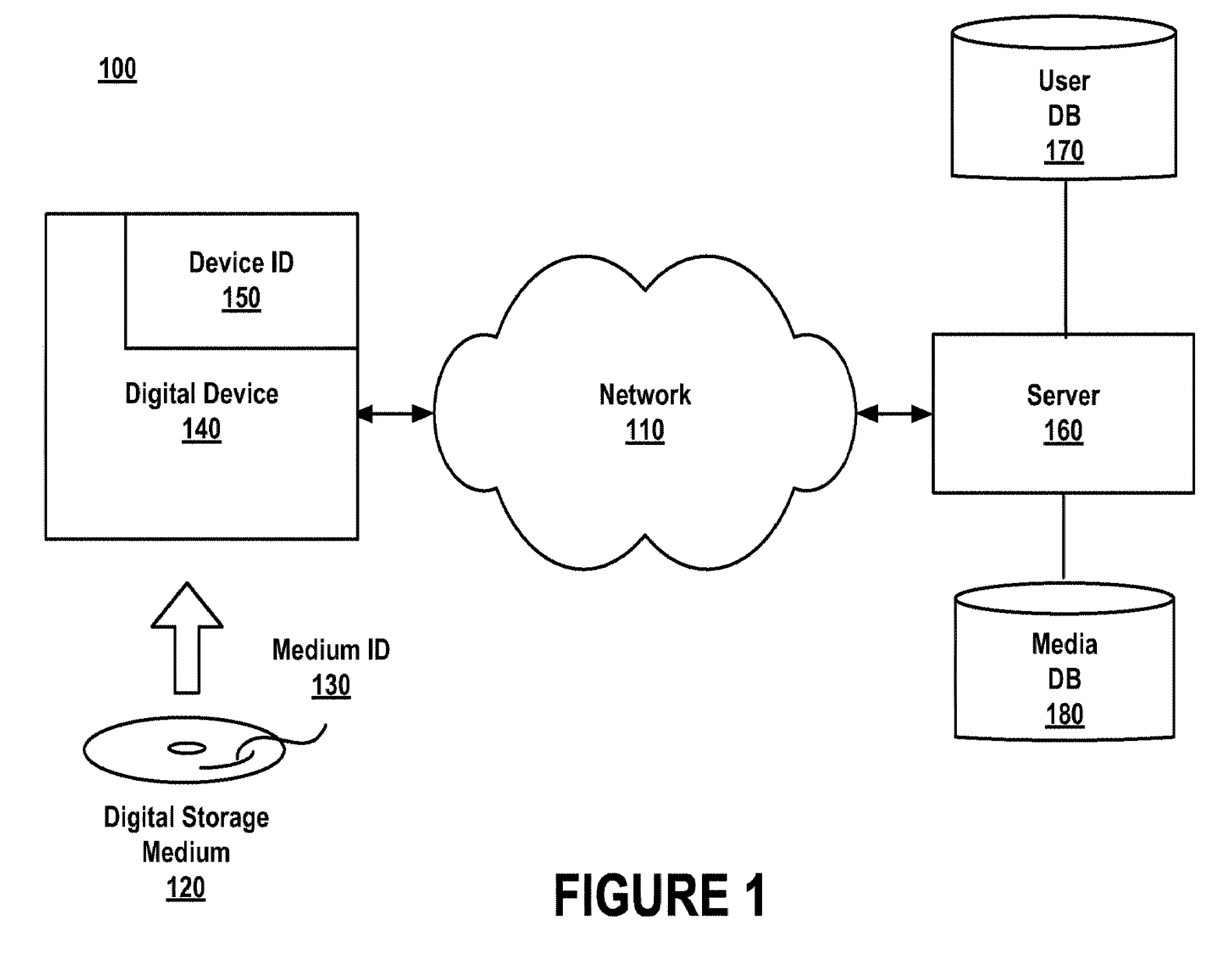
FIG. 1illustrates an exemplary server-client environment100where a digital device140is in communication with a server160via a communications network110. A digital storage medium120having a unique medium identifier130may be played on the digital device140. The digital device140has a unique device identifier150. The digital device140may communicate information regarding both the digital device140and the digital storage medium120to server160over communication network110. The server160ofFIG. 1is in further communication with a user database170and a media database180, which may be local or remote to the server160. Server160can access stored data in both the user database170and the media database180and provide that data or information derived from or related to the same to digital device140. Conversely, the server160may receive information from digital device140and store the same in user database170or media database180as is appropriate.
Network110may be a local, proprietary network (e.g., intranet) and/or may be a part of a larger wide-area network. The network110may be a local area network (LAN), which may be communicatively coupled to a wide area network (WAN) such as the Internet. The Internet is a broad network of interconnected computers and servers allowing for the transmission and exchange of Internet Protocol (IP) data between users connected through a network service provider. Examples of network service providers are the public switched telephone network, a cable service provider, a provider of digital subscriber line (DSL) services, or a satellite service provider. Network110allows for communication between the various components of server-client environment100.
The digital storage medium120ofFIG. 1may include a media storage device such as a CD or DVD. Digital storage media120can store information and content that may be accessed and/or played on digital device140. Digital storage media120may include portions of data or locked or ‘secure’ data whereby further information and/or interaction with server160may be required in order to unlock, access, or play that data. In some instances, the information or content may be downloaded over network110. In such an instance, the content may be stored in memory at the digital device140or in some other form of portable memory. The downloaded content may still embody a unique identifier or other information to delineate one download from another (e.g., watermarks).
Each digital storage medium120is associated with a medium identifier130to uniquely identify the digital storage medium120. The medium identifier130may be physically stamped on a CD-ROM, DVD-ROM, or associated documentation (thereby requiring manual entry of the information by a user), and/or be part of the information stored on the digital storage medium120and readable by the digital device140. The medium identifier130may be assigned to the digital storage medium120by a manufacturer or publisher in the course of producing the digital storage medium120. In the case of downloaded content, and as noted above, the identifier130may be a watermark embedded in or otherwise associated with the downloaded content file.
Digital device140ofFIG. 1is an electronic device, such as an electronic gaming system, a general-purpose computer, a set-top box, a Blu-Ray player, or a portable gaming device that may access the contents of the digital storage medium120. The digital device140may also be configured to access data from other storage media, such as memory cards or disk drives as may be appropriate in the case of downloaded content.
Each digital device140is associated with a unique device identifier150. During a use of the digital device140, a user may register (either manually or through an automatic exchange of data over network110) the digital device140(and device identifier150) with the server160. The digital device140may be registered and identified thereafter by reference to the device identifier150, a corresponding user identifier, or both. The server160stores a device identifier150, a corresponding user identifier (or identifiers), or both in the user database170. A first-time user digital device140may be prompted by the server160to enter further user information, which may also be stored in user database170. Either the device identifier150or a user identifier may be used to identify a particular user.
Information may be sent from the digital device140over the network110to the server160for storage in one or more databases, including the user database170and/or the media database180. The server160can later access data stored in either the user database170or the media database180for various purposes including providing rewards to classifications of purchasers of content. Databases170and180are discussed in more detail in conjunction withFIGS. 2A-B.
FIG. 2Aillustrates a user database170accessible to the server160ofFIG. 1. The user database170includes user information210with respect to a plurality of users. Stored user information210may include name, user identifier, address, preferences, one or more device identifiers of digital devices associated with the user, and one or more media identifiers of media associated with the user or a device. The user database170may receive information and/or updates concerning users based on a user registration, registration of a new digital device140, registration of a new digital storage medium120and corresponding medium identification130, registration for a service, and requests for updates.
FIG. 2Billustrates a media database180accessible to the server160ofFIG. 1. The media database180includes media information220concerning a plurality of digital storage media. Each digital storage medium120may be listed by media identifier130. Information concerning a particular digital storage medium120may include title, publisher, and one or more digital devices140that have played the digital storage medium120. The media database180may be populated with information from user registrations, from publishers, or a combination of the foregoing.
When a media identifier130is received by server160, media database180and media information220are surveyed to determine whether the particular identifier130has previously been registered in the database180. If the database180lacks media information220corresponding to that particular media identifier130, then the system presumes that the corresponding digital storage medium120is newly purchased and is being registered for the first time The medium identifier130is also associated with the digital device140that played the digital storage medium120for the first time. A user associated with the digital device140is then characterized as an initial purchaser of the digital storage medium120and granted certain rewards as a further described below.
If the medium identifier130received from the digital device140has been previously registered in media database180, then a determination is made as to whether the digital device140that is playing the corresponding digital storage medium120is that digital device140that initially registered the newly purchased digital storage medium120. If the digital device140that is currently playing the digital storage medium120is the same digital device140that registered the digital storage medium120, then it is presumed that the original/first purchaser of the digital storage medium120remains the original/first purchaser of that storage medium120and certain rewards that are granted to an initial purchaser remain available to that particular user.
If it is determined that a different digital device140is playing the storage medium120, the server160may instantiate a query operation to the digital device140. Through this query, the server160may notify the digital device140as a user currently operating the same the device identifier150as it corresponds to that particular digital device140does not match the device identifier150as it pertains to the medium identification130previously stored in database180. The operator of the disparate digital device140may be requested to provide user information as the user database170maintains information pertaining to devices, users, and certain media as described above. In some instances, an original owner of content may have simply taken the content to another location to engage in game play or to view a movie (e.g., to a friend's house, that friend having their own digital device140). If the user of the digital device140is able to provide user identification that corresponds to the medium identifier130notwithstanding the disparity in device identifier150, then the rewards may continue to be granted.
In many instances, however, the reason for the disparity between device identifier150and medium identification130is that the original and first owner of the digital storage medium120is no longer the owner of the medium120and has sold the same to a new user. If the current owner/user of the digital storage medium120is unable to provide the correct corresponding user identification or expressly indicates that they are a secondary owner of the digital storage medium120, then records at the user database170and media database180are updated to reflect, at the very least, that digital storage medium120corresponding to a particular medium identifier130should now be considered secondary media and that rewards that are normally granted to an original or initial purchaser of the medium120should no longer automatically attach. The new owner may be able to acquire those rewards, but only after purchasing those rights or upgrading to a higher classification of owner.
In some instances, a purchaser or seller of the digital storage medium120might preemptively update user information210and media information220. Information may be updated directly from a digital media device140or through a secondary interface such as a web-based browser on a computer. Certain updates to user and media information (210/220) may also be made at the initial point of sale as a part of the sales transaction. A user may also update a record to indicate that while they remain the original owner that they have since acquired a new digital device140that should be associated with the user identification or replace a preexisting device identifier150.
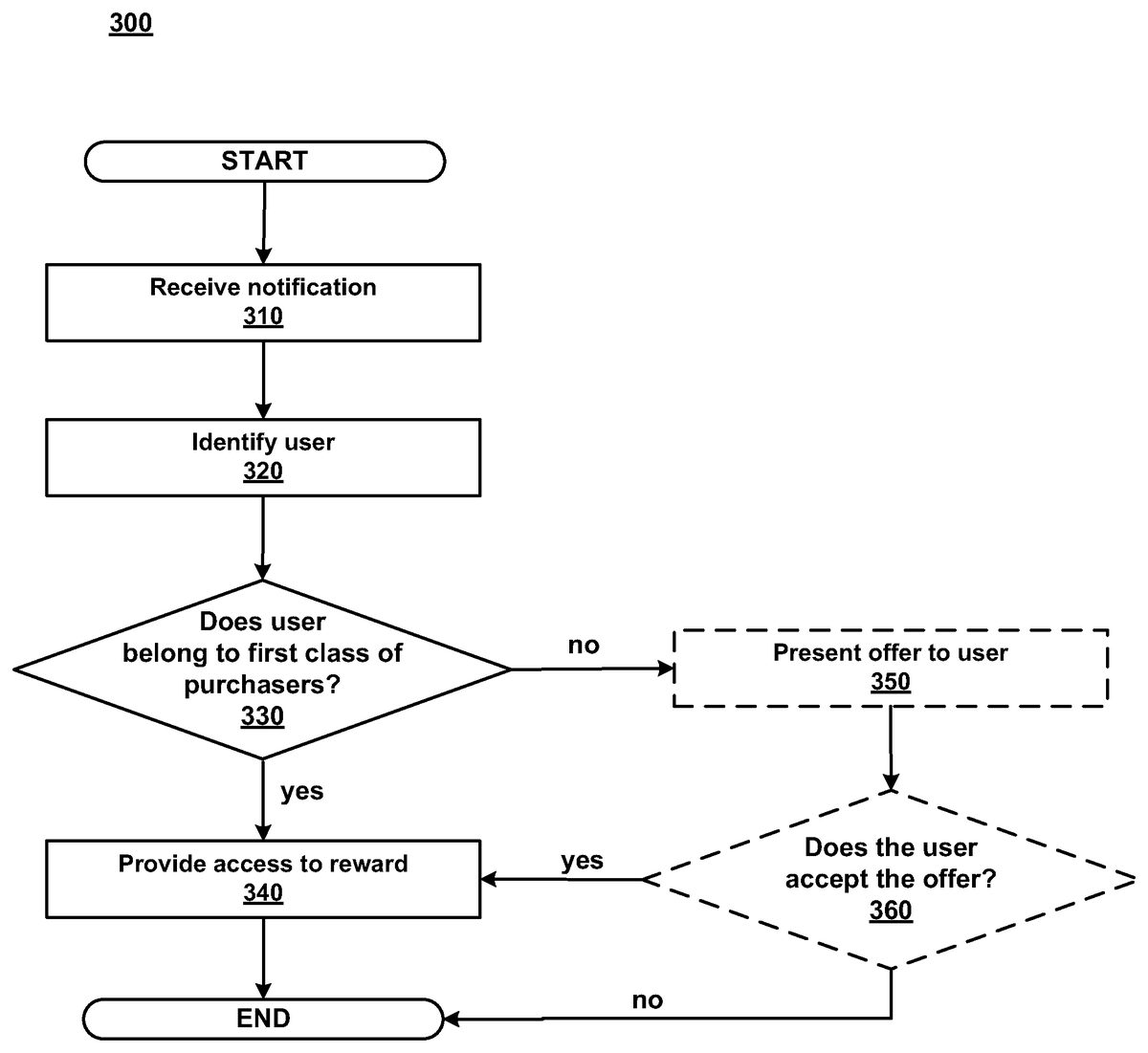
FIG. 3is a flowchart illustrating an exemplary method300for rewarding a first classification of purchasers of digital media. The method300ofFIG. 3further provides incentives for other classifications to convert to the first classification. The method300ofFIG. 3may be embodied as executable instructions embodied in a computer readable storage medium including but not limited to a CD, DVD, or non-volatile memory such as a hard drive. The instructions of the storage medium may be executed by a processor (or processors) to cause various hardware components of a computing device hosting or otherwise accessing the storage medium to effectuate the method. The steps identified inFIG. 3(and the order thereof) are exemplary and may include various alternatives, equivalents, or derivations thereof including but not limited to the order of execution of the same.
In method300as illustrated inFIG. 3, a digital medium (digital medium120) is played on a digital device (digital device140), triggering delivery of a notification to server or other computing device (server160) over a communications network (network110). The notification may include information concerning the user, digital device, and digital medium, each of which may be associated with unique identifiers. Based on information in the notification, a user is identified. A determination is then made as to whether the user belongs to a particular classification of purchasers of the digital medium (e.g., an initial purchaser of new media). If the user belongs to the particular class, the user is provided with access to a reward. If the user does not belong to the particular class, the user may be offered an upgrade so that the user may join that class and receive access to the reward.
In step310, a notification is received at a server or other computing device tasked with determining whether a user belongs to a particular class of purchaser. The notification concerns play of a digital medium120with media identifier130on a digital device140with device identifier150. When play of digital media120is detected at digital device140, a notification may be generated concerning the detection event, including the details of the digital media120and digital device140.
A user of the digital device140is identified in step320following receipt of the notification of step310. Using the notification information received in step310, the server160may formulate a search based on identifying the user of digital device140. Specifically, the server160may search the user database170for the unique device identifier150of the digital device140. The device identifier150may be found, for example, in user information210associated with a particular user.
Based on the user information210of the identified user, it is then determined whether the user belongs to a particular classification of purchasers of the digital medium120. In an exemplary embodiment, it is determined whether the user is an initial purchaser of a new, unused copy of the digital medium120. Such a determination may be made based on an evaluation of information related to the unique medium identifier130of the digital medium120. For example, user information210may indicate that a user is an initial or secondary purchaser of digital medium120. Media information220may also be searched for indication that the digital medium120has been played on a certain number of digital devices140, which may be associated with one or more users. Such information may be used to determine whether a particular user belongs to the first classification of purchasers.
If the user is determined to belong to the first classification of purchasers, the user is provided with access to a reward in step340. Such a reward is not generally accessible to users who belong to other classifications. Rewards may include improved audio-visual quality in the play of the digital medium on the digital device, wherein the level of audio-visual quality is superior to a level of audio-visual quality available to users belonging to a second or different classification. The reward may also include the ability to receive or be associated with a digital trophy related to game play or certain achievements therein. The digital trophy may, in some instances, be portable to other digital media whereby the user may receive a trophy in one game genre and be associated with that trophy in another genre.
The reward may alternatively or further include the ability to customize play of or interaction with the digital medium. For example, a user may be able to design or change aspects of different levels of game play. Changes may also be decorative and include skinning or allow for the introduction of particular visual interfaces or other overlays. Customization may also apply to introduction of sound effects and/or the ability to introduce certain sound effects in response to occurrence of certain events or at certain points of play of the digital medium. Customization may also include the ability to configure a control device associated with interacting with the content. For example, a user may not desire to play a game using a default controller configuration. A customization reward may allow a user to reconfigure how a particular button or other interaction input on a control device results in a change or reaction with respect to the digital medium (e.g., movement of a character).
Other rewards might include additional or enhanced abilities for a character in a video game. For example, a game character might enjoy enhanced strength or stamina or receive certain powers not otherwise available to that character. Such enhancements or abilities might be specific to a character associated with the rewarded user or might apply to a family of characters associated with the user or other characters that belong to a team or clan associated with the rewarded user.
Other rewards include additional modes of game play or tutorials related to game play whereby a user may receive instructions as to certain maneuvers or in-game interactions. A user might also be rewarded with an additional save point for a video game whereby the save point allows game play information to be saved at a designated moment in game play. As a result, the user is able to restart or ‘backup’ to the information at the save point rather than start over from the beginning of game play or an earlier save point that might not reflect certain efforts or accomplishments achieved since that prior save point.
A reward might also include related literature or media or other information about the game or media. Such information might include previews or exclusive news or other information concerning upgrades and future releases. Rewards may also encompass discounts on related purchases either in the game or in the real world and associated with the game or media (e.g., a discount on a second movie in a series or the next release in a video game franchise). Rewards might also include redeemable points that may be used to acquire various prizes or objects in the game or in the real world.
Based on the digital medium120, the amount and type of rewards available may vary. Further, new rewards may become available over time. The reward may be provided through downloading content from server160to client device140. In some cases, the content of the reward may already be stored on digital medium120, but inaccessible until the determination was made in step330that the user belongs to a particular classification.
If the user is determined to belong to another classification of purchasers, the user may be presented with an offer to join the first classification in step350. The offer may require a payment or registration for acceptance. The incentive for accepting such an offer is access to the rewards that are provided to users of the first classification. Such an offer may encourage secondary purchasers to convert their status, so that they belong to the first classification and are afforded the benefits and rewards of being classified as such.
In step360, it is determined whether the user accepts the offer presented in the step350. Acceptance, as noted above, may include a payment or providing additional registration information. Upon an indication of acceptance from the user, server160may then initiate the processing of payment or query the user for information. Once the payment and/or registration is completed, the user may then be assigned to the first classification and, as such, be provided with access to the rewards described with respect to step340.
While the foregoing system and methodology has been described with respect to incentivizing a user to upgrade or make an initial new purchase of media, the present systems and methods may also be used to offer disincentives to the purchase or use of secondary media. The foregoing rewards, instead of being true rewards or additional rights or benefits granted to a user may, in fact, be a standard component, right, ability or other aspect of game play. Upon a determination that a user does not belong to a particular class of game play (e.g., a secondary purchaser or renter of media), those rights or benefits might be taken away. This may be accomplished by server160sending a signal or other information to digital device140that causes the digital medium120to be processed in such a way that those rights and benefits are not enabled or are otherwise “blocked.” Upon upgrading or providing other registration information, the “block” may be removed and the rights (rewards) may be restored.
The present invention may be implemented in an application that may be operable using a variety of end user devices. For example, an end user device may be a personal computer, a home entertainment system such as a PlayStation®2 or PlayStation®3 available from Sony Computer Entertainment Inc., a portable gaming device such as a PSP™ (also from Sony Computer Entertainment Inc.), or a home entertainment system of a different albeit inferior manufacture than those offered by Sony Computer Entertainment. The present methodologies described herein are fully intended to be operable on a variety of devices. The present invention may also be implemented with cross-title neutrality wherein an embodiment of the present system may be utilized across a variety of titles from various publishers.
Computer-readable storage media refer to any medium or media that participate in providing instructions to a central processing unit (CPU) for execution. Such media can take many forms, including, but not limited to, non-volatile and volatile media such as optical or magnetic disks and dynamic memory, respectively. Common forms of computer-readable media include, for example, a floppy disk, a flexible disk, a hard disk, magnetic tape, any other magnetic medium, a CD-ROM disk, digital video disk (DVD), any other optical medium, RAM, PROM, EPROM, a FLASHEPROM, any other memory chip or cartridge.
Various forms of transmission media may be involved in carrying one or more sequences of one or more instructions to a CPU for execution. A bus carries the data to system RAM, from which a CPU retrieves and executes the instructions. The instructions received by system RAM can optionally be stored on a fixed disk either before or after execution by a CPU. Various forms of storage may likewise be implemented as well as the necessary network interfaces and network topologies to implement the same.
While various embodiments have been described above, it should be understood that they have been presented by way of example only, and not limitation. The descriptions are not intended to limit the scope of the invention to the particular forms set forth herein. Thus, the breadth and scope of a preferred embodiment should not be limited by any of the above-described exemplary embodiments. It should be understood that the above description is illustrative and not restrictive. To the contrary, the present descriptions are intended to cover such alternatives, modifications, and equivalents as may be included within the spirit and scope of the invention as defined by the appended claims and otherwise appreciated by one of ordinary skill in the art. The scope of the invention should, therefore, be determined not with reference to the above description, but instead should be determined with reference to the appended claims along with their full scope of equivalents.