U.S. Pat. No. 10,279,252
GAME EXECUTION ENVIRONMENTS
AssigneeSony Interactive Entertainment America LLC
Issue DateDecember 12, 2017
U.S. Patent no. 10,279,252: Game execution environments
Issued May 7, 2019 to Sony Interactive Entertainment America LLC
Priority Date May 17, 2010
Summary:
U.S. Patent No. 10,279,252 (the ‘252 Patent) relates to executing multiple video game environments on one device. The ‘252 Patent proceeds by allowing each game environment which includes a different video game played by different geographically distributed players to be played on the same operating system within a virtual shell. This will allow those to access video games using more conventional services over the Internet even if they don’t physically possess the computing device normally necessary to execute the video game environment. This is a major advancement in allowing players to move beyond the limitations of physical consoles. The ‘252 Patent also allows a game delivery system to distribute games to players from data centers which can stream the game video directly to a player’s device.
Abstract:
Systems and methods for executing multiple video games, or other sources of video, include a cloud game execution environment in which each game application is executed on the same operating system but within a virtual I/O shell. The virtual I/O shell includes virtual video, audio and input channels that allow each game application to operate as if it had dedicated drivers. In some embodiments, the systems and methods of the invention are used to provide video streams to a plurality of clients over the internet.
Illustrative Claim:
1. A video game system, comprising, a gaming computer, the gaming computer including, a processor; a graphics processing unit (GPU); and memory for storing video frames generated for an executable application, the video frames being compressed for video game streaming to one or more other computers, wherein the executable application is associated with virtual I/O shells that provide for video, audio and input channels for said one or more other computers to control interactivity of operation of the executable application during said video game streaming; wherein said video, audio and input channels implement separate virtual channel drivers to simulate I/O processing at the gaming computer.
Illustrative Figure
Abstract
Systems and methods for executing multiple video games, or other sources of video, include a cloud game execution environment in which each game application is executed on the same operating system but within a virtual I/O shell. The virtual I/O shell includes virtual video, audio and input channels that allow each game application to operate as if it had dedicated drivers. In some embodiments, the systems and methods of the invention are used to provide video streams to a plurality of clients over the internet.
Description
DETAILED DESCRIPTION FIG. 1illustrates an Application Execution Environment100, e.g., a game system, according to various embodiments of the invention. Application Execution Environment100is configured to execute a plurality of Executable Applications105on a single Hardware Device110. Each of the Executable Applications105is executed in association with its own virtual I/O shell. The virtual I/O shell typically includes a virtual Input Channel Driver115, a virtual Sound Channel Driver120, a virtual Video Channel Driver130and/or a virtual Control Channel Driver125. Each Executable Application105also is associated with a Local Manager160. In various embodiments the Executable Applications105include a plurality of different video games and/or separate instances of the same video game. The I/O shell is configured to provide virtualization at the I/O (input/output) level. Thus, only one instance of an Operating System135is required to support two, three or more Executable Applications105. The virtualization occurs above the operating system level. The virtual I/O shell does not prevent the Executable Applications105from each accessing a Central Processing Unit145, and/or system Memory150. However, the virtual I/O shell typically does prevent the Executable Applications105from directly accessing some physical I/O devices, such as ports, within Hardware Device110. For example, the virtual I/O shell is configured to allow each of the Executable Applications105to share the Graphics Processing Unit140via Video Channel Driver130. The Graphics Processing Unit140is a 3D rendering engine that can be shared by a plurality of the Executable Applications105. In typically embodiments, Graphics Processing Unit140includes a dedicated graphics microprocessor. The virtual I/O shell optionally includes a Windows emulator. Local Manager160is configured to establish a virtual I/O shell around each Executable Application105. The virtual I/O shell is configured to appear as local hardware and/or software devices to each of the Executable Applications105. The virtual I/O shell is optionally configured to provide a separate input, audio and video channels (and optionally a control channel) for each ...
DETAILED DESCRIPTION
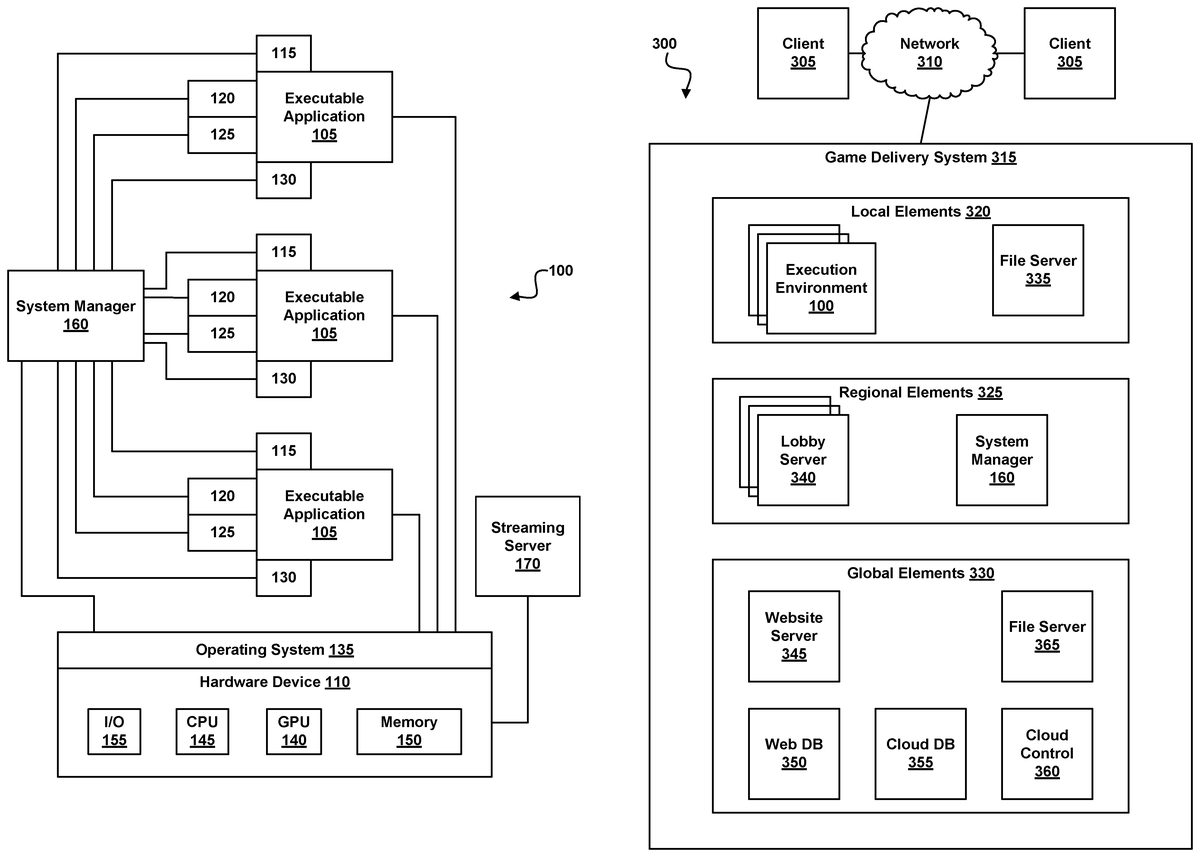
FIG. 1illustrates an Application Execution Environment100, e.g., a game system, according to various embodiments of the invention. Application Execution Environment100is configured to execute a plurality of Executable Applications105on a single Hardware Device110. Each of the Executable Applications105is executed in association with its own virtual I/O shell. The virtual I/O shell typically includes a virtual Input Channel Driver115, a virtual Sound Channel Driver120, a virtual Video Channel Driver130and/or a virtual Control Channel Driver125. Each Executable Application105also is associated with a Local Manager160. In various embodiments the Executable Applications105include a plurality of different video games and/or separate instances of the same video game.
The I/O shell is configured to provide virtualization at the I/O (input/output) level. Thus, only one instance of an Operating System135is required to support two, three or more Executable Applications105. The virtualization occurs above the operating system level. The virtual I/O shell does not prevent the Executable Applications105from each accessing a Central Processing Unit145, and/or system Memory150. However, the virtual I/O shell typically does prevent the Executable Applications105from directly accessing some physical I/O devices, such as ports, within Hardware Device110. For example, the virtual I/O shell is configured to allow each of the Executable Applications105to share the Graphics Processing Unit140via Video Channel Driver130. The Graphics Processing Unit140is a 3D rendering engine that can be shared by a plurality of the Executable Applications105. In typically embodiments, Graphics Processing Unit140includes a dedicated graphics microprocessor. The virtual I/O shell optionally includes a Windows emulator.
Local Manager160is configured to establish a virtual I/O shell around each Executable Application105. The virtual I/O shell is configured to appear as local hardware and/or software devices to each of the Executable Applications105. The virtual I/O shell is optionally configured to provide a separate input, audio and video channels (and optionally a control channel) for each of the Executable Applications105. These channels are managed by Local Manager160, which redirect, optionally bidirectional, signals through these channels. Local Manager160is configured to redirect these signals to a Streaming Server170and/or to locations outside Application Execution Environment100. Operating System135is configured to support execution of the Executable Applications105, Local Manager160and the virtual I/O shell. Operating System135may be, for example, Windows, Linux, UNIX or Apple OS based. Operating System135is optionally configured to execute computing instructions compiled for a game console such as PlayStation, or Xbox or Nintendo.
One Local Manager160is optionally associated with more than one Application Execution Environment100in the same location. In various embodiments, Local Manager160is further configured for game ranking, optimizing the use of game servers for particular players, moving game play between Executable Applications105, cashing of games, storing game states, controlling access (e.g., password access) to games, balancing game server load, and/or the like. Local Manager160is optionally configured to access a library of Executable Applications105and to provision an Executable Application105from this library to Application Execution Environment100. The library of Executable Applications105is optionally disposed at a distant data center. Parts of Local Manager160may be distributed among several computing devices. These computing devices may be geographically distributed and may communicate with each other over the internet. In some embodiments an instance of Local Manager160is configured to manage several instance of Application Execution Environment100.
Input Channel Driver115is configured to provide input to the Executable Applications105through a virtually separate input channel. The virtual Input Channel Driver115has a separate API (Application Program Interface) to each of the Executable Applications105. This API is included in the virtual I/O shell and is typically configured to simulate one or more local hardware or software input devices. For example, Input Channel Driver115may simulate a Linux or Windows I/O driver and port. The Input Channel Driver115also has an API configured to receive the input from the Local Manager160. The Local Manager160typically receives this input from an external client, e.g., a game player's computing device, over a communication network. The APIs of Input Channel Driver115are configured such that each of Executable Applications105can operate as if they have their own dedicated input channel.
The virtual Sound Channel Driver120is configured to redirect sound data received from the Executable Applications105to the Local Manager160and optionally to provide sound from the Local Manager160to the Executable Applications105, the virtual Sound Channel Driver120has an API to each Executable Application105that is included in the virtual I/O shell and is typically configured to simulate one or more local hardware or software sound devices. For example, the API may simulate a Linux or Windows® sound driver and audio hardware. The several Sound Channel Driver120illustrated inFIG. 1are optionally a part of a sound server configured to receive sound from a plurality of Executable Applications105and to redirect the received sound to a plurality of output channels, e.g., a plurality of remote clients. This redirection is optionally first to a Windows® API such as “Wine” or memory that can be accessed by Local Manager160. In various embodiments, Sound Channel Driver120and the sound server are configured to redirect sound with less than 5, 10, 15, 20, 30 or 50 milliseconds delay. In various embodiments, Sound Channel Driver120and the sound server are configured to redirect sound while buffering the redirected sound less than 1, 2, 3, 4, 6 or 8 times.
The virtual Video Channel Driver130is configured to redirect video data received from the Executable Applications105and optionally to provide video data from the Local Manager160to the Executable Applications105. The video data received from the Executable Applications105may be game video generated by the Executable Applications105or game video generated elsewhere and processed by the Executable Applications105. Instances where video may be provided to the Executable Applications105include embodiments wherein the Executable Applications105make use of overlays or real-time video generated externally. The Video Channel Driver130each includes an API to one of Executable Applications105. The API is included in the virtual I/O shell and is typically configured to simulate one or more local hardware or software video device. As such, each of Executable Applications105can operate as if they have their own dedicated video driver and/or exclusive use of graphics hardware. Video Channel Driver130optionally includes the Virtual GL video emulator available for the Linux operating system. Virtual GL allows redirection of video calls that would normally go to a video card, and redirects these calls to software accessible memory, e.g., memory accessible to Local Manager160or to a non-virtual video driver having control of Graphics Processing Unit140. In some embodiments, each Video Channel Driver130receives video data (e.g., a game environment) from an assigned Executable Application105and passes this video data to a driver controlling Graphics Processing Unit140. Graphics Processing Unit140is, thus, shared by more than one Executable Application105while each Executable Application105can execute as if it has exclusive use of a video driver and Graphics Processing Unit140. As used herein the term “game environment” refers to a three dimensional virtual environment including in game objects, object properties, avatars, locations of objects, their shapes, textures, and spatial relationships there between, and/or the like.
The several Video Channel Driver130is optionally part of a video server configured to receive video from multiple sources and redirect the received video to multiple destinations. This redirection can include a variety of combinations. For example, some video may be received from one source and sent to one destination, some video may be received from more than one source (combined or overlaid) and sent to one destination, some video may be received from one source and sent to multiple destinations, etc.
The Application Execution Environment100illustrated inFIG. 1optionally further comprises a control channel configured for communicating application control commands to the executable application through the Local Manager160. These control command may include, for example, a pause button control, a change game control, a graphics command in response to a cursor over, game crash recovery, and/or the like.
Application Execution Environment100further comprises Memory150configured to store the Local Manager160, the virtual Input Channel Driver115, the virtual Sound Channel Driver120and/or the virtual Video Channel Driver130. Memory150may also be shared by the various Executable Applications105during execution. Memory150comprises random access memory (RAM), optical memory, flash memory, magnetic memory, and/or other memory configured to store computing instructions and/or data.
Application Execution Environment100further comprises Central Processing Unit145configured to execute the Local Manager160, the virtual input channel driver, the virtual sound channel driver and/or the virtual video channel driver. Central Processing Unit145is an electronic or optical processor configured to execute computing instructions. Application Execution Environment100may be divided among several hardware devices.
In some embodiments Application Execution Environment100is configured to execute the Executable Applications105in a Microsoft Windows emulator and/or the operating system is a non-windows operating system. For example, Executable Applications105may be executed within the “Wine” windows API for Linux.
In various embodiments of the invention the Application Execution Environment100illustrated inFIG. 1is a game delivery system. The game delivery system includes plurality of virtual I/O shells. Each of the virtual I/O shells is configured to receive and redirect at least sound and video from a separate video game application, e.g., form a separate Executable Application105. In these embodiments Local Manager160is configured to execute the separate video game applications on a shared operating system, each of the separate video game applications being in one of the virtual I/O shells and accessing the shared operating system for non-I/O operations.
These embodiments also typically include Streaming Server170. Streaming Server170is configured to stream video and audio from the separate video game applications. The video and audio from each of the video game applications is typically streamed to a different client or clients. In some embodiments, Streaming Server170includes a video encoding system such as that taught in U.S. provisional patent application No. 61/183,037. The Streaming Server170is optionally configured to encode to a High Profile (or better) H.264 codec lacking B-frames. The separate video game applications may be configured to serve different instance of the same video game and/or configured to serve different video games.
Streaming Server170is optionally configured to switch between video codecs mid-stream while streaming video received from Executable Applications105. The decision to change video codec may be based on the size of the video, the quality (e.g., color depth) of the video and/or the frame rate (or frame drop rate), and the lag time required to generate and encode the video. In some embodiments, these parameters are used to calculate a quality factor. The calculation of the quality factor can be dependent on the specific game. For example, video quality may be given a greater weight in a game such at World of Warcraft or Eve that is very dependent on dramatic colors, relative to a game such as MarioKart wherein a minimal lag time may be more important. A change between video codecs can occur when the quality factor falls below a required level. The change may, therefore, be responsive to a lag between the streaming server and one of the different player's clients. In some embodiments, the Streaming Server170is configured to switch to a lower quality codec in order to reduce lag between the streaming server and one of the different clients, when the lag or the quality factor reaches a threshold value. Streaming Server170is optionally configured to deliver video of different codecs to different destinations, e.g., different IP addresses. Streaming Server170may share hardware, such as Central Processing Unit145and/or Graphics Processor Unit140, with Hardware Device110.
In some embodiments, Local Manager160is configured to simulate a virtual console. This simulation allows (game) players at different locations to play a game as if they were at the same location playing on a game console. For example, some video games are designed to receive multiple players' inputs at a single console. Local Manager160may be configured to combine inputs from different clients, e.g., from different IP addresses. More than one player client can, thus, provide input and receive video from a single Executable Application105. In combining these inputs, keystrokes made at the different clients are mapped to inputs of a virtual game console. The virtual game console is emulated by Executable Application105. From the point of view of the video game application the inputs are being received at a game console, e.g., from a single keyboard or from a set of game controllers. Executable Application105is optionally configured to map inputs from different clients to a single virtual keyboard. For example, two game players using different clients may wish to use a space bar to enter a “jump” command. In this case Executable Application105is configured to may these inputs to different keys of a virtual keyboard.
In some embodiments, the video game applications are themselves clients of server based video games. For example, the video game applications can be clients of massive online multiplayer games such as Eve or World of Warcraft. These games are, in part, executed remotely by a third party. Executable Applications105can communicate with these third parties just as any other client would.
In some embodiments Streaming Server170is configured to deliver video from Executable Applications105to multiple destinations that include, for example, two or more different web pages. One of these two web pages can by the web page through which a player interacts with Application Execution Environment100and plays a game. A second of these web pages can be a blog, social networking site, a guild website, advertisement, or the like. The presentation of the video at the second web page optionally includes a link configured to allow a user to play the game, join another player in the game, or interact with another player in the game. For example, a player may have a blog to which a copy of his game is delivered, from his point of view. Third parties can observer the player's viewpoint of the game on the player's blog. If the third party wishes to join the player in the game the third party can click the link. In response to this click the third party may be given a trial introduction to the game, be added to a game room with the player, communication with the player in the game, and/or the like. In some embodiments, one of the multiple destinations to which video are delivered includes a storage location configured for storing the game video. The storage location can be a website, a blog, a file server, a web server, a social networking site, and/or the like. Copies of video provided by Streaming Server170optionally have different qualities and may be sent to multiple destinations. Streaming Server170is optionally configured to access and stream previously stored game video.
Streaming Server170is optionally configured to combine video with other video or still images. For example Streaming Server170may be configured to add a logo to video before streaming, or add the output of a webcam to video before streaming. In some embodiments, Streaming Server170is configured to overlay a game interface over video generated using Graphics Processing Unit140. For example, if the client to which the game video is to be delivered has a touch screen interface and the computer game was designed to be played using a keyboard or game controller, then an overlay may be configured to provide user game control inputs appropriate for a touch screen interface.
In some embodiments, Local Manager160is configured to automatically spawn an additional video game application within a virtual I/O shell responsive to a request to play the video game application. Such requests can come from several sources including, for example, from Streaming Server170, from a player in a game room, from a solo player, or from a link included in a third party website, and/or the like. A game room is a virtual space in which players can gather and request and play games as a group. For example, a game normally played on a four player game console may be requested by four players gathered in a game room. Presence in the room determines which players are playing at the virtual console. Players in a game room may join and leave games as a group. A game room is optionally associated with the account of a particular player who has the privileges required to invite or remove other players.
Requests for an new spawn that come from Streaming Server170or Local Manager160may be the result of a determination that a game being played on first instance of Application Execution Environment100would be better played on a second instance of Application Execution Environment100. For example, lag may be reduced by playing the game at an instance of Application Execution Environment100with a faster connection to a player's client. The faster connection may be due to being closer geographically or by having communication channels with greater available capacity. In these cases the new spawn may be a (seamless) continuation of a currently running game. A player may be in the middle of playing a game and Local Manager160may determine that a second Application Execution Environment100at a different location would be able to provide a better quality of service. A new Executable Application105is spawned at the second Application Execution Environment100, the current Executable Application105is synchronized with the new Executable Application105and the game play is transferred essentially seamlessly. In various embodiments this transfer can be accomplished without interrupting game play. Synchronization optionally includes sending player input to both Executable Applications105until they reach the same game state. The transfer can then be accomplished by choosing to received video and audio from the new Application Execution Environment100rather than the original Application Execution Environment100.
A request that a new Executable Application105be spawned may come from a player in a game room when one or more players in a game room choose to start playing a new game or switch to a new game. For example, a group of players in a game room may select a game to play together and make a request for that game. This will typically result in the spawning of a new Executable Application105including game executable. The I/O shell around the new spawn will be configured to communicate audio and video to the clients of the players who are in the game room.
In some embodiments, a change in the identity of players within a game room will result in a new Executable Application105being spawned. For example, if the game room is occupied by three players, the selection of the best Application Execution Environment100may be in part of the geographic location of the three players. The three players may be geographically distributed. The geographic distribution includes both their physical locations and their distance adjusted for the available bandwidth between locations. If one of the three players leaves the room and/or another player enters the room, this may result in a different geographic distribution. If Regional Manager343determines that this different geographic distribution would be better served by an Application Execution Environment100at a different location, a new Executable Application105will be spawned at the different location and the game play will be transferred to the new Executable Application105as described elsewhere herein.
A solo player may request a video game to play or to change between video games. This request will typically result in the spawning of an Executable Application105. The Executable Application105is spawned at the best Application Execution Environment100for providing the game to the solo player. The selection of the best Application Execution Environment100may be dependent on the player's connection history and experience with connecting to different Application Execution Environment100. The quality of the player's experience is dependent on, for example, the size of the desired image, the quality of the desired image, a frame drop rate, and the lag between the player's client and the Application Execution Environment100. If a player's connection to an Application Execution Environment100changes during game play, the player may be automatically switched to a different Application Execution Environment100during the game.
A request for the spawning of a new Executable Application105may come from a link included in a third party website. The link is optionally encoded to identify the website and is typically associated with text, an image, or video. For example, a player may select to have a copy of their video streamed to a blog or a social networking website. Another person can click on this video to communication with the player, to going the player in the game, to try a free trial of the game, and/or to play the game independently of the player. Players in a game guild may select to have their video sent to a guild associated website. The video at the third party website can be approximately real-time or saved and displayed after a delay. Clicking the link typically results in the automatic spawning of a new Executable Application105.
Streaming Server170is optionally configured to communicate video using RTMP.
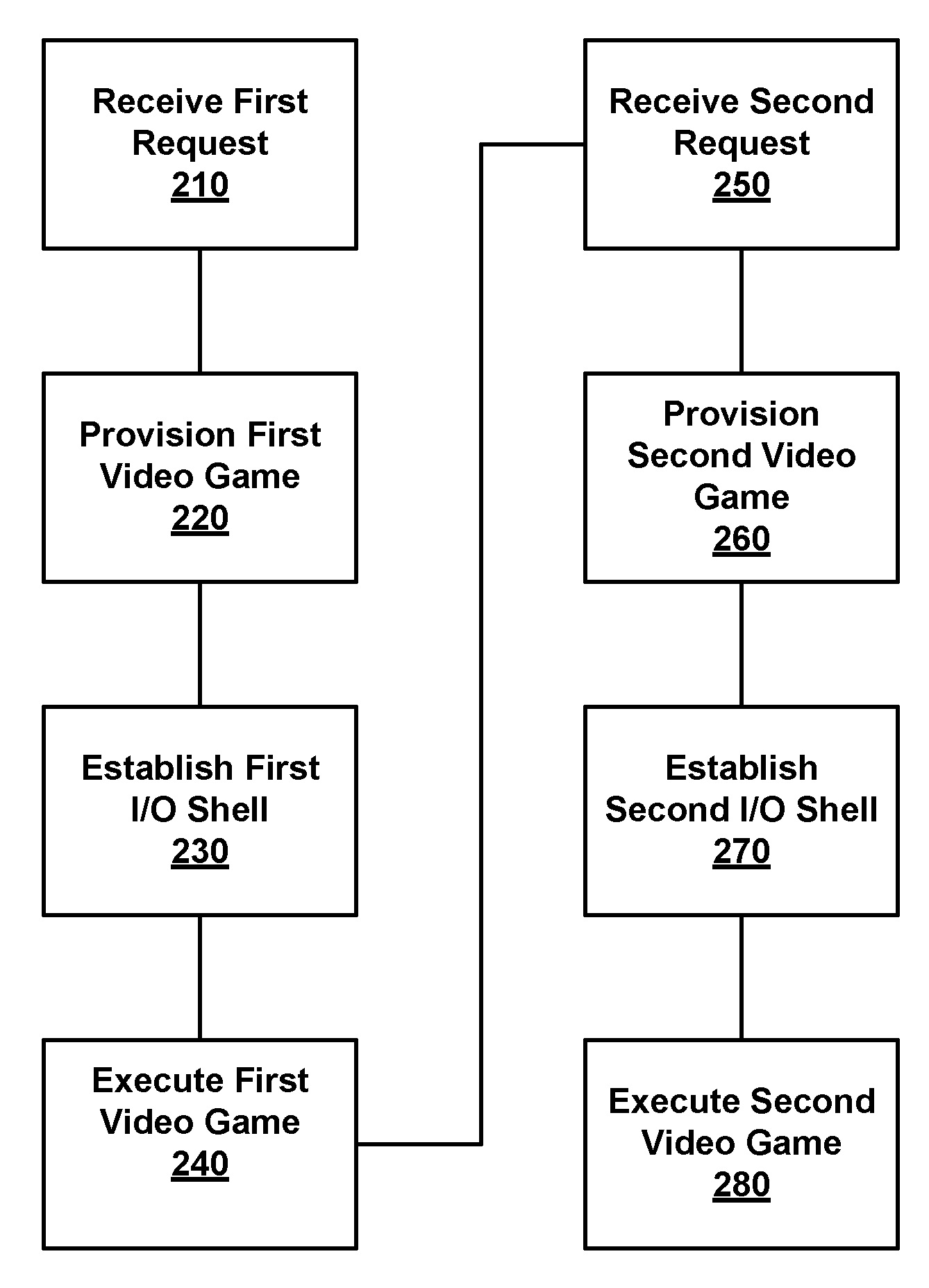
FIG. 2illustrates a method of executing a plurality of executable applications (e.g., video games) within virtualized I/O shells, according to various embodiments of the invention. These video games can be stand alone game of clients of video games supported by a remote server. In this method the video games are executed in a non-virtualized environment with respect to an operating system but in a virtual environment with respect to one or more I/O functions.
In a Receive First Request Step210a request for a first video game is received. This request can be received from a game player or a game playing device. The request can be the result of the game player clicking on a link. The request is receive by Local Manager160, which may select a specific Application Execution Environment100in which the game is to be executed. This selection may be based on, for example, the availability of resources within the Application Execution Environment100and/or on the quality of communication channels between the Application Execution Environment100and a client of the game player.
In a Provision First Video Game Step220the requested video game is provisioned on Hardware Device110. This provisioning may include transferring required files (e.g., computing instructions and data) from a remote location. The provisioned video game is loaded into Memory150. The provisioning is typically managed by Local Manager160.
In an Establish First I/O Shell Step230a first I/O shell is established around the video game provisioned in Provision First Video Game Step220. The first I/O shell is configured to redirect inputs, commands, video data or audio data received from or sent to the first video game. The first I/O shell may include any combination of virtual Input Channel Driver115, virtual Sound Channel Driver120, virtual Video Channel Driver130and virtual Control Channel Driver125. Establishing the first I/O shell includes linking the APIs of virtual Input Channel Driver115, virtual Sound Channel Driver120, virtual Video Channel Driver130and/or virtual Control Channel Driver125to the outputs and inputs of the video game provisioned in Provision First Video Game Step220. For example, because of this linking video data generated by Executable Application105will be sent to Video Channel Driver130rather than to a driver more directly associated with Graphics Processing Unit140.
In an Execute First Video Game Step240the video game provisioned in Provision First Video Game Step220is executed. This execution normally occurs on Operating System135. As part of the execution game commands may be received from a game playing device, a game state is updated and/or received from an external device, and a game environment is generated for rendering by Graphic Processing Unit140. Some or all of these processes occur through the first I/O shell. For example, a game environment generated by Executable Application105may be passed to Video Channel Driver130and then to Graphics Processing Unit140for rendering to a video stream.
In a Receive Second Request Step250a request for execution of a second video game is received. The second video game may be a different instance of the first video game or a different video game. As in Receive First Request Step210, this request can be received from a game player or a game playing device, etc. The request in Receive Second Request Step250is often from a different player than the request in Receive First Request Step210.
In a Provision Second Video Game Step260the second video game is provisioned on Hardware Device110. Both the first video game and the second video game are provisioned on the same computing device.
In an Establish Second I/O Shell Step270a second I/O shell is established around the second video game. The second I/O shell is configured to redirect commands, inputs, video data or audio data to or from the second video game. The second I/O shell can include any combination of virtual Input Channel Driver115, virtual Sound Channel Driver120, virtual Video Channel Driver130and virtual Control Channel Driver125. The second I/O shell provides communication (I/O) channels that are isolated from communication channels through the first I/O shell. The first or second I/O shell optionally includes a Windows emulator.
In an Execute Second Video Game Step280the second video game is executed. This execution is supported by the same Operating System135on which the first video game is executed. Operating System135is configured for execution of computing instructions on a hardware device. Unlike the I/O functions of the first and second I/O shells, the operating system is typically not virtualized or executed in a virtual environment. The first video game and the second video game are optionally executed in parallel.
FIG. 3illustrates a Game Delivery Architecture300, according to various embodiments of the invention. Game Delivery Architecture300comprises a one or more Clients305, a Network310, and a Game Delivery System315. Clients305are typically game playing devices, such as personal computers, game consoles, tablet computers, telephones, handheld game players, and/or the like. Clients305are used by game players to play a video game.
Network310includes a communication network such as the internet, a telephone network, a wide area network, a local area network, and/or the like. Network310is configured to allow communication between Clients305and Game Delivery System315, between elements within Game Delivery System315, and optionally between Clients305.
Game Delivery System315is a geographically distributed system of computing devices configured to provide computer game video to Clients305via Network310. Game Delivery System315is a hierarchical system comprising many Local Elements320, some Regional Elements325, and one Global Element330.
Local Elements320include computing devices configured to generate and send game video to Clients305. Local Elements320each include one or more instance of Application Execution Environment100and Streaming Server170. Local Elements320are geographically disposed to server game video to Clients305over a relatively short distance and with a minimum lag. For example, Local Elements320can include a data center configured to serve a specific city, or metropolitan region. Typically, the locations of Local Elements320are selected so as to most efficiently serve as many game players as possible. In some embodiments, each Local Element320includes two or more Hardware Device110each configured to support the execution of 2, 3, 4, 5, 6 or more Executable Applications105(computer games) within virtual I/O shells.
Local Elements320each optionally further include a File Server335. File Server335is configured for providing computing instructions and data to the one or more Application Execution Environment100within each of the Local Elements320. For example, File Server335may be used as a source of game instructions in Provision First Video Game Step220and Provision Second Video Game Step260. Likewise, File Server335may be used as a source of virtual components in Establish First I/O Shell Step230and Establish Second I/O Shell Step270.
Regional Elements325are configured to manage several instance of Local Elements320distributed over a larger region than any one of the Local Elements320is configured to server. For Example, an instance of Local Elements320may be configured to support a large geographical region such as the Western United States or Western Europe. An instance of Local Elements320is optionally configured to support Local Elements320over an entire continent.
Regional Elements325include one or more Lobby Servers340and optionally a Regional Manager343. Regional Manager343is may be included in one of Local Elements320or Global Elements330. Regional Manager343is an embodiment of Local Manager160configured to perform tasks that are not time critical and/or that involve multiple Application Execution Environments100. Lobby Servers340are configured to manage non-streaming or non-time sensitive functionality related to game delivery. These can include instant messaging style chat, connection status information, player login, coordination between Application Execution Environments100, and/or the like. Lobby Servers340are also configured to manage virtual game rooms configured for a group of game players to join or move between games as a group.
In those embodiments wherein Regional Manager343is included in one or more instances of Regional Elements325a game player may first contact Regional Manager343at the regional level and then be assigned to one of the Local Elements320and Local Managers160for actual delivery of game video. As discussed elsewhere herein, this assignment is based on testing performed by Regional Manager343or the like.
Global Elements330is the top level management unit of Game Delivery System315and is configured for management of Regional Elements325and Local Elements320. Typically, only one of Global Elements330is required. Global Elements330includes a Website Server345configured to provide access to Global Elements330via the Internet or some other communication network. Website Server345is configured to provide a website for control and management of Game Delivery System315. This website typically includes tools for assigning Local Elements320to Regional Elements325, for allocating resources to Local Elements320and Regional Elements325, for monitoring operation and load on Local Elements320, and/or the like.
Website Server345typically makes use of a Web DB (Database)350configured to store records of the resources available at each of Local Elements320and Regional Elements325, logs of usage of these resources, amount (bytes and time) of video streamed by Local Elements320, the identity (e.g., which game and game publisher) of streamed video, sources of requests for video streams, logs of reliability and quality of delivered video, and/or the like. In some embodiments Global Elements330are configured to change game publishers a fee based on an amount of video streamed based on the publisher's games. Web DB350optionally further includes information on game players such as their names, locations, IP addresses, credentials, account status, billing records, activity logs, and/or the like.
Global Elements330typically also includes a Cloud DB (Database)355configured to store records of the relationships between Regional Elements325and Local Elements320. Cloud DB355may also store locations of various resources, and/or other information relating to the computing cloud formed by Local Elements320and Regional Elements325. This cloud is managed using a Cloud Control360. Cloud Control360is typically a computer program configured to manage computing clouds comprising distributed and interconnected computing devices. Web DB350and Cloud DB355are optionally combined into a single database.
Global Elements330typically further includes a File Server365configured to store, for example, master copies of computer games and other software elements of Game Delivery System315. File Server365is optionally configured to store all or parts of Web DB350and Cloud DB355.
The elements of Game Delivery System315discussed herein comprise hardware, firmware and/or software stored on a computer readable medium.
FIG. 4illustrates a method of transferring execution of a computer game between Application Execution Environments100. This transfer may occur, for example, when it is found that a first Application Execution Environment100does not provide the video game as streaming video at at least a desired quality and minimum lag time, if the is delivered to several game players in a game room and the identities of these game players changes, or for reasons discussed elsewhere herein. For example, if the geographic distribution of the players receiving the same streaming video changes, then a different Application Execution Environment100may be better able to provide this video.
In an Establish Game Room Step410a virtual game room is established for use by game players to play jointly in a video game. A game room may be a simulation of a multi-player game console where two or more players can play a game together and receive the same or essentially the same video streams. Game rooms are optionally managed by Lobby Server340. Game players can enter or leave a game room, optionally under the control of a player having ownership of the game room. For example, the game room can be established by a player wishing to invite other players. In some embodiments the player that establishes the game room is given ownership of the game room and can control which other players are in the game room.
In a Receive Request Step415a request for a video game is received by Regional Manager343or Local Manager160from the game room (e.g., player(s) in the game room). This request is for the video game to be delivered as streaming video from one of Application Execution Environments100. The request is optionally made via a browser executing on one of Clients305.
In a Select Environment Step420one of Application Execution Environments100is selected to provide the streaming video to the player(s) is the game room. This selection is typically based on which Application Execution Environment100is best suited to provide the streaming video, in terms of minimal lag time and other criteria discussed herein. The suitability can be based on 1) maintaining at least a minimum quality of service and/or lag time to all game players in the game room, and/or 2) an average quality of service and/or lag to all game players in the game room. The testing to determine suitability of each Application Execution Environment100is optionally performed using Regional Manager343and may include those tests taught in U.S. provisional patent application Ser. No. 61/345,534 filed May 17, 2010.
In a Provide Game Step425the requested game is provided as streaming video from the Application Execution Environment100selected in Select Environment Step420. This streaming video may be sent to one, some or all of the players in the game room. The streaming video may also be stored or sent to third party websites. In some embodiments the same video content, but in different video formats, is sent do different players or locations. For example, one game player may receive a higher resolution video than another video, both videos being based on the same viewpoint. The video received by different players in a game room may be rendered from the same game environment but preprocessed, encoded and/or packaged differently. In some embodiments the received video includes overlays customized for each player.
In an Add Player Step430a player is added (or alternatively removed) from the game room. A change in the players within a game room is likely to result in a change in the geographic distribution of players. For example, if the game room previously included a player from Los Angeles and a player from San Francisco, an Application Execution Environment100in San Jose could have been the best available for providing video to both of these players. However, if a player from Las Vegas is added to the game room, the Application Execution Environment100in San Jose may no longer be the best. The second player may join the game room, for example, upon an invitation from a player already in the game room.
In a Determine Environment Step435a determination is made as to whether the Application Execution Environment100selected in Select Environment Step420is still the best available Application Execution Environment100to provide the streaming video to the new set of game players in the game room. Or, if a second Application Execution Environment100is more qualified to provide the streaming video, relative to the first Application Execution Environment100. This determination may include the same tests discussed elsewhere herein, e.g., those tests discussed in relation to Select Environment Step420or taught in U.S. Provisional patent application Ser. No. 61/345,534.
In an Execute Game Step440copies of the computer game are executed on both the first and second Application Execution Environment100. These executions optionally occur in parallel and during execution a game state may be transferred and updated from the first Application Execution Environment100to the second Application Execution Environment100. During the parallel execution game commands received at the first Application Execution Environment100are optionally forwarded to the second Application Execution Environment100.
In an optional Synchronize Step445execution of the video game on the first and second Application Execution Environments100are synchronized such that the video stream produced by each is approximately the same. Synchronization of the video stream allows for the source of the streaming video to be changed from the first execution environment to the second execution environment without significantly interrupting the video game from the point of view of the game players.
In a Provide Game Step450the source of the streaming video is changed from the first Application Execution Environment100to the second Application Execution Environment100. If the game was executed in parallel on each Application Execution Environment100and Synchronize Step445was performed then the transition between sources can be performed with no or insignificant interruption of the video stream. For example, the numbering of video frames from each source is optionally synchronized such that the game playing device of the game player is not affected by the change.
Computing systems referred to herein can comprise an integrated circuit, a microprocessor, a personal computer, a server, a distributed computing system, a communication device, a network device, or the like, and various combinations of the same. A computing system may also comprise volatile and/or non-volatile memory such as random access memory (RAM), dynamic random access memory (DRAM), static random access memory (SRAM), magnetic media, optical media, nano-media, a hard drive, a compact disk, a digital versatile disc (DVD), and/or other devices configured for storing analog or digital information, such as in a database. The various examples of logic noted above can comprise hardware, firmware, or software stored on a computer-readable medium, or combinations thereof. A computer-readable medium, as used herein, expressly excludes paper. Computer-implemented steps of the methods noted herein can comprise a set of instructions stored on a computer-readable medium that when executed cause the computing system to perform the steps. A computing system programmed to perform particular functions pursuant to instructions from program software is a special purpose computing system for performing those particular functions. Data that is manipulated by a special purpose computing system while performing those particular functions is at least electronically saved in buffers of the computing system, physically changing the special purpose computing system from one state to the next with each change to the stored data.
Several embodiments are specifically illustrated and/or described herein. However, it will be appreciated that modifications and variations are covered by the above teachings and within the scope of the appended claims without departing from the spirit and intended scope thereof. For example, while the examples presented herein relate to video games, the systems and methods discussed herein may be applied to other interactive video systems.
The embodiments discussed herein are illustrative of the present invention. As these embodiments of the present invention are described with reference to illustrations, various modifications or adaptations of the methods and or specific structures described may become apparent to those skilled in the art. All such modifications, adaptations, or variations that rely upon the teachings of the present invention, and through which these teachings have advanced the art, are considered to be within the spirit and scope of the present invention. Hence, these descriptions and drawings should not be considered in a limiting sense, as it is understood that the present invention is in no way limited to only the embodiments illustrated.
As used herein, the term “game player” is used to refer to a person that plays a game and the term “game playing device” is used to refer to a device used to play a game.
Claims
- A video game system, comprising, a gaming computer, the gaming computer including, a processor;a graphics processing unit (GPU);and memory for storing video frames generated for an executable application, the video frames being compressed for video game streaming to one or more other computers, wherein the executable application is associated with virtual I/O shells that provide for video, audio and input channels for said one or more other computers to control interactivity of operation of the executable application during said video game streaming;wherein said video, audio and input channels implement separate virtual channel drivers to simulate I/O processing at the gaming computer.
- The video game system of claim 1 , wherein each of said one or more other computers are remote clients with respect to the gaming computer.
- The video game system of claim 1 , wherein said channels are channel drivers to interface with the executable application from a remote computer, wherein the remote computer is either on a local network or connected to a wide area network.
- The video game system of claim 1 , wherein each virtual I/O shell is configured to simulate one or more local hardware or software input devices, and has a function or API configured to receive input.
- The video game system of claim 1 , further comprising, an instant messaging chat interface for enabling players of one or more of said other computers to communicate while viewing or playing said video game streaming of the executable application with other users.
- The video game system of claim 1 , further comprising, a lobby interface is configured to manage players using said one or more clients as remote clients to the gaming computer, the lobby interface used to allow players to enter or leave game sessions accessed for active play or viewing.
- The video game system of claim 1 , further comprising, an encoder of the gaming computer is used for compressing said video frames.
- The video game system of claim 1 , wherein video game streaming from said gaming computer provides a plurality of video game streams, and each video game stream is provisioned to each of said one or more other computers so that each of said one or more other computers is provided with video, audio and input channels for controlling interactivity of the executable application.
- The video game system of claim 8 , wherein said GPU is shared and used for each of the plurality of video game streams during said video game streaming.
- The video game system of claim 8 , wherein said executable application is provisioned at least in part with use of a Windows emulator.
- The video game system of claim 8 , wherein said executable application is provisioned using at least in part a host operating system (OS), which is one of a Windows OS, or a Linux OS, or a UNIX OS, or an Apple OS, or a game console OS.
- The video game system of claim 1 , wherein gaming computer is one of a personal computer, a game console, or a cloud gaming system.
- A video game system, comprising, a gaming computer, the gaming computer including, a processor;a graphics processing unit (GPU);and a buffer for storing video frames generated for an executable application, the video frames being compressed for video game streaming to one or more other computers that are connected to the gaming computer over a network, wherein the executable application is provisioned for each of the one or more other computers to provide video, audio and input channels to control interactivity of operation of the executable application during said video game streaming, wherein said video, audio and input channels implement separate virtual channel drivers to simulate I/O processing at the gaming computer.
- The video game system of claim 13 , wherein said gaming computer is associated with a first player and the one or more other computers are associated with other one or more other remote players, wherein said one or more other remote players are provided with shared access to the executable application to view or participate in active play of the video game streaming with the first player or for the first player.
- The video game system of claim 13 , wherein each of said one or more other computers is connected to the gaming computer either via a local network or connected via a wide area network;wherein gaming computer is one of a personal computer, a game console, or a cloud gaming system.
- The video game system of claim 13 , wherein the provisioning is configured to simulate one or more local hardware or software input devices as controlled by one or more players of the one or more other computers connected to the gaming computer over a network.
- The video game system of claim 13 , further comprising, an instant messaging chat interface for enabling players of one or more of said other computers to communicate while viewing or playing said video game streaming of the executable application with other users.
- The video game system of claim 13 , further comprising, a lobby interface is configured to manage players using said one or more clients as remote clients to the gaming computer, the lobby interface used to allow players to enter or leave game sessions accessed for active play or viewing.
- The video game system of claim 13 , wherein said GPU is shared for provisioning the video game streaming to the one or more other computers over a network.
- The video game system of claim 13 , wherein said executable application is provisioned using at least in part a host operating system (OS), which is one of a Windows OS, or a Linux OS, or a UNIX OS, or an Apple OS, or a game console OS.
Disclaimer: Data collected from the USPTO and may be malformed, incomplete, and/or otherwise inaccurate.