U.S. Pat. No. 10,275,026
REAL-TIME GAMEPLAY ANALYSIS AND ADJUSTMENT BASED ON INFORMATION FROM WEARABLE BIOMETRIC SENSORS
AssigneeBandlab Singapore Pte Ltd; International Business Machines Corp
Issue DateAugust 14, 2015
Illustrative Figure
Abstract
Using real-time biometrics of a player during play of a game through a gaming computer to maintain player biometrics within acceptable ranges. When real-time biometric sensor data for a player has fallen out of range of the player biometric thresholds and preferences specific to the player, a query is sent to a central biometric data store to retrieve at least one corrective action which was most effective for other players who exceeded player biometric thresholds and preferences in a same stage of the game being played. At least one corrective action from the query is received and evaluated to determine what corrective action should be taken. A notification is sent to and corrective action applied to the game, such that the corrective action alters the game for the player to return the real-time biometric sensor data of the player to within the range of the player biometric thresholds and preferences.
Description
DETAILED DESCRIPTION It is understood in advance that although this disclosure includes a detailed description on cloud computing, implementation of the teachings recited herein are not limited to a cloud computing environment. Rather, embodiments of the present invention are capable of being implemented in conjunction with any other type of computing environment now known or later developed. Cloud computing is a model of service delivery for enabling convenient, on-demand network access to a shared pool of configurable computing resources (e.g. networks, network bandwidth, servers, processing, memory, storage, applications, virtual machines, and services) that can be rapidly provisioned and released with minimal management effort or interaction with a provider of the service. This cloud model may include at least five characteristics, at least three service models, and at least four deployment models. Characteristics are as follows: On-demand self-service: a cloud consumer can unilaterally provision computing capabilities, such as server time and network storage, as needed automatically without requiring human interaction with the service's provider. Broad network access: capabilities are available over a network and accessed through standard mechanisms that promote use by heterogeneous thin or thick client platforms (e.g., mobile phones, laptops, and PDAs). Resource pooling: the provider's computing resources are pooled to serve multiple consumers using a multi-tenant model, with different physical and virtual resources dynamically assigned and reassigned according to demand. There is a sense of location independence in that the consumer generally has no control or knowledge over the exact location of the provided resources but may be able to specify location at a higher level of abstraction (e.g., country, state, or datacenter). Rapid elasticity: capabilities can be rapidly and elastically provisioned, in some cases automatically, to quickly scale out and rapidly released to quickly scale in. To the consumer, the capabilities available for provisioning often appear to ...
DETAILED DESCRIPTION
It is understood in advance that although this disclosure includes a detailed description on cloud computing, implementation of the teachings recited herein are not limited to a cloud computing environment. Rather, embodiments of the present invention are capable of being implemented in conjunction with any other type of computing environment now known or later developed.
Cloud computing is a model of service delivery for enabling convenient, on-demand network access to a shared pool of configurable computing resources (e.g. networks, network bandwidth, servers, processing, memory, storage, applications, virtual machines, and services) that can be rapidly provisioned and released with minimal management effort or interaction with a provider of the service. This cloud model may include at least five characteristics, at least three service models, and at least four deployment models.
Characteristics are as follows:
On-demand self-service: a cloud consumer can unilaterally provision computing capabilities, such as server time and network storage, as needed automatically without requiring human interaction with the service's provider.
Broad network access: capabilities are available over a network and accessed through standard mechanisms that promote use by heterogeneous thin or thick client platforms (e.g., mobile phones, laptops, and PDAs).
Resource pooling: the provider's computing resources are pooled to serve multiple consumers using a multi-tenant model, with different physical and virtual resources dynamically assigned and reassigned according to demand. There is a sense of location independence in that the consumer generally has no control or knowledge over the exact location of the provided resources but may be able to specify location at a higher level of abstraction (e.g., country, state, or datacenter).
Rapid elasticity: capabilities can be rapidly and elastically provisioned, in some cases automatically, to quickly scale out and rapidly released to quickly scale in. To the consumer, the capabilities available for provisioning often appear to be unlimited and can be purchased in any quantity at any time.
Measured service: cloud systems automatically control and optimize resource use by leveraging a metering capability at some level of abstraction appropriate to the type of service (e.g., storage, processing, bandwidth, and active user accounts). Resource usage can be monitored, controlled, and reported providing transparency for both the provider and consumer of the utilized service.
Service Models are as follows:
Software as a Service (SaaS): the capability provided to the consumer is to use the provider's applications running on a cloud infrastructure. The applications are accessible from various client devices through a thin client interface such as a web browser (e.g., web-based e-mail). The consumer does not manage or control the underlying cloud infrastructure including network, servers, operating systems, storage, or even individual application capabilities, with the possible exception of limited user-specific application configuration settings.
Platform as a Service (PaaS): the capability provided to the consumer is to deploy onto the cloud infrastructure consumer-created or acquired applications created using programming languages and tools supported by the provider. The consumer does not manage or control the underlying cloud infrastructure including networks, servers, operating systems, or storage, but has control over the deployed applications and possibly application hosting environment configurations.
Infrastructure as a Service (IaaS): the capability provided to the consumer is to provision processing, storage, networks, and other fundamental computing resources where the consumer is able to deploy and run arbitrary software, which can include operating systems and applications. The consumer does not manage or control the underlying cloud infrastructure but has control over operating systems, storage, deployed applications, and possibly limited control of select networking components (e.g., host firewalls).
Deployment Models are as follows:
Private cloud: the cloud infrastructure is operated solely for an organization. It may be managed by the organization or a third party and may exist on-premises or off-premises.
Community cloud: the cloud infrastructure is shared by several organizations and supports a specific community that has shared concerns (e.g., mission, security requirements, policy, and compliance considerations). It may be managed by the organizations or a third party and may exist on-premises or off-premises.
Public cloud: the cloud infrastructure is made available to the general public or a large industry group and is owned by an organization selling cloud services.
Hybrid cloud: the cloud infrastructure is a composition of two or more clouds (private, community, or public) that remain unique entities but are bound together by standardized or proprietary technology that enables data and application portability (e.g., cloud bursting for load-balancing between clouds).
A cloud computing environment is service oriented with a focus on statelessness, low coupling, modularity, and semantic interoperability. At the heart of cloud computing is an infrastructure comprising a network of interconnected nodes.
Referring now toFIG. 1, a schematic of an example of a cloud computing node is shown. Cloud computing node10is only one example of a suitable cloud computing node and is not intended to suggest any limitation as to the scope of use or functionality of embodiments of the invention described herein. Regardless, cloud computing node10is capable of being implemented and/or performing any of the functionality set forth hereinabove.
In cloud computing node10there is a computer system/server12, which is operational with numerous other general purpose or special purpose computing system environments or configurations. Examples of well-known computing systems, environments, and/or configurations that may be suitable for use with computer system/server12include, but are not limited to, personal computer systems, server computer systems, thin clients, thick clients, hand-held or laptop devices, multiprocessor systems, microprocessor-based systems, set top boxes, programmable consumer electronics, network PCs, minicomputer systems, mainframe computer systems, and distributed cloud computing environments that include any of the above systems or devices, and the like.
Computer system/server12may be described in the general context of computer system-executable instructions, such as program modules, being executed by a computer system. Generally, program modules may include routines, programs, objects, components, logic, data structures, and so on that perform particular tasks or implement particular abstract data types. Computer system/server12may be practiced in distributed cloud computing environments where tasks are performed by remote processing devices that are linked through a communications network. In a distributed cloud computing environment, program modules may be located in both local and remote computer system storage media including memory storage devices.
As shown inFIG. 1, computer system/server12in cloud computing node10is shown in the form of a general-purpose computing device. The components of computer system/server12may include, but are not limited to, one or more processors or processing units16, a system memory28, and a bus18that couples various system components including system memory28to processor16.
Bus18represents one or more of any of several types of bus structures, including a memory bus or memory controller, a peripheral bus, an accelerated graphics port, and a processor or local bus using any of a variety of bus architectures. By way of example, and not limitation, such architectures include Industry Standard Architecture (ISA) bus, Micro Channel Architecture (MCA) bus, Enhanced ISA (EISA) bus, Video Electronics Standards Association (VESA) local bus, and Peripheral Component Interconnect (PCI) bus.
Computer system/server12typically includes a variety of computer system readable media. Such media may be any available media that is accessible by computer system/server12, and it includes both volatile and non-volatile media, removable and non-removable media.
System memory28can include computer system readable media in the form of volatile memory, such as random access memory (RAM)30and/or cache memory32. Computer system/server12may further include other removable/non-removable, volatile/non-volatile computer system storage media. By way of example only, storage system34can be provided for reading from and writing to a non-removable, non-volatile magnetic media (not shown and typically called a “hard drive”). Although not shown, a magnetic disk drive for reading from and writing to a removable, non-volatile magnetic disk (e.g., a “floppy disk”), and an optical disk drive for reading from or writing to a removable, non-volatile optical disk such as a CD-ROM, DVD-ROM or other optical media can be provided. In such instances, each can be connected to bus18by one or more data media interfaces. As will be further depicted and described below, memory28may include at least one program product having a set (e.g., at least one) of program modules that are configured to carry out the functions of embodiments of the invention.
Program/utility40, having a set (at least one) of program modules42, may be stored in memory28by way of example, and not limitation, as well as an operating system, one or more application programs, other program modules, and program data. Each of the operating system, one or more application programs, other program modules, and program data or some combination thereof, may include an implementation of a networking environment. Program modules42generally carry out the functions and/or methodologies of embodiments of the invention as described herein.
Computer system/server12may also communicate with one or more external devices14such as a keyboard, a pointing device, a display24, etc.; one or more devices that enable a user to interact with computer system/server12; and/or any devices (e.g., network card, modem, etc.) that enable computer system/server12to communicate with one or more other computing devices. Such communication can occur via Input/Output (I/O) interfaces22. Still yet, computer system/server12can communicate with one or more networks such as a local area network (LAN), a general wide area network (WAN), and/or a public network (e.g., the Internet) via network adapter20. As depicted, network adapter20communicates with the other components of computer system/server12via bus18. It should be understood that although not shown, other hardware and/or software components could be used in conjunction with computer system/server12. Examples, include, but are not limited to: microcode, device drivers, redundant processing units, external disk drive arrays, RAID systems, tape drives, and data archival storage systems, etc.
Referring now toFIG. 2, illustrative cloud computing environment50is depicted. As shown, cloud computing environment50comprises one or more cloud computing nodes10with which local computing devices used by cloud consumers, such as, for example, personal digital assistant (PDA) or cellular telephone54A, desktop computer54B, laptop computer54C, and/or automobile computer system54N may communicate. Nodes10may communicate with one another. They may be grouped (not shown) physically or virtually, in one or more networks, such as Private, Community, Public, or Hybrid clouds as described hereinabove, or a combination thereof. This allows cloud computing environment50to offer infrastructure, platforms and/or software as services for which a cloud consumer does not need to maintain resources on a local computing device. It is understood that the types of computing devices54A-N shown inFIG. 2are intended to be illustrative only and that computing nodes10and cloud computing environment50can communicate with any type of computerized device over any type of network and/or network addressable connection (e.g., using a web browser).
Referring now toFIG. 3, a set of functional abstraction layers provided by cloud computing environment50(FIG. 2) is shown. It should be understood in advance that the components, layers, and functions shown inFIG. 3are intended to be illustrative only and embodiments of the invention are not limited thereto. As depicted, the following layers and corresponding functions are provided:
Hardware and software layer60includes hardware and software components. Examples of hardware components include mainframes, in one example IBM® zSeries® systems; RISC (Reduced Instruction Set Computer) architecture based servers, in one example IBM pSeries® systems; IBM xSeries® systems; IBM BladeCenter® systems; storage devices; networks and networking components. Examples of software components include network application server software, in one example IBM WebSphere® application server software; and database software, in one example IBM DB2® database software. (IBM, zSeries, pSeries, xSeries, BladeCenter, WebSphere, and DB2 are trademarks of International Business Machines Corporation registered in many jurisdictions worldwide).
Virtualization layer62provides an abstraction layer from which the following examples of virtual entities may be provided: virtual servers; virtual storage; virtual networks, including virtual private networks; virtual applications and operating systems; and virtual clients.
In one example, management layer64may provide the functions described below. Resource provisioning provides dynamic procurement of computing resources and other resources that are utilized to perform tasks within the cloud computing environment. Metering and Pricing provide cost tracking as resources are utilized within the cloud computing environment, and billing or invoicing for consumption of these resources. In one example, these resources may comprise application software licenses. Security provides identity verification for cloud consumers and tasks, as well as protection for data and other resources. User portal provides access to the cloud computing environment for consumers and system administrators. Service level management provides cloud computing resource allocation and management such that required service levels are met. Service Level Agreement (SLA) planning and fulfillment provides pre-arrangement for, and procurement of, cloud computing resources for which a future requirement is anticipated in accordance with an SLA.
Workloads layer66provides examples of functionality for which the cloud computing environment may be utilized. Examples of workloads and functions which may be provided from this layer include: mapping and navigation; software development and lifecycle management; virtual classroom education delivery; data analytics processing; transaction processing; and player biometric data monitoring.
FIG. 4depicts an example of a cloud computing environment50, within which is a central biometric data store70, which may be on one of the computer system/servers12(FIG. 2) in the cloud computing node10(FIG. 2). The central biometric data store70preferably includes copies of every player's biometric data store records and any associated corrective actions.
The node10is preferably in communication with a local computer device, such as a gaming computer54D. The gaming computer54D may include a player biometric data store73, a biometric monitoring system76, player thresholds and preferences data store77, and game software or game74. The gaming computer54D is preferably in communication with a wearable biometric sensor80. The wearable biometric sensor80may contain one or many biometric sensors. The wearable biometric sensor80obtains and stores sensor data regarding the user or player and stores sensor data in a biometric data store79. The wearable biometric sensor80may communicate with the gaming computer54D via Wi-Fi®, BlueTooth®, infra-red or other similar technology.
The player biometric data store73of the gaming computer54D is in communication with the wearable biometric sensor80being worn by the gamer or user. The player biometric data store73stores real-time sensor data78regarding the player's biometrics from the wearable biometric sensor80.
The player biometric data store73is also in communication with the biometric monitoring system76. The biometric monitoring system76provides an interface between the biometric sensor data and the game74the user is playing and correlates the real-time biometric sensor data received from the wearable biometric sensors80to a specific level or time sequence of the game being played.
The biometric monitoring system76interfaces with the game74via an application program interface (API)75. The real-time sensor data78is stored in the player biometric data store73with what portion of the game or level the user is playing as provided by the biometric monitoring system76.
The player biometric data store73can communicate the real-time sensor data as it relates to the state or level of the game71to the central biometric data store70within the node10. Furthermore, the player biometric data store73communicates with central biometric data store70within the node10to periodically send sensor data and associated game state, as well as any issued corrective actions executed during game play for the user.
The biometric monitoring system76also communicates with a player threshold and preferences data store77, which stores biometric thresholds and biometric range preferences associated with play for the user.
The biometric monitoring system76monitors the biometric sensor data78to determine whether the biometric sensor data has fallen out of range of a threshold or preferences.
The biometric monitoring system76may send queries79to central biometric data store70as well as receive historical data72regarding sensor data and associated game play corrective actions associated with multiple players for the same game from the central biometric data store70based on the query79.
FIG. 5shows a flow diagram of a method of defining player biometric safety thresholds and biometric range preferences. Prior to a player initiating a game, a player can define biometric threshold and preferences ranges they wish to maintain during gameplay.
The player may define a safety threshold range, which is range in which the player's biometric data is “safe” within. For example, a player's pulse should not exceed 120 beats per minute or their blood pressure must remain below a diastolic reading of 95 during gameplay. The player may also set preferential ranges for specific biometric measurements. For example, a player can set a threshold for stress levels for all games play (e.g. Medium stress), or that their heart rate is maintained between 90 and 110 beats per minute.
In a first step (step102), a biometric monitoring system76of the gaming computer54D receives input from a user or player regarding safety thresholds and stores the input in the player thresholds and preferences data store77. The biometric monitoring system76also receives input regarding player preferences for specific biometric measurements and the input is stored in the player thresholds and preferences data store77(step104) and the methods ends.
In an alternate embodiment, the safety thresholds maybe preset by the biometric monitoring system76based on a player's known attributes such as age, gender and weight, which may be supplied by the user.
FIG. 6shows a flow diagram of a method of monitoring biometrics during gameplay by wearable biometric sensor worn by the player.
In a first step (step110), the wearable biometric sensor80of the player receives an indication that a game is being played by the wearer. The indication can be manually provided by the wearer or player or can be detected by the biometric sensors.
The wearable biometric sensor80monitors and stores biometric data of the user while playing the game in real-time in a biometric data store79(step112). The biometric data may include, but is not limited to a player's pulse, blood pressure, skin temperature, perspiration, and stress level.
The real-time biometric data is transmitted from the wearable biometric sensor80to the gaming computer54D and stored in the player biometric data store73of the gaming computer54D (step114). The transmission may be through the Internet, wi-fi, BlueTooth®, or other similar technology. The player's biometrics are continuously monitored and sent to the biometric monitoring system76until game play ends (step113). The ending of game play be manually indicated by the user, sent by the gaming platform to the wearable biometric sensor80or detected by the wearable biometric sensor80.
FIG. 7shows a flow diagram of a method of a biometric monitoring system of a gaming computer monitoring real-time biometrics of a player during gameplay and determining game play corrective action to alter the biometrics of the player to within acceptable ranges.
In a first step (step130), the biometric monitoring system76receives real-time biometric sensor data from the wearable biometric sensor80.
The real-time biometric data received is then correlated with what portion of the game is being played (step132), for example level, stage, sequence chapter, etc. . . . An example of the correlation of real-time biometric data and game stage is shown in Table 1 below. The correlated data is then stored in the player biometric data store75.
TABLE 1Biometric Sensor DataGame StateBlood. . .GameLevelActivityPulsePressureStress. . .Game A1.1Seq A75115/75Low. . .Game A1.1Seq B90130/85High. . .Game A1.2Seq A80118/80Medium. . .. . .. . .. . .. . .. . .. . .. . .
The biometric monitoring system76compares the real-time biometric sensor data with player thresholds and preferences from the player thresholds and preferences data store77(step134). If the real-time biometric sensor data does not fall out of range (step136), the method returns to step130of receiving real-time biometric sensor data.
If the real-time biometric sensor data falls out of range (step136), the biometric monitoring system76determines corrective action for game play and sends a notification to the game (step138). The notification may be sent to the game74via the API interface75. The corrective action is any adjustment of the game play which brings or causes the real-time biometric sensor data to fall back within the range or preferences of the user or player. The corrective action may be to pause the game, alter the intensity level, alter the difficulty of completing a task within the game play, or alter other aspects of game play.
The game play is adjusted based on the corrective action (step140) and the method ends.
FIG. 8shows a flow diagram of a method of determining corrective action for game play of a first embodiment. In this embodiment, the corrective action is pre-determined, in that the developer of the game itself has included corrective actions and executable software within the game which will execute based on the notification received from the biometric monitoring system76, causing the game74to adjust accordingly.
Step138ofFIG. 7may further include the steps of the game receiving notification that corrective action is needed (step142) from the biometric monitoring system76and the game74looking up the corrective action based on the received notification in a lookup table (step144) and the method returns to step140where the game play is adjusted based on the corrective action received from the lookup table within the game.
For example, if the game receives a notification that the player's blood pressure has fallen out of range (too high), the game would lookup the notification to obtain a corrective action, which in this case is pausing the game. The game then pauses, allowing the player's blood pressure to return to within the player's acceptable range.
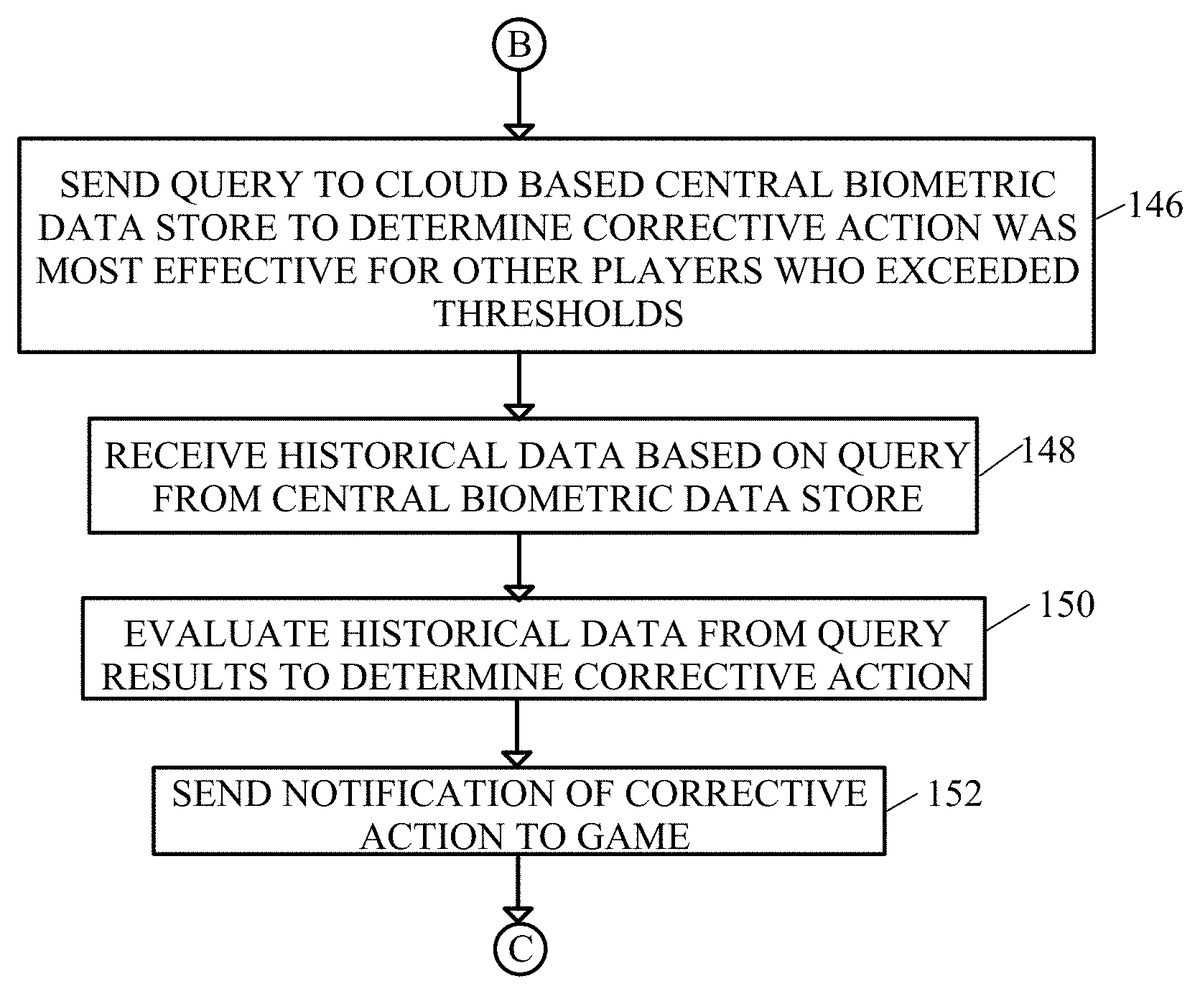
FIG. 9shows a flow diagram of a method of determining corrective action for game play of an alternate embodiment. In this embodiment, the corrective action is determined based on historical data and is directed by the biometric monitoring system76.
Step138ofFIG. 7may further include steps146-152. The biometric monitoring system76sends a query to a cloud-based central biometric data store70to determine a corrective action which was most effective for other players who fell out of range or preferences during this stage or sequence of the game (step146). The biometric monitoring system76receives historical data based on the query from the central biometric data store70(step148). The biometric monitoring system76evaluates the historical data from the query results to recommend and determine the corrective action (step150) and notification of the corrective action for the game to take is sent to the game (step152) through the API interface75and the method returns to step140, where the game play is adjusted based on the corrective action received.
For example, a query for high stress level for game A may be sent to the cloud-based central biometric data store70to determine a corrective action which was most effective for other players who fell out of range or preferences during this stage of the game, such as level 1.1, sequence B as shown in Table 1 above. Historical data received from the cloud-based central biometric data store70is then evaluated by the biometric monitoring system76. The evaluation of the historical data may show that reducing the game difficulty of opponents (weakened opponents) in the game at this particular stage reduced stress levels of players 90% of the time. The biometric monitoring system76would then send a notification to reduce the difficulty of the opponents to the game.
It should be noted that the corrective action and monitoring of biometric information is preferably applicable in single player games. In an alternate embodiment, the game may be a multi-player game.
The present invention may be a system, a method, and/or a computer program product. The computer program product may include a computer readable storage medium (or media) having computer readable program instructions thereon for causing a processor to carry out aspects of the present invention.
The computer readable storage medium can be a tangible device that can retain and store instructions for use by an instruction execution device. The computer readable storage medium may be, for example, but is not limited to, an electronic storage device, a magnetic storage device, an optical storage device, an electromagnetic storage device, a semiconductor storage device, or any suitable combination of the foregoing. A non-exhaustive list of more specific examples of the computer readable storage medium includes the following: a portable computer diskette, a hard disk, a random access memory (RAM), a read-only memory (ROM), an erasable programmable read-only memory (EPROM or Flash memory), a static random access memory (SRAM), a portable compact disc read-only memory (CD-ROM), a digital versatile disk (DVD), a memory stick, a floppy disk, a mechanically encoded device such as punch-cards or raised structures in a groove having instructions recorded thereon, and any suitable combination of the foregoing. A computer readable storage medium, as used herein, is not to be construed as being transitory signals per se, such as radio waves or other freely propagating electromagnetic waves, electromagnetic waves propagating through a waveguide or other transmission media (e.g., light pulses passing through a fiber-optic cable), or electrical signals transmitted through a wire.
Computer readable program instructions described herein can be downloaded to respective computing/processing devices from a computer readable storage medium or to an external computer or external storage device via a network, for example, the Internet, a local area network, a wide area network and/or a wireless network. The network may comprise copper transmission cables, optical transmission fibers, wireless transmission, routers, firewalls, switches, gateway computers and/or edge servers. A network adapter card or network interface in each computing/processing device receives computer readable program instructions from the network and forwards the computer readable program instructions for storage in a computer readable storage medium within the respective computing/processing device.
Computer readable program instructions for carrying out operations of the present invention may be assembler instructions, instruction-set-architecture (ISA) instructions, machine instructions, machine dependent instructions, microcode, firmware instructions, state-setting data, or either source code or object code written in any combination of one or more programming languages, including an object oriented programming language such as Java, Smalltalk, C++ or the like, and conventional procedural programming languages, such as the “C” programming language or similar programming languages. The computer readable program instructions may execute entirely on the user's computer, partly on the user's computer, as a stand-alone software package, partly on the user's computer and partly on a remote computer or entirely on the remote computer or server. In the latter scenario, the remote computer may be connected to the user's computer through any type of network, including a local area network (LAN) or a wide area network (WAN), or the connection may be made to an external computer (for example, through the Internet using an Internet Service Provider). In some embodiments, electronic circuitry including, for example, programmable logic circuitry, field-programmable gate arrays (FPGA), or programmable logic arrays (PLA) may execute the computer readable program instructions by utilizing state information of the computer readable program instructions to personalize the electronic circuitry, in order to perform aspects of the present invention.
Aspects of the present invention are described herein with reference to flowchart illustrations and/or block diagrams of methods, apparatus (systems), and computer program products according to embodiments of the invention. It will be understood that each block of the flowchart illustrations and/or block diagrams, and combinations of blocks in the flowchart illustrations and/or block diagrams, can be implemented by computer readable program instructions.
These computer readable program instructions may be provided to a processor of a general purpose computer, special purpose computer, or other programmable data processing apparatus to produce a machine, such that the instructions, which execute via the processor of the computer or other programmable data processing apparatus, create means for implementing the functions/acts specified in the flowchart and/or block diagram block or blocks. These computer readable program instructions may also be stored in a computer readable storage medium that can direct a computer, a programmable data processing apparatus, and/or other devices to function in a particular manner, such that the computer readable storage medium having instructions stored therein comprises an article of manufacture including instructions which implement aspects of the function/act specified in the flowchart and/or block diagram block or blocks.
The computer readable program instructions may also be loaded onto a computer, other programmable data processing apparatus, or other device to cause a series of operational steps to be performed on the computer, other programmable apparatus or other device to produce a computer implemented process, such that the instructions which execute on the computer, other programmable apparatus, or other device implement the functions/acts specified in the flowchart and/or block diagram block or blocks.
The flowchart and block diagrams in the Figures illustrate the architecture, functionality, and operation of possible implementations of systems, methods, and computer program products according to various embodiments of the present invention. In this regard, each block in the flowchart or block diagrams may represent a module, segment, or portion of instructions, which comprises one or more executable instructions for implementing the specified logical function(s). In some alternative implementations, the functions noted in the block may occur out of the order noted in the figures. For example, two blocks shown in succession may, in fact, be executed substantially concurrently, or the blocks may sometimes be executed in the reverse order, depending upon the functionality involved. It will also be noted that each block of the block diagrams and/or flowchart illustration, and combinations of blocks in the block diagrams and/or flowchart illustration, can be implemented by special purpose hardware-based systems that perform the specified functions or acts or carry out combinations of special purpose hardware and computer instructions.
Having thus described the invention of the present application in detail and by reference to embodiments thereof, it will be apparent that modifications and variations are possible without departing from the scope of the invention defined in the appended claims.
Claims
- A method of using real-time biometrics of a player during play of a game through a gaming computer to maintain player biometrics within acceptable ranges comprising: the gaming computer receiving real-time biometric sensor data from a wearable biometric sensor on the player;the gaming computer correlating the real-time biometric sensor data with stages of the game being played;the gaming computer comparing the real-time biometric sensor data to ranges of player biometric thresholds and preferences specific to the player set by the player prior to game play;when the real-time biometric sensor data has fallen out of range of the player biometric thresholds and preferences specific to the player set by the player prior to game play, the gaming computer: sending a query to a central biometric data store to retrieve at least one corrective action which was most effective for other players who exceeded player biometric thresholds based on historical data of the other players and preferences set by the player prior to game play in a same stage of the game being played;receiving and evaluating the at least one corrective action from the query to determine what corrective action should be taken;and sending a notification to the game to apply the corrective action to the game, such that the corrective action alters the game for the player to return the real-time biometric sensor data of the player to within the range of the player biometric thresholds and preferences set by the player prior to game play.
- The method of claim 1 , wherein the gaming computer further comprises: a data store of player biometric thresholds and preferences specific to the player;a data store of real-time biometric sensor data from the wearable biometric sensor worn by the player;and a biometric monitoring system interfaced with the game, and in communication with the data store of player biometric thresholds and preferences specific to the player, the data store of real-time biometric sensor data from the wearable biometric sensor worn by the player and the central biometric data store.
- The method of claim 1 , wherein the real-time biometric sensor data and correlated stage pertaining to the player of the game is periodically sent to the central biometric data store.
- The method of claim 1 , wherein the corrective action is alter the intensity level of the game.
- The method of claim 1 , wherein the corrective action is alter the difficulty of completing a task within the game.
- The method of claim 1 , wherein the corrective action is halting play of the game.
- A computer program product for using real-time biometrics of a player during play of a game through a gaming computer to maintain player biometrics within acceptable ranges, a gaming computer comprising at least one processor, one or more memories, one or more computer readable storage media, the computer program product comprising a computer readable storage medium having program instructions embodied therewith, the program instructions executable by the computer to perform a method comprising: receiving, by the gaming computer, real-time biometric sensor data from a wearable biometric sensor on the player;correlating, by the gaming computer, the real-time biometric sensor data with stages of the game being played;comparing, by the gaming computer, the real-time biometric sensor data to ranges of player biometric thresholds and preferences specific to the player set by the player prior to game play;when the real-time biometric sensor data has fallen out of range of the player biometric thresholds and preferences specific to the player set by the player prior to game play, the gaming computer: sending a query to a central biometric data store to retrieve at least one corrective action which was most effective for other players who exceeded player biometric thresholds based on historical data of the other players and preferences set by the player prior to game play in a same stage of the game being played;receiving and evaluating the at least one corrective action from the query to determine what corrective action should be taken;and sending a notification to the game to apply the corrective action to the game, such that the corrective action alters the game for the player to return the real-time biometric sensor data of the player to within the range of the player biometric thresholds and preferences set by the player prior to game play.
- The computer program product of claim 7 , wherein the gaming computer further comprises: a data store of player biometric thresholds and preferences specific to the player;a data store of real-time biometric sensor data from the wearable biometric sensor worn by the player;and a biometric monitoring system interfaced with the game, and in communication with the data store of player biometric thresholds and preferences specific to the player, the data store of real-time biometric sensor data from the wearable biometric sensor worn by the player and the central biometric data store.
- The computer program product of claim 7 , wherein the real-time biometric sensor data and correlated stage pertaining to the player of the game is periodically sent to the central biometric data store.
- The computer program product of claim 7 , wherein the corrective action is alter the intensity level of the game.
- The computer program product of claim 7 , wherein the corrective action is alter the difficulty of completing a task within the game.
- The computer program product of claim 7 , wherein the corrective action is halting play of the game.
- A computer system for using real-time biometrics of a player during play of a game through a gaming computer to maintain player biometrics within acceptable ranges, comprising a gaming computer comprising at least one processor, one or more memories, one or more computer readable storage media having program instructions executable by the computer to perform the program instructions comprising: receiving, by the gaming computer, real-time biometric sensor data from a wearable biometric sensor on the player;correlating, by the gaming computer, the real-time biometric sensor data with stages of the game being played;comparing, by the gaming computer, the real-time biometric sensor data to ranges of player biometric thresholds and preferences specific to the player set by the player prior to game play;when the real-time biometric sensor data has fallen out of range of the player biometric thresholds and preferences specific to the player set by the player prior to game play, the gaming computer performing the program instructions comprising: sending a query to a central biometric data store to retrieve at least one corrective action which was most effective for other players who exceeded player biometric thresholds based on historical data of the other players and preferences set by the player prior to game play in a same stage of the game being played;receiving and evaluating the at least one corrective action from the query to determine what corrective action should be taken;and sending a notification to the game to apply the corrective action to the game, such that the corrective action alters the game for the player to return the real-time biometric sensor data of the player to within the range of the player biometric thresholds and preferences set by the player prior to game play.
- The computer system of claim 13 , wherein the gaming computer further comprises: a data store of player biometric thresholds and preferences specific to the player;a data store of real-time biometric sensor data from the wearable biometric sensor worn by the player;and a biometric monitoring system interfaced with the game, and in communication with the data store of player biometric thresholds and preferences specific to the player, the data store of real-time biometric sensor data from the wearable biometric sensor worn by the player and the central biometric data store.
- The computer system of claim 13 , wherein the real-time biometric sensor data and correlated stage pertaining to the player of the game is periodically sent to the central biometric data store.
- The computer system of claim 13 , wherein the corrective action is alter the intensity level of the game.
- The computer system of claim 13 , wherein the corrective action is alter the difficulty of completing a task within the game.
- The computer system of claim 13 , wherein the corrective action is halting play of the game.
Disclaimer: Data collected from the USPTO and may be malformed, incomplete, and/or otherwise inaccurate.