U.S. Pat. No. 10,272,335
Systems and Methods of Serving Game Video for Remote Play
AssigneeSony Interactive Entertainment America LLC
Issue DateNovember 23, 2016
U.S. Patent no. 10,272,335: Systems and methods of serving video for remote play
U.S. Patent no. 10,272,335: Systems and methods of serving video for remote play
Issued April 30, 2019 to Sony Interactive Entertainment America LLC
Priority Date December 15, 2007
Summary:
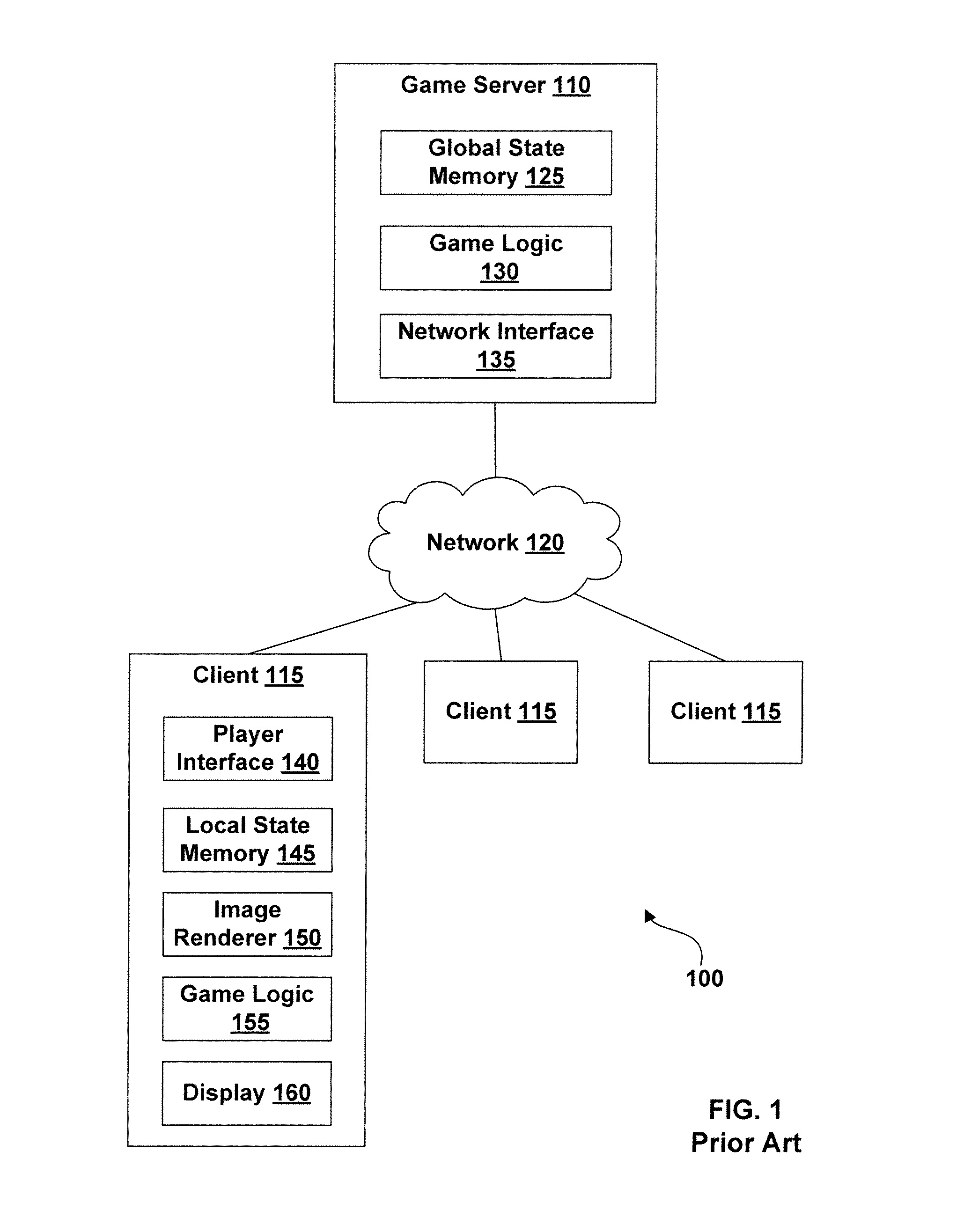
U.S. Patent No. 10,272,335 (the ‘335 Patent) relates to video games played over a computing network. These video games can be played by using a remote server that sends game state information and limited image information to clients via the computing network. This is in contrast to video games played locally on a stand-alone game console such as Microsoft’s Xbox, Nintendo’s GameBoy, and Sony’s PlayStation. Video games played over a computing network instead function by allowing players to input commands that are received by a computing network which then advances the global game state. This process can similarly be applied to multiplayer games as well which allow for many users to send data to this computing network whereby an image is generated and sent back to the players’ devices. The ‘335 Patent represents a potential massive improvement in remote play. The invention represents a major advancement in video games as a movement beyond being limited to physical immobile consoles and allowing for games to be played more freely.
Abstract:
Methods and systems are provided for executing video games by a gaming computer and enabling remote play. In example, a method includes receiving a command from a first player via a first client and a computing network. The method updates a game state of a video game based on the command received from the first player and receiving a first point of view of the first player via the computing network. The method communicates at least part of the game state to a first image generator executed by the gaming computer and sends via the computing network to the first client a first image based on the game state and the first point of view using the first image generator. The first image is configured for rendering by the first client. The first image is a video image of a plurality of video images presented to the first client, which is accessing the gaming computer for remote play.
Illustrative Claim:
1. A method executed on gaming system, comprising: receiving a connection request from a remote client to access a player interface of the game system, the connection request being received via a computing network; receiving a command for a video game from the remote client via the player interface executed by the gaming system, the command being received via the computing network; executing the game based at least in part on the received command; and sending compressed images from the gaming system via the computing network to the remote client, the compressed images including an image of the video game rendered based on a game state of the video game and a point of view of a player connected via the remote client, the game state being based in part on the command, wherein the compressed images include partially rendered images that require additional rendering by the remote client; the compressed images configured to be decompressed by the remote client; and the remote client is configured to perform additional texture rendering for display of the decompressed images for viewing by the player.
Illustrative Figure
Abstract
Methods and systems are provided for executing video games by a gaming computer and enabling remote play. In example, a method includes receiving a command from a first player via a first client and a computing network. The method updates a game state of a video game based on the command received from the first player and receiving a first point of view of the first player via the computing network. The method communicates at least part of the game state to a first image generator executed by the gaming computer and sends via the computing network to the first client a first image based on the game state and the first point of view using the first image generator. The first image is configured for rendering by the first client. The first image is a video image of a plurality of video images presented to the first client, which is accessing the gaming computer for remote play.
Description
DETAILED DESCRIPTION In various embodiments, the provision of a network based video game includes at least partial rendering of images using a server-side game server, prior to delivery of these images over a computing network, e.g. the internet. The rendered images are optionally also compressed prior to delivery over the computing network. Once received by a client, the rendered images are optionally decompressed, optionally further rendered, and displayed to a player of the video game. The rendered images are optionally part of a sequence of images that form a moving picture when viewed in order. The rendered images are optionally configured for specific display types, e.g., HDTV 1080p, 1080i, 720p, and may be for displays having 480 by 272, 480 by 234, 160 by 160, 320 by 240, 320 by 480, 800 by 600, 1024 by 768, 1280 by 720, 1280 by 800, 1280 by 1024, 1600 by 1200, 1920 by 1200, 1920 by 1080, and/or a larger or smaller number of pixels. The rendered images may be configured for interlaced or progressive displays. Rendering that occurs on the server-side is typically based on a point of view of a player. This point of view may be the point of view of an avatar or from a position relative to the avatar. The point of view is one of the factors that determine what is shown in the rendered image. For example, the rendering may include occlusion of a distant object by a nearby object based on a specific point of view. This occlusion varies as a function of point of view. The rendering may further include application of shadows, bitmaps, lighting, patterns, and/or other textures. Different image generators are optionally assigned to render images for different clients and/or players. Each of these image generators uses at least part of ...
DETAILED DESCRIPTION
In various embodiments, the provision of a network based video game includes at least partial rendering of images using a server-side game server, prior to delivery of these images over a computing network, e.g. the internet. The rendered images are optionally also compressed prior to delivery over the computing network. Once received by a client, the rendered images are optionally decompressed, optionally further rendered, and displayed to a player of the video game. The rendered images are optionally part of a sequence of images that form a moving picture when viewed in order. The rendered images are optionally configured for specific display types, e.g., HDTV 1080p, 1080i, 720p, and may be for displays having 480 by 272, 480 by 234, 160 by 160, 320 by 240, 320 by 480, 800 by 600, 1024 by 768, 1280 by 720, 1280 by 800, 1280 by 1024, 1600 by 1200, 1920 by 1200, 1920 by 1080, and/or a larger or smaller number of pixels. The rendered images may be configured for interlaced or progressive displays.
Rendering that occurs on the server-side is typically based on a point of view of a player. This point of view may be the point of view of an avatar or from a position relative to the avatar. The point of view is one of the factors that determine what is shown in the rendered image. For example, the rendering may include occlusion of a distant object by a nearby object based on a specific point of view. This occlusion varies as a function of point of view. The rendering may further include application of shadows, bitmaps, lighting, patterns, and/or other textures.
Different image generators are optionally assigned to render images for different clients and/or players. Each of these image generators uses at least part of the same global game state. A global game state includes the positions and characteristics of avatars, non-player characters, game objects (e.g., chairs or vehicles), and the game environment (e.g., zones, instances and/or regions). In a multi-player game the global game state can include contributions from multiple players.
Multiple image generators are optionally used to provide rendered images to multiple clients. The image generators are optionally configured to render images configured for different client types and/or display types. For example, one image generator may render images configured for display on a mobile device (e.g., personal digital assistant or cellular telephone) having limited display area and computational power, while another image generator may render images for display on a larger display area and/or images that may be further rendered on the client.
The rendered images optionally include images generated using an external source. This external source may include a still camera, a video camera and/or an image storage. For example, in some embodiments, the rendered images include video of an event (e.g., sporting event, contest or game) recorded in real-time which is combined with images rendered based on a game state. The external source may include devices configured to identify the positions and/or identities of real world objects. These positions and/or identities are optionally used to control positions or identities of rendered objects within a game environment. For example, the position of a real world vehicle may be used to control the position of a computer rendered vehicle in a game. Likewise, a determined identity of a real works playing card may be used to set an identity of an in-game playing card. Devices configured to identify positions may include global or local positioning sensors, gyroscopes, inertia and acceleration sensors, and/or the like. Devices configured to identify identities may include image recognitions systems, barcode readers, RFID readers, electrical sensors, and/or the like.
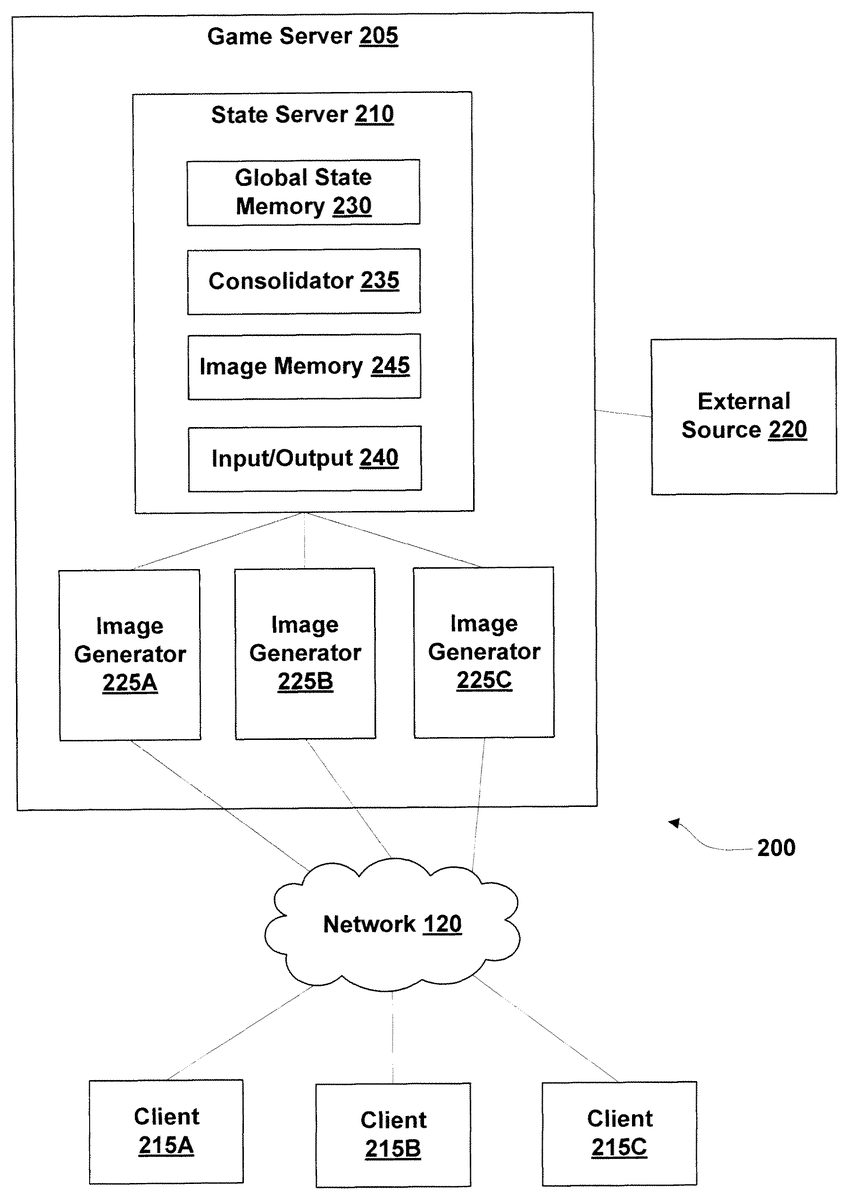
FIG. 2illustrates a Game System generally designated200and configured to provide a video game over a computing network, according to various embodiments of the invention. Game System200includes a Game Server205, Network120, one or more Clients215, and an optional External Source220. Clients215are individually referred to as Client215A, Client215B, Client215C, etc. Generally, Game Server205is configured to generate one or more at least partially rendered image based on the point of view or one or more players, respectively. These images are communicated to Clients215via Network120. Clients215are each configured to receive the at least partially rendered images, optionally perform further rendering, and to display the images to a player. Game Server205and Clients215are typically each controlled, owned and/or operated by different game players. For example, Game Server205may be managed in a first location by a game provider while Clients215are managed by separate game players in a variety of further locations geographically distant from the first location. Game Server205is configured to provide images to one, two, three, four, five, or more of Clients215, each of Clients215having its own display. These images are optionally communicated to the Clients215over a computing network.
The displays of Clients215may include a two or three dimensional display device. For example, a two-dimensional computer screen or a three-dimensional display in which an image is presented within a three-dimensional volumetric space. The displays of Clients215may include a device configured to present a slightly different image to each eye of a user, e.g., 3D goggles. Three-dimensional displays may include lenticular displays, projected displays, polarized displays, or the like. The slightly different images are configured to create a three dimensional image for the user. In some embodiments, Clients215include one or more devices configured to determine a position of a user. These devices may include a motion sensing device, a wireless device, a gyroscope, an inertia sensor, a head tracking device, and/or the like. For example, one of Clients215may include head tracking goggles configured to determine positions of a user's head and also to present a three-dimensional image to the user.
Game Server205typically includes hardware, firmware, and/or software embodied on a computer readable medium and configured to perform the functions of Game Logic130.
Game Server205includes a State Server210and one or more Image Generators225. Image Generators225are individually referred to as Image Generator225A, Image Generator225B, Image Generator225C, etc. State Server210is configured to maintain a state of a game using inputs received from one or more of Clients215. Image Generators225are configured to render images based on the state of the game stored in Global State Memory230and player points of view. For example, if the game is a multi-player game different members of Image Generators225may be assigned to generate rendered images for different members of Clients215. In some embodiments, Image Generator225A is assigned to generate rendered images for Client215A, Image Generator225B is assigned to generate rendered images for Client215B, and Image Generator225C is assigned to generate rendered images for Client215C. In these embodiments the rendered images are configured specifically for each client. For example, the rendered image generated using Image Generator225A may be based on the point of view of a player using Client215A, and the rendered image generated using Image Generator225B may be based on the point of view of a player using Client215B, etc. In other embodiments, there is not a 1-to-1 relationship between members of Image Generators225and Clients215. For example, Image Generator225A may be assigned to generate rendered images for both Client215A and215B.
In some embodiments, Image Generators225is distributed among different physical locations. For example, Image Generators225may be geographically distributed so as to reduce communication delays between members of Image Generators225and Clients215. In some embodiments, part of Image Generator225A is disposed near other elements of Game Server205and all or part of Image Generator225A is disposed closer to a member of Clients215. For example, part of Image Generator225A may be disposed at an in-home server configured to provide game images to a plurality of different display devices.
The output of Image Generators225optionally include Flash, Silverlight, Air, Shockwave or some other standard streaming video format. For example, Image Generator225A may be configured to output flash data representative of a partially rendered image. The output of Image Generator225A may be compressed in a vector format that can be decompressed to a scalable image size. The decompressed image can be further rendered and displayed on one of Clients215. The division in the rendering process between Image Generator225A and Clients215is optionally selected so as to maximize the efficiency of the compression. The output of Image Generator225A may include 2D video, 3D video, audio (speech/music/sound effects, etc.) 3D polygons, 2D vector artwork, controller movements, user interface inputs/data, global or local positioning data, player information, and/or the like.
A Video Source typically includes rendering logic, e.g., hardware, firmware, and/or software stored on a computer readable medium such as Storage. This rendering logic is configured to create video frames of the video stream based on the game state. All or part of the rendering logic is optionally disposed within a graphics processing unit (GPU). Rendering logic typically includes processing stages configured for determining the three-dimensional spatial relationships between objects and/or for applying appropriate textures, etc., based on the game state and viewpoint. The rendering logic produces raw video that is then usually encoded prior to communication to Clients. For example, the raw video may be encoded according to an Adobe Flash® standard, .wav, H.264, H.263, On2, VP6, VC-1, WMA, Huffyuv, Lagarith, MPG-x. Xvid. FFmpeg, x264, VP6-8, realvideo, mp3, or the like. The encoding process produces a video stream that is optionally packaged for delivery to a decoder on a remote device. The video stream is characterized by a frame size and a frame rate. Typical frame sizes include 800×600, 1280×720 (e.g., 720p), 1024×768, although any other frame sizes may be used. The frame rate is the number of video frames per second. A video stream may include different types of video frames. For example, the H.264 standard includes a “P” frame and an “I” frame. I-frames include information to refresh all macro blocks/pixels on a display device, while P-frames include information to refresh a subset thereof. P-frames are typically smaller in data size than are I-frames. As used herein the term “frame size” is meant to refer to a number of pixels within a frame. The term “frame data size” is used to refer to a number of bytes required to store the frame.
In some embodiments, different members of Image Generators225are assigned to render images for different types of Clients215. For example, Image Generator225A may be configured to render images for up to thirty-two members of Clients215having screen resolutions of 320 by 480 (pixels), Image Generator225B may be configured to render images for up to four of Clients215having screen resolutions of 1920 by 1200, and Image Generator225C may be configured to render images for one of Clients215having a higher image resolution. In embodiments such as these, Game Server205is optionally configured to assign different members of Image Generators225to provide rendered images to different members of Clients215based on needs of each client and capacity of each image generator.
The renderings performed by Image Generators225are based on the state of the game, specific player points of view, and optionally textures stored in Image Memory245. Because these renderings are based on specific player points of view which are dependent on information received from Clients215, they are customized for use on specific Members of Clients215. The renderings generated by Image Generators225may be complete renderings, e.g., renderings that result in images that are ready to be presented to a player. Alternatively, they may be partial renderings. A partial rendering includes, for example, a determination of which points in a three dimensional environment are visible from a specific point of view, but not application of textures to those points that are visible. In some embodiments, audio is prepared on a member of Clients215while images are at least partially rendered using one of Image Generators225, or vice-versa. In some embodiments, the type of rendering that is performed is a function of the capabilities of Clients215and/or the bandwidths of communications from Game Server205to Clients215. For example, if Client215A is a cellular telephone having relatively limited image processing power, then a complete rendering may be provided to Client215A. If Client215B is a personal computer with greater processing power, then a partial rendering may be provided to Client215B. The renderings performed by Image Generators225may be configured for two or three dimensional game environments.
In some embodiments Game Server205is configured to deliver a discovery agent (not shown) to Clients215. The discovery agent is configured to identify characteristics of Clients215, e.g., rendering ability, screen size, processing power, player interface type, version information, etc., and to report these characteristics back to Game Server205via Network120. The discovery agent may be automatic or controlled by a player. In some embodiments, Game Server205is configured to test various alternative communication channels in order to determine one having a desired quality of service, e.g. minimal communication latency.
State Server210is configured to maintain a global state of a game. This global state is a game state that results in inputs received from several players. The global game state is global in that it represents the states of the game environment around more than one player. The global game state may represent a subset of the state of an entire game. For example, the global game state may be a state of a specific region or instance within a game.
State Server210may include one or more computing devices. For example, in some embodiments, State Server210includes an array of interconnected servers. State Server210typically includes at least one processor, associated memory and at least one Input/Output240. State Server210includes a Global State Memory230and a Consolidator235. Global State Memory230is memory configured to store one or more global game state. For example, in some embodiments a game is divided into a plurality of regions and/or instances, and Global State Memory230is configured to store a global game state associated with each of these regions and/or instances, respectively.
Consolidator235is configured to receive state information from Clients215via Input/Output240and to update Global State Memory230using this received state information. For example, Consolidator235may receive state information from each of Client215A and Client215B. This state information may be the result of inputs by players and/or interactions between avatars within the game. These inputs include, for example, commands for an avatar to move, interactions with in-game objects, text messages, audio data. Interactions between avatars include, for example, dancing, shooting, trading, or the like between avatars. Both these inputs and interactions result in changes in a global state of the game. For example, when an avatar moves from one position to a second position, Consolidator235is configured to update Global State Memory230to reflect this change in position. Likewise, when an avatar trades an object with another avatar, consolidator235is configured to update Global State Memory230to reflect this change. The state information includes player points of view received from Clients215or determined from other information received from Clients215.
Image Memory245includes memory configured to store video, textures, graphics, color pallets, and/or images received from External Source220. These data are optionally used by Image Generators225to generate rendered images. These data are optionally generated using External Source220.
In various embodiments, Input/Output240comprises a data bus, a communication port, a network interface, and/or the like. Input/Output240is configured to both receive state information from Clients215(via Network120) and to provide all or part of a global game state stored in Global State Memory230to Image Generators225. In some embodiments, members of Image Generators225are disposed within the same computing device as other parts of Game Server205. In some embodiments, members of Image Generators225are disposed in separate computing devices. For example, Image Generators225may each include a processing blade within a rack. In these embodiments, the number of Clients215that can be supported by Game Server205is optionally scaled by adding additional processing blades.
Network120may include the internet, a telephone network, an Ethernet, a wireless network, a cellular network, a TCP/IP network, and/or the like. In some embodiments, members of Clients215are connected to the Internet at different locations, using different types of devices, and are used to participate in a multi-player game supported by Game Server205. Network120is typically a digital network.
Clients215can include a wide variety of devices and are typically characterized by having at least a display, a user input and communication capabilities. Examples of Clients215include a telephone, a cellular telephone, a personal digital assistant, a handheld game console, a game console, a digital video recorder, a television, a personal computer, a laptop computer, a projector, and/or the like. Clients215may or may not have image rendering capabilities. For example, Client215A may include a cellular telephone that does not include electronics configured to further render an image received via Network120. Members of Clients215that do not have rendering capabilities are referred to herein as renderless clients. Renderless clients are unable to determine three dimensional projections and/or apply textures.
For example, in some embodiments, a renderless member of Clients215includes a cellular telephone that is not configured to calculate three dimensional projections nor apply textures to a surface within an image. In some embodiments, a renderless member of Clients215includes a personal digital assistant or cellular telephone that is not configured to calculate a three dimensional projection but does have logic (firmware, hardware and/or software embodied on a computer readable medium) configured to apply a texture to a surface within an image.
Optional External Source220is configured to generate information to be used by Image Generators225. In various embodiments, this information includes video or still images, audio, the locations of objects in the real world, the occurrence of events in the real world, and/or the like. In various embodiments, the information generated using External Source220is real-time or time-shifted information. For example, External Source220may include a video camera configured to generate images of real-world events and/or position sensing devices configured for identifying positions of real world objects. These real-world events can include a game, a sporting event, movement of a vehicle, movement of a person, movement of an animal, a contest, a puzzle, and/or the like. For example, in some embodiments a real-world event includes a game show that is also shown through another medium, e.g., television. In some embodiments, the real-world event is a football (American or European) game, a race, a basketball game, a poker game, a card game, cricket game, a baseball game, a hockey game, a field and track event, a fighting event, an Olympic event, or the like. If the real-world event involves movement of objects, such as an automobile race, then External Source220may be configured to determine the positions of these objects. Such determination can include the use of optical object recognition, wireless signals, range finders, global positioning system or local positioning systems, or the like. The information generated by External Source220may also include actions that occur in the real-world, such as dealing of a card, a time-out, a time, a score, a choice made by a person, a hit, an out, a penalty, a catch, a collision, roll of a dice, and/or the like. Such information may be manually entered or gathered using sensors, optionally in real time.
The information generated using External Source220is optionally used for several purposes. For example, if the information includes video or still images these images may be added, by Image Generators225, to images provided from Game Server205to Clients215. These images may be added as a background, foreground, or texture. If the information includes real-world positions of objects or actions that occur in the real-world, then the information may be used to update the global game state stored in Global State Memory230or to control computer generated representations of the objects. For example, the real world position of a ball, vehicle or person, or the like, may be used to control the position of a computer generated representation of the ball, vehicle or person with a game environment, respectfully. The computer generated representation may be an avatar, a representation that accurately reflects visual characteristics of the real world object, and/or a representation that includes some visual features different from those of the real world object. For example, if the real world object is a vehicle, the computer generated representation may include a vehicle of a different type or a different logo, color or texture.
In some embodiments, External Source220is configured to receive information from Game Server205. For example, External Source220may be configured to receive camera movement/selection instructions from Game Server205. In another example, External Source220may be configured to receive instructions to move objects in the real-world based on instructions received from Game Server205and/or Clients215. For example, a user of Client215A may be able to control movement or other actions of a real-world object via Game Server205. In one embodiment, External Source220is configured to control movement of a vehicle responsive to signals received from one of Clients215.
FIG. 3illustrates further details of Image Generator225A, according to various embodiments of the invention. Image Generator225A includes a Network Interface310, an optional Local State Memory320, a Renderer330, and an optional Compressor340. Image Generator225A is configured to generate an image for delivery to Clients215. This image may be video or a still image, fully or partially rendered, and may be configured for display on a device having particular characteristics (e.g., display resolution, memory, processing power, communication bandwidth, and/or the like). Image Generator225A may be embodied in a single device, e.g., a processing blade, or a plurality of devices, e.g., a processing device and a separate communication device.
At a particular time, Image Generator225A is typically associated with one or more of Clients215, e.g., assigned to generate at least partially rendered images for those one or more of Clients215. For example, when a player logs on to a game using Client215A, that player's session and their avatar may be assigned to a particular member of Image Generators225. This assignment can be based on characteristics or identity of Client215A, processing load on members of Clients215, location of Client215A, availability of communication channels, account type (e.g., paid or free), a quality of service requirement, and/or the like. In some embodiments, the association between Image Generator225A and a member of Clients215is independent of where in a game a player's avatar may travel. In other embodiments, the association between Image Generator225A and a member of Clients215is dependent on where in a game a player's avatar travels. In these embodiments, Image Generator225A may be associated with a specific region or instance within a game. In some embodiments, Image Generator225A is selected for association with Client215A based on a geographic relationship and/or a desired quality of service.
Network Interface310is configured for communicating to one or more of Clients215via Network120. Network Interface310may include a network card, a router, a switch, an internet server, a modem, Ethernet interface, or the like. In various embodiments, Network Interface310is addressable using a MAC (machine access control) address and/or configured to communicate using DNS (domain name service) or TCP/IP (transmission control protocol/internet protocol) protocols. In some embodiments, Network Interface310is configured to communicate using Ethernet protocols. Network Interface310is optionally shared by more than one member of Clients215. Network Interface310is optionally configured for sending game state information to one or more members of Clients215.
Local State Memory320is configured to store part of the game state stored in Global State Memory230. For example, in some embodiments, Local State Memory320is configured to store that part of a game state that is local to the location of a particular avatar. In embodiments where the association between Image Generator225A and members of Clients215is independent on the location of the avatar, when an avatar moves between different regions or instances of a game, that part of the global game state that is stored in Local State Memory320may change. Typically, the part of the global game state stored in Local State Memory320includes the state of game objects, non-player characters, other players, and/or game environment that are spatially adjacent to the location of the avatar within the game environment. In embodiments where the association between Image Generator225A and members of Clients215is dependent on the location of the avatar, the part of the global game state stored in Local State Memory320is independent of the movement of avatars. In these embodiments, when an avatar played using Client215A moves from one location in a game to a second location in the game, the association of Client215A may be changed to a different member of Image Generators225in response to this movement. The information stored in Local State Memory320typically includes a player point of view. The player point of view may be the point of view of the avatar or some other point of view selected by the player. For example, the player point of view may be from a point behind or above the avatar. The player point of view is the point of view, e.g., viewpoint and direction, though which the player views the game via a member of Clients215. In some embodiments, Local State Memory320is optional. In these embodiments, Renderer330is configured to access game state information stored in Global State Memory230.
Renderer330is configured to partially or fully render an image responsive to information stored in Local State Memory320and/or Global State Memory230. Rendering typically includes determination of one or more objects visible from a player point of view in a three dimensional environment, proper sizing of these objects from the player point of view, and/or applying one or more texture to a surface of the visible objects. The determination of visible objects may include identifying those objects that are occluded by other objects. For example, a first object may be located between the point of view and a second object. If the first object is opaque, all or part of the second object may not be visible from the point of view. Thus, the rendering is based on the player point of view as well as locations and characteristics of other objects in the game.
Rendering optionally includes determination of an object's proper perspective size based on a distance from the point of view to the object.
Rendering optionally includes application of a texture to a surface of an object within the game environment. The texture may include a color, a pixel pattern, an image, a transparency, and/or the like. In some embodiments the texture includes image data received from External Source220. For example, the texture may include an image of a real-world event. A texture may be applied as a background within a game environment. Application of a texture may occur in a two or three dimensional environment.
Complete rendering results in an image that is ready for display on one of Clients215. In contrast, partial rendering results in image information that requires further rendering before being displayed as an image on one of Clients215. For example, partial rendering may include determining which objects are visible and sizing images to proper prospective, but not application of textures to all visible surfaces. Partial rendering may include application of textures to some but not all visible surfaces. Partial rendering may include application of textures but not complete determination of which objects are visible from the player point of view. Partial rendering may include different amounts of rendering as a function of distance from an avatar. For example, distant objects may be more completely rendered relative to nearby objects, or vice-versa.
Optional Compressor340is configured to compress a fully or partially rendered image prior to delivery to a member of Clients215via Network120. Compressor340may include hardware, firmware, and/or software embodied on a computer readable medium. For example, in some embodiments, Compressor340includes circuits configured for data compression. Compressor340may be configured to perform any of the compression techniques know in the art. Compressor340is optionally shared by more than one of Image Generators225.
FIG. 4illustrates Client215A, according to various embodiments of the invention. Client215A is configured to display still and/or video images to a game player using a Display410. Display410may include a liquid crystal display, a plasma display, a cathode ray tube display, a light emitting diode display, and/or the like. In some embodiments, Display410is detachable from other parts of Client215A. For example, Display410may include a computer monitor or a television coupled to Client215A via a cable. Display410is optionally configured to support a browser.
Client215A further includes a Player Interface420configured for a person to interact with Client215A. Player Interface420can include, for example, a keyboard, a pointing device, a joystick, buttons, switches, location sensors, a microphone, a touch sensor, a wireless remote, a position sensor, a wireless receiver, a universal serial bus port, and/or the like.
Client215A further includes a Processor430configured to process data. For example, in some embodiments, Processor430is configured to parse received data and provide the received data to Display410in a form appropriate for viewing by a user. Processor430may include software, firmware, and/or hardware. In some embodiments, Processor430is configured to receive inputs from Player Interface420and convert those inputs into data that can be provided to Game Server205via Network120.
Client215A optionally further includes a Decompressor440configured to decompress a fully or partially rendered image received from Game Server205via Network120. Decompressor440includes hardware, firmware and/or software embodied on a computer readable medium, and may be configured to perform any of the decompression techniques known in the art.
Client215A further includes a Network Interface450. Network Interface450is configured for communicating with Network Interface310via Network120. Network Interface450may include a network card, a router, a wireless connection, a switch, an internet server, a modem, Ethernet interface, and/or the like. In various embodiments, Network Interface310is addressable using a MAC address and/or configured to communicate using DNS (domain name service) or TCP/IP protocols. In some embodiments, Network Interface is configured to communicate using Ethernet protocols. Network Interface310is optionally shared by more than one member of Clients215. Network Interface310is optionally configured for sending game state information to Game Server205and/or one or more other members of Clients215.
Client215A optionally further includes a Renderer460configured to complete rendering of a partially rendered image received from Game Server205. For example, Renderer460may be configured to apply textures to surfaces, determine object sizes according to a player viewpoint perspective, and/or complete determination of which objects are visible.
In some embodiments, textures applied using Renderer460are local to Client215A, e.g., not generally available to other members of Clients215. For example, an image generated by Client215A or received from a source other than Game Server205may be used as a texture by Renderer460. Alternatively, Client215A may be configured to receive a texture from Game Server205and to apply the received texture to an object using Renderer460. The texture applied by Renderer460may be stored in an optional Texture Storage470. For example, in some embodiments, one or more textures are provide by Game Server205to Client215A at one time in a game session and then applied to objects at one or more different times, in the game session (or as subsequent game session). Thus, textures may be stored in Texture Storage470for repeated and/or later use. In some embodiments, this reduces the amount of data that need be communicated between Game Server205and Client215A.
The rendering performed by Renderer460may be responsive to game state information stored in an optional State Memory480. This game state information is optionally received from Game Server205via Network120, from Player Interface420, and/or from some other source. For example, in some embodiments, Client215A is configured to receive a partially rendered image from Game Server205and complete rendering of the image based on movement commands received via Player Interface420. In some embodiments, the rendering performed by Renderer460is responsive to state information communicated from Global State Memory230and/or Local State Memory320to State Memory480.
Decompressor440and/or Renderer460are optionally disposed within Processor430. Texture Storage470and State Memory480include random access memory, volatile memory, static memory, read only memory, magnetic storage, optical storage, and/or the like.
FIG. 5illustrates further details of External Source220, according to various embodiments of the invention. External Source220includes a Camera510, an Image Processor520, an External Data Source540, a Video Storage530, or various combinations thereof. For example, in some embodiments, External Source220includes Camera510and Image Processor520configured to record still or video images and to process these images for communication to Game Server205and/or members of Clients215. In some embodiments, External Source220includes merely an External Data Source540configured to receive signals representative of identities, positions and/or orientations of real world objects.
In some embodiments, Image Processor520is further configured to identify objects within an image obtained using Camera510. For example, Image Processor520may be configured to identify a human player in a real-world game and/or to determine a location of that player. In another example, Image Processor520may be configured to determine the location of a vehicle in a real-world race. In further examples, Image Processor520may be configured to identify a playing card, the location of a ball or puck, the location of a betting chip, the location of a roulette ball, the orientation of one or more dice, or the like. The video processed using Image Processor520may be real-time video or video previously stored in Video Storage530. The images recorded using Camera510, the identification of objects within the images, and/or the locations of these objects may be communicated to Game Server205and/or members of Clients215. The locations of these objects are optionally included in the global game state and/or a local game state. Image Processor520is optionally disposed within Game Server205.
Video Storage530can include, for example, a digital video recorder, a hard drive, an optical drive, recording tape, volatile memory, static memory, or the like.
External Data Source540is configured to generate or receive data regarding the state of the real world. For example, External Data Source540may include a wireless signal source, a range finder, a global positioning system, a local positioning system, a sensor, a computing device, and/or the like, and/or an interface therefore. In some embodiments, External Data Source540includes a wireless receiver configured to receive signals from physical objects in the real world. In some embodiments, External Data Source540includes an electrical interface, e.g., a universal serial bus, an
Ethernet interface, an analog signal wire, a digital signal wire, or the like configured to receive electrical signals from an external device. For example, in some embodiments, External Data Source540includes an interface configured to receive an input from a human participating in a real-world event.
External Source220optionally further includes a Control Output550configured to provide signals from External Source220to real-world devices. These signals are optionally dependent on inputs provided by a player via a member of Clients215. For example, in some embodiments, signals from Control Output550are configured to control a real-world device, e.g., a model car, according to inputs provided by a player via Player Interface420. In various embodiments, External Source220is connected to a member of Clients215directly or via Network120, rather than via Game Server205.
FIG. 6illustrates methods of providing an image to one or more members of Clients215via Network120, according to various embodiments of the invention. InFIG. 6two processes are illustrated, one having step identifiers ending in “A” and one having step identifiers ending in “B.” For the purposes of example, one can assume that the “A” process is performed to deliver an image to Client215A and the “B” process is performed to deliver an image to Client215B. These processes may be performed in parallel or in series and need not be synchronized with each other. In various embodiments, one, two, three, four or more such processes may be performed using Game Server205.
In a Receive Command Step605A, a first command is received at Game Server205from a first player via Client215A and Network120. This command may include a movement, a change in player point of view, an interaction with an object within the game, an interaction with the game environment, an interaction with an avatar of another player, and/or the like. In various embodiments, the command is received using TCP/IP protocols, Ethernet protocols, or other communication protocols discussed herein. For example, in some embodiments the command is received over the internet.
In a Receive Command Step605B, a second command is received at Game Server205from a second player via Client215B and Network120. Typically, the second player will be at a different location than the first player. For example, Client215A and Client215B may be located in different cities and be addressed using different MAC addresses.
In an Update State Step610A, part of the global game state stored in Global State Memory230is updated using the received first command. For example, if the first command is a movement command then a position of an avatar of the first player may be changed in the global game state. In an Update State Step610B, part of the global game state is updated using the received second command.
In a Receive POV Step615A, a player point of view (POV) is received by Game Server205from Client215A via Network120. As discussed elsewhere herein, the player point of view can be, for example, the point of view of an avatar or some other point of view selected by the player. In a Receive POV Step615B, a different player point of view is received by Game Server205from Client215B via Network120.
In an optional Receive Image Step620, an image is received from External Source220, optionally via Network120. The received image may be a still or video image and is optionally an image of a real-world event. For example, the received image may be an image of an event recorded using a video camera. The image can be real-time or delayed. The received image is optionally stored in Image Memory245.
In an optional Communicate Step625, the image received in Receive Image Step620is communicated to one or more of Image Generators225. This communication may be via a bus, via a local computing network, via an Ethernet, and/or the like
In an optional Receive Real-World State Step630, information regarding the state of a real-world object or event is received by Game Server205, optionally from External Source220via Network120. This state information may include a game score, a vehicle position, the position of a person, as well as other examples discussed herein. In some embodiments the state information is derived from the image received in Receive Image Step620. This derivation may be accomplished using Image Processor520and may take place on External Source220or on Game Server205. For example, in some embodiments the image is processed to determine locations of objects in the real world.
In an optional Include External State Step635, the information regarding the state of a real-world object or event is included in the global game state stored in Global State Memory230.
In an optional Communicate Step640A, the player point of view received in Receive POV Step615A and at least part of the global game state is communicated from State Server210to one of Image Generators225, e.g., Image Generator225A. In various embodiments, this communication includes one of Image Generators225reading directly from Global State Memory230, communication via a bus, communication via a local computing network, communication via an Ethernet, and/or the like. Communicate Step640A optionally includes establishing an association between Client215A and Image Generator225A. As is discussed elsewhere herein, this association may be based on a variety of factors such as the location of an avatar or the capabilities of Client215A.
In an optional Communicate Step640B, the player point of view received in Receive POV Step615B and at least part of the global game state is communicated from State Server210to one of Image Generators225, e.g., Image Generator225A or Image Generator225B. The part of the global game state communicated in Communicate Step640B may be the same or different than the part of the global game state communicated in Communicate Step640A. For example, if the avatars of the first player and the second player are in different regions or instances of a game environment, then the communicated parts of the global game state may have little or nothing in common, while if the avatars are in the same region or instance the communicated parts may be the same or have significant overlap. Communicate Steps640A and640B are optional in embodiments wherein Image Generators225are configured to read data directly from Global State Memory230.
In a Render Step645A, a first image is at least partially rendered using Image Generator225A based on the game state communicated to Image Generator225A in Communicate Step640A. As discussed elsewhere herein, the rendering can result in a fully rendered image or an image in which part of the rendering process is incomplete.
In a Render Step645B, a second image is at least partially rendered using Image Generator225B based on the game state communicated to Image Generator225B in Communicate Step640B. As discussed elsewhere herein, the rendering can result in a fully rendered image or an image in which part of the rendering process is incomplete. In some embodiments, the rendering performed in Render Step645A is different than that of Render Step645B.
In an optional Compress Step650A, the first image rendered in Render Step645A is compressed using Compressor340. In an optional Compress Step650B, the second image rendered in Render Step645B is compressing using Compressor340.
In a Deliver Step655A, the first image is delivered from Image Generator225A to Client215A via Network120. In a Deliver Step655B, the second image is delivered from Image Generator225B to Client215B. As discussed elsewhere herein, these deliveries may be accomplished using TCP/IP protocols, Ethernet protocols, or the like.
FIG. 7illustrates methods of using an image received via Network120, according to various embodiments of the invention. These methods may be performed by, for example, a member of Clients215. In these methods a fully or partially rendered image is received from Game Server205and displayed to a player using Display410. The received image is typically responsive to commands entered by game players using one or more of Clients215.
In a Receive Command Step705, a command is received by Client215A via Player Interface420. As described elsewhere herein, this command may be, for example, a movement command.
In a Send Command Step710, Network Interface450is used to send the command received in Receive Command Step705to Game Server205.
In a Receive Image Step715, an at least partially rendered image is received by Client215A from Game Server205via Network120. The at least partially rendered image is based at least in part on the command sent in Send Command Step710and may be fully or partially rendered.
In an optional Decompress Step720, the at least partially rendered image received in Receive Image Step715is decompressed using Decompressor440.
In an optional Render Step725, the at least partially rendered image received in Receive Image Step715is rendered to produce a fully rendered image using Renderer460. For example, in one embodiment, the at least partially rendered image does not include textures applied to some surfaces and Render Step725includes application of textures to these surfaces. This results in an image that is partially rendered using Image Generator225A and partially rendered using Renderer460. The various parts of the rendering process that can take place on each of these devices are discussed elsewhere herein. Render Step725is optional when a fully rendered image is received from Game Server205in Receive Image Step715.
In a Display Step730, the fully rendered image produced in Render Step725or received in Receive Image Step715is displayed to a player using Display410.
Several embodiments are specifically illustrated and/or described herein. However, it will be appreciated that modifications and variations are covered by the above teachings and within the scope of the appended claims without departing from the spirit and intended scope thereof. For example, the systems and methods describe herein may be used to generate a fully rendered image that is used to update part of a larger image. Different parts of an image may be rendered on different devices. For example, part of an image may be rendered on Image Generator225A and part of an image may be rendered on Client215A. In the same example, Image Generator225A and Client215A may perform different steps in the rendering process. All or part of Game System200is optionally disposed on a vehicle such as a car, airplane, ship, recreational vehicle, bus, or the like. All or part of Game System200may be disposed in a hotel, school, apartment building, or the like. In some embodiments the systems and methods discussed herein are implemented in a peer-to-peer architecture rather than a client server architecture. In these embodiments at least partially rendered images are generated on one peer for display on another peer.
The embodiments discussed herein are illustrative of the present invention. As these embodiments of the present invention are described with reference to illustrations, various modifications or adaptations of the methods and or specific structures described may become apparent to those skilled in the art. All such modifications, adaptations, or variations that rely upon the teachings of the present invention, and through which these teachings have advanced the art, are considered to be within the spirit and scope of the present invention. Hence, these descriptions and drawings should not be considered in a limiting sense, as it is understood that the present invention is in no way limited to only the embodiments illustrated.
Claims
- A method executed on gaming system, comprising: receiving a connection request from a remote client to access a player interface of the game system, the connection request being received via a computing network;receiving a command for a video game from the remote client via the player interface executed by the gaming system, the command being received via the computing network;executing the game based at least in part on the received command;and sending compressed images from the gaming system via the computing network to the remote client, the compressed images including an image of the video game rendered based on a game state of the video game and a point of view of a player connected via the remote client, the game state being based in part on the command, wherein the compressed images include partially rendered images that require additional rendering by the remote client;the compressed images configured to be decompressed by the remote client;and the remote client is configured to perform additional texture rendering for display of the decompressed images for viewing by the player.
- The method of claim 1 , wherein the partially rendered images by the game system do not include all textures applied to surfaces of the image of the video game rendered for the point of view of the player.
- The method of claim 1 , wherein the compressed images are received via the internet.
- The method of claim 1 , wherein the compressed images are compressed video frames.
- The method of claim 4 , wherein the compressed images are generated using an encoder that encodes images using one of Adobe Flash® standard, or .wav, or .mpg, or H.264, or H.263, or On2, or VP6, or VC-1, or WMA, or Huffyuv, or Lagarith, or MPG-x., or Xvid., or FFmpeg, or x264, or VP6-8, or realvideo, or mp
- The method of claim 5 , wherein the remote client uses a decoder that corresponds to an encoder used for the compressing of images.
- A method executed by a gaming computer, comprising: receiving, by the gaming computer, a command from a first player via a first client over a computing network;updating, by the gaming computer, a game state of a video game based on the command received from the first player;receiving, by the gaming computer, a first point of view of the first player via the computing network;communicating, by the gaming computer, at least part of the game state to a first image generator executed by the gaming computer;sending, by the gaming computer, via the computing network, to the first client a first image based on the game state and the first point of view using the first image generator, wherein the first image generator produces partially rendered images that require additional rendering by the first client to apply texturing based on the first point of view of the first player, the partially rendered images being video frames;and the video frames being sized to fit a screen size upon rendering by the first client.
- The method of claim 7 , wherein the first client is a remote device, and the gaming computer is remotely accessed by the remote device.
- The method of claim 8 , wherein the first image is one of a plurality of images representing video images, the video images being of game play of the video game.
- The method of claim 9 , wherein the video images are compressed by the gaming computer before being sent to the first client, the first client is configured to decompress the video images for presentation on a display of the first client.
- The method of claim 9 , wherein the compressing is processed by an encoder that encodes the video images on the gaming computer using one of Adobe Flash® standard, or .wav, or .mpg, or H.264, or H.263, or On2, or VP6, or VC-1, or WMA, or Huffyuv, or Lagarith, or MPG-x., or Xvid., or FFmpeg, or x264, or VP6-8, or realvideo, or mp
- The method of claim 11 , wherein the first client uses a decoder that corresponds to the encoder used for the compressing of video images.
- The method of claim 7 , wherein the partially rendered images by the gaming computer do not include all textures applied to surfaces of the first image of the video game rendered for first the point of view of the first player.
- The method of claim 1 , wherein the partial rendering is carried out at least in part by a graphics processing unit (GPU) of the gaming system.
- The method of claim 14 , further comprising, determining to apply the partial rendering instead of full rendering based at least in part on the point of view or a determined capability of the remote client.
- The method of claim 7 , wherein the partial rendering is carried out at least in part by a graphics processing unit (GPU) of the gaming computer.
- The method of claim 16 , further comprising, determining to apply the partial rendering instead of full rendering based at least in part on the first point of view or a determined capability of the first client.
Disclaimer: Data collected from the USPTO and may be malformed, incomplete, and/or otherwise inaccurate.