U.S. Pat. No. 10,238,971
DYNAMIC QUALITY OF SERVICE MANAGEMENT IN MULTIPLAYER GAMING
AssigneeLenovo Enterprise Solutions Singapore Pte Ltd
Issue DateAugust 12, 2017
Illustrative Figure
Abstract
Embodiments of the present invention provide a method, system and computer program product for dynamic quality of service (QoS) management for multi-player gaming. In an embodiment of the invention, a method for dynamic QoS management for multi-player gaming is provided. The method includes monitoring a multi-player game and detecting a game moment for a game player in the multi-player game. The method also includes determining a degree of sensitivity for the game moment and enhancing access to a computing resource of the game player in response to determining the game moment to be highly sensitive. In one aspect of the embodiment, the method additionally includes detecting a subsequent game moment for the game player in the multi-player game, determining a degree of sensitivity for the subsequent game moment, and reducing access to the computing resource of the game player in response to determining the game moment to be less sensitive.
Description
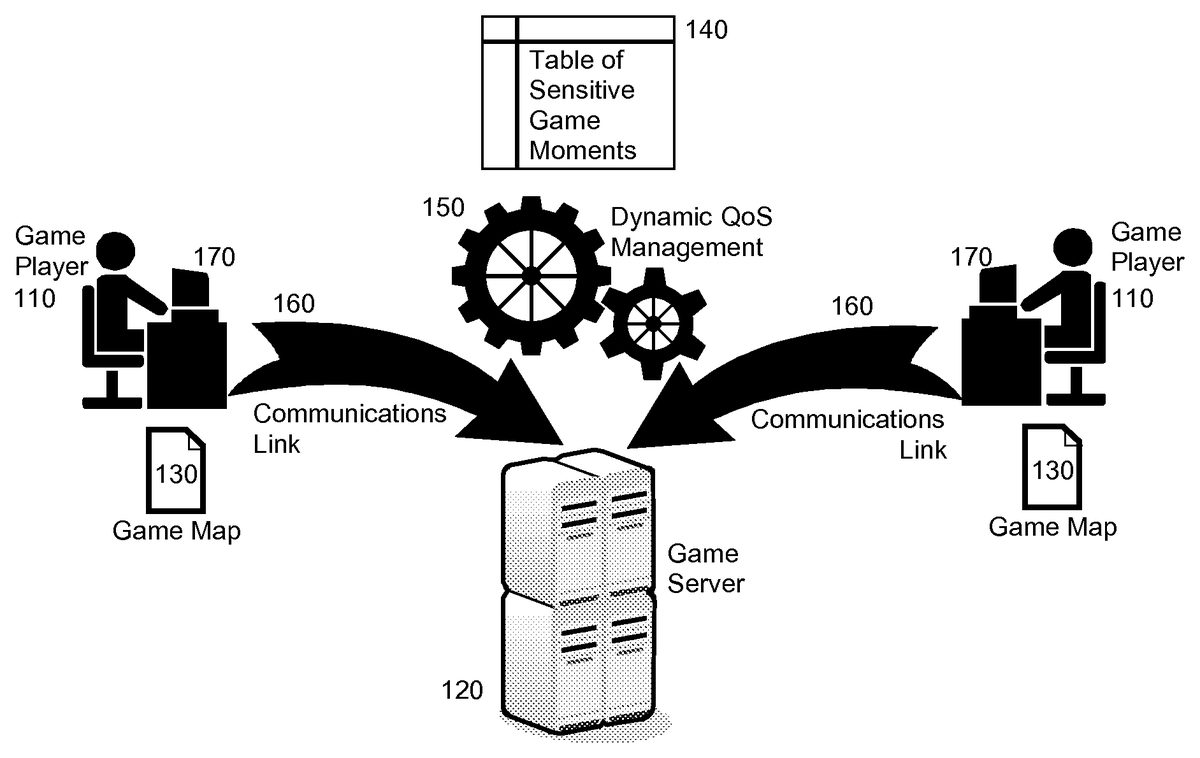
DETAILED DESCRIPTION OF THE INVENTION Embodiments of the invention provide for dynamic QoS management for multi-player gaming. In accordance with an embodiment of the invention, a multi-player game can be established in memory of a host computing system communicatively coupling together different players corresponding to respectively different characters in the multi-player game. One or more different highly sensitive game moments can be defined for the multi-player game. Thereafter, as a character approaches a highly sensitive game moment in the multi-player game, access to a computing resource to support the activities of the character can be enhanced. For example, additional memory can be allocated for use in supporting the activities of the character, increased processor usage can be allocated for use in supporting the activities of the character, or increased network bandwidth can be allocated for use in supporting the activities of the character. Conversely, when a character is not determined to be in or approaching a highly sensitive game moment, access to computing resources can be reduced. In this way, the QoS in the multi-player game for different players can vary according to the activities of the corresponding characters in the multi-player game. In further illustration,FIG. 1is a pictorial illustration of a process for dynamic QoS management for multi-player gaming. As shown inFIG. 1, different game players110through respective computers170and communications links160a multi-player game hosted by a game server120. The participation of each game player110in the multi-player game can be regulated according to a corresponding game map130which provides a visualization to the corresponding game player110of the location and movement of the game player110in the multi-player game. Of note, the ability of game players110to individually perform optimally in the multi-player game can depend upon access to computing resources provided to the game players110at any given time, including access to bandwidth in the ...
DETAILED DESCRIPTION OF THE INVENTION
Embodiments of the invention provide for dynamic QoS management for multi-player gaming. In accordance with an embodiment of the invention, a multi-player game can be established in memory of a host computing system communicatively coupling together different players corresponding to respectively different characters in the multi-player game. One or more different highly sensitive game moments can be defined for the multi-player game. Thereafter, as a character approaches a highly sensitive game moment in the multi-player game, access to a computing resource to support the activities of the character can be enhanced. For example, additional memory can be allocated for use in supporting the activities of the character, increased processor usage can be allocated for use in supporting the activities of the character, or increased network bandwidth can be allocated for use in supporting the activities of the character. Conversely, when a character is not determined to be in or approaching a highly sensitive game moment, access to computing resources can be reduced. In this way, the QoS in the multi-player game for different players can vary according to the activities of the corresponding characters in the multi-player game.
In further illustration,FIG. 1is a pictorial illustration of a process for dynamic QoS management for multi-player gaming. As shown inFIG. 1, different game players110through respective computers170and communications links160a multi-player game hosted by a game server120. The participation of each game player110in the multi-player game can be regulated according to a corresponding game map130which provides a visualization to the corresponding game player110of the location and movement of the game player110in the multi-player game. Of note, the ability of game players110to individually perform optimally in the multi-player game can depend upon access to computing resources provided to the game players110at any given time, including access to bandwidth in the communications links160, access to memory and processor resources in either the computers170or the game server120, and the responsiveness of the game server120to the requests of the game players110.
Dynamic QoS management logic150can manage the access to computing resources provided to the game players110. In this regard, the QoS management logic150can refer to the movements of the game players110in the multi-player game and can compare different moments for each of the different game players110in the multi-player game to entries in a table of game sensitive moments140. The table of game sensitive moments140can include an aggregation of pre-determined game moments of high sensitivity. To the extent that a particular game player110is determined to contemporaneously experience a game moment of high sensitivity, the dynamic QoS management logic150can provide enhanced access to computing resources for the game player110, such as enhanced bandwidth, increased memory or processing cycles, or priorities responsiveness in the game server120to requests from the game player110. Conversely, the extent that a particular game player110is determined not to contemporaneously experience a game moment of high sensitivity, the dynamic QoS management logic150can provide reduced access to computing resources for the game player110.
The process described in connection withFIG. 1can be implemented in a multi-player data processing system. In yet further illustration,FIG. 2schematically shows a multi-player gaming data processing system configured for dynamic QoS management. The system can include a host computing system250that includes one or more computers each with memory and at least one processor. The host computing system250can support the operation of a game server270configured to generate and manage a multi-player game260in which different game players interact collaboratively or adversely as the case may be. In this regard, different client computers210can be communicatively coupled to the game sever270over computer communications network220, each hosting an operating system230supporting the execution of a game client240through which a respective one of the game players interacts with others of the game players in the multi-player game260.
Importantly, a QoS management module300can be coupled to either or both of the game server270and one or more of the game clients240. The QoS management module300can include program code that when executed in memory of a computer can be enabled to monitor game moments for respectively different game players in the multi-player game260to determine whether or not the game moments are of high sensitivity. Upon determining a given game moment for a game player is highly sensitive, the program code of the QoS management module300can be enabled to apply one or more rules270to enhance access to computing resources for the game player—for example, by enhancing network bandwidth available to the game player, by prioritizing data transmitted to and from the game player, by increasing memory available to the game player either within a corresponding one of the client computers210or in the host computing system270, by increasing central processor unit (CPU) cycles available to the game player either within a corresponding one of the client computers210or in the host computing system270, or by prioritizing request handling in the game server270for requests from the game player.
In even yet further illustration of the operation of the QoS management module300,FIG. 3is a flow chart illustrating a process for dynamic QoS management for multi-player gaming. Beginning in block310, a programmatic link can be established with a game hosted by the game server on behalf of one or more game players. In block320, one or more game moment rules can be loaded into memory each indicating a resource modification that is to result in consequence of a detected game moment of a particular sensitivity. Optionally, the rules additionally can provide a manner in which to determine a degree of sensitivity for a game moment. For instance, a table can be consulted mapping game moments to a particular degree of sensitivity. As another example, a table can be consulted mapping a game moment to a specific modification of a specific resource for the benefit of the game players implicated by the game moment.
In block330, the events of the game can be monitored to detect a game moment. In decision block340, if a game moment is detected, in block350one or more of the rules can be applied to the moment. In particular, the rules can specify whether or not the detected game moment warrants an adjustment to one or more resources for the implicated game players. Alternatively, the rules can first rate the game moment to specify a degree of sensitivity and then, if the degree of sensitivity warrants, the rules can specify an adjustment to one or more resources for the implicated game players. In decision block360, if the application of the rules provide that an adjustment to one or more resources for the implicated game players is warranted, in block370those resources can be adjusted. Thereafter, the process can return to block330.
As will be appreciated by one skilled in the art, aspects of the present invention may be embodied as a system, method or computer program product. Accordingly, aspects of the present invention may take the form of an entirely hardware embodiment, an entirely software embodiment (including firmware, resident software, micro-code, etc.) or an embodiment combining software and hardware aspects that may all generally be referred to herein as a “circuit,” “module” or “system.” Furthermore, aspects of the present invention may take the form of a computer program product embodied in one or more computer readable medium(s) having computer readable program code embodied thereon.
Any combination of one or more computer readable medium(s) may be utilized. The computer readable medium may be a computer readable signal medium or a computer readable storage medium. A computer readable storage medium may be, for example, but not limited to, an electronic, magnetic, optical, electromagnetic, infrared, or semiconductor system, apparatus, or device, or any suitable combination of the foregoing. More specific examples (a non-exhaustive list) of the computer readable storage medium would include the following: an electrical connection having one or more wires, a portable computer diskette, a hard disk, a random access memory (RAM), a read-only memory (ROM), an erasable programmable read-only memory (EPROM or Flash memory), an optical fiber, a portable compact disc read-only memory (CD-ROM), an optical storage device, a magnetic storage device, or any suitable combination of the foregoing. In the context of this document, a computer readable storage medium may be any tangible medium that can contain, or store a program for use by or in connection with an instruction execution system, apparatus, or device.
A computer readable signal medium may include a propagated data signal with computer readable program code embodied therein, for example, in baseband or as part of a carrier wave. Such a propagated signal may take any of a variety of forms, including, but not limited to, electro-magnetic, optical, or any suitable combination thereof. A computer readable signal medium may be any computer readable medium that is not a computer readable storage medium and that can communicate, propagate, or transport a program for use by or in connection with an instruction execution system, apparatus, or device.
Program code embodied on a computer readable medium may be transmitted using any appropriate medium, including but not limited to wireless, wireline, optical fiber cable, radiofrequency, and the like, or any suitable combination of the foregoing. Computer program code for carrying out operations for aspects of the present invention may be written in any combination of one or more programming languages, including an object oriented programming language and conventional procedural programming languages. The program code may execute entirely on the user's computer, partly on the user's computer, as a stand-alone software package, partly on the user's computer and partly on a remote computer or entirely on the remote computer or server. In the latter scenario, the remote computer may be connected to the user's computer through any type of network, including a local area network (LAN) or a wide area network (WAN), or the connection may be made to an external computer (for example, through the Internet using an Internet Service Provider).
Aspects of the present invention have been described above with reference to flowchart illustrations and/or block diagrams of methods, apparatus (systems) and computer program products according to embodiments of the invention. In this regard, the flowchart and block diagrams in the Figures illustrate the architecture, functionality, and operation of possible implementations of systems, methods and computer program products according to various embodiments of the present invention. For instance, each block in the flowchart or block diagrams may represent a module, segment, or portion of code, which comprises one or more executable instructions for implementing the specified logical function(s). It should also be noted that, in some alternative implementations, the functions noted in the block may occur out of the order noted in the figures. For example, two blocks shown in succession may, in fact, be executed substantially concurrently, or the blocks may sometimes be executed in the reverse order, depending upon the functionality involved. It will also be noted that each block of the block diagrams and/or flowchart illustration, and combinations of blocks in the block diagrams and/or flowchart illustration, can be implemented by special purpose hardware-based systems that perform the specified functions or acts, or combinations of special purpose hardware and computer instructions.
It also will be understood that each block of the flowchart illustrations and/or block diagrams, and combinations of blocks in the flowchart illustrations and/or block diagrams, can be implemented by computer program instructions. These computer program instructions may be provided to a processor of a general purpose computer, special purpose computer, or other programmable data processing apparatus to produce a machine, such that the instructions, which execute via the processor of the computer or other programmable data processing apparatus, create means for implementing the functions/acts specified in the flowchart and/or block diagram block or blocks.
These computer program instructions may also be stored in a computer readable medium that can direct a computer, other programmable data processing apparatus, or other devices to function in a particular manner, such that the instructions stored in the computer readable medium produce an article of manufacture including instructions which implement the function/act specified in the flowchart and/or block diagram block or blocks. The computer program instructions may also be loaded onto a computer, other programmable data processing apparatus, or other devices to cause a series of operational steps to be performed on the computer, other programmable apparatus or other devices to produce a computer implemented process such that the instructions which execute on the computer or other programmable apparatus provide processes for implementing the functions/acts specified in the flowchart and/or block diagram block or blocks.
Finally, the terminology used herein is for the purpose of describing particular embodiments only and is not intended to be limiting of the invention. As used herein, the singular forms “a”, “an” and “the” are intended to include the plural forms as well, unless the context clearly indicates otherwise. It will be further understood that the terms “comprises” and/or “comprising,” when used in this specification, specify the presence of stated features, integers, steps, operations, elements, and/or components, but do not preclude the presence or addition of one or more other features, integers, steps, operations, elements, components, and/or groups thereof.
The corresponding structures, materials, acts, and equivalents of all means or step plus function elements in the claims below are intended to include any structure, material, or act for performing the function in combination with other claimed elements as specifically claimed. The description of the present invention has been presented for purposes of illustration and description, but is not intended to be exhaustive or limited to the invention in the form disclosed. Many modifications and variations will be apparent to those of ordinary skill in the art without departing from the scope and spirit of the invention. The embodiment was chosen and described in order to best explain the principles of the invention and the practical application, and to enable others of ordinary skill in the art to understand the invention for various embodiments with various modifications as are suited to the particular use contemplated.
Having thus described the invention of the present application in detail and by reference to embodiments thereof, it will be apparent that modifications and variations are possible without departing from the scope of the invention defined in the appended claims as follows.
Claims
- A computer program product for dynamic quality of service (QoS) management for multi-player gaming, the computer program product comprising: a non-transitory computer readable storage medium having computer readable program code embodied therewith, the computer readable program code comprising: computer readable program code for monitoring a multi-player game;computer readable program code for detecting a game moment for a game player in the multi-player game;computer readable program code for determining a degree of sensitivity for the game moment;and, computer readable program code for enhancing access of the game player to a computing resource in response to determining the game moment to be highly sensitive.
- The computer program product of claim 1 , further comprising: computer readable program code for detecting a subsequent game moment for the game player in the multi-player game;computer readable program code for determining a degree of sensitivity for the subsequent game moment;and, computer readable program code for reducing access of the game player to a computing resource in response to determining the game moment to be less sensitive.
- The computer program product of claim 1 , wherein the game moment is determined to be highly sensitive when the game player is poised to engage in a coordinated attack.
- The computer program product of claim 1 , wherein the game moment is determined to be highly sensitive when the game player is in proximity of an enemy.
- The computer program product of claim 1 , wherein the resource is communications bandwidth.
- The computer program product of claim 1 , wherein the resource is memory.
- The computer program product of claim 1 , wherein the resource is central processing unit (CPU) access.
Disclaimer: Data collected from the USPTO and may be malformed, incomplete, and/or otherwise inaccurate.