U.S. Pat. No. 10,232,259
Apparatus, Method and Computer Readable Storage Medium for Collecting Doobers in an Electronic Game
AssigneeZynga Inc.
Issue DateJuly 18, 2017
Illustrative Figure
Abstract
An apparatus, method and computer-readable storage medium for efficiently collecting doobers. A game area may be presented in a graphical user interface on a display device. The game area may include a game character associated with a first player, regions and objects within the regions. The character may move within the regions and interact with the objects. One or more doobers may be presented in the game area, and the doober(s) may be identified as collected by the first player in response to one or more inputs to the graphical user interface by the first player. The doober(s) may be marked as collected if an input is within a particular distance from the doober(s).
Description
DETAILED DESCRIPTION Embodiments may be discussed herein to efficiently collect doobers in an electronic game. In an embodiment, an electronic game apparatus may be provided for efficiently collecting doobers. The apparatus may include a graphical user interface to receive and respond to player inputs and present data to a first player; a display device to present the graphical user interface; and a processor that executes computer instructions for responding to player inputs and manipulating the presentation of data in the graphical user interface and causing the presentation of the data on the display device. The processor may be configured to present a game window in the graphical user interface on the display device. The game window may include a game character associated with the first player, regions and objects within the regions. The character may move within the regions and interact with the objects. The processor may also be configured to present one or more doobers in the game window, and the processor may be configured to mark the doober(s) as collected by the first player in response to one or more inputs to the graphical user interface by the first player. A doober may be marked as collected if an input moves a cursor within a particular distance from the doober. Another embodiment provides a method for performing the steps executed by the previously described apparatus for efficiently collecting doobers in an electronic game. Another embodiment provides a computer readable medium containing computer readable program instructions that when executed by a processor performs the previously described method for efficiently collecting doobers in an electronic game. FIG. 1illustrates an exemplary view of a graphical user interface according to an embodiment of the present invention. The graphical user interface (GUI)100may be presented on a display device, e.g., computer monitor, tablet computer, ...
DETAILED DESCRIPTION
Embodiments may be discussed herein to efficiently collect doobers in an electronic game. In an embodiment, an electronic game apparatus may be provided for efficiently collecting doobers. The apparatus may include a graphical user interface to receive and respond to player inputs and present data to a first player; a display device to present the graphical user interface; and a processor that executes computer instructions for responding to player inputs and manipulating the presentation of data in the graphical user interface and causing the presentation of the data on the display device. The processor may be configured to present a game window in the graphical user interface on the display device. The game window may include a game character associated with the first player, regions and objects within the regions. The character may move within the regions and interact with the objects. The processor may also be configured to present one or more doobers in the game window, and the processor may be configured to mark the doober(s) as collected by the first player in response to one or more inputs to the graphical user interface by the first player. A doober may be marked as collected if an input moves a cursor within a particular distance from the doober.
Another embodiment provides a method for performing the steps executed by the previously described apparatus for efficiently collecting doobers in an electronic game.
Another embodiment provides a computer readable medium containing computer readable program instructions that when executed by a processor performs the previously described method for efficiently collecting doobers in an electronic game.
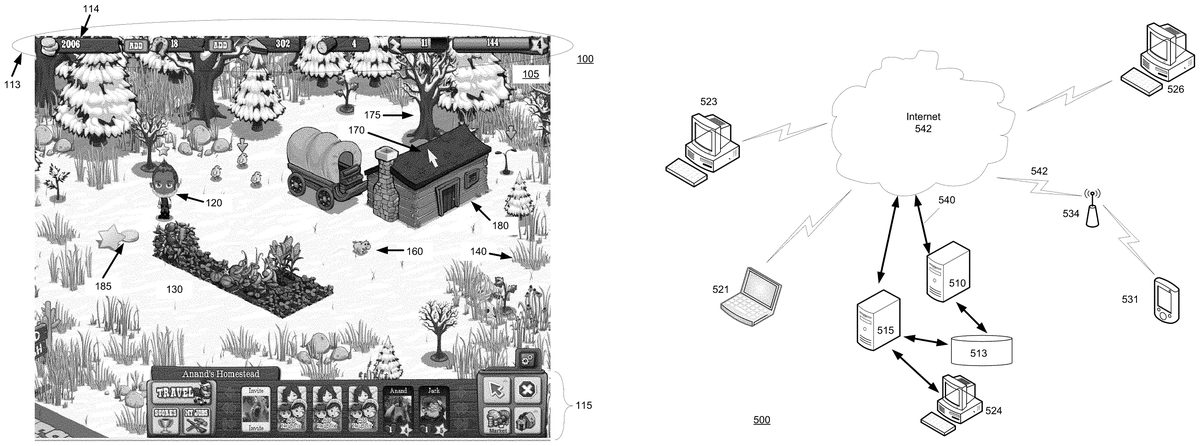
FIG. 1illustrates an exemplary view of a graphical user interface according to an embodiment of the present invention. The graphical user interface (GUI)100may be presented on a display device, e.g., computer monitor, tablet computer, television. The graphical user interface100may present a game board105that is an environment with which an avatar120interacts. For example,FIG. 1shows an frontier-themed game board environment. Other themes, such as the “wild west,” underwater, extraterrestrial, archeological, fantasy-oriented themed game board environments may also be used. In addition, the GUI100may include tabs (not shown) for navigating between different game screens. The avatar120may be a character representation of a player, and may respond to inputs to the GUI100. The game board105may include indicators, such as a task list (not shown), tool kits115, game progress indicators113. No matter the theme of the game board, the game boards, including game board105, may have in addition to an avatar120, paths130for traveling around the game board105, and objects140and160. Objects may include obstacles, such as bushes, or traps, such as a banana peel that may cause the avatar120to slip. Objects may also include animals, plants, and structures that the avatar may interact with. Obstacle objects140may be removed by the player by commanding the avatar120to perform some action. For example, the player may select a tool from the tool kit115, and the avatar120, in response to player inputs to the GUI100, may clear the bushes (obstacle object140) that block a path. A task list may present a number of tasks that are to be performed by the player via the avatar120during game play. Some of the tasks in the task list, e.g., feed the cute piglet160, may be easily accomplished by the player, while others may be more challenging.
Inputs to GUI100which control the avatar120and other objects in the game may be via an input device such as a keyboard, a mouse device, or a combination of both. For example, the player may use a mouse device which controls a cursor (for example, a mouse pointer)170to move the cursor to a particular location on the GUI100, and click one or more buttons on the mouse to select an object and then control that object. For example, in an embodiment, the player may use a mouse device to move cursor170to avatar120to select the avatar120, and then move the cursor over an object such as the piglet160, and click on the piglet160to instruct the avatar to feed the piglet160. In another embodiment, the player may use a mouse device to move cursor170to avatar120to select the avatar120, and then press one or more keys on a keyboard device to instruct the avatar120to perform an action or a task.
During game play, the player may be awarded points and/or rewards for completing tasks or successfully interacting with certain objects in order to complete tasks. For example, in an embodiment, a task may be presented to the player to build an extension to the house180. In order to do so, the avatar120may have to cut down a tree175to obtain lumber required to build the extension. If the player successfully cuts down the tree175and obtains lumber, the player may be given a reward such as points or money. These rewards may be used by the player to obtain objects in the game to enhance the game play experience (for example, a new outfit for the avatar) or to obtain objects to advance the player in the game (for example, a tool that helps the avatar complete tasks, or complete tasks quicker). In an embodiment, rewards/points may automatically accumulate when a player completes a task or interacts with an object.
In an embodiment, a reward may appear on the GUI100as a visual representation of the reward185, but the player may not benefit from the reward until the player collects or acquires the visual representation of the reward185. The visual representation of the reward may be called a doober. For example, the doober185may be game play money which may be used by the player to obtain tools or materials in the game. In an embodiment, the visual representation of the money185will not be added to the player's overall accumulated money114in the game unless the player acquires the doober. For example, the overall accumulated money114may increase from 2006 to 2007 once the player acquires the doober185. In order to acquire the doober, the player may have to perform one or more actions. In an embodiment, to acquire the doober, the player may move the avatar120close to the location of the doober. In a further embodiment, the player may move cursor170via a mouse device to the doober185and click a button on the mouse device.
In the above exemplary embodiments, the player has to execute more than one action, or a complex action, in order to collect the doober185. It may be advantageous for the player to acquire the doober with a single action, or one or more simple actions. Accordingly, in an embodiment, the player may move cursor170via a mouse device to the doober185, and may automatically accumulate the reward when the cursor touches the doober185. This may be referred to as a mouseover. In an embodiment, the player only needs to move the cursor within a distance threshold from the doober185to accumulate the reward.
FIG. 2illustrates an exemplary view of a graphical user interface after acquiring a doober according to an embodiment of the present invention.FIG. 2shows the game board105(fromFIG. 1) after the doober185is acquired by touching the doober185with cursor270. The doober185may disappear as soon as cursor270touches the doober185, and the reward accumulated by the player may be incremented. For example, the number of coins accumulated by the player may be incremented from 2006 to 2007 (214) as a result of acquiring the doober185. Acquiring the doober185may also be accompanied by a notice285on the GUI indicating to the player that doober185has been acquired. For example, the notice285indicates that +1 coins were gained.
FIG. 3illustrates a doober and an acquire space around a doober in an exemplary embodiment of the present invention.FIG. 3shows an overhead view of an exemplary doober310. The exemplary doober is shown in the form of two coins, but a person having ordinary skill in the art will appreciate that the doober may take any visual representation form. In an embodiment, a player may need to move a cursor until the cursor touches the outline of the doober310in order to acquire the doober. In another embodiment, a player only needs to move the cursor until the cursor touches the outline of the space surrounding the doober320to acquire the doober. This space may be referred to as the doober acquire space. The doober acquire space may be defined by various spatial parameters. For example, the doober acquire space may be take any shape including a rectangular area320or a circular area330. The doober acquire space does not necessarily have to be symmetrical, and can be irregularly shaped. AlthoughFIG. 3has been illustrated with 2-dimensional drawings, the principles discussed inFIG. 3are applicable to games which render graphics in a 3-dimensional space. Specifically, doober310may occupy 3-dimensions, and doober acquire space320may be a 3-dimensional rectangular cube encapsulating 3-dimensional doober310. Similarly, a 3-dimensional sphere330, may encapsulate a doober. When a cursor touches the 3-dimensional space which encapsulates the doober, the doober may be acquired.
FIG. 4illustrates acquiring a doober in a first person shooter electronic game in an exemplary embodiment of the present invention. Examples of first person shooter games are Doom, Half Life, Halo, and Modern Warfare. The graphical user interface (GUI)400may be presented on a display device, e.g., computer monitor, tablet computer, television. The graphical user interface400may present a 3-dimensional game view405of an environment in which a player interacts with game objects and game characters. The player views the game from a first person perspective of an associated character within the game. I.e., the player views the game through the eyes of the character and can interact with the game environment by manipulating the character through inputs via input devices such as a mouse, keyboard, or a joystick. The crosshair470shows the position of a cursor (for example, a mouse pointer), and controls the direction in which the character's eyes are directed. The player can control the view on the GUI400, by moving the cursor. The player may also control the movement of his/her associated character via an input device such as a keyboard or a joystick. As the character moves (for example, walks or runs) in the game, the point of view of the character, and consequently the image displayed on the GUI400, changes.
A doober485may be presented in a first person shooter video game. The doober485may be a visual representation of an object that is beneficial to the character associated with the player. For example, in an exemplary military themed game, the doober485may be a weapon, ammo, health, or a shield. In traditional first person shooter games, the player has to move the character to the location of the doober485in order to acquire the doober485. In addition, the player may have to press a button to acquire the doober485. Therefore, it is desirable to acquire the doober by minimizing the number of steps and/or effort. Accordingly, in an embodiment, the player may move cursor470via an input device to the doober485, and may automatically acquire the doober485when the cursor touches the doober485. In an embodiment, the player only needs to move the cursor within a distance threshold from the doober485.
Although the above embodiments have been discussed in the context of online games with a game board and first person shooter games, a person having ordinary skill in the art will appreciate that the principles discussed are not restrictive and can be applied to any type of video game including third person shooters, tactical shooters, light-gun games, role-playing games, strategy games, simulation games, sports games, massively multiplayer online games, arcade games, and fighting games.
FIG. 5illustrates an exemplary hardware configuration for implementing a system according to an embodiment of the present invention. The system500may comprise one or more networked servers510and515, one or more player computers521,523,524and526, data storage devices513, wired and wireless communication links540,542, wireless access point534, and portable device(s)531. The one or more networked servers510and515may execute a multi-application software system that may include a web server, gaming software applications and social networking applications. The servers510,515may include processor(s), internal memory and related computer program instructions (all not shown). The player computers521,523,524,526may include a processor, display device, and data storage device, such as a hard disk (all not shown).
The server510and/or515may provide connectivity between the players' computers521,523,524and526, and/or players' portable device(s)531over wired or wireless communication paths. The server510may access data storage device(s)513that store machine-readable software instructions for executing the described method which may be accessed and executed by the processor(s) of the server510. The instructions for generating and presenting may be downloaded to players' computers521,523,524and526, and/or players' portable device(s)531over wired or wireless communication paths. The game software may execute on the processors in the players' computers521,523,524and526, and/or players' portable device(s)531.
The data storage device(s)513also may store data related to the players for future use. The data storage device513that may be a hard disk drive, non-volatile memory, flash memory, or any suitable device for storing electronic data, and may be organized as a object-oriented or relational database.
The servers510and515may communicate with client terminal(s)521,523,524,526and portable device(s)531via the internet542. The player computers521,523,524,526may include a processor, display device, and data storage device, such as a hard disk (all not shown). The client terminals521,523,524,526may participate in execution of program instructions. The portable device531may be a smartphone, personal digital assistant, tablet, notebook or mini-notebook computer capable of wired and/or wireless communication. The portable device531may include memory, a processor, input device, display, and devices that enable wired or wireless communication.
Several embodiments of the present invention are specifically illustrated and described herein. Those skilled in the art may appreciate from the foregoing description that the present invention may be implemented in a variety of forms, and that the various embodiments may be implemented alone or in combination. In other instances, well-known operations, components and circuits have not been described in detail so as not to obscure the embodiments. It can be appreciated that the specific structural and functional details disclosed herein may be representative and do not necessarily limit the scope of the embodiments. Therefore, while the embodiments of the present invention have been described in connection with particular examples thereof, the true scope of the embodiments and/or methods of the present invention should not be so limited since other modifications will become apparent to the skilled practitioner upon a study of the drawings, specification, and following claims.
Various embodiments may be implemented using hardware elements, software elements, or a combination of both. Examples of hardware elements may include processors, microprocessors, circuits, circuit elements (e.g., transistors, resistors, capacitors, inductors, and so forth), integrated circuits, application specific integrated circuits (ASIC), programmable logic devices (PLD), digital signal processors (DSP), field programmable gate array (FPGA), logic gates, registers, semiconductor device, chips, microchips, chip sets, and so forth. Examples of software may include software components, programs, applications, computer programs, application programs, system programs, machine programs, operating system software, middleware, firmware, software modules, routines, subroutines, functions, methods, procedures, software interfaces, application program interfaces (API), instruction sets, computing code, computer code, code segments, computer code segments, words, values, symbols, or any combination thereof. Determining whether an embodiment is implemented using hardware elements and/or software elements may vary in accordance with any number of factors, such as desired computational rate, power levels, heat tolerances, processing cycle budget, input data rates, output data rates, memory resources, data bus speeds and other design or performance constraints.
Some embodiments may be implemented, for example, using a computer-readable medium or article which may store an instruction or a set of instructions that, if executed by a machine, may cause the machine to perform a method and/or operations in accordance with the embodiments. Such a machine may include, for example, any suitable processing platform, computing platform, computing device, processing device, computing system, processing system, computer, processor, or the like, and may be implemented using any suitable combination of hardware and/or software. The computer-readable medium or article may include, for example, any suitable type of memory unit, memory device, memory article, memory medium, storage device, storage article, storage medium and/or storage unit, for example, memory, removable or non-removable media, erasable or non-erasable media, writeable or re-writeable media, digital or analog media, hard disk, floppy disk, Compact Disc Read Only Memory (CD-ROM), Compact Disc Recordable (CD-R), Compact Disc Rewriteable (CD-RW), optical disk, magnetic media, magneto-optical media, removable memory cards or disks, various types of Digital Versatile Disc (DVD), Blu-ray Disc (BD), a tape, a cassette, or the like. The instructions may include any suitable type of code, such as source code, compiled code, interpreted code, executable code, static code, dynamic code, encrypted code, and the like, implemented using any suitable high-level, low-level, object-oriented, visual, compiled and/or interpreted programming language.
Claims
- An electronic game apparatus comprising: a graphical user interface to receive and respond to player inputs and present data to a player;a display device to present the graphical user interface;and a processor that executes computer instructions for responding to player inputs and manipulating the data in the graphical user interface and causing the presentation of the data on the display device, the processor configured to: process data to present a game area in the graphical user interface on the display device, the game area including a game character associated with the player, wherein the character is configured to move within regions in the game area and interact with objects in the regions responsive to said player inputs;and process data to generate a visual representation of a doober in response to movement of an input in the graphical user interface that is within a predefined distance from the doober, wherein the doober is rendered as a graphical object within the game area and a graphical indication is provided to signal that the doober has been collected when the input in the graphical user interface is within the predetermined distance.
- The apparatus of claim 1 , wherein the at least one input touches the doober, and the apparatus is one of a computer, a smartphone, a tablet computer, or a personal digital assistant.
- The apparatus of claim 1 , wherein the electronic game is presented with an interface to a social network website.
- The apparatus of claim 1 , wherein the electronic game is a first person shooter game or a social game.
- A method executed for access via an electronic game system comprising: receiving from a server data for presenting a game area in a graphical user interface on a display device, the game area providing access to an input controllable by a player, wherein the input is used for interacting with objects in the game area;receiving data from the server for presenting a doober in the game area;and processing instructions to identify when the doober is interacted with using the input, the interaction with the doober is indicative of a collection of said doober by the player, wherein the input is qualified as interaction with the doober when the input is provided within a predefined distance from the doober, wherein the doober is rendered as a graphical object within the game area, and a graphical indication is provided to signal that the doober has been collected.
- The method of claim 5 , wherein the input simulates a touch with the doober, and the display device is associated with one of a computer, a smartphone, a tablet computer, or a personal digital assistant.
- The method of claim 5 , wherein the electronic game is presented via a social network website or with an interface to the social network website.
- The method of claim 5 , wherein the electronic game is a first person shooter game or a social game.
- Computer readable media having non-transitory instructions for processing a game when executed by an electronic device, the computer readable media comprising: program instructions for receiving from a server data for presenting a game area in a graphical user interface on a display device, the game area providing access to an input controllable by a player, wherein the input is used for interacting with objects in the game area;program instructions for receiving data from the server for presenting a doober in the game area;and program instructions for processing instructions to identify when the doober is interacted with using the input, the interaction with the doober is indicative of a collection of said doober by the player, wherein the input is qualified as interaction with the doober when the input is provided within a predefined distance from the doober, wherein the doober is rendered as a graphical object within the game area, and a graphical indication is provided to signal that the doober has been collected.
- The computer readable media of claim 9 , wherein the input simulates a touch with the doober, and the display device is associated with one of a computer, a smartphone, a tablet computer, or a personal digital assistant.
- The computer readable media of claim 9 , wherein the electronic game is presented via a social network website or with an interface to the social network website.
- The computer readable media of claim 9 , wherein the electronic game is a first person shooter game or a social game.
Disclaimer: Data collected from the USPTO and may be malformed, incomplete, and/or otherwise inaccurate.