U.S. Pat. No. 10,226,703
SYSTEM AND METHOD OF GENERATING AND PROVIDING INTERACTIVE ANNOTATION ITEMS BASED ON TRIGGERING EVENTS IN A VIDEO GAME
AssigneeACTIVISION PUBLISHING, INC.
Issue DateApril 22, 2016
Illustrative Figure
Abstract
A system and method is provided that automatically annotates gameplay based on triggering events that occur during a gameplay session. The system may automatically annotate the gameplay in real-time, such as during a gameplay session associated with an electronic-sports tournament. For example, the system may obtain and parse a game log corresponding to the gameplay session, identify triggering events based on the game log, obtain an annotation rule associated with the triggering event, generate an annotation item based on the annotation rule, and cause the annotation item to be presented in association with video of the gameplay session. An annotation item may be displayed interactively such that, when selected, causes the system to take an action. The action may include obtaining additional information relating to the selected annotation item; saving, sharing, liking/disliking or commenting on the selected annotation item; removing the selected annotation item from a display, and/or other actions.
Description
DETAILED DESCRIPTION OF THE INVENTION The invention described herein relates to a system and method of automatically annotating gameplay of a video game based on triggering events. While aspects (including examples) of the invention may be described herein with reference to particular types of video game genres, the system and method described in detail herein may be used in any genre of single or multiplayer video game. Exemplary System Architecture FIG. 1illustrates a system100of automatically annotating gameplay of a video game based on triggering events, according to an implementation of the invention. As used herein, the term “automatically” (e.g., automatically annotating gameplay of a video game) denotes that a computer system is programmed to annotate gameplay without human intervention based on logic that programs the computer system, one or more rules, and/or other information the computer system may use to generate annotations without human intervention. Such terminology, however, does not preclude the intervention by a human to either modify the automatically generated annotations, delete (or otherwise prevent the dissemination of) the automatically generated annotations, provide information used by the computer system110to automatically generate the annotations, or otherwise interact with the annotations after they have been automatically generated annotations. In one implementation, system100may include a game host104, a decoder106, a computer system110, one or more databases130, and/or other components. Game Logs In an implementation, game host104may host a gameplay session101between one or more players103and generate a game log121based on gameplay during gameplay session101. A game log, which may be generated by a game engine (e.g., executing at game host104), describes gameplay during a given gameplay session such that events occurring during the video game session may be recreated. In a sense, a game log may be thought of as a recording of events that occurred during gameplay, even though a game ...
DETAILED DESCRIPTION OF THE INVENTION
The invention described herein relates to a system and method of automatically annotating gameplay of a video game based on triggering events. While aspects (including examples) of the invention may be described herein with reference to particular types of video game genres, the system and method described in detail herein may be used in any genre of single or multiplayer video game.
Exemplary System Architecture
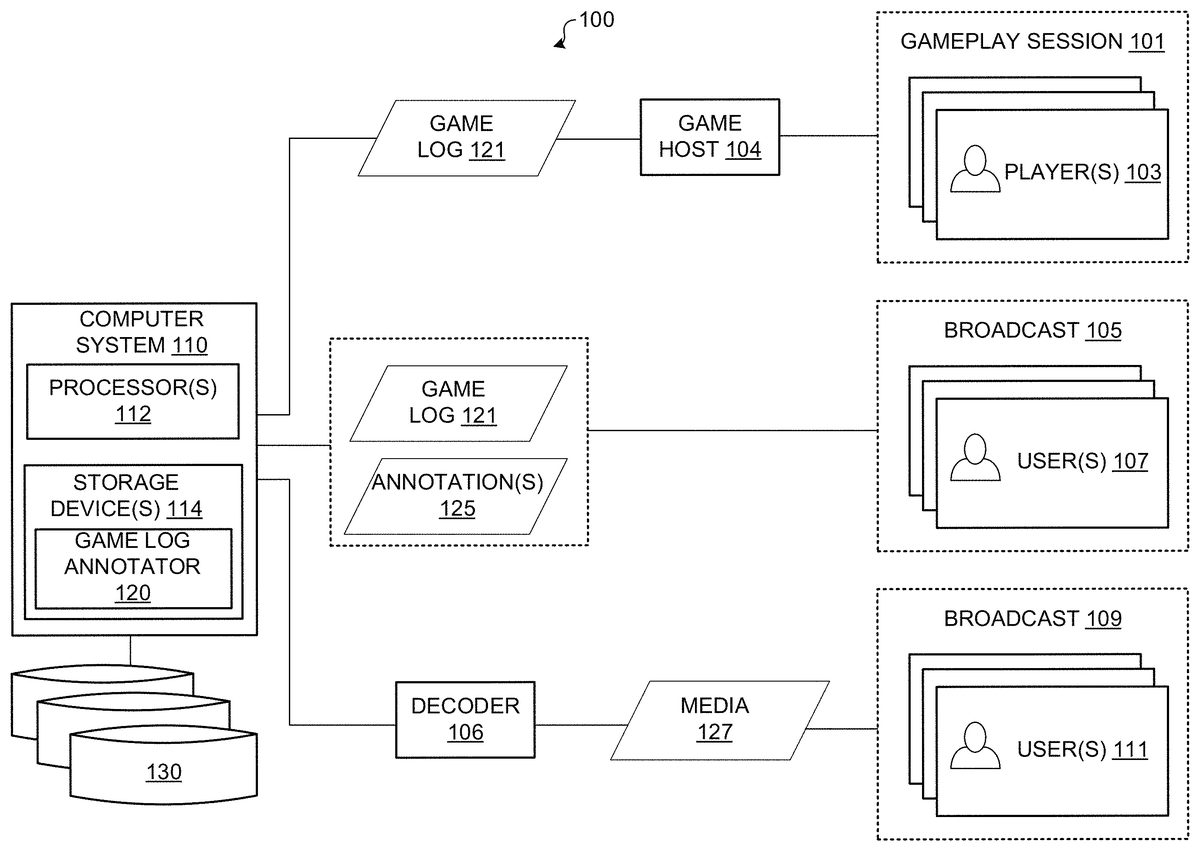
FIG. 1illustrates a system100of automatically annotating gameplay of a video game based on triggering events, according to an implementation of the invention. As used herein, the term “automatically” (e.g., automatically annotating gameplay of a video game) denotes that a computer system is programmed to annotate gameplay without human intervention based on logic that programs the computer system, one or more rules, and/or other information the computer system may use to generate annotations without human intervention. Such terminology, however, does not preclude the intervention by a human to either modify the automatically generated annotations, delete (or otherwise prevent the dissemination of) the automatically generated annotations, provide information used by the computer system110to automatically generate the annotations, or otherwise interact with the annotations after they have been automatically generated annotations.
In one implementation, system100may include a game host104, a decoder106, a computer system110, one or more databases130, and/or other components.
Game Logs
In an implementation, game host104may host a gameplay session101between one or more players103and generate a game log121based on gameplay during gameplay session101. A game log, which may be generated by a game engine (e.g., executing at game host104), describes gameplay during a given gameplay session such that events occurring during the video game session may be recreated. In a sense, a game log may be thought of as a recording of events that occurred during gameplay, even though a game log may not be a “video recording” per se in that the game log itself is not played back by a conventional media player (unless converted to a conventional media format as described herein). Instead, a game log may include information that indicates one or more game events that have occurred during gameplay. In an implementation, a game log may include information relating to player activity during gameplay such as the presence or absence of player chats via headsets, the amplitude/volume of such headset chat, texting/chatting in out-of-band streams, observed physical behavior of a player (e.g., a player standing, jumping, etc.) based on inputs from peripheral devices such as cameras, and/or other player activity information.
Accordingly, gameplay that occurred during a video game session may be replayed based on the game events (hereinafter, such replay based on a game log will be referred to as a “video game playback” even though a replay may occur substantially in real-time—e.g., as a gameplay session is occurring—or not in real-time—e.g., stored and later retrieved for later video game playback). Because a game log specifies game events that occurred during gameplay rather than a rendering of the gameplay, a given game log occupies a much smaller footprint than a conventional media file that would, for example, render video of the gameplay.
The game events may include, without limitation, a player's input, a game engine's response to a player's input, an interaction between a bot and another player (e.g., another human player or another bot), an interaction between virtual objects and other objects or players, and/or other event that can occur during gameplay. A game event may be recorded as information that encodes the event. For instance, a game event may be encoded as a generic event, such as “player input button A,” or a specific event (e.g., specific to a particular game), such as “player defeated boss X.” A computer readable mapping of events to encodings may be stored in a database as well, in which case a game log may simply include encodings that map to particular events.
A given game log may be associated with video game information such as, without limitation, a video game title, a video game genre related to the video game title, a publisher of the video game title, the names of player(s) involved in a video game session to which the game log relates, and/or other information relating to the video game or video game session to which the game log relates.
Game host104may generate the game log in real-time (e.g., as gameplay is happening) and may stream the game log as it is generated to one or more other devices for annotating gameplay and/or broadcasting the gameplay. For example, game host104may provide the game log to computer system110for automatic annotation of the gameplay. It should be noted, however, that the functions of computer system110may be incorporated within the game host (and vice versa). For example, game host104and computer system110may be housed within the same device or may cooperate together (e.g., they may each be server blades/processors that cooperatively work together).
Annotating Gameplay
Computer system110may be configured as a server (e.g., having one or more server blades, processors, etc.), a gaming console, a handheld gaming device, a personal computer (e.g., a desktop computer, a laptop computer, etc.), a smartphone, a tablet computing device, and/or other device that is programmed to automatically annotate gameplay of a video game as described herein.
Computer system110may include one or more processors112(also interchangeably referred to herein as processors112, processor(s)112, or processor112for convenience), one or more storage devices114(which may store a gameplay annotator120), and/or other components. Processors112may be programmed by one or more computer program instructions. For example, processors112may be programmed by gameplay annotator120and/or other instructions. Gameplay annotator120may include various instructions that program computer system110. As described herein, gameplay annotator120will be described as programming computer system110to perform various operations. However, it should be understood that a portion (or all) of gameplay annotator120may, alternatively or additionally, program other system components (e.g., an end user device) to perform at least some of the functions of gameplay annotator120.
Identifying Triggering Events
In an implementation, gameplay annotator120may parse (e.g., read), either in real-time or after gameplay session101has concluded, the game log. Whether real-time or not, such parsing may occur in intervals (as described below with respect toFIG. 2A) or continuously (as described below with respect toFIG. 2B). Regardless of the method by which parsing is performed, gameplay annotator120may identify one or more triggering events based on the parsing. For example, a triggering event may have occurred during gameplay and be specified in the game log, from which the triggering event is parsed and identified.
A triggering event may include an in-game event that may be of interest to an audience member (e.g., user107, user111) viewing the gameplay. For example, and without limitation, a triggering event may include the gameplay session has reached a particular game state (e.g., a start/end of a match, a change in location of action (e.g., combat moves from one area of the map to another), an injury to a particular player (e.g., in a basketball, football or sports simulation), a number or all players dying except one), an in-game achievement by one or more players (e.g., a first kill of a match, a first score, a score differential by certain threshold, a particular type of achievement has been reached (e.g., that's the 10th time a player has gotten a double kill this match or that's a player's 5th basketball assist to another player this video gameplay session)), and/or other event that may be of interest to a user.
Triggering events may be customized for a given game. Such customizations may be made by a game developer, a player103, a user107, a user111, and/or others. Information specifying the triggering events and/or customizations may be stored in a triggering event repository, such as a database130. For example, a triggering event may be stored as a triggering event identifier, and a triggering event type or description.
Generating Annotation Items Based on Annotation Rules Tied to Triggering Events
In an implementation, gameplay annotator120may obtain, responsive to identification of a triggering event, a corresponding set of one or more annotation rules relating to the triggering event. For example, an annotation rules database (e.g., a database130) may store annotation rules in association with information identifying triggering events (e.g., a triggering event identifier). Alternatively or additionally, the annotation rules may be part of the logic of gameplay annotator120. In either or both instances, each triggering event may be associated with (e.g., mapped to) one or more annotation rules that specifies how to handle the triggering event.
An annotation rule may relate to a game characteristic relating to the triggering event. For example, an annotation rule may relate to players/teams involved in a gameplay session, a time that the triggering event occurred in the game (e.g., if the trigger is one team killing all the members of the opposing team, the annotation item(s) that are generated may depend on whether the triggering event is detected at the in the first 3 minutes of the game, minutes 3-10, or after the 10 minute mark), a location (e.g., on a game map) at which the triggering event was detected, a number of times the triggering event was detected previously in the match, the events that were recorded the last time the triggering detected was detected, etc.).
A given annotation rule may specify that coarse (e.g., general) and/or more granular (e.g., specific) information be gathered and provided as an annotation item in response to a triggering event. Alternatively or additionally, two or more annotation rules may be associated with a triggering event. One of the annotation rules may specify that one piece of information be provided in response to the triggering event while another one of the annotation rules may specify that another piece of information be provided in response to the triggering event. The information for the annotation item(s) may be obtained from a pre-stored statistical/historical database of gameplay (e.g., a database130) and/or may be gathered from the game log itself (e.g., in-game statistics for the current gameplay session such as number of kills, kill-to-death “k/d” ratio, number of pistol kills, success rate after entry, heads-up matches, etc.). As such, annotation items may relate to historical statistical data and/or current in-game data. In some embodiments, a description of the trigger event itself could be provided as the annotation item instead of or in addition to one or more pieces of information.
In one example, if a triggering event relates to a start of a match, an annotation rule may specify that a comparison between the match participants be made. Such annotation rule may be coarse (e.g., obtain the prior N meetings between the match participants and the corresponding records). Alternatively, the annotation rule may be more granular, such as specifying that a specific set of statistics of prior N meetings between the match participants be obtained. In some implementations, the foregoing rules (and/or other rules) may be combined into a single rule or be individually associated with the triggering event such that both coarse and granular information be obtained.
In an implementation, an annotation rule may specify that a game condition be taken into account when generating annotation items. For example, an annotation rule may specify that if only N number of players (e.g., one or two players) are alive after a predetermined time after the start of a gameplay session, an annotation item relating to the odds of survival/winning for each remaining player be generated based on the number of remaining players, the statistics (e.g., k/d ratios) of the other remaining players, etc. In another example, if a triggering event relates to a particular k/d ratio that has been achieved (e.g., a k/d ratio that exceeds a threshold value), then the annotation rule may specify that the k/d ratio be presented as an annotation item. It should be noted that an annotation item may relate to a single player, more than one player, or a collective team of players.
Providing Annotation Items and Updating the Set of Annotation Items
In an implementation, annotation item(s) may be presented as they are obtained responsive to triggering events. For example, as a triggering event occurs during a gameplay session, corresponding annotation item(s) may be obtained and presented to the audience. Such annotation items may be presented as a graphical user interface (“GUI”) object (e.g., a moving ticker display, a stationary display, a separate window, etc.), a message (e.g., a social media message, an email, an Short Message Service text message, etc.), and/or other communication channel. An example GUI is described with respect toFIG. 4below.
In implementations in which an annotation item is presented as a GUI object, the annotation item may be displayed persistently until a next annotation item is available (e.g., based on a new triggering event) to replace the annotation item. Alternatively or additionally, the annotation item may be displayed until a timer has expired. In this manner, an annotation item may be removed from the display when a certain time period has expired (or when a replacement item is available).
In an implementation, gameplay annotator120may store annotation items for a gameplay session in an annotation stack. The annotation stack may include all or a portion of annotation items generated for the gameplay session. Each annotation item may be associated with a timestamp. The timestamp may indicate a date/time that the annotation item was generated, a date/time that the corresponding triggering event (which triggered creation of the annotation item) occurred in the gameplay, and/or other date/time (the term “date/time” refers to date and/or time). In some instances, gameplay annotation120may select a top N annotation items to display any time a triggering event has occurred and cause the selected N annotation items to be presented. Such selection may be based on the date/time (e.g., only the most recent annotation items are presented),
In an implementation, the annotation items may be weighted using various annotation weights that signify an importance of the annotation item. The weights may include a time weight that causes more recent annotation items to be weighed more heavily that previous annotation items. An annotation item may be assigned with an annotation score based on the annotation weight. The top N annotation items having the highest scores may be selected for presentation at a given time (such as when a new triggering event and annotation item is detected and generated). In these implementations, the set of annotation items selected for presentation may or may not change after a triggering event has occurred. In these implementations,
In some instances, a triggering event may lead to an annotation item that replaces one of the top N annotation items (such replacement may, in some instances, include an annotation item that is effectively an update of another annotation item—such as when a current k/d ratio of a player “replaces” a previous k/d ratio of that same player).
Providing Annotations of Gameplay to Audiences
Annotation items and playback of gameplay session101(which may occur in real-time) may be facilitated in various ways. For example, gameplay annotation120may provide game log121along with automatically generated annotation items125to users107, whose devices may include a decoder (not illustrated) that reads the game log and recreates video and/or audio of the gameplay based on the game log. The decoder may also read the annotation items125and present them as overlays or other graphical objects in association with the video and/or audio recreation. The decoder may also present the annotation items125as audio objects in association with the video and/or audio recreation (e.g., using a text to speech engine).
In other implementations, gameplay annotator120may provide, through a decoder (e.g., decoder106), media127that includes the gameplay recreation overlaid with or otherwise incorporating the annotation items125to users111. In some of these implementations, the gameplay session101may simply be live-streamed as media directly from game host104, and gameplay annotator120may synchronize the annotation items125with the live-stream media. For example, game host104may output video and audio to users111(e.g., to a display viewed by users111) and output the game log to gameplay annotator120. In some of these implementations, latency may be injected into the live-stream media (e.g., introduce a delay or take advantage of commercial or other broadcast delays) so that gameplay annotator120has time to generate annotation items based on the game log. The gameplay recreation or live-stream media may comprise timestamps corresponding to timestamps in the game log and/or annotation items. The various timestamps can be used to synchronize the gameplay recreation or live-stream media with the annotation items125and/or game log.
In an implementation, the game log and annotation items automatically generated based on the game log may be stored as a metadata track for later retrieval and further annotation by users, as described in co-pending U.S. patent application Ser. No. 14/919,398, entitled “SYSTEM AND METHOD OF GENERATING AND DISTRIBUTING VIDEO GAME STREAMS,” filed Oct. 21, 2015, which is incorporated by reference herein in its entirety.
Although illustrated inFIG. 1as a single component, computer system110may include a plurality of individual components (e.g., computer devices) each programmed with at least some of the functions described herein. In this manner, some components of computer system110may perform some functions while other components may perform other functions, as would be appreciated. The one or more processors112may each include one or more physical processors that are programmed by computer program instructions. The various instructions described herein are exemplary only. Other configurations and numbers of instructions may be used, so long as the processor(s)112are programmed to perform the functions described herein.
Furthermore, it should be appreciated that although the various instructions are illustrated inFIG. 1as being co-located within a single processing unit, in implementations in which processor(s)112includes multiple processing units, one or more instructions may be executed remotely from the other instructions.
The description of the functionality provided by the different instructions described herein is for illustrative purposes, and is not intended to be limiting, as any of instructions may provide more or less functionality than is described. For example, one or more of the instructions may be eliminated, and some or all of its functionality may be provided by other ones of the instructions. As another example, processor(s)112may be programmed by one or more additional instructions that may perform some or all of the functionality attributed herein to one of the instructions.
The various instructions described herein may be stored in a storage device114, which may comprise random access memory (RAM), read only memory (ROM), and/or other memory. The storage device may store the computer program instructions (e.g., the aforementioned instructions) to be executed by processor112as well as data that may be manipulated by processor112. The storage device may comprise floppy disks, hard disks, optical disks, tapes, or other storage media for storing computer-executable instructions and/or data.
Databases130
The various databases130described herein may be, include, or interface to, for example, an Oracle™ relational database sold commercially by Oracle Corporation. Other databases, such as Informix™, DB2 (Database 2) or other data storage, including file-based, or query formats, platforms, or resources such as OLAP (On Line Analytical Processing), SQL (Structured Query Language), a SAN (storage area network), Microsoft Access™ or others may also be used, incorporated, or accessed. The database may comprise one or more such databases that reside in one or more physical devices and in one or more physical locations. The database may store a plurality of types of data and/or files and associated data or file descriptions, administrative information, or any other data.
The various components illustrated inFIG. 1may be coupled to at least one other component via a network, which may include any one or more of, for instance, the Internet, an intranet, a PAN (Personal Area Network), a LAN (Local Area Network), a WAN (Wide Area Network), a SAN (Storage Area Network), a MAN (Metropolitan Area Network), a wireless network, a cellular communications network, a Public Switched Telephone Network, and/or other network. InFIG. 1, as well as in other drawing Figures, different numbers of entities than those depicted may be used. Furthermore, according to various implementations, the components described herein may be implemented in hardware and/or software that configure hardware.
FIG. 2Adepicts a schematic diagram illustration of processing intervals of a game log to annotate gameplay, according to an implementation of the invention. In an implementation, gameplay annotator120may parse a game log at intervals (I1, I2, . . . , IN). Each interval may be defined by a predefined time period (e.g., five seconds) or a predetermined number of triggering events. For example, at the start (t1) of a gameplay session, gameplay annotator120may start a timer to determine whether the predefined time period has expired and/or begin counting triggering events to determine whether the predetermined number of triggering events have occurred. During this time, there will be a latency (Δt) until the first interval I1is to be processed. When the interval defining occurrence has been reached, gameplay annotator120may identify triggering events (or process the counted triggers) and generate annotation items for that corresponding interval. For example, at time t2, gameplay annotator120may generate annotation items for any event triggers that occurred during interval I1. Gameplay annotator120may repeat this process for the remaining intervals. The foregoing may increase computational efficiency because the game log may be processed in more manageable chunks, while introducing minimal latency (or taking advantage of any broadcast latency).
FIG. 2Bdepicts a schematic diagram illustration of continuous processing of a game log to annotate gameplay, according to an implementation of the invention. In an implementation, gameplay annotator120may continuously parse a game log as it is received/read. For instance, each time a triggering event is detected (e.g., at t1, t2, t3, . . . , tN) gameplay annotator120may process the triggering event (e.g., obtain a corresponding annotation rule, generate an annotation item based on the annotation rule, present the annotation item, etc.).
FIG. 3depicts a process300of automatically annotating gameplay of a video game based on triggering events, according to an implementation of the invention. The various processing operations and/or data flows depicted inFIG. 3(and in the other drawing figures) are described in greater detail herein. The described operations may be accomplished using some or all of the system components described in detail above and, in some implementations, various operations may be performed in different sequences and various operations may be omitted. Additional operations may be performed along with some or all of the operations shown in the depicted flow diagrams. One or more operations may be performed simultaneously. Accordingly, the operations as illustrated (and described in greater detail below) are exemplary by nature and, as such, should not be viewed as limiting.
In an operation302, process300may include obtaining a game log. The game log may be obtained from a game engine substantially in real-time as gameplay is occurring (e.g., at least some of the game log is received while a corresponding gameplay session is occurring) or the game log may be pre-stored (e.g., after the gameplay session has completed). In some instances, process300may be performed by a game engine that generates a game log. In other instances, process300may be performed by a system component separate from the game engine, in which case the system component may obtain the game log directly or indirectly from the game engine.
In an operation304, process300may include identifying a triggering event based on events in the game log. In an operation306, process300may include obtaining one or more annotation rules associated with the triggering event. In an operation308, process300may include generating one or more annotation items based on the one or more annotation rules. In some implementations, the one or more annotation items may be generated based further on feedback from viewers (e.g., users107,111illustrated inFIG. 1). For example, as further described with respect toFIG. 4, a viewer may select or otherwise interact with an annotation item that has been generated. Such selection may indicate user interest in the annotation item. An indication of the selection may be obtained and stored (e.g., in a database130) for later analysis.
For example, process300may determine that certain types of annotation items are of interest to viewers based on stored indications that certain annotation items have been selected by viewers. In a particular non-limiting example, process300may determine that K/D ratios are of particular interest to users. As such, process300may generate more annotation items relating to K/D ratios relative to other types of annotation items. In other instances, process300may determine that certain types of annotation items are not of interest to viewers based on stored indications that certain annotation items have been removed by viewers from an interface. In these instances, process300may recognize that certain types of annotation items should not be generated (or if they are generated, they should be ranked lower than other types of annotation items for implementations in which annotation items are ranked).
The foregoing feedback loop (whether positive or negative) of using user selections of annotation items to affect generation and/or display of future annotation items may be applied to all viewers generally, customized for a specific group of viewers (e.g., one demographic of viewers may have an interest in K/D ratios while another demographic of views may have an interest in Clutch Win percentages), customized for a particular viewer, etc.
In an operation310, process300may include causing the one or more annotation items to be provided with a broadcast of the gameplay. The broadcast may include a live stream or a download.
FIG. 4depicts a screenshot400of a broadcast of gameplay augmented with automatically generated annotations, according to an implementation of the invention. Various user interface components of screenshot400may be added, deleted, moved, or otherwise changed so that the configuration, appearance, and/or content of the screenshots may be different than as illustrated in the figures. Accordingly, the graphical user interface objects as illustrated (and described in greater detail below) are exemplary by nature and, as such, should not be viewed as limiting.
As illustrated, screenshot400includes a main display area404that provides video of gameplay for a gameplay session (e.g., gameplay session101illustrated inFIG. 1). Main display area404may include a player statistics portion402, which may list one or more players and their current game, event (e.g., tournament), historical, and/or other statistics relating to gameplay or the player. Annotation portion410may display annotation items. As illustrated, four annotation items for players103A-D are displayed. Annotation portion410may be generated/updated as a set (e.g., all four annotation items are not generally individually swappable) or may be generated/updated individually (e.g., each annotation item may be individually generated and swapped out for another annotation item). In some instances, annotation portion410may be fixed, in which case only a maximum number of annotation items may be displayed at any given time. In other instances, annotation portion410may be scrolling, as in a ticker-style GUI object. In either case, the most recent or otherwise relevant set of annotation items may populate the annotation portion410. Annotation portion410may be overlaid onto video of the gameplay, presented adjacent to the video of the gameplay, or may be presented on an altogether separate display (e.g., a display separately housed from the main display portion404, which displays video of the gameplay).
FIG. 5depicts interactive, automatically generated, annotation items, according to an implementation of the invention.FIG. 6depicts a process600of displaying interactive, automatically generated, annotation items and processing interactions with the interactive annotation items, according to an implementation of the invention.FIGS. 5 and 6will be described with respect to one another for ease of illustration.
In an operation602, computer system110may generate one or more annotation items, as described herein, and provide the annotation items for broadcast105(which may include a device configured to display a view of related gameplay and/or an interactive annotation portion410). In some implementations, each annotation item may be associated with a unique identifier (hereinafter, an annotation item ID) so that it may be later referenced. Each annotation item ID may be stored (e.g., in a database130) in association with a game log, a player, a timestamp at which the annotation item is relevant in a game log, and/or other information related to the annotation item.
In an operation604, broadcast105may display an interactive annotation portion410, which includes the annotation items. In some implementations, one or more components of annotation portion410, including the displayed annotation items, may be interactive and capable of receiving input from a viewer of the broadcast to cause additional actions510. For example, in an operation606, a viewer may select (e.g., click, tap, or otherwise designate) an annotation item and broadcast105may receive such selection.
The selection may cause an action to be performed, such as access, and provide to the viewer, additional information (e.g., details) related to the annotation item (e.g., access an internet resource containing information relating to the annotation item or access additional information related to the annotation item stored in the annotation item); save the annotation item; transmit the annotation item (e.g., via social media, email, etc.); remove the annotation item from annotation portion410(in some instances, a replacement annotation item such as the next highest ranked annotation item may be added in place of the removed annotation item), comment on the selected annotation item, like (or dislike) the selected annotation item, and/or take other actions. In some implementations, the viewer may indicate a level of interest for a particular annotation item. The level of interest and/or other interactions may be fed back to game log annotator120and used in generating future annotation items.
In an operation608, broadcast105may provide an indication of the interaction (e.g., the type of action called for by the interaction) to computer system110. The indication may include an annotation item ID to which the interaction relates, an identification of a user who interacted with the annotation item, a timestamp in the game log at which the interaction was made, and/or other information. In an operation610computer system110may process the indication of the interaction, which may include storing the indication and relevant information (e.g., the type of action called for by the interaction, a user who requested the action, the annotation item ID, the timestamp at which the interaction occurred, any likes/dislikes provided by viewers, any comments provided by viewers, etc.). Computer system110may later retrieve the stored information to refine generation of annotation items.
In addition to the foregoing processing, computer system110may perform one or more operations612(612A,612B,612C, and/or other operations) depending on the type of action called for in the interaction. For example, responsive to an action to save an annotation item, in an operation612A, computer system110may store the annotation item (more particularly, for example, the annotation item ID) in association with a user ID who requested such storage. In this manner, the user or others may obtain annotations items that the user has saved. Responsive to an action to share the annotation item, in an operation612B, computer system110may share the annotation item via a requested communication channel (whether via electronic mail, social media site601, etc.).
Responsive to an action to obtain additional information (e.g., details) about an annotation item, in an operation612C, computer system110may obtain and provide the details to broadcast105. The details may be obtained from a database, from the game log (e.g., to provide detailed information relating to events that culminated in the annotation item), from a player profile for a player to which the annotation item relates, a third party source, and/or source from which additional information relating to an annotation item may be obtained. In an operation614, the details, if obtained, may be provided by broadcast105to user107.
In some implementations, because the user interactions with a given annotation item may be stored (e.g., in a database130), information relating to the interactions may be obtained by the system or others for analytics (e.g., to refine generation of annotation items as described herein), display, and/or other use. In implementations in which information relating to the interactions are displayed, the information may be displayed alongside an annotation item. For example, if a game log is replayed later (whether or not originally live-streamed), any automatically generated annotation items may be displayed as well in accordance with timestamps that synchronize the annotation items with the game log. Furthermore, the annotation items may be further augmented with the user interaction information, such as likes/dislikes, comments (including a thread of comments made), indications of the number of removals, saves, shares, etc.
Annotation items in annotation portion410may be swapped out or otherwise updated based on various display rules. Such rules may dictate when one or all annotation items should be swapped out for another annotation item (and/or expired and should be removed). For example, a display rule may specify that annotation items should be updated (but remain displayed) when one or more new annotation items are available to replace currently displayed annotation items. Another display rule may specify that annotation items should be expired upon passage of a predetermined period of time. Other rules may specify other conditions by which annotation items displayed at annotation portion410should be updated.
It should be noted that computer system110may provide broadcast105(or broadcast109, which is not illustrated inFIG. 6). In other words, computer system110may provide a view of the game log and annotation items, either in an integrated display device and/or to a display device that is connected to computer system110. Thus, computer system110and broadcast105are illustrated as being separate for illustrative purposes.
Other implementations, uses and advantages of the invention will be apparent to those skilled in the art from consideration of the specification and practice of the invention disclosed herein. The specification should be considered exemplary only, and the scope of the invention is accordingly intended to be limited only by the following claims.
Claims
- A computer-implemented method of providing interactive annotation items, which are generated based on triggering events during gameplay, and performing actions responsive to user interactions with the interactive annotation items, the method being implemented in a computer system having one or more physical processors programmed with computer program instructions that, when executed by the one or more physical processors, cause the computer system to perform the method, the method comprising: obtaining, by a gameplay annotator, an annotation item that is generated based on one or more triggering events during the gameplay, wherein the annotation item comprises graphical and/or audio data distinct from video of the gameplay;generating, by the gameplay annotator, a user interface comprising a display portion that includes video of the gameplay and a graphical and/or audio annotation portion that includes the annotation item and that is presented in combination with the video of the gameplay;receiving, by the gameplay annotator, an indication that the annotation item was interacted with via the user interface;determining, by the gameplay annotator, an action to be taken based on the indication;and causing, by the gameplay annotator, the action to be taken.
- The method of claim 1 , wherein determining the action to be taken comprises: determining, by the gameplay annotator, that the annotation item should be shared, and wherein causing the action to be taken comprises sharing, by the computer system, the annotation item.
- The method of claim 2 , wherein sharing the annotation item comprises: causing, by the gameplay annotator, the annotation item to be posted to a social media site.
- The method of claim 2 , wherein sharing the annotation item comprises: causing, by the gameplay annotator, the annotation item to be transmitted via electronic mail.
- The method of claim 1 , wherein determining the action to be taken comprises: determining, by the gameplay annotator, that the annotation item should be stored in association with a user identification, and wherein causing the action to be taken comprises causing, by the gameplay annotator, the annotation item to be stored in association with the user identification.
- The method of claim 1 , wherein determining the action to be taken comprises: determining, by the gameplay annotator, that additional information relating to the annotation item should be obtained and provided, and wherein causing the action to be taken comprises obtaining, by the gameplay annotator, the additional information and providing the additional information via the user interface.
- The method of claim 1 , wherein determining the action to be taken comprises: determining, by the gameplay annotator, that the annotation item should be removed from the annotation portion, and wherein causing the action to be taken comprises removing, by the gameplay annotator, the annotation item from the annotation portion.
- The method of claim 7 , the method further comprising: replacing, by the gameplay annotator, the removed annotation item with a different annotation item.
- The method of claim 1 , the method further comprising: obtaining, by the computer system, at least a portion of a game log for a gameplay session during which the gameplay occurs, said game log being generated by a game engine;identifying, by the gameplay annotator, a triggering event based on the game log;generating, by the gameplay annotator, the annotation item based on the triggering event.
- The method of claim 9 , the method further comprising: storing, by the gameplay annotator, the indication that the annotation item was interacted with along with a previous indication that a previous annotation item was interacted with, wherein generating the annotation item is based further on the previous indication that the previous annotation item was interacted with, indicating that a given user was interested in the previous annotation item.
- A system of providing interactive annotation items, which are generated based on triggering events during gameplay, and performing actions responsive to user interactions with the interactive annotation items, the system comprising: a computer system comprising one or more physical processors programmed with computer program instructions that, when executed by the one or more physical processors, program the computer system to: have a game annotator obtain an annotation item that is generated based on one or more triggering events during the gameplay, wherein the annotation item comprises graphical and/or audio data distinct from video of the gameplay;have the game annotator generate a user interface comprising a display portion that includes video of the gameplay and a graphical and/or audio annotation portion that includes the annotation item and that is presented in combination with the video of the gameplay;have the game annotator receive an indication that the annotation item was interacted with via the user interface;have the game annotator determine an action to be taken based on the indication;and have the game annotator cause the action to be taken.
- The system of claim 11 , wherein to determine the action to be taken, the game annotator is programmed to: determine that the annotation item should be shared, and wherein to cause the action to be taken, the game annotator is programmed to share the annotation item.
- The system of claim 12 , wherein to share the annotation item, the game annotator is programmed to: cause the annotation item to be posted to a social media site.
- The system of claim 12 , wherein to share the annotation item, the game annotator is programmed to: cause the annotation item to be transmitted via electronic mail.
- The system of claim 11 , wherein to determine the action to be taken, the game annotator is programmed to: determine that the annotation item should be stored in association with a user identification, and wherein to cause the action to be taken, the game annotator is programmed to cause the annotation item to be stored in association with the user identification.
- The system of claim 11 , wherein to determine the action to be taken, the game annotator is programmed to: determine that additional information relating to the annotation item should be obtained and provided, and wherein to cause the action to be taken, the game annotator is programmed to obtain the additional information and providing the additional information via the user interface.
- The system of claim 11 , wherein to determine the action to be taken, the game annotator is programmed to: determine that the annotation item should be removed from the annotation portion, and wherein to cause the action to be taken, the game annotator is programmed to remove the annotation item from the annotation portion.
- The system of claim 17 , wherein the game annotator is programmed to: replace the removed annotation item with a different annotation item.
- The system of claim 11 , wherein the computer system is programmed to: obtain at least a portion of a game log for a gameplay session during which the gameplay occurs;have the gameplay annotator identify a triggering event based on the game log;have the gameplay annotator generate the annotation item based on the triggering event.
- The system of claim 19 , wherein the game annotator is programmed to: store the indication that the annotation item was interacted with along with a previous indication that a previous annotation item was interacted with, wherein the annotation item is generated based further on the previous indication that the previous annotation item was interacted with, indicating that a given user was interested in the previous annotation item.
Disclaimer: Data collected from the USPTO and may be malformed, incomplete, and/or otherwise inaccurate.