U.S. Pat. No. 10,220,318
GENERATING INDIVIDUAL PLAY BASES IN A VIRTUAL SPACE USING MARKUP INFORMATION
AssigneeELECTRONIC ARTS INC.
Issue DateDecember 14, 2017
Illustrative Figure
Abstract
A system and method for generating individual player bases in a virtual space using markup information are disclosed. Player base definitions specific individual players may be managed. The player base definitions may indicate boundaries of player bases in the virtual space, a base type for the player bases, and/or any other information related to the player bases. Player base markup information may be obtained for a given player base type. The obtained player base markup information may indicate, in a markup language format, building information regarding one or more default buildings within a player base having the given base type. Individual player bases may be generated in the virtual space base on the boundaries of the player bases as indicated in the player base definitions associated with the individual players and further based on the player base markup information for the base type of the player bases.
Description
DETAILED DESCRIPTION FIG. 1illustrates a system100for generating player bases in a virtual space using markup information. Providing the virtual space/environment may include hosting the virtual space/environment over a network. Providing the virtual space may include hosting the virtual space over a network. The players may access system100and/or the virtual space via client computing platforms104. In some implementations, system100may include a server102. The server102may be configured to communicate with one or more client computing platforms104according to a client/server architecture. The players may access system100and/or the virtual space via client computing platforms104. The computer program modules may include one or more of a space module112, player module114, player base configuration module116, player base generation module118and/or other modules. The game module112may be configured to execute an instance of the game space in which an online game takes place. Within the instance of the game space, the players may participate in the game space to experience gameplays provided by the online game. The gameplays may include role-playing, first-person shooter, real-time strategy, turn-based strategy, simulation, music or rhythm playing, social interaction, twitching and/or any other gameplays. For facilitating the player participation in the game space, the game module112may be configured to determine states of the game space communicated (e.g., via streaming visual data, via object/position data, and/or other state information) from server102to client computing platforms104for presentation to players. A given game space state determined and transmitted to a given client computing platform104may correspond to a view for a player character being controlled by a player via the given client computing platform104at a point of time in the game space. The given state determined and transmitted to a given client computing platform104may correspond to a location in the game space. The view described by the given state for the given client computing platform may correspond, for ...
DETAILED DESCRIPTION
FIG. 1illustrates a system100for generating player bases in a virtual space using markup information. Providing the virtual space/environment may include hosting the virtual space/environment over a network. Providing the virtual space may include hosting the virtual space over a network. The players may access system100and/or the virtual space via client computing platforms104.
In some implementations, system100may include a server102. The server102may be configured to communicate with one or more client computing platforms104according to a client/server architecture. The players may access system100and/or the virtual space via client computing platforms104. The computer program modules may include one or more of a space module112, player module114, player base configuration module116, player base generation module118and/or other modules.
The game module112may be configured to execute an instance of the game space in which an online game takes place. Within the instance of the game space, the players may participate in the game space to experience gameplays provided by the online game. The gameplays may include role-playing, first-person shooter, real-time strategy, turn-based strategy, simulation, music or rhythm playing, social interaction, twitching and/or any other gameplays. For facilitating the player participation in the game space, the game module112may be configured to determine states of the game space communicated (e.g., via streaming visual data, via object/position data, and/or other state information) from server102to client computing platforms104for presentation to players. A given game space state determined and transmitted to a given client computing platform104may correspond to a view for a player character being controlled by a player via the given client computing platform104at a point of time in the game space. The given state determined and transmitted to a given client computing platform104may correspond to a location in the game space. The view described by the given state for the given client computing platform may correspond, for example, to the location from which the view is taken, the location the view depicts, and/or other locations, a zoom ratio, a dimensionality of objects, a point-of-view, and/or view parameters of the view. One or more of the view parameters may be selectable by the player.
The instance of the game space may comprise a simulated space that is accessible by players via clients (e.g., client computing platforms104) that present the views of the game space to a player. The simulated space may have a topography, express ongoing real-time interaction by one or more players, and/or include one or more objects positioned within the topography that are capable of locomotion within the topography. In some instances, the topography may be a 2-dimensional topography. In other instances, the topography may be a 3-dimensional topography. The topography may include dimensions of the space, and/or surface features of a surface or objects that are “native” to the space. In some instances, the topography may describe a surface (e.g., a ground surface) that runs through at least a substantial portion of the space. In some instances, the topography may describe a volume with one or more bodies positioned therein (e.g., a simulation of gravity-deprived space with one or more celestial bodies positioned therein). The instance executed by the computer modules may be synchronous, asynchronous, and/or semi-synchronous.
The instance of the game space may comprise automatically controlled entities not associated with any player. As such, the automatically controlled game space entities may be generated, controlled, evolved, customized, developed and/or otherwise provided by artificial intelligence configured into the server102by a provider, administrator, moderator, and/or any other entities related to the game space. The automatically controlled game space entities interact with entities controlled by or associated with the players, other automatically controlled game space entities and as well as the topography of the game space. Certain traits, attributes and/or characteristics may be manifested by, possessed by and/or otherwise associated with the automatically controlled entities and evolved in the game space in accordance with the artificial intelligence. As an illustration, such evolving characteristics of the automatically controlled game space entities may include skills, abilities, powers, strength, stamina, physical appearances such as age, attire, facial expression, speech style and pattern, response style in reaction to player's interaction, gesture and/or any other traits. Examples of the automatically controlled game space entities may include game space characters, objects, components of the topography, game space phenomena (e.g., rains, storms, snow), and/or any other automatically controlled game space elements. As used herein, such automatically controlled game space entities in the instance of the game space are referred to as “AI entities”.
The above description of the manner in which state of the game space is determined by game module112is not intended to be limiting. The game module112may be configured to express the game space in a more limited, or richer, manner. For example, views determined for the game space representing the state of the instance of the game space may be selected from a limited set of graphics depicting an event in a given place within the game space. The views may include additional content (e.g., text, audio, pre-stored video content, and/or other content) that describes particulars of the current state of the place, beyond the relatively generic graphics. For example, a view may include a generic battle graphic with a textual description of the opponents to be confronted. Other expressions of individual places within the game space are contemplated.
Within the instance of the game space executed by game module112, the players may participate in the instance of the game space by controlling one or more of an element in the game space. The player controlled elements may include player controlled entities such as avatars, characters, units (e.g., troops) and/or any other player controlled entities, controlled objects such as weaponry, vehicle, artillery, medicine, decorative items and/or any other player controlled game space objects, simulated physical phenomena such as wind, rain, earthquakes, and/or other phenomena, and/or other player controlled elements. The player controlled avatars may represent the players in the game space. The player controlled characters (herein referred to as “player characters”) may include heroes, knights, commanders, leaders, generals and/or any other individualized characters that may be trained, recruited, captured, and/or otherwise acquired by the players. The game space units controlled by the player may include troops, cohorts, and/or any other game space entities that may be trained, recruited, captured, and/or otherwise acquired by the players in groups or en mass. Unlike player characters, individual members of a game space unit controlled by a given player may not be individualized (e.g., they may share attributes associated with the unit of the troop).
In any case, the player controlled elements may move through and interact with the game space (e.g., AI entities, elements controlled by other players and/or topography in the game space). The elements controlled by a given player may be created and/or customized by the given player. The given player may have an “inventory” of virtual goods and/or currency that the given player can use (e.g., by manipulation of a player character or other player controlled elements, and/or other items) within the game space.
Controls of virtual elements may be exercised through commands input by the players through client computing platforms104. The players may interact with each other through communications exchanged within the game space. Such communications may include one or more of textual chat, instant messages, private messages, voice communications, and/or other communications. Communications may be received and entered by the players via their respective client computing platforms104. Communications may be routed to and from the appropriate players through server102(e.g., through game module112).
A given player may input commands with specific parameters through a client computing platform104associated with the given player to initiate player actions or sphere of actions, to under specific deeds, to perform functions and/or initiate any other types of interactions within the game space or with other players. For example, the given player may input commands to construct, upgrade and/or demolish virtual buildings, harvest and/or gather virtual resources, heal virtual player controlled elements, AI entities and/or elements controlled by other players, train, march, transport, reinforce, reassign, recruit, and/or arrange troops, attack, manage, create, demolish and/or defend cities, realms, kingdoms, and/or any other game space locations controlled by or associated with the players, craft or transport virtual items, interact with, compete against or along with AI entities and/or game space elements controlled by other players in combats, research technologies and/or skills, mine and/or prospect for virtual resources, complete missions, quests, and/or campaigns, exercise magic power and/or cast spells, and/or perform any other specific deeds, actions, functions, or sphere of actions within the game space. In some examples, the given player may input commands to compete against elements in an environment within the game space—i.e., PvE activities. In some examples, the given player may input commands to compete against each other within the game space—i.e., PvP activities.
The game module112may be configured to execute player actions to facilitate interaction of the players with the game space and/or each other in response to receiving game space commands input by the players. Execution of the player actions by the game module112may produce changes to the game space state, which may reflect progresses and/or results of the player actions. In some examples, state changes caused by the execution of the player actions may be recorded in the electronic storage110to facilitate persistency throughout the instance of the game space. In some examples, execution of the player actions may not produce persistent changes to the game space state (e.g., a player character jumping forward and backward successively may not produce any perceivable game state changes to other players).
Within the instance of the virtual space, players may construct, upgrade, and/or demolish virtual buildings. Virtual buildings may be virtual space elements providing specific functionality to the players to enable the players to engage in various activities. For example, a player may construct a barrack to train troops, a barn to store food supply, a defense tower to defend the player base, a factory to produce consumable virtual items, a workshop to craft virtual objects, and so on. For a specific type of buildings, different levels may be established to distinguish various features of the type of buildings. For example, a lower level of barrack may train less troops than a higher level of barrack; a lower level barn may store less food than a higher level barn; a lower level defense tower may have smaller defense ranger than a higher level defense tower; a lower level factory may produce less products per unit time than a higher level factory; and so on. Players may upgrade a building to the next level by, for example spending resources, virtual currencies, and/or any other virtual consideration as desired by the provider of the virtual space.
Within the instance of the game space executed by the game module112, players may be associated with player bases in the virtual space. When a new player starts interacting with the virtual space for the very first time upon joining the online game, the new player may be assigned to a new player base in the virtual space, where the player may construct buildings, raise population, farming, manufacturing, mining and so on, train troops, develop virtual skills, magic, strength, power, and so on, conduct diplomacy, make alliance, and/or perform many more other activities within the player base. Such a new player base may be unoccupied in a pristine state such that no other players have developed or engaged in with such player base previously. That is, acquiring a new and unoccupied player base may be a different gameplay provided in the virtual space distinguished from conquering player bases already developed by other players.
Typically the new and unoccupied player base may have several default game elements, for example such as, buildings, resources, units (population, troops, famers, and so on), and/or any other default game elements that may be placed in the new and unoccupied player base. These default game elements typically provide necessary functionality, material, resource, or any other virtual space means for the new player to start interacting with the virtual space. For example, the new and unoccupied player base may have a default barrack for player to train troops, a few farms for player to grow food supplies to raise population level, a factory for player to earn some income and so on. With such default game space elements in the new and unoccupied player base, the new player may start to interact with the virtual space, for example by raising population, recruiting specialists from the population (e.g., troops, workers, farmers, miner, resource collectors, and so on), harvesting resources, constructing new buildings, upgrade existing buildings, and/or any other activities.
As a player progresses in the virtual space, the player may acquire more new and unoccupied player base(s). For example, during the course of interacting with the virtual space, the player may be assigned to a new and unoccupied player by the provider, administrator, moderator, and/or any other entities related to the virtual space; or the player may expand on the player's own to develop more new player base(s). That is, during the course of player interactions with the virtual space, the player may acquire new and unoccupied player base(s) in accordance with the in-game conditions set forth by the provider of the virtual space for player to acquire new player base. For example, the provider may set forth that at every major experience level, a player may set up a new player base within 40 tiles of the current player base(s).
Some examples of player bases may include cities, castles, spaceships, farm land, enclaves, realms, kingdoms, and/or any other types of player bases. A given player base typically has boundaries that defines an area the given place occupies in the virtual space. Within the boundaries of the player base, the player is provided with more in-game means to interact with the virtual space than outside the boundaries of the player base. The boundaries of the player base may be specified in terms of coordinates within the virtual space, in terms of tile number within the virtual space, and so on. For example, a player base may have boundaries the defines a polygon shape of area with the virtual space having coordinates (x1,y1; x2,y2; x3,y3; x4,y4). Within such an area, different terrain types and/or resources may be present. For example, some player bases may have aquatic resources as these player bases are within a coastal region in the virtual space; while some other player bases may have mine resources as these player bases are within a mountain range in the virtual space.
The player module114may be configured to access and/or manage one or more player profiles and/or player information associated with players of the system100. The one or more player profiles and/or player information may include information stored by server102, one or more of the client computing platforms104, and/or other storage locations. The player information may indicate inventories available to the individual players in the virtual space. An inventory associated with a given player may list virtual items, virtual resources, virtual space elements associated with the given player or under control of the player and/or any other virtual space components of the given player at a time of inventory inquiry.
The player information may include a player base definition defining various aspects of one or more player bases associated with a player in the virtual space. The player base definition may indicate, for example boundaries of the player base in the virtual space through location expression(s) such as coordinate sets, shape definition, tile group specification and/or any other location expression. For example, for a given player, the player information of the given information managed by the player module114may include a player base definition indicating that the given player is associated with a player base in the virtual space and the boundaries of the player base are (x1,y1; x2,y2; x3; y3; x4,y4).
The player base definition may indicate a base type associated with the player base. A given base type, for example may dictate features of an player base having the give base type, such as the number, type, level and/or any other aspects of default buildings, resources, units, terrains and/or or any other default game space elements initially available in the player base when first acquired by a player. Different base types e.g., indicating different levels of player bases may be predetermined by the provider of the virtual space to distinguish player bases having the different base types. For example, a new and unoccupied player base having a less advanced base type may have less number of default buildings than a new and unoccupied player base having a more advanced level of base type. Further details about base types associated with player bases will be illustrated inFIGS. 2A-2B.
The player base configuration module116may be configured to obtain player base markup information for the base types. The player base markup information obtained by the player base configuration module116may include information, specified in a markup language format, indicating various aspects for a new and unoccupied player base having a given base type. Such aspects may include a level, a name of the new and unoccupied player base, building information indicating one or more default buildings within the new and unoccupied player base, resource information regarding the new and unoccupied player base, terrain information regarding the new and unoccupied player base, and or any other aspects of new and unoccupied player base having the given base type. Such aspects may be specified in the markup language format, for example in a hierarchical structure. The markup language format may include extensible markup language (XML), Yet Another Markup Language (YAML), hyper extensible markup language (HTML), and/or any other markup language.
The player base configuration module116may obtain the player base markup information for a given base type from, for example electronic storage110. In some exemplary implementations, such player base markup information may be predetermined by the provider, administrator, moderator, and/or any other entities related to the virtual space and stored in files on the electronic storage110. At any point during the runtime of system122, the player base configuration module116may obtain the player base markup information for the given base type by retrieving such files from the electronic storage. The player base configuration module116may perform such retrieval at instructions of other modules of the system100(e.g., player base generation module118), at a restart of the server102, at instructions of provider, administrator, moderator, and/or any other entities related to the virtual space via a graphical interface, and/or at any other point during the runtime of system102. In some other implementation, the player markup information may be obtained by the player base configuration module116from a player database associated with the system100, the external resources106, a network location, a third party content provider, and/or any other sources.
FIG. 2Aillustrates one example of player markup information for a first base type in the virtual space provided by the system shown inFIG. 1. As shown in this example, the player markup information200obtained by the player base configuration module116is in a YAML format. It should be appreciated this is only illustrative. In some other examples, the player markup information200for the first base type obtained by the player base configuration module116may be in other markup language formats, such as XML, HTML, and/or any other markup language format. As shown in this example, the player markup information200may include building information202regarding one or more default buildings available to player initially when the players acquire new and unoccupied player bases having the first base type. It should be understood, although in this illustrative example building information202is only shown, other information such as resource, production, terrain, units regarding the player base having the first base type may be specified in the player markup information200similarly to the building information202. In any case, as shown, the building information202illustrated inFIG. 2Afor first base type may include types of default buildings that may be instantiated in a player base having the first base type, e.g. the “Command Center, Staging Area, Warp Gate, Crystal Mine, Gas Refinery, Defense Simulator”. As also shown, for each default building indicated in the building information202, attributes such as building level and relative location of the default buildings within a player base having first base type may be specified in the markup language format (e.g., YAML in this example). For instance, as illustrated inFIG. 2A, a player base having the first base type may have a level 1 command center placed at a relative location (340,280) within the player base. It should be appreciated that the location information associated with each default building in this example is relative location within a player base having the first base type.
FIG. 2Bshows an example of player markup information for a second base type in the virtual space provided by the system shown inFIG. 1. As shown in this example, the building information202specifies, in the markup language format (e.g., YAML), more default buildings than those specified in the building information included in the player markup information200for the first player base type shown inFIG. 1. It should be also noticed that for the buildings included in the first base and second base types, e.g., command center, staging area, warp gate, crystal mine, gas refinery, defense simulator, the levels of these default buildings specified in the player markup information200for the second base type is higher than those in the player markup information200for the first base type shown inFIG. 2A. It should be further noticed that the locations of those common buildings within the player base are different between first base type and second base type.
Referring back toFIG. 1, the player base generation module118may be configured to generate individual player bases in the virtual space based on the player base boundaries indicated in the player base definitions included in the player information managed by the player module114, and further based on the player base markup information for the base types of the individual player bases as also indicated in the player base definitions. In some exemplary implementations, for generating a given player base associated with a player in the virtual space, the player base generation module118may first obtain the player base definition for the player (e.g., via the player module114); extract the information indicating the boundaries of the given player base in the virtual space and a base type of the given player base from the obtained player base definition; obtain the player base markup information for the extracted base type of the given player base (e.g., via the player base configuration module116); parse the obtained player base markup information for the base type; obtain default building information such as the type, location, level and/or any information associated with the default buildings specified in the player base markup information; generate the default buildings at the extracted default building locations in reference with the obtained boundaries of the player base; and generate other elements of the player base in similar fashion.
In some examples, the individual player bases may be generated by the player base generation module118in a player database included in or coupled to the system100for further processing by other modules of the system100, for example the space module112. Simultaneously or alternatively, the individual player bases may be generated by the player base configuration module116as output to the client computing platform104for presentation to the players.
In some exemplary implementations, the player base generation module118may be configured such that the player markup information for base type obtained by the player base configuration module116may cause the player base generation module118to generate an instance of a player base having the base type according to the player markup information. For example, the obtained player markup information may indicate an instance of a building type B should be placed at a location of (X,Y) within the player base as a default building. Upon such information being parsed and obtained by the player base generation module118, the player base generation module118may generate the instance of the building type B as a X,Y within the boundaries of the player base in the virtual space. This may involve generating graphical information for presentation on the client computing platform104so that the instance of building type B may be displayed at a location X,Y relative to the boundaries of the player base in the virtual space, or generating database record to the same effect.
The server102, client computing platforms104, and/or external resources106may be operatively linked via one or more electronic communication links. For example, such electronic communication links may be established, at least in part, via a network such as the Internet and/or other networks. It will be appreciated that this is not intended to be limiting, and that the scope of this disclosure includes implementations in which servers102, client computing platforms104, and/or external resources106may be operatively linked via some other communication media.
A given client computing platform104may include one or more processors configured to execute computer program modules. The computer program modules may be configured to enable an expert or player associated with the given client computing platform104to interface with system100and/or external resources106, and/or provide other functionality attributed herein to client computing platforms104. By way of non-limiting example, the given client computing platform104may include one or more of a desktop computer, a laptop computer, a handheld computer, a tablet computing platform, a NetBook, a Smartphone, a gaming console, and/or other computing platforms.
The external resources106may include sources of information, hosts and/or providers of virtual environments outside of system100, external entities participating with system100, and/or other resources. In some implementations, some or all of the functionality attributed herein to external resources106may be provided by resources included in system100.
The server102may include electronic storage110, one or more processors108, and/or other components. The server102may include communication lines, or ports to enable the exchange of information with a network and/or other computing platforms. Illustration of server102inFIG. 1is not intended to be limiting. The server102may include a plurality of hardware, software, and/or firmware components operating together to provide the functionality attributed herein to server102. For example, server102may be implemented by a cloud of computing platforms operating together as server102.
Electronic storage110may comprise electronic storage media that electronically stores information. The electronic storage media of electronic storage110may include one or both of system storage that is provided integrally (i.e., substantially non-removable) with server102and/or removable storage that is removably connectable to server102via, for example, a port (e.g., a USB port, a firewire port, etc.) or a drive (e.g., a disk drive, etc.). Electronic storage110may include one or more of optically readable storage media (e.g., optical disks, etc.), magnetically readable storage media (e.g., magnetic tape, magnetic hard drive, floppy drive, etc.), electrical charge-based storage media (e.g., EEPROM, RAM, etc.), solid-state storage media (e.g., flash drive, etc.), and/or other electronically readable storage media. The electronic storage110may include one or more virtual storage resources (e.g., cloud storage, a virtual private network, and/or other virtual storage resources). Electronic storage110may store software algorithms, information determined by processor108, information received from server102, information received from client computing platforms104, and/or other information that enables server102to function as described herein.
Processor(s)108is configured to provide information processing capabilities in server102. As such, processor108may include one or more of a digital processor, an analog processor, a digital circuit designed to process information, an analog circuit designed to process information, a state machine, and/or other mechanisms for electronically processing information. Although processor108is shown inFIG. 1as a single entity, this is for illustrative purposes only. In some implementations, processor108may include a plurality of processing units. These processing units may be physically located within the same device, or processor108may represent processing functionality of a plurality of devices operating in coordination. The processor108may be configured to execute modules112,114,116,118. Processor108may be configured to execute modules {module numbers} by software; hardware; firmware; some combination of software, hardware, and/or firmware; and/or other mechanisms for configuring processing capabilities on processor108.
It should be appreciated that although modules {module numbers} are illustrated inFIG. 1as being co-located within a single processing unit, in implementations in which processor108includes multiple processing units, one or more of modules {module numbers} may be located remotely from the other modules. The description of the functionality provided by the different modules {module numbers} described below is for illustrative purposes, and is not intended to be limiting, as any of modules {module numbers} may provide more or less functionality than is described. For example, one or more of modules {module numbers} may be eliminated, and some or all of its functionality may be provided by other ones of modules {module numbers}. As another example, processor108may be configured to execute one or more additional modules that may perform some or all of the functionality attributed below to one of modules {module numbers}.
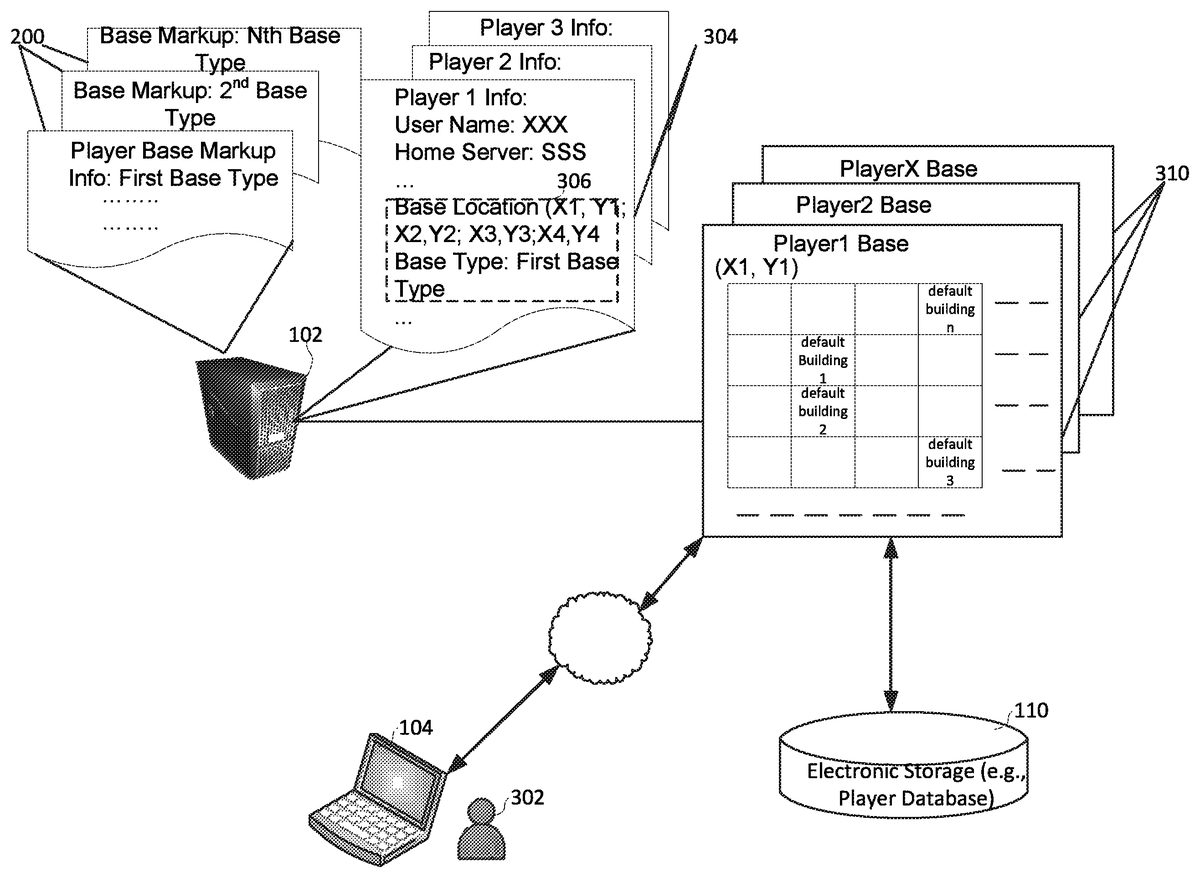
FIG. 3illustrates one example for generating individual player bases in the virtual space provided by system100shown inFIG. 1using the player base markup information shown inFIGS. 2A-B. It will be described with references toFIGS. 1 and 2A-B. As shown in this example, the server102manages player information304associated with players, for example player302via a player module as described above. As shown, the player information304may include player base definition306indicating boundaries of the player bases associated with the individual players in the virtual space and base types of the player bases. As illustrated, the player base definition306associated with player 1 indicates that the player base associated with player 1 has boundaries defined by (x1, y1; x2, y2; x3, y3; x4,y4) and a first base type. As shown, player markup information for the first base type, such as the player markup information200shown inFIG. 2may be obtained by the server102. As described above, the player markup information200may indicate, in a markup language format, various default aspects associated with a player base having the first base type, such as the building information202regarding one or more default building initially placed in the player base having first base type.
As shown, based on the player base definition306and the player base markup information200for the base type indicated in the player definition306, the server102may generate individual player bases 308 in the virtual space. The generated individual player base has the default building placed in the virtual space in accordance with the player base markup information for the base type of the individual player bases 308. As illustrated, the generated individual player bases may be output to the client computing platform104for presentation. Simultaneously or alternatively, the generated individual player bases may be embodied in a database record stored on a player database implemented on the electronic storage110.
FIG. 4illustrates one exemplary method400for generating individual player bases in a virtual space using player markup information in accordance with the disclosure. The operations of method400presented below are intended to be illustrative. In some embodiments, method400may be accomplished with one or more additional operations not described, and/or without one or more of the operations discussed. Additionally, the order in which the operations of method400are illustrated inFIG. 4and described below is not intended to be limiting.
In some embodiments, method400may be implemented in one or more processing devices (e.g., a digital processor, an analog processor, a digital circuit designed to process information, an analog circuit designed to process information, a state machine, and/or other mechanisms for electronically processing information). The one or more processing devices may include one or more devices executing some or all of the operations of method400in response to instructions stored electronically on an electronic storage medium. The one or more processing devices may include one or more devices configured through hardware, firmware, and/or software to be specifically designed for execution of one or more of the operations of method400.
At an operation402, an instance of a virtual space may be executed and implemented to determine view information for transmission to one or more client computing platforms associated with players. The players may interact with the virtual space by initiating virtual space commands to perform player actions. The player actions may be executed in the virtual space. In some implementations, operation402may be performed by a space module the same as or similar to space module112(shown inFIG. 1and described herein).
At an operation404, player information associated with the players may be managed. The player information may include player base definitions. The player base definition may indicate, for example boundaries of the player base in the virtual space through location expression(s) such as coordinate sets, shape definition, tile group specification and/or any other location expression. In some implementations, operation406may be performed by a player module the same as or similar to player module114(shown inFIG. 1and described herein).
At an operation406, a request for generating a player base associated with a player may be received. In some implementations, operation408may be performed by a player base generation module the same as or similar to player base generation module118(shown inFIG. 1and described herein).
At an operation408, a player base definition for the player base being requested in operation406may be obtained. In some implementations, operation408may be performed by a player base generation module the same as or similar to player base generation module118(shown inFIG. 1and described herein).
At an operation410, the boundaries of the player base being requested in operation408may be obtained from the player base definition obtained in operation410. The player boundaries obtained in operation410may indicate an area in the virtual space that may be assigned to the player as the player base for the player. In some examples, the player boundaries obtained in operation410may include coordinate sets defining the boundaries. In some implementations, operation410may be performed by a player base generation module the same as or similar to player base generation module118(shown inFIG. 1and described herein).
At an operation412, a base type for the player base may be obtained from the player definition obtained in operation408. The base type obtained in operation412, for example may dictate features of the player base having the base type, such as the number, type, level and/or any other aspects of default buildings, resources, units, terrains and/or or any other default game space elements initially available in the player base when first acquired by a player. In some implementations, operation412may be performed by a player base generation module the same as or similar to player base generation module118(shown inFIG. 1and described herein).
At an operation414, the player base markup information for the base type obtained in operation412may be obtained. The player base markup information obtained in operation414may include information, specified in a markup language format, indicating various aspects for a new and unoccupied player base having a given base type. Such aspects may include a level, a name of the new and unoccupied player base, building information indicating one or more default buildings within the new and unoccupied player base, resource information regarding the new and unoccupied player base, terrain information regarding the new and unoccupied player base, and or any other aspects of new and unoccupied player base having the given base type. Such aspects may be specified in the markup language format, for example in a hierarchical structure. The markup language format may include extensible markup language (XML), Yet Another Markup Language (YAML), hyper extensible markup language (HTML), and/or any other markup language. In some implementations, operation414may be performed by a player base configuration module the same as or similar to player base configuration module116(shown inFIG. 1and described herein).
At an operation416, building information regarding one or more default buildings may be extracted from the player markup information obtained in operation414. The building information regarding the one or more default building specified, in the markup language format, may be extracted in operation416by employing markup language parser. The extracted default building information may include locations, levels and/or any other attributes related to the one or more buildings within the player base having the base type obtained in operation412. In some implementations, operation416may be performed by a player base configuration module the same as or similar to player base configuration module116(shown inFIG. 1and described herein).
At an operation418, the player base requested in operation418may be generated based on the boundaries of the player base obtained in operation410, and further based on the player base markup information obtained in operation414and the building information regarding the one or more default buildings extracted in operation416. In some implementations, operation418may be performed by a player base generation module the same as or similar to player base generation module118(shown inFIG. 1and described herein).
Although the present technology has been described in detail for the purpose of illustration based on what is currently considered to be the most practical and preferred implementations, it is to be understood that such detail is solely for that purpose and that the technology is not limited to the disclosed implementations, but, on the contrary, is intended to cover modifications and equivalent arrangements that are within the spirit and scope of the appended claims. For example, it is to be understood that the present technology contemplates that, to the extent possible, one or more features of any implementation can be combined with one or more features of any other implementation.
Claims
- A virtual space server generating individual player bases in a virtual space using markup information, the virtual space server comprising: one or more physical processors configured by machine-readable instructions to: execute an instance of the virtual space in which an online game takes place, and to implement the instance of the virtual space to facilitate player participation in the online game via client computing platforms by transmitting space state information derived from the instance of the virtual space to the client computing platforms;manage player accounts comprising player information associated with individual players, the player accounts including a first player account associated with a first player;obtain player base markup files for the player bases, the obtained player base markup files being in a markup language format and defining individual bases associated with the players separate from other player information associated with individual players in the player account, the obtained player base markup files including a first player base markup file that defines a first base associated with the first player, the first player base markup file being separate from the other player information included in the first player account, wherein edits to the player base markup files are configured to be deployed to the virtual space server during the execution of the instance of the virtual space without changing a codebase of the virtual space;generate, on the virtual space server, player bases in the instance of the virtual space based on the player base markup files such that the first player base is generated in the instance of the virtual space based on a first boundary and the first player base markup information;and generate, format, and initiate transmission of state information derived from the instance of the virtual space to the client computing platforms to facilitate user participation in the virtual space.
- The virtual space server of claim 1 , wherein the one or more processors are further configured by machine-readably instructions such that the first player base markup file for the first base specifies, in the markup language format, building information regarding one or more default virtual buildings within the first player base, the building information indicating locations of the virtual buildings within the first player base.
- The virtual space server of claim 2 , wherein the building information specified by the first player base markup file for the first base further indicates levels of default buildings in the first player base.
- The virtual space server of claim 1 , wherein the individual player bases have a base type, wherein the base type dictates one or more of the number, type, level, and/or location of the default buildings, and/or wherein the base type dictates one or more of resources and/or base units initially available to a given player specified in the player base markup information associated with the base type for the given player.
- The virtual space server of claim 1 , wherein the one or more processors are further configured by machine-readably instructions to assign a new player base, that has not been occupied by any other players previously in the virtual space, to a new player responsive to the new player beginning to interact with the virtual space upon joining the online game.
- The virtual space server of claim 1 , wherein a given player base markup file includes player based markup information that indicates various aspects of a new and/or unoccupied player base.
- The virtual space server of claim 1 , wherein the various aspects of a new and/or unoccupied player based include one or more of a level of the new and/or unoccupied player base, a name of the new and/or unoccupied player base, building information indicating one or more default buildings within the new and/or unoccupied player base, resource information regarding the new and/or unoccupied player base, and/or terrain information regarding the new and/or unoccupied player base.
- The virtual space server of claim 1 , wherein the markup language format includes Extensible Markup Language (XML) and/or Yet Another Markup Language (YAML).
- A method for generating individual player bases in a virtual space using markup information, the method being implemented in physical processors of a virtual space server, the physical processors being configured by machine-readable instructions, the method comprising: executing an instance of the virtual space in which an online game takes place, and implementing the instance of the virtual space to facilitate player participation in the online game via client computing platforms by transmitting space state information derived from the instance of the virtual space to the client computing platforms;managing player accounts comprising player information associated with individual players, the player accounts including a first player account associated with a first player;obtaining player base markup files for the player bases, the obtained player base markup files being in a markup language format and defining individual bases associated with the players separate from other player information associated with individual players in the player account, the obtained player base markup files including a first player base markup file that defines a first base associated with the first player, the first player base markup file being separate from the other player information included in the first player account, wherein edits to the player base markup files are configured to be deployed to the virtual space server during the execution of the instance of the virtual space without changing a codebase of the virtual space;generating player bases in the instance of the virtual space based on the player base markup files such that the first player base is generated in the instance of the virtual space based on the first player base markup file;deriving state information from the instance of the virtual space for transmission to the client computing platforms to facilitate user participation in the virtual space;formatting the state information for transmission to the client computing platforms to facilitate user participation in the virtual space;and initiating transmission of the state information to the client computing platforms to facilitate user participation in the virtual space.
- The method of claim 9 , wherein the first player base markup file for the first base specifies, in the markup language format, building information regarding one or more default virtual buildings within the first player base, the building information indicating locations of the virtual buildings within the first player base.
- The method of claim 10 , wherein the building information included in the first player base markup file for the first base further indicates levels of default buildings in the first player base.
- The method of claim 10 , wherein the markup language format includes Extensible Markup Language (XML) and/or Yet Another Markup Language (YAML).
- The method of claim 9 , wherein the individual player bases have a base type, wherein the base type dictates one or more of the number, type, level, and/or location of the default buildings, and/or wherein the base type dictates one or more of resources and/or base units initially available to a given player specified in the player base markup information associated with the base type for the given player.
- The method of claim 9 , further comprising assigning a new player base, that has not been occupied by any other players previously in the virtual space, to a new player responsive to the new player beginning to interact with the virtual space upon joining the online game.
- The method of claim 9 , wherein a given player base markup file includes player based markup information that indicates various aspects of a new and/or unoccupied player base.
- The method of claim 9 , wherein the various aspects of a new and/or unoccupied player based include one or more of a level of the new and/or unoccupied player base, a name of the new and/or unoccupied player base, building information indicating one or more default buildings within the new and/or unoccupied player base, resource information regarding the new and/or unoccupied player base, and/or terrain information regarding the new and/or unoccupied player base.
Disclaimer: Data collected from the USPTO and may be malformed, incomplete, and/or otherwise inaccurate.