U.S. Pat. No. 10,173,141
MESSAGE ENCRYPTION WITH VIDEO GAME
AssigneeTEXTA, INC.
Issue DateMarch 23, 2017
Illustrative Figure
Abstract
A system that may be utilized for sending and locking text messages is provided. The system may allow a user to send an electronic message that is encrypted, locked, hidden, or otherwise made unviewable by the system to form a locked message. The locked message may be formed by associating a game with the message and requiring that a recipient play the game and satisfy an objective of the game before the message is “unlocked” or made viewable and displayed for the recipient. The locked messages may be sent to multiple recipients or to groups and may provide opportunities for competitive or cooperative play between recipients. Promotions, coupons, incentives, coupons, and marketing materials may be sent as locked messages and require or incentivize engagement by recipients.
Description
While the invention is susceptible to various modifications and alternative forms, specific embodiments thereof have been shown by way of example in the drawings and are herein described in detail. It should be understood, however, that the description herein of specific embodiments is not intended to limit the invention to the particular forms disclosed, but on the contrary, the intention is to cover all modifications, equivalents, and alternatives falling within the spirit and scope of the invention as defined by the appended claims. DETAILED DESCRIPTION The following description and accompanying figures, which describe and show certain embodiments, are made to demonstrate, in a non-limiting manner, several possible configurations of systems, platforms, devices, methods, etc. that may be used for sending and receiving messages, locking or encrypting messages, using electronic games to encrypt messages, and/or for playing electronic or video games according to various aspects and features of the present disclosure. Various systems, devices/apparatuses, and methods are described herein, including systems, platforms, devices, methods, etc. that may be used for sending and receiving messages, hiding, locking, or encrypting the messages using electronic games that must be completed to open the messages, and/or for playing electronic/video games. While specific embodiments are discussed herein by way of example, the embodiments and examples described are not intended to be limiting. The inventive principles associated with the embodiments described herein, including with respect to the units, systems, devices, phones, apparatuses, applications, messages, methods, etc., described herein, may be applied to a variety of different types of uses, systems, apparatuses, units, applications, messages, methods, etc. In the following description, certain terminology is used to describe features of the invention. For example, in certain situations, the term “logic” may be representative of hardware, firmware and/or software that is configured to perform one or more functions. As hardware, ...
While the invention is susceptible to various modifications and alternative forms, specific embodiments thereof have been shown by way of example in the drawings and are herein described in detail. It should be understood, however, that the description herein of specific embodiments is not intended to limit the invention to the particular forms disclosed, but on the contrary, the intention is to cover all modifications, equivalents, and alternatives falling within the spirit and scope of the invention as defined by the appended claims.
DETAILED DESCRIPTION
The following description and accompanying figures, which describe and show certain embodiments, are made to demonstrate, in a non-limiting manner, several possible configurations of systems, platforms, devices, methods, etc. that may be used for sending and receiving messages, locking or encrypting messages, using electronic games to encrypt messages, and/or for playing electronic or video games according to various aspects and features of the present disclosure.
Various systems, devices/apparatuses, and methods are described herein, including systems, platforms, devices, methods, etc. that may be used for sending and receiving messages, hiding, locking, or encrypting the messages using electronic games that must be completed to open the messages, and/or for playing electronic/video games. While specific embodiments are discussed herein by way of example, the embodiments and examples described are not intended to be limiting. The inventive principles associated with the embodiments described herein, including with respect to the units, systems, devices, phones, apparatuses, applications, messages, methods, etc., described herein, may be applied to a variety of different types of uses, systems, apparatuses, units, applications, messages, methods, etc.
In the following description, certain terminology is used to describe features of the invention. For example, in certain situations, the term “logic” may be representative of hardware, firmware and/or software that is configured to perform one or more functions. As hardware, logic may include circuitry having data processing or storage functionality. Examples of such circuitry may include, but are not limited or restricted to a microprocessor, one or more processor cores, a programmable gate array, a microcontroller, an application specific integrated circuit, wireless receiver, transmitter and/or transceiver circuitry, semiconductor memory, or combinatorial logic.
Logic may be software in the form of one or more software modules, such as executable code in the form of an executable application, an application programming interface (“API”), a subroutine, a function, a procedure, an applet, a servlet, a routine, source code, object code, a shared library/dynamic load library, or one or more instructions. These software modules may be stored in any type of a suitable non-transitory storage medium, or transitory storage medium (e.g., electrical, optical, acoustical or other form of propagated signals such as carrier waves, infrared signals, or digital signals). Examples of non-transitory storage medium may include, but are not limited or restricted to a programmable circuit; a semiconductor memory; non-persistent storage such as volatile memory (e.g., any type of random access memory “RAM”); persistent storage such as non-volatile memory (e.g., read-only memory “ROM”, power-backed RAM, flash memory, phase-change memory, etc.), a solid-state drive, hard disk drive, an optical disc drive, or a portable memory device. As firmware, the executable code is stored in persistent storage.
FIG. 1shows an exemplary screenshot8from an exemplary communication device or phone operating exemplary logic (e.g., an application (“app”)) that may be used as part of the systems or platforms described herein. The communication device (e.g., a mobile phone/smart phone) may, optionally, include some type of notification bar10that can be displayed on the screen and that notifies a user of messages, events, application updates, email, sound, volume, cellular service, cellular coverage, cellular strength, Wi-Fi, Bluetooth, battery remaining, time, etc. The communication device may be any type of communication device with a screen and connection through which communications/messages may pass (e.g., a physical connection such as a Lightning connector, a Universal Serial Bus (USB) connector, etc., or a wireless or cellular communication interface). For example, the communication device may be a phone, mobile phone, smart phone, computer, laptop, tablet, phablet, virtual reality device, gaming system (Microsoft® Xbox®, Sony® PlayStation®, etc.) or other computing device, etc. The communication device may have buttons and/or keys. The screen or monitor associated with the communication device may be a touchscreen, or a screen or monitor without touch control capability.
Additionally, the logic may include software that is downloaded to the communication device and/or is accessible through the communication device. The logic used, whether on the communication device or in a remote location or both, may be configured to generate and/or display screenshot8(and other screenshots described herein) on a screen/display of the communication device and perform the functions described herein. The logic may operate in combination with hardware of the communication device, external hardware, remote hardware, memory, processors, servers, routers, screens/displays, cellular equipment, and any other hardware or equipment useful to implement the system, software, and/or invention. The system may be configured to use the same internet data plan that a user uses for email and web browsing, so there may be no additional cost to message and use the system or app. The system may store messages and other information associated with a user, such that a user could log-in (e.g., with their telephone number) to the app from different devices/phones and locations, and the system would be able to access the user's messages and friends as stored (e.g., on a database) and generate and display copies of the information on the different devices/phones.
The screenshot8inFIG. 1shows an exemplary homepage or newsfeed page of an application that may be used to implement or facilitate one or more features described herein. The homepage or newsfeed page may include a user identifier or name12, an update or download indicator14, point/score trackers16, a rank indicator18, a dialog or input box20, a home link22, a points/awards link24, a conversation or messaging link26, a game link28, a relationship/friend link30, and a newsfeed32. The system or a user's phone may display links22,24,26,28, and30on some or all of other screens displayed to provide a user with an easy way of navigating to a desired location, e.g., these links are shown in one or more of the screenshots inFIGS. 1-17. If the system receives input that a link has been selected, the system may automatically generate and/or display a new screen that corresponds to the link. When the system receives input that a link has been selected, it may display the link as highlighted or otherwise distinguished from other links to show it has been selected.
For example, inFIG. 2, the points/awards link24is shown as having its colors inverted relative to the other links (e.g., the other links show a white interior depiction and a shaded background, but the selected link is shown as having a shaded interior depiction and a white background). This or some other type of highlighting can be done with each of the links when they are selected. In other embodiments, the links24,26,28and30as seen inFIGS. 2-5, 7-9, 11 and 14-17may appear at other locations in the user interface (e.g., at the bottom of the display screen of the electronic device or phone).
The system may generate and display alerts or new activity indicators64(e.g., notification bubbles as shown inFIG. 11) that indicate new activity, messages, updates, games, information, etc. in one or more of the links. For example, the system may generate and display an alert or new activity indicator64associated with the home link22when new status updates are posted. Additionally, or in the alternative, the system may generate and display (i) an alert or new activity indicator64associated with the points/awards link24when new high scores are achieved or new points are earned, (ii) an alert or new activity indicator64associated with the conversation or messaging link26when new messages are received from another user (e.g., a contact or friend), (iii) an alert or new activity indicator64associated with the game link28when new games are available or new high scores are achieved by someone, and/or (iv) an alert or new activity indicator64associated with the relationship/friend link30when new friend/contact requests have been made or accepted. An alert or new activity indicator64may also be generated and displayed by the system to indicate other updates or information.
The user identifier or name12may be an actual name, user name, alphanumeric text, image, symbol, other type of identifier, or a combination of two or more of these. In one embodiment, the user identifier or name12may be used and displayed to identify and/or describe the user. The user identifier or name12may be the name of the user accessing the logic, system, app, and/or using the communication device. The user identifier or name12may appear in various locations on the screen. The user identifier12may include a profile picture, image, or avatar, e.g., as displayed just below the name to the left of trackers16inFIG. 1.
Referring still toFIG. 1, the update or download indicator14may provide a visual (e.g., graphical or textual) indication that a software update or other download is available. The communication device, app, or system may cause the software update or other download to download and/or update in response to receiving input that a user has selected (e.g., by tapping, clicking, etc.) the update or download indicator14.
One or more point/score tracker(s)16may be used. The point/score tracker(s)16may be used to keep track of points earned by one or more users. The point/score tracker(s)16may track points earned over different time periods, e.g., a first box may track points earned that day, a second box may track points earned that week, and a third box may track total points earned, as shown inFIG. 1. The point/score tracker(s)16may also track other information, e.g., a box may be provided to track points earned on playing games and/or the most recent game played and another box may be provided to track other points earned from using the system or app. In one embodiment trophies, prizes, medals, badges, or other awards may be earned over time and the point/score tracker(s)16may be used to track these.
A rank indicator18may also be provided. The rank indicator18may indicate how a user ranks in relation to the user's friends on points, awards, trophies, prizes, medals, badges, and/or one or more other criteria. In one embodiment, the system may provide options for creating leagues and/or teams of people/users that use the system for various purposes, including competition. In one embodiment, the system can onboard users from other platforms or applications by rewarding them for messaging and sending games and/or locked messages.
A dialog or input box20may be provided that allows a user to input information. In one embodiment the dialog or input box20allows a user to provide a status update that will be shown in the newsfeed32. The status update or other input may comprise words, numbers, images, video, links, other media, or any combination of these. The system may receive the status update or other input as entered in the dialog or input box20, then automatically display the status update or other input in the newsfeed32.
Newsfeed32may include status updates, images, videos, and other information posted by any of the user's friends or contacts and/or posted by the user in the dialog or input box20. Newsfeed32could be configured to display only the status updates or other information, images, videos, etc. posted by anyone using the system or may be limited to only a user's friends or contacts. Optionally, the user may customize the newsfeed to selectively hide or allow status updates from different people, friends, contacts, etc. The newsfeed32(as well as other screens showing friends/contacts) may include a profile picture, image, icon, or avatar34associated with each user to give a visual indication of the user, may include status updates36of various users/friends/contacts, may list the name or user name of the users/friends/contacts, and may list an indicator38of the time when the status update was posted (e.g., show how long it has been since the status update was posted as inFIG. 1, show a date of posting, or other time information). The system may provide options for uploading new profile pictures, image, icon, or avatar34associated with each user.
A home link22may be provided. When the system receives input that the home link22has been selected, the system may process the information and display the home screen, e.g. as shown in screenshot8. The home screen may include newsfeed32and other information as shown inFIG. 1. The home screen may also or alternatively include other information as well, e.g., profile information, a calendar, statistics, links, scores, and/or other information.
A points/awards link24may also be provided. When the system receives input that the points/awards link24has been selected, the system may process the information and display a points/awards screen, e.g. as shown in screenshots40and58inFIGS. 2 and 3.FIG. 2shows an exemplary screenshot40of an exemplary points/awards screen. When the system receives input that the points/awards link24has been selected, it may also display the points/awards link24as highlighted or otherwise distinguished from other links. For example, inFIG. 2, the points/awards link24is shown as having its shading or colors inverted relative to the other links (e.g., the other links show a white interior depiction and a shaded background, but the selected link is shown as having a shaded interior depiction and a white background). This or some other highlighting can be done with each of the links when they are selected. Screenshot40also shows a sliding bar42and various point/award trackers44. The sliding bar42may allow for switching between different screens, e.g., between screenshot40and58or between a points summary and a scoreboard. Other ways of switching between different screens are also possible, e.g., different tabs, links, etc.
Various point/award trackers44may be generated by the system, used, and displayed. For example,FIG. 2in order from top to bottom shows point trackers for points earned for “Messaging” (e.g., sending a message and/or a locked message), “Game Played/Sent” (e.g., for completing a game sent to you by another person or sending a game to another person to play), “Friending” (e.g., adding new friends or contacts), “Status Update” (e.g., entering a new status update in the dialog or input box20on the home screen), “Today” (e.g., points earned that day), “Weekly” (e.g., points earned that week), and “Total” (e.g., total points earned). Other categories/trackers are also possible, e.g., categories/trackers for awards, prizes, trophies, medals, badges, yearly points, earning points in other categories, high scores on individual or combinations of games, etc. The trackers44can take a variety of shapes, colors, styles, etc. In one embodiment, the trackers44function similar to bar graphs that give visual and numerical indication of the category (e.g., points earned). Different points can be awarded/earned for different activities, e.g., 1-100 points for each message sent (e.g., 1 point), 1-100 points for each game played or sent to another person (e.g., 2 points), 1-100 points for each friend added (e.g., 5 points), 1-100 points for each status update (e.g., 25 points), and/or other amounts of points for these or other actions/events, etc. The built-in point system can directly link points to messaging (e.g., SMS/text sent), status updates, friending/making new contacts, games sent and received, and more. It should be noted that other numerical ranges may be used and the disclosure is not intended to be limited by those recited herein as examples.
FIG. 3shows an exemplary screenshot58that can represent another screen possible related to points and awards or link24. Screen shot58shows tab or sliding bar42set to “scoreboard.” The sliding bar42may include a plurality of selectable positions representing, for example, a Points Summary, a Scoreboard and Prizes & Products. A scoreboard60is shown in which multiple users are ranked according to how many points they have accumulated highest to lowest. The scoreboard60shown inFIG. 3shows the points accumulated during the current week among one group of contacts/friends, so the scoreboard60provides rankings for that group during the current week. However, scoreboard60could provide different scores and rankings for the same or different groups of people. Further, multiple scoreboards60could be provided (e.g., as different windows, tabs, points along the sliding bar42, etc.) that each track different types of points, awards, rankings, and/or other information. For example, some scoreboards may track high scores on different games, some may track high scores for different types of activities, etc.
In one embodiment, users with the highest scores or the top 5, 10, 15, 20, 30, 100, or other number of top scores may be eligible for additional prizes, promotions, options, deals, discounts, etc. Rewards may include daily, weekly, monthly, yearly, holiday, or other special prizes/rewards from sponsored brands (e.g., discounts, promotions, coupons, gift cards, tangible prizes (maybe an Oculus® Rift® headset, Beats® headphones, or other prizes)). In one embodiment, upon winning, a deal, reward, promotion, etc. may be generated by the system and provided to the user in the form of a Quick Response (“QR”) code, barcode or unique alphanumeric promo identification (“ID”) code that can be entered into a website to redeem. The system or platform may store and manage deals, rewards, promotions, etc. in a digital store within the system, platform, or app for users to browse, explore and ultimately redeem online or in store. The system or gaming platform may provide unique opportunities for users, friends/contacts to compete with each other and with the greater network (or all users).
A conversation or messaging link26may also be provided. When the system receives input that the conversation or messaging link24has been selected, the system may process the information and display a conversation or messaging screen, e.g. as shown in screenshot62inFIG. 11, as discussed in detail below. The conversation or messaging screen may show conversations or other exchanges between the user and his/her contacts, friends, and/or other people. The user is shown as having two ongoing conversations (e.g., messaging conversations) with friends66. More conversations may be shown, and if the number of conversations exceeds the space available on the screen, the user may scroll down or up to see additional conversations/exchanges. The screen may also show a message summary68of what is the most recent message received or sent in that messaging conversation. Summary or indication68inFIG. 11shows that the last message received from the first friend is a locked alphanumeric text message, and that the last message received from the second friend is a locked media text message (e.g., an image, video, sound clip, etc.) The messages are locked with electronic/video games that are played to open the messages as discussed in more detail below.
In one embodiment, a Brand advertising segment and/or User prize opportunity segment may be provided. In summation, this segment may be built into the tabbed user interface within the trophy/points section of the mobile application. Users on the platform may receive points for doing various actions, e.g., messaging, playing games, completing games, sending games, updating status, adding friends, etc. The points can be used to gamify the messaging and gaming experiences as well as create playful competition among friends via the scoreboard. Beyond those features, users may also be able to also qualify daily and weekly (and/or over other periods of time) to be entered into a raffle for opportunities to win prizes as products & experiences on behalf of brands globally.
Brand advertising segment and/or User prize opportunity segment may offer a variety of different brands/prizes/products (e.g., 1-15 different brands/prizes/products) each day (or over another time period). In one embodiment, three different brands may be offered each day for a minimum of one week each in the prize of the day (hereinafter referred to as “POD”) segment. Usually the brands in those segments will have a variety of products or experiences that will differ daily but not necessarily. With the prize of the week (hereinafter referred to as “POW”) segment, a brand may have an opportunity to showcase one product or experience that is generally a larger ticket item. Experiences may include meeting a celebrity (e.g., backstage passes at a concert, meal with a celebrity, etc.), vacation packages, travel, etc. Smaller experiences may be offered through the POD segment (or POW segment) as well, e.g., dinner out for two. The value may be used to determine what is categorized as a POD and what is categorized as a POW or other prize offerings.
Referring now toFIG. 4, a screenshot from an exemplary communication device or phone operating an exemplary application that may be used as part of the invention, the screenshot showing an exemplary animated carousel illustrating one or more brands is shown. In one embodiment, the screenshot400illustrates a POD screen when a “Prizes & Products” tab is selected from the sliding bar42. When the tab registers that a user has tapped it or provided input, the system may automatically fall or transition to the POD screen. In one embodiment, when the POD screen is first displayed (or at other times) a 10-15 second animation402may “carousel” or rotate various brands (shown inFIG. 4as circles having of the icons shadows underneath, but could be other icons, logos, trademarks, prize images, or other images, etc.) featured as a daily or weekly prize. It has also been contemplated that other animations could be used.
Referring now toFIG. 5, an exemplary screenshot from a communication device or phone operating an exemplary application that may be used as part of the invention is shown. The screenshot shows a featured brand of the one or more brands illustrated in the carousel ofFIG. 4. In one embodiment, the screenshot500is displayed when the animation ofFIG. 4ends. The screenshot500may display a product/experience501featured that day by a first brand or advertiser, e.g., in the foreground of the screenshot500(and optionally displayed larger in size than others), and other products/experiences featured by the first brand or advertiser and/or products/experiences featured by alternative brands or advertisers in the background (and optionally smaller in size than the product/experience501). Other embodiments may be used wherein the product/experience501is highlighted as compared to the other products/experiences. The various products/experiences may appear in a carousel, similar toFIG. 4. When the system receives input from the user indicating a desire to rotate the carousel or images (e.g., when the system receives input that the user has swiped the screen to either side or pushed an icon to cause rotation as illustrated using reference numeral502), the system can rotate and display the other images in the foreground. The system can receive input indicating that a user has selected or chosen a particular brand, prize, product, experience, etc. (e.g., by receiving input that the user has tapped on a brand/prize/product/experience/etc.)
Referring toFIG. 6, a screenshot from an exemplary communication device or phone operating an exemplary application that may be used as part of the invention is shown, where the screenshot showing a video of one or more featured products and/or brands. In one embodiment, when the system receives the input indicating the user has selected a brand/prize/product/experience/etc. (e.g., input indicating the user has tapped on a specific product/experience), the screenshot600is displayed on the communication device, mobile phone or other electronic device. The screenshot600includes a video (e.g., a 5-60 second video), which may be produced by the brand/advertiser and loaded/integrated into the system. Referring toFIG. 7, a screenshot from an exemplary communication device or phone operating an exemplary application that may be used as part of the invention, the screenshot showing additional information of a featured product/brand, a current point total and an option to buy the featured product is shown. In one embodiment, when the video ofFIG. 6has ended, the screen shown in screenshot700transition (e.g., may “dissolve” or undergo an alternative transition) such that the screenshot700is displayed. The system may display more information/images/videos/etc. provided by the brand/advertiser for the selected product/experience501. The system may also be configured to display a link701to a website of the brand/advertiser's choosing. A point status bar702revealing the user's current point status and whether the user has achieved the required amount/point total (e.g., POD—100 points) and/or the user's progress toward the required amount/point total may be displayed. Referring to the example shown inFIG. 7, the point status bar702shows that the user has acquired 70 of the 100 points needed to unlock the POD/POW featured (e.g., the selected product/experience501). If the system determines a user has not met the point requirement, a lock icon may be displayed as inFIG. 7. In one embodiment, a “Buy Now” button703may also be provided/displayed by the system, which may be configured to provide the user with an option to directly purchase the product/experience501, e.g., through a redirected handoff back to the brand's selected Uniform Resource Locator (URL).
Referring toFIG. 8, a screenshot from an exemplary communication device or phone operating an exemplary application that may be used as part of the invention, the screenshot presenting an icon notifying the user that a selected product/experience has been unlocked is shown. In one embodiment, when the system determines that a user has successfully accrued the required amount/point total (e.g., 100 points) within a 24 hour cycle for a POD (or a 7 day cycle for a POW), the screenshot800may be displayed to provide an alert (e.g., icon801) indicating that the user has unlocked a selected prize/product/experience/etc., which may be, for example, the selected product/experience501as seen inFIGS. 5 and 7. In one embodiment, when the system determines a user has satisfied the point requirement and has unlocked a selected prize/product/experience/etc. (e.g., a POD), the system may determine the user is eligible to enter (or may automatically enter the user) into a lottery. A tab/button/icon802may be displayed for a user to tap to enter the lottery. The lottery may be configured to use a unique identifier (e.g., a username, avatar, cell phone number, one or more unique identifiers (e.g., zip, phone, email), etc.) to identify participants in the lottery. The lottery may be conducted randomly and/or automatically by the system, e.g., at a specified time. Additionally, input to the system may be generated by the activation of the “Buy Now” button or icon703(e.g., including the text “BUY NOW” or other, similar text). Activation of the “Buy Now” button703may result in the system display a shopping cart screen, not shown, for the user to continue an electronic check-out process to purchase the prize/product/experience/etc. The brand/advertiser may also offer a promotion for a user to purchase the prize/product/experience/etc., which may be displayed along with the “Buy Now” button703as shown inFIG. 9.
Referring now toFIG. 9, a screenshot from an exemplary communication device or phone operating an exemplary application that may be used as part of the invention, the screenshot presenting an icon notifying the user has successfully entered the lottery for a selected prize/product/experience/etc. is shown. In one embodiment, when the system receives input indicating the user has selected or tapped to enter the lottery, the system may display an icon901which may be an image, pop up, notice, alert, etc. that indicates the user is now in the lottery as shown in, for example, the screenshot900. In one embodiment the screenshot900may be “grayed out” except for the icon901in order to focus attention on the icon901. In another embodiment, the icon901may appear in the foreground of the screenshot900and other components such as a link701A to a website of the brand/advertiser's choosing, the tab/button/icon802and the “Buy Now” button703may appear in the background of the screenshot900.
Referring toFIG. 10, a screenshot from an exemplary communication device or phone operating an exemplary application that may be used as part of the invention, the screenshot illustrates a chat/message screen between user and the system is shown. In one embodiment, as illustrated in the chat screen1001, the system may transmit one or more messages (e.g., SMS, MMS, etc.) to a user to notify the user that he/she has won a lottery for a POD/POW (e.g., message1002), provide a means for the user to claim the prize/product/experience/etc. as a result of winning the lottery (e.g., message1003), provide the user with notice that he/she did not win the lottery but offer a discount on purchasing the prize/product/experience/etc. (e.g., message1004), or provide news/information to the user (e.g., message1005). In one embodiment, the means provided to the user for claiming the prize/product/experience/etc. may be done digitally, e.g., with QR, Barcode, or unique redemption ID, which may be created and provided to the system by the brand/advertiser for online or in store redemption by the user. Any prize redemption options/methods described elsewhere could also be provided/used. In one embodiment, a “redeem now” CTA (call to action) could direct the user to the brand/advertiser's checkout screen wherein a shipping and handling/procurement processes may direct the user through the checkout process. Similarly, a link may be provided to the user for the user to activate and subsequently redeem his/her prize/product/experience/etc.
Also within the information/communication areas (e.g., newsfeed, messaging, chat, etc.), the system may be able to highlight or push promotions on items of interest. For example, if a user entered into the lottery for a product/experience/etc. but did not win, the system may provide the user with options to purchase the item of interest at a discount. The system may be able to use a communication area (e.g., newsfeed, chat, etc.) as an to display/highlight the POD/POW/etc. segment to one or more users, e.g., via a periodic or occasional message (e.g., a once per week notice message). In some communication areas (e.g., newsfeed, etc.), every user may be treated a friend and have access to at least some information displayed.
On each of the relevant screens (e.g., as seen onFIGS. 4-5), the system may be able to detect if a user has provided input to toggle to the POW segment. The POW segment (or other time period segments, e.g., biweekly, monthly, semi-annual, annual, or any other time period) may be configured to look and act the same as or similar to the POD segment. In one embodiment, prizes over longer periods of time may be higher in value or be big ticket items, e.g., a car, vacation package, bike, celebrity experience, etc.) In one embodiment, the system may only allow users to be in the running for certain prizes/experiences/etc. if they meet certain preset requirements, e.g., a perfect score of 700 points for a week or 100 points/day for seven days. The system may allow a user to purchase at any time. In one embodiment, the system may allow users entering into the POD segments to redeem won prizes/experiences/etc. daily, while the POW segment may only allow users to redeem won prizes/experiences/etc. after seven days (or another time period for other time segments).
As shown inFIG. 11, the conversation or messaging link26may show a new activity indicator64when new messages are received from another user (e.g., a contact or friend). InFIG. 11, the new activity indicator shows the number six, indicating that 6 new messages have been received since the last time messages were reviewed by the user. New message indicators70show that two new messages were received from the first friend and four new messages were received from the second friend. The indicators70can add up to match the number shown in indicator64. Other uses of indicators64and indicators70are also possible. A new message link72may be provided that if input is received that a user has selected the link72, the system allows a user to initiate a conversation or message to another person, contact, or friend.
In response to receiving input that a conversation link has been selected (e.g., that a user has selected or tapped on message summary68or icons for friends66), the system may open and display the selected conversation and any new messages, etc.FIG. 12shows an example of an open conversation displayed in exemplary screenshot74. The conversation identification bar76at the top of the screen can display the user's friend or contact that the conversation is with, including the users image, icon, avatar, etc. and the person's name and/or user name. Any screens shown or used may include a back button/link78that can tell the system to go back to the previous screen, e.g., the back button/link78shown inFIG. 12may tell the system to return to the conversation/messaging screen as shown, for example, inFIG. 11.
Below the conversation identification bar76inFIG. 12is shown a portion of an exemplary conversation between a user and one of the user's contacts/friends. Different types of messages may be sent between users. For example, text messages80and84are simple messages that are unencrypted and alphanumeric. Game message82is an electronic/video game sent as a message from one user to another. If the system receives input that a game message82has been selected (e.g., by a user tapping the game message82), then the system may launch the electronic/video game. The user may play the electronic/video game to completion, until a desired score is reached, until the user runs out of time, until an objective is reached, and/or as otherwise desired. A game message82may be play repeatedly or as often as desired. The game message82can be sent with or without being encrypted, hidden, or locked. The system can allow for game message82to be sent and played without requiring a download by the recipient or sender.
Media messages like media message90may also be sent and may comprise media in addition to or instead of alphanumeric text, e.g., the media may comprise a video, image, sound clip, hyperlink, other media, or a combination of these. A media button/link94may be provided to allow selection of the desired media for messaging. If the system receives input indicating that the media button/link94has been selected, the system may display media that the user might want to attach as a message, may link to the a camera (e.g., a device's built-in camera) to allow the user to take a picture or video for the message at that time, may link to a microphone (e.g., a device's microphone) to allow the user to take a picture or video for the message at that time, may provide options/links for browsing media stored on the device, and/or provide other options for accessing media.
A message field92may be provided. The system may receive and process messages to be sent based on messages (e.g., alphanumeric text) entered into the message field92. A send button/link98may also be provided. If the system receives input that a message has been entered into the message field92and input that the send button/link98has been selected, the system may send the message to the desired recipient. The send button/link98may also trigger the system to “lock” (e.g., hide, encrypt, or otherwise prevent opening of) the message, if the system receives input that the message should be “locked.” Optionally, system may be configured to receive, interpret, and process voice commands used to compose and send messages, and to instruct the system whether or not to lock a message and how (e.g., “lock message with Breakout game”). Sound or voice data may thereby automatically trigger the system to hide, lock, or encrypt the message or show the message as locked until the recipient unlocks the message. In one embodiment, the system may also be configured to receive and process similar input from3D touch, user interface (“UI”) gestures, and/or other interactions or input methods.
Locked messages86and88may be sent. Locked messages may be messages that are hidden, encrypted, or otherwise prevented from being viewed until something occurs to “unlock” or make the message viewable. Text messages, media messages, game messages, and/or other messages may be locked and sent as locked messages. Locked message86was sent by the user to another person, e.g., a friend or contact. The user who wrote the locked message86can see the message and the system indicates that it was sent as a locked message by including brackets on either side of the message. Including brackets on either side of the message is one way to show that the message was locked, but other ways of showing the message was hidden, locked, or encrypted are also possible, e.g., showing an image/icon of a lock or other image/icon that indicates the message was locked, or using different colors, fonts, styles, etc. to set distinguish the message from other unencrypted messages, like text messages80and84. When a locked message is received from another person, it may look similar to locked message88or otherwise be in a format that indicates the message is locked. To open the locked messages86and88, the recipient or friend to whom the message was sent will have to “unlock” the message by completing some objective or set of steps required before the system will display the image.
In one embodiment, the locked messages86and88are locked (e.g., hidden, encrypted, or otherwise prevented from being viewed) using an electronic or video game, and one must play the game to open or display the message.FIG. 13shows an exemplary screenshot100that is within the same conversation or messaging exchange as shown inFIG. 12, but that includes the game menu102. The system can display the game menu102in response to receiving input that game menu button/icon96has been selected. The game menu102can show a variety of different types of games that can be used to hide, lock, or encrypt a message. In response to receiving input that a game has been selected, that a message (e.g., a text message or media message) has been entered, and that the send button98has been selected, the system may automatically generate data indicating that the message should be hidden or locked, or may encrypt the message, with the selected electronic/video game to form a locked message (e.g., similar to locked messages86and88) and send the locked message to the intended recipient. The locked message may be a locked text message, locked media message, locked game message, or other type of message that is locked. The intended recipient must then play the electronic/video game before the message is “unlocked” and the message can be viewed. Successfully unlocking and/or opening the locked message may require completion of the game, satisfying a point requirement, or satisfying some other objective.
In one embodiment, the game objectives (e.g., completion, minimum score, number of items collected, beating a game/level in a limited amount of time, or other objectives) are predetermined and a recipient of a locked message must only satisfy the predetermined objective to open the message. In one embodiment, the game objective may be customizable by the sender. For example, the sender could make the game objective very easy to satisfy, so the recipient will quickly be able to unlock and read the message. Also, the sender could make the game objective more difficult to satisfy, so the recipient will need to take more time and effort to unlock and read the message. In one embodiment, the game objectives may be predetermined, customizable, or a combination of the two. The logic may provide tools and/or a user interface for the user to use in customizing a game or objective. In one embodiment, examples of the tools for user in customizing a game or objective (or creation thereof) may include, but is not limited or restricted to, logic components that provide video game building blocks including predesigned levels, characters, storylines, etc., customizable options for the building blocks, video game templates, APIs, tutorials on video game customization and/or creation, etc.
Once a game objective has been achieved and a locked message is “unlocked,” the message may appear or be displayed in the conversation or messaging exchange, so the recipient may read the message or view the media that was sent. For example, locked message88inFIG. 12may appear as unlocked message89, as shown inFIG. 13, after the game objective has been completed and the message opened. Brackets or some other indicator (e.g., an icon or image or different color, font, style, etc.) may be provided/shown to indicate that the message was previously locked. In one embodiment, the system may allow a recipient or sender to re-lock or encrypt a message after it has been read to help keep the message/information private and secure.
In one embodiment, a set of predetermined games is provided (e.g., as shown in game menu102ofFIG. 13) that may be used to lock or encrypt a message (e.g., a text message or media message). The games may consist of the a variety of games, including new games, classic video game remakes, puzzles, trivia, learning games and more. In one embodiment, aspects of the predetermined games may be customized by the user, e.g., game objectives, quests, missions, levels, characters, avatars, colors, background, styles, fonts, or other features, to create a customized game. In one embodiment, the user may also create a customized game by creating a new game or level using basic building blocks or tools that may be provided by the system, or a new game or level may loaded to the system if it is compatible or made compatible. In one embodiment, the system is able to automatically convert or make compatible a variety of games that may be loaded to the system. The system may provide the user with various options and/or interfaces for customizing a game for a particular person, contact, or friend. In one embodiment, the system may enable personalized games (e.g., a puzzle of one or many of the user's pictures) to be sent to a particular person. Many customized and/or otherwise unique games may also be developed by indie developers and be provided by the system to users as an option to lock a message. Once the system has received input indicating that the user is finished customizing the electronic/video game or has selected a customized electronic/video game (or other electronic/video game) and desires to hide, lock, or encrypt a message with the electronic/video game, the system can automatically hide, lock, or encrypt the message with the electronic/video game such that the recipient cannot read the message without first playing the customized electronic/video game (or other selected electronic/video game) and achieving the required objective. The system, messages, and games may also be used as an educational tool, e.g., to teach computer programming, design, math, grammar, etc. They may even be used for testing or as part of a job interview, e.g., to test competencies for certain skills (for example, computer programming, language, problem solving, etc.).
In one embodiment, group messages (i.e., messages to more than one recipient) may also be sent. The group messages may be standard messages (e.g., unlocked text or media messages) or may be locked messages (e.g., messages that are hidden, locked, or encrypted). If a group message is sent to more than one user, the message may be set such that it can be unlocked by one of the recipients such that each recipient can then read the unlocked message when one person unlocks it, or, optionally, each recipient may be required to unlock the message individually. In one embodiment, the group message may be hidden, locked, or encrypted with a game from game menu102or with a customized game in a similar manner to that discussed above. In one embodiment, the game may be a competitive, two-player, or multiple-player game in which the recipients can play against each other. The winner may be able to unlock the message and/or win points, an award, trophy, prize, etc. The loser(s) may not be able to open the message or may be able to open the message, but not receive all the same benefits as the winner. The game may also be cooperative, in which the recipients must work together to complete the game objectives and open the message. In one embodiment, multiple users must advance through a game together to reveal or unlock certain rewards. In one embodiment, objectives may be similar to a scavenger hunt. Various competitions and/or contests may be conducted using group messages and various, prizes, awards, rewards, trophies, etc. may be generated, awarded, and displayed by the system.
In one embodiment, the system may enable user challenges (e.g., one to one or one to group) challenges. For example, the system may enable a user to challenge other users in certain games or contests (e.g., as described above) in the system or platform. A user's points or other rewards may be used as a form of “bet currency,” e.g., a user may have certain number of points (e.g., 4,000 points) and want to challenge another person in a certain game, whether real-time or not, for some of those points (e.g., 500 points). The win parameters may be defined based on time, points collected before fail or advancement, for example. The system may automatically determine the winner of the challenge, deduct points from the loser, and award the points to the winner. Opening locked messages from one of the users, a third party, a company, brand, or the system may be an objective of the challenge and/or may reveal clues/information necessary to win the challenge.
The system and gaming platform may be used for marketing or brand engagement. In one embodiment, the system may be used for targeted marketing and may gather information regarding demographics of users, shopping inclinations, and friend interests, and may also geo-target “gifted” discounts. In one embodiment, the system or gaming platform may enable companies and brands to create and/or feature unique branded games, e.g., games including icons, trademark, images, phrases, etc., related to the company or brand. In one embodiment, the game may feature a character or person associated with the company. In one embodiment, a brand, trademark, etc. may show up as objects in the game or may be part of the background. The system or gaming platform may also include deals, promotions, or coupons in message. For example, a company may send out a locked message with a coupon, promotion, or deal, or the system may be authorized to automatically generate and send coupons, promotions, or deals to certain people (e.g., people who meet certain criteria, for example, based on location, interests, etc.). If a recipient is able to complete the game and unlock the message, the recipient may access/use the reward, coupon, promotion, or deal. The reward, coupon, promotion, or deal may be generated, attached, and/or displayed by the system in the form of a Quick Response (“QR”) code, barcode, unique alphanumeric promo identification (“ID”) code that can be entered into a website to redeem, etc. The system or platform can store these rewards, coupons, promotions, or deals in a digital store within the system, platform, or app for users to browse, explore and ultimately redeem online or in store. Branded games, locked messages, promotions, coupons, etc. may be circulated in to a user's conversations or feed by the system as the system or app is used. Branded games, locked messages, promotions, coupons, etc. may be targeted to the user based on their age, location, gender, app usage, interests, etc. or may be randomized. The system may also obtain input or data from friends/contacts of a user and select specific brands for a user based on interests, characteristics, or suggestions of friends/contacts.
Advertising/marketing with branded games, promotions, locked messages, and other features described herein may be geo-targeted. For example, the system or game platform might obtain permission to track and may track a user's location using a Global Positioning System (“GPS”), Bluetooth technologies, Near Field Communications (“NFC”), Beacon technology, geofencing, gyroscope, accelerometer, geolocation, tagging, and/or other tracking associated with the communication device or phone of the user, or a combination of these. The system may automatically generate and provide coupons, deals, promotions, etc. based on location information. The system may base these at least partially on criteria or information received from companies that provide parameters for coupons, deals, promotions, etc. that the system is allowed to generate and in what circumstances. For example, in one embodiment, the system or game platform may automatically provide authorized offers based on a user's location, e.g., send a message or locked message with a coupon to a restaurant or store nearby the user's current location. The system may be able to store a user's rewards, electronic coupons, vouchers, codes, etc. that can be redeemed in physical locations (stores) or for online shopping. The system may enable companies and brands to target users or use the system to target users currently or frequently in or near the company/brand's physical location(s) and offer special promotions or unlockable messages with promotions, deals, etc. available only in that area via messaging. For example, a company/store (e.g., Starbucks) may have games that the system prevents from being played at any location other than at the company/store (e.g., you can only play the game at Starbucks).
In one embodiment, certain actions must be performed in certain locations to unlock a message, promotion, etc. For example, the system may require a user to “do the wave” at a stadium to unlock a message, promotion, etc. The communication device's or phone's motion, tilt, location, and/or other sensors may sense the proper motion and the geo-location information to unlock the message, e.g., to sense the wave in the right location to unlock a discount on a hot dog, drink, or meal at the game.
In one embodiment, a system, platform, or app may be provided that acts as a one to one and/or a one to many messaging app consisting of personal contacts/friends, and a platform connecting users to brands, services, institutions and brick and mortar entities via chat, messaging, gaming, or a combination of these. The system, platform, or app may utilize a lock/unlock feature to reveal messages, gifts, deals, prizes, rewards, promotions, etc. Companies or brands may be added as contacts that can be followed, and the platform or app can cause messages and electronic games to be sent and viewed as with personal contacts/friends. For example, a company like Lyft could be a contact, and if the system receives input that a user is at a particular location (e.g., “33rd and 5th”) and needs a ride, the system can send a message to Lyft and a ride may be provided to the user. The system may automatically or in response to input received from Lyft, send a promotional locked message to the user, such that if the user is able to complete a game and unlock the message, then the user may receive a discount or other promotion for the ride or future rides. Similar uses are possible with other companies/brands as well, e.g., the system may receive input from a user indicating a need/desire for something, and respond by sending a message to a company or brand to order/purchase items, request services, send services, etc. Artists, bands, authors, actors, bloggers, celebrities, etc. may also use the system or be followed on the system. The system/platform/app may enable them to provide exclusive content to fans or followers and promote upcoming events, releases, etc.
A game link28may also be provided on the home and/or other screens. When the system receives input that the game link28has been selected, the system may process the information and display a game screen, e.g. as shown in screenshot104inFIG. 14. The game screen may allow a user to select different games to play for entertainment, practice, or other reasons. The games may be the same games that can be used for locking or encrypting a message or may be games used solely for entertainment or games used for other reasons. The game screen may include a game section108that allows a user to view the games available to play, e.g., in a list or tile arrangement. If the system receives input that a game has been highlighted, tapped once, or otherwise selected, the window106may show a larger version of the game or provide information about or instructions for the game. If the system receives input that the game has been tapped a second time or otherwise further selected for playing, the system may launch the game for playing by the user.
Many different types of games are possible for use with messaging and/or for play on the game screen. For example,FIG. 14shows the games:64; Alien Invasion; Asteroids; Breakout; Coil; Crappy Bird; Hextris; and Ski Free. These games have different designs, rules, actions, and objectives. For example, 64 involves sliding and combining numbers until enough numbers have been combined to reach 64; Alien Invasion involves shooting aliens with a spaceship as the aliens descend the screen; Asteroids involves a spaceship that can rotate to shoot other spaceships and where things wrap around such that something traveling outside the screen on one side appears on the opposite side; Breakout involves a paddle moveable along the bottom of the screen that is used to deflect a ball up to remove bars/blocks at the top of the screen that disappear when the ball hits them; Coil involves drawing closed circles around various dots before they explode; Crappy Bird involves tapping the screen to cause a bird to flap and rise and navigating the bird through obstacles to collect dots; Hextris involves a rotatable hexagon and bars of different colors that fall to the hexagon on various sides getting a group (e.g., three) of the same color to touch causes them to disappear; and Ski Free involves controlling a downhill skier and avoiding obstacles in his path. Many other games are also possible and customization or level creation for these and other games are also possible. The games may programmed in various different languages, e.g., some may be in html5, Objective C (iOS), Java (Android), or others.
The electronic/video games may have a save feature which allows the user to save the particular game play or any customization for subsequent use and/or editing. In one embodiment, the system or gaming platform may enable a user to upload a game or customized game for others to view, play, and/or further customize/edit.
The system or game platform will also be unique in that it may enable users to sample exclusive mobile games without the need to download the games. The system or gaming platform will present game developers a novel opportunity to enable users to sample their games without downloading and bypass app stores. In one embodiment, a user may not be able to lock a message with a game or purchase a game for use, unless the system has received input that the user has first played and unlocked the game by meeting some set game objective.
A relationship/friend link30may also be provided on the home and/or other screens. When the system receives input that the relationship/friend link30has been selected, the system may process the information and display a relationship/friend screen, e.g. as shown in screenshots114,124, and134inFIGS. 15-17.FIG. 15shows an exemplary screenshot114of an exemplary relationship/friend screen.FIGS. 15-17show relationship/friend link30with inverted shading or colors from the other links at the top of the screen to indicate that it has been selected, but other ways of distinguishing the link that has been selected are possible as discussed above.FIG. 15also shows a sliding bar116and a list118of connected friends/contacts. The sliding bar116may allow for switching between different screens, e.g., between screenshot114,124, and134or between a friends screen (e.g., similar to that shown inFIG. 15that shows friend/contact connections), an add friends screen (e.g., similar to that shown inFIG. 16that provides suggestions of friends to add and/or search options to find friends/contacts and connect with them), and a Friend Requests screen (e.g., similar to that shown inFIG. 17that shows requests to connect initiated by other users that are potential contacts/friends). Other ways of switching between different screens are also possible, e.g., different tabs, links, etc. Each of the contacts/friends listed in list118includes an icon of a telephone next to it. If the system receives input that the telephone icon has been selected, the system can automatically initiate a telephone call to that friend/contact. The call can be initiated within the app, without having to exit.
FIG. 16shows an exemplary screenshot124of an add-friends screen. The add-friends screen includes a search field126and a list of suggested friends128. The search field126allows a user to search for contacts/friends with whom to connect. One can search in the search field126by phone number, name, username, and/or other identifying information or words. The search may cause the system to automatically generate a list of potential matches that the user can browse. The list of potential matches from a search may be similar to the list of suggested friends128.
The list of suggested friends128may include a list of potential contacts or friends that the user might be interested in connecting with. The system may automatically generate the list of suggested friends128based on various information or criteria. For example, the system may automatically generate the list of suggested friends128from connections the user's friends have that the user has not yet made. The system may also automatically search contact information in the phone or communication device and match that information to potential contacts/friends on the system. The list of suggested friends128includes an “add friend” button/link130next to each of the potential contacts/friends in the list. If the system receives input that the “add friend” button/link130has been tapped or otherwise selected, the system may automatically generate and send a friend request to the potential friend/contact. The potential friend/contact may then choose to accept or decline the friend/connection request. Optionally, if the system receives input that the “add friend” button/link130has been tapped or otherwise selected, the system may automatically connect the user to the potential friend/contact. In one embodiment, “add friend” button/link130” may be depicted as one or more plus signs. Optionally, the system may generate and/or display a new image in place of the pluses when they are selected, e.g., into a paper airplane or other object.
FIG. 17shows an exemplary screenshot134of a friend requests screen. The friend requests screen includes a list of pending friend requests136. An accept friend request button/link138is provided and is associated with a friend request. If the system receives input that the accept friend request button/link138has been tapped or otherwise selected, the system may automatically connect the friends/users/contacts. In one embodiment, reject friend request button/link138may also be provided to allow a user to reject a friend request.
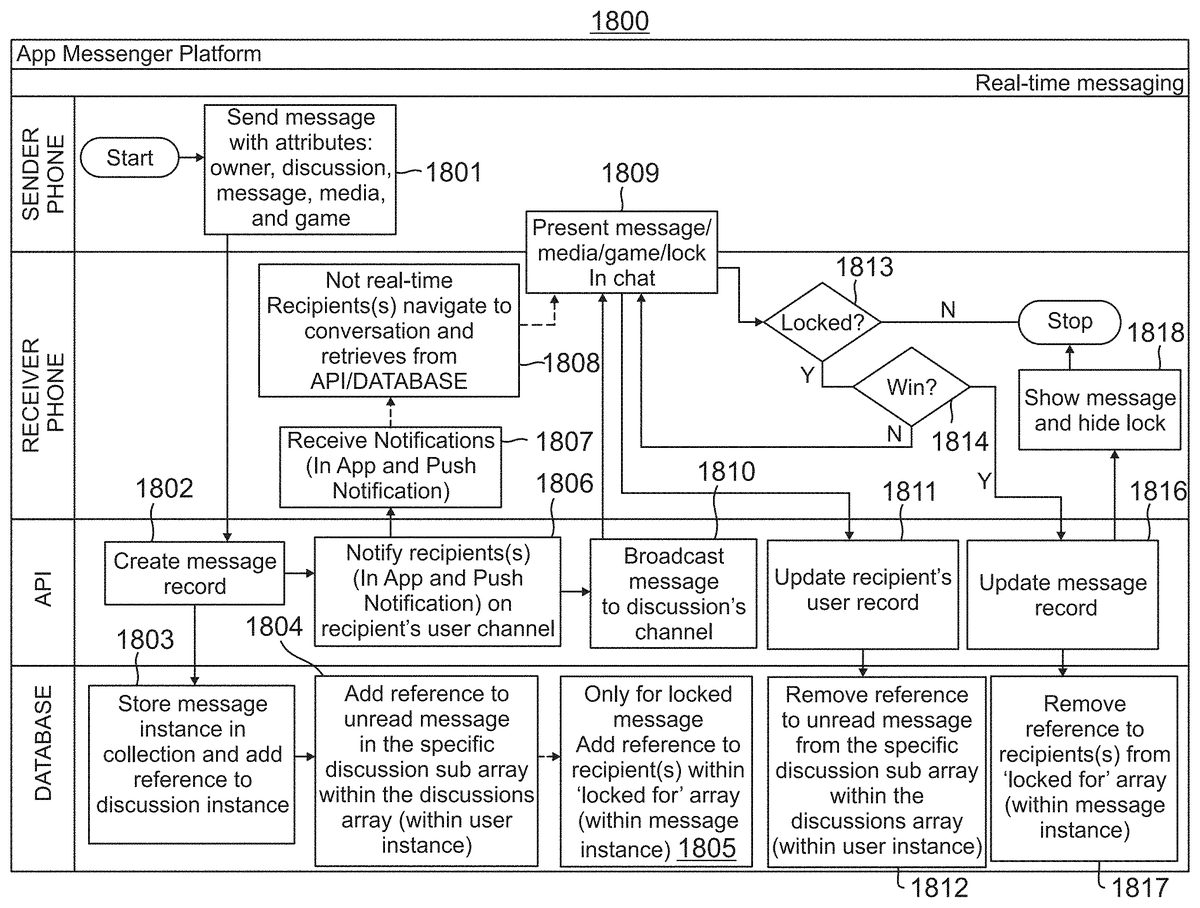
FIG. 18shows an exemplary process diagram of one way the system or platform may be configured and work. Along the left side ofFIG. 18are listed: Sender Phone; Receiver Phone; API (Application Programming Interface); and Database. These may each be part of the system or platform and may generate or facilitate or include logic that generates or facilitates one or more aspects/functions associated with the system or platform. When functions are described in this application as being performed by the system, platform, phone, database, API, computing devices etc., the functions may be generated and/or performed by logic associated with the system, platform, phone, database, API, etc. The system may be JavaScript driven or use another language. The sender's phone (or other communication device) is where a message is initiated and starts (e.g., as discussed above relating to composition and sending of messages). In the method1800, the sender's phone may receive input indicating that a message has been composed and/or entered and receive input indicating that the message should be sent. For example, step1801indicates that the system sends the message with its attributes, e.g., the owner (sender or recipient), discussion/conversation indicators, message content, media content (if any), game (if any), etc. The message may be any of the message types discussed above and may be entered as discussed above, e.g., into a conversation or message exchange as discussed and shown with respect toFIGS. 11-13. The sender's phone may signal the game as locked, locked for certain recipients, or lock or encrypt the message (e.g., with an electronic/video game) using software associated with the app and the hardware of the phone or device.
If encrypted, the encryption may be generated on the sender's phone to ensure maximum security or may be generated by the API. The encryption may be done in a variety of ways. For example, encryption may be done using hashing and a salt. A salt is random data that is used as an additional input to a one-way function that hashes a password, passphrase, or other data. The salt may help defend against various attacks or attempts to reveal or hack the message. A new salt may be randomly generated on the sender's phone or at the API for each locked message. The salt and a password or other data may be concatenated and processed with a cryptographic hash function, and the resulting output stored with the salt in a database. Hashing allows for later authentication or unlocking while protecting the data in the event that the authentication data store is compromised. In one embodiment, proper authentication or unlocking is not possible until a game has been played and game objective achieved. Completing the game objective may allow the system to generate and/or access the required information/data to decrypt and reveal the message.
The message may be routed/sent to the API where a message record is created at step1802. The API may receive input or data from the sender's phone indicating that the message should be shown as locked until a game and/or certain criteria have been met, and this information or information that the message should be shown as locked may be included as part of the message record. If encryption is desired and the encryption did not take place at the sender's phone, the API can encrypt the message based on information/data received from the sender's phone.
At step1803, the message and/or message record may be routed/sent to the database and stored as a message instance in a collection of messages in the database and reference may be added and/or included to a discussion instance (e.g., a particular conversation, discussion, or message exchange with a friend). At step1804, in the database, reference to the message as an “unread message” may be added in a specific discussion sub array within a discussion array that is within a user instance. If the message is a locked message, then, at step1805, the system may add reference to recipient(s) to “locked for” array (within message instance). In one embodiment, the message and/or message record may be stored in the database before sending the message or notification to the recipient. In one embodiment, the message database may be routed to and stored in the database concurrently with sending the message to the receiver. The messages may remain saved in the database or be deleted eventually (e.g., after some time period or after certain criteria have been met). Optionally, the database may only be used if the receiver's phone is not active or is otherwise able to receive the message, and the message may only be stored in the database until the message can be sent to the receiver's phone or other communication device. In one embodiment, once the message object has been delivered to the receiver's phone, the system may remove, from the database, a copy of the message within a specific discussion within recipient(s) discussions array (within user instance). Once a locked message is unlocked, the system may remove, from the database, recipient(s) from the “locked for” array (within message instance).
After the message record is created, the API may generate notification data to be sent to the phones or communication devices of the intended recipient(s) of the message and send/route the notification data to the receiver's phone or other communication device at step1806. The notification data may indicate that the recipient has received a message. The API may generate and send data that causes the notifications to appear, and/or the receiver's phone receives data from the API and then generates and displays the notifications (e.g., a notification bubble that a new message has been received). The notification may be an in-app notification (e.g., if the app is open, notification of a new message will show in the app, for example, alert, notification bubble, or new activity indicator64and/or a notification70). The notification may also be a push notification (e.g., if the app is closed, the notification may show up in the user's telephone notifications in a notification bar, home screen notice, notification menu, alert, etc.) Both in-app and push notifications may be generated, sent, and/or displayed by system logic. At steps1807and1808, the receiver's phone may receive the in-app and/or push notification(s) data from the API and automatically generate and/or display an alert, new activity indicator, notification bubble, etc. in response to receiving the data generated and sent from the API. If the app is open on the receiver's phone, the notifications may be generated, displayed, and viewed in real-time in the app at step1807. If the app is closed on the receiver's phone or otherwise not available, the system may still generate and display a push notification on the receiver's phone. If the notification is selected or tapped then or at a later time, the system may automatically open the app, retrieve the message from memory where it is stored in the database, and display the new message (e.g., at step1809) and/or an in-app notification. Optionally, the system may receive input that the app itself has been selected, open the app, retrieve the message from memory where it is stored in the database, and display the new message (e.g., at step1809) and/or an in-app notification. The system may require navigation to the conversation, then retrieve the message from the database and display it in the conversation (e.g., at step1809).
At step1810, the API may broadcast the message itself to both the sender and recipient(s), then the sender's phone or other communication device and the receiver's phone or other communication device, at step1809, may display the message (e.g., text message, media, game, etc.) or display a locked message indicator (e.g., display as locked message86on the sender's phone and as locked message88on the receiver's phone, until the message is unlocked) in a conversation, e.g., as discussed above with respect toFIGS. 11-13. If the message is not locked, encrypted, or otherwise associated with data indicating it should display as locked, then both the sender's and the receiver's phones or communication devices will display the message as normal (e.g., similar to messages80,84,82, and90) without requiring further unlocking steps. Once the message is displayed to a reader, the receiver's phone can send data indicating that the message has been read to the API. Then at step1811, the API can generate data telling the database to update the recipient's user record with respect to that message and send the data or instructions to the database. At step1812, the database receives the data/instructions from the API to update the recipient's user record, and automatically removes reference to the message as an “unread message” from the specific discussion sub array within the discussions array (within the user instance).
If the message broadcast by the API to the phones or communication devices is associated with data indicating it should display as locked (e.g., a field indicating locked as true, or if the message data includes the receiver's phone or username in the “locked for” array associated with the message). For example, the message or message data may include or be associated with a “locked for” field or array that includes the phone numbers, user names, or other identifiers of the recipients for whom the message should appear as locked or similar to locked message88. The sender will not generally be identified in the “locked for” array, so the message will show for the sender as a message sent as a locked message, but that is opened or unlocked (e.g., similar to locked message86). This type of message (e.g., message86) will be generated and displayed automatically on the sender's phone after the message has been sent and the API has broadcast the message to the sender's phone. If the receiver's phone is in the “locked for” array or otherwise receives the message with data indicating the message should display as locked, a locked message indicator similar to that shown in locked message88will be generated and shown instead of the content of the message. At step1813, the receiver's phone will determine if the message is indicated as locked or if the receiver is in the “locked for” array. If the data indicates the message is locked and/or shows the message as locked, the system may require the recipient to play a game and complete and objective before the message is shown as unlocked. If the system receives input that a locked message indicator (e.g., as shown in locked message88) is selected or tapped, then the system may automatically launch the game that the message is locked with and allow the recipient to play.
At step1814, the system or receiver's phone determines whether the recipient successfully completed the game or game objective. If the system or receiver's phone determines that the recipient did not successfully complete the game or game objective, the message remains locked (e.g., the recipient is still identified in the “locked for” array) and the receiver's phone displays the locked indicator or message88again. If the system determines that the recipient successfully completed the game or game objective, the receiver's phone sends data to the API and, at step1816, the API generates data/instructions telling the database to update the message record. At step1817, the database receives the data/instructions from the API to update the message record and reference to the recipient or the identifier of the recipient in the “locked for” array may be removed from the “locked for” array within the message instance as stored in memory on the database. At step1818, when the receiver is no longer indicated or referenced in the “locked for” array, the receiver's phone can automatically show the message (e.g., similar to locked message89) and hides the lock indicator (e.g., similar to locked message88). Optionally, if a “locked for” array is not used, other data that indicates the message should display as locked can be updated in memory on the database and the indicator that the message should display as locked can be changed so that the message no longer displays as locked. Other methods of unlocking a message are also possible. Generally, the system may accept an unlimited number of times attempting to open the message but, optionally, a limit could be imposed on the number of tries the system will accept before a message remains permanently locked or is deleted.
Optionally, if the broadcast and received message is encrypted, e.g., encrypted by the receiver's phone or communication device or API, the system must receive certain required input prior to unlocking (or decrypting) the message. For example, the required input may be input pertaining to a game that achieves a predefined score (e.g., reaches at least a predefined level within the game), as discussed above in more detail. The unlocked/decrypted message may be opened and displayed on the display of the receiver's phone or communication device as discussed above, e.g., with respect toFIGS. 12-13. When the system receives input other than the required input (e.g., the input does not result in a sufficient score or level within the game), a locked message indicator may again be generated and displayed on the display of the phone or communication device. The system may then wait for additional input that is equivalent to the required input.
The above systems, features, aspects, methods, etc. have generally been described with respect to an application on a communication device; however, the principles described may be applied to other types of devices, systems, methods, etc. Further, features described in one embodiment above, including embodiments described in the Summary section, may generally be combined with features described in other embodiments herein.
Components, aspects, features, etc. of the systems, devices, methods, etc. described herein may be implemented in hardware, software, or a combination of both. Where components, aspects, features, etc. of the systems, devices, methods, etc. described herein are implemented in software, the software may be stored in an executable format on one or more non-transitory machine-readable mediums. Further, the software and related steps of the methods described above may be implemented in software as a set of data and instructions. A machine-readable medium includes any mechanism that provides (e.g., stores and/or transports) information in a form readable by a machine (e.g., a computer). For example, a machine-readable medium includes read only memory (ROM); random access memory (RAM); magnetic disk storage media; optical storage media; flash memory devices; DVD's, electrical, optical, acoustical or other forms of propagated signals (e.g., carrier waves, infrared signals, digital signals, EPROMs, EEPROMs, FLASH, magnetic or optical cards, or any type of media suitable for storing electronic instructions. Information representing the units, systems, and/or methods stored on the machine-readable medium may be used in the process of creating the units, systems, and/or methods described herein. Hardware used to implement the invention may include integrated circuits, microprocessors, FPGAs, digital signal controllers, stream processors, and/or other components.
While the invention has been described in terms of particular variations and illustrative figures, those of ordinary skill in the art will recognize that the invention is not limited to the variations or figures described. The features described with respect to one embodiment or variation may be used in other embodiments or variations. In addition, where methods and steps described above indicate certain events occurring in certain order, those of ordinary skill in the art will recognize that the ordering of certain steps may be modified and that such modifications are in accordance with the variations of the invention. Additionally, certain of the steps may be performed concurrently in a parallel process when possible, as well as performed sequentially as described above. Therefore, to the extent there are variations of the invention, which are within the spirit of the disclosure or equivalent to the inventions found in the claims, it is the intent that this patent will cover those variations as well.
Claims
- A system for electronic communication between two or more users, the system including one or more processors, a non-transitory computer-readable storage medium and instructions stored thereon, the instructions being executable by the one or more processors to perform operations including: generating a locked message by encrypting an electronic message created by a first user;providing the locked message to a mobile communication device of a second user in a messaging application, wherein the locked message is unlocked in response to receipt of an indication that a game objective has been achieved, wherein the first user and the second user are participants in the message application;and determining a number of points accumulated by the second user, wherein user input is received from the mobile communication device of the second user resulting in achievement of the game objective corresponding to the locked message which results in an accumulation of one or more points, and wherein the points accumulated by the second user correspond to obtaining one or more prizes.
- The system of claim 1 , wherein the system utilizes an Application Programming Interface (API) in generating and transmitting the locked message.
- The system of claim 1 , wherein the instructions that, when executed by the one or more processors, perform operations further comprising: responsive to receiving input that the game objective is a customized game objective identified by the first user via a user interface of an electronic device of the first user, generating the locked message such that the electronic game is to be played and the customized game objective achieved before the locked message is displayed on the mobile communication device.
- The system of claim 1 , wherein the instructions that, when executed by the one or more processors, perform operations further comprising: determining points earned by the second user based on input received as a result of certain predetermined activities performed by the second user on the mobile communication device;and displaying the points earned by the second user on a screen of the mobile communication device.
- The system of claim 4 , wherein the instructions that, when executed by the one or more processors, perform operations further comprising: determining points earned by multiple users based on input received as a result of certain predetermined activities performed by the multiple users on one or more mobile communication devices, and displaying the points earned by the second user and the multiple users on a screen of the mobile communication device.
- The system of claim 4 , wherein the instructions that, when executed by the one or more processors, perform operations further comprising: determining a high-point user that has the highest number of points of the multiple users and the second user;generating a locked award message including at least one of a Quick Response (QR) code, barcode, and a unique identification code that can be used to obtain a discount or award, wherein the locked award message is generated such that the high-point user is to play a second electronic game to unlock the locked award message;and transmitting the locked award message to the high-point user.
- The system of claim 1 , wherein the instructions that, when executed by the one or more processors, perform operations further comprising: providing, to the electronic device of the first user, one or more tools for generation of a customized game that may be used to lock the locked message;receiving a second input including the customized game, wherein the electronic game for locking the message is the customized game.
- The system of claim 7 , wherein the instructions that, when executed by the one or more processors, perform operations further comprising: determining the second input includes information detailing the game objective, the game objective being a customized game objective identified by the first user via a user interface of the electronic device of the first user;and generating the locked message such that the electronic game is to be played and the customized game objective achieved before the locked message is displayed on the mobile communication device.
- The system of claim 1 wherein the electronic game is configured to be played on the mobile communication device to unlock the message without requiring the electronic game to be downloaded to the mobile communication device.
- The system of claim 1 , wherein the electronic message is one or more of a text message, a media message, a group message, or a game message.
- The system of claim 1 wherein the system receives the first input as a result of the first user activating a send button or send link via the electronic device.
- The system of claim 1 , wherein the instructions that, when executed by the one or more processors, perform operations further comprising: displaying a locked message indicator on the mobile communication device to indicate receipt of the locked message.
- The system of claim 12 , wherein the instructions that, when executed by the one or more processors, perform operations further comprising: responsive to receiving third input from the mobile communication device, the third input being that the locked message indicator has been selected, launching the electronic game for playing on the mobile communication device;and responsive to receiving fourth input from the mobile communication device, the fourth input being that the game objective has been achieved, displaying the electronic message on the mobile communication device.
- The system of claim 1 wherein generating the locked message comprises generating data associated with the electronic message indicating that the electronic message is not to be displayed on the mobile communication device.
- The system of claim 14 , wherein the instructions that, when executed by the one or more processors, perform operations further comprising: responsive to receiving fifth input from the mobile communication device, the fifth input being that the electronic game has been played and the game objective achieved, deleting or changing the data associated with the electronic message such that the electronic message may be displayed on the mobile communication device.
- The system of claim 1 wherein generating the locked message comprises encrypting the electronic message using a hash and salt such that the electronic message cannot be displayed on the mobile communication device until the locked message is decrypted by playing the electronic game and the indication that the game objective has been achieved is received.
- The system of claim 1 , wherein the instructions that, when executed by the one or more processors, perform operations further comprising: gathering information regarding the second user and, based on the information, generating a personalized locked message including a promotion or discount that may be accessed by the second user after unlocking the personalized locked message, wherein the information includes information regarding the second user's location, and wherein generating the personalized locked message includes generating the personalized locked message to include a promotion or discount for use near the second user's location, wherein the promotion or discount may be accessed by the second user after unlocking the personalized locked message.
- The system of claim 1 , wherein the instructions that, when executed by the one or more processors, perform operations further comprising: determining a number of points accumulated by the first user in response to the generating of the locked message by the encrypting of the electronic message created by the first user.
- The system of claim 1 , wherein the instructions that, when executed by the one or more processors, perform operations further comprising: providing the locked message to mobile communication device of a plurality of users in a messaging application, wherein the plurality of users are participants in the message application.
- A non-transitory storage medium having stored thereon instructions, the instructions being executable by one or more processors to perform operations including: generating a locked message by encrypting an electronic message created by a first user in response to receiving a first input from a first computing device of the first user;providing the locked message to a second computing device of a second user, the locked message provided in a messaging application, wherein the locked message is unlocked in response to receipt of an indication that a game objective has been achieved, wherein the first user and the second user are participants in the message application;and determining a number of points accumulated by the second user, wherein user input is received from the mobile communication device of the second user resulting in achievement of the game objective corresponding to the locked message which results in an accumulation of one or more points, and wherein the points accumulated by the second user correspond to obtaining one or more prizes.
- The non-transitory storage medium of claim 20 , wherein the instructions being executed by the one or more processors to perform operations further including: receiving a second input from the second computing device, the second input including an indication that a required score or level of the electronic game has been reached based on a third input received by the second computing device.
- The non-transitory storage medium of claim 20 , wherein the instructions being executed by the one or more processors to perform operations further including: generating a second electronic message including data received in the first input;and transmitting the second electronic message to the second computing device, wherein the second electronic message is not locked by the electronic game.
- The non-transitory storage medium of claim 20 , wherein the instructions that, when executed by the one or more processors, perform operations further comprising: determining points earned by the second user based on input received as a result of certain predetermined activities performed by the second user on the second computing device;and displaying the points earned by the second user on a screen of the second computing device.
- The non-transitory storage medium of claim 20 , wherein the instructions that, when executed by the one or more processors, perform operations further comprising: determining points earned by multiple users based on input received as a result of certain predetermined activities performed by the multiple users on one or more mobile communication devices, and displaying the points earned by the second user and the multiple users on a screen of the second computing device.
- The non-transitory storage medium of claim 20 , wherein the instructions that, when executed by the one or more processors, perform operations further comprising: providing the locked message to mobile communication device of a plurality of users in a messaging application, wherein the plurality of users are participants in the message application.
Disclaimer: Data collected from the USPTO and may be malformed, incomplete, and/or otherwise inaccurate.