U.S. Pat. No. 10,143,923
ELECTRONIC GAME-PROVIDING DEVICE, ELECTRONIC GAME DEVICE, ELECTRONIC GAME-PROVIDING PROGRAM, AND ELECTRONIC GAME PROGRAM
AssigneeDENA CO., LTD.
Issue DateApril 20, 2016
Illustrative Figure
Abstract
An electronic game-providing device is provided that stores log information relating to electronic game play conducted by an invitor user in association with link information used to access said log information, in the form of a game play database; transmits invitation information containing the link information to an invitee user; and, upon receipt of a link information selection from the invitee user, refers to the game play database and transmits the log information associated with the selected link information.
Description
BEST MODE FOR CARRYING OUT THE INVENTION As shown inFIG. 1, an electronic game system used in an embodiment of the present invention includes information terminals100and a server102. The server102is communicatively connected to multiple information terminals100(100a,100b. . . ) via an information communication network104. The server102provides information allowing for an electronic game to be played on the information terminals100. As shown inFIG. 2, an information terminal100includes a processor10, a memory12, an input module14, an output module16, and a communication module18. The basic configuration of the information terminals100is that of a communication-enabled mobile terminal, such as a mobile phone, a smartphone, a tablet terminal, or the like. In this embodiment, the information terminals100operate as electronic game devices. The processor10includes means for performing arithmetic processing, such as a CPU. The processor10implements the functions that may be used on the information terminals100by running mobile terminal software stored in the memory12. The memory12includes storage means, such as a semiconductor memory, a memory card, or the like. The memory12is accessibly connected to the processor10and stores electronic game software, data required for electronic game processing, as well as databases and other information. The input module14includes means for entering information into the information terminals100. The input module14has, for example, a touchscreen panel, buttons, or the like for receiving input from the user. The output module16includes, for example, a user interface screen (UI) for accepting input information from the user and means for outputting the results of processing by the information terminals100. The output module16is provided with a display that, for example, presents images to the user. The communication module18includes an interface for exchanging information with other information communication devices via the information communication network104. The communication module18may be wired or wireless. As shown inFIG. 3, the server102includes a processor20, a memory22, an input module24, an output module26, ...
BEST MODE FOR CARRYING OUT THE INVENTION
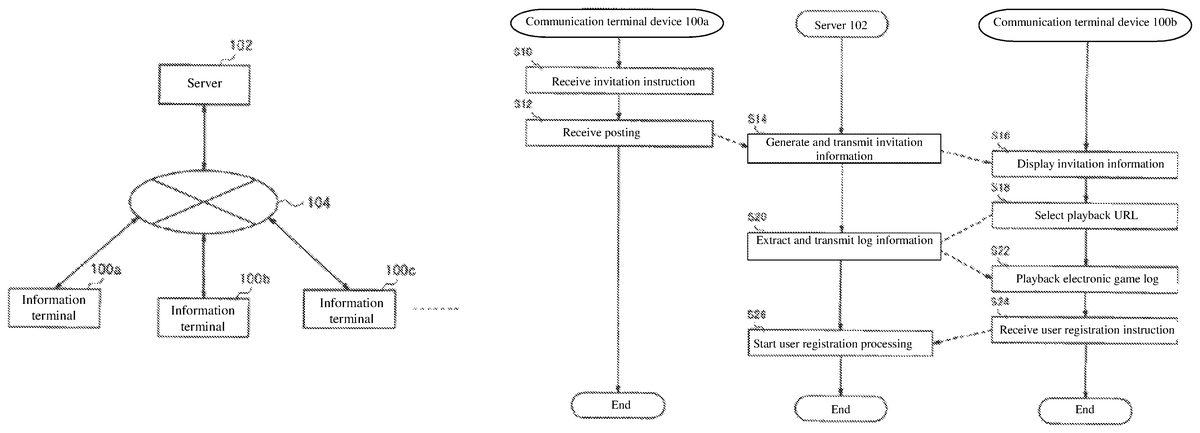
As shown inFIG. 1, an electronic game system used in an embodiment of the present invention includes information terminals100and a server102. The server102is communicatively connected to multiple information terminals100(100a,100b. . . ) via an information communication network104. The server102provides information allowing for an electronic game to be played on the information terminals100.
As shown inFIG. 2, an information terminal100includes a processor10, a memory12, an input module14, an output module16, and a communication module18. The basic configuration of the information terminals100is that of a communication-enabled mobile terminal, such as a mobile phone, a smartphone, a tablet terminal, or the like. In this embodiment, the information terminals100operate as electronic game devices.
The processor10includes means for performing arithmetic processing, such as a CPU. The processor10implements the functions that may be used on the information terminals100by running mobile terminal software stored in the memory12. The memory12includes storage means, such as a semiconductor memory, a memory card, or the like. The memory12is accessibly connected to the processor10and stores electronic game software, data required for electronic game processing, as well as databases and other information. The input module14includes means for entering information into the information terminals100. The input module14has, for example, a touchscreen panel, buttons, or the like for receiving input from the user. The output module16includes, for example, a user interface screen (UI) for accepting input information from the user and means for outputting the results of processing by the information terminals100. The output module16is provided with a display that, for example, presents images to the user. The communication module18includes an interface for exchanging information with other information communication devices via the information communication network104. The communication module18may be wired or wireless.
As shown inFIG. 3, the server102includes a processor20, a memory22, an input module24, an output module26, and a communication module28. The basic configuration of the server102is that of a computer with communication capabilities. In this embodiment, the server102operates as an electronic game-providing device.
The processor20includes means for performing arithmetic processing, such as a CPU. The processor20controls the functions that may be used on the information terminals100by executing a server program (e.g., non-transitory computer-readable medium including instructions stored in a storage and a processor) stored in the memory22. The memory22includes storage means, such as a semiconductor memory, a hard disk, or the like. The memory22is accessibly connected to the processor20and stores an electronic game-providing program (e.g., non-transitory computer-readable medium including instructions stored in a storage and a processor), data used in an electronic game acquired from the information terminals100, as well as databases and other information. The input module24includes means for entering information into the server102. The input module24has, for example, a keyboard, for receiving input from the user. The output module26includes, for example, a user interface screen (UI) for accepting input information from the user, and means for outputting the results of processing by the server102. The output module26is provided with a display that, for example, presents images to the user. The communication module28includes an interface for exchanging information with the information terminals100and other information communication devices via the information communication network104. The communication module28may be wired or wireless.
In the present embodiment, it is assumed that the information terminal100abelongs to User A and the information terminal100bbelongs to User B. In addition, it is assumed that User A has been registered with the electronic game service provided by the server102using the information terminal100aand is playing the electronic game provided by said service. On the other hand, it is assumed that User B has not been registered with the electronic game service provided by the server102and cannot play the electronic game provided by said service.
In addition, in this embodiment, it is assumed that the electronic game program (e.g., non-transitory computer-readable medium including instructions stored in a storage and a processor) running on the information terminals100includes a function for acquiring information about the electronic game played by the user and uploading it to the server102. For every user, the server102registers electronic game-related information (log information) uploaded from the information terminals100in the game play database of the memory22.
The electronic game-related information (log information) may be represented by photographs and videos having recorded therein images appearing during the playing of an electronic game or an input log created by a player during an electronic game. In addition, the uploading of the electronic game-related information may be performed either automatically or by instruction from a player of the electronic game.
As shown in the example of registration inFIG. 4, the game play database has stored therein user IDs in association with game play data IDs, playback URLs, and game URLs. The game play database is stored in the memory22of the server102.
A user ID is an identifier identifying a user who has been registered with the electronic game service provided by the server102. User IDs are unique identifiers assigned to every user.
The game play data IDs are identifiers used for reading out the parameters and data used to run the electronic game played by the users identified by the associated user IDs. The parameters and data used when providing an electronic game in communication with the information terminals100are registered in the memory22of the server102in association with the game play data IDs. When a game play data ID is specified, the server102reads out the parameters and data associated with said game play data ID and runs the electronic game based on this information.
It should be noted that the specific processes used in the electronic game are not a feature of the invention of this Application, and specific discussion thereof has been omitted.
A playback URL represents link information used to view the history of a first user's performance in the electronic game when the first user identified by the associated user ID invites a second user to the electronic game service. Records (still pictures, videos, and log information, such as input logs) obtained when the first user plays the electronic game as a player and registers a game play data ID are stored in the memory22of the server102in association with a playback URL. As a result of accessing the playback URL, the log information associated with the playback URL is read out, and an electronic game play can be recreated based on said log information.
A game URL is a URL used to invite other users to the electronic game system. A game URL represents link information that is used to initiate the electronic game from a stage determined by the electronic game play results of the invitor user when the corresponding selection is made by another user who has been invited. Log information used to restart the electronic game from the state corresponding to the time when the user identified by the associated user ID registered the game play data ID is stored in the memory22of the server102in association with a game URL. As a result of accessing the game URL, the information associated with the game URL is read out, and the game can be initiated from the state reached by the user identified by the associated user ID.
It should be noted that the same user may register a plurality of game play data IDs, playback URLs, and game URLs. In the example ofFIG. 4, the user with the user ID of a0001has registered four sets of game play data IDs, playback URLs, and game URLs.
In addition, registration in the game play database may be performed after the user finishes playing the electronic game. In addition, registration may be accomplished by instruction from the user while the user is in the process of playing the electronic game.
The process of issuing an invitation to join the electronic game system in this embodiment is illustrated below with reference to the flowchart ofFIG. 5. The discussion below will describe an example in which an invitation to join the electronic game system is sent via the server102from User A, who is using information terminal100a, to User B, who is using information terminal100b. It should be noted that by going through the following processes, the information terminals100a,100band the server102operate as means for performing the respective processes.
In Step S10, an instruction to invite another user to the electronic game service is accepted by the information terminal100a. The process performed in this step corresponds to an invitation instruction acceptance means. A selection module used to invite other users to the electronic game service is displayed by the output module16of the information terminal100awhile User A (i.e., the first user) is playing the electronic game, or after the game play is over. The process of issuing an invitation to another user is initiated when User A selects (taps, if this is a touchscreen panel) the on-screen selection module.
In Step S12, a message is posted to a messaging tool or a social networking service (hereinafter, SNS) via the information terminal100a. The process performed in this step corresponds to a message posting acceptance means. The information terminal100adisplays an interface screen that facilitates posting messages to a messaging tool or SNS in order to send other users invitations to the electronic game system. User A then identifies another user to be invited to the electronic game system (User B). For example, User A enters SNS access information or a destination address for a message to User B, who is the invitee. The information terminal100atransmits a user ID for User A, who is the referring user, and access information for User B, who is identified as the invitee, to the server102.
It should be noted that messages may be posted to a messaging tool or SNS without identifying users. That is, the invitor user's posting may be transmitted to a messaging tool or SNS server and disclosed to many users, such as the originating user's friends or other SNS users, etc. Subsequently, when the users access the messaging tool or SNS server, the posting is displayed on the information terminals100of the users.
It should be noted that a setup may be used in which an inputted message from an invitor user to an invitee user is accepted and the message is transmitted to the server102.
In addition, upon initiation of the invitation process, information (hypertext, etc.) about the interface to facilitate the posting of messages to the messaging tool or SNS in order to invite other users to the electronic game system may be transmitted from the server102to the information terminal100a, and messages may be posted using said interface on the information terminal100a.
In Step S14, an invitation is sent to the user who has been designated as the invitee. The process performed in this step corresponds to an invitation information transmitting means. After receiving the invitor User A's user ID and the invitee User B's access information from the information terminal100a, the server102transmits invitation information to User B's information terminal100b. The server102refers to the game play database stored in the memory22, reads out the playback URL and game URL associated with the invitor User A's user ID, and transmits the acquired playback URL and game URL, along with the invitation information (hypertext, etc.), to the information terminal100b.
In addition, when a message is posted to a messaging tool or SNS without identifying users, the posted message includes the playback URL and game URL associated with the invitor User A's user ID. The server102transmits the message posting information containing the playback URL and game URL to the server providing the SNS or messaging tool service. Accordingly, the other user may receive the invitation from User A by accessing the messaging tool or SNS.
If there is a message from the invitor user to the invitee user at such time, said message may be transmitted along with the invitation information.
In addition, if there are multiple sets of playback URLs and game URLs registered for the invitor user, all the information items may be transmitted along with the invitation information. In addition, the originating user may be allowed to specify which of the playback URLs and game URLs are to be used.
In Step S16, the invitation information is displayed on the information terminal100bbelonging to User B who has been designated as the invitee. This step corresponds to an invitation information receiving means and an invitation information displaying means. User B's information terminal100breceives the invitation information from the server102and displays information used to invite User B to the electronic game system on the output module16of the information terminal100b. The displayed screen preferably includes hyperlinks to the playback URL and game URL.
In Step S18, an instruction to view an electronic game play is received from User B. The process performed in this step corresponds to a viewing instruction acceptance means. If User B, who has received an invitation from User A, thinks that he would like to know what kind of electronic game this is prior to registration with the electronic game system, User B specifies a playback URL (hyperlink). Once a playback URL has been specified, the information terminal100btransmits a request to playback User A's game play data to the server102.
In Step S20, the log information used for the playback of electronic game play is transmitted to the information terminal100b. The process performed in this step corresponds to a log information transmitting means. Upon receiving the playback URL specified by User B, the server102reads out the log information registered in the memory22in association with the playback URL and transmits it to the information terminal100b. Further, in addition to the log information, a registration URL (preferably a hyperlink) to allow for registration with the electronic game service once the log information playback has finished is transmitted to the information terminal100b.
In Step S22, the electronic game play is played back based on the log information. The process performed in this step corresponds to a log information receiving means and a game recreating means. Upon receiving the log information from the server102, the information terminal100brecreates the electronic game play on the information terminal100bbased on the log information. If the log information is a video, video data stored in the memory22of the server102may be recreated on the information terminal100b. In addition, if the log information is an input log, the game may be automatically executed on the information terminal100bbased on the input log.
For example, if information recreating a situation in which User A skillfully completing the electronic game is registered as log information, User B can use the recreated screens to learn how to successfully complete the electronic game. Alternatively, if information recreating a situation in which User A suffered an amusing defeat in the electronic game is registered as the log information, User B can appreciate the entertainment value of the defeat in the electronic game.
In this manner, game play situations from the electronic game are recreated and presented to User B, who has been designated as the invitee, thereby stimulating communication between User A and User B. Furthermore, this can lower User B's psychological barrier to registering with the electronic game service and can help smoothly introduce User B to the electronic game. In addition, User B can determine whether or not the electronic game provided by the electronic game service to which he is invited is interesting prior to user registration with the electronic game service.
In Step S24, an instruction to perform user registration is received from the invitee user. The process performed in this step corresponds to a user registration instruction acceptance means. Once the playback of the log information on the information terminal100bis finished, a registration URL (hyperlink) is displayed on the output module16of the information terminal100b. When registering with the electronic game service, User B selects the displayed registration URL. If the registration URL is selected, the information terminal100btransmits the registration URL to the server102.
In Step S26, the process of User B's registration with the electronic game service is initiated. This process corresponds to a user registration means. Upon receiving the registration URL from the information terminal100b, the server102transmits information used for registration with the electronic game service to the information terminal100b. The information used for registration may be, for example, the hypertext, etc. of the registration website.
At such time, the information sent from User B's information terminal100bmay be used to determine whether User B is a registered user who has already been registered with the electronic game service or a new user who has not been registered, and the user registration process may be performed only if it is determined that User B is a new user. This process corresponds to a user registration determination means.
As a result, User B can be registered as a new user of the electronic game service. It should be noted that the registration process uses existing methods and will not be discussed in further detail herein.
Once User B completes user registration with the electronic game service, a friend request, which is intended to build friendly relations within the electronic game service, may be sent to invitor User A. Alternatively, once User B completes user registration with the electronic game service, User B may be made friends with User A. These processes correspond to a friendly relation building means. As a result, User A can start the game in a state in which he has a friend, which makes it possible to increase User A's motivation to start the game.
In the above-described embodiment, it is assumed that the playback URL is indicated by User B and the log information of the electronic game is recreated. However, information about the invitation provided to User B is not limited to the above and it may involve making the invited User B actually play the electronic game.
The process of issuing an invitation to join the electronic game system in this variation is illustrated below, with reference to the flowchart ofFIG. 6. The discussion below will describe an example in which an invitation to join the electronic game system is sent via the server102from User A, who is using information terminal100a, to User B, who is using information terminal100b. It should be noted that steps involving processes similar to those of the above-described embodiment are assigned the same reference numerals and will not be discussed further. In addition, by going through the following processes, the information terminals100a,100b, and the server102operate as means for performing the respective processes. It should be noted that the playback of User A's game play data may be performed after Step S16, and the process of Step S30may be performed thereafter. In such a case, the playback of User A's game play data involves performing the same processes as in the above-described steps S18through S20.
In Step S30, an instruction is received to play (as a trial) the electronic game. The process performed in this step corresponds to a game play instruction acceptance means. If User B, who has received an invitation from User A, thinks that he would like to try playing said electronic game prior to registration with the electronic game system, User B specifies a game URL (hyperlink). When the game URL is specified, the information terminal100btransmits the game URL to the server102.
In Step S32, the log information used to play the electronic game is transmitted to the information terminal100b. The process performed in this step corresponds to a log information transmitting means. Upon receiving the game URL specified by User B, the server102reads out the log information used to restart the game, which is registered in the memory22in association with the game URL, and then transmits it to the information terminal100b. If at such time there is an application, etc. required to run the electronic game on the information terminal100b, it is transmitted as well. Further, in addition to the log information, a registration URL (preferably a hyperlink) to allow for registration with the electronic game service after playing the electronic game is transmitted to the information terminal100b.
In Step S34, the electronic game is initiated based on the log information. The process performed in this step corresponds to a log information receiving means and a game executing means. Upon receiving the log information from the server102, the information terminal100binitiates the electronic game on the information terminal100bbased on the log information. At such time, an application required for playing the electronic game may be run if necessary.
For example, if log information is registered such that the electronic game is initiated from a situation immediately prior to User A completing a certain stage in the electronic game, User B can readily learn how to successfully complete the electronic game. In addition, the user can actually feel the joy of successfully completing the electronic game. Furthermore, if log information is registered such that the electronic game is restarted from a situation in which User A is engaged in a fight with a Raid Boss in the electronic game, or a situation, where he is playing a special stage, User B can experience the intrinsic entertaining value of this electronic game without undergoing painstaking procedures.
In this manner, communication between User A and User B is stimulated by allowing the invitee user to start playing from the situation in which the invitor user is playing the electronic game. Furthermore, this can lower User B's psychological barrier to registering with the electronic game service and can help smoothly introduce User B to the electronic game. In addition, User B can determine whether or not the electronic game provided by the electronic game service to which he is invited is interesting prior to user registration with the electronic game service.
It should be noted that the initiation of the electronic game and user registration may take place at the same time.
In addition, despite the fact that the above-described embodiment and variation involved management, etc. of the log information by the server102, part or all of the processing performed by the server102may be performed by the information terminals100aor100b, or by other information terminals100.
DESCRIPTION OF THE REFERENCE NUMERALS
10Processor12Memory14Input module16Output module18Communication module20Processor22Memory24Input module26Output module28Communication module100(100a,100b) Information terminals102Server104Information communication network
Claims
- An electronic game-providing device provided with: means for storing log information used for the playback of electronic game play conducted on an invitor user's information terminal from a game play state reached on the invitor user's information terminal in association with link information used to access said log information, in the form of a game play database;means for transmitting invitation information for user registration processing containing the link information to an invitee user's information terminal;means for log information transmitting which, upon receipt of a link information selection from the invitee user's information terminal, refers to the game play database and transmits the log information associated with the selected link information to the invitee user's information terminal, wherein the log information contains information allowing for the electronic game to be recreated on the invitee user's information terminal starting from the game play state reached on the invitor user's information terminal, the log information involving at least one of video or game play screens;means for determining whether an invitee user is a registered user or a new user based on the information transmitted from the invitee user's information terminal;and means for carrying out the user registration processing for the invitee user if the means for determining determines that the invitee user is a new user.
- The electronic game-providing device according to claim 1 , wherein the means for transmitting invitation information transmits the invitation information to the information terminal of the invitee user specified by the invitor user's information terminal.
- The electronic game-providing device according to claim 1 , wherein the log information contains information allowing for the electronic game to be played on the invitee user's information terminal starting from the game play state reached on the invitor user's information terminal.
- A non-transitory computer-readable medium containing instructions for a processor to perform: storing log information used for the playback of electronic game play conducted on an invitor user's information terminal from a game play state reached on the invitor user's information terminal in association with link information used to access said log information, in the form of a game play database;transmitting invitation information for user registration processing containing the link information to an invitee user's information terminal;and log information transmitting which, upon receipt of a link information selection from the invitee user's information terminal, refers to the game play database and transmits the log information associated with the selected link information to the invitee user's information terminal, wherein the log information contains information allowing for the electronic game to be played on the invitee user's information terminal starting from the game play state reached on the invitor user's information terminal, the log information involving at least on of video or game play screens;determining whether an invitee user is a registered user or a new user based on the information transmitted from the invitee user's information terminal;and carrying out the user registration processing for the invitee user if the means for determining determines that the invitee user is a new user.
- An electronic game device provided with: means which, as a result of accessing an electronic game-providing device provided with means for storing log information used for the playback of electronic game play conducted on an invitor user's information terminal from a game play state reached on the invitor user's information terminal in association with link information used to access said log information, in the form of a game play database;means for transmitting invitation information for user registration processing containing the link information to an invitee user's information terminal;and means for log information transmitting which, upon receipt of a link information selection from the invitee user's information terminal, refers to the game play database and transmits the log information associated with the selected link information to the invitee user's information terminal, receives invitation information containing link information inviting to the game from said means for transmitting invitation information;means for log information receiving which, as a result of selecting the link information and transmitting it to the means for transmitting invitation information, receives the log information associated with the selected link information from the means for log information transmitting;means for recreating electronic game history based on the log information;means for determining whether an invitee user is a registered user or a new user based on the information transmitted from the invitee user's information terminal;and means for carrying out the user registration processing for the invitee user if the means for determining determines that the invitee user is a new user;wherein said electronic game device is provided with means for game executing which, based on the log information, allows the electronic game to be recreated on the invitee user's information terminal starting from the game play state reached on the invitor user's information terminal, the log information involving at least one of video or game play screens.
- A non-transitory computer-readable medium containing instructions for a computer including the non-transitory computer-readable medium and a processor, wherein, as a result of accessing an electronic game-providing device, the instructions comprise: means for storing log information used for the playback of electronic game play conducted on an invitor user's information terminal from a game play state reached on the invitor user's information terminal in association with link information used to access said log information, in the form of a game play database;means for transmitting invitation information for user registration processing containing the link information to an invitee user's information terminal;and means for log information transmitting which, upon receipt of a link information selection from the invitee user's information terminal, refers to the game play database and transmits the log information associated with the selected link information to the invitee user's information terminal, directs a computer to operate as means for receiving invitation information containing link information inviting to the game from said means for transmitting invitation information;means for log information receiving which, as a result of selecting the link information and transmitting it to the means for transmitting invitation information, receives the log information associated with the selected link information from the means for log information transmitting;means for recreating electronic game history based on the log information;means for determining whether an invitee user is a registered user or a new user based on the information transmitted from the invitee user's information terminal;means for carrying out the user registration processing for the invitee user if the means for determining determines that the invitee user is a new user;and means for game executing which, based on the log information, allows the electronic game to be recreated on the invitee user's information terminal starting from the game play state reached on the invitor user's information terminal, the log information involving at least one of video or game play screens.
Disclaimer: Data collected from the USPTO and may be malformed, incomplete, and/or otherwise inaccurate.