U.S. Pat. No. 10,134,238
Method of Gaming, A Game Controller And A Gaming System
AssigneeARISTOCRAT TECHNOLOGIES AUSTRALIA PTY LIMITED
Issue DateMarch 27, 2017
Illustrative Figure
Abstract
A method of gaming comprising: conducting a game requiring a player to make a choice between at least one optimal action and at least one sub-optimal action having a lower return to player than the optimal action such that the difference between the sub-optimal action and the optimal action represents a lost return to player; receiving a player choice of an action; and conducting a trial for an award in which the probability of success is controlled to provide an expected return to player from the trial that compensates the player for the lost return to player in response to determining that the choice is a sub-optimal action.
Description
DETAILED DESCRIPTION OF THE INVENTION Referring to the drawings, there is shown a gaming system having a game controller arranged to implement a game where players can seek to exercise skill to take optimal actions but if they take sub-optimal actions they are compensated by a chance or an increased chance to win an award. In an embodiment, all of the player return lost by sub-optimal choices is added to a jackpot pool and the players chances of winning a jackpot from the jackpot pool are adjusted to provide an expected player return equivalent to the lost return such that the player return is the same irrespective of a player's choices. General Construction of Gaming System The gaming system can take a number of different forms. In a first form, a stand alone gaming machine is provided wherein all or most components required for implementing the game are present in a player operable gaming machine. In a second form, a distributed architecture is provided wherein some of the components required for implementing the game are present in a player operable gaming machine and some of the components required for implementing the game are located remotely relative to the gaming machine. For example, a “thick client” architecture may be used wherein part of the game is executed on a player operable gaming machine and part of the game is executed remotely, such as by a gaming server; or a “thin client” architecture may be used wherein most of the game is executed remotely such as by a gaming server and a player operable gaming machine is used only to display audible and/or visible gaming information to the player and receive gaming inputs from the player. However, it will be understood that other arrangements are envisaged. For example, an architecture may be ...
DETAILED DESCRIPTION OF THE INVENTION
Referring to the drawings, there is shown a gaming system having a game controller arranged to implement a game where players can seek to exercise skill to take optimal actions but if they take sub-optimal actions they are compensated by a chance or an increased chance to win an award. In an embodiment, all of the player return lost by sub-optimal choices is added to a jackpot pool and the players chances of winning a jackpot from the jackpot pool are adjusted to provide an expected player return equivalent to the lost return such that the player return is the same irrespective of a player's choices.
General Construction of Gaming System
The gaming system can take a number of different forms. In a first form, a stand alone gaming machine is provided wherein all or most components required for implementing the game are present in a player operable gaming machine.
In a second form, a distributed architecture is provided wherein some of the components required for implementing the game are present in a player operable gaming machine and some of the components required for implementing the game are located remotely relative to the gaming machine. For example, a “thick client” architecture may be used wherein part of the game is executed on a player operable gaming machine and part of the game is executed remotely, such as by a gaming server; or a “thin client” architecture may be used wherein most of the game is executed remotely such as by a gaming server and a player operable gaming machine is used only to display audible and/or visible gaming information to the player and receive gaming inputs from the player.
However, it will be understood that other arrangements are envisaged. For example, an architecture may be provided wherein a gaming machine is networked to a gaming server and the respective functions of the gaming machine and the gaming server are selectively modifiable. For example, the gaming system may operate in stand alone gaming machine mode, “thick client” mode or “thin client” mode depending on the game being played, operating conditions, and so on. Other variations will be apparent to persons skilled in the art.
Irrespective of the form, the gaming system comprises several core components. At the broadest level, the core components are a player interface50and a game controller60as illustrated inFIG. 1. The player interface is arranged to enable manual interaction between a player and the gaming system and for this purpose includes the input/output components required for the player to enter instructions and play the game.
Components of the player interface may vary from embodiment to embodiment but will typically include a credit mechanism52to enable a player to input credits and receive payouts, one or more displays54, a game play mechanism56that enables a player to input game play instructions (e.g. to place bets), and one or more speakers58.
The game controller60is in data communication with the player interface and typically includes a processor62that processes the game play instructions in accordance with game play rules and outputs game play outcomes to the display. Typically, the game play instructions are stored as program code in a memory64but can also be hardwired. Herein the term “processor” is used to refer generically to any device that can process game play instructions in accordance with game play rules and may include: a microprocessor, microcontroller, programmable logic device or other computational device, a general purpose computer (e.g. a PC) or a server.
A gaming system in the form of a stand alone gaming machine10is illustrated inFIG. 2. The gaming machine10includes a console12having a display14on which are displayed representations of a game16that can be played by a player. A mid-trim20of the gaming machine10houses a bank of buttons22for enabling a player to interact with the gaming machine, in particular during game play. The mid-trim20also houses a credit input mechanism24which in this example includes a coin input chute24A and a bill collector24B. Other credit input mechanisms may also be employed, for example, a card reader for reading a smart card, debit card or credit card. A player marketing module (not shown) having a reading device may also be provided for the purpose of reading a player tracking device, for example as part of a loyalty program. The player tracking device may be in the form of a card, flash drive or any other portable storage medium capable of being read by the reading device.
A top box26may carry artwork28, including for example pay tables and details of bonus awards and other information or images relating to the game. Further artwork and/or information may be provided on a front panel29of the console12. A coin tray30is mounted beneath the front panel29for dispensing cash payouts from the gaming machine10.
The display14shown inFIG. 2is in the form of a video display unit, particularly a cathode ray tube screen device. Alternatively, the display14may be a liquid crystal display, plasma screen, any other suitable video display unit, or the visible portion of an electromechanical device. The top box26may also include a display, for example a video display unit, which may be of the same type as the display14, or of a different type.
FIG. 3shows a block diagram of operative components of a typical gaming machine which may be the same as or different to the gaming machine ofFIG. 2.
The gaming machine100includes a game controller101having a processor102. Instructions and data to control operation of the processor102are stored in a memory103, which is in data communication with the processor102. Typically, the gaming machine100will include both volatile and non-volatile memory and more than one of each type of memory, with such memories being collectively represented by the memory103.
The gaming machine has hardware meters104for purposes including ensuring regulatory compliance and monitoring player credit, an input/output (I/O) interface105for communicating with peripheral devices of the gaming machine100. The input/output interface105and/or the peripheral devices may be intelligent devices with their own memory for storing associated instructions and data for use with the input/output interface or the peripheral devices. A random number generator module113generates random numbers for use by the processor102. Persons skilled in the art will appreciate that the reference to random numbers includes pseudo-random numbers.
In the example shown inFIG. 3, a player interface120includes peripheral devices that communicate with the game controller101comprise one or more displays106, a touch screen and/or buttons107, a card and/or ticket reader108, a printer109, a bill acceptor and/or coin input mechanism110and a coin output mechanism111. Additional hardware may be included as part of the gaming machine100, or hardware may be omitted as required for the specific implementation.
In addition, the gaming machine100may include a communications interface, for example a network card112. The network card may, for example, send status information, accounting information or other information to a central controller, server or database and receive data or commands from the central controller, server or database.
FIG. 4shows a block diagram of the main components of an exemplary memory103. The memory103includes RAM103A, EPROM103B and a mass storage device103C. The RAM103A typically temporarily holds program files for execution by the processor102and related data. The EPROM103B may be a boot ROM device and/or may contain some system or game related code. The mass storage device103C is typically used to store game programs, the integrity of which may be verified and/or authenticated by the processor102using protected code from the EPROM103B or elsewhere.
It is also possible for the operative components of the gaming machine100to be distributed, for example input/output devices106,107,108,109,110,111to be provided remotely from the game controller101.
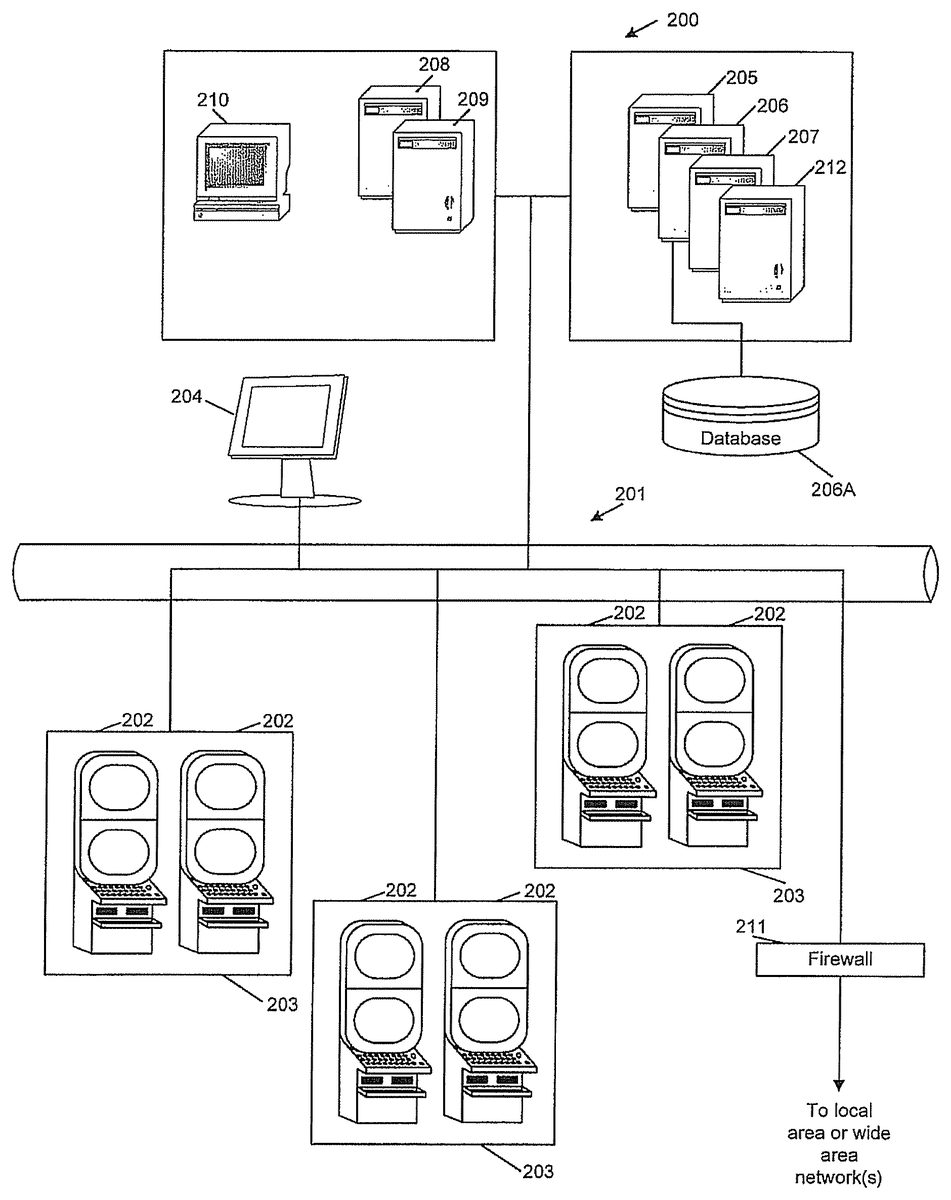
FIG. 5shows a gaming system200in accordance with an alternative embodiment. The gaming system200includes a network201, which for example may be an Ethernet network. Gaming machines202, shown arranged in three banks203of two gaming machines202inFIG. 5, are connected to the network201. The gaming machines202provide a player operable interface and may be the same as the gaming machines10,100shown inFIGS. 2 and 3, or may have simplified functionality depending on the requirements for implementing game play. While banks203of two gaming machines are illustrated inFIG. 5, banks of one, three or more gaming machines are also envisaged.
One or more displays204may also be connected to the network201. For example, the displays204may be associated with one or more banks203of gaming machines. The displays204may be used to display representations associated with game play on the gaming machines202, and/or used to display other representations, for example promotional or informational material.
In a thick client embodiment, game server205implements part of the game played by a player using a gaming machine202and the gaming machine202implements part of the game. With this embodiment, as both the game server and the gaming device implement part of the game, they collectively provide a game controller. A database management server206may manage storage of game programs and associated data for downloading or access by the gaming devices202in a database206A. Typically, if the gaming system enables players to participate in a Jackpot game, a Jackpot server207will be provided to perform accounting functions for the Jackpot game. A loyalty program server212may also be provided.
In a thin client embodiment, game server205implements most or all of the game played by a player using a gaming machine202and the gaming machine202essentially provides only the player interface. With this embodiment, the game server205provides the game controller. The gaming machine will receive player instructions, pass these to the game server which will process them and return game play outcomes to the gaming machine for display. In a thin client embodiment, the gaming machines could be computer terminals, e.g. PCs running software that provides a player interface operable using standard computer input and output components.
Servers are also typically provided to assist in the administration of the gaming network200, including for example a gaming floor management server208, and a licensing server209to monitor the use of licenses relating to particular games. An administrator terminal210is provided to allow an administrator to run the network201and the devices connected to the network.
The gaming system200may communicate with other gaming systems, other local networks, for example a corporate network, and/or a wide area network such as the Internet, for example through a firewall211.
Persons skilled in the art will appreciate that in accordance with known techniques, functionality at the server side of the network may be distributed over a plurality of different computers. For example, elements may be run as a single “engine” on one server or a separate server may be provided. For example, the game server205could run a random generator engine. Alternatively, a separate random number generator server could be provided. Further, persons skilled in the art will appreciate that a plurality of game servers could be provided to run different games or a single game server may run a plurality of different games as required by the terminals.
Further Detail of Gaming System
FIG. 6shows a gaming system of an embodiment where the compensatory award is provided by adjusting the odds of a player winning a jackpot. To play a game round the player operates the instruction input mechanism56to place a wager. The outcome generator622generates a game outcome based on game rules641using random number generator621.
The game rules641require the player to make a choice between a set of possible actions. The number of different actions can vary depending on the implementation of the game and can be, for example, a selection between different options. The player operates choice selector56A of instruction input mechanism56to input their choice. The choice processor623receives the input choice input and determines whether the player has selected to take an optimal action or a sub-optimal action.
The choice processor623provides the choice to the prize award module624. The prize award module624determines what prize applies based on the choice and the prize table642(as well as the previously determined game outcome if this affects the prize) and updates the meters643accordingly.
The choice processor623advises the jackpot module625whether the player has made an optimal or sub-optimal choice and the amount of any lost return to player resulting from the choice. The action of the jackpot module625varies depending on whether a player has made an optimal choice or a suboptimal choice. In this embodiment, each player has a chance to win the jackpot in each game round and accordingly if a player makes an optimal choice, the jackpot module625determines whether they have won a prize from the jackpot pool644in accordance with the normal odds of winning Those normal odds of winning may depend, for example, on the size of a player's bet
If the choice processor623determines that a player made sub optimal choice it determines the amount of credits that the player has foregone by the sub-optimal choice and advises the pool incrementer626which adds the amount of credits to the jackpot pool644. It will be appreciated in this embodiment the jackpot is a progressive jackpot which allows the pool to be incremented.
A person skilled in the art will appreciate that the amount of lost return can be represented in a number of different ways including as an amount in currency. The choice processor623also advises the jackpot module625that the player is made of sub-optimal choice. The odds adjustor625A adjust the odds of winning the jackpot in order to compensate the player for the lost amount of credits. The jackpot controller module625then determines using random number generator621whether the player has won the jackpot. Accordingly, players who make sub-optimal choices have a greater chance of winning the jackpot. Persons skilled in the art will appreciate that the jackpot controller module625could be provided by a separate device in data communication with the game controller, for example at jackpot server207
In an alternative embodiment only players who make sub-optimal choices get access to a chance to win the jackpot in this particular part of the game. Other players may have a chance to win the jackpot in other parts of the game.
It will be appreciated that the determination of whether the player has won the jackpot is made by the jackpot module625as part of the game round such that compensation is targeted specifically at players who make the sub-optimal play. Merely increasing the jackpot pool with any loss returned to player could result in players who are more skilled in obtaining a better return to player and less skill.
The method is summarised inFIG. 7and involves starting a game round710and offering a player choice of some action720, for example a decision to make, where they must make a selection. The method then involves determining whether the action is optimal730and if it is optimal conducting a normal jackpot trial740and awarding any prizes780. If the action is not optimal the method involves adding the lost credit to the jackpot pool750, adjusting the odds for jackpot wins760and conducting an adjusted jackpot trial770and awarding prizes if any before proceeding to the start of another game round. Other features of the method will be apparent from the above description of the gaming system.
Persons skilled in the art will appreciate that the probability of winning is adjusted in accordance with the lost return to player. Thus the expected return to player of the jackpot is compensates for the lost return to the player. Further, it is possible to offer players a game of skill without providing optimal play instructions. Thus, players who derive enjoyment by learning the optimal plays for a game while other players who do not learn the optimal plays are not disadvantaged.
Persons skilled in the art will also appreciate that the method of the embodiment could be embodied in program code. The program code could be supplied in a number of ways, for example on a computer readable medium, such as a disc or a memory (for example, that could replace part of memory103) or as a data signal (for example, by downloading it by transmitting it from a server).
EXAMPLES
Example 1
A game has a free game multiplier that is randomly generated, either ×2 or ×4 multiplier with even probability. Thus, the average result is ×3. The player has an option of repeating the selection and so the player gets a second chance to hit the ×4 if their original result was ×2. Hence the optimal play would be to repeat the selection if the player receives ×2. If the player refuses to repeat the selection then they have rejected an average multiple at ×3 and taken an average multiplier at ×2. The loss is equivalent to an average multiplier at ×1. This amount in credits (i.e. what the player would win without the multiplier) is forwarded to the jackpot pool and a probability for winning the jackpot could be cast immediately such that the expected return from the jackpot for this hapless player is exactly the return lost through the poor decision.
Example 2
In this example, a fixed value prize is available to be awarded as compensation a feature is worth a total value of $30 and the feature comprises 30 skill events worth $1 each. Player A only wins $20 in the feature. To maintain player return, the player A needs to be paid $10. In this game, a prize of $40 is available as a randomly awarded prize. The player has lost $10 so the player needs a 1 in 4 chance of winning the $40. Player B plays the same game but has less skill and wins only $10 in the skill feature. The player has “lost” $20. The fixed prize is $40 so the player needs a 1 in 2 chance to win the fixed prize. The game adjusts the probability of winning the prize accordingly.
Example 3
In this example a progressive prize is available to be awarded as compensation. Using the example above, the player has “lost” $10 due to lack of skill but a regulator requires that the player have access to be able to win that amount to ensure fairness. The $10 amount is added to a progressive meter. (The addition can be to the visible meter or the amount can be broken in to parts with some of the amount going to a hidden meter to fund future start ups and some of it going to the visible meter) The visible progressive meter reads $15. Half of the lost amount is added to the visible meter and the other half goes to the hidden meter. The visible meter now reads $20 and the hidden meter has increased by $5. The player needs to be given a chance to win $10. The available prize is $20 on the progressive meter. So the player is given a 1 in 2 chance of winning the progressive meter. The player is successful and the player is paid the $20 and the meter resets to $5 from the hidden meter. Time passes and the visible progressive meter now reads $20. Player B has “lost” $20 of which $10 goes to the visible meter and $10 to the hidden meter. The visible meter now reads $30. Player B is given a 2 in 3 chance of winning the progressive meter.
It will be understood to persons skilled in the art of the invention that many modifications may be made without departing from the spirit and scope of the invention. In particular, various of the above features may be combined to form further embodiments.
It is to be understood that, if any prior art publication is referred to herein, such reference does not constitute an admission that the publication forms a part of the common general knowledge in the art, in Australia or any other country.
In the claims which follow and in the preceding description of the invention, except where the context requires otherwise due to express language or necessary implication, the word “comprise” or variations such as “comprises” or “comprising” is used in an inclusive sense, i.e. to specify the presence of the stated features but not to preclude the presence or addition of further features in various embodiments of the invention.
Claims
- A method of conducting a game in a gaming system having (1) a player interface comprising (i) a credit input mechanism configured to receive a physical item representing a monetary value for credit input and establishing a credit balance, and (ii) a game play mechanism configured to enable manual interaction between a player and the gaming system, and to provide player inputs of an optimal action and a sub-optimal action, (2) credit meters configured to monitor the credit input having been provided by the credit input mechanism, and (3) a gaming controller configured to implement a game, the method comprising: receiving via the player interface a player input of one of the optimal action and the sub-optimal action;determining via the gaming controller a loss in a return-to-player between the sub-optimal action and the optimal action;increasing via the gaming controller a probability of success in winning an award based on the loss in response to the player interface receiving a player input of a sub-optimal action;and conducting the game via the gaming controller for an award with the increased probability of success in response to the player interface receiving a player input of a sub-optimal action.
- A method as claimed in claim 1 , and wherein an expected return-to-player is equivalent to the lost return-to-player when the choice is a sub-optimal action.
- A method as claimed in claim 1 , and further comprising conducting a normal game for the award in response to a player choosing an optimal action such that an expected return-to-player is increased when the choice is a sub-optimal action.
- A method as claimed in claim 1 , and wherein the award is a progressive jackpot.
- A method as claimed in claim 4 , and further comprising adding the lost return-to-player to a pool of the progressive jackpot.
- A method as claimed in claim 1 , and further comprising making the player input as part of a game round and any game is conducted prior to any further game round.
- A game controller conducting a game in a gaming machine having (1) a player interface comprising (i) a credit input mechanism configured to receive a physical item representing a monetary value for credit input and establishing a credit balance, and (ii) a game play mechanism configured to enable manual interaction between a player and the gaming system, and to provide player inputs of an optimal action and a sub-optimal action, and (2) credit meters configured to monitor the credit input having been provided by the credit input mechanism, the game controller comprising: a choice selector configured to receive via the player interface a player input of one of the optimal action and the sub-optimal action;a choice processor configured to determine a loss in a return-to-player between the sub-optimal action and the optimal action;an odds adjuster configured to increase a probability of success in winning an award based on the loss in response to the player interface receiving a player input of a sub-optimal action;and a jackpot module configured to conduct the game for an award with the increased probability of success in response to the player interface receiving a player input of a sub-optimal action.
- A game controller as claimed in claim 7 , and wherein an expected return-to-player is equivalent to the lost return-to-player when the choice is a sub-optimal action.
- A game controller as claimed in claim 7 , and wherein the jackpot module is further configured to conduct a normal game for the award in response to a player choosing an optimal action such that an expected return-to-player is increased when the choice is a sub-optimal action.
- A game controller as claimed in claim 9 , and wherein the award is a progressive jackpot.
- A game controller as claimed in claim 10 , and wherein the choice processor is further configured to add the lost return-to-player to a pool of the progressive jackpot.
- A game controller as claimed in claim 7 , and wherein the choice is made as part of a game round and wherein said jackpot module is further configured to conduct any game to any further game round.
- A gaming system comprising: a player interface comprising (i) a credit input mechanism configured to receive a physical item representing a monetary value for credit input and establishing a credit balance, and (ii) a game play mechanism configured to enable manual interaction between a player and the gaming system, and to provide player inputs of an optimal action and a sub-optimal action;credit meters configured to monitor the credit input having been provided by the credit input mechanism;and a game controller configured to: receive via the player interface a player input of one of the optimal action and the sub-optimal action;determine a loss in a return-to-player between the sub-optimal action and the optimal action;increase a probability of success in winning an award based on the loss in response to the player interface receiving a player input of a sub-optimal action;and conduct the game for an award with the increased probability of success in response to the player interface receiving a player input of a sub-optimal action.
- A gaming system as claimed in claim 13 , and wherein an expected return-to-player is equivalent to the lost return-to-player when the choice is a sub-optimal action.
- A gaming system as claimed in claim 13 , and wherein the game controller is further configured to conduct a normal game for the award in response to a player choosing an optimal action such that the expected return-to-player is increased when the choice is a sub-optimal action.
- A gaming system as claimed in claim 15 , and wherein the award is a progressive jackpot.
- A gaming system as claimed in claim 16 , and wherein the game controller is further configured to add the lost return-to-player to a pool of the progressive jackpot.
- A gaming system as claimed in claim 13 , and wherein the game controller is further configured such that the choice is made as part of a game round and any game is conducted prior to any further game round.
- A gaming system as claimed in claim 13 , and wherein the game controller is configured to conduct the game.
- A gaming system as claimed in claim 13 , and further comprising a jackpot controller in data communication with the game controller and configured to conduct the game.
Disclaimer: Data collected from the USPTO and may be malformed, incomplete, and/or otherwise inaccurate.