U.S. Pat. No. 10,105,600
GAME PROCESSING METHOD AND RECORDING MEDIUM
AssigneeKoei Tecmo Games Co Ltd
Issue DateOctober 25, 2016
Illustrative Figure
Abstract
The information processing device 3 is caused to function as an information acquisition processing part 17 that acquires positional information of the other player character 33 located on a game field at the time of death of the other player character 33, an object display processing part 19 that displays based on the positional information an object 31 at the position corresponding to the death position of the other player character 33 on a game field on which the player character 33 is located, and a character appearance processing part 25 that causes a specter character 35 to appear in association with the object 31, and the specter character 35 is an enemy character corresponding to the other dead player character 33 and an enemy character with which the player character 33 is able to battle.
Description
DETAILED DESCRIPTION OF THE EMBODIMENTS An embodiment of the present invention will now be described with reference to the drawings. 1. Overall Configuration of Game System First, an example of an overall configuration of a game system1related to this embodiment will be described with reference toFIG. 1. As shown inFIG. 1, the game system1has multiple information processing devices3and a server9. Each of the multiple information processing devices3and the server9are connected in a communicable manner through a network NW such as a LAN and the Internet, for example. The information processing device3is a stationary game machine. A controller5such as a game controller and a display device7such as a television set are connected to the information processing device3in a communicable manner. Although the case of wired connection is shown inFIG. 1, the connection may wirelessly be made. Although only the controller5and the display device7connected to one of the information processing devices3are shown inFIG. 1, the controllers5and the display devices7can also be connected to the other information processing devices3. The information processing device3is not limited to the stationary game machine and may be a portable game machine integrally including an input part and a display part. Other than the game machine, for example, the information processing device3may be one of those manufactured and sold as computers such as server computers, desktop computers, notebook computers, and tablet computers or those manufactured and sold as telephones such as portable telephones, smartphones, and tablets. The games executable by the information processing device3include a game in which a player operates a player character33(seeFIG. 5described later) through the controller5to move in a game field and fight with an enemy character. This game will hereinafter be simply referred to as a “game.” Additionally, although the model of the player character33is a human being in the examples in the following ...
DETAILED DESCRIPTION OF THE EMBODIMENTS
An embodiment of the present invention will now be described with reference to the drawings.
1. Overall Configuration of Game System
First, an example of an overall configuration of a game system1related to this embodiment will be described with reference toFIG. 1. As shown inFIG. 1, the game system1has multiple information processing devices3and a server9. Each of the multiple information processing devices3and the server9are connected in a communicable manner through a network NW such as a LAN and the Internet, for example.
The information processing device3is a stationary game machine. A controller5such as a game controller and a display device7such as a television set are connected to the information processing device3in a communicable manner. Although the case of wired connection is shown inFIG. 1, the connection may wirelessly be made. Although only the controller5and the display device7connected to one of the information processing devices3are shown inFIG. 1, the controllers5and the display devices7can also be connected to the other information processing devices3.
The information processing device3is not limited to the stationary game machine and may be a portable game machine integrally including an input part and a display part. Other than the game machine, for example, the information processing device3may be one of those manufactured and sold as computers such as server computers, desktop computers, notebook computers, and tablet computers or those manufactured and sold as telephones such as portable telephones, smartphones, and tablets.
The games executable by the information processing device3include a game in which a player operates a player character33(seeFIG. 5described later) through the controller5to move in a game field and fight with an enemy character. This game will hereinafter be simply referred to as a “game.” Additionally, although the model of the player character33is a human being in the examples in the following description, the model of the player character33may be an animal other than human beings or a machine such as a robot.
In the following description, out of multiple player characters33related to multiple players (it is noted that one player having multiple accounts can retain multiple player characters33), the player character33operated by the player himself/herself (corresponding to an example of a “second player character”) is simply referred to as “the player character33,” and the player character33different from the above player character33, which is operated by another player other than himself/herself or by the player himself/herself playing with a different account (corresponding to an example of a “first player character”), is particularly referred to as “the other player character33.”
A game field on which the player character33is located corresponds to a “second game field” and a game field on which the other player character33is located corresponds to a “first game field.”
In the game, the player character33modeled after a human being dies when a physical strength value becomes zero, for example. Examples of the cause of death include, for example, a death due to an attack of an enemy character, a death due to a geographical feature of a game field (e.g., death from a fall from a cliff), and a death due to a trap set in the game field. A “dead state” of the player character33corresponds to an example of a “state of being unable to fight”, and the cause of death corresponds to a “cause of being unable to fight.” The state of being unable to fight is not limited to the dead state of the player character33modeled after a human being and may be a state of being unable to fight because of being injured, stunned, nearly dead, petrified, paralyzed, cursed, spellbound, or bewitched (it is noted that the player character33may be in a movable state). Alternatively, when the player character33is modeled after a machine, the state of being unable to fight may be a state of being unable to fight because the player character33modeled after a machine is broken or runs out of energy (it is noted that the player character33may be in a movable state).
The “state of being unable to fight” corresponds to an example of a “predetermined state.” However, the predetermined state is not limited to the state of being unable to fight and may be some kind of state in which the player character33is not made unable to fight (e.g., a state of being unable to move (unable to escape) due to a geographical feature, a trap, etc. on the game field).
The game involves an ability value such as a “level” indicative of a grade of strength of the player character33. The game also involves “items.” For example, the items include “equipped items” such as “weapons” and “protectors” and “usable items” such as “recovery items” and “strengthening items.” The player character33can be possessed of and equipped with acquired weapons and protectors and can possess and use acquired recovery and strengthening items.
The information processing device3can transmit play information (described in detail later) at the time of death of the player character33through the network NW to the server9.
The server9can acquire and store pieces of the play information transmitted from the multiple information processing devices3as a database. The server9can transmit the play information related to the other player character33stored as a database through the network NW to the information processing device3executing the game in which the player character33is operated. Although made up of one server inFIG. 1, the server9may be made up of multiple servers.
2. Database of Server
An example of contents of a database of the server9will be described with reference toFIGS. 2 and 3. Arrows shown inFIG. 2indicate an example of signal flow and are not intended to limit the signal flow directions.
As shown inFIG. 2, the server9has a database13. The database13stores pieces of the play information related to the multiple player characters33. The play information includes a player name, level information of the player character33, equipped item information of the player character33, the other player character data (e.g., data forming the exterior of the player character33, and fighting tendency information such as a posture of the player character33), positional information on a game field on which the player character33is located, information on the cause of death, etc. at the time of death of the player character33in the game.
In particular, as shown inFIG. 3, the database13is provided with “player name” fields, “character level” fields, “equipped item” fields, “character data” fields, “position” fields, “cause of death” fields, etc. The “player name” fields each store a player name (e.g., an account name) out of the play information. The “character level” fields each store the level information of the player character33out of the play information. The “equipped items” fields each store the equipped item information of the player character33out of the play information. The “character data” fields each store the other player character data out of the play information. The “position” fields each store the positional information on a game field out of the play information. The “cause of death” fields each store the information on the cause of death out of the play information.
The play information stored in the database13is not limited to the information described above and may include information other than the above (e.g., game stage level information at the time of death of the player character33, and information of possession items that are unequipped weapons/protectors and usable items at the time of death of the player character33) or may not include some of the above.
Although the server9has constituent elements (such as a CPU, a memory, input/output devices, a recording device, and a communication device) for a typical computer along with the database13, these elements will not be shown and described.
3. Functional Configuration of Information Processing Device
An example of a functional configuration of the information processing device3will be described with reference toFIGS. 2 and 4 to 6.
As shown inFIG. 2, the information processing device3has a communication device123, a filter processing part15, an information acquisition processing part17, an object display processing part19, an information display processing part21, an appearance propriety determination processing part23, a character appearance processing part25, a battle execution processing part27, an item acquisition processing part29, and a recording device117.
The communication device123communicates through the network NW with the server9. A communication mode is not particularly limited as long as information can be transmitted and received.
The filter processing part15controls the communication device123to access the database13of the server9through the network NW and extract the play information related to the other player characters33matching a predetermined condition out of the pieces of the play information related to the multiple player characters33stored in the database13.
An example of the predetermined condition is that a level (the level of the other player character33) indicated by the level information in the play information is in the same range as the level of the player character33(e.g., within a level difference of about ±10). Another example is that, on the basis of the play information including stage level information of the game, a stage level (the stage level related to the other player character33) indicated by the stage level information in the play information is in the same range as the stage level related to the player character33(e.g., within a level difference of about ±10). A further example is that a player (the other player) corresponding to a player name in the play information is one of the other players registered in the information processing device3. The predetermined conditions described above are examples and other conditions may be used.
The filter processing part15may extract the play information related to all, or a predetermined number of, the other player characters33matching the predetermined condition. If the play information is extracted with respect to only the predetermined number of the player characters, the play information may be extracted at random or in accordance with some sort of criterion.
The information acquisition processing part17acquires the play information related to a predetermined number of the other player characters33at random out of the play information related to the other player characters33extracted by the filter processing part15.
The information acquisition processing part17may acquire the play information related to the predetermined number of the other player characters33in accordance with some sort of criterion. Alternatively, the information acquisition processing part17may acquire the extracted play information related to all the other player character33. Alternatively, the filter processing part15may not be included and the information acquisition processing part17may control the communication device123to access the database13of the server9through the network NW and acquire the play information related to the predetermined number of the other player characters33at random out of pieces of the play information related to the multiple player characters33stored in the database13.
The processes of the filter processing part15and the information acquisition processing part17may be executed at constant time intervals (e.g., intervals of five minutes), or may be executed each time a frame is changed in the game being executed by the information processing device3. These are enabled in an online state in which the information processing device3is connected to the network NW.
The recording device117is made up of a hard disk, for example. The play information related to the other player characters33acquired by the information acquisition processing part17may be recorded in the recording device117. In this case, once the play information related to the other player characters33is acquired, a processing part such as the object display processing part19can execute a predetermined process based on the play information related to the other player characters33recorded in the recording device117even in an offline state in which the information processing device3is not connected to the network NW. Alternatively, the play information related to the other player characters33extracted by the filter processing part15may be recorded in the recording device117. In this case, once the play information related to the other player characters33is extracted, the information acquisition processing part17can acquire the play information related to the predetermined number of the other player characters33at random out of the play information related to the other player characters33recorded in the recording device117even in an offline state in which the information processing device3is not connected to the network NW.
Based on the positional information in the play information related to the other player character33acquired by the information acquisition processing part17(positional information of a first position), the object display processing part19controls the display device7to display an object31(seeFIG. 4described later) at a position of death of the other player character33on a game field on which the player character33is located in the game being executed. The position of display of the object31(a second position) in this case may not exactly be the same as the position corresponding to the positional information (a first position) and may be a position near the position corresponding to the positional information or any position in an area including the position corresponding to the positional information (or an area immediately before or after the area).
Although not particularly limited, the object31is preferably an object suggestive of the death of the other player character33such as a “sword tumulus,” a “tomb,” a “coffin,” and “corpse,” for example.
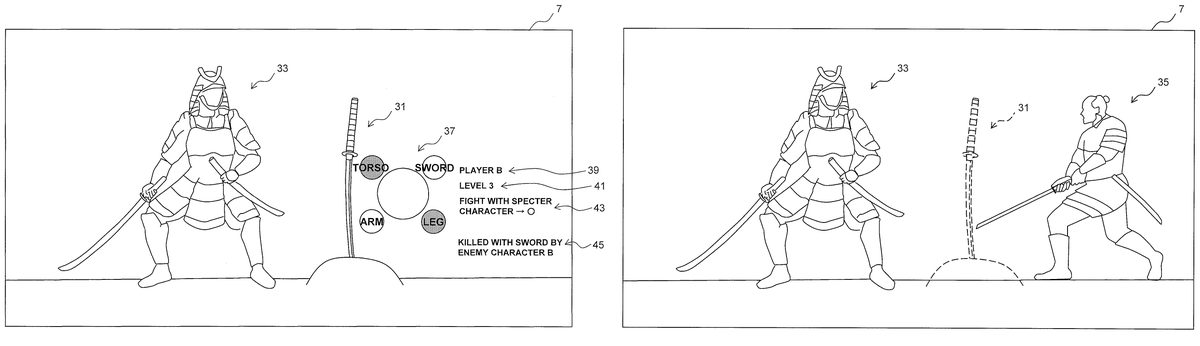
FIG. 4shows an example of a screen on which the object31is displayed. In the example shown inFIG. 4, the display device7displays a screen displaying the object31that is a “sword tumulus” with a sword stabbed into a round mound raised from the surrounding ground at the position of the death of the other player character33on the game field on which the player character33is located. In this screen, the player character33is not shown.
If the multiple other player characters33have died in the same area, the multiple objects31may be displayed. In this case, an upper limit may be set for the number of the objects31displayed at the same time in an area (or a screen) (e.g., the number of the objects per area is up to 10).
A form of display of the objects31may not be common to all the objects31and may differ between areas or may differ in accordance with an equipped item, a level, etc. of a specter character described later making an appearance.
Returning toFIG. 2, if the player character33is within a predetermined range from the object31in the game being executed, the information display processing part21controls the display device7to display predetermined information.
Specifically, based on the equipped item information in the play information related to the other player characters33acquired by the information acquisition processing part17, the information display processing part21displays a display37(seeFIG. 5described later) including information on equipped items at the time of death of the other player character33related to the object31(in particular, equipped items of a specter character described later corresponding to the other player character33). Although not particularly limited, the information on the equipped items displayed in this case includes, for example, types, rarities, names, and ability values of equipped items.
On the basis of the play information including the possession item information, the information display processing part21may display information on possession items at the time of death of the other player character33(in particular, possession items of a specter character described later corresponding to the other player character33) (e.g., types, rarities, names, and effects of possession items), in addition to or instead of the information on equipped items of the other player character33related to the object31.
Based on the player's name in the play information related to the other player characters33acquired by the information acquisition processing part17, the information display processing part21displays a display39(seeFIG. 5described later) indicative of the other player's name corresponding to the other player character33related to the object31.
Based on the level information in the play information related to the other player characters33acquired by the information acquisition processing part17, the information display processing part21displays a display41(seeFIG. 5described later) indicative of the level at the time of death of the other player character33related to the object31.
Based on the information on the cause of death in the play information related to the other player characters33acquired by the information acquisition processing part17, the information display processing part21displays a display45(seeFIG. 5described later) indicative of information on the cause of death of the other player character33related to the object31. In this example, the information on the cause of death of the other player character33includes information of an object (such as an enemy character, a geographical feature, and a trap) causing the death of the other player character33.
The information displayed by the information display processing part21is not limited to the information described above and may include information other than the above or may not include some of the above.
If the player character33is within a predetermined range from the object31in the game being executed, the appearance propriety determination processing part23controls the display device7to display a display43(seeFIG. 5described later) making an inquiry to the player operating the player character33about whether to allow a specter character35to appear (seeFIG. 6described later). The specter character35is an enemy character that is the other dead player character33turned into a specter, and is an enemy character with which the player character33can battle.
FIG. 5shows an example of a screen corresponding to a state in which the player character33is within a predetermined range from the object31. In this description, it is assumed that the play information corresponding to the object31is the play information shown at the top of the table ofFIG. 3.
In the example shown inFIG. 5, the player character33is equipped with a sword, a head protector, a torso protector, an arm protector, and a leg protector in this example and is present within a predetermined range from the object31. The display37is displayed in the vicinity of the object31(to the right of the object31in this example). Specifically, the equipped item information in the play information shown at the top of the table ofFIG. 3indicates a “sword B,” a “torso protector B,” an “arm protector B,” and a “leg protector B.” The display37includes four objects having respective displays of texts indicative of respective types of these four equipped items (a text “sword” indicative of a “type: sword”, text “torso” indicative of a “type: torso protector”, a text “arm” indicative of a “type: arm protector”, and a text “leg” indicative of a “type: leg protector”). The types of equipped items may be indicated by marks or codes. The objects related to highly rare equipped items (the “torso protector B” and the “leg protector B” in this example) among the four equipped items are displayed in a different form (in a different color in this example) as compared to the objects related to the other equipped items (the “sword B” and the “arm protector B” in this example).
The display39(a text “player B” in this example) is displayed in the vicinity of the object31(to the upper right of the display37in this example). The display41(a text “level 3” in this example) is displayed in the vicinity of the object31(under the display39in this example). The display43(a text “battle with specter character→∘” in this example) is displayed in the vicinity of the object31(under the display41in this example). The display45(a text “killed with sword by enemy character A” in this example) is displayed in the vicinity of the object31(under the display43in this example).
Returning toFIG. 2, after displaying the display43, the appearance propriety determination processing part23accepts a player's input operation through the controller5and determines whether to allow the specter character35to appear in accordance with the input operation. In particular, if an operation is performed for allowing the specter character35to appear (according to the display43shown inFIG. 5, a button “∘” of the controller5is pressed), the appearance propriety determination processing part23determines to allow the specter character35to appear.
An operation of preventing the specter character35from appearing may be set and, if this operation is performed, the appearance propriety determination processing part23may determine to prevent the specter character35from appearing. In this case, the object31related to the determination of preventing the specter character35from appearing may disappear.
If the appearance propriety determination processing part23determines to allow the specter character35to appear, the character appearance processing part25controls the display device7to cause the specter character35to appear in association with the object31(form the object31in this example) and cause the object31to disappear. In this case, based on the other player character data in the play information related to the other player characters33acquired by the information acquisition processing part17, the character appearance processing part25causes the specter character35to appear with the exterior and the fighting strength (i.e., with the equipped items, the ability value such as a level, and the fighting tendency such as a posture) at the time of death of the other player character33related to the object31.
The place of the specter character35caused to appear by the character appearance processing part25may not be the object31itself as long as the place is associated with the object31, and may be a position near the object31, a predetermined or random position within an area in which the object31is present, etc.
The enemy character caused to appear by the character appearance processing part25is not particularly limited as long as the enemy character can battle with the player character33and has a character form corresponding to the other player character33that have died. For example, the enemy character may be the same character as the other player character33that have died. However, the enemy character preferably has a character farm suggestive of the dead of the other player character33, such as a “specter,” a “zombie,” and a “ghost,” for example.
FIG. 6shows an example of a screen corresponding to a state in which the specter character35has appeared. In the example shown inFIG. 6, the display device7displays a screen in which the specter character35has appeared from the object31near the player character33. The specter character35in this example is equipped with a sword, a torso protector, an arm protector, and a leg protector. In this screen, the object31at the place of appearance of the specter character35has disappeared.
The exterior of the specter character35may be a preset exterior. The object31may not be caused to disappear even after the specter character35has appeared and, for example, the object31may be caused to disappear after the player character33defeats the specter character35as described later. The one object31may be correlated with pieces of the play information to cause the multiple specter characters35to appear from the one object31.
When the player character33falls within a predetermined range from the object31, the character appearance processing part25may cause the specter character35to appear from the object31without allowing the player to select whether to allow the specter character35to appear (in this case, the appearance propriety determination processing part23can be eliminated).
Returning toFIG. 2, the battle execution processing part27operates the specter character35caused to appear by the character appearance processing part25in accordance with so-called AI (AI reflecting the fighting tendency of the other player character33as described above) and operates the player character33in accordance with a player's input operation through the controller5, so as to execute a battle between the specter character35and the player character33.
Even when the specter character35appears, for example, the player character33may be able to avoid the battle with the specter character35by escaping etc. In this case, the specter character35having appeared may be returned to the original object31after a certain time has elapsed.
If the player character33defeats the specter character35and wins the battle between the specter character35and the player character33executed by the battle execution processing part27, the item acquisition processing part29allows the player character33to acquire one or more equipped items at random out of the equipped items of the defeated specter character35. The item acquisition processing part29may allow the player character33to acquire the possession items of the defeated specter character35in addition to or instead of the equipped items of the defeated specter character35. The item acquisition processing part29may allow the player to select whether to allow the player character33to acquire the items of the defeated specter character35, and may not allow the player character33to acquire the items in some cases. In addition to the items of the defeated specter character35, the player character33may be allowed to acquire a so-called experience point or may be allowed to acquire a player record of the other player (e.g., a game play time, the number of times of death of the player character33, and the number of defeated enemy characters).
The processes etc. or the processing parts described above are not limited to the example of allocation of these processes and, for example, the processes may be executed by a fewer number of processing parts (e.g., one processing part) or may be executed by more finely divided processing parts. The functions of the processing parts described above are implemented by a game program executed by a CPU101(seeFIG. 8) described later or may partially be implemented by actual devices such as dedicated integrated circuits including ASICs and FPGAs, and other electric circuits, for example.
4. Process Procedures Executed by Information Processing Device
An example of process procedures executed by the CPU101of the information processing device3will be described with reference toFIG. 7.
At step S10, the information processing device3uses the filter processing part15to access the database13of the server9and extract the play information related to the other player characters33matching the predetermined condition out of the pieces of the play information related to the multiple player characters33stored in the database13.
At step S20, the information processing device3uses the information acquisition processing part17to acquire the play information related to a predetermined number of the other player characters33at random out of the play information related to the other player characters33extracted at step S10.
At step S30, the information processing device3uses the object display processing part19to display the object31at the position of death of the other player character33on the game field on which the player character33is located, based on the positional information in the play information related to the other player characters33acquired at step S20.
At step S40, the information processing device3determines whether the player character33falls within the predetermined range of the object31. If the player character33does not fall within the predetermined range of the object31, the determination is negative, and the information processing device3waits in a loop. If the player character33falls within the predetermined range of the object31, the determination is affirmative, and the information processing device3goes to step S50.
At step S50, the information processing device3uses the information display processing part21to display the display37related to the equipped items, the display39indicative of the other player's name, the display41indicative of the level, and the display45related to the cause of death with respect to the other player character33related to the object31based on the equipped item information, the player name, the level information, and the information on the cause of death in the play information related to the other player characters33acquired at step S20.
At step S60, the information processing device3uses the appearance propriety determination processing part23to display the display43making an inquiry to the player about whether to allow the specter character35to appear.
At step S70, the information processing device3uses the appearance propriety determination processing part23to accept a player's input operation through the controller5and determine whether an operation of allowing the specter character35to appear is performed. If the operation of allowing the specter character35to appear is not performed, the determination of step S70is negative, and the information processing device3returns to step S40to repeat the same procedure. If the operation of allowing the specter character35to appear is performed, the determination of step S70is affirmative, and the information processing device3uses the appearance propriety determination processing part23to determine to allow the specter character35to appear and returns to step S80.
At step S80, the information processing device3uses the character appearance processing part25to cause the specter character35to appear from the object31while causing the object31to disappear.
At step S90, the information processing device3used the battle execution processing part27to execute the battle between the specter character35caused to appear at step S80and the player character33.
At step S100, the information processing device3determines whether the player character33wins in the battle executed at step S90between the specter character35and the player character33. If the player character33looses, the determination of step S100is negative, and this flowchart is terminated. If the player character33wins, the determination of step S100is affirmative, and the information processing device3goes to step S110.
At step S110, the information processing device3uses the item acquisition processing part29to allow the player character33to acquire one or more equipped items at random from the equipped items of the defeated specter character35. The flowchart is then terminated.
The process procedures described above are an example, and the procedures may at least partially be deleted or changed or a procedure other than the above may be added. The order of the above procedures may at least partially be changed.
5. Hardware Configuration Example of the Information Processing Device
A hardware configuration example will be described for the information processing device3achieving the processing parts implemented by a program executed by the CPU101described above, with reference toFIG. 8.
As shown inFIG. 8, the information processing device3has, for example, a CPU101, a ROM103, a RAM105, a dedicated integrated circuit107constructed for specific use such as an ASIC or an FPGA, an input device113, an output device115, a recording device117, a drive119, a connection port121, and a communication device123. These constituent elements are mutually connected via a bus109and an input/output (I/O) interface111such that signals can be transferred.
The game program can be recorded in a recording device such as the ROM103, the RAM105, and the recording device117, for example.
The game program can also temporarily or permanently be recorded in a removable recording medium125such as magnetic disks including flexible disks, various optical disks including CDs, MO disks, and DVDs, and semiconductor memories. The recording medium125as described above can be provided as so-called packaged software. In this case, the game program recorded in the recording medium125may be read by the drive119and recorded in the recording device117through the I/O interface111, the bus109, etc.
The game program may be recorded in, for example, a download site, another computer, or another recording medium (not shown). In this case, the game program is transferred through a network NW such as a LAN and the Internet and the communication device123receives this program. The program received by the communication device123may be recorded in the recording device117through the I/O interface111, the bus109, etc.
The game program may be recorded in appropriate external connection equipment127, for example. In this case, the game program may be transferred through the appropriate connection port121and recorded in the recording device117through the I/O interface111, the bus109, etc.
The CPU101executes various process in accordance with the program recorded in the recording device117to implement the processes of the information acquisition processing part17, the object display processing part19, etc. In this case, the CPU101may directly read and execute the program from the recording device117or may be execute the program once loaded in the RAM105. In the case that the CPU101receives the program through, for example, the communication device123, the drive119, or the connection port121, the CPU101may directly execute the received program without recording in the recording device117.
The CPU101may execute various processes based on a signal or information input from the input device113such as the controller5described above, a mouse, a keyboard, and a microphone as needed.
The CPU101may output a result of execution of the process from the output device115such as a display device7and a sound output device (not shown), for example, and the CPU101may transmit this process result to the communication device123or the connection port121as needed or may record the process result into the recording device117or the recording medium125.
6. Effect of Embodiment
As described above, the game program of the embodiment drives the information processing device3to act as the information acquisition processing part17, the object display processing part19, and the character appearance processing part25. The information processing device3acquires the positional information on the game field on which the other player character33is located, when the other player character33is put into a predetermined state (in this embodiment, a dead state that is an example of the state of being unable to fight). Based on the positional information, the object display processing part19displays the object31at the position of death of the other player character33on the game field on which the player character33is located. The character appearance processing part25causes the specter character35to appear from the object31, and the specter character35is an enemy character corresponding to the other dead player character33and is an enemy character with which the player character33can battle.
The object31enables the player to know the position of death of the other player character33, and the number etc. of the objects31enable the player to comprehend a degree of risk of the area in the game field. As a result, for example, the area can be avoided in accordance with the level of the player character33and, therefore, the player's convenience can be improved.
Additionally, the player character33can battle with the specter character35appearing from the object31. Since the specter character35making an appearance is a character corresponding to the other dead player character33, the player can enjoy battling with a wide variety of the specter characters35. Therefore, the game can be improved in the entertainment performance.
The game program of this embodiment drives the information processing device3to further act as the battle execution processing part27. The battle execution processing part27executes a battle between the specter character35and the player character33. As a result, the player can enjoy battling with a wide variety of the specter characters35corresponding to the other player character33.
The game program of this embodiment allows the information processing device3to further act as the appearance propriety determination processing part23. If the player character33is within the predetermined range from the object31, the appearance propriety determination processing part23makes an inquiry to the player about whether to allow the specter character35to appear and determines whether to allow the specter character35to appear in accordance with an input operation of the player. If the appearance propriety determination processing part23determines to allow the specter character35to appear, the character appearance processing part25causes the specter character35to appear from the object31.
As a result, the player can select whether to allow the specter character35to appear from the object31. For example, if a remaining physical strength of the player character33is small or if it is desired to preserve the physical strength in preparation for a subsequent fight, a battle with the specter character35can be avoided by not allowing the specter character35to appear. Alternatively, for example, if it is desired to grow the player character33by causing the battle to occur or if it is desired to have an opportunity to acquire items of the specter character35, the specter character35can be allowed to appear so as to actively cause the battle to occur. Since whether to allow the specter character35to appear can be selected in accordance with player's needs in this way, the player's convenience can be improved.
Particularly in this embodiment, the character appearance processing part25causes the specter character35to appear with a fighting strength corresponding to the other dead player character33. As a result, the player can comprehend through the battle with the specter character35what level or fighting power etc. is required in the area for proceeding with the game (in other words, the player character33at what level or with what fighting strength is possibly killed in the area). Therefore, the player's convenience can be improved.
Additionally, through the battle with the specter character35, the player can compare the strength of the player character33at the time point of arrival at the stage with that of the other player character33. From the comparison result, the player can comprehend how the other player proceeds with the game etc. Therefore, the game can be improved in the entertainment performance.
The game program of this embodiment drives the information processing device3to further act as the information display processing part21. If the player character33is within the predetermined range from the object31, the information display processing part21displays the information on the equipped items of the other player character33corresponding to the object31. As a result, the player can comprehend the fighting strength of the specter character35by reference to the displayed information and therefore can use the information as a guide to determine whether to battle with the specter character35(whether to allow the specter character35to appear), so as to advantageously proceed with the game.
Additionally, by reference to the displayed information, the player can comprehend whether the specter character35is equipped with an equipped item desired by the player (e.g., an equipped item that the player character33is not equipped with or possessed of, or an equipped item with better quality than the equipped item that the player character33is equipped with or possessed of). Therefore, the player can use the information as a guide to determine whether to battle with the specter character35(whether to allow the specter character35to appear), so as to have an opportunity to obtain such an equipped item.
The game program of this embodiment drives the information processing device3to further act as the item acquisition processing part29. If the player character33wins in the battle executed by the battle execution processing part27between the specter character35and the player character33, the item acquisition processing part29allows the player character33to acquire the equipped items of the defeated specter character35. As a result, the player character33can be allowed to acquire an equipped item desired by the player (e.g., an equipped item that the player character33is not equipped with or possessed of, or an equipped item with better quality than the equipped item that the player character33is equipped with or possessed of), so as to strengthen the player character33or compensate for weakness. Consequently, the player can advantageously proceed with the game.
Particularly in this embodiment, if the player character33is within the predetermined range from the object31, the information display processing part21displays information on the cause of death of the other player character33corresponding to the object31. As a result, the player can know how the other player character33has died. Therefore, for example, the player can change the equipped items or a posture or recover the physical strength in preparation for the battle with the enemy or can take an action such as avoiding the encounter with an enemy and, therefore, the player's convenience can be improved.
The game program of this embodiment drives the information processing device3to further act as the filter processing part15. The filter processing part15extracts the positional information matching a predetermined condition out of pieces of positional information stored in the server9. The information acquisition processing part17acquires the positional information out of the positional information extracted by the filter processing part15. As a result, for example, the positional information can be acquired to display the object31with respect to only the other player character33at a level corresponding to the stage level being played or the level of the player character33. Consequently, for example, the specter character35extremely different in strength as compared to the stage level etc. Can be prevented from appearing and, therefore, the entertainment performance of the game can be prevented from being impaired.
7. Modification Example Etc.
The present invention is not limited to the embodiment and may variously be modified without departing from the spirit and the technical ideas thereof. For example, a predetermined number of the objects31may be displayed as preset objects on the game field on which the player character33is located during the game being executed, and the specter character35may be caused to appear under the same condition as described above. In this case, even a player using the information processing device3offline without entering an online state can enjoy battling with the specter characters35, and the game can be improved in the entertainment performance.
Techniques by the embodiment and each modified example may be appropriately combined and utilized in addition to the examples having already described above. Although exemplification is not performed one by one, the embodiment and each modified example are carried out by various changes being applied thereto without departing from the technical idea of the present invention.
Claims
- A game processing method executed by an information processing device, comprising: acquiring positional information of a first position of a first player character for a first player on a first game field when the first player character is put into a predetermined state, wherein the first position is a position at a particular time when the first player character is put into the predetermined state;displaying an object at a second position on a second game field on which a second player character for a second player is located based on the positional information, the second position corresponding to the first position;and causing an enemy character with which the second player character is able to battle to appear on the second game field in association with the object, the enemy character corresponding to the first player character put into the predetermined state, wherein the first player is a first actual player, wherein the second player is a second actual player, wherein the enemy character is a character version of the first player character, wherein the positional information of the first position is acquired when the first player character is controlled by the first actual player, and wherein the enemy character is controlled by the information processing device without input from an actual player.
- The game processing method according to claim 1 , wherein the acquiring the positional information comprises acquiring the positional information when the first player character is put into a state of being unable to fight, wherein the displaying the object comprises displaying the object at the second position corresponding to the first position at which the first player character is put into the state of being unable to fight on the first game field, and wherein the causing the enemy character to appear comprises causing the enemy character corresponding to the first player character put into the state of being unable to fight to appear in association with the object.
- The game processing method according to claim 2 , further comprising: executing a battle between the enemy character and the second player character on the second game field.
- The game processing method according to claim 3 , further comprising: inquiring to a player operating the second player character about whether to allow the enemy character to appear when the second player character is within a predetermined range from the object;and determining whether to allow the enemy character to appear in accordance with an input operation of the player, and wherein the causing the enemy character to appear comprises causing the enemy character to appear in association with the object when determining to allow the enemy character to appear.
- The game processing method according to claim 4 , wherein the causing the enemy character to appear comprises causing the enemy character to appear with a fighting strength corresponding to the first player character put into the state of being unable to fight.
- The game processing method according to claim 5 , further comprising: displaying information on an item of the enemy character corresponding to the object when the second player character is within the predetermined range from the object.
- The game processing method according to claim 6 , further comprising: allowing the second player character to acquire the item of the defeated enemy character when the second player character wins in the battle between the enemy character and the second player character.
- The game processing method according to claim 7 , wherein the displaying the information on the item comprises displaying information on a cause of inability of the first player character corresponding to the object to fight when the second player character is within the predetermined range from the object.
- The game processing method according to claim 8 , further comprising: extracting the positional information matching a predetermined condition out of a plurality of pieces of the positional information stored in a server, and wherein the acquiring the positional information comprises acquiring the positional information out of the positional information extracted.
- The game processing method according to claim 1 , wherein the character version is a same character as the first player character or another character suggestive of a dead version of the first player character, and wherein the another character includes any one of a specter character of the first player character, a zombie character of the first player character, or a ghost character of the first player character.
- The game processing method according to claim 1 , wherein the acquiring the positional information includes acquiring positional information of at least one of an equipped item information and a possession item information of the first player character when the first player character is put into the predetermined state, further comprising displaying at least one of information on an equipped item and information on a possession item of the first player character based on the at least one of the equipped item information and the possession item information when the second player character is within a predetermined range from the object, and wherein the causing the enemy character to appear includes causing the enemy character that possesses at least one of the equipped item and the possession item and with which the second player character is able to battle to appear on the second game field in association with the object.
- A non-transitory recording medium readable by an information processing device, the recording medium storing a game program causing the information processing device to function as: an information acquisition processing part that acquires positional information of a first position of a first player character for a first player on a first game field when the first player character is put into a predetermined state, wherein the first position is a position at a particular time when the first player character is put into the predetermined state;an object display processing part that displays an object at a second position on a second game field on which a second player character for a second player is located based on the positional information, the second position corresponding to the first position;and a character appearance processing part that causes an enemy character with which the second player character is able to battle to appear on the second game field in association with the object, the enemy character corresponding to the first player character put into the predetermined state, wherein the first player is a first actual player, wherein the second player is a second actual player, wherein the enemy character is a character version of the first player character, wherein the information acquisition processing part acquires the positional information of the first position when the first player character is controlled by the first actual player, and wherein the enemy character is controlled by the information processing device without input from an actual player.
- The recording medium according to claim 12 , wherein the information acquisition processing part acquires the positional information when the first player character is put into a state of being unable to fight, wherein the object display processing part displays the object at the second position corresponding to the first position at which the first player character is put into the state of being unable to fight on the first game field, and wherein the character appearance processing part causes the enemy character corresponding to the first player character put into the state of being unable to fight to appear in association with the object.
- The recording medium according to claim 13 , the game program further causing the information processing device to function as: a battle execution processing part that executes a battle between the enemy character and the second player character on the second game field.
- The recording medium according to claim 14 , the game program further causing the information processing device to function as: an appearance propriety determination processing part that inquiries to a player operating the second player character about whether to allow the enemy character to appear when the second player character is within a predetermined range from the object, and determines whether to allow the enemy character to appear in accordance with an input operation of the player, and wherein the character appearance processing part causes the enemy character to appear in association with the object when the appearance propriety determination processing part determines to allow the enemy character to appear.
- The recording medium according to claim 15 , wherein the character appearance processing part causes the enemy character to appear with a fighting strength corresponding to the first player character put into the state of being unable to fight.
- The recording medium according to claim 16 , the game program further causing the information processing device to function as: an information display processing part that displays information on an item of the enemy character corresponding to the object when the second player character is within the predetermined range from the object.
- The recording medium according to claim 17 , the game program further causing the information processing device to function as: an item acquisition processing part that allows the second player character to acquire the item of the defeated enemy character when the second player character wins in the battle executed by the battle execution processing part between the enemy character and the second player character.
- The recording medium according to claim 18 , wherein the information display processing part displays information on a cause of inability of the first player character corresponding to the object to fight when the second player character is within the predetermined range from the object.
- The recording medium according to claim 19 , the game program further causing the information processing device to function as: a filter processing part that extracts the positional information matching a predetermined condition out of a plurality of pieces of the positional information stored in a server, and wherein the information acquisition processing part acquires the positional information out of the positional information extracted by the filter processing part.
- The recording medium according to claim 12 , wherein the character version is a same character as the first player character or another character suggestive of a dead version of the first player character, and wherein the another character includes any one of a specter character of the first player character, a zombie character of the first player character, or a ghost character of the first player character.
- The recording medium according to claim 12 , wherein the information acquisition processing part acquires positional information of at least one of an equipped item information and a possession item information of the first player character when the first player character is put into a predetermined state, further comprising an information display processing part that displays at least one of information on an equipped item and information on a possession item of the first player character based on the at least one of the equipped item information and the possession item information when the second player character is within a predetermined range from the object, and wherein the character appearance processing part that causes the enemy character that possesses at least one of the equipped item and the possession item and with which the second player character is able to battle to appear on the second game field in association with the object.
Disclaimer: Data collected from the USPTO and may be malformed, incomplete, and/or otherwise inaccurate.