U.S. Pat. No. 10,092,839
MULTI-PLAYER VIDEO GAME ENVIRONMENT FOR SINGLE-PLAYER USE
AssigneeSONY INTERACTIVE ENTERTAINMENT AMERICA LLC
Issue DateSeptember 27, 2016
Illustrative Figure
Abstract
A multi-player game environment is created for single-player use. A user may select a single-player game or a multi-player game. When the user chooses a multi-player game, the user is prompted to select one or more customized AI characters. The AI characters may be available individually or in themed “packs.” The selected AI character or pack may be downloaded, stored, or otherwise made accessible to an electronic entertainment system. The user may select a mode or skill level for each AI character. The user may begin playing the game in a multi-player mode with the game environment populated with an avatar effectuating behaviors of the selected AI character or characters.
Description
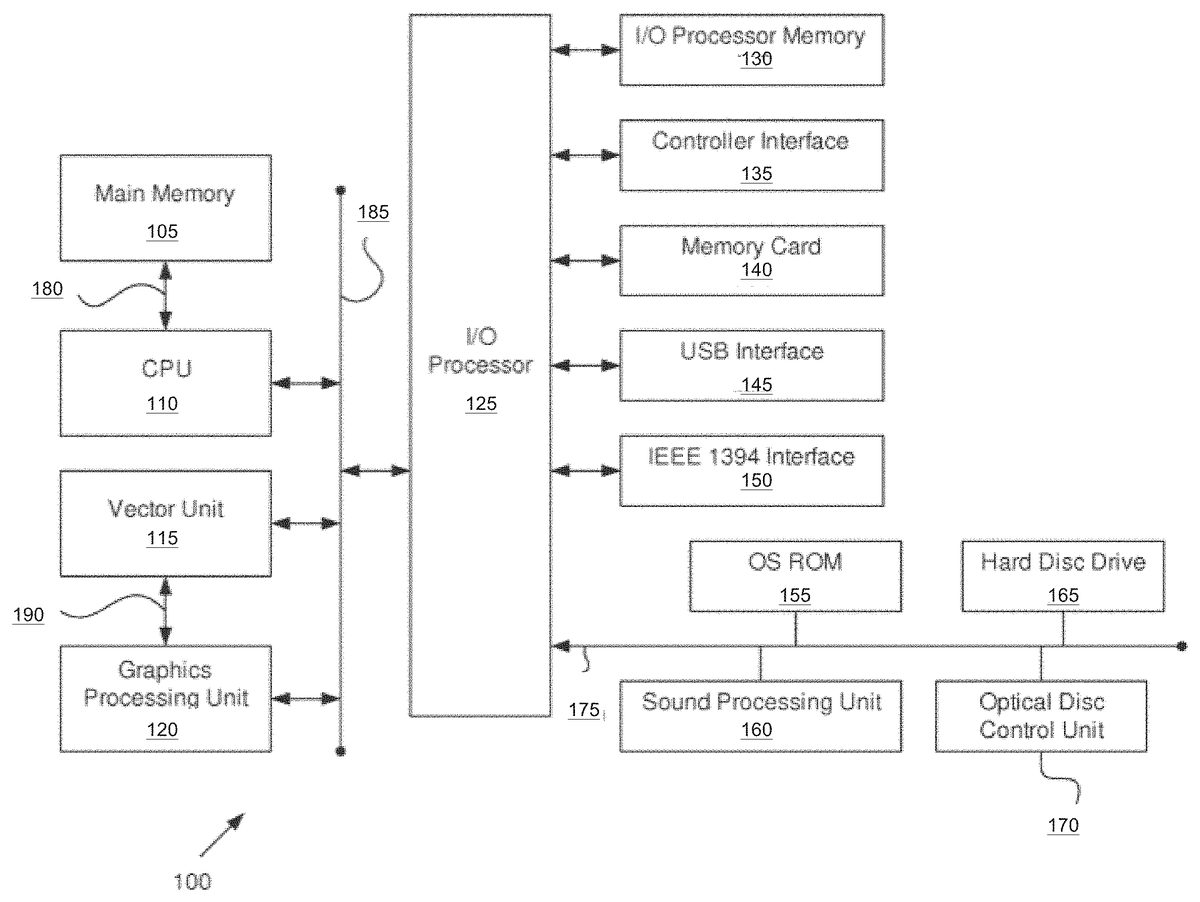
DETAILED DESCRIPTION FIG. 1is a block diagram of an exemplary electronic entertainment system100. The entertainment system100ofFIG. 1includes a main memory105, a central processing unit (CPU)110, vector unit115, a graphics processing unit120, an input/output (I/O) processor125, an I/O processor memory130, a controller interface135, a memory card140, a Universal Serial Bus (USB) interface145, and an IEEE 1394 interface150. The entertainment system100further includes an operating system read-only memory (OS ROM)155, a sound processing unit160, an optical disc control unit170, and a hard disc drive165, which are connected via a bus175to the I/O processor125. Entertainment system100may be an electronic game console. Alternatively, the entertainment system100may be implemented as a general-purpose computer, a set-top box, a hand-held game device, a tablet computing device, or a mobile computing device or phone. Entertainment systems may contain more or less operating components depending on a particular form factor, purpose, or design. The CPU110, the vector unit115, the graphics processing unit120, and the I/O processor125ofFIG. 1communicate via a system bus185. Further, the CPU110ofFIG. 1communicates with the main memory105via a dedicated bus180, while the vector unit115and the graphics processing unit120may communicate through a dedicated bus190. The CPU110ofFIG. 1executes programs stored in the OS ROM155and the main memory105. The main memory105ofFIG. 1may contain pre-stored programs and programs transferred through the I/O Processor125from a CD-ROM, DVD-ROM, or other optical disc (not shown) using the optical disc control unit170. I/O Processor125ofFIG. 1may also allow for the introduction of content transferred over a wireless or other communications network (e.g., 4$, LTE, 3G, and so forth). The I/O processor125ofFIG. 1primarily controls data exchanges between the various devices of the entertainment system100including the CPU110, the vector unit115, the graphics processing unit120, and the controller interface135. The graphics processing unit120ofFIG. 1executes graphics instructions received from the CPU110and the vector unit115to produce images for display on a display ...
DETAILED DESCRIPTION
FIG. 1is a block diagram of an exemplary electronic entertainment system100. The entertainment system100ofFIG. 1includes a main memory105, a central processing unit (CPU)110, vector unit115, a graphics processing unit120, an input/output (I/O) processor125, an I/O processor memory130, a controller interface135, a memory card140, a Universal Serial Bus (USB) interface145, and an IEEE 1394 interface150. The entertainment system100further includes an operating system read-only memory (OS ROM)155, a sound processing unit160, an optical disc control unit170, and a hard disc drive165, which are connected via a bus175to the I/O processor125.
Entertainment system100may be an electronic game console. Alternatively, the entertainment system100may be implemented as a general-purpose computer, a set-top box, a hand-held game device, a tablet computing device, or a mobile computing device or phone. Entertainment systems may contain more or less operating components depending on a particular form factor, purpose, or design.
The CPU110, the vector unit115, the graphics processing unit120, and the I/O processor125ofFIG. 1communicate via a system bus185. Further, the CPU110ofFIG. 1communicates with the main memory105via a dedicated bus180, while the vector unit115and the graphics processing unit120may communicate through a dedicated bus190. The CPU110ofFIG. 1executes programs stored in the OS ROM155and the main memory105. The main memory105ofFIG. 1may contain pre-stored programs and programs transferred through the I/O Processor125from a CD-ROM, DVD-ROM, or other optical disc (not shown) using the optical disc control unit170. I/O Processor125ofFIG. 1may also allow for the introduction of content transferred over a wireless or other communications network (e.g., 4$, LTE, 3G, and so forth). The I/O processor125ofFIG. 1primarily controls data exchanges between the various devices of the entertainment system100including the CPU110, the vector unit115, the graphics processing unit120, and the controller interface135.
The graphics processing unit120ofFIG. 1executes graphics instructions received from the CPU110and the vector unit115to produce images for display on a display device (not shown). For example, the vector unit115ofFIG. 1may transform objects from three-dimensional coordinates to two-dimensional coordinates, and send the two-dimensional coordinates to the graphics processing unit120. Furthermore, the sound processing unit160executes instructions to produce sound signals that are outputted to an audio device such as speakers (not shown). Other devices may be connected to the entertainment system100via the USB interface145, and the IEEE 1394 interface150such as wireless transceivers, which may also be embedded in the system100or as a part of some other component such as a processor.
A user of the entertainment system100ofFIG. 1provides instructions via the controller interface135to the CPU110. For example, the user may instruct the CPU110to store certain game information on the memory card140or other non-transitory computer-readable storage media or instruct a character in a game to perform some specified action.
FIG. 2is a flowchart of method steps for creating a multi-player game environment for single-player use. In step205ofFIG. 2, the CPU110ofFIG. 1executes a software module stored in main memory105ofFIG. 1with instructions to provide a user with an option to play a single-player game or a multi-player game. If the user chooses to play a single-player game, the game begins using an unaltered, single-player environment.
When the user chooses to play a multi-player game, the user is prompted to select one or more AI characters at step210ofFIG. 2. An AI character may be created based on a human player by using data about the human player, e.g., actions, behavior, and game play style, are recorded used to create an AI character that has the same characteristics.
The prompt may allow the user to choose an AI character based on a player that the user knows, or an AI character based on a player that the user does not know. In the latter instance, the character may be that of a celebrity or other person of repute in the video game community or for a particular video game. In some instances, game players may make their prior game play behavior available for purchase as an AI character. The AI characters based on players that the user knows may appear in a “friends” list that shows AI characters available for players that have previously used the entertainment system or that the user is connected to through a network.
The AI characters may be available in themed “packs” that are offered through the entertainment system. For example, one pack may have different AI characters that have a certain style, such as a “stealth” style or a “fighter” style. The pack may also include AI characters of different skill levels. Alternatively, a single AI character may have different styles and skill levels from which a user may choose. Other AI characters that may be available include players that appear, for example, on leader boards for the game. A user may wish to use such AI characters in order to compete against or learn from highly skilled players of a particular game. Single AI characters or packs may be available for free or the user may be charged a fee for the download.
The user may send instructions to CPU110(FIG. 1) to download the selected AI character(s) at step215ofFIG. 2. The AI character may downloaded permanently or temporarily into memory. The character, too, may be accessed as part of a cloud computing game environment.
Optionally, at step220ofFIG. 2, the user may select a mode for each AI character based on the level of involvement the user wishes the AI character to have within the game environment. For example, the user may select an “active” mode, in which the AI character may behave as fully engaged player similar to another human player in a multi-player game. A “passive” mode may be used when the user wishes for the AI character to act as a secondary character that may assist the user when called upon. Alternatively, a “tutorial” mode may be used where the user does not want the AI character to play the game alongside the user, but instead may be turned “on” and “off” when the user needs assistance. In this way, the AI character could serve as an alternative or a replacement for conventional tutorial books that are commonly used to help players navigate games.
At step225ofFIG. 2, the multi-player game environment is displayed to the user and the user may begin playing the game in a multi-player mode. The game environment may be populated with an avatar representing the game play behaviors of the selected AI character or characters.
Constraints may be placed on the avatars of the AI characters effectuating certain behaviors to ensure that the realism of the game is preserved for the user. The game program may recognize certain physical limitations present in the game environment that require the AI character to alter its behavior. The program may “flag” instances in which the AI character may need instructions. The flags may be stored in a table in memory, each flag being associated with a particular scene in the game environment. When the user reaches a new scene, the AI accesses the table and follows instructions based on the flags present in the table associated with that scene.
For example and by way of illustration, a door may be shut in the game environment that happened to be open when the actions of the player associated with the AI character were recorded. The game environment would be disrupted if the AI character were to walk through the closed door while the character controlled by the user is left behind. The AI character would be instructed to pause and wait for the user to open the door. Similarly, an object may be present in the game environment from which the AI was derived, that is not in the game environment being played by the user. For example, the AI character may be attempting to fight a monster that the user, in his game environment, has already defeated. Thus, the AI character would be instructed that the object is no longer present and to discontinue interacting with the object. In another example, the AI character may be moving faster or slower than the user during game play. The AI character, in such a situation, would be instructed to either slow down or speed up accordingly. In this way, the AI character does not interfere with game play and the realism of the game environment is maintained. Furthermore, the user is required to continue to make substantive decisions to progress through the game.
At step230ofFIG. 2, the AI characters are updated periodically. For example, an AI character may be updated when new data has become available to improve the character.
FIGS. 3A-3Fillustrate exemplary interfaces for creating a multi-player game environment for single-player use.
Referring now toFIG. 3A, which illustrates a start menu in an exemplary entertainment system environment. The user may select “Single-Player” mode305or “Multi-player” mode310, as described in step205ofFIG. 2.
Referring now toFIG. 3B, which illustrates an AI selection menu in an exemplary entertainment system environment. After the user selects “Multi-player” mode310(FIG. 3A), the user is prompted to select one or more AI characters, as described in step210ofFIG. 2. The user may choose an AI character from a “Friends” list315ofFIG. 3B. Alternatively, the user may search for an individual AI character by typing criteria into search box320ofFIG. 3B. The user may also choose a pack of AI characters by selecting “Theme Pack” button325ofFIG. 3B.
Referring now toFIG. 3C, which illustrates a download menu in an exemplary entertainment system environment. The user may download the selected AI character(s) by selecting “Download AI Selection” button330, as described in step215ofFIG. 2.
Referring now toFIG. 3D, which illustrates an AI options menu in an exemplary entertainment system environment. The user may customize a selected AI character. For example, the user may select a “Skill Level” button335or a “Mode” button340ofFIG. 3D, as described in step220ofFIG. 2.
Referring now toFIG. 3E, which illustrates a save menu in an exemplary entertainment system environment. The user may store the downloaded AI character(s) on a memory card140ofFIG. 1by selecting the “Save AI” button345ofFIG. 3E.
Referring now toFIG. 3F, which illustrates a play menu in an exemplary entertainment system environment. The user may choose the “Play Now” button350ofFIG. 3Fto display the multi-player game environment populated with the AI character(s) and commence game play, as described in step225ofFIG. 2.
The invention has been described above with reference to specific embodiments. It will, however, be evident that various modifications and changes may be made thereto without departing from the broader spirit and scope of the invention as set forth in the appended claims. The foregoing description and drawings are, accordingly, to be regarded in an illustrative rather than a restrictive sense.
Claims
- A method for creating a multi-player game environment for single-player use on an electronic entertainment system, the method comprising: storing information in memory regarding a game with one or more AI characters;receiving one or more user preferences for at least one of the AI characters from a first user, wherein the user preferences include a preference for an active mode or a passive mode;and executing non-transitory computer readable instructions stored in memory, wherein execution of the instructions by a processor: displays a game environment for game play by the first user, wherein the game environment is populated with an avatar of the at least one AI character, and effectuates one or more behaviors by the avatar within the game environment, wherein the effectuated behaviors are based on the received user preferences indicating a preferred mode of game play, the active mode entailing the at least one AI character acting in accordance with a game play behavior of a second user and the passive mode entailing the at least one AI character acting only upon request by the first user.
- The method of claim 1 , wherein the preferred mode of gameplay includes a tutorial mode having the at least one AI character.
- The method of claim 1 , wherein input from the first user is capable of changing the behavior of the at least one AI character as desired during gameplay.
- The method of claim 1 , wherein the preferred mode of gameplay is a multi-player mode having one or more of the AI characters.
- The method of claim 1 , wherein the effectuation of the behaviors by the avatar within the game environment is further constrained based on the game environment.
- The method of claim 1 , wherein the information associated with the at least one AI character of the game are updated periodically when new data is available to improve the at least one AI character.
- The method of claim 1 , wherein information for one or more of the AI characters is customizable by input from the first user.
- The method of claim 1 , wherein information for one or more of the AI characters is located and downloaded using a user search by the first user, the downloaded AI character information being usable by the first user within the game.
- The method of claim 1 , wherein the effectuation of the behaviors by the avatar within the game environment is modified based on current gameplay of the first user.
- A non-transitory computer-readable storage medium having embodied thereon a program, the program being executable by a processor to perform a method for creating a multi-player game environment for single-player use on an electronic entertainment system, the method comprising: storing information in memory regarding a game with one or more AI characters;receiving one or more user preferences for at least one of the AI characters from a first user, wherein the user preferences include a preference for an active mode or a passive mode;and executing non-transitory computer readable instructions stored in memory, wherein execution of the instructions by a processor: displays a game environment for game play by the first user, wherein the game environment is populated with an avatar of the at least one AI character, and effectuates one or more behaviors by the avatar within the game environment, wherein the effectuated behaviors are based on the received user preferences indicating a preferred mode of game play, the active mode entailing the at least one AI character acting in accordance with a game play behavior of a second user and the passive mode entailing the at least one AI character acting only upon request by the first user.
- The non-transitory computer-readable storage medium of claim 10 , wherein the preferred mode of gameplay includes a tutorial mode having the at least one AI character.
- The non-transitory computer-readable storage medium of claim 10 , wherein input from the first user is capable of changing the behavior of the at least one AI character as desired during gameplay.
- The non-transitory computer-readable storage medium of claim 10 , wherein the preferred mode of gameplay is a multi-player mode having one or more of the AI characters.
- The non-transitory computer-readable storage medium of claim 10 , wherein the effectuation of the behaviors by the avatar within the game environment is further constrained based on the game environment.
- The non-transitory computer-readable storage medium of claim 10 , wherein the information associated with the at least one AI character of the game are updated periodically when new data is available to improve the at least one AI character.
- The non-transitory computer-readable storage medium of claim 10 , wherein information for one or more of the AI characters is customizable by input from the first user.
- The non-transitory computer-readable storage medium of claim 10 , wherein information for one or more of the AI characters is located and downloaded using a user search by the first user, the downloaded AI character information being usable by the first user within the game.
- The non-transitory computer-readable storage medium of claim 10 , wherein the effectuation of the behaviors by the avatar within the game environment is modified based on current gameplay of the first user.
- A system for creating a multi-player game environment for single-player use on an electronic entertainment system, the system comprising: a processor for executing instructions stored in memory, wherein execution of the instructions by the processor: stores information in memory regarding a game with one or more AI characters, receives one or more user preferences for at least one of the AI characters from a first user, wherein the user preferences include a preference for an active mode or a passive mode, and effectuates one or more behaviors by the avatar within the game environment, wherein the effectuated behaviors are based on the received user preferences indicating a preferred mode of game play, the active mode entailing the at least one AI character acting in accordance with a game play behavior of a second user and the passive mode entailing the at least one AI character acting only upon request by the first user;and a display device that displays a game environment for game play by the first user, wherein the game environment is populated with an avatar of the at least one AI character.
Disclaimer: Data collected from the USPTO and may be malformed, incomplete, and/or otherwise inaccurate.