U.S. Pat. No. 10,092,836
SYSTEM FOR STORING DISPLAY SPATIAL DATA TEMPLATE CREATED DURING VIDEO GAME PLAY
AssigneeIPPASA, LLC
Issue DateSeptember 11, 2017
Illustrative Figure
Abstract
A system (10) includes a video game play ecosystem (12) and a smart device (14) communicating with each other through a short-range wireless bidirectional communication link (16). The system enables user creation of a display spatial data template in the video game play ecosystem and storage of the display spatial data template in the smart device located outside the video game play ecosystem. The user creates the display spatial data template in real time during game play by manipulating an input device (18) connected to a command processing device (20) on which the video game is operating. The user can retrieve the stored display spatial data template during game play at a later time. The system is advantageous in that the storage and retrieval of the display spatial data template makes minimal use of the ecosystem resources, including processing power, bandwidth capacity, and display screen real estate.
Description
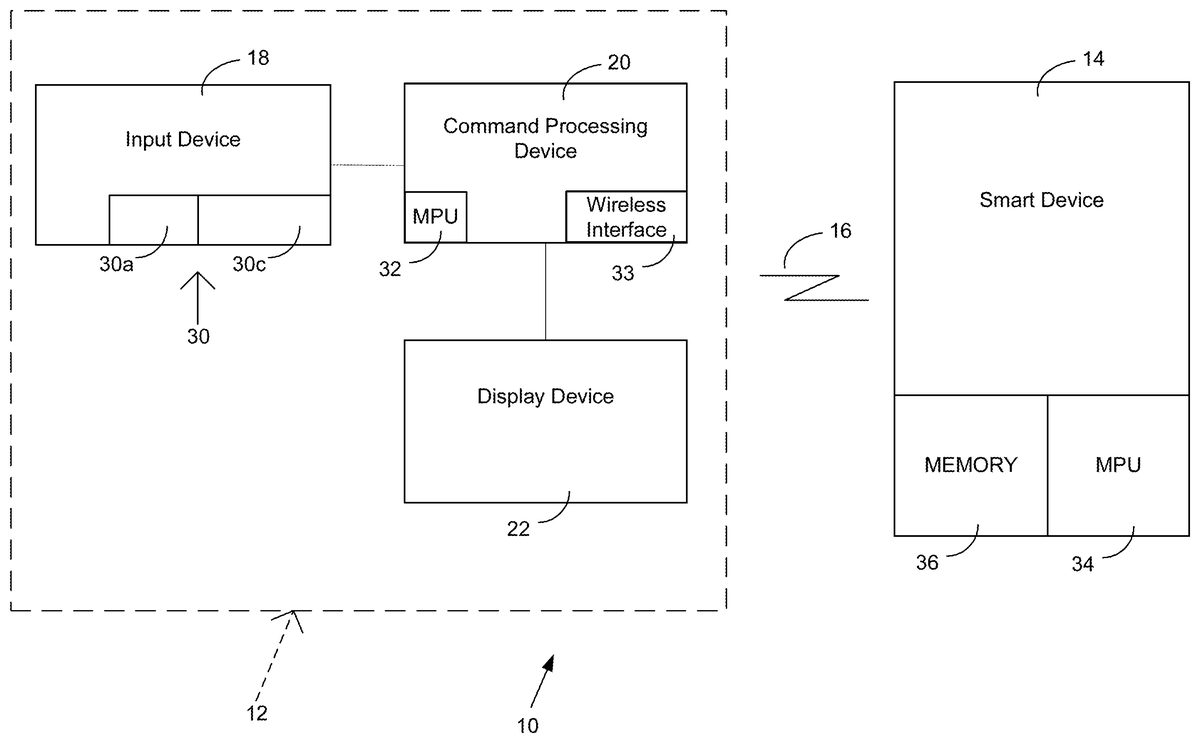
DETAILED DESCRIPTION OF PREFERRED EMBODIMENTS FIG. 1is a block diagram showing, as a preferred embodiment, a system10that includes a video game play ecosystem12and a smart device14communicating with each other by operation of a communication signal interface establishing a short-range wireless bidirectional communication link through a communication medium16. Although less preferred, there may be wired connections to smart device14outside video game play ecosystem12. System10enables user creation of a display spatial data template in video game play ecosystem12and storage of the display spatial data template in smart device14located outside video game play ecosystem12. The user creates the display spatial data template in real time during game play and can retrieve the stored display spatial data template during game play at a later time. Video game play ecosystem12includes an input device18connected by wired or wireless transmission to a command processing device20, to which a display device22is connected by wired or wireless transmission. Input device18is an on-the-fly, real time actuator. A preferred input device18is a hand-held video game controller having a set of input actuators30, which include conventional input actuators30cand additional actuators30athat also function as multiple operation input actuators for retrieving a display spatial data template stored in smart device14. Alternative input devices18include a gesture recognition device, an augmented reality device, a touchpad, a touch screen, an eye movement tracking device, a head motion sensing device, a virtual reality device, a joystick, a game pad, a steering wheel, a gun, or a mouse. Command processing device20is implemented with a main microprocessing unit (MPU32) on which a video game program operates and a short-range wireless bidirectional communication interface33to establish pairing connectivity between command processing device20and smart device14. The video game program produces a set of display spatial data in response to a set of commands by user actuation of game play command input actuators in ...
DETAILED DESCRIPTION OF PREFERRED EMBODIMENTS
FIG. 1is a block diagram showing, as a preferred embodiment, a system10that includes a video game play ecosystem12and a smart device14communicating with each other by operation of a communication signal interface establishing a short-range wireless bidirectional communication link through a communication medium16. Although less preferred, there may be wired connections to smart device14outside video game play ecosystem12. System10enables user creation of a display spatial data template in video game play ecosystem12and storage of the display spatial data template in smart device14located outside video game play ecosystem12. The user creates the display spatial data template in real time during game play and can retrieve the stored display spatial data template during game play at a later time.
Video game play ecosystem12includes an input device18connected by wired or wireless transmission to a command processing device20, to which a display device22is connected by wired or wireless transmission. Input device18is an on-the-fly, real time actuator. A preferred input device18is a hand-held video game controller having a set of input actuators30, which include conventional input actuators30cand additional actuators30athat also function as multiple operation input actuators for retrieving a display spatial data template stored in smart device14. Alternative input devices18include a gesture recognition device, an augmented reality device, a touchpad, a touch screen, an eye movement tracking device, a head motion sensing device, a virtual reality device, a joystick, a game pad, a steering wheel, a gun, or a mouse.
Command processing device20is implemented with a main microprocessing unit (MPU32) on which a video game program operates and a short-range wireless bidirectional communication interface33to establish pairing connectivity between command processing device20and smart device14. The video game program produces a set of display spatial data in response to a set of commands by user actuation of game play command input actuators in the set of input actuators30. Display device22produces visual images corresponding to the set of display spatial data. A preferred command processing device20is a video game console. Alternative command processing devices20include a portable video game system, tablet, and personal computer. A notebook computer can perform the operations of command processing device20and display device22.
Input actuators30include actuators that produce signals representing display data marking commands that identify display spatial data defining the display spatial data template. The display spatial data template represents a subset of the display spatial data produced in response to a corresponding subset of the set of commands generated by the user actuation of the game play command input actuators in the set of input actuators30.
Smart device14includes a main MPU34, on which a display spatial data template application program (“Template app”) operates, and a memory36, in which the display spatial data template created by the user is stored. Smart device14receives user-activated commands to store in or retrieve from memory36the display spatial data template received by smart device14through communication medium16. Commands to store or retrieve the display spatial data template preferably given by user actuation of actuators on smart device14, but may also be received through communication medium16from input device18or other source. The Template app manages the recording (i.e., storing), editing, and transmission to input actuators30aof the subset of display spatial data. The transmission of the subset of display spatial data representing the template preferably actuates on smart device14a visual representation of input device18that allows the user to select the input actuator30athat will perform the multiple functions for that template. The display spatial data template file exported from smart device14to video game play ecosystem12may be stored in memory located in controller18or command processing device20.
Smart device14is an electronic device that can operate autonomously and interactively with other devices. A preferred smart device14is a smartphone. Alternative smart devices include a mobile phone; phablet; tablet; smart keychain; and wearables, including, for example, a smartwatch and a smart band.
FIG. 2is an annotated pictorial flow chart showing, in an example of Minecraft™ building survival game play, the process of storing in and later accessing from smart device14a display spatial data template derived from input actions created by user actuation of game play command input actuators30on input device18. The flow chart is arranged in two columns side-by-side. The left-side column presents process blocks describing creation and use of a building structure display spatial data template, and the right-side column shows pictorially the system components performing the actions during game play, as described by the associated process blocks. The input device18depicted inFIG. 2is a dual ID controller that maintains the secure communication link with game processing device20as implemented by its manufacturer and by Bluetooth™ radio signal establishes a paired connection and effects all communications with smart device or smartphone14. The communication link in use during each process step described is indicated in italics inFIG. 2.
With reference toFIG. 2, a game player named “User” is playing the Minecraft™ video game on a notebook or laptop computer20. User powers up game controller18and decides to build a place of shelter as User searches new areas of the Minecraft™ map. User constructs a shelter and realizes that it would be of use at many different points in the game while User is searching across the map. (FIG. 2, process block50and diagram50D.) User decides that, the next time User has to build a shelter, User is going to record the building process with controller18and smartphone14.
User arrives at the next spot on the map User deems perfect for the shelter. User picks up smartphone14, turns it on, and selects the Template app labeled “Template”. (Prior to this point, User has already established paired connectivity between controller18with smartphone14.) Once the Template app loads, a menu appears on the display screen of smartphone14, with a record button prominently displayed in the middle of the Template app. (FIG. 2, process block52and diagram52D.) User taps the record button, sets down smartphone14, turns to controller18, and starts to build the shelter. (FIG. 2, process block54and diagram54D.) Upon finishing the shelter, User sets aside controller18, picks up smartphone14, and taps a stop recording button on the app. (FIG. 2, process block56and diagram56D.)
The display spatial data template created during the recording represents a blueprint of the building structure, i.e., the shelter built. A window pops up on the display screen of smartphone14and asks User to name the recording. User decides to name the recording “Temp”. Once User names the recording, another window pops up on the display screen of smartphone14and shows a picture of the controller18that is in use, with the buttons on controller18that are available to assign the new recorded template “Temp”. User selects the “M” button, and then taps assign. (FIG. 2, process block58and diagram58D.) User then puts down smartphone14and returns to controller18. To test the template, User presses the “M” button on controller18to export to controller18the shelter blueprint represented by Temp, and a shelter is built by the Minecraft™ game program operating on laptop computer20.
The export of blueprint template data to controller18could be accomplished as a live stream of Temp file data on demand in response to user activation of the “M” button for building the shelter, as a Temp file transfer for storage to the “M” button for building the shelter upon later user actuation of the “M” button on controller18, or, in response to User actuation of a transmit command button on smartphone14, as a pass through of shelter building instructions in real time from controller18to laptop computer20. This last alternative is performed in lieu of actuation of a transmit command button on smartphone14to store shelter building instructions on controller18.
The building materials used to construct the building structure represented by the TEMP data file can be accessed on the Minecraft™ Hot Bar.
User later decides to share with other people the Temp shelter User created. To do so, User picks up smartphone14, loads the Template app, goes to Menu, under recordings selects User's recording, and then shares it with a third-party video game play ecosystem. (FIG. 2, process block60and diagram60D.) User is able to share a specified recorded template because smart device14is configured to establish through a wireless Internet network protocol a wireless public template communication link with third-party wireless Internet protocol networks.
The next day User plays the Minecraft™ game on laptop computer20and decides to build in User's house a room perfectly configured for chests. User sets aside controller18, picks up smartphone14, loads the Template app, under Menu goes to the Public Template section, and searches for a chest room. The Public Template section represents a section of memory36in which templates uploaded by third parties are stored. User finds a chest room candidate and taps the download button to download the template called “Chest Room”. Once the Chest Room template is downloaded, User selects a template naming button and choses the Assign option, which then displays a symbol representing User's controller18. User then assigns the Template called “Chest Room” to the “P” button on controller18.
System10can be configured so that, after establishing a paired connection between smart device14and controller18, a third party-provided building structure template can be streamed direct to command processing device20without storage in controller18. System10can also be configured to effect direct download of a third party-provided building structure template to controller18, after initiation by user actuation of the Template app operating on smart device14. Therefore, the direct download of the third party-provided building structure template bypasses storage in memory36of smart device14.
If User forgets which button on controller18is storing which template, User can open the Template app on smartphone14and under the Menu section choose “Show Controller,” and it will show a symbol representing controller18with the current template assignment settings.
The following are three examples of use cases for the display of spatial data template.
A user playing the Minecraft™ game on a PC wants to populate the world with structures, landscape, and buildings to make it a more immersive experience. User does not have the technical expertise to carry out the schematic installation or Clone process and, therefore, wants access to other players' creative building structures. User need only find the build on the Template app and then assign that building structure to a button on the controller to make the building structure appear.
User is a working professional with a family and does not have the time necessary to build all the structures the user would like, so user accelerates the process by using building structure display spatial data templates.
User is in the middle of a survival mode and is under attack. The user, who does not function well under pressure during game play, needs to quickly build a shelter on the fly and uses a display spatial data template to continue beneficial game play.
It will be obvious to those having skill in the art that many changes may be made to the details of the above-described embodiments without departing from the underlying principles of the invention. The scope of the present invention should, therefore, be determined only by the following claims.
Appendix 1
The following are the steps for installing WorldEdit:1. Visit http://wiki.sk89q.com/wiki/WorldEdita. This link is the starting point for figuring out how to install WorldEdit.b. Before installing, the user must decide on a “plug-in” that will allow WorldEdit to be installed. There are five choices, each of which comes with its own set of instructions to download first:i. Forgeii. Bukkitiii. Liteloaderiv. Canaryv. hMod.c. For purpose of this example, the “Forge” plug-in is selected.d. Click on the link Want it for single player? Get the Forge mod and follow these instructions:http://wiki.sk89q.com/wiki/WorldEdit/Installation/Forgee. But before installing Forge, the user first needs to install WorldEdit for Forge http://minecraft.curseforge.com/mc-mods/225608-worldedit, which is on the page.f. Click on link at the right side of the page WorldEdit 6.1 (for MC 1.8.0) to ensure that it matches with the version of the Minecraft™ program that is in operation.g. Return to http://wiki.sk89q.com/wiki/WorldEdit/Installation/Forge and click on the http://files.minecraftforge net/ installer link.h. Find the appropriate version and the appropriate Computer OS, and then download.i. Return to http://wiki.sk89q.com/wiki/WorldEdit/Installation/Forge.j. On http://wiki.sk89q.com/wiki/WorldEdit/Installation/Forge, click on the LiteLoader installer link, which is an apparently recommended link.k. Return to http://wiki.sk89q.com/wiki/WorldEdit/Installation/Forge.l. Restart the Minecraft™ program launcher.m. At the bottom left of the launcher, choose the “Forge” profile.n. Click on “Edit Profile”.o. Click on “Open Game Dir”.p. Make a “mods” folder, if one does not exist.q. Copy into the mods folder the WorldEdit's .jar file, as well as WorldEdit CUI's .litemod.r. Close any dialogs and click on “Play” to launch the game with WorldEdit!s. Paste the .schematic file in the /plugins/worldedit/schematics/ folder on user's Minecraft™ server.t. Load the schematic file in the game, using the “//schem load mcedit filename” command, where “filename” is the file name without the .schematic extension.u. Now go where user wants to place the schematic and paste it with the “//paste” command.v. If the schematic is badly placed, user can cancel it with the “//undo” command.
Claims
- A system for delivering to and storing in a smart device, in real time, a display spatial data template developed during video game play by a user playing in a video game play ecosystem and for making the stored display spatial data template accessible for subsequent retrieval by the user or another user for video game play in the same or another video game play ecosystem, comprising: a video game play ecosystem including an input device operatively connected to a command processing device and a display device operatively connected to the command processing device, the input device having a set of input actuators, the command processing device implemented with a command processing device main MPU on which a video game program operates to produce a set of display spatial data in response to a set of commands produced by user actuation of input actuators in the set of input actuators, and the display device producing visual images corresponding to the set of display spatial data;a user-operable actuator producing signals representing display spatial data marking commands, the display spatial data marking commands identifying display spatial data defining a display spatial data template representing a subset of the set of display spatial data produced in response to a corresponding subset of the set of commands generated by the user actuation of the input actuators;and a smart device operating through a communication interface to establish a bidirectional communication link with the video game play ecosystem, the smart device located outside the video game play ecosystem, including a smart device main MPU on which a display spatial data template application program operates, and including display spatial data template memory, the smart device main MPU causing, in response to commands received by the smart device, storage in and retrieval from the display spatial data template memory the display spatial data template received by the smart device through the bidirectional communication link.
- The system of claim 1 , in which the smart device includes a mobile phone, smartphone, phablet, tablet, smartwatch, smart band, smart keychain, or wearable.
- The system of claim 1 , in which the command processing device includes a video game console, portable video game system, notebook computer, tablet, or personal computer.
- The system of claim 1 , in which the input device includes a video game controller, a gesture recognition device, a hololens, a touchpad, a touch screen, an eye movement tracking device, a head motion sensing device, a joystick, a game pad, a steering wheel, a gun, or a mouse.
- The system of claim 1 , in which the user-operable actuator producing signals representing display spatial data marking commands is not included in the set of input actuators.
- The system of claim 1 , in which the user-operable actuator producing signals representing display spatial data marking commands is included in the set of input actuators and is configured to function as a multiple operation input actuator for retrieval of the display spatial data template received by the smart device.
- The system of claim 1 , in which the smart device is configured to establish through a wireless Internet network protocol a wireless public template communication link with the smart device, and in which the display spatial data template memory stores display spatial data templates created in third-party video game play ecosystems and received through the wireless public template communication link.
- The system of claim 1 , in which the smart device is configured to establish through a wireless Internet network protocol a wireless public template communication link with the smart device to transmit the display spatial data template to a third-party video game play ecosystem.
- The system of claim 1 , in which the smart device is configured to establish through a wireless Internet network protocol a wireless public template communication link with the smart device, and in which, upon user actuation of the display spatial data template application program to download a third-party created display spatial data template in a third-party video game play ecosystem, the third-party created display spatial data template downloads to the video game play ecosystem without storage in the display spatial data template memory of the smart device.
Disclaimer: Data collected from the USPTO and may be malformed, incomplete, and/or otherwise inaccurate.