U.S. Pat. No. 10,061,395
BUTTON STRUCTURE, MANUFACTURING METHOD THEREOF, AND GAME CONTROLLER USING THE SAME
AssigneePRIMAX ELECTRONICS LTD.
Issue DateMay 9, 2016
Illustrative Figure
Abstract
The present invention provides a button structure and a manufacturing method thereof. The button structure includes a base made from a first material, a graphic piece made from a second material, and a transparent piece made from a third material, where the graphic piece is integrally formed with the base and protrudes out beyond an upper surface of the base, the transparent piece wraps the base and the graphic piece, and a heat resistance temperature of the first material and a heat resistance temperature of the second material are both higher than a heat resistance temperature of the third material. In addition, the present invention further provides a game controller using the button structure.
Description
DETAILED DESCRIPTION OF THE PREFERRED EMBODIMENT Referring toFIG. 2andFIG. 3,FIG. 2is a schematic structural diagram of an exemplary embodiment of a button structure of the present invention, andFIG. 3is a schematic three-dimensional exploded diagram of the button structure shown inFIG. 2. The button structure2includes a base21, a graphic piece22, and a transparent piece23. The base21has an upper surface211. The graphic piece22is integrally formed with the base21, and protrudes out beyond the upper surface211of the base21, to mark the button structure2and provide a three-dimensional effect. The transparent piece23wraps the base21and the transparent piece23, and has a contact pressure surface231for a user to press. The base21, the graphic piece22, and the transparent piece23are respectively made from a first material, a second material, and a third material, and a heat resistance temperature of the first material and a heat resistance temperature of the second material are higher than a heat resistance temperature of the third material. In this exemplary embodiment, the contact pressure surface231of the transparent piece23is a flat surface, and is used to provide a desired contact pressure feel to a user. The graphic piece22for marking the button structure2is in a font shape (for example, a font A shown in the figure), but is not limited thereto. The graphic piece22may also be in a geometric shape, for example, a circle, a triangle, or a rectangle. Further, in this exemplary embodiment, the first material and the second material are both of polycarbonate (PC) materials, while the third material is of an acrylic plastic (PMMA) material. The foregoing description is only an embodiment, and the first material and the second material may also be of different materials. A person skilled in the art may use any suitable materials to manufacture the base21, the graphic piece22, and the transparent piece23according to an actual application requirement. ...
DETAILED DESCRIPTION OF THE PREFERRED EMBODIMENT
Referring toFIG. 2andFIG. 3,FIG. 2is a schematic structural diagram of an exemplary embodiment of a button structure of the present invention, andFIG. 3is a schematic three-dimensional exploded diagram of the button structure shown inFIG. 2. The button structure2includes a base21, a graphic piece22, and a transparent piece23. The base21has an upper surface211. The graphic piece22is integrally formed with the base21, and protrudes out beyond the upper surface211of the base21, to mark the button structure2and provide a three-dimensional effect. The transparent piece23wraps the base21and the transparent piece23, and has a contact pressure surface231for a user to press. The base21, the graphic piece22, and the transparent piece23are respectively made from a first material, a second material, and a third material, and a heat resistance temperature of the first material and a heat resistance temperature of the second material are higher than a heat resistance temperature of the third material.
In this exemplary embodiment, the contact pressure surface231of the transparent piece23is a flat surface, and is used to provide a desired contact pressure feel to a user. The graphic piece22for marking the button structure2is in a font shape (for example, a font A shown in the figure), but is not limited thereto. The graphic piece22may also be in a geometric shape, for example, a circle, a triangle, or a rectangle. Further, in this exemplary embodiment, the first material and the second material are both of polycarbonate (PC) materials, while the third material is of an acrylic plastic (PMMA) material. The foregoing description is only an embodiment, and the first material and the second material may also be of different materials. A person skilled in the art may use any suitable materials to manufacture the base21, the graphic piece22, and the transparent piece23according to an actual application requirement.
Refer toFIG. 4, which is an exemplary method flowchart of a manufacturing method for a button structure of the present invention. The manufacturing method for a button structure2includes: step S1: first forming a base21and a graphic piece22by means of a double injection process; and step S2: forming, by means of an over-molding process, a transparent piece23used to wrap the base21and the graphic piece22. Regardless whether a first material of the base21is the same as a second material of the graphic piece22, or whether a color of the base21is the same as that of the graphic piece22, the base21and the graphic piece22may be simultaneously formed by means of the double injection process, to reduce operations and reduce costs. Moreover, bond strength of the base21and the graphic piece22may be further increased.
It should be further noted that a reason why a heat resistance temperature of the first material and a heat resistance temperature of the second material must be higher than a heat resistance temperature of a third material, which is described above, is to prevent the base21and the graphic piece22from being intenerated or deformed because a working temperature for manufacturing of the third material affects the already formed base21and graphic piece22during the over-molding process.
Exemplarily but unlimitedly, the base21further has a groove212extending inward from an upper surface211of the base21, so that a part of the graphic piece22is accommodated in the groove212. An objective of such design is that after the graphic piece22and the base21are formed, the graphic piece22and the base21are bond more firmly and do not drop off easily.
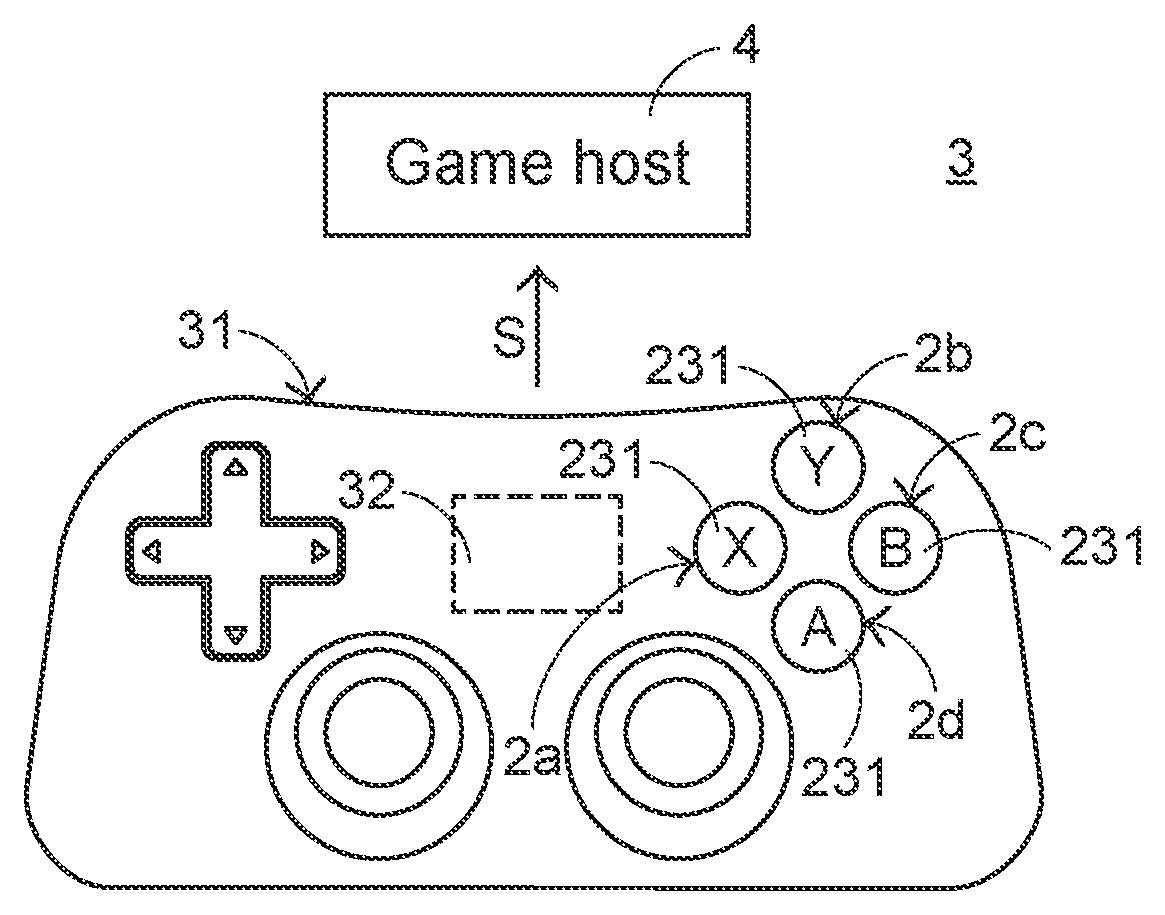
Refer toFIG. 5, which is a schematic structural diagram of an exemplary embodiment of a game controller of the present invention. The game controller3includes a housing31, a processing unit32, and a plurality of button structures2ato2d, each of the button structures2ato2dis accommodated in the housing31, and only a contact pressure surface231of the transparent piece23is exposed outside the housing31. The processing unit32is disposed in the housing31, and outputs, when any one of the button structures2ato2dis pressed, a corresponding control instruction S to a game host4connected to a game controller3. Any one of the button structures2ato2dof the game controller3is used to mark a shape of the graphic piece22of the button structure2, and other details are all substantially the same as those of the button structure shown inFIG. 2. Therefore, details are not described herein again.
It can be learned according to the foregoing descriptions that because the graphic piece of the button structure of the present invention is wrapped by the transparent piece and accordingly is protected, a deficiency that a text or graph printed on a conventional button structure drops off easily due to regular pressure is improved, and a desired contact pressure feel and a desired appearance are provided. In addition, the application of the button structure of the present invention is not limited to the foregoing game controller, and various electronic apparatuses, for example, a television remote control and a mobile device may fall within its application scope. A person skilled in the art may make any equivalent change and design according to an actual application requirement.
The foregoing descriptions are only exemplary embodiments of the present invention, but are not intended to limit the application scope of the present invention. Any equivalent variation and modification made without departing from the spirit disclosed in the present invention shall fall within the application scope of the present technical solutions.
Claims
- A button structure, comprising: a base, having an upper surface and made from a first material;a graphic piece, integrally formed with the base and at least partially protruding out beyond the upper surface of the base, wherein the graphic piece is made from a second material;and a transparent piece, wrapping the base and the graphic piece and made from a third material, wherein a heat resistance temperature of the third material is lower than a heat resistance temperature of the first material and a heat resistance temperature of the second material.
- The button structure according to claim 1 , wherein the base has a groove extending inward from the upper surface, and at least a part of the graphic piece is accommodated in the groove.
- The button structure according to claim 1 , wherein the base and the graphic piece are formed by means of a double injection process.
- The button structure according to claim 1 , wherein the transparent piece is formed by means of an over-molding process.
- The button structure according to claim 1 , wherein the graphic piece is in a font shape or a geometric shape.
- The button structure according to claim 1 , wherein both the first material and the second material are of polycarbonate (PC) materials.
- The button structure according to claim 1 , wherein the third material is of an acrylic plastic (PMMA) material.
- A game controller, comprising: a housing;a button structure, at least partially accommodated in the housing and comprising: a base, having an upper surface and made from a first material;a graphic piece, integrally formed with the base and at least partially protruding out beyond the upper surface of the base, wherein the graphic piece is made from a second material;and a transparent piece, wrapping the base and the graphic piece and made from a third material, wherein a heat resistance temperature of the third material is lower than a heat resistance temperature of the first material and a heat resistance temperature of the second material;and a processing unit, disposed in the housing, and used to generate and output a corresponding control instruction when the transparent piece is pressed.
- The game controller according to claim 8 , wherein the base has a groove extending inward from the upper surface, and at least a part of the graphic piece is accommodated in the groove.
- The game controller according to claim 8 , wherein the base and the graphic piece are formed by means of a double injection process.
- The game controller according to claim 8 , wherein the transparent piece is formed by means of an over-molding process.
- The game controller according to claim 8 , wherein the graphic piece is in a font shape or a geometric shape.
- The game controller according to claim 8 , wherein both the first material and the second material are of polycarbonate (PC) materials.
- The game controller according to claim 8 , wherein the third material is of an acrylic plastic (PMMA) material.
- A manufacturing method for a button structure, comprising: forming a base and a graphic piece by means of a double injection process, wherein the graphic piece at least partially protrudes out beyond an upper surface of the base;and wrapping the base and the graphic piece up in a transparent piece by means of an over-molding (Over-molding) process.
- The manufacturing method for a button structure according to claim 15 , wherein the base, the graphic piece, and the transparent piece are respectively made from a first material, a second material, and a third material, and a heat resistance temperature of the third material is lower than a heat resistance temperature of the first material and a heat resistance temperature of the second material.
- The manufacturing method for a button structure according to claim 16 , wherein both the first material and the second material are of polycarbonate (PC) materials.
- The manufacturing method for a button structure according to claim 16 , wherein the third material is of an acrylic plastic (PMMA) material.
- The manufacturing method for a button structure according to claim 15 , wherein the graphic piece is in a font shape or a geometric shape.
- The manufacturing method for a button structure according to claim 15 , wherein the base has a groove extending inward from the upper surface, and at least a part of the graphic piece is accommodated in the groove.
Disclaimer: Data collected from the USPTO and may be malformed, incomplete, and/or otherwise inaccurate.