U.S. Pat. No. 10,058,781
RENDERING OF GAME CHARACTERS
AssigneeEmpire Technology Development LLC
Issue DateOctober 14, 2015
Illustrative Figure
Abstract
Technologies are generally described for rendering a character for games. In some examples, a method performed under control of a game server may include calculating a level of detail (LOD) for a first character positioned in a same virtual game space as a second character, based at least in part on a calculated degree of closeness between the first character and the second character; and controlling a display definition of the first character based at least in part on the calculated LOD.
Description
DETAILED DESCRIPTION In the following detailed description, reference is made to the accompanying drawings, which form a part hereof. In the drawings, similar symbols typically identify similar components, unless context dictates otherwise. The illustrative embodiments described in the detailed description, drawings, and claims are not meant to be limiting. Other embodiments may be utilized, and other changes may be made, without departing from the spirit or scope of the subject matter presented herein. It will be readily understood that the aspects of the present disclosure, as generally described herein, and illustrated in the Figures, can be arranged, substituted, combined, separated, and designed in a wide variety of different configurations, all of which are explicitly contemplated herein. This disclosure is generally drawn, inter alia, to methods, apparatuses, systems, devices, and computer program products related to a game character rendering scheme. Technologies are generally described for a method for controlling a display definition of a game character based in part on a calculated level of detail for the game character and for rendering the game character with the controlled display definition. In some examples, a first character and a second character of a virtual game may be displayed on an end device. A game server may be configured to calculate a degree of closeness between the first character and the second character, based at least in part on a history of mutual activity between the first character and the second character in a virtual game space. Non-limiting examples of the mutual activity may include a frequency of occurrences in which the first character and the second character are included in a same character party, or a frequency of occurrences in which the first character and the second character execute a collaborative attack against an opposing character (e.g., a monster character). For example, ...
DETAILED DESCRIPTION
In the following detailed description, reference is made to the accompanying drawings, which form a part hereof. In the drawings, similar symbols typically identify similar components, unless context dictates otherwise. The illustrative embodiments described in the detailed description, drawings, and claims are not meant to be limiting. Other embodiments may be utilized, and other changes may be made, without departing from the spirit or scope of the subject matter presented herein. It will be readily understood that the aspects of the present disclosure, as generally described herein, and illustrated in the Figures, can be arranged, substituted, combined, separated, and designed in a wide variety of different configurations, all of which are explicitly contemplated herein.
This disclosure is generally drawn, inter alia, to methods, apparatuses, systems, devices, and computer program products related to a game character rendering scheme. Technologies are generally described for a method for controlling a display definition of a game character based in part on a calculated level of detail for the game character and for rendering the game character with the controlled display definition.
In some examples, a first character and a second character of a virtual game may be displayed on an end device. A game server may be configured to calculate a degree of closeness between the first character and the second character, based at least in part on a history of mutual activity between the first character and the second character in a virtual game space. Non-limiting examples of the mutual activity may include a frequency of occurrences in which the first character and the second character are included in a same character party, or a frequency of occurrences in which the first character and the second character execute a collaborative attack against an opposing character (e.g., a monster character). For example, the more the first character and the second character are included in a same character party, the game server may be configured to determine the degree of closeness between the first character and the second character to be the higher.
Further, the game server may be configured to determine a level of detail (LOD) for the first character in accordance with the calculated degree of closeness between the first character and the second character. The game server may be further configured to control a display definition of a 2D or 3D image of the first character based in part on the determined level of detail for the first character. In some embodiments, the game server may be configured to reduce a number of polygons used to render the first character, as the level of detail decreases. On the contrary, the game server may be configured to increase the number of polygons used to render the first character, as the level of detail increases.
Further, the game server may be configured to render the first character with the controlled number of polygons to be displayed on the end device. Accordingly, it is possible to render a game character to which a user pays more attention with a relatively higher definition, and to reduce graphic resources for rendering a game character to which a user does not pay much attention.
FIG. 1schematically shows an illustrative example of an environment10including at least one end device100and a game server110, arranged in accordance with at least some embodiments described herein. As illustrated inFIG. 1, end device100and game server110may be connected to each other via a network105.
End device100may be configured to display a first character120and a second character130on a display that is part of, or communicatively coupled to, end device100. For example, it may be assumed that second character130refers to a game character which is controlled by a user of end device100and first character120refers to a game character which is controlled by another user or entity and positioned in a same virtual game space as second character130.
As a non-limiting example, end device100may refer to a notebook computer; a personal computer; a smart phone; a tablet computer; a phablet device; and/or a personal communication terminal, such as PCS (Personal Communication System), GMS (Global System for Mobile communications), PDC (Personal Digital Cellular), PDA (Personal Digital Assistant), IMT (International Mobile Telecommunication)-2000, CDMA (Code Division Multiple Access)-2000, W-CDMA (W-Code Division Multiple Access) and Wibro (Wireless Broadband Internet) terminals.
By way of example, but not as a limitation, network105between end device100and game server110may include all kinds of wireless networks, non-limiting examples of which may include a mobile radio communication network, a satellite network, a bluetooth, WiBro (Wireless Broadband Internet), Mobile WiMAX, HSDPA (High Speed Downlink Packet Access) or the like.
Game server110may refer to one or more apparatuses or servers that are hosted on or by a game service providing organization or entity. In some embodiments, game server110may be configured to calculate a degree of closeness between first character120and second character130, based at least in part on a history of mutual activity between first character120and second character130in a virtual game space. For example, the closeness may refer to a relationship or communication between at least two characters or players in a virtual game space. Non-limiting examples of the history of mutual activity may include at least one of first character120and second character130being included in a same character party for a predetermined amount of time, a frequency of occurrences in which first character120and second character130are included in the same character party, a frequency of occurrences in which first character120and second character130execute a collaborative attack against an opposing character (e.g., a monster character), or a frequency of occurrences in which first character120and second character130interact with each other (e.g., a chat between first character120and second character130).
In some embodiments, game server110may be configured to predefine various weight coefficients, each of which corresponds to various kinds of mutual activities. For example, game server110may be configured to assign a relatively higher weight coefficient to the occurrence in which first character120and second character130execute a collaborative attack against an opposing character than the occurrence in which first character120and second character130are included in the same character party. Game server110may be configured to then calculate the degree of closeness between first character120and second character130by using the frequency of each mutual activity and the weight coefficients assigned to each mutual activity. For another example, game server110may be configured to predefine a weight coefficient according to the amount of time for which first character120and second character130are included in a same character party. Game server110may be configured to assign the higher weight coefficient, as first character120and second character130are included in the same character party for the much amount of time. Game server110may be configured to then calculate the degree of closeness between first character120and second character130by using the amount of time for which first character120and second character130are included in the same character party and the assigned weight coefficients.
Game server110may be configured to store the history of mutual activity between first character120and second character130in a memory that is part of, or communicatively coupled to, game server110. Game server110may be further configured to update the memory in real time or at predetermined time intervals. Further, game server110may be configured to calculate the degree of closeness between first character120and second character130in real time or at predetermined time intervals, using the updated history of mutual activity.
Further, game server110may be configured to calculate a distance between first character120and second character130in the virtual game space. The distance may be measured as spatial proximity in the virtual game space. In some embodiments, game server110may be configured to trace or detect a current position of first character120and a current position of second character130in the same virtual game space. Further, game server110may be configured to store the traced or detected current positions of first character120and second character130in a memory. Game server110may be configured to calculate the distance between first character120and second character130, based at least in part on the current position of first character120and the current position of second character130.
Game server110may be configured to calculate a level of detail for first character120positioned in the same virtual game space as second character130, based at least in part on at least one of the calculated degree of closeness between first character120and second character130or the calculated distance between first character120and second character130. In some embodiments, as the calculated degree of closeness between first character120and second character130is the higher, game server110may be configured to determine a level of detail for first character120to be the higher. Further, as the calculated distance between first character120and second character130is the shorter, game server110may be configured to determine a level of detail for first character120to be the higher.
Game server110may be configured to control a display property of first character120based at least in part on the calculated level of detail for first character120. By way of example, but not as a limitation, the display property may include at least one of a display definition, a transparency, a visibility, a chroma, or a resolution. In some embodiments, game server110may be configured to control a number of polygons (e.g., vertices) used to render first character120based on the calculated level of detail for first character120in order to control the display definition of first character120. Game server110may be configured to reduce the number of polygons, relative to a predefined standard number of polygons, as the calculated level of detail for first character120decreases. For example, the standard number of polygons may refer to a number of polygons with which a character is rendered in a normal state. On the contrary, game server110may be configured to increase the number of polygons, relative to the standard number of polygons, as the calculated level of detail for first character120increases.
In some other embodiments, game server110may be configured to control the number of polygons used to render first character120based on the calculated distance between first character120and second character130in the virtual game space in order to control the display definition of first character120. Game server110may be configured to reduce the number of polygons, relative to a predefined standard number of polygons, as the distance between first character120and second character130increases. On the contrary, game server110may be configured to increase the number of polygons, relative to the standard number of polygons, as the distance between first character120and second character130decreases.
Further, game server110may be configured to control the number of polygons used to render first character120in real time or at predetermined time intervals, as game server110calculates the level of detail for first character120or the distance between first character120and second character130in real time or at predetermined time intervals.
Game server110may be configured to render first character120having the controlled display definition to be displayed on end device100. Game server110may be configured to render first character120with the controlled number of polygons. For example, the controlled number of polygons may refer to the reduced or increased number of polygons relative to the standard number of polygons. In some embodiments, game server110may be configured to encode an image of first character120into a video stream, and to transmit the video stream to end device100. Then, a 2D or 3D image of first character120, which is formed from the controlled number of polygons, may be displayed on end device100.
Accordingly, if the level of detail for first character120is relatively higher, a larger number of polygons may be used to render first character120, so a relatively much fine and delicate 2D or 3D image of first character120may be displayed on end device100. On the contrary, if the level of detail for first character120is relatively lower, a smaller number of polygons may be used to render first character120, so a relatively much flat and blur 2D or 3D image of first character120may be displayed on end device100.
FIG. 2schematically shows an illustrative example20graph showing a level of detail in accordance with a distance between two characters, arranged in accordance with at least some embodiments described herein. As depicted inFIG. 2, an x-axis may refer to a distance210between first character120and second character130, and a y-axis may refer to a level of detail220for first character120. As depicted inFIG. 2, as distance210between first character120and second character130increases, level of detail220for first character120decreases. Although, inFIG. 2, level of detail220for first character120is depicted to be changed in an S-shape curve, level of detail220for first character120may be changed having other tendency. For example, level of detail220for first character120may be decreased while drawing a straight line, as distance210between first character120and second character130increases. For another example, level of detail220for first character120may be decreased step by step, as distance210between first character120and second character130is larger than a threshold value.
FIG. 3shows a schematic block diagram illustrating an example architecture for a game server110, arranged in accordance with at least some embodiments described herein. As depicted inFIG. 3, game server110may include a calculating unit310, a display definition control unit320, a graphic processing unit (GPU)330, an activity database340, and a character database350. Although illustrated as discrete components, various components may be divided into additional components, combined into fewer components, or eliminated altogether while being contemplated within the scope of the disclosed subject matter. It will be understood by those skilled in the art that each function and/or operation of the components may be implemented, individually and/or collectively, by a wide range of hardware, software, firmware, or virtually any combination thereof. In that regard, one or more of calculating unit310, display definition control unit320, graphic processing unit330, activity database340, and character database350may be included in an instance of an application hosted on game server110.
Calculating unit310may be configured to calculate a degree of closeness between first character120and second character130based at least in part on a history of mutual activity between first character120and second character130in a same virtual game space. Calculating unit310may be configured to calculate the degree of closeness between first character120and second character130in real time or at predetermined time intervals.
Non-limiting examples of the history of mutual activity may include at least one of first character120and second character130being included in a same character party for a predetermined amount of time, a frequency of occurrences in which first character120and second character130are included in the same character party, a frequency of occurrences in which first character120and second character130execute a collaborative attack against an opposing character (e.g., a monster character), or a frequency of occurrences in which first character120and second character130interact with each other (e.g., a chat between first character120and second character130).
In some embodiments, calculating unit310may be configured to assign various weight coefficients to various kinds of mutual activities. For example, but not as a limitation, game server110may be configured to assign a relatively higher weight coefficient to the occurrence in which first character120and second character130execute a collaborative attack against an opposing character than the occurrence in which first character120and second character130are included in the same character party. Calculating unit310may be configured to then calculate the degree of closeness between first character120and second character130by using the frequency of each mutual activity and the weight coefficients assigned to each mutual activity.
For another example, calculating unit310may be configured to predefine various weight coefficients according to the amount of time for which first character120and second character130are included in a same character party. Calculating unit310may be configured to assign the higher weight coefficient, as first character120and second character130are included in a same character party for the much amount of time. Calculating unit310may be configured to then calculate the degree of closeness between first character120and second character130by using the amount of time for which first character120and second character130are included in the same character party and the assigned weight coefficients.
Further, calculating unit310may be configured to calculate a distance between first character120and second character130in the virtual game space. In some embodiments, calculating unit310may be configured to calculate the distance between first character120and second character130based at least in part on a current position of first character120and a current position of second character130.
Further, calculating unit310may be configured to calculate a level of detail for first character120positioned in the same virtual game space as second character130, based at least in part on at least one of the calculated degree of closeness between first character120and second character130or the calculated distance between first character120and second character130. In some embodiments, as the calculated degree of closeness between first character120and second character130is the higher, calculating unit310may be configured to determine a level of detail for first character120to be the higher. Further, as the calculated distance between first character120and second character130is the shorter, calculating unit310may be configured to determine a level of detail for first character120to be the higher.
Display definition control unit320may be configured to control a display property of first character120based at least in part on the calculated level of detail for first character120. By way of example, but not as a limitation, the display property may include at least one of a display definition, a transparency, a visibility, a chroma, or a resolution. In some embodiments, display definition control unit320may be configured to control a number of polygons (e.g., vertices) used to render first character120based on the calculated level of detail for first character120in order to control the display definition of first character120. Display definition control unit320may be configured to reduce the number of polygons, relative to a predefined standard number of polygons, as the calculated level of detail for first character120decreases. On the contrary, display definition control unit320may be configured to increase the number of polygons, relative to the standard number of polygons, as the calculated level of detail for first character120increases.
Further, display definition control unit320may be configured to control the number of polygons used to render first character120, based in part on the calculated distance between first character120and second character130in the virtual game space. Display definition control unit320may be configured to reduce the number of polygons, relative to a predefined standard number of polygons, as the distance between first character120and second character130increases. On the contrary, display definition control unit320may be configured to increase the number of polygons, relative to the standard number of polygons, as the distance between first character120and second character130decreases.
Display definition control unit320may be further configured to control the number of polygons used to render first character120in real time or at predetermined time intervals, as calculating unit310calculates the level of detail for first character120and the distance between first character120and second character130in real time or at predetermined time intervals.
Graphic processing unit330may be configured to render first character120with the controlled number of polygons to be displayed on end device100. In some embodiments, graphic processing unit330may be configured to encode an image of first character120into a video stream, and to transmit the video stream to end device100. Then, a 2D or 3D image of first character120, which is formed from the controlled number of polygons, may be displayed on end device100.
Activity database340may be configured to store the history of mutual activity between first character120and second character130. The history of mutual activity stored in activity database340may be updated in real time or at predetermined time intervals.
Character database350may be configured to store 2D or 3D images of multiple game characters. Further, character database350may be configured to store information regarding the multiple game characters. By way of example, but not as a limitation, the information regarding the multiple game characters may include a current position of respective one of the multiple game characters, a game species for the respective one of the multiple game characters, virtual game attributes for the respective one of the multiple game characters, virtual game skills for the respective one of the multiple game characters, or virtual game items with which the respective one of the multiple game characters are equipped.
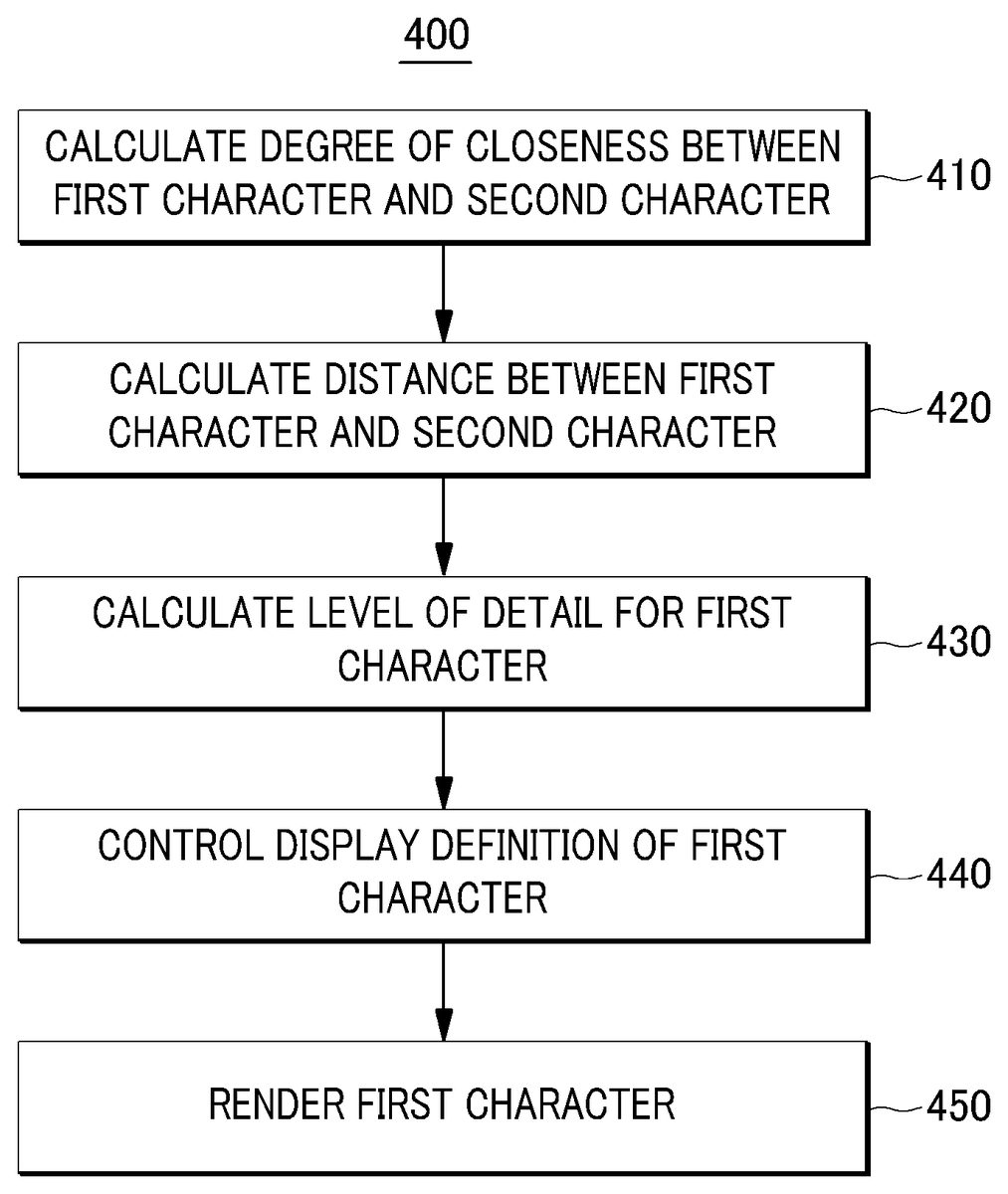
FIG. 4schematically shows an example flow diagram of a process400of a game server110for rendering a game character, arranged in accordance with at least some embodiments described herein. The process inFIG. 4may be implemented in environment10including end device100and game server110, as illustrated inFIG. 1. An example process may include one or more operations, actions, or functions as illustrated by one or more blocks410,420,430,440and/or450. Although illustrated as discrete blocks, various blocks may be divided into additional blocks, combined into fewer blocks, or eliminated, depending on the desired implementation. Processing may begin at block410.
At block410(Calculate Degree of Closeness Between First Character and Second Character), game server110may calculate a degree of closeness between first character120and second character130, based at least in part on a history of mutual activity between first character120and second character130in a virtual game space. In some embodiments, game server110may calculate the degree of closeness between first character120and second character130in real time or at predetermined time intervals.
Non-limiting examples of the history of mutual activity may include at least one of first character120and second character130being included in a same character party for a predetermined amount of time, a frequency of occurrences in which first character120and second character130are included in the same character party, a frequency of occurrences in which first character120and second character130execute a collaborative attack against an opposing character (e.g., a monster character), or a frequency of occurrences in which first character120and second character130interact with each other (e.g., a chat between first character120and second character130). Processing may proceed from block410to block420.
At block420(Calculate Distance Between First Character and Second Character), game server110may calculate a distance between first character120and second character130in the virtual game space. In some embodiments, game server110may calculate the distance between first character120and second character130, based at least in part on a current position of first character120and a current position of second character130. Processing may proceed from block420to block430.
At block430(Calculate Level of Detail for First Character), game server110may calculate a level of detail for first character120positioned in the same virtual game space as second character130, based at least in part on at least one of the degree of closeness between first character120and second character130, which is calculated at block410, or the distance between first character120and second character130, which is calculated at block420. In some embodiments, as the calculated degree of closeness between first character120and second character130is the higher, game server110may determine a level of detail for first character120to be the higher. Further, as the calculated distance between first character120and second character130is the shorter, game server110may determine a level of detail for first character120to be the higher. Processing may proceed from block430to block440.
At block440(Control Display Definition of First Character), game server110may control a display definition of first character120based at least in part on the level of detail for first character120, which is calculated at block430. In some embodiments, game server110may control a number of polygons (e.g., vertices) used to render first character120based in part on the calculated level of detail for first character120in order to control the display definition of first character120. Game server110may reduce the number of polygons, relative to a predefined standard number of polygons, as the level of detail for first character120decreases. On the contrary, game server110may increase the number of polygons, relative to the standard number of polygons, as the level of detail for first character120increases.
Further, in some other embodiments, at block440, game server110may control the number of polygons used to render first character120based in part on the distance between first character120and second character130, which is calculated at block420. Game server110may reduce the number of polygons as the distance between first character120and second character130increases. On the contrary, game server110may increase the number of polygons as the distance between first character120and second character130decreases. Processing may proceed from block440to block450.
At block450(Render First Character), game server110may render first character120with the number of polygons, which is controlled at block440, to be displayed on end device100. In some embodiments, game server110may encode an image of first character120into a video stream, and transmit the video stream to end device100. Then, a 2D or 3D image of first character120, which is formed from the controlled number of polygons, may be displayed on end device100.
One skilled in the art will appreciate that, for this and other processes and methods disclosed herein, the functions performed in the processes and methods may be implemented in differing order. Furthermore, the outlined steps and operations are only provided as examples, and some of the steps and operations may be optional, combined into fewer steps and operations, or expanded into additional steps and operations without detracting from the essence of the disclosed embodiments.
FIG. 5illustrates computer program products that may be utilized to provide a game character rendering scheme, arranged in accordance with at least some embodiments described herein. Program product500may include a signal bearing medium510. Signal bearing medium510may include one or more instructions520that, when executed by, for example, a processor, may provide the functionality described above with respect toFIGS. 1-4. By way of example, instructions520may include: one or more instructions for calculating a level of detail (LOD) for a first character positioned in a same virtual game space as a second character, based at least in part on a calculated degree of closeness between the first character and the second character; or one or more instructions for controlling a display definition of the first character based at least in part on the calculated LOD. Thus, for example, referring toFIG. 3, game server110may undertake one or more of the blocks shown inFIG. 4in response to instructions520.
In some implementations, signal bearing medium510may encompass a computer-readable medium530, such as, but not limited to, a hard disk drive, a CD, a DVD, a digital tape, memory, etc. In some implementations, signal bearing medium510may encompass a recordable medium540, such as, but not limited to, memory, read/write (R/W) CDs, R/W DVDs, etc. In some implementations, signal bearing medium510may encompass a communications medium550, such as, but not limited to, a digital and/or an analog communication medium (e.g., a fiber optic cable, a waveguide, a wired communications link, a wireless communication link, etc.). Thus, for example, program product500may be conveyed to one or more modules of game server110by an RF signal bearing medium510, where the signal bearing medium510is conveyed by a wireless communications medium550(e.g., a wireless communications medium conforming with the IEEE 802.11 standard).
FIG. 6is a block diagram illustrating an example computing device that may be utilized to provide a game character rendering scheme, arranged in accordance with at least some embodiments described herein. In these examples, elements of computing device600may be arranged or configured for a device. In a very basic configuration602, computing device600typically includes one or more processors604and a system memory606. A memory bus608may be used for communicating between processor604and system memory606.
Depending on the desired configuration, processor604may be of any type including but not limited to a microprocessor (μP), a microcontroller (μC), a digital signal processor (DSP), or any combination thereof. Processor604may include one more levels of caching, such as a level one cache610and a level two cache612, a processor core614, and registers616. An example processor core614may include an arithmetic logic unit (ALU), a floating point unit (FPU), a digital signal processing core (DSP Core), or any combination thereof. An example memory controller618may also be used with processor604, or in some implementations memory controller618may be an internal part of processor604.
Depending on the desired configuration, system memory606may be of any type including but not limited to volatile memory (such as RAM), nonvolatile memory (such as ROM, flash memory, etc.) or any combination thereof. System memory606may include an operating system620, an application622, and program data624. Application622may include instructions626that may be arranged to perform the functions as described herein including the actions described with respect to game server110architecture as shown inFIG. 3or including the actions described with respect to the flow charts shown inFIG. 4. In some examples, application622may be arranged to operate with program data624on an operating system620such that the schemes for rendering a game character.
Computing device600may have additional features or functionality, and additional interfaces to facilitate communications between basic configuration602and any required devices and interfaces. For example, a bus/interface controller630may be used to facilitate communications between basic configuration602and one or more data storage devices632via a storage interface bus634. Data storage devices632may be removable storage devices636, non-removable storage devices638, or a combination thereof. Examples of removable storage and non-removable storage devices include magnetic disk devices such as flexible disk drives and hard-disk drives (HDD), optical disk drives such as compact disk (CD) drives or digital versatile disk (DVD) drives, solid state drives (SSD), and tape drives to name a few. Example computer storage media may include volatile and nonvolatile, removable and non-removable media implemented in any method or technology for storage of information, such as computer readable instructions, data structures, program modules, or other data.
System memory606, removable storage devices636and non-removable storage devices638are examples of computer storage media. Computer storage media includes, but is not limited to, RAM, ROM, EEPROM, flash memory or other memory technology, CD-ROM, digital versatile disks (DVD) or other optical storage, magnetic cassettes, magnetic tape, magnetic disk storage or other magnetic storage devices, or any other medium which may be used to store the desired information and which may be accessed by computing device600. Any such computer storage media may be part of computing device600.
Computing device600may also include an interface bus640for facilitating communication from various interface devices (e.g., output devices642, peripheral interfaces644, and communication devices646) to basic configuration602via bus/interface controller630. Example output devices642include a graphics processing unit648and an audio processing unit650, which may be configured to communicate to various external devices such as a display or speakers via one or more A/V ports652. Example peripheral interfaces644include a serial interface controller654or a parallel interface controller656, which may be configured to communicate with external devices such as input devices (e.g., keyboard, mouse, pen, voice input device, touch input device, etc.) or other peripheral devices (e.g., printer, scanner, etc.) via one or more I/O ports658. An example communication device646includes a network controller660, which may be arranged to facilitate communications with one or more other computing devices662over a network communication link via one or more communication ports664.
The network communication link may be one example of a communication media. Communication media may typically be embodied by computer readable instructions, data structures, program modules, or other data in a modulated data signal, such as a carrier wave or other transport mechanism, and may include any information delivery media. A “modulated data signal” may be a signal that has one or more of its characteristics set or changed in such a manner as to encode information in the signal. By way of example, and not limitation, communication media may include wired media such as a wired network or direct-wired connection, and wireless media such as acoustic, radio frequency (RF), microwave, infrared (IR) and other wireless media. The term computer readable media as used herein may include both storage media and communication media.
Computing device600may be implemented as a portion of a small-form factor portable (or mobile) electronic device such as a cell phone, a personal data assistant (PDA), a personal media player device, a wireless web-watch device, a personal headset device, an application specific device, or a hybrid device that include any of the above functions. Computing device600may also be implemented as a personal computer including both laptop computer and non-laptop computer configurations.
The present disclosure is not to be limited in terms of the particular embodiments described in this application, which are intended as illustrations of various aspects. Many modifications and variations can be made without departing from its spirit and scope, as will be apparent to those skilled in the art. Functionally equivalent methods and apparatuses within the scope of the disclosure, in addition to those enumerated herein, will be apparent to those skilled in the art from the foregoing descriptions. Such modifications and variations are intended to fall within the scope of the appended claims. The present disclosure is to be limited only by the terms of the appended claims, along with the full scope of equivalents to which such claims are entitled. It is to be understood that this disclosure is not limited to particular methods, reagents, compounds, compositions or biological systems, which can, of course, vary. It is also to be understood that the terminology used herein is for the purpose of describing particular embodiments only, and is not intended to be limiting.
With respect to the use of substantially any plural and/or singular terms herein, those having skill in the art can translate from the plural to the singular and/or from the singular to the plural as is appropriate to the context and/or application. The various singular/plural permutations may be expressly set forth herein for sake of clarity.
It will be understood by those within the art that, in general, terms used herein, and especially in the appended claims (e.g., bodies of the appended claims) are generally intended as “open” terms (e.g., the term “including” should be interpreted as “including but not limited to,” the term “having” should be interpreted as “having at least,” the term “includes” should be interpreted as “includes but is not limited to,” etc.). It will be further understood by those within the art that if a specific number of an introduced claim recitation is intended, such an intent will be explicitly recited in the claim, and in the absence of such recitation no such intent is present. For example, as an aid to understanding, the following appended claims may contain usage of the introductory phrases “at least one” and “one or more” to introduce claim recitations. However, the use of such phrases should not be construed to imply that the introduction of a claim recitation by the indefinite articles “a” or “an” limits any particular claim containing such introduced claim recitation to embodiments containing only one such recitation, even when the same claim includes the introductory phrases “one or more” or “at least one” and indefinite articles such as “a” or “an” (e.g., “a” and/or “an” should be interpreted to mean “at least one” or “one or more”); the same holds true for the use of definite articles used to introduce claim recitations. In addition, even if a specific number of an introduced claim recitation is explicitly recited, those skilled in the art will recognize that such recitation should be interpreted to mean at least the recited number (e.g., the bare recitation of “two recitations,” without other modifiers, means at least two recitations, or two or more recitations). Furthermore, in those instances where a convention analogous to “at least one of A, B, and C, etc.” is used, in general such a construction is intended in the sense one having skill in the art would understand the convention (e.g., “a system having at least one of A, B, and C” would include but not be limited to systems that have A alone, B alone, C alone, A and B together, A and C together, B and C together, and/or A, B, and C together, etc.). In those instances where a convention analogous to “at least one of A, B, or C, etc.” is used, in general such a construction is intended in the sense one having skill in the art would understand the convention (e.g., “a system having at least one of A, B, or C” would include but not be limited to systems that have A alone, B alone, C alone, A and B together, A and C together, B and C together, and/or A, B, and C together, etc.). It will be further understood by those within the art that virtually any disjunctive word and/or phrase presenting two or more alternative terms, whether in the description, claims, or drawings, should be understood to contemplate the possibilities of including one of the terms, either of the terms, or both terms. For example, the phrase “A or B” will be understood to include the possibilities of “A” or “B” or “A and B.”
In addition, where features or aspects of the disclosure are described in terms of Markush groups, those skilled in the art will recognize that the disclosure is also thereby described in terms of any individual member or subgroup of members of the Markush group.
As will be understood by one skilled in the art, for any and all purposes, such as in terms of providing a written description, all ranges disclosed herein also encompass any and all possible subranges and combinations of subranges thereof. Any listed range can be easily recognized as sufficiently describing and enabling the same range being broken down into at least equal halves, thirds, quarters, fifths, tenths, etc. As a non-limiting example, each range discussed herein can be readily broken down into a lower third, middle third and upper third, etc. As will also be understood by one skilled in the art all language such as “up to,” “at least,” and the like include the number recited and refer to ranges which can be subsequently broken down into subranges as discussed above. Finally, as will be understood by one skilled in the art, a range includes each individual member. Thus, for example, a group having 1-3 cells refers to groups having 1, 2, or 3 cells. Similarly, a group having 1-5 cells refers to groups having 1, 2, 3, 4, or 5 cells, and so forth.
From the foregoing, it will be appreciated that various embodiments of the present disclosure have been described herein for purposes of illustration, and that various modifications may be made without departing from the scope and spirit of the present disclosure. Accordingly, the various embodiments disclosed herein are not intended to be limiting, with the true scope and spirit being indicated by the following claims.
Claims
- A method performed under control of a game server, the method comprising: calculating a degree of closeness between a first character and a second character positioned in a same space of a virtual game, wherein the calculating the degree of closeness is based at least in part on one of: a frequency of occurrences in which the first character and the second character are included in a same character party or a frequency of occurrences in which the first character and the second character execute a collaborative attack against an opposing character, wherein each of the frequency of occurrences in which the first character and the second character are included in the same character party and the frequency of occurrences in which the first character and the second character execute the collaborative attack against the opposing character is assigned a different weight coefficient, wherein the calculating the degree of closeness is based on the assigned weight coefficient, and wherein the closeness corresponds to a relationship or communication between the first character and second character;calculating a level of detail (LOD) for the first character, wherein the calculation of the LOD is based at least in part on the calculated degree of closeness;controlling a display definition of the first character, wherein the controlling the display definition is based at least in part on the calculated LOD, and wherein the controlling the display definition includes controlling a number of polygons used to render the first character;and rendering the first character with the controlled number of polygons, to enable the first character to be displayed with different display definition, based on attention of a user, with respect to other characters positioned in the same space of the virtual game.
- The method of claim 1 , wherein the calculating the LOD is further based in part on a distance between the first character and the second character.
- The method of claim 2 , wherein the controlling the number of polygons includes: reducing the number of polygons, relative to a standard number of polygons, as the calculated LOD decreases;and increasing the number of polygons, relative to the standard number of polygons, as the calculated LOD increases.
- The method of claim 2 , wherein the controlling the number of polygons includes: reducing the number of polygons as the distance between the first character and the second character increases;and increasing the number of polygons as the distance between the first character and the second character decreases.
- The method of claim 1 , wherein the calculating the degree of closeness is executed in real time or at particular time intervals.
- The method of claim 1 , wherein the calculating the degree of closeness is further based on the first character and the second character being included in the same character party for a particular amount of time or a frequency of occurrences in which the first character and the second character interact with each other.
- The method of claim 2 , further comprising: calculating the distance between the first character and the second character based at least in part on a current position of the first character and a current position of the second character in the same space of the virtual game.
- A game server, comprising: a calculation unit configured to: calculate a degree of closeness between a first character and a second character positioned in a same space of a virtual game, wherein the calculation of the degree of closeness is based at least in part on one of: a frequency of occurrences in which the first character and the second character are included in a same character party or a frequency of occurrences in which the first character and the second character execute a collaborative attack against an opposing character, wherein each of the frequency of occurrences in which the first character and the second character are included in the same character party and the frequency of occurrences in which the first character and the second character execute the collaborative attack against the opposing character is assigned a different weight coefficient, wherein the calculating the degree of closeness is based on the assigned weight coefficient, and wherein the closeness corresponds to a relationship or communication between the first character and second character;and calculate a level of detail (LOD) for the first character, wherein the calculation of the LOD is based at least in part on the calculated degree of closeness;a display definition control unit configured to control, based at least in part on the calculated LOD, a display definition of the first character by control of a number of polygons used to render the first character;and a graphic processing unit (GPU) configured to render the first character with the controlled number of polygons, to enable the first character to be displayed with different display definition, based on attention of a user, with respect to other characters positioned in the same space of the virtual game.
- The game server of claim 8 , wherein the calculation unit is configured to calculate the level of detail (LOD) further based in part on a distance between the first character and the second character.
- The game server of claim 9 , wherein the display definition control unit is further configured to: reduce the number of polygons, relative to a standard number of polygons, as the calculated LOD decreases;and increase the number of polygons, relative to the standard number of polygons, as the calculated LOD increases.
- The game server of claim 9 , wherein the display definition control unit is further configured to: reduce the number of polygons as the distance between the first character and the second character increases;and increase the number of polygons as the distance between the first character and the second character decreases.
- The game server of claim 8 , wherein the calculation unit is configured to calculate the degree of closeness in real time or at particular time intervals.
- The game server of claim 8 , wherein the calculation of the degree of closeness is further based on the first character and the second character being included in the same character party for a particular amount of time or a frequency of occurrences in which the first character and the second character interact with each other.
- A non-transitory computer-readable storage medium having stored thereon computer-executable instructions that, in response to execution, cause a game server to perform operations that comprise: calculate a degree of closeness between a first character and a second character positioned in a same space of a virtual game, wherein the calculation of the degree of closeness is based at least in part on one of: a frequency of occurrences in which the first character and the second character are included in a same character party or a frequency of occurrences in which the first character and the second character execute a collaborative attack against an opposing character, wherein each of the frequency of occurrences in which the first character and the second character are included in the same character party and the frequency of occurrences in which the first character and the second character execute the collaborative attack against the opposing character is assigned a different weight coefficient, wherein the calculating the degree of closeness is based on the assigned weight coefficient, and wherein the closeness corresponds to a relationship or communication between the first character and second character;calculate a level of detail (LOD) for the first character, wherein the calculation of the LOD is based at least in part on the calculated degree of closeness;control a display definition of the first character, wherein the control of the display definition is based at least in part on the calculated LOD, and wherein the control of the display definition includes control of a number of polygons used to render the first character;and render the first character with the controlled number of polygons, to enable the first character to be displayed with different display definition, based on attention of a user, with respect to other characters positioned in the same space of the virtual game.
- The non-transitory computer-readable storage medium of claim 14 , wherein the calculation of the LOD is further based in part on a distance between the first character and the second character.
Disclaimer: Data collected from the USPTO and may be malformed, incomplete, and/or otherwise inaccurate.