U.S. Pat. No. 10,022,632
Online Computer Game Systems and Methods for Facilitating Financial Investment
AssigneeIndividual
Issue DateMarch 16, 2016
Illustrative Figure
Abstract
A computer game system in which real-world financial investment by the player of the computer game is incentivized, and such real-world financial investment is realized as a secondary benefit of game play.
Description
DETAILED DESCRIPTION OF THE DRAWINGS The following detailed description is to be read in conjunction with the identified drawing figures that are included as a part of this patent application. FIG. 1is an illustration of a computer game system101that may be used to implement embodiments disclosed hereby. A computer game system101may be played by a gamer110and the computer game system101comprises a client system120that features an audiovisual display121connected to a client system processor122that is capable of receiving gamer input150and providing gamer output150to the gamer110and is capable of transmitting to a game server140game play input160and receiving from the game server140game play output170, wherein the game play input160and game play output170may be transmitted over a network130connecting the client system120and the game server140. The client system will also include a client input device123that facilitates gamer input150into the client system. The client system will include an audiovisual display121that displays a graphical user interface180generated by the computer game system101that is experienced by the gamer110as a virtual world in which the garner controls an avatar111that exists and may move and take action within the virtual world of the online computer game and is visualized in the graphical user interface180displayed by the audiovisual display121in that gamer input150is received and processed by the client system processor122and/or the game server140and such processing by the client system processor122, the game server140, or both, results in movement or other action of the avatar111within the virtual world displayed in the graphical user interface180. FIG. 2illustrates an additional example of a computer game system102that may be used to implement embodiments disclosed hereby. The computer game system102may be played by a garner110using a client system120, wherein the client system120is part of the game system102, and the client system120is comprised of one or more devices such as a smart phone105, a desktop computer129, a tablet computer104, ...
DETAILED DESCRIPTION OF THE DRAWINGS
The following detailed description is to be read in conjunction with the identified drawing figures that are included as a part of this patent application.
FIG. 1is an illustration of a computer game system101that may be used to implement embodiments disclosed hereby. A computer game system101may be played by a gamer110and the computer game system101comprises a client system120that features an audiovisual display121connected to a client system processor122that is capable of receiving gamer input150and providing gamer output150to the gamer110and is capable of transmitting to a game server140game play input160and receiving from the game server140game play output170, wherein the game play input160and game play output170may be transmitted over a network130connecting the client system120and the game server140. The client system will also include a client input device123that facilitates gamer input150into the client system. The client system will include an audiovisual display121that displays a graphical user interface180generated by the computer game system101that is experienced by the gamer110as a virtual world in which the garner controls an avatar111that exists and may move and take action within the virtual world of the online computer game and is visualized in the graphical user interface180displayed by the audiovisual display121in that gamer input150is received and processed by the client system processor122and/or the game server140and such processing by the client system processor122, the game server140, or both, results in movement or other action of the avatar111within the virtual world displayed in the graphical user interface180.
FIG. 2illustrates an additional example of a computer game system102that may be used to implement embodiments disclosed hereby. The computer game system102may be played by a garner110using a client system120, wherein the client system120is part of the game system102, and the client system120is comprised of one or more devices such as a smart phone105, a desktop computer129, a tablet computer104, a laptop computer103, a virtual reality head mounted display unit128, a game console122attached to a T.V. or monitor that serves as a display121or other suitable client system with equivalent functions. The client system120may also comprise one or more client input devices, such as a game controller123, a joystick124, a computer mouse125, a keyboard126, a touch screen127, or similar client input device. The client system120may be directly connected to a game server140or may even be located on the same device in certain instances, but is more typically connected to the game server140via a computer network130such as a portion of the Internet, a wide area network (WAN), a local area network (LAN), a wireless LAN (WLAN), a metropolitan area network (MAN), a campus area network (CAN), a virtual private network (VPN), a cellular telephone network, a portion of the Public Switched Telephone Network (PSTN), an ad hoc network, an intranet, an extranet, another type of network, or a combination of two or more such networks. During normal game play using the computer game system102, a gamer110may interact with the computer game through input/output150to/from the client system120. Some processing of the input150received from the gamer110by the client system120may be processed by software and/or hardware located in the client system120. The client system120is capable of its own input/output160to/from the computer network130. In turn, the game server140is capable of input/output170to/from the computer network130. The game server140is composed of hardware and software that processes input170received from the computer network130and producing output170to the computer network130following processing within the game server140. The output170from the game server140to the computer network130is then transmitted as output160back to the client system120where it is either immediately rendered as output150to the gamer110, or more commonly is processed to some degree by software or hardware located on the client system120with resulting output150to the gamer110.
FIG. 3Ais a flow diagram that illustrates an embodiment302in which a payment of real-world funds is made311, part of which payment of real-world funds311is a subscription payment312that is transferred to a software company320, and part of which is an optional investment payment314that is transferred into a linked investment account330and is subsequently used by computer software and/or hardware335to purchase financial securities such as stocks340, bonds350, CDs360, or other similar financial products370such as stock funds, bond funds, index funds, savings bonds, etc. to be held in the linked investment account330. A determination function of the game system software or game logic380is told what amount of the real-world funds payment311was paid as optional investment payment314and processes this data to determine the tier applicable to such amount of optional investment payment314such that a first amount of optional investment payment314will result in a first tier status381entitling the game account holder or gamer to first tier rewards382, a second amount of optional investment payment314will result in second tier status383entitling the game account holder or gamer to second tier rewards384, and a third amount of optional investment payment314will result in third tier status385entitling the game account holder or gamer to third tier rewards386.
FIG. 3Bis a flow diagram that illustrates an embodiment301in which a subscription payment310is required for game play and the subscription payment310is divided as a function of computer software and/or hardware315, into an amount of financial consideration that is received by the software company320and an amount of financial consideration that is transferred into a linked investment account330. The amount of financial consideration that is transferred into the linked investment account330is subsequently used by computer software and/or hardware335to purchase financial securities such as stocks340, bonds350, CDs360, or other similar products370such as stock funds, bond funds, index funds, savings bonds, etc. It should be appreciated that the required subscription payment310is comprised of whatever amount of payment is required by the software company for game play320and an additional amount of real-world funds to be paid into the linked investment account330, such that the software company is not disadvantaged. In other words, the amount that the software company would normally charge for basic access to, and play of, the online computer game320is not diminished by virtue of the fact that the payment by the account holder or gamer310may be called a “subscription payment” since the portion of that payment310to be received by the software company320is wholly within the control of the software company and is a function of market factors and business decisions.
FIG. 4is a flow diagram that illustrates an embodiment401in which a subscription payment410is required for game play and the subscription payment410is divided as a first function of game system software415into an amount of financial consideration that is received by the software company420and an amount of real-world funds that are temporarily held in a segregated game account430. The segregated game account430may be a computerized database, electronic account, or module of the game software that temporarily holds the amount of real-world funds that have been transferred into the segregated game account430. The amount of real-world funds held within the segregated game account430is then allocated by a second function of the game system software435among multiple in-game value units440which are virtual objects that are created by the game software or game logic and exist within the virtual world of the computer game and may be displayed to the gamer (not pictured) in the graphical user interface (also not pictured). The allocation accomplished by said second function of the game system software435causes the allocated portions of the real-world funds held in the segregated game account430to be linked to in-game value units440. These in-game value units440may appear in the graphical user interface of the computer game that is displayed to the gamer by a client system in the form of virtual objects that are available for collection or acquisition by the avatar, such as, for example, virtual gold coins, silver coins, gold treasures, treasure boxes, gemstones, diamonds, rubies, emeralds, and other such precious stones, amulets, flowers, items of food or drink, dollar bills, other types of currency, or other similar virtual objects that are displayed to a gamer by a client system as part of game play and that signify in-game value that may be collected or acquired by the gamer's avatar while playing the online computer game. When the gamer's avatar has an encounter445with such an in-game value unit440within the virtual world of the computer game, there is an opportunity for the avatar to collect or acquire the in-game value unit440. A third function of the game software or game logic450determines if the avatar successfully collects or acquires the in-game value unit440in the virtual world of the computer game. If the gamer's avatar does not collect or acquire465the in-game value unit440within the virtual world of the computer game, the said third function450determines that no collection has occurred470and the portion of the real-world funds that had been allocated and linked to the now uncollected in-game value unit440are returned475to the segregated game account430and become available to be reallocated and linked to other in-game value units440by virtue of the said second function435of the game software such that the other in-game value units440may subsequently be encountered445by the gamer's avatar within the virtual world of the game. If, on the other hand, the in-game value unit440is collected or acquired455by the gamer's avatar within the virtual world of the computer game, then the said third function450determines that the collection of the in-game value unit by the avatar has occurred460and the portion of the total amount of real-world funds in the segregated account430that was previously allocated and linked to the now collected in-game value unit440is electronically transferred485into a linked investment account480where it is used to make purchases495of financial securities490. As discussed concerningFIG. 3Babove, although the initial payment shown inFIG. 4is characterized as a “subscription payment”410, it should be appreciated that the amount to be received by the software company as its real-world consideration420is determined by the software company. Moreover, as previously discussed with regard toFIG. 3A, it is possible to restructure this embodiment of the invention shown inFIG. 4such that the total amount of real-world funds transferred into the segregated game account430is wholly optional such that it would be the decision of the game play account holder and/or the player how much, if any, real-world funds would be paid into the segregated game account430beyond the amount required to be paid to the software company as its real-world financial consideration420.
FIG. 5is a flow diagram illustrating an embodiment in which a subscription payment510is required for game play and the subscription payment510is divided by a first function of game system software515into an amount of financial consideration that is transferred to the software company520and an amount of real-world funds that are transferred into a segregated game account530. The segregated game account530may be a computerized database, electronic account, or other module in the game software that temporarily holds the amount of real-world funds that are transferred into the segregated game account530. The amount of real-world funds held within the segregated game account530is then allocated and linked by means of a second function of the game system software535among multiple in-game value units540which are virtual objects that are created by the game software or game logic and exist within the virtual world of the computer game and may be displayed as part of the graphical user interface (not pictured) seen by the gamer (not pictured). In this manner, the said second function535apportions the real-world funds held in the segregated game account530among multiple in-game value units540and links each such portion of the real-world funds held in the segregated game account530to a discrete in-game value unit540that may later be collected or acquired by the gamer's avatar as game play progresses. The in-game value units540that are each linked to portions of the real-world funds held in the segregated game account530and which are subject to collection or acquisition by the gamer's avatar during game play will appear as virtual objects in the graphical user interface of the computer game that is displayed to the gamer by a client system, and such virtual objects may take various forms signifying value in the game, such as, for example, virtual gold coins, silver coins, gold treasures, treasure boxes, gemstones, diamonds, rubies, emeralds, and other such precious stones, amulets, flowers, items of food or drink, dollar bills, other types of currency, or other similar virtual objects that are displayed to a gamer by a client system as part of game play and signify in-game value that may be collected or acquired by a gamer's avatar while playing the computer game. When the gamer's avatar has an encounter545with such an in-game value unit540within the virtual world of the computer game, there is an opportunity for collection of the in-game value unit540by the gamer's avatar. A third function of the game software550determines whether or not during such encounter545the gamer's avatar has taken the appropriate action in the virtual world of the game to collect555the in-game value item540that has been encountered545, and the determination that the avatar has taken action to collect555and has successfully collected560the in-game value item540causes the portion of real-world funds in the segregated game account530previously linked to the now collected in-game value unit540to be electronically transferred585into a linked investment account580where it will be used to purchase595financial securities590. If, on the other hand, the gamer's avatar has an encounter545with an in-game value unit540that is linked to a portion of the real-world funds stored in the segregated game account530and fails to take the necessary steps to collect565and therefore does not collect570the in-game value unit540, the said third function550determines that no collection has occurred570within the virtual world of the computer game. At this point, the portion of real-world funds in the segregated game account530previously linked to the now uncollected in-game value unit540may be again made available575within the segregated game account530to be reallocated and linked to other in-game value units540by virtue of said second function535of the game software, or the portion of the real-world funds held in the segregated game account530that was previously linked to the now uncollected in-game value unit540may be electronically transferred573to the software company520. The determination on whether the portion of real-world funds held in the segregated game account530that was previously linked to the now uncollected in-game value unit540will be electronically transferred573to the software company520or reallocated and linked to other in-game value units540by the said second function535is made by a fourth function of the game software571that determines whether or not a predetermined amount of time, or “time limit,” has expired after the most recent subscription payment510was made. If said fourth function571determines that the time limit has expired572, then the amount of real-world funds in the segregated game account530that had been linked to the now uncollected in-game value unit540is electronically transferred573to the software company520as additional consideration, but if said fourth function571determines that such time limit has not expired574, then the amount of real world funds held in the segregated game account530that had previously been linked to the now uncollected in-game value unit540is again made available575to be allocated and linked to one or more other in-game value units540that have not yet been encountered by the player's avatar in the virtual world of the game.
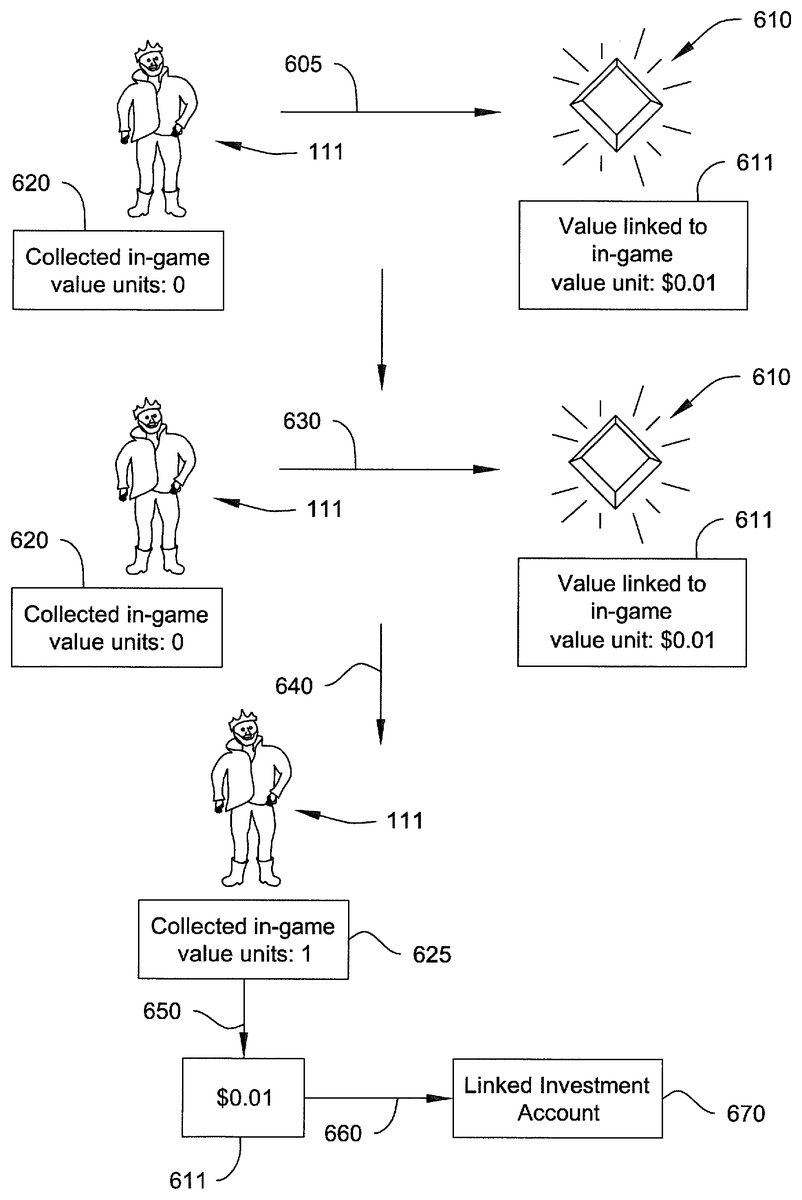
FIG. 6is an illustration of a potential scenario of an embodiment in which a player may use her in-game avatar111to collect an in-game value unit610that is linked to an amount of real-world funds having real-world value611, where the avatar111is a virtual representation of the player in the virtual world of the online computer game, and the in-game value unit610is a virtual object that exists within the virtual world of the computer game. In this embodiment, the game system software keeps track of the real-world value611that is linked to the in-game value unit610such that a collection640of the in-game value unit610by the avatar111in the virtual world of the computer game results in the amount of real-world value611being electronically transferred660into a linked investment account670. In this scenario, as the player's avatar111moves through the virtual world of the computer game, the player's avatar111has an encounter605with an in-game value unit610that is displayed by the game system as a virtual object within the virtual world of the computer game, and is linked as a function of the game software to an amount of real-world value611. If the player's input to the game system causes the player's avatar111to take some action in the virtual world of the game with regard to collecting the in-game value unit610, for example, by directionally moving its location630to the location of the in-game value unit610within the virtual world such that as a function of the game software the avatar111collects640the in-game value unit610and is credited with collection625of the in-game value unit610by the game software, then as a further function of the game software650, the amount of real-world value611that was previously linked to the now collected in-game value unit610is electronically transferred660as a function of game software to the linked investment account670. The essence of this embodiment is that a player can manipulate the avatar111through the player's input into the game system in order to collect the in-game value unit610triggering a transfer of an amount of real-world value611into a linked investment account670, thereby incentivizing the player to continue playing the game and increasing investments in the linked investment account as a secondary benefit of game play.
FIG. 7is an illustration of a scenario of one embodiment in which the player's avatar111that exists in the virtual world of the computer game takes action to collect720an in-game value unit710in the virtual world of the online computer game at a time when there is a first amount of real-world value in a linked investment account730such that when the in-game value unit710is actually collected740, the player's avatar is credited with the collection750and an amount of real-world value is electronically deposited735as a function of the game logic or game software into the linked investment account such that the amount of real-world value held in the linked investment account is increased760and is greater than the first amount of real-world value in the linked investment account730that was present prior to collection740of the in-game value unit710by the avatar111.
FIG. 8Ais an illustration of a scenario of an embodiment in which the gamer's avatar111has an encounter805with an in-game store810that is a virtual store or virtual market existing within the virtual world of the computer game such that the gamer is presented with the opportunity to purchase one or more in-game items820that are virtual objects offered for purchase by the gamer for use by the gamer's avatar111and which may be purchased from the in-game store810. If the gamer makes a purchase825of one or more of the in-game items820, such purchase825will require the gamer's payment of real-world financial consideration in exchange for the gamer's avatar111acquiring one or more of the in-game items820from the in-game store810for subsequent use by the avatar111in the virtual world of the computer game during game play. In this example, the in-game items820that are offered for purchase are shown as a virtual bow and arrows, virtual sword, and virtual battle axe, but these in-game items820that are virtual weapons are shown for illustrative purposes only since the in-game items820that are offered for purchase in the in-game store810may be any type or kind of virtual object for which the gamer would be required to pay real-world financial consideration in exchange for the gainer's avatar111acquiring and being able to use the one or more virtual objects within the virtual world of the computer game. In this example scenario, the gamer may take the step of purchasing825one or more of the in-game items820that are offered for purchase, for example, the garner may pay $10.00 of real-world financial consideration to purchase the virtual bow and arrows830, the gamer may pay $5.00 of real-world financial consideration to purchase the virtual sword840, or the gamer may pay $3.50 of real-world financial consideration to purchase the virtual battle axe850. Once a purchase825has occurred involving the payment of real-world consideration by the gamer, all or a portion of the real-world consideration that has been paid by the gamer is electronically transferred into a linked investment account860, such that, for example only, in the event of a purchase of the virtual bow and arrows in exchange for the gamer's payment of $10.00 in real-world financial consideration830, the $10.00 that has been paid is electronically deposited into a linked investment account835, in the event of a purchase of the virtual sword840, the $5.00 of real-world financial consideration that was paid is electronically deposited into a linked investment account845, and in the event of a purchase of the virtual battle axe850, the $3.50 of real-world financial consideration that was paid is electronically deposited into a linked investment account855. The amounts of the payments required for purchase of the one or more in-game items820made available for purchase at the in-game store810are solely for illustrative purposes only, and the amounts required for such purchases may be any suitable amounts as selected by the software company, account holder, gamer, or some combination of these persons or entities. Upon purchase and payment of the required amount of real-world financial consideration825and after electronic deposit of real-world financial consideration into the linked investment account860, the amount of real-world financial consideration in the linked deposit account may be used in real-time, or at a time subsequent to the electronic deposit into the linked investment account860, to make a purchase of a real-world financial product865that is to be held in a linked investment account, such as purchase of a certificate of deposit870, purchase of a share of stock880, or purchase of a bond890. It should also be appreciated that it is not necessary that the entire amount of real-world financial consideration that is paid by the gamer for purchase of an in-game item825be deposited into a linked investment account865. In some embodiments, such as discussed herein regardingFIG. 8B, part of the payment of real world financial consideration that is required for purchase of one or more in-game items825may be transferred to the software company (step not shown) as consideration for its work developing and marketing the computer game, with the remainder of the payment of the payment of real-world financial consideration being deposited into the linked investment account as shown860for subsequent purchase of one or more financial products865. Thus,FIG. 8Ais meant to illustrate a scenario of an embodiment, but the specific types of in-game items offered for purchase, the specific amounts of real-world financial consideration required to be paid for purchase of the in-game items, the specific amounts transferred into a linked investment account upon the purchase and payment for the in-game items, and the types of financial products purchased using the financial consideration that is transferred into the linked investment account are all optional and may vary depending upon programming choices made by the software company, choices made by a partnering investment or brokerage house, market fluctuations, the game account holder, or the gamer herself. Further, in certain instances the amount of real-world financial consideration that is electronically deposited into the linked investment account as a result of the purchase of an in-game item may be allowed to accumulate with other deposits prior to being used to purchase real-world financial products, depending on the requisite purchase price of the real-world financial products.
FIG. 8Bis an illustration of an alternate scenario of an embodiment in which the gamer's avatar111has an encounter807with an in-game store810within the virtual world of the computer game and the gamer has the opportunity to purchase one or more in-game items820that are offered for purchase for use by the gamer's avatar111in the virtual world of the game, wherein such potential purchase will require the gamer's payment of real-world financial consideration in exchange for the gamer's avatar111acquiring and being able to use the one or more in-game items820during game play within the virtual world of the computer game. In this example, the in-game items820that are offered for purchase are shown as a virtual magic potion offered for $25.00, virtual invisibility cloak offered for $20.00, and virtual food and drink offered for $15.00, but the type of in-game items820shown in this illustration are for illustrative purposes and the in-game items820offered for purchase may be any type or kind of virtual object for which the gamer would be required to pay real-world financial consideration in exchange for the avatar111acquiring and being able to use the in-game item820within the virtual world of the computer game. In this example scenario, the gamer may take the step of purchasing825the one or more in-game items820that are offered for purchase in the in-game store810, for example, the gamer may purchase the virtual magic potion by paying the required $25.00 of real-world consideration832, the gamer may purchase the virtual invisibility cloak by paying the $20.00 of real-world consideration842, or the gamer may purchase the virtual food and drink by paying the $15.00 of real-world consideration852. In this scenario, as distinguished from the scenario illustrated inFIG. 8A, the gamer's required payment of real-world financial consideration during the purchase825then goes through a bifurcation step in which a portion of the payment of real-world financial consideration is transferred to the software company as its consideration for developing and marketing the computer game, while the remainder of the payment real-world financial consideration is deposited into a linked investment account. For instance, if the gamer purchases the virtual magic potion and pays a total of $25.00 for the purchase832, $10.00 of the payment made by the garner will be transferred to the software company836, and the remaining $15.00 will be electronically deposited into a linked investment account837, where it may be subsequently used to make a purchase of a financial product865, for example, shares of a mutual fund872. In this example, if the gamer purchases the virtual invisibility cloak and pays a total of $20.00 for the purchase842, $10.00 of the payment will be transferred to the software company846and the remaining $10.00 will be transferred to a linked investment account848, where it may be used to purchase a financial product865, for example, shares of a bond fund882. In this example, if the gamer purchases the virtual food and drink and pays a total of $15.00 for the purchase852, $5.00 of the payment will go to the software company856, and the remaining $10.00 will be electronically deposited into a linked investment account858, where it may be used to purchase a financial product865, for example, shares of an index fund892.FIG. 8Bis meant to illustrate a scenario of an embodiment, but the specific types of in-game items, the specific purchase amounts required to be paid for purchase of the in-game items, the specific amounts transferred to the software company versus the amounts transferred into the linked investment accounts upon purchase of the in-game items, and the types of financial products purchased using the financial consideration that is transferred into the linked investment account are all optional and may vary depending upon programming choices made by the software company, choices made by partnering investment or brokerage houses, market fluctuations, the game account holder, the gamer herself, or a combination of these persons and entities.
FIG. 9Aillustrates an embodiment involving an in-game challenge in which the gamer's avatar111has an encounter901with a virtual monster902within the virtual world of the computer game. Although not necessarily shown as part of the audiovisual display of the virtual world provided by the client system used by the gamer to play the computer game, the game software or game logic keeps track of the amount of real-world value in the linked investment account such that there is a first linked investment account total910that exists immediately prior to the in-game challenge, in this instance, an encounter901between the avatar111and the virtual monster902. Furthermore, prior to the encounter901between avatar111and virtual monster902, an amount of real-world currency is linked to potential successful completion of the in-game challenge903, in this example, defeating the virtual monster902in virtual combat. The linking of an amount of real-world currency to successful completion of the in-game challenge903is a function of the game software or game logic. Assuming that a combat between the avatar111and the virtual monster902occurs (not illustrated) and leads to a change in game state920wherein the avatar111is victorious and the virtual monster902has been defeated940, the amount of real-world currency that is linked to potential successful completion of the in-game challenge903, in this example, the defeat of the virtual monster940, is electronically transferred904into a linked investment account915as a function of the game software or game logic. AlthoughFIG. 9shows an illustration of an embodiment in which potential successful completion of an in-game challenge, for example defeating a virtual monster through combat, is linked to an amount of real-world currency that will be transferred into a linked investment account upon the defeat of the virtual monster by the gamer's in-game avatar, an in-game challenge need not involve combat or the potential defeat of an in-game monster or opponent. The in-game challenge can take on many different forms, including moving the avatar through the virtual world to search for and find hidden or disguised in-game items, solving puzzles, completing in-game quests or missions, and many other types of in-game challenges. As with the other embodiments, once the real-world currency is in the linked investment account, it may be used to purchase financial products.
FIG. 9Billustrates an alternate embodiment involving an in-game challenge in which the gamer's avatar111has an encounter950with a locked gate955preventing entrance into a virtual cave960within which is located a bag of loot965that is linked to $10.00 in real-world currency. The avatar111, the cave960, the locked gate955and the bag of loot965are all virtual and all exist within the virtual world of the computer game. The amount of real-world currency that is linked to the bag of loot965may or may not be displayed on by the audiovisual display of the client system with regard to the bag of loot965, but the amount of real-world currency is linked to the bag of loot965as a function of the game software or game logic. In this embodiment, the in-game challenge is in the form of a question970that must be successfully answered in order to unlock the locked gate955and obtain the bag of loot965. The gamer is required to provide an answer to the question, and if the gamer provides the correct answer to the question980, the locked gate955will be opened985such that the gamer's avatar111may move into990the cave960and collect the bag of loot965. Either contemporaneously with the correct answer being provided by the garner980, or upon the avatar111entering the cave960and collecting the bag of loot965, the amount of real-world currency linked to the bag of loot965is transferred981to the linked investment account995. Thus, prior to the encounter950between avatar111and the in-game challenge, in this example a locked gate955at the entrance of the cave960requiring an answer to a question970, an amount of real-world currency is linked to potential successful completion of the in-game challenge, in this instance, unlocking the locked gate960by providing a correct answer980to the question970in order for the avatar111to obtain access to the bag of loot965. The linking of an amount of real-world currency to successful completion of the in-game challenge is a function of the game software or game logic. In the event of successful completion of the in-game challenge, in this example, providing the correct answer and unlocking the gate, the linked amount of real-world currency is electronically transferred into a linked investment account as a function of the game software or game logic. AlthoughFIG. 9Ashows an illustration of one scenario of an embodiment in which potential successful completion of an in-game challenge, namely correctly answering a question posed to the player by the computer game, is linked to an amount of real-world currency that will be transferred into a linked investment account upon the successful completion of the in-game challenge, an in-game challenge need not involve successfully answering questions or riddles as shown inFIG. 9B. The in-game challenge can take on many different forms, including moving the avatar through the virtual world to search for and find hidden or disguised in-game items, solving puzzles, completing in-game quests or missions, successfully defeating virtual monsters or virtual challengers, winning in virtual combat with avatars controlled by other players, and many other types of in-game challenges.
FIG. 10illustrates an embodiment involving an in-game challenge in which the gamer's avatar111becomes engaged in virtual combat1010with a second gamer's avatar112within the the virtual world of the computer game. Although not necessarily shown as part of the audiovisual display of the virtual world provided by the client system to the gamer that is used to play the computer game, game software or game logic records and keeps track of the amount of real-world value in each of the garners' linked investment accounts such that there is a first linked investment account with a first amount of real-world value associated with the gamer1012and a second linked investment account with a second amount of real-world value that is associated with the second gamer1016, each of which linked investment accounts1012,1016contain an initial total amount of real-world value prior to the virtual combat1010. Furthermore, prior to the initiation of the virtual combat1010, an amount of real-world currency is linked to potential victory in the virtual combat1014, in this instance, the amount of real-world currency linked to potential victory in the virtual combat1014is $25.00. The linking of an amount of real-world currency to potential victory in the virtual combat1014is a function of the game software or game logic. Assuming that a combat between the gamer's avatar111and the second gamer's avatar112occurs (not illustrated) and leads to a change in game state1020wherein the second gamer's avatar112is victorious and the gamer's avatar111has been defeated, the amount of real-world currency that is linked to potential victory in the combat1014, in this instance $25.00, is electronically transferred into the second linked investment account that will now contain a new total amount of real-world value1026, and this transfer will occur as a function of the game software or game logic, while no amount of real-world currency is transferred into the first linked investment account such that the new total of the real-world value contained within the first linked investment account1022remains the same as the previous total1012because the gamer's avatar was defeated in the virtual combat1010within the virtual world of the game. AlthoughFIG. 10shows an illustration of an embodiment in which successful completion of an in-game challenge, namely defeating another gamer's avatar, is linked to an amount of real-world currency that is transferred into the linked investment account of the successful combatant upon victory in virtual combat, an in-game challenge need not involve combat or the potential defeat of an opponent. The in-game challenge can take on many different forms, including moving the avatar through the virtual world to search for and find hidden or disguised in-game items, solving puzzles or riddles, defeating virtual opponents or monsters generated and controlled by the computer game, completing in-game quests or missions, and many other types of in-game challenges.
It should be understood that the above-described embodiments of the invention are not intended to limit the scope of the invention, but merely to illustrate specific embodiments of the invention as envisioned by the inventors at the time of filing of their application for patent.
Claims
- A computer game system allowing for a player to play an interactive online computer game that also facilitates financial investment as a secondary benefit of game play comprised of: One or more game servers in communication with one or more client systems over a network that cooperate to accomplish the functions of the interactive online computer game that are involved in a player playing the computer game, including the creation and display of a virtual world of the computer game to the player through a user interface of the client system, receiving game play input from the player through the client system during game play, processing the game play input provided by the player and determining appropriate game play output in response to the game play input by means of game play program instructions stored in non-transitory memory of the computer game system, and display of the game play output to the player by means of the user interface;At least one avatar that is displayed by the user interface as existing within the virtual world of the computer game, wherein the avatar may be controlled by game play input of the player provided to the computer game system through a client system, and wherein the avatar may move and act within the virtual world of the computer game as a result of processing of game play input provided by the player through the client system and processing of that game play input by the computer game system;At least one in-game item that is a virtual object generated by the computer game system that is displayed by the user interface as existing within the virtual world of the computer game, wherein the player may provide game play input to the computer game system that results in movement or other action of the avatar within the virtual world of the computer game such that the avatar collects or acquires the in-game item within the virtual world of the computer game;A game account that is an electronic account that must be set-up prior to initiation of online game play of the computer game based on identifying game account information that is provided to the computer game system through a client system and stored in non-transitory memory of the computer game system, wherein such a game account must be used by a player in order to access and play the online interactive computer game;Account payment program instructions that are program instructions stored in non-transitory memory of the computer game system that require the making of at least one payment of real-world financial consideration with regard to a game account in exchange for the ability of a player to use the game account to access and play the interactive online computer game on the computer game system;A linked investment account that is a financial investment account that is capable of receiving electronic transfers of real-world financial consideration and is either directly linked to a game account or linked by means of a network to a game account;Value allocation program instructions that are program instructions stored in non-transitory memory of the computer game system that intercept the said at least one payment of real-world financial consideration that is made with regard to the game account and allocate a portion of the intercepted real-world financial consideration to at least one in-game item such that the at least one in-game item is linked by means of program instructions to the allocated portion of real-world financial consideration;Account transfer program instructions that are program instructions stored in non-transitory memory of the computer game system that initiate an electronic transfer of the portion of real-world financial consideration allocated to the at least one in-game item to a linked investment account upon the collection or acquisition of the at least one in-game item by a player's avatar within the virtual world of the computer game;and wherein the value allocation program instructions intercept the at least one payment of real world financial consideration and allocate a portion of the intercepted real-world financial consideration among a plurality of in-game items such that the total amount of real-world financial consideration allocated among the plurality of in-game items may be incrementally transferred to the linked investment account as the player's avatar collects or acquires the plurality of in-game items during game play.
- The computer game system of claim 1 wherein the in-game items are in-game value items that are icons or virtual representations of real-world items that have real-world financial value.
- The computer game system of claim 1 wherein the in-game items are virtual objects that may be used by a player's avatar within the virtual world of the computer game during game play in order to complete in-game challenges.
- The computer game system of claim 1 wherein the payment of real-world consideration with regard to a game account is in the form of a periodic subscription payment that is required in order to maintain the game account in good standing such that the game account may continue to be used to obtain access and to play the online interactive computer game.
- The computer game systems of claim 4 wherein the periodic subscription payment is in the form of an electronic debit transaction, electronic credit transaction, or electronic transfer of real-world financial consideration from an electronic payment account.
- The computer game system of claim 5 wherein upon the receipt of each periodic subscription payment, additional amounts of real world financial consideration are allocated among in-game items by the value allocation program instructions such that additional incremental transfers of real world financial consideration into the linked investment account are made possible and will be initiated by the account transfer program instructions upon the collection or acquisition of the in-game items by the player's avatar.
- A computer game system allowing for a player to play an interactive online computer game that also facilitates financial investment as a secondary benefit of game play comprised of: One or more game servers in communication with one or more client systems over a network that cooperate to accomplish the functions of the interactive online computer game that are involved in a player playing the computer game, including the creation and display of a virtual world of the computer game to the player through a user interface of the client system, receiving game play input from the player through the client system during game play, processing the game play input provided by the player and determining appropriate game play output in response to the game play input by means of game play program instructions stored in non-transitory memory of the computer game system, and display of the game play output to the player by means of the user interface;At least one avatar that is displayed by the user interface as existing within the virtual world of the computer game, wherein the avatar may be controlled by game play input of the player provided to the computer game system through a client system, and wherein the avatar may move and act within the virtual world of the computer game as a result of processing of game play input provided by the player through the client system and processing of that game play input by the computer game system;At least one in-game challenge that is generated by the computer game system and displayed by the user interface as existing within the virtual world of the computer game, wherein the player may provide game play input to the computer game system that results in movement or other action of the avatar within the virtual world of the computer game such that the avatar completes the in-game challenge within the virtual world of the computer game;A game account that is an electronic account that must be set-up prior to initiation of online game play of the computer game based on identifying game account information that is provided to the computer game system through a client system and stored in non-transitory memory of the computer game system, wherein such a game account must be used by a player in order to access and play the online interactive computer game;Account payment program instructions that are program instructions stored in non-transitory memory of the computer game system that require the making of at least one payment of real-world financial consideration with regard to a game account in exchange for the ability of a player to use the game account to access and play the interactive online computer game on the computer game system;A linked investment account that is a financial investment account that is capable of receiving electronic transfers of real-world financial consideration and is either directly linked to a game account or linked by means of a network to a game account;Value allocation program instructions that are program instructions stored in non-transitory memory of the computer game system that intercept the said at least one payment of real-world financial consideration that is made with regard to the game account and allocate a portion of the intercepted real-world financial consideration to at least one in-game challenge such that the at least one in-game challenge is linked by means of program instructions to the allocated portion of real-world financial consideration;Account transfer program instructions that are program instructions stored in non-transitory memory of the computer game system that initiate an electronic transfer of the portion of real-world financial consideration allocated to the at least one in-game challenge to a linked investment account upon the completion of the at least one in-game challenge by a player's avatar within the virtual world of the computer game;and wherein the value allocation program instructions intercept the at least one payment of real world financial consideration and allocate a portion of the intercepted real-world financial consideration among a plurality of in-game challenges such that the total amount of real-world financial consideration allocated among the plurality of in-game challenges may be incrementally transferred to the linked investment account as the player's avatar completes the plurality of in-game challenges during game play.
- The computer game system of claim 7 wherein at least one of the in-game challenges is presented in the form of virtual combat between the player's avatar and an in-game opponent that is generated and controlled by the game play program instructions such that the virtual combat occurs within the virtual world of the computer game.
- The computer game system of claim 7 wherein at least one of the in-game challenges is presented in the form of virtual combat between the player's avatar and an avatar controlled by a second player such that the virtual combat occurs within the virtual world of the computer game.
- The computer game system of claim 7 wherein at least one of the in-game challenges is presented in the form of a maze, puzzle, or riddle that must be solved by the player through appropriate input into a client system resulting in the solving or completion of the maze, puzzle, or riddle.
- The computer game system of claim 7 wherein at least one of the in-game challenges is presented in the form of a mission, quest, or task that must be completed by the player through appropriate input into a client system resulting in completion of the mission, quest, or task.
- The computer game system of claim 7 wherein at least one of the in-game challenges is presented in the form of the requirement that the player use her avatar to find, collect, or acquire certain in-game items within the virtual world of the computer game.
- The computer game system of claim 7 wherein the payment of real-world consideration with regard to a game account is in the form of a periodic subscription payment that is required in order to maintain the game account in good standing such that the game account may continue to be used to obtain access and to play the online interactive computer game.
- The computer game systems of claim 13 wherein the periodic subscription payment is in the form of an electronic debit transaction, electronic credit transaction, or electronic transfer of real-world financial consideration from an electronic payment account.
- The computer game system of claim 14 wherein upon the receipt of each periodic subscription payment, additional amounts of real world financial consideration are allocated among in-game challenges by the value allocation program instructions such that additional incremental transfers of real world financial consideration into the linked investment account are made possible and will be initiated by the account transfer program instructions upon the completion of the in-game challenges by the player's avatar.
Disclaimer: Data collected from the USPTO and may be malformed, incomplete, and/or otherwise inaccurate.